Billy Graham’s almost agreement with nonresistance

Author’s note: This post originally appeared on the blog of the Brethren in Christ Historical Society and was reposted on the Mennonite World Review World Together blog in 2014. This version is adapted from those two original postings, and presented here in recognition of Billy Graham’s death.

An important but little-known event in American Anabaptist history occurred on August 30, 1961, when Mennonite and Brethren in Christ church leaders sat down around the breakfast table with Billy Graham to tell him about their peace position.

Today, Graham is remembered as an evangelist, a presidential pastor, and an influential icon of American evangelicalism. But for Anabaptists in the mid-twentieth century, Graham was also a potential convert to the doctrine of nonresistance.

Black and white photo of four men sitting around a table with food on it.

In this photo from the Oct. 21, 1961 issue of the Evangelical Visitor, Billy Graham (third from left) meets with representatives of the Mennonite church.

Those familiar with Mennonite history will recognize some of the denominational leaders who participated in the event, including John C. Wenger and Elmer Neufeld. Bishop, Mennonite Central Committee chairman, and Messiah College president C. N. Hostetter Jr., represented the Brethren in Christ. As Hostetter’s biographer E. Morris Sider records:

Hostetter was consistently impressed with Graham. He heard Graham speak frequently at NAE [National Association of Evangelicals] conventions; he invariably labelled Graham’s sermons with such adjectives as “powerful” or “impressive.” [^1]

No doubt others in the group had been similarly impressed by Graham’s style and presence—and no doubt they were aware of his celebrity among most of America’s Christians in the 1960s. Likely it was this combination of professionalism and popularity that led these Anabaptists into dialogue with “America’s preacher.” If they could convince Graham of the gospel message of peace, perhaps he could proclaim that message far beyond the bounds of American Anabaptism.

The Oct. 21, 1961 issue of the Brethren in Christ publication, the Evangelical Visitor, gives further details on the conversation:

The purpose of the meeting was to engage in a personal conversation with Dr. Graham concerning the New Testament ethic of love and nonresistance and also to hear from Dr. Graham a word which might encourage and stimulate our churches to become more evangelistic. . . .

In response to the presentation, Dr. Graham replied that he appreciated deeply the privilege of listening to the testimony of other Christians. . . . He commented briefly on the problems involved in taking the nonresistant position, but noted the uncertainty and confusion among Christians regarding the proper attitude toward participation in war. He stated his personal openness and interested in meeting for more extended discussion on the doctrine of nonresistance. [^2]

This event matters beyond American Anabaptist historiography. The historian Molly Worthen, author of the groundbreaking Apostles of Reason: The Crisis of Authority in American Evangelicalism, highlights the meeting as an example of the fragmentation of evangelicalism in the twentieth century.

In a post at the Christian Century blog, Worthen argues that the popularity of Billy Graham among conservative Protestants in the 1950s and 1960s projected a public image of evangelicalism as unified across denominational lines and cooperative despite varying theological emphases. The reality, Worthen concludes, was much more complex. Numerous groups — Pentecostals, Southern Baptists and Mennonites and Brethren in Christ among them — admired Graham for his popularity and conversionist message, but felt that aligning themselves with the so-called “evangelical coalition” represented by the National Association of Evangelicals might compromise their denominational authority.

Worthen highlights the Graham dialogue as an example of this complex interplay between particular denominations and the larger evangelical ecumenical movement:

After a detailed presentation of Anabaptist beliefs—particularly nonviolence—the Mennonites asked for Graham’s advice. How did evangelical leaders view Mennonites’ pacifism? How might they improve their evangelistic outreach?

Graham was gracious. This wasn’t the first time he had heard of Christian nonviolence; civil rights activists had been living and preaching it for years. Graham told the group that he “could easily be one of us in about 99% of what has been said,” the secretary recorded. He expressed willingness to discuss the doctrine of nonviolence in the future, but warned of the “historical danger of a denomination putting undue emphasis and overweighting ourselves on one particular point.

Afterwards the Mennonites felt hopeful. Graham was “open to be led and to be taught,” and they planned to pursue more contact with evangelical leaders. Yet Graham was wary of appearing too easygoing in his theology. He insisted that no press release quote him directly.

In exchanges with neo-evangelicals, the Mennonites—like all good diplomats—continually revised their approach. They stressed common ground but grew more confident in their distinctive doctrines.

Years later, when a new generation of young evangelicals grew disillusioned with the Christian right and went looking for alternative models of discipleship, the Mennonites were ready. John Howard Yoder’s The Politics of Jesus—a closely argued defense of Christian nonviolence—enjoyed a long life beyond its 1972 publication. In 1976, ethicist Stephen Charles Mott called it “the most widely read political book in young evangelical circles in the United States.”

Interestingly, Worthen’s conclusions about Evangelical complexity echo my own research and writing about the ways in which the Brethren in Christ reacted to the rise of post-World War II evangelicalism — the kind of evangelicalism, at least, represented by Graham, the National Association of Evangelicals, Christianity Today, and Fuller Theological Seminary. As I’ve argued elsewhere, the Brethren in Christ really responded not just by joining the NAE — and thereby embracing the claims of the post-war Evangelical movement — but also by resisting identification with this broad contingent of Protestants, and even, in some cases, seeking to reform these fellow Christians.

Certainly the Mennonites’ and Brethren in Christ’s attempt to “convert” Graham to a peace position reflects one effort to reform evangelicalism.
Mennonite Elders Meet Acting Minister of War Podbielski While the House of Lords Debates Their Special Tax, February 21, 1868

Mennonites Accept and Contest Military Service in the German East: A Sesquicentennial Series

Although Mennonites would be the subject of two different debates in the Prussian House of Lords during the Elders’ stay in Berlin, they concentrated on meeting cabinet ministers, the crown prince, and the king instead of lobbying members of Parliament. Accordingly, on this day one hundred and fifty years ago, they met with three cabinet members while conservatives in the House of Lords were arguing for reinstating their exemption as a way to pursue pro-monarchist political goals.

They first met at 9 a.m. with Heinrich von Mühler, Minister of Culture, whose agency had oversight of education and the churches. Their conversation was apparently short, with Peter Bartel reporting only that they heard the same story from him, that they were unlikely to escape the clutches of the military service law.1 The minister had dealt with Mennonite matters before, so their concerns were not new to him, but he stood more with the nationalists than with the monarchists who were Mennonites’ best allies.2

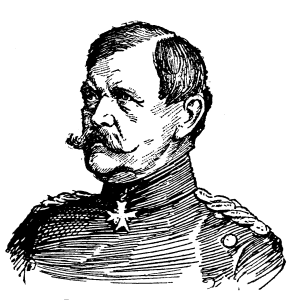
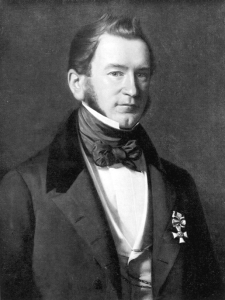
6.1 August_von_der_Heydt_(1801–1874)

August von der Heydt (1801–1874)

By 10 a.m. they were in the offices of the Minister of Finance, August von der Heydt. Bartel noted frankly that “he was very solidly against us.” He saw no way around Mennonites adjusting their scruples to accept military service. He tried to comfort them with the story of his own mother, who had her own scruples against sending her sons to the military. She had even gone to see the king to ask that they be exempted, but to no avail. With time she got over her reservations and he hoped the Mennonites would as well. He was from a Reformed family and had attended a Moravian Brethren high school in Neuwied, a city with a prominent Mennonite congregation, so he likely also knew about the group before meeting them. Nonetheless, as a staunch liberal, equality before the law would have been his guiding principle.3

6.2 Eugen_anton_theophil_von_podbielski

Eugen Anton Theophil von Podbielski

The next meeting at 11 a.m. took them to the offices of Acting Minister of War Theophil von Podbielski. Albrecht von Roon, the minister of war who had engaged Mennonites in a lengthy theological discussion during their visit in October, was on an extended leave due to illness. The Acting Minister assured them he had been informed about their case. He said arrangements would be made to take care of them and that he thought they would find the solution acceptable. He added that Prussian Mennonites “would not have faced such serious challenges if we would have been united in living out our faith instead of being splintered apart by so many internal divisions.” He mentioned that it was particularly difficult for the Mennonites’ case that several petitions from “our people (or nation)” (Volk) had arrived “asking that we be subjected to the draft.”4

The use of the word Volk here, meaning both people and nation, by the Acting Minister of War to describe Mennonites was not uncommon either for officials or for Mennonites themselves.  The lines between peoples and nations were not drawn as tightly at this point in multi-ethnic Prussia as they would be later. Yet the term does suggest the ambiguity that both Mennonites and officials felt in this encounter over whether Mennonites were willing to give their highest allegiance to Germany, or to put it differently, which “people” were really their “people.”

The petitions from Mennonites asking to be drafted that von Podbielski referred to could have included the one dated May 30, 1867, from Mennonite Pastor Carl Harder in Neuwied, mentioned in the first two posts in this series. In addition, already on April 11, 1867, the church council of the Mennonite congregation in Emden had petitioned that they be allowed to fulfill all the duties and enjoy all the rights of other Prussian citizens.5 Emden was part of the Kingdom of Hanover, which had been annexed to Prussia in 1866, and the Mennonites there strongly preferred military service to facing extra taxes or restrictions on buying real estate. On August 7, 1866, a number of landowners from the Vistula Delta, apparently both Mennonites and non-Mennonites, made a similar appeal to the House of Lords, which rejected their petition at that time.6 One can perhaps sympathize with officials who, when presented with conflicting demands from Mennonites, decided not to take them too seriously.

On this day there was also a lively debate in the House of Lords over accepting the proposed budget for the kingdom. One of the sticking points was striking the communal tax Mennonites had paid for their military exemption from the income side. One of the Mennonites’ most fervent supporters in this debate was Adolf Senfft von Pilsach, who was well-connected to the royal family and also had talked with the elders.7 Peter Bartel did not record meeting him until later in their trip, raising the question of how complete his account is.8

Senfft-Pilsach in any case started his lengthy intervention on behalf of the Mennonites with recounting an anecdote from his conversation with them. “When their delegation visited me in order to impress the seriousness of the matter on my heart, all of them peasants, one of them asked me, ‘Do you really think that our King and Lord no longer has the power to uphold the Charter of Privileges that his forefathers granted us?’” Senfft-Pilsach went on to cast the matter as a serious issue of conscience best left to the king. He also reported that he had asked if they would not be willing to serve as non-combatants. The reply was that once the Charter was violated, their position would depend on the whimsy of the Minister of War at the time, not law. The Mennonites concluded that “if the power of the state is so great that it can ignore a legally binding Charter, it will not hesitate to step over this much lower barrier as well.”9 Events soon proved these traditionalist peasants to be astute observers of nationalist politics.

Finance Minister von der Heydt, who had just spoken to the Mennonites that morning, was the main speaker in favor of revoking the Mennonite tax. In his comments he also gave his own, quite different, account of their meeting. He opened by noting that he had assured the Mennonites that ending the payment of the tax would not prejudice the final decision on whether their Charter was still valid, but since they were not exempted from the military any longer, he thought it would be an injustice for them to continue paying it. “I did, however, tell them that if they feel bound by conscience to pay the tax, I would be willing to accept it.” This comment provoked laughter from the lords.

Von der Heydt hastened to add that he thought the matter serious and had only hoped to be accommodating. He said he had told them paying the tax now was an injustice, but if they wanted to pay it voluntarily, he would ask for royal permission to do so. He concluded that he did not want to get anywhere close to supporting the Mennonites’ wishes and that the tax should be revoked.10 At the end of the session, the budget of 159,757,064 Thaler without the Mennonite tax of 5, 600 Thaler was accepted by a wide margin.11 Mennonites had lost this symbolic battle, but a specific petition to reinstate their exemption would be debated the next day while the elders visited Justice Minister Adolf Leonhardt.

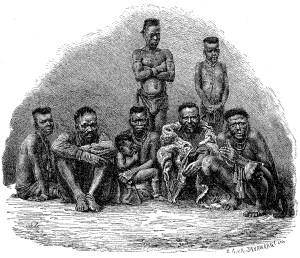
6.3 Book Illustration based on photo by Wangemann

Book Illustration based on photo by Wangemann

The spiritual component of this day was listening to Berlin Mission Society Director Hermann Wangemann preach in the Andreas Church on the natives of Africa (Kaffern).12 The church was on Andreas Street near what is now the East Train Station, but was destroyed by Allied bombs in World War II and the ruins were removed by the Communist government of East Germany. Most of these Elders would have been active supporters of the Danzig Mission Society, a related organization, explaining their interest in this particular church service.

SEE OTHER POSTS IN THIS SERIES


  1. Peter Bartel, “Beschreibung der persönliche Bemühung der fünf Aeltesten bei den Hohen und Allerhöchsten Staatsmännern in Berlin um Wiederheraushelfung aus dem Reichsgesetz, worin der Reichstag uns Mennoniten am 9. November 1867 versetzt hat,” Christlicher Gemeinde-Kalendar 29 (1920), 74. 
  2. On Mühler’s earlier interactions with Mennonites, see Mark Jantzen, Mennonite German Soldiers: Nation, Religion, and Family in the Prussian East, 1772-1880 (Notre Dame, IN: University of Notre Dame Press, 2010), 157, 166. 
  3. Bartel, “Beschreibung, 74, https://www.deutsche-biographie.de/sfz32097.html#ndbcontent 
  4. Bartel, “Beschreibung, 74. 
  5. Geheimer Staatsarchiv Preußischer Kulturbesitz (GStA), Berlin, Hauptabteilung (HA) I, Rep. 77 (Ministry of the Interior), Tit. 332t (Militärpflicht), no. 5 (Die Militärpflicht der Mennoniten), vol. 1 (1819-1868), n.p. 
  6. GStA, HA I, Rep. 77, Tit. 31 (Mennonitensachen), no. 2 (Die in Ansehung der staatsbürgerlichen Verhältnisse der Mennoniten vorgenommen Anordnugnen, desgl. wegen Behandlung der Mennoniten-Gemeinde in Danzig nach der Reoccupation dieser Stadt), vol. 9 (1862 Juli – 1869 Dez.), 226-228. 
  7. The connection ran through his more famous brother, https://www.deutsche-biographie.de/sfz80044.html#adbcontent. 
  8. Bartel records a meeting at 10 am on February 24 to thank Senfft-Pilsach for his efforts, “Beschreibung,” 74-5. 
  9. Stenographische Berichte des Herrenhauses, Vierzehnte Sitzung am 21. Februar 1868, 207-8. 
  10. Ibid., 208-9 
  11. Ibid., 212. 
  12. Bartel, “Beschreibung,” 79. 

Mennonite Elders Meet with Minister of Interior Count Friedrich zu Eulenburg, Head of the Ministry That Administers the Draft, February 20, 1868

Mennonites Accept and Contest Military Service in the German East: A Sesquicentennial Series

With the passage of the military service law in the North German Confederation and its signing on November 9, most government officials and more than a few Mennonites considered the issue of the draft settled. In the interests of equality before the law, Mennonites would have to serve. However, a large portion of the Mennonite leadership and a majority of Mennonites at this point were not ready to give up. After unleashing a flurry of petitions to various government officials that largely went unanswered, the votes in both houses of the Prussian parliament in February 1868 to revoke the collective tax that Mennonites had paid since 1773 served as a platform for politicians who supported Mennonites and Mennonite leaders to continue to make their case for restoring their exemption. Since democracy had stripped Mennonites of their exemption as bestowed by kings, they took their case to the king and his ministers and to conservative politicians, but not to the court of public opinion, which was decisively set against them.1

Already on Thursday, February 13, the lower house of the Prussian parliament debated the government’s proposed budget that eliminated the Mennonite tax. Wilhelm von Brauchitsch represented the heavily Mennonite district of Elbing both in the Prussian parliament and the North German Confederation. He quoted the 1780 Mennonite Charter of Privilege at length and asked that this privilege be respected. Carl Twesten, a member of the National Liberal Party, countered that federal law trumped Prussian law and that the matter was already settled. Other representatives debated the merits of making compromises for solid citizens who might otherwise emigrate and noted that Mennonites were internally divided on the issue, since Mennonite requests had reached the house asking for military service to be imposed. The house voted to remove the tax on Mennonites in recognition of their service now. Since the debate would next be taken up in the House of Lords, von Brauchitsch wired the Mennonite leadership that they should come to Berlin to seek to influence official policy at this crucial juncture.2

The same five Elders who had been Berlin in October 1867 returned now, Gerhard Penner, Heubuden, Johann Toews, Ladekopp, Johann Wiebe, Fürstenwerder, Peter Bartel, Gruppe, and Johann Penner, Thiensdorf. They arrived in Berlin on February 18 and spend most of the next day trying to set up meetings with various ministers. The key meeting was with Hermann Wagener, a confidant of Bismarck’s who encouraged them to pay the collective tax no matter what and then sue the government for violation of their legal privilege. The morning of February 20 was likewise spent lining up additional meetings for subsequent days.3

Their efforts to meet powerful officials paid its first dividend on Thursday, February 20, at 2 pm when they met with Count Friedrich zu Eulenburg, the Minister of the Interior. In the Prussian government it was this agency that oversaw the draft. Right up front he told them that there was no chance of changing their draft status. Peter Bartel saw him as sympathetic since he did not want to see them emigrate and promised to work at getting them an audience with the king. Zu Eulenburg also reported that he had written Albrecht von Roon, Minister of War, asking if noncombatant medic status might be possible. Even that was more than the law currently allowed and would be a good deal for Mennonites in zu Eulenberg’s view.4

Peter Bartel’s account of sympathy from the Interior Minister does not reflect zu Eulenburg’s actual position, leaving us to wonder if Bartel was deliberately misled or simply grasping at straws in any half-way positive remark the minister made. Behind the scenes zu Eulenburg was one of the least flexible cabinet ministers, pushing hard in a memorandum to the Ministry of War for not allowing any exemption beyond noncombatant service for Mennonites at a time when von Roon seemed to agree with the Mennonites that their Charter of Privilege was inviolable. The more conservative von Roon was happy to uphold royal privilege and support the Mennonites while the less conservative zu Eulenburg favored equality before the law although he made exceptions to the draft for other, better-connected people than Mennonites.5

Perhaps the most important meeting of the day for the Mennonites was the one they failed to organize. At 4 p.m. they tried to get an audience with Chancellor Otto von Bismarck, who von Brauchitsch had suggested was against their cause. Their meeting with Bismarck’s friend Hermann Wagener had given them more hope, but they could not get in to see the great man. Here again it is not clear why Bartel seemed to harbor false hopes. The report from their own representative had been accurate, Bismarck was opposed to Mennonites’ exemption, dooming their project from the start unless the king could be brought to take on his own chancellor.6

All in all, a discouraging day. Perhaps the five Mennonite farmers wandering the halls of power took consolation in the sermon they heard at a chapel service in the Moravian Brethren church that day, a Pietist denomination with which most of these five would have felt an affinity. Perhaps they, like us, pondered how to keep the faith in a world bent on preparing for war. The next day would bring a meeting with the Acting Minister of War and another raucous debate on Mennonites in a Prussian parliament, this time in the House of Lords.7

SEE OTHER POSTS IN THIS SERIES


  1. For a general overview, see Mark Jantzen, Mennonite German Soldiers: Nation, Religion, and Family in the Prussian East, 1772-1880 (Notre Dame, IN: University of Notre Dame Press, 2010), 26-33, 191-218. 
  2.   The debates are from the Stenographische Berichte, February, 13, 1868, 1580-3. On Mennonite divisions see  https://ml.bethelks.edu/issue/vol-70/article/the-resolution-of-november-9-1867-by-the-north-ger/. The summons from von Brauchitsch is in Peter Bartel, “Beschreibung der persönliche Bemühung der fünf Aeltesten bei den Hohen und Allerhöchsten Staatsmännern in Berlin um Wiederheraushelfung aus dem Reichsgesetz, worin der Reichstag uns Mennoniten am 9. November 1867 versetzt hat,” Christlicher Gemeinde-Kalendar 29 (1920), 72. 
  3.   Ibid., 72-3. 
  4.   Ibid., 73-4. 
  5.   Jantzen, Mennonite German Soldiers, 199-200, 212-7. 
  6.   Bartel, “Beschreibung,” 72-74, Jantzen, Mennonite German Soldiers, 200. 
  7.   Bartel, “Beschreibung,” 79. 

Meditation on Jealousy and Relief/Community and Individualism

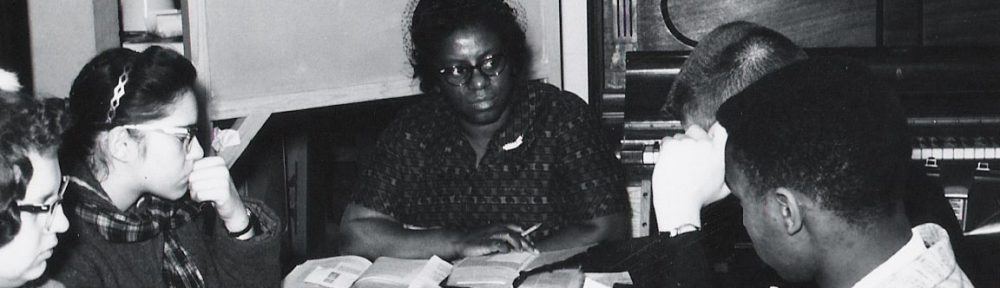
Back in November, I reflected on what some of the women of the Eastern Mennonite High School class of 1959 had to say about mischief in their school days. Talking to these women I had the same two reactions I have anytime I talk with Mennonites from older generations: jealousy and relief.

My interview with the EMHS grads was part of a series of interviews with Mennonite women, talking about daily life in the 1930s-1960s. My interviewees described a world centered on church community. It was a world that sounds like an awful lot of fun (thus, the jealousy).

From a group of women who grew up in Denbigh, Virginia in the “Mennonite colony,” the 1940s and 1950s meant roller skating parties on Colony Road, hot dog roasts, boat rides on the river, swimming, and girls’ slumber parties at home or along the river. The boys usually stopped by, too—to hang around and tease a bit. “I just remembering having fun,” one woman remarked. Another chimed in, “the young folks would have so much fun together.” Their bonds were strong, perhaps because so much of the world was off limits. One woman remembered that they were not allowed to play cards, so they made their own decks.1

Other women also described church as their social world. Ruth H. (b. 1924, Ohio) remembered the difference the new Mennonite Youth Fellowship made in her life. Sermons may have been long, but MYF made church worthwhile.2 Vera K. (b. 1926, Pennsylvania) remembered how much she enjoyed hanging around after church just talking with other young people. Both described singing, in groups or quartets, and Sunday School parties.3

Church was a place to fit in—often in contrast to life at public schools. Ruth H,. recalled being “lonely” at school, in the early 1940s, as one of only a few Mennonites. Going to Goshen College was a “wonderful experience” where she found close friends and mentors and felt she finally belonged.4 Ruth S. (b. 1933, Pennsylvania) echoed this sentiment. She, too, went to public school where she was involved in activities, but only to a point. She remembered making signs for school dances but not going to the dances. On the rare occasion she did go, she hung back and didn’t dance (one time she danced with the football coach: “I survived it okay. It didn’t do me in,” she reported). Ruth S. described feeling torn: she wasn’t comfortable taking part in all of the school activities and yet she didn’t like being left out. For her, too, Goshen College was where she could fully participate.5

You don’t have to be a historian to realize the risks in idealizing the past. The price of a tightly knit community was surveillance and conformity. The women all remembered a less fun cornerstone of community life: revival meetings. While many had positive things to say, most also remembered feeling fear as well. Ruth S.  called revivals “high pressure” and “very emotional.”6 The Denbigh women recalled that preaching often centered on fear of hell, not the love of God. The preachers were “after the hardened sinners but… got me” said one, remembering the fear she felt. Another recalled the anxiety around communion and the experience of taking open communion at a Presbyterian church as and adult. “It was unbelievably freeing,” she said, so moving that she cried. Another faulted their church community for having “no grace” and said that leaders “deprived me of a loving God.”7

Revival meetings were not the only source of anxiety. The same social bonds that could make life fun could make life hard. The EMHS women remembered how even just looking “worldly” could get you marked as a trouble-maker. Looking worldly could involve your dress and deportment choices—or it could be something you had no control over, such as having bright, unruly hair.8 And there was always someone watching, especially if you were a woman. Mary R. (b. 1930, Pennsylvania) remembered how uncomfortable it made her to walk up the steps to the Lancaster Mennonite School library with a male administrator looking on, checking that skirts were long enough.9 The good old days were not that great (thus, relief that those days are gone).

Just as we should be cautious about idealizing the past, we should not forget that community norms are often unstable—and there is joy in the process of contesting culture. The EMHS women chuckled at their exploits: holding hands under the table, away from the eyes of “spies” in the social room, sneaking out for motorcycle rides, banding together to irritate a conservative teacher in subtle ways. There is no fun quite like subversive fun. We don’t acknowledge this nearly enough.

Then again, subversive fun is less fun if you’re caught—and you’re more likely to be caught if you’re someone who is less “in.” Being “in” means knowing how to break rules, or how to read the often unstated exceptions to rules and knowing how to handle yourself if caught. Being “out” means you function with the same rules but without the inside knowledge required to keep you from more serious consequences.

These are hard truths: tight community bonds often mean community surveillance. Having a sense of being “in” often means someone else will have a sense of being “out.” I am relieved to have grown up in a time where I never imagined God as scary, where no one checked my skirt length, and there was no pressure surrounding baptism. I was encouraged to know my own mind and to make choices that were “right for me.” I am relieved the Mennonite world shifted before I was born.

But I am still jealous. When I’m 70, I won’t be gathering for regular breakfasts with the women of my high school class. As a child I stayed in one place but my friends moved regularly as parents climbed career ladders. We were drawn together by similar interests but we didn’t know each other’s families in the same way these women knew each other. We were friends as individuals. We were not a community.

Is there a way to have both room for the individual and a close-knit community? When I think about this on a theoretical level the answer seems like an obvious yes. It’s a matter of prioritizing community and intentionally cultivating it. When I think about this on a practical level it gets stickier.

What does it mean to prioritize or intentionally cultivate community? The world is no longer off limits. You can go to the college that best suits you, as an individual, not necessarily a college you have family or church ties to. It’s expected that you’ll move for a career, leaving the connections of family, friends, and church. You can give as little or as much as you like to a church in terms of time and resources. No one is watching. There is a never-ending list of things you can do with your time, the people you can meet, and the places you can take your talents. We don’t need to invent our own deck of playing cards anymore. We are all free to go to the public school dance.

But there is only so much time in this life and if I go to the dance Saturday night I may be too tired to go to church on Sunday. Or, to make this metaphor more fitting for my life: if I’m facing a deadline at work then I might stay home and work on a Sunday, because that’s what I need this day. It’s more than just church attendance. I look for the friends and communities that suit my individual tastes—sometimes that means church community and often not.

What has been lost? Community life? Sense of place? Stable church-related institutions? Individualism has its place, but it’s not always conducive to walking together. If the church I was raised in doesn’t suit me just right as an individual, I can easily go down the road to another one.

There is probably no easy solution to the conundrum of community and individualism. No easy resolution to my feelings of both jealousy and relief. Perhaps the tension does not need to be resolved, only acknowledged. Is this state of tension at the core of what it is to be a Mennonite in the twenty-first century? We are painfully aware of the ways in which community went wrong in the past and continues to go wrong today. But we also make community a hallmark of our faith.

A couple of months ago I ended up in a Facebook conversation about Austin McCabe Juhnke’s piece “Rethinking 606, the ‘Mennonite national anthem.’” My friends and friends of friends pondered the implications of Juhnke’s argument. We agreed we all wanted community, and rituals that bring us together, but we struggled with how to create community that does not exclude.

I find it difficult to know how to end a meditation like this one. Perhaps that is because you can’t think your way out of the conundrum of community life. We may have to spend more time together to work on it. I don’t necessarily mean more time at church or more time dissecting hidden power dynamics inherent in community building. I mean more time playing together or getting to know each other—perhaps more time engaging in subversive fun together. In the past Mennonites knew each other well but likely had a less developed analysis of the perils of community life. Today we have the theory down, but we don’t know each other as well. Could we put the two together—awareness of the danger and knowing each other well—and see if we end up in a different place?


  1.   Women from the Denbigh community, oral history interview (February 12, 2014), in Voices: Oral Histories of Mennonite Women, Eastern Mennonite University archives, Harrisonburg, VA. 
  2. Ruth Heatwole, oral history interview (January 29, 2014), in Voices: Oral Histories of Mennonite Women, Eastern Mennonite University archives, Harrisonburg, VA. 
  3.  Vera Kauffman, oral history interview (February 5, 2014), in Voices: Oral Histories of Mennonite Women, Eastern Mennonite University archives, Harrisonburg, VA. 
  4. Ruth Heatwole, oral history interview (January 29, 2014), in Voices: Oral Histories of Mennonite Women, Eastern Mennonite University archives, Harrisonburg, VA. 
  5. Ruth Stauffer, oral history interview (December 2 and December 5, 2013), in Voices: Oral Histories of Mennonite Women, Eastern Mennonite University archives, Harrisonburg, VA. 
  6. Ruth Stauffer, oral history interview (December 2 and December 5, 2013), in Voices: Oral Histories of Mennonite Women, Eastern Mennonite University archives, Harrisonburg, VA. 
  7. Women from the Denbigh community, oral history interview (February 12, 2014), in Voices: Oral Histories of Mennonite Women, Eastern Mennonite University archives, Harrisonburg, VA. 
  8. Eastern Mennonite High School, class of 1959, oral history interview (March 14, 2014), in Voices: Oral Histories of Mennonite Women, Eastern Mennonite University archives, Harrisonburg, VA. 
  9. Mary Reitz, oral history interview (January 29, 2014), in Voices: Oral Histories of Mennonite Women, Eastern Mennonite University archives, Harrisonburg, VA. 

Mennonites and the Holocaust: An Introduction

Mennonites entered Nazi consciousness in 1929, when 13,000 refugees descended on Moscow, clamoring to leave the Soviet Union. In Germany, the National Socialist Racial Observer took up their cause. Blaming Jews and Bolsheviks for oppressing Mennonites, the paper condemned Western democracies for ignoring their plight. In one front-page article, editor Alfred Rosenberg—who had led the Nazi Party while Hitler was in prison—offered what he considered a solution. “The National Socialist movement,” he wrote, “recognized this danger [of ‘Judeo-Bolshevism’] from the beginning and built that into its essence.”1 Little more than a decade later, Rosenberg felt that the Second World War had vindicated his position. Traveling in 1942 and 1943 through Nazi-controlled Ukraine as Reich Minister for the Occupied Eastern Territories, he announced to crowds in the Mennonite colonies of Chortitza and Molotschna that tables were finally turned.2 Already, death squads had murdered most of Ukraine’s 1.2 million Jews.

“Film footage of Alfred Rosenberg’s visit to the Chortitza Mennonite colony in Nazi-occupied Ukraine, June 1942.”

Seventy-five years after the Holocaust, the global Mennonite church has yet to confront its entanglement in this genocide. While stories have long circulated privately and in some academic publications, only recently have they garnered sustained public attention.3 In this light, the upcoming conference, “Mennonites and the Holocaust,” to be held at Bethel College in North Newton, Kansas, on March 16 and 17, 2018, is a breakthrough. [EDIT 5/29/2018: coverage of the Mennonites and the Holocaust conference can be found here.] The event promises serious discussion of the church’s relationship with Jews and Judaism, a topic vitally important to Mennonites around the globe. Sponsored by seven Mennonite religious and educational institutions, including Mennonite Church USA, this conference brings together leading scholars of Anabaptism and of the Holocaust from five countries. A film screening and the keynote lecture by Doris Bergen—who is Chancellor Rose and Ray Wolfe Professor of Holocaust Studies at the University of Toronto—are free and open to the public. Registration for panel sessions is now open.

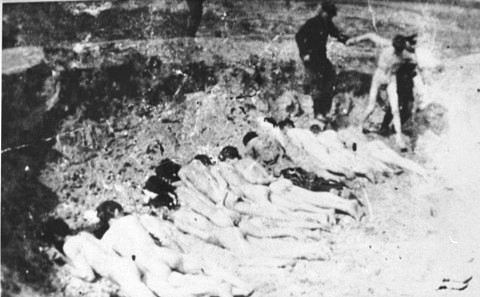
A naked prisoner is led to an execution site in the Stutthof concentration camp 2

Some of the 60,000 victims killed at the Stutthof concentration camp, a source of slave labor for Mennonite farms and factories. Credit: Holocaust Education & Archive Research Team

Mennonite experiences of and involvement in the Holocaust differed widely. We know that a handful of individuals actively participated as executioners and concentration camp guards. We also know that a substantial percentage of Europe’s Mennonites benefited from and often sympathized with aspects of Nazism. Around 120,000 people, or about one-fourth of the denomination worldwide, lived under Nazi rule at the height of Hitler’s expansionism. Generally categorized as members of the Aryan racial elite, Mennonites sometimes received goods taken from murdered Jews or moved into their vacant homes. Others leased slave labor for their farms and factories, or otherwise profited from genocide.4 Yet many Mennonites also suffered. Life in wartime could be brutal, not least in German-occupied Western Europe, where some Mennonites joined the resistance.5 A number were executed or sent to concentration camps for political activities or for possessing Jewish heritage or cognitive disabilities.6 And a small but important subset—primarily in the Netherlands and France—hid Jews.7

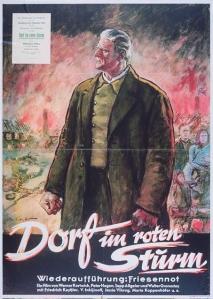
dorf_im_roten-sturm_1941

A poster for the Nazi propaganda film, Frisians in Peril, re-released in 1941 as Village in the Red Storm. Here, the Mennonite congregational elder is portrayed as a stoic Aryan in the face of Bolshevik oppression.

Arguably more impactful than Mennonites’ own actions, however, was the denomination’s enrollment in Nazi propaganda. In 1929, popular opinion had pressured German politicians to help approximately 4,000 of the Mennonite refugees in Moscow relocate to Germany. The event became a founding myth of the Third Reich, inspiring novels and two of the Nazis’ most important early films, Refugees (1933) and Frisians in Peril (1935). Both were re-released in 1941 during Hitler’s invasion of the Soviet Union.8 In general, Mennonites became symbolic of Aryans’ supposed ability to maintain German cultural traditions abroad. Hundreds of books and articles by the Third Reich’s leading experts on German speakers in Canada, the United States, Mexico, Paraguay, Galicia, Ukraine, the Volga region, and Siberia depicted the denomination in glowing terms. Many of these authors eventually translated their theories into ethnic cleansing by consulting for the Wehrmacht, East Ministry, and SS.9

As for Mennonites overseas, most remained unaware of or uninterested in Nazi flattery. But they were equally apathetic to the fate of European Jews.10 Moreover, certain communities developed robust fascist sensibilities. In Paraguay and Brazil, entire colonies hoped to “return” to the Reich.11 Leading Mennonites helped finance the German Paper for Canada, a pro-Nazi organ.12 And in the United States, Herald Publishing House of Newton printed the rabidly anti-Semitic Defender, whose monthly circulation reached 100,000.13 As a site for the upcoming conference, Bethel College is an appropriate choice, given that it was Bible professor J. R. Thierstein who, as editor of The Mennonite during the 1930s, gave that periodical its anti-Semitic slant. Readers of the Bethel College Monthly likewise learned from Thierstein that “harm done to the Jews was insignificant by comparison with the great service Hitler had performed in saving Germany from Communism and its Jewish adherents.”14

In 1945 when the Third Reich collapsed, church institutions on both sides of the Atlantic worked to suppress allegations of Mennonite collaboration. The Pennsylvania-based Mennonite Central Committee, in particular, feared for the safety of 45,000 Mennonite refugees in postwar Europe. Administrators believed that these individuals might be denied humanitarian aid and—as actually happened to around half—deported to the Soviet Union. Under MCC auspices, prominent scholars and churchmen sent dozens of memos to military personnel, refugee organizations, and the United Nations. These documents portrayed Mennonites as “strict pacifists,” as non-Germans, and as abhorring National Socialism.15 Receptive bureaucrats developed an erroneous impression that huge numbers had performed “slave labour” for the Nazis, while the New York Times reported that they suffered “as the Jews.”16

Denialism has marked public discussions ever since. While other Christian denominations began self-scrutiny decades ago, conservative strategies—such as emphasizing Mennonites’ own hardships, referencing “Germans” instead of “Nazis,” and refocusing on Bolshevik atrocities—have depressed engagement for generations in Paraguay, Canada, and Germany.17 Little wonder, perhaps, that several of the twentieth century’s leading white supremacists and Holocaust deniers wrote fondly of their Mennonite backgrounds.18 Even among well-meaning and respected church members, anti-Semitic tropes continue to circulate. In 2017, Mennonite periodicals carried pieces that alternately excused genocidal killings by invoking Jewish communists, and denied that Jews were murdered near Mennonite colonies.19 In fact, death squads’ meticulous wartime reports are all too clear. 10,000 Jews were shot on October 13, 1941, for instance, fifty miles from Chortitza.20 And that was just one day.

Loewen, Road to Freedom, pg 106

Members of a Mennonite Waffen-SS squadron in Ukraine’s Molotschna colony, 1943. Credit: Harry Loewen, ed., Long Road to Freedom: Mennonites Escape the Land of Suffering (Kitchener, ON: Pandora Press, 2000), 106.

The “Mennonites and the Holocaust” conference will provide a crucial step in our denomination’s journey toward recognition and atonement. Already, strongly-attended conferences in Germany and Paraguay have raised aspects of Mennonites’ involvement with National Socialism, and since 2015, three edited volumes and numerous journal articles have brought the subject to a wide readership. Yet almost none of this literature has broached the Holocaust specifically—a sign that major soul-searching remains for Mennonites. On a global scale, Mennonite World Conference and its member entities have recently participated in dialogue with Lutherans, Catholics, and others. Such deliberations have resulted, to much fanfare, in Mennonites accepting apologies for the persecution of sixteenth-century Anabaptists during the Reformation. Whether our church is willing to extend the same grace toward victims of a much larger and more recent outpouring of violence, remains to be seen.

Register for “Mennonites and the Holocaust,” North Newton, Kansas, March 16-17, 2018.

Ben Goossen is a historian at Harvard University. He is the author of Chosen Nation: Mennonites and Germany in a Global Era, published in 2017 by Princeton University Press.


  1. Alfred Rosenberg, “Das deutsche Bauernsterben in Sowjetrußland,” Völkischer Beobachter, November 24/25, 1929. For context, see John Eicher, “A Sort of Homecoming: The German Refugee Crisis of 1929,” German Studies Review 40, no. 2 (2017): 333-352. On Rosenberg, see Ernst Piper, Alfred Rosenberg: Hitlers Chefideologe (Munich: Blessing, 2005). 
  2. Alfred Rosenberg, “Besichtigungsreise durch die Ukraine vom 18.6. bis 26.6.42,” Captured German and Related Records, T-454/105, National Archives and Records Administration, College Park, Maryland; “Aus dem Zeitgeschehen,” Deutschtum im Ausland 26, no. 5/6 (1943): 115-116. 
  3. For an overview of early scholarship on Mennonites and Nazism, see John D. Thiesen, “Menno in the KZ or Münster Resurrected: Mennonites and National Socialism—Historiography and Open Questions,” in European Mennonites and the Challenge of Modernity: Contributors, Detractors, and Adapters, ed. Mark Jantzen, Mary S. Sprunger, and John D. Thiesen (North Newton, KS: Bethel College, 2016), 313-328. 
  4. Gerhard Rempel, “Mennonites and the Holocaust: From Collaboration to Perpetuation,” Mennonite Quarterly Review 84, no. 4 (2010): 507-549; Doris L. Bergen, “Protestant, Catholics, Mennonites and Jews: Identities and Institutions in Holocaust Studies,” in Holocaust Scholarship: Personal Trajectories and Professional Interpretations, ed. Christopher R. Browning, Susannah Heschel, Michael R. Marrus, and Milton Shain (New York: Palgrave Macmillan, 2015), 142-156; Benjamin W. Goossen, Chosen Nation: Mennonites and Germany in a Global Era (Princeton: Princeton University Press, 2017), 121-173. 
  5. See the contributions in Jelle Bosma and Alle Hoekema, eds., “Doopsgezinden tjdens de Tweede Wereldoorlog,” Doopsgezinde Bijdragen 41 (2015), as well as Alle G. Hoekema, “Niederländische Taufgesinnte während des Zweiten Weltkriegs,” in Mennoniten in der NS-Zeit: Stimmen, Lebenssituationen, Erfahrungen, ed. Marion Kobelt-Groch and Astrid von Schlachta (Bolanden-Weierhof: Mennonitischer Geschichtsverein, 2017), 173-184. 
  6. This is one of the least studied aspects of Mennonite-Nazi interactions. Examples include Gerlof Homan, “‘We Must and Can Stand Firmly’: Dutch Mennonites in World War II,” Mennonite Quarterly Review 69, no. 1 (1995): 7-36; Christiana Duschinsky, “Mennonite Responses to Nazi Human Rights Abuses: A Family in Prussia/Danzig,” Journal of Mennonite Studies 32 (2014): 81-96; “David P. Boder Interviews Anna Braun,” September 20, 1946, Voices of the Holocaust Project, online
  7. Gerlof Homan, “Friends and Enemies: the World War II Origins of MCC Work in France,” Mennonite Historical Bulletin 71, no. 2 (2010): 7-14; Gerlof Homan, “From Danzig to Down Under: A Mennonite-Jewish Family’s Escape from the Nazis to Australia,” Mennonite Historical Bulletin 73, no. 1 (2012): 13-18; Alle G. Hoekema, “Dutch Mennonites and German Jewish Refugee Children, 1938-1945,” Mennonite Quarterly Review 87, no. 2 (2013): 133-152. 
  8. David Welch, Propaganda and the German Cinema: 1933-1945 (London: I.B. Tauris, 2006), 108-109, 207-213. 
  9. Part of this history is discussed in Benjamin W. Goossen, “Mennoniten als Volksdeutsche: Die Rolle des Mennonitentums in der nationalsozialistischen Propaganda,” trans. Helmut Foth, Mennonitische Geschichtsblätter 71 (2014): 54-70. 
  10. Jack Fischel, “An American Christian Response to the Holocaust,” Bearing Witness to the Holocaust 1939-1989, ed. Alan L. Berger (Lewiston: Edwin Mellen Press, 1991), 127-139. 
  11. John Thiesen, Mennonite and Nazi? Attitudes Among Mennonite Colonists in Latin America, 1933-1945 (Kitchener, ON: Pandora Press, 1999); Uwe Friesen, ed., “Die völkische Bewegung und der Nationalsozialismus bei den Mennoniten in Paraguay,” Jahrbuch für Geschichte und Kulture der Mennoniten in Paraguay 18 (2017). 
  12. James Urry, Mennonites, Politics, and Peoplehood: Europe—Russia—Canada, 1525 to 1980 (Winnipeg: University of Manitoba Press, 2006), 236-237. 
  13. James C. Juhnke, A People of Two Kingdoms: The Political Acculturation of the Kansas Mennonites (Newton, KS: Faith and Life Press, 1975), 139. 
  14. Fischel, “An American Christian Response to the Holocaust,” 134. 
  15. Peter Dyck, “Mennonite Refugees in Germany,” July 1946, FO 1050/1565, The National Archives, Kew, United Kingdom. For context, see Goossen, Chosen Nation, 174-187. 
  16. Intergovernmental Committee on Refugees, “Memorandum: Mennonite Refugees from Soviet Russia,” ca. December 1946, AJ/43/49, Archives Nationales, Pierrefitte-sur-Seine, France; “Mennonite Issue in Germany Ends,” New York Times, February 15, 1947, 8. 
  17. Ted Regehr, “Of Dutch or German Ancestry? Mennonite Refugees, MCC, and the International Refugee Organization,” Journal of Mennonite Studies (1995): 15-17; Ted Regehr, “Walter Quiring (1893-1983),” in Shepherds, Servants and Prophets: Leadership among the Russian Mennonites (ca. 1880-1960), ed. Harry Loewen (Kitchener, ON: Pandora Press, 2003), 329-330; Diether Götz Lichdi, “Vergangenheitsbewältigung und Schuldbekenntnisse der Mennoniten nach 1945,” Mennonitische Geschichtsblätter 64 (2007): 39-54; Daniel Stahl, “Wie die Fernheimer lernten, über die ‘Völkische Zeit’ zu sprechen: Zur langen Nachgeschichte eines Konflikts,” Jahrbuch für Geschichte und Kulture der Mennoniten in Paraguay 18 (2017): 161-186; Benjamin W. Goossen, “From Aryanism to Anabaptism: Nazi Race Science and the Language of Mennonite Ethnicity,” Mennonite Quarterly Review 90, no. 2 (2016): 135-163; Goossen, Chosen Nation, 187-194; Benjamin W. Goossen, “Ending the Silence,” Mennonite Historian 43, no. 4 (2017): 10-12. 
  18. James Urry, “Fate, Hate and Denial: Ingrid Rimland’s Lebensraum!” Mennonite Quarterly Review 73, no. 1 (1999): 107-127; Damon T. Berry, Blood and Faith: Christianity in American White Nationalism (Syracuse: Syracuse University Press, 2017): 74-101. 
  19. Although both statements are publicly available in print and online, I am choosing not to cite them here, as my aim is not to shame individuals but to point out the continued circulation of certain forms of anti-Semitism among Mennonite communities. 
  20. SD, “Ereignismeldung UdSSR Nr. 135,” November 19, 1941, R 58/219, Bundesarchiv, Berlin, Germany. For context, see Helmut Krausnick, Hitlers Einsatzgruppen: die Truppe des Weltanschauungskrieges, 1938-1942 (Frankfurt a.M.: Fischer Taschenbuch Verlag, 1985), 166-175. 


Reviewed: Our Amish Devotional Heritage

Our Amish Devotional Heritage: From the Collection of the Heritage Historical Library, by David Luthy. Aylmer, Ont.: Pathway Publishers, 2016. 134 pp. Hard cover. Color illustrations.

OADHOur Amish Devotional Heritage is a consideration of religious and devotional literature used by the Amish, though not strictly comprehensive. It aims to be a less-academic counterpart to Robert Friedmann’s Mennonite Piety through the Centuries.1 Like other works from the Heritage Library, it also functions as an annotated and illustrated catalog of the library’s holdings.
The work is structured in five sections: Bibles and Bible Portions, Hymnals and Songbooks, Prayerbooks, Martyr Books, and Miscellaneous, each richly illustrated.

The Bible section begins with the Vulgate and Gutenberg versions, then moves to German-language editions, giving extensive treatment of the fourteen editions of the Froschauer Bible. The detailed listing of books kept by the Heritage Library are a mix of material construction and provenance, with notable descriptors as relevant—this remains the case throughout the rest of the book. There are a few details of interest to genealogists, such as the note that family registers started appearing within Bibles in the 1800s.

The second section, on hymnals, starts with Etliche Schone Christliche Geseng, then quickly moves onto the Ausbund and variations thereof. It then moves through Schrift and Lieder Registers (schedules of Scriptures and songs to be used in worship services), Unpartheysisches Gesangbuch, and Liedersammlung “B” and “G”, and the host of small songbooks used outside worship.

Especially interesting is Luthy’s consideration of the Ausbund hymns in that he includes in his survey Ausbund hymns that appear in non-Amish hymnals. This meshes nicely with a section on Lutheran-derived hymns that are used by the Amish. “Both Mennonites and Amish accepted Lutheran hymns, but only those which include no particular Lutheran doctrine.” To help contextualize these hymns, he includes short biographies of the Lutheran writers whose hymns appear in Amish hymnals.

The discussion on prayer books starts with Die Ernsthafte Christenpflicht and editions, including discussion on authorship of the prayers contained within. It also covers Golden Apples in Silver Bowls, Lustgärtlein, and Rules of a Godly Life.

Section four, on martyr books, is the smallest section, with some discussion of the early Dutch work Het Offer des Heeren, but mostly serving as an appendix to the 2013 publication A History of the Printings of the Martyrs Mirror. It is followed by the miscellaneous section covering daily devotionals, inspirational posters, devotional booklets and tracts, religious fiction, and several Sammelbands (collections of shorter works bound as a single volume).

Our Amish Devotional Heritage is generally a very helpful reference book and introductory text, especially given the full-color illustration and the low price. It is hampered by a poor font selection, which makes extended reading difficult. English-language speakers should also note that some of the textual comparisons are done in German only, with no English translation. Those faults, however, do not detract from the worthy accomplishment of organizing such a vast swath of literature in such an accessible way.


  1.  Robert Friedmann, Mennonite Piety through the Centuries: Its Genius and Its Literature, Studies in Anabaptist and Mennonite History, no. 7 (Goshen, Ind.: Mennonite Historical Society, 1949). 

Beyond the Martyrs Mirror: The Prints of Jan Luyken

Originally exhibited at the Regier Art Gallery, Bethel College, North Newton, Kansas, October 30 to December 4, 2015. Excerpted from an article of the same name in Pennsylvania Mennonite Heritage 41 no.1 (January 2018): 10-29

by Rachel Epp Buller

Jan Luyken (also spelled Luiken) was born in Amsterdam into a middle-class family led by a school-teaching father who was devout in faith and committed to intellectual study. After his formal schooling, Luyken apprenticed in the workshop of a local painter, Martin Saeghmolen, and then learned etching and engraving from printmaker Coenraet Decker. He also met regularly with a group of friends, who called themselves De Wijngaardranken (The Vine Tendrils), to write poetry. In 1672, at the age of twenty-three, Luyken married Maria den Oudens. Of their five children, only their son Caspar survived childbirth. At the time of their marriage, Luyken joined the Anabaptist movement at his wife’s instigation, but he did not fully commit until having visions and experiencing a powerful religious conversion in 1673. Luyken remained committed to the Anabaptist church and to piety for the rest of his life.

Following Luyken’s death in 1712, fellow artist Pieter Sluiter etched Luyken’s portrait, shown at left, and published it together with a six-line poem by Adriaan Spinniker that encapsulates how his contemporaries viewed him:1

The desire for God and good deeds, which burns in LUIKEN’s heart
Shown in his behavior, and etchings, and poetry,
Spread thus its glow in the modest countenance,
Which gaze made each aspire to share his way of living.
Thou, who dost always view and read his work with pleasure,
Look frequently at this face, as incentive for thy spirit.

Professional Work

Although he is known predominantly in today’s Anabaptist communities for his iconic etchings in the Martyrs Mirror by Thieleman J. van Braght (1685), Jan Luyken produced over three thousand other works that included paintings (of which only a few survive), drawings, prints, and poems. Luyken published twelve books focused on piety and Scripture, for which he both created prints and wrote poetry. He also produced illustrations for nearly five hundred books by other authors in disciplines as varied as biology, chemistry, geography, shipbuilding, early Christian history, and Dutch history, among others. The books and prints in this exhibition offer a closer look into the breadth of Luyken’s work.

Many of Luyken’s prints fall into the category of emblem literature. Throughout sixteenth- and seventeenth-century Europe, but particularly in the Low Countries, artists and writers favored the use of emblems, which combined images and verses for didactic ends. Emblems generally included a title or motto, an illustration, and an explanation in prose or poetic form. Taken together, these three pieces sought to impart a moral lesson to the viewer or reader. Luyken’s emblems offered meditations on living a godly life and on attaining the path to salvation, using a wide variety of symbolism that would have been easily understandable to his contemporaries.

De Onwaardige Wereld vertoond in Zinnebeelden (The Unworthy World, as told in Emblems), 1710

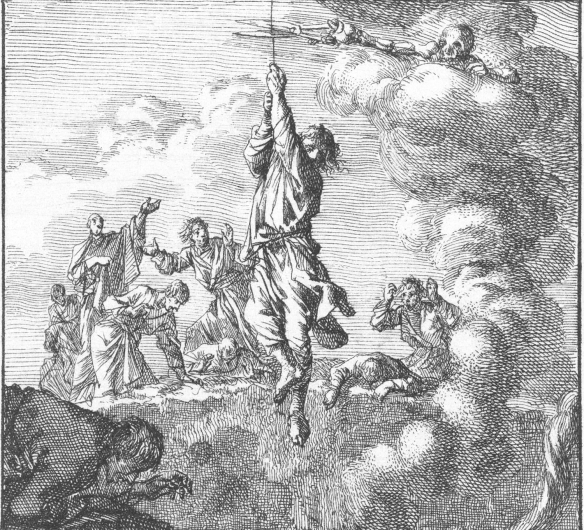
Dangerous-Stand

The Dangerous Stand, from The Unworthy World (Menno Simons Historical Library photo)

Dutch artists of the sixteenth and seventeenth centuries commonly depicted immoral or dangerous behavior, partly as an instructional device to their viewers. In this book of religious emblems, Luyken pictured “the unworthy world” as a warning to urge his readers onto the right path of Christian life. In the scene displayed here, a mortal hangs by a thread above the fires of hell while the specter of death waits to snip his life thread with scissors. If only the man will change his ways, he might be saved. The accompanying verse, Matthew 10:28, reminds us that a better fate awaits us beyond this life if we so choose it: “Do not fear those who kill the body but cannot kill the soul; rather fear him who can destroy both soul and body in hell.”

Dangerous Stand), from De Onwaardige Wereld (The Unworthy World), 1710. Reproduced in Het Werk Van Jan en Casper Luyken door P. Van Eeghen, vol. 2, 1905

Preperatory-for-dangerous-stand-1

Preparatory drawing for The Dangerous Stand (Menno Simons Historical Library photo)

A catalogue raisonné lists all of the works created by a particular artist. This compendium of the works of Jan and Caspar Luyken includes not only the finished prints but also the sketches and preparatory drawings made in advance of the completed works. Looking at this drawing in comparison to the eventual print (see page 15) shows how Luyken worked out the basic composition in the drawing but added a much higher level of detail and linework to the finished product. Notice also how the compositions are reversed since Luyken would have drawn this image onto the copper plate, only to have it printed as a mirror image.

Tafereelen der Eerst Christenen (Scenes of the First Christians). With prints by Jan Luyken and verses by Pieter Langendijk and Claas Bruin, 1722; reprinted 1740, Bedieninge des Doops in een rivier” (Ministry of Baptism in the River)

baptism

Ministry of Baptism in the River, from Scenes of the First Christians (Menno Simons Historical Library photo)

Even posthumously, Jan Luyken’s work continued to garner much attention. Ten years after Luyken’s death, ninety-two of his engravings were published in this volume of early church history. Poems by Pieter Langendijk and six-line verses by Claas Bruin accompany each of Luyken’s images. Not surprisingly, given Luyken’s Anabaptist connections, one of the scenes he chose to include in his series of early Christians is a scene of adult baptism. Notice how Luyken’s compositional lines lead our eyes to the baptism in the center of the image, with small background figures building up to larger foreground figures and with circular ripples of water surrounding the key players.

De Schriftuurlyke Geschiedenissen en Gelykenissen, Van het oude en nieuwe verbond [Scriptural Histories and Parables of the Old and New Testaments], 1712

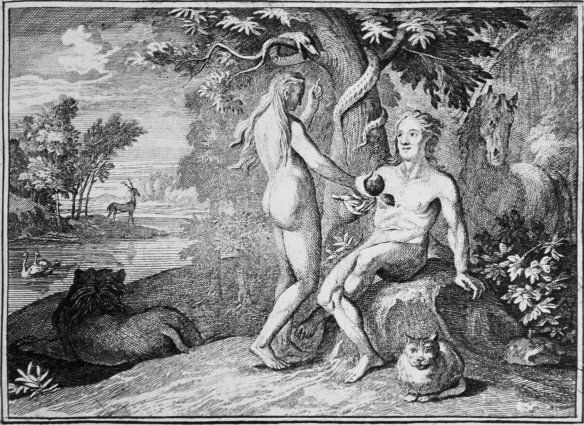
Genesis III: 1-7, from De Schriftuurlyke Geschiedenissen en Gelykenissen, Van het oude en nieuwe verbond (Scriptural Histories and Parables of the Old and New Testaments), 1712

adam-and-eve

Genesis 3:1-7, from Scriptural Histories and Parables of the Old and New Testaments (Menno Simons Historical Library photo)

In picturing the fall of humanity from the Garden of Eden, Luyken placed the blame squarely on the figure of Eve through both image and text. In the print, Eve occupies the center of the composition and points to the tree of knowledge while she hands the apple to Adam. The rhyming verse that accompanies the image, which Luyken titled “Man Seduced,” laments the bitter outcome of Eve’s temptation.

Jan Luyken, De Schriftuurlyke Geschiedenissen en Gelykenissen, Van het nieuwe verbond (The Scriptural Stories and Parables of the New Testament), 1712

Luke-4-with-verse

Image for Luke 2:6-7, from The Scriptural Stories and Parables of the New Testament (Menno Simons Historical Library photo)

In this visual retelling of the New Testament, Luyken highlighted both somewhat obscure and well-known stories. The scene depicted here illustrates the two most familiar verses of the nativity story in Luke’s gospel:

6 So it was, that while they were there, the days were completed for her to be delivered. 7 And she brought forth her firstborn Son, and wrapped Him in swaddling cloths, and laid Him in a manger, because there was no room for them in the inn.

Notice how Luyken positioned the Christ Child at the center of the composition, surrounded by the parents, the shepherds, and the animals of the stable. Luyken’s rhyming poem on the theme of Christ’s birth accompanies the print.

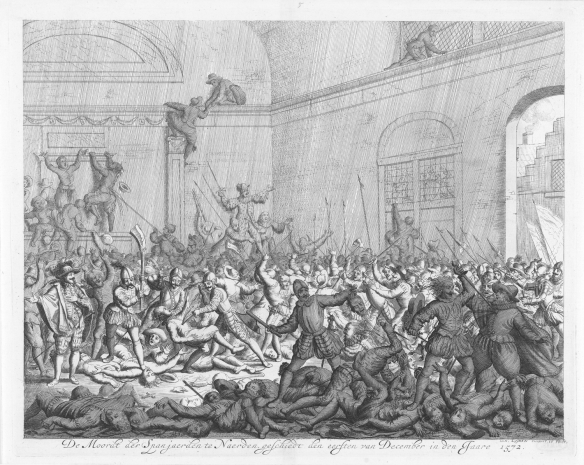
Wreede moordt der Spanjaarden tot Naarden, den eersten December des jaars 1572 [Cruel Murder by the Spanish at Naarden, 1 December 1572], 1677-79, from Hugo de Groot, Nederlandtsche Jaerboeken en Historien (Netherlandish Yearbook and History), 1681

Naarden

Cruel Murder by the Spanish at Naarde, from Netherlandish Yearbook and History (Rijksmuseum photo)

In historical prints such as this, Luyken displayed a rare patriotic sentiment. The scene depicted here marks an episode in what came to be known as the Spanish Fury, a series of bloody confrontations in the sixteenth century when Spanish troops sacked and pillaged Dutch towns in an effort to maintain Catholic rule and allegiance to the Spanish Crown. Luyken pictured the chaos of the battle, and the closed-in setting suggests that the citizens of Naarden had no way to escape the villainous Spanish soldiers.


Dr. Rachel Epp Buller is a feminist art historian, print maker, book artist, and mother of three whose art and scholarship often speak to these intersections. She speaks and publishes widely on the maternal body in contemporary art, including her book Reconciling Art and Mothering (Ashgate/Routledge). She privileges collaboration in her work, which has resulted in various outcomes, including the edited collection Mothering Mennonite, with Kerry Fast (Demeter Press); an exhibition and book, Alice Lex-Nerlinger, Fotomonteurin und Malerin / Photomontage Artist and Painter, with Das Verborgene Museum in Berlin; and the exhibition “Beyond the Martyrs Mirror: The Prints of Jan Luyken,” with Bethel College student Alexandra Shoup, exhibit designer  David Kreider and archivist John Thiesen at the Mennonite Library and Archives. She is a Fulbright scholar, a board member of the National Women’s Caucus for Art, a regional coordinator for the international Feminist Art Project, and current associate professor of visual arts and design at Bethel College, North Newton, Kansas.


  1. Josephine V. Brown, “Biography of Jan Luiken,” Digital Collections, Pitts Theology Library, http://www.pitts.emory.edu/collections/digitalcollections/luiken.cfm 

Melchior Hoffman’s Defense of Female Prophets

The relatively wide array of roles open to women in Melchiorite congregations—Anabaptist congregations found in the Netherlands and North Germany in the sixteenth century and founded by the itinerant apostle Melchior Hoffman—has long been recognized by scholars of early modern Anabaptism. As Arnold Snyder noted in Anabaptist History and Theology, “nowhere in the Anabaptist movement did women achieve and maintain as lofty a pastoral and leadership role as in the Strasbourg Melchiorite community.”1  Sigrun Haude, in her 1998 essay “Anabaptist Women—Radical Women” echoed the point and argued that “the greatest freedom enjoyed by women can be found in those Anabaptist groups that emphasized visions, prophecies, and the Spirit.”2 Hoffman did indeed emphasize visions, prophecies, and the Spirit. He believed, firmly, that he lived in the Last Days, a time in which God would pour out his Spirit on all people, men and women alike.3

After his arrival in Strasbourg in 1529, Melchior Hoffman encountered Lienhard and Ursula Jost, a married couple who had both had visionary and prophetic experiences over the course of the 1520s. He set out to disseminate their visions and prophecies through print (the Josts were illiterate, and had thus not been able to publish them themselves). Hoffman first published Ursula’s visions in 1530. This first edition of her visions, published by the Strasbourg printer Balthasar Beck, did not record her name, but instead referred to her simply as a Gottesliebhaberin, a feminine noun meaning “lover of God.”4 For Hoffman, the emergence of contemporary prophets such as Ursula and her husband Lienhard served as validation for his apocalyptic ideas. Hoffman’s ideas about prophecy and the work of the Spirit also shaped his views of how church hierarchies should be structured. In the afterword to the 1530 edition of Ursula’s visions he included a discussion of church offices and the gifts of the Spirit; Ursula, for instance, possessed the gift of prophecy but not the gift of interpretation.5

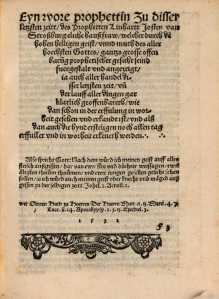
image1-17

The title page to the 1532 edition of Ursula’s visions, published jointly with Lienhard’s prophecies and housed at the Austrian National Library in Vienna

In the 1530 edition of the visions, neither Melchior Hoffman nor Ursula Jost made an issue of Ursula’s gender. They simply took for granted that women could prophesy. In 1532, however, Hoffman offered a more systematic defense of female prophets in a foreword to the second edition of Ursula’s visions. This second edition, printed by Albert Paffraet in Deventer, appeared alongside an edition of Lienhard Jost’s prophecies and its survival at the Austrian National Library in Vienna was unknown to Klaus Deppermann, Hoffman’s most recent biographer.6 In his foreword, Hoffman acknowledged that “some are bewildered and angry that God works and lays out his plans through such a poor and simple little woman.”7 Hoffman contended, however, that this was not remotely novel, and that God had spoken to and through women since the beginning of the world.

To reinforce this point, Hoffman provided a list of women in the Old and New Testament through whom God had spoken or accomplished His purposes in other ways. His list was comprehensive, with a few exceptions—curiously, he omitted Huldah, whom the authors of 2 Kings and 2 Chronicles explicitly identified as a prophetess.8 He began his list of biblical prophetesses and female servants of God with the women of Genesis: Eve, Sarah and Hagar (both of whom heard the voice of God), and Rebecca, Isaac’s wife, who became the mother of two people groups.9 Exodus provided the example of Myriam, Aaron’s sister, and Judges the stories of Samson’s mother, Jael (who defeated the general Sisera), and Deborah (who was not only a prophetess, but also a “great teacher of Israel”).10 Hannah, who prayed so fervently for a child that the priest Eli mistook her for a drunk woman, went on to become the mother of a great prophet of Israel in 1 Samuel, and Judith and Esther both rescued the people of Israel in the books that bore their names.11 Finally, Hoffman highlighted the woman with seven sons in 2 Maccabees, whose sons died for the sake of God’s law and who ultimately gave up her own life “in a very manly way.”12

Unsurprisingly, Hoffman began the New Testament portion of his survey of biblical women with Mary the mother of Jesus, and he went on to list two other women from the beginning of Luke: Elizabeth, who recognized Christ while he was still in the womb, and the prophetess Anna, who recognized Him at the Temple.13 Mary Magdalene, he continued, became the first of Christ’s followers to see Him after the Resurrection and was tasked with spreading this good news to the apostles.14 The Samaritan woman met with Jesus and preached about him to her city in the book of John, and the daughters of the deacon Philip in Acts had the gift of prophecy.15 Hoffman ended this cast of characters with a reference to twelve Gentile prophetesses “reported in the histories”—a possible reference to prominent women from the early and medieval church, though the reason for the number twelve is not clear.16

Since the Bible explicitly called certain women prophetesses, the theoretical possibility of female prophets was undisputed among medieval and early modern Christians, even as many other ecclesiastical roles remained closed to women. Hoffman, however, went further than many of his contemporaries; he described the Samaritan woman’s actions as “preaching” (predigen) and used the word “teacher” (lerrerin) to refer to both Judith and Deborah.17 He did not directly acknowledge or attempt to reinterpret the Pauline command from 1 Timothy that women should remain silent in the churches, but instead mined other Pauline letters for support for his position. After all, had not Paul said in Galatians that all—male or female—were one in Christ? And had he not acknowledged in 1 Corinthians that women could prophesy, provided they did so in an orderly fashion? Moreover, Hoffman added, women could also take on the role of teaching, “if there were no enlightened men.”18

Ultimately, for Hoffman, God gave the gift of prophecy to all who hungered for truth and righteousness without regard for age, gender, or social station, as was made clear in Joel 2, which spoke of sons and daughters, old and young, manservants and maidservants as recipients of the Spirit of God.19 The only trait that disqualified a person from prophesying was pride and hardness of heart. Indeed, Hoffman acknowledged that there were many learned women (schriftgelerder weyber), who were better-educated and more prominent than Ursula, to whom God might have revealed Himself instead. However, despite their prestige, these women were unsuitable because they were proud and haughty.20

While Hoffman’s support of women such as Ursula Jost and Barbara Rebstock has long been known, the recently rediscovered foreword to the second edition of Ursula’s visions sheds further light both on the biblical examples Hoffman used to justify his support of women’s active leadership in Melchiorite communities and the boundaries he still placed on this leadership. The range of possibilities Hoffman envisioned for women in the church was wider than that afforded to them by many of his contemporaries. Ultimately, however, women were second to men even in Hoffman’s congregations, since the role of teaching was open to them only when no qualified men were present to fill it.


  1.   C. Arnold Snyder, Anabaptist History and Theology: Revised Student Edition (Kitchener: Pandora Press, 1997), 321. 
  2. Sigrun Haude, “Anabaptist Women—Radical Women?” in Infinite Boundaries: Order, Disorder, and Reorder in Early Modern German Culture, ed. Max Reinhart (Kirksville: Sixteenth Century Journal Publishers, 1998), 318-319. 
  3. Cf Joel 2 
  4. Ursula Jost, Prophetische Gesicht un[d] Offenbarung der götliche[n] würckung zu diser letste[n] zeit (Strasbourg: Balthasar Beck, 1530), passim. 
  5. Melchior Hoffman, afterword to Jost, Prophetische Gesicht, fols. C vii r-v. 
  6. For the English version of Deppermann’s seminal biography, see Klaus Deppermann, Melchior Hoffman: Social Unrest and Apocalyptic Visions in the Age of Reformation, edited by Benjamin Drewery, translated by Malcolm Wren (Edinburgh: T&T Clark, 1987). The survival of the 1532 edition of the Josts’ prophetic writings was briefly noted in Andrew Pettegree and Malcolm Walsby (Eds), Netherlandish Books: Books Published in the Low Countries and Dutch Books Printed Abroad Before 1601, Volume 1 A-J (Leiden: Brill, 2011), 753 and its contents were the subject of Jonathan Green, ‘The Lost Book of the Strasbourg Prophets: Orality, Literacy, and Enactment in Lienhard Jost’s Visions,’ in: The Sixteenth Century Journal 46:2 (Summer 2015), 313-330. 
  7. Melchior Hoffman, foreword to Ursula Jost, Eyn wore prophettin zu disser letzsten zeitt (Deventer: Albert Paffraet, 1532), fol. F4r. 
  8. For the story of Huldah, see 2 Kings 22:13-20 and 2 Chronicles 34:22-33. 
  9. Hoffman, foreword to Jost, Wore Prophettin, fol. F4r. 
  10. Hoffman, foreword to Jost, Wore Prophettin, fol. F4r. 
  11. Hoffman, foreword to Jost, Wore Prophettin, fols. F4r-F4v. 
  12. Hoffman, foreword to Jost, Wore Prophettin, fol. F4v. 
  13. Hoffman, foreword to Jost, Wore Prophettin, fol. F4v. 
  14. Hoffman, foreword to Jost, Wore Prophettin, fol. F4v. 
  15. Hoffman, foreword to Jost, Wore Prophettin, fol. F4v. 
  16. Hoffman, foreword to Jost, Wore Prophettin, fol. F4v. 
  17. Hoffman, foreword to Jost, Wore Prophettin, fols. F4r-F4v. 
  18. Hoffman, foreword to Jost, Wore Prophettin, fol. F4v. 
  19. Hoffman, foreword to Jost, Wore Prophettin, fol. F4r. 
  20. Hoffman, foreword to Jost, Wore Prophettin, fol. F3v. 

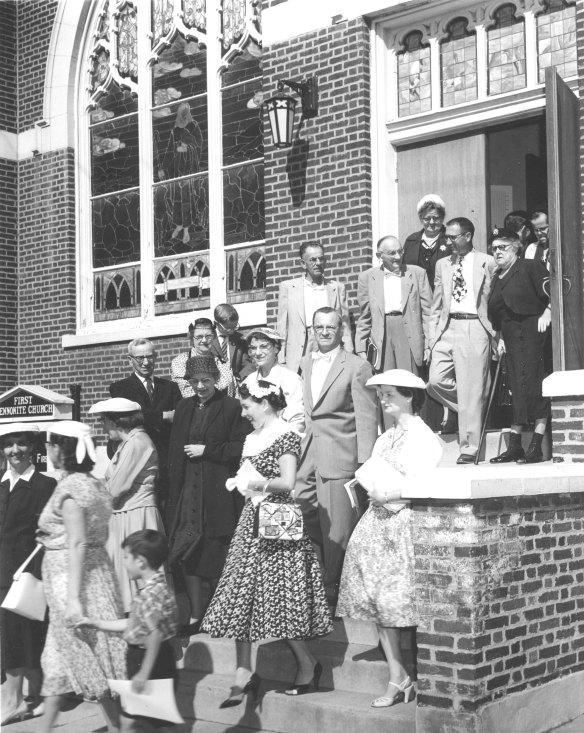
First Mennonite Church, Allentown, Pennsylvania,1958

Image

4

Members leaving worship at First Mennonite Church, Allentown, Pennsylvania in 1958. This photo was one of a series promoting expansion of the church building at that time. By the late twentieth century, demographics had changed and the First Mennonite Church declined in membership, with nearly all members living outside the city. In 2006, the congregation closed, and the building was taken up by the Eastern District Conference for a English-Spanish bilingual church plant called Christ Fellowship.

Forrest Moyer, Archivist, Mennonite Heritage Center