How Mennonites Reckon with our History in the Holocaust

Lisa Schirch

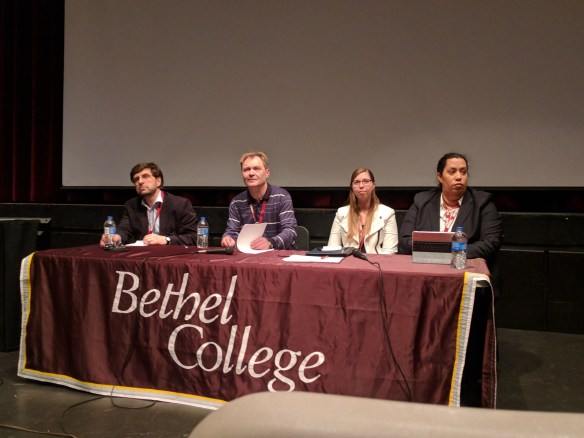
Bethel College should be applauded for taking the leadership to organize the “Mennonites and the Holocaust” conference March 16-17, 2018. Because of a generous grant from Israel/Palestine Partners in Peacemaking initiative of MCUSA, I was able to attend the conference.  Across the street from Bethel College’s campus, the Kauffman Museum portrays a history of Mennonites that illustrates the type of commonly told positive narrative of our beliefs, pacifism, martyrdom, humanitarian work and community. While there are stories of Mennonites opposing the Nazis and hiding Jews in this history, the recently revealed story of Mennonites and the Holocaust feels like a betrayal of everything I’ve been taught over the last fifty years of attending and working for Mennonite institutions. There is a terrible chapter in our history that has been intentionally silenced and absent from my education. Records of Mennonite history are like Swiss cheese: full of holes that leave out our participation in the holocaust. It is important for the church to reflect on how we reckon with this history and what this history requires us to do.

IMG_E4818

Jerusalem at Sunrise

Beyond Academic Discussions

This is not just an abstract, academic conversation among historians who compete to document the facts of this history. Many people in the audience at the conference were experiencing intense emotions because of the shocking revelations about Mennonite complicity and participation in the Holocaust.

I grew up in the Mennonite community of Bluffton, Ohio, where I never heard anything anti-semitic. I was encouraged to read Jewish literature as a kid and was taught to have nothing but respect for Judaism. I was taught to commit to “Never Again” and took up a career in peacebuilding to prevent genocide. On the other hand, I never heard any Mennonite discuss broader church responsibility for the anti-semitism or the Holocaust. In hindsight, this is problematic. Christians are generally unaware of the long history of Christian persecution of Jews.

Last fall, I led Eastern Mennonite University’s study abroad program to Israel and Palestine where we focused on Israeli and Palestinian peacebuilding efforts. My husband is Jewish, and we are raising our children to be both Jewish and Mennonite. We know at least fifteen other Jewish-Mennonite families. For us, this is not just history. I was flooded with emotion hearing about Mennonites participating in massacres of Jewish families or Mennonites taking Jewish land. 

My first thought was this: ethnic Mennonites went from participating in the Holocaust, to helping Palestinian refugees, to denouncing Israeli occupation. Where in this story did ethnic Mennonites help Jewish refugees or stand up for Jewish rights at the same scale? How dare Mennonites act self-righteous in their relentlessly critical stance toward Israel when these Mennonites literally pushed Jews out of their homes and some of those Jews fled to Palestine, where my Palestinian friends were pushed out of their homes. This is a sick and twisted history where Mennonite victims hurt Jewish victims who hurt Palestinian victims. And of these three groups, Jews suffered the most.

The role of Mennonites in the Holocaust has direct impacts on Mennonite-Jewish families, the integrity of Mennonite peacebuilding efforts in Israel and Palestine, and our collective voice on issues of peace and justice.

IMG_4496

Synagogue Bimah in Migdal, beside the Galilee, where Jesus studied. The bimah is the Seed of Life symbol, a symbol used to represent the sacredness of life in many religions.

Emotional Intelligence and Personal Sharing

During the first few panels of the conference, members of the audience shared personal stories. These were a necessary part of the audience digesting and processing the information provided by researchers. But it was not without consequence.

A Mennonite holocaust denier, Bruce Leichty, attended parts of the conference. Leichty is a California-based lawyer known for representing the Holocaust deniers Ernst Zundel and his Mennonite wife Ingrid Rimland Zundel. Leichty has passed out anti-semitic literature at the past several MCUSA gatherings. At the introduction of the conference, the organizers told the audience there was someone attending the conference who they were watching. But many were not in the room or did not understand what was being said. When Leichty began to ask an offensive question during the conference, the organizers removed him by calling campus security, but did not inform the audience of who the man was or why he was being removed. The lack of communication confused many in the audience.

Minutes earlier, a Jewish participant in the audience shared about her discomfort at the emotionally inappropriate discussion of these topics. I can’t imagine how difficult it was for her to stand up in a room where she was alone in representing the Jewish people to a group of Mennonites. She noted the lack of acknowledgment that the stories being told were about people like her and included her relatives. She expressed offence at the laughter and lighthearted comments that were tone-deaf to the seriousness of the stories being told. For example, one panelist mentioned there were “fifty shades of Mennonite collaboration” which was met with laughter. She asked, “you’re laughing at the number of ways your people were involved in the genocide against my people?” I felt pain and embarrassment over the behavior of “my people.” Perhaps Mennonites are so allergic to grief that some choose to laugh inappropriately instead? This was so awkward and uncomfortable. But what came next made it worse, not better.

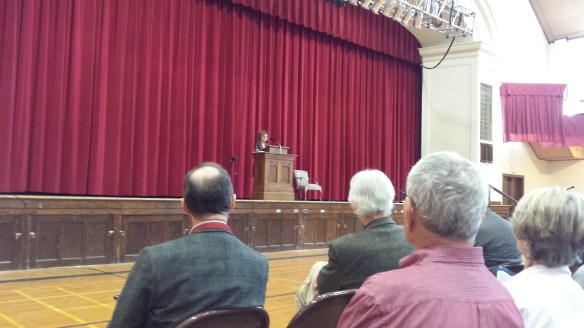
Panel moderators immediately told the audience we were no longer allowed to share personally. They informed us we were only allowed to write down our questions on slips of paper and submit these to the moderators. Coming immediately after the sharing of a Jewish woman, while a number of us in the audience were in tears, it was hard to understand the logic. No one explained this decision.

A trauma expert, facilitator or pastor could have helped the conference audience recognize and make space for the personal impacts we might experience during the conference. We could have acknowledged that people in the room would feel a range of emotions. We might have been reminded that laughter can be therapeutic but that we need to be careful to understand that inappropriate laughter can also be harmful.

The body and brain are not separate. I have attended many academic conferences that also include elements that address emotion and spirituality. It is not either/or. A conference can be both academic and address the intense emotional significance of a subject.

It is not possible or desirable to have an academic conference on a topic involving discussion of Mennonite complicity in the genocide of six million Jews and other groups without the expression of emotion. This insistence that the conference ONLY be academic and heady, without allowing other people to participate in shaping elements to support emotional, spiritual and personal responses was harmful. Because several conference attendees had mentioned this need for a grief room, candle or prayers to the conference organizers before and during the conference with no response. It appeared as if the organizers themselves were unable to imagine or acknowledge the emotion that might emerge from the academic discussions, overwhelmed when audience members shared their personal responses, and felt deeply uncomfortable with giving up some control of the conference and allowing others to help facilitate aspects of the program.

For a conference about Mennonite collaboration with the Nazis, it felt in form like Mennonites are still infected with some lingering patriarchal, authoritarian mindsets. There was only one person of color involved as a panel moderator. White men were in charge. No emotion was allowed. Participants were restricted in how they participated. Offers to help facilitate grief circles were seemingly ignored. There was no collective accountability or statement of responsibility. The tone and form of the conference felt offensive given the weight of the facts presented.
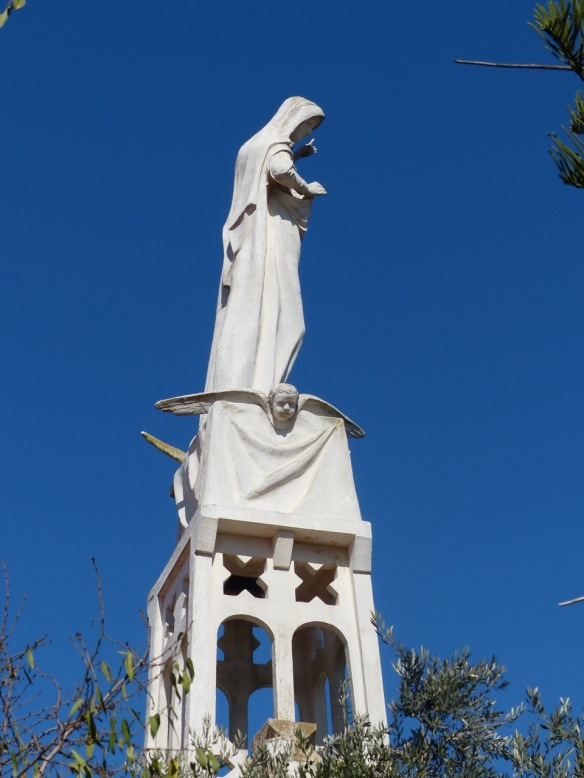
P1130403

Statue of Mother Mary standing on Jewish Covenant representing Supercessionist Theology

Ramifications for Mennonite Theology, History, and Institutions Today

For decades, Mennonite historians and theologians have searched for a coherent statement of our history and theology. History impacts theology. While the Associated Mennonite Biblical Seminary (AMBS) is planning a theology conference to address this history in 2020, it feels strange to try to completely separate out a history conference from a theology conference or to have to wait two more years to take church action on this history. Mennonite complicity with the Holocaust requires action in the present. This is not just an academic historical topic – this history disrupts Mennonite narratives about ourselves, our history, our theology, and our current struggle with racism in the church. Mennonite Nazi connections and theologies of racial superiority continue to have impact today. 

The role of Mennonites and the Holocaust requires an acknowledgement and a statement to Jewish groups that we are undergoing a process of accountability and repentance and invite their participation in how we best do that.  I am curious to understand the rationale for not inviting Jewish participants to attend these conferences where we are wrestling with how we are accountable.

The Bethel conference included papers about German and Dutch Mennonite theology, Some challenged Nazi theology. Some justified Nazi theology. But these scholarly panels made no reference to how the story of Mennonites and the Holocaust seriously disrupts today’s narrative of Mennonite theology.

  • Some Mennonite theologians took part in Nazi racial science, opened church records, and asserted with Nazis that “morals pass through blood.” This is seemingly in direct opposition to Anabaptist beliefs about adult baptism.
  • Some Mennonites in the Netherlands, Germany, Poland, Ukraine and elsewhere rejected pacifism and joined the military to defend national interests. This directly challenges the narrative of Anabaptist nonviolence.
  • Just as West Germany went through a process of self-reflection and intentional de-Nazification, so too does the Mennonite Church need an explicit de-Nazification effort to address the lingering anti-semitism that informs our history and church culture.
  • Mennonite-born White Nationalist leader Ben Klassen is one of the two main figures of the white nationalist movement in North America.  Ben Klassen grew up in a Mennonite colony in Ukraine and read Mein Kampf there. He credits Mennonite theology for his white supremacy.  Regrettably, Klassen is not an aberration. Some Mennonites have reinforced the ideology of white supremacy in unique ways in US and Canadian history. White nationalism is a serious threat to Muslims, Jews, First Nations, African Americans, Latinos and all people of color and non-Christians in North America today. The white supremacists in Charlottesville last summer were carrying the words of Mennonite-born Ben Klassen. In sharing the history of Mennonite roles in the Holocaust with friends on Facebook, the strongest response has been from African American friends who repeatedly reported that they were “not at all surprised.” Racism and anti-semitism stem from the same superiority narrative and belief that “morals pass through blood.” Friends recounted how they didn’t get jobs at Mennonite institutions even though they were clearly more qualified than the “ethnic Mennonites” who were hired. Our current work on racism needs to be informed now by this history.
  • The Mennonite Central Committee (MCC) story has been told in a way that has suppressed the fact that Russian Mennonites were both victims and perpetrators. At the conference, we heard that MCC storyteller Peter Dyck told stories that intentionally deceived not only immigration agents, but also the Mennonite church at large. MCC has hidden the fact that some Russian Mennonites were Nazi leaders and collaborators. The whole story of MCC needs to be retold. MCC needs to reckon with its founding, its relationship to Jews, and its programming in Israel and Palestine which to date has focused almost entirely on the Palestinian narrative without acknowledging Jewish connection to the land and need for control over their safety following centuries of persecution. MCC is holding a 100-year anniversary conference in 2020. Hopefully, this awful history can be addressed, and real action can take place to be accountable for both these historic wrongs and the glaring absence of attention to Jewish connections to the land of Israel just as Palestinians are connected to the land of Palestine, and the need for safety for both Jews and Palestinians.
  • Who will be held to account for suppressing this awful history? Some scholars in the audience at the conference shared that they had tried to raise this history with Mennonite institutions thirty to forty years ago. Church leaders intentionally silenced these voices, diminished the Mennonite role in the Holocaust, and continued to leave out this history. Even today, I’ve heard a dozen Mennonite scholars assert that Ben Goossen’s historical survey of this history in his book Chosen Nation: Mennonites and Germany in a Global Era is an “exaggeration” or “not footnoted carefully.” When I ask for specifics, it turns out they haven’t yet read the book. But they are clearly eager to downplay the significance of this history (which, as a fellow scholar, I think is well footnoted). This failure to take responsibility and to illustrate accountability and repentance is familiar to those of us who have worked on the history of sexual abuse in the Mennonite church.  Mennonite leaders practice denial and suppression of any facts about Mennonites that are not flattering. They give speeches over and over about Mennonite values, our humility, our history of persecution, our work for reconciliation and justice. But they leave out any truthful acknowledgement of our failings.  They seem to think they can keep these terrible histories down by ignoring and suppressing them.  But truth always has a way of coming out. And the church is more likely to suffer lack of integrity by the failure of Mennonite leadership to confront these problems than it will if it admits the failures of the past.
  • Mennonites and Jews have a unique history. For centuries before the holocaust, Jews and Mennonites were persecuted together. European states applied special taxes, restrictions on public office, and allowed Mennonites and Jews only to live in certain areas. Helen Stolzfus is a Mennonite friend also married to a Jewish man, and also raising her children as both Mennonite and Jewish. Helen gave a reading of a play she and her husband wrote about their discussions of this painful history of Mennonite roles in the long history of anti-semitism. In the play, her Mennonite ancestors and her husband’s Jewish ancestors talk to each other. I know fifteen or so other Mennonite-Jewish families, at least. I don’t know that many Mennonites married to any other groups, not Mennonite Catholics, or Quakers, or Muslims. So why do Mennonites and Jews intermarry so often? And what more can we learn about the history of this, for Mennonite friends have also found they have Jewish blood. Mennonites also need to look into this broader history between Mennonites and Jews.
  • Finally, Mennonites pride themselves as being “authentic” Christians who attempt to return to the teachings of the early church, before the Council of Nicaea and before Christianity became the state religion of the Roman Empire. Of course, Jesus and the early church were Jewish. Jesus was very clear he was an observant Jew and was not trying to start a new religion. While traveling though Galilee last fall with my students from EMU, we visited the synagogues where Jesus studied. We learned many new things about Jesus, seeing him through the eyes of our Israeli and Palestinian guides. If Mennonites actually want to practice an authentic way of following Jesus, we are going to need to learn more about Judaism.

Mennonite history classes, books and museums need to tell this newly-revealed story of Mennonites and the Holocaust. The positive narrative of Mennonites needs to include the angels and demons in our histories. We can’t wait another few years to address Mennonite history and theology. It will take a lifetime for me to recover a positive sense of identity after learning all of this. And Mennonites have some serious work to do in taking responsibility for those Mennonites who did these terrible things. We urgently need to begin talking about the ramifications of this history now.

As a witness to this conference and this history, I feel shame, grief, and immense sadness. This history disrupts my world, my identity, and my relationships.
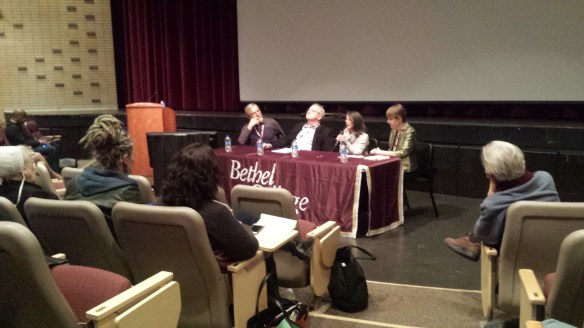
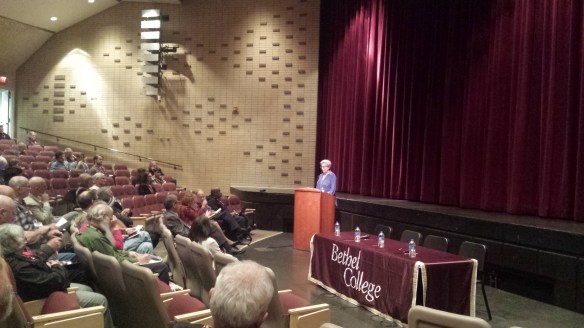
Mennonites and the Holocaust: Personal and Literary Responses

20180317_142835.jpg

Session Five: Personal Impacts

“The Missing Pieces of Our Narratives,”
Connie Braun, Trinity Western University

  • Braun opened with her poem “Ecclesiastical Artifacts,” reprinted below with permission:

Ecclesiastical Artifacts

i.

Burning pyres, screws
hammered through tongues
of pious mouths, in ashes.

Births and deaths,

marriages, lineages.
Our tome is thick
with sorrow.

ii.

Between the Nogat and Vistula
and the sea.

iii.

Faith without icon, or Christs
hanging on crosses (He is risen,
He is risen, indeed).
Our ministers thanked God

for sending an army,

Jesus became Aryan, the cross
grew twisted, we, the Volk,
looked the other way

our neighbours’
wooden synagogues doused with gasoline.

We were a berm that could not hold
the river’s current.

Our ancestors’ gravestones
paved Stalin’ roads.

iv.

In green pastures
lower than the sea,
the shells

of our churches and housebarns,
rows and rows

of lindens we planted centuries ago
cast shadow and filigree.

Connie Braun Notes: I apologize that the unpublished draft of the poem to which James Urry refers held a line about gravestones that he points out was inaccurate in its attribution. The error was amended in later drafts long before his comment came to my attention and was most surely not intended as perceived. This I profoundly regret. (June 8, 2020)

  • Presenting what she termed an “Afterward” to her 2017 book, Silentium, Braun went on to identify two main streams that are missing from the stories Mennonites often tell themselves. First, Mennonites should be mourning not just their own losses and those of their families, “but mourning [also] the loss of the Other. That is the narrative that has been missing from our stories.” Braun also noted that Mennonites’ prejudices are missing from the narratives they construct.

“A Usable Past: Soviet Mennonite Memories of the Holocaust,”
Hans Werner, University of Winnipeg

  • When the Wehrmacht initiated Operation Barbarossa and shortly thereafter occupied Ukraine’s large Mennonite colonies, residents experienced intense relief that they were free from Stalinist oppression. Mennonites in these areas considered themselves German and were viewed as Germans by the invading army. They were seized with euphoria by their liberation at the same time their Jewish neighbors made a desperate escape to the east, with forced labor and death awaiting those who were caught by the advancing German army. Under occupation, Mennonites were engaged across all possible roles, although for this presentation Werner focused on those who were witnesses rather than active perpetrators of genocide
  • Werner enumerated four frameworks used by postwar memoir-writers to render their memories usable: 1) Remember/write only about the Soviet Period, but do not talk about the Holocaust; 2) Write oppositional memoirs rejecting National Socialism and its manifestations, a typology dominated by Mennonite women who married Ukrainians; 3) Feature narratives that acknowledge the stories of Jews whom the writers knew, including their execution; 4) Construct memoirs in such a way as to alleviate guilt, telling stories that portray the Wehrmacht as innocent and/or try to equate Nazi and Allied actions.
  • The presentation concluded by noting that the clearest intersection of the collective and individual memories among Mennonites who experienced Nazi occupation in Ukraine is of Hitler having saved the Mennonites. In the postwar years, members of this cohort grasped for other memories rather than dealing with their own roles in the murder and persecution of Jews and others: “They made their prewar experience under the Soviets into their own Holocaust.”

“Family Responses to the 1930s and ’40s in West Prussia,”
Joachim Wieler, Fachochschule Erfurt

  • Wieler was born before World War II in the eastern German city of Marienburg, and in 1945 fled along with his mother as a refugee to Dresden, which he remembers burning. He recounted the experience of recently being given a box of family documents after his parents had died. Inside the box, he discovered, among other surprises, a thank you note to his mother for supporting the German war effort in the World War I. One letter from after World War II, sent by his father to family from a Soviet prisoner of war camp,  read: “Since we did not do any injustice to anyone and since you also love to work, I believe we will see each other again. In this sense I am greeting all of you with justified confidence and with a strong heart.”
  • Documents from the Nazi period included a letter that Wieler’s father sent from the French front, mixing heavily patriotic language and strong religious overtones: “All soldiers who are fighting here for their fatherland are performing worship in the truest sense of the word.”
  • Wieler ended his presentation by expressing gratitude to Mennonite Central Committee and North American families for their role in supporting refugee families as well as the United States Government’s Marshall Plan for the rebuilding of Germany. He also asked, “How many more boxes are out there?”

20180317_160049

Session Seven: Literary Responses

“Readings from Silentium: And Other Reflections on Memory, Sorrow, Place, and the Sacred,” Connie Braun, Trinity Western University

  • Braun is a poet, memoirist, speaker and instructor. Having written and published widely in diverse genres including poetry, memoir, book reviews and academic papers, her work has been featured in numerous journals and anthologies. Her areas of interest and expertise include Mennonite Studies and Creative Writing. Connie writes on themes of family history, ethnicity, immigration/emigration, loss, (dis)placement and (dis)location.
  • She read from chapter 4, “Running through the heart of storms,” from her 2017 book, Silentium and Other Reflections on Memory, Sorrow, Place, and the Sacred (Wipf and Stock), proceeded by a poem, “Kanada.” Silentium is based on three visits to Poland–first to her mother’s village, a second to Krakow and Auschwitz (reflected in the excerpt Braun read), and a third that included visiting the Stutthoff concentration camp.

“A Mennonite Wife, A Jewish Husband, and the Holocaust,” dramatic reading from Heart of the World,  Helen Stoltzfus, Black Swan Arts and Media, Oakland, California

  • Stoltzfus reflected on her time as co-artistic director, playwright, and performer for the internationally-acclaimed “A Traveling Jewish Theatre,” in which she was the only non-Jewish member of the ensemble.  This group’s original works for the stage were produced worldwide, including the Los Angeles Theatre Festival, the Kampnagel Hamburg Sommer Festival, the Fool’s Festival in Copenhagen, and the Baltimore International Theater Festival. The group traveled the globe–from Toronto to Oslo, and Prague to Appalachia.
  • “Heart of the World,” written twenty-five years ago, looks at the experience of a Mennonite wife and a Jewish husband as they are expecting a child and discussing how to parent their offspring, with the question, “Who will this child be?” driving the story. The play uses archetypal characters “Ancestral Mennonite” and “Ancestral Jew,” into whom the characters regularly transform, as a way to express “that we all carry our ancestors inside of us, whether we are conscious of this or not.”
  • Speaking about the play and its reception, Stoltzfus recalled, “We sought connections where others saw separations.”

Mennonites and the Holocaust: Soviet Union and Mennonite-Jewish Connections

Session Two: Soviet UnionIMG_20180316_145202.jpg

“Survival and Trial: The Post-War Experience of Chortitza Mennonites”
Erika Weidemann, Texas A& M University

  • Using the life stories of two women, Erika Weidemann explored how the actions of Mennonites from Chortitza during the Second World War influenced their ability to create new lives in the post-war environment.

  • She demonstrated how Mennonites (and other ethnic Germans) attempted to re-characterize their wartime experiences to fit the categories created by the Allied powers of displaced peoples worthy of assistance; sometimes they were successful, other times they were not. Often this re-characterization involved emphasizing their victimhood and reinventing their identity in pursuit of survival.

  • Weidemann’s study shows us that identity politics, which performed an important role in shaping the options and opportunities available to Mennonites during the war, continued to be one of the main factors in determining access to resources and routes out of Europe in the post-war era.

“The Mennonites under the Nazi Regime in KGB Documentation, Ukraine 1941-44”
Dmytro Myeshkov, Nordost-Institut (Lüneberg)

  • Dmytro Myeshkov presented fascinating new materials from the recently opened SBU (KGB) archives in Kiev that reveal many hidden stories about Mennonites before, during, and after the Second World War. While he illustrated the limitations of these sources, which must be read with caution, he also demonstrated their incredible potential in allowing us to trace the life stories of Soviet Mennonites.

  • On the basis of these sources, Myeshkov described the case of Ivan Klassen, a doctor from Molochansk (Halbstadt), who was tried and convicted by the Soviet of a number of offenses. During the German occupation, Klassen visited a hospital in Orloff with disabled people (including children) to determine whether the patients could work or not. After his visit to the site, about half of the people were executed by the Germans. Klassen’s case raises questions on the role of Mennonite doctors in the Holocaust.

  • Finally, Myshkov discussed Mennonite women who served as translators in Crimea. These translators assisted in locating Jews for elimination and they received Jewish property and goods in return for their service. His research cautions us against assuming that only men belong in the category of perpetrators and against viewing the activities of translators under German occupation as benign.

“The Mennonite Search for Their Place in the Struggle Between Germany and the USSR”
Viktor Klets, Dnipropetrovsk University

  • Viktor Klets provided an overview of Mennonite experiences during the Second World War, showing this period in all of its complexities. He reminded us of the deportation of part of the Mennonite population in Ukraine by the Soviets before German occupation and their treatment in the labour army.

  • By demonstrating not only how Mennonites collaborated with the Germans, but also how Mennonites did not quite fit the expectations of these occupiers, Klets illuminates how the Soviet environment had shaped Mennonite life in the years preceding the war.

  • He also offered a window into how Ukrainians viewed Mennonites during this period. Some Ukrainians remembered Mennonites as willing collaborators, who readily adopted a superior attitude toward their neighbours based on their Germanness while others emphasized that Mennonites reacted in similar ways to other Soviet citizens.

Session Three: Mennonite-Jewish Connections20180316_153936.jpg

“Jewish-Mennonite Relations in Gabin, Plock County, Masovian Voivodeship, Poland, Prior to and during World War II”
Colin Neufeldt, Concordia University of Edmonton

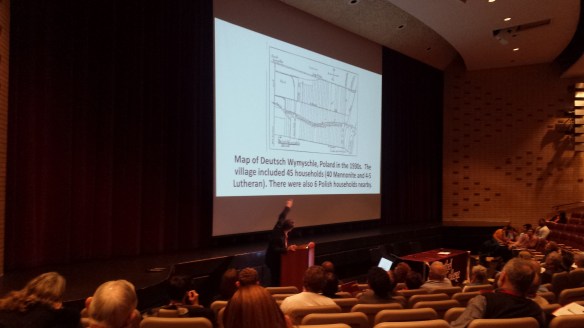
  • Colin Neufeldt investigated Mennonite experience in Poland through a microhistory of the village of Deutsche Wymyschle. Based on a combination of archival sources and oral interviews, Neufeldt showed the variety of ways in which Mennonites in this area collaborated with the German occupiers as their Jewish neighbours faced discrimination and then destruction.

  • Neufeldt also shared the story of Erich L. Ratzlaff, a native of Deutsch Wymyschle, who would become well-known as a teacher, editor of the Mennonitische Rundschau, and minister in Canada. After Germany invaded Poland, Ratzlaff became a full member of the Nazi Party, serving the party cause as the mayor of Gabin. Similar to a number of other prominent Mennonite men from this period, this wartime history has never been fully incorporated into Ratzlaff’s biography.

“Mennonites and Jews in Soviet Ukraine”
Aileen Friesen, Conrad Grebel University College

  • My presentation explored issues surrounding perpetration and rescue among Mennonites living in Khortitsa. By detailing the massacre of Jews just outside of Zaporizhia and the celebration of Easter by Mennonites, both events which took place in the spring of 1942, this presentation forces us to address the reality of occupation: Mennonites benefitted from the racialized policies of the Nazis which victimized their Jewish neighbours.
  • By exploring cases of Ukrainians providing assistance to Jews in the province of Zaporizhia, this presentation also raised uncomfortable questions about why we find so few stories of Mennonites helping Jews during this period. 

Mennonites and the Holocaust: Panels on The Netherlands and German Mennonite Responses

Session Four: The Netherlands20180317_095008.jpg

“Dutch Mennonite Theologians and Nazism”
Pieter Post, United Mennonite Church of Heerenveen and Tjalleberd

  • Post contrasted the thought and practice of Cornelis Bonnes Hylkema (author of Werkelijkheids-theologie [The Theology of Reality] (1932), among other works) and Fritz Kuiper (author of De Gemeente in de Wereld [The Church in the World] (1941) among others). Hylkema was a retired minister from Haarlem who regarded himself as an idealist and historian.  Kuiper was a minister in Alkmaar, a member of the Social Democratic Workers Party, and founder of the “Committee for Socialism and the Church.” Post analyzed how each understood the relationship between church and state, Anabaptism, nonresistance, and the faith community.
  • Hylkema emphasized love of God as an example for the National Socialist party and believed that Christians should submit to the state as part of God’s creation order.  Hylkema agreed with the Anabaptist tenet that violence was not in the spirit of Christ but was not himself a pacifist. Instead he argued that “a Christian people is armed and able bodied” who would fight in the name of God. He also understood the church to be a universalist faith community that offered a common grace and a “place of refuge for the spirit in a turbulent reality.”
  • Kuiper believed in the strict separation of church and state, where the church serves to remind the world of God’s commandments. As a social democrat, Kuiper emphasized the freedom of Christians to choose whichever party expressed biblical justice and believed that the faith community must be prepared to suffer in order to preserve its independence.  After the execution of two of his friends, however, he confessed to a friend that he “no longer had the courage to believe in peace work.” He viewed the faith community as a service of reconciliation.

“Dutch Mennonites and the Yad Vashem Recognition”
Alle Hoekema, professor emeritus, Vrije Universiteit, Amsterdam

  • Hoekema used testimonies collected by the Yad Vashem and other sources from Dutch Mennonite communities to narrate the stories of individuals who aided Jewish neighbors and friends during the Holocaust.
  • He emphasized the importance of community networks and argued that most people were motivated to help, not because of their religious faith or Mennonite identity, but a more general sense of common humanity.
  • He concluded by highlighting several patterns that emerged from his analysis of Dutch Mennonites who were recognized. Most were upper-middle class, many were involved in resistance movements, few later spoke about their experiences, and most saw their actions as normal rather than extraordinary.

“From War Criminal in the Netherlands to Mennonite Abroad and Back to Prison in the Netherlands”
David Barnouw, researcher emeritus, Dutch Institute for War, Holocaust, and Genocide Studies

  • Barnouw narrated the story of Jacob Luitjens, a Dutch collaborator with the Nazi regime during World War II. After the war, Luitjens managed to flee to Paraguay, claiming Mennonite identity and adopting the pseudonym Gerhard Harder. He later moved to Canada but was eventually arrested and extradited to the Netherlands where he was tried and convicted of war crimes.
  • Barnouw highlighted how Luitjens made strategic use of his Mennonite identity and connections in the Mennonite community to avoid prosecution for his wartime collaboration. In court proceedings, he said “I told my God and He forgave me.”
  • Luitjens spent time in jail but was release before serving his full sentence. Stripped of his Canadian citizenship and denied the rights of Dutch citizenship, Luitjens exists as a person without a state. Barnouw is unable to confirm whether Luitjens is still living.

Session Five: German Mennonite Responses in Theology and Memory20180317_103617.jpg

“German Mennonite Theology in the Era of National Socialism”
Arnold Neufeldt-Fast, Tyndale Seminary

  • Neufeldt-Fast’s paper used the writings of German Mennonite church leaders to analyze the underlying logic that led most of them – from across the theological and ideological spectrum – to accept and promote National Socialist ideology.
  • Drawing upon Zygmunt Bauman’s concept of the “gardening state,” Neufeldt-Fast argued that most leaders came to embrace National Socialism’s “order-making, instrumental rationale” of a modern German society in which some plants should be protected and cared for while others should be segregated, contained, removed, or destroyed.
  • While earlier writings of theologians were not explicitly anti-Semitic, they did not condemn Nazi racial doctrine as heresy. By the late 1930s, however, many actively drew upon contemporary understandings of race and blood purity to argue for the expulsion of Jewish people from Germany.
  • Neufeldt-Fast ended his discussion with a call for a critical evaluation of Mennonite theology and the need to develop a post-Holocaust theology.

“Judaism as Argument: German Mennonites between Anti-Semitism and the Old Testament God”
Astrid von Schlachta, Mennonitischer Geschichtsverein (paper delivered by John Thiesen in her absence)

  • In her paper, Astrid von Schlachta used sermons and other publications to explore the range of theological convictions among German Mennonites on the role and use of the Old Testament in the church during the 1930s.
  • Von Schlachta argued that there was not a unified opinion among Mennonites on the matter and that the influence of National Socialist ideology on Mennonite interpretations of Judaism in the Old Testament depended upon the context.
  • While some interpretations were clearly anti-Semitic, other authors pushed back against a racialized view of the Old Testament and argued for its continued relevance for Mennonites and other Christians.

“Selective Memory: Danziger Mennonite Reflections on the Nazi Era, 1945-1950”
Steve Schroeder, University of the Fraser Valley

  • Steve Schroeder drew from oral histories and memoirs to examine how Mennonites from Danzig remembered and explained their experiences during and after World War II. While other Christians in Germany were forced to account for their actions under allied occupation, Danziger Mennonites emigrated and were able to avoid critical reflection on their actions.
  • Schroeder used the framework of cycles of grief and loss – denial, bargaining, and acceptance – to categorize Mennonite memories of the Nazi era. Although many supported the Nazi regime and identified as ethnic Germans during the war, afterwards many made strategic use of their religious identity as Mennonites, distancing themselves from the German nation in an effort to seek asylum abroad.
  • Schroeder ended with a call to continue a critical examination of the role that Mennonites have played, not only in the Holocaust, but also colonial and other systems in which they continue to participate and from which they continue to benefit.

Mennonites and the Holocaust: Film Screening of Friesennot

Frisians in Peril, 1935

The final event on Friday, March 16, at the “Mennonites and the Holocaust” conference was an evening screening of the 1935 Nazi propaganda film Friesennot, which in English translates to “Frisians in Peril.” Professor of History Mark Jantzen of Bethel College, one of the conference organizers, introduced the film. Jantzen had requested permission to screen the film from the German Federal Film Archive, and he organized English-language subtitles of the German and Russian dialogue. This was the first public screening of Friesennot in the United States since 1936 and its world premiere with English subtitles.

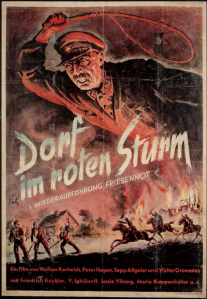
Friesennot was one of several films featuring Mennonite themes promoted by the Third Reich’s Propaganda Ministry. Of these, Friesennot most explicitly depicts Mennonite characters—although even here, the protagonists are referred to not according to their religion but with to the racial term “Frisian.” The film’s plot follows a small Mennonite colony along the Volga in Russia, shortly after the Bolshevik Revolution of 1917. While the Mennonite inhabitants are portrayed as quintessential Germans, the film depicts communists who arrive in their colony as Semitic brutes, who oppress the blond “Aryan” farmers.

The moral dilemma of Friesennot concerns the Mennonites’ pacifism. While the Bolsheviks steal horses and molest women, the Mennonite elder cautions his congregants to turn the other cheek. Continued abuses by the communists prove this foolhardy, however, and eventually the men of the colony take up arms. One evening while the Bolsheviks are inebriated, the Mennonite militia surprises them in the church building—which has been turned into a drinking hall—slaughtering everyone inside. In the final scene, the colonists pack their belongings and depart for a new homeland.

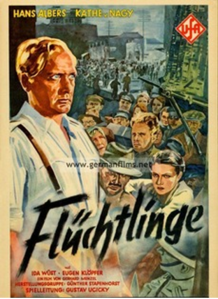
Refugees, 1933

Nazi filmmakers had become interested in Mennonites following an international crisis in 1929 and 1930 when thousands of refugees fled the Soviet Union, arriving both in Germany and in northern China. This event captured German public attention, inspiring extensive newspaper coverage as well as several novels. In 1933, the first film in the Third Reich to win the Propaganda Ministry’s State Film Prize—entitled Flüchtlinge, meaning “Refugees” in English—followed the fate of German-speaking colonists who escaped from the Soviet Union to China.

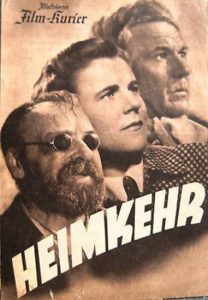
Homecoming 1940

During the Second World War, Nazi films with Mennonite themes became tied to ethnic cleansing. In 1940, a film called Heimkehr, meaning “Homecoming,” valorized National Socialist programs to resettle hundreds of thousands of German speakers—including Mennonites—from across Europe to occupied Poland, where they were supposed to “Germanize” land previously held by Poles or Jews. With Hitler’s invasion of the Soviet Union in 1941, the Propaganda Ministry also re-released Flüchtlinge and Friesennot—retitled Dorf im roten Sturm, meaning “Village in the Red Storm.”

Following the film screening on Friday, discussants noted the various ways that Friesennot contributed to Nazi programs of anti-Semitism before and during the Second World War. Originally produced in 1935, the film coincided with the re-introduction of German military service as well as the passage of the Nuremberg Laws stripping Jews of citizenship and targeting sexual relations between Germans and Jews—a topic of contention in the film. When re-released during Hitler’s invasion of the Soviet Union, Friesennot helped generate support for the Nazi war effort and stirred up anti-Semitism at the same time that death squads were initiating the Holocaust.

Mennonites and the Holocaust: “Neighbors, Killers, Enablers, Witnesses”

20180316_110912Bookending Doris Bergen’s lecture “Neighbors, Killers, Enablers, Witnesses: The Many Roles of Mennonites in the Holocaust” was the call for more scholarship. Her talk, the keynote of the Mennonites and the Holocaust Conference and convocation for Bethel College, focused on the challenges of doing Holocaust scholarship.  Bergen—who is Chancellor Rose and Ray Wolfe Professor of Holocaust Studies at the University of Toronto—explored five specific challenges, increasing in difficulty, with the note that “like those nesting dolls”, each opens new issues even as the resolve others.
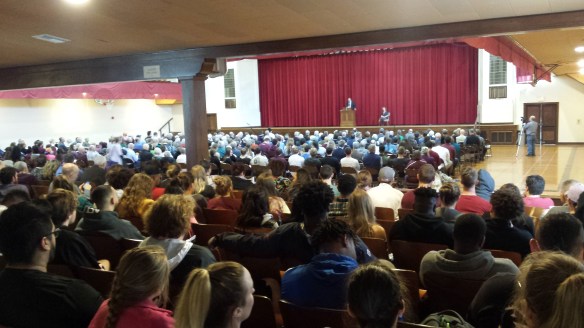
The first challenge looked at insider/outsider scholarship, including its costs and benefits. Mennonite scholars come with some advantages–they have access to some sources, especially oral memories–that could not be found by outsiders. Insiders also make special note  of details others might miss: Bergen recounted being at a talk about the nature of the guards at Auschwitz, and in the general spreadsheet of place of origin and other statistics was a column on religion; one Mennonite was listed. “As an insider you notice and care,” noted Bergen. However, insiders face disadvantages. She singled out the push and pull of mythologies, especially “the myth of Mennonite innocence,” as a factor that can lead scholars to attack, defend, or censor themselves.

The second challenge was the question of definitions, specifically “what is a Mennonite” and “what is the Holocaust?” For the former she gave two guidelines. First, a warning to avoid “the temptation to define to distract” where you become so caught up in the words that you lose sight of the matter at hand. Second, she stressed the importance of having a functional definition of identity, not one based on fluid individual identities, but one that accounts for accounts for all ages and genders, covers communal bonds and how Mennonite identity can be constructed. She also included an admonition not to forget the women, “as defining, narrating, and performing Mennonitism has largely been the work of women.” For the latter, she noted that a proper definition of the Holocaust would consider a chronological range, encompassing both the prewar years and the immediate postwar period, as well as  being constructed by the identity of the perpetrators not the victims.

Bergen’s third challenge was to maintain a clear focus on the way Jews maintained a particular place of destruction in the Holocaust, being mindful of anti-Semitism. It is especially important for Mennonites to examine how Jews and anti-Semitism are built into our narratives. As one example, she recounted hearing how “Mennonites were [like] Jews” being told as the description of their experience; an inversion common across genocides where people take on the identity of victims “as a way of erasing their memory of their roles as victimizers.” She also noted how in Mennonite literature, especially in texts in the 1920s and 1930s, Jews become narrated as villains. The solution to this held up by Bergen was to incorporate literary scholars into the research to help analyze texts deeply, as opposed to taking them at face value. She also highlighted the need to have multiple sources, not just Mennonite and German ones, but Jewish, Roma, and more as well.

20180316_110409The fourth challenge was the questions “how do we avoid writing scholarship that is moralistic or judgemental?” Bergen’s response was to start by noting that studying genocide does not imply that she would personally have done better had she lived in a genocidal context, but “scholarship is about analyzing and understanding–how could people like us behave certain ways?” She also warned against the tendency to use avoiding judgement as a way to avoid discussion. This also gets caught up with the maintenance of Mennonite mythology. One solution given was to use the tools of genocide scholarship, which use comparison. “Mennonites were not unique, though distinctive, many of the issues we explore have been and are being confronted by many other people,” said Bergen, “These can be humbling and extremely liberating.”
The final challenge, as articulated at the beginning, was the need for more scholarship, particularly work “that will contextualize the topic, that will be discipline, that will look for unknown unknowns” an use a broad range of sources and tools. While this is an impossible task for an individual, it becomes possible if many become involved. Specific topics of research named included the Stutthoff concentration camp (situated among Mennonite communities), interactions between Mennonites and Roma, pre-war relations with Jews, and the role of singing and music.

Professor Bergen’s research focuses on issues of religion, gender, and ethnicity in the Holocaust and World War II and comparatively in other cases of extreme violence. During the keynote, she confided that she had not grown up with an innate interest in Mennonite history–indeed she actively avoided it–but it found her nonetheless via the topics she researched; at every turn, Mennonites popped out of the archive. Bergen’s books include Twisted Cross: The German Christian Movement in the Third Reich (1996); War and Genocide: A Concise History of the Holocaust (2003); The Sword of the Lord: Military Chaplains from the First to the Twenty-First Centuries (edited, 2004); and Lessons and Legacies VIII (edited, 2008).1


  1.  http://history.utoronto.ca/people/doris-bergen 

Mennonites and the Holocaust: Conference Opening and Session One

Bethel College

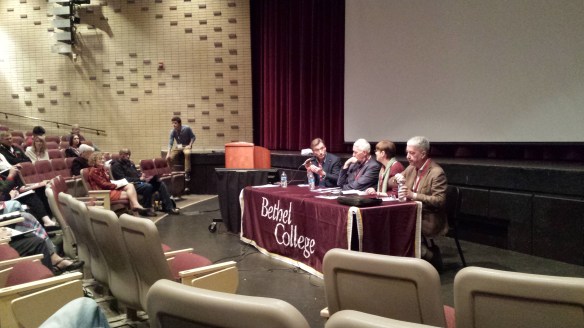
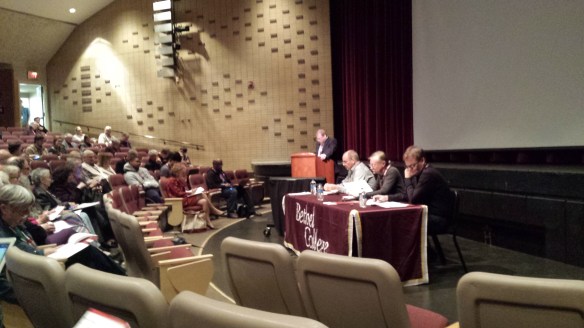
Over two hundred participants gathered today for the “Mennonites and the Holocaust” conference, held at Bethel College in North Newton, Kansas. Bethel President Jon Gering welcomed the assembly for a packed day to discuss challenging topics. Conference co-organizer John Thiesen offered some brief background, noting that this is the third conference in a series dedicated to interrogating the history of Mennonites’ relationship to National Socialism. The first event, which focused on Mennonites and Nazism in Germany, took place in Münster, Germany, in 2015. The second, held in Filadelfia, Paraguay, dealt with the history of Mennonites and Nazism in Latin America. A fourth conference on the topic of “Reading the Bible after the Holocaust” is being planned for the spring of 2020 at Anabaptist Mennonite Biblical Seminary in Elkhart, Indiana.

Seeds planted by this multi-year international dialogue across and beyond the Mennonite church bore fruit today. Many speakers at this “Mennonites and the Holocaust” conference had been present at previous events and made reference to work produced by colleagues in those contexts. Presenters hail from five countries—Canada, Germany, Netherlands, Ukraine, and the United States—and attendees have arrived from across North America. Because this event is sponsored by seven church and educational organizations, discussions have engaged participants with diverse interests and expertise, transcending disciplinary, professional, and faith boundaries. Topics addressed this weekend include: Mennonite-Jewish relations, theology and anti-Semitism, war crimes, postwar refugee experiences, memory, and literature.

Numerous participants expressed gratitude that this event is being held publicly and with formal church sponsorship. The fact that such a conference on Mennonites and the Holocaust is occurring only now in 2018 also highlights, however, the enormous opposition—official or otherwise—that this topic has faced from within the Mennonite community over the past seventy years. In that regard, the current conference is also an imperfect vessel, with many of us still learning how to appropriately, respectfully navigate the best ways to talk and learn about Mennonite complicity in the Holocaust. Today included an impromptu teach-in from a Jewish individual, whose own family had suffered during the Holocaust, who critiqued audience members for laughing at inappropriate moments and encouraged Mennonites to keep the victims of Nazism—not themselves—at the forefront of their minds when talking about anti-Semitic atrocities.

The conference will continue tomorrow with further presentations—and the progress set in motion here will also continue for many months afterward via further dialogue, research, and publications. Here at Anabaptist Historians, we are pleased to be providing full coverage of this groundbreaking event. Be sure to watch this site over the next days and weeks for updates, including new posts with panel summaries, narrative reports, and participant reflections.

Panel Summary

Session One: Pre-War Denominational and Organizational Themes

“Anti-Semitism and the Concept of ’Volk’: The Mennonite Youth Circular Community at the Beginning of the Nazi Dictatorship”
Imanuel Baumann, Haus der Geschichte Baden-Württemberg

  • In the first paper of the conference, Imanuel Baumann provided an analysis of round robin letters circulated between Mennonite youth groups in Germany at the start of the Third Reich. Participants included men and women and were of diverse backgrounds.
  • The concept of “Gemeinschaft,” meaning community, helped provide a bridge to Nazism for many of the writers, who since the 1920s often sought a strong sense of belonging. Nazis aimed to provide this desire for coherence with a new specifically “racial” community.
  • Within the circular letters, anti-Semitic measures in the Third Reich mostly drew silence or positive assessments. Even in cases where Mennonite writers opposed these acts, they only condemned Nazi focus on race as an idol, without questioning racial logics as such.

“Mennonite Scholarship in the Third Reich: From Knowledge Production to Genocide”
Ben Goossen, Harvard University

  • My paper examined the writings of a small but influential cohort of Third Reich academics who produced hundreds of books and articles about Mennonites, often praising members of the denomination as possessing unusual German racial purity
  • These mostly non-Mennonite scholars developed interest in the denomination in the context of a 1929 refugee crisis in the Soviet Union. The temporary “return” of thousands of Soviet Mennonites to Germany generated major public and official interest
  • Nearly all leading Nazi scholars of Mennonitism went on to participate in ethnic cleansing during the Second World War, often deploying concepts they had developed when conducting racial studies on Mennonites to help segregate Germans from non-Germans

“An Illusion of Freedom: Denominationalism, German Mennonites, and Nazi Germany”
Jim Lichti, Milken Community Schools, Los Angeles

  • Drawing on his 2008 book, Houses on the Sand? Pacifist Denominations in Nazi Germany, Jim Lichti discussed the legal and administrative structures of Mennonites in the Third Reich, comparing them with Quakers and Seventh Day Adventists.
  • Mennonites in Nazi Germany identified as members of a “Free Church.” This term could be contrasted with Protestant or Catholic “state churches” as well as with the word “sect,” which was an undesirable designation in the Third Reich.
  • Religious opposition to Nazism more often came from state churches, since Free Churches welcomed Nazi emphasis on separation of church and state. They often also supported Nazi anti-Bolshevism, of particular interest to Mennonites with relatives in the Soviet Union.

America’s Pastor among the “Quiet in the Land”: Billy Graham and North American Anabaptists, Part I

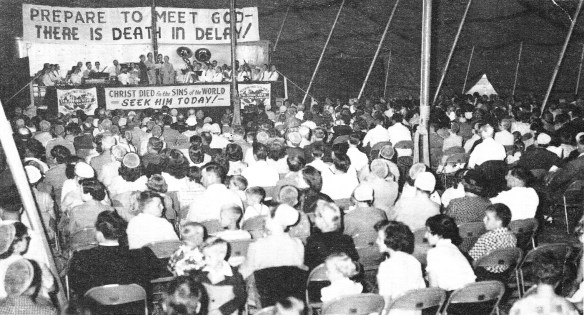
In the summer of 1951, two Mennonites from Virginia — brothers George and Lawrence Brunk — and a team of workers erected a large tent capable of seating 6,000 people in a field in Lancaster County, Pennsylvania. For the next seven weeks, area Mennonites flocked to the tent to hear George preach and Lawrence lead the singing. The services featured all the trappings of had come to define the American revivalist tradition: expressive preaching, compelling music, modern methods of advertising and promotion, and invitations for listeners to leave their seats, walk down the aisle to the altar, and experience a religious conversion. According to reports, hundreds of people came forward at the Lancaster meetings to convert to Christianity for the first time, to renew their covenant as members of the Mennonite Church, or to make a deeper consecration as Christians.1

A man stands with his back facing the camera. He is preaching to a large crowd under a large white canvas tent.

George R. Brunk II speaks during a revival service in the 1950s. Note the large crowd sitting under the massive tent, as well as the signage at the front of the stage. Both of these elements, along with elements of Brunk’s preaching style, are borrowed from another mid-century revivalist: Billy Graham. (Source: Theron F. Schlabach Photograph Collection [HM4-378 Box 1 Folder 4 photo], Mennonite Church USA Archives, Goshen, Indiana)

After closing the event in Lancaster, the Brunk brothers traveled east to Souderton, Pennsylvania, where they held a five-week series of meetings. An article in the Gospel Herald reported that 2,500 people attended the meetings on weekday evenings, an an additional ten to twelve thousand on weekends or closing nights. Those who came to the altar confessing sin and seeking a conversion experience were invited to share their testimony. And yet, attuned to Mennonite expectations about decorum, the Gospel Herald writer also made clear that the meetings were conducted appropriately and without excessive emotionalism.2 From Souderton, the Brunk brothers conducted campaigns in Orville, Ohio and Manheim, Pennsylvania, before the end of 1951. Their crusades continued throughout the 1950s and 1960s.3

The Brunks’ work inspired others. In 1952, after attending the Brunks’ services in Ohio the previous year, Mennonite preachers Myron Augsburger and Howard Hammer each began careers as evangelists, adopting a style cribbed from the Brunk Brothers.4 Also in 1952, a Brethren in Christ minister from Mount Joy, Pennsylvania — John Rosenberry — launched the Living Hope Gospel Campaign and began holding revival meetings in the local area. Rosenberry and his team borrowed the Brunks’ tent for their first series of meetings.5

A large crowd of people sit under a large canvas tent watching a preacher behind a podium. Large signs are posted behind him, proclaiming Christian messages.

A scene from one of John Rosenberry’s Living Hope Gospel Campaign tent meetings, probably in the early 1950s. Note the use of a large canvas tent (just like the Brunk brothers and, before them, Graham) and dramatic signage. (Source: Brethren in Christ Historical Library and Archives, Messiah College, Mechanicsburg, Pa.)

One scholar has noted that these revival meetings “were a dramatic change from traditional Mennonite experience.”6 While revivalism per se was not new to Anabaptists, the style of these mid-century meetings — massive tents, dramatic signage behind and in front of the pulpits, branded materials such as logos, the use of technology such as speakers, and more — were clearly different than those used by previous generations. Anabaptists in the mid-twentieth century were embodying a modern revival style.7

What inspired these Mennonites and Brethren in Christ to launch revival meetings? The answer, quite simply, is Billy Graham.

Today, in popular memory, Graham — who died last week at the age of 99 — is remembered as an evangelist, a presidential confidant, and an influential icon of American evangelicalism. As then-President George W. Bush noted in 2007, Graham was “America’s pastor.”

Moreover, in the historiography of American Christianity, Graham has come to symbolize conservative Protestantism’s move from fundamentalist isolationism to irenic neo-evangelicalism. Graham’s ascendance to the national stage in the late 1940s and early 1950s marked a public “resurgence” (to use the language of Joel A. Carpenter) in conservative Protestantism. Christians from various denominational backgrounds flocked to Graham’s rallies, subscribed to Graham’s periodicals, listened to Graham’s radio program, and watched Graham’s films. In a way, Graham served to unite those communities fragmented by sectarian differences and fundamentalist-modernist schisms.

Indeed, Graham was a symbol of this conservative Protestant resurgence after World War II. But he also modeled a style that characterized this resurgence — a style emulated by well-intentioned imitators such as the Brunks, Hammer, Augsburger, and Rosenberry. As his biographer, the Duke Divinity School historian Grant Wacker, has argued, Graham was a product of his age — an evangelist who rose to fame amid the midcentury rise of mass popular media, youth culture, and organizational efficiency. From the start of his ministry Graham delivered his sermons in a crisp, compelling, and direct manner that mirrored the style of contemporaries such as the news broadcaster Walter Winchell. His preaching was backed up by heartwarming testimonies and toe-tapping music. Moreover, Graham was tall and handsome, perfectly suited to captivate audiences and appear on newsprint pages and glossy magazine covers. And behind him stood the well-oiled Billy Graham Evangelistic Association machine, comprised of a small army of professionals and staffers who promoted Graham’s services through slick advertising, organized and streamlined his growing throng of volunteers, and armed his old-fashioned tent-style meetings with dramatic signage that grabbed the attention of the audience almost as much as Graham’s preaching.8

This period newsreel from Graham’s first revival crusade, held in a Los Angeles field under a big canvas tent in 1949, showcases some of the style that captivated audiences and inspired Anabaptist imitators.

Of course, these methods evolved over time: Graham’s first crusade, held in a Los Angeles field under a big canvas tent in 1949, was a far cry from the stadiums and amphitheaters he filled later in his career. But for midcentury Mennonites and other Anabaptists, this early style was simple enough — yet also sufficiently modern — that they believed they could borrow it, adapt it, and deploy it effectively in order to bring about what they saw as much-needed spiritual renewal in their churches.

Yet it was more than just the would-be Anabaptist evangelists who were drawn to Graham’s style. As the Goshen College historian John D. Roth recently observed in an article for The Mennonite, Graham influenced not only imitators within the Anabaptist fold but also directly inspired the many Mennonites, Brethren in Christ, and other Anabaptist laypeople that attended his crusades:

Long before Mennonites were comfortable with the “ecumenical movement,” they were participating fully in the Billy Graham revival crusades. Many of us were attracted by the biblicism, clarity and simplicity of Graham’s message, and the “altar call” fit well with our conviction that following Jesus should be a public decision. Not least, the Billy Graham crusades offered Mennonites a chance to enter alongside their neighbors into the evangelical mainstream. The long-term impact of Graham’s impact on the Mennonite community has been profound.

As Roth’s comments suggest, many Mennonites embraced Graham, his message, and his style. The work of the Brunks, Hammer, Augsburger, and Rosenberry reflects this positive assessment; they saw his success and the response to his message and style, and sought to emulate it. And the activities of these Anabaptist evangelists would make an important impact on mid-century North American Anabaptism, especially in terms of their relationship to the wider evangelical Protestant world.

But not all Mennonites held such a positive view of Graham or American evangelicalism — or their influence on North American Anabaptism. In my next post, I want to explore some of the negative reactions to America’s pastor. Then, in a final post, I want to use these reflective comments about Graham’s influence as a jumping off point for thinking about one of my major areas of research interest: the relationship between Anabaptism and evangelical Protestantism in twentieth century America. Stay tuned!

NOTES:


  1. Harold S. Bender and Sam Steiner, “Brunk Brothers Revival Campaign,” Global Anabaptist Mennonite Encyclopedia Online, 2009, and Maurice E. Lehman, “The Lancaster Revival,” Gospel Herald, September 4, 1951, 852-853, cited in Beulah Stauffer Hostetler, American Mennonites and Protestant Movements: A Community Paradigm (Scotdale, Pa.: Herald Press, 1978), 281-282. 
  2. Paul M. Lederach, “Revival in Franconia,” Gospel Herald, September 18, 1951, 902-903, cited in Hostetler, American Mennonites and Protestant Movements, 281-282. 
  3. Bender and Steiner, “Brunk Brothers Revival Campaign.” 
  4. James O. Lehman, Mennonite Tent Revivals: Howard Hammer and Myron Augsburger, 1952-1962 (Kitchener, ON: Pandora Press, 2002). 
  5. E. Morris Sider, Called to Evangelism: The Life and Ministry of John L. Rosenberry (Nappanee, Ind.: Evangel Press, 1988), 90-92. 
  6. Sam Steiner, “Brunk, George Rowland (1911-2002),” Global Anabaptist Mennonite Encyclopedia Online, 2016. 
  7. This point regarding revivalism is especially true of the Brethren in Christ, who were engaged in such religious activity as early as the late nineteenth century. See Morris N. Sherk, “Tent Evangelism Among the Brethren in Christ,” Brethren in Christ History and Life 11, no. 2 (August 1988): 157-204. 
  8. This assessment of Graham’s style comes from Grant Wacker, “Billy Graham’s America,” Church History 78, no. 3 (September 2009): 500-504. See also Wacker, America’s Pastor: Billy Graham and the Shaping of a Nation (Cambridge, Mass.: Bellknap Press of Harvard University Press, 2014). 

King William I Allows Mennonites to Serve as Noncombatants, Forcing Mennonites to Chose Emigration or Military Service in Some Form

Mennonites Accept and Contest Military Service in the German East: A Sesquicentennial Series

The five Mennonite elders who had spent over a week in Berlin at the end of February had petitioned the king for an audience on February 20 and used that audience to press their case for a full exemption in exchange for additional cash or medical services provided as civilians. If that was not possible, they wanted a temporary reprieve from the draft which had been imposed by law on November 9, 1867, in order to sell their farms and households before emigrating. The result of their visit and other currents swirling in Prussian politics was that on March 3, 1868, the king signed an executive order granting them the right to serve as non-combatants, a deal that satisfied the vast majority of Mennonites while around fifteen percent ended up emigrating to Russia or the United States. This momentous cabinet or executive order is quoted here in full:

The High Royal Executive Order of March 3, 1868

Because the Confederation law On the Requirement to Serve in the Military, dated November 9, 1867, revoked the Mennonites’ former exemption from personal military service, I declare that the members of the older Mennonite families who do not volunteer to perform normal military duty shall, in accordance with your report of February 29 of this year, be trained to fulfill their military obligations as medics, militia clerks, artisans, and teamsters I hereby permit the Mennonites drafted as militia clerks to be released from firing range training. You are charged with arranging the necessary details.
Berlin, March 3, 1868
(signed) William
To the Minister of War and the Minister of the Interior
(signed) von Roon (signed) Count Eulenburg1

The tussle over how to implement the new draft law for Mennonites had involved the two bureaucracies most responsible for implementing it, the Ministry of War and the Ministry of the Interior, which administered the draft. War Minister Albrecht von Roon, and his temporary replacement, Theophil von Podbielski, thought Mennonites should be spared, since they believed that their religious concerns were genuine and their legal case, that royal privileges trumped parliamentary laws and even constitutions, was valid. It was, in short, a convenient way to forward their political program of maintaining monarchical power. Interior Minister Friedrich zu Eulenburg insisted that the law be followed and that the debate in the North German Confederation Diet had made clear that the lawmakers wanted the Mennonites drafted. Using the Mennonites, he could advance his political program of strengthening the rule of law over the power of the king. The tie breaker in this cabinet disagreement was Chancellor Bismarck, who did not want to be bothered with this arcane religious detail and wanted the machinery of government unstuck and moving forward.2

As a result of this political positioning and the king’s request to resolve the matter, the two ministers drafted an executive order with a copy going to Bismarck and sent it to the king for his consideration on February 29. Their rationale included many caveats. For example, only forty Mennonites a year would be drafted from the congregations along the Vistula River that opposed the draft. This was a much lower number than the one hundred and forty that was thrown around in the parliamentary debates. Since the number was so low it would be easier to implement exceptional rules. In addition, the order would treat all Mennonites in the newly expanded Prussia equally. There were not many Mennonites elsewhere in Prussia and many of them were willing to serve already, so the principle of equality everywhere could be held up without much additional risk of losing soldiers.

Exceptions were made for letting Mennonites serve as orderlies in the hospitals or as clerks. Traditionally, those jobs were reserved for soldiers who had completed their initial duty. However, since one could assume that the Mennonites would both be inclined to serve in these roles and generally exhibit good will, they would be excused from qualifying for them first. The artisans referred specifically only to tailors, cobblers, and saddlers. The teamsters would have to prove prior experience with horses and need to carry arms in any case for use if their wagons were attacked, so non-combatant does not quite capture what is offered here. Roon was skeptical this assignment would be acceptable. Nonetheless, the king signed the draft exactly as submitted by the two officials.3

The impact of this approach by politicians to dealing with Mennonites was at least two-fold. Most obviously, it gave Mennonites a third choice when confronted with military service. In addition to emigrating (or going to jail, as Johann Dyck did now and Mennonites in Prussia had done in the past) or serving outright, they could meet the state halfway by serving as non-combatants. This option opened up a divisive debate among Mennonites and met the politicians’ goal of keeping Mennonites from emigrating while training them to accept military service. In its focus on preventing emigration, it mirrored the forestry service later implemented in Russia, but given the small number of Prussian Mennonites willing to emigrate compared to Russian Mennonites who did so in large numbers even at the hint of military service, the deal Mennonites got was much worse in terms of how service was arranged, as non-combatant instead of church-related forestry service units.4

Less obvious, but reaching perhaps even deeper into the Mennonite community, was the fact that this new approach meant that Mennonites now had to make moral and theological decisions as individuals and not as a community. Leaders worked hard to keep the community together, but those who insisted that all male members serve as non-combatants ran afoul of the law. Thus all that remained for proponents of that option was education and moral suasion. Thus the executive order was reprinted by Mennonites, as in this example from 1879, and distributed widely among Mennonite congregations. Young men were now informed of their right to serve as a non-combatant and encouraged to take advantage of it. That emphasis on a right, however, sounded quite different to traditionalists, who saw it as betrayal of the teaching and example of Jesus Christ. Prussian Mennonites one-hundred-fifty years ago today experienced the problem of individualism challenging a common commitment to living out church teachings that has returned again and again to disrupt Mennonite unity and witness.

SEE OTHER POSTS IN THIS SERIES


  1.   Mark Jantzen, Mennonite German Soldiers: Nation, Religion, and Family in the Prussian East, 1772-1880 (Notre Dame, IN: University of Notre Dame Press, 2010), 268. 
  2. For background and context, see ibid., 191-205. 
  3.   Geheimes Staatsarchiv Preußischer Kulturbesitz Berlin (GStA), Hauptabteilung (HA) I, Rep. 77 (Ministry of the Interior), Tit. 332T (Militärpflicht), no. 5 (Acta betreffend die Mennoniten), vol. 1 ((1819-1868), n.p., 29 February 1868. 
  4.   On Prussian Mennonites going to jail over military service, see Jantzen, Mennonite German Soldiers, 91-2, 98-100, 222-6. The laws that forced congregations to allow individual choices are explained in ibid., 223-6,