Digital History: The German Mennonite Sources Database

By Ben Goossen

What does it mean to bring the “Anabaptist past into a digital century”? The subtitle of this blog includes a playful reference to the anti-modernist stance of many Amish, Mennonites, Hutterites, and other so-called Plain Peoples—as well as an acknowledgement of the widely-held stereotype that Anabaptists do not use technology or engage the modern world. On one hand, the mission of Anabaptist Historians parallels that of any historical organization, namely to uncover, interpret, and make accessible the records of bygone eras for twenty-first century audiences. Yet for scholars of Anabaptism, this task holds unique challenges as well as opportunities.
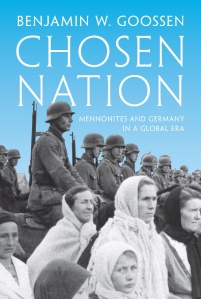
image001

Documents in the German Mennonite Sources Database were collected during the research for Chosen Nation: Mennonites and Germany in a Global Era (Princeton University Press, 2017)

“Digital History” is a practice that, over the past several years, has increasingly shaped the historical profession. In a narrow sense, Digital History refers to projects that primarily use digital tools to tell historical stories, such as animated maps, YouTube documentaries, or interactive wikis. Anabaptist-related efforts such as the extensive Global Anabaptist Mennonite Encyclopedia Online (GAMEO) or the Bearing Witness website, designed to collect stories of persecuted Anabaptists from around the world, fit this definition. At an even broader level, nearly all history done today is “digital” in some way. It is hard to imagine writing an article or reviewing a book without opening Google, consulting an online repository like JSTOR, or downloading an open-access journal. Sending emails, maintaining websites, and using search engines are all part of Digital History.

Some Anabaptist groups are today among the only populations that write history without digital tools. In the summer of 2016, when the Anabaptist Historians Editorial Board was starting this blog, one tough question was how to include conservative Amish and other historians who do not use the internet. Is it possible to represent the full spectrum of Anabaptist pasts and identities in a digital format? Or does the very nature of a blog preclude the participation and accurate representation of some groups? We tried to create a website defined by simplicity – a value with cachet in Anabaptist households and Silicon Valley alike – yet reaching conservative populations remains difficult. When communicating with one historian in the Weaverland Conference, for example, I copy and paste web text into my messages or send screenshots as attachments, since he uses email but no internet browsers.

In other circumstances, Anabaptist history can feel tailor-made for digital approaches. With a relatively small population – around two million members are active worldwide – major digital projects are more feasible than they would be for larger demographics. Anabaptism, as a religious movement, is also blessed with substantial institutional resources, including church libraries, denominational archives, and nongovernmental organizations. Many have already undertaken Digital History initiatives. And joining these is a vast webscape of informal Twitter feeds, Facebook pages, chat room support groups, and genealogical sites. Previous posts on this blog have begun a fascinating dialogue about the places where Anabaptist history happens, including discussions of the value of borderland perspectives, centralized archives, and public history. How can we think about cyberspace as a location of and platform for historical work?

Over the past seven years, I have been working on a large-scale digitization project, the German Mennonite Sources Database. Released in October and hosted online by the Mennonite Library and Archives in North Newton, Kansas, this is the largest digital repository of books and newspapers by or about Mennonites in Germany as well as one of the most complete collections on this subject anywhere in the world. The database spans the years 1800 to 1950 and includes approximately 100,000 pages of text, including thousands of books, pamphlets, newsletters, and articles. Its purpose is to make historical resources available to anyone who reads German and is interested in religious history. Readers will find documents pertaining to virtually every aspect of German Mennonite life, ranging from sermons and catechisms to texts on nonresistance, the draft, and Nazism. Some topics are expected, such as hymn selections and condemnations of oath swearing. Others less so – like an 1859 rumination on vampires in the world’s first journal of folklore.

The German Mennonite Sources Database began as a personal resource, growing out of research conducted for my book, Chosen Nation: Mennonites and Germany in a Global Era, forthcoming in 2017 from Princeton University Press. As a history of Mennonites’ worldwide entanglement with German nationalism during the nineteenth and twentieth centuries, Chosen Nation required familiarity with a wide spectrum of issues, from congregational and institutional life to historical, educational, and mission activities, involvement in war and political movements, peace declarations, gender, genocide, and anti-Semitism. In archives across Europe and the Americas, I found myself digitizing dozens or sometimes hundreds of documents a day. The essential tools of the Digital Historian include a computer, cell phone, digital camera, and a bevy of cords, adapters, and USB sticks. My archival desks unfailingly resembled a crow’s nest of snaking wires and metallic boxes.

A major advantage of Digital History is its ability to make scarce resources widely available. Documents that might exist only in one or two places in the world become accessible to anyone with a modem. This has a democratizing effect, since travel to distant libraries or archives usually requires deep pockets or university support, while digital files can be downloaded from the comfort of home. With Optical Character Recognition (OCR) software and online translation services (some of which now use artificial intelligence), texts in German or other languages can be rendered quickly and with stunning accuracy into English. Still another advantage is that different researchers bring diverse perspectives to the same sources. Documents in the German Mennonite Sources Database, for instance, might find wide interest beyond my initial purposes – hopefully providing a basis for articles, dissertations, scholarly debates, and family research.
warning-and-suggestions

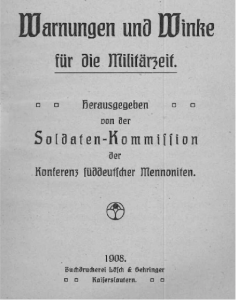
Warnings and Suggestions for Military Service, a handbook for Mennonite soldiers, is one of thousands of books, pamphlets, and articles now available via the German Mennonite Sources Database

Not all history is digital, of course, and not all Digital History is good. While open-access sites like the German Mennonite Sources Database are available to all, many research venues like Ancestry.com or HeinOnline lock material that would be provided for free in physical libraries behind digital paywalls. In this age of uneven globalization, the web remains only partially worldwide, with internet unavailable to the earth’s most disadvantaged populations – those lacking power in both senses of the word. As Anabaptists, we are also attuned to the spiritual politics of the internet. Is it possible to use digital tools in ways that are constructive rather than damaging, uniting rather than alienating? Such questions resonate with current public debates about internet bullying, cyberterrorism, and fake news. Some plain Anabaptists find a solution in eschewing digital resources altogether.

Our challenge then, as Anabaptist historians, is to consider not only how to engage Digital History, but also how to do so responsibly. Can we find ways of digitizing library holdings that also increase donations and visits to physical locations? Can we build integrated networks to share data and exchange ideas without losing sight of the distinctive needs and identities within the Anabaptist church family? Perhaps we could take cues from the wonderful work already undertaken by friends and colleagues – such as the open access website of Anabaptist Witness, the database of Anabaptist-related websites hosted by Mennonite Church USA, or the breathtaking Mennonite Archival Image Database. The tools offered by Digital History are like any new resource. They invite us to explore and affirm their limitations, while also finding fresh ways of working together.

You can access the German Mennonite Sources Database here.

Thanks to John Thiesen and the Mennonite Library and Archives for hosting the German Mennonite Sources Database, as well as to Rosalind Andreas, Kevin Enns-Rempel, Rachel Waltner Goossen, Royden Loewen, Titus Peachey, John Roth, Astrid von Schlachta, and Paul Toews for their support.
From the Shenandoah Valley to No Man’s Land at Christmas

img_6176-2

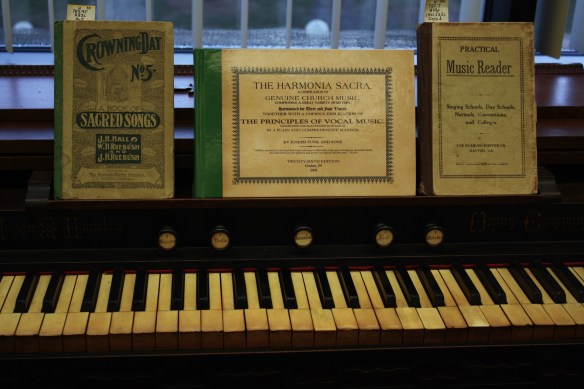
The most recent edition of the Harmonia Sacra (2008) next to some songbooks by the Ruebush-Kieffer company displayed on Aldine Kieffer’s organ. Menno Simons Historical Library

Simone D. Horst

Though I’ve lived in Harrisonburg and worked with the EMU Special Collections for nearly eight years now, it took a British Christmas advertisement for me to fully appreciate the musical heritage of the Mennonites in the Shenandoah Valley. Sainsbury’s is a supermarket chain in the UK and, like many other retailers in the UK, creates specific holiday-themed advertisements to entice Christmas shoppers to their stores. Two years ago I saw their 2014 Christmas advertisement online  and was intrigued to hear a familiar tune.  For this ad they had partnered with the Royal British Legion to commemorate the 100th anniversary of the Christmas Truce of 1914. The beautifully shot commercial features British and German soldiers in the trenches singing “Silent Night/Stille Nacht” and then as they join together in no man’s land the viewer hears the strains of “Leaning on the Everlasting Arms” (starting at 2:09). When I Googled the hymn to figure out why it was so familiar, I discovered that it was written by an Anthony Showalter from Rockingham County, Virginia. Thus my curiosity about Mennonite hymnody in the Valley was piqued.

I knew that Mennonites have long been regarded for their unique tradition of acapella singing and talent for four-part harmony. But I didn’t realize how much influence a man who lived in a town ten miles northwest of where I live and work had in shaping the tradition.

The story begins with Joseph Funk. Funk was the son of Mennonite Bishop Henry Funk and moved to Rockingham County, Virginia from Pennsylvania with his family as a young boy. A bit of a jack-of-all-trades, he worked as a farmer, teacher, herbalist, and translator before settling in Mountain Valley (now Singers Glen), Virginia1 and beginning his work as a printer. He found success in the music business, doing a great deal of translation, compilation, and printing. He also ran singing schools, teaching individuals of all ages how to read music and sing. One of his greatest contributions is his development of shape-note music2; a musical notation that employs different shaped notes to denote pitch. He used this method in his singing schools and it quickly gained popularity as it was easy to learn and effective. Funk believed that all church members should be able to “take part in the ‘divine art’ of singing sacred songs” and went so far as to actively discourage the use of choirs in Mennonite and other denominations in order to encourage congregational singing3. Through his singing schools and shape notes he also introduced Virginia Mennonites to three- and four-part harmony and to singing in English, two practices that later spread throughout most Mennonite communities in North America.4

Funk printed numerous song-books, but his most famous work is the Harmonia Sacra, a collection of ‘genuine church music’ that is a beloved songbook still used in Harmonia Sacra ‘sings’ throughout the Valley.

Funk’s grandson, Aldine Kieffer, continued his musical tradition with his partnership with Ephraim Ruebush. They began their collaboration teaching singing schools together before the outbreak of the Civil War, then after the conflict finished (both served, neither having been raised Mennonite), they began the Ruebush-Kieffer publishing company. They started printing in Singers Glen then moved the operation to Dayton, Virginia, in 18785. Through their singing schools and their song books they taught many people in the Shenandoah Valley and beyond to sing the shape-notes and tunes devised by Funk.

One person so influenced by this legacy was Anthony Johnson (A. J.) Showalter from Rockingham County, Virginia. His father was a singing school teacher from the Funk tradition, so Showalter grew up attending singing schools and studying music. He began his career working for Ruebush-Kieffer as a singing school teacher and in the publishing house. Showalter later moved to Georgia and became a prolific composer; his most recognizable tune is “Leaning on the Everlasting Arms,” which he wrote in 1887 after hearing about two friends losing their wives6.

Though many can recognize the tune, few may know its connection to the Shenandoah Valley or its ties to Mennonite hymnody. Once I learned the hymn’s provenance I felt that it was an odd, yet perhaps apt, juxtaposition to have a hymn born out of a Mennonite tradition of song used in a commercial about war that highlights one of the few peaceful moments of the horrific conflict. I’m sure when the advertising executives chose the song, they had little idea of its connections to an historic peace church tradition in rural Virginia, but to me that makes it even more meaningful. 

*If you are interested in learning more about Joseph Funk and the Ruebush-Kieffer legacy, the Menno Simons Historical Library is a great place to start! We have a nearly comprehensive collection of Ruebush-Kieffer and Funk song books, as well as interesting artifacts like Joseph Funk’s writing chair and Aldine Kieffer’s organ (which is still played occasionally by Lois Bowman, former librarian and wonderful volunteer).

References:

Brunk, Harry Anthony. 1959. History of Mennonites in Virginia 1727-1900. Staunton, Va: McClure Print. Co.

Eskew, Harry, Wm. B. Blake, B. C. Unseld, John Walter Wayland, and Weldon T. Myers. 1995. Two notable shaped-note leaders: combined from Musical million, Dayton, Virginia. Wytheville, Va: Available from Jim Presgraves, ABAA, Bookworm & Silverfish.

McNeil, W. K. “Showalter, Anthony Johnson.” Encyclopedia of American Gospel Music. New York: Routledge, 2005. 339-40.


  1.  The town was founded by Joseph Funk and initially named “Mountain Valley.” It was later renamed Singers Glen to honor his and Ruebush-Kieffer’s contribution to music in the area. 
  2.  Though Funk is often credited with developing the first form of shape note notation, this is likely not the case. But he did develop one unique to his work and schools.  
  3.  Harry Brunk, History of Mennonites in Virginia: 1727-1900, (Staunton, Va.: McClure Print Co., 1959), 121. 
  4.  Brunk, 118. 
  5. Weldon T. Myers, “Aldine S. Kieffer, the Valley Poet, and His Work” Two notable shaped-note leaders. (Wytheville, Va.: Available from Jim Presgraves, ABAA, Bookworm & Silverfish, 1995), 21-25. 
  6.  W.K. McNeil, s.v. “Showalter, Anthony Johnson” Encyclopedia of American Music, (New York: Routledge, 2005), 339-340. 

On Being a Watch Listed Historian in the Age of Donald Trump

Tobin Miller Shearer

The evening of Monday, November 21, 2016, I received an email from a colleague. In it, she wrote, “You are on a ‘professor watch list’ compiled by a right-wing group.… Sorry to be the bearer of bad news….”

I had just returned home from leading a three-hour graduate seminar during which we discussed at length what it means to write advocacy history. Some students felt it essential to tailor their research and writing so that it could speak to present-day public policy. Others felt that contemporary interests fundamentally compromised historical scholarship. The only thing that mattered was whether you were true to the historical record.

Historians often tell uncomfortable truths about the past, truths that many in our church and society would prefer to forget.

In the subsequent days and weeks since my name showed up on the Professor Watchlist website and the list received national attention in the New York Times and elsewhere, I’ve given a lot of thought to the subject of advocacy and the practice of writing history. It is not accidental that the developers of Professor Watchlist have targeted more academics from the field of history than from any other discipline. Historians often tell uncomfortable truths about the past, truths that many in our church and society would prefer to forget. Frequently the truths we tell as historians do influence public policy in tangible ways, whether we want them to or not.

I’ve spent the better part of the last ten years researching the Fresh Air rural hosting movement, a summer vacation program for urban children in which white Mennonite families have regularly participated. From the end of the nineteenth century through to the present, white rural and suburban families hosted children from urban centers for one- to two-week summer vacations. My research focuses on the period between 1939 and 1979 when the program transitioned from white families hosting white children to white families hosting black and brown children.

mla-bethel-1960-gulfport-group-with-bus

Photo of group of twenty-one African-American youth from Gulfport, MS, preparing for Mennonite sponsored Fresh Air trip to Kansas in July 1960. Used with permission of Mennonite Library and Archives, Bethel, Kansas

Back in 2008, I contacted the director of the oldest and most well known hosting group, the Fresh Air Fund, based out of New York City. Formerly known as the Herald Tribune Fresh Air Fund, the New York Times is now its primary publicity partner. In that initial phone conversation, I described my research to the director. Although at first she was quite thrilled to hear that I would be writing a book about the Fresh Air movement, her tone abruptly shifted when I explained that I would be examining the programs’ racial dynamics. She went from friendly to icy in a minute. Despite my best efforts to assure her that I was a trained, professional historian, she informed me that they had no archive and, even if they did, I would not be given access to it.

I followed up the conversation with subsequent requests for access to their materials and, several years later, arranged to stop by their offices while I was on a research trip to New York. Despite a warm welcome and a tour of their offices, my request for access to their records was again denied, this time by both their executive director and their board. They told me that they had had a bad experience with a graduate student and, therefore, no longer gave researchers access to their records. Interestingly, a short while after they denied me access, they opened their archives to a historian from an Ivy League school with whom I had begun to correspond. His focus on the program’s early years did not touch on race.

The Fresh Air were wary of my agenda. Those who put me on Professor Watchlist were likewise suspicious that I carry an agenda. In the case of the former, an agenda to expose a troubling truth about the way race worked in Fresh Air programs. In the case of the later, an agenda to expose a troubling truth about the way race worked in society.

In my line of work, being singled out for extra scrutiny is not new. In the past, right wing groups ranging from the KKK to a group called Campus Reform have targeted me. Thus far, little has come of such scrutiny other than ill-conceived and rather anemic death threats. Although we are in a new and deeply troubling political climate at the moment, I remain wary but not unduly concerned.

But that is not the point of my essay.

Rather, I want to explore the possibility that I do have an agenda, that I am somehow breaking an ethical code by pursuing advocacy history. That possibility bothers me far more than being included on a Watchlist.

In the discussion with my graduate students, I made the point that sometimes advocacy history keeps historians from asking certain questions because they don’t want the subject of their research to look good – or bad – depending on their topic and particular political interests. In a recent discussion about his research on the black freedom struggle in Alabama during the 1960s and 1970s, civil rights movement historian Hassan Jeffries described how difficult it was to write the last chapter of his book, Bloody Lowndes: Civil Rights and Black Power in Alabama’s Black Belt. In that chapter, he had to describe the disappointing outcome of electoral politics in Lowndes County. Even though black citizens had finally earned the right to vote, black politicians lost touch with the freedom values that had brought them into office; they then betrayed their constituents. It was not a story that Jeffries wanted to tell, but he knew that he had to tell it or his historical project would have no integrity.

I’ve wondered if my own scholarship has that kind of integrity. On the one hand, when I’ve written about white Mennonites, I’ve been very conscious of the perception that I have an agenda, one bent on exposing Mennonite racism. As a result, I’ve been meticulous in my documentation, deliberate in my attempt to contextualize and explain, careful not to hold white Mennonites to a standard that was not present at the time.

In the instance of Mennonite involvement in the Fresh Air program, I’ve described the programs as one-way, short-term, paternalistic endeavors that valorized the country at the expense of the city. But I did so only after discovering that African-American leaders within the church were equally critical of the programs at the time that they were being offered. As my research expanded to look at the Fresh Air Movement in its entirety, I discovered even more critical voices calling for discontinuation of the programs. One critic famously exclaimed that the programs allowed children of color to visit white suburbs for one week every summer but then locked “them out the other 51 weeks of the year.”1

The book that emerged from those ten years of research, Two Weeks Every Summer: Fresh Air Children and the Problem of Race in America features those critics. Of course, I also include accolades from an adoring press. But, as I look back at that work and my body of research on Mennonites writ large, I have to agree with my critics at the Fresh Air program and Professors Watchlist. I do have an agenda. It is not, however, the one they have accused me of having.

Back in 2008, the Fresh Air Fund director accused me of emphasizing something that they had “never paid attention to.” She was referring to race. Yet my agenda is not so much to focus on race – even though I have reams of evidence that, at least by the 1960s, the program claimed race relations as its raison d’etre – as it is to engage in truthtelling. You can’t tell the truth if you don’t tell the whole story. At that time, the Fresh Air Fund simply didn’t want to hear the racial side of their story.

Professor Watchlist has accused me of talking about systemic racism and white privilege in my classes and, more generally, of “discriminat[ing] against conservative students and advance[ing] leftist propaganda in the classroom.” Again, they are off the mark. I do most certainly talk about systemic racism and white privilege in the classroom but make a point of inviting students to disagree and debate with me at every turn. The minute students feel that they can’t disagree with my perspective, I am no longer doing my job. Here again, my interest is in challenging my students to engage with a difficult truth, one that most of my students have not previously encountered.

So, yes, I do believe that there is such a thing as a historically determinable truth. It is not coincidental that the discourse of postmodernism – one which calls Truth with a capital T into question – has emerged at a point when female, black, brown, gay, lesbian, and trans voices have finally begun to be heard in society. Postmodernism suggests that there are only individual perspectives, that all truth is relative. My study of history has convinced me that, while there are many perspectives, there are also raw realities evident in the practice of slavery, the denial of women the vote, the institution of apartheid and Jim Crow, and the persistent and recurring evidence of racism, sexism, and abuse within the white Mennonite community, some of it directly connected to Fresh Air ventures as former Fresh Air participant Janice Batts has courageously made known. And so despite being denied access to the Fresh Air Fund records, I kept on writing; despite being put on a watchlist, I will continue to teach history and research difficult topics.

A coda: a week after the Watchlist came out, I received an email out of the blue from the new executive director of the Fresh Air Fund. A volunteer had sent her a link to a lecture I gave on the programs at Eastern Mennonite University this past January. She wanted to talk about “your studies, findings, perspectives, and thoughts of the ‘Fresh Air’ Friendly Towns, in particular.” It was a gracious note. We will be speaking in two weeks.

Like me, the Fund’s executive director is deeply concerned that we “now sit with the reality of a Trump presidency.” Although I expect that we will have differing perspectives on the contemporary worth and value of a program that I have found fundamentally paternalistic and based on assumptions of white superiority, I am equally convinced that we will have much to learn from each other. At this point I don’t know what the outcome of our conversation will be, but I am eager to discover where a path of advocacy history in a time of watchlisting will take us.


  1. Ellen Delmonte, “An Editorial Feature,” Call and Post, Saturday, July 3 1971. 

What do Public History’s methods have to offer Anabaptist History (and the Anabaptist Future)?

Mainstream (that is, acculturated) North American Anabaptist denominations have made efforts to reach outside of ethnic and geographical boundaries in many ways over the last century and a half. Beginning with the resettlement of Mennonite Refugees in the 1870s and continuing with mission and service efforts at home and abroad, these efforts have had varying amounts of success (however success is quantified). If this is a continuing social and evangelical goal for these denominations and the populations that compose them, the discipline of public history can provide strategies and techniques to achieve it.

Public history is a field that doesn’t like to be pinned down. Academic programs branding themselves as “Public History” sprang up in the 1970s in response to a shortage of jobs in academia, but the work the newly minted public historians did had a long history. Many of the products of the discipline—exhibits, archives, lectures, oral history, monuments and markers—were the only history products that existed prior to the nineteenth century and the Rankean professionalization of academic history. In the early twentieth century, public history had flourished in the form of the Works Progress Administration and the National Parks Service.

In the last half century, the field of public history has tried to define itself, often settling for the distinction that it is concerned with history outside of the academy. Yet at the same time public history has proliferated within the academy, with new public history programs emerging every year. Part of this explosion of interest is pragmatic: with fewer tenure-track jobs in the humanities available than the number of graduate students, departments must prepare their pupils for life outside of the academy. In part, however, public history is the logical extension of the social history movement of the 1960s. Public history often seeks to decentralize history through such tenets as shared authority. In the prologue to Museums, Monuments, and National Parks: Toward a New Genealogy of Public History, Denise Meringolo argues that public history is “practicing history not simply in public but rather for the public” (italics in original). By engaging in collaborative work with inter-disciplinary methods, Meringolo suggests, public historians who self-identify as such primarily see their work as public service.

So what would specifically Anabaptist public history look like? Or to put the emphasis differently, what would public Anabaptist history look like? Or what does it look like? Within the field of Anabaptist History, we already have many institutions that could be called public history: archives and libraries, local and regional historical societies, and interpretive exhibits in museum settings, to name a few. In several cases, multiple elements are present together, as in the Mennonite Heritage Center in Harleysville, PA, and Lancaster Mennonite Historical Society, which combine exhibit space with library and archives. Efforts such as Lancaster Roots, a calendar of cultural events by the Lancaster Mennonite Historical Society and 1719 Hans Herr House & Museum, take history out to churches and invite people in with specific programming on cultural crafts, as well as lectures.

However, these institutional settings tend to be intrinsically conservative in nature. Jarrett M. Drake has written about the oppressive experience of archives, which protect the resources within them through the tyranny of “silence, solitude, and surveillance.”1 Furthermore, archives often exclude people by virtue of their accessibility—located far from public transport or open for limited hours—or simply by the hoops would-be researchers must jump through—registration, fees for copying through convoluted mechanisms, etc.

On this blog in recent months we’ve seen calls to “deterritorialize” Anabaptist History from Felipe Hinojosa and Jason B. Kauffman. What could that look like?

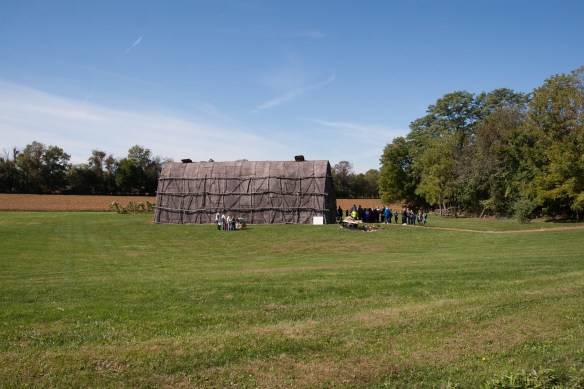
The Lancaster Longhouse at the 1719 Has Herr House & Museum (created in collaboration with Lancaster Mennonite Historical Society, the Circle Legacy Center, and local American Indian groups) is one example of public history in an Anabaptist context, though its creators may not have envisioned it as such. The digital archive of a (relatively) diverse Anabaptist web presence by Mennonite Church USA’s archive (begun under Colleen McFarland Rademaker’s tenure as archivist) is another way forward.

pa-lancaster-mennonite-historical-society-october-14-2016-132028

Lancaster Longhouse at the 1719 Hans Herr House & Museum

This is the work of history but it has bearing on the present and future reality. The Longhouse and the MC USA web archive are both attempts to share authority with communities that have been held at arm’s length, at the the periphery, by Anabaptist denominations and academia. If Anabaptist denominations want to move toward a more diverse population (racially and otherwise) within North America, the techniques of public history present one way toward reconciliation and engagement with populations that have been excluded, offended, or oppressed by the church and/or the academy. This could also be an opportunity to connect with Amish and Plain communities who have been left out of the academic history of the last fifty years other than as subjects of academic work (and the Lancaster Roots approach is especially suited for this outreach). At the root of all of those efforts must be a willingness to cede truth-telling power, truly collaborate, and have projects and the greater church move in directions that weren’t expected or hoped for.

More traditional public history institutions can make changes to deterritorialize their collections. Archivists can identify collections that have been overlooked—those that provide a window into the lives of the evangelized as well as the missionaries, the lives of women as well as men, and the lives of Anabaptists whose sexuality was not recognized as legitimate by their social and religious communities, among others—and invite scholars to tell the stories they contain. Traditional methods such as historic preservation can be used in areas outside of the traditional Anabaptist enclaves—some of the first 1-W or MVS units could make fascinating historic house museums. Some changes could be painful. The Heinrich (Henry) Voth collection in the MC USA archives could be repatriated to the Hopi Reservation, for instance, even though the Native American Graves Protection and Repatriation Act (NAGPRA) doesn’t extend to photographic materials.

The work of public history is not apolitical. As an example of the aims and methods of public historians in this country, it is instructive to read the National Council on Public History’s editorial in the wake of the presidential election.2 The whole piece is worth a read, but here’s the crux of the argument: 

Promoting education and dialogue will likely not be enough to ensure that human rights are respected. Public history exhibits and projects provide people with tools to parse how fear and self-interest can be manipulated, but if we want to walk our talk, our institutions will need to continue to strengthen emerging practices of direct engagement and civic action that we see around the field.”

While standing up for immigrant, minority, and refugee rights fits comfortably within Biblical calls to action, historians working in MC USA-affiliated organizations may find that advocacy for other vulnerable groups, such as LGBTQ Americans (which is also within the scope of “the least of these”) puts them in political or ethical quandaries at work. Historians may find themselves, in the coming years, in the public arena against their will, as our own Tobin Miller Shearer did this week when he was listed by an alt-right group for “advanc[ing]leftist propaganda in the classroom.”

This work is not simple. As Philipp Gollner cautions,  it will be easy for white progressive voices to drown out others, even while seemingly asking for input.3 The Mennonite world that I grew up in was proud of its humility, multiculturalism (even while being predominately white), and progressivism. Yet that very progressive identity can shield against self-reflection. Humility, self-examination, and willingness to listen when others tell you that you are wrong are all necessary in this work.

More pragmatic concerns are where the financial and social capital would come from to develop more innovative public history programming. The Anabaptist historical institutions that exist have long histories, yet little surplus that they could gamble on an ephemeral program that may or may not have the desired effect. Our colleges face tough financial times, and the departures of Lancaster Conference and others from MC USA  have put fund-raising throughout the Mennonite non-profit world in jeopardy in ways that may have knock-on effects.

So what does public Anabaptist history look like in a North American context and what should or could it look like? Our institutions have been resourceful with the budgets they’ve been given, but also tended to take conservative forms. I want to see Anabaptist Historians (the folks who contribute to this blog as well as the broader field) try new ways of making history that get out of our fellowship halls and our college campuses and our archives and combine the concerns of our religious community—pacifism, social justice, and the Dominion of God—with the methods and verve of public history. As public history moves toward disruptive techniques that cede control and challenge traditional narratives, public Anabaptist historians should do the same. As the greater discipline hears a call to activism, public Anabaptist historians should embrace the same call, especially where it aligns with the ethics we espouse in our congregations and households. We should approach the challenges that come—including funding shortfalls and awkwardness—with humility as well as fervency.


  1. Jarret M. Drake, “Libraries and Archives: Towards Belonging and Believing,” On Archivy, October 22, 2016 https://medium.com/on-archivy/liberatory-archives-towards-belonging-and-believing-part-1-d26aaeb0edd1#.fb37008sb 
  2. National Council on Public History, “A Response to the Election,” History at Work, November 11, 2016 http://ncph.org/history-at-work/a-response-to-the-election/ 
  3. Phillip Gollner, “Who Calls Whom Racist, and What’s The Privilege With That?” Anabaptist Historians, November 4, 2016, https://anabaptisthistorians.org/2016/11/04/who-calls-whom-racist-and-whats-the-privilege-with-that/ 

Holding to the Jot and Tittle: Deaconesses in Virginia Conference

Anna Showalter

I grew up in a Mennonite community that did not recognize women in positions of church leadership.  As times changed, I assumed that my sisters and I were the first generation of women in our family to imagine that our calls to ministry might be affirmed and even ordained by the Mennonite Church.  Imagine my surprise when my dad discovered that my great-great-great-grandmother, Elizabeth Shank Showalter, was ordained as a deaconess in 1889 to the Middle District of Virginia Conference!  As much as I celebrated the rediscovery of my deaconess matriarch, I also learned that church polity, influenced by a renewed zeal for doctrinal conformity, significantly confined the role of the deaconess, eventually making it obsolete.

elizabeth-shank-showalter

Deaconess Elizabeth Shank Showalter

Deaconesses were an anomaly in the (Old) Mennonite Church except for in the Middle District of Virginia Conference, where around 28 women were ordained as deaconesses loosely between the years of 1861-1962.1  Deaconesses were appointed to assist ministers in providing for the pastoral care and physical needs of women and girls and to help facilitate services of baptism, communion and footwashing.2  The role of deaconess, at its best, offered women an outlet for meaningful (albeit modest) ministry in the church complete with public affirmation through ordination (of a kind).  However, as power consolidated around conferences and Bishops, Mennonites began emphasizing doctrinal and behavioral uniformity.  As a result, the role of deaconess was significantly curtailed to focus heavily on monitoring women’s dress and behavior.  

Mennonite historians have amply documented increases around the turn of the century in ordered organizational structures in conferences, which consolidated power to Bishops and enforced order in doctrine, dress, and congregational life.3  This institutionalization was part of an attempt to secure and clarify Mennonite identity so that it could withstand the challenges of a modern era.  Maintaining doctrinal and behavioral compliance was a struggle, however.  In 1919, the Middle District of Virginia Conference reported that out of its 700 members only 100 men and 175 women “conform to the regulations of the church.” Leadership addressed this problem, saying, “We need to redouble our energy.  We need to hold to the…jot and tittle and it is necessary to place more emphasis on this subject now since the world is against it.”4

The responsibility for holding women to the “jot and tittle” fell to deaconesses.  Their work increasingly consisted of “visiting women and girls, members of the church who were out of line in dress, morals and conduct.”5  Holding the line included ensuring that other women were dressed properly, particularly for communion and baptism, sewing suitable garments for converts in mission posts and “visiting” (a euphemism for correcting) those who did not comply.  

Some deaconesses fully embraced their role in holding the line. Deaconess Betty Keener believed wholeheartedly in the importance of the bonnet and plain dress.  A missionary with her husband in West Virginia from 1909-1912, she sought to bring the women there into compliance with Mennonite standards of dress.  She was appalled to learn that “fault had been found” in a convert who ceased to wear her bonnet because she didn’t feel comfortable being the only woman her community to do so.  The woman was seen in “one of those big straw hats and jewelry.” The sister in question “flew off the handle” when confronted and said, “ If you can’t carry me as I am, scratch my name off the book.”  Betty expressed her disappointment.  “How could she?  How can it be possible for her whom we thought consecrated to fall away so soon?  What has done it?”6  

Other deaconesses, however, had more empathy with the “transgressors” and felt the burden of enforcing standards.  Frances Suter Harman, daughter of deaconess Pearl Suter, recalled impressions of her mother’s ministry in the 1930s and 40s.  “The deaconesses of those later years often felt that their duties were becoming onerous, as they tried to hold the line with the rules for the dress of the women.  They did this for the bishops who felt they should not become involved in overseeing that the women and girls were dressed properly for baptism and communion.”7  Another daughter remembers feeling how much her mother worried about the task of visiting sisters who had fallen into sin—a task assigned by church leadership as hers to “deal with.”

By the 1940s and 50s, as the work of the deaconess became more “onerous,” fewer deaconesses were ordained, and finally in 1962 the Middle District Ministerial Council decided that the wives of ordained men would perform the duties of deaconess but without title or ordination.  In her study of Virginia Conference deaconesses, Ruth Lehman suggests that the ministry of deaconesses had “become so mundane that the vision of the possibilities for the office in the life and growth of the church were no longer seen.”8  Someone still needed to bake communion bread, wash out basins for foot washing and attend to women’s needs in the church, but the role of deaconess had become so confined to upholding discipline that there was no longer vision for a recognized ministry role for women in the church.   The ministerial council decided that pastors’ wives should take over these tasks.  Thus, church polity, with its solidifying institutions and insistence on doctrinal and behavioral uniformity, first curtailed the role of the deaconess before finally phasing it out.

Thus, church polity, with its solidifying institutions and insistence on doctrinal and behavioral uniformity, first curtailed the role of the deaconess before finally phasing it out.

The story of my deaconess great-great- great-grandmother was completely forgotten by my family until my dad stumbled across it while doing family research.  We are surprised that my grandpa, a knowledgeable Mennonite historian, never told us about it.  His cousin compiled the deaconess list at the archive so surely he would have seen it.  We will never know if Grandpa didn’t know about his deaconess great-grandmother or if he chose not to talk about it because of his opposition to women in leadership.  In any case, those of us who know about Elizabeth Showalter and the deaconesses of Virginia Conference have the opportunity to remember forgotten leaders of our past and to be aware of how church polity continues to affect marginal leaders in our own day.  

Today women serve in a variety of roles in Virginia Mennonite Conference and are ordained as pastors.  Concerns about holding to the “jot and tittle” no longer pertain to plain dress, but issues of authority, decision-making, compliance and discipline continue to affect leaders in minority positions.  Are negotiations between ministry on the margins and conference polity once again “onerous?”  The future of a viable ministry for leaders in minority positions may depend on the answer to that question.  


  1.  Ruth K. Lehman, “Deaconesses of the Middle District of Virginia Conference,” (class paper, Eastern Mennonite Seminary, 1989), 40-42. 
  2.  Lehman, 14. 
  3.  James C. Juhnke,  Vision, Doctrine, War: Mennonite Identity and Organization in America, 1890-1930, vol. 3: Mennonite Experience in America (Scottdale, Pa.: Herald Press, 1989), 119. 
  4. Minutes of the Virginia Mennonite Conference (1835-1938), (Scottdale, Pa,  Virginia Mennonite Conference, 1939), 125. 
  5. Lehman, 14. 
  6.  Henry Brunk, History of Mennonites if Virginia 1900-1960, (Verona, VA. McClure Printing Company, Inc., 1972), 188. 
  7.  Lehman, 17. 
  8.  Lehman, 22. 

Mennonites, Mission and Race: The Cleveland Experiment

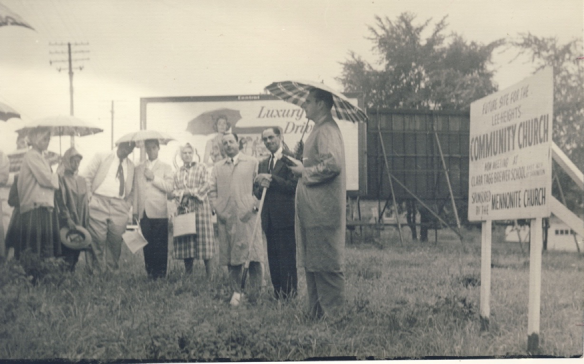
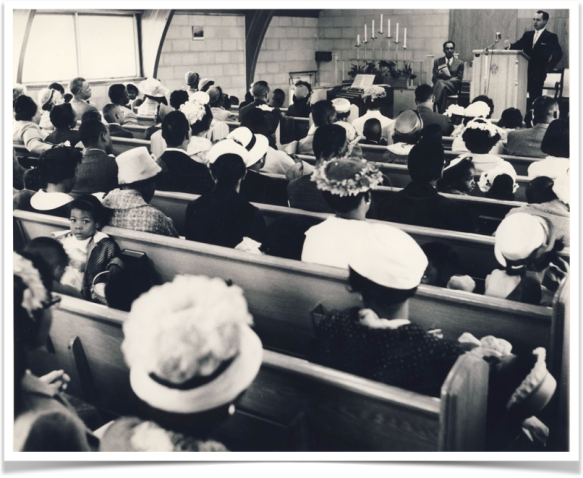
My Mennonite identity was born of the convergence of post-World War II urban missions and African American migration to the city of Cleveland. The Lee Heights Community Church in Cleveland was one of the original 13 Black Mennonite congregations, and is perhaps one of the very few Mennonite churches in the U.S. that has had a racial consciousness to it since its very beginning. Established in 1958, this congregation emerged against a complicated background of race and politics.

lee-heights-groundbreaking

Groundbreaking at Lee Heights Community Church

Before World War I, about 10,000 Black people lived in Cleveland. By 1960, that number had swelled to a quarter million, with most Black families living on the east side of the city. The influx, especially between 1940 and 1960, greatly taxed the availability of housing and schools, and they were often inadequate and in poor condition. These conditions, replicated in cities across the country, erupted in the Hough riots in 1966. Tensions rose, as well as distrust of Cleveland’s old guard politicians, setting the stage for the election of the first Black mayor of a major U.S. City. Cleveland was attractive because jobs were available. Black men could find work, especially in the steel and auto industries. Other jobs possibilities were with the post office, and teaching and social work jobs were open for Black women, in addition to domestic positions.

lee-heights-community-church-early-days

Worship service during the early days of Lee Heights Community Church

As opportunities increased for Black people, so did white flight. Suburbanization and the completion of interstate highways facilitated the shift in housing patterns. As Blacks moved into previously all white neighborhoods, white families moved out. The neighborhood transitions were facilitated by the institutionalized racist policies of realtors, construction companies, banks, and mortgage and insurance companies. Riots along the east coast and throughout the Midwest accelerated the push of Black out of white neighborhoods and helped Black neighborhoods become firmly entrenched ghettos by World War II. 1

This was the climate when Mennonites began their urban missions projects in earnest.

The heightened racial unrest occurred at the same time white Mennonites were moving from isolated farming communities to major cities. As conscientious objectors to war, Mennonite men who otherwise would have been drafted into military service fulfilled their civic duties by entering into 1-W service, often in cities. Common assignments were located in hospitals and public service agencies. Denominational mission and relief agencies also helped coordinate voluntary service assignments in urban communities; through these avenues many young white Mennonites first encountered African Americans and had eyes opened to the reality of racism and Black discontent in America.

gladstone-mennonite-church

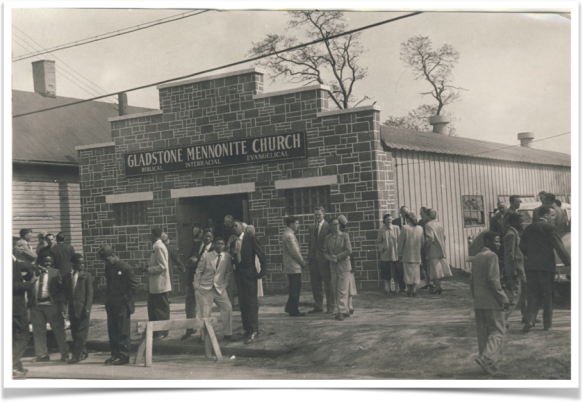
Gladstone Mennonite Church

The Mennonite church in Cleveland church began as a Bible school, run by volunteers from the nearby rural Plainview (later Aurora) Mennonite Church in the 1940s. This ministry was located in the Gladstone area near East 55th Street, and housed in an elementary school. By 1948, over 400 children had attended the summer Bible school, and that year, the program was extended into the fall. A house was purchased and renovated in 1951 for the Voluntary Service (VS) unit, which housed men who were doing 1-W service in Cleveland. In 1952, Vern Miller, a recent Goshen College graduate, and his wife Helen moved into the area.2

lee-heights-community-church-pastor-vern-miller-with-parishoners

Vern Miller, pastor of Lee heights Community Church, with parishioners

Gladstone’s first church council was organized in the spring of 1953 when the church had 35 members, most of whom lived in the neighborhood. The congregation quickly outgrew the original building, and the VS unit was eventually phased out. In 1955, plans for an urban renewal project signaled the end of the Mennonite ministry at Gladstone.3

The Housing Act of 1949, part of president Harry Truman’s Fair Deal [Thank you Linda Rosenblum for that correction], expanded the role of the federal government in housing, and chief element of the plan provided federal funds for “slum clearance” with the promise to build new public housing developments. Entire neighborhoods were razed in order to make room for non-residential public works, and in some cases rebuilt housing that was too expensive for the current inhabitants. Poor people, usually people of color, were pushed out of their neighborhoods, inspiring the pithy saying “urban renewal equals Negro removal.” 4

With the mission board’s backing, the Millers decided to move southeast of the first church into the Lee Heights area where there was only one other church. The area had recently been annexed by the city; the land was not desired by industry because it was partially wooded and had ravines running through it. When the congregation formally organized in 1957, they were first known as the Protestant Inter-Racial Parish. These dynamics were the DNA for the new church – a ministry of the Mennonite Church, but interdenominational and community based. The doctrinal statement of the church included a statement of the church’s stance against racial segregation and discrimination.

In 1959, the General Conference Mennonite Church issued a statement called “The Christian and Race Relations” that confessed Mennonites were complicit in “discrimination against racial and minority groups (Mexicans, Negroes, Jews, American Indians, Oriental peoples, and others),” weakening mission outreach. Because “in Christ all barriers of race and nation have been destroyed,” the statement urged congregations to “welcome all persons as brothers and members despite their color” and called on all church institutions to examine their policies and programs. 5

The 1963 General Conference Confession of Faith called the church to be a witness against racial discrimination, economic injustice, and all forms of human slavery and moral degradation. 6

At a conference on race relations in 1964, Vincent Harding challenged Mennonites, arguing they had come late to the issue even though their very theology and history compelled their response. 7

Mennonites in America were no longer as socially isolated, and the fruits of mission efforts meant that people of different racial and cultural backgrounds were now part of the Mennonite family; this diversity necessitated an expansion of Mennonite’s peace position.

Guy Hershberger’s 1941 (revised 1953) War, Peace and Nonresistance articulated the Mennonite stance on non-resistance for the 20th century church. Written in part to explain Mennonites to outsiders, but mostly to help that generation of American Mennonites understand their theology, the book outlined the biblical basis for Mennonite non-resistance, and went beyond military involvement to address issues like responses to labor union tactics as part of a peace witness. Hershberger was clear that a faithful biblical response to violence was to not resist; one did not pick up the sword, and tactics like demonstrations, boycotts and strikes were to be avoided because these were coercive; that is, not nonresistance. 8

For this reason, Hershberger could not support Gandhian (and subsequently Civil Rights Movement) tactics of boycotting and demonstrating. Yet he did call Mennonites to a response to racial injustice and racial unrest.

Challenges also came directly from the African American community. In 1945, the Mennonite Biblical Seminary moved to Chicago. While working on a doctorate in history at the University of Chicago, Vincent Harding was called to co-pastor the integrated Woodlawn Mennonite Church, where his spouse, Rosemarie Harding, also served as a lay counselor. The Hardings pressed Mennonites to use their peace and justice theology as a response to systemic racism. This call is certainly relevant for Mennonites today.


  1. Stephen Grant Meyer, As Long as they Don’t Move Next Door: Segregation and Racial Conflict in American Neighborhoods, (Lanham, MD, Rowman and Littlefield Publishers, 1999), 31. 
  2. Willard Helmuth, “The History of the Lee Heights Community Church,” Unpublished paper, January 11, 1962, 2. 
  3. Mennonite Board of Missions and Charities, ed., 1956 Report of the Mennonite Board of Missions and Charities (Elkhart, Ind.: 1956): 79. 
  4. James Baldwin, interviewed by Kenneth Clark, “The Negro and The American Promise,” Boston Public Television, 1963. 
  5. “A Church of Many Peoples Confronts Racism (General Conference Mennonite Church, Mennonite Church, 1989).” Anabaptistwiki, Accessed February 13, 2016. 
  6. “Mennonite Confession of Faith, 1963.” – Global Anabaptist Mennonite Encyclopedia Online, gameo.org (Accessed February 13, 2016). 
  7. Felipe Hinojosa, Latino Mennonites: Civil Rights, Faith and Evangelical Culture, (Baltimore, Johns Hopkins University Press, 2014), 49. 
  8. Guy Hershberger, “Biblical Nonresistance and Modern Pacifism,” in War, Peace, and Nonresistance (Scottdale, Pa.: Herald Press, 1944), 222-223. 

Call For Papers: What Young Historians Are Thinking

What Young Historians Are Thinking Symposium

June 5, 2017

The Lancaster Mennonite Historical Society, in partnership with the Sider Institute for Anabaptist, Pietist, and Wesleyan Studies at Messiah College and with the Young Center for Anabaptist and Pietist Studies at Elizabethtown College, welcomes paper proposals for its event “What Young Historians Are Thinking.”

Invited to participate are undergraduate, graduate, and doctoral students, those who have just started careers in history, and those who are “young” in scholarly study of historical topics (no matter what their age). All must be engaged in original research using chiefly primary sources (written and/or oral). All should be a part of an Historic Peace Church (Amish, Brethren in Christ, Church of the Brethren, Mennonite, Religious Society of Friends/Quaker, etc.) or focusing on one or more of these traditions.

Those interested should submit a 250-word proposal for a 20-minute paper to be given at the symposium, along with a brief autobiographical sketch and full contact information. Send these to Joel Nofziger at Lancaster Mennonite Historical Society, 2215 Millstream Road, Lancaster, PA 17602, or at younghistorians@lmhs.org. A limited number of travel scholarships are available. Please note in the proposal whether this will be needed. The symposium will take place at Ridgeview Mennonite Church in Gordonville, Pennsylvania, at 7:00 p.m.

Symposium Planning Committee: Jeff Bach, Simone Horst, Devin Manzullo-Thomas, Joel Nofziger, and Anne Yoder.

Proposals are due April 14, 2017

Now You’re the Institution

Jason B. Kauffman

My reference to a Ben Folds song probably dates me, but lately I’ve been thinking about the relationship between archives, institutions, and power. According to historian Paul Toews (described by Felipe Hinojosa in a recent blog), as I write this blog I am sitting in one of the “archival centers of the Mennonite universe.” I recently began working as director of the Mennonite Church USA Archives in Goshen. As a senior at Goshen College (2005) I spent long hours in the archives researching for my history thesis project.

When I reported for my first day of work in July, the archives looked (and smelled) pretty much like I remembered them, complete with a stone bust of Sanford Calvin Yoder (President of Goshen College from 1923 to 1940) and a large plaque listing the names of “pioneer leaders” (all white men of European descent) in the (old) Mennonite Church. One of the men, Jacob Gottschalk (the first Mennonite bishop in Germantown, Pennsylvania), is a distant family relative. So, to quote Ben Folds again, “how’s it feel to be the man?”

I don’t have a simple answer to that question. As a historian, I resonate with Hinojosa’s call to “deterritorialize Mennonite studies” and to tell the stories of Mennonites whose lives unfolded on the periphery, far removed from “holy places” like Goshen, Newton, Lancaster, or Winnipeg. I spent the majority of graduate school resisting the centralizing forces in my discipline which told me that the only topics worthy of study were those with an established historiography, focused on places at the centers of political or economic power. Latin American history is very nation-centric and I found a niche in the study of frontiers and borderlands, a subfield which questions the centrality of the nation-state in the stories historians tell about the region and its people. In a similar way to the Mennonite community in south Texas that Hinojosa describes, I discovered that what it means to be Brazilian or Bolivian looks very different from the margins than it does at the center. Place matters.

However, institutions also matter. For historians, institutions matter because they are the entities most likely to preserve the documents that we rely upon to analyze and write about the past. While my research focused on one of the most sparsely populated regions in South America, I would not have been able to write my dissertation without going to institutional archives in Rio de Janeiro or La Paz. Indeed, the available sources often dictate the types of questions we can ask (and answer) about the past. Through my research, I was able to learn much about how representatives of the Bolivian state felt about migratory laborers and the many ways officials attempted to control the movement of goods and people across borders. I learned comparatively little about the complex motivations that guided individuals in their decisions to migrate in search of work, how they felt about these decisions, and how such decisions impacted their lives and families.

Such archival silences are, of course, also present at the MC USA Archives. For example, collections in the archives yield much information about how church leaders and academics felt about growing Mennonite involvement in business after World War II but much less about businesspeople themselves, those who built successful businesses while navigating the norms and expectations of the broader Mennonite community. Despite such limitations, many historians have made creative use of the MC USA Archives. For example, recent studies have mined collections for sources that document Mennonite involvement during the Civil Rights movement and the complicated dynamics of racial prejudice and discrimination that pervaded this involvement.1 And there are many more sources yet to be discovered. But this does not change the fact that the voices of institutional (white, male) leaders are overrepresented in the archives and those of ethnic minorities, women, LGBTQ people, and those otherwise removed from institutional centers are underrepresented. This reality is itself a reflection of the history of the Mennonite Church as an institution.

Through my job as the archivist, I am now a part of this institution. I am keenly aware of the power that institutions hold to shape the terms of historical memory and its production.2 Archives play a key role in this equation because the written word is one of the primary ways in which people and institutions preserve history for future generations.3 Archives are also powerful weapons that institutions have used in their efforts to minimize or, in some cases, completely erase elements of the past.4 History is replete with examples of the many ways that institutions have done damage to the broader communities that they represent.

At the same time, now that I’m on the “inside” my perspective is beginning to shift. From the outside, institutions often seem like faceless entities, engaged in a timeless quest to centralize authority and wield power to advance their own agendas. It is often easy to forget that the Mennonite Church is a complex institution made up of complex individuals, each with different backgrounds and changing (and, in many cases, different) beliefs, motivations, and goals. All share a deep commitment to the broader Mennonite community and many are actively working to promote peace and social justice; to combat racism, prejudice, and discrimination; and to redefine what it means to be Mennonite.

No institution is perfect and good intentions do not erase the inequalities and injustices that persist. It is difficult to predict what form the institutional Mennonite Church will take in the next decades or how it will evolve or adapt in response to our rapidly changing denominational landscape. In 2116, who will future generations of Mennonites look back and recognize as the “pioneer leaders” of the twenty-first century? I hope that the list will be much different than the one currently hanging in the archives, made up of many more people from the farthest reaches of the Mennonite universe.

To explore one of the ways that the MC USA Archives is working to document the diversity of Mennonites voices, check out this online archive of Mennonite websites, which preserves the websites of Mennonite news outlets, MC USA agencies and conferences, and Mennonite bloggers. Let me know of others that I should add to the list!


  1.  Many of these recent studies also make excellent use of oral histories, critical sources for documenting and understanding the lives and experiences of people underrepresented in the written historical record. 
  2.  See, for example, Michel-Rolph Trouillot, Silencing the Past: Power and the Production of History (Boston: Beacon Press, 1995). 
  3.  Kathryn Burns, Into the Archive: Writing and Power in Colonial Peru (Durham: Duke University Press, 2010). 
  4. For a recent – and excellent – exploration of these dynamics at play, see Kirsten Weld, Paper Cadavers: The Archives of Dictatorship in Guatemala (Durham: Duke University Press, 2014). 

Tell Me Your Stories and I’ll Tell You Mine

This is a response to “Mennonite Genealogy and Racial Privilege” by Ben Goossen.

Steve Ness

As librarian and archivist at the Lancaster Mennonite Historical Society (LMHS), a question that I hear quite often is, “Do the genealogical records in your library only include Mennonites?” My response is to encourage any researcher with an ancestral connection to southeastern Pennsylvania (and Lancaster County in particular) to spend some time digging into the many genealogical resources that we make available. While our focus is on the history of the Mennonites of this area, the genealogies and other resources in our collections contain many non-Mennonites as well. Any good genealogist will understand that they cannot claim that all of their ancestors were of a particular denomination any more than they can claim that they were all admirable.

Any good genealogist will understand that they cannot claim that all of their ancestors were of a particular denomination any more than they can claim that they were all admirable.

Ben Goossen, in his post, “Mennonite Genealogy and Racial Privilege,” states that little has been written about how Mennonites have historically approached the field of genealogy. I agree that it is a subject that warrants proper investigation.1 Despite the dearth of research, however, Goossen makes the claim that, “Over the past century, white Mennonites have expressed uncommon interest in their ancestry.” I suspect that this cannot be substantiated and that Mennonite interest in genealogy is not significantly different than one would find among the rest of the population.

As is the case with many historical societies, the majority of visitors to the LMHS library arrive with the purpose of conducting genealogical research. A conservative estimate would be ninety percent. Of these, probably fewer than half consider themselves to be Mennonite. Some suspect or have been told that they have some Mennonite or Amish ancestry; some already know that they do, and some are surprised to learn of a Mennonite connection. This is due to historic migration patterns that have interwoven Mennonites into the fabric of broader Pennsylvania German culture in southeastern Pennsylvania. Many people across the United States—both Mennonite and non-Mennonite—have ancestral connections to this area which they value.

If Mennonite family and religious identity is so tightly bound, why aren’t more Mennonite individuals, congregations, and institutions expressing greater interest in their history?

Many LMHS members are not Mennonite and, despite the fact that the Historical Society serves as the official repository for Lancaster Mennonite Conference (LMC) and Atlantic Coast Conference (ACC) records, LMC and ACC congregants represent a disappointingly-small percentage of LMHS membership overall. If Mennonite family and religious identity is so tightly bound, why aren’t more Mennonite individuals, congregations, and institutions expressing greater interest in their history? Even one of the examples Goossen provides of a “Mennonite genealogical publication”—Theodore W. Herr’s 1908 book on the descendants of Hans Herr—was neither written by a Mennonite nor printed by a Mennonite publisher.2

Genealogy is one of the most popular hobbies in the United States.  A 2008 poll cited by USA Today identifies only gardening as being more popular.3 The air time that major television networks have provided for shows focused on genealogy is additional evidence of its general appeal. The article’s author recognizes that genealogy has been used as a tool for exclusion but, unlike Goossen, emphasizes instead the value of genealogical research in helping us—all of us—understand better the stories of our past that help to shape us today.

Is there such a thing as “Mennonite Genealogy?” I am doubtful. Certainly there is privilege in the ability of white Mennonites to trace many of their ancestral lines back multiple generations with relative ease. I would argue that honest engagement with our past reveals a richer diversity in our stories than we might first imagine. Rather than seeing genealogy as a tool to build walls, we should embrace it as a technique to learn from and value the stories of everyone. Let’s sit down and listen to each other. You tell me your stories and I’ll tell you mine.


Steve Ness is a graduate of Eastern Mennonite College (B.S., History and Social Science) and Clarion University (M.S.L.S., Library and Information Science). His ancestry includes persons who were Amish, Church of the Brethren, Lutheran, Mennonite, United Brethren, and others.


See also:


  1. Such research should include a more comprehensive examination of Christian Z. Mast, whose words in A Brief History of Bishop Jacob Mast… sound troubling to our twenty-first-century ears. Good historical research will look more carefully at the context in which Mast was writing, how the words quoted by Goossen fit with Mast’s other writings, and how representative Mast was of the larger Mennonite community at that time. Until such research is done I think it wise to temper condemnation. 
  2.  The book was republished twice by the Lancaster Mennonite Historical Society—in 1980 and 1994. The third edition contained updates and corrections by Phillip E. Bedient, former emeritus professor at Franklin and Marshall College and member of the United Methodist Church. 
  3. Rodriguez, Gregory. “Roots of Genealogy Craze.” . Online at  http://www.usatoday.com/story/opinion/2014/05/12/genealogy-americans-technology-roots-porn-websites-column/9019409/.