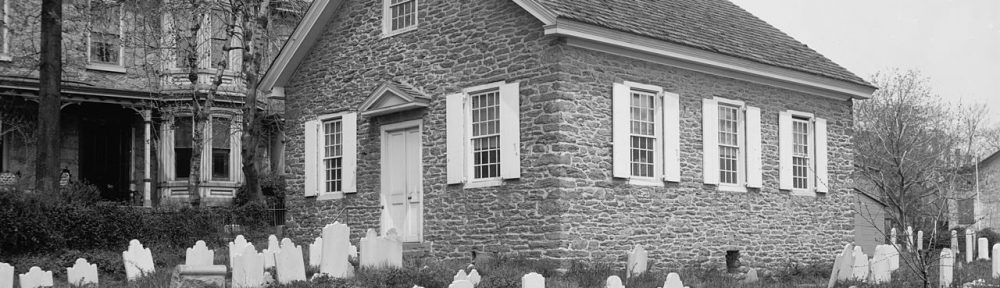
Mennonites and the Holocaust: An Introduction

Mennonites entered Nazi consciousness in 1929, when 13,000 refugees descended on Moscow, clamoring to leave the Soviet Union. In Germany, the National Socialist Racial Observer took up their cause. Blaming Jews and Bolsheviks for oppressing Mennonites, the paper condemned Western democracies for ignoring their plight. In one front-page article, editor Alfred Rosenberg—who had led the Nazi Party while Hitler was in prison—offered what he considered a solution. “The National Socialist movement,” he wrote, “recognized this danger [of ‘Judeo-Bolshevism’] from the beginning and built that into its essence.”1 Little more than a decade later, Rosenberg felt that the Second World War had vindicated his position. Traveling in 1942 and 1943 through Nazi-controlled Ukraine as Reich Minister for the Occupied Eastern Territories, he announced to crowds in the Mennonite colonies of Chortitza and Molotschna that tables were finally turned.2 Already, death squads had murdered most of Ukraine’s 1.2 million Jews.

“Film footage of Alfred Rosenberg’s visit to the Chortitza Mennonite colony in Nazi-occupied Ukraine, June 1942.”

Seventy-five years after the Holocaust, the global Mennonite church has yet to confront its entanglement in this genocide. While stories have long circulated privately and in some academic publications, only recently have they garnered sustained public attention.3 In this light, the upcoming conference, “Mennonites and the Holocaust,” to be held at Bethel College in North Newton, Kansas, on March 16 and 17, 2018, is a breakthrough. [EDIT 5/29/2018: coverage of the Mennonites and the Holocaust conference can be found here.] The event promises serious discussion of the church’s relationship with Jews and Judaism, a topic vitally important to Mennonites around the globe. Sponsored by seven Mennonite religious and educational institutions, including Mennonite Church USA, this conference brings together leading scholars of Anabaptism and of the Holocaust from five countries. A film screening and the keynote lecture by Doris Bergen—who is Chancellor Rose and Ray Wolfe Professor of Holocaust Studies at the University of Toronto—are free and open to the public. Registration for panel sessions is now open.
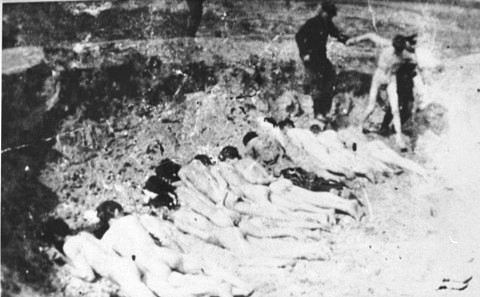
A naked prisoner is led to an execution site in the Stutthof concentration camp 2

Some of the 60,000 victims killed at the Stutthof concentration camp, a source of slave labor for Mennonite farms and factories. Credit: Holocaust Education & Archive Research Team

Mennonite experiences of and involvement in the Holocaust differed widely. We know that a handful of individuals actively participated as executioners and concentration camp guards. We also know that a substantial percentage of Europe’s Mennonites benefited from and often sympathized with aspects of Nazism. Around 120,000 people, or about one-fourth of the denomination worldwide, lived under Nazi rule at the height of Hitler’s expansionism. Generally categorized as members of the Aryan racial elite, Mennonites sometimes received goods taken from murdered Jews or moved into their vacant homes. Others leased slave labor for their farms and factories, or otherwise profited from genocide.4 Yet many Mennonites also suffered. Life in wartime could be brutal, not least in German-occupied Western Europe, where some Mennonites joined the resistance.5 A number were executed or sent to concentration camps for political activities or for possessing Jewish heritage or cognitive disabilities.6 And a small but important subset—primarily in the Netherlands and France—hid Jews.7
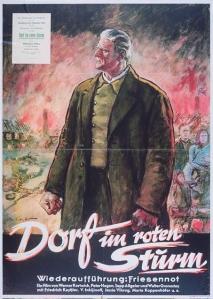
dorf_im_roten-sturm_1941

A poster for the Nazi propaganda film, Frisians in Peril, re-released in 1941 as Village in the Red Storm. Here, the Mennonite congregational elder is portrayed as a stoic Aryan in the face of Bolshevik oppression.

Arguably more impactful than Mennonites’ own actions, however, was the denomination’s enrollment in Nazi propaganda. In 1929, popular opinion had pressured German politicians to help approximately 4,000 of the Mennonite refugees in Moscow relocate to Germany. The event became a founding myth of the Third Reich, inspiring novels and two of the Nazis’ most important early films, Refugees (1933) and Frisians in Peril (1935). Both were re-released in 1941 during Hitler’s invasion of the Soviet Union.8 In general, Mennonites became symbolic of Aryans’ supposed ability to maintain German cultural traditions abroad. Hundreds of books and articles by the Third Reich’s leading experts on German speakers in Canada, the United States, Mexico, Paraguay, Galicia, Ukraine, the Volga region, and Siberia depicted the denomination in glowing terms. Many of these authors eventually translated their theories into ethnic cleansing by consulting for the Wehrmacht, East Ministry, and SS.9

As for Mennonites overseas, most remained unaware of or uninterested in Nazi flattery. But they were equally apathetic to the fate of European Jews.10 Moreover, certain communities developed robust fascist sensibilities. In Paraguay and Brazil, entire colonies hoped to “return” to the Reich.11 Leading Mennonites helped finance the German Paper for Canada, a pro-Nazi organ.12 And in the United States, Herald Publishing House of Newton printed the rabidly anti-Semitic Defender, whose monthly circulation reached 100,000.13 As a site for the upcoming conference, Bethel College is an appropriate choice, given that it was Bible professor J. R. Thierstein who, as editor of The Mennonite during the 1930s, gave that periodical its anti-Semitic slant. Readers of the Bethel College Monthly likewise learned from Thierstein that “harm done to the Jews was insignificant by comparison with the great service Hitler had performed in saving Germany from Communism and its Jewish adherents.”14

In 1945 when the Third Reich collapsed, church institutions on both sides of the Atlantic worked to suppress allegations of Mennonite collaboration. The Pennsylvania-based Mennonite Central Committee, in particular, feared for the safety of 45,000 Mennonite refugees in postwar Europe. Administrators believed that these individuals might be denied humanitarian aid and—as actually happened to around half—deported to the Soviet Union. Under MCC auspices, prominent scholars and churchmen sent dozens of memos to military personnel, refugee organizations, and the United Nations. These documents portrayed Mennonites as “strict pacifists,” as non-Germans, and as abhorring National Socialism.15 Receptive bureaucrats developed an erroneous impression that huge numbers had performed “slave labour” for the Nazis, while the New York Times reported that they suffered “as the Jews.”16

Denialism has marked public discussions ever since. While other Christian denominations began self-scrutiny decades ago, conservative strategies—such as emphasizing Mennonites’ own hardships, referencing “Germans” instead of “Nazis,” and refocusing on Bolshevik atrocities—have depressed engagement for generations in Paraguay, Canada, and Germany.17 Little wonder, perhaps, that several of the twentieth century’s leading white supremacists and Holocaust deniers wrote fondly of their Mennonite backgrounds.18 Even among well-meaning and respected church members, anti-Semitic tropes continue to circulate. In 2017, Mennonite periodicals carried pieces that alternately excused genocidal killings by invoking Jewish communists, and denied that Jews were murdered near Mennonite colonies.19 In fact, death squads’ meticulous wartime reports are all too clear. 10,000 Jews were shot on October 13, 1941, for instance, fifty miles from Chortitza.20 And that was just one day.
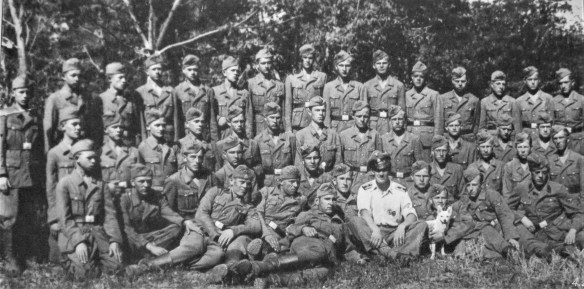
Loewen, Road to Freedom, pg 106

Members of a Mennonite Waffen-SS squadron in Ukraine’s Molotschna colony, 1943. Credit: Harry Loewen, ed., Long Road to Freedom: Mennonites Escape the Land of Suffering (Kitchener, ON: Pandora Press, 2000), 106.

The “Mennonites and the Holocaust” conference will provide a crucial step in our denomination’s journey toward recognition and atonement. Already, strongly-attended conferences in Germany and Paraguay have raised aspects of Mennonites’ involvement with National Socialism, and since 2015, three edited volumes and numerous journal articles have brought the subject to a wide readership. Yet almost none of this literature has broached the Holocaust specifically—a sign that major soul-searching remains for Mennonites. On a global scale, Mennonite World Conference and its member entities have recently participated in dialogue with Lutherans, Catholics, and others. Such deliberations have resulted, to much fanfare, in Mennonites accepting apologies for the persecution of sixteenth-century Anabaptists during the Reformation. Whether our church is willing to extend the same grace toward victims of a much larger and more recent outpouring of violence, remains to be seen.

Register for “Mennonites and the Holocaust,” North Newton, Kansas, March 16-17, 2018.

Ben Goossen is a historian at Harvard University. He is the author of Chosen Nation: Mennonites and Germany in a Global Era, published in 2017 by Princeton University Press.


  1. Alfred Rosenberg, “Das deutsche Bauernsterben in Sowjetrußland,” Völkischer Beobachter, November 24/25, 1929. For context, see John Eicher, “A Sort of Homecoming: The German Refugee Crisis of 1929,” German Studies Review 40, no. 2 (2017): 333-352. On Rosenberg, see Ernst Piper, Alfred Rosenberg: Hitlers Chefideologe (Munich: Blessing, 2005). 
  2. Alfred Rosenberg, “Besichtigungsreise durch die Ukraine vom 18.6. bis 26.6.42,” Captured German and Related Records, T-454/105, National Archives and Records Administration, College Park, Maryland; “Aus dem Zeitgeschehen,” Deutschtum im Ausland 26, no. 5/6 (1943): 115-116. 
  3. For an overview of early scholarship on Mennonites and Nazism, see John D. Thiesen, “Menno in the KZ or Münster Resurrected: Mennonites and National Socialism—Historiography and Open Questions,” in European Mennonites and the Challenge of Modernity: Contributors, Detractors, and Adapters, ed. Mark Jantzen, Mary S. Sprunger, and John D. Thiesen (North Newton, KS: Bethel College, 2016), 313-328. 
  4. Gerhard Rempel, “Mennonites and the Holocaust: From Collaboration to Perpetuation,” Mennonite Quarterly Review 84, no. 4 (2010): 507-549; Doris L. Bergen, “Protestant, Catholics, Mennonites and Jews: Identities and Institutions in Holocaust Studies,” in Holocaust Scholarship: Personal Trajectories and Professional Interpretations, ed. Christopher R. Browning, Susannah Heschel, Michael R. Marrus, and Milton Shain (New York: Palgrave Macmillan, 2015), 142-156; Benjamin W. Goossen, Chosen Nation: Mennonites and Germany in a Global Era (Princeton: Princeton University Press, 2017), 121-173. 
  5. See the contributions in Jelle Bosma and Alle Hoekema, eds., “Doopsgezinden tjdens de Tweede Wereldoorlog,” Doopsgezinde Bijdragen 41 (2015), as well as Alle G. Hoekema, “Niederländische Taufgesinnte während des Zweiten Weltkriegs,” in Mennoniten in der NS-Zeit: Stimmen, Lebenssituationen, Erfahrungen, ed. Marion Kobelt-Groch and Astrid von Schlachta (Bolanden-Weierhof: Mennonitischer Geschichtsverein, 2017), 173-184. 
  6. This is one of the least studied aspects of Mennonite-Nazi interactions. Examples include Gerlof Homan, “‘We Must and Can Stand Firmly’: Dutch Mennonites in World War II,” Mennonite Quarterly Review 69, no. 1 (1995): 7-36; Christiana Duschinsky, “Mennonite Responses to Nazi Human Rights Abuses: A Family in Prussia/Danzig,” Journal of Mennonite Studies 32 (2014): 81-96; “David P. Boder Interviews Anna Braun,” September 20, 1946, Voices of the Holocaust Project, online
  7. Gerlof Homan, “Friends and Enemies: the World War II Origins of MCC Work in France,” Mennonite Historical Bulletin 71, no. 2 (2010): 7-14; Gerlof Homan, “From Danzig to Down Under: A Mennonite-Jewish Family’s Escape from the Nazis to Australia,” Mennonite Historical Bulletin 73, no. 1 (2012): 13-18; Alle G. Hoekema, “Dutch Mennonites and German Jewish Refugee Children, 1938-1945,” Mennonite Quarterly Review 87, no. 2 (2013): 133-152. 
  8. David Welch, Propaganda and the German Cinema: 1933-1945 (London: I.B. Tauris, 2006), 108-109, 207-213. 
  9. Part of this history is discussed in Benjamin W. Goossen, “Mennoniten als Volksdeutsche: Die Rolle des Mennonitentums in der nationalsozialistischen Propaganda,” trans. Helmut Foth, Mennonitische Geschichtsblätter 71 (2014): 54-70. 
  10. Jack Fischel, “An American Christian Response to the Holocaust,” Bearing Witness to the Holocaust 1939-1989, ed. Alan L. Berger (Lewiston: Edwin Mellen Press, 1991), 127-139. 
  11. John Thiesen, Mennonite and Nazi? Attitudes Among Mennonite Colonists in Latin America, 1933-1945 (Kitchener, ON: Pandora Press, 1999); Uwe Friesen, ed., “Die völkische Bewegung und der Nationalsozialismus bei den Mennoniten in Paraguay,” Jahrbuch für Geschichte und Kulture der Mennoniten in Paraguay 18 (2017). 
  12. James Urry, Mennonites, Politics, and Peoplehood: Europe—Russia—Canada, 1525 to 1980 (Winnipeg: University of Manitoba Press, 2006), 236-237. 
  13. James C. Juhnke, A People of Two Kingdoms: The Political Acculturation of the Kansas Mennonites (Newton, KS: Faith and Life Press, 1975), 139. 
  14. Fischel, “An American Christian Response to the Holocaust,” 134. 
  15. Peter Dyck, “Mennonite Refugees in Germany,” July 1946, FO 1050/1565, The National Archives, Kew, United Kingdom. For context, see Goossen, Chosen Nation, 174-187. 
  16. Intergovernmental Committee on Refugees, “Memorandum: Mennonite Refugees from Soviet Russia,” ca. December 1946, AJ/43/49, Archives Nationales, Pierrefitte-sur-Seine, France; “Mennonite Issue in Germany Ends,” New York Times, February 15, 1947, 8. 
  17. Ted Regehr, “Of Dutch or German Ancestry? Mennonite Refugees, MCC, and the International Refugee Organization,” Journal of Mennonite Studies (1995): 15-17; Ted Regehr, “Walter Quiring (1893-1983),” in Shepherds, Servants and Prophets: Leadership among the Russian Mennonites (ca. 1880-1960), ed. Harry Loewen (Kitchener, ON: Pandora Press, 2003), 329-330; Diether Götz Lichdi, “Vergangenheitsbewältigung und Schuldbekenntnisse der Mennoniten nach 1945,” Mennonitische Geschichtsblätter 64 (2007): 39-54; Daniel Stahl, “Wie die Fernheimer lernten, über die ‘Völkische Zeit’ zu sprechen: Zur langen Nachgeschichte eines Konflikts,” Jahrbuch für Geschichte und Kulture der Mennoniten in Paraguay 18 (2017): 161-186; Benjamin W. Goossen, “From Aryanism to Anabaptism: Nazi Race Science and the Language of Mennonite Ethnicity,” Mennonite Quarterly Review 90, no. 2 (2016): 135-163; Goossen, Chosen Nation, 187-194; Benjamin W. Goossen, “Ending the Silence,” Mennonite Historian 43, no. 4 (2017): 10-12. 
  18. James Urry, “Fate, Hate and Denial: Ingrid Rimland’s Lebensraum!” Mennonite Quarterly Review 73, no. 1 (1999): 107-127; Damon T. Berry, Blood and Faith: Christianity in American White Nationalism (Syracuse: Syracuse University Press, 2017): 74-101. 
  19. Although both statements are publicly available in print and online, I am choosing not to cite them here, as my aim is not to shame individuals but to point out the continued circulation of certain forms of anti-Semitism among Mennonite communities. 
  20. SD, “Ereignismeldung UdSSR Nr. 135,” November 19, 1941, R 58/219, Bundesarchiv, Berlin, Germany. For context, see Helmut Krausnick, Hitlers Einsatzgruppen: die Truppe des Weltanschauungskrieges, 1938-1942 (Frankfurt a.M.: Fischer Taschenbuch Verlag, 1985), 166-175. 


Reviewed: Our Amish Devotional Heritage

Our Amish Devotional Heritage: From the Collection of the Heritage Historical Library, by David Luthy. Aylmer, Ont.: Pathway Publishers, 2016. 134 pp. Hard cover. Color illustrations.

OADHOur Amish Devotional Heritage is a consideration of religious and devotional literature used by the Amish, though not strictly comprehensive. It aims to be a less-academic counterpart to Robert Friedmann’s Mennonite Piety through the Centuries.1 Like other works from the Heritage Library, it also functions as an annotated and illustrated catalog of the library’s holdings.
The work is structured in five sections: Bibles and Bible Portions, Hymnals and Songbooks, Prayerbooks, Martyr Books, and Miscellaneous, each richly illustrated.

The Bible section begins with the Vulgate and Gutenberg versions, then moves to German-language editions, giving extensive treatment of the fourteen editions of the Froschauer Bible. The detailed listing of books kept by the Heritage Library are a mix of material construction and provenance, with notable descriptors as relevant—this remains the case throughout the rest of the book. There are a few details of interest to genealogists, such as the note that family registers started appearing within Bibles in the 1800s.

The second section, on hymnals, starts with Etliche Schone Christliche Geseng, then quickly moves onto the Ausbund and variations thereof. It then moves through Schrift and Lieder Registers (schedules of Scriptures and songs to be used in worship services), Unpartheysisches Gesangbuch, and Liedersammlung “B” and “G”, and the host of small songbooks used outside worship.

Especially interesting is Luthy’s consideration of the Ausbund hymns in that he includes in his survey Ausbund hymns that appear in non-Amish hymnals. This meshes nicely with a section on Lutheran-derived hymns that are used by the Amish. “Both Mennonites and Amish accepted Lutheran hymns, but only those which include no particular Lutheran doctrine.” To help contextualize these hymns, he includes short biographies of the Lutheran writers whose hymns appear in Amish hymnals.

The discussion on prayer books starts with Die Ernsthafte Christenpflicht and editions, including discussion on authorship of the prayers contained within. It also covers Golden Apples in Silver Bowls, Lustgärtlein, and Rules of a Godly Life.

Section four, on martyr books, is the smallest section, with some discussion of the early Dutch work Het Offer des Heeren, but mostly serving as an appendix to the 2013 publication A History of the Printings of the Martyrs Mirror. It is followed by the miscellaneous section covering daily devotionals, inspirational posters, devotional booklets and tracts, religious fiction, and several Sammelbands (collections of shorter works bound as a single volume).

Our Amish Devotional Heritage is generally a very helpful reference book and introductory text, especially given the full-color illustration and the low price. It is hampered by a poor font selection, which makes extended reading difficult. English-language speakers should also note that some of the textual comparisons are done in German only, with no English translation. Those faults, however, do not detract from the worthy accomplishment of organizing such a vast swath of literature in such an accessible way.


  1.  Robert Friedmann, Mennonite Piety through the Centuries: Its Genius and Its Literature, Studies in Anabaptist and Mennonite History, no. 7 (Goshen, Ind.: Mennonite Historical Society, 1949). 

Beyond the Martyrs Mirror: The Prints of Jan Luyken

Originally exhibited at the Regier Art Gallery, Bethel College, North Newton, Kansas, October 30 to December 4, 2015. Excerpted from an article of the same name in Pennsylvania Mennonite Heritage 41 no.1 (January 2018): 10-29

by Rachel Epp Buller

Jan Luyken (also spelled Luiken) was born in Amsterdam into a middle-class family led by a school-teaching father who was devout in faith and committed to intellectual study. After his formal schooling, Luyken apprenticed in the workshop of a local painter, Martin Saeghmolen, and then learned etching and engraving from printmaker Coenraet Decker. He also met regularly with a group of friends, who called themselves De Wijngaardranken (The Vine Tendrils), to write poetry. In 1672, at the age of twenty-three, Luyken married Maria den Oudens. Of their five children, only their son Caspar survived childbirth. At the time of their marriage, Luyken joined the Anabaptist movement at his wife’s instigation, but he did not fully commit until having visions and experiencing a powerful religious conversion in 1673. Luyken remained committed to the Anabaptist church and to piety for the rest of his life.

Following Luyken’s death in 1712, fellow artist Pieter Sluiter etched Luyken’s portrait, shown at left, and published it together with a six-line poem by Adriaan Spinniker that encapsulates how his contemporaries viewed him:1

The desire for God and good deeds, which burns in LUIKEN’s heart
Shown in his behavior, and etchings, and poetry,
Spread thus its glow in the modest countenance,
Which gaze made each aspire to share his way of living.
Thou, who dost always view and read his work with pleasure,
Look frequently at this face, as incentive for thy spirit.

Professional Work

Although he is known predominantly in today’s Anabaptist communities for his iconic etchings in the Martyrs Mirror by Thieleman J. van Braght (1685), Jan Luyken produced over three thousand other works that included paintings (of which only a few survive), drawings, prints, and poems. Luyken published twelve books focused on piety and Scripture, for which he both created prints and wrote poetry. He also produced illustrations for nearly five hundred books by other authors in disciplines as varied as biology, chemistry, geography, shipbuilding, early Christian history, and Dutch history, among others. The books and prints in this exhibition offer a closer look into the breadth of Luyken’s work.

Many of Luyken’s prints fall into the category of emblem literature. Throughout sixteenth- and seventeenth-century Europe, but particularly in the Low Countries, artists and writers favored the use of emblems, which combined images and verses for didactic ends. Emblems generally included a title or motto, an illustration, and an explanation in prose or poetic form. Taken together, these three pieces sought to impart a moral lesson to the viewer or reader. Luyken’s emblems offered meditations on living a godly life and on attaining the path to salvation, using a wide variety of symbolism that would have been easily understandable to his contemporaries.

De Onwaardige Wereld vertoond in Zinnebeelden (The Unworthy World, as told in Emblems), 1710

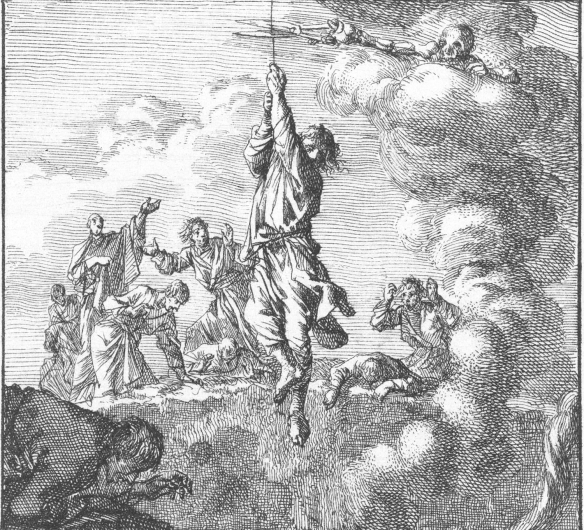
Dangerous-Stand

The Dangerous Stand, from The Unworthy World (Menno Simons Historical Library photo)

Dutch artists of the sixteenth and seventeenth centuries commonly depicted immoral or dangerous behavior, partly as an instructional device to their viewers. In this book of religious emblems, Luyken pictured “the unworthy world” as a warning to urge his readers onto the right path of Christian life. In the scene displayed here, a mortal hangs by a thread above the fires of hell while the specter of death waits to snip his life thread with scissors. If only the man will change his ways, he might be saved. The accompanying verse, Matthew 10:28, reminds us that a better fate awaits us beyond this life if we so choose it: “Do not fear those who kill the body but cannot kill the soul; rather fear him who can destroy both soul and body in hell.”

Dangerous Stand), from De Onwaardige Wereld (The Unworthy World), 1710. Reproduced in Het Werk Van Jan en Casper Luyken door P. Van Eeghen, vol. 2, 1905

Preperatory-for-dangerous-stand-1

Preparatory drawing for The Dangerous Stand (Menno Simons Historical Library photo)

A catalogue raisonné lists all of the works created by a particular artist. This compendium of the works of Jan and Caspar Luyken includes not only the finished prints but also the sketches and preparatory drawings made in advance of the completed works. Looking at this drawing in comparison to the eventual print (see page 15) shows how Luyken worked out the basic composition in the drawing but added a much higher level of detail and linework to the finished product. Notice also how the compositions are reversed since Luyken would have drawn this image onto the copper plate, only to have it printed as a mirror image.

Tafereelen der Eerst Christenen (Scenes of the First Christians). With prints by Jan Luyken and verses by Pieter Langendijk and Claas Bruin, 1722; reprinted 1740, Bedieninge des Doops in een rivier” (Ministry of Baptism in the River)

baptism

Ministry of Baptism in the River, from Scenes of the First Christians (Menno Simons Historical Library photo)

Even posthumously, Jan Luyken’s work continued to garner much attention. Ten years after Luyken’s death, ninety-two of his engravings were published in this volume of early church history. Poems by Pieter Langendijk and six-line verses by Claas Bruin accompany each of Luyken’s images. Not surprisingly, given Luyken’s Anabaptist connections, one of the scenes he chose to include in his series of early Christians is a scene of adult baptism. Notice how Luyken’s compositional lines lead our eyes to the baptism in the center of the image, with small background figures building up to larger foreground figures and with circular ripples of water surrounding the key players.

De Schriftuurlyke Geschiedenissen en Gelykenissen, Van het oude en nieuwe verbond [Scriptural Histories and Parables of the Old and New Testaments], 1712

Genesis III: 1-7, from De Schriftuurlyke Geschiedenissen en Gelykenissen, Van het oude en nieuwe verbond (Scriptural Histories and Parables of the Old and New Testaments), 1712

adam-and-eve

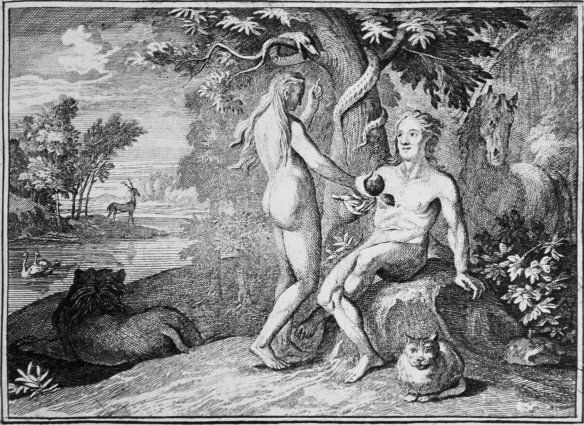
Genesis 3:1-7, from Scriptural Histories and Parables of the Old and New Testaments (Menno Simons Historical Library photo)

In picturing the fall of humanity from the Garden of Eden, Luyken placed the blame squarely on the figure of Eve through both image and text. In the print, Eve occupies the center of the composition and points to the tree of knowledge while she hands the apple to Adam. The rhyming verse that accompanies the image, which Luyken titled “Man Seduced,” laments the bitter outcome of Eve’s temptation.

Jan Luyken, De Schriftuurlyke Geschiedenissen en Gelykenissen, Van het nieuwe verbond (The Scriptural Stories and Parables of the New Testament), 1712

Luke-4-with-verse

Image for Luke 2:6-7, from The Scriptural Stories and Parables of the New Testament (Menno Simons Historical Library photo)

In this visual retelling of the New Testament, Luyken highlighted both somewhat obscure and well-known stories. The scene depicted here illustrates the two most familiar verses of the nativity story in Luke’s gospel:

6 So it was, that while they were there, the days were completed for her to be delivered. 7 And she brought forth her firstborn Son, and wrapped Him in swaddling cloths, and laid Him in a manger, because there was no room for them in the inn.

Notice how Luyken positioned the Christ Child at the center of the composition, surrounded by the parents, the shepherds, and the animals of the stable. Luyken’s rhyming poem on the theme of Christ’s birth accompanies the print.

Wreede moordt der Spanjaarden tot Naarden, den eersten December des jaars 1572 [Cruel Murder by the Spanish at Naarden, 1 December 1572], 1677-79, from Hugo de Groot, Nederlandtsche Jaerboeken en Historien (Netherlandish Yearbook and History), 1681

Naarden

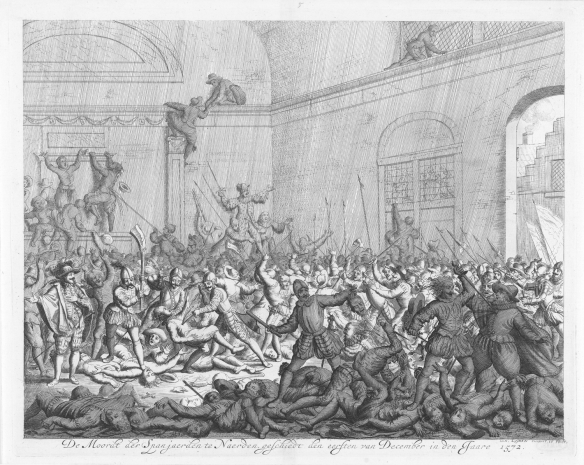
Cruel Murder by the Spanish at Naarde, from Netherlandish Yearbook and History (Rijksmuseum photo)

In historical prints such as this, Luyken displayed a rare patriotic sentiment. The scene depicted here marks an episode in what came to be known as the Spanish Fury, a series of bloody confrontations in the sixteenth century when Spanish troops sacked and pillaged Dutch towns in an effort to maintain Catholic rule and allegiance to the Spanish Crown. Luyken pictured the chaos of the battle, and the closed-in setting suggests that the citizens of Naarden had no way to escape the villainous Spanish soldiers.


Dr. Rachel Epp Buller is a feminist art historian, print maker, book artist, and mother of three whose art and scholarship often speak to these intersections. She speaks and publishes widely on the maternal body in contemporary art, including her book Reconciling Art and Mothering (Ashgate/Routledge). She privileges collaboration in her work, which has resulted in various outcomes, including the edited collection Mothering Mennonite, with Kerry Fast (Demeter Press); an exhibition and book, Alice Lex-Nerlinger, Fotomonteurin und Malerin / Photomontage Artist and Painter, with Das Verborgene Museum in Berlin; and the exhibition “Beyond the Martyrs Mirror: The Prints of Jan Luyken,” with Bethel College student Alexandra Shoup, exhibit designer  David Kreider and archivist John Thiesen at the Mennonite Library and Archives. She is a Fulbright scholar, a board member of the National Women’s Caucus for Art, a regional coordinator for the international Feminist Art Project, and current associate professor of visual arts and design at Bethel College, North Newton, Kansas.


  1. Josephine V. Brown, “Biography of Jan Luiken,” Digital Collections, Pitts Theology Library, http://www.pitts.emory.edu/collections/digitalcollections/luiken.cfm 

Melchior Hoffman’s Defense of Female Prophets

The relatively wide array of roles open to women in Melchiorite congregations—Anabaptist congregations found in the Netherlands and North Germany in the sixteenth century and founded by the itinerant apostle Melchior Hoffman—has long been recognized by scholars of early modern Anabaptism. As Arnold Snyder noted in Anabaptist History and Theology, “nowhere in the Anabaptist movement did women achieve and maintain as lofty a pastoral and leadership role as in the Strasbourg Melchiorite community.”1  Sigrun Haude, in her 1998 essay “Anabaptist Women—Radical Women” echoed the point and argued that “the greatest freedom enjoyed by women can be found in those Anabaptist groups that emphasized visions, prophecies, and the Spirit.”2 Hoffman did indeed emphasize visions, prophecies, and the Spirit. He believed, firmly, that he lived in the Last Days, a time in which God would pour out his Spirit on all people, men and women alike.3

After his arrival in Strasbourg in 1529, Melchior Hoffman encountered Lienhard and Ursula Jost, a married couple who had both had visionary and prophetic experiences over the course of the 1520s. He set out to disseminate their visions and prophecies through print (the Josts were illiterate, and had thus not been able to publish them themselves). Hoffman first published Ursula’s visions in 1530. This first edition of her visions, published by the Strasbourg printer Balthasar Beck, did not record her name, but instead referred to her simply as a Gottesliebhaberin, a feminine noun meaning “lover of God.”4 For Hoffman, the emergence of contemporary prophets such as Ursula and her husband Lienhard served as validation for his apocalyptic ideas. Hoffman’s ideas about prophecy and the work of the Spirit also shaped his views of how church hierarchies should be structured. In the afterword to the 1530 edition of Ursula’s visions he included a discussion of church offices and the gifts of the Spirit; Ursula, for instance, possessed the gift of prophecy but not the gift of interpretation.5

image1-17

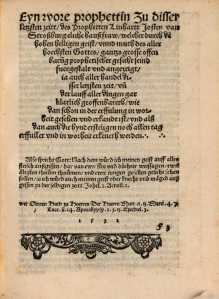
The title page to the 1532 edition of Ursula’s visions, published jointly with Lienhard’s prophecies and housed at the Austrian National Library in Vienna

In the 1530 edition of the visions, neither Melchior Hoffman nor Ursula Jost made an issue of Ursula’s gender. They simply took for granted that women could prophesy. In 1532, however, Hoffman offered a more systematic defense of female prophets in a foreword to the second edition of Ursula’s visions. This second edition, printed by Albert Paffraet in Deventer, appeared alongside an edition of Lienhard Jost’s prophecies and its survival at the Austrian National Library in Vienna was unknown to Klaus Deppermann, Hoffman’s most recent biographer.6 In his foreword, Hoffman acknowledged that “some are bewildered and angry that God works and lays out his plans through such a poor and simple little woman.”7 Hoffman contended, however, that this was not remotely novel, and that God had spoken to and through women since the beginning of the world.

To reinforce this point, Hoffman provided a list of women in the Old and New Testament through whom God had spoken or accomplished His purposes in other ways. His list was comprehensive, with a few exceptions—curiously, he omitted Huldah, whom the authors of 2 Kings and 2 Chronicles explicitly identified as a prophetess.8 He began his list of biblical prophetesses and female servants of God with the women of Genesis: Eve, Sarah and Hagar (both of whom heard the voice of God), and Rebecca, Isaac’s wife, who became the mother of two people groups.9 Exodus provided the example of Myriam, Aaron’s sister, and Judges the stories of Samson’s mother, Jael (who defeated the general Sisera), and Deborah (who was not only a prophetess, but also a “great teacher of Israel”).10 Hannah, who prayed so fervently for a child that the priest Eli mistook her for a drunk woman, went on to become the mother of a great prophet of Israel in 1 Samuel, and Judith and Esther both rescued the people of Israel in the books that bore their names.11 Finally, Hoffman highlighted the woman with seven sons in 2 Maccabees, whose sons died for the sake of God’s law and who ultimately gave up her own life “in a very manly way.”12

Unsurprisingly, Hoffman began the New Testament portion of his survey of biblical women with Mary the mother of Jesus, and he went on to list two other women from the beginning of Luke: Elizabeth, who recognized Christ while he was still in the womb, and the prophetess Anna, who recognized Him at the Temple.13 Mary Magdalene, he continued, became the first of Christ’s followers to see Him after the Resurrection and was tasked with spreading this good news to the apostles.14 The Samaritan woman met with Jesus and preached about him to her city in the book of John, and the daughters of the deacon Philip in Acts had the gift of prophecy.15 Hoffman ended this cast of characters with a reference to twelve Gentile prophetesses “reported in the histories”—a possible reference to prominent women from the early and medieval church, though the reason for the number twelve is not clear.16

Since the Bible explicitly called certain women prophetesses, the theoretical possibility of female prophets was undisputed among medieval and early modern Christians, even as many other ecclesiastical roles remained closed to women. Hoffman, however, went further than many of his contemporaries; he described the Samaritan woman’s actions as “preaching” (predigen) and used the word “teacher” (lerrerin) to refer to both Judith and Deborah.17 He did not directly acknowledge or attempt to reinterpret the Pauline command from 1 Timothy that women should remain silent in the churches, but instead mined other Pauline letters for support for his position. After all, had not Paul said in Galatians that all—male or female—were one in Christ? And had he not acknowledged in 1 Corinthians that women could prophesy, provided they did so in an orderly fashion? Moreover, Hoffman added, women could also take on the role of teaching, “if there were no enlightened men.”18

Ultimately, for Hoffman, God gave the gift of prophecy to all who hungered for truth and righteousness without regard for age, gender, or social station, as was made clear in Joel 2, which spoke of sons and daughters, old and young, manservants and maidservants as recipients of the Spirit of God.19 The only trait that disqualified a person from prophesying was pride and hardness of heart. Indeed, Hoffman acknowledged that there were many learned women (schriftgelerder weyber), who were better-educated and more prominent than Ursula, to whom God might have revealed Himself instead. However, despite their prestige, these women were unsuitable because they were proud and haughty.20

While Hoffman’s support of women such as Ursula Jost and Barbara Rebstock has long been known, the recently rediscovered foreword to the second edition of Ursula’s visions sheds further light both on the biblical examples Hoffman used to justify his support of women’s active leadership in Melchiorite communities and the boundaries he still placed on this leadership. The range of possibilities Hoffman envisioned for women in the church was wider than that afforded to them by many of his contemporaries. Ultimately, however, women were second to men even in Hoffman’s congregations, since the role of teaching was open to them only when no qualified men were present to fill it.


  1.   C. Arnold Snyder, Anabaptist History and Theology: Revised Student Edition (Kitchener: Pandora Press, 1997), 321. 
  2. Sigrun Haude, “Anabaptist Women—Radical Women?” in Infinite Boundaries: Order, Disorder, and Reorder in Early Modern German Culture, ed. Max Reinhart (Kirksville: Sixteenth Century Journal Publishers, 1998), 318-319. 
  3. Cf Joel 2 
  4. Ursula Jost, Prophetische Gesicht un[d] Offenbarung der götliche[n] würckung zu diser letste[n] zeit (Strasbourg: Balthasar Beck, 1530), passim. 
  5. Melchior Hoffman, afterword to Jost, Prophetische Gesicht, fols. C vii r-v. 
  6. For the English version of Deppermann’s seminal biography, see Klaus Deppermann, Melchior Hoffman: Social Unrest and Apocalyptic Visions in the Age of Reformation, edited by Benjamin Drewery, translated by Malcolm Wren (Edinburgh: T&T Clark, 1987). The survival of the 1532 edition of the Josts’ prophetic writings was briefly noted in Andrew Pettegree and Malcolm Walsby (Eds), Netherlandish Books: Books Published in the Low Countries and Dutch Books Printed Abroad Before 1601, Volume 1 A-J (Leiden: Brill, 2011), 753 and its contents were the subject of Jonathan Green, ‘The Lost Book of the Strasbourg Prophets: Orality, Literacy, and Enactment in Lienhard Jost’s Visions,’ in: The Sixteenth Century Journal 46:2 (Summer 2015), 313-330. 
  7. Melchior Hoffman, foreword to Ursula Jost, Eyn wore prophettin zu disser letzsten zeitt (Deventer: Albert Paffraet, 1532), fol. F4r. 
  8. For the story of Huldah, see 2 Kings 22:13-20 and 2 Chronicles 34:22-33. 
  9. Hoffman, foreword to Jost, Wore Prophettin, fol. F4r. 
  10. Hoffman, foreword to Jost, Wore Prophettin, fol. F4r. 
  11. Hoffman, foreword to Jost, Wore Prophettin, fols. F4r-F4v. 
  12. Hoffman, foreword to Jost, Wore Prophettin, fol. F4v. 
  13. Hoffman, foreword to Jost, Wore Prophettin, fol. F4v. 
  14. Hoffman, foreword to Jost, Wore Prophettin, fol. F4v. 
  15. Hoffman, foreword to Jost, Wore Prophettin, fol. F4v. 
  16. Hoffman, foreword to Jost, Wore Prophettin, fol. F4v. 
  17. Hoffman, foreword to Jost, Wore Prophettin, fols. F4r-F4v. 
  18. Hoffman, foreword to Jost, Wore Prophettin, fol. F4v. 
  19. Hoffman, foreword to Jost, Wore Prophettin, fol. F4r. 
  20. Hoffman, foreword to Jost, Wore Prophettin, fol. F3v. 

Praying to the Lord Against the City?

Dürer_FourHorsemen

Albrecht Dürer’s woodcut The Four Horsemen (1498), an interpretation of Revelation 6:1-8 featuring Death, Famine, War, and Pestilence (from left to right).

In 1639, the city council of Zurich published its so-called Manifest, an apologetic mandate which justified authorities’ recent repressive actions against the Anabaptist population living in the rural jurisdictions surrounding the city. Among the reasons given for a campaign of incarceration, intentional impoverishment, and child removal—the weight of which ended a more than century-long Anabaptist presence in the area—was the nonconformists’ alleged utterance of malevolent prayers. Instead of interceding on behalf of the authorities, in keeping with the instruction of the apostles [1 Tim. 2:1-2], Anabaptists were accused of asking God to visit “pestilence, war, and other plagues” on the territory’s inhabitants.1

This particular accusation is of uncertain origin, but it was not new. The authors of the Manifest claimed that Anabaptists had cultivated this specific prayer “among themselves for years.” Indeed, clerics stationed in rural parishes had complained of a prayer with similar content in a list of grievances submitted to Zurich’s synod already in 1601. Allegedly, several local Anabaptists had asked God to rain down disaster on the territory so that Reformed authorities would forget about the dissidents and leave them alone.2 Anabaptists denied such claims. For example, Hans Müller, a deacon from Zurich’s southeastern Oberland, dismissed the charge categorically as an untruth spread by “evil people.” In keeping with Christ’s command, his brethren prayed for those who persecuted them, Müller insisted.3

We cannot determine definitively whether beleaguered nonconformists actually beseeched God to inflict their Reformed neighbors with disease, famine, and armed conflict. Still, the occasional reappearance of the claim that they did leaves us with a few interesting questions: why were some members of Reformed communities convinced that Anabaptists engaged in such malicious devotions, despite dissidents’ frequent denials, and why did they care?

Reformed pastors—those who reported the practice in question—likely believed that Anabaptists were capable of such spiritual sabotage because it accorded with the stereotypes of the dissident movement reinforced by their clerical education. Ministers’ libraries contained texts that attributed to local Anabaptists the seductive power of heretics and the disruptive potential of rebels.4 In addition, in the early 17th century pastors periodically attended academic events organized around discussion of anti-Anabaptist theses, including one entitled “Concerning the diabolic possession of men . . .”5 Furthermore, ill-seeking prayer communicated a lack of concern for the welfare of the Reformed society. This fit with clerics’ understanding of the intentions behind Anabaptists’ withdrawal from the religious life of the majority: nonconformists’ refusal to participate in certain religious and civil ceremonies was viewed as an act of spiritual arrogance. Since religious disunity held the potential to invite divine wrath, their behavior put the entire Christian community at risk. By offering up malevolent prayers, Anabaptists requested with their words what they were calling for with their actions.

Other members of the Reformed majority may have believed allegations of ill-intentioned prayers because of some rhetorical consistency with other instances of Anabaptist speech. Anabaptists often openly denounced what they deemed to be the generalized moral depravity of Reformed society, and implied its members’ perdition. They also frequently got into trouble for purposefully provoking their Reformed neighbors in shared social spaces. When Anabaptists told fellow travelers on the street that they had seen a devil on the local minister’s shoulder, or suggested that reconciliation with the Reformed church was akin to a dog vomiting and snarfing the results back up again, they deliberately baited their audience by publicly impugning their faith.6 In this context, the malevolent prayers which accusers attributed to Anabaptists might have been understood to reflect a similar spirit.

Undergirding all of these concerns was an assumption that Anabaptists’ words mattered, that they had the power to enact some kind of effect on reality. One the one hand, this belief existed in tension with Reformed leaders’ claims that Anabaptists’ spiritual and civil disobedience had cut them off from communion with God. On the other, it fit easily within a worldview that saw the crises of the period—indeed, exactly those disasters the Anabaptists were accused of appealing for—in the context of a broader spiritual conflict, in which Zurich was deeply engaged. These were not theoretical disasters, but catastrophes that marred seventeenth-century Europeans’ everyday existence. A primary response of the city council to the threat posed by the period’s economic ruin and the Thirty Years’ War was to mandate mass participation in days of prayer and repentance. That Anabaptists were engaging simultaneously in spiritual counter-efforts simply confirmed their identity as opponents of the common good in the eyes of authorities. The assumption, of course, was that God would only answer the petitions of those faithful to him. Some, however, believed that Anabaptists’ utterances had the power to invoke diabolical forces. This was the charge often lodged against Anabaptist medical practitioners—midwives, doctors, and veterinarians—who supposedly harnessed dark powers in the practice of healing arts.

The charge of uttering malevolent prayers represents a curious facet of the long-standing relationship between Anabaptists and representatives of Zurich’s Reformed majority. It sheds light on how contemporaries understood the effects of dissidents’ clandestine devotional practices on social well-being. It also shows that, despite their non-participation in Reformed religious culture, Anabaptists were deeply implicated in rural communal life. Their participation in networks of village sociability and exchange was a feature of long-term coexistence. Differences in religious belief and practice did not make living together impossible. However, as this case shows, this coexistence did not exclude conflict over speech with religious content. When open conflict did erupt, latent accusations (of questionable derivation) could be reactivated and used to sanction the repression of members of the local religious minority.


  1. “Wahrhaffter Bericht…,” in Täufer und Reformierte im Disput: Texte des 17. Jahrhunderts über Verfolgung und Toleranz aus Zürich und Amsterdam, ed. Wälchli, Philip, Urs Leu, and Christian Scheidegger (Zug: Achius, 2010), 125. 
  2. Zentralbibliothek Zürich (ZBZ), Ms B 163, 82v. 
  3. ZBZ, Ms B 163, 303v-304r. 
  4. Hanspeter Jecker, “Lange Schatten und kurzes Gedächtnis – Heinrich Bullingers posthumer Einfluss auf die Behandlung der Täufer in der Schweiz,” in Heinrich Bullinger: Life – Thought – Influence, ed. Emidio Campi and Peter Opitz (Zürich: Theologischer Verlag Zürich, 2007), 709-713. 
  5. A thesis entitled “Disputatio theologico-philosophica, de diabolica hominum obsessione, et de daemonum eiectione” was submitted for dispute during synodal meetings in October 1626. Urs B. Leu, “Letzte Verfolgungswelle und niederländische Interventionen,” in Die Zürcher Täufer, 1525-1700, ed. Urs B. Leu, and Christian Scheidegger (Zürich: Theologisher Verlag Zürich, 2007), 208. 
  6. Francisca Loetz has argued that blasphemers engaged in similar forms of verbal performance. Dealings with God: From Blasphemers in Early Modern Zurich to a Cultural History of Religiousness (Farnham, England: Ashgate, 2009), 272-73. 

Samuel Ernst and the German Language

Mark L. Louden

Two years ago I was reading through a fascinating publication that appeared irregularly between 1943 and 1946. Der Pennsylvanisch Deitsch Eileschpiggel (The Pennsylvania Dutch Eulenspiegel [<Till Eulenspiegel, a prankster in German folklore]) was brought out by by J. William Frey (1916–1989), who was for many years a professor of German and Russian at Franklin and Marshall College. Frey was a native speaker of Pennsylvania Dutch who wrote his doctoral thesis on the language at the University of Illinois and became a pioneer in the field of Pennsylvania Dutch studies. The Eileschpiggel, which bore the subtitle En Zeiding, Schwetzbrief un Blauderschtick far die Deitsche (A newspaper, newsletter, and chat-sheet for the Pennsylvania Dutch), included Pennsylvania Dutch prose and poetry along with many other items of interest for both “scholars and laymen.”

In the first issue of the Eileschpiggel, Frey printed a short piece in Pennsylvania Dutch by a fellow native speaker and German professor at Lehigh University, Ralph Charles Wood, who expressed his support for Frey’s enterprise. Wood wrote:

This is not the first time that people have tried to publish a Pennsylvania Dutch newspaper to talk a little about the language in the language itself. Around 1860, Samuel Ernst of Millwood, Gap, [PA], published a newspaper in three languages – High German, Pennsylvania Dutch, and English . . .

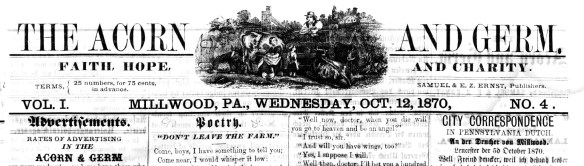
My curiosity was piqued, since I had never heard of Samuel Ernst and his trilingual publication. After a little sleuthing, I learned that Ernst was an “old” Mennonite who was born in Lancaster County in 1825, moved to Olathe, Kansas, in 1884, and died there in 1909. The newspaper Wood was referring to actually began in 1870 and was titled The Acorn and Germ.image1-17

According to the Global Anabaptist Mennonite Encyclopedia Online, The Acorn and Germ was published by Ernst and his son, Eleazar Israel (known as “E. Z. Ernst,” the “Z” referring to his mother’s maiden name, Zimmerman) from July until December 1870, at which time it was succeeded by Der Waffenlose Wächter (The weaponless watchman), which Samuel edited alone. The Wächter initially appeared monthly and eventually quarterly, continuing until 1888. Through the kind assistance of Iren L. Snavely, the Rare Books Librarian at the Pennsylvania State Library in Harrisburg,  I was able to obtain digital copies of several issues the The Acorn and Germ and Der Waffenlose Wächter from September 1870 through April 1871, some highlights of which I will share here.

Ernst’s newspapers were indeed trilingual, with material mainly in English and German, but also Pennsylvania Dutch. In my last post on this blog about Mennonites and Amish and Pennsylvania Dutch, I mentioned that Samuel Ernst is one of just two identified Anabaptists who published Pennsylvania Dutch material in the nineteenth century, the other being John H. Oberholtzer (1809–1895). Both Oberholtzer and Ernst expressed the concern in their respective publications that younger American Mennonites, especially schoolchildren, had insufficient knowledge of High German for the practice of their faith. This concern is shared by many Amish and Old Order Mennonites today, who continue to use the Luther Bible and German-language prayer and hymn books for devotions and worship.

A few words are in order about what kind of German was used by Anabaptists and other Pennsylvania Dutch speakers in Samuel Ernst’s day. Ralph Charles Wood, the German linguist and Pennsylvania Dutch scholar mentioned above, described it as “Pennsylvania High German” to distinguish it from the written German standard used in modern Europe. High German, so-called for the fact that it is based most closely on written dialects used in one part of the High (as opposed to Low) German dialect area (where “high” and “low” refer to the elevation of the Central European landscape), was not widely spoken in the 18th century, when the ancestors of the Pennsylvania Dutch set out for America. At that time and continuing into the 20th century, there was considerable variation in how German was written and even more variation in how it was pronounced when spoken.

Pennsylvania High German, which is still used by the Old Orders today, was strongly influenced by Pennsylvania Dutch, the vernacular language, as well as English. Its users, being cut off from German-speaking Europe since the 18th century, were unaffected by the increasing standardization of German vocabulary, grammar, spelling, and eventually, pronunciation throughout the 19th and 20th centuries. The maintenance of High German in devotion and worship was important for generations of Anabaptists, as well as other German-American Christians, especially Lutherans. For contemporary Old Orders, the continued use of their Mudderschprooch (mother tongue), which refers to both Deitsch (Pennsylvania Dutch) and Hochdeitsch (High German), is a salient marker of an identity that connects them to the spiritual heritage they brought with them from the Old World.

image2-19Samuel Ernst’s reverence for German was ardent. At the top of one page in every issue of The Acorn and Germ he printed the aphorism

Wir ströben nicht um zeitlich’s gut,

Obgleich wir lieben Deutsches blut

which may be translated as “We do not strive for temporal goods, but we love [our] German blood.” The spelling and word choice are classically Pennsylvania High German and differ from how the aphorism would be rendered in its normative European counterpart:

Wir streben nicht um zeitliches Gut,

Aber wir lieben deutsches Blut.

Contemporary Old Orders might feel uncomfortable with the second part of Ernst’s aphorism, however they would find the quote below it that he printed from the Luther German Bible (based on 1 John 4 and 12) more in line with their sensibilities: “They are from the world; therefore what they say is from the world, and the world listens to them . . . if we love one another, God lives in us, and his love is perfected in us.”

In the October 12, 1870, issue of The Acorn and Germ, Ernst published an interesting poem in Pennsylvania High German that he composed himself. Giving it the English title “On the German Language,” Ernst noted that the poem could be sung to the tune of “Yankee Doodle,” a fitting expression of the fundamentally American cultural milieu in which he and his fellow Mennonites lived.


Ihr jungen helten wachet auf,
Zum kampf der Deutschen sprache.
Laß nicht der dröchheit gahr den lauf
Durch schlummer, oder schlafe.

Das uns nicht der gute Geist
Die gabe gahr entzühe,
Obgleich in unsern odren flüßt
Daß Deutsche blut zum Ende.

Die ed’le Mutter sprache nun
Laßt nicht so gahr dahinden
Kost’s gleig was muhe, doch ist der lohn
Und nutzen auch zu finden.

In disem freyen Lande
Wo alle Völker wohnen,
Laß selbst den Kindern werden kund
Daß Deutsch, sich nicht läßt höhnen.

In Deutscher sprache war zuerst
Die Bibel Prot[e]stantisch,
Dem guten volke uberreicht
Nun ist sie Vatter-landisch.

Auch fast in allen Sprachen
Wie auch die “Druck erfindung,”
Und auch manch andre gutte Sach’n
Ihr’n uhrsprung Deutsch’r endöckung.

Auch selbst die sprache ist so leicht
Doch deitlicher auch keine,
Daß Man von ihr nun wenich braucht
Zur dämpfung ehrer Feinde.

Wo ihr Man die ehre gibt
Welch ehre ehr gebuhred,
Da zeigt ihr werd im a[u]genblick
Daß sie kein Esel führed.


Ye young heroes, awaken
To the battle for the German language.
Let not indolence run freely
Because of slumber or sleep.

May the Holy Spirit not from us
Take away the gift;
After all, in our veins flows
German blood till the end.

Now, do not abandon
The noble mother tongue.
Whatever effort it may cost, the reward
And utility are to be found.

In this free country
Where all peoples dwell,
Let even the children know
That German will not be scoffed at.

In the German language
The Protestant Bible was first
Passed on to the good people;
It is now a national possession.

Also in nearly every language,
As also the invention of printing
And also many other good things
[Owe] their origin to a German discovery.

And even though the language may be so easy [to learn],
None other is as precise,
Such that one needs to use just a little of it
To quiet its enemies.

Wherever one gives it its honor
That it is due,
It shows its value in that moment
[And] that it is led by no jackass.

The form of German that Ernst used was consistent with that of other Pennsylvania Dutch writers at that time; the poem’s content, however, would likely have struck his fellow Anabaptists as somewhat odd and perhaps a bit too worldly in its tone, bordering on the German-nationalistic.

There is much more fascinating material to be mined from the publications of Samuel Ernst, including on the topic of language, some of which I hope to share in future posts.

Peppernuts and other living traditions

By Janneken Smucker

I didn’t grow up with peppernuts. My mom made simple Christmas cookies like peanut butter blossoms with Hershey kisses on top, or dipped peanut butter filled Ritz Bitz in chocolate. But when I married in to a so-called Russian Mennonite family—actually “Swiss Volhynian,” to be more precise—from Harvey County, Kansas, I learned about hardcore, generations-old culinary traditions, something my Old Mennonite family did not have.1 The women of this family, along with the men of some of the younger generations, are peppernut making machines, each year producing dozens of pounds of miniscule cookies, each about the size of a pencil eraser (when I try to make them, in contrast, they typically are the diameter of a dime). Like any humble family with its secret pride of tradition, these central Kansas Mennonites view the peppernuts of others as inferior creations. How could a bloated ginger cookie kissed with a gumdrop even be of the same genre as these refined anise oil rock-hard concoctions?


Yet, that’s one of the great things about traditions: they evolve and shift and adapt to new lifestyles. To another family, those gumdrop cookies are peppernuts, and the crunchy eraser-sized bits are strange and foreign.

In my American Civilization course, an interdisciplinary general education class I teach every semester, the final unit of the course centers on folklore. I introduce the subject by using the American Folklore Society’s official definition: things that groups of people traditionally believe, do, know, make, or say, which serve as part of their cultural identity.

I ask my students to give examples of these behaviors from their own worlds—from their families, ethnicities, clubs, teams, sororities, and communities. I provide my own.  My Pennsylvania German background dictates that we must eat pork and sauerkraut on New Year’s Day in order to have good luck in the new year—we must snort ahead (by eating pig) rather than scratch back (by eating chicken or turkey). I describe being a fifth generation Mennonite quiltmaker, emphasizing that the quilts I make are quite distinct than those of my foremothers, but part of an important cultural tradition that ties me to these previous generations. I recall how for years I have made pizza every Saturday evening, since my family did that throughout my childhood, in the early years using Swiss cheese from Eastern Ohio. My mom remembers how her mother made pizza in the 1950s on Saturday evenings, using a Chef Boyardee sauce. We aren’t Italian-Americans maintaining a tradition from the old world; instead we created a new tradition that has carried on several generations.

My students counter with tales of the Feast of the Seven Fishes on Christmas Eve, popularized by Italian-Americans but with southern Italian origin. A Venezuelan American student shared her family’s tradition of walking around outside carrying luggage shortly after midnight on New Year’s Day as a way to ensure travel in the new year, and burying money only to dig it up after the clock strikes midnight in order to bring economic prosperity. One student came from a family of taxidermists and described how she grew up learning how to stuff a carcass. Others describe distinct foods, prayers, superstitions, jokes, and songs that are deeply rooted to their sense of belonging within their tribes, however they define them.

I then emphasize that folklore is living, not some kind of static fossilized behavior that is unchanging over time. Last New Year’s Day my daughter and I gathered with friends to make jioazi, Chinese dumplings inspired by the ones I learned to make when in Sichuan Province during Study-Service Term at Goshen College in 1996. We filled them with pork and cabbage, along with ginger and garlic and sesame oil. I knew that by eating this combination of ingredients, even if wrapped in a flour wrapper and steamed and fried, I would still have fulfilled my requisite intake of lucky foods. And I think this might become a new tradition in my family.

traditions_Image_3 (1)

My daughter stuffing jiaozi wrappers with pork and cabbage, New Year’s Day 2017.]


  1. Jeanette Krehbiel Wedel, Swiss Volhynian Favorite Recipes (Pretty Prairie, KS: Swiss Mennonite Cultural and Historical Association, 2017).   

A School By Any Other Name?

Names are funny things. Once they’re assigned to people, places, or things it can be hard to imagine anything else fitting. Though 100 years on it seems almost inconceivable for Eastern Mennonite University to be anything other than Eastern Mennonite, it took the founders a few tries to find a name that stuck. Many of the early suggestions were informed by the locations they would inhabit. Warwick Mennonite Institute, Warwick Mennonite Academy, and Alexandria Mennonite Institute clearly didn’t fit anymore once Harrisonburg became the settled upon location. But what about another suggestion: The Mennonite Student’s Safeguard and Industrial School? Certainly this conveyed in plain language the goals of the school, but it was a bit wordy and perhaps a bit too on the nose.  

scan_58011.1

In the end, they settled on Eastern Mennonite School. Not as conspicuous as The Mennonite Student’s Safeguard and Industrial School, but it was decidedly less of a mouthful and still contained a key indication of their core identity: Mennonite. In Eastern Mennonite University: A Century of Countercultural Education Don Kraybill writes that “The records do not say how the final name was determined” but that “even in the twenty-first century, Eastern Mennonite University remains the only Mennonite-related college or university of eight in the United States that carries the denominational name”1

It must be stated that having the word Mennonite in the name certainly doesn’t make EMU more Mennonite than other colleges. Some of the founders even made the case for leaving Mennonite out. Kraybill writes of a letter that chair of the local board C.H. Brunk wrote to the General Board stating “it is not customary to give a school a denominational name…some people are more or less prejudiced against denominational institutions . . . [the school] can be just as truly denominational without the name” A small group including Brunk agreed “unanimously” that it should be named simply “Eastern Institute and Bible School.”2

There are some even today who think that the inclusion of Mennonite in EMU’s name is off-putting to prospective students or has the potential to be polarizing. In recent times other Anabaptist groups have made or proposed changes to their names that remove words like Brethren and Mennonite in order to be more inclusive and broaden their appeal.3 And it’s possible that Goshen, Bluffton, Bethel, and Hesston don’t have to field pesky questions about the availability of electricity on their campuses.4 But some on campus argue that we should lean into, rather than downplay, the Mennonite characteristics. Kraybill touches on this argument, noting that:

In a campus forum, enrollment managers proposed striking Mennonite from the marketing materials and reducing “other odd things about EMU to make it look less ‘weird’ and easier to recruit local Virginia students and mainstream evangelical Christian ones.” History professor Mark Sawin argued the reverse: “If EMU stops being distinctively Mennonite, we have no reason to exist. There are plenty of better-funded, better-situated Christian colleges and liberal arts colleges. If we try to be like them—to be just another mainstream, vanilla, Christian liberal arts school, I think we would, and perhaps should, fail. We aren’t vanilla; we’re pistachio. Most people prefer vanilla and chocolate, it’s true, but those who prefer pistachio love it and will seek it out. To thrive we need to not lessen but increase our distinctiveness—we need to be more, not less, pistachio.” 5

So Eastern Mennonite University it is. We have spent the last 100 years committing to our pistachio-ness and will continue to do so.  Though some may see the label as a hindrance, it can also be seen as an opportunity to invite conversation and share the unique ideals of Anabaptism.  In this way EMU really is a Christian—and more specifically an Anabaptist Mennonite—University like no other.

For more information about the history of Eastern Mennonite University, check out Don Kraybill’s 100-year history: Eastern Mennonite University: a Century of Countercultural Education. Available from EMU, Amazon, and Penn State University Press.


  1. Donald Kraybill, Eastern Mennonite University: A Century of Countercultural Education (University Park, PA: Penn State University Press, 2017), 54. 
  2. Kraybill, 54. 
  3. Rich Preheim, Still BIC but no longer Brethren,” Mennonite World Review, Oct. 30, 2017.; Rachel Stella, “Switch to ‘Rosedale Network’ narrowly fails,” Mennonite World Review, Aug. 14, 2017. 
  4. As a student tour guide I once was asked this very question. Other people I’ve spoken with have reported being asked where we keep our horses and buggies. 
  5. Kraybill, 294. 

Missing Pieces: Lancaster Mennonite Conference, Racism, and Us

Tobin Miller Shearer

In an era when the sitting president of the United States is able to re-tweet highly racist and inflammatory videos with apparent impunity, we need ever more sophisticated and historically grounded means of analyzing the problem before us. Although the use of historical analysis for political ends is fraught with difficulty, careful attention to specific historical trends can be illustrative. This graph-based analysis of Lancaster Mennonite Conference’s engagement in and response to racism from 1900 through 1970 may offer some insight for our present moment. This kind of analysis may show us the pieces we are missing in our present response.

*   *   *   *

I expect that I am far too fond of charts. My friends, when they’re being honest, tease me about my nerdy ways. Workshop participants shake their heads bemusedly in response to my excitement when I comment on a new handout.

So it is not surprising that I would turn to graphic representation for a new study of racism in Lancaster Mennonite Conference.

Actually the research is not entirely new. I simply revisited the database I developed when writing my dissertation and subsequent book Daily Demonstrators: The Civil Rights Movement in Mennonite Homes and Sanctuaries (Johns Hopkins: 2010). I then mapped the ways in which white Lancaster Mennonite Conference leaders and members dealt with external and internal race relations. The charts emerged from conversations that Cheryl Miller Shearer, my life partner, and I had as we prepared to lead a Sunday School class on racism and white supremacy at our congregation. I’ve chose Lancaster Mennonite Conference as the focus of my study because of their geographical location in a region representative of much of the kind of racism we see resurgent in society today.

Lancaster Conference response to racism - Chart AThe first graphic (Chart A) positions acts of racism on a grid with a public/private y-axis (vertical line) and an individual/collective x-axis (horizontal line). While by no means representative of every conceivable type of racist action, the graphic demonstrates that acts of racism in the twentieth century have been carried out across the full spectrum of public/private arenas and by a wide array of individuals and groups. The chart also suggests that collective manifestations of racism have been far more prevalent – and therefore damaging – than have individual acts of racism.
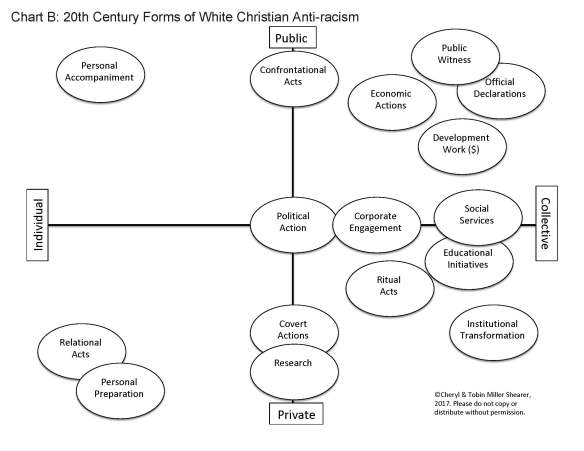
Lancaster Conference response to racism - Chart BThe second graphic (Chart B) positions acts of anti-racism on the same public/private|individual/collective grid. In particular, the named categories are representative—though not comprehensively so—of the kinds of anti-racist actions taken by white Christians in the twentieth century.1 This chart indicates that—across the white Christian community—responses to racism have been fairly robust and, to a degree, addressed racism in all its manifestations. What the chart does not indicate is the degree to which these responses are common in various Christian communities. For example, few white-majority Christian groups have been comfortable with confrontational acts or covert actions (for descriptions of the categories used on this chart see Appendix One below). Responses to racism on the individual end of the horizontal axis have been somewhat anemic, suggesting that white congregations have done less well at preparing and equipping their congregants to resist racism on an individual basis even though many white church leaders claim that they do encourage their congregants to take individual action.

Lancaster Conference response to racism - Chart CThe third graphic (Chart C) highlights a sampling of the kinds of racism that white Mennonites in Lancaster Conference participated in between 1900 and 1970 according to the records I have surveyed below and anecdotal evidence shared with me over the years (for citations and complete source listing, see Appendix Two). White Lancaster Conference Mennonites display a pattern consistent with the broader society during the first seven decades of the twentieth century. The Lancaster Conference actively and knowingly participated in racial segregation, promoted paternalistic programs like Fresh Air summer hosting ventures, invested far more money and resources in white congregations than in congregations of color, told racist jokes, and regularly hired those who looked like them.

None of this is surprising.

Lancaster Conference response to racism - Chart DThe fourth graphic (Chart D) highlights the kinds of anti-racism that white Mennonites in Lancaster Conference participated in between 1900 and 1970. Here again, most of the actions conform to patterns consistent with the broader society. As Christian Smith and Michael Emerson have demonstrated, white Protestant Christians—of which Lancaster Mennonites would be a sub-category—have been far more comfortable engaging in relational acts, non-political social service projects, and some types of educational initiatives.2 In short, actions in the public-collective quadrant are rare.
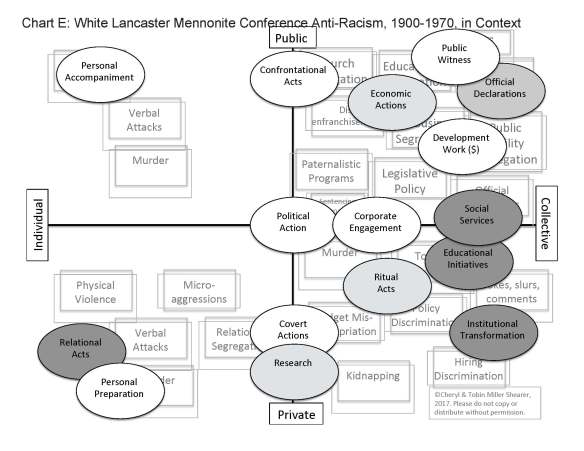
It is somewhat surprising, then, to note that Lancaster Mennonite Conference did pass a public “race relations statement” in 1960 and then assigned a committee to revise it in 1970. Much could be said about the content of the 1960 statement. I will limit my comment here to note that the 1960 statement is strong on integrationist thought and action but does not deal with systemic manifestations of racism. Nonetheless, the statement did put Lancaster Mennonite Conference on record as opposing “race prejudice” and the “segregation of races.”3

The other outlier that Chart D points to is that Lancaster Mennonite Conference went through a rather substantive shift from an overtly and unapologetic segregated institution to an, at least officially, desegregated institution. Prior to the passage of the 1960 statement, Lancaster Conference institutions practiced racial segregation in congregations, Vacation Bible Schools, Sunday Schools, mission outreach, and retirement communities. They did so deliberately, by official decision, and with little record of hesitation. The decision to integrate all such facilities did result in integrated congregations, retirement communities, etc., but the implementation of that integration was slow, attenuated, and incomplete a decade later.

Lancaster Conference response to racism - Chart EThe fifth and final graphic (Chart E) superimposes this record of anti-racist response on the breadth of racist actions in society. As the chart makes evident, white Lancaster Conference Mennonites were historically far more prepared to address acts of racism when they occurred in private and were non-confrontational in nature. With the exception of passing their race relations statement, white Lancaster Conference Mennonites did little if anything to respond to the public-collective—and therefore systemic—acts of racism and were likewise ill-prepared to respond to institutional racism in the form of lending practices, hiring decisions, policy determinations, etc.

I was, however, surprised to encounter the founding documents of Menno Housing, a Lancaster Conference related initiative to promote racially integrated neighborhoods. Leaders of Menno Housing did so by providing housing for “minority group families … in white neighborhoods” and for “white families” in historically black and brown neighborhoods.4 This kind of economically focused programming addressed the public issue of housing segregation and drew attention to the lending and realty practices that supported it.

The biggest take-away from my charting exercise is that white Lancaster Conference Mennonites were best equipped to respond to racism when it took interpersonal forms in the individual-private quadrant. Between 1900 and 1970, members of this community learned the lessons that they should not use racial epithets or tell racist jokes and that they should have friends from other racial groups. During that time period, they did not learn, however, of the overwhelming, sustained patterns of systemic and institutional racism both within and without their community. They lacked the theological and programmatic resources necessary to dismantle racism in all of the four quadrants in which racism operated in their churches and the society around them.

According to available research, what was true for white Mennonites in Lancaster Conference was true for most white members of mainline denominations in the United States. The question then, as now, is how will we equip our white congregations to be ready to respond to racism in its collective forms—that is both systemic and institutional—whether publicly or privately manifested?

White church leaders often contend their congregants are prepared to deal with racism on an individual basis. If that is all they do, if that is the only piece of the puzzle they have to offer, the kind of overt racism practiced by our current president —not to mention the less overt and systemic kinds—will remain with us for a very long time. We need to add the missing pieces of public, collective action to our faith-based responses.


Appendix One: Categories Used in Chart B

  • Ritual acts (prayer, liturgy, worship, etc.)
  • Public witness (marches, picketing, vigils, etc.)
  • Confrontational acts (meeting disruption, sit-ins, personal confrontation, etc.)
  • Educational initiatives (classes, workshops, book clubs, etc.)
  • Personal preparation/education (fasting, reading, personal prayer, etc.)
  • Research development (local history, institutional analysis, writing, etc.)
  • Institutional transformation (changing policy, procedure, mission statements, practices, etc.)
  • Development work ($) (giving drives, fundraisers, budgetary allocation, etc.)
  • Relational connections (one-one-one conversations, personal challenges, interrupting racist jokes, etc.)
  • Social service programming (food drives, housing initiatives, emergency monetary provision, etc.)
  • Official declarations (statements, pastoral letters, sermons, etc.)
  • Personal accompaniment (night watches, witnesses, being present, etc.)
  • Political actions (letter writing, voting, advocacy for candidates, etc.)
  • Covert actions (hiding refugees, secret taping, group infiltration, etc.)
  • Corporate engagement (stock purchasing, board membership, board ownership, etc.)
  • Economic actions (boycotting, strikes, work slowdowns, etc.)

Appendix Two: Citations for Chart C

Ritual acts (prayer, liturgy, worship, etc.)

  • 1963 ordination of “first colored minister” James Harris in Lancaster conference (1963b)

Public witness (marches, picketing, vigils, etc.)

  • 1970 Lancaster conference leaders make specific statement not to become involved in marches or demonstrations (1970b)
  • 1970 Pastoral Messenger editorial repeats opposition to marches (Baer 1970)

Confrontational acts (meeting disruption, sit-ins, personal confrontation, etc.)

Educational initiatives (classes, workshops, book clubs, etc.)

  • 1926 Publication of article by black author (Faust 1926)
  • 1939 Publication of article about mission work among African-Americans (Good 1939)
  • 1946 Publication of article describing racism within and without the church (Erb 1946)
  • 1946 Publication of editorial asking whether the church is equipped to engage in “Negro missions” (Wert 1946)
  • 1950 Publication of advice on relating to “negroes” including call for fresh air hosting (Brubaker 1950)
  • 1952 Publication of article on “Winning the Negro with Love” (Lehman 1952)
  • 1960 Publication of article on “Building Interracial Churches” that includes quote “We don’t want to be your brothers-in-law; we want to be your brothers in Christ.” (Landis 1960)
  • 1960 held panel with white mission workers and black church leaders on “understanding racial difficulties” (Stoltzfus et al. 1960)
  • 1964 Lancaster Conference leaders attend and speak at conference on race relations in Atlanta (1964)
  • 1965 Lancaster Conference leaders attend urban racial meeting in Youngstown, OH (Gingerich 1965)
  • 1968 Peace Committee of Lancaster Conference aims to change white attitudes (Landis 1968a)
  • 1968 Article published about the privilege of white people, white supremacy, and call for healing on the occasion of MLK, Jr.’s assassination (Landis 1968b)
  • 1969 letter and response to Black Manifesto warns against calling the police (1969a, Good and Landis 1969, Hess 1969)
  • 1970 program developed to get preachers of color in white congregations (Wenger 1970)

Personal preparation/education (fasting, reading, personal prayer, etc.)

Research development (local history, institutional analysis, writing, etc.)

  • conducts attitude survey on interracial housing in New Holland PA (Bomberger and Longenecker 1967)

Institutional transformation (changing policy, procedure, mission statements, practices, etc.)

  • 1915 Establishment of separate, segregated “Colored Mennonite Congregation (1915)
  • 1933 Establishment of segregated Sunday School for black people in Lancaster (Herr 1933)
  • 1936 Segregation of vacation bible schools in Philadelphia (1936); (Eshleman 1936)
  • 1938 Purchase of property for Lancaster “colored mission” (1938)
  • 1941 Purchase of property for Philadelphia “colored mission” (Lutz 1941)
  • 1948 Proposal to integrate retirement facilities (1948)
  • 1950 Listing of eleven mission statements to the “colored” (Stoltzfus 1950)
  • 1954 Establishment of integrated retirement community in Philadelphia (1954)
  • 1954 Starting of new missions to “Negro People” in Harlem and Tampa (Garber 1954)
  • 1954 evidence of small integration at LMS and of prejudice on the part of the principal (Weaver 1954)
  • 1955 move away from segregation in Tampa mission facilities (Kraybill 1955)
  • 1960 set up committee on race relations and call for full integration of all Lancaster Mennonite institutions (Thomas 1960)
  • 1962 Evidence of segregated churches starting to integrate (Shenk 1962)
  • 1963 Congregation in Lancaster Conference – Monterey – conducts interracial marriage but places stipulation that it cannot be a public wedding (Hershberger 1963)
  • 1963 previously segregated congregations in Steelton, integrate (Kraybill 1963)
  • 1969 committee on peace and industrial relations has extensive conversation about John Powell’s statement at Turner, Oregon, that give rise to Minority Ministries Council (Landis 1969)

Development work ($) (giving drives, fundraisers, budgetary allocation, etc.)

Relational connections (one-one-one conversations, mission and evangelism)

  • 1928 Call for missions to North American blacks (1928)
  • 1932 Decision to engage in African Missions (1932)
  • 1935 Maintenance of segregated mission in Philadelphia (Herr 1935)
  • 1944 Witness to migrant workers (Mosemann 1944)
  • 1961 report by Tampa missionaries exposes strong prejudice and paternalism of missionaries posted there (Lehman 1961)
  • 1962 Lancaster Conference church plant in Atlanta says that “the church of Jesus Christ overlooks race” (1962)

Social service programming (food drives, housing initiatives, emergency monetary provision, etc.)

  • 1926 Relief and mission work at Welsh Mountain (Weaver 1926)
  • 1929 Service to black children at Welsh Mountain (1929)
  • 1943 Purchase of building for elderly black woman in Welsh Mountain (Miller 1943)
  • 1950 Founding of Mission Children’s Visitation Program (Buckwalter 1947-1953);(Kraybill 1950)
  • 1951 High profile of Fresh Air program (Thomas and Thomas 1951)
  • 1952 Query by Lancaster Conference official over Fresh Air children carrying venereal disease into Mennonite homes (Kraybill 1952)
  • 1957 appreciation banquet for migrant laborers (1957)
  • 1957 article about “caring for the little brown-faced children” while parents, deemed to be in poverty because of sin in their lives, worked in the fields (Sensenig 1957)
  • 1961 Fresh Air Program for children from city missions in full swing (Shenk 1961)
  • 1966 Fresh Air Program still going strong (Benner 1966)
  • 1968 Fresh Air Program still active (1968b)
  • 1970 use Black Manifesto money to help out black member of an urban congregation (1970a)
  • 1970 Fresh Air program still ongoing (Lapp et al. 1970)

Official declarations (statements, pastoral letters, sermons, etc.)

  • 1955 statement by Lancaster Conference offered (1955)
  • 1959 Lancaster Conference race relations statement developed (1959)
  • 1960 Lancaster Conference on race relations released (1960)
  • 1963 Bishop board prints 5,000 copies of race statement for distribution (1963a)
  • 1963 bishops call attention to racial strife and urge additional use of conference race relations statement (Landis 1963)
  • 1970 Committee formed to revise race relations statement (Stauffer 1970)

Personal accompaniment (night watches, witnesses, being present, etc.)

Political actions (letter writing, voting, advocacy for candidates, etc.)

Covert actions (hiding refugees, secret taping, group infiltration, etc.)

Corporate engagement (stock purchasing, board membership, board ownership, etc.)

Economic actions (boycotting, strikes, work slowdowns, etc.)

  • 1967 Mennonites in Lancaster found Menno Housing to promote integrated housing (Voth 1967, Wenger 1967)
  • 1968 Menno Housing founding documents incorporated and passed (1968c, 1968a)
  • 1969 Menno Housing still focused on interracialism (1969b)

Works Cited

  1. Lancaster Conference Bishop Board Minutes. Rohrerstown, Pa.: Lancaster Conference.
  2. “The Stranger That Is Within Thy Gates.” Missionary Messenger, February 15, 1-2.
  3. SIXTH QUARTERLY JOINT MEETING OF THE EASTERN MENNONITE BOARD OF MISSIONS AND CHARITIES WITH THE BISHOP BOARD OF THE LANCASTER CONFERENCE DISTRICT HELD AT THE LANCASTER VINE STREET MISSION, JAN. 14, 1929. Lancaster, Pa.: Eastern Mennonite Board of Missions and Charities.
  4. Minutes of the Twenty-first quarterly Meeting of the Board of Bishops and the EMB of M & C held at the E. Chestnut St. Church. Lancaster, Pa.: EMBMC.
  5. Mennonite Mission for Colored, Philadelphia, Pa. In LMHS – Diamond Street Cong. Lancaster, Pa.
  6. Minutes of the Forty-Fourth Quarterly Joint Meeting of the E.M.B. of M.&C. and the Board of Bishops held at the Ephrata Church, Ephrata Pa. April 5, 1938 at 9:30 A.M. Ephrata, Pa.: Eastern Mennonite Board of Missions and Charities.
  7. EASTERN MENNONITE BOARD OF MISSIONS AND CHARITIES Executive Committee Meeting Mellinger’s Meeting House. Lancaster, Pa.: Eastern Mennonite Board of Missions and Charities.
  8. Eastern Mennonite Board Executive Committee Meeting 3/6/54.
  9. Lancaster Conference Bishop Board Minutes. Lancaster, Pa.: Lancaster Conference.
  10. “Migrant Workers Meet In Lancaster.” Christian Living, March, 10.
  11. Statement on Race Relations. Salunga, Pa.: Lancaster Mennonite Conference.
  12. From the East West North South: God is no respector of persons…. Are you? Salunga, Pa.: Lancaster Mennonite Conference.
  13. “Mennonite Faith Called ‘Total Love’.” Gospel Herald, August 14, 720-721.

1963a. Lancaster Conference Bishop Board Minutes. East Petersburg, Pa.: Lancaster Conference.

1963b. “News Notes.” Pastoral Messenger, July, 6-7.

  1. “Mennonite Churches in South Hold Conference on Race.” The Mennonite, March 31, 203-204.

1968a. Menno Housing Executive Committee Meeting Minutes. Lancaster, Pa.: Menno Housing.

1968b. Mission Children’s Visitation Program July 15-29, 1968. Lancaster, Pa.: Eastern Mennonite Board of Missions and Charities.

1968c. Statement of Purpose. Salunga, Pa.: Menno Housing, Inc.

1969a. “Lancaster Conference Peace Committee Responds to Black Manifesto.” Gospel Herald, August 12, 702.

1969b. “Menno Housing Works to East Poverty, Race Discrimination.” Mennonite Weekly Review, April 10, 2.

1970a. “A Proposal for the Use of Black Manifesto Funds.” Salunga, Pa., April 13.

1970b. “Report to the Lancaster Mennonite Conference, Mellinger Mennonite Meetinghouse, Lincoln Highway East, Lancaster, Pennsylvania.” Pastoral Messenger, October, 3-5.

Baer, Russell J. 1970. “Editorial.” Pastoral Messenger, January, 4.

Benner, N. 1966. Boys on bus on the way to fresh air placement.

Bomberger, Luke R., and Charles B. Longenecker. 1967. Attitudes regarding interracial housing in the New Holland area. Lancaster, Pa.: Menno Housing.

Brubaker, J. Lester. 1950. “Colored Missions.” Missionary Messenger, May, 11.

Buckwalter, Ira J. 1947-1953. Colored Workers Committee Notes 1947-1953. Colored Workers Committee.

Erb, Ruth G. 1946. “Meeting the Challenge of Negro Missions.” Missionary Messenger, January, 3-4, 12.

Eshleman, Merle W. 1936. “Mission for Colored, Philadelphia.” Missionary Messenger, February 16, 11.

Faust, Jessie. 1926. “A Negro View of the Color Problem.” Missionary Messenger, June 15, 10-11.

Garber, Henry F. 1954. FORTIETH ANNUAL REPORT EASTERN MENNONITE BOARD OF MISSIONS AND CHARITIES 1953. Elizabethtown, Pa.: Eastern Mennonite Board of Missions and Charities.

Gingerich, Simon G. 1965. Report of the Findings Committee Urban Racial Meeting, Youngstown, Ohio. Elkhart, Indiana: Mennonite Board of Missions and Charities.

Good, Noah G. 1939. “Our Witness to the Negro.” Missionary Messenger, April 16, 14-15.

Good, Noah G., and Paul G. Landis. 1969. “Dear Brethren.” Salunga, Pa., July.

Herr, Barbara H. 1935. “Philadelphia.” Missionary Messenger, October 20, 12.

Herr, H. L. 1933. Minutes of the Twenty-fifth Quarterly Meeting of the Eastern Mennonite Board of Mission and Charities of Lancaster Co., and The Board of Bishops, held at Mellinger’s Church, Tuesday, Oct. 3, 1933. Lancaster, Pa.: Eastern Mennonite Board of Mission and Charities.

Hershberger, Guy F. 1963. “Dear Abram.” Goshen, Ind., August 27.

Hess, Mahlon M. 1969. “Editorial.” Missionary Messenger, August, 24, 23.

Kraybill, Paul N. 1950. Mennonite Mission Children Visitation Program. Salunga, Pa.: Eastern Mennonite Board of Missions and Charities.

Kraybill, Paul N. 1952. “Dear Mr. Lewis.” Salunga, Pa., June 25.

Kraybill, Paul N. 1955. EASTERN MENNONITE BOARD OF MISSIONS AND CHARITIES and LANCASTER CONFERENCE BOARD OF BISHOPS Bimonthly Joint Meeting. Lancaster, Pa.: Eastern Mennonite Board of Missions and Charities.

Kraybill, Paul N. 1963. That Middle Wall Falls Again. Salunga, Pa.: Eastern Mennonite Board of Missions.

Landis, Paul G. 1960. “Building Interracial Churches.” Missionary Messenger, January, 6-7.

Landis, Paul G. 1963. “Lancaster Mennonite Conference Report, Mellinger Meetinghouse, Lincoln Highway East, Lancaster, Pennsylvania.” Pastoral Messenger, October, 3-5.

Landis, Paul G. 1968a. COMMITTEE ON PEACE AND SOCIAL CONCERNS Executive Secretary’s Report. Lancaster, Pa.: Lancaster Conference.

Landis, Paul G. 1968b. “Dr. King’s Message Often Misunderstood.” Mennonite Weekly Review, April 18, 4.

Landis, Paul G. 1969. Peace and Industrial Relations Committee. Salunga, Pa.: Lancaster Conference.

Lapp, Elmer, Dale Stoltzfus, Esther Petersheim, Evelyn Buckwalter, Jim Moyer, Velma Landis, Maria Lugo, Doris Stoltzfus, Dorothy Kruse, Ray Siegrist, Anna Kuhns, Jesus Cruz, Lorraine Weaver, Alton Longenecker, and Dick Frey. 1970. Glad Tidings Mennonite Church Program Evaluations. New York city: Glad Tidings Mennonite Church.

Lehman, Joseph S. 1952. “Winning the Negro with Love.” Missionary Messenger, November, 7, 9.

Lehman, Martin W. 1961. “Dear Bro. Charles.” Tampa, Fl., October 13.

Lutz, Henry E. 1941. Lancaster Conference Bishop Board Minutes. Lancaster, Pa.: Lancaster Conference.

Miller, Orie O. 1943. SIXTY-THIRD QUARTERLY MEETING OF E.M.B. OF M. & C. and LANCASTER CONFERENCE BOARD OF BISHOPS held at Chestnut Street, Lancaster Church. Lancaster, Pa.: Eastern Mennonite Board of Mission and Charities.

Mosemann, Alta M. 1944. “Witnessing In Southern Migrant Labor Camps.” Missionary Messenger, June 11, 5,12.

Sensenig, Velma. 1957. “Migrant Ministry.” Missionary Messenger, April, 2, 14.

Shenk, Norman G. 1961. “Dear Brethren.” Salunga, Pa., December 14.

Shenk, Norman G. 1962. Joint Members’ Meeting of Steelton, Myers Street and Sharon Congregations. Steelton, Pa.: Eastern Mennonite Mission Board.
Stauffer, Leon. 1970. Peace Committee Minutes. Salunga, Pa.: Lancaster Mennonite Conference Peace Committee.

Stoltzfus, Luke, William Weaver, George Nolley, James Harris, and John H. Kraybill. 1960. “Understanding Racial Difficulties.” Missionary Messenger, January, 6.

Stoltzfus, Robert. 1950. “A Short History of Mennonite Work Among the American Negro.” Missionary Messenger, October, 12.

Thomas, Amos, and Martha Thomas. 1951. “Dear Bro.”, March 21.

Thomas, David N. 1960. Lancaster Conference Bishop Board Minutes. East Petersburg, Pa.: Lancaster Conference.

Voth, Arthur A. 1967. Lancaster Area Housing Group. Lancaster, Pa.: Menno Housing.

Weaver, Amos W. 1954. Response to LeRoy Bechler Survey. Lancaster, pa.: Lancaster Mennonite High School.

Weaver, John H. 1926. An Experience at the Welsh Mountain.

Wenger, A. Grace. 1967. “”No Room” – in Lancaster?” Missionary Messenger, July, 5-7.

Wenger, Chester L. 1970. “Dear Pastors.” Salunga, Pa., August 24.

Wert, Daniel D. 1946. “What About Our Negro Missions?” Missionary Messenger, January, 2.


  1. Assessment based on my study of the white Christian community. Appendix One describes the actions included in each of these categories. 
  2. Michael O. Emerson and Christian Smith, Divided by Faith: Evangelical Religion and the Problem of Race in America (New York: Oxford University Press, 2001). 
  3. Lancaster Mennonite Conference, “Statement on Race Relations,” Pastoral Messenger, April 1960. 
  4. “Statement of Purpose,” (Salunga, Pa.: Menno Housing, Inc., 1968).