“Diddy In A Buggy”: A Rapper, The Amish, and The Fresh Air Fund

Tobin Miller Shearer

Hip-hop artist, rapper, and producer Sean “Diddy” Combs reminisced about his experience with the Fresh Air Fund (FAF) during an interview with talk show host Jimmy Kimmel on August 1, 2018. Combs described his time among the Plain people as a “beautiful” experience that formed his identity. He recalled milking cows, picking berries, riding buggies, and eating large Amish meals, all of which – in the absence of electronics – “taught him how to just relate with each other.” He concluded his reminiscence with a “shout-out to the Fresh Air Fund.”

Combs sounds nostalgic in the interview despite Kimmel’s repeated attempts to poke fun at the experience. Rather than a means to obtain cheap child labor – Kimmel suggested that the Amish had “somehow bamboozled this charity into sending you there to work” – Combs mentioned how often he thought about his host family and how they had contributed to his life. When Kimmel joked that Combs should hitch a horse to his Bentley to recreate the buggy rides of his youth, the rap star and actor stayed serious, emphasizing that he “truly appreciated” his summer in Lancaster, Pennsylvania. Combs’s memory holds only positive associations with his summer hosting venture.

The juxtaposition of a world-wise, very wealthy, hip-hop artist with the world-wary, frugal, hymn-singing Amish captured the media’s attention. In addition to dozens of accounts on entertainment portals ranging from People magazine to Billboard.com, the venerable BBC News also reported on the exchange five days after the interview appeared. Always media savvy in their fundraising efforts, the FAF tweeted out a link to the Kimmel interview within forty-eight hours.

The story told by Combs echoes the prevailing narrative about the Fresh Air Fund. It is a tale composed with nostalgia, sung without discord, resonate with racial harmony. Since its founding in 1877, the Fund has brought city children to the country for summer stays – most of them of the one- to two-week variety. Combs purported two-month stay is much rarer. Beginning in the 1940s and 50s as white flight resulted in increasingly black and brown urban centers, the Fund shifted from sending white ethnic children from the city to white rural hosts to sending African-American and Latinx children from the city to white rural hosts. As told in thousands of glowing newspaper accounts generated by the Fund for distribution to regional newspapers, happy hosts welcomed happy children to rural and suburban communities invariably happy to host them.

There was no room for another narrative in the Fund’s accounts. Nostalgia from public figures like tennis champion Arthur Ashe, crooner Bing Crosby, comedian Jimmy Durante, actor Lauren Bacall, and singer Ethel Merman only offered positive testimonies.
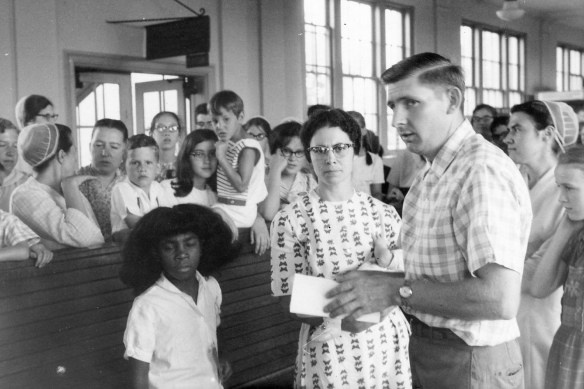
Photo 1 - Eastern Mennonite Missions Train Station Pick-up

Eastern Mennonite Missions Train Station Pick-up (circa late 1950s): Edith and John Boll with unidentified Fresh Air participant at Lancaster City, Pennsylvania, train station. Used by permission of Eastern Mennonite Missions, Salunga, PA (EMM – Record Room, File Cabinets middle isle, Drawer marked, Information Services Picture File, File: Archives – Home Ministries, Children’s Visitation Program).

And the Amish and Mennonites frequently starred in those accounts. A 1958 press release praised the Mennonite family who hosted a family of five fresh air boys from New York City for an off-season Christmas visit replete with a feast of turkey and stuffing, sweet pickles, peas, carrots, cranberry sauce, plum pudding, fruit cake and ice cream for dessert. Summer’s Children, a 1964 promotional film produced by the Fund, featured Mennonite and Amish families. In 1976, the Fund’s executive director Lisa Pulling noted that Mennonites made Pennsylvania the “most popular place to go” other than New York itself. That same year, newspapers across the country featured a column by popular writer George Will in which he praised the Amish for their Fresh Air hosting in glowing terms every bit as nostalgic as those offered by Combs. After describing the “creak and jingle of harnesses, and the clippity-clop of hooves on pavement,” Will described the family of Benuel Smucker in Ronks, Pennsylvania, who “have no truck with modernity, including electricity, a fact which does not bother their guests from the Big Apple — twin eight-year-old black boys.” Combs was far from the only African-American child to have discovered the appeal of rustic, rural havens.

As the burst of interest in Combs’s story makes evident, the prospect of placing urban children of color with pristine symbols of the nation’s agrarian past – scholar and poet Julia Kasdorf refers to the Amish as “whiter than white:  innocent, pure, plain—Puritans but without their unhappy edge” – has mass appeal. When placing innocents with innocents, everybody wins. There is no racial loser; no antagonist; only the celebration of borders crossed and friendships won.

However, that formula of doubled innocence did not always balance. Children grew homesick and begged to return to the city. Busloads cheered upon crossing back over into New York City. Neighbors, townspeople, and sometimes hosts used racial epithets to refer to their charges. Accusations of theft abounded. Administrators had to remind the hosts that they were not just getting free labor. Assured that they were getting a vacation, some guests balked at the demands of chores and refused to toil without compensation. Up until the mid-1980s, the Fresh Air Fund paid little attention to screening hosts for a history of sexual abuse even while intensively screening the children for STDs and other communicable diseases. The narrative related by Combs is, at the very least, more complex than he suggested.

As much as I was fascinated to hear Combs talk about his Fresh Air experience, it was not the content of the narrative itself that drew my attention. While my research suggests a far more problematic story than the one he told – particularly when the model itself continues to be one-way, short-term, urban-negative, and racially paternalistic – it was the nostalgic way he told the story that I found most gripping.

No matter how hard Kimmel tried to make light of Combs’s reminiscences, he stayed sincere and focused on the positive memories that he held of his time with the Amish. Here was a highly successful entrepreneur whose personal worth tops $800 million, a man who lavishes expensive gifts on his children, a philanthropist who has founded his own program to assist urban youth – one that includes a summer camp each year – and who has given generously to both victims of Hurricane Katrina and students at Howard University. Amid that material success, he harkened back to his time with the Plain people, a group whose lifestyle and commitments seem light years from his own.

But through nostalgia – an emotion defined by sentimental longing and a wistful yearning for better times gone by – Combs made a connection. He saw in his life some measure of charity, hard-work, care for children, and simplicity. He claimed to have learned those values, at least in part, from the Amish; the experience “helped to make me what I am,” he explained in his interview with Kimmel.

Nostalgia is a powerful emotion. Our current president used its appeal to great effect in his most recent campaign. Yet, as was the case with Combs and the Fresh Air Fund, nostalgic appeals often cover over the complexities and underside of history and, in so doing, create a past that never really existed. That’s why the writing and research of history are so critical at this moment. Without a grounding in as much evidence as can be mustered, we risk basing our decisions on fanciful and false presentations of the past.

Combs said in the interview that he would love to know if his host family realized what he grew up to become. Apparently they do, since his sister, who also stayed with the same Amish family in eastern Lancaster County, recently contacted them.

Should Combs talk with his former hosts, I wonder what they would discuss. As is the case in the vast majority of Fresh Air exchanges, long-term relationships are rare, difficult to sustain, and often end when the children enter adolescence. A great deal of evidence shows that white host families are much more reluctant to host teenagers due to the possibility of interracial romance blossoming. Nonetheless, perhaps they would discuss Combs’s efforts to better the lives of other children from the city. Perhaps they would chat about additional memories Combs carries from his sojourn. They might even talk over the ways in which Combs life remains so far from their own.

But, if I had to guess, I would venture that they would spend at least some small measure of their time simply reminiscing about, in the words of Kimmel, the now incongruous image of “Diddy in a buggy.”

Works Cited

Crandell, Richard F., ed. The Frog Log and Other Stories About Children. New York: Herald Tribune Fresh Air Fund, 1962.

“Fresh Idea in ’77 Becomes Fun Fund for City Children.” New York Times, Sunday, May 23, 1976, 51.

Hechler, David. The Battle and the Backlash: The Child Sexual Abuse War.  Lexington, MA: Lexington Books, 1988.

Kasdorf, Julia Spicher. “‘Why We Fear the Amish’: Whiter Than White Figures in Contemporary American Poetry.” In The Amish and the Media, edited by Diane Zimmerman Umble and David Weaver-Zercher, 67-90. Baltimore: Johns Hopkins Press, 2008.

“Lancaster Holds Film Premier.” What’s In the Air, Fall 1964, 1-2.

Shearer, Tobin Miller. Two Weeks Every Summer: Fresh Air Children and the Problem of Race in America.  Ithaca, NY: Cornell University Press, 2017.

Will, George F. “Amish Able Hosts to New York Children.” The Post-Crescent, Saturday, August 7, 1976, A-4.


[^1]: Richard F. Crandell, ed. The Frog Log and Other Stories About Children (New York: Herald Tribune Fresh Air Fund, 1962).

[^2]: “Lancaster Holds Film Premier,” What’s In the Air, Fall 1964.

[^3]: “Fresh Idea in ’77 Becomes Fun Fund for City Children,” New York Times, Sunday, May 23, 1976.

[^4]: George F. Will, “Amish Able Hosts to New York Children,” The Post-Crescent, Saturday, August 7, 1976.

[^5]: Julia Spicher Kasdorf, “‘Why We Fear the Amish’: Whiter Than White Figures in Contemporary American Poetry,” in The Amish and the Media, ed. Diane Zimmerman Umble and David Weaver-Zercher (Baltimore: Johns Hopkins Press, 2008), 69.

[^6]: David Hechler, The Battle and the Backlash: The Child Sexual Abuse War (Lexington, MA: Lexington Books, 1988), 29-54.

[^7]: I explore all these themes in my recent book: Tobin Miller Shearer, Two Weeks Every Summer: Fresh Air Children and the Problem of Race in America (Ithaca, NY: Cornell University Press, 2017).

[^8]: “Sean Combs, “https://en.wikipedia.org/wiki/Sean_Combs#Charity_work_and_honors, Wikipedia, accessed August 7, 2018.

[^9]: Sean ‘Diddy’ Combs wants to find the Lancaster Amish couple he spent summers with as a Fresh Air Kid” LNP Monday, August 7, 2018 https://lancasteronline.com/features/entertainment/sean-diddy-combs-wants-to-find-the-lancaster-amish-couple/article_cd3b8412-9973-11e8-8892-4be24b7102d6.html

[^10]: Shearer, 79.
“We Are Very Good Friends:” Two School Directors Build Bridges between Mennonite and Rarámuri Communities in Chihuahua, Mexico

Abigail Carl-Klassen

Note: This article is sourced from the “Rebels, Exiles, and Bridge Builders: Cross-Cultural Encounters in the Campos Menonitas of Chihuahua” Oral History Project conducted in northern Mexico in the spring of 2018 with funding from the D.F. Plett Historical Research Foundation. The complete audio recordings, transcripts, and translations of the project interviews are housed in the Mennonite Heritage Archives in Winnipeg, Manitoba. Selected audio interviews in English and Spanish (with English subtitles), featuring landscape photography by local photographers Marcela Enns, Veronica Enns, and Raúl Kigra are available on YouTube as part of a series titled Darp Stories which will run from May to December 2018. Bruno Ramos Rivas and Alicia Bustillos González’s interview will be available after November 23, 2018, and Peter Rempel’s interview will be available after November 9, 2018. After the Darp Stories series runs to completion, all videos will remain online as a public access archive.

In 2008, Bruno Ramos Rivas, like an increasing number of Rarámuri Indigenous people1, left his home in the mountains of Guachochi, Chihuahua, Mexico, to find work in the city. Instead of the bustling capital, Chihuahua, or the border metropolis of Juárez, both popular destinations for Rarámuri people fleeing economic insecurity and narco-violence, Bruno found himself in the Manitoba Colony of the Campos Menonitas, the Mennonite settlements just north of Cuauhtémoc, Chihuahua. Cuauhtémoc and the surrounding region is celebrated as “La Tierra de Tres Culturas,” “The Land of the Three Cultures”: Mestizo, Rarámuri, and Mennonite. Once the stomping grounds of Mexican revolutionary Pancho Villa, the Tres Culturas region, like much of northern Mexico, known for its industry, commercial agriculture, and higher wages, now attracts migrant labor from across Mexico and Central America. A billboard in the small town of Rubio, forty kilometers north of Cuauhtémoc, that reads “Rubio Tierra del Trabajo,” “Rubio the Land of Work” greets travelers on the Corredor Comercial, the commercial highway that connects the Mennonite settlements of the Ojo de la Yegua colony, Swift Colony and Manitoba Colony to Cuauhtémoc. “The Land of Work” delivered on its promise and Bruno soon found work in a Mennonite-owned sand plant alongside Rarámuri, Mestizo, and Mennonite employees, and within the year, his wife Alicia and their children joined him in the Campos Menonitas.

IMG_7360

The Rarámuri school, Ministerio de Amor, and its programs. (Photo provided by Pete Rempel, director of the Gnadenthal Kleingemeinde school)

Upon arrival, Bruno and Alicia did not anticipate the close relationships they would build with the Mennonite community, or the opportunities they would have to empower Rarámuri children, youth and their families who migrated to the Campos Menonitas by serving as educators at a bilingual (Rarámuri/Spanish) school in Campo 14, Ministerio de Amor, funded by a Kleingemeinde Mennonite church. The school, which has been in operation since 2011, was founded by Maria Wiebe Enns, the wife of Kleingemeinde pastor Jacobo Enns, who was concerned that the children of Rarámuri workers living in the Manitoba Colony did not have access to education. In the 2017-2018 academic year, the school served forty students in preschool through sixth grade, employed six Rarámuri teachers, and became a fully registered and accredited school through Mexico’s Department of Education. Bruno, who has served as the school’s director for the last three years, anticipates that the school will continue to grow, as a result of increasing Rarámuri migration, and he hopes to be able to serve students through the end of secondary school in the near future.

The first Mennonites arrived in San Antonio de Arenales (now Cuauhtémoc) from Saskatchewan and Manitoba, Canada, on March 8, 1922, in the wake of the Mexican Revolution, and in the nearly one hundred years since, they have been navigating the complex socio-political dynamics of the region and building cross-cultural relationships with their Mestizo and Rarámuri neighbors. From early conflicts concerning land sales and distribution to later disputes concerning military service exemptions to present-day tensions concerning water rights and narco-violence, the Mennonites’ time in Chihuahua has not been without challenges. Because the Campos Menonitas were originally separatist, both in ideology and geography, and had a large amount of autonomy granted by the Mexican government, contact with people outside the colonies until recent decades was almost exclusively business related and done by men. Educational, social, and romantic relationships were frowned upon and many times, forbidden outright with the threat of excommunication. Despite these risks, however, there have always been members of the Mennonite community who have pushed the boundaries. In recent years as a result of reforms within communities, such as the transition from horse and buggy to vehicles and education reform to include Spanish instruction in many schools (with the exception of the Sabinal Colony in far northern Chihuahua), interactions of all kinds between Mennonites and people from Mestizo and Rarámuri communities, like the formation of Ministerio de Amor, have been increasing.

IMG_3049

The Rarámuri school, Ministerio de Amor, and its programs. (Photo provided by Pete Rempel, director of the Gnadenthal Kleingemeinde school)

Pete Rempel, the director of a Kleingemeinde school in Gnadenthal (Campo 22), where he also teaches ninth grade, is one such example of this increased contact between communities. His great-grandparents were among the first colonists to arrive in 1922, and he credits his interests in building relationships across cultures to his grandmother whose warmth, hospitality, and humor was extended to her Mestizo neighbors, despite her limited Spanish. A young man approaching thirty, Pete remembers when the primary language of instruction in Kleingemeinde schools shifted from German to Spanish when he was in third grade, which gave him and subsequent generations of students the language skills necessary for increased interactions outside the Mennonite community. Because of his Spanish abilities and openness to build relationships cross-culturally, Pete serves on a committee that funds and advocates on behalf of Ministerio de Amor where Bruno and Alicia work. During their time working together, Bruno and Pete have formed a close friendship that has provided opportunities for growth and self-reflection. Pete speaks frankly about working to overcome his prejudices, saying, “Don’t think that I am a saint.” He addresses how his friendship with Bruno has allowed him to more clearly see racism in the Mennonite community, as well as the need for individual and systemic changes in the ways in which Mennonites interact with Mestizo and Rarámuri communities, particularly in terms of fair wages: “There are some [Mennonites] that take it to an extreme. They pay them as little as possible.” He believes that friendships like his and Bruno’s are a good first step, saying, “I think it is by the grace of God that yes, I have changed in some way. It is because God was patient with me and helped me, but I continue to struggle with this, and I think it partly due to how we are raised. We need to raise our children differently. Not raising them to see other cultures with discrimination, or to discriminate against them.”

IMG_7158

The Rarámuri school, Ministerio de Amor, and its programs. (Photo provided by Pete Rempel, director of the Gnadenthal Kleingemeinde school)

Bruno notes that despite his close relationship that he has with Pete and the Mennonite community, upon his arrival to the Campos Menonitas he was wary of people outside his community because of the long history of repression of Indigenous peoples. “The Tarahumara live with that feeling of self-defense toward white people because of the history we bring with us.” However, over time Bruno’s feelings changed based on the positive experiences he had with the community. “Since I have gotten to know these Mennonites, I discovered that yes, I can trust them. I can trust because they have demonstrated it to me. Not just because I think so, but because they have demonstrated it.” He views his friendship with Pete as a way to begin to rebuild trust and a way to for him to advocate for justice and opportunities for the Rarámuri community: “We are very good friends despite being from another nationality. You can see that brotherhood. That friendship that can break with race, with language. With color. With social conditions. It is just a matter of getting to know one another. I would like the Tarahumara to have freedoms, to feel the freedom to speak with a Mestizo, with an American, with a foreigner. To think freely without being ashamed that he is Tarahumara.”


  1. An alternative term, Tarahumara, is often used to refer to the Rarámuri Pueblo. This term has its origins in Spanish colonization, and while both Rarámuri and Tarahumara are often used interchangeably, I chose to use the term Rarámuri because it is the term officially used by the Pueblo to refer to themselves. 

Amish Quilts and Abstract Art

Janneken Smucker

When I began researching the relationship of Amish quilts to the art market about ten years ago, I wanted to find the missing link that proved that abstract minimalist artists—like Mark Rothko, Barnett Newman, Ellsworth Kelly, and others—painting in bold, graphic blocks of color were inspired by Amish quilts. Surely, some of these artists must have noticed Center Diamond and Bars quilts hanging on the clothes lines in Lancaster County while they tooled about the countryside, right? I had heard a rumor that Frank Stella owned and displayed Navajo blankets, so it didn’t seem like such a stretch. And buried in a exhibition catalog I found a reference to Andy Warhol owning a Lancaster County Amish quilt, but his signature pop art shared more in common with the repeat block patterned quilts of the dominant culture, rather than the graphic minimalism of Amish quiltmakers.1 Maybe, just maybe, there was some hidden connection.

An art historian friend offered to get a message from me to Mark Rothko’s children. I asked if Rothko was familiar with Amish quilts, or if the family ever slept under quilts. His heirs’ answer was an adamant “no,” that this signature color field painter was not at all familiar with the craft. Barnett Newman’s widow fielded a similar question from a folk art curator comparing her late-husband’s work to an Amish bars quilt, stating that his intention was to explore the “subtle relationships between stripes and ground,” whereas a quiltmaker was “carrying out a simple pattern.”2

No_61_Mark_Rothko

“No. 61 (Rust and Blue)”, by Mark Rothko 1953. Museum of Contemporary Art, Los Angeles

Perhaps it would not be in a prominent living artist’s best interest to acknowledge being inspired by the artistic work of untrained female artists from a relatively closed religious group. The hierarchies between art and craft, between male-trained fine artists and female needleworkers were rigidly defined in the 1960s and ’70s. A Philadelphia Inquirer review of one of the very first exhibits focused narrowly on Amish quilts noted, “It would probably be difficult to secure loans of paintings from abstract artists if the intention were to show them alongside quilts… hard-edge abstract painters…probably would feel chagrined, I should think, to have their efforts compared… with applied arts – albeit excellent, quintessentially American folk arts such as Amish quilts.”3 But these boundaries began to blur as interest in women’s traditional artforms gained prominence, thanks to feminism, the approaching Bicentennial, the counterculture’s interest in applied arts and crafts, and an otherwise expanding art canon.

While Newman and Rothko may not have acknowledged drawing any inspiration from Amish quilts—and indeed I can find no evidence that they did—another artist who painted in a similar vein did. Warren Rohrer, with deep roots in a Mennonite farm family from Smoketown in Lancaster County, Pennsylvania, had grown up sleeping under quilts made by his mother and grandmother. Yet despite living in proximity to the Amish in Lancaster County, he never saw one of their quilts until visiting Abstract Design in American Quilts, a 1971 exhibit at the Whitney Museum of American Art. He described the Amish Bars quilt he saw there as “simple in design, like ‘modern art,’ and brooding in color, like Rothko.”4

Following this introduction to Amish quilts, Rohrer explicitly drew on the minimalism and graphic simplicity inherent in the bedcovers in his paintings. Rohrer’s mid-1970s paintings reflect both his newfound interest in Amish quilts (his paintings Fields: Amish 1, Amish 4, and Amish 5 share a strong resemblance with Lancaster Amish quilts) and a return to his agrarian roots as his minimalist painting recalled the farm fields of his youth.5 This conscious turning to his own Anabaptist, rural history prompted the Inquirer art critic to observe that unlike most abstract painters whose work had been compared to quilts, Warren Rohrer would not mind this association.

Rohrer_settlement_magenta

Warren Rohrer, Settlement Magenta, 1980. Philadelphia Museum of Art, Purchased with funds contributed by Henry Strater and Marion Boulton Stroud, 1982

And he and his wife Jane Rohrer also began, in his words, “to search for the ‘perfect Amish quilt,’” buying some with the assistance of Philadelphia antiques dealer Amy Finkle.6 And they found quilts, that seem to my eyes, indeed close to perfect, including this one they later gifted to the Philadelphia Museum of Art.

PMA_quilt

Center Square Quilt, Artist/maker unknown, American, Amish, Made in Lancaster County, Pennsylvania, c. 1900. Philadelphia Museum of Art, Gift of Mr. and Mrs. Warren Rohrer, 1982

Penn State’s Palmer Museum of Art is slated to exhibit Rohrer’s paintings along with his wife Jane Turner Rohrer’s poetry in a 2020 show titled From Mennonite Fields: Tradition and Modernism in the Painting and Poetry of Warren and Jane Rohrer, exploring the work of these two artists of Mennonite upbringing. Curated by poet and Penn State professor of English, Julia Spicher Kasdorf; director of the graduate program in Visual Studies at Penn State, Christopher Reed; and Palmer curator Joyce Robinson, the exhibit will also feature Amish quilts from the Rohrer’s collection along with Pennsylvania Dutch painted furniture. The exhibit is funded by a Penn State University Strategic Plan Seed Grant.


  1. Sandra Brant and Elissa Cullman, Andy Warhol’s “Folk and Funk” : September 20, 1977-November 19, 1977 (New York: Museum of American Folk Art, 1977). 
  2. Quoted in Jean Lipman, Provocative Parallels : Naïve Early Americans, International Sophisticates, 1st ed. (New York: Dutton, 1975), 144. 
  3. Victoria Donohue, “Amish Quilts and Abstract Art Blended at ICA,” Philadelphia Inquirer, August 8, 1976. 
  4. Warren Rohrer, “My Experience with Quilts (A Bias),” in Pennsylvania Quilts: One Hundred Years, 1830-1930 (Philadelphia: Moore College of Art, 1978). 
  5. David Carrier, Warren Rohrer [Published in Conjunction with the Exhibition “Warren Rohrer: The Language of Mark Making” Held at Allentown Art Museum of the Lehigh Valley, October 23, 2016 – January 22, 2017], (Philadelphia, Pa: Locks Art Publ., 2016), 72–77. 
  6. Rohrer, “My Experience”; Amy Finkel, interview by Janneken Smucker, Philadelphia, PA, May 15, 2008, Louie B. Nunn Center for Oral History, University of Kentucky Libraries, https://kentuckyoralhistory.org/catalog/xt71zc7rqw4b. 

What Do Historians Look Like?

Rachel Waltner Goossen

The first time I submitted a piece of scholarship for consideration to an academic journal—at age twenty-one and having just earned B.A. in history—a rejection letter came in quick response.

Why? Because I was young? A woman? Not networked to the journal’s editor and his team? I wasn’t sure, but subsequent discussions with my two college mentors—who had advised my capstone seminar research—backed my notion that the turn-down might have had something to do with all the above. They encouraged me to submit my article to another journal, where a shortened version soon appeared in print.  I’ve never forgotten their professorial advice, helping me make a crucial step forward at the start of my career.1

During the 1980s, when I became a historian, my academic mentors were all male: first at Bethel College, and then in graduate school at the University of California and the University of Kansas. Few women were available in my discipline, history, to serve as role models.

For my first teaching job, a tenure-track position at Goshen College, I joined a department of four male colleagues. It was clear from our conversations that they had been motivated to hire the first woman historian in the institution’s one-hundred-year history. I appreciated the support I received as a young faculty member at Goshen. But it took another half-decade, and accepting a job offer from another institution, before I had the opportunity to work alongside women historians daily and reap the benefits of having a more diverse set of colleagues.

This summer, I’ve been encouraging historian friends, including former students who have entered the profession, to sign up as participants in a new online database, “Women Also Know History.” It is an initiative for historians, and I’m prompting Mennonite/Anabaptist women historians, as a subset of that larger whole, to sign on. And I’d like to see the database utilized by all, regardless of gender. For example, if you or a colleague plan to organize a panel or conference in the next year, consider searching the website to become informed about qualified women working in your field.

CrossingtheLineWrapupSession

Jenae Longenecker speaks at the “Crossing the Line” history conference, Eastern Mennonite University, June 2017. Photo credit: Ann Hostetler

Many Anabaptist/Mennonite scholars, like our colleagues in the broader academy, are prone to imagine historians as white men, often because we’ve been educated and mentored by individuals who, due to gender, gravitas, or both, resemble those who helped me along early in my career: Keith Sprunger, James Juhnke, Robert S. Kreider, and others.

This gender bias—often implicit—is hardly limited to those of us who employed by colleges and universities. It extends to journalists, who reach out to historians to offer perspectives on topics both past and present, and who may not think twice before calling on men they’ve long known and relied upon. And gender bias extends to members of the broader public, too; for example, consumers of television news programs who see, exasperatingly often, all-male panels of commentators.

The “Women Also Know History” initiative is a networking tool, and it’s easy to use. The website is designed so that anyone interested in organizing a conference panel, designing a course syllabus, or reaching out for informed commentary on a given subject can learn about (and potentially contact) qualified, knowledgeable women. The goal is to bring more gender balance to scholarly and journalistic enterprises.2

Launched on June 5, the website now includes more than 2,500 women with historical training and expertise from around the world.  It represents a new strategy to increase the visibility and voices of qualified women, to level the playing field, to diversify perspectives.3 This resource—open to women historians from a variety of backgrounds, including graduate students, public historians, museum professionals, and others—is inspired by “Women Also Know Stuff,” a similar endeavor begun two years ago through a collaboration of political scientists. Christina Wolbrecht, one of the organizers of that site, says that her editorial board “supports efforts to combat implicit bias in every discipline and every country . . . . We enthusiastically encourage efforts to build similar initiatives for other groups of underrepresented scholars and within other disciplines.”4

The new historians’ database is an easy-to-use tool for scholars and journalists to find and network with women working in a range of professional fields. Any woman who registers can choose how much she wants to include about the depth and breadth of her scholarship. For those visiting the website, benefits quickly accrue as one scrolls through profiles of historians and begins to make connections across topics, geographical settings, and generations.

Since I entered the historical profession thirty-five years ago, women’s visibility in many subject areas has increased. In the field of Anabaptist/Mennonite scholarship, this evolution has never been more evident than at the “Crossing the Line: Women of Anabaptist Traditions Encounter Borders and Boundaries” conference, hosted in June 2017 by Eastern Mennonite University in Virginia. Academics and independent scholars serving on the planning committee crafted a program with panel after panel of historical and interdisciplinary presentations featuring scholars and artists from five continents.

With the “Crossing the Line” theme highlighting literal and metaphorical boundary-crossings, we considered how gender has influenced interpretations of Anabaptist and Mennonite history. Professor and novelist Sofia Samatar, reflecting during a plenary session with humor and insight on her upbringing in Mennonite and Muslim subcultures, reminded participants of the cultural richness that comes from narrating histories from a variety of perspectives. Because of the ways in which certain topics have been gendered, some topics receive more visibility while others receive less.  Hearing from women (not just men) on panels enriches all listeners because different histories are likely to be told, and in different ways.

Samatar concluded: “We need all the women’s voices we can get.”5 In that spirit, the new database “Women Also Know History” is a welcome resource for us all.

Rachel Waltner Goossen is professor of history at Washburn University in Topeka, Kansas.


  1.  More than thirty-five years later, the article is still cited occasionally in the work of other scholars.  Rachel Waltner, “From Anabaptism to Mennonitism:  The Mennonite Encyclopedia as a Historical Document,” Mennonite Life 37 (December 1982): 13-19. 
  2. Nell Gluckman, “Female Historians Try to End the ‘I Didn’t Know Any Women’ Excuse for All-Male Panels,” Chronicle of Higher Education, 22 June 2018, A-23. 
  3. For an example of earlier strategizing by women in a specifically Mennonite context, see Dorothy Nickel Friesen, The Pastor Wears a Skirt: Stories of Gender and Ministry (Eugene, Oregon:  Resource Publications, 2018), 21-22. 
  4.  Quoted in Keisha N. Blain and Karin Wulf, “’Women Also Know History’:  Dismantling Gender Bias in the Academy,” History News Network, 9 June 2018, https:  historynewsnetwork.org/article/169254. 
  5.  Samatar, “In Search of Women’s Histories,” presented 24 June 2018, Crossing the Line:  Women of Anabaptist Traditions Encounter Borders and Boundaries conference, Eastern Mennonite University, Harrisonburg, Virginia; see Ben Goossen, “In Search of Women’s Histories:  Crossing Space, Crossing Communities, Crossing Time at Crossing the Line,” Anabaptist Historians, 27 June 2017, https://anabaptisthistorians.org/tag/anabaptist-identity/page/3/. 

“I’m likin’ Pennsylvania Dutch”

Mark L. Louden 

A decade ago, my wife, daughter, and I lived in Freiburg, Germany, for a year. Our daughter, who turned five that year, attended a wonderful preschool there, but had some adjustment problems at first and often cried at drop-off. I would smile, wave good-bye, and tell her I loved her, at first in English, and then, after a few weeks, in German. We soon settled into a comfortable routine, and I continued to say Ich liebe dich to her, until one day the mother of another child turned to me and, with a hint of consternation in her voice, asked me where I was from. When I told her we were American, she said that although she also loved her child, she would never say Ich liebe dich at drop-off. It was too emotional or serious an expression to be used in such an everyday situation, she informed me.

mEven though I felt a bit defensive at the time, I realized that the woman was right, lieben-related words are marked by more linguistic gravitas in German than their love counterparts in English. When McDonald’s introduced their “I’m lovin’ it” branding campaign in 2003, Germans were notably uncomfortable with the sound of Ich liebe es. If they feel awkward telling their children they love them, imagine the problem they would have directing that expression toward burgers and fries. It is no accident that McDonald’s restaurants in all other European countries with linguistic sensibilities similar to those of Germany, including Austria, Switzerland, Liechtenstein, the Netherlands, and the Nordic countries, avoided the problem by simply using the English slogan.

Although Pennsylvania Dutch speakers have essentially been cut off from German-speaking Europe since the eighteenth century, and conversational routines from English have been adopted into their heritage language, many patterns of German speech endure in the varieties spoken by Amish and traditional Mennonites today, including how the verb liewe ‘to love’ and noun Liewi ‘love’ are used. Their meanings are rooted in the Christian notion of agape rather than romantic or even brotherly love. Gott liebt sei Kinner ‘God loves his children’ is perfectly fine, but Plain parents, in speaking of their own children, are more apt to say, Mir gleiche unser Kinner literally ‘We like our children’, using a native German verb, gleiche, that originally meant ‘to resemble’ but under the semantic influence of English now means ‘to like’. Just as the German mom who called me onto the linguistic carpet at my daughter’s preschool, Amish and traditional Mennonite parents do not love their children any less than other parents do. Pennsylvania Dutch speakers, like their distant linguistic cousins in Europe, are simply inclined toward understatement relative to their English-monolingual neighbors.

sis addlich waarm heit

The Plain Anabaptist tendency toward verbal humility is clearly reinforced by a concern to always aim to speak the truth. Expressions such as I’m starving, I died laughing, or even It’s hot outside today that are commonplace in English are all but nonexistent in Pennsylvania Dutch. Acceptable equivalents would be Ich kennt esse ‘I could eat’, Ich hab hatt glacht ‘I laughed hard’, and S’is addlich waarm heit ‘It’s quite warm today’, even if the temperature were well above ninety degrees. The concern with using the adjective hees ‘hot’ in reference to the weather has to do with wanting to avoid a comparison, even unintentionally, between the world and hell. Boiling water or a hot stove can be called hees; in fact, for safety reasons, hot objects must be identified as such (Geb acht, sell is hees! ‘Watch out, that’s hot!’). In such cases, however, there is no risk of making unwanted comparisons.

Exercising verbal caution is reflected in another way that Pennsylvania Dutch is used by Amish and Mennonites, namely with regard to pregnancy. It may come as a surprise that in the language used in communities whose birth rates are between triple and quadruple that of the U.S. general population there is no native word for ‘pregnant’. In the monumental Comprehensive Dictionary of Pennsylvania German compiled by the late C. Richard Beam, there is an entry for schwanger, which is also the German word for ‘pregnant’, yet Beam notes that it is “not used much anymore but up until 1960, it was used.”1 It is probably no coincidence that it was around that time that Plain (sectarian) speakers of Pennsylvania Dutch came to outnumber their “Fancy” (nonsectarian) counterparts, who were more likely to describe pregnant women as schwanger. So what do Amish and Mennonites say? In general, people avoid talking openly about pregnancy, but when they do, the most common expression is an ekschpeckte sei ‘to be expecting’, as in Sie is an ekschpeckte ‘She is expecting’. This is a doubly indirect turn of phrase since it is both a euphemism and a borrowing from English.

Out of curiosity, I consulted the equivalent of Beam’s Comprehensive Dictionary for Palatine German, the Pfälzisches Wörterbuch, which documents the European source dialects of Pennsylvania Dutch. Schwanger is listed, yet with the comment that the word is usually avoided in favor of euphemisms, such as aufgebündelt sein ‘to be bundled up’ and die Täsche voll haben ‘to have full pockets’. Intriguingly, the first synonym listed in the dictionary for schwanger is pattersch, a word borrowed from Yiddish that refers to animal pregnancies.2 This is neither humorous nor disrespectful, but similar to the double indirectness involved in the borrowed euphemism an ekschpeckte sei.

The caution surrounding discussions of pregnancy characteristic of the Old Orders is not as common today among younger Central Europeans, however certain traditions connected with pregnancy that distinguish both Germans and Plain people from mainstream Americans endure. The most obvious one is the relative rarity of baby showers in Germany (and many other countries around the world), which are nonexistent in Old Order culture. For traditional Anabaptists, to assume that all will go well with a pregnancy, which is implicit in baby showers, is understood as prideful thinking, a serious transgression from a Christian perspective. Germans, as members of a highly secular culture, are more inclined to view a baby shower as just a “bad omen.” However, in recent years, among younger German women, at least, the baby shower – called a Babyparty in German – has joined McDonald’s, Halloween, and cheerleaders in the array of American popular cultural imports.

Another way that Plain people’s views on events that have not yet occurred are encoded into their Pennsylvania Dutch is in the expression, so mir lewe un’s der Harr sei Wille is ‘if we live and it is the Lord’s will’, a turn of phrase that is certainly not unfamiliar to other Americans, including Johnny Cash in his song If the Good Lord’s Willing (lyrics by Jerry Reed) with its signature line, “If the good Lord’s willing and the creeks don’t rise.” Amish and Mennonites, like their English-monolingual neighbors, cannot avoid planning for the future, but there is always a contingency that is encoded linguistically. Interactions such as this are the norm: Sind dihr an figgere mit noch Indiana geh? — Ja, sell is was der Plaen is ‘Are you (pl.) figuring on going along to Indiana? – Yes, that’s the plan’.

The fundamental open-endedness of what may lie ahead among traditional Anabaptist speakers of Pennsylvania Dutch makes their use of future tense verb forms interesting. Older varieties of the language, especially those spoken by the historical nonsectarian majority (people of mainly Lutheran and German Reformed background), resembled European German in the lack of a distinct future tense. A simple expression like Ich geh mit (Ich gehe mit in German) could mean either ‘I go along’ in a habitual sense (e.g., every time my friends go to Indiana, I accompany them), ‘I’m going along’ (right now), or ‘I will go along’ (next week). English differs from German in this regard by typically drawing a clear verbal line between present and future time, e.g., I go along vs. I will go along (or I’m going to go along). Modern sectarian Pennsylvania Dutch, almost certainly due to the influence of English, has developed two auxiliary (helping) verbs that mark future time (similar to English will/be going to), both of which are derived from metaphoric uses of counting or calculating verbs with reference to future events: zeele or (zelle) from the verb zaehle ‘to count’ and figgere, which is derived from English to figure. The difference between the two is largely regional/generational, with younger Midwestern Amish using figgere more frequently than older Midwesterners or sectarians of any age from a Lancaster-affiliated community.

That a group of speakers who are averse to speaking with certainty about the future would actually develop (albeit unconsciously) dedicated future tense forms is, on the face of it, anomalous. How are zeele and figgere used? In sentences like Sind dihr an figgere mit noch Indiana geh?, when the auxiliary is used in a progressive expression (marked by an), it has the meaning of to intend to (do something). If figgere (or zeele) is used as a normal helping verb, the future becomes more definite: Ich figger noch Indiana geh means ‘I will go to Indiana.’ Such sentences are problematic, as I myself learned many years ago. My first exposure to Pennsylvania Dutch was through Lancaster-affiliated speakers, thus I was unfamiliar with the use of figgere. After moving to Texas and living in an Amish community there, I acquired Midwestern Pennsylvania Dutch. On one occasion, I was discussing plans to drive an Amish couple to Oklahoma and made the mistake of saying Ich figger ken Accident hawwe, by which I meant to say ‘I’m not planning on having an accident’ but was understood by my friends as ‘I won’t have an accident’. The wife immediately corrected me by saying, Du HOFFSCHT, du hoscht ken Accident! ‘You HOPE you don’t have an accident!’

Examples of the acceptable uses of the future tense in Pennsylvania Dutch can be found in Di Heilich Shrift, the Pennsylvania Dutch translation of the Bible, which was completed in 2013. The first instance of a zeele form (spelled zayla) is in Genesis 2:16-17:

Un Gott da Hah hott em mann en gebott gevva un hott ksawt, “Du kansht essa funn awl di baym im goahra; avvah fumm bohm funn di eisicht funn goot un evil solsht du nett essa. Fa im dawk vann du esht difunn zaylsht du gevislich shteahva.”

And the Lord God commanded the man, “You may freely eat of every tree of the garden; but of the tree of the knowledge of good and evil you shall not eat, for in the day that you eat of it you shall die.” (NRSV)

It is, of course, entirely appropriate for God, who has perfect knowledge of what will or could come to pass, to employ a future tense form when quoted in Pennsylvania Dutch.

The status of the future tense in sectarian Pennsylvania Dutch connects to a very interesting area of inquiry linking linguistics with psychology and economics. In general, human languages fall into one of two groups as far distinguishing the present from the future time goes in their grammars. English and sectarian Pennsylvania Dutch, in which there is a clear distinction between the present and the future in the verbal system, are “strong future languages.” German, on the other hand, is a “weak future language” because the difference between the present and the future tenses is blurred.

In 2013, an economist from Yale published the results of a fascinating study that showed a significant correlation between the use of strong future or weak future languages and personal economic and lifestyle behaviors.3 Specifically, speakers of weak future languages like German were more likely to save more of their income, smoke less, and generally maintain their health better than speakers of strong future languages like English. The conclusion that the Yale researcher drew was that speakers of weak future languages, such as Germans, for whom the future is in a real sense “closer” to the present, are more likely to invest, literally, in their futures, than British, Anglo-Canadians, and Americans, who speak a strong future language.

Lest one think that Germans’ overall healthier outlook on their futures might be due to cultural or historical factors independent of the grammar of their language, the Yale researcher looked closely at two European countries in which both strong future and weak future languages are spoken, namely Switzerland and Belgium. He found statistically significant personal economic and lifestyle differences between speakers of German and Flemish Dutch (which is also a weak future language), on the one side, and those who spoke French, Italian, and Romansh, which are strong future languages like English. The German and Flemish speakers saved more and smoked less than their Romance-speaking counterparts, even in the same city, Brussels.

How might the historical development of Pennsylvania Dutch from a weak future language to a strong future language reflect sectarian faith and culture? A major distinctive of Plain thought is the recognition that life in this world is fleeting; traditional Anabaptists hold that eternal life is much more important than worrying about one’s earthly legacy. Plain sectarians’ de-emphasis of materialism, in line with I John 2:15-17, as well as their inclination to be more accepting of death than what is found in mainstream American culture, could well be interpreted as fitting for speakers of a strong future language. The relatively clear distinction between the present and future for sectarians and monolingual English speakers alike may indeed be connected to certain attitudes and behaviors, albeit radically different ones. For Plain Pennsylvania Dutch, the focus is on the one half of the divide – a hoped-for future in heaven – while mainstream Americans are more concerned with the other half, making the most of the here and now.

One of the most astute observers of the relationship between language and worldview was the linguist Edward Sapir (1884–1939), who noted, “It is quite an illusion to imagine that one adjusts to reality essentially without the use of language and that language is merely an incidental means of solving specific problems of communication or reflection.”4 Amish and traditional Mennonites have inherited a language with roots in German-speaking Europe, yet use it and have even altered its structure to fit a reality, spiritual and material, rooted in their abiding faith.


  1. Beam, C. Richard and Jennifer L.Trout, The Comprehensive Pennsylvania German Dictionary, Vol. 9: S, Center for Pennsylvania German Studies, 2006, p. 313. 
  2. Christmann, Ernst, Julius Krämer, and Rudolf Post, Pfälzisches Wörterbuch, Franz Steiner Verlag, 1965–1998. (Entry on schwanger accessible here: http://woerterbuchnetz.de/cgi-bin/WBNetz/wbgui_py?sigle=PfWB). 
  3. Chen, M. Keith, “The Effect of Language on Economic Behavior: Evidence from Savings Rates, Health Behaviors, and Retirement Assets,” American Economic Review 103 (2), April 2013, pp. 690–731. (Accessible here: https://www.aeaweb.org/articles?id=10.1257/aer.103.2.690.) 
  4. Sapir, Edward, Culture, Language and Personality, University of California Press, 1958, p. 69. 

Scattered Among Strangers

In the mid-seventeenth century, Dutch Mennonites inquired with increasing persistence into reports of Swiss Reformed governments’ mistreatment of Anabaptists living in their rural territories.1 In response to these expressions of concern, nonconformists in Zurich sought to provide their own testimony of what they had experienced. The primary result of this effort was Jeremias Mangold’s True Report . . . Concerning the Tribulations Which Came Upon Them, a description of the suffering of Anabaptist women and men, and their children, during a campaign of repression instigated by the city’s council in 1635.2 “It is not possible with a few words to tell of the great tribulation and cruelty which came upon us, as well as our wives, children, the aged, the sick, those with child, and those nursing—how they dealt with us poor subjects so harshly, inhumanely, and mercilessly,” Mangold wrote.3 Despite a recognition of the limited capacity of language to capture the breadth of their hardships, community members had contributed to a “short, simple, sure, and true account” of what had occurred. As the text revealed, the detention of Anabaptists and their separation from their children stood at the center of nonconformists’ understanding of the source of their suffering.

Oetenbach_Image

Detail from Jos Murer’s woodcut Der uralten wytbekannten Statt Zurych gestalt und gelaegenhait… (Zurich, 1576) depicting the Oetenbach cloister, which lay just inside the city’s walls. By the 1630s, the city’s council had converted the complex into an orphanage, workhouse, and prison and used it to incarcerate scores of Anabaptist women and men who lived in the surrounding countryside.

For a period of more than a century after the city’s reformation, Zurich’s government had sought to achieve uniformity of religious belief and practice in the territory under its control. The authorities had employed a variety of means, including social exclusion, financial penalties, and control of physical mobility, to compel Anabaptist conformity. Yet, despite the existence of a stable legal framework under which nonconformists could be prosecuted, officials had not implemented penalties systematically. Exemplary punishment of male Anabaptist leaders achieved only short-lived successes. Nonconformists continued to threaten the unity and health of the sacred society which authorities believed they had been ordained to institute and protect.

In the mid-seventeenth century, the council extended the scope of its repression. Frustrated by Anabaptists’ ongoing unwillingness to agree to their basic demand to either conform or leave, the authorities decided to incarcerate both nonconformist men and women in large numbers and to relocate their children, now separated from their parents, into Reformed households throughout the region. In the eyes of the authorities, given the failure of previous initiatives to address Anabaptists’ intransigence, this tactic was a lamentable but necessary means to achieve what they deemed a public good, the elimination of Anabaptist religious culture and the removal of nonconformists from the social body. “But as long as the Anabaptists . . . neither want to move away, nor be obedient, is not an Honorable Government compelled to take such a disobedient people into civil custody?” they asked.4

Thus, the breaking up of Anabaptist families became routine. Reports of family separation punctuate the True Report’s biographical vignettes which relate the details of each Anabaptist family’s experience. When Rudolph Hägi and his wife were detained in the orphanage-cum-prison of Oetenbach—Hägi for a period of eighty-three weeks–their five children were “scattered . . . from house and home among strangers.”5 The children of Adelheid Egli, the daughter-in-law of the martyred Anabaptist Hans Landis, suffered a similar fate during the nearly four years she survived in confinement.6 Anabaptist parents who agreed to leave the territory in exchange for their freedom later returned, incurring significant personal risk to find their daughters and sons. Mangold, describing the actions of the expelled Anabaptist Jacob Gochnauer, reported that “when he came into the area again to search for his scattered children, he walked into the hands of the enemies on the street, and they took him prisoner.”7

Evidence of family separation also appears in the city’s archived financial records. When Anna Peter and her husband Hans Müller, a miller from the small rural settlement of Edickon and an Anabaptist deacon, were imprisoned in Oetenbach for more than a year, their nine-year-old twins and three-year-old son were handed over to Müller’s Reformed brother, while their eighteen-month-old daughter was placed in the home of Müller’s Reformed brother-in-law, an official with policing functions in a nearby village government. The authorities mandated that these children be billeted and supervised without any support from the common funds.8

Members of local Anabaptist communities, who had survived in hostile conditions for decades, recognized that the breaking up of families represented a departure from a previous punitive regime. They lamented this punishment over any other. In addition to concern about the physical well-being of children–who were now “buffeted about among strangers, looked down upon, scolded, and mocked”—Anabaptists also harbored fears about the long-term consequences of their children’s separation from “fatherly and motherly care.”9 Who would supply their children’s needs and with what intentions? Who would protect them as they matured? Who would care for their spiritual well-being? Who would they become? How these questions would be answered had grave implications for the maintenance of fragile community life.

If anything, the authorities believed that separating children from their Anabaptist parents would improve their lot; integrated into the life of the Reformed parish, children stood a chance at social and spiritual restoration.10 Yet, this remained the secondary benefit of a coercive program with a more important objective. By exerting intolerable pressure on Anabaptist parents, the breaking up of families forced them to choose between conformity or exit. This practice helped authorities articulate a basic message: “We do not want you here, at least not as you are.” Within a few years after the implementation of this program, there was no longer an Anabaptist presence in Zurich. The government’s project of religious and cultural purification found success.


  1. Translated editions of many of the records produced by these inquiries and the efforts of mutual aid that followed are found in Documents of Brotherly Love: Dutch Mennonite Aid to Swiss Anabaptists, Volume I, 1635- 1709, trans. James W. Lowry, ed. David J. Rempel Smucker and John L. Ruth (Millersburg, Oh.: Ohio Amish Library, 2007), and Letters on Toleration: Dutch Aid to Persecuted Swiss and Palatine Mennonites, 1615-1699, ed. and trans. Jeremy Dupertuis Bangs (Rockport, Maine: Picton, 2004). 
  2. All subsequent passages cited from this work, originally titled “Ein Warhafftiger Bericht, Von den Brüdern im Schweitzerland, in dem Zürcher Gebiet, Wegen der Trübsalen welche über sie ergangen seyn, um des Evangeliums willen; Von dem 1635sten bis in das 1645ste Jahr,” are taken from Lowry’s full translation in Documents, 24-83. On the attribution of authorship of this manuscript to Mangold, see Documents, 25n1. 
  3.  Documents, 27. 
  4. Johann Heinrich Ott to Isaac Hattavier (July 1645), translated in Documents, 103. Here, Ott, a Reformed minister defending the Zurich government’s actions to Hattavier, a merchant representing the interests of Dutch Mennonites, paraphrased an anti-Anabaptist tract known as the Manifest, published and disseminated by the city council in 1639. The original passage is found in Täufer und Reformierte im Disput: Texte des 17. Jahrhunderts über Verfolgung und Toleranz aus Zürich und Amsterdam, ed. Philip Wälchli, Urs Leu, and Christian Scheidegger (Zug: Achius, 2010), 104. 
  5.  Documents, 43. 
  6.  Documents, 61. 
  7.  Documents, 73. 
  8. Staatsarchiv Zürich, F I 190, 253. There is no mention of the removal of Peter and Müller’s children in the True Report. 
  9.  Documents, 81-83. 
  10. Reformed authorities considered children’s attendance at regular catechetical classes in the parish church an essential step in young people’s spiritual formation. Anabaptist parents regularly impeded their children from attending Reformed religious instruction. 

The Mausts at Stone Mountain

Over the last year, as my grandmother, Evelyn Brunk Maust, neared the end of her life and then passed away, I started looking at family pictures. At Christmas, I looked through scrapbooks as she slept in her chair. In May, as we prepared to bury her, we looked through many more. And last week, as most of the family gathered at a beach house for a vacation, we looked at a couple hundred slides.

Petrified_Forest[1]

Evelyn, Dennis, and Robert Maust pose in the Petrified Forest National Park.

David Thelen and Roy Rosenzweig included looking at family photos as one way of engaging with the past in their landmark study The Presence of the Past, and now I understand why. I was able to see past editions of these people I love, versions I will never meet. I was able to catch glimpses of their world: to see how my grandparents’ house evolved and how the neighboring campus of Eastern Mennonite University has changed and remained constant.

There were flashes of the present too. Nearly every photo of my dad and my uncle was accompanied by an outburst of “He looks like [my cousin/me/my cousin’s children]!” The boys in the slides, now in their seventh decade of life, retained fresh memories too: of people, places, and sartorial choices.

IMG-3213 (1)

I believe those folks facing the camera are members of the Brunk family. Photo by unknown photographer, circa 1940.

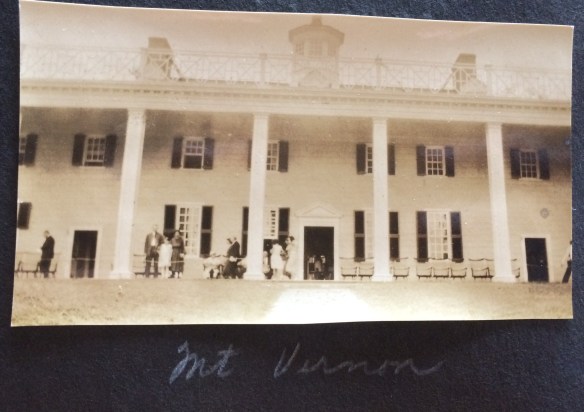
Because of my interest in public history, I paid special attention to the photos of relatives at historic sites. In the scrapbook, for instance, I found a photo of my grandmother’s family visiting Mount Vernon. In the slideshow, there were many more history sites.

When my father was a boy, his family spent many of their summers in Pigeon, Michigan, with his father Earl’s extended family. Several summers, however, they embarked on massive road trips. On these odysseys, the Mausts made stops at various national parks and tourist attractions.

Ship[1]

Dennis and Robert Maust in front of one of the ships they visited.

Historic ships have their own special appeal, and the Maust family visited at least two of them. They visited Plymouth Rock too. The rock, inscribed with the year “1620,” was identified as the landing place of the first Pilgrim immigrants by a ninety-five year-old man in 1741 and moved multiple times over the last centuries.1

Indian[1]

An unnamed interpreter in American Indian dress poses for a photo, location and date unknown.

The western trips included stops at the St. Louis Arch, giant redwoods, at least one spot that had a person in American Indian ceremonial costume, and Mount Rushmore. Perhaps more surprisingly, on a trip through Georgia, the Mausts visited Stone Mountain. Their visit was probably soon after the site—which features carvings of Jefferson Davis, Robert E. Lee, and Stonewall Jackson—opened to the public as a state park on the centenary of Abraham Lincoln’s assassination.

General_Sherman[1]

Dennis, Earl, and RobertMaust sit in front of the tree named “General Sherman” in Sequoia National Park.

What were the lessons at all of these sites in the 1960s? Despite Denise Meringolo’s uncovering of radical precedents of public history, the historic sites and monuments of the mid-twentieth century were overwhelmingly nationalistic and concerned with privileged Americans. Many of these sites, both private and public, explicitly aimed to teach visitors how to be American; that is, how to assimilate to a specific strand of American culture. House museums and period rooms, for instance, were used to display idealized American homes and teach the values which informed the décor choices.

The sites visited by my family probably saw themselves fulfilling the same purpose to varying degrees. The messages at historic ships and Plymouth Rock likely centered around eighteenth century European immigration. Across the American west, history sites largely told the story of Manifest Destiny. Did the Mausts hear anything about the “Six Grandfathers” on the South Dakotan mountain which were replaced by four white presidents? Surely the word “genocide” did not appear on any plaques or on any tour guide’s tongue.

Mt._Rushmore[1]

A Maust photo of Mount Rushmore, undated.

Evelyn and Earl Maust were mainstream Mennonites for their time. Earl achieved several degrees in music and education and Evelyn was a nurse. Earl served in Puerto Rico in Civilian Public Service. Together they had traveled through Europe. So what did they take away from any of these places? Did they feel patriotic fervor at Mount Rushmore? Or alienation? Did they feel American? Did they settle for awe at the size and and skill evident in the carving?

Perhaps more intriguingly, what did they take away from Stone Mountain? To what extent had the nurse from Harrisonburg, Virginia, and the choral director from Pigeon, Michigan, internalized the Lost Cause narrative? Did they know that Stone Mountain was the site of the re-founding of the KKK in 1915? Earl participated in a march led by Martin Luther King Jr. in Nashville just a few years before. How do we square these events in one family’s life? What was the Mausts’ racial consciousness in the mid 1960s? Were Earl and Evelyn just attracted by the novelty of the new state park?

Stone_Mt[1]

Dennis and Robert Maust pose in front of Stone Mountain.

These are questions I suspect I’ll never have answers to. My grandmother left behind some diaries and correspondence which might shed light on her tourist experience, but knowing her, any observations would likely be enigmatic and brief. My grandfather, who passed away fifty years ago this fall, left these slides and little else, I think.

Why do I pose these questions? By the late 1960s, over a million and a half Americans visited Mount Rushmore each year. I suspect that the Mausts were not the only Mennonites among that number. Considering how Mennonites and other Anabaptist groups engaged with American public history sites at the high tide of their nationalist focus could provide an important data point in the story of twentieth century Anabaptist life and these communities’ relationship with the state. Perhaps more importantly, considering Anabaptist reactions to sites such as Mount Rushmore and Stone Mountain which directly or indirectly commemorate white supremacy and genocide might provide important context for those working to dismantle racial injustice in the present. For those of my parents’ generation, understanding their parents’ engagement or disassociation with mainstream American culture through this lens might be enlightening as they consider their own identity as American Anabaptists.

What messages conveyed by these sites were comfortable to mid-century Anabaptists? Which ones were uncomfortable? Even glimpses into the answers to these questions might be illuminating as contemporary Anabaptists confront an uncomfortable present.

Special thanks to Robert Maust for digitizing these slides on short notice. 


  1. James Thacher, History of the Town of Plymouth: From Its First Settlement in 1620 to the Year 1832 (Boston: Marsh, Capen & Lyon, 1832), 29-30: http://books.google.com/books?id=IWWLjiaEs2AC. Also, here’s a great home video of Thanksgiving at Plymouth Rock ca. 1960: https://vimeo.com/32595596. 

A Train Wreck and a Hair Picture

It’s a well-known story.

It was July 25, 1896, and there had been a party at the home of John Musser in Witmer, Pennsylvania, and many young Mennonites had gathered to socialize, perhaps discussing the quarterly mission meeting that had been held a few days earlier, perhaps not. Some time before midnight the party broke up, and everybody went their separate ways.1

Three buggies went together down Old Philadelphia Pike, now Route 340, towards Bird-in-Hand. Chatting from carriage to carriage, they did not hear the east bound train approaching at the Bird-in-Hand curve—not a regularly scheduled train, but a special service, carrying militia troops home from an encampment.

“At the Bird it happened,” wrote Jakob M. Barge, recounting the incident to a son who had moved west. The first buggy, carrying Amos Landis and his girlfriend barely made it across, but the second, carrying Jakob’s son Enos, and Barbara Hershey, stopped on the tracks, horse rearing. “Enos was struck by an engine, his horse killed, his lady friend [Barbara Hershey] was killed and he has lost his right arm.” Jakob did not mention that Enos had been found thirty feet from his right arm. The next day, Enos would succumb to his wounds and die in the Lancaster hospital.2

This event is usually remembered for its tremendous impact on the young people of Lancaster Conference. Barbara Hershey’s funeral possession had three hundred carriages. At Enos Barge’s funeral, more than a thousand vehicles arrived at Strasburg for the funeral, three times the capacity of the meetinghouse.

Amos D. Wenger, already in Lancaster County at the time, was leading almost-but-not-quite-revival meetings that gained greater attention and following after the accident. Young people started to look at baptism and joining the church at a younger age—as opposed to waiting for marriage. Indeed, baptismal classes were larger than normal that summer, with about five hundred young people becoming church members. The impact of this was felt long through the conference on the account of the energy the young people brought in.

IMG_20180621_084543

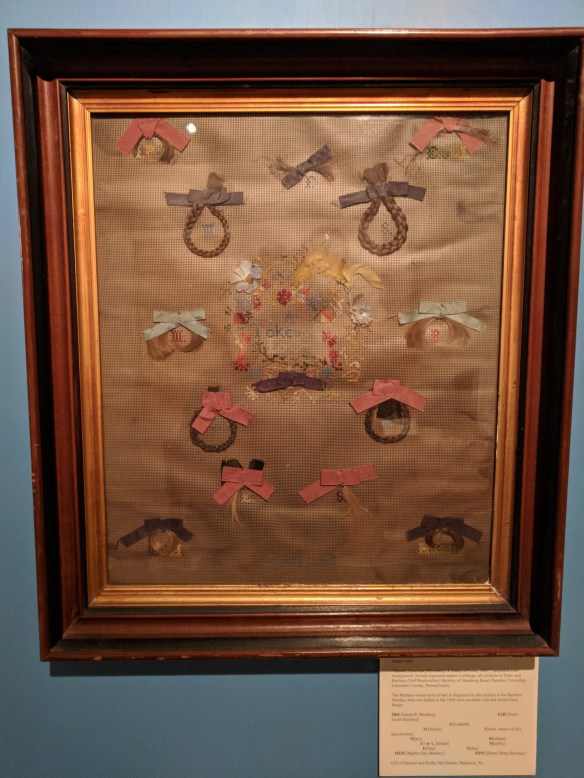
“Hair Picture,” in Decorated and Plain: A Mennonite and Amish Sampler.

But there is also a perhaps less important impact of this story. In 1882, Sarah Lucinda Hershey made a hair picture of herself and her siblings—including Barbara Hershey. It is a fascinating thing—a punch card background, neatly framed in wood with the first initial carefully stitched below each of the thirteen locks of hair. Each lock of hair, some braided, others loosely gathered, is neatly bundled with ribbon. In the middle, “A Token of Love” with cross-stitched flowers with silk other and feathers as finishing touches. The piece came to the Society’s collection through a non-Mennonite antique dealer, and little is known during the time period between its construction and its purchase by the Society.3

I am looking for other similar hair memorials, in any form, that have Mennonite connections to provide comparative analysis. If you know of one, please connect with me through the Lancaster Mennonite Historical Society.


  1. This telling of the story is based on the account in John L. Ruth, The Earth is the Lord’s: A Narrative History of Lancaster Mennonite Conference (Scottdale, Pa.: Herald Press, 2001), 726-727. 
  2. Jakob M. Barge to Frank Barge, July 26, 1896, in Decorated and Plain: A Mennonite and Amish Sampler in the Lancaster Mennonite Historical Society Museum, Lancaster, Pa. 
  3. “Hair Picture,” in Decorated and Plain: A Mennonite and Amish Sampler

Five Myths about Mennonites and the Holocaust

“Not all the Jews were bad,” a widely respected Mennonite born in interwar Ukraine told me recently, “even though they started the [Bolshevik] Revolution. My father had good Jewish friends.” This statement is classically anti-Semitic. It falsely conflates communism with Judaism, while using the excuse of having a few Jewish friends to mask an implied belief that Jews in general were bad. At least as importantly, my conversation partner’s words reveal how people who do not consider themselves racist or anti-Semitic can still propagate harmful myths.

New scholarship and ongoing public discussion about the historic entanglement of tens of thousands of Mennonites on three continents with Nazism and the Holocaust during the 1930s and 1940s has yielded productive conversation regarding how present-day Anabaptists can and should respond to this history, as well as calls for further discussion. At the same time, some church-affiliated periodicals have printed articles, letters, and reviews that propagate troubling interpretations of Mennonite-Nazi connections, including anti-Semitic tropes.

Figure 1, Great Trek

Imagery of the “Great Trek” during WWII has dominated Mennonite depictions of the era, bolstering a narrative of suffering, mostly female refugees. In fact, the word “trek” was widely and triumphally used in the Third Reich to describe German-speakers relocating from Eastern Europe to Germany. This particular movement of Mennonites and others out of Ukraine in 1943 and 1944 was overseen by the SS. Participants were not primarily considered to be refugees but rather Aryan “re-settlers,” traveling to a fatherland newly cleansed of Jews. Credit: Mennonite Archives of Ontario, attributed to Hermann Rossner.

Such reactionary responses are not exceptional, either in Holocaust historiography or in the current context of Israeli human rights abuses against Palestinians. In February, Poland passed legislation criminalizing mention of some Poles’ involvement in genocide, while part of the international backlash to Israeli violence has been couched in anti-Semitic terms. When certain Mennonites voice anti-Semitic sentiments, this often reflects—as is the case of other groups—both an attempt to protect their own and also a real, dangerous current of anti-Jewish prejudice.

The following five myths date to the Third Reich or its immediate aftermath. They remain in circulation, deployed today to excuse Mennonite involvement in Nazism or to foreclose public discussion. Examples given below all appeared in Mennonite periodicals within the past two years. Since my intention is to stimulate thoughtful reflection, not to shame individuals, I have chosen not to cite most quotations. However, all are easily accessible online and in print.

Myth #1: Mennonites suffered under Bolshevism, justifying Nazi collaboration.

This is the most typical excuse for Mennonite involvement for Nazism. The trope holds that life in the Soviet Union was so brutal, Mennonites had no choice but to embrace Hitler’s crusade. In fact, most Mennonites involved with the Third Reich had never lived in the USSR. The subset who did—approximately 35,000 individuals in Ukraine—came under Nazi occupation in 1941. Like millions of other Soviet citizens, most of these Mennonites welcomed Hitler’s armies as “liberators” from hardship and repression. Yet unlike the majority of their neighbors, Mennonites were generally considered Aryan, a status that provided additional incentives to support Nazism.

This trope is often accompanied by assertions that Mennonite suffering under communism has not been properly recognized. But in reality, Mennonite authors have been publicizing Soviet atrocities without abate since the Bolshevik Revolution. Scholarly literature and memoirs on Mennonite victimhood greatly outnumber texts that explore collaboration or perpetration. Nearly all of the latter have appeared only recently. The imbalance is so stark that Mennonite historians can claim to have created an entire subgenre on the “Soviet Inferno,” a term in academic use since the 1990s and whose deployment continues to refer almost exclusively to Mennonites.

Myth #2:  The Allied powers committed atrocities, too – why should we single out Nazism?

“The Nazis were bad, but the Bolsheviks were worse,” a Mennonite born in the USSR told me in March. “You mean from a Mennonite perspective,” I said. My conversation partner shrugged. “Of course.” When white Mennonites think about what life might have been like for them if they had lived in Hitler’s Germany, they invariably assume that they would have been Mennonite—and by extension Aryan. From such a viewpoint, each of the Allied powers, not just the Soviet Union, would have posed a greater threat to life and livelihood than Nazism. In other words, assuming one would have been Aryan creates a false equivalency that downplays genocide.

Studying the Holocaust from a Mennonite-centric perspective runs the added risk of repeating debunked Nazi propaganda, such as the myth that Bolshevism was Jewish. Some invocations of a “Soviet Inferno” falsely imply systematic persecution or even a “final solution” of Mennonites (by Jews) in the USSR. Nazi perpetrators commonly used such reversals to portray themselves as the true victims. Last year, one historian explained Mennonite participation in Nazi death squads, stating: “men and women of Jewish background worked as [Soviet] administrators, agents, and interrogators.” He had previously directed me to a webpage entitled “Jewish Mass Murderers.”

Myth #3: Mennonites were mostly women and children, so they either had no choice or could not have been involved.

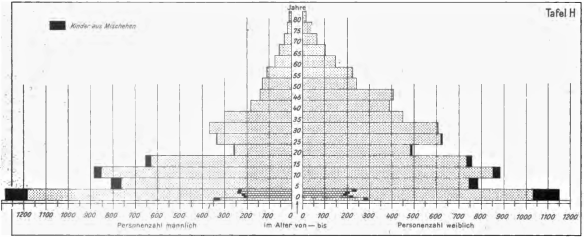
Women and children are often invoked to claim Mennonite innocence in Nazi war making. One writer recently claimed, for example: “in the 1930s most Mennonite men [in the USSR] had been exiled, imprisoned or executed, leaving families to be led by mothers and grandmothers,” who were not “collaborators, anti-Semites or Aryan.” Mennonites in Nazi-occupied Ukraine were indeed disproportionately women and children. But there were also plenty of men—many of whom served in administrative positions, as translators, policemen, or soldiers. Gender disparity at the end of the war in part reflected the death or capture of Mennonite men in German uniform.

Figure 2, Chortitza table

A table compiled by Nazi occupiers showing the age and gender (men on the left, women on the right) of the 13,000 “ethnic Germans” in Ukraine’s Chortitza colony, ca. 1942. Forty-three percent of “ethnic German” families in Chortitza had no male head of household—but fifty-seven percent did. Source: Karl Stumpp, Bericht über das Gebiet Chortitza im Generalbezirk Dnjepropetrowsk (Berlin: Publikationsstelle Ost, 1943), Tafel H.

This myth further assumes that women or children could not have contributed to Nazism or the Holocaust. However, many Mennonite women served as translators or in bureaucratic capacities, sometimes enriching themselves with the spoils of genocide. More often, women supplied moral support to male relatives and contributed to the war effort through their labor. Meanwhile, some underage boys took up arms. And most Mennonite children in the Third Reich absorbed Nazi ideals at school and through organized youth activities. They helped boost morale by singing, marching, and telling stories. Some racist proclivities learned in the 1930s and 1940s persist today.

Myth #4: Mennonites knew nothing about Holocaust-related atrocities.

This is simply untrue, as numerous archival documents testify. Nonetheless, the way this myth is told is itself revealing. Consider one statement: “Although Mennonites under German occupation witnessed how their Jewish neighbours packed up and fled, they did not know about the outcome of this fleeing until much later.” Another, strikingly similar account holds that Mennonites “saw their Jewish neighbours pack up and flee eastward across the Dnepr; how many survived and how many were executed on the eastern side they did not know until later.” These authors care more about locating killing elsewhere than considering why Mennonites stayed as Jews fled.

Figure 3, Molotschna

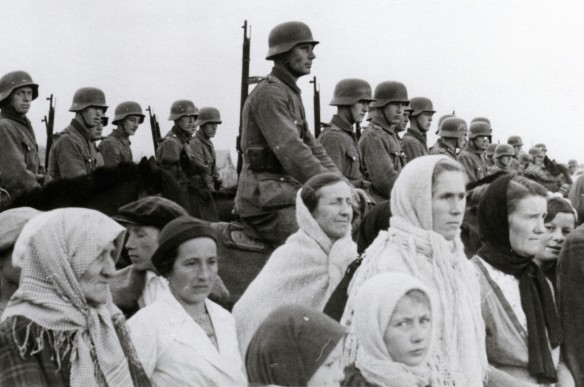
A caption in one Mennonite history book for this scene from the Molotschna colony in Ukraine, 1942, reads: “This photo shows the uneasy meeting of two branches of the German and Low German cultures: the militarism of Prussia as well as of the Third Reich, and its opposite—the nonresistance of the Mennonite religious culture. The worldwide German culture is much richer given the existence of a community that did not soil itself with the militarist Nazi madness.” In fact, the men pictured here belonged to Waffen-SS cavalry units composed mostly of Mennonites. The photo was taken at a rally where Mennonite women and children performed for the visiting head of the SS, Heinrich Himmler. Source: Adina Reger and Delbert Plett, eds., Diese Steine: Die Russlandmennoniten (Steinbach, MB: Crossway Publications, 2001), 332.

To suggest that murder did not occur around some Mennonite settlements or that Mennonites in these areas had no knowledge of genocide is a form of Holocaust denial. Such myths repudiate known facts. Yet claims persist that Mennonites “had not heard of Aryanism and other racial theories until well after the conclusion of the war.” The author of this line, in subsequent postal correspondence, described glowingly her own wartime work as the secretary for a top German officer in Nazi-occupied Dnipropetrovsk, her receipt of German citizenship, and the voluntary induction of Mennonite men into the military; “I am a beneficiary of the German occupation!”

Myth #5: Mennonites suffered under Nazism.

Among the most disingenuous myths about Mennonite life under Nazism, this trope holds that the general suffering of Mennonites in the USSR continued under German rule. Nazi occupation was indeed catastrophic for a minority of Mennonites who were committed communists, as well as for disabled individuals and those of Jewish heritage. Some in Nazi-occupied France and the Netherlands joined the resistance or hid Jews. Yet claims of Mennonite suffering normally refer to those who in 1943 and 1944 participated in the “Great Trek” from Ukraine to Poland to escape the Red Army—an endeavor supervised by the SS and praised by Mennonite leaders at the time.

Indeed, closer inspection reveals that allegations of Mennonite hardship are often complaints that Nazism did not live up to its potential. If only the Eastern Front had held; if only religious reform had been more thorough; if only welfare programs were more generous—then Mennonite life would have been easier. Even the Holocaust and other persecutions are said to have “occasioned much disappointment among Mennonites.” This may be true. But note how the author chooses to emphasize the “disappointment” of Aryans, not the actual enslavement and slaughter of Jews. Despite the fading of his own initial “euphoria” for Germany, he could remain “deeply grateful.”

* * *

Mennonite authors and editors should think carefully before writing or printing pieces about the Third Reich. This is an important topic and requires our attention. But we must approach it in ways that do not recapitulate racism. Even those of us with good intentions need to be wary. In April, the cover story of a major denominational magazine laudably covered Mennonites and the Holocaust; yet in her introduction, the editor blithely compared Mennonites murdering Jews to Jews murdering Jesus—arguably the single most injurious trope of Christian anti-Semitism. Proofreaders apparently saw no problem with invoking “the crowd that yelled ‘Crucify him!’”

A few rules of thumb might be helpful. If you are discussing Nazism or the Holocaust, consider how someone from a different background might react—particularly if you are defending actions by your own group. Second, be aware of contextual differences: refocusing from the Holocaust to Soviet atrocities erases the specificity of Jewish genocide. Finally, when evaluating suffering, do not discriminate. While Mennonites have faced many difficulties, they never suffered alone. Nor were they always victims. Anabaptists, of all people, must surely grasp that violence can permeate even the most peaceable of cultures, a process we should understand but never justify.

Ben Goossen is a historian at Harvard University. He is the author of Chosen Nation: Mennonites and Germany in a Global Era, published in 2017 by Princeton University Press.