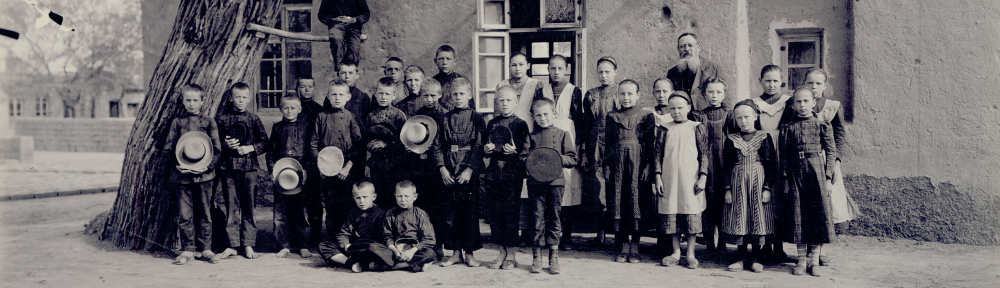
Surprising finds: Mennonites in Mexico and archives of movement

Kat Hill

The National Archives in Kew, London seems an unlikely place to find records for Mennonite history; Mennonites have never been a major presence in the UK and the London Mennonite Centre closed in 2010.1 But documents are funny things and end up in odd places. On a visit to check out some material related to early modern migrations, I typed in ‘Mennonite’ to find a series of documents held by the Foreign Office and the Dominions Office, relating to Mennonites in Mexico and Europe in the twentieth century.

FIgure 1: The National Archives, London, Image from https://blog.nationalarchives.gov.uk/project-alpha-building-an-archive-for-everyone/

One cache of documents deals with British discussions about European Mennonites who were part of the complex negotiations over displaced persons and refugees after the Second World War.2 Others discuss emigration plans after World War Two.3 One very rich collection, and the focus of this piece, relates to the back and forth conversations in the 1930s between Mennonite communities in Mexico, the British Consulate, and Mexican and Canadian authorities.4 Some items are official reports of government representatives, others handwritten scrawls by individual Mennonites. The documents reveal a story about changing definitions of identity, shifting borders and nations, and movement in the interwar period, and how Mennonites tackled these challenges. Focusing in on these allow us to examine the way in which citizenship changed as the British Empire disintegrated and as states and nations redefined themselves. And it also reminds us of the complex archival remnants which are the legacy of movement and migration.
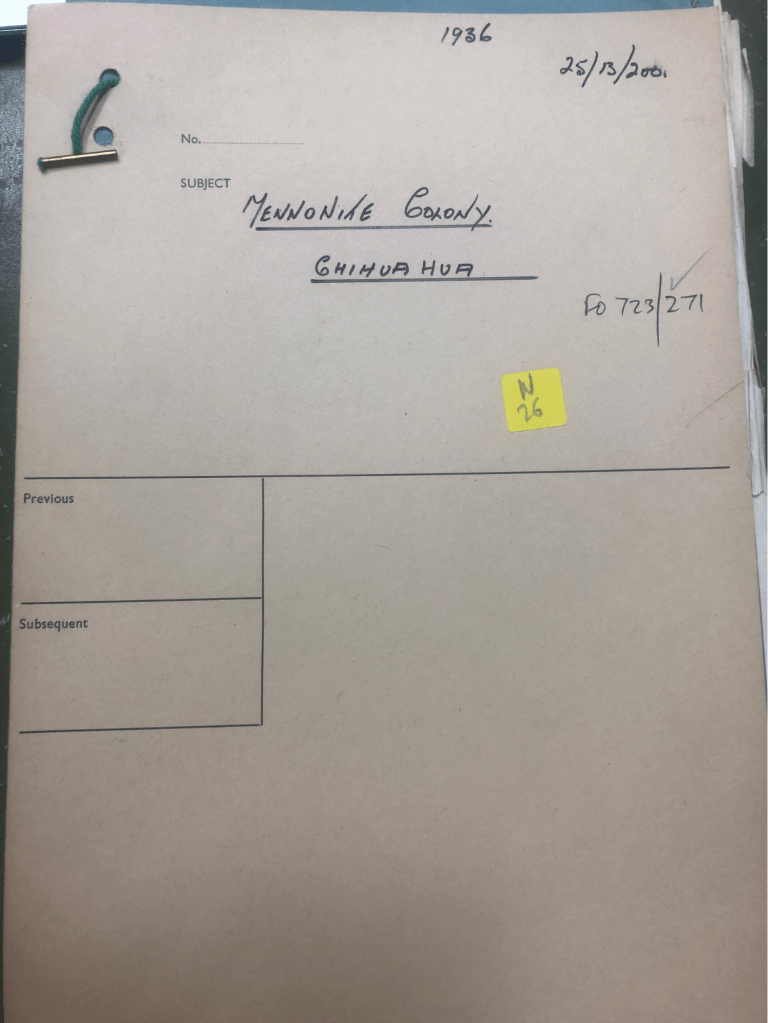
FIgure 2: One of the folders with documents related to Mennonites in Mexico, THe ational Archives. Image Kat Hill.

Moving to Mexico

Around 8000 Mennonites left Manitoba and Saskatchewan to head to northern Mexico in the early 1920s. Demands placed on Canadian communities by a series of governmental acts, including the use of the English language in schools and compulsory attendance at recognized educational establishments, drove some Mennonites to seek out a location where they could avoid these restrictions.5 After investigating possibilities in several south American countries, they were able secure privileges from Álvaro Obregon, president of Mexico.

But in the 1930s, dissatisfaction set in. The threat of similar restrictions on schooling and Mennonite ways of life from the Mexican authorities, as well as increasing violence and conflict with indigenous Mexican communities, prompted restlessness and thoughts of migration. Some talked of a return to Canada, but in a letter to British Consul-General Joseph Pyke, P.H. Peters also mooted the possibility of transplanting communities to Australia.6 As they considered the possibility of return, Mennonites asked for British passports: Canada was an independent British Dominion. In the end, a mass return to Canada never happened, but the stack of papers housed in south west London give glimpses into the decisions, negotiations, and the lives of theses communities in myriad ways.7

New Languages of citizenship and movement

As some Mennonites in Mexico sought to return to Canada, they navigated a political landscape of shifting nations, empires and states which deployed novel and emergent vocabularies about citizenship and migration in the interwar world. Many nations hardened their borders and tightened up controls after World War One, at the same time as economic transformation and political upheaval caused mass movement of people, with rising numbers of refugees and migrants.8 Vocabularies reflected this reality. Writing to Gerhard D. Klassen in April 1936, the Acting British Consul-General J.D. Murray listed the evidence needed for British nationality, talked about naturalization, and underscored the importance of authorized documentation.9 In October of the same year, the Canadian Department of External Affairs made it very clear that a medical officer and immigration official had to assess any returning migrants to stop the entry of ‘undesirable’ individuals.10
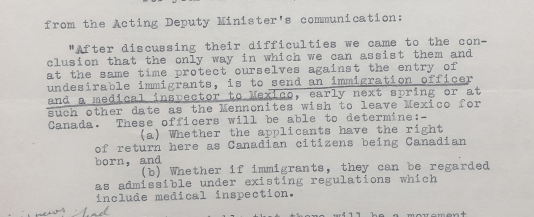
Figure 3: Extract from Laurent Beaudry’s letter to the British Consul-General, 29 October 1936.

Living in a country recently torn apart by revolution and coming from an independent Dominion of the British Empire, Mennonites in Durango and Chihuahua encountered the structures and institutions of the British, Canadian and Mexican authorities. They also looked back to their lives under Tsarist rule before they had emigrated west at the end of the nineteenth century. The documents lay bare the reality of living lives across borders and regimes. Jacob Klassen, who wanted a British passport, was born in Lekopol, Russia in November 1876, and naturalized in Canada in 1908, with papers to prove this. He counted as a British subject, and his wife and child, born in Saskatchewan in 1923, could also be included in this definition as long as records of the marriage and birth could be verified. Being a British subject mattered when dealing with the authorities, but it remains unclear how important this categorization was for the Klassen family’s own sense of belonging.11 The demands of citizenship and the language of nationalism also hint at some of the tensions in new classifications which did not always sit easily with Mennonite conceptions of community. Being a national subject was at odds with many of the ways in which Mennonites perceived themselves as separate communities who resisted the demands of nations and states. Yet these games of belonging mattered in official discussions. Writing to Pyke, Cornelius D. Fehr signed off as ‘Your very friend and British subject’ and gave his passport number, appealing to Pyke’s emotional and national loyalties.12

Documenting identity

Klassen and Fehr’s cases underscore the reality that movement between regimes and authorities required the right papers. Different regimes had different ways of indexing identities, whilst Mennonites themselves kept their own records. The archives reveal the way in which the requirements of documentation by nations and states intertwined and often clashed with the record-keeping practices of Mennonites communities. Mennonites requesting the right of return to Canada and negotiating for British passports had to prove the dates and locations of births and marriages. John P. Wall, Mennonite representative for the Durango church, wrote to Pyke in April detailing responses to Pyke’s questions about the documentation kept by the Mennonites. Their original records had stayed with the church in Canada, but they did have copies.13 Even if Mennonites could prove the details of births or marriages from their own church records, registered with the Mennonite elders, these may not have been verified by the various local authorities and would not be considered proof in their own right. The question of children who had been born in Mexico and to a couple whose marriage may not have been recognized by the relevant authorities was particularly fraught. Pyke wrote to W.C. Rempel of the Blumenort church to say that for children to be considered legitimate, he needed an endorsement from the Mexican authorities that any marriages were legally contracted and officially recognized as such by the Mexican authorities. The official date had to predate the birth date of any children.14

As Fehr’s signoff in his letter to Pyke indicates, definitions of identity inscribed on papers and forms were complex and confused. A Mexican identity card for Margarethe Dyck reflected the entanglements and compromises across cultures, citing her nationality as Canadian but her religion as Mennonite; the identity card itself was of course written in Spanish for the Mexican authorities.15 What these differences meant for lived experience and subjectivities is harder to uncover, although Fehr’s letter hints at the way in which ideas about belonging changed and could even be used by Mennonites. As they have always done, confessional belief, birthplace, language, and culture all shaped notions of belonging, but these practices and expressions were also applied in new ways as they intertwined with the demands of national sovereignty.

Migrant lives, culture and violence

Finally, the documents reveal something of the migrant lives of Mennonite communities, both in the contents of their letters and the materiality of the documents themselves. The very fact these records have ended up in London in The National Archives, with other documents residing in Mexican and Canadian archives and others undoubtedly in family collections, bears witness to the types of archives which resulted from migration. Each document, too, in its physicality tell us story. We can contrast the neatly typed missives of the authorities and official, sometimes adorned with offhand marginalia, with the poorly expressed hand scribbled note of an individual Mennonite.16 Archivalities always tell their own stories.
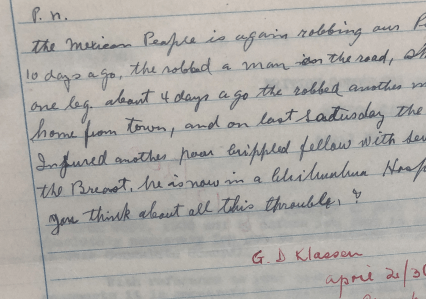
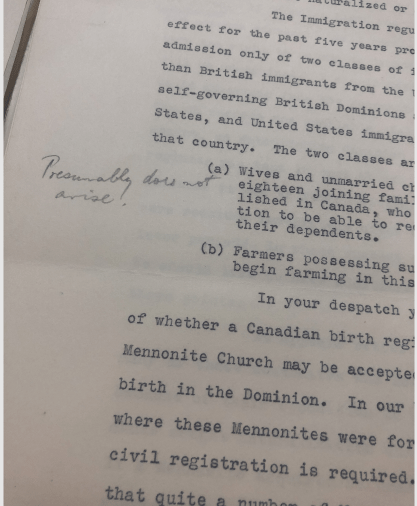
Figure 4: Extract from Gerhard D. Klassen’s note to the British Consul-General, 21 April 1936.
Figure 5: Marginal Note by Canadian Under-Secretary of State for External Affairs

There are of course silences in the records and stories not told. This is a record of men and their negotiations – the women and children who are talked about so often in the documents do not feature as individuals. A marginal note on a letter from the Canadian Under-Secretary of State for External Affairs reveals the dismissive attitudes: on the subject of wives and unmarried children joining family heads established Canada, exempt from certain immigration conditions, he merely writes ‘Presumably does not arise!’17 And there is the deafening silence of what local Mexican communities made of the presence of Mennonites in their landscape, who also battled for land and rights, or who entered into violent altercations with the neighbors who remained very distant despite their physical proximity. But this remarkable set of documents, in their detail and their silences, their contents and their materiality, give us a window onto questions of land, movement, violence and identity which continue to be asked in the present day.18


[1] Harriet Sherwood, ‘UK Mennonites end Sunday services after numbers dwindle’, The Guardian, 16 March 2016, https://www.theguardian.com/world/2016/mar/16/uk-mennonites-end-sunday-services-after-numbers-dwindle, accessed 16 April 2020.

[2] The National Archives (TNA), FO 1050/1565; FO 1043/2579; FO 945/480.Packet_Emails_2010

[3] See for example TNA, FO 371/126537.

[4] TNA DO 35/679/7; DO 35/814/8; FO 723/720; FO 723/721.

[5] Luann Good Gingrich, Out of Place: Social Exclusion and Mennonite Migrants in Canada (Toronto: Univeristy of Toronto Press, 2016),15; Royden Loewen, Village Among Nations: Canadian” Mennonites in a Transnational World, 19162006 (Toronto: University of Toronto Press, 2013), 40–79.

[6] TNA, FO 723/271, 2 June 1935, P.H. Peters to British Consul-General Joseph Pyke.

[7] Other places also featured as suggested destinations. For more details on the discussions over a possible return and the situation in the 1930s see Loewen, Village Among Nations, 120 –165

[8] See for example Daniela L. Cagliotti, ‘Subjects, Citizens, and Aliens in a Time of Upheaval: Naturalization and Denaturalization in Europe during the First World War’, The Journal of Modern History 89 (2017), 495–530; John Torpey, ‘Coming and Going: On the State Monopolization of the Legitimate ‘Means of Movement’, Sociological Theory 16.3 (1998), 239–259; Claudena M. Skran, Refugees in Inter-War Europe: The Emergence of a Regime (Oxford: OUP, 1995).

[9] TNA, FO 723/271 28 April 1936, J.D. Murray Acting British Consul-General to Gerhard D. Klassen.

[10] TNA, FO 723/271 29 October 1936, Laurent Beaudry Acting Under-Secretary of State for External Affairs Canada to British Consul-General, fo. 1.

[11] TNA, FO 723/271 16 September 1936, Laurent Beaudry Acting Under-Secretary of State for External Affairs Canada to British Consul-General, fo. 1.

[12] TNA, FO 723/271 2 April 1936, Cornelius D. Fehr to Pyke to Joseph Pyke British Consul-General, fo. 2.

[13] TNA, FO 723/271, 6 April 1935, John P. Wall to Joseph Pyke British Consul-General.

[14] National Archives, FO 723/271, 28 March 1936, Joseph Pyke British Consul-General Pyke to W.C. Rempel.

[15] Janzen, Liminal Sovereignty, 20.

[16] TNA, FO 723/271, 21 April 1936, Gerhard. D. Klassen to J.D. Murray Acting British Consul-General.

[17] TNA, FO 723/271, 18 February 1936, Acting Under-Secretary of State for External Affairs Canada to British Consul-General, fo. 2.

[18] See for example Rebecca Janzen’s recent piece, ‘Mexican Mennonites combat fears of violence with a new Christmas tradition’, The Conversation, 11 December 2019, https://theconversation.com/mexican-mennonites-combat-fears-of-violence-with-a-new-christmas-tradition-127982, accessed 19 April 2020.
An Anabaptist Anti-Racist Reading List

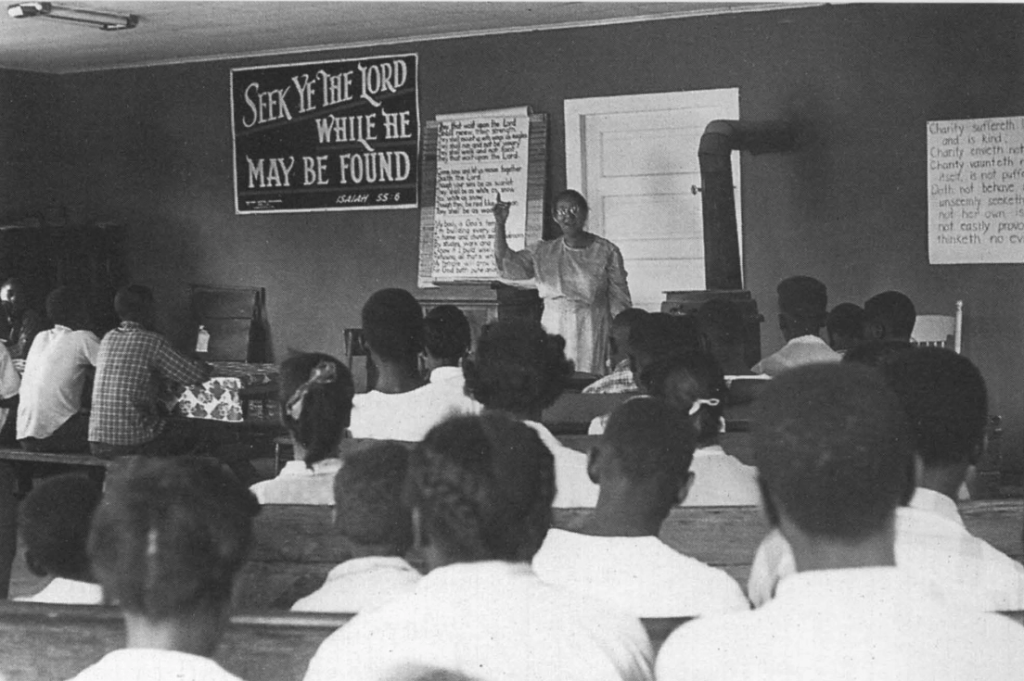
Rowena Lark teaching Bible school. Lark’s husband, James, was the first African American minister ordained in the Mennonite church (1944). [Caption edited 6/19/2020]

The brutal murder of George Floyd has exposed again the systematic injustices perpetrated by institutions of power against black and brown people in the United States and around the world. We, the board of Anabaptist Historians, are enraged and heartbroken. To stand in solidarity with those protesting police violence and interrelated forms of institutionalized racism, we have put together the following Anabaptist Anti-Racist Reading List. We have been inspired by other anti-racist reading lists recently circulated, and we hope our contribution will be as useful as possible for readers. We have thus compiled specifically Anabaptist ways of saying: Black Lives Matter.

This Anabaptist Anti-Racist Reading List features short and online-accessible articles and essays on the relationships between Anabaptist history and matters of race, racism, and violence. Each thematic section also includes suggestions for further readings, including articles and books that may require purchase. In such cases, we recommend supporting local bookstores, ordering used copies, or you can submit a purchase or interlibrary loan request through your local library. And of course, if you like what you read, be sure to share recommendations with friends and family!

Overview

Anabaptists over the past five hundred years have been deeply entangled with racism and racial violence. From European imperial expansion and the Dutch slave trade to settler colonialism and displacement of native peoples, the origins and development of Anabaptist churches have been shaped and reformed in crucibles of injustice. As individuals and as communities, Anabaptists have struggled with these contexts, often developing sophisticated ways of naming and resisting state violence although more typically deploying such strategies to serve themselves than others.

If the story of Anabaptism is inextricably bound to race and racism, then the process of doing Anabaptist history must be understood as an anti-racist calling. The readings highlighted below share a common mission to bring about a more equal church and a more just future. Historians may take different approaches toward this end. Some uncover troubling examples of racism in the church. Others explore cases when Anabaptists meaningfully spoke truth to power within their own denominational contexts or beyond. All recognize that these stories resonate today.

We acknowledge the profound incompleteness of this anti-racist reading list. The brokenness of our wider society impedes efforts to fully grasp systemic injustice. Working toward restitution will mean changing how we think about the Anabaptist past alongside reformulating our public institutions. We invite readers to submit further reading suggestions in the moderated comments section. We also welcome submissions and pitches for short historical essays and think-pieces. Anabaptist Historians looks forward to publishing a new anti-racism series over the coming year.

Readings by Topic

1) African Americans and Anabaptism

Melody Marie Pannell, “A Radical Love in Harlem: Resolve, Resilience and Restoration (Part 1: 1952-1975),” Anabaptist Historians, November 24, 2017.

Regina Shands Stoltzfus, “Mennonites, Mission and Race: The Cleveland Experiment,” Anabaptist Historians,November 15, 2016.

Further Reading:

  • Regina Shands Stoltzfus, “The Unexpected and Complicated Presence of African American Women in Mennonite Churches” (PhD diss., Chicago Theological Seminary, 2017).
  • Jeffrey Phillip Gingerich, “Sharing the Faith: Racial and Ethnic Identity in an Urban Mennonite Community” (PhD diss., University of Pennsylvania, 2003).

2) Anabaptists and the Black Freedom Struggle

Tobin Miller Shearer, “Martin and the Mennonites: Lessons From King’s Legacy for Today,” Anabaptist Historians, January 20, 2020.

Tobin Miller Shearer, “State of the Race: A Short History of Mennonite Racial Statements, 1940-1979,” Anabaptist Historians, October 3, 2019.

Further Reading:

  • Tobin Miller Shearer, Daily Demonstrators: The Civil Rights Movement in Mennonite Homes and Sanctuaries (Baltimore: Johns Hopkins Press, 2010).
  • Tobin Miller Shearer, Two Weeks Every Summer: Fresh Air Children and the Problem of Race in America (Ithaca, NY: Cornell University Press, 2017).

3) Imperialism, Slavery, and Settler Colonialism

Marvin E. Kroeker, “Natives and Settlers: The Mennonite Invasion of Indian Territory,” Mennonite Life 61, no. 2 (2006): online.

Ben Goossen, “Mennonites and Empire,” Anabaptist Historians, September 21, 2018.

Further Reading:

  • James Lehman, Mennonites, Amish, and the American Civil War (Baltimore: Johns Hopkins University Press, 2007).
  • Anthony Siegrist, “‘Part of the Authority Structure’: An Organizational History of Mennonite Indian Residential Schools in Ontario,” Mennonite Quarterly Review 93, no. 1 (2019): 5-38.

4) Anabaptists, Immigration, and Nativism

Felipe Hinojosa, “Place Matters,” Anabaptist Historians, September 22, 2016.

Felipe Hinojosa, “Hazel’s People,” Anabaptist Historians,January 12, 2017.

Further Reading:

5) Gender, Race, and Anabaptist Women

Regina Shands Stoltzfus, “Juanita Lark Building Dedication at Goshen College,” Anabaptist Historians, February 16, 2017.

Regina Shands Stoltzfus, “Telling All of Our Stories as a Movement To Peace,” Anabaptist Historians,August 24, 2017.

Further Reading:

  • Anita Hooley Yoder, “In A Reunion Like This We Can Share,” Anabaptist Historians, August 31, 2017.
  • Kimberly Schmidt, “Moneneheo and Naheverein: Cheyenne and Mennonite Sewing Circles, Convergences and Conflicts, 1890-1970,” Great Plains Quarterly 31, no. 1 (2011): 3-22.

6) Anabaptists and White Supremacy

Ben Goossen, “The Pacifist Roots of an American Nazi,” Boston Review, May 2, 2019.

Tobin Miller Shearer, “On Being a Watch Listed Historian in the Age of Donald Trump,” Anabaptist Historians, December 8, 2016.

Further Reading:

  • Damon Berry, Blood and Faith: Christianity in American White Nationalism (Syracuse: Syracuse University Press, 2017): 74-101.
  • Ben Goossen, “Mennonite Fascism,” Anabaptist Historians, April 27, 2017.

7) Ethnic Shibboleths and Racial Exclusion

Austin McCabe Juhnke, “Rethinking 606, the ‘Mennonite National Anthem,’” Anabaptist Historians, November 28, 2017.

Ben Goossen, “Mennonite Genealogy and Racial Privilege,” Anabaptist Historians, November 3, 2016.

Further Reading:

8) Interracial Alliances and the Problem of Tokenism

Tobin Miller Shearer, “A Prophet Pushed Out: Vincent Harding and the Mennonites,” Mennonite Life 69 (2015): online.

Tobin Miller Shearer, “Mennonites and the Magical African-American Friend,” Anabaptist Historians, April 10, 2019.

Further Reading:

  • Philipp Gollner, “How Mennonites Became White: Religious Activism, Cultural Power, and the City,” Mennonite Quarterly Review 90, no. 2 (2016): 165-193.
  • Steve Heinrichs, ed., Unsettling the Word: Biblical Experiments in Decolonization (Maryknoll, NY: Orbis Books, 2019).

9) White Mennonites as Allies

Tobin Miller Shearer, “The Deepest Dichotomy: How A Sixty-Five-Year-Old Essay on Racism Helped Me Learn A Lesson From Before I Was Born,” Anabaptist Historians, September 8, 2016.

Tobin Miller Shearer, “Confronting the Confessional Catharsis: David A. Shank and the Legacy of ‘Race Criminals’,” Anabaptist Historians, April 19, 2019.

Further Reading:

10) Anabaptists, Antisemitism, and the Holocaust

Mennonites and the Holocaust Syllabus,”Anabaptist Historians, April 7, 2018.

“Lisa Schirch, “How Mennonites Reckon with our History in the Holocaust,” Anabaptist Historians, March 23, 2018.

Further Reading:

  • Mark Jantzen and John D. Thiesen, eds., European Mennonites and the Holocaust (Toronto: University of Toronto Press, 2020).
  • Benjamin W. Goossen, Chosen Nation: Mennonites and Germany in a Global Era (Princeton, NJ: Princeton University Press, 2017).

11) Anabaptism, Race, and Overseas Missions

Danang Kristiawan, “The Faint Past and Constructed Identity: The Challenges of Historical Awareness in Javanese Mennonite Church,” Anabaptist Historians, May 21, 2020.

Lucille Marr, “Mysticism and Evangelicalism in the Writings of a ‘Spiritual Mother,’” Anabaptist Historians, January 28, 2020.

Further Reading:

12) Building Coalitions

Felipe Hinojosa, “Freedom Dreams: On the Legacy of the Minority Ministries Council,” Anabaptist Historians, April 24, 2017.

Tobin Miller Shearer, “Money, Sex, and Power: The Black Manifesto and the Minority Ministries Council,” Anabaptist Historians,April 13, 2017.

Further Reading:


We hope that these readings offer entry points into deep, long-lasting movements that address racism and violence in Anabaptist communities and beyond. We see scholarship and education as elements of larger struggles against structural injustice that also include organizing, protests, voting, and other strategies for systemic change. We hope that this Anti-Racist Reading List will inspire fresh research into the subjects covered here as well as new areas like Anabaptism and policing. If you are conducting such scholarship, please contact us about featuring your work.

This Anabaptist Anti-Racist Reading List was compiled by the Board of Anabaptist Historians: Ben Goossen, Simone Horst, Ted Maust, and Christina Entz Moss, as well as by Coordinating Editor, Joel Horst Nofziger. Thanks to Rachel Waltner Goossen and Madeline J. Williams for providing comments.

Public Nudity and Prophecy in Early Anabaptism: The Cases of Lienhard Jost and the Naaktlopers

On the 10th of February, in 1535, the Melchiorite Anabaptist Hendrick Hendricks Snyder addressed a group of seven men and five women and prophesied to them of God’s impending wrath. Then he cast off first the weapons and then the very clothes he wore, and threw them into the fire.[1] The other men and women followed suit and burned all their clothing as well. The group then ran into the city, shouting “Woe, woe, woe! Divine wrath, divine wrath, divine wrath!” Unarmed and small in numbers, the naaktlopers or “naked walkers” were easily captured by the Netherlandish authorities. They refused clothing even as they were escorted to prison, citing their intention to proclaim the “naked truth.”[2] All the men involved in the incident, and some of the women, were sentenced to capital punishment as a result of their involvement, and the authorities in Amsterdam were motivated to enforce imperial edicts against Anabaptism more stringently than they had before.[3]

The naaktlopers’ demonstration provided ample fodder for polemicists who sought to warn their readers about the dangers and excesses of Anabaptism. A little more than a decade after the incident, in 1548, the Dutch humanist and Catholic priest Lambertus Hortensius published a scathing account of Anabaptism in the Low Countries. Hortensius’ account circulated in several editions well into the seventeenth century and in several countries. A Dutch translation appeared in 1667, and in 1702 a French adaptation was published. The Dutch and French editions came accompanied with a striking woodcut of the incident, intended to further shock the audience and convince them of Anabaptism’s ridiculousness, if not its nefariousness.

1702 woodcut
A woodcut featuring the naaktlopers from the 1702 French edition of Lambertus Hortensius’ anti-Anabaptist polemic, available at https://books.google.com/books?id=Ei-qGw_urRUC

For Hortensius and his translators, the naaktloper incident provided prime evidence of just how ludicrous Anabaptism was, and how deluded and unreasonable its followers were. Their descriptions of the event alternated between ridicule and pity for the persons involved. “Since these people were full of nothing but visions and each one considered himself a prophet, when the mood seized them, one could see them committing completely strange and ridiculous acts,” wrote Hortensius’ French translator. He went on to describe their decision to cast off their clothes and walk around Amsterdam naked as “one of the most ridiculous [ideas] that could befall the imagination.”[4] For these early modern polemicists, the naaktlopers, with their immoderate excess and their willingness to perform every strange idea that came into their heads, perfectly encapsulated the failings of Anabaptism. More recent histories of Anabaptism have largely recounted the story of the naaktlopers as part of the general uproar surrounding the establishment of the Anabaptist kingdom of Munster, but have largely treated the public nudity aspect of the story as a curious but isolated incident.

The naaktlopers, however, were not entirely unique among their coreligionists. The third chapter of Strasbourg prophet Lienhard Jost’s visions reveals that he engaged in public nudity as a prophetic act, just as the naaktlopers did. Lienhard recounted that, one night, he felt the Spirit of God tell him to rise immediately, disrobe, and run through the streets of Strasbourg naked in order to sound the Mord Glock—the alarm bell located in Strasbourg’s cathedral. He rose immediately and ran through the streets of Strasbourg, shouting the following prophetic utterance: “Murder upon murder! The child in its mother’s womb must and will be terrified before the word of the Lord comes to pass . . . if the lords and rulers of the city only knew that their princely clothes will be removed from them before God and the world, that they might seek God again, they would all cry along with me…but after this the child in its mother’s womb will rejoice again, and all those who have been sad will find peace.”[5] Like the naaktlopers, Lienhard’s actions resulted in his capture. However, given the relative tolerance of Strasbourg’s magistrates toward religious dissenters, he met with a much lighter sentence—he was brought to Strasbourg’s hospital, where he was deemed insane and moved to an asylum. He remained there for a few months until his release.

This is the only incidence of public nudity in Lienhard’s visions, but it nevertheless is not out of place. In his 2015 article on Lienhard’s prophecies, Jonathan Green notes the prevalence of clothing-based imagery. Lienhard counsels his audience to throw off their stinking clothes in order that God might clothe them, although he quickly clarifies that he is speaking in spiritual, not physical terms.[6] Green also notes the performative nature of Lienhard’s visions in general. Lienhard was not content to merely share the words of God, but instead frequently contrived an object lesson. He chewed and then spit out bread in order to demonstrate his rejection of “idolatrous masses,” and he poured wine on his bed and watched it spread as a symbol of how a God-sent abundance of good things would soon spread across the earth.[7] Lienhard’s own experiences of God were multi-sensory. He not only saw and heard God’s messages, he felt and tasted them. Since his experience of divine revelation that was so arresting and all-consuming, it is unsurprising that Lienhard would attempt to replicate aspects of this experience for his audience.

It is impossible to establish with certainty whether Hendrick Hendricks Snyder and the rest of the naaktlopers were familiar with Lienhard’s prophetic career, but it seems distinctly possible, and perhaps even likely. Melchior Hoffman assiduously disseminated their visions and prophecies among his followers. In 1533, his associate Cornelijs Poldermann testified to Strasbourg’s Protestant preachers in a letter that the whole Netherlands were full of the Josts’ books—an obviously hyperbolic claim, but one that nevertheless speaks to the popularity the Josts’ visions enjoyed among Hoffman’s followers in the Low Countries.[8] Thus, Snyder and his compatriots may well have read Lienhard’s visions, or at least been apprised of their contents if they could not read them themselves. Their cries of woe even echo Lienhard’s cries of “murder upon murder,” although Lienhard went further and promised God’s eventual mercy after announcing impending judgment. He also tied nakedness to the casting off of superfluous wealth, and the historical record does not say whether any of the naaktlopers made a similar connection.

Whether or not the naaktlopers drew their inspiration from Lienhard, however, the practice of public nudity as a prophetic act has a long-established place in the Jewish and Christian canon. In Isaiah 20, God commanded Isaiah to remove the sackcloth and ashes he had previously worn to prophesy and instead to prophesy completely naked for a period of three years as a portent of God’s impending judgment on Egypt.[9] Isaiah’s display is the only divinely sanctioned instance of post-Garden of Eden public nudity in the Bible—Noah’s drunken exhibitionism in Genesis earned the patriarch and his son divine censure—but it is not, for all that, an aberration.[11] The Old Testament prophets frequently engaged in visually arresting, often shocking and bizarre displays as a means of reinforcing God’s message. Early modern Christians in search of a more recent example could point to Saint Francis of Assisi, who made a public display of his rejection of his parents and his upbringing by publicly casting off his clothing before the Bishop of Assisi. This incident had a powerful hold on the imaginations of medieval Christians; it was not only recounted in many of St. Francis’ vitae, but also became the subject of several different artistic depictions of the life of Francis in late medieval and Renaissance-era European churches and chapels.

It is difficult to ascertain just how much Lienhard Jost and the Amsterdam naaktlopers knew about the biblical and medieval prophets and saints who came before them. Lienhard Jost was an illiterate peasant labourer, and the educational status of Hendrick Hendricks Snyder and his followers is not known. It is probable that they never had the opportunity to study the biblical text in much detail or read saints’ vitae for themselves. Nevertheless, they may well have become acquainted with some of these examples through preaching, ecclesiastical artwork, or oral tradition. Elements of Lienhard’s account suggest that he may have, consciously or unconsciously, drawn inspiration from the life of St. Francis of Assisi. It is true that he never mentioned Francis by name and he frequently derided the Catholic mass as idolatrous and clerical celibacy as an abomination. Even so, however, there are some striking points of similarity between the life of the Strasbourg prophet and that of the Italian mendicant. Lienhard’s motivation for running around Strasbourg naked bears a strong resemblance to the Francis’ motivation for disrobing in front of his father and the bishop of Assisi. For both men, the casting off of clothing represented an emphatic rejection of wealth and opulence. In Francis’ case, he rejected the wealth and opulence to which he had been born and which his family still enjoyed. In Lienhard’s case, though he himself was not endowed with much wealth to cast off, he physically enacted the spiritual renunciation he expected from Strasbourg’s ruling class. Another event in Lienhard’s life also mirrored that of St. Francis: in pondering the wounds of Christ, Lienhard received a physical reminder of these wounds on his right foot, which calls to mind Francis’ reception of the stigmata, a famous event that inspired many imitators—particularly women—well into the seventeenth century.[12]

The surviving accounts of the naaktlopers are far less detailed than Lienhard’s description of his visions, and make it difficult to say with certainty even what their motivation was for running into Amsterdam unclothed—whether it was a warning of God’s impending wrath, a reminder of humanity’s vulnerability, or a call to cast off worldly wealth and greed—let alone what people in biblical or church history served as their inspiration. Nevertheless, regardless of whether Hendrick Hendricks Snyder and his followers consciously imitated Lienhard Jost or Francis of Assisi or the prophet Isaiah in their public display of nudity, their actions, while shocking (and purposefully so), were not an aberration. Lienhard Jost and the naaktlopers’ decisions to disrobe publicly form part of a long Judeo-Christian tradition of prophecy as a public performance, designed not only to share the word of the Lord, but also to communicate his message to the people visually through the use of striking physical displays and object lessons. The word had become flesh in Jesus, and, in a lesser way, it became flesh again and again through his messengers.


[1] Samme Zijlstra, Om de ware gemeente en de oude gronden: Geschiedenis van de dopersen in de Nederlanden, 1531-1675 (Leeuwarden: Fryske Akademy, 2000), 135-136.

[2] Lambertus Hortensius, Tumultuum Anabaptistarum Liber Unus (Amsterdam: Henricus Laurentius, 1636), 55.

[3] Cornelius Krahn, Dutch Anabaptism: Origin, Spread, Life, and Thought (Scottdale, PA: Herald Press, 1981), 148.

[4] Lambertus Hortensius and François Catrou, Histoire des Anabaptistes (Amsterdam: Jacques Desbordes, 1702), 106.

[5] Lienhard Jost, Ein Worhafftige Hohe und Feste Prophecey des Linhart Josten van Stroßburg, edited by Melchior Hoffman (Deventer: Albert Paffraet, 1532), fol. B3r.

[6] Jonathan Green, “The Lost Book of the Strasbourg Prophets: Orality, Literacy, and Enactment in Lienhard Jost’s Visions” in The Sixteenth Century Journal 46:2 (Summer 2015): 324.

[7] Green, 324-325.

[8] Manfred Krebs and Hans Georg Rott (eds), Quellen zur Geschichte der Täufer. Vol. 8. Elsass II. Teil: Stadt Straßburg 1533-1535 (Gütersloh: Gerd Mohn, 1960), 213.

[9] Isaiah 20:1-6.

[10] Genesis 9:20-23

[11] See Julian Gardner, “A Minor Episode of Public Disorder in Assisi: Francis renounces his Inheritance.” Zeitschrift für Kunstgeschichte 68:2 (2005): 275-285.

[12] Jost, Worhafftige Hohe und Feste Prophecey, fols. E1v-E2r. On the stigmata in late medieval and early modern mysticism, see Stephen Haliczer, Between Exaltation and Infamy: Female Mystics in the Golden Age of Spain (Oxford: Oxford University Press, 2002).