The Mausts at Stone Mountain

Over the last year, as my grandmother, Evelyn Brunk Maust, neared the end of her life and then passed away, I started looking at family pictures. At Christmas, I looked through scrapbooks as she slept in her chair. In May, as we prepared to bury her, we looked through many more. And last week, as most of the family gathered at a beach house for a vacation, we looked at a couple hundred slides.

Petrified_Forest[1]

Evelyn, Dennis, and Robert Maust pose in the Petrified Forest National Park.

David Thelen and Roy Rosenzweig included looking at family photos as one way of engaging with the past in their landmark study The Presence of the Past, and now I understand why. I was able to see past editions of these people I love, versions I will never meet. I was able to catch glimpses of their world: to see how my grandparents’ house evolved and how the neighboring campus of Eastern Mennonite University has changed and remained constant.

There were flashes of the present too. Nearly every photo of my dad and my uncle was accompanied by an outburst of “He looks like [my cousin/me/my cousin’s children]!” The boys in the slides, now in their seventh decade of life, retained fresh memories too: of people, places, and sartorial choices.

IMG-3213 (1)

I believe those folks facing the camera are members of the Brunk family. Photo by unknown photographer, circa 1940.

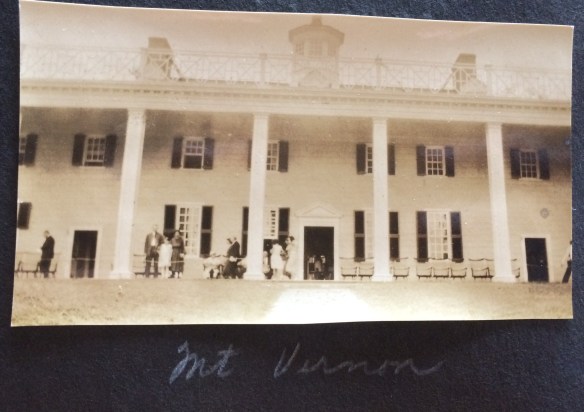
Because of my interest in public history, I paid special attention to the photos of relatives at historic sites. In the scrapbook, for instance, I found a photo of my grandmother’s family visiting Mount Vernon. In the slideshow, there were many more history sites.

When my father was a boy, his family spent many of their summers in Pigeon, Michigan, with his father Earl’s extended family. Several summers, however, they embarked on massive road trips. On these odysseys, the Mausts made stops at various national parks and tourist attractions.

Ship[1]

Dennis and Robert Maust in front of one of the ships they visited.

Historic ships have their own special appeal, and the Maust family visited at least two of them. They visited Plymouth Rock too. The rock, inscribed with the year “1620,” was identified as the landing place of the first Pilgrim immigrants by a ninety-five year-old man in 1741 and moved multiple times over the last centuries.1

Indian[1]

An unnamed interpreter in American Indian dress poses for a photo, location and date unknown.

The western trips included stops at the St. Louis Arch, giant redwoods, at least one spot that had a person in American Indian ceremonial costume, and Mount Rushmore. Perhaps more surprisingly, on a trip through Georgia, the Mausts visited Stone Mountain. Their visit was probably soon after the site—which features carvings of Jefferson Davis, Robert E. Lee, and Stonewall Jackson—opened to the public as a state park on the centenary of Abraham Lincoln’s assassination.

General_Sherman[1]

Dennis, Earl, and RobertMaust sit in front of the tree named “General Sherman” in Sequoia National Park.

What were the lessons at all of these sites in the 1960s? Despite Denise Meringolo’s uncovering of radical precedents of public history, the historic sites and monuments of the mid-twentieth century were overwhelmingly nationalistic and concerned with privileged Americans. Many of these sites, both private and public, explicitly aimed to teach visitors how to be American; that is, how to assimilate to a specific strand of American culture. House museums and period rooms, for instance, were used to display idealized American homes and teach the values which informed the décor choices.

The sites visited by my family probably saw themselves fulfilling the same purpose to varying degrees. The messages at historic ships and Plymouth Rock likely centered around eighteenth century European immigration. Across the American west, history sites largely told the story of Manifest Destiny. Did the Mausts hear anything about the “Six Grandfathers” on the South Dakotan mountain which were replaced by four white presidents? Surely the word “genocide” did not appear on any plaques or on any tour guide’s tongue.

Mt._Rushmore[1]

A Maust photo of Mount Rushmore, undated.

Evelyn and Earl Maust were mainstream Mennonites for their time. Earl achieved several degrees in music and education and Evelyn was a nurse. Earl served in Puerto Rico in Civilian Public Service. Together they had traveled through Europe. So what did they take away from any of these places? Did they feel patriotic fervor at Mount Rushmore? Or alienation? Did they feel American? Did they settle for awe at the size and and skill evident in the carving?

Perhaps more intriguingly, what did they take away from Stone Mountain? To what extent had the nurse from Harrisonburg, Virginia, and the choral director from Pigeon, Michigan, internalized the Lost Cause narrative? Did they know that Stone Mountain was the site of the re-founding of the KKK in 1915? Earl participated in a march led by Martin Luther King Jr. in Nashville just a few years before. How do we square these events in one family’s life? What was the Mausts’ racial consciousness in the mid 1960s? Were Earl and Evelyn just attracted by the novelty of the new state park?

Stone_Mt[1]

Dennis and Robert Maust pose in front of Stone Mountain.

These are questions I suspect I’ll never have answers to. My grandmother left behind some diaries and correspondence which might shed light on her tourist experience, but knowing her, any observations would likely be enigmatic and brief. My grandfather, who passed away fifty years ago this fall, left these slides and little else, I think.

Why do I pose these questions? By the late 1960s, over a million and a half Americans visited Mount Rushmore each year. I suspect that the Mausts were not the only Mennonites among that number. Considering how Mennonites and other Anabaptist groups engaged with American public history sites at the high tide of their nationalist focus could provide an important data point in the story of twentieth century Anabaptist life and these communities’ relationship with the state. Perhaps more importantly, considering Anabaptist reactions to sites such as Mount Rushmore and Stone Mountain which directly or indirectly commemorate white supremacy and genocide might provide important context for those working to dismantle racial injustice in the present. For those of my parents’ generation, understanding their parents’ engagement or disassociation with mainstream American culture through this lens might be enlightening as they consider their own identity as American Anabaptists.

What messages conveyed by these sites were comfortable to mid-century Anabaptists? Which ones were uncomfortable? Even glimpses into the answers to these questions might be illuminating as contemporary Anabaptists confront an uncomfortable present.

Special thanks to Robert Maust for digitizing these slides on short notice. 


  1. James Thacher, History of the Town of Plymouth: From Its First Settlement in 1620 to the Year 1832 (Boston: Marsh, Capen & Lyon, 1832), 29-30: http://books.google.com/books?id=IWWLjiaEs2AC. Also, here’s a great home video of Thanksgiving at Plymouth Rock ca. 1960: https://vimeo.com/32595596. 

A Train Wreck and a Hair Picture

It’s a well-known story.

It was July 25, 1896, and there had been a party at the home of John Musser in Witmer, Pennsylvania, and many young Mennonites had gathered to socialize, perhaps discussing the quarterly mission meeting that had been held a few days earlier, perhaps not. Some time before midnight the party broke up, and everybody went their separate ways.1

Three buggies went together down Old Philadelphia Pike, now Route 340, towards Bird-in-Hand. Chatting from carriage to carriage, they did not hear the east bound train approaching at the Bird-in-Hand curve—not a regularly scheduled train, but a special service, carrying militia troops home from an encampment.

“At the Bird it happened,” wrote Jakob M. Barge, recounting the incident to a son who had moved west. The first buggy, carrying Amos Landis and his girlfriend barely made it across, but the second, carrying Jakob’s son Enos, and Barbara Hershey, stopped on the tracks, horse rearing. “Enos was struck by an engine, his horse killed, his lady friend [Barbara Hershey] was killed and he has lost his right arm.” Jakob did not mention that Enos had been found thirty feet from his right arm. The next day, Enos would succumb to his wounds and die in the Lancaster hospital.2

This event is usually remembered for its tremendous impact on the young people of Lancaster Conference. Barbara Hershey’s funeral possession had three hundred carriages. At Enos Barge’s funeral, more than a thousand vehicles arrived at Strasburg for the funeral, three times the capacity of the meetinghouse.

Amos D. Wenger, already in Lancaster County at the time, was leading almost-but-not-quite-revival meetings that gained greater attention and following after the accident. Young people started to look at baptism and joining the church at a younger age—as opposed to waiting for marriage. Indeed, baptismal classes were larger than normal that summer, with about five hundred young people becoming church members. The impact of this was felt long through the conference on the account of the energy the young people brought in.

IMG_20180621_084543

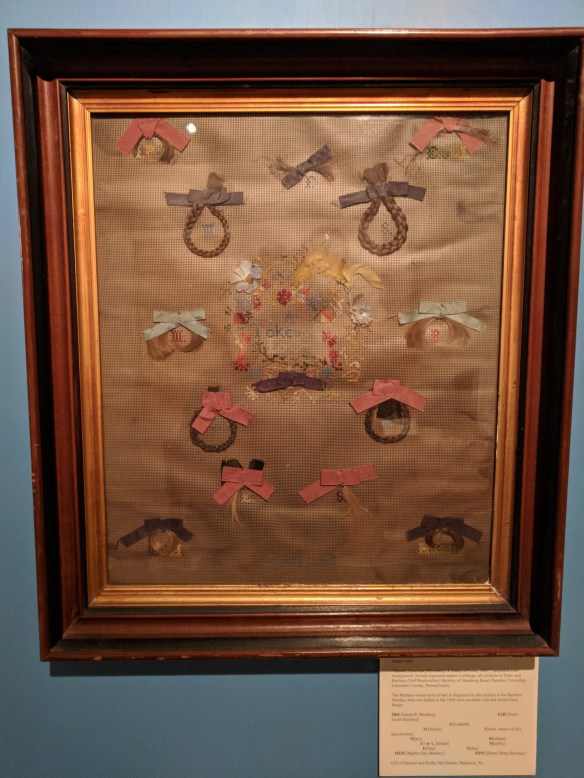
“Hair Picture,” in Decorated and Plain: A Mennonite and Amish Sampler.

But there is also a perhaps less important impact of this story. In 1882, Sarah Lucinda Hershey made a hair picture of herself and her siblings—including Barbara Hershey. It is a fascinating thing—a punch card background, neatly framed in wood with the first initial carefully stitched below each of the thirteen locks of hair. Each lock of hair, some braided, others loosely gathered, is neatly bundled with ribbon. In the middle, “A Token of Love” with cross-stitched flowers with silk other and feathers as finishing touches. The piece came to the Society’s collection through a non-Mennonite antique dealer, and little is known during the time period between its construction and its purchase by the Society.3

I am looking for other similar hair memorials, in any form, that have Mennonite connections to provide comparative analysis. If you know of one, please connect with me through the Lancaster Mennonite Historical Society.


  1. This telling of the story is based on the account in John L. Ruth, The Earth is the Lord’s: A Narrative History of Lancaster Mennonite Conference (Scottdale, Pa.: Herald Press, 2001), 726-727. 
  2. Jakob M. Barge to Frank Barge, July 26, 1896, in Decorated and Plain: A Mennonite and Amish Sampler in the Lancaster Mennonite Historical Society Museum, Lancaster, Pa. 
  3. “Hair Picture,” in Decorated and Plain: A Mennonite and Amish Sampler

Five Myths about Mennonites and the Holocaust

“Not all the Jews were bad,” a widely respected Mennonite born in interwar Ukraine told me recently, “even though they started the [Bolshevik] Revolution. My father had good Jewish friends.” This statement is classically anti-Semitic. It falsely conflates communism with Judaism, while using the excuse of having a few Jewish friends to mask an implied belief that Jews in general were bad. At least as importantly, my conversation partner’s words reveal how people who do not consider themselves racist or anti-Semitic can still propagate harmful myths.

New scholarship and ongoing public discussion about the historic entanglement of tens of thousands of Mennonites on three continents with Nazism and the Holocaust during the 1930s and 1940s has yielded productive conversation regarding how present-day Anabaptists can and should respond to this history, as well as calls for further discussion. At the same time, some church-affiliated periodicals have printed articles, letters, and reviews that propagate troubling interpretations of Mennonite-Nazi connections, including anti-Semitic tropes.

Figure 1, Great Trek

Imagery of the “Great Trek” during WWII has dominated Mennonite depictions of the era, bolstering a narrative of suffering, mostly female refugees. In fact, the word “trek” was widely and triumphally used in the Third Reich to describe German-speakers relocating from Eastern Europe to Germany. This particular movement of Mennonites and others out of Ukraine in 1943 and 1944 was overseen by the SS. Participants were not primarily considered to be refugees but rather Aryan “re-settlers,” traveling to a fatherland newly cleansed of Jews. Credit: Mennonite Archives of Ontario, attributed to Hermann Rossner.

Such reactionary responses are not exceptional, either in Holocaust historiography or in the current context of Israeli human rights abuses against Palestinians. In February, Poland passed legislation criminalizing mention of some Poles’ involvement in genocide, while part of the international backlash to Israeli violence has been couched in anti-Semitic terms. When certain Mennonites voice anti-Semitic sentiments, this often reflects—as is the case of other groups—both an attempt to protect their own and also a real, dangerous current of anti-Jewish prejudice.

The following five myths date to the Third Reich or its immediate aftermath. They remain in circulation, deployed today to excuse Mennonite involvement in Nazism or to foreclose public discussion. Examples given below all appeared in Mennonite periodicals within the past two years. Since my intention is to stimulate thoughtful reflection, not to shame individuals, I have chosen not to cite most quotations. However, all are easily accessible online and in print.

Myth #1: Mennonites suffered under Bolshevism, justifying Nazi collaboration.

This is the most typical excuse for Mennonite involvement for Nazism. The trope holds that life in the Soviet Union was so brutal, Mennonites had no choice but to embrace Hitler’s crusade. In fact, most Mennonites involved with the Third Reich had never lived in the USSR. The subset who did—approximately 35,000 individuals in Ukraine—came under Nazi occupation in 1941. Like millions of other Soviet citizens, most of these Mennonites welcomed Hitler’s armies as “liberators” from hardship and repression. Yet unlike the majority of their neighbors, Mennonites were generally considered Aryan, a status that provided additional incentives to support Nazism.

This trope is often accompanied by assertions that Mennonite suffering under communism has not been properly recognized. But in reality, Mennonite authors have been publicizing Soviet atrocities without abate since the Bolshevik Revolution. Scholarly literature and memoirs on Mennonite victimhood greatly outnumber texts that explore collaboration or perpetration. Nearly all of the latter have appeared only recently. The imbalance is so stark that Mennonite historians can claim to have created an entire subgenre on the “Soviet Inferno,” a term in academic use since the 1990s and whose deployment continues to refer almost exclusively to Mennonites.

Myth #2:  The Allied powers committed atrocities, too – why should we single out Nazism?

“The Nazis were bad, but the Bolsheviks were worse,” a Mennonite born in the USSR told me in March. “You mean from a Mennonite perspective,” I said. My conversation partner shrugged. “Of course.” When white Mennonites think about what life might have been like for them if they had lived in Hitler’s Germany, they invariably assume that they would have been Mennonite—and by extension Aryan. From such a viewpoint, each of the Allied powers, not just the Soviet Union, would have posed a greater threat to life and livelihood than Nazism. In other words, assuming one would have been Aryan creates a false equivalency that downplays genocide.

Studying the Holocaust from a Mennonite-centric perspective runs the added risk of repeating debunked Nazi propaganda, such as the myth that Bolshevism was Jewish. Some invocations of a “Soviet Inferno” falsely imply systematic persecution or even a “final solution” of Mennonites (by Jews) in the USSR. Nazi perpetrators commonly used such reversals to portray themselves as the true victims. Last year, one historian explained Mennonite participation in Nazi death squads, stating: “men and women of Jewish background worked as [Soviet] administrators, agents, and interrogators.” He had previously directed me to a webpage entitled “Jewish Mass Murderers.”

Myth #3: Mennonites were mostly women and children, so they either had no choice or could not have been involved.

Women and children are often invoked to claim Mennonite innocence in Nazi war making. One writer recently claimed, for example: “in the 1930s most Mennonite men [in the USSR] had been exiled, imprisoned or executed, leaving families to be led by mothers and grandmothers,” who were not “collaborators, anti-Semites or Aryan.” Mennonites in Nazi-occupied Ukraine were indeed disproportionately women and children. But there were also plenty of men—many of whom served in administrative positions, as translators, policemen, or soldiers. Gender disparity at the end of the war in part reflected the death or capture of Mennonite men in German uniform.
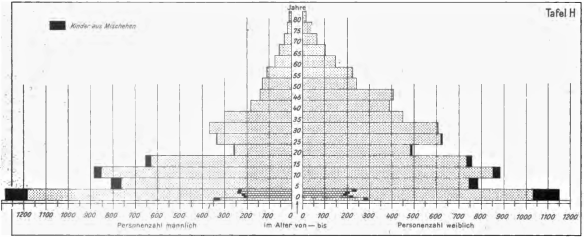
Figure 2, Chortitza table

A table compiled by Nazi occupiers showing the age and gender (men on the left, women on the right) of the 13,000 “ethnic Germans” in Ukraine’s Chortitza colony, ca. 1942. Forty-three percent of “ethnic German” families in Chortitza had no male head of household—but fifty-seven percent did. Source: Karl Stumpp, Bericht über das Gebiet Chortitza im Generalbezirk Dnjepropetrowsk (Berlin: Publikationsstelle Ost, 1943), Tafel H.

This myth further assumes that women or children could not have contributed to Nazism or the Holocaust. However, many Mennonite women served as translators or in bureaucratic capacities, sometimes enriching themselves with the spoils of genocide. More often, women supplied moral support to male relatives and contributed to the war effort through their labor. Meanwhile, some underage boys took up arms. And most Mennonite children in the Third Reich absorbed Nazi ideals at school and through organized youth activities. They helped boost morale by singing, marching, and telling stories. Some racist proclivities learned in the 1930s and 1940s persist today.

Myth #4: Mennonites knew nothing about Holocaust-related atrocities.

This is simply untrue, as numerous archival documents testify. Nonetheless, the way this myth is told is itself revealing. Consider one statement: “Although Mennonites under German occupation witnessed how their Jewish neighbours packed up and fled, they did not know about the outcome of this fleeing until much later.” Another, strikingly similar account holds that Mennonites “saw their Jewish neighbours pack up and flee eastward across the Dnepr; how many survived and how many were executed on the eastern side they did not know until later.” These authors care more about locating killing elsewhere than considering why Mennonites stayed as Jews fled.
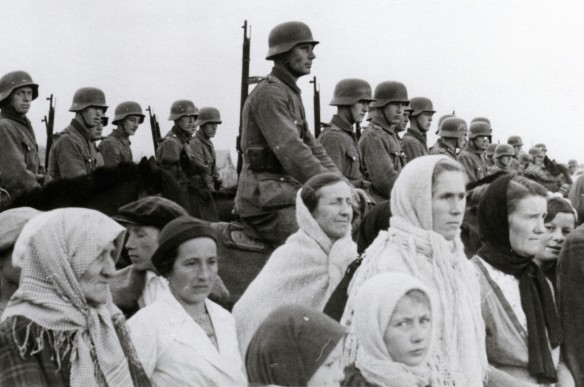
Figure 3, Molotschna

A caption in one Mennonite history book for this scene from the Molotschna colony in Ukraine, 1942, reads: “This photo shows the uneasy meeting of two branches of the German and Low German cultures: the militarism of Prussia as well as of the Third Reich, and its opposite—the nonresistance of the Mennonite religious culture. The worldwide German culture is much richer given the existence of a community that did not soil itself with the militarist Nazi madness.” In fact, the men pictured here belonged to Waffen-SS cavalry units composed mostly of Mennonites. The photo was taken at a rally where Mennonite women and children performed for the visiting head of the SS, Heinrich Himmler. Source: Adina Reger and Delbert Plett, eds., Diese Steine: Die Russlandmennoniten (Steinbach, MB: Crossway Publications, 2001), 332.

To suggest that murder did not occur around some Mennonite settlements or that Mennonites in these areas had no knowledge of genocide is a form of Holocaust denial. Such myths repudiate known facts. Yet claims persist that Mennonites “had not heard of Aryanism and other racial theories until well after the conclusion of the war.” The author of this line, in subsequent postal correspondence, described glowingly her own wartime work as the secretary for a top German officer in Nazi-occupied Dnipropetrovsk, her receipt of German citizenship, and the voluntary induction of Mennonite men into the military; “I am a beneficiary of the German occupation!”

Myth #5: Mennonites suffered under Nazism.

Among the most disingenuous myths about Mennonite life under Nazism, this trope holds that the general suffering of Mennonites in the USSR continued under German rule. Nazi occupation was indeed catastrophic for a minority of Mennonites who were committed communists, as well as for disabled individuals and those of Jewish heritage. Some in Nazi-occupied France and the Netherlands joined the resistance or hid Jews. Yet claims of Mennonite suffering normally refer to those who in 1943 and 1944 participated in the “Great Trek” from Ukraine to Poland to escape the Red Army—an endeavor supervised by the SS and praised by Mennonite leaders at the time.

Indeed, closer inspection reveals that allegations of Mennonite hardship are often complaints that Nazism did not live up to its potential. If only the Eastern Front had held; if only religious reform had been more thorough; if only welfare programs were more generous—then Mennonite life would have been easier. Even the Holocaust and other persecutions are said to have “occasioned much disappointment among Mennonites.” This may be true. But note how the author chooses to emphasize the “disappointment” of Aryans, not the actual enslavement and slaughter of Jews. Despite the fading of his own initial “euphoria” for Germany, he could remain “deeply grateful.”

* * *

Mennonite authors and editors should think carefully before writing or printing pieces about the Third Reich. This is an important topic and requires our attention. But we must approach it in ways that do not recapitulate racism. Even those of us with good intentions need to be wary. In April, the cover story of a major denominational magazine laudably covered Mennonites and the Holocaust; yet in her introduction, the editor blithely compared Mennonites murdering Jews to Jews murdering Jesus—arguably the single most injurious trope of Christian anti-Semitism. Proofreaders apparently saw no problem with invoking “the crowd that yelled ‘Crucify him!’”

A few rules of thumb might be helpful. If you are discussing Nazism or the Holocaust, consider how someone from a different background might react—particularly if you are defending actions by your own group. Second, be aware of contextual differences: refocusing from the Holocaust to Soviet atrocities erases the specificity of Jewish genocide. Finally, when evaluating suffering, do not discriminate. While Mennonites have faced many difficulties, they never suffered alone. Nor were they always victims. Anabaptists, of all people, must surely grasp that violence can permeate even the most peaceable of cultures, a process we should understand but never justify.

Ben Goossen is a historian at Harvard University. He is the author of Chosen Nation: Mennonites and Germany in a Global Era, published in 2017 by Princeton University Press.

A Reader’s Reward

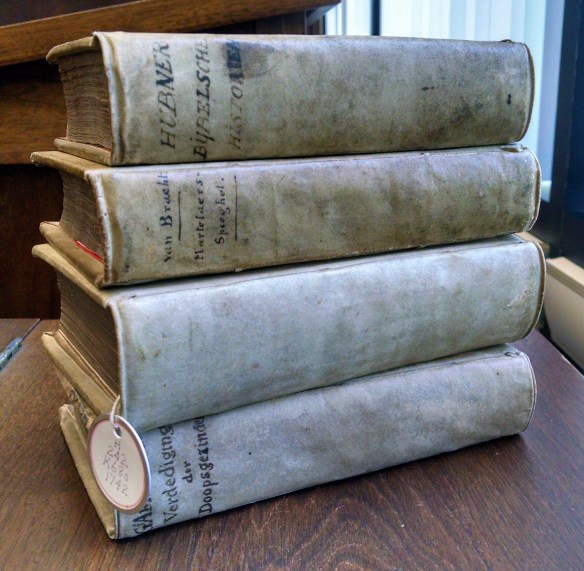
IMG_20180601_130550089_HDRA sampling of prize books housed in the Menno Simons Historical Library at EMU


The beauty of old and rare books is that through studying some of them we can learn not just about the ideas of the writer, but also the life of their reader.

We are fortunate in the Menno Simons Historical Library to have some rare books that give us an insight into the work of Dutch Mennonites in the eighteenth century. These books were given as prizes to children who did well in their catechism classes. The prize encouraged children to learn scripture and the books that were given taught them about the faith of the Mennonite church. Topics ranged from martyr books to histories of the Bible and Mennonite doctrine. We have at least eight examples of prize books in our collection, and I will highlight a few here.

The first is a book of Mennonite history and doctrine by Galenus Abrahamsz de Haan given to Jacob Beukenberg, an orphan living in the Weehuis in Amsterdam, on April 23, 1710.

IMG_20180601_130743832

Another is an emblem book of poems, scripture, and illustrations given to Gerardus de Wind on the 22nd of April 1753.

IMG_20180601_130729839

The third is and final one I will highlight is a small book of martyr stories by Thielman van Braght (best known as compiler and author of the Martyrs Mirror) presented to Pieter Corver on the 26th of February 1774.
IMG_20180601_130632141_HDR

Keith Sprunger, emeritus professor of history at Bethel College, studied these books twenty years ago during a research trip to the Menno Simons Historical Library. He notes that “the provider of the books was usually a church member who was a printer or ran a book store”1. Many Dutch Mennonites had warmly embraced this new printing technology, with some becoming quite rich from the enterprise. Sprunger writes that “This era was . . . the heroic age of Dutch Mennonite printing” and that “the Mennonite churches made great use of the printed word for advancing their religion”2.

Is the printed word still valued by Mennonites? The existence of Herald Press, MennoMedia, and the various Mennonite libraries and archives scattered around North America are hopeful indicators to me that as Mennonites we still make great use of the printed word to transmit our faith, heritage, and the good news of Jesus to the next generation. Many congregations today maintain traditions of giving their young people Bibles or books when they are baptized or reach other milestones.

But the news is full of stories of traditional forms of media struggling to maintain viability in the face of a population becoming ever-more reliant on instant access via the internet, social media, and smartphones. And while I believe technology is a fantastic tool to meet many communication and learning needs, it is clear that when it comes to leaving a long-term record it is not as enduring or reliable as print media. The prize books I mentioned above have been preserved in their original form for nearly three hundred years; computers from twenty years ago have long been relegated to the trash heap. Just as technology has enabled us to preserve through digitization and increase access through web content, it also presents major problems of preservation and access of records based in formats that are now obsolete. 

While it is tempting to continue chasing the new and best technology trends, I think it is wise to take a step back and consider how we can also continue to support and use print resources to leave a record and transmit our traditions to future generations of believers. There is value in possessing tangible resources that we can peruse and return to years later without worrying about data migration, file format compatibility, and URL stability. The young people who received these books appreciated them as the prize they were and we would do well to remember in our ever-changing and fast-paced world that there are still many rewards to be found between the covers of a good book.

Sources:
Sprunger, Keith L. 1999. Mennonitism in print : EMU and the history of Dutch Mennonite printing. n.p.: [1999]., 1999. Menno Simons Historical Library Vertical File.


  1. Sprunger, 17. 
  2. Sprunger, 13.