The Gift of Leadership: Paul N. Kraybill’s Ministry to the Global Mennonite Community

For the last several weeks, I have been working to arrange and describe the personal papers of Paul Nissley Kraybill. Kraybill is best known for his work as the Executive Secretary of Mennonite World Conference (MWC), a position he held from 1973 until 1990.1 During this time, he led the effort to create and implement a new structure for the organization and oversaw planning for three assemblies in Wichita, Kansas, Strasbourg, France, and Winnipeg, Manitoba. Shortly before he began his position, the presidium for the tenth assembly chose Million Belete from Ethiopia to serve as the first non-western President of MWC. Along with Belete and MWC staff, Kraybill created a new constitution designed to better serve the organization’s diverse, global constituency and a travel fund to enable a broader segment of the Mennonite community to participate in assemblies. Under the leadership of Kraybill and Belete, the MWC blossomed into a truly global organization.2
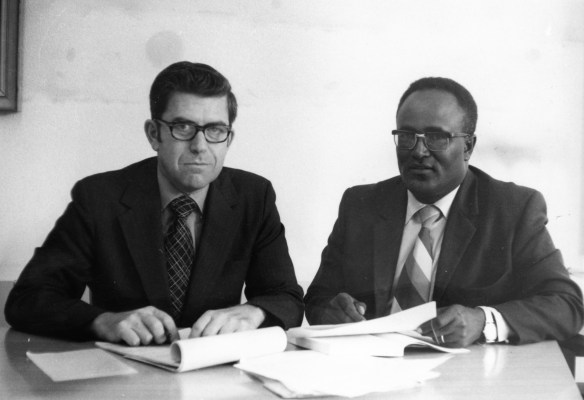
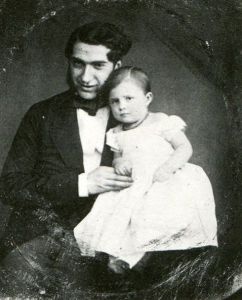
Kraybill and Belete, 1973

Kraybill and Belete, 1973

As I worked my way through his papers, I was struck by the variety of Mennonite-related organizations with which Kraybill worked during his life. Aside from the global Mennonite and Anabaptist groups he partnered with as executive secretary of MWC, over the course of his forty-year career Kraybill worked with or served on the boards of at least a dozen other organizations. Like other successful Mennonite administrators before him, Kraybill was skilled at bridging inter-Mennonite divides, and he privileged ecumenical understanding and collaboration over rigid adherence to the creeds of a single faith community. Unlike some Mennonite leaders before him, however, Kraybill’s strengths did not lie in envisioning the creation of new organizations or initiatives, but in articulating and implementing a plan to improve those that already existed.3

By the time he planned his first MWC assembly in Wichita (1978), Kraybill had long proven himself as a skilled administrator. Born in 1925 in rural Lancaster County, Pennsylvania, Kraybill grew up attending Bossler Mennonite Church in Elizabethtown and graduated from Lancaster Mennonite School in 1943. Before completing his B.A. at Eastern Mennonite College (Harrisonburg, Virginia) in 1955, he received two separate calls to ministry: one to serve at his home congregation and the other to serve as the Assistant Secretary of the Eastern Mennonite Board of Missions and Charities (EMBMC) in Salunga, Pennsylvania. Kraybill chose the latter call and worked with EMBMC for a total of seventeen years, first as Assistant Secretary (1953-1958) and later as Overseas Executive Secretary (1958-1970), a position he took over from Orie O. Miller.4
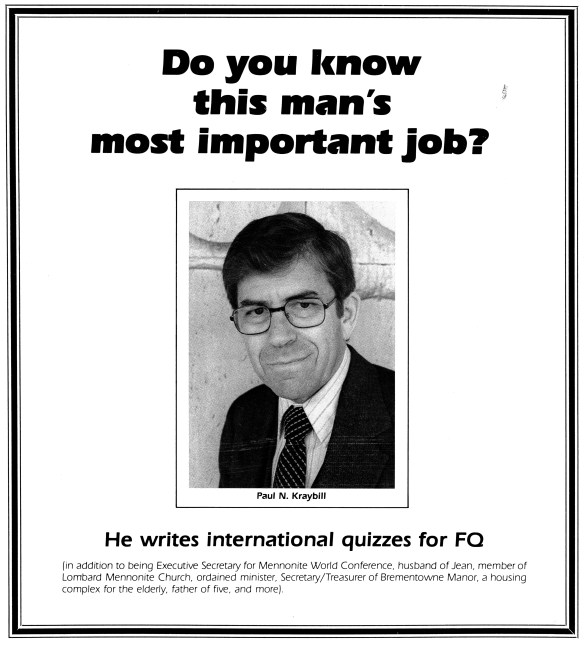
FestivalQuarterlyBackCover_Feb-Apr.-1981

Back cover of Festival Quarterly, February-April, 1981

In 1970, Kraybill’s gifts in administration were further affirmed when he was appointed Executive Secretary of the (old) Mennonite Church Study Commission on Church Organization. Shortly thereafter, Kraybill assumed the role of General Secretary of the Mennonite Church General Board and moved to Lombard, Illinois, with his family and children. He held this position until 1977 when he took on full-time responsibilities with Mennonite World Conference. However, Kraybill’s Mennonite institutional influence extended far beyond his work with the Mennonite Church General Board. Over the course of his long career, Kraybill donated his time and expertise to a variety of other organizations (some Mennonite, some not) as a committee or board member:

He also served as an organizational consultant for a number of Mennonite-related organizations, including Chicago Area Mennonites, Lancaster Mennonite School, Lancaster Mennonite Conference, and Lombard Mennonite Church.

Although he never served as a pastor or received any formal seminary training, Kraybill was “ordained to ministry with [the] worldwide fellowship” of Mennonites at Lombard Mennonite Church on April 12, 1981. In his written examination for ministry in the Illinois Mennonite Conference, Kraybill reflected on his call and his “gifts for the ministry” as follows:

I do not feel that my gifts are strong in the current sense of a professional pastor . . . If I have gifts I think they are in the area of organization and leadership . . . For me that means communicating ideas, helping to shape new directions, working at reconciliation, creating larger vision and encouraging the church to be faithful to the Scriptures in terms of the understandings which grow out of our Anabaptist heritage.5
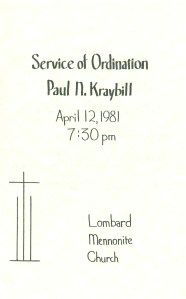
OrdinationService_B15_F12

Order of service for Kraybill’s ordination

While Kraybill expressed ambivalence about his ordination, Lombard co-pastors Joe and Emma Richards were unequivocal in their affirmation of Kraybill’s gifts. In their letter of support for his ordination, they pointed to Kraybill’s “life of consistent discipleship [and] sensitivity to the leading of the Holy Spirit” and described him as a “gifted administrator, a resourceful counselor, and a confident leader.”6

Leadership is important in the church and cannot be easily separated from other gifts of ministry. Unlike other leaders, however, administrative leaders like Kraybill held considerable power to determine the eventual shape and function of multiple church institutions over the course of their careers. In fact, these organizations welcomed Kraybill’s leadership for precisely those reasons. Fittingly, when he died in 1993, Kraybill was in the midst of planning the restructuring of the Mennonite Health Association, an organization for which he had served as president since 1990.

While leaders are often over-represented in the Mennonite historical narrative (and archives), their lives can teach us much about the historical evolution of the institutions that continue to structure relationships between members of the Mennonite faith community. They can also serve as reference points as we reflect on our past and articulate common dreams for the future.


  1. Mennonite Church USA Archives is also the official repository for the records of Mennonite World Conference
  2. For an excellent synopsis (authored by Kraybill) of Mennonite World Conference’s historical development from 1925 to 1990 and the changes that Kraybill implemented, see the following article from the Global Anabaptist Mennonite Encyclopedia Online (GAMEO): http://gameo.org/index.php?title=Mennonite_world_conference [accessed 10/12/2017]. 
  3. One exception is Mennonite Housing Aid, Inc., in Chicago, Illinois. Kraybill played a key role from its inception and served as president during its first six years, from 1975 to 1981. 
  4. For more on the relationship between Kraybill and Miller, see John E. Sharp, My Calling to Fulfill: The Orie O. Miller Story (Harrisonburg, VA: Herald Press, 2015), 318-320 and 334-335. 
  5. Examination for Ministry, Illinois Mennonite Conference, January 9, 1981. Box 15, Folder 12. Paul N. Kraybill Papers, 1942-1992. HM1-998. Mennonite Church USA Archives – Elkhart. Elkhart, Indiana. 
  6. “Paul N. Kraybill Ordination,” Press Release, undated. Box 15, Folder 12. Paul N. Kraybill Papers, 1942-1992. HM1-998. Mennonite Church USA Archives – Elkhart. Elkhart, Indiana. 

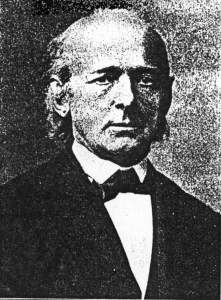
Bishop Jacob Hostetter (1774-1865)

Image

20150240080.jpg

Jacob Hostetter (or Hochstetter) was a farmer, mechanic, tailor, shoemaker, and basket-maker from the Manheim area. He was a bishop in the Lancaster Mennonite Conference who served as the Conference moderator following the death of Bishop Peter Eby in 1843.

This photographic portrait was taken in the 1850s and is remarkable in several ways. First, it depicts someone who was born before the United States of America existed. Second, it was made at a time when there was some contention among the Lancaster Mennonites about the use of photographic portraits. John Ruth writes that Hostetter “reluctantly yielded to his family’s persistent requests for his picture. But that brought him serious criticism, as expressed by an anonymous letter writer from Farmersville, in the conservative region of Groffdale. Bishop Hochstetter had acknowledged to the conference several years earlier that his picture had been taken, and he did not find it pleasant to have the matter thrown up to him again at the age of eighty-four.”1


  1.  John L. Ruth, The Earth Is the Lord’s: A Narrative History of the Lancaster Mennonite Conference (Scottdale, Pa.: Herald Press, 2001), 533-534. 

Five Mennonite Elders Meet with Prussian Minister of War, Albrecht von Roon, Oct. 24, 1867

Mennonites Accept and Contest Military Service in the German East: A Sesquicentennial Series

The passage on Friday, October 18, 1867, of the military service law of the North German Confederation explicitly stripped Mennonites in Prussia of their exemption and led to an immediate response from Mennonite leadership in an attempt to restore it. Six days later, on Thursday, October 24, five Elders from the rural Vistula Delta congregations were in the office of the Prussian Minister of War, Albrecht von Roon, seeking his support for reinstatement. The encounter led to a lengthy theological discussion over the nature of salvation and won the Mennonites a long-term supporter at the highest level of government in what turned out, however, to be a futile project. Von Roon might have been the last Minister of War to engage Mennonites theologically anywhere, an interesting measure of changes in both governments and Mennonites since then, if true.

3.1 penner

Elder Gerhard Penner

Mennonites found out about the October 18 vote the same day. Wilhelm von Brauchitsch, the representative from Elbing-Marienburg district, which had the highest percentage of Mennonite voters anywhere in German lands, telegraphed Elder Gerhard Penner of the Heubuden congregation to relay the news. For unknown reasons he was not in the chamber that day during the debates, but obviously knew about the vote. He advised the Mennonites to send a delegation to Berlin immediately to lobby the Bundesrat, the council of ruling princes in the Confederation that served as the second legislative body, to veto or amend the law. Von Brauchitsch was possibly so solicitous of traditionalist Mennonite concerns because while voting had only come to Prussia in 1848, Mennonites had not taken to the ballot box in large numbers until the 1860s and voted overwhelmingly for the conservative von Brauchistsch, even though the liberals ran a Mennonite named Warkentin from Königsberg against him.1

Five Elders were selected at a meeting of the wider leadership held on Wednesday in the village of Koczelitzki, and they left immediately on the train to Berlin. This village was the home of Gerhard Penner, the acknowledged leader of the rural congregations and the most ardent opponent of military service, so presumably the meeting was at his house. He was appointed part of the delegation and was joined by Johann Toews, Ladekopp, Johann Wiebe, Fürstenwerder, Peter Bartel, Gruppe, and Johann Penner, Thiensdorf. Upon arrival, they checked into the Hotel Alexander Großfürst at Friedrich St. 57, likely close to intersection with Leipziger Street. All the important offices of government would have been within reach of a ten-minute walk. They went to visit a friend, Guthke, who worked in the trade ministry. He was a “believer” who was always helpful in explaining the political situation to them and in making connections. Many of the rural congregations would have had a strong interest in missions and an affinity for Pietism, so making connections with Lutheran Pietists was common.

On the morning of the 24th the delegation went first to visit von Brauchitsch, who got them into the Reichstag, which took up deliberations starting at 11:20 am. The delegation then listened for a couple of hours to debates and votes on fees in the postal system and sea-borne trade with Italy. The Chancellor of the North German Confederation and of the Kingdom of Prussia, Otto von Bismarck, was not in the house that day.2

Von Brauchitsch had arranged for them to meet with Minister of War von Roon at 2 p.m., where they were received warmly. Johann Toews explained their situation and asked that the minister make it possible for their exemption to be restored. Von Roon told them that changing the law was not something he could do, but he thought an arrangement could nonetheless be worked out and encouraged them not to lose heart. He then continued by suggesting that Mennonites could agree to work as medics in the army. Both sides would give a little and things could work out fine that way. Peter Bartel asked if medics had to wear sidearms, which von Roon affirmed. Although they would not be firing them, they had to wear them to honor the king, Bartel recounts von Roon as clarifying. Bartel replied that in such a case Mennonites would have to humbly decline to serve in the military since carrying weapons was against their beliefs.3

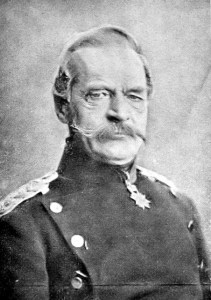
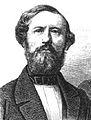
3.2 Albrecht Graf von Roon

Prussian war minister Albrecht Graf von Roon

This assertion led to a lengthy theological conversation over non-resistance. Finally von Roon grabbed Bartel’s coat lapel between two fingers and asked him, “So what do you think of me, since I carry weapons in war, regarding my salvation?” Compelled to reply, Bartel said, “We think about that the way Paul described the issue of eating meat offered to idols in his letter to the Corinthians. Paul told them to feel free to buy any meat offered in the market, but when they are told that the meat had been offered to idols, they should not buy it, for it will be accounted to them as sin. That is how we think about waging war. We have learned with our mother’s milk, so to speak, and been taught by our parents and spiritual leaders, that according to God’s Word going to war is a sin. So for us it has become a matter of conscience and if we go to war it will be accounted to us as sin. You, your Excellence, and others like you, have been taught with your mother’s milk that going to war is defending your fatherland and a holy duty, so that it is not idol worship for you. Therefore it will not be counted as sin for you and your comrades.”

“So you will allow me into heaven,” von Roon replied, which Bartel and the others affirmed. Von Roon assured them he was satisfied with their answer and would do what he could to help them out. He thought something could be worked out and shook their hands before dismissing them.4

Although Bartel’s account of Paul’s teaching in I Corinthians 8 was somewhat garbled, it was typical of these conservative rural elders that they argued directly from the Bible and not from current politics, philosophical ideas, or the issue of human rights and preserving their religious freedom. Equally striking is a minister of war who is concerned, at least on the face of it, of getting into heaven. The delegation spent a little time sightseeing in the capital the next day and a couple hours listening to parliamentary debates before returning home that day yet. Since von Roon had told them nothing could be done, they did not linger any longer.

Unfortunately for Mennonite interests, Bismarck quickly shepherded the law through the Bundesrat, not wanting to leave opportunity for amendments of any kind.5 The final step would be to secure the signature of the king, which happened on November 9, setting the stage for the next event in moving Mennonites closer to military service and the next sesquicentennial blog post.

See Other Posts in this Series


  1. For a general overview, see Mark Jantzen, Mennonite German Soldiers: Nation, Religion, and Family in the Prussian East, 1772-1880 (Notre Dame, Ind.: University of Notre Dame Press, 2010), 193-200. Additional specific details are taken from H. G. Mannhardt, “Zur Entstehung und Geschichte der königl. Kabinettsordre von 3. März 1868, betreffend den Herresdienst der Mennoniten,” Christlicher Gemeinde-Kalender 28 (1919), 99-100. 
  2.   The parliament printed word-for-word protocols of their debates that were bounded in volumes and are now available on a website dedicated to the protocols of all the modern German parliaments. http://www.reichstagsprotokolle.de/Blatt3_nb_bsb00000438_00643.html 
  3.  Peter Bartel, “Beschreibung der persönliche Bemühung der fünf Aeltesten bei den Hohen und Allerhöchsten Staatsmännern in Berlin um Wiederheraushelfung aus dem Reichsgesetz, worin der Reichstag uns Mennoniten am 9. November 1867 versetzt hat,” Christlicher Gemeinde-Kalendar 29 (1920), 71. See also Jantzen, Mennonite German Soldiers, 196-7. On Bartel, see ibid., 196n20. 
  4. Ibid., 71-2. 
  5.  H. G. Mannhardt, “Zur Entstehung,” 100. 

Debating Military Service Exemptions in the North German Confederation, Oct. 18, 1867

Mennonites Accept and Contest Military Service in the German East: A Sesquicentennial Series

On Friday, October 18, 1867, the North German Confederation continued debate on the military service law that proposed exemptions for two different classes of top-ranked nobility and for Mennonites and Quakers. The North German Chancellor, Otto von Bismarck, and the acting Minister of War, Theophil von Podbielski, were again present for these debates. Mennonites were attacked from the lectern at great length for treason, duplicity, and heresy against the doctrine of patriotism by a number of representatives, while only two weak defenses of the exemption were mounted.1

2.1 Franz Duncker

Franz Duncker

The first speaker of the day, Franz Duncker, launched a vigorous attack on any form of exemption. As a co-founder of the German Progressive Party, he was an ardent proponent of both equality and German nationalism, seeing equality as constituting the nation and the nation as the guarantor of equality. Exemptions were therefore damaging to both projects. He attacked the idea that the sons of the kings and rulers should be exempt as making a mockery of the idea of equality and noted that, “such a principle is a great and holy principle only when there is really no exception.” He went on to note that neither a religious principle nor a legal principle, such as state treaties, that exempted former ruling houses could trump the constitutional principle of equality.

Duncker was a left liberal and had little patience for conservative nobility or religious twaddle. Although the parliament was for the North German Confederation, Prussia was the dominant power, and the Prussian constitution, Duncker went on to note, explicitly said in article 12 that civic and civil duties could not be avoided due to religious concerns. Therefore when the constitutions stated that all Prussians or all North Germans were liable for military service, Mennonites could not be exempted. It could not be the job of a democratically elected parliament to work out ways to circumvent the constitution. In addition, he remarked that Mennonites themselves had suggested ways to work around this problem, an apparent allusion to Neuwied Mennonite pastor Carl Harder’s petition that Mennonites be made to serve in the military in exchange for being granted full civil rights. He concluded with an ardent plea to block all exemptions, since a constitution and human rights should not be massaged to create space for “artificial privileges and preferential treatment based on social classes.”2

2.2 Julius_von_Hennig

Julius von Hennig

The third speaker of the day, Julius von Hennig, was a liberal on the conservative side of the political spectrum and a leader of the National Liberal party. He also devoted a long speech to the specific question of military service exemptions. He affirmed the exemptions for the current and former ruling families since state treaties must be respected. No such protection, however, could be claimed by the Mennonites. He argued that Mennonites historically were not primarily non-resistant, rather they were opposed to taking on any political role, which thus precluded military service. Now, however, they were getting more involved in politics by standing for minor offices and voting in national elections. By implication, political Mennonites could also participate in the politics of getting drafted. He quoted at length from a Dutch Mennonite statement that ended any church support for requiring members to avoid military service. He claimed, correctly, that many Mennonites had used the revolutionary turmoil in 1848 that lifted restrictions on buying property to do so. Given that a main restriction on Mennonites had been lifted, drafting them was only fair. He noted, “there is no doubt that every religious sect must obey the requirements of the state if they want to be tolerated by that state.”3

The next speaker, Baron Karl von Vincke-Olbendorf, also a more conservative liberal, was the only speaker outside the government’s speaker to defend the Mennonites. His argument was weak and short as he briefly noted that he thought Mennonites’ exemptions, which were enshrined in existing laws, did perhaps raise the level of state guarantees that could not be so easily overturned. He also noted that revoking the exemption would cause a number of worthy citizens to emigrate which could hardly be in the state’s interest.4

Adolf Weber, another National Liberal, then mounted a sustained rebuke of Mennonites and the government for wanting to shield them. He noted that the Mennonites in his area, East Frisia in the former kingdom of Hannover, had been able to pay for substitutes as a way to avoid the draft. He repeated many of the arguments already given and summed up his position by saying, “Whoever will not defend his homeland (Heimath) should leave it! Whoever will not defend his fatherland does not have one!”5

2.3 Emil_von_Melle

Emil von Melle

Skipping one speaker who felt compelled to attack the Social Democrat Wilhelm Liebknecht, the next speaker, Emil von Melle, also took up the Mennonite issue. As a representative from the city of Hamburg, which had an important Mennonite congregation, he was ambivalent about drafting them, but vehemently opposed to any idea that a Prussian Mennonite could be in a better position than one from Hamburg, and demanded the reinstatement of the dropped proposal to spread the Mennonite exemption in the form used in the west of Prussia. That amounted to a plea to let Mennonites everywhere or nowhere be exempt, but he noted that since they were so few in number, perhaps it did not matter a great deal.6 In terms of broader German politics, Melle’s speech revealed an abiding and popular suspicion among smaller German states that Prussia was a bully, demanding special privileges not accorded to others.

2.4 Karl_Twesten_1862

Karl Twesten (1862)

Karl Twesten was a founder of the right-of-center National Liberal party, a member of the parliamentary committee that had reviewed and slightly amended the government’s proposal and was charged with defending the government’s position. He outlined the discussion in the committee, which noted that the constitution declared both the end of all noble privilege and the obligation on the part of all males to serve in the military, and yet in both cases it was unclear how this was to be implemented. He simply argued that implementation belonged to the legislature and so they should feel free to decide on both points. His next point was that these debates did not matter much. Mennonites were a small group and not counted in the population when it came time to determine the number of draftees needed, so their presence did not in fact require their neighbors to serve at a higher rate. What finally swung the majority of the committee to vote for preserving Mennonite privilege at this point was the realization that in the law on military service they could not revoke the laws that discriminated against Mennonites’ civil rights, and that it would be improper for the legislature to draft Mennonites without lifting the restrictions and extra taxes in place on them.7

The defense of the committee’s draft concluded the debate, so that the parliament moved immediately to voting, which was done by standing. The proposal to exempt members of current ruling houses of the states of the North German Confederation was approved almost unanimously, the exemption for former ruling houses by a large majority. Melle’s proposal to extend the Mennonite and Quaker exemption was narrowly defeated, and the exemption as a whole was easily defeated. Thus Mennonites everywhere in the central and northern German states were to be subject to the draft with no chance of exemption.8

Mennonites found themselves in an unusual spotlight in these two days of debate, but Quakers were not named from the floor even once. Their defense by the government and other supporters was tepid and promised only short-lived relief that would be removed as soon as their civil rights were granted. Mennonite pleading for exemption from the draft could not be squared with equality before the law. Other opponents of the draft  dragged Mennonites into uncomfortable company; Social Democrats, ethnic minorities, and particularists who did not trust Prussia, the founder of the Confederation. There was no progressive path to exemption, nor were Mennonite leaders interested in one, as we will see in the next post on October 24, when they meet with the Prussian Minister of War in Berlin.

See Other Posts in this Series


  1. For overviews, see Mark Jantzen, Mennonite German Soldiers: Nation, Religion, and Family in the Prussian East, 1772-1880 (Notre Dame, Ind.: University of Notre Dame, 2010), 191-228, and “‘Whoever Will Not Defend His Homeland Should Leave It!’ German Conscription and Prussian Mennonite Emigration to the Great Plains, 1880-1890, Mennonite Life, Vol. 58, no. 3 (Sept. 2003), https://ml.bethelks.edu/issue/vol-58-no-3/article/whoever-will-not-defend-his-homeland-should-leave/ 
  2. http://www.reichstagsprotokolle.de/Blatt3_nb_bsb00000438_00489.html and the next two pages. Harder’s petition is at the Geheimes Staatsarchiv Preußischer Kulturbesitz, Berlin, Hauptabteilung I, Repositur 77 (Innenministerium), Titel 31 (Mennonitensachen), Nr. 2 (staatsbürgerliche Verhältnisse der Mennoniten), Bd. 9 (1862-1869), 220-1. Harder proposed requiring Mennonites to serve in non-combatant roles such as medics, clerks, or artisans and in exchange granting them full civil rights, including the right to buy property, affirming instead of swearing oaths, and incorporating their congregations so that the congregations could register the deeds to their buildings instead of being listed as the property of an individual. Neuwied had become part of Prussia as part of the Congress of Vienna, and Prussian Mennonites had the right to affirm since 1827, but perhaps Harder was thinking here of a solution for non-Prussians, see Mark Jantzen, Mennonite German Soliders: Nation, Religion, and Family in the Prussian East, 1772-1880 (Notre Dame, IN: University of Notre Dame Press, 113-4, 267. On Harder more generally see ibid., 174-181. 
  3. http://www.reichstagsprotokolle.de/Blatt3_nb_bsb00000438_00492.html and the next two pages. It is true that Mennonites in the Vistula River valley were able to buy land after 1848 with the support of the local courts who now took a more liberal view of Mennonites’ rights. Because doing so, however, threatened their exemption as demonstrated by von Hennig’s attack, Mennonite leaders required buyers to sell back much of that land and refrain from buying more even though it was now legal to do so. Jantzen, Mennonite German Soldiers, 151-9. 
  4. https://www.deutsche-biographie.de/sfz83810.html#adbcontent; http://www.reichstagsprotokolle.de/Blatt3_nb_bsb00000438_00494.html 
  5. Ibid, and the next two pages. 
  6. http://www.reichstagsprotokolle.de/Blatt3_nb_bsb00000438_00497.html 
  7. http://www.reichstagsprotokolle.de/Blatt3_nb_bsb00000438_00498.html 
  8. http://www.reichstagsprotokolle.de/Blatt3_nb_bsb00000438_00499.html and the following page. 

Debating Military Service Exemptions in the North German Confederation, Oct. 17, 1867

Mennonites Accept and Contest Military Service in the German East: A Sesquicentennial Series

One hundred and fifty years ago today, Mennonites were dragged into a raucous debate over the draft in the most important German parliament of the day. This debate was the first in a series of unusual sesquicentennial events in Mennonite history that will occur over the next six months. In addition to parliamentary debates on October 17 and 18, 1867, a Mennonite delegation lobbied politicians in Berlin in late October, Mennonites in the Vistula River valley became subject to the draft on November 9, 1867, another round of lobbying, including a meeting with King William I occurred in February 1868, and they were granted, and for the most part accepted, non-combatant status on March 3, 1868. A series of blog entries will mark the one hundred and fiftieth anniversary of each of these events on the exact date over the next six months.1

Following a quick war between the Austrian Empire and the Kingdom of Prussia in 1866, victorious Prussia formed a North German Confederation by annexing some of the northern German states that had fought on Austria’s side and forcing the others to join the new polity. Along with Austria, only the three southern German states of Baden, Württemberg, and Bavaria remained outside this new German entity. By 1871, those three states had joined to form the German Empire. Elections for a new Confederation parliament were held on August 31, 1867, after Otto von Bismarck, the Chancellor of the Kingdom of Prussia and the new Chancellor of the Confederation, had a special assembly approve the constitution he wrote for it.

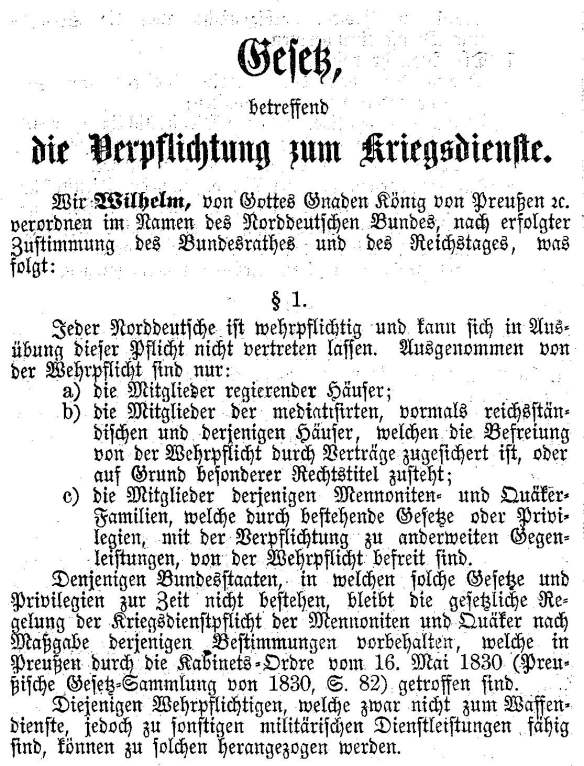
1.1 paragraph 1Since the individual states retained control over most domestic institutions, the military was the main focus of the Confederation’s constitution, budget, and laws. During the inaugural legislative period of the parliament of the North German Confederation, the government proposed a law regulating the length and types of military service. The opening paragraph made provisions for three classes of citizens who should be exempted. The first was the members of the ruling families of the North German states, including the Hohenzollern family of Prussia, with the King of Prussia serving as commander-in-chief of the combined forces. The second category was for the ruling families whose territories had been annexed by Prussia in 1866 or driven from power by Napoleon in 1806. State treaties exempted these families from the draft. The third category was for those Quakers and Mennonites who were currently exempt. Whatever current arrangements obtained were to be extended and carried over into the new state.2
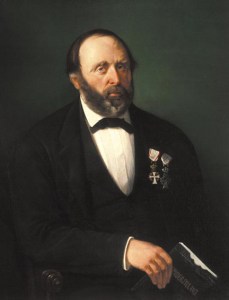
The government offered two reasons for including the Mennonites. The exemption was an expression of tolerance demonstrated by long-standing legal arrangements. Secondly, it dealt with an exceedingly small group of people considering the state as a whole.3 By far the largest group in this category were the 12,000 Mennonites in the Prussian east living along the Vistula River. Since 1830 Mennonites in the Prussian west were exempted if they paid an additional 3 percent income tax and refrained from buying real estate from non-Mennonites. If a territory in North German Confederation did not yet have a law dealing with Mennonites and Quakers, the government proposal was to apply that 1830 standard outlined for the Prussian west.

Starting on Thursday, October 17, 1867, the parliament debated this new military service law, attempting to standardize practices between the various states in the Confederation. Chancellor Otto von Bismarck and the acting Minister of War, Theophil von Podbielski, were among those seated at the table in front representing the states of the confederation. The most serious issue was the length of army service. The government wanted soldiers to serve three years on active duty while members of parliament on the left accused the government of using that lengthy service to create a force loyal enough to the crown that it could be used against domestic rebellion, as had been the case less than twenty years earlier during the revolutionary events of 1848 and 1849.4

1.2 Kryger, Hans Andersen

Hans Andersen Kryger

The debates over universal military service itself were acrimonious. Before the parliament took up the specifics of particular exemptions, they shouted down two proponents of wide-scale exemptions. Hans Andersen Kryger represented the northern most tip of the Confederation where Danes were the majority. He did not want his people drafted at all since they did not even want to be in this state. When he claimed that he could not acknowledge the legitimacy of the constitution, his speech was cut off.5


A subsequent speaker, Wilhelm Liebknecht, who was one of the founders of the Social Democratic Party of Germany, went even further. He argued that the entire army should be abolished and replaced with a militia of armed citizens, as in Switzerland. He accused the army of being an instrument of oppression of the people, not their defender. When he prophesied the imminent demise of the Confederation and denounced it as a fig leaf of authoritarianism, he was removed from the lectern.6 He was followed by the other founder of the Social Democratic Party, August Bebel. He and Liebknecht were the only two Socialists in the parliament and the first Socialists elected to such high positions on a national stage. Bebel reiterated the call for a militia and for serving only three months of active duty instead of three years. He noted that such a long term of service meant that only a small portion of the male population would ever be drafted due to a lack of money and capacity in the army to handle everyone for such long times. Thus the majority was going to be de facto exempted. He was at least allowed to finish his speech.7

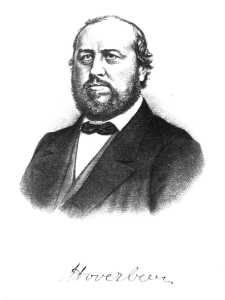
1.5 Leopold_von_Hoverbeck_portrait_1878

Leopold von Hoverbeck, 1878

The specific debate on the Mennonite exemption was opened by Baron Leopold von Hovenbeck, who was a left liberal, a co-founder of the German Progressive Party, and had been a member of the commission assigned to work through the many proposals for amendments, which explains his deeper knowledge of the topic.8 He mocked the idea of calling these Mennonites “pious and non-resistant.” Instead these knaves knew that “their military exemption had significant material rewards,” namely while they paid 15 silver dimes [probably less than a week’s wages] annually per head for their exemption, their neighbors who had to compete with them were gone for three years. When they returned home, they could not afford to farm next to Mennonites who had gotten richer. “Gentlemen, this piety has an economic foundation,” he asserted. Furthermore, it was not even true that Mennonites were forbidden to serve in the military. Napoleon had made them serve as non-combatants, he claimed, and he pointed as well to a petition sent in by Mennonite pastor Carl Harder, formerly of Königsberg and Elbing, currently Neuwied, who had long argued that Mennonites could serve as regular soldiers or non-combatants, as in fact most did in the west of Prussia.9

1.6-harder

Carl Harder

Harder’s petition tellingly was titled “Seeking the Removal of Mennonites’ Military Service Exemption in Exchange for Recognition as Independent Congregations.”10 Since Harder had long accepted military service, at least for non-combatants, he was interested in leveraging this acceptance into removing remaining discriminatory laws and shoring up Mennonite distinctives in other areas. His proposal was to remove the exemption and to require and allow Mennonites to serve as medics, clerks, or artisans in the army. In exchange, Mennonites should be allowed to buy real estate, incorporate their congregations so that they could register the deeds to their church buildings, and give affirmations instead of swearing oaths. The petition was sent to the king on May 30, 1867, forwarded by his staff to the Ministry of the Interior, which administered the draft, on June 19, and made available to the committee that work on the military service law, or perhaps even more widely, by the government.11 The fact that more progressive Mennonites had already accepted military service both as active duty or as non-combatants made traditionalists look hypocritical to Hoverbeck and other parliamentarians and he beat the traditionalists rhetorically with a stick provided by their progressive brethren. Continued debate on the topic would bring more of the same the next day.

See Other Posts in this Series


  1.  For overviews see Mark Jantzen, Mennonite German Soldiers: Nation, Religion, and Family in the Prussian East, 1772-1880 (Notre Dame, Ind.: University of Notre Dame, 2010), 191-228; and “‘Whoever Will Not Defend His Homeland Should Leave It!’ German Conscription and Prussian Mennonite Emigration to the Great Plains, 1880-1890, Mennonite Life, Vol. 58, no. 3 (Sept. 2003), https://ml.bethelks.edu/issue/vol-58-no-3/article/whoever-will-not-defend-his-homeland-should-leave/ 
  2.  The parliament printed word-for-word protocols of their debates that were bounded in volumes and are now available on a website dedicated to the protocols of all the modern German parliaments. The government’s proposed military service law is here, http://www.reichstagsprotokolle.de/Blatt3_nb_bsb00000439_00061.html 
  3.  http://www.reichstagsprotokolle.de/Blatt3_nb_bsb00000439_00063.html 
  4.  On Podbielski, see Mennonite German Soldiers, 199, on the larger issues, ibid., 193-4. 
  5.   Ibid., 195, http://www.reichstagsprotokolle.de/Blatt3_nb_bsb00000438_00471.html 
  6.   Starting on http://www.reichstagsprotokolle.de/Blatt3_nb_bsb00000438_00476.html and continuing two more pages. 
  7.  http://www.reichstagsprotokolle.de/Blatt3_nb_bsb00000438_00479.html and continuing on the next page. 
  8.  https://www.deutsche-biographie.de/sfz33979.html#adbcontent, http://www.reichstagsprotokolle.de/Blatt3_nb_bsb00000438_00157.html 
  9.  http://www.reichstagsprotokolle.de/Blatt3_nb_bsb00000438_00483.html 
  10.  http://www.reichstagsprotokolle.de/Blatt3_nb_bsb00000439_00128.html 
  11.  The petition is in the Geheimes Staatsarchiv Preußischer Kulturbesitz, Berlin, Hauptabteilung I, Repositur 77 (Innenministerium), Titel 31 (Mennonitensachen), Nr. 2 (staatsbürgerliche Verhältnisse der Mennoniten), vol. 9 (1862-1869), 220-1. See also Mennonite German Soldiers, 194n11 and on Harder’s intriguing career generally, ibid., 174-181. Asking for the right to affirm instead of swearing oaths was available to Prussian Mennonites since 1827. Since Neuwied had become part of Prussia in 1815, they should have had this right as well, making Harder’s request here a bit odd. Perhaps he was simply wanted the privilege reaffirmed, ibid., 267.  

Crowdsourcing Anabaptist history?

I’m teaching two digitally focused courses this semester at West Chester University, Introduction to Digital Humanities and the upper level history election, Digital History. In both courses, my students spend a lot of time looking at existing digital projects and learning how to analyze and evaluate them, not unlike a book review. This is a great opportunity not just for my students—but for me—because I get to learn about cool digital projects and be inspired by them.

One of my favorite genres of digital projects is crowdsourced public history, in which public users—the people out there on the internet—contribute their knowledge, skills, and labor to a greater understanding of history.

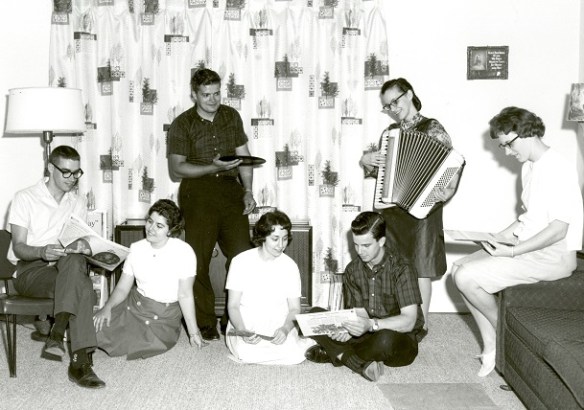
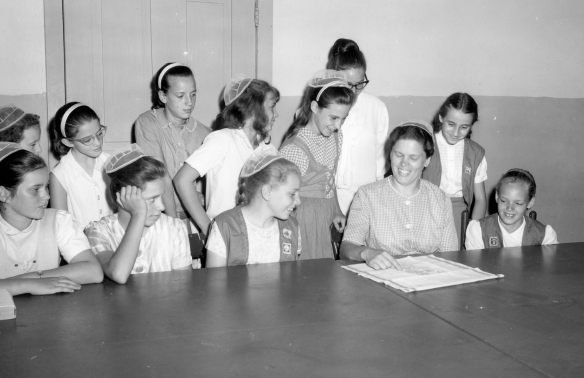
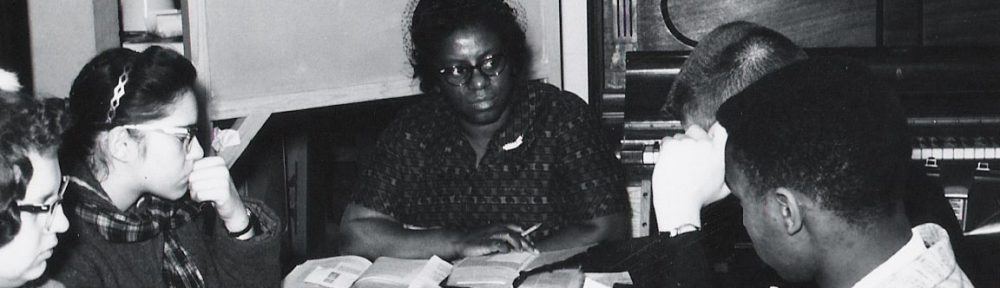
The Mennonite Church Archive already participates in a crowdsourced project by sharing some of its photographs on Flickr Commons, the wing of the Yahoo-owned photo sharing service through which cultural heritage institutions share copyright-free images, allowing users to add tags to photographs or identify individuals pictured. Wouldn’t all these great photographs of 1960s VSers and “Bean Blossom Wayfarers” be even better if we knew who was in them? As a frequent student of the material culture of the Anabaptist traditions, these photographs are an amazing resource for tracking changes of fashion among church members (note when the head coverings come off), analyze the introduction of cultural objects like musical instruments, and study other visual elements of the cultural tradition.

VSers_01

Figure 1. First group of Mennonite Volunteers (VSers) to serve in Rocky Ford, Colo. at the Pioneers Memorial Hospital. They gather informally for a period of relaxation and sharing after a hard day at the Hospital. 1965. Mennonite Board of Missions Photograph Collection from Rocky Ford and Colorado from 1961-65. IV-10-7.2 Box 3 Folder 18, Photo #8. Mennonite Church USA Archives -Elkhart. Elkhart, Indiana.

bean_blossom_wayfarers

Figure 2. Bean Blossom Wayfarers. Mennonite Board of Missions Photographs. IV-10-7.2. Box 7, Folder 3, Photo 9. Mennonite Church USA Archives – Elkhart. Elkhart, Indiana.

Other successful crowdsourced humanities projects include those that let volunteers transcribe primary sources, such as handwritten nineteenth-century diaries and letters, menus, and all sorts of government documents. These work in a twofold way: first, volunteers interested in these historical materials provide labor to assist cultural heritage organizations in the essential process of making their documents machine-readable, and thus searchable through databases and search engines. Second, the institutions gain engaged community members who are using and thinking about their archival materials.

Another type of crowdsourced project asks contributors to share their knowledge and stories in order to add to a body of knowledge and cultural heritage. Wikipedia may be the best-known example, with its volunteer force of editors who continually work to create and improve encyclopedia entries. Public history projects have also captured the stories of those affected by Hurricane Katrina, crowdsourced location-based media by pinning it to a world map, or harvested stories of quilts (a personal favorite of Anabaptist Historian’s resident quilt expert).

So, what does this mean for Anabaptist historians? How can the traditional venues of both religious and cultural history harness the power of the crowd? In some ways, Anabaptist genealogists have long been engaged in crowdsourcing, contributing their knowledge of extensive family trees and long-lost details harvested from cemetery headstones or European church record books. The Swiss Anabaptist Genealogy Association’s extensive databases attest to this. It also demonstrates the enthusiasm of the community interested in Anabaptist history. Those same community experts could lend a hand by identifying and tagging photographs on Flickr, transcribing handwritten documents hidden in archives, and recording stories about their quilts. The Global Anabaptist Mennonite Encyclopedia Online (GAMEO)’s community portal could become a real community portal where participants could suggest new articles and additions to existing ones, rather than a blank page. What about a digital project that allows Pax Program participants to upload their stories of doing voluntary service during the Vietnam War or Mennonite Central Committee volunteers to share accounts of their service?

These ideas all have a low barrier to entry in terms of the technology and cost required for digital history projects. But all of them require cultivating an enthusiastic community of participants. No digital humanities project can survive on the motto of “if you build it they will come.” But the enormous benefit of an engaged community ensures not just the longevity of a digital project, but a sustained commitment from an active public who wants to interact with an institution’s collections.

William and Clara Anderson, ca. 1940

Image

William and Clara Anderson, ca. 1940

William and Clara Anderson, pictured here in plain Mennonite attire circa 1940, were early members of the Rocky Ridge Mennonite Mission near Quakertown, Pennsylvania. They were the first African-Americans to join a Franconia Conference congregation, in 1932. That year, at the conference in Franconia meetinghouse, a resolution was passed: “That a colored applicant applying for admission at the Rocky Ridge Mission, be baptized and received into the Mennonite Church.” This resolution, which was read from the pulpit in all conference congregations, established a standard of racial integration.

Forrest Moyer, Archivist, Mennonite Heritage Center

Mennonites, Amish, and the Pennsylvania Dutch Language

Mark Louden

When people hear the name “Pennsylvania Dutch,” they often assume it is a synonym for “Amish.” And in the same way that the difference between “Amish” and “Mennonite” is often fuzzy for folks unfamiliar with Anabaptist groups, the meaning of “Pennsylvania Dutch” gets stretched even further.

Yet even for those with some familiarity with Amish and Mennonite groups in North America and their history, it may come as a surprise to learn that the primary language used in many Old Order communities, which is also known as Pennsylvania German, was once spoken mainly by non-Anabaptists.

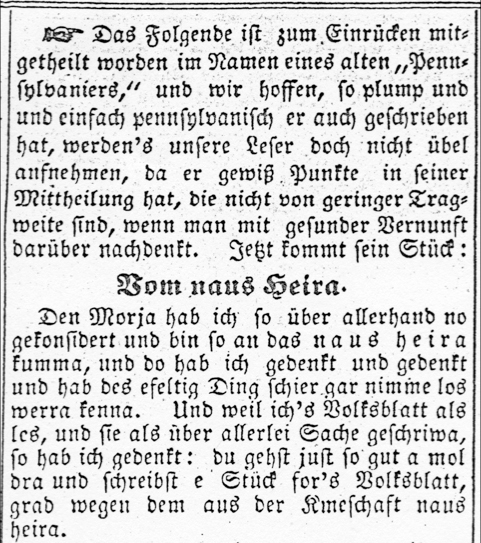
4-2_Oberholtzer_1862-(1)

“Vom naus Heira” by John H. Oberholtzer, from “Das Christliche Volks-Blatt,” April 2, 1862.

The roots of the Pennsylvania Dutch language extend back to the migration to Pennsylvania of around 81,000 German speakers from central and southwestern Germany, Alsace, and Switzerland during the eighteenth century.1 At that time, Germans and Swiss of all social classes spoke regional dialects that in most cases differed quite substantially from the emerging written dialect known today as “High German.” Since Pennsylvania Dutch strongly resembles the German varieties spoken in the region known as the Palatinate (Pfalz), we can presume that a critical mass of those 81,000 immigrants to colonial Pennsylvania came from that region.

Though we often have little precise information on where immigrants came from, we do have good information on the religious affiliations of the Pennsylvania Dutch founder population. The great majorityaround 95%were members of Lutheran and German Reformed churches. Only about 3,000 were associated with Anabaptist or Pietist groups, including Mennonites, Amish, and Brethren.2 The relations across denominational lines into the early nineteenth century were, however, sufficiently close that all varieties of Pennsylvania Dutch, those spoken by the “church people” (“Fancy Dutch,” i.e., Lutherans and Reformed) and those of the “plain people” have always been mutually intelligible with one another.

The maintenance of Pennsylvania Dutch as a vital language among church people and plain people alike has, since the eighteenth century, correlated with a number of important external characteristics. One important one is ruralness. Pennsylvania Dutch has always been a language of people who live outside of cities and towns in relatively ethnically homogeneous communities. Not surprisingly, as rural dwellers, active speakers of Pennsylvania Dutch traditionally pursued modest levels of formal education and earned their living mainly through agriculture, crafts, and other forms of manual labor. Moving off the farm, literally and figuratively, usually meant a shift away from Pennsylvania Dutch to speaking mostly or exclusively English.

Looking at today’s situation, Pennsylvania Dutch is now essentially only spoken by Amish and horse-and-buggy-driving Old Order Mennonites, who have very consciously maintained a lifestyle, grounded in their strong faith, that promotes the continued use of a distinctive language without special effort. In contrast, Pennsylvania Dutch has been moribund among the church people for at least two generations. The same is true for most Anabaptists who are less traditional than their Old Order brethren, including conservative groups who in some cases may still live in rural areas and limit their children’s formal education. Unlike the Old Orders, however, members of these conservative Mennonite communities, often pursue active mission work, which in their view makes more practical the use of English only.

At the center of my research program is documenting the history of Pennsylvania Dutch, which includes locating and interpreting texts that were written in the language. Already around the turn of the nineteenth century we find the first evidence of Pennsylvania Dutch, which were generally short texts that appeared in German-language newspapers serving rural southeastern Pennsylvania. Eventually, especially after the Civil War, Pennsylvania Dutch speakers began writing longer prose, poetic, and dramatic texts that gave rise to a body of folk literature that is a precious resource for students of American history and culture.

JH-Oberholtzer

John H. Oberholtzer

It is noteworthy that the vast majority of identified Pennsylvania Dutch writers were not affiliated with Anabaptist groups, the likely reason being the relatively small numbers of Mennonites and Amish in North America into the twentieth century. I have looked closely at two exceptional writers, both Mennonites who hailed from southeastern Pennsylvania, John H. Oberholtzer (1809–1895) and Samuel Ernst (1825–1909). Oberholtzer’s name is likely most familiar to readers of this blog, as he was a prominent figure in the progressive movement that eventually led to the founding of the General Conference of the Mennonite Church in North America in Iowa in 1860. Ernst was an “old” Mennonite from Lancaster County, Pennsylvania, who later moved to Kansas and edited what were likely the only trilingual periodicals of the time, newspapers that included material in German, English, and Pennsylvania Dutch.


In future posts I will share some of the Pennsylvania Dutch writings of Oberholtzer and Ernst, which have been untouched by scholars until now.


  1. Marianne Wokeck, Trade in Strangers: The Beginnings of Mass Migration to North America (University Park: Pennsylvania State University Press, 1999), 44–47. 
  2. Aaron Spencer Fogleman, Hopeful Journeys: German Immigration, Settlement, and Political Culture in Colonial America, 1717–1775 (Philadelphia: University of Pennsylvania Press), 102–103. 

Mennonite Environmental History

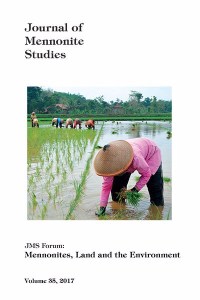
The term “Mennonite environmental history” yields only nine results when entered in a Google search. That is astounding, given the extent to which white Mennonites’ narratives of peoplehood are bound up with imagery of tilling and harvesting—as well as the degree to which Anabaptism and soil are linked in public imaginations. Recent New York Times articles featuring “Mennonite” in the title are exclusively devoted to issues of land, agriculture, and food: “Mennonite farmers prepare to leave Mexico,” “A Mennonite’s knack for fine goat cheese,” “Mennonite farmers struggle with water shortage,” and “Eat like a Mennonite.” While other reporting certainly focuses on topics from conscientious objection to sexual politics, surely no idea is more closely tied to popular North American perceptions of Anabaptism than the environment.image1-17

In this light, the latest issue of the Journal of Mennonite Studies is an important and long overdue milestone. The first full volume of scholarship devoted to Mennonite environmental history, this special issue brings together papers presented at a conference in Winnipeg, Manitoba last year on “Mennonites, Land and the Environment.” The conference was hosed by the Centre for Transnational Mennonite Studies as well as Royden Loewen, Chair in Mennonite Studies at the University of Winnipeg, who in 2005 published the first academic article on Mennonites and environmental history. As Loewen explains in his editor’s foreword, the nucleus of the recent conference—as well as the resulting volume—formed around a multi-year research project, “Seven Points on Earth,” which the Social Sciences and Humanities Research Council of Canada funded in order to enable study of the environmental history of Mennonite communities in Bolivia, Canada, Indonesia, the Netherlands, Russia, the United States, and Zimbabwe.

This essay aims to offer an interpretive and critical review of the articles collected in “Mennonites, Land and the Environment.” My intention is to illuminate what makes the volume’s contributions so interesting and refreshing to read, while also suggesting a number of possible future directions for the still fledgling field of Mennonite environmental history. To start with the obvious: this volume is a timely and much needed corrective to the surprising paucity of literature on Mennonites and the environment. In an era of rapid climate change, biodiversity loss, and growing resource scarcity, we should all be studying and acting on environmental issues. If ever there were a time for Anabaptist history, theology, and practice to join an urgent, planet-wide conversation, it is now.

The 2017 Journal of Mennonite Studies admirably addresses its topic from a global perspective. Arguably, Anabaptism has been a global movement from the beginning, shaped by the mobile, transnational forces of the Reformation and quickly exported to Eastern Europe, the far side of the Atlantic, and later to Asia, Africa, and Oceania. Since the twentieth century, the church’s demographic weight—like most Christian denominations—has shifted decidedly to the Global South, indicating that a historiography disproportionately focused on Europe and the Americas is now badly out of balance. Given the uneven degree to which Anabaptist historians have thus far told the story of the global church, the articles in “Mennonites, Land and the Environment,” offer varying degrees of nuance and innovation, depending on the geographic locations they cover. Taking the pieces more or less in chronological order, a few preliminary thoughts are as follows:

First, the section on the Netherlands provided fascinating insights into seventeenth and eighteenth century Dutch Mennonite rural transformation and visual art. Although the role of Mennonites in the Dutch Golden Age is comparatively well studied, it remains only poorly integrated into larger histories of Anabaptism. Generally, this period is portrayed as exceptional, having relatively little bearing on the more “typical” conservative white agrarian Mennonite communities in Russia and the Americas that were only at their nascent stage during this era. Second, in the section on Mennonites in North America, I appreciated the authors’ attention to changes within and challenges to agrarian lifestyles. These pieces do important work to contextualize narratives of land use rather than treating them as immemorial.

If one looks beyond the pale of Mennonite studies, the section on Imperial Russia and the Soviet Union seems perhaps the most historiographically important part of this volume. The Black Sea region appears, on the evidence presented here, to be one place where Mennonite agriculture made a truly substantial impact, contributing both to the construction of the Russian state and also to narratives of East European modernity. The authors portray Mennonites as an unusually useful group to study with relation to agronomy across the nineteenth and twentieth centuries, into the Soviet period and beyond. As revealed in the section on Bolivia, the hundreds of thousands of Low German-speaking Mennonites now living in Latin America are in many ways the most direct inheritors of this Russian tradition, so even the physical proximity of articles on these topics in one volume is revealing.

From a Mennonite studies standpoint, the sections on Indonesia and Zimbabwe cover the most important new ground. Anabaptist scholarship in North America generally and the Journal of Mennonite Studies in particular have tended—for both institutional and ideological reasons—to focus on white Mennonites with a general, sometimes latent, master narrative of migration from Europe, relative isolation and/or persecution, and perseverance through hard work, whether in the traditional patriarchal sense, or in an inverted way via the struggles of women and other underrepresented groups against the constraints of traditional authority. These articles challenge that master narrative in valuable ways: one essay on the environmental ethics of the nineteenth-century Javanese apostle Tunggul Wulung offers a non-European source of Anabaptist agency, as does another piece on pre-colonial environmental practices in southern Africa. To these might be added an earlier article on Mennonite-indigenous relations in Manitoba, which emphasizes the settler-colonial nature of white immigration, taking local Métis as an alternative narrative center of moral authority.

Where to go from here? “Mennonites, Land and the Environment” will not remain the only volume on Anabaptist environmental history for long, so it is worth considering the extent to which the 2017 issue of Journal of Mennonite Studies can and should stand as a touchstone at the birth of a field. First, I think some rather high-level theorizing might be in order for any future synthetic work on Mennonites and environment. Within North American Mennonite studies, Anabaptist history has been dominated by social and, more recently, cultural history. Those traditions remain dominant strands in this volume, with the tools of environmental history often present yet playing a secondary role. If one were to begin from an environmental history perspective, rather than simply adding in environmental analysis here and there, much of this volume would look different.

For example, there would have to be some serious assessment about whether and how Mennonites are important at all, were we to start with the premise of Alfred Crosby’s The Columbian Exchange, Carolyn Merchant’s The Death of Nature, or William Cronon’s Nature’s Metropolis, to name a few classic examples. I suspect an honest treatment of Anabaptism in environmental history might ultimately depict Mennonites as marginal figures operating within much larger trends: the formation of modern industrial economies, the trans-oceanic movements of seeds and animals, and the ongoing global transformation of agrarian landscapes. Mennonite actors retain an inordinate degree of narrative agency in the volume at hand. Noting some minor exceptions, such as in Tsarist Russia, I am not convinced—environmentally speaking—that they are deserving.

My second suggestion would be to take seriously the lessons of transnational history—which Royden Loewen and others have persuasively argued is uniquely suited to understanding the environmental context of at least some Mennonite communities. By contrast, most of the articles in “Mennonites, Land and the Environment” exhibit a more narrow community-centric model of narration, with the global Mennonite church divided up more or less by nationality like an enormous pie. The volume’s essay-collection format may overdetermine methodological nationalism, although some laudable examples of transnational scholarship are present here.

One meta question raised by a volume like this is, of course: why put these predominantly nationally-organized stories side by side in the first place? The basic assumption seems to be that Mennonites, globally considered, are worth studying together, including in the context of agriculture. On one hand, the point is to show diversity. Loewen notes in his foreword that “The [journal] issue makes no case for an ‘Anabaptist’ approach to the land,” and indeed, some of the articles’ primary conclusions are simply that agriculture as practiced by Mennonites in, say, the present-day Netherlands does not conform to traditional narratives of Anabaptist history and identity as recounted in North American academies.

But such disruptions are only interesting to a point. It would be valuable to consider how connected any of these case studies really are. Given that Mennonite historians have disproportionately emphasized agriculture as a through-line in their narrations of some groups’ movements across the Atlantic world—with sovereigns and migration agents emphasizing Mennonites’ alleged agrarian qualities along the way—we might follow how environmental thought and practice has mediated movements across and also within borders.

Finally, if future scholars of Mennonite environmental history choose to retain this volume’s global emphasis while also taking transnationalism seriously, I will be eager to see how they treat the Global South. From a Eurocentric or North-dominant view, the story would presumably be one of transmission through institutions (Loewen mentions Mennonite World Conference in his foreword) or individuals (missionaries figure prominently in the Indonesia and Zimbabwe sections). Alternatively, the tale might be one of failure by locals to develop Western Mennonite agrarian traditions, much as some early histories of missions narrated the disinclination of locals to wear bonnets and cape dresses. Both of these options are self-evidently problematic, however, since they presuppose the normality of Western institutions and perspectives, in turn raising the question of whether and how Mennonites studies departments and forums like the Journal of Mennonite Studies can create multi-centered approaches to Anabaptist scholarship.

Taken as a whole, this volume does not yet meet the challenge. Its starting premise is that Mennonite history should be studied from an environmental perspective; many of the individual articles subsequently justify this belief through reference to an Anabaptist agrarian tradition identified as unique and significant primarily in Western contexts. Thus, the final result sends an implied message to readers that Mennonites of color outside the industrialized West either deviate from or fail to live up to a “standard” white-ethnic Anabaptist model.

My critique is meant not to dissuade but to encourage widespread use and thoughtful engagement with this special issue of the Journal of Mennonite Studies. The many authors who have contributed to the volume have enriched our historiographical horizons invaluably, while also adding extensively to our knowledge regarding communities on five continents. “Mennonites, Land and the Environment” will be of great significance to anyone studying Anabaptism and environmental history over the coming years. It will certainly be a testament to this volume if the ideas and methodologies offered here undergo sustained testing and rigorous transformation in future works. Many more of us, after all, should be thinking critically and innovatively about our local communities and our planetary home, given the real environmental challenges ahead.

Ben Goossen is a global historian of religion and science at Harvard University. He is the author of Chosen Nation: Mennonites and Germany in a Global Era, published in 2017 by Princeton University Press.