Searching for Common Ground: Muslim-Mennonite Encounters

Image

In the last number of years, Mennonite churches and institutions in North America have paid particular attention to their relations with Muslims. They have sought to dispel suspicion and hostility between communities; terms like “friendship, hospitality, and dialogue” regularly accompany organized events that seek to create a common ground by emphasizing the values shared by Muslims and Christians. Rarely, however, do these events reach into the past to acknowledge the collective history of Muslims and Mennonites. In the Russian empire, these groups were neighbors: in Molochna, Crimea, Kuban, Terek, Ufa, Neu-Samara, Orenburg, Slavgorod, Pavlodar, and Aulia Ata, Mennonites settled next to established Muslim communities, who practiced a variety of nomadic, semi-nomadic, and settled lifestyles.1

—A Kumyk family (left) and a Russian Mennonite family (right)

The Russian empire expanded at the expense of Muslims on its periphery. This was particularly the case in the Caucasus. By the mid-nineteenth century, Russia’s military conquest had transformed the Caucasus “from a contested frontier zone into a borderland of the Russian empire.”2 The violence that secured Russian rule left an indelible mark on the region, which would haunt relations between the state and the indigenous peoples as well as influence the lives of settlers. In the Caucasus, the Russian state’s actions initiated a clash between a colonial Christian empire and a local population increasingly united by a shared Muslim identity. Even though the local population at the time was incredibly diverse and highly fragmented (as it remains today), the interpretation of Russia as a Christian empire aggressively and without mercy annexing territories lingered in the region, arguably influencing relations on the ground.3

Mennonites decided, in the early twentieth century, to move right into the heart of this maelstrom, purchasing 66,950 acres of land from Princes Aleksandr and Konstantin Lvov for nearly a million rubles. This land was located between the river Sulak in the south and the river Aktash in the north. A map showing the ethnicity of the population in 1913 confirms the isolation of Mennonites. Located in the far reaches of the Terek province, near the Caspian Sea, Mennonites established a small enclave surrounded by various groups of Sunni Muslims, such as the Nogai, the Kumyks, and a little further away, the Chechens. Mennonites, however, were not the only Christians in the Khasavyurt district, as other German and Russian settlers also established villages.4 As Terry Martin has noted, Mennonites debated the decision to purchase this land on the basis of economic and health concerns; it did not cross their minds that Mennonite properties and lives might be jeopardized by their neighbors.5 This showed, perhaps, a strong belief in their own resourcefulness, or maybe they sincerely believed that the Tsarist state could keep them safe: either way, they were mistaken. My grandmother, who was born in Khartsch (village #2), could vividly recall the day her family fled their home, as her mother carried loaves of raisin bread to the wagon in her apron. Through the eyes of a child, this was an adventure—to her mother, a stressful event, as she frantically packed her children and belongings. My grandmother’s family, as well as the majority of the Mennonite settlement, fled in beginning of 1918, as anarchy spread through the region with the collapse of authority after the overthrow of the Provisional Government by the Bolsheviks.

It is important to interpret Muslim-Mennonite interactions through the lens of settler colonialism to show how the structure of settlement benefited Mennonites at the expense of the local population. It is equally as important to focus on the ways in which both Mennonites and Muslims participated in and instigated violence against each other, as they asserted control over land and property. In case of the Mennonites, this violence, at least initially, was performed by others on their behalf; however, as raids on their villages intensified,  some Mennonites chose to participate directly. As Martin notes, the Terek settlement foreshadowed the difficult choice that Mennonites would soon face in Ukraine: fight or submit humbly to the violence.6 In the Terek, they chose to both fight and flee.

Yet this is not the full story. Amid this chaos, there were moments when the values of friendship, hospitality, and dialogue joined Mennonites with their Muslim neighbors. As the raids on Mennonite villages intensified during 1918, Mennonites not only prayed for God’s mercy, they also approached some of their Muslim neighbors (the Kumyks) living in the villages of Kazi-Yurt and Kostek for help. The Kumyks sent representatives to a meeting held at the Mennonite Brethren Church in the village of Talma (village #3) to discuss the situation. They brought a detachment of the militia, which travelled to the neighbouring Nogai and Taulin villages to confiscate goods stolen from the Mennonites.7 These militiamen were then billeted in Mennonite villages overnight. When it became apparent that the settlement could not be saved, Mennonites fled to Kazi-Yurt and Kostek where they were welcomed by the local population and extended significant hospitality.8 Those who could not make it to these villages were helped by Muslim acquaintances to safety through alternative routes.9

These short vignettes are only snippets of a complicated story that has yet to be fully told. Despite the fact that this help saved Mennonite lives, Mennonites felt betrayed as their protectors asked for compensation. While I have no evidence, I’m sure that Muslims felt shocked by the ingratitude of Mennonites, who appeared to place the same value on their property as they did on their lives. Nonetheless, the example of the Terek settlement shows that even amidst violence, anarchy, and competing interests Mennonites relied on and benefitted from the kindness of their Muslim neighbors.


  1.  For more on this issue, see my article in the 2016 issue of Preservings. 
  2.  Michael Khodarkovsky, Bitter Choices Loyalty and Betrayal in the Russian Conquest of the North Caucasus (Ithaca: Cornell University Press, 2011), 10. 
  3.  Ibid., 17. 
  4.  Arthur Tsutsiev, Atlas of the Ethno-Political History of the Caucasus, trans. Nora Seligman Favorov (New Haven: Yale University Press, 2014), 56. 
  5.  Terry Martin, “The Terekers’ Dilemma: A Prelude to the Selbstschutz,” Mennonite Historian XVII, no. 4 (1991): 1. 
  6.  Ibid., 2. 
  7.  C. P. Toews, The Terek Settlement: Mennonite Colony in the Caucasus, Origion [Sic], Growth and Abandonment, 1901-1918, 1925 Memoirs, trans. Isaac A Dyck (Yarrow: Columbia Press, 1972), 54–55. 
  8.  Ibid., 57. 
  9.  Ibid., 59. 

Oral History for the “Quiet in the Land”

Janneken Smucker

I’ve read with interest the posts here from my colleagues  Ben Goossen on Digital History and Ted Maust on Public History, topics very near and dear to me in both my scholarship and teaching. Ben outlines some of the facets of digital history, particularly how digital technologies can provide increased access to historical sources. Ted considers what public history—historical interpretation that in some way engages with the general public rather than to fellow academic historians—can do and has done for Anabaptists. I’d like to draw on these threads by exploring the role of oral history, and how oral history poses particular opportunities and challenges for those of us conducting history among Anabaptist groups.

Much of my scholarly energy in recent years has involved oral history in one capacity or another. As a young historian working on contemporary history topics from the 1970s and ‘80s, it was a natural fit. Interviews with living subjects served as excellent primary sources for my senior seminar paper at Goshen College, about the origins of the Women’s Studies program at GC. When I began studying quilts from an academic perspective, my first paper was based on an oral history interview I conducted with my elderly grandmother about the quilts she and her Amish-Mennonite peers made as young women in the 1920s in eastern Ohio. I now regularly teach with oral history, working with my students to create digital public history projects, interpreting and providing access to archival oral history interviews, by building classroom/archive partnerships that take advantage of open source technologies.

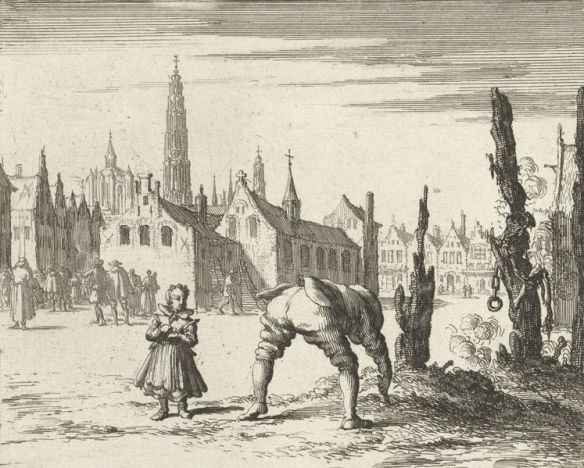
Members of the Anabaptist faith have long valued oral tradition, as the stories from our ancestors have been a source of faith. So-called ethnic Mennonites remember the challenges of our forebearers as stories and folklore are passed down from one generation to the next. Perhaps Martyrs’ Mirror, with its tales of courage and conviction, is the ultimate collection of Anabaptist oral tradition. Books like Martyrs Mirror, Amish Roots, and MennoFolk: Mennonite and Amish Folk Traditions collect and interpret some oral accounts that have resonance to many members of the Anabaptist tradition.1

tonguescrew

Sons of Maeyken Wens search for the tongue screw used to silence her among her ashes, Antwerp, 1573. Engraving by Jan Luiken in Martyrs Mirror, v. 2, p. 661 of Dutch edition. Source: Rijksmuseum via GAMEO

But oral history itself is a historical method distinct from oral tradition. Oral history really only became possible in our current understanding of the term with the availability of audio recording technologies, which enabled the interview—the dialogue between the interviewer and narrator—to become permanently fixed as a primary source. One of the most straightforward definitions of oral history comes from Donald Ritchie: “An oral history interview generally consists of a well-prepared interviewer questioning an interviewee and recording their exchange in audio or video format.  Recordings of the interview are transcribed, summarized, or indexed and then placed in a library or archives.”2

My brief search for Mennonite (the wing of Anabaptism I most closely identify with) oral histories turned up archived collections of interviews (among others) with Russian Mennonite immigrants, World War I conscientious objectors (with digitized audio!), Mennonite women from Manitoba discussing their childbirth experiences, and video interviews collected by the Brethren Mennonite Council for Lesbian, Gay, Bisexual and Transgender Interests. Perhaps not surprisingly, the majority of the oral history collections I discovered are from Canadian organizations or are interviews conducted with individuals from Russian-Mennonite backgrounds. At the risk of overgeneralizing, I surmise that Amish and “Old Mennonites”—the really quiet of the land—have been less keen on recording oral histories. Maybe individual life stories have seemed not to reflect the humility for which these groups have historically striven, or members of these less worldly affiliations have been reluctant to record their stories using modern technologies for the permanent record. In my own research, I’ve encountered this. What if the narrator is from a plain community and does not feel comfortable with the research, the technology, the release forms, or the archive? Can we still do oral history?

Two current tenets of oral history which squarely place this methodology in relationship with public history are “informed consent” and “shared authority.” By informed consent, oral historians mean that the interviewee/narrator has a full understanding of the purpose and potential uses of the interview. They should understand that they are “on the record” while being able to restrict aspects of their interview for future use if necessary. Typically, this is handled through a release form granting the interviewer permission to record, use, and/or archive the interview. Historian Michael Frisch popularized the term “shared authority” in relationship to oral and public history, suggesting that historians are not the sole arbiters of historical interpretation, but instead share that authority with those from the public with whom we dialogue and engage—especially those sharing their testimony through oral history interviews.3

Amish Country Quilts

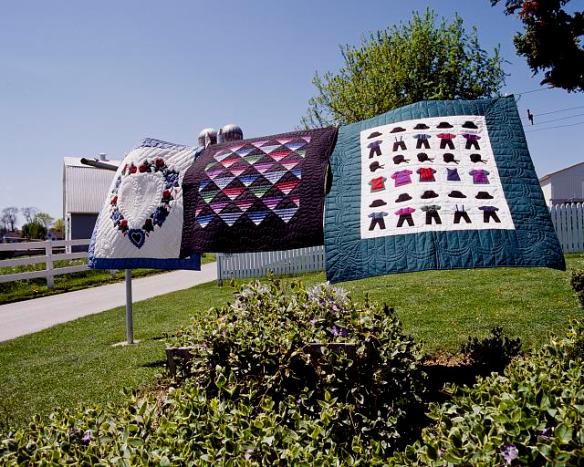
Carol Highsmith, Amish Country Quilts, c. 1990. Photographs in the Carol M. Highsmith Archive, Library of Congress, Prints and Photographs Division.

When I was conducting fieldwork among Amish quilt entrepreneurs, I was hesitant to pull out legal forms for these women to sign, let along my fancy little digital audio recorder. Although I strived to make these informants feel comfortable speaking with me, I don’t think I did particularly well with “informed consent” guideline. I typically told the proprietor of a shop I was a student studying quilts (true, even though I was a PhD student, who hoped to eventually translate my research into a book) and asked if I could ask her a few questions. These women (and the occasional man) were usually quite willing to talk. They were accustomed to tourists asking lots of questions about quilts, and they typically had an almost scripted answer to my questions about how the design, production, and sale of quilts functioned. I did not quote these informants directly in my text, since I did not record the conversations, although their responses certainly served as evidence that informed my interpretation of the subject. In the endnotes to my book, I refer to these non-interviews as “conversations” rather than as “interviews.”4

In 2003, when Emma Witmer, the Old Order Mennonite proprietor of the longest operating quilt shop in Lancaster County, agreed to give an interview for Q.S.O.S. – Quilters Save Our Stories, an oral history project of the non-profit Quilt Alliance, she declined to be recorded or have her photograph taken. But she agreed to tell her story, presumably feeling informed and giving consent, as she signed a release form. Interviewer Heather Gibson took notes rather than record the audio, and the online “transcript” begins with the disclaimer: “notes from the interviewer—Emma Witmer is an Old Order Mennonite. The interview was recorded on pencil and paper at Emma Witmer’s request. Portions of the interview that were not recorded verbatim are noted in brackets. There are no photographs.” With this note, can we even consider this interview as “oral history,” at least based on Ritchie’s definition that an oral history must be recorded in audio or video? I drew on this interview extensively in my research on the origins of the quilt industry in Lancaster County, but is this as reliable of a source as I think it is since it is based on notes, which ultimately are an interpretation of the interview rather than the verbatim interview itself? Is it more or less reliable than the “conversations” I had with other shop owners?5

In contrast, one particular Amish informant was quite willing to go on the record, signing the forms and having his voice recorded. He knew I was writing about his father, an Amish businessman who bought quilts from his co-religionists and sold them to New York quilt dealers. He was the expert. I was the student. Here I think I came close to achieving the elusive “shared authority,” with his interview completely transforming my understanding of the relationship of Amish individuals to the market for quilts. When I wrote articles drawing on what I learned from him, I sent him drafts, and he gave me feedback. I even invited him to attend my dissertation defense, where he engaged in the discussion along with my committee members (he continues to relish telling people about that momentous event).

Excerpt from interview with Benuel Riehl, conducted by Janneken Smucker, May 13, 2008.

Throughout my career as a historian, I am continually reminded of the power of the first hand accounts gained through oral history. But I worry about what interviews we might never have the opportunity to record because of the challenges of conducting interviews with some Anabaptist groups. I also fear for the collections of interviews that have been recorded—like the ones with Mennonite women about childbirth—but remain inaccessible, on analog cassette tapes in faraway archives. Too often oral history projects result in amazing resources that are virtually undiscoverable, although new technologies have made it increasingly affordable and possible to provide access. And most importantly, we need to find ways to ensure that we as historians freely share our authority with our publics, listening not only as a way to elicit details of the past, but also as a way to check our perceived expertise as historians.


  1.  Thieleman J. van Braght, I. Daniel Rupp, and Thieleman J. van Braght, The Bloody Theatre, or Martyrs’ Mirror, of the Defenceless Christians: Who Suffered and Were Put to Death for the Testimony of Jesus, Their Savior, from the Time of Christ until the Year A.D. 1660 (Near Lampeter Square, Lancaster Co., Pa.: David Miller, 1837); John A Hostetler, Amish Roots: A Treasury of History, Wisdom, and Lore (Baltimore: Johns Hopkins University Press, 1989); Ervin Beck, MennoFolk: Mennonite and Amish Folk Traditions (Scottdale, Pa.: Herald Press, 2004). 
  2. Donald A. Ritchie, Doing Oral History, 3rd edition (New York, NY: Oxford University Press, 2014), 1. 
  3.  Michael H Frisch, A Shared Authority: Essays on the Craft and Meaning of Oral and Public History (Albany: State University of New York Press, 1990); Michael Frisch, “From A Shared Authority to the Digital Kitchen, and Back,” in Letting Go?: Sharing Historical Authority in a User-Generated World, ed. Bill Adair, Benjamin Filene, and Laura Koloski (Philadelphia, Pa.; Walnut Creek: Pew Center for Arts & Heritage ; Distributed by Left Coast Press, 2011). 
  4.  See Janneken Smucker, Amish Quilts: Crafting an American Icon (Baltimore, Md.: Johns Hopkins University Press, 2013). 
  5.  Emma Witmer, interview by Heather Gibson, October 20, 2003, Quilt Alliance, Quilters’ S.O.S.—Save Our Stories, Library of Congress, American Folklife Center, http://quiltalliance.org/portfolio/qsos-emma-witmer/

Hazel’s People

Felipe Hinojosa

hazels-peopleIn 1973 the motion picture Hazel’s People, an adaptation of Merle Good’s novel, Happy as the Grass Was Green, became one of the first mainstream films to depict Mennonite life in rural Lancaster, Pennsylvania. It was also the first Mennonite-made feature film. The film followed a young “hippie” named Eric from New York City who came to Lancaster for the funeral of his close Mennonite friend, John. After the funeral, Eric decides to stay in Lancaster, and forms a close relationship with the simple and quiet Mennonites portrayed in the film. But his growing admiration is tempered when he begins working for a prominent Mennonite fruit grower in the area. The grower, who in the film goes by “Rufus,” is cast as a pious businessman who has abandoned many of the traditional values that Eric has come to admire about the Mennonites.
Soon after he is hired, Eric discovers that his new boss is housing Puerto Rican farmworkers in small shacks with no heat and charging them rent at forty dollars a month. Outraged, Eric confronts Rufus’ assistant, Stanley, demanding to know “what those people are doing out in those sheds… it’s thirty-five degrees outside!” Stanley, trying to calm Eric down, discloses that “Puerto Ricans used to give us a lot of trouble drinking and that sort of stuff . . . last summer Rufus got a hold of a Spanish speaking evangelist and since then we’ve hardly had any trouble.”1 When Eric shares what he saw with a Mennonite minister and close friend named Eli, his only response is “You expect too much from us, Eric . . . we disappoint you.” A few scenes later, Eric delivers a fiery sermon at the Mennonite church where Rufus attends, challenging churchgoers to stop building cages, “no more Mennonite cages… no more Puerto Rican cages!”

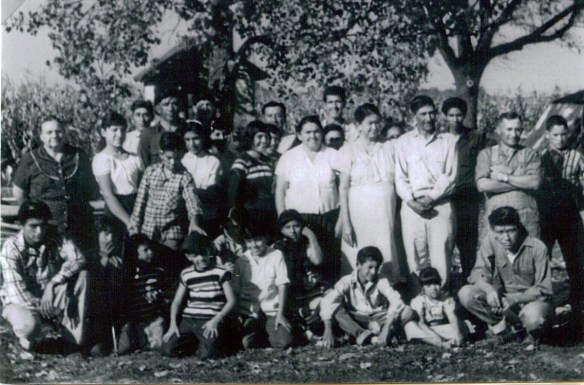
Have you seen this film? You should. Of course, the film is full of problems. It perpetuates the white savior myth and there are few, if any, Latinas/os in the film. To be fair, the film is not only about the poor labor practices of Mennonite farmers. It’s also about the flaws and the beauty of one Mennonite community in Pennsylvania. But ask Latina/o Mennonite leaders from the 1970s and they will remember Hazel’s People as a film about Mennonite farmers and their mistreatment of Puerto Rican farmworkers. Many Latino/as, including members of my own family, experienced similar conditions while working on Mennonite farms across the Midwest.

tijerina-family-oh

The Tijerina family (author’s family) with the Mennonite family on whose farm they worked, Archbold, Ohio (circa late 1950s)

But the film also came eerily close to portraying a real life case in Goshen, Indiana. In 1969  Rudolfo Blanco, a migrant farm worker, committed suicide at the Pine Manor Turkey processing plant in Goshen, Indiana. The tragedy of Blanco’s suicide exposed the dreadful working and living conditions that many Mexican American farmworkers experienced at the Pine Manor Turkey processing plant. Owned by Mennonite businessman, Annas Miller, Pine Manor regularly attracted Mexican Americans from South Texas to work in its plant. Blanco’s suicide, however, brought to light the negligence of Pine Manor’s management with regards to the living conditions of workers at the plant. Goshen News reporter Don Klassen described the living conditions at Pine Manor as “a brooder house or a tar-paper shack hidden behind tall corn or over the hill, or a room ten by twenty with two or three beds where three to five children sleep in the same bed.”2 To make matters worse, a large open cesspool was within a few feet of the living quarters and created an “unbelievable stench” for the workers and their families living nearby.3

Local church groups in the area initiated a boycott of Pine Manor products in 1969 as the plight of migrant farmworkers in northwestern Indiana, most of whom were from Texas, took center stage for many progressive religious groups. Since at least the late 1950s, Mexican American families had been making the trip north to Indiana to work in the fields and processing plants like Pine Manor. Migrant workers were often recruited to work in the tomato cannery in Milford and the tomato fields in southern Elkhart and northern Kosciusko Counties in northwestern Indiana. In 1970 the annual report on farm labor in Indiana also counted several hundred Puerto Rican migrants from Florida who joined Mexican American workers in the fields and in the turkey processing plants. Working and living conditions for migrant farm workers in northwestern Indiana were so bad that one migrant commented how “from Utah to Wyoming, and Idaho to Kentucky, Virginia, and Alabama, THIS is the worst place… I’m sick of it here—I’ll never come back!”4

The concerns that were raised over how Mennonite farmers treated their workers emerged right at the time when Latina/os took more leadership roles throughout the church. In 1971, the Minority Ministries Council (MMC) hired Lupe De León, Jr., to work as an Associate Secretary in partnership with John Powell. De León, who grew up as a migrant farmworker in the cotton fields of West Texas, immediately raised important questions about the negligence of some Mennonite business owners. De León and other Latino leaders led the charge to get official support from Mennonite church leaders for the lettuce and grape boycotts led by Cesar Chavez and the United Farm Worker movement. Like Eric in Hazel’s People, Latina/o leaders expected white Mennonites to share in their outrage and openly support the farmworker movement. Sadly, white Mennonite leadership—from MCC to Mennonite Brethren, Old Mennonite, and General Conference leaders—refused to give official support to what became the most successful agricultural rights movement in U.S. history.5 Instead what did happen was that migrant farmworkers like the ones depicted in Hazel’s People found their greatest support from Mennonites in the pews—White, Black, and Brown—ordinary folks who marched, boycotted, stood on the picket lines, and encouraged people to only buy union lettuce and union grapes. These politics, the ones where the people in the pews and the outsiders are leading the charge, make the message of Hazel’s People so relevant for us today. But I also think the film does more than remind us about the importance of grassroots politics.

In my first post, I argued for the deterritorialization of Mennonite studies by moving beyond the familiar geographical spaces that have come to define the Mennonite experience in the United States. But as several of my colleagues have rightly noted in their own posts, much work remains to be done in those familiar spaces. In other words, even as we move out of the familiar and expand the geographic and ethnoracial limits of Mennonite studies, we must also look inward and reimagine the familiar. The notion that we must expand Mennonite studies does not suggest a complete abandonment of the ethno-Mennonite story, but instead a deeper investigation of it. As Hildi Froese Tiessen argued in the book, After Identity: Mennonite Writing in North America, the issue here is “not to abandon identity issues in Mennonite [life] altogether but to probe them more vigorously.”6 Hazel’s People does that by portraying Mennonite piety, even as it calls out the aloofness of Mennonites whose peace theology remained silent on labor injustice. Expanding the contours of Mennonite studies will require us to explore multiple forms of evidence from film, music, architecture, and especially the familiar areas that are today being changed by the demographic revolution currently underway in places like Lancaster, Pennsylvania, and Goshen, Indiana, where the Latino population has been the engine of demographic growth. My hope as a historian is that as we probe Mennonite life and identity more deeply—as we reimagine the familiar—that we also take a stand like Eric’s character did in Hazel’s People and call ourselves out of those Mennonite cages that have kept us from imagining a new and vibrant future for Mennonite studies.


  1. Charles Davis, Hazel’s People, 1973. 
  2. Don Klassen, “Plea for Migrants,” The Goshen News, 14 November 1969. 
  3. Ken Washington, “Protesters to Boycott Pine Manor Products,” The Goshen News, 19 November 1969. 
  4. Quoted in Ben Noll, “A Community of Brotherhood,” unpublished paper, Goshen College, 2009, 4-5, Goshen College, IN. 
  5. For more on this, see my book: Felipe Hinojosa, Latino Mennonites: Civil Rights, Faith, and Evangelical Culture (Baltimore: Johns Hopkins University Press, 2014). 
  6. Hildi Froese Tiessen, After Identity: Mennonite Writing in North America (Penn State University Press), 212. 

Digital History: The German Mennonite Sources Database

By Ben Goossen

What does it mean to bring the “Anabaptist past into a digital century”? The subtitle of this blog includes a playful reference to the anti-modernist stance of many Amish, Mennonites, Hutterites, and other so-called Plain Peoples—as well as an acknowledgement of the widely-held stereotype that Anabaptists do not use technology or engage the modern world. On one hand, the mission of Anabaptist Historians parallels that of any historical organization, namely to uncover, interpret, and make accessible the records of bygone eras for twenty-first century audiences. Yet for scholars of Anabaptism, this task holds unique challenges as well as opportunities.

image001

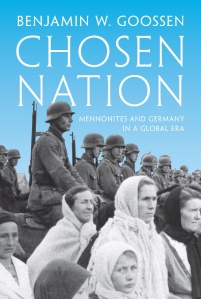
Documents in the German Mennonite Sources Database were collected during the research for Chosen Nation: Mennonites and Germany in a Global Era (Princeton University Press, 2017)

“Digital History” is a practice that, over the past several years, has increasingly shaped the historical profession. In a narrow sense, Digital History refers to projects that primarily use digital tools to tell historical stories, such as animated maps, YouTube documentaries, or interactive wikis. Anabaptist-related efforts such as the extensive Global Anabaptist Mennonite Encyclopedia Online (GAMEO) or the Bearing Witness website, designed to collect stories of persecuted Anabaptists from around the world, fit this definition. At an even broader level, nearly all history done today is “digital” in some way. It is hard to imagine writing an article or reviewing a book without opening Google, consulting an online repository like JSTOR, or downloading an open-access journal. Sending emails, maintaining websites, and using search engines are all part of Digital History.

Some Anabaptist groups are today among the only populations that write history without digital tools. In the summer of 2016, when the Anabaptist Historians Editorial Board was starting this blog, one tough question was how to include conservative Amish and other historians who do not use the internet. Is it possible to represent the full spectrum of Anabaptist pasts and identities in a digital format? Or does the very nature of a blog preclude the participation and accurate representation of some groups? We tried to create a website defined by simplicity – a value with cachet in Anabaptist households and Silicon Valley alike – yet reaching conservative populations remains difficult. When communicating with one historian in the Weaverland Conference, for example, I copy and paste web text into my messages or send screenshots as attachments, since he uses email but no internet browsers.

In other circumstances, Anabaptist history can feel tailor-made for digital approaches. With a relatively small population – around two million members are active worldwide – major digital projects are more feasible than they would be for larger demographics. Anabaptism, as a religious movement, is also blessed with substantial institutional resources, including church libraries, denominational archives, and nongovernmental organizations. Many have already undertaken Digital History initiatives. And joining these is a vast webscape of informal Twitter feeds, Facebook pages, chat room support groups, and genealogical sites. Previous posts on this blog have begun a fascinating dialogue about the places where Anabaptist history happens, including discussions of the value of borderland perspectives, centralized archives, and public history. How can we think about cyberspace as a location of and platform for historical work?

Over the past seven years, I have been working on a large-scale digitization project, the German Mennonite Sources Database. Released in October and hosted online by the Mennonite Library and Archives in North Newton, Kansas, this is the largest digital repository of books and newspapers by or about Mennonites in Germany as well as one of the most complete collections on this subject anywhere in the world. The database spans the years 1800 to 1950 and includes approximately 100,000 pages of text, including thousands of books, pamphlets, newsletters, and articles. Its purpose is to make historical resources available to anyone who reads German and is interested in religious history. Readers will find documents pertaining to virtually every aspect of German Mennonite life, ranging from sermons and catechisms to texts on nonresistance, the draft, and Nazism. Some topics are expected, such as hymn selections and condemnations of oath swearing. Others less so – like an 1859 rumination on vampires in the world’s first journal of folklore.

The German Mennonite Sources Database began as a personal resource, growing out of research conducted for my book, Chosen Nation: Mennonites and Germany in a Global Era, forthcoming in 2017 from Princeton University Press. As a history of Mennonites’ worldwide entanglement with German nationalism during the nineteenth and twentieth centuries, Chosen Nation required familiarity with a wide spectrum of issues, from congregational and institutional life to historical, educational, and mission activities, involvement in war and political movements, peace declarations, gender, genocide, and anti-Semitism. In archives across Europe and the Americas, I found myself digitizing dozens or sometimes hundreds of documents a day. The essential tools of the Digital Historian include a computer, cell phone, digital camera, and a bevy of cords, adapters, and USB sticks. My archival desks unfailingly resembled a crow’s nest of snaking wires and metallic boxes.

A major advantage of Digital History is its ability to make scarce resources widely available. Documents that might exist only in one or two places in the world become accessible to anyone with a modem. This has a democratizing effect, since travel to distant libraries or archives usually requires deep pockets or university support, while digital files can be downloaded from the comfort of home. With Optical Character Recognition (OCR) software and online translation services (some of which now use artificial intelligence), texts in German or other languages can be rendered quickly and with stunning accuracy into English. Still another advantage is that different researchers bring diverse perspectives to the same sources. Documents in the German Mennonite Sources Database, for instance, might find wide interest beyond my initial purposes – hopefully providing a basis for articles, dissertations, scholarly debates, and family research.

warning-and-suggestions

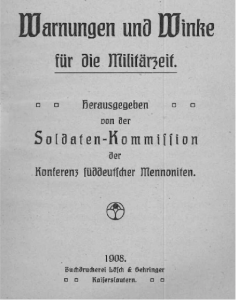
Warnings and Suggestions for Military Service, a handbook for Mennonite soldiers, is one of thousands of books, pamphlets, and articles now available via the German Mennonite Sources Database

Not all history is digital, of course, and not all Digital History is good. While open-access sites like the German Mennonite Sources Database are available to all, many research venues like Ancestry.com or HeinOnline lock material that would be provided for free in physical libraries behind digital paywalls. In this age of uneven globalization, the web remains only partially worldwide, with internet unavailable to the earth’s most disadvantaged populations – those lacking power in both senses of the word. As Anabaptists, we are also attuned to the spiritual politics of the internet. Is it possible to use digital tools in ways that are constructive rather than damaging, uniting rather than alienating? Such questions resonate with current public debates about internet bullying, cyberterrorism, and fake news. Some plain Anabaptists find a solution in eschewing digital resources altogether.

Our challenge then, as Anabaptist historians, is to consider not only how to engage Digital History, but also how to do so responsibly. Can we find ways of digitizing library holdings that also increase donations and visits to physical locations? Can we build integrated networks to share data and exchange ideas without losing sight of the distinctive needs and identities within the Anabaptist church family? Perhaps we could take cues from the wonderful work already undertaken by friends and colleagues – such as the open access website of Anabaptist Witness, the database of Anabaptist-related websites hosted by Mennonite Church USA, or the breathtaking Mennonite Archival Image Database. The tools offered by Digital History are like any new resource. They invite us to explore and affirm their limitations, while also finding fresh ways of working together.

You can access the German Mennonite Sources Database here.

Thanks to John Thiesen and the Mennonite Library and Archives for hosting the German Mennonite Sources Database, as well as to Rosalind Andreas, Kevin Enns-Rempel, Rachel Waltner Goossen, Royden Loewen, Titus Peachey, John Roth, Astrid von Schlachta, and Paul Toews for their support.