Soybeans and Milk: Community and Commodification in a Bolivian Mennonite Colony

Since 2013, seven researchers have been investigating Mennonite agricultural practice in farming communities around the globe as part of Royden Loewen’s “7 Points on Earth Project.”  We first met in Amsterdam in December of that year to discuss the logistics of conducting oral histories in small farming communities and to introduce one another to our research sites.  These extended from regions traditionally associated with the Mennonite faith and farming, including nearby Friesland, the U.S. and Canadian prairies, and Russia, to less well known Mennonite communities in Bolivia, Indonesia, and Zimbabwe.  Leaving Amsterdam, we scattered to our seven points.  I spent five months in mid-2014 and one month in the spring of 2015 in the Department of Santa Cruz in the tropical eastern lowlands of Bolivia traveling muddy colony roads by bicycle as I conducted interviews with Mennonites farmers.

Street Scene in Riva Palacio

On October 28-29 we will be reconvening in Winnipeg to discuss our findings as part of a public conference on “Mennonites, Land, and the Environment.”  For those that may not be able to attend the conference I offer here a brief portrait of Mennonite history and farming in one of those Seven Points on Earth.

While Mennonites migrated to Bolivia from Canada, Paraguay and Belize, the majority were horse-and-buggy “Old Colony” Mennonites from Northern Mexico who began to settle in the department of Santa Cruz in 1967.  Their migration offers observers a compelling paradox.  On the one hand, they were part of a religious pilgrimage to maintain traditional ways they saw as under threat in modernizing North American Mennonite colonies.  On the other hand, they successfully presented themselves to the Bolivian government as modern farmers, capable of transforming the densely forested landscape of lowland Bolivia into a series of productive agricultural colonies.

As Mexican Mennonites approach their fifty year anniversary in Bolivia and the country’s Mennonite population nears 100,000, that duality remains as apparent as ever.  Old Colonists, most of whom continue to use horse-and-buggies on the roads and lumbering steel-wheeled tractors in the fields, might appear to live traditional, isolated lives.  Yet they are also key producers for a regional economy that has emerged as one of Bolivia’s largest and most dynamic.  They farm over a third of Bolivia’s soybeans, the country’s star agricultural crop, with a harvest in 2015 of over two million metric tons and an export value of one billion U.S. dollars.  As soy farmers they are at the center of a broad swath of South America – including portions of Brazil, Paraguay and Argentina – that now produces the majority of the world’s soy.
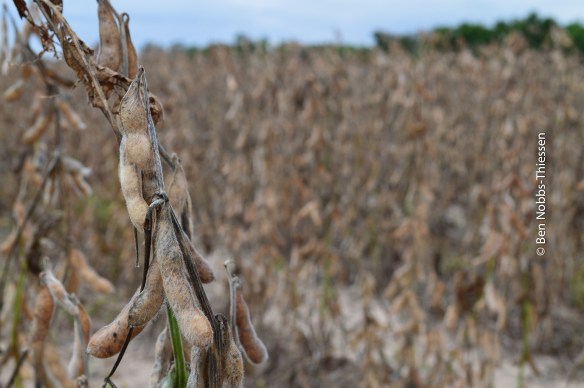
A field of soybeans in Riva Palacio colony

Even as Mennonites generate this high-value, export-oriented commodity that depends on intense mechanization, nearly every farmer in Riva Palacio, Bolivia’s largest Mennonite colony and my primary research site, rises early in the morning to milk their herd of dairy cattle by hand.  Buckets clang and wooden stools are set down as the entire family – men, women and children – take part in this laborious daily activity which will be repeated again in the early evening.  By the time the last cow is milked the sun is usually rising and one member of the family pushes a cart laden with brimming metal jugs out to the corner to wait for the milk-men that travel through the village by horse cart.

Milk awaiting pickup at the entrance to a Mennonite homestead

The practice is both intimate and, for scholars of Old Colony Mennonites, historical in nature.  While Mexican Mennonites had never produced soybeans before arriving in Bolivia, they successfully transplanted a dairy industry from Chihuahua to Santa Cruz.  Farmer Enrique Siemens still remembers the first year in Bolivia when as a young boy he drank powdered milk because there were no dairy cattle to be had in local markets.  In 1969, his father traveled with a friend to neighboring Paraguay to bring back the colony’s first Holstein cattle – a journey of forty days.  “When I arrived back at home [from school] the cow was already there,” he exclaims, “and oh[!] after that we were happy, then we had milk.”
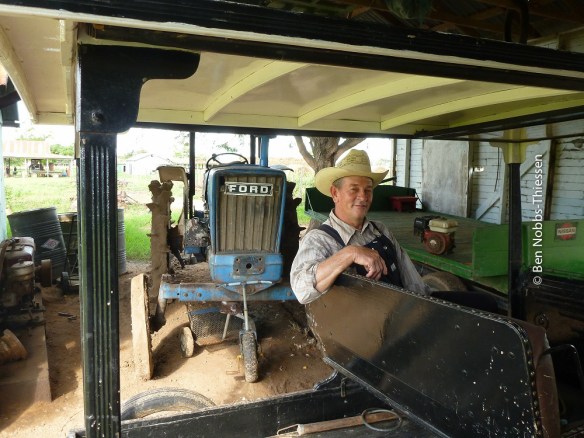
Enrique Siemens sits in his buggy during an interview with the author

What to make of this dual – and diametrically opposed – agrarian economy?  The respective meanings attached to cash cropping and dairy farming in Bolivian Mennonite colonies form a central aspect of my research.  Linked with nourishment and happiness in Siemens’ memories, daily family milk production seems to stand in opposition to the capital-intensive cash-cropping of export commodities like soybeans.  Indeed, even the income earned from the two activities is treated in different ways.  Harvest money might be invested in new land and machinery to expand one’s operations.  Milk money, by contrast, provides regular access to goods on credit at the colony’s small stores – particularly critical in drought years when the harvest might fail altogether.

An example of this form of accounting can be seen below for David Unger, a farmer in a nearby Paraguayan Mennonite colony.  For each two week period, daily milk production (morning and evening) is divided into that which was of a quality to be sold as milk and that which, due to its higher bacterial content, is only suitable for making cheese.  From those two balances Unger’s purchases at the colony store over the same period are deducted and the balance is passed on to him.

image-5

Jakob Unger’s biweekly balance sheet, Canadiense Colony

Yet, the intimate snapshot of daily milking can be deceptive.  Dairy, a fringe industry when Mennonites arrived in Santa Cruz, is now, like soybeans, big business.  It is no coincidence that both the milk and the soy produced in Mennonite colonies find their way to Santa Cruz’s sprawling industrial park.  There, across the highway from one another sit IOL Aceite, the largest oil-seed production plant in Bolivia and PIL Andina, the country’s sole major dairy distributor.

IOL has been encouraging Mennonite soy production with seed and credit since the mid-seventies.  In contrast, PIL only began to install collection centers on the edge of most major colonies in 2000.  This has led to changes for the company and for colonists.  Mennonites once processed all of their milk as cheese to be sold in the streets of Santa Cruz.  Farmer Cornelio Peters remembers that “before, the milk was worthless…there was too much [cheese] with all the Mennonites here in Bolivia.”

The arrangement between PIL and the Mennonites appears mutually beneficial.  The presence of the company has meant price stability for Mennonites, while the increased milk supply has also enabled PIL to double its production.  Riva Palacio alone produces approximately 100,000 liters of milk a day. On a tour of the installation in 2014, the operations manager explained that approximately four-fifths of their daily capacity of 500,000 liters came from Santa Cruz’s Mennonite colonies.

As Mennonites moved from independent producers of cheese – which everyone in Bolivia knows as “queso menonita” – to suppliers of a primary input for a large corporation, the potential for tension also exists.

Mennonite cheese (“queso menonita”) for sale in a La Paz grocery store

When I returned to Santa Cruz in 2015 I found Riva Palacio colony up-in-arms.  While PIL had been paying 2 Bolivianos and 30 centavos per liter for their milk, they had recently discovered that the minimum price to be paid to producers – by national decree – was three Bolivianos and fifty centavos.  A hastily formed “Mennonite Federation of Milk Producers” – representing 3000 families – was calling emergency cross-colony meetings, contracting lawyers, and petitioning PIL, the president of Bolivia, Congress and the Senate to demand “a fair price for Mennonite milk.”
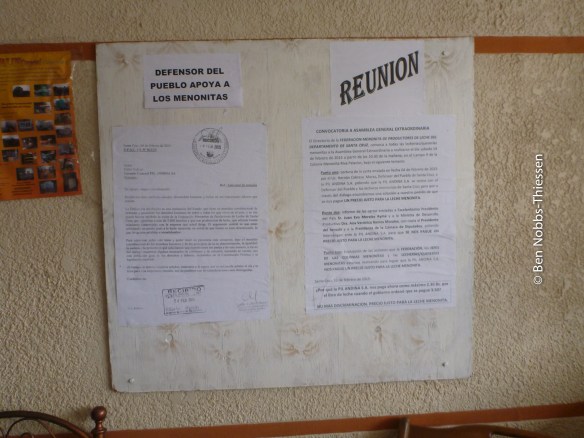
Letter from Ombudsman to PIL administration on behalf of Mennonites posted alongside a call for an Extraordinary Meeting of the Mennonite Federation of Milk Producers in the Mennonite Market in Santa Cruz de la Sierra

The above sketches of Mennonite soy and dairy demonstrate not simply the importance of different production strategies to the survival of colonists but the ways in which that daily production – on the fields and in the milking barns – is interwoven with regional and global markets.  Popular and scholarly approaches to Old Colony Mennonites have tended to accept the idea that these are “a people apart.”  Steel wheels and milk jugs at the end of the road tend to confirm such impressions.  Yet whether they are quietly acting as the largest producers of Bolivian soybeans or actively demanding a “fair price for Mennonite milk,” Old Colonists are embedded in broader economic structures.  This is a conversation – about Mennonite history and place-making – that we look forward to continuing at the University of Winnipeg next month.  Hope to see you there!
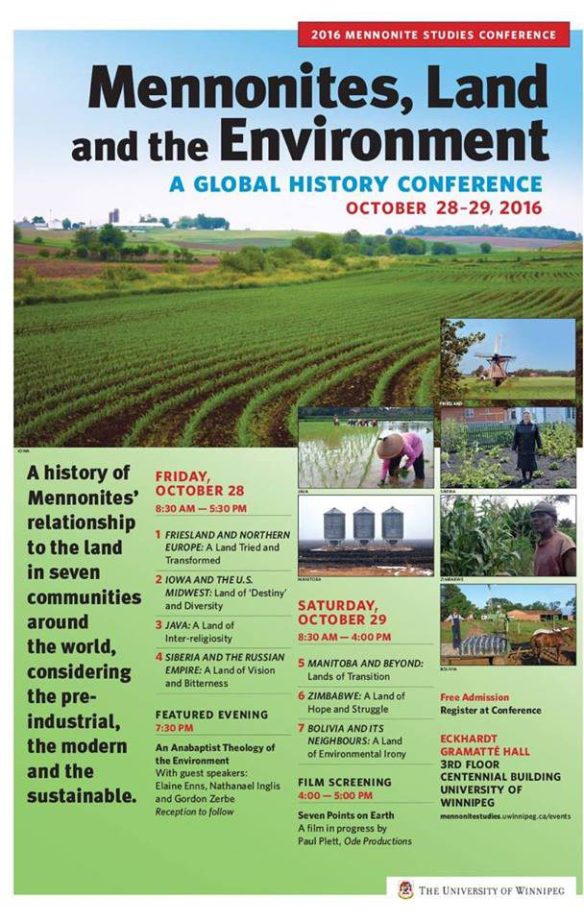
image-8

© Benjamin Nobbs-Thiessen 2016. Unauthorized use and/or duplication of this material (including images) without express and written permission from this author is strictly prohibited. Excerpts and links may be used, provided that full and clear credit is given to Benjamin Nobbs-Thiessen with appropriate and specific direction to the original content.
Mennonite Agriculture in Siberia: Past and Present

In the summer of 2015, I travelled to Siberia as a part of Royden Loewen’s Seven Points on Earth project. My task was to explore how Mennonites in Russia related to the land through interviews and archival research into the history of the village of Apollonovka (formerly Waldheim), located over 100 kilometres from the regional centre of Omsk and 35 kilometres from the nearest railway station. The village was established by Mennonite settlers to the region in 1911, after the tsarist state opened Siberia to agricultural settlement. The search for land propelled hundreds of Mennonite families to undertake the long trek from various parts of the empire to this new frontier.

planting-2

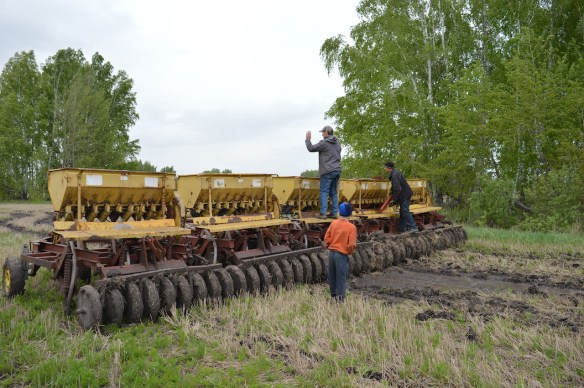
Late seeding after a wet spring

In the Russian empire, Mennonites showed a strong inclination to adapting their agricultural methods to address the challenges of the local environment. As David Moon has demonstrated, Mennonites performed an important role in the development of agriculture on the steppe, as they successfully planted trees to create shelter for their crops and protect the soil1 along with establishing irrigation methods to address the region’s semi-arid climate.2 In Siberia, Mennonites faced new challenges to adapt to local conditions, especially the shorter growing season. Initially, only some Mennonite farmers employed the four crop rotation method used in southern Russia; eventually most adopted this technique.3

It would be difficult to argue that Mennonites demonstrated adaptability in their agricultural practices out of a concern for the environment born out of their religious conviction. Instead of exemplifying a dedication to sustainable practices, this adaptability arguably reflected a strong commitment to efficient use of the land, rigorous hard work, and a quiet compulsion for wealth without excess materialism.

cows.JPG

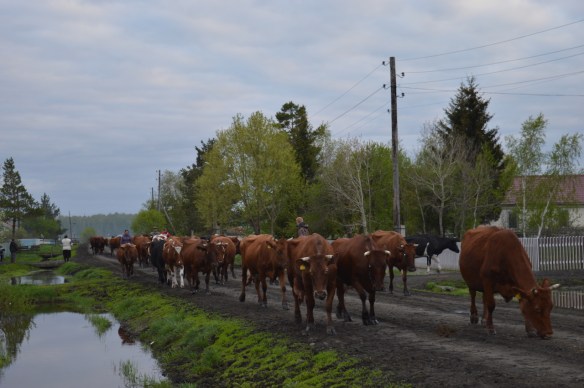
Cows returning home from for evening milking

Over a hundred years later, the Low German-speaking population of Apollonovka continues to live by the tenets of faith, family, and farming and shows many of the same characteristics despite the intervening years under the communist regime. In spite of current economic difficulties in Russia, locals expressed a strong belief in the future of their children and faith community. In addition to working for one of the three agricultural firms in the village, many have build small barns where they raise pigs for market. Like their ancestors, the inhabitants of Apollonovka have shown resilience and innovation, building local businesses that support the continuation of community life.


  1. David Moon, The Plough That Broke the Steppes: Agriculture and Environment on Russia’s Grasslands, 1700-1914 (Oxford: Oxford University Press, 2013), 176. 
  2. Ibid., 210. 
  3. Petr Epp, Ne ischezli po milosti Gospoda: Waldheim-Apollonovka, 1911-2011 (Steinhagen: Samenkorn, 2011), 83. 

Place Matters

Felipe Hinojosa

This past week I got the news that my parent’s house had sold. My parents bought the house back in the 1970s for $26,000 and sold it for $45,000. The financial returns were slim, but the house on Taylor street—located in the heart of el barrio de la 421 (the 421 neighborhood)—holds deep memories for me and my family. This was the house where Sunday afternoons were loud with people around the table eating arroz con pollo while closely following the Dallas Cowboy football game. It was where people from all over the U.S. and Latin America came to visit my parents, and where el hermano Manuelito—a Mennonite pastor from Matamoros (a border town on the Mexican side) would patiently wait for a ride to church on most Sunday mornings. It’s the neighborhood where my first bike was stolen, where the cholos and cholas decorated the streets with their fashion and art, and where we were certainly the only non-Catholic family. We were the aleluyas (a term sometimes used to identify non-Catholic, mostly Pentecostal, Mexican Americans). We had a tortilleria one house down, across the street you could buy hielitos (frozen kool-aid in styrofoam cups), Ofelia had a tiendita (small store) a short distance away, and I’ll never forget how well manicured our neighbor, Conchita, kept her plants and grass. In recent years the neighborhood has not looked very good. After Conchita passed away the subsequent owners never kept up the landscaping and the nearby Lincoln Park closed down, giving way for a new highway built to connect to a new border crossing to Mexico.

fb95img9514742946311821

Esther Hinojosa, the author’s mother

Of all that is quickly recognizable about my family and my neighborhood, being Mennonite is certainly not. And yet we are, and that house, and that neighborhood, has been visited by other Mennonites (mostly Mexican Americans) who came for a Bible study, for a meal, or for a place to stay. Our family was the only Mennonite family in el barrio de la 421, but all across town, Mexican-American Mennonites lived, worked, and faithfully attended Iglesia Menonita del Cordero (Mennonite Church of the Lamb) in Brownsville, Texas. For most of us, place (our neighborhoods and the border city where we lived) shaped our understanding of Mennonite and Anabaptist faith and theology. Place mattered to us because it compelled us to live out our Mennonite faith in distinctive ways. For example, our church started programs to help people in our church (poor people helping poor people) and we became a sanctuary church in the late 1980s and early 1990s, providing migrants and refugees from Central America and Mexico sanctuary, a warm meal, and the opportunity to make a long distance phone call.

IMG_20160919_132811361.jpg

The house on Taylor Street

Social geographers tell us that space and place are not neutral, but in fact are vital in determining social interactions, politics, and social movements.1 Being on the border—being a border church and a Mennonite church—meant that we lived out our faith very differently than white Mennonites in the east or Midwest. Like the prairies and flat lands of the Midwest or the Pennsylvania Dutch Country that have shaped Mennonite faith and theology in America, living as a borderlands people between two nations has shaped the experiences of Mexican American Mennonites. 

The relation to place has been a critical point in much of the Mennonite and Anabaptist histories written in the twentieth century. That focus makes sense given that most of the Russian Mennonite immigrants to America settled in defined locations across the east and Midwest during the latter half of the nineteenth century. The cities and towns in which they ended up, such as Hillsboro and Newton, Kansas, and Goshen and Elkhart, Indiana, historian Paul Toews has called “holy places”. 2 

While Mennonites have historically been geographically segregated, place is additionally important in that it has also shaped the historical topics chosen for study as well as the methodologies and approaches of scholars who focus on the Mennonite experience. Consider: what places and which archives are Mennonite scholars working in and with? In 1997 Toews made it clear that most of the scholars who authored books as part of the “Mennonite Experience in America” series made “trips into the archival centers of the Mennonite universe [and] bypassed the bright lights of the nation’s metropolitan centers.”3 While the majority of the historical records for the Mennonite community are archived in the “holy places,” it is important to remember that Mennonites themselves have never been solely confined to those areas. What new information might we have gathered about the experience of Mennonites during the civil rights movement or the Sanctuary movement by looking in the National Archives, the Library of Congress in Washington, DC, or even the Luis Muñoz Marín Foundation in Trujillo Alto, Puerto Rico, which currently has an electronic collection of over 20,000 photos of Mennonite service work on the island in the 1950s and 1960s?

For those of us working on rewriting the Mennonite story in the United States, deterritorializing Mennonite studies—moving it away from its current ethnic and place-based trappings—has the potential to open new avenues that take us to the different locations where Mennonite history occurred: in the West, the South, the Pacific Northwest, and across national borders. Doing so can help us to better understand how racism and oppression take place, how people of color have redefined the Mennonite experience, and what the range of Mennonite and Anabaptist history can teach us about religious experiences in the United States and across the globe. I know that in my corner of the world, in the barrios of the Texas/Mexico borderlands, there are many stories yet to be told.   


  1.  See the work of Edward Soja, Thirdspace: Journeys to Los Angeles and other Real and Imagined Places (Blackwell Publishers, 1996). 
  2.  Paul Toews, “The Quest for the Mennonite Holy Grail: Reflections on ‘the Mennonite Experience in America’ Project,” Direction Journal 26, no. 1 (Spring 1997), 43. 
  3. Ibid. 

Current Research on Early Modern Anabaptist and Spiritualist History: A Report from the 2016 SCSC

Bruges.jpg

Every year, scholars of the European Reformations gather to present papers at the annual meeting of the Sixteenth Century Society and Conference. The most recent annual conference was held in Bruges, Belgium, with over 1000 scholars in attendance. As it did at the 2015 conference in Vancouver, British Columbia, the Society for Reformation Research sponsored three panels on the Radical Reformation, and the papers presented at these panels showcased exciting new research on sixteenth- and seventeenth-century Anabaptist and Spiritualist topics and challenged established historiographical norms and categories.

The first panel, entitled New Approaches to the Radical Reformation, featured papers from James Stayer, Mary Sprunger, and me. I opened the panel by presenting a paper on Melchior Hoffman and the prophecies of Lienhard and Ursula Jost. The paper detailed the North German/Dutch Anabaptist founding father’s reverence for contemporary prophecy as equal in value to biblical prophecy and his approach to prophecy both scriptural and contemporary, which served to bolster his own authority in Melchiorite circles as its ultimate interpreter.1 James Stayer, professor emeritus at Queen’s University, presented a paper on The Blasphemy of Jan van Leiden, a work which first appeared in print in 1627 and was attributed to Menno Simons. Stayer outlined the controversy between Willem de Bakker and Helmut Isaak (both of whom accept Menno’s authorship) on the date the work was first written and suggested that the document was a forgery, as Christiaan Sepp had argued in the nineteenth century.2 Mary Sprunger of Eastern Mennonite University closed out the panel with a paper on the migration of Flemish (in the geographic rather than religious sense) Mennonites to Amsterdam following increased religious persecution in the Spanish Netherlands and their economic impact on Dutch Mennonite and Doopsgezind congregations, particularly in the area of trade.3

The second panel, entitled Religious and Social Radicalism in the Early Years of the Reformation, featured presentations from Geoffrey Dipple, Emese Bálint, and Roy Vice. Dipple, of the University of Alberta, revisited the question of who baptized South German Anabaptist founder Hans Denck. Dipple argued that Denck’s focus was far less on baptism than on the Lord’s Supper, and that if he himself was baptized at all, he was not baptized in Switzerland. Rather, as the polygenesis paradigm suggests, Denck’s form of Anabaptism was distinct from that of the Swiss Brethren.4 Bálint, of the European University Institute, presented a paper coauthored with Christopher Martinuzzi of the Scuola Normale Superiore on exchanges between Anabaptists and Saxon reformers in the early years of the reformation. The paper emphasized the widespread exchange of ideas in the early years of the Reformation and the fluid nature of religious identity, calling into question the divide between magisterial and Radical Reformations and arguing that given the multiplicity of influences that shaped every surviving sixteenth-century creed, the religions that began in the sixteenth century are best understood as composite religions.5 Roy Vice presented a third paper on the mockery of the sacred in the Peasants’ War. He particularly detailed the peasants’ frequent desecration of consecrated hosts, an action that evinced both anticlericalism and a denial of the Real Presence.6

The final panel, entitled Spiritualist Currents in the Radical Reformation and Their Long-term Impact, featured papers from Theo Brok, Gary Waite, and Michael Driedger. Theo Brok, of the Vrije Universiteit in Amsterdam, presented a paper on Anabaptism in the Lower Rhine from its origins to the 1550s. Brok maintained that the region developed a unique form of Anabaptism influenced by Johannes Campanus and a network of bishops unconnected to Menno Simons and Dirk Philips.7 Gary Waite, of the University of New Brunswick, gave a paper on the long-term impact of the Spiritualist hermeneutic, in which he traced relationships between Amsterdam’s seventeenth-century religious dissenters and argued that the Spiritualist emphasis on the inner word and distaste for dogmatism paved the way for a historical-critical approach to Scriptural revelation adopted by figures such as Baruch Spinoza.8 The panel’s final presenter, Michael Driedger of Brock University, challenged the very category of Radical Reformation, which had served as an organizing principle for this series of panels. Driedger argued that the idea of an essential unity between Anabaptists, Spiritualists, and other dissenters was an idea propagated not by members of these groups themselves, but rather in polemical literature written by their opponents.9

The complicated and interconnected currents of sixteenth-century religious thought continue to resist simple categorization, whether by academics seeking to present historical material in an accessible fashion or by religious groups seeking a neat and tidy origin story. Ongoing research on Anabaptists and other marginal sixteenth-century religious figures reveals both important distinctions between individuals and groups and the exchange of ideas both within and beyond confessional and sectarian boundaries. For those of us, Anabaptist or otherwise, who belong to a religious tradition, these findings offer an opportunity to reflect on the complicated and multifaceted nature of religious identity. Our forebears may not be our ideological twins, but nevertheless we, like them, are shaped not only by our upbringing—both the parts we reject and the parts we accept—but by the people and ideas we interact with over the course of our lives.


Works Cited

Bálint, Emese  and Christopher Martinuzzi. “Composite Religions: Encounters Between Early Saxon Reformers and the First Anabaptists.” Paper presented at the annual meeting for the Sixteenth Century Society and Conference, Bruges, Belgium, August 18-20, 2016.

Brok, Theo. “Johannes Campanus (ca. 1500–1575) and Early Anabaptism in the Lower Rhine.” Paper presented at the annual meeting for the Sixteenth Century Society and Conference, Bruges, Belgium, August 18-20, 2016.

Dipple, Geoffrey. “Who Baptized Hans Denck?” Paper presented at the annual meeting for the Sixteenth Century Society and Conference, Bruges, Belgium, August 18-20, 2016.

Driedger, Michael. “The Origins of the Radical Reformation in the Republic of Hateful Letters.” Paper presented at the annual meeting for the Sixteenth Century Society and Conference, Bruges, Belgium, August 18-20, 2016.

Moss, Christina. “‘Worth as Much as Jeremiah and Isaiah’: Melchior Hoffman and the Prophecies of Lienhard and Ursula Jost.” Paper presented at the annual meeting for the Sixteenth Century Society and Conference, Bruges, Belgium, August 18-20, 2016.

Sprunger, Mary. “The Impact of Flemish Mennonite Migration to Amsterdam in the Late Sixteenth Century and Early Seventeenth Century” (paper presented at the annual meeting for the Sixteenth Century Society and Conference, Bruges, Belgium, August 18-20, 2016).

Stayer, James. “‘The Blasphemy of Jan van Leiden’ (1627) by Menno Simons?” Paper presented at the annual meeting for the Sixteenth Century Society and Conference, Bruges, Belgium, August 18-20, 2016.

Vice, Roy. “Mocking the Sacred During the German Peasants’ War.” Paper presented at the annual meeting for the Sixteenth Century Society and Conference, Bruges, Belgium, August 18-20, 2016.

Waite, Gary. “The Spiritualist Hermeneutic and Its Long-Term Impact: From David Joris to Baruch Spinoza?” Paper presented at the annual meeting for the Sixteenth Century Society and Conference, Bruges, Belgium, August 18-20, 2016.


  1. Christina Moss, “‘Worth as Much as Jeremiah and Isaiah’: Melchior Hoffman and the Prophecies of Lienhard and Ursula Jost” (paper presented at the annual meeting for the Sixteenth Century Society and Conference, Bruges, Belgium, August 18-20, 2016). 
  2. James Stayer, “‘The Blasphemy of Jan van Leiden’ (1627) by Menno Simons?” (paper presented at the annual meeting for the Sixteenth Century Society and Conference, Bruges, Belgium, August 18-20, 2016). 
  3. Mary Sprunger, “The Impact of Flemish Mennonite Migration to Amsterdam in the Late Sixteenth Century and Early Seventeenth Century” (paper presented at the annual meeting for the Sixteenth Century Society and Conference, Bruges, Belgium, August 18-20, 2016). 
  4. Geoffrey Dipple, “Who Baptized Hans Denck?” (paper presented at the annual meeting for the Sixteenth Century Society and Conference, Bruges, Belgium, August 18-20, 2016). 
  5. Emese Bálint and Christopher Martinuzzi, “Composite Religions: Encounters Between Early Saxon Reformers and the First Anabaptists” (paper presented at the annual meeting for the Sixteenth Century Society and Conference, Bruges, Belgium, August 18-20, 2016). 
  6. Roy Vice, “Mocking the Sacred During the German Peasants’ War” (paper presented at the annual meeting for the Sixteenth Century Society and Conference, Bruges, Belgium, August 18-20, 2016). 
  7. Theo Brok, “Johannes Campanus (ca. 1500–1575) and Early Anabaptism in the Lower Rhine” (paper presented at the annual meeting for the Sixteenth Century Society and Conference, Bruges, Belgium, August 18-20, 2016). 
  8. Gary Waite, “The Spiritualist Hermeneutic and Its Long-Term Impact: From David Joris to Baruch Spinoza?” (paper presented at the annual meeting for the Sixteenth Century Society and Conference, Bruges, Belgium, August 18-20, 2016). This paper is related to an ongoing research project on religious dissent in England and the Low Countries entitled Amsterdamnified and helmed by Waite and Michael Driedger. See more at http://amsterdamnified.dutchdissenters.net/wp/
  9. Michael Driedger, “The Origins of the Radical Reformation in the Republic of Hateful Letters” (paper presented at the annual meeting for the Sixteenth Century Society and Conference, Bruges, Belgium, August 18-20, 2016). 

The Deepest Dichotomy: How A Sixty-Five-Year-Old Essay on Racism Helped Me Learn A Lesson From Before I Was Born

Tobin Miller Shearer

J. Lester Brubaker taught me a lesson. He did so back in 1950, fifteen years before I entered this world. That is the wonder of history.

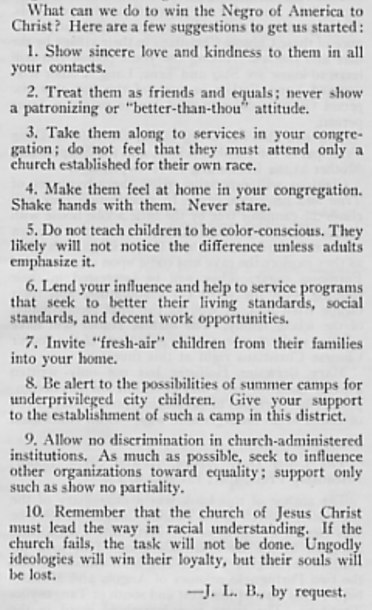
Brubaker wrote an article beneath the headline “Colored Missions.” In it, he used his position as editor of Lancaster (Pennsylvania) Mennonite Conference’s Missionary Messenger to suggest ten ways to “win the Negro of America to Christ.”1 Starting from the assumption that it was easier to help the “dark-skinned American” than the “dark-skinned African” because it was less expensive and did not require learning a “difficult language,” Brubaker carefully enumerated his motivations and methods for reaching across the color line.2

j-brubaker

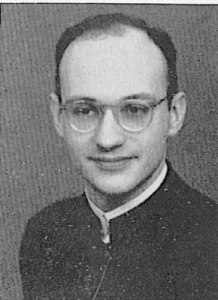
J.  Lester Brubaker, 1952 Lancaster Mennonite High School Laurel Wreath

His was a daunting task. Two years after he penned his essay, there were still only twelve African-American congregations listed in the Mennonite Yearbook, and they were lumped together with “Spanish speaking” missions and ministries focused on “Jewish People” under the category “Missions Among Different Peoples.”3 What was segregated in print was also segregated in practice. Many retirement and children’s homes run by Mennonites would not accept African Americans. Nearby Virginia Conference continued to enforce its 1940 bishop-approved segregation guidelines for all church sacraments from communion to the Holy Kiss.4 And the numbers were small: by 1953 mission worker Leroy Bechler reported only 282 black members of the Mennonite Church in the United States.5

To be certain, some African-American leaders pushed back against these walls of racial segregation. James and Rowena Lark had been actively ministering within the African-American community for several years, with James being ordained as a minister on October 6, 1946.6 Both Larks had gained notice of the church at large, and in 1951 James would come to serve on the church-wide Committee on Economic and Social Relations (CESR), a group that would, concurrent with Lark’s involvement and the leadership of Guy F. Hershberger, focus on race relations for many years.7 Over in Chicago, James and Rowena had started Bethel Mennonite church where they lead an integrated congregation and advocated for full inclusion of African Americans. In a 1950 article, Rowena noted that a “worker” in their congregation, originally from Virginia, became “the first Colored girl ever to attend E. M.C. as a registered student.”8

But despite these efforts, segregation in 1950 was, in the Mennonite community, the norm. Integration, however halting, was the anomaly.

In that historical context, Brubaker wrote his editorial. Having studied at Franklin and Marshall College and taught English at Lancaster Mennonite School, Brubaker knew how to wield a pen. He also knew his audience.

And this is where the lesson that I learned fifteen years from before I was born enters in.

Among the many suggestions that he had to offer [see sidebar/image], Brubaker focused brubaker-mm-1950on two themes: becoming involved in changing institutions and being nice to black people. As a thoughtful writer, Brubaker was of course more nuanced in his recommendations. He seems to have realized that the problem of racism was not just a matter of individual prejudice, so he called for changes in “church-administered institutions” and for more involvement in efforts to improve economic, labor, and social conditions for black Americans. He likewise recognized that white Mennonites were prone to patronizing behaviors and superiority and so enjoined his readers to “[n]ever show a patronizing or ‘better-than-thou’ attitude.”9

But the lesson that Brubaker taught me is just how long the Mennonite Church has been struggling to overcome this dichotomy between advocating for institutional change and fostering interpersonal relationship. When Brubaker encouraged parents to “not teach children to be color conscious” because “they likely will not notice the difference unless adults emphasize it,” he could not have been more distant from the African Americans who in 1950—and for decades previously—had been asking for more attention to the realities of racism, not less. Even for his relative sophistication and nuance, as a white Mennonite from Lancaster County, Brubaker and his co-believers stood at a far remove from African-American leaders like W. E. B. DuBois, Mary Mcleod Bethune, and Ida B. Wells-Barnett who had long been advocating for forthright, nuanced, and informed approaches to racism. Likewise, Gunnar Myrdal’s 1944 An American Dilemma noted the deep-seated patterns of white racism and prejudice that could not be overcome by avoiding discussion about race.

Brubaker and his contemporaries knew how to encourage each other to be nice, to host black and brown children from the city, and to sponsor children of color at their summer camps. But those actions, regardless of how well meaning, lovingly offered, and challenging they were to implement, missed the mark of the standards set by African-American leaders of the day.

What is so striking is that this same dichotomy is present in the contemporary church. White Mennonites continue to find relationally based solutions far more attractive than the kind of activism promoted by groups affiliated with the Black Lives Matter movement, for example. The problem now, as it was in 1950, is that the solutions white Mennonites are most familiar with have not been called for by the black community and have not proven effective over time. Addressing violence against black communities, paying reparations for slavery, and instituting community controlled policing have proven historically much more difficult for white Mennonites to support.

Our way forward as a church community will turn in part on how well we come to grips with the very dichotomy that J. Lester Brubaker helped me understand has been part of the Mennonite zeitgeist for sixty-five years and counting.


Works Cited

Bechler, Le Roy. The Black Mennonite Church in North America 1886-1986. Scottdale, Pa.: Herald Press, 1986.

———. Facts, Considerations and Membership of Negroes in the Mennonite Church 1955. Negro Evangelism Committee, 1955.

Brubaker, J. Lester. “Colored Missions.” Missionary Messenger, May 1950, 11.

Lark, Rowena. “The History of Bethel Mennonite Church.” Our Journal, May 1950, 1-3.

“Policy Governing the Organization of a Mennonite Colored Organization.” 1. Harrisonburg, Va.: Virginia Mennonite Conference; Virginia Mennonite Board of Missions And Charities, 1940.

Shetler, Jan Bender. “A Prophetic Voice in Race Relations?: The Mennonite Church – Missions to Minority Ministries.” Paper, Goshen College, 1977.

Zook, Ellrose D., ed. Mennonite Yearbook and Directory. Vol. 43. Scottdale, PA: Mennonite Publishing House, 1952.


  1.  J. Lester Brubaker, “Colored Missions,” Missionary Messenger, May 1950, 11. 
  2.  Ibid. 
  3.  Ellrose D. Zook, ed. Mennonite Yearbook and Directory, vol. 43 (Scottdale, PA: Mennonite Publishing House, 1952), 42. 
  4.  “Policy Governing the Organization of a Mennonite Colored Organization,”  (Harrisonburg, Va.: Virginia Mennonite Conference; Virginia Mennonite Board of Missions And Charities, 1940). 
  5. Le Roy Bechler, Facts, Considerations and Membership of Negroes in the Mennonite Church 1955 (Negro Evangelism Committee, 1955), 1. 
  6.  Le Roy Bechler, The Black Mennonite Church in North America 1886-1986 (Scottdale, Pa.: Herald Press, 1986), 49-54. 
  7.  Jan Bender Shetler, “A Prophetic Voice in Race Relations?: The Mennonite Church – Missions to Minority Ministries” (Paper, Goshen College, 1977), 18. 
  8.  Rowena Lark, “The History of Bethel Mennonite Church,” Our Journal, May 1950, 3. 
  9.  Brubaker, “Colored Missions,” 11. 

Submission Deadline Changed for Crossing the Line

The deadline for submissions for “Crossing the Line: Women of Anabaptist Traditions Encounter Borders and Boundaries” has been extended to October 15. This conference, to be held at Eastern Mennonite University June 22-25, 2017, will examine gendered experiences within Anabaptist traditions.

See the call for papers here: http://www.emu.edu/academic-conferences/women-of-anabaptist-traditions/.

Threads of Connection Woven through History

What do the Anabaptists from Prussia, cowboys, and Eastern Mennonite College have in common? Admittedly not much, but these three threads have intertwined in a unique way throughout history to weave a tale of conflict, connection, and caring.

Gesangbuch 1908 1

Danzig Mennonites

The first thread is the Anabaptists in Danzig, Prussia (now Gdansk, Poland). The history of the Danzig Mennonites is long and complex and there isn’t enough time or space do it justice here, but I will attempt to give a brief overview.1 Anabaptists moved to the Danzig area in the 1530s fleeing persecution in the Netherlands and other areas of what is now Germany and Switzerland (Mannhardt 2007, 37-38). They established a community in Danzig, living there from the 16th century to the early 20th century.  Both Menno Simons and Dirk Philips visited the Anabaptists at Danzig a number of times, with the latter living there for a while. Danzig church historian H.G. Mannhardt says that “the beginnings of our church can be traced to Menno himself” but that Philips “is considered the actual founder of the Danzig Mennonite Church.”2 
The Danzig Mennonites practiced strict church discipline, tried to avoid fashionable clothing, and were excused from military service so long as they paid for two substitutes. They also practiced mutual aid and care for the poor. They maintained an alms house to house the homeless and had an alms fund for the care of needy church members. Mannhardt says that “their care for the poor was to be similar to that of the early Christians, and for that reason they had, besides the office of preacher, the office of deacon or caregiver to the poor.”3

The Mennonites were appreciated for their work ethic and quiet nature, but they still experienced some discrimination. For the first few centuries of their tenure they were denied the rights of citizenship as they refused to take the citizenship oath, were not allowed to live within the city walls (many settled in the nearby suburb of Schottland), and endured hindrances to practicing their crafts and trade in lace and fine liquors. Seemingly each time a new King of Poland came to power he would try to evict them.4 Fortunately, they were given enough protection by the Danzig City Council to be able to continue living in and around Danzig.5

By the 1800s Danzig Mennonites were granted citizenship along with other protections and were able to move within the city walls, where they constructed a church building on what became known as Mennonitenstrasse (Mennonite Street).  Church membership was always strong and had grown to over one thousand after World War I, but it dwindled significantly after World War II as many were driven out by the conflict and subsequent Soviet occupation.6  The church building was restored after the war and continues to serve as a church, although it is no longer used by Mennonites.7 

Seagoing Cowboys

The second thread is post-World War II relief work done by young men of Mennonite, Church of the Brethren, Brethren in Christ, Quaker, and other Anabaptist faiths. Mennonite Central Committee (MCC) was instrumental in overseeing and coordinating the Anabaptist connection to governmental conscientious objector (CO) programs during and after the war, including Civilian Public Service (CPS) and the United Nations Relief and Rehabilitation Administration (UNRRA).8 After WWII, the UNRRA partnered with the Heifer Project, a Church of the Brethren organization, to provide livestock for people in Europe and China whose lives and livelihoods had been destroyed during the war. The men who volunteered to accompany heifers, horses, mules, and other livestock across the ocean were nicknamed “Seagoing Cowboys”. In total they made over 350 trips over the course of three years.9 Many went over as a fulfillment of their alternative service, but some were just seeking adventure. All came back with a deeper understanding of the gravity of pain and destruction endured by the survivors of WWII.10 

The Menno Simons Historical Library

The final thread is that of Eastern Mennonite College (now Eastern Mennonite University), more specifically its special collections library, the Menno Simons Historical Library (MSHL). The MSHL was started in the 1920s by two professors who wanted to create a collection of materials related to Mennonite and Anabaptist history, life, and culture. Since its inception, the collection has grown to include a number of rare books and materials relating to the early Anabaptists in Germany, Switzerland, and the Netherlands. It now holds over 45,000 books, including about 5,000 rare books, and a host of other materials related to the Mennonites and Anabaptists.

Conflict, Connection, and Caring

These threads were woven together when a young man from the Shenandoah Valley named Wilbur C. Layman went over to Poland as a seagoing cowboy in 1946. His fellow cowboys went out one day to explore the ruins of the bomb-damaged Danzig Mennonite church, but Wilbur stayed back as he wasn’t feeling well. The men found church records and documents in the damaged church, many of which they recovered and brought back to the United States.11 These were housed at the Mennonite Library and Archives at Bethel College in North Newton, Kansas from 1947-2009 (they have since been transferred to the Mennonitische Forschungsstelle in Weierhof, Germany).12 Although he had stayed back that day, two items found their way into Wilbur’s hands and were brought home to Virginia. He later donated them to the Menno Simons Historical Library–a 1908 songbook from the Danzig Mennonite Church entitled Gesangbuch zur kirchlichen und häuslichen Erbauung : für Mennoniten-Gemeinden and a single page entitled Rechnung von unsrer Gemeinte[sic] Armen Gelder : welche anno 1698 adÿ 29 December geschlossen worden, which very roughly translated means, “Account of our community poor funds which concluded December AD 1698”. This page lists the deacons for the poor that are mentioned in Mannhardt’s history of the church as well as an account of the alms fund. The deacons listed are Martin Enken, Harman Allerts, Hendrick Klaassen, Andries Penner, Gerrit Jansen, and Nicolas Penner. This document is a fantastic example of the mutual aid and care for the poor practiced by the Danzig Mennonites.

Gesangbuch 1908 2.JPG

Documentary evidence such as this provides a tangible connection to history that is hard to replicate through reading facts and figures. Every rare item in the Menno Simons Historical library has a unique provenance, but we aren’t fortunate to have such a complete and fascinating tale for them all, which makes this document and songbook all the more special.


  1.  More information can be found in the GAMEO article on the Danzig Mennonite Church or in H.G. Mannhardt’s book The Danzig Mennonite Churchthat was recently translated and published in English. Mannhardt, H.G. The Danzig Mennonite Church: Its Origin and History from 1569-1919. Translated by Victor G. Doerksen, edited and annotated by Mark Jantzen and John D. Thiesen. North Newton, Kansas: Bethel College, 2007; Mannhardt, H. G. Global Anabaptist Mennonite Encyclopedia Online. October 2012. “Danzig Mennonite Church (Gdansk, Poland).” Accessed August 22 2016.
    http://gameo.org/index.php title=Danzig_Mennonite_Church_(Gdansk,_Poland)&oldid=127394 
  2. Mannhardt 2007, 44-46. 
  3. Mannhardt 2007, 116). 
  4.  (Mannhardt 2007, 53; 56-57). 
  5.  (Mannhardt 2007, 71-72). 
  6.  (Mannhardt 2007, 245). 
  7.  (Mannhardt 2007, 251-53). 
  8.  Byler, J. N. Global Anabaptist Mennonite Encyclopedia Online. 1959. “UNRRA (The United
    Nations Relief and Rehabilitation Administration).” Accessed August 19 2016.
    http://gameo.org/index.php?title=UNRRA_(The_United_Nations_Relief_and_Rehabilitation_Administration)&oldid=78411
  9. For more information on Seagoing Cowboys, visit seagoingcowboys.com, where a great deal of information and wonderful stories have been compiled by Peggy Reiff Miller. Also check out her new children’s book entitled The Seagoing Cowboy, now available from Brethren Press. Miller, Peggy Reiff. The Seagoing Cowboys: Delivering Hope to a War-Torn World. Accessed August 18, 2016. www.seagoingcowboys.com
  10. Miller, Peggy Reiff. The Seagoing Cowboy. Elgin, Illinois: Brethren Press, 2016, 38-39). 
  11. Scans of the Danzig Mennonite Church records that were once housed at the Mennonite Library and Archives can be found 
  12.  (Mannhardt, xxvii). 

‘Selling the Amish’: Amish Country as Consumerist Self-help or Retrograde Utopia?

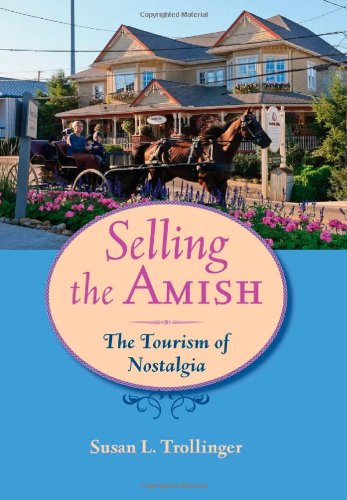
I’ve just moved from Wisconsin back to Southeastern Pennsylvania, and one of the things I’d completely forgotten about was the use of a horse-and-buggy logo for regional shorthand. The silhouette, with or without a prominent wide-brimmed hat sticking out, seems like it’s everywhere. And just at the moment when I noticed it, Susan L. Trollinger’s Selling the Amish: The Tourism of Nostalgia was dropped into my hands.1

Trollinger opens with a short chapter for those readers unfamiliar with the religious and cultural history of the Amish, then moves on to frame her argument in Chapter 2. Drawing on precedents in cultural studies (such as Dean McCannell’s The Tourist) and those specifically about the phenomenon of Amish tourism (such as Thomas J. Meyers’ essay “Amish Tourism” in Mennonite Quarterly Review), Trollinger explains that places such as Shipshewana, Indiana and Intercourse, Pennsylvania become mediated spaces at which mainstream Americans (most of them middle-aged, middle-class, and white) can encounter the idea of the Amish.Selling the Amish

It is in three such liminal places in Ohio that Trollinger explores in her next three chapters. In each town, she identifies a few larger themes of Amish tourism in general to focus on.

In Walnut Creek, the majority of tourist buildings embrace a Victorian aesthetic outside and in. In Berlin, the architecture is split between the old(e) frontier and the 1950s. Sugarcreek, Ohio, is known for its Swiss Cheese and its annual Swiss Festival in addition to its proximity to a large Amish population. Each of these themes offer an intermediary setting, a stylistic mid-point between the tourists who come and the Amish they come to see. The technology in the tea room in Walnut Creek and for sale in Berlin is not that different from that which the Amish utilize. Mainstream America sees the Amish as trapped in time and it takes entering simulacra of past mainstream Americas for tourists to not be too discomfited by the life of the Amish.

The irony is that it is just that life that they are coming to see in many cases. Trollinger suggests that Middle Americans facing a “time famine” are entranced by the slower pace of agrarian Amish life and that the retrograde gender roles of the Amish are comforting in a time of gender revolution. Tourists who have just been given iPads by their children find comfort in seeing an old apple peeler like the one they used in their youth.

On the whole, Trollinger succeeds in raising interesting questions about the commodification of members of the Amish church by tourism entrepreneurs. For instance, she complicates the idea that this practice is necessarily exploitative. Trollinger cites Roy C. Buck’s argument that Amish-themed tourism insulates the Amish community from mainstream society by directing tourists to a commercialized version of Amish life rather than the homesteads, farms, and schools in which the Amish actually live.

Furthermore, Trollinger opens and closes the book with a conversation she had with several New Order Amish men in Holmes County, Ohio. The men suggested that they pitied the tourists who toured their community because of the awful rushed lives they led. The men relished the opportunity they had to perform a witness to the tourists, to show them that life need not be lived in a frenzy. Thus while the Amish lifestyle is turned into a marketable brand, it also preserves its practitioners’ everyday activities and provides a stage on which they can share their truth with the mainstream.

Yet I wonder how much witness the tourists receive. Retail is at the forefront of Walnut Creek and Berlin, and Trollinger suggests that a large part of the appeal of these places is that visitors can take tools (cookbooks, décor, hand-planers) back to their mainstream lives to capture a little of the slow and simple life and work toward “fixing” their modern problems.

While I find this argument persuasive, I wish that Trollinger had applied the same visual close-reading to some more Amish-adjacent tourist attractions (buggy rides, barn tours, etc.) that she does to the Thomas Kinkade portraits and American-flag bunting on sale next to “hand-dipped” candles and other kitsch. Perhaps in these more “authentic” experiences (even though they are simulacra) there is more opportunity for witness?

As Trollinger described the appeal of the Amish: the slower pace, clear-cut gender-roles, and simple technology, I found myself waiting for her to get to the darker side of such a time-traveling yen. When she talks about the 1950s as evoking an “innocent” time, I think Trollinger soft-pedals a bit. It seems to me that the appeal of the 1950s (and Victorian America, and Ethnic Swiss pride) for middle-aged, middle-class, and white tourists is not “innocence” but “purity.” As in racial purity. Trollinger doesn’t fail to cite statistics that only 3% of tourists to Shipshewana, Indiana are non-white, but I think she fails to acknowledge that the appeal of an agrarian, patriarchal, Luddite existence on the frontier is inextricably tied up with racial homogeneity and a winding back of the clock past the civil rights movements. In the face of changing demographics, racial anxiety is surely just as prevalent in the minds of Middle Americans as any of the other lizard-brain impulses that drive them to Amish country.

Selling the Amish is certainly a contribution to a growing field of semiotic analysis of how the Amish are portrayed. I am confident that this volume will join David Weaver-Zercher’s The Amish in the American Imagination, Valerie Weaver-Zercher’s The Thrill of the Chaste (still the best title ever), and The Amish & the Media (which Trollinger contributed to as Susan Biesecker) as a foundational text.


  1. Susan L. Trollinger, Selling the Amish: The Tourism of Nostalgia, Young Center Books in Anabaptist and Pietist Studies (Baltimore: Johns Hopkins University Press, 2012). 

An Introductory Taxonomy of Anabaptist Histories

IMG_6493“Anabaptist Historians: Bringing the Anabaptist Past into a Digital Century” is a collaborative blog gathering scholars of Anabaptist history to share their research and engage on critical issues in contemporary Anabaptist life. But what is Anabaptist history? Part of the trouble is that the word “anabaptist” has many overlapping meanings, as does “Mennonite.” In this blog, each contributor will have his or her own understanding of what “Anabaptist” and “Anabaptist history” means.

In a conversation with Linford Stutzman during my Cross Cultural semester with Eastern Mennonite University, he postulated a three-part criteria for being a Mennonite, where meeting two out of three constituted a pass: 1) having Mennonite values; 2) belonging to a Mennonite congregation; 3) belonging to a Mennonite family. This construct concisely states the three strands of identity that are bound together in each individual’s experience (I recognize the lack of any may be as important– if not more important–in shaping the experience). The variations are not just an individual experience, they play out in the stories Anabaptists (and I include myself therein) tell themselves. As Dallas E. Wiebe ends his satirical work, The Sayings of Abraham Nofziger: A Guide for the Perplexed, vol. 3:1

147. The logical extension of Anabaptist thought is that each person becomes a church of one.

148. I’m the only Mennonite I know.

There are as many Anabaptist histories as there are Anabaptists. Since it is crucial to understand which type of history is being read in order to understand it, I am providing a brief taxonomy.

The Ethnic Genus of Anabaptist History

The Ethnic Genus of Anabaptist History is the story of Anabaptist peoplehood. That is, it is the story of how Anabaptists have been together.

To many understandings, an “ethnic” understanding of Anabaptism is simply not true, as believer’s baptism and the clear choice to join are central to Anabaptist faith. There are, however,  cultural markers that persist in differing Anabaptist communities, and the language of ethnicity can be a helpful tool to describe them—it is not meant as a pejorative.

Ethnic: Peoplehood Studies

Perhaps the most developed species of Anabaptist history is “Ethnic: Peoplehood Studies.” This is focused on looking at the many types of Anabaptist groups (say, “Ethnic: Peoplehood Studies: Amish Studies” or “Ethnic: Peoplehood Studies: Mennonite Studies”). It looks at trends, markers, and mores in the groups on the Anabaptist spectrum. There are as many subfields under “Ethnic: Peoplehood Studies” as there are Anabaptist groups.

Ethnic: Boundary Politics

The species of “Boundary Politics” is worthy of special attention: it is historical work that is less concerned about the past and more with the present. One example of this would be Thieleman J. van Braght’s guiding ethos when he considered whom to include in the Martyrs’ Mirror,  in counting only the “Defenseless Christians” as part of the true Brotherhood. Another can be found in the work of H. S. Bender—who through historical work attempted to recreate an Anabaptist vision.2 Bender systematically expunged violent Anabaptists from the mythic past: “this principle of nonresistance, or biblical pacifism, which was thoroughly believed and resolutely practiced by all the original Anabaptist Brethren and their descendants throughout Europe from the beginning until the last century.”3 The story of staunch pacifism had such sway for Bender that he ignored the likes of Thomas Müntzer, the Anabaptist Kingdom of Munster, or the Anabaptist Riot of 1535. Both Braght and Bender used history as their medium to work theologically“Bender was able to build the new vision because his initial position at Goshen College was in history rather than biblical studies. He was thus able to avoid most of the divisive disputes over doctrine. By concentrating on Anabaptist-Mennonite history, he was able to concentrate on questions that drew communalism back into the center of Mennonite discussion.” 4

The efforts of German Mennonite leaders to shift Mennonite identity by creating historical narratives from 1772 to 1950 is an example of “Boundary Politics.”  Mark Jantzen in Mennonite German Soldiers: Nation, Religion, and Family in the Prussian East, 1772–1880, traces how Mennonites reworked their identity to move from closed sectarians to fully German.5 Ben Goossen, in his Mennonite Quarterly Review article, “From Aryanism to Anabaptism: Nazi Race Science and the Language of Mennonite Ethnicity,” looks at how that same identity-shifting work was brought to fullness under the Third Reich and then quickly redone to rebirth Anabaptists as a distinct Ethnicity for preferential treatment post World War II.6 Examples of “Boundary Politics” can be very problematic: they wear the clothing of history, but have another purpose. When encountering work that falls under “Ethnic: Boundary Politics,” it is especially necessary to understand what the type of work one is reading so that what is not being said can be considered, as well as that which is.7

Ethnic: Genealogical/Family

One popular form of folk-history among many Anabaptists is that of genealogy and family history. I call it a folk-history because it is not a field of study popular in the academy. Perhaps this is so because of the past efforts by eugenicists to develop it as a scientific field. Or it could be that while genealogists are busy collecting and archiving pieces of the past, they do not, strictly speaking, work historically; they are not using what they have collected to tell a story beyond personal and family identity. But for many Anabaptists, this is their primary way of thinking about history: Where and Who Did I Come From? Working at the Lancaster Mennonite Historical Society, it is clear that most people who come through our doors are looking for answers about where they came from, and the tools they use or desire to answer that question are genealogical.

The Ecclesiastical Genus of Anabaptist History

The Ecclesiological Genus of Anabaptist History is concerned with the study of Anabaptist church history. That is, it is the story of how Anabaptists have been church.

As is the case with “Ethnic: Peoplehood Studies,” each sect and sub-organization therein has its own species and subspecies. For Lancaster Mennonite Conference, John Ruth’s tome, The Earth is The Lord’s: A Narrative History of Lancaster Conference is the defining work; Ruth’s Maintaining Right Fellowship would hold the same position for Franconia Mennonite Conference. For the Meserete Kristos church of Ethiopia, Alemu Checole’s work in Anabaptist Songs in African Hearts is another fine example.

The Epistemological Genus of Anabaptist History

This Epistemological Genus of Anabaptist History is concerned with how people considering themselves Anabaptist have known; it is Anabaptist historiography. When Julia Kasdorf traces how and looks towards why the Martyrs’ Mirror “has collapsed into only one story and one iconic image for many readers” (that of Dirk Willems), she is working in the Epistemological Genus of Anabaptist History.8 This area is receiving the most attention in emerging scholarship, not just from the historical arena but in literary studies. I will not try to give a synopsis of current state of the field here.

Conclusion

Here I have attempted to start a taxonomy of Anabaptist Histories, identifying in broad strokes the subsets of our discipline. However, unlike Linnaeus and his heirs, most of the specimens we see in the wild are chimeras, and so I have sought to describe various phenotypic packages rather than prescribe what this scholastic menagerie should look like. Surely there are species out there that I have not seen yet, in other parts of the world, in other languages, or in other fields. These classifications I have laid out are not fixed, nor are they meant to demean or devalue, but simply to help the hunters of Anabaptist History to properly place and understand that which they read.


  1. Dallas E. Wiebe, The Sayings of Abraham Nofziger: A Guide For the Perplexed (2004), 65. 
  2. Leonard Gross, “Bender, Harold Stauffer (1897-1962),” Global Anabaptist Mennonite Encyclopedia Online,1990. <http://gameo.org/index.php?title=Bender,Harold_Stauffer(1897-1962); (Accessed August 29, 2016). 
  3. Harold S. Bender, The Anabaptist Vision, (Scottdale, Pa.: Herald Press, 1944), 32. 
  4. Fred Kniss, Disquiet in the Land, (New Brunswick, N.J.: Rutgers University Press, 1997), 65. 
  5. Mark Jantzen, Mennonite German Soldiers: Nation, Religion, and Family in the Prussian East, 1772-188, (Notre Dame, Ind.: University of Notre Dame Press, 2010). 
  6. Ben Goossen, “From Aryanism to Anabaptism: Nazi Race Science and the Language of Mennonite Ethnicity,” Mennonite Quarterly Review 40 no. 2 (April 2016). 
  7. I might be inclined to argue that the role of the historian in the church is to promote an unbounded boundary politics. “I have discovered a truly marvelous proof of this, which this margin is too narrow to contain.” 
  8. Julia Spicher Kasdorf, “Mightier than the Sword: Martyrs Mirror in the New World,” The Conrad Grebel Review 31, no. 1 (Winter 2013), https://uwaterloo.ca/grebel/publications/conrad-grebel-review/issues/winter-2013/mightier-sword-martyrs-mirror-new-world (Accessed August 29, 2016).