Soybeans and Milk: Community and Commodification in a Bolivian Mennonite Colony

Since 2013, seven researchers have been investigating Mennonite agricultural practice in farming communities around the globe as part of Royden Loewen’s “7 Points on Earth Project.”  We first met in Amsterdam in December of that year to discuss the logistics of conducting oral histories in small farming communities and to introduce one another to our research sites.  These extended from regions traditionally associated with the Mennonite faith and farming, including nearby Friesland, the U.S. and Canadian prairies, and Russia, to less well known Mennonite communities in Bolivia, Indonesia, and Zimbabwe.  Leaving Amsterdam, we scattered to our seven points.  I spent five months in mid-2014 and one month in the spring of 2015 in the Department of Santa Cruz in the tropical eastern lowlands of Bolivia traveling muddy colony roads by bicycle as I conducted interviews with Mennonites farmers.
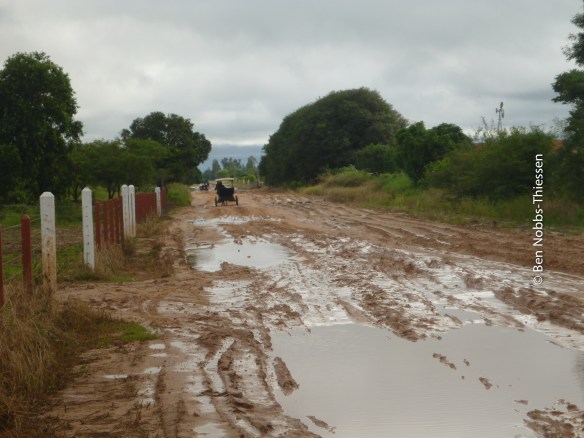
Street Scene in Riva Palacio

On October 28-29 we will be reconvening in Winnipeg to discuss our findings as part of a public conference on “Mennonites, Land, and the Environment.”  For those that may not be able to attend the conference I offer here a brief portrait of Mennonite history and farming in one of those Seven Points on Earth.

While Mennonites migrated to Bolivia from Canada, Paraguay and Belize, the majority were horse-and-buggy “Old Colony” Mennonites from Northern Mexico who began to settle in the department of Santa Cruz in 1967.  Their migration offers observers a compelling paradox.  On the one hand, they were part of a religious pilgrimage to maintain traditional ways they saw as under threat in modernizing North American Mennonite colonies.  On the other hand, they successfully presented themselves to the Bolivian government as modern farmers, capable of transforming the densely forested landscape of lowland Bolivia into a series of productive agricultural colonies.

As Mexican Mennonites approach their fifty year anniversary in Bolivia and the country’s Mennonite population nears 100,000, that duality remains as apparent as ever.  Old Colonists, most of whom continue to use horse-and-buggies on the roads and lumbering steel-wheeled tractors in the fields, might appear to live traditional, isolated lives.  Yet they are also key producers for a regional economy that has emerged as one of Bolivia’s largest and most dynamic.  They farm over a third of Bolivia’s soybeans, the country’s star agricultural crop, with a harvest in 2015 of over two million metric tons and an export value of one billion U.S. dollars.  As soy farmers they are at the center of a broad swath of South America – including portions of Brazil, Paraguay and Argentina – that now produces the majority of the world’s soy.
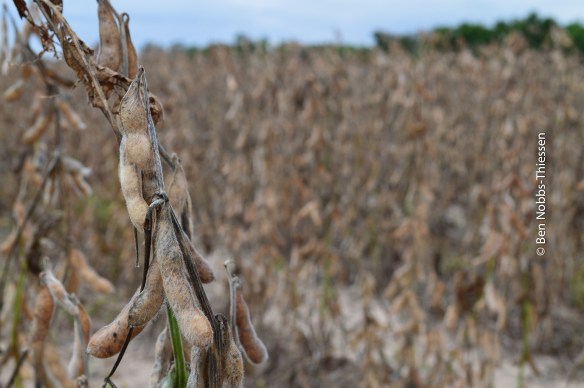
A field of soybeans in Riva Palacio colony

Even as Mennonites generate this high-value, export-oriented commodity that depends on intense mechanization, nearly every farmer in Riva Palacio, Bolivia’s largest Mennonite colony and my primary research site, rises early in the morning to milk their herd of dairy cattle by hand.  Buckets clang and wooden stools are set down as the entire family – men, women and children – take part in this laborious daily activity which will be repeated again in the early evening.  By the time the last cow is milked the sun is usually rising and one member of the family pushes a cart laden with brimming metal jugs out to the corner to wait for the milk-men that travel through the village by horse cart.
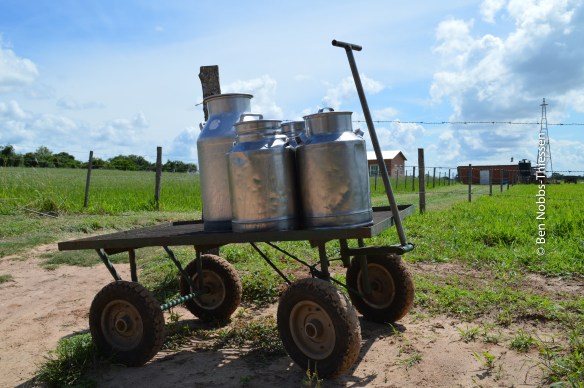
Milk awaiting pickup at the entrance to a Mennonite homestead

The practice is both intimate and, for scholars of Old Colony Mennonites, historical in nature.  While Mexican Mennonites had never produced soybeans before arriving in Bolivia, they successfully transplanted a dairy industry from Chihuahua to Santa Cruz.  Farmer Enrique Siemens still remembers the first year in Bolivia when as a young boy he drank powdered milk because there were no dairy cattle to be had in local markets.  In 1969, his father traveled with a friend to neighboring Paraguay to bring back the colony’s first Holstein cattle – a journey of forty days.  “When I arrived back at home [from school] the cow was already there,” he exclaims, “and oh[!] after that we were happy, then we had milk.”
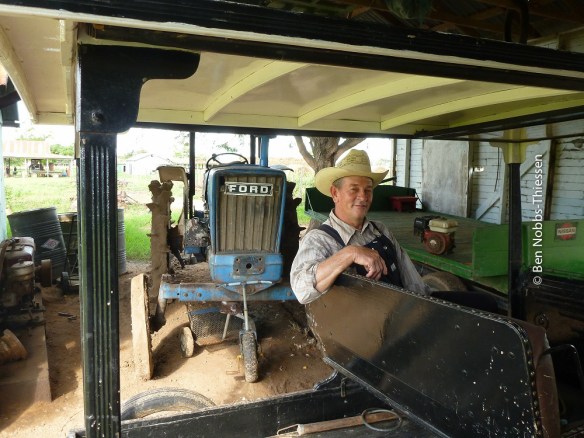
Enrique Siemens sits in his buggy during an interview with the author

What to make of this dual – and diametrically opposed – agrarian economy?  The respective meanings attached to cash cropping and dairy farming in Bolivian Mennonite colonies form a central aspect of my research.  Linked with nourishment and happiness in Siemens’ memories, daily family milk production seems to stand in opposition to the capital-intensive cash-cropping of export commodities like soybeans.  Indeed, even the income earned from the two activities is treated in different ways.  Harvest money might be invested in new land and machinery to expand one’s operations.  Milk money, by contrast, provides regular access to goods on credit at the colony’s small stores – particularly critical in drought years when the harvest might fail altogether.

An example of this form of accounting can be seen below for David Unger, a farmer in a nearby Paraguayan Mennonite colony.  For each two week period, daily milk production (morning and evening) is divided into that which was of a quality to be sold as milk and that which, due to its higher bacterial content, is only suitable for making cheese.  From those two balances Unger’s purchases at the colony store over the same period are deducted and the balance is passed on to him.

image-5

Jakob Unger’s biweekly balance sheet, Canadiense Colony

Yet, the intimate snapshot of daily milking can be deceptive.  Dairy, a fringe industry when Mennonites arrived in Santa Cruz, is now, like soybeans, big business.  It is no coincidence that both the milk and the soy produced in Mennonite colonies find their way to Santa Cruz’s sprawling industrial park.  There, across the highway from one another sit IOL Aceite, the largest oil-seed production plant in Bolivia and PIL Andina, the country’s sole major dairy distributor.

IOL has been encouraging Mennonite soy production with seed and credit since the mid-seventies.  In contrast, PIL only began to install collection centers on the edge of most major colonies in 2000.  This has led to changes for the company and for colonists.  Mennonites once processed all of their milk as cheese to be sold in the streets of Santa Cruz.  Farmer Cornelio Peters remembers that “before, the milk was worthless…there was too much [cheese] with all the Mennonites here in Bolivia.”

The arrangement between PIL and the Mennonites appears mutually beneficial.  The presence of the company has meant price stability for Mennonites, while the increased milk supply has also enabled PIL to double its production.  Riva Palacio alone produces approximately 100,000 liters of milk a day. On a tour of the installation in 2014, the operations manager explained that approximately four-fifths of their daily capacity of 500,000 liters came from Santa Cruz’s Mennonite colonies.

As Mennonites moved from independent producers of cheese – which everyone in Bolivia knows as “queso menonita” – to suppliers of a primary input for a large corporation, the potential for tension also exists.

Mennonite cheese (“queso menonita”) for sale in a La Paz grocery store

When I returned to Santa Cruz in 2015 I found Riva Palacio colony up-in-arms.  While PIL had been paying 2 Bolivianos and 30 centavos per liter for their milk, they had recently discovered that the minimum price to be paid to producers – by national decree – was three Bolivianos and fifty centavos.  A hastily formed “Mennonite Federation of Milk Producers” – representing 3000 families – was calling emergency cross-colony meetings, contracting lawyers, and petitioning PIL, the president of Bolivia, Congress and the Senate to demand “a fair price for Mennonite milk.”
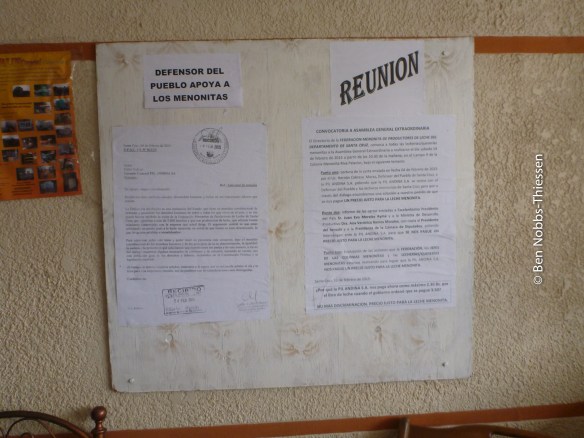
Letter from Ombudsman to PIL administration on behalf of Mennonites posted alongside a call for an Extraordinary Meeting of the Mennonite Federation of Milk Producers in the Mennonite Market in Santa Cruz de la Sierra

The above sketches of Mennonite soy and dairy demonstrate not simply the importance of different production strategies to the survival of colonists but the ways in which that daily production – on the fields and in the milking barns – is interwoven with regional and global markets.  Popular and scholarly approaches to Old Colony Mennonites have tended to accept the idea that these are “a people apart.”  Steel wheels and milk jugs at the end of the road tend to confirm such impressions.  Yet whether they are quietly acting as the largest producers of Bolivian soybeans or actively demanding a “fair price for Mennonite milk,” Old Colonists are embedded in broader economic structures.  This is a conversation – about Mennonite history and place-making – that we look forward to continuing at the University of Winnipeg next month.  Hope to see you there!
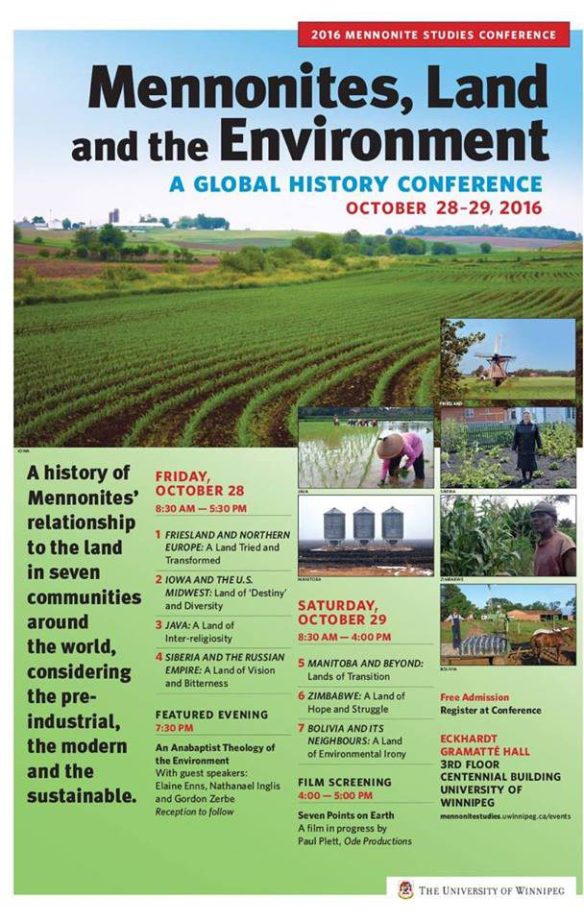
image-8

© Benjamin Nobbs-Thiessen 2016. Unauthorized use and/or duplication of this material (including images) without express and written permission from this author is strictly prohibited. Excerpts and links may be used, provided that full and clear credit is given to Benjamin Nobbs-Thiessen with appropriate and specific direction to the original content.
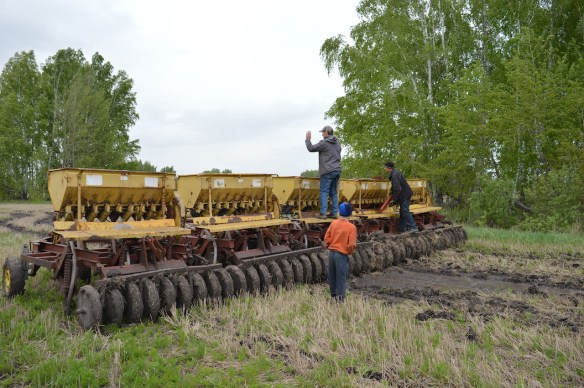
Mennonite Agriculture in Siberia: Past and Present

In the summer of 2015, I travelled to Siberia as a part of Royden Loewen’s Seven Points on Earth project. My task was to explore how Mennonites in Russia related to the land through interviews and archival research into the history of the village of Apollonovka (formerly Waldheim), located over 100 kilometres from the regional centre of Omsk and 35 kilometres from the nearest railway station. The village was established by Mennonite settlers to the region in 1911, after the tsarist state opened Siberia to agricultural settlement. The search for land propelled hundreds of Mennonite families to undertake the long trek from various parts of the empire to this new frontier.

planting-2

Late seeding after a wet spring

In the Russian empire, Mennonites showed a strong inclination to adapting their agricultural methods to address the challenges of the local environment. As David Moon has demonstrated, Mennonites performed an important role in the development of agriculture on the steppe, as they successfully planted trees to create shelter for their crops and protect the soil1 along with establishing irrigation methods to address the region’s semi-arid climate.2 In Siberia, Mennonites faced new challenges to adapt to local conditions, especially the shorter growing season. Initially, only some Mennonite farmers employed the four crop rotation method used in southern Russia; eventually most adopted this technique.3

It would be difficult to argue that Mennonites demonstrated adaptability in their agricultural practices out of a concern for the environment born out of their religious conviction. Instead of exemplifying a dedication to sustainable practices, this adaptability arguably reflected a strong commitment to efficient use of the land, rigorous hard work, and a quiet compulsion for wealth without excess materialism.

cows.JPG

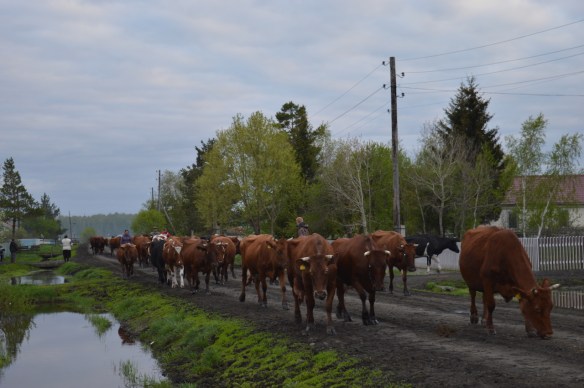
Cows returning home from for evening milking

Over a hundred years later, the Low German-speaking population of Apollonovka continues to live by the tenets of faith, family, and farming and shows many of the same characteristics despite the intervening years under the communist regime. In spite of current economic difficulties in Russia, locals expressed a strong belief in the future of their children and faith community. In addition to working for one of the three agricultural firms in the village, many have build small barns where they raise pigs for market. Like their ancestors, the inhabitants of Apollonovka have shown resilience and innovation, building local businesses that support the continuation of community life.


  1. David Moon, The Plough That Broke the Steppes: Agriculture and Environment on Russia’s Grasslands, 1700-1914 (Oxford: Oxford University Press, 2013), 176. 
  2. Ibid., 210. 
  3. Petr Epp, Ne ischezli po milosti Gospoda: Waldheim-Apollonovka, 1911-2011 (Steinhagen: Samenkorn, 2011), 83. 

Current Research on Early Modern Anabaptist and Spiritualist History: A Report from the 2016 SCSC

Bruges.jpg

Every year, scholars of the European Reformations gather to present papers at the annual meeting of the Sixteenth Century Society and Conference. The most recent annual conference was held in Bruges, Belgium, with over 1000 scholars in attendance. As it did at the 2015 conference in Vancouver, British Columbia, the Society for Reformation Research sponsored three panels on the Radical Reformation, and the papers presented at these panels showcased exciting new research on sixteenth- and seventeenth-century Anabaptist and Spiritualist topics and challenged established historiographical norms and categories.

The first panel, entitled New Approaches to the Radical Reformation, featured papers from James Stayer, Mary Sprunger, and me. I opened the panel by presenting a paper on Melchior Hoffman and the prophecies of Lienhard and Ursula Jost. The paper detailed the North German/Dutch Anabaptist founding father’s reverence for contemporary prophecy as equal in value to biblical prophecy and his approach to prophecy both scriptural and contemporary, which served to bolster his own authority in Melchiorite circles as its ultimate interpreter.1 James Stayer, professor emeritus at Queen’s University, presented a paper on The Blasphemy of Jan van Leiden, a work which first appeared in print in 1627 and was attributed to Menno Simons. Stayer outlined the controversy between Willem de Bakker and Helmut Isaak (both of whom accept Menno’s authorship) on the date the work was first written and suggested that the document was a forgery, as Christiaan Sepp had argued in the nineteenth century.2 Mary Sprunger of Eastern Mennonite University closed out the panel with a paper on the migration of Flemish (in the geographic rather than religious sense) Mennonites to Amsterdam following increased religious persecution in the Spanish Netherlands and their economic impact on Dutch Mennonite and Doopsgezind congregations, particularly in the area of trade.3

The second panel, entitled Religious and Social Radicalism in the Early Years of the Reformation, featured presentations from Geoffrey Dipple, Emese Bálint, and Roy Vice. Dipple, of the University of Alberta, revisited the question of who baptized South German Anabaptist founder Hans Denck. Dipple argued that Denck’s focus was far less on baptism than on the Lord’s Supper, and that if he himself was baptized at all, he was not baptized in Switzerland. Rather, as the polygenesis paradigm suggests, Denck’s form of Anabaptism was distinct from that of the Swiss Brethren.4 Bálint, of the European University Institute, presented a paper coauthored with Christopher Martinuzzi of the Scuola Normale Superiore on exchanges between Anabaptists and Saxon reformers in the early years of the reformation. The paper emphasized the widespread exchange of ideas in the early years of the Reformation and the fluid nature of religious identity, calling into question the divide between magisterial and Radical Reformations and arguing that given the multiplicity of influences that shaped every surviving sixteenth-century creed, the religions that began in the sixteenth century are best understood as composite religions.5 Roy Vice presented a third paper on the mockery of the sacred in the Peasants’ War. He particularly detailed the peasants’ frequent desecration of consecrated hosts, an action that evinced both anticlericalism and a denial of the Real Presence.6

The final panel, entitled Spiritualist Currents in the Radical Reformation and Their Long-term Impact, featured papers from Theo Brok, Gary Waite, and Michael Driedger. Theo Brok, of the Vrije Universiteit in Amsterdam, presented a paper on Anabaptism in the Lower Rhine from its origins to the 1550s. Brok maintained that the region developed a unique form of Anabaptism influenced by Johannes Campanus and a network of bishops unconnected to Menno Simons and Dirk Philips.7 Gary Waite, of the University of New Brunswick, gave a paper on the long-term impact of the Spiritualist hermeneutic, in which he traced relationships between Amsterdam’s seventeenth-century religious dissenters and argued that the Spiritualist emphasis on the inner word and distaste for dogmatism paved the way for a historical-critical approach to Scriptural revelation adopted by figures such as Baruch Spinoza.8 The panel’s final presenter, Michael Driedger of Brock University, challenged the very category of Radical Reformation, which had served as an organizing principle for this series of panels. Driedger argued that the idea of an essential unity between Anabaptists, Spiritualists, and other dissenters was an idea propagated not by members of these groups themselves, but rather in polemical literature written by their opponents.9

The complicated and interconnected currents of sixteenth-century religious thought continue to resist simple categorization, whether by academics seeking to present historical material in an accessible fashion or by religious groups seeking a neat and tidy origin story. Ongoing research on Anabaptists and other marginal sixteenth-century religious figures reveals both important distinctions between individuals and groups and the exchange of ideas both within and beyond confessional and sectarian boundaries. For those of us, Anabaptist or otherwise, who belong to a religious tradition, these findings offer an opportunity to reflect on the complicated and multifaceted nature of religious identity. Our forebears may not be our ideological twins, but nevertheless we, like them, are shaped not only by our upbringing—both the parts we reject and the parts we accept—but by the people and ideas we interact with over the course of our lives.


Works Cited

Bálint, Emese  and Christopher Martinuzzi. “Composite Religions: Encounters Between Early Saxon Reformers and the First Anabaptists.” Paper presented at the annual meeting for the Sixteenth Century Society and Conference, Bruges, Belgium, August 18-20, 2016.

Brok, Theo. “Johannes Campanus (ca. 1500–1575) and Early Anabaptism in the Lower Rhine.” Paper presented at the annual meeting for the Sixteenth Century Society and Conference, Bruges, Belgium, August 18-20, 2016.

Dipple, Geoffrey. “Who Baptized Hans Denck?” Paper presented at the annual meeting for the Sixteenth Century Society and Conference, Bruges, Belgium, August 18-20, 2016.

Driedger, Michael. “The Origins of the Radical Reformation in the Republic of Hateful Letters.” Paper presented at the annual meeting for the Sixteenth Century Society and Conference, Bruges, Belgium, August 18-20, 2016.

Moss, Christina. “‘Worth as Much as Jeremiah and Isaiah’: Melchior Hoffman and the Prophecies of Lienhard and Ursula Jost.” Paper presented at the annual meeting for the Sixteenth Century Society and Conference, Bruges, Belgium, August 18-20, 2016.

Sprunger, Mary. “The Impact of Flemish Mennonite Migration to Amsterdam in the Late Sixteenth Century and Early Seventeenth Century” (paper presented at the annual meeting for the Sixteenth Century Society and Conference, Bruges, Belgium, August 18-20, 2016).

Stayer, James. “‘The Blasphemy of Jan van Leiden’ (1627) by Menno Simons?” Paper presented at the annual meeting for the Sixteenth Century Society and Conference, Bruges, Belgium, August 18-20, 2016.

Vice, Roy. “Mocking the Sacred During the German Peasants’ War.” Paper presented at the annual meeting for the Sixteenth Century Society and Conference, Bruges, Belgium, August 18-20, 2016.

Waite, Gary. “The Spiritualist Hermeneutic and Its Long-Term Impact: From David Joris to Baruch Spinoza?” Paper presented at the annual meeting for the Sixteenth Century Society and Conference, Bruges, Belgium, August 18-20, 2016.


  1. Christina Moss, “‘Worth as Much as Jeremiah and Isaiah’: Melchior Hoffman and the Prophecies of Lienhard and Ursula Jost” (paper presented at the annual meeting for the Sixteenth Century Society and Conference, Bruges, Belgium, August 18-20, 2016). 
  2. James Stayer, “‘The Blasphemy of Jan van Leiden’ (1627) by Menno Simons?” (paper presented at the annual meeting for the Sixteenth Century Society and Conference, Bruges, Belgium, August 18-20, 2016). 
  3. Mary Sprunger, “The Impact of Flemish Mennonite Migration to Amsterdam in the Late Sixteenth Century and Early Seventeenth Century” (paper presented at the annual meeting for the Sixteenth Century Society and Conference, Bruges, Belgium, August 18-20, 2016). 
  4. Geoffrey Dipple, “Who Baptized Hans Denck?” (paper presented at the annual meeting for the Sixteenth Century Society and Conference, Bruges, Belgium, August 18-20, 2016). 
  5. Emese Bálint and Christopher Martinuzzi, “Composite Religions: Encounters Between Early Saxon Reformers and the First Anabaptists” (paper presented at the annual meeting for the Sixteenth Century Society and Conference, Bruges, Belgium, August 18-20, 2016). 
  6. Roy Vice, “Mocking the Sacred During the German Peasants’ War” (paper presented at the annual meeting for the Sixteenth Century Society and Conference, Bruges, Belgium, August 18-20, 2016). 
  7. Theo Brok, “Johannes Campanus (ca. 1500–1575) and Early Anabaptism in the Lower Rhine” (paper presented at the annual meeting for the Sixteenth Century Society and Conference, Bruges, Belgium, August 18-20, 2016). 
  8. Gary Waite, “The Spiritualist Hermeneutic and Its Long-Term Impact: From David Joris to Baruch Spinoza?” (paper presented at the annual meeting for the Sixteenth Century Society and Conference, Bruges, Belgium, August 18-20, 2016). This paper is related to an ongoing research project on religious dissent in England and the Low Countries entitled Amsterdamnified and helmed by Waite and Michael Driedger. See more at http://amsterdamnified.dutchdissenters.net/wp/
  9. Michael Driedger, “The Origins of the Radical Reformation in the Republic of Hateful Letters” (paper presented at the annual meeting for the Sixteenth Century Society and Conference, Bruges, Belgium, August 18-20, 2016).