David Rempel Smucker Responds to “Mennonite Genealogy and Racial Privilege”

This is a response to “Mennonite Genealogy and Racial Privilege” by Ben Goossen.

David Rempel Smucker

Mennonites doing genealogical research may or may not have undesirable attitudes about racial privilege. Goossen works from one case—Christian Z. Mast—out of the thousands of Mennonites who have done genealogical research. In my twenty-two years (1981-2003) of assisting people doing historical and genealogical research at the Lancaster Mennonite Historical Society library and archives (Lancaster, Pa.), I encountered many people in the following two categories: Mennonites who discovered information about non-Mennonite ancestors, and non-Mennonites who discovered their Mennonite and Amish ancestors. Both gained an enlarged sense of lineage from their genealogical study. These researchers emerged with an expanded identity that incorporated people of varied religious and ethnic persuasions.

These researchers emerged with an expanded identity that incorporated people of varied religious and ethnic persuasions.

Goossen also calls the vigorous interest in family history research among Mennonites “uncommon,” as if that interest is higher than that of other denominations. My years at Lancaster Mennonite Historical Society acquainted me with many other denominational and ethnic groups with historical and genealogical organizations. Of course, the Latter Day Saints (Mormons) is perhaps the denomination with the most interest in genealogy. In my experience, they were very generous in their willingness to share their vast historical resources with all researchers. They also quickly discovered how many contemporary Mormons had non-Mormon ancestors, and vice-versa.

To suggest that “Mennonite family history research is intimately connected to issues of racial privilege,” as Goossen does, is far too sweeping. It is similar to saying that I know a racist plumber, so I conclude that plumbing has an affinity to racism. Christian Mast’s ideas on race and culture are mistaken and lamentable, but one case does not constitute sufficient proof. Nor does that racism totally ruin the genealogical value of his book.  To show that Mennonite genealogy in Germany in the 1930s was influenced by Nazi ideology on race does not support generalizations about all Mennonite genealogy.  


David Rempel Smucker, Ph.D., former staff of Lancaster Mennonite Historical Society, a resident of Winnipeg, Manitoba.


See also:


Who Calls Whom Racist, and What’s the Privilege With That?

This is a response to “Mennonite Genealogy and Racial Privilege” by Ben Goossen.

Philipp Gollner

I would rather not smoke a pipe with Mr. Mast. He’ll compliment me on my German accent, and how tall and “sterling” I am. Privilege, for this outsider. But I would rather not chat it up with “Genealogists against Inequality” either. They’ll tell me that it’s really, really, really, ok that I don’t have Mennonite relatives. They’ll say “diversity” thirty-four times. And, oh no, we’re not a tribe. Only peace and justice, that’s what we’re tracking.

I cheer Goossen’s probing of the artifacts of Mennonite belonging. Mennonite material culture remains understudied, even as Mennonites’ merging of ethnic and religious cultures continues to yield plenty of sacred stuff.

On a larger scale, however, I wonder if there aren’t eerie similarities between early twentieth-century version of American Mennonite purity and contemporary highbrow Mennonite longings for the post-ethnic. And I suspect that any real investigation of privilege in Mennonite history in the United States is ill-served by the N-word (that is, Nazi)—because too often, the N-word hits bottom as a convenient, anachronistic catch-all; because most “Mennonite ethnicity” in North America is much older and more complex; and because Mennonite privilege, even purity, are now passed on through more than blood.

Might enlisting genealogy again in the cause of a more perfect church—a post-ethnic one, this time—continue, not disrupt, this puritan streak of Mennonite mapping?

Those with enough brains to write, and enough politics to pull in the church, mapped Mennonite racial purity in early twentieth-century America. They weren’t only keepers of memory—they also pruned the family tree, made it more presentable. They were activists for the church’s present relevance and its future purity. (Mast, by the way, represented a progressive group that soon dropped the term “Amish” altogether.)

Might enlisting genealogy again in the cause of a more perfect church—a post-ethnic one, this time—continue, not disrupt, this puritan streak of Mennonite mapping? Doesn’t it simply perpetuate the original Mennonite desire for a fresh break, a clean sheet? And could such an exculpation make authentic relationships with non-white Anabaptists, who often rely on the messy transmission of ancestry and culture for a vital faith community, even more awkward?

More importantly, the building blocks of Mennonite aristocracy have changed from Blut und Boden to subtler forms of privilege: educational opportunities, denominational connections, the right ideas. Mennonite parents of my and Goossen’s generation won’t tell their young ones what a “stern” race theirs is. They access other privilege: they will tell their children to be “world-changers,” before they ever show a photo of their great-grandmother. They will humblebrag that their child has never eaten at McDonald’s, but loves vegan curry. Doesn’t know football, but is the bestest peacemaker of them all in second grade. Swims in a pool of Mennonite social capital, but grows up with the assumption that the virtue of studying its history lies chiefly in uncovering its oppressive character.

Therein, too, is purity. Therein, too, is privilege—and its passing on. And to the extent that an openly worn revulsion against the unbearable Teutonism of many North American Mennonite bloodlines helps us white progressives mask this privilege while accumulating another (think: “world changers”), it is no way forward.

I have no Mennonite ancestors. Sometimes I wish I would. The one grandparent who was an National Socialist soldier was a socialist, and deserted in 1944. Sometimes I wish I had a Nazi Other to point at. My daughters are growing up binational, bilingual. Sometimes I wish their belonging was clearer. But my diverse non-Anabaptist students find us educated white Mennos most grating when we preach color-free virtue, not when we are a tribe, warts and all. And most times, I’m with them.

Whither genealogists? I don’t even know if it’s my business as a historian to tell them. Poking Mennonite privilege with the help of history, however, will take more than the obvious scrutiny of race science. Instead, it might make collateral damage out of many of us white progressives.


Philipp Gollner (Ph.D., University of Notre Dame) is an Assistant Professor of U.S. History at Goshen College. Most recently, he is the author of “How Mennonites Became White: Religious Activism and Cultural Power.” Mennonite Quarterly Review 90 (April 2016). Catch up with him on twitter, or philippgollner.com


SEE ALSO:

Mennonite Genealogy and Racial Privilege

Editor’s Note: In keeping with the mission of Anabaptist Historians to foster lively debate on important topics, we have solicited responses to this post from several experts. Check in over the coming weeks to follow the discussion or contact us to submit your own contribution.

Ben Goossen

A tour of my parents’ house is also a journey into our family’s past. Tables, china hutches, and clocks carry stories of craftsmanship in Europe or of pioneer life in Nebraska, Kansas, or South Dakota. Here a bowl that crossed the Atlantic, there a Bible from Prussia. All are bound up with tales of our ancestors’ faith, of the Anabaptist values that—so the story goes—led them from country to country in search of peace, shelter, and good, hearty land.

14914599_3711188936990_746584616_n

A “memory box” depicting the pioneer life of Mennonite immigrants from Russia.

Like other “ethnic” Mennonites across Europe and the Americas, I learned from a young age to associate my religion with genealogy. A “memory box,” perched in a place of honor in my parents’ library, shows how family stories and material objects can interweave the threads of faith and ancestry. Constructed by my great-grandmother, the box contains photographs of her own grandparents, Jacob and Suzanne Balzer, who emigrated from southern Russia to Minnesota; an invitation to the wedding of their daughter; dried straw flowers; silk worm cocoons and a silk spool; nineteenth-century German-language storybooks; heirloom seeds; and part of a shirt sewn in Russia. The box uses artifacts to build a cultural atmosphere around memories of Mennonite immigration to the United States. My forebears, the objects imply, were straight-laced and pious. They spoke German. They worked with their hands and found fulfillment in tending the soil.

Over the past century, white Mennonites have expressed uncommon interest in their ancestry. Children’s books, historical scholarship, and memoirs often follow family narratives or depict the supposedly upright and persevering character of the “Mennonite people.” I can only begin to enumerate the ways my own life has been shaped by ancestral knowledge: The largest book in my childhood room was a genealogy compiled by my grandmother. Whenever I meet “ethnic” Mennonites from Europe or the Americas, new acquaintances hear my last name and recognize me as one of their own. As a historian of Anabaptism, I frequent websites maintained by amateur genealogists, who have located an amazing number of rare documents; a printout of my own family tree from one Mennonite database revealed hundreds of direct forebearers over seventeen generations, the earliest dating to the sixteenth-century Reformation.

It is remarkable that although Anabaptist studies is a well-developed field, no scholar has yet written a history of Mennonite genealogical practices. Family researchers themselves often assume that genealogy has always been a normal and important part of Anabaptist life. Yet as historians of ancestry are beginning to demonstrate, genealogy as we understand it today is quite a recent concept, finding widespread acclaim only in the last hundred and fifty years. While some communities, Anabaptist and otherwise, had long recorded birth, death, and baptismal dates in family bibles or congregational record books—perhaps finding inspiration in the genealogies of Jesus as presented in the New Testament—it was not until the second half of the nineteenth century that such information became subject to rigorous study and publication.1 And far from an ideologically neutral undertaking, genealogy in the modern era emerged largely in the context of scientific racism and social exclusion. “From the 1860s to the mid-twentieth century,” writes François Weil in his recent book, Family Trees: A History of Genealogy in America, “racial purity, nativism, and nationalism successfully dominated the quest for pedigree.”2

14881727_3711189216997_391176032_o

Christian Mast (1885-1974), Amish Mennonite historian and genealogist.

To what degree can this charge be leveled at Mennonite genealogy? I have argued elsewhere that the blossoming of Mennonite family research in 1930s Germany intimately reflected Nazi-era concerns with blood purity and racial hygiene.3 Comparable practices in other countries developed under different, if interrelated, circumstances. My hope is that this essay will spur more sustained inquiry into the origins and nature of Mennonite family research, especially in North America. This is not the space to provide a full sketch of what such an undertaking might entail. But I can indicate some of the possibilities through a short case study: a look at the genealogist Christian Mast and his book, A Brief History of Bishop Jacob Mast and Other Mast Pioneers, printed in 1911 by the Mennonite Publishing House.

The son of an Amish Mennonite Bishop from Pennsylvania, Christian Mast wrote his Brief History while still in his mid-20s. It appeared at a time when genealogical interest was rising among Anabaptists as well as wider American society. “Never before have people been more inquisitive and diligent in investigating the study of their ancestry than at this time,” Mast explained in his introduction, noting that although only a minority of US citizens knew much about their heritage, “it is a matter of congratulation that some are turning attention to family genealogy.”4 The author himself gathered material from relatives scattered across Pennsylvania, Ohio, Iowa, and Indiana—and he corresponded with other Anabaptist genealogists researching the Funk, Oberholzer, Hostetler, and Wenger families. Upon completion, Mast sent a copy of his book to the United States’ oldest and largest repository of ancestral knowledge, the New England Historic Genealogical Society.5

Although his extensive papers await detailed analysis, it is clear that Mast was well-read in both American history and the scientific study of ancestry. His Brief History opens with a discussion of the alleged racial prowess of America’s white pioneers, supported by quotations from the likes of Daniel Webster and Henry Clay. In a section on heredity, the author dwelled extensively on the relationship between ancestry and virility, invoking the nineteenth-century phrenologist George Combe to advocate a far-reaching eugenic program. “As a nation’s greatness depends upon the character of her population,” Mast wrote, “it is the duty of every government to bestow at least as much attention upon the improvement of her human stock, as agricultural societies expend upon the improvement of the breeds of their horses and cattle.”6 Warning in particular against degeneration through endogamous marriage, he praised spousal selection as a means of preventing heredity diseases, bodily deformities, mental retardation, and even moral failings.

14914934_3711205817412_702325373_n

This frontispiece to Christian Mast’s Brief History shows the homestead of the author’s ancestor, Jacob Mast, who migrated from Switzerland to Pennsylvania in 1750.

In its discussion of American nationhood, Mast’s Brief History identified a privileged role for Anabaptist bloodlines. “[O]ur Swiss and German ancestors,” the genealogist opined, “were the pure material of the Teutonic nation; being stern, sterling and frugal.” While Mast acknowledged that some of his relatives had become soldiers, fallen into evil ways, or otherwise lived “without God,” he maintained that most had led exemplary Christian lives of nonviolent witness. The writer especially contrasted Anabaptist qualities with those of Native Americans, whose “physical and mental power have… melted into weakness.” While the diligence, industriousness, and farming acumen of Amish and Mennonite settlers were said to exemplify the “bone and sinew of a nation,” inbreeding had supposedly left people of color with limited mental and physical abilities. When narrating Indian attacks against early Anabaptist immigrants, for instance, Mast emphasized the animal-like nature of these “savages,” in turn justifying his forebearers’ seizure of native lands.7

To what extent were Mast’s views typical of Mennonite genealogists at the beginning of the twentieth century? And in what ways do racist undertones continue to inform family research in Anabaptist communities today? A full answer to these questions awaits further study. It is nevertheless telling that although most Mennonites living across the world today are people of color, popular stereotypes continue to associate the denomination with white “ethnic” members of Germanic descent. Genealogy has remained an avenue for white Anabaptists to identify their families’ longstanding adherence to the faith, and in many cases, to trace their ancestry to the religion’s origins in Reformation-era Europe—a possibility unavailable to most members of color. Moreover, the recent advent of DNA testing and genetic research among “ethnic” populations are once again privileging the notion that Anabaptism is as much an inheritable trait as a religious conviction.8

Mennonite family research is intimately connected to issues of racial privilege. Whether in the seemingly innocuous memorial culture of my parents’ home or in the overtly racist language of historic figures like Christian Mast, it is time to take seriously its ideological power. It is time to ask how genealogists, along with the rest of us, can respond to inequalities within the church and beyond.

Thanks to Rachel Waltner Goossen and Joel H. Nofziger for their assistance with this essay.


SEE ALSO:


  1. Early examples of Mennonite genealogical publications include Jacob N. Brubacher, The Brubacher Genealogy in America (Elkhart, IN: Mennonite Publishing Co., 1884); John H. Hess, A Genealogy of the Hess Family from the First Emigrant to this Country Down to the Present Time as Far as Could Be Ascertained (Lititz, PA: Express Print, 1896); Franklin Keagy, A History of the Kägy Relationship in America from 1715 to 1900 (Harrisburg, PA: Harrisburg Publishing Company, 1899); Theodore W. Herr, Genealogical Record of Reverend Hans Herr and his Direct Lineal Descendants from his Birth A. D. 1639 to the Present Time Containing the Names, etc., of 13223 Persons (Lancaster, PA: The Examiner Printing House, 1908). 
  2.  François Weil, Family Trees: A History of Genealogy in America (Cambridge: Harvard University Press, 2013), 6.  
  3.  Benjamin W. Goossen, “From Aryanism to Anabaptism: Nazi Race Science and the Language of Mennonite Ethnicity,” Mennonite Quarterly Review 90 (April 2016): 135-163. 
  4.  C. Z. Mast, A Brief History of Bishop Jacob Mast and Other Mast Pioneers and a Complete Family Register and Those Related by Inter-Marriage (Scottdale, PA: Mennonite Publishing House Press, 1911), 12. See also the co-authored volume, C. Z. Mast and Robert E. Simpson, Annals of the Conestoga Valley in Lancaster, Berks, and Chester Counties, Pennsylvania (Scottdale, PA: Mennonite Publishing House, 1942), which contains extensive genealogical information on Anabaptist families. 
  5.  The New England Historic Genealogical Society thanked Mast in Wm. P. Greenlaws to C. Z. Mast, March 21, 1912, Mast, Christian Z., Papers, box 2: Correspondence C. Z. M. (Annals-N.C.), folder 4: Mast Genealogy, Lancaster Mennonite Historical Society. Mast’s name also appeared in “List of Donors to the Library,” The New England Historical and Genealogical Register (Supplement to April Number, 1913): xxxi. 
  6.  Mast, A Brief History, 749. On pages 748 and 749, he quoted a passage on physical and mental degeneracy from George Combe, Moral Philosophy; Or, The Duties of Man Considered in His Individual, Domestic, and Social Capacities (New York: Fowler and Wells, 1863), 85. Scholars have noted the centrality of such arguments, as well as of genealogical practices generally, to the rise of eugenics programs in the late nineteenth and early twentieth centuries. See Alison Bashford and Philippa Levine, eds., The Oxford Handbook of the History of Eugenics (Oxford: Oxford University Press, 2010), 9-10. 
  7. Quotations from Mast, A Brief History, 12-13, 18, 748. 
  8.  On genetic testing among “ethnic” Mennonite populations, see for example Cheryl Rockman-Greenberg and Marlis Schroeder, “Mennonites, Hypophosphatasia and Severe Combined Immunodeficiency Disease: The Story of Two Genetic Disorders,” Journal of Mennonite Studies 34 (2016): 89-104. Recent scholarship on the genetic reinscriptionof race includes Nadia Abu El-Haj, The Genealogical Science: The Search for Jewish Origins and the Politics of Epistemology (Chicago: University of Chicago Press, 2012), and Alondra Nelson, The Social Life of DNA: Race, Reparations, and Reconciliation After the Genome (Boston: Beacon Press, 2016). 

Encounters with the Spirit: Anabaptists in the Charismatic Movement (Part 1)

At the start of this year, I queried the Anabaptist-Mennonite scholars I follow on Twitter and Facebook:

My scholar friends suggested a few books — mostly theological/pastoral texts, rather than historical treatments. Fortunately, they weren’t the only ones to respond: my pastor friends (especially in Mennonite Church USA) offered lots of suggestions. They pointed me to groups such as the Hopewell Network, a group of formerly Mennonite churches born through charismatic outpourings that split off from Atlantic Coast Conference in 2001 after it developed a more “interdenominational vision” of ministry, as well as to specific Mennonite individuals and congregations influenced by the charismatic movement. They even offered to set up some oral history interviews for me! But they also couldn’t point to any historical treatments of the subject.

The whole interaction confirmed what I already suspected: Anabaptist-Mennonite historians have paid very little attention to charismatic expressions within the traditions they study. While much—though not enough—ink has been spilled trying to understand the roles played by Anabaptists in the post-World War II evangelical renewal movement, little to no scholarly effort has been directed toward Anabaptists’ role in charismatic renewal. But as my pastor-friends’ comments showed, the historiographical silence belies the reality that lots of Mennonites and Brethren in Christ have embraced and been influenced by charismatic beliefs and practices.

This silence is telling, because it reminds us of the problematic ways that Mennonite historians have typically framed the influence of renewal movements (especially post-World War II evangelical renewal) on Mennonites. Here’s how David R. Swartz has described the conventional historiography:

The usual narrative is one of declension, a story of evangelicalism’s insensitivity to the perils of militarism, of getting into bed with American culture, of more concern for theological particularities and not enough concern for ethics, of its easy denunciation of abortion and its defense of capital punishment. . . . Its logic assumes both a caricatured evangelicalism (pictured as fundamentalist vultures) and Mennonitism (pictured as pristine pacifists). 1

Historians will recognize that the declension mode frames other stories of Mennonite encounter, including the colonial-era encounter between North American Mennonite immigrants and radical Pietists.2 Yet as Swartz concludes, while there is truth in the declension narrative critique, this framework is too simplistic.3 Telling the story of Anabaptists in the charismatic movement offers historians an opportunity to move beyond the “simplistic” declension narratives and to explore alternative ways of talking about Mennonites and the broader Protestant world.

A conference held at Wycliffe Hall, Oxford University, UK

A conference held at Wycliffe Hall, Oxford University, UK

I’m still in the process of sorting out how and why Mennonites and Brethren in Christ took part in charismatic renewal, and what their involvement means for the story of North American Anabaptism in the twentieth century. I shared some of my initial thoughts at a conference in September — “Charismatic Renewal: Historical Perspectives, 1950-2000,” a two-day event at Wycliffe Hall at Oxford University in the UK. In the next couple of posts in this series, I’ll draw on the paper I presented at that conference to set out a few tentative ideas about Anabaptist-Mennonites and the meaning of their encounters with the Spirit in the last half of the twentieth century. Stay tuned!


  1. David R. Swartz, “New Directions in North American Mennonite History,” The Mennonite Quarterly Review 81 (January 2007): 72. 
  2. Ibid. 
  3. See, for instance, the first half of Robert Friedmann, Mennonite Piety Through the Centuries: Its Genius and Its Literature (Scottdale, Pa.: Herald Press, 1949). For a critique of the “Friedmann thesis” when it comes to Anabaptism and Pietism, see Chris Gehrz, “The Friedmann Thesis,” The Pietist Schoolman, https://pietistschoolman.com/2011/07/05/the-friedmann-thesis/ 

You shall not oppress a refugee. You know the heart of a refugee, for you were refugees in the land of Egypt. (Exodus 23:9)

shenandoah-valley-sept-1864
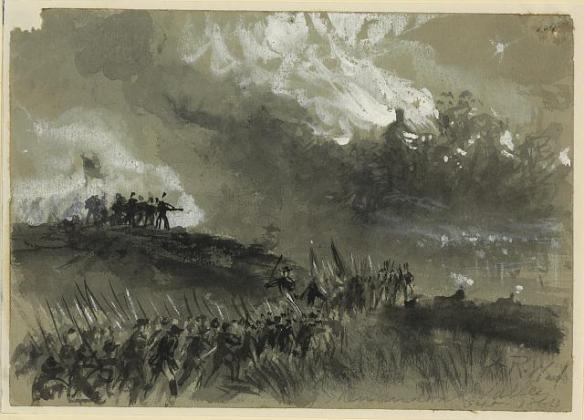
Shenandoah Valley, Sept. 1864. Alfred R. Waud.

Diaries give us a unique, intimate look into the lives of people throughout history. They have a special ability to shed light on our present realities by exposing similarities and differences in daily life across time.

The Virginia Mennonite Conference Archives, located on the first floor of EMU’s Hartzler Library, is fortunate to have the diaries of Emanuel Suter, a Mennonite potter from the Shenandoah Valley. His diaries span nearly 40 years (1864-1902), and today I will highlight some entries from early October 1864, almost exactly 152 years ago. In September 1864, under the direction of General Sheridan, the Union army began a systematic burning of the Shenandoah Valley, which was known as the “breadbasket of the Confederacy”. Fearing for their safety and facing the destruction of their homes and livelihoods, Suter and his family, along with other Mennonite and Brethren families from the Valley, made the difficult decision to leave the Valley and were escorted to safety in the North by the Union army1 Here are his reflections on that trek:

Diary commencing the 5th day of October 1864

The federal army being in the valley of Virginia, burning barns dwelling houses mills &c a general destruction was threatnt [sic]. Myself and family decided to leave the Shenandoah Valley and go north. In the morning of the 5th day of October we left went to Harrisonburg then went with the army to Mt. Jackson, there we remained that night and all the day of the 6. I will here mention that my family at this time consisted of myself and wife Elizabeth, three children Daniel Reuben, Susan Virginia, John Robert…The sister Margaret Suter and father Daniel Suter were with us. Brother Christian Suter, also belonged to the family but he and a young man Albert Jenkins were back in the rear but came to us on the way.

On the morning of the 7th we were ordered to get in readiness to move at one o’clock we with the Army started down the Valley Pike, I will also mention here, that at Mt. Jackson we found many families of the Valley that we knew also going some north and some west. we were now pushed on hurretly [sic] in a fast walk but most of the time in a trot. This evening we came to Cedar Creek where we put up for the night. Here we had some trouble keeping my horses from being stolen. Father and I took turn about guarding them. One fellow cut the halter strap while in Father’s hand but found that he was seen and got away quickly.

This morning the 8th which was Saturday. The Army soon move down the valley2 We traveled like the day before mostly in atrot two wagons in abrest. We past through Winchester and at night we stopped at a place called Bunker Hill. It turned cold during the day. It was cold and blustery all night. We were constantly compelled to keep an eye on our horses, our nights rest was not at all comfortable. We had considerable trouble keeping warm.

The morning of the 9th Sunday we moved towards Martinsburg [WV]. We arrived there at 8pm. Here we spent another cold night out in an open field

The morning of the 10th Monday we moved on an old sawmill where we remained camped until the 12th. The two days while there all that were going north and west were required to take the oath of allegiance.

We left for Maryland, traveled nearly all day. At night myself and my family came to old John Horst we remained with him the next day and that night. The same day [the 13th] myself Father Suter Brother Christian…started with the wagons and…crossed the little South mountain through Adams and York counties. The first night we came to Christian Muslemans [sic]. We had some trouble to get a place to stay the people did not trust us they thought we were rebels but this man received us and treated us kindly.

We were away from home under very unfavorable circumstances, yet we engaged ourselves as well as could be expected. We were in a strange country and surrounded with everything quite different to what we were used to, but kind friends made us comfortable.3

By the time the Suter family reached their destination of Lancaster, Pennsylvania, they had traveled over 200 miles, mostly by foot.

Many Mennonites in North America today live lives of comfort, privilege, and stability. It is easy to see the news and feel removed from the experience of refugees whose troubles seem worlds away from our day-to-day life. It is also easy to forget that it wasn’t long ago that Mennonites were driven from their homes with little warning and forced to settle in new places to ensure safety for their families. The Suters fled just 150 years ago. Many Russian Mennonites had to flee the hostile Soviet regime in the early 20th century.4 And even today, Anabaptists in the Global South face intolerance and fear for their safety.5

Emanuel Suter wrote that at times it was hard to find a place to stay as “the people did not trust us.” Many refugees today are also met with hostility, xenophobia, and violence as they flee dangerous homelands and attempt to find security for their families. In Suter’s diary he notes the names of each person or family who helped his family and expresses his appreciation for “kind friends who made us comfortable.” We should remember the people throughout history who helped Mennonites in their time of need and seek to be helpers as well.

To learn more about the refugee wagon train that took many Mennonites out of the Shenandoah Valley during the Civil War, you can read Shenandoah Mennonite Historian’s Autumn 2014 edition (v.22 n.4), or the book The Burning by John L. Heatwole.

To learn more about how you can help the cause of refugees today, visit Mennonite Central Committee’s website.

Works Cited:

1864 Diary, Box 1, I-MS-31, Emanuel Suter Diaries 1864-1884, Virginia Mennonite Conference Archives.

Epp, Frank H., Mennonite exodus; the rescue and resettlement of the Russian Mennonites since the Communist Revolution. (Altona, Manitoba : Canadian Mennonite Relief and Immigration Council, 1962).

Heatwole, John L. The Burning : Sheridan’s Devastation of the Shenandoah Valley. (Charlottesville, Va. : Rockbridge Pub., 1998).

Waud, Alfred R. , Artist. Shenandoah Valley, Sept. 1864. September, 1864. Image. Retrieved from the Library of Congress, https://www.loc.gov/item/2004660274/. (Accessed October 13, 2016.)


  1. Heatwole, The Burning, 30. 
  2. This means north. Valley folk use the northern flow of the Shenandoah River rather than traditional cardinal directions to indicate direction in the Valley. So you go “down” (North) to Winchester and “up” (South) to Roanoke. 
  3. Suter, 1864 Diary, 1-9. 
  4. Epp, Mennonite Exodus, 139-155. 
  5. For example, consider the violence and persecution facing Ekklesiyar Yan’uwa a Nigeria (Church of the Brethren in Nigeria). 

Will the Amish Vote for Donald Trump?

Javan Lapp

As the 2016 Presidential election heads into its final stretch, Americans are once again debating the merits of different candidates. Deeply held beliefs and perceptions of national identity and priorities are spilling out into everyday conversations wherever people meet or work. As the media and citizenry alike watch the political landscape for clues of emerging trends, the Amish have been featured in occasional speculation about electoral allegiances. Because “Anabaptist Historians” probes Anabaptist histories in an effort to connect the contemporary issues to the past, this post will attempt to provide historical context for the question: “Will the Amish vote for Trump?”

Media Interest

Media interest in the question of Amish support for Trump began in May when the Lancaster, Pennsylvania newspaper LNP first ran an article reporting on the creation of Amish PAC, a political action committee run by professional political operatives whose goal was to drive up Amish turnout and support for the GOP ticket. The article noted that this new group was an entirely new innovation “because it is being run by political professionals from inside the Washington Beltway instead of by local party workers or campaigns.”1 The creation of Amish PAC did not go unnoticed by other media, and several weeks later Politico carried an article entitled “Amish for Trump.” The premise for the article was spelled out rather clearly in the subtitle/explanation line: “Can Ben Carson and Newt Gingrich allies convince this anti-divorce, tech-shunning group to back the boasting billionaire?”2

Media attention continued to follow the activities of Amish PAC. In July, LNP reported on the Amish PAC’s launching of newspaper ads and billboards.3 These ads have been placed in publications read by the Amish and have explicitly targeted Amish and other Plain group participation in the 2016 election. The strategy of these Amish PAC ads was to introduce Donald Trump as a successful businessman who would stand up to political corruption. In August, The Philadelphia Inquirer took notice of the activities of Amish PAC,4 and US News and World Report carried an article by Kyle Kopko entitled, “Will the Amish turnout for Trump? Don’t Bet the Farm.”5 Kopko’s article reviewed the research he did with Donald Kraybill analyzing the effort to convince the Amish to turnout for George W. Bush in the 2004 election.6

Media attention to Amish support of Donald Trump intensified after Trump held a large rally in western Lancaster County. On September 30, 2016, Trump made held a rally at the Spooky Nook Sports Complex in Manheim, Pennsylvania. The crowd size was estimated at 6,000 people. Although there wasn’t a specific Amish outreach component to the rally in this strong GOP stronghold, Trump was clearly aware that he was in Amish Country as he made note of the tenth anniversary of the Nickel Mines Amish school shooting.7 Numerous media reports after the rally took note of Amish attendance at the rally, including LNP8 and Al Jazeera.9

Historical Precedent – 2004

Donald Kraybill and Kyle Kopko’s previously cited analysis of the participation of Lancaster County Amish in the 2004 election is a thorough review of a very aggressive effort to use the Amish as a new electoral tool to help boost Republican support in swing state Pennsylvania.  The below points are a few summary points from their research:

  1. While voting is not anathema to all Amish or forbidden by the Ordnung that governs Amish life, there is a strong reluctance to political participation. This reluctance is tied to communal and theological values and is hard to overcome.
  2. The Republican outreach attempts of 2004 were bolstered by strong community advocates and three separate visits Bush made to the area that included direct meetings with the Amish. In these meetings Bush impressed the Amish with humble and folksy demeanor they could relate to and trust.
  3. Many Amish identified with key item’s in Bush’s 2004 platform, especially related to traditional values and opposition to abortion and gay marriage.
  4. In the fall of 2004 approximately 20.6% of voting-age Amish in Lancaster County were registered to vote. The 2,134 Lancaster County Amish that were registered to vote in 2004 represented a large jump from the 598 who were registered to vote in 2000. Nearly all of them (92.6%) were registered as Republicans. Amish voter turnout in 2004 was 62.9%, meaning approximately 13% of voting-age Lancaster County Amish cast a ballot in 2004.
  5. Despite the pre-election rhetoric about the role the Amish could play in a swing state like Pennsylvania, the 1,342 Lancaster County Amish who voted in 2004 was a statistically small number compared to the 144,248 vote margin by which Bush lost Pennsylvania to Kerry.
  6. Kraybill and Kopko also noted that Amish voter registration and turnout percentages were more than double that of Old Order Mennonite groups in the county.

If the historical precedent of 2004 has much relevance to the question of whether Amish will vote for Donald Trump on November 8, we can expect the Amish PAC and politically active Amish to provide the backdrop for interesting conversations in Lancaster County.  To expect a large shift in Amish voter participation, however, would be to expect Trump to have far greater appeal to the larger Amish community than Bush did.  Now there’s a question that history won’t be able to answer until November 9.


  1. Sam Janesch, “New PAC looks to get Amish vote for Donald Trump,” LNP Online, May 15, 2016, http://lancasteronline.com/news/politics/new-pac-looks-to-get-amish-vote-for-donald-trump/article_45bad350-1949-11e6-a23a-33ecffcf4a7f.html 
  2. Katie Glueck,”Amish for Trump,” Politico, May 29, 2016, http://www.politico.com/story/2016/05/donald-trump-amish-voters-223669 
  3. Sam Janesch, “Amish PAC launches newspaper ads to introduce the Plain community to Donald Trump,”  LNP Online, July 14, 2016, “http://lancasteronline.com/news/politics/amish-pac-launches-newspaper-ads-to-introduce-the-plain-community/article_b5b2b7c8-4940-11e6-8b28-a7a06b9a1fc7.html
    http://lancasteronline.com/news/local/have-you-seen-these-donald-trump-billboards-going-up-in/article_ce962892-5403-11e6-af72-4fec2f4dc67e.html 
  4. Michael Matza, “For Donald Trump, the Plain People are plainly in play,” Philly.com, August 15, 2016, http://articles.philly.com/2016-08-15/news/74996709_1_amish-people-donald-trump-amish-horse-and-buggy 
  5. Kyle C. Kopko, “Will the Amish turn out for Donald Trump? Don’t bet the farm,” U.S. News and World Report, August 4, 2016, http://www.usnews.com/news/articles/2016-08-04/will-the-amish-turn-out-for-trump-dont-bet-the-farm 
  6. Donald B. Kraybill and Kyle C. Kopko, “Bush Fever:  Amish and Old Order Mennonites   in the 2004 Presidential Election,” Mennonite Quarterly Review 81 (July 2007), 165-205.  Also available online at http://www.kylekopko.com/Research_files/Bush_Fever.pdf 
  7. Sam Janesch, “Donald Trump bashes Clinton in rally with 6,000 supporters in Lancaster,” LNP Online, October 1, 2016, http://lancasteronline.com/news/pennsylvania/donald-trump-bashes-clinton-in-rally-with-supporters-in-lancaster/article_7f346dfc-8844-11e6-a77b-93622ea539c0.html 
  8.  Jessica Sarhan, “US Elections: America’s Amish voters,” Aljazeera.com, September 29,2016 http://www.aljazeera.com/indepth/features/2016/09/elections-america-amish-voters-160915122802283.html 
  9. Jeff Hawkes and Heather Stauffer, “Thousands lined up for Trump rally at Spooky Nook Sports in Lancaster County,” LNP Online, October 1, 2016, http://lancasteronline.com/news/local/thousands-lined-up-for-trump-rally-at-spooky-nook-sports/article_9185f928-87f2-11e6-8311-6bf987b32c25.html 

Shoofly Pie, Pennsylvania Dutch, and the Mennonites

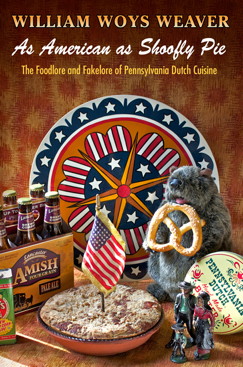
As American as Shoofly Pie: The Foodlore and Fakelore of Pennsylvania Dutch Cuisine1 by William Woys Weaver is many things: it is a detailed look at the foodways among the Pennsylvania Dutch, a commentary on modern culture, and a cookbook. It is scholarly and snarky. It purposely does not focus on Anabaptists, though it does deal extensively with the Amish in popular imagination. Weaver states in his introduction: “In terms of the larger culinary story, the Amish are mostly marginal anyway because the real centers of creative Pennsylvania Dutch cookery were in the towns and not to be found among the outlying Amish or Mennonite communities, even though today the Mennonites have attempted to preempt the Amish as their cultural public-relations handlers in their Amish and Mennonite cookbooks to press for ‘Christian’ culinary values—whatever that may mean” (7). He is also clear that one of his major criteria for the recipes he highlights in the book was to contrast against the “artificial portrait” created by Amish tourism (8).15094

What Weaver sets about doing in As American as Shoofly Pie is to take food as the avenue into Pennsylvania Dutch culture to discuss its identity markers—historic and current—as well as the class dynamics involved, portrayals in popular culture, and the commercially driven conflation of the Amish and Pennsylvania Dutch. He details cooking implements, the “cabbage wall” of sauerkraut defining the borders of Pennsylvania Dutch country, how the Amish imagery became normative for Pennsylvania Dutch tourism, and how the culture is renewing itself. It is an excellent read, both informative and engagingly written.2

I use here the term “Pennsylvania Dutch” instead of “Pennsylvania German” for two reasons: first, because that is the terminology of Weaver, and second, because the “Pennsylvania Dutch” have no connection to the nation-state of Germany, past or present. On the second point, I will offer a story from my wife’s family history:

When Pop-Pop Riegle was a prisoner of war in Germany during World War II, the camp taught German to the POWs. The guards doubled over in laughter to hear the POWs from New York City try to pronounce words with a New York accent. My grandfather, from what I understand, could converse with the guards easily, because he spoke Pennsilfaanisch Deitsch. The German guards asked him why he was fighting for the wrong side. To them, speaking German meant loyalty to Deutschland. For my grandfather, speaking a German dialect was part of his American culture.

Furthermore, it seems this story is borne out in every ethnography of the Pennsylvania Dutch I have encountered. They all carry a variation of the following: A researcher walks up to some Pennsylvania Dutch women and asks them about how they describe themselves, only to be rebuffed with, “We’re not Pennsylvania Dutch, we’re American.” The Pennsylvania Dutch are an American cultural group consisting of a blend of German speakers, mostly Palatinate and Swiss, who settled together. The eponym “Dutch” has long roots going back into medieval Europe as a term for western German speakers. They can be divided into two broad categories, the Plain Dutch, such as the Amish and Mennonites, or the Gay (Fancy) Dutch, such as my wife’s Lutheran and Reformed forebears.

It is important for Mennonite scholars to remember that Mennonite fish were just one school swimming in Pennsylvania Dutch water. Even though they may have been marginal in shaping Pennsylvania Dutch culture, as Weaver notes, they were still shaped by it. Mennonites all across South Central Pennsylvania were surrounded by people who spoke, ate, and worked in the same ways they did—the majority of them Lutheran or Reformed, but also the Amish, Church of the Brethren, and other plain Anabaptists.[^3]  As Felipe Hinojosa has noted, place matters—both in space and time, as well as culturally. The Swiss-German strain of the Mennonite experience practiced their faith and promulgated their beliefs not in ethnic colonies but surrounded by a shared culture that itself was distinctive from broader America. Surely this has led to a different way of knowing and living as Mennonites. For this reason, scholars dealing with Mennonite identity must familiarize themselves with Pennsylvania Dutch culture. For its insistence on placing the Pennsylvania Dutch culture within the broader national culture, and his disgust at the conflation of the Amish with the Pennsylvania Dutch, Weaver’s As American as Shoofly Pie is an excellent place to start.


  1. William Woys Weaver, As American as Shoofly Pie: The Foodlore and Fakelore of Pennsylvania Dutch Cuisine (Philadelphia: University of Pennsylvania Press, 2013). 
  2. This is not to say there are no points where I disagree with Weaver.  For example, his repetition of Rufus Jones’ claim that the Amish adapted bonnets from Quakers as “common knowledge” (135) is uncritical at best.
    [^3] Moravians are one of the German groups that maintained a markedly different culture than that of the Pennsylvania Dutch. 

On Exhibit: Contextualizing Amish Quilts

Janneken Smucker

In the early 1970s, art enthusiasts began to display Amish quilts from the early twentieth century on the walls of apartments, galleries, antiques shops, and museums, noting how their strong graphics and minimalist designs resembled abstract paintings of the post-World War II period. Prior to the 1970s, no one really had paired the adjective Amish with the noun quilt. Yet with this cultural dislocation, Amish quilts shifted in status from special, heirloom bedcovers, kept folded in chests and treasured as gifts between family members, to cult objects in demand within the outside world. Amish families responded by selling their “old dark quilts,” happy to have extra money that could be split among descendants in a way a quilt could not be, and glad to remove objects now considered “status symbols” by outsiders from their homes. In turn, Amish entrepreneurs began making quilts to sell to consumers, creating a quilt industry that could capitalize on increasing tourism to settlements and the growing fascination with Amish-made bedcovers.

smucker_image_1

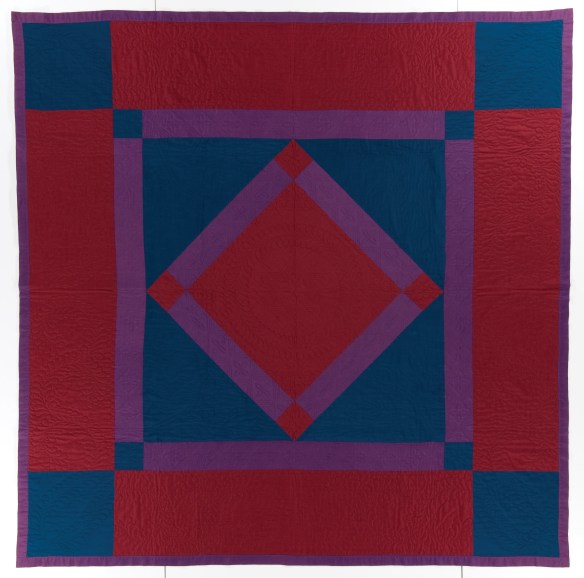
Center Diamond, Unknown Amish maker, Circa 1920-1940, Lancaster County, Pennsylvania, Machine pieced, hand quilted. International Quilt Study Center & Museum, University of Nebraska – Lincoln; Jonathan Holstein Collection, 2003.003.0072

This intersection between the Old Order Amish and the worlds of art, fashion, and commerce is a central tension of my recent book, Amish Quilts: Crafting an American Icon (Johns Hopkins University Press, 2013). As I worked on this book, I frequently imagined it as an exhibition, with the objects themselves serving as evidence and touchstones within the narrative. With this mindset, I was thrilled when the International Quilt Study Center & Museum at the University of Nebraska – Lincoln invited me to guest curate an exhibit of Amish quilts. This exhibit, Amish Quilts and the Crafting of Diverse Traditions opens October 7, running through January 25, 2017.

Since the 1971 landmark exhibition Abstract Design in American Quilts at the Whitney Museum of American Art, the typical mode of display for quilts in museum settings has been on walls, hung vertically like the paintings to which Amish quilts in particular have often been compared. As I began work translating my research into an exhibition, I struggled to figure out how to simultaneously interrogate the de-contextualization of Amish quilts while participating in the process itself. I did not want to simply hang quilts on walls as they had been for the last 45 years, where too often they appear merely as great works of design, rather than as objects symbolic of the Amish emphasis on community, mutual aid, and Gelassenheit. But what could we do instead that would fulfill the museum’s dual mission of showcasing quilts’ artistry and cultural significance?

All public history requires careful and deliberate communication; it’s intended to translate complex ideas into meaningful and engaging forms. Working with the IQSCM staff, we’ve developed ways to communicate the multiple contexts of Amish quilts. When museum-goers enter the gallery, they will indeed still see quilts hanging on walls. But in the center of one gallery, there will be an object strangely foreign to most quilt exhibits, Amish or otherwise: a bed. My parents, who live in Goshen, Indiana, generously loaned the museum the ¾ size four-poster rope bed that descended in my mother’s family from our Amish-Mennonite ancestors. Made in the family of Solomon Beachy from Holmes County, Ohio, c. 1840-1860, the bed will be the perfect showcase for an early twentieth-century quilt made by Barbara Yoder.

smucker_image_2

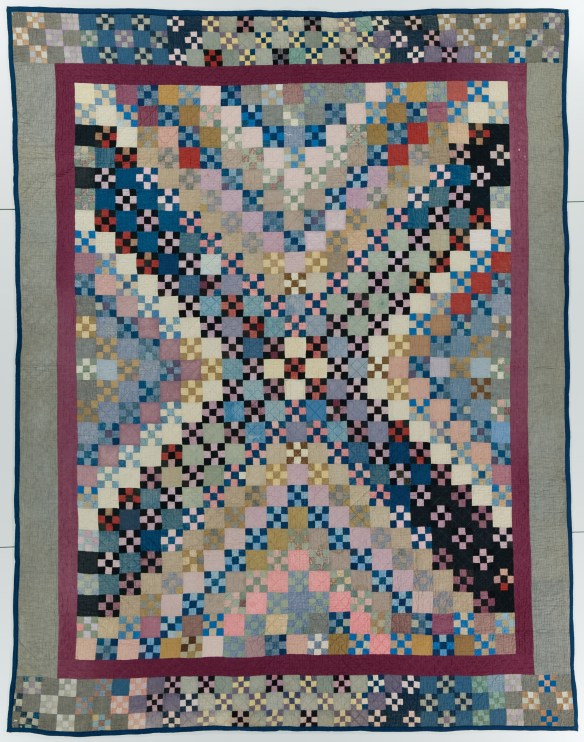
Nine Patch, Made by Barbara Yoder (1885-1988) Circa 1920, Made in Weatherford, Oklahoma, Machine pieced, hand quilted. International Quilt Study Center & Museum, University of Nebraska – Lincoln; Gift of the Robert & Ardis James Foundation, 2005.039.0005

But the Amish origins of these quilts are not the only context through which I interpret them. The lives of these objects since they left Amish homes are equally intriguing, and I explore them as influential within contexts of art, consumer culture, and fashion. The Esprit clothing company, well-known for its color block designs of the 1980s, was home to a significant corporate collection of Amish quilts which hung on the walls throughout its San Francisco headquarters. We will hang a quilt that Esprit once owned alongside a mannequin dressed in one of my personal favorite objects of material culture—this amazing Esprit vest that in my mind was clearly inspired by Amish quilts.

smucker_image_3

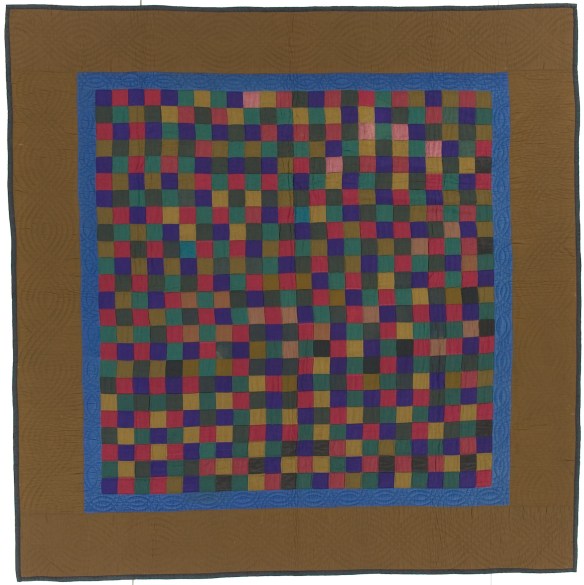
One Patch/Checkerboard, unknown Amish maker, circa 1900-1920, machine pieced, hand quilted. International Quilt Study Center & Museum, University of Nebaska-Lincoln, Ardis & Robert James COllection, 1997.007.0469

smucker_image_4

Espirit women’s vest, circa 1985, United States. Collection of Janneken Smucker

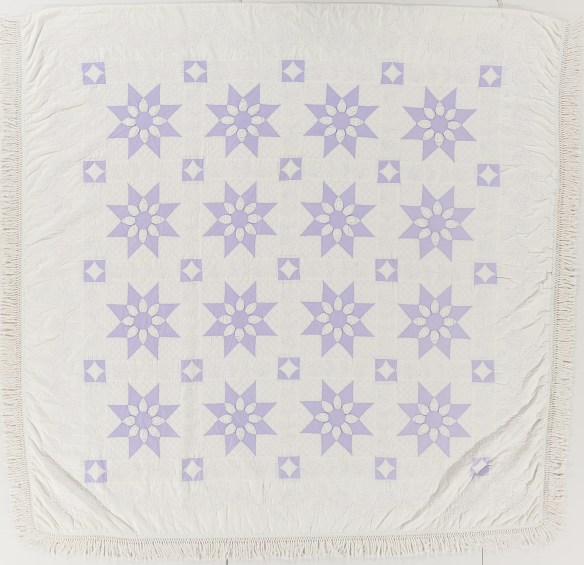
We will also display images of contemporary Amish quilt shops, along with two new quilts made for the consumer market, with designs in clear contrast to the “cult objects” with which art enthusiasts became enamored. I also had the pleasure of attending the Gap (Pennsylvania) Fire Company Sale last March, known locally as a mud sale. We include photographs from this event, which supports the local volunteer fire company, along with quilts I acquired on the museum’s behalf there (not a bad gig — bidding with someone else’s money). The quilts include a white and lavender Dahlia quilt from the mid-twentieth century, complete with intricate lavender hand quilting and ornate fringe—not what we expect from an Amish made quilt, but one of the many styles that have co-existed within Amish communities.

smucker_image_5

Dahlia, Unknown Amish maker, circa 1940-1960, probably made in Lancaster County, Pennsylvania. International Quilt Study Center & Museum, University of Nebraska – Lincoln Gift of the Robert & Ardis James Foundation, 2016.030.0003

I have relished the challenge of translating my research into this physical form. I hope my thesis—that the craft of Amish quiltmaking has never fossilized, but has been a living, evolving, and diverse tradition, adapted by creative quiltmakers, capitalized upon by businesswomen eager to earn a livelihood, and embraced within both Amish communities and the broader artistic and consumer worlds—comes through. But even if my message is lost, the quilts look great, as they always have, both in and out of context.

Soybeans and Milk: Community and Commodification in a Bolivian Mennonite Colony

Since 2013, seven researchers have been investigating Mennonite agricultural practice in farming communities around the globe as part of Royden Loewen’s “7 Points on Earth Project.”  We first met in Amsterdam in December of that year to discuss the logistics of conducting oral histories in small farming communities and to introduce one another to our research sites.  These extended from regions traditionally associated with the Mennonite faith and farming, including nearby Friesland, the U.S. and Canadian prairies, and Russia, to less well known Mennonite communities in Bolivia, Indonesia, and Zimbabwe.  Leaving Amsterdam, we scattered to our seven points.  I spent five months in mid-2014 and one month in the spring of 2015 in the Department of Santa Cruz in the tropical eastern lowlands of Bolivia traveling muddy colony roads by bicycle as I conducted interviews with Mennonites farmers.
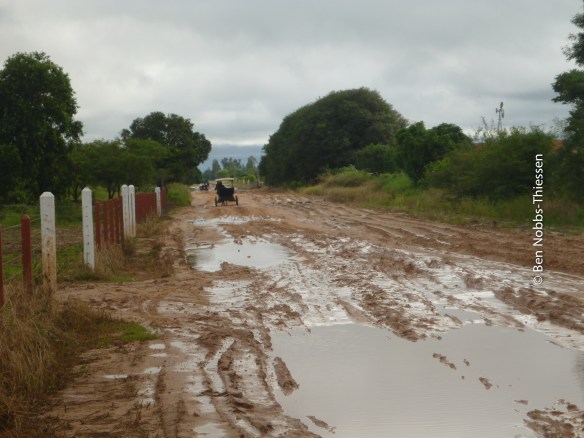
Street Scene in Riva Palacio

On October 28-29 we will be reconvening in Winnipeg to discuss our findings as part of a public conference on “Mennonites, Land, and the Environment.”  For those that may not be able to attend the conference I offer here a brief portrait of Mennonite history and farming in one of those Seven Points on Earth.

While Mennonites migrated to Bolivia from Canada, Paraguay and Belize, the majority were horse-and-buggy “Old Colony” Mennonites from Northern Mexico who began to settle in the department of Santa Cruz in 1967.  Their migration offers observers a compelling paradox.  On the one hand, they were part of a religious pilgrimage to maintain traditional ways they saw as under threat in modernizing North American Mennonite colonies.  On the other hand, they successfully presented themselves to the Bolivian government as modern farmers, capable of transforming the densely forested landscape of lowland Bolivia into a series of productive agricultural colonies.

As Mexican Mennonites approach their fifty year anniversary in Bolivia and the country’s Mennonite population nears 100,000, that duality remains as apparent as ever.  Old Colonists, most of whom continue to use horse-and-buggies on the roads and lumbering steel-wheeled tractors in the fields, might appear to live traditional, isolated lives.  Yet they are also key producers for a regional economy that has emerged as one of Bolivia’s largest and most dynamic.  They farm over a third of Bolivia’s soybeans, the country’s star agricultural crop, with a harvest in 2015 of over two million metric tons and an export value of one billion U.S. dollars.  As soy farmers they are at the center of a broad swath of South America – including portions of Brazil, Paraguay and Argentina – that now produces the majority of the world’s soy.
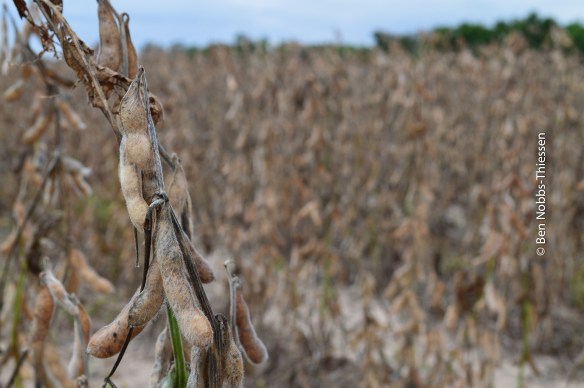
A field of soybeans in Riva Palacio colony

Even as Mennonites generate this high-value, export-oriented commodity that depends on intense mechanization, nearly every farmer in Riva Palacio, Bolivia’s largest Mennonite colony and my primary research site, rises early in the morning to milk their herd of dairy cattle by hand.  Buckets clang and wooden stools are set down as the entire family – men, women and children – take part in this laborious daily activity which will be repeated again in the early evening.  By the time the last cow is milked the sun is usually rising and one member of the family pushes a cart laden with brimming metal jugs out to the corner to wait for the milk-men that travel through the village by horse cart.
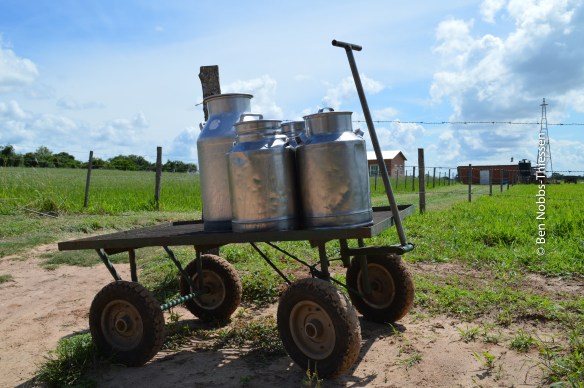
Milk awaiting pickup at the entrance to a Mennonite homestead

The practice is both intimate and, for scholars of Old Colony Mennonites, historical in nature.  While Mexican Mennonites had never produced soybeans before arriving in Bolivia, they successfully transplanted a dairy industry from Chihuahua to Santa Cruz.  Farmer Enrique Siemens still remembers the first year in Bolivia when as a young boy he drank powdered milk because there were no dairy cattle to be had in local markets.  In 1969, his father traveled with a friend to neighboring Paraguay to bring back the colony’s first Holstein cattle – a journey of forty days.  “When I arrived back at home [from school] the cow was already there,” he exclaims, “and oh[!] after that we were happy, then we had milk.”
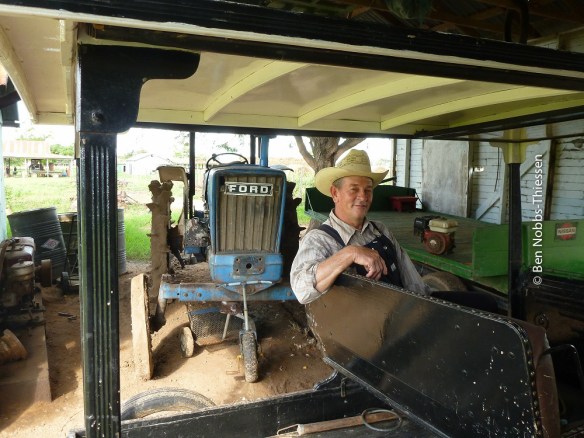
Enrique Siemens sits in his buggy during an interview with the author

What to make of this dual – and diametrically opposed – agrarian economy?  The respective meanings attached to cash cropping and dairy farming in Bolivian Mennonite colonies form a central aspect of my research.  Linked with nourishment and happiness in Siemens’ memories, daily family milk production seems to stand in opposition to the capital-intensive cash-cropping of export commodities like soybeans.  Indeed, even the income earned from the two activities is treated in different ways.  Harvest money might be invested in new land and machinery to expand one’s operations.  Milk money, by contrast, provides regular access to goods on credit at the colony’s small stores – particularly critical in drought years when the harvest might fail altogether.

An example of this form of accounting can be seen below for David Unger, a farmer in a nearby Paraguayan Mennonite colony.  For each two week period, daily milk production (morning and evening) is divided into that which was of a quality to be sold as milk and that which, due to its higher bacterial content, is only suitable for making cheese.  From those two balances Unger’s purchases at the colony store over the same period are deducted and the balance is passed on to him.

image-5

Jakob Unger’s biweekly balance sheet, Canadiense Colony

Yet, the intimate snapshot of daily milking can be deceptive.  Dairy, a fringe industry when Mennonites arrived in Santa Cruz, is now, like soybeans, big business.  It is no coincidence that both the milk and the soy produced in Mennonite colonies find their way to Santa Cruz’s sprawling industrial park.  There, across the highway from one another sit IOL Aceite, the largest oil-seed production plant in Bolivia and PIL Andina, the country’s sole major dairy distributor.

IOL has been encouraging Mennonite soy production with seed and credit since the mid-seventies.  In contrast, PIL only began to install collection centers on the edge of most major colonies in 2000.  This has led to changes for the company and for colonists.  Mennonites once processed all of their milk as cheese to be sold in the streets of Santa Cruz.  Farmer Cornelio Peters remembers that “before, the milk was worthless…there was too much [cheese] with all the Mennonites here in Bolivia.”

The arrangement between PIL and the Mennonites appears mutually beneficial.  The presence of the company has meant price stability for Mennonites, while the increased milk supply has also enabled PIL to double its production.  Riva Palacio alone produces approximately 100,000 liters of milk a day. On a tour of the installation in 2014, the operations manager explained that approximately four-fifths of their daily capacity of 500,000 liters came from Santa Cruz’s Mennonite colonies.

As Mennonites moved from independent producers of cheese – which everyone in Bolivia knows as “queso menonita” – to suppliers of a primary input for a large corporation, the potential for tension also exists.

Mennonite cheese (“queso menonita”) for sale in a La Paz grocery store

When I returned to Santa Cruz in 2015 I found Riva Palacio colony up-in-arms.  While PIL had been paying 2 Bolivianos and 30 centavos per liter for their milk, they had recently discovered that the minimum price to be paid to producers – by national decree – was three Bolivianos and fifty centavos.  A hastily formed “Mennonite Federation of Milk Producers” – representing 3000 families – was calling emergency cross-colony meetings, contracting lawyers, and petitioning PIL, the president of Bolivia, Congress and the Senate to demand “a fair price for Mennonite milk.”
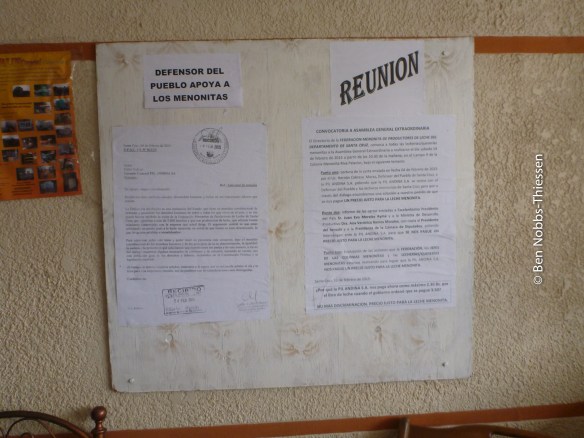
Letter from Ombudsman to PIL administration on behalf of Mennonites posted alongside a call for an Extraordinary Meeting of the Mennonite Federation of Milk Producers in the Mennonite Market in Santa Cruz de la Sierra

The above sketches of Mennonite soy and dairy demonstrate not simply the importance of different production strategies to the survival of colonists but the ways in which that daily production – on the fields and in the milking barns – is interwoven with regional and global markets.  Popular and scholarly approaches to Old Colony Mennonites have tended to accept the idea that these are “a people apart.”  Steel wheels and milk jugs at the end of the road tend to confirm such impressions.  Yet whether they are quietly acting as the largest producers of Bolivian soybeans or actively demanding a “fair price for Mennonite milk,” Old Colonists are embedded in broader economic structures.  This is a conversation – about Mennonite history and place-making – that we look forward to continuing at the University of Winnipeg next month.  Hope to see you there!
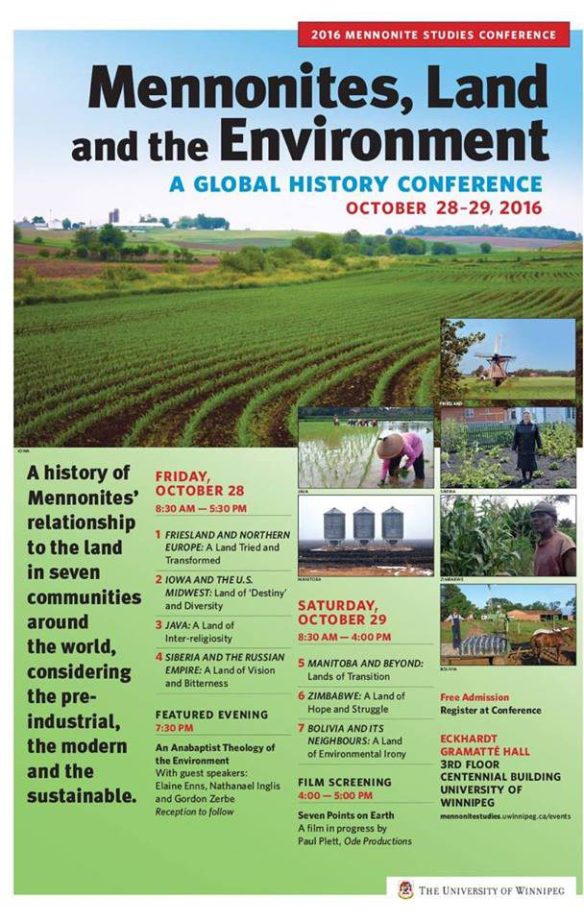
image-8

© Benjamin Nobbs-Thiessen 2016. Unauthorized use and/or duplication of this material (including images) without express and written permission from this author is strictly prohibited. Excerpts and links may be used, provided that full and clear credit is given to Benjamin Nobbs-Thiessen with appropriate and specific direction to the original content.