An Honest Look at Ancestry Reveals Diversity

This is a response to “Mennonite Genealogy and Racial Privilege” by Ben Goossen.

Darvin L. Martin

Ben Goossen convincingly explains that the development of Mennonite family research a century ago was at least partially motivated by a quest for “blood purity and racial hygiene” (“Mennonite Genealogy and Racial Privilege”). Bridging to the present, Goossen also asserts that these themes become exacerbated through the recent advent of DNA testing, “privileging the notion that Anabaptism is as much an inheritable trait as a religious conviction.” The implication is that interest in ancestry today continues to foster attitudes of exclusion and superiority, when in my experience the opposite can and should be true.

As a prime historic example, Goossen cites the Amish-Mennonite historian C. Z. Mast, who published a genealogy in 1911, and within it spent pages to express his thoughts of heredity, defending a position we now understand as white supremacist. [^1] What Mast articulated on paper, many and perhaps most of his contemporary Mennonites had also embraced, but were ill-equipped to write or to express in detail.

In a lengthy epilogue, Mast proposed that the same natural law exemplified by selecting physical vitality in breeding agricultural stock likewise applied to humans.  He further projected that moral tendencies, in addition to outward form and features, were physically transmitted from parents to their children (747). Mast endorsed the responsibility of governments to convince their populations of the natural laws of heredity, selectively improving “human stock,” by implementing and enforcing regulations against endogamous marriage, and praised purposeful spousal selection as a means to reduce and ultimately eliminate undesirable characteristics and diseases, including blindness, tuberculous, curved legs, and mental handicaps (749).

Mast argued that the remarkable progress of his contemporary early twentieth-century Americans was the expected outcome of inheriting the vitality of the most successful men and women of the different nationalities of Europe. In contrast, he gave examples from other cultures where “divine displeasure is announced.” He cited Native Americans and other “ancient tribes and races of the Orient” having succumbed to severe inbreeding, causing “their physical and mental power [to have] melted into weakness” (748).  He criticized the Catholic royalty in Spain and Portugal, concluding their congenital disorders were the product of pope-blessed marriages between princes and their nieces.  He imprecated the emirs of Turkey for producing “simpletons and imbeciles,” as they have “intermarried so long and extensively [. . .] among those who revere the memory of the prophet” (749).

To use a common and necessary tag line of our time, it is not far-fetched to clearly report that Mast’s comments are the “textbook definition” of racism.  Yet here we have them, published by our very own Mennonite Publishing House in 1911.  In his defense, Mast had merely articulated the mainstream thoughts of the scientific and intellectual community of his time, with a directed passion to convince his Amish and Mennonite cousins to extend the tent a bit wider when looking for a spouse among the community.  But his words also subsequently labeled the “other” communities as inexcusable for the very problems that he found in his own.

Goossen calls us to own the historic racism exhibited by Mast and his fellow Mennonite and Amish family researchers, as rightly we should.  Just like those who descend from slave holders, those of us who are ethnic Mennonites have our own demons to expose. We cannot pretend that our ancestors thought of their whiteness as but one variety among many.  Likewise, let’s not be haphazard in our attempt to separate family history research from racism, as this is no easy task. Especially when Mast and others have been intent on keeping these themes so tightly bound.

For myself, an honest account showcases that Mast’s supremacist ideas sit uncomfortably close to home.  C. Z. Mast’s father was a first cousin to my great-great grandmother, Hannah Kurtz (1855-1937).  They grew up in the same congregation along the upper reaches of the Conestoga River, just west of Morgantown, Pennsylvania.  C. Z. lived on the farm of our common ancestor, Stephen Mast (1800-1868), two miles south of Morgantown.

Perhaps some of C. Z.’s prowess and detail towards family history found a home in my genes as well.  I can relate.  C. Z. was only in his mid-twenties when he wrote this history, and he certainly pursued it as a way to exercise his intellectual curiosity and differentiate himself from the expected mandate to become a farmer.  C. Z. was well read, and ascribed to the basic understanding of genetics promoted in his day—that human genetics were understood as having an ideal, pure and original form; that we exhibit various stages of corruption from that pure form . . . and for some, in Mast’s warped view, the corruption is more extreme than in others.

This understanding, although now proven untrue, had filtered down through my family. Physical and mental problems were blamed on such corruption.  My grandmother (the granddaughter of the Hannah Kurtz mentioned above) scolded her younger brother when in middle-age he fell in love with a woman and decided to marry.  This brother was somewhat mentally and physically limited, had always lived with his parents, and was part of the Friendship Community program sponsored by Mennonites in Lancaster for handicapped individuals.  

From my grandmother’s perspective, marriage and the benefits and responsibilities that came with it were not to be made available to those constrained by handicaps assigned from birth.  In childhood she was told that we have a moral duty to keep handicapped individuals from having children, otherwise we inhibit humanity from rising to its full potential.  She grew up in the face of the eugenics movement, and ultimately had enough control over her brother that he decided not to marry, even though both he and his partner were well beyond child bearing age.  Both my grandmother and her brother had passed away within three weeks of each other in February 2016. These attitudes of restricting bloodlines to attain a supposed ethnic purity haunt our recent past, and perhaps have found expression in new contemporary forms.

Goossen suggests that DNA testing has become a new avenue to enforce concepts of ethnic exclusion—that those who grew up Mennonite use this to privilege common ancestry over shared convictions. While there is a tendency to use DNA testing to play the “Mennonite Game,” my own experience in interpreting DNA results of several hundred individuals, both inside and outside the Mennonite circles of ethnicity and persuasion, challenges this notion. DNA testing is all about surprises—that our ancestry is not straightforward, but rather a complicated web of interconnectedness.  We see the surprises advertised in the commercials by the two most prevalent DNA testing companies, Ancestry DNA and 23andMe.  DNA testing reveals the unexpected, and that is what people find attractive.

There are at least a dozen Mennonite DNA projects on the internet that seek to use DNA as a means to link families together.  And all of these clearly reveal an astounding amount of diversity among ethnic Mennonite populations. An honest assessment of the Y-DNA profiles among testers who share the common surnames familiar to ethnic Mennonites reveals that they are not homogenous, but rather span a wide cluster of populations of origin. The “Mennonite DNA Project” by Tim Janzen, the “Swiss Anabaptist DNA Project” by Bonnie Schrack and my own “Mennonite and Amish Immigrants to Pennsylvania DNA Project” are but three examples. While a very selective reading of DNA can enforce a tester’s prejudices, a more complete assessment determines that ancestry is much more complex than first assumed.

Here’s why.  All of us, if we extend our family trees into the past, have an increasing diversity of ancestors.  This is statistically inevitable. Eight great-grandparents descend from sixteen great-great grandparents and thirty-two three great-grandparents, and so forth back through time.  Ten generations back, about 350 years ago, we each should have 512 ancestors.  At twenty generations back, about 700 years ago, that number of ancestors increases to 524,288, and at thirty generations, around 1000 A.D., we should have 536 million, more than the total population of the world at that time.

Those statistics eventually break down due to the inevitable placement of common ancestors in different places on one’s tree.  In my personal example, (through recordkeeping as the result of the privileges received because of 300 years of relative economic and social stability), I can create a nearly complete ancestral chart back ten generations on each side of my family. And in spite of having strong Mennonite background on both sides of my family, the chart shows increasing diversity.

I don’t have 512 ancestors ten generations ago, but instead have 372, due to duplications on my tree.  This is caused by fourth, fifth and sixth cousins marrying each other.  But even so, diversity far outweighs the truncation experienced by intermarriages.  For myself, truncation first appears seven generations back, where a seventh-generation ancestor of my father’s lineage also appears as an eighth-generation ancestor on my mother’s side.  This one and a few others reduce my total ancestral count by about ten percent in the eighth generation, and consistently another ten percent in the ninth, and another ten percent in the tenth, so I am left with 372 unique ancestors, 350 years ago.  

Each of these has a unique story of their own life experience.  Many crossed the ocean to carve out a new existence in America. Many were Swiss—representing at least four cantons, about four dozen were German, as many as ten held Dutch nationality, a few were French, and at least five were Irish.  And I have a few unknowns.  That’s where my genealogy ends.

But let’s assume out of those 372, they each had 372 ancestors ten generations further back.  That gives me 138,384 ancestors twenty generations ago, around the year 1300.  That is far less than the 524,288 I should have, assuming each ancestor a unique individual. Even if a full half of them were duplicates, I’m left with 65,000 people that I can statistically claim as ancestors.  Writing their names alone would fill more than a thousand-page book.  What are the statistics that every one of those had the same five nationalities as my most recent ancestors? The amount itself simply forces further diversity.

And we all experience this diversity, if we take an honest look at ancestry. Some Americans can claim ancestors who fought on both sides of the Civil War.  Some have found ancestors among the Native Americans, among Africans forced into slavery and transported to America, and among those engaging in the slave trade, all at the same time.  Go back further in time and the probability increases that your ancestors were not just the ones you perceive as friends, but also your foes.

And among these 65,000 people 700 years ago, what if they each had 372 ancestors ten generations back?  That’s twenty-four million ancestors in the year 950.  It is statistically inevitable that at least one of these is a Central Asian merchant of the Nestorian Christian persuasion. At least one is an Arab from the Maghreb practicing Muslim faith, one a caravanning Mongol whose abode lies far to the east in modern China, one a Hindu who bathed in the Ganges, and one a sub-Saharan African herding cattle within the shadow of Kilimanjaro.

I’m only considering a thousand years ago. Jump back another thousand years and it is not difficult to assume that nearly every person alive at that time was an ancestor, statistically speaking.  Even those island populations that have lived in relative isolation for tens of thousands of years, such as the indigenous populations of Australia, New Guinea, and the Andaman Islands would have had occasional escapees and castaways in nearly every generation who mixed with nearby continental populations. Over time the web that starts with yourself extends wider and wider back through time until everyone is included.

Modern DNA testing as it relates to family history grants us the ability to apply specific data towards these statistical results. Through a 23andMe DNA test, I found that my grandmother (mentioned above) has a small snippet of Native American ancestry, predicted to have arisen eight generations back. In one woman around the year 1730, I find the DNA evidence to include 200 to 400 Native American ancestors by the year 1380, and 40,000 in the year 1030, encompassing all the known Native peoples’ groups of the Mid-Atlantic region and likely far beyond.  Can anyone doubt that every one of those migrant families who resided along the Bering land bridge linking Siberia to Alaska during the last Ice Age 15,000 years ago was also an ancestor?  Of course, some left no descendants, but those who left descendants ultimately became the ancestors of all of us.

Through Y-DNA testing, we have uncovered that the prominent Mennonite Groff family shares Y-chromosome affinity not with fellow Swiss Mennonite families, but with a Greco-Roman cluster of Italian families with surnames such as Albarano, Margarelli and Visentin.  Through similar testing, we have uncovered that Mennonites who share the Swiss surname Hollinger, Hullinger or Holiger, have as their next closest matches the Saudi families Almotawa and Al Daihan and the Turkish family Kahanizaman. The Mennonite Metzler family, tracing their lineage of descent through Valentine Metzler, a German immigrant who arrived in Lancaster County with his father Jacob in 1738, has close Y-DNA matches to Jewish families such as Kronik (in Belarus), Cohen and Langer (in Ukraine) and Friedman and Wengrowski (in Poland).

These are only a few of the examples in which DNA showcases the statistical inevitability of diversity as one takes a serious look at ancestry. I haven’t even touched the Y-DNA results of the Mennonite Good family, which reveal an origin in Afghanistan predating the time of Alexander the Great. Nor have we seriously examined the Amish Bassinger families from Ohio, which have a Central Asian Y-DNA signature closer aligned to the Asian origins of the Native Americans than to most European families.  Nor have we investigated the selection of European surnames than showcase Y-DNA signatures more closely matching a recent African origin than the typical Celtic or Greco-Roman cultures of European antiquity.

An honest look at DNA can and should break down the racial prejudices that have defined the last few generations of family researchers.  DNA analysis provides concrete ways that forecast the inevitable diversity that a statistical evaluation of our ancestry requires. Eventually, given enough time, all humans around the world are included in our ancestry, along with their diverse cultures and traditions.  That fusion throws the ideas of genetic purity on its head.  If a pure genepool of humanity exists, it includes the genes of everyone. As family history research increasingly considers DNA as a means to fill in the gaps and extend family trees, these notions of inclusion become inevitable.

I certainly am privileged to be able to construct a genealogy of my ancestry back ten generations.  But DNA testing has now broken down these barriers.  Today, anyone, even one who knows nothing of his or her ancestry, can find pertinent and often surprising information through DNA testing. The most accurate records are the ones stored in our bodies. These records are now becoming accessible and, in many cases, challenge the assertions of a century of family history researchers.

I ponder what C. Z. Mast would think of genetic testing for family history as it exists today.  Would he selectively interpret it to confirm and promote his own stereotypes, or would he embrace the data in its diversity, extending the genealogical fence to include everyone?  I don’t know for sure, but I would like to think that C. Z. Mast could be persuaded through the presentation of DNA test results that his Swiss Mennonite ancestors were vastly more diverse than he could ever have imagined.


Darvin L. Martin is a graduate of Eastern Mennonite University (B.S., Agriculture) and Millersville University (B.S., Analytical Chemistry).  As a real occupation, he tinkers with chemistry related instrumentation, but on the side, manages the “Mennonite and Amish Immigrants to Pennsylvania DNA Project” through Family Tree DNA.


See also:

Anabaptist Monuments?

The last year has been full of discussion about collective memory and ownership of historical truth. Last summer I had to explain what “public history” meant to many people as I prepared to start a master’s program in the discipline. These days I’m just as likely to hear, “We need that now.”

Societal and political debates about history have coalesced in the last few months around the concept of commemoration through monuments. Statues of Confederate generals have been torn down or shrouded, and a statue of Christopher Columbus in Baltimore was just defaced. Here in Philadelphia, a months-long “Monument Lab” has kicked off with—among other pieces—a statue of an Afro pick incorporating a fist in the same plaza as a controversial monument to former mayor Frank Rizzo.

I’ve watched the unfolding conversation with interest but with critical distance. Others are saying things far smarter and more meaningful than I could. The National Council on Public History made a valuable contribution, for instance, with a special virtual edition of The Public Historian, re-running essays on monumentalism and memory around the world and across time. To date, one of the best proposals I’ve heard for Confederate monuments is that they all be piled up in one place to convey the volume of metal and concrete and stone that supported white supremacy.

I’ve begun to try to think about which monuments I support. Many monuments lack nuance and do not invite conversation. A bronze man on a horse doesn’t ask any questions, but makes powerful statements about power. As a historian, these are problematic characteristics, even if it weren’t true that monuments in the United States are overwhelmingly dedicated to white men over all other types of people. When President Trump asked on Twitter if monuments to Washington and Jefferson were next on the agenda for debate, someone on my social media feed acknowledged that the president accidentally posed the most relevant public history question of the year.

Looking closer to (metaphorical) home, what have Anabaptists, my people, commemorated? I struggled, initially, to think of any. Then I remembered the many sculptures that decorated the campus of Goshen College, my alma mater. I remembered Esther and Michael Augsburger’s “Guns into Plowshares” in Washington, DC (which is moving again). A Google search alerted me to a variety of Mennonite monuments scattered throughout Canada and Europe. I came across Paul Epp’s monuments across Eastern Europe to Anabaptist persecution, including a particularly haunting piece in Zaporizhia, Ukraine, that depicts a family over a mantle, the human forms in negative space in the granite, the voids representing disappeared Mennonites throughout the former USSR.

In this field, too, I find others far ahead of me. James Urry explored the history of Mennonite monumentalism a decade ago in the Conrad Grebel Review.1 Urry traces the resistance of Anabaptist communities to statuary, a form they associated with nationalism, up until the nineteenth century. Early in that century, Menno Simons began to be included (along with Calvin and Luther) in several monuments to the Protestant Reformation, and around 1861, a marker was proposed (and rejected) to mark the three hundredth anniversary of Simons’ death.

Nearly two decades later, an obelisk was raised to Simons in Friesland, purportedly on the site of his first teaching after leaving the Catholic church. Similar obelisks were erected in Russian Mennonite colonies over the next generation before such commemorative forms seemingly lost wide approval. “Instead,” writes Urry, “the opening of new schools, hospitals, and other institutional structures seemed sufficient to mark the steady march of progress in the Mennonite world.”

The next phase of Mennonite monumentalism, Urry argues, took place in the United States and Canada as Mennonite settlers joined other North American settlers in commemorating westward expansion. Canadian Mennonites of Russian origin marked the centennial of the 1870s wave of immigration, just as in the United States polities big and small geared up for the bicentennial celebration. Interestingly, Urry notes that many of the most fervent supporters of the 1970s Canadian commemorations were immigrants from the 1920s.

Another generation passed before the next form of Mennonite monuments were erected. These include Paul Epp’s monuments, and were spurred by tours and conferences in the Ukraine that revealed the extent to which evidence of Mennonite colonies had largely been erased. The statues generally commemorated specific events such as massacres or persecution, but Urry seems to argue that the erasure of colony-built environments was also a motivating factor. He focuses his analysis on one particular monument—which resembles a gravestone and marks the site of a 1919 massacre at Eichenfeld-Dubowka, north of Khortitsa, Ukraine—and makes a compelling argument about monumentation in this vein:

[This monument] clearly indicates some of the problems in trying to mark a complex past event in a singular stone memorial. At one level its message might appear simple: it is a memorial to the victims of a savage massacre who have lain in mass, unmarked graves until the stone was erected and unveiled. But the memorial is also supposed to mark not just a single event and its victims…

The fact that a number of people were murdered in such a terrible manner, on the date stated on the stone and detailed in the book, is not in question. But why the deaths occurred in this particular village, to this group of people, and at this particular time is something that must be interpreted and explained. The explanation in press releases provided at the memorial’s unveiling, and the more detailed account given in the later booklet, are simple and inadequate. We are presented with simple dichotomies of good and evil, with innocent Mennonite victims and guilty perpetrators. Such stark oppositions have little explanatory power in understanding such complex events.

Urry completes his analysis with the recent trend of memorial trees, grown from the seeds of ancestors still planted in European soil. These living monuments seem more in line with early Anabaptist iconoclasm (and indeed, Urry argues, earlier pagan forms of commemoration) but I feel the monuments still lack context and nuance.

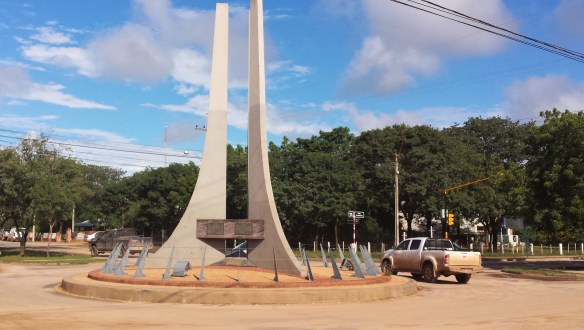
Rather I would suggest that Mennonite monumentalism has recently, like global monumentalism, embraced more polyvalent forms that offer space for debate and nuance. The Eichenfeld-Dubowka tablet that Urry analyzed was dedicated in 2001. Eight years later—and two years after Urry’s essay—another Paul Epp monument, the family in negative space described above, was unveiled. By embracing an evocative visual language rather than an engraved message, this latter monument represents the new monumentalism, perhaps best represented by the Vietnam Veterans Memorial, designed by Maya Lin. These memorials reject the (literal and metaphorical) monolith form of many nineteenth- and twentieth-century monuments in favor of aesthetics more representative of current movements in public art and landscape architecture. Another example that comes to mind within the Anabaptist context is this monument at the center of a roundabout in Paraguay.

Paraguay Monument

Photo by Ben Goossen

The result of this aesthetic shift is an openness to interpretation. Monuments are still not neutral, yet these commemorations allow space for people to bring a variety of experiences to them and come away with a sense of reflection (in the case of the Vietnam wall, this reflection is literal).

The line between public art and public monument can be sticky. A memorable presentation by Frank G. Pérez at the National Council of Public History 2017 conference described how attempts to diversify the monumental landscape in El Paso with public artwork faced countless obstacles. Monuments to conquistadors were unquestioned, but new sculptures elicited complaints about aesthetics and logistics. I suspect one of the factors that separates “monument” from “public art installation” in most people’s minds is choice of material (e.g. stone, unpainted metal). I look forward to Philadelphia’s Monument Lab’s exploration of that liminal space.

Meanwhile, the monolith has not gone away. Each year is a new opportunity to mark an anniversary of something or other. For Anabaptists in North America, many of those mark first settlements in an area. Many of these will take the form of a plaque or stone marker. I encourage families seeking to mark their persistence in the land to think carefully and critically about the statements that these monuments make. What was this land before your ancestors came here? Whose land was it?

On the global scale, Mennonite World Conference is gearing up for the five-hundredth anniversary of the first rebaptisms in Zurich. In Mennonite Life, Ben Goossen has argued, persuasively, that Anabaptists should embrace a more polyvalent origin story that spans from apostolic times to the present and includes the global church. Like monuments, other kinds of commemoration can tend to reify established narratives rather than providing context or provoking dialogue.

I have learned in the last couple months that monuments can spark debate, but sometimes only after years of organized opposition. Historians are in a position to contextualize the origins of these obelisks and busts, to tell the stories of how and why they came to be there. I think, however, that some monuments are effective because they invite questions and emotions as well as marking an event or movement. Let’s have more questions, more reflection, and fewer white men on horses.


  1. James Urry, “Memory: Monuments and the Markings of the Past,” Conrad Grebel Review 25, no. 1 (Winter 2007), https://uwaterloo.ca/grebel/publications/conrad-grebel-review/issues/winter-2007/memory-monuments-and-marking-pasts#12 

A peek into the past at EMU

Eastern Mennonite University is celebrating their Centennial this year with year-long celebrations that kicked off at Convocation, will continue with Homecoming celebrations including artwork, theater, live music, reunions, and the release of a new history book, and will culminate in the 100th commencement in May 2018.

As we launch into our next hundred years, it is worthwhile to go back to the beginning and take a look at where the school began. In the EMU Archives’ digital collection we are fortunate to have correspondence from Mary Nafzinger, a charter student at EMS from Pigeon, Michigan, to her pen pal to Evan Miller, who was a C.O. in Camp Mead at the time.  Evan Miller was also the grandfather of former EMU archivist Nathan E. Yoder, who graciously shared this material with the collection.

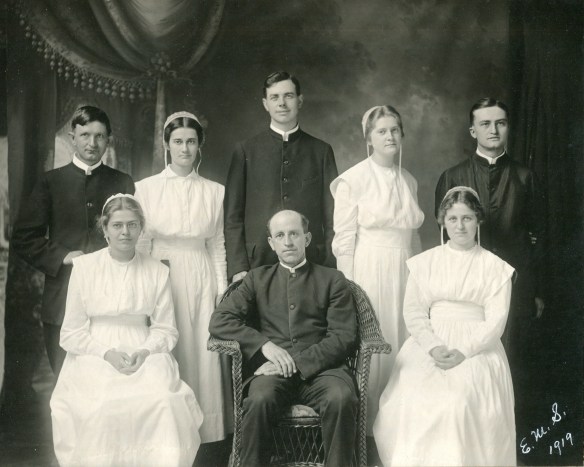
First EMS graduating class, 1919

First graduating class of EMS; Mary Nafzinger, front left

Mary’s letters to Evan give us a sense of day-to-day life in the early years of the school and also an understanding of how world events–like the Spanish Flu and World War I–impacted the small campus:

September 19, 1918

“Things are going on in their usual quiet way here at school. Much like last year only I am taking a heavier course, and taking seven subjects. Six of them being solid. I also put in my application to do the ironing so I am quite busy. The spiritual side of the school is growing dearer to me every day. We girls have prayer circle every evening then we have a devotional service before breakfast every morning. We also have a S.S. [Sunday School] organized, and a Young People’s Meeting . . . Elizabeth Horsch [later wife of H.S. Bender] from Scottdale is my roommate.”


September 26, 1918

“I am sitting out on our porch writing on the bannisters. . . .”

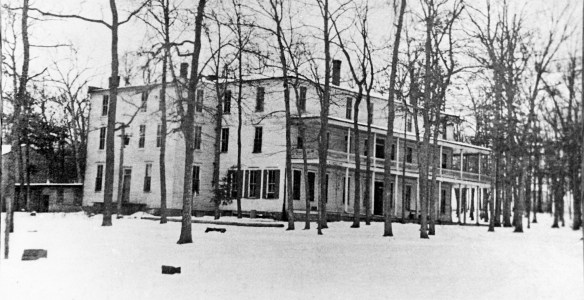
White house002
The porch Mary Nafzinger is referencing here was on the “White House”, a mansion on the property in Park Woods that the EMS founders purchased in 1917. This building housed all school activities and students.

In this letter Mary also discusses the impact of WWI on enrollment numbers:

“We have about 22 students registered. Four of them are Maryland and Pa. Some more are expected soon. This last draft law cut down so many that wanted to come but of course girls could come, but some have to stay at home on account of their brothers leaving.”

In one of her next letters Mary tells Evan how they spend their leisure time at the school:

October 7, 1918:

“Two girls from here at the Park and I were out on a rocky hill all afternoon, too, writing letters, reading etc. I think that is one way of spending an ideal Sunday afternoon. The greatness and grandness of nature impresses me so much and makes me conscious of His greatness and also as nothing else can makes me feel the nearness of Him who never leaves or forsakes us.”

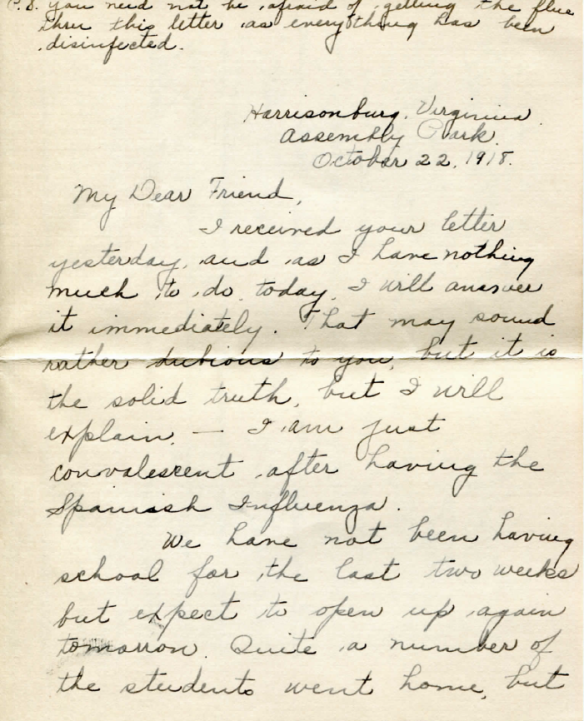
In the fall of 1918, the second wave of an influenza pandemic, nicknamed the “Spanish Flu” hit Harrisonburg and the surrounding areas. EMS was not immune from the pandemic, with many students and faculty taking ill. Mary writes:

Oct. 22, 1918

“I am just convalescent after having the Spanish Influenza. We have not been having school for the last two weeks but expect to open up again tomorrow. Quite a number of students went home, but all we folks that stayed got it. In fact we were all in bed with it except the cook. She took care of us and good care at that . . . I was in bed nine days and was quite sick as one day they decided to send for my parents then I happened to get better right off.

Quite a few people died around here, but only one Mennonite that I know of.

P.S. You need not be afraid of getting the flue thru this letter as everything has been disinfected.”

Hen-Flew-Enza

The influenza continued to affect the school after Mary’s recovery, and she was pressed into service as a caregiver:

November 7, 1918

“Just after writing to you three more students and the cook took sick with the “Hen-flew-enza.” The students from Pa and Md immediately went home, leaving only three of us in charge and two men to cook for, J.L. Stauffer and Mr. Matz. Miss Charlton and Miss Horsch were installed as cooks and I your humble servant as nurse. None of us were very strong yet, and we had some time. They were not used to cooking and in fact had never cooked much so they as well as the rest of us were in a misery ha.

I cooked soft-diet food for my patients and you can imagine they were in a perfect misery with me as a nurse. But I got along famously and like nursing fine. It was almost as much of a lesson to me to wait on patients as to have the ‘flue’ myself.”

Mary spent the Thanksgiving holiday at the school and enjoyed some special entertainment:

November 30, 1918

“Then Thanksgiving evening we had a taffy pulling in the kitchen. It was fine but the taffy and the sport of pulling it. Also to see some four little freshman smearing in the sticky stuff that were not accustomed to handling it.”

Lest we think that EMS in the early 20th century was all excitement and occupation, here is what Mary and her roommate were doing to entertain themselves in the winter of 1918:

December 8, 1918

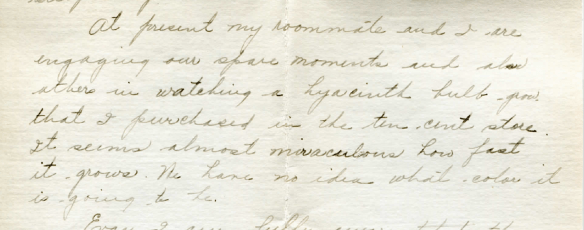
“At present my roommate and I are engaging our spare moments and also others in watching a hyacinth bulb grow that I purchased in the ten-cent store. It seems almost miraculous how fast it grows. We have no idea what color it is going to be.”

Hyacinth

The EMS of 1918 was certainly a different place to the EMU of today. It was smaller, more tight-knit, and moved at a slower pace. I think it’s safe to say that students of today, with numerous campus activities, extracurriculars, WiFi, and Netflix could find many ways to occupy themselves other than watching plants grow. But there are also similarities–a focus on spiritual life, challenging academics, and enjoyment of the beauty of the Shenandoah Valley.

1919

Mary’s final missive to Evan contained her graduation announcement and the commencement program inscribed with her class’s motto ‘Each May Serve’. Likewise, the class of 2018 are prepared by EMU to ‘serve and lead in a global context’. As we appreciate the growth and changes the past 100 years have brought to EMU, it is also reassuring to notice the similarities and qualities that have made the school a unique place throughout its history.

In A Reunion Like This We Can Share

Anita Hooley Yoder

History matters in the church. It matters what kinds of stories are told about our past, and who gets to tell them.

This was obvious at the recent Mennonite Church USA convention in Orlando, where a timeline exercise brought up some past events and issues but left out others. (See Joel Nofziger’s recent post)

As I worked on a book on the history of Mennonite women’s organizations, I found myself especially captivated by stories I had not heard before, and did not fit neatly into a typical understanding of Mennonite women. I was specifically fascinated to learn about the activities of Black and Hispanic Mennonite women, which began in an organized way in the 1970s and, to some extent, continue to today.

These activities are narrated in just one chapter in the book, but I hope the chapter I wrote is just the beginning of more writing and sharing about what happened at these events and the way God continues to work through Mennonite women of all kinds of backgrounds.

Below is an excerpt from Circles of Sisterhood, about the start of the Hispanic Mennonite women’s conferences. To read more, purchase the book! You can order online from Mennonite Women USA or MennoMedia.


5-1 Sefi de Leon

Seferina De León speaking at an Hispanic Mennonite women’s conference in the 1970s

The first Spanish-speaking Mennonite women’s conference was held in April 1973 in Moline, Illinois. Maria Bustos, wife of pastor Mac Bustos, coordinated the gathering, along with Lupe Bustos and Maria Rivera Snyder. Several reasons were given for the one-day event, which was called a servicio de inspiración. Seferina De León described it as an opportunity “to have a group of our own to listen to each other and figure out how we can help each other.”1 The organizers specifically wanted to gather women whose husbands were involved in church work and spent much time traveling, so the women could have a meaningful time together while their husbands stayed home.2 In a Voice article about the conference, Lupe Bustos wrote that the gathering arose from a concern for women who could not speak English and had never had the benefit of participating in the WMSC [the Mennonite Church women’s organization].3 As a woman of “American-Spanish descent,” she had been encouraged by attending WMSC meetings and wanted to provide similar encouragement for Spanish-speaking women.4

At the first conference, about sixty women gathered from churches in several Midwestern states as well as New York and Texas. Lupe Bustos’s article described the event as having women’s marks of creativity and care: hospitable overnight hosts, corsages for each participant, a craft project fashioning crosses out of a variety of materials. But the most memorable aspect of the event was the spiritual presence that pervaded it. The Spirit-led singing, prayer, and testimonies came to a climax when the women gathered to take communion. Mac Bustos wished to join the group for the communion service, which was led by pastor Mario Bustos. Suffering from leg pain and other health complications so severe that he was planning to give up his pastoral work, Pastor Mac was assisted into the sanctuary. Women nearby laid hands on him as they prayed and praised God. Suddenly, Mac got up and said, “Praise the Lord, all pain is gone!” He began going up and down the steps to show his increased mobility.5 “Tears just streamed from all of us,” Lupe Bustos wrote. “We realized that God still performs miracles; and a miracle happened to all of us there, because we were renewed again in Him.”6

The conference’s leaders viewed the miraculous healing of Mac Bustos as confirmation of God’s presence with them and as encouragement to continue their gatherings. At the October 1973 Minority Ministries Council meeting, they made plans for another conference and also adopted the name Conferencia Femenil Hispana Menonita (Hispanic Mennonite Women’s Conference). This is the name the group uses today, after a several-year period of using the name Sociedad de Damas Cristianas en Acción (Society of Christian Women in Action).

A 1974 gathering was planned for Lancaster, Pennsylvania. The first gathering was presumably paid for by the women themselves; Maria Bustos lists “faith” in the finances column on a chart showing figures for the early conferences.7 To help with the second conference, the Concilio leaders wrote to the WMSC requesting a grant of $3,000 for “las hermanas.” The WMSC executive committee decided to make the money available, even though it required some temporary reallocation of funds. Beulah Kauffman, WMSC director, wrote a letter to the WMSC district presidents explaining the move and reminding them of the WMSC meeting at the 1973 MC assembly. . . . At that meeting, women had expressed that they would “stand ready to help in whatever ways possible” when “clearly defined” needs of Spanish-speaking members were presented. Kauffman described this request as just such a need and expressed hope that women across the denomination would consider making the Hispanic women’s conference their annual giving project.8

The WMSC money was apparently the only outside funding received for the 1974 conference. Women from many Hispanic churches contributed through offerings, craft sales, and other fundraisers, either to support the conference in general or to fund the travel of their own members. Lois Gunden Clemens attended the gathering as a WMSC representative. She reflected in a July 1974 Voice article: “It has been good for me at various times to be a minority within a Christian group representing a cultural heritage different from mine. My heart has been strangely warmed in sensing the oneness I could feel with them. This was true again when I joined our Spanish-speaking sisters gathered together in their Lancaster meeting.”9 Enriqueta Diaz summed up her sentiments about the conference in an August 1974 Voice article: “It is marvelous that in a reunion like this we can share with each other ideas, emotions, and thoughts, all in our own language and in a cordial environment. Praise God for His love!”10

Excerpt and photo are from Circles of Sisterhood by Anita Hooley Yoder. © 2017 Herald Press, Harrisonburg, Va. All rights reserved. Used with permission. www.HeraldPress.com


  1. Quoted in Felipe Hinojosa, Latino Mennonites: Civil Rights, Faith, and Evangelical Culture (Baltimore: Johns Hopkins University Press), 152. Maria Bustos is often referred to as “Mary Bustos” in publications, since there were many other “Marias” involved with the organization. I follow Hinojosa in using “Maria.” 
  2.  Ibid., 152–53. 
  3. Lupe Bustos, “Historic Women’s Assembly,” Voice, April 1973, 5. 
  4.  Ibid. 
  5.  This event is also written about in several other places, including Hinojosa, Latino Mennonites, 153. 
  6.  Bustos, “Historic Women’s Assembly,” 5–6. 
  7.  Mary Bustos, “Report to the Executive Committee,” November 10, 1978, box 1, folder 3, WMSC Partnerships Records, 1973–1992 (IV-20-008), MCUSAA– Elkhart.  
  8.  Beulah Kauffman, letter to district WMSC presidents, April 3, 1974, box 4, folder 19, Women’s Missionary and Service Commission Executive Committee Records, 1917–1997 (IV-20-001), MCUSAA– Elkhart. 
  9. Lois Gunden Clemens, “Editorially Speaking,” Voice, July 1974, 2. 
  10.  Enriqueta Díaz, “Hispanic Women’s Conference,” Voice, August 1974, 11. 

Telling All of Our Stories as a Movement To Peace

20806922_709505384849_918526609_oAs a young Mennonite girl in Harlem, Melody Pannell didn’t see urban settings orAfrican Americans represented in church media. She didn’t see validation of her lived reality—the good and some of the social ills. This fueled her passion to work with African American youth. She has thrown herself into this work, noting “it has been my calling since the very beginning, since growing up in Harlem.”
Pannell’s Mennonite story begins with her parents. Her African American father, Richard W. Pannell, was invited, and subsequently attracted to the Mennonite Church when he was young.  He and Pannell’s white Mennonite mother, Ethel Pannell, met in New York during the Civil Rights Movement.

Reared at Seventh Avenue Mennonite Church in Harlem, Melody Pannell’s Anabaptist theology was infused with Black liberation theology. Her church fostered the belief that Mennonite faith should demonstrate the love of God and be the love of God by tending to the realities of social, psychological, cultural, educational and economic issues. To do this adequately, historical gaps in Mennonite stories must be tended to.

Pannell often talked to her peers about struggles in their neighborhoods, including drug abuse, sexual assault, poverty, and self-esteem.  She says social work has been her calling since she was a child.  As a middle child, she was a natural counselor.  Yet she cautions, “The title ‘social worker’ in my community had a bad connotation.  The social worker was often the white woman who came and took away the black children.  I would have never named it that, but that’s what I was doing.”  But agency and empowerment, her current passions, were not things she saw in the Anabaptist congregations where people where assimilating or oppressed.  Pannell learned from, and takes after her father in speaking up and speaking against injustice.

Pannell has a favorite word: empowerment.  This word brings focus to her work as an assistant professor of Social Work at Eastern Mennonite University.  However, years before this appointment, Pannell long celebrated the presence and gifts of African American women and girls while supporting them and seeking their empowerment. This is central to her work as a Mennonite woman of color, and as a peacemaker. She started the Seventh Avenue Mennonite Church Girls Group in the early 90’s, which has now become The Destiny’s Daughter’s Empowerment Ministry LLC.

Pannell’s focus on the lives and experiences of adolescent girls is influenced by current research into the effects of historical trauma on the mental health of black girls. Interdisciplinary approaches, including history and theology, are important parts of the “empowerment” package Pannell seeks to employ in her important work.

As an adult, she is concerned about what happens to African American Mennonites when they do engage and contribute—what happens to them as people.  “What I saw was a lot of assimilation and not empowerment—this is something my father fought against.”  Many were pushed to assimilate into “traditional” Mennonite culture.  This makes it difficult for young people to know who their role models should be.

And this, she says, is part of why there are gaps in our historical record.  She gives the example of Eastern Mennonite University, her alma mater and current employer, as it prepares for its centennial.  Celebrations such as these often leave the stories of African American out, or they are told in ways that do not share the depth of their stories, struggles and contributions.

“I think sometimes the stories are not told because they are not always success stories.  There have been many who have come into the church and have left.  Sometimes it is for personal reasons, and sometimes it is because of some things that we as a church need to address.”  This is one of the reasons, she says, African Americans are not adequately represented in the denomination’s history. Additionally, “People sometimes don’t want to stay around and tell the story, and sometimes those who would be the documenters don’t want to tell the full story, because that means we will have to talk about race. These are the things that don’t make us look like the church we say we are.”

Pannell believes a fuller accounting of the history of Mennonites in North America would also facilitate the denomination moving beyond a ‘mission mentality.’  “A power shift has to take place.  When you get into these spaces and places where you are the one, or one of a few, you have to guard against being a token.”  Being a token, she explains, is a precarious position.  “I have seen African American leaders hit that concrete wall and just were . . . destroyed. Their leadership trajectory was cut off and diminished.  And then the blame gets put on the person, and not the culture of the church.”

The opportunity to teach and mentor young adult energizes Pannell, but it is her passion for the church as an instrument of justice that drives her to continue to push for change. From never seeing faces that reflected her own in denominational publications, Melody Pannell has no problem making waves so that the Mennonite narrative continues to be broadened.

Collections on the Move

Jason B. Kauffman

For most of my short time at the Mennonite Church USA (MC USA) Archives, I have occupied myself with “the move.” Shortly before I began in July 2016, MC USA made the decision to transfer all archival collections from their long-time home on the campus of Goshen College to a new facility at the denominational building in Elkhart. I spent the better part of ten months (July 2016-April 2017) planning for and carrying out the move of over 6,500 boxes—from three different locations—onto new shelves in Elkhart. Among these boxes were six new ones from Forks Mennonite Church, a congregation outside of Middlebury, Indiana, which closed its doors in December 2016, 159 years after it was first established. Also among the boxes were those of several Mennonite congregations which have recently withdrawn from the Indiana-Michigan Conference of MC USA.

ForksMennChurchin1963

Forks Mennonite Church, 1967

Not among the items moved were those boxes belonging to Goshen College (GC), composed mostly of institutional records and the papers of former faculty members. While these records had been managed along with those of the (old) Mennonite Church (and related agencies) since the archive’s founding in 1937, as part of the move MC USA formally relinquished “all interest in or claims to ownership” of GC records.1 The move of MC USA collections to Elkhart was the final step in a process of separating out collection management responsibilities that the two institutions initiated several years earlier. A similar phase in the decentralization of Mennonite institutional recordkeeping occurred in 2012 when Mennonite Central Committee relocated over 1,200 linear feet of material from the MC USA Archives to its headquarters in Akron, PA.

Indeed, the wheels for this year’s move were set in motion long before I arrived. These flows of collections in and out of the archives happened for practical reasons, but are also integrally related to changes that have occurred in the denominational landscape in the last two decades. How have realignments happening across MC USA—and the departures of congregations and conferences—affected its ability to preserve the history of its predecessor denominations, its agencies, and the people whose actions have shaped institutions into their present forms?

Archives move for a variety of reasons. For MC USA, one of the primary “push factors” was that we were out of space. When the archives moved into the Newcomer Center on the GC campus in 1959, it needed 1,500 square feet of space to house its entire collection. As the collection grew, the (old) Mennonite Church rented progressively more space from the college so that by 2016, collections occupied around 2,900 square feet in Newcomer and another 1,700 in the Westlawn building.2 On a basic level, then, the denominational building in Elkhart offered the space necessary to reunite dispersed records in one location.

While space was a major issue, financial considerations also figured prominently in the decision to move collections to Elkhart. For most of its history, the archives was overseen by a standing Historical Committee which supported the publication of books and spearheaded a variety of initiatives that reached global audiences. The archives was an active part of the ministry of the (old) Mennonite Church and the denomination regarded it as a major center for the preservation of Anabaptist cultural heritage. In fact, the archives accepted records that extended beyond the denomination, including many significant Hutterite and Amish collections.

Since the creation of MC USA in 2002, and likely before, denominational support for the work of the archives has gradually declined. Shortly before I arrived, reduced budgets and smaller staffs contributed, in part, to the decision to create a new collection development policy with a much narrower scope. This, in turn, led to the deaccession of manuscript collections, congregational records, and conference records to new repositories. The move to Elkhart provided an opportunity for the denomination to eliminate rental payments to Goshen College, moving the archives closer to a sustainable operational model.3

Many of the reasons behind changes in policy at the MC USA Archives are tied to its own history as an institution. However, these recent developments also reflect changes that the denomination has undergone since it was created through the merger of the (old) Mennonite Church and the General Conference in 2002. Since then, hundreds of congregations (and entire conferences) have left MC USA which, in turn, has contributed to a significant decrease in financial support for the work of the denomination and its ministries. And, like most other ministries, the archives has not been immune to this financial crisis. The move is thus an acknowledgment of the important role the archive plays in the preservation of the denomination’s historical record, but it also represents an effort to shore up the many costs associated with its operation.

But what other costs—beyond financial—have resulted from the move? On a practical level, researchers must now potentially travel to three different locations to consult collections that used to be housed in Goshen.4 On a broader level, the move ended an almost century-long relationship between Goshen College and the (old) Mennonite Church. It has also ended (and strained) a newer relationship with the Mennonite Library and Archives (MLA) at Bethel College. Since 2002, MC USA has subsidized the work of the MLA to cover the cost of housing and managing the institutional records of the General Conference, one of MC USA’s predecessor denominations. Within the last year, MC USA made the decision to discontinue funding for the MLA. Rather than ship those records to the new facility in Elkhart, Bethel College chose to take on ownership and is currently working to build an endowment to fund the MLA.5 A similar process has taken place within Mennonite Church Canada, as the denomination recently turned over management of the Mennonite Heritage Centre Archives to Canadian Mennonite University.6

As M.J. Heisey has noted, the movement and reconfiguration of archival collections over time “make significant statements on the politics of the present.” This is clearly the case with the changes that have taken place in the Mennonite archival world in the last several years. But why does all of this matter? Certainly there are more pressing issues in our denomination (and our world) that deserve our attention before the preservation of a bunch of old, dusty documents that only a fraction of Mennonites actually use.

I think at least part of the answer to this question lies in the centrality of history to Mennonite identity. As John Roth has noted,

“Mennonites are a people whose identity is formed by story. Our theology has been intimately connected with our history. So attentiveness to how we tell our story is profoundly important. How we preserve these records are not simply technical questions of keeping them dry and well organized. We also have a long tradition of gathering archival records in ways that enable historians to give the fullest possible account of our past.”7

With Roth and many others, I lament the recent fragmentation (and defunding) of Mennonite institutional archives. But these recent developments also compel Mennonites to reassess what is important to us about our past and set priorities for the institutions that will preserve our historical memory going forward. Present realities are much different today than they were in 1960 (or even 2000): resources are far scarcer, and old ways of doing things are no longer sustainable. If our story is as important to our identity as Roth suggests, then our denomination—and Mennonite-related historical organizations in general—will need to generate new, creative ways to care for the shared cultural heritage that we have created (and will continue to create). Or, as Rolando Santiago has put it, we need to think seriously about “how we care for our fragile church institutions in times when budgets and resources are decreasing . . . address their flaws, and build their financial assets.”

Such changes won’t happen overnight and they will likely require expertise, wisdom, collaboration, and support from a network of committed individuals and institutions. Already, I have been encouraged by new relationships that have grown out of the move to Elkhart. This summer the archives formed a partnership with Mennonite Mission Network’s SOOP program that will provide an opportunity for volunteers to support the work of the archives. I am also exploring avenues to create a regular internship program for college students interested in a library, archive, or museum career. They will join an existing core of committed volunteers as we work together to arrange and describe the records that continue to arrive at the archives.

If you care about our Mennonite story, I invite you to join with me and other Mennonite-related historical organizations in imagining new ways that we can work together to create sustainable and thriving programs that will benefit future generations. In the meantime, I will continue to do my best to preserve the rich stories that are already here—those of the many individuals and institutions that have shaped the history of our denomination. This includes congregations—such as Forks Mennonite Church—that are no longer meeting and those that have chosen to leave the denomination. Their histories, too, are central parts of our collective Mennonite story.

  1. This wording is taken from a Memorandum of Understanding between MC USA and Goshen College finalized in April 2017. 
  2. In 2014, the archive also shipped 342 boxes to a remote storage facility in Fort Wayne, Indiana. Archival records were first moved to the Westlawn building in 1999. Discussion of space needs in the archives administrative files date to 1986, but conversations were likely initiated earlier than this. 
  3. Due to the generous support of private donors, the denomination accrued no debt to remodel the space, install moveable shelves, and move the collection from Goshen to Elkhart. 
  4. For example, researchers interested in the life and work of Harold S. Bender will find materials in the institutional records of the (old) Mennonite Church at the MC USA Archives in Elkhart, his personal papers and faculty records at Goshen College, and Mennonite Central Committee records in Akron, PA. 
  5. A Memorandum of Understanding between MC USA and Bethel College was finalized in July 2017. 
  6. According to the press release, Mennonite Church Canada will still provide funding for the archives through a three-way partnership with CMU and the Centre for Transnational Mennonite Studies at the University of Winnipeg. 
  7. Heisey and Roth made these statements in 2012 in reference to the relocation of MCC’s archive from Goshen to Akron, PA. 

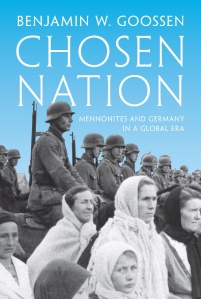
Half of the Story, Honestly Told: Review of Benjamin Goossen’s “Chosen Nation”

William Yoder, Ph.D.

Benjamin W. Gossen, Chosen Nation: Mennonites and Germany in a German Era (Princeton, N. J.: Princeton University Press, 2017). ISBN: 978-0-691-17428-0. Cloth $49.50; eBook $34.99.

image001

The “invention” of a Mennonite nation is one outstanding theme in Benjamin Goossen’s dissertation, Chosen Nation. Mennonites and Germany in a Global Era, published by Princeton University Press in June 2017. This Mennonite from Kansas with Russian-Ukrainian roots points to the fact that the theory of a Mennonite “nation” was based on the assumed existence of a Jewish one. In both cases, a religious-ethnic grouping present in many cultures was seen as part of a larger nation transcending traditional cultural and linguistic boundaries. In the fascist-controlled, post World War I-regions of Europe, Mennonites even of Dutch heritage had celebrated themselves as champions of “Germandom.” But for obviously opportunistic reasons, the concept of a transnational Mennonite “nation” kicked in after 1945. It was used as a crux for obtaining exist visas to the Americas in post-war, anti-fascist Europe.

The Mennonite icon Peter J. Dyck (1914-2010) was honest enough to admit in 1988 that the claim of being a nation had been “a temporary cloak woven from the wool of political expediency.” The refugees from Russia had “changed their identity when it suited them. They became chameleons” (199). Dyck himself had under Mennonite Central Committee (MCC) tutelage helped fashion this construct at the end of WW II. The claim was used to spare once-Nazi Mennonites who deserved retribution. But of course, Dyck’s motives were somehow humanitarian.

In the course of the past several centuries, Mennonites had insisted on privilege. Privilege—in taxation for example—was very much a part of their decision to move to Russia (now eastern Ukraine) in the 1780s. When it was convenient, Mennonites promoted their state of privilege either by citing their Germanness or their supranational nationhood. Goossen points out that the ethnic and racial criteria prevalent during the Nazi period survived into the post-war era. Agnostics and Catholics posed as Mennonites in hopes of obtaining equal privilege for emigrating to the Americas. The criteria remained cultural and racial. He asks on page 182: “What were MCC’s refugee operations, after all, but an elaborate exercise in ethnic nationalism?” It was the Cold War’s transition from anti-fascism to anti-communism which in 1951 finally opened Canada’s gates even for Mennonite members of the Waffen-SS (181).

A particularly strong point of this book is its descriptions of Nazi fascination for the Mennonite colonies of Eastern Europe, an appeal underscored by Heinrich Himmler’s landmark visit to the Molotschna colony in October 1942. Mennonites in the USSR were one of “Germandom’s” most impressive specimens and “groundbreakers for Germandom.” Though scattered across the globe, Mennonites’ “church discipline and religious racial defense system have protected (them) one-hundred-percent against the dilution of their blood through the infiltration of foreign elements. There is likely no other confession in the world that demonstrates such a racially uniform character as the Mennonites” (131, from Benjamin Unruh, approx. 1939). Supposedly the most Aryan of all, this characteristic made them prime targets for Nazi anthropologists and Eugenicists. According to the author, Mennonites “relished the attention” these researchers showered upon them.

Goossen is to be thanked for pointing to the questionable, racist character of genealogical research as practiced by ethnic Mennonites. Though it had been strongly propagated by fascist circles, Mennonite theologian Harold S. Bender (1897-1962) wrote in 1950: “It is encouraging to learn that a permanent interest in family history remains among the Mennonites in Germany, even after the Hitler regime has long since passed away” (201).

The book points to the direct linkage between pacifism and Mennonite quietism. The Mennonite understanding with Czarist authorities assumed that freedom from the draft would be conceded if the colonies did not proselytise. Numerical growth had to be restricted to procreation; to do otherwise would have exceeded the limits of Russian tolerance.

The pacifism issue was also a source of long-term tension between Mennonites in Germany and the diaspora. Germany had no Mennonite conscientious objectors after the 1870s, and in 1912 the Danzig “modernizer” Hermann Mannhardt (1855-1927) was very much opposed to the repatriation of Ukrainian Mennonites to Germany. After all, “Mannhardt and his associates had spent the last half-century ridding pacifism from their own congregations. At the very moment that charges of cowardice were finally dissipating, it would be madness to import 100,000 colonists” (102). At the turn of the twentieth century, the pacifists were rural and traditional, located primarily in Russia and North America. It was the urban Mennonite middle-class  in Germany and Holland that had by then opted to “modernize.”

It was also the rural and traditional who best resisted the enticements of Nazism. After a trip to Paraguay in the 1930’s, the pro-Nazi geographer Herbert Wilhelmy (1910-2003) complained that Mennonites there viewed the Third Reich as “too militarist and too worldly.” These “religious fanatics consider (pro-Nazi Mennonites) as being traitors to the Mennonite cause” (142). In North America, South German- and Swiss-rooted “Old Mennonites” and Amish expressed little admiration or interest in Hitler. Yet this is not the entire story: Pro-fascist sentiment among the low-German Mennonites of Manitoba in the 1930s also included the rural.

Goossen’s treatise includes tidbits of information worthy of further exploration. Numerous Mennonites were active in Germany’s liberal “Vormärz” revolution of 1848. Krefeld banker Hermann von Beckerath (1801-1870) served as the German Reich’s first minister of finance. Indeed, Krefeld’s industrialist Von der Leyen family had been active in German politics and finance since the 1650s. (The current German minister of defense, the Lutheran Ursula von der Leyen, is married to a member of this Mennonite family.)

A particularly unsavoury set of anecdotal clips refers to Mennonites caught up in the fascist war. Heinrich Wiens, a Molotschna native and member of an SS-Einsatzgruppe, was involved in the elimination of Jews with gas vans (159). Jakob Reimer from Halbstadt/Ukraine participated in a massacre near Lublin (apparently the “Aktion Erntefest” of November 1943—see 162).

No less questionable were persons mentioned by Goossen as the close allies of Mennonites. Adolf Ehrt (1902-1975), the head of the Nazi “Anti-Comintern,” wrote his dissertation on the Mennonites. Georg Leibbrandt (1891-1982), a “long-time scholar of Mennonitism” (163), participated in the “Wannsee Conference” of January 1942 and was co-responsible for the mass extermination of Jews. Leibbrandt also served as an advisor to German chancellor Konrad Adenauer in 1955 (see German “Wikipedia”).

Erected in a region of dense Mennonite settlement near Danzig, Mennonite contractors were involved in the construction of the Stutthof concentration camp in 1939. Mennonites served there later as guards. A small consolation: Mennonite youth visiting from Germany helped rebuild Stutthof as a memorial in 1973-74 (193).

Conclusion

Mennonite encyclopedic or Wikipedia entries do not mention the pro-fascist dealings of Benjamin H. Unruh (1881-1959) or the militarism of Hermann Mannhardt. Ben Goossen can therefore be thanked for inching their biographies closer to reality. Along with Peter Dyck, Cornelius F. Klassen (1894-1954) was a second icon of mid-twentieth century Mennonitism. Yet Goossen quotes on page 143, that Klassen “aligned himself with Hitler’s Germany, railing against social-democratic rot, the Communist insanity, and the machinations of the Jews.” Apparently, a part of the essential story on C.F. Klassen remains untold.

My primary criticism of Goossen’s treatise pertains to the fact that he only tells half the Mennonite story. Though the book’s title refers to “Mennonites in Germany,” solely the low-German story is told. More seriously, the story is told from the perspective of the Mennonite émigré, not also from those who “remained behind.” Surely there were Mennonites who did not desert the Red Army. I—not a specialist in Mennonite history—have not heard their story. Goossen reports that after WW I a “subset” of Mennonites joined the Bolsheviks and attempted to foment class struggle (110). That is a story which, to my knowledge, has yet to be told.

Most importantly of all, the book does not tell the Mennonite story as perceived through the eyes of their Slavic neighbors. Why, in 1920, did the anarchists and Bolsheviks of eastern Ukraine react as they did? Bolsheviks included Mennonites among the most counter-revolutionary of Russia’s minorities.

The mass Soviet deportations eastward in August 1941 were motivated by the suspicion that ethnic Germans were potential turncoats. As it turned out, those suspicions were completely justified. The communist position was, among other things, also a reaction to the German and German-Mennonite position. (These words are no defense of Stalinist behavior; they are only an attempt to understand it.) Western Mennonites have produced hundreds of treatises describing communist guilt; it is now time to hear the other half. We must hear more than only how Mennonites have interpreted themselves.

Though untold here, Ben Goossen understands that another Slavic narrative exists. Indeed, he has taken initial steps. When Mennonite farmers moved into Russia or the American frontier, they ”seized the land.” No amalgamation with native forces took place—they were simply displaced (211). Slavs were welcome as field laborers, not as co-owners. Concerned little about the good of the whole, these colonists intended to remain an ark in a Slavic sea. (Of course, there were exceptions, and prejudice ran both ways.) The author relates: Christian farmers opposed heathen nomads. Mennonite writers portrayed their colonies as “blossoming islands in the middle of Russian barbarianism” (102). Yet by 1920, Russia’s Mennonite colonies had clearly entered the globe’s post-colonial age.

Goossen refers in several instances to the Mennonite narrative’s bias: refugees were “lost” until MCC located them. Mennonites were “rescued out” of Russia—an interpretation still far from dead. The author describes the “lost” Baltic homeland as “a place of mystic tragedy.” Mennonites and other Germans have “constructed an intricate memorial culture;” minute details of their former lives are “obsolete and therefore fascinating” (191). Sadly, as we can observe since 1990, this “outpouring of minutiae” has not automatically resulted in interest for the present and future well-being of these Slavic societies. Why have almost no Mennonite refugees from Eastern Europe and their offspring chosen to move back to the “homeland”?

A further problem involves the fact that this study harbors an ideological agenda not requisite to the story. The author rejects mission as a colonial enterprise and places the word “heathen” in quotation marks (33). Gender issues, hardly ever a part of the historic Mennonite narrative, crop up in several instances. According to him, the denunciation of a Jewish neighbor in Nazi-occupied Ukraine or the shaming of the “queer” in the USA are “at least as Mennonite as bonnets, buggies and pacifism” (211).

Due in part to my perusal of the current Russian political and theological scene, I remain wary of the libertarian, individualist, pro-abortion, gender-neutral, essentially secular agenda grafted into western Mennonitism during the past three decades. Its present ideology may well be a result of the old desire of the intellectual to “be modern,” to conform. They are interested in worldly fashion, in keeping up with the Joneses. The venerable Mennonite theologian Myron Augsburger expressed to me in early 2017 his concern that Mennonite thought is no longer non-conformist: “Mennonite thinking should be with Kingdom priorities and Christ-centered in distinction from the liberal, secular agenda.”

It was the educated who brought down pacifism in Germany and Holland in the nineteenth century. Mennonite involvement in the wars of German nationalism and fascism ensued. Had German Mennonites remained “old-fashioned,” they would not have been guarding the condemned at Stutthof. Pacifism keeps believers with pro-fascist leanings—or liberals currently supporting “humanitarian” wars in the Middle East—from involvement in greater mischief.

Non-pacifism means ethical anarchy in countries with an aggressive foreign policy. In the U.S. context it meant that Mennonites dropping pacifism in the late 1950s soon had their sons dropping Agent Orange on the hapless peasants of Southeast Asia. In the context of WW II, it was the world’s rural and under-educated Mennonites who ended up prophetic, who stood the best chance of not compromising the Anabaptist witness.

The pacifists are almost always the prophets. Mennonites and Protestants in general, once they haven “broken free” of pacifism, don’t have the political savvy or acumen (“politischer Durchblick”) required to stay out of particularly questionable wars. Perhaps only some Marxists and Quakers are capable of choosing their wars carefully.

Mennonites have proven prophetic by accident. Their state was a gift of heaven, not a result of cool analysis. Connected to the wisdom of tradition, country bumpkins have proven to be the actual prophets. In Sarasota, Florida, it’s the Amish steering their barely-kosher electric tricycles across baked asphalt parking malls that point to a saner and greener form of future transport. The world is a ball, and the Amish were so far behind the trend that they suddenly ended up out front. When the professors have lost their way, the stones will cry out (Luke 19:40).

We all so through a glass darkly. In hopes of learning from past mistakes, I encourage Ben Goossen and others to press onward with their diligent research.

Originally from Sarasota, Florida, William E. (Bill) Yoder (born 1950), has resided in Russia and Belarus since 2001. He received a Ph.D. in political science from West Berlin’s “Free University” in 1991. He can be reached at kant50(at)web(dot)de”.

Power, History, and the Future Church Summit

Shortly after we married, my wife turned to me and asked, “Why are all the influential men in the Mennonite church historians?”

Strictly speaking, this is not a true statement, with Orie O. Miller and George Brunk1 being examples of North American Mennonite leaders who did not work historically. But, working from my context with Mennonites in the United States, there is a strong line of Mennonite leaders using history as a tool towards power, specifically the power that comes with shaping the story of Mennonites.2  The story has played a role in the way Mennonites understand their identity, and  has contributed to power dynamics in Mennonite historiography that must be reckoned with. (For a parallel in how institutions have shaped history, see posts by Jason Kauffman and Simone Horst.)

The following is not meant to be an exhaustive list, but merely a demonstration of how intimately enmeshed history is with influencing Mennonite identity and faith, a project many of these embraced as “creating a useable past.”

  • The immigrant Bishop Heinrich Funk (d. 1760) worked alongside Dielman Kolb and others to have the Ephrata Martyrs’ Mirror translated and printed as a way to remember the mythic origin of Anabaptism in the face of the Seven Years’ War.3

  • His grandson, John F. Funk (1835-1930), worked to create a unified Mennonite community, as best exemplified by Herald of Truth.  His publishing house worked to create a usable past for this newly “unified” community, reprinting texts such as The Martyrs’ Mirror  and the 1632 Dortrecht Confession of Faith.4

  • C. Henry Smith (1875-1948) wrote “Christian Peace: Four Hundred Years of Mennonite Peace Principles and Practice” as a brief overview of how Anabaptists have practiced nonresistance, written for workers in CO camps. The pamphlet ends with a doctrinal and ecclesiological discussion on the future of the peace testimony. Threats include “the subtle influence creeping into the church from certain short cut Bible schools which are committed to an unwholesome overemphasis on a militant millenarianism . . .”5

  • Harold S. Bender (1897-1962) perhaps most clearly illustrates this trend with the Anabaptist vision he and his students promoted. Because of some doctrinal disagreements, his position at Goshen was in history rather than Bible or theology, the fields of his formal training. Fred Kniss notes in Disquiet in the Land that this meant “he was thus able to avoid most of the divisive disputes over doctrine. By concentrating on Anabaptist-Mennonite history, he was able to concentrate on questions that drew communalism back into the center of Mennonite discussion.”6

  • John Howard Yoder (1927-1997), while a theologian, rooted his work in a historical methodology. The Politics of Jesus works towards systematic ethics and theology with biblical and historical scholarship. In his “Anabaptist Vision with Mennonite Reality,” John D. Roth notes that one of the innate tensions in Politics is a confusing use of history, where Anabaptism is claimed as a hermeneutic but used as a historical possibility.7

  • Moving towards the contemporary era, John D. Roth continues the tradition of historians playing leading roles in the Mennonite church with the Institute for the Study of Global Anabaptism and its initiative, the Bearing Witness Stories Project, both of which work to create a useable past from the experience of Anabaptists around the globe.8

  • Ervin R. Stutzman, current executive director of Mennonite Church USA, also has historical inclinations. He has published a series of historical fiction novels, including the Return to Northkill series, looking at the encounters between the Hochstetler family and Native Americans, as well as From Nonresistance to Justice: The Transformation of Mennonite Church Peace Rhetoric 1908-2008, which is a rhetorical and historical look at how Mennonites articulate what they believe about peace.

All these have given valuable contributions to the Mennonite understanding of who they are, as well as helped conversations with how the faith community has related and interacted with broader culture. But it is important to recognize the power, albeit soft power, therein. One demonstration of this is, as Felipe Hinojosa notes, how “historian after historian has ignored the calls by Black and Brown Mennonites—and marginal white Mennonites— that offer us alternative visions of the future church.

The power of history as a tool for understanding and controlling identity came to the forefront during Mennonite Church USA’s Future Church Summit (FCS), part of MC USA’s biennial convention. The FCS was billed as an opportunity for the denomination to imagine what it means to “follow Jesus as Anabaptists in the 21st century.” After building community with the table groups on the first day, the process turned to the question, “How our past has shaped us and what this may mean for us going forward?”9 To provide context, there was a plenary presentation that featured John D. Roth, Erica Littlewolf (Northern Cheyenne), Jason B. Kauffman, Bishop Leslie Francisco III, and Regina Shands Stoltzfus presenting a timeline of Mennonite history, graphically presented as a tangled vine growing from sixteenth century roots and stretching into the future.

An effort was made to be as broad and inclusive as possible in the process. There was diversity represented among the presenters, with representation from African Americans and Native Americans, and participants were reassured that they would have the opportunity, indeed, were encouraged, to come up afterwards and expand the timeline. Some interesting dynamics were explored, especially as Erica Littlewolf teased out how Mennonite narratives of coming into the land and finding freedom and prosperity directly contradicted her people’s experience of suffering.

There were problems in the presentation’s content, however, with significant gaps in the material presented. There was no mention of the rich Hispanic Mennonite tradition (though this was partly because a representative could not make it at the last moment), no past for the LGBTQ Mennonites (perhaps not surprising given the politics of MC USA), and no mention of the old General Conference Mennonites (an omission, I am told, that left some people so angry they could barely speak). The history as it was told did not contain all people present.

However, the content gaps were not the most striking disconnect in the presentation. Most striking was that the lack of recognition of the power dynamics inherent in history, especially in the Mennonite church context, since church history has been equated with stories of belonging that are told in our faith tradition. The opening remark, “We all know that is history is an argument” was an example of this. It may be a true statement in the academy, but it is at odds with how history has been embodied publicly in Mennonite congregations and schools.10

History in the Mennonite church has been a tool of authority, giving an absolute view of what happened in the past. History has been a firm foundation for the purpose of maintaining Mennonite identity, not a malleable past that can be argued. There was a fundamental disconnect between the useable past given to summit participants and the history many attendees had been primed to receive by experience in church and school. This is in part why the reaction to the historical gaps was so strong: people were looking for a useable past that told them who they were, but instead were told that they needed to find history for themselves.11

As historians choosing to practice history within the church, we need to be aware of the weight of interpreting the past. The place to start is to give careful attention to the contours of power surrounding Mennonite historiography, an investigation that deserves further attention. It is from this place that we can work with individuals, congregations and broader church institutions to create history that is in the service of living traditions.12


  1.  I have not made an extensive study of George Brunk and his thought, but am basing this claim on a conversation with Javan Lapp, who has studied revivalism among Old Order and conservative Mennonites. 
  2.  There is also an interesting phenomena where non-historians writers have felt they need to translate their work into history in order to speak into the Church, but that is outside the scope of this post. 
  3.  Zijpp, Nanne van der, Harold S. Bender and Richard D. Thiessen, “Martyrs’ Mirror.” Global Anabaptist Mennonite Encyclopedia Online, November 2014 (accessed July 19, 2017). 
  4.  Ted Maust, “”Union with such as we might perhaps otherwise never know”: John F. Funk and the Herald of Truth, 1854-1864,” Pennsylvania Mennonite Heritage 38 no. 2 (April 2015): 40-54. 
  5.  C. Henry Smith, “Christian Peace: Four Hundred Years of Mennonite Peace Principles and Practice” (Peace Committee of the General Conference of the Mennonite Church in North America, 1938), 31. 
  6.  Fred Kniss, Disquiet in the Land: Cultural Conflict in American Mennonite Communities (New Brunswick, N. J.: Rutgers University Press, 1997), 65; James C. Juhnke Vision, Doctrine, War: Mennonite Identity and Organization in America, 1890-1930 Mennonite Experience in America Vol. 3 (Scottdale, Pa.: Herald Press, 1985), 277-282. 
  7.  John D. Roth, “Living Between the Times: ‘The Anabaptist Vision and Mennonite Reality’ Revisited” in Refocusing a Vision, ed. John D. Roth (Goshen, Ind.: Mennonite Historical Society, 1995); John Howard Yoder, “Anabaptist Vision and Mennonite Reality,” in A. J. Klassen, ed., Consultation on Anabaptist-Mennonite Theology (Fresno, Cal.: Council of Mennonite Seminaries, 1970). 
  8. Goshen College, “Institute for the Study of Global Anabaptism” goshen.edu, https://www.goshen.edu/isga/ (Accessed July 19,2017). 
  9.  Mennonite Church USA, “Future Church Summit,” http://convention.mennoniteusa.org/future-church-summit/ (accessed July 19, 2017). I attended as the delegate for Pilgrims Mennonite Church, Akron, Pennsylvania. Most of the material going forward is based on my personal notes. 
  10.  In his ethnographic study of Mennonite schools in Lancaster, Pa., Ken Sensenig notes, “Heritage [that is, history] awareness plays a significant role in Greenfield’s attempts to maintain its peace position. Remembering and interpreting the people and concepts which gave birth to the Anabaptist/Mennonites during the sixteenth century Reformation is one important method of teaching peace at this school. [. . .] More formal heritage training takes place in the classroom, with both schools devoting courses exclusively to the study of Mennonite and general church history. The commitment to peace and justice is an important focus of these studies. Kenneth L. Sensenig, “An Ethnographic Approach to the Study of Sociopolitical Views in Two Mennonite High Schools.” (Dissertation, Temple University, Philadelphia, 1991), 91-92. 
  11. This is not a bad way to do history in the church, but it is not how many are accustomed to it to being done. 
  12.  I borrow this phrase from William H. Katerberg, “Is there Such a Thing as ‘Christian’ History?” Fides et Historia 34:1 (winter/Spring 2002): 57-66. 

Rising through Mennonite shame, Reflections on Crossing the Line: Women of Anabaptist Traditions Encounter Borders and Boundaries

Anna Wall

This post first appeared at Mennopolitan.

Life is like a Kjrinjel1: you never know how it’s going to twist.

A year ago, when I received an invitation from Abigail Carl-Klassen to participate in a panel at a conference at Eastern Mennonite University in Harrisonburg, Virginia, I said “YES!” before I’d even finished reading the email. The panel would showcase creative work by and about women from Mennonite communities in Mexico, discussing transnational identities and issues.

Editor’s Note: While Anabaptist Historians generally focuses on historical research, in the interdisciplinary spirit of “Crossing the Line”, we are broadening our scope during this series to include a wide variety of Anabaptist studies.

As the date of the conference drew closer, I became overwhelmed with fear and self-doubt. I thought, “Who am I kidding?  I can’t do this!” So I did what I always do when that happens: drop everything and read a book, because now, I can. Luckily, my friend and co-worker Sidney Bater has a library full of books that are written just for me. I picked up one of the books whose title spoke to me: Rising Strong by Brené Brown. After reading this book, I thought, “So what if I screw this up and fall flat on my face? I will rise strong and do it again.”

That was easier said than done. But I was able to stay focused enough to go through with it. It began with a ten-hour drive to Virginia from Ontario in a black minivan with four amazing women. We came from different backgrounds, yet we all had so much in common.

Upon arriving at EMU campus, I was thrilled to learn that I was sharing a room with Laura Morlock, one of the women that I had just gotten to know during the ten-hour trip. I believe that everything happens for a reason, and the reason for her company was to keep me from letting self-doubt crush me.

What an overwhelmingly humbling experience it was as I remembered George’s words: “Life doesn’t happen in the same order for everyone, and there is nothing wrong with that.”

I thought, “Finally! Not only do I get to sleep in a dorm at a university, but at a Mennonite university.”I giggled a little on the inside, because the butterflies in my stomach were going insane with excitement.

The next day, after walking around on campus in disbelief, and taking it all in, I met with Abigail Carl-Klassen and Veronica Enns, who were part of the panel. I immediately connected with both of them. The experience was deeply moving.

That evening, I sat beside my new friends Abby and Vero in the theater listening to women speak. I mostly spent the whole time fighting back the tears, because every word that was spoken touched me so deeply.

After successfully holding back my tears, I made my way to the art gallery. As I stood in front of an art piece, staring at it and trying to feel what it was telling me, a man joined me there. I glanced at him nervously, and it was none other than Canadian History Professor Royden Loewen. I recognized him because I had met him at a lecture and book signing I had attended at Conrad Grebel University a while before with my friend Shirley Redekop. As Shirley flipped through Royden’s book, Villages Among Nations, she pointed out a picture of a Rev. Johann P. Wall, and asked if I could be related to him. And that’s when I discovered that not only was Rev. Johann P. Wall my great-grandfather, but he was one of the leaders who took part in the decision to migrate to Mexico from Saskatchewan Canada in the 1920s.  

I moved on to the coffee lineup, and there I spotted another familiar face. It was the one-and-only author, Saloma Miller Furlong. I had read her memoir, Bonnet Strings, a couple of months before, and had afterwards sought out information about her online.

After reading about Saloma, I dreamed of meeting her someday. I told myself that if I ever got to meet her, I would hug her, and she would know why, before we even exchanged any words. But when I stood in front of her, I froze, and shook her hand instead. I told her many things that I hadn’t planned to say. But at the end of my ramble, she hugged me and said, “Find me tomorrow. I want to talk to you some more.”

It was hard to settle down and go to sleep after all that.

After Abigail Carl-Klassen had presented, I nervously walked up to the front to share my story. I began with the pivotal decision to cross cultural boundaries and two borders–leaving my colony in Mexico and coming to Canada. I shared that I was illiterate and didn’t speak English, and how I faced many barriers as I began my journey of finding my place in a whole new world, one that I had never been part of.

I spoke about how I began attending an adult learning center, at which point I had only even written my name a handful of times, and how simply holding a pen in my hand was awkward. I shared how ashamed I was of my literary incompetence and how embarrassing it was, as I was nineteen years old and felt like I was starting kindergarten. I said that ever since then, reading and writing have been my obsession, one of the main reasons I started blogging.  At the beginning of my presentation, I stumbled over my words and said sort of what I had written, but in mixed-up order. I reminded myself of what I had read in the book, Rising Strong, that it was alright; I should leave my mistakes behind and just continue.

When I read a post from my blog titled Fashion Faux Pas, and people began laughing with me as I read, I knew that I was back on track. That moment was the first time I felt I was doing exactly what I was meant to do. That included speaking in front of an audience about ridiculously embarrassing experiences that at one point I wouldn’t have wanted to remember, let alone tell strangers about.

It was surreal—not only being there, but being in the presence of scholars I had only read about, and discussing an art piece in Plautdietsch with a Canadian history professor. Then there was sharing with Saloma Miller Furlong my dream of publishing a memoir, and comparing our similar experiences and our struggles over how to clothe our bodies after shunning our Mennonite dresses.

I left the conference with an abundance of knowledge, hope, and new relationships. The experience has inspired me to no end. Thank you to Abigail Carl-Klassen for opening the door, and to EMU for inviting me in.

Thank you.

See other writings on “Crossing the Line: Women of Anabaptist Traditions Encounter Borders and Boundaries” here.


  1. From, Plautdietsch; m. (pl: s) a pretzel, twisted buns, a soft pretzel