Mennonit to Gottgläubig

2+3 panorama

Genealogy Chart of Manfred Quiring

Walter ( Jacob) Quiring (1893-1983) was a widely read writer of Russian Mennonite background, an outspoken Nazi apologist, and later the editor of the Canadian Mennonite newspaper Der Bote—a set of significantly clashing roles over his lifetime.

This genealogy chart is found in the Library of Congress German Captured Documents microfilms.1 It is filled out in the name of Quiring’s son Manfred, who, as I understand it, was killed in World War 2.

What is  most interesting is that Quiring filled in the space for religious affiliation for himself, his wife, and son as gottgläubig, a Nazi term for non-Christian religious affiliation which might be translated as “theistic.”2 However, all of the previous generations are labeled as Mennonit.

John D. Thiesen, Archivist, Co-director of Libraries, Mennonite Library and Archives, Bethel College, North Newton, KS


  1. German captured documents collection, 1766-1945, Library of Congress, Reel 286, shelf no. 18,806.4 (near the end of the reel). 
  2.  “Gottgläubig” Wikipedia, https://de.wikipedia.org/wiki/Gottgl%C3%A4ubig (Accessed November 30). 

Rethinking 606, the “Mennonite National Anthem”

Austin McCabe Juhnke

In 2015, Garrison Keillor’s “Prairie Home Companion” recorded a show on the campus of Goshen College in Indiana.1 As he often does, Keillor began the show with an introduction to the local area, describing the Mennonites who live there as “one of the most persecuted people in history.”  According to Keillor, these Mennonites developed a tradition of hymn singing “to keep up their spirits in the midst of all of this horrible cruelty and violence.”2 As if to prove his point, following this introduction, Keillor had the Goshen College choir lead the audience in singing “606,” a unique setting of Thomas Ken’s doxology (“Praise God from whom all blessings flow”) which many Mennonites know colloquially by its number in the 1969 Mennonite Hymnal. After recording the show, Keillor marveled at how his “Mennonite” audience “sang like angels. You just hummed a note and gave them the downbeat, and they sang in perfect four-part harmony.”3 Even though Keillor framed this performance of 606 as an expression of Mennonite-Anabaptist historical persecution, Mennonites have only been singing this hymn widely since its appearance in the 1969 Mennonite Hymnal. Since 1969, however, it has become commonplace for Mennonites to sing 606 not only in worship, but also as a celebration of Mennonite community in public places. The song has even sometimes been called “the Mennonite national anthem.”4 Though this nickname is used with somewhat jocular tone, it is perhaps more fitting than it appears, and it is worth considering the ways nationalist thinking has shaped Mennonite identity and musical practices.

Nationalists of the late-eighteenth and nineteenth centuries thought of nations as naturally occurring, discrete groups of people. Within these groups one would expect to find essential similarities and between the groups one would find essential differences. Points of national comparison ranged from cultural practices to physical features to emotional temperaments. Today it is generally agreed that nations are constructed, rather than natural entities.5 Nevertheless this enticing idea has made for strong political solidarities that have been used both to resist and reinforce systems of oppression over the last centuries. Thus, at best, nationalism is used as a strategic simplification of the complexity of human social relationships. At worst, however, this ideology fuels a drive to maintain the “purity” of a supposedly natural identity.

One important way of legitimating national identities is history. If a group of people saw themselves in the same historical narrative, it helped create the sense of belonging to a national “we” that united people across space and time. “Praise God from whom” (606) was added to The Mennonite Hymnal during a period in which American Mennonites were more consciously looking to history to make sense of themselves in the modern world. Between the First and Second World Wars, Mennonites formalized a belief in nonviolent pacifism, identifying their tradition with the phrase “historic peace church.” In 1943 Harold Bender, founder of the Mennonite Historical Society and professor of history at Goshen College, penned his influential essay “The Anabaptist Vision.” In it he connects present-day Mennonites to an “authentic” Anabaptist lineage.

[W]e know enough today to draw a clear line of demarcation between original evangelical and constructive Anabaptism on the one hand, which was born in the bosom of Zwinglianism in Zurich, Switzerland, in 1525, and established in the Low Countries in 1533, and the various mystical, spiritualistic, revolutionary, or even antinomian related and unrelated groups on the other hand. . . The former, Anabaptism proper, maintained an unbroken course in Switzerland, Germany, Austria, and Holland throughout the sixteenth century, and has continued until the present day in the Mennonite movement[.]6

In assuming that there is a definable “Anabaptism proper” and that it has an unbroken lineage to the present, Bender—consciously or not—was taking cues from nationalist models of identity. Later historians disputed the idea that it is possible to determine a single origin point for Anabaptism, but Bender’s “Vision” of a historical Anabaptist-Mennonite essence became an influential articulation of Mennonite identity in the mid-twentieth century and beyond.7

In this context, Mennonite hymnals became a powerful way of mediating ideas about Mennonite history, tradition, and identity. During the 1950s the (Old) Mennonite Church’s Music and Worship committee began to consider revising their 1927 Church Hymnal. There was a sense among many on the committee that the quality of Mennonite singing had been slipping. In 1959 committee member Chester K. Lehman gave a talk called “Congregational Singing – Our Losses and Gains” in which he criticized recent Mennonite hymnbooks for their heavy reliance on the “popular and emotional gospel songs,” which he viewed as a “retrogression” in Mennonite tastes.8 In 1960, another committee member and Goshen College music professor Walter E. Yoder spoke at a Music and Worship conference at Goshen. In his talk, “Raising Our Sights in Our Church Music” he bemoaned the loss of hymns from before Mennonites began speaking English and taking on Protestant- and evangelical-like church activities: “The unfortunate thing was, and we still have this problem with us today, that with the change of language and the taking on of many new activities, the church dropped its good german [sic] hymnody and sub[s]tituted for them the weaker texts and lighter tunes of the Gospel Hymns.”9 The years-long process of compiling and editing the 1969 Mennonite Hymnal formalized a Mennonite musical aesthetic that sought a return to the “solemn, sober, thoughtful and dignified” hymns of an imagined Mennonite past.10

3

606 in the red Mennonite Hymnal (1969). Photograph by the author.

It was in this process of “recovering” the Mennonite musical past that “Praise God from whom” came into Mennonite institutional hymnbooks. The source for number 606 in The Mennonite Hymnal was a nineteenth-century song collection called Harmonia Sacra by Mennonite publisher Joseph Funk. Funk’s instructional songbooks were part of a broader “singing school” movement in the United States that influenced Mennonite and Protestant singing alike.11 The song had fallen into relative obscurity, before its inclusion in the 1969 Hymnal.12 By 1979, however, the song was described as “the favorite of Mennonites everywhere” in the Gospel Herald, and by the 1980s it was referred to as the “Mennonite national anthem.”13

In The Mennonite Hymnal, 606 was placed in the “Choral Hymns” section because the committee thought it was too difficult for general congregational use. Indeed, there are several musical features that make singing 606 especially difficult. Unlike most hymns, in which the voice parts move more or less in the same rhythm, in 606 the soprano, alto, tenor, and bass voices jump in and out unpredictably. One example of this is right at the beginning of the hymn. Here the soprano and tenor voices begin singing “Praise God from whom” in duet. Not until a measure later do the alto and bass voices join in, singing a compressed rhythm to catch up to the other voices by the end of the first musical phrase. Complicating the issue further, there are no verses in 606 and thus no “second chances” for learning one’s part. It is not a coincidence that the “Mennonite national anthem” has these difficult elements. In fact, it is precisely because it is difficult for outsiders to join in that the hymn works as a musical identity marker. For those who are able to sing along, 606 is a powerful auditory and embodied experience of Mennonite community, yet this insider experience is predicated on musical stumbling blocks that produce outsiders in the act of performance.

4

“Project 606” on the banner of the webpage for MennoMedia’s new hymnal project. Screen capture November 7, 2017. (http://hymnalproject606.com)

In the most recent Mennonite hymnal (Hymnal: A Worship Book, 1992), 606 became number 118. Nevertheless, “606” continues to resonate as a favorite hymn and a Mennonite cultural symbol. At the 2011 Mennonite Church USA convention in Pittsburgh, a tally from the delegates put the “Mennonite national anthem” at the top of a list of “heart songs.”14 More recently, 606—or the idea of 606—has become a fundraising and publicity tool for Mennonite Church USA and Canada’s work on a new hymnal. According MennoMedia, the forthcoming hymnal’s publisher, the project aims to “take into account the breadth of the Mennonite Church [USA and Canada], the diverse ways Mennonites sing and worship, and new digital technologies.”15 Still, in an effort to raise money for the hymnal ($606,000), the work on the new hymnal was until recently nicknamed “Project 606.”16 This nickname highlights the tension between the desire to preserve and propagate a practice understood as “traditionally Mennonite” and the hope of making space for diversity within the Mennonite church.

In singing, do Mennonites, as Keillor, imagine connecting to a history of European-Anabaptist persecution? If so, will the church be able to embrace the new songs and joyful noises of a vibrant church community? I do not wish to propose here that Mennonites need a new “national anthem,” or that new musical styles will be inherently better or more inclusive. Nor do I mean to suggest that Mennonites must stop singing “Praise God from whom.” More important for Mennonites—particularly those who trace their heritage to European Anabaptists—is to confront the exclusive, ethnocentric mythologies that often inform the ways hymn singing is valued. In so doing, it would make possible a practice of singing that works not to undergird narrow formulations of Mennonite identity, but rather to reveal resonant experiences of the divine in community that transcend the logics of the world.
Austin McCabe Juhnke is a PhD candidate in Musicology at Ohio State University studying music in the Mennonite Church during the twentieth century.


  1. As of November 28, 2017, the show can be heard in its entirety here: https://www.prairiehome.org/shows/48522. 
  2.  Garrison Keillor, “Good Enough is Enough,” A Prairie Home Companion, American Public Media, May 2, 2015. 
  3.  Michela Tindera, “Quick Q&A: Garrison Keilor” Indianapolis Monthly,  August 6, 2015, http://www.indianapolismonthly.com/arts-culture/quick-qa-garrison-keillor/ (accessed November 28, 2017). 
  4.  See Anna Groff, “606: When, Why and How Do Mennonites Use the Anthem,” The Mennonite, March 18, 2008. 
  5.  See, e.g., Benedict Anderson, Imagined Communities: Reflections on the Origin and Spread of Nationalism, (New York: Verso, 2006). 
  6.  Harold S. Bender, “The Anabaptist Vision,” Church History 13, no. 1 (March 1, 1944): 8. 
  7.  James M. Stayer, Werner O. Packull, and Klaus Deppermann, “From Monogenesis to Polygenesis: The Historical Discussion of Anabaptist Origins,” Mennonite Quarterly Review 49, no. 2 (April 1975): 83–121. 
  8. Chester K. Lehman, “Congregational Singing – Our losses and gains,” (1959). Box 6, Folder 2. Mennonite Church, Music and Worship Committee, 1909-1992.  I-3-1. Mennonite Church USA Archives – Elkhart. Elkhart, Indiana. 
  9.  Walter E. Yoder, “Raising Our Sights in Our Church Music” (1960). Box 6, Folder 6. Mennonite Church, Music and Worship Committee, 1909-1992.  I-3-1. Mennonite Church USA Archives – Elkhart. Elkhart, Indiana. 
  10.  Yoder, “The New Church Hymnal and its Implications for Worship” (ca. 1962). Box 6, Folder 4. Mennonite Church, Music and Worship Committee, 1909-1992.  I-3-1. Mennonite Church USA Archives – Elkhart. Elkhart, Indiana. 
  11.  See, e.g., Walter E. Yoder, “Singing Schools,” in Global Anabaptist Mennonite Encyclopedia Online, 1958, http://gameo.org/index.php?title=Singing_Schools&oldid=113641. 
  12. “Praise God from Whom” Also appeared in the Songs of the Church, ed. Walter E. Yoder (Scottdale, PA: Herald Press, 1953), 10. 
  13.  “World’s Attic Goes to Kitchen for Help,” Gospel Herald, March, 13 1979. For a use of “Mennonite national anthem,” see, e.g., James C. Juhnke, Dialogue with a Heritage: Cornelius H. Wedel and the Beginnings of Bethel College (North Newton, KS: Super Speed Printing, 1987), 75. 
  14. “What Songs Will Mennonites Sing?” Canadian Mennonite, http://www.canadianmennonite.org/articles/what-songs-will-mennonites-sing 
  15.  “‘Project 606’: Mennonite Song Collection Project Aims for 2020 Release,” The Mennonite, January 4, 2016, https://themennonite.org/daily-news/project-606-mennonite-song-collection-project-aims-for-2020-release/. 
  16. MennoMedia, Project 606: A Gift for the Next Generation,  September 12, 2017, http://web.archive.org/web/20170912230138/http://hymnalproject606.com/ . The project has recently been rebranded as Resonate: Join the Everlasting Song, http://hymnalproject606.com (Accessed November 30, 2017), a change that was found after this post was initially published. 

A Radical Love in Harlem: Resolve, Resilience and Restoration (Part 1: 1952 – 1975)

This is a portion of a current autobiographical project documenting the historical account of Seventh Avenue Mennonite Church in Harlem, New York City from its birth in 1954 leading to the 65 Church’s Anniversary in 2019. (Part I Resolve: 1954 – 1975) Part II Resilience: 1976 – 1996) (Part III Restoration: 1997 – 2017) 


DadHS

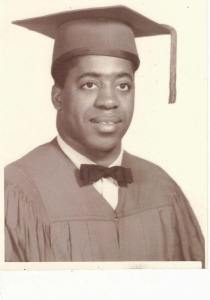
Richard W. Pannell

It was in the heat of the civil rights movement on June 2, 1961, when my father, Richard W. Pannell, a twenty-one year old African-American man first arrived from Coatesville, Pennsylvania, to the historic village of Harlem, New York City. Harlem was known as a predominately African-American community that had a “southern presence” due to the “Great Migration” that fueled Harlem’s population in the 1920’s. Harlem was often called “the spiritual home of the Negro protest movement,” as noted activists Marcus Garvey, A. Philip Randolph and W. E. B. Du Bois led several protests and organized ideas around social justice movements.  The growth of organizations such as the National Association for the Advancement of Colored People (NAACP) and the radical writings of The Messenger magazine empowered Harlem residents to speak up and advocate on behalf of their community. 1

Harlem was also an oasis of cultural, social and intellectual enlightenment that gave birth to the “Harlem Renaissance” (1918 – 1930s). Literary figures spoke to the social disparities and suffering of the people of Harlem as mirrored in the famous poem entitled “Harlem” by Langston Hughes:

What happens to a dream deferred?
Does it dry up
like a raisin in the sun?
Or fester like a sore—
And then run?
Does it stink like rotten meat?
Or crust and sugar over—

like a syrupy sweet?
Maybe it just sags
like a heavy load.

Or does it explode?2

Theologically speaking, Harlem was a community of vibrant yet contradictory ideologies and beliefs in the early 1960s. Nation of Islam leader Malcolm X was deemed the “Prince of Harlem” and regularly held protests on the corner of the infamous 125th Street and Seventh Avenue to mass supporters. Televised speeches of the Rev. Dr. Martin Luther King Jr. could be heard echoing throughout tenement house hallways on Lenox Avenue, and were emulated by black preachers like the Rev. Adam Clayton Powell, Jr. in the pulpit on Sunday mornings. Yet on almost every dining room wall of black families living in the projects, there hung a picture of a blond haired, blue-eyed “White Jesus.” This was Harlem; a radical, renowned and resiliently beautiful community.

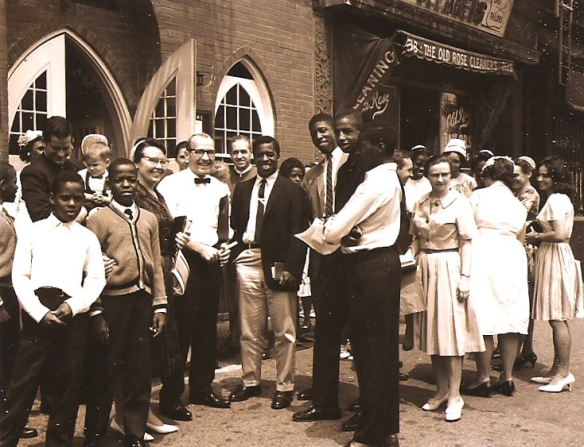
It was here in the place known as the “Black Mecca” of the world that John H. Kraybill, a young white Mennonite pastor, greeted my father in front of 2526 Seventh Avenue and welcomed him to Seventh Avenue Mennonite Church.  It would be a moment in time that would change the trajectory of the relationship between the Harlem community and the broader Lancaster Mennonite Church Conference throughout the civil rights and black power movements. 3

5.Kraybill family at brickfront church (1)

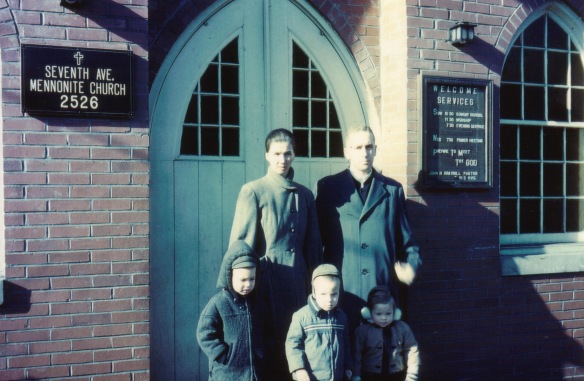
Kraybill family at brickfront church

John H. Kraybill was the founder and first pastor of Seventh Avenue Mennonite Church (originally named Harlem Mennonite Church). Kraybill had arrived in New York City from Lancaster County, Pennsylvania, in May of 1953. Kraybill, once a student at Ontario Mennonite Bible Institute from 1951 – 1953, was drafted during the Korean War (Jun 25, 1950 – Jul 27, 1953 ) and was given classification as a “conscientious objector,”  “a person who refuses military service on the grounds that he or she cannot in good conscience participate in the machinery of war due to personal beliefs.”4 Kraybill was ordered to work two years at a nonprofit institution that addressed national health and safety. It also had to be at least 150 miles from his home town in Lancaster County, Pennsylvania. Bellevue Hospital in New York City was the ideal place for Kraybill to serve his two years. However, unbeknownst to him at that time, Kraybill would spend thirteen years building the mission church plant of Seventh Avenue and ushering in a shift that would serve to save, strengthen and call a generation of radical and diverse young leaders to serve this Harlem Church for the next fifty years.

Kraybill arrived in New York City in the spring of 1953 and became a member of one of the mission churches planted by Lancaster Mennonite Conference in partnership with Eastern Mennonite Board of Missions and Charities. St. Ann’s Mennonite Church, located in the South Bronx, was founded in 1951. Harold Thomas served as the pastor. Prior to then, the Fox Street Mennonite Church was founded in 1949 under the pastoral leadership of Aquila Riehl. Shortly after Kraybill arrived at St. Ann’s Mennonite Church, he learned that the congregation had a vision to plant another church across the bridge in Harlem. Kraybill recalled a dear elderly sister in the congregation named Olive Lucas, who felt passionate about supporting this new vision and gave a few dollars as she could to help it come to pass. The congregational leadership also believed that they had found the perfect person to serve as the pastor of this new endeavor: John H. Kraybill.

With a leader now selected, a group from St. Ann’s Mennonite Church located a vacant lot in Harlem on 147th street between Seventh and Eighth Avenues to start their mission. There they established the Open Air Bible School for two weeks in the summer of 1953. Over fifty children attended this outreach and it continued throughout the fall. Kraybill began getting to know the families in the community and informed them of his search for a vacant building to establish the new church. Soon Kraybill came across a building for sale on Seventh Avenue between 146th and 147th street. It was a five story building with thirteen apartments and two store fronts. Kraybill rented the building and made plans for the first service.

3.Minese and Olive

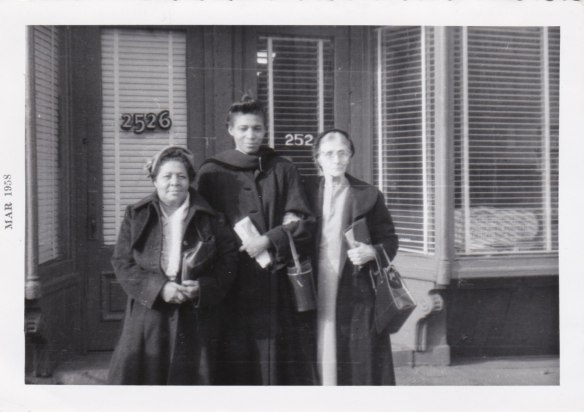
Olive Lucas, Minese Hamilton, and unknown friend

On January 17 1954, the opening service was held for Harlem Mennonite Church at 2526 Seventh Avenue, later to be renamed Seventh Avenue Mennonite Church. That same year, John Kraybill married Thelma Synder and was credentialed for the ministry through Lancaster Mennonite Conference. The first members included  Willis Johnson, Minese Hamilton and Glen and Florence Good Zeager, urban blacks and rural whites coming together as one. This was the beginning of a quiet resolve to build a cross-cultural church intertwining two very separate communities for the greater purpose of the radical love of Jesus Christ.

In the spring of 1954, Glen Zeager encouraged Kraybill to consider purchasing the building to expand the ministry that included Sunday School, Bible Classes and Sunday Morning Worship. In June 1954, John Kraybill and Glen Zeager gathered together a down payment of $3,000 and was able to miraculously purchase 2526 Seventh Avenue for $26,000. Later, in order to increase sustainability for the property, Kraybill and Zeager sold the building to Eastern Mennonite Board of Missions and Charities in 1959.

7thAve

Seventh Avenue Mennonite Church

The ministry of Seventh Avenue continued to flourish with the help of many Mennonites that came from Pennsylvania through Volunteer Service or 1-W service assignments (conscientious objectors). It was a 1-W service assignment that brought Richard W. Pannell to Seventh Avenue Mennonite Church on that summer day in 1961. My father was introduced to the Mennonite church in 1952 as a twelve year old living in Newlinville, Pennsylvania. In 1946, the Newlinville Mennonite Church emerged from a summer Bible school program held by the Coatesville Mennonite Church among African Americans in Coatesville, Pennsylvania. There my father attended Sunday School and was later baptized at the age of fourteen. Under the pastoral leadership of Elmer D. Leaman, Pannell developed a deeper understanding of Anabaptist values, community and practices. Once stating that he felt “a part of the family,” Pannell was accepted, valued and loved by his new church community. As a teenager, Pannell shared fond memories of  participating in summer camps such as Camp Tel Hai, Camp Men-O-Lan and Camp Hebron. Pannell also had the opportunity to meet  and socialize with other black Mennonite youth from different urban outreach churches such as Diamond Street Mennonite Church in Philadelphia through the many mission station gatherings that were held in the area. Some of these other young black Mennonites from Harrisburg and Philadelphia such as Harold Davenport, Margie Middleton and Doris Allen Perkins also came up to New York and joined in this counter-cultural idea of building a Mennonite church in the heart of Harlem.  A new radical Anabaptist community of young, diverse and energetic modern day missionaries would live in the apartments above the church that was developing.


  1. Richard W. Pannell, phone interview by author, November, 17 2017. All following comments about Richard W. Pannell’s life are taken from this interview. 
  2. Langston Hughes, “Harlem [2]” in Collected Poems, ed. Arnold Rempersad (New York: Alfred A. Knopf, 1995), 426. 
  3. John H. Kraybill presentation and personal notes from April 30, 2017 at Infinity (Seventh Avenue)Mennonite Church Building Celebration; John H. Kraybill, email interview by author, on November 15, 2017. All following comments about John H. Kraybill’s  life are taken from this documentation and interview. 
  4. Hanspeter Jecker, “Conscientious Objection,” Global Anabaptist Mennonite Encyclopedia Online, accessed August 15, 2014, http://gameo.org/index.php?title=Conscientious_objection. 

On the Theological Uses of Anabaptist History: A Conversation

Note: The following is a conversation about the theological and ecclesiological uses of Anabaptist history from the perspectives of an early modernist and a modernist

By Christina Moss and Ben Goossen

CM: When the two of us presented on a panel together in June at the Crossing the Line conference at Eastern Mennonite University, one of the recurring themes during the discussion that followed was the ways in which contemporary Anabaptists engage with Anabaptist history. My own period of study, the sixteenth century, encompasses the beginnings of Anabaptism, so it continues to hold a lot of interest for the spiritual descendants of those first Anabaptists. But of course, Anabaptism is a dynamic tradition and has continued to evolve since the sixteenth century. Ben, your research has focused more on Anabaptists in the modern era. How have you found that contemporary Anabaptists engage (or perhaps fail to engage) with more recent Anabaptist history?

image1-17

The ongoing influence of Harold Bender’s Anabaptist Vision, despite extensive scholarly critique, represents the entanglement of history and theology in Anabaptist communities.

BG: That was a great discussion! One of the insights I have continued to ponder is your comment that Reformation-era Anabaptists lived during a radically different time that, if we are honest with ourselves, may not actually have that much bearing on our twenty-first century context. In my work, I have tried to trace some of the reasons why modern (i.e. nineteenth- and twentieth-century) Anabaptist church leaders, historians, and lay persons have attached such importance to Reformation history.[^1] Frequently, the answer seems to be a search for a “usable past,” in which sixteenth-century stories are brought to bear on more contemporary challengescrises of faith, external threats, shrinking congregations, etc. I might venture that for modern Anabaptists, the study of Reformation history has disproportionately been about modern issues. So in that sense, I would say that truly understanding either modern or early modern Anabaptism would first require deconstructing how we talkand have talked in the pastabout the Reformation. But you’re the sixteenth-century expert; where would you say the historiography falls on this point?

CM: I’ll admit to being much more familiar with how historians talk about sixteenth-century Anabaptists than how contemporary Anabaptist churches and theologians deal with that legacy, but from what I’ve seen there’s definitely a gap, though perhaps there wasn’t always. The dominant narrative in the mid-twentieth century was that cast by Harold Bender in his essay “The Anabaptist Vision.” Bender argued that Anabaptism was a logical culmination of the Reformation principle of sola scriptura. He distinguished between the “original evangelical and constructive Anabaptism,” or “Anabaptism proper,” and “the various mystical, spiritualistic, revolutionary, or even antinomian related and unrelated groups on the other hand.”[^2] The Bender school of Anabaptist history provided churches and theologians with a usable past, but from a historiographical standpoint it was roundly critiqued because it marginalized so many different expressions of sixteenth-century Anabaptism. Later seminal works like James Stayer’s Anabaptists and Sword and Stayer, Werner Packull, and Klaus Deppermann’s article “From Monogenesis to Polygenesis” emphasized the diversity of early Anabaptism, both in terms of theological views and geographical points of origin.[^3] Currently, some historians working on sixteenth-century have confessional commitments of their own and others don’t, but all would agree on their responsibility to explain the beliefs of their subjects as accurately as possible, regardless of whether those views are theologically relevant for contemporary Anabaptists.

I do want to be clear that I don’t think that churches shouldn’t look to the past for theological inspiration. Certainly, as we seek to be faithful in our own context, we can learn from others who sought to be faithful in theirs. But I do think we need to be really careful about it, and honest with ourselves. Often, as people of faith, we approach church history having already made up our mind about a theological question and seeking antecedents in order to validate our position. Take the question of women’s ordination, for instance. There are some truly fascinating women in sixteenth-century Anabaptism, and they are well worth studying, but even the most permissive Anabaptist groups wouldn’t have practiced women’s ordination the way we do in MC Canada and MCUSA churches today. Melchior Hoffman, who enthusiastically affirmed the callings of both male and female prophets, allowed for the possibility that women might also serve as teachers if no qualified men were present.[^4] As notable as this concession was for its time, reluctantly allowing women to serve as a “Plan B” is not a suitable approach to women in ministry for the twenty-first century church. Where legitimate antecedents do exist, they’re certainly worth highlighting to emphasize that there is, and has long been, room in our theological tradition for the views we’re trying to advance. However, our theological forebears weren’t infallible, and, if we sincerely believe that a theological position is worth advocating for, we should do so regardless of whether or not it has precedent, without trying to reshape the theology of our spiritual forebears to better fit our views.

In fact, I believe that reflecting on our theological tradition’s fallibility is perhaps one of the most crucial ways churches can and should engage with church history. Ben, I know that your work has touched on this quite a bit. Could you speak to that here? What does it look like for Anabaptist churches to reckon with our spiritual forebears’ fallibility, and to do so well?

BG: Perhaps we should pull a few theologians into this conversation. It strikes me that history as practiced by Anabaptists has probably always been theological in nature. For many conservative groups, history writing has in the past and continues today to offer an acceptable alternative to more “worldly” disciplines like philosophy and theology—which, in my opinion, makes it a kind of philosophy or theology par excellence. Meanwhile, those of us influenced by or working in the wider academy would, I think, tend to join other professional historians in seeing the practice of history as a means of tracking power relations in the past, often for purposes of altering them in the present. All historians do this according to a guiding (often changing) set of ethical or moral standards; and Anabaptist historians—like practitioners of other religious traditions—might see these standards as emanating specifically from their theological worldviews.

image3-19

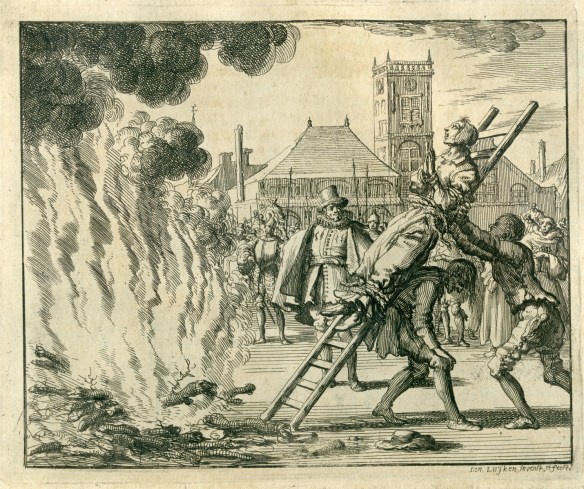
Images and narratives about Reformation-era Anabaptists, such as this etching from Thieleman van Braght’s Martyrs Mirror, have held different resonances among Anabaptist communities over the centuries.

I like your notion of reckoning with past fallibility as a source for spiritual inspiration in our own time. This way of evaluating history both takes seriously the discipline’s fundamentally ethical character and also avoids purely laudatory accounts. That still leaves the question, however, of how to decide what to praise and what to lament. Here I’m thinking of David Weaver-Zercher’s excellent new book, Martyrs Mirror: A Social History, which examines how Anabaptists of various stripes have read and interpreted Thieleman van Braght’s famous seventeenth-century martyrology over the past four centuries.[^5] Weaver-Zercher persuasively argues that despite vastly different contexts and hermeneutics, Anabaptist readers have consistently seen the Martyrs Mirror as a tool for measuring their own communities’ faithfulness (understood in different ways), against the faithfulness of Reformation-era Anabaptists. Such a practice already depends on the construction of a theologically-grounded narrative dichotomy, which in this case presents Anabaptist martyrs as heroic and their Catholic and Protestant persecutors as fallen.

So I think the issue is less whether our histories—scholarly or popular—should or should not emphasize past fallibility; they do so inherently. Rather, the more significant question might be how closely that fallibility is associated with historical actors with whom we might be inclined to identify, especially “spiritual forebears,” as you put it. Displacing fallibility exclusively or mostly onto others can be appealing, but doing so tends to render the actions of our historical role models unimpeachable, in turn making it difficult to criticize the male-dominated gender relations of the early Anabaptists, to pick up on your example, or to recognize how contemporary discourses of peacemaking, discernment, and process can disadvantage LGBTQ members today. For me, one the basic purposes of Anabaptist history is to recognize when Anabaptism as a denomination or identity is invoked to disadvantage or marginalize others. Often, Anabaptism as an idea is so positively connoted in our minds—or in the minds of historical actors—that preserving its honor, unity, or very existence takes precedence over advocating for the needs of women, queer folks, people of color, or any other number of people. Thus I see recent work around gender, labor, and race by Felipe Hinojosa, Stephanie Krehbiel, Tobin Miller Shearer, and Janis Thiessen, among many others, as vitally important in the task of keeping us skeptical and honest about a faith we have chosen and a past we have not.[^6]

image5-21

Recent scholarship on Anabaptism in both the early modern and modern periods, such as this edited collection, owe much to non-Anabaptist historians.

In some ways, that brings us back to theology. Christina, I’d be fascinated to know how early modernists like yourself navigate disciplinary boundaries and even professional relationships within the discipline of history, where some practitioners identify as religious and others do not. I’m also wondering what sources Anabaptist and non-Anabaptist historians of the Reformation have drawn upon to develop the moral-theological lenses that they use and have used to evaluate past actions and events—scripture, revelation, arguments and texts developed during the sixteenth century?

CM: In my experience, the scholarly relationship between scholars of different religious affiliations (or non-affiliations) who study early modern Anabaptism has been really fruitful. We bring different questions, interests, and perspectives to the material at times, but we learn so much from each other. The field has been incredibly enriched both by historians who are rooted in contemporary Anabaptist communities and historians who aren’t. For instance, we know quite a bit more about Spiritualists and apocalyptically-minded Anabaptists thanks to the work of scholars who don’t belong to contemporary Anabaptist faith communities. If anything, I see less tension between Anabaptist and non-Anabaptist historians than has sometimes existed between Anabaptist historians and Anabaptist theologians. The debate between Denny Weaver and Arnold Snyder after the release of Anabaptist History and Theology comes to mind.[^7] Essentially, Weaver argued that Snyder had written a skewed historical survey of sixteenth-century Anabaptism that “[opened] the door to the accommodation of violence rather than seeing the rejection of violence as theologically normative.”[^8] Snyder, however, pointed out Weaver’s critique was historically insubstantial, since he failed to demonstrate from the sources how Snyder’s reading was skewed.[^9]

Personally, as someone who is both an active member of a faith community and a historian, I try as much as possible to separate out my historian and theologian hats. As a historian, my job is to be as faithful as I can to the source material—treatises, letters, court records—and to represent the views of the people I study as clearly and accurately as possible. It’s only after I’ve done that work that I can bring out my inner armchair theologian and start asking questions like “Is this a useful model for the Church today?” or “Does this Scriptural interpretation have the potential to lead to human flourishing?” The latter question gets at the heart of the moral/theological lens I’ve personally come to adopt when sifting through approaches to faith and Scriptural interpretation, but that’s highly individual and different scholars and people of faith often come in with different considerations.

BG: Your suggestion that our understanding of early modern Anabaptism has been enriched by dialogue with historians of various (or no) faith traditions is fascinating. It rings true to me for the modernist period as well. Non-Anabaptist scholars have done vital work to situate modern Anabaptist history within larger trends and contexts, often showing that Mennonites, Amish, Brethren, and others are not really as unusual or disconnected from the world as we’d sometimes like to think, but thereby also helping to make true instances of uniqueness all the more significant. More broadly, the integration of modern Anabaptist history into Marxist scholarship, gender analysis, or the so-called social and cultural “turns,” to name only a few important examples, has been possible only because of broader developments emerging from many voices across the academy and beyond. Each of these intellectual and methodological movements has further allowed us to see Anabaptist history as multiple, contested, and endlessly interesting. 

I’d like to thank you, Christina, for initiating this conversation, which I think demonstrates how dialogue between early modernists and modernists—like exchange between disciplines or across religious lines—can illuminate anew topics we thought we knew well. I’d be excited to see more such discussions in the future, and of course I look forward to reading more of your ongoing work and to thinking about how it can inform modernists’ thinking and writing about Anabaptist history. 

CM: Thank you so much for your willingness to take part in this conversation! It’s so important to keep having these discussions, both as historians and as members of faith communities.

Christina Moss is a PhD candidate in History at the University of Waterloo studying Anabaptist prophets in sixteenth-century Strasbourg. Ben Goossen is a historian at Harvard University and the author of Chosen Nation: Mennonites and Germany in a Global Era, published in 2017 by Princeton University Press.


Lessons in Mischief from the Eastern Mennonite High School Class of 1959

The Eastern Mennonite School centennial a few weeks back provided the opportunity to reflect on, as Donald Kraybill has put it, one hundred years of countercultural education. Hopefully, the reunions and reminiscences also provided the chance to reflect on a quintessential aspect of student life: mischief. But if you’re looking for more, read on. 

In March 2014 I sat down with five women from the EMHS class of 1959. They shared about many aspects of student life in the 1950s, perhaps most gleefully reminiscing about the little ways they pushed the boundaries of good behavior. What follows is a list of things I learned about how to get away with mischief from the self-described “good kids” of 1959. (The women are identified below by their initials. All quotes come from the transcript I prepared, titled “EMHS 1959 Transcript,” available at the Menno Simons Historical Library at Eastern Mennonite University, Harrisonburg, VA).

#1. Spies are all around: know who to watch out for (and where to watch for them)

It’s not just teachers, staff, or parents who enforce good behavior. College students, too, could act as “spies.”

MH: You remember the spies? [they all laugh]. They were college kids. We didn’t know who they were. College kids were designated spies so when you were in the dorm [Northlawn] in the social room…You never knew who was watching you. So you tried to sit there with your hands down here [indicates under the table] so you could hold hands [with a boyfriend]. We did that a lot…. I never got caught but it’s not that we never held hands.

#2. Break one rule at a time and make the most of your image

In 1959 looking plain signaled that all was right within you. You could be trusted. And this meant you could get away with more.

MH: And one day, I lived in the dorm and [boyfriend] had a sister that lived down close to where the seminary is now. They wanted us to come for supper so Miss Barge and Esther Longacre were deans and I had to get permission to go walk from this dorm [Northlawn] to there with him and it was dark. And that was almost a no-no. They didn’t want to let us go but [boyfriend] at that time was very conservative. He wore a plain coat. And Miss Barge liked him. [laughing]. And I still remember her words: we’re going to let you go but you know we trust you.  [more laughter]. Little did they know! [laughter]

CB: If you looked conservative.

MH: Yeah.

CB: You could get by with just about anything.

#3. Mischief is best accomplished within the safety of a group — and in a way that uses modesty to your advantage

The women recalled a particularly conservative faculty member and what they did to irritate him:

CB: …one time just to be kind of ornery, some of us girls sewed little bells on our crinolines, under our skirts. And then when we walked it jingled a little bit. Wasn’t real loud but you could hear these little bells. And I know…one of the professors, it would agitate him so. Of course he couldn’t see them but he started quoting scripture about these tinkling cymbals or something. [Laughter.]…. he thought we were very sinful because we had bells on.

#4. If possible, be a boy

CB: And remember the boys found out that I was so afraid of mice…We had these desks which opened up. I opened it up and there’s a mouse!

UK: a live one?

CB: No, dead. And I screamed. [Laughter]. They had the biggest kick out of that. But I don’t think they got in trouble. [More laughter].

UK: You probably got in trouble for screaming.

#5. Sometimes you need a little help from worldly items (like an eyebrow pencil)

WR: You were supposed to wear hose all the time.

Shen61 02

Girls playing volleyball, c. 1961. Is that truly a stocking seam on the back of the girl’s leg? Or a cleverly drawn line, courtesy of an eyebrow pencil? (Girls playing volleyball, 1961 Shenandoah (Eastern Mennonite School yearbook), courtesy of the Menno Simons Historical Library, Eastern Mennonite University, Harrisonburg, VA.)

WR: And they had to be dark.

ED: And they had to have seams.

HS: What was it about seams? [the younger interviewer is confused, having only known a world where hose don’t have seams]

ED: So they knew you had hose on.

CB: Eyebrow pencil worked.

UK: You just took eyebrow pencil and —

UK: There’s always a way to get around everything! [Laughter]

CB: You could use an eyebrow pencil and put the mark up your leg and you’d look like you had stockings on.

HS: And that worked? [wondering how they all had eyebrow pencil; wouldn’t make-up have been forbidden?]

WR: For a while! [Laughter]

#6. Enjoy the ironies that will come when your elders don’t think through the logical results of certain rules

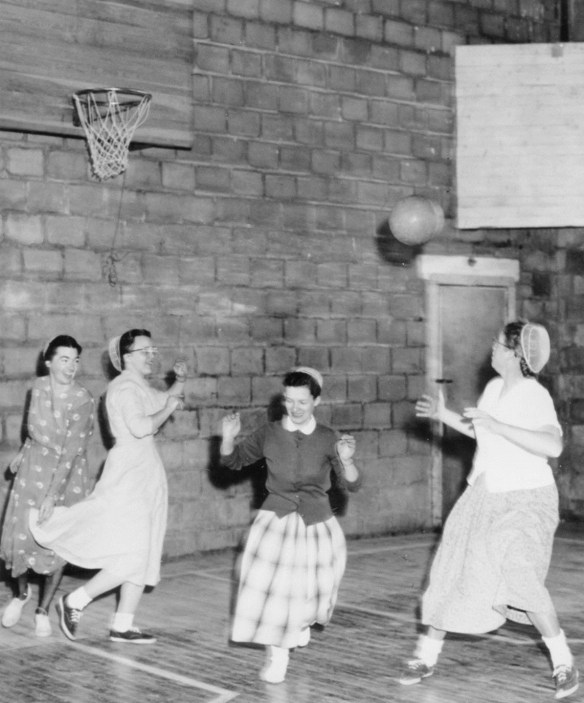
The women remembered rules about wearing skirts even during gym class. Bad news for the girls; potentially appreciated by the boys. 

MH: And the boys really enjoyed going to the basketball games. Because they couldn’t wait until we’d fall over and then they’d see our skirts would fly up. I remember them talking about it. [laughter.]

57Shen010

Girls playing basketball in the old gym at EMS, c. 1957. Their skirts appear well in order. (Girls playing basketball, 1957 Shenandoah (Eastern Mennonite School yearbook), courtesy of the Menno Simons Historical Library, Eastern Mennonite University, Harrisonburg, VA)

#7. Sometimes you just have to risk it

CB: The most sneaky thing we did was we snuck out in front of the chapel, got on motorcycles with two of our male classmates and they took us for a ride through Park View and back and then we worried for weeks; we were afraid that somebody would find out. That would have been terrible.

UK: We’d have been sent home.

#8. When you get older and are looking back, have some grace for your elders

CB: You know I have done a lot of fussing about the way things were but I really appreciate the bottom line was a good religious base and some of these far out things that they demanded, they were just carrying out what they needed to, I suppose. But I am thankful for what the church stands for, the Mennonite church.

#9 But also acknowledge that amid the fun was real hurt—and real mistakes

It may be funny sixty years later to think of boys hoping the girls’ skirts would fly up in gym class; it could very well have been deeply embarrassing for the girls then. But embarrassment is the least of the problem—sexism, double standards, and all the problems inherent in the male gaze also come to mind.

And while pushing the limits in small ways was one thing, the costs were real for those who didn’t quite fit in. The women remembered one classmate who left school because she would not confess to the error of having a boy student put his arm around her shoulder on the couch. They remembered this student had “looked a little wordly” and always been under suspicion. Speaking of another issue, one woman recalled that her sister had red, curly hair. Just having this bright, unruly hair meant “she looked like a wordly student…And everything that went wrong, she got blamed for because she just looked like somebody that would be mischievous or break the rules or whatever. And she carries that stigma with her today.” Whether kicked out of school, or just being under suspicion for how you naturally look, inequality and injustice lurks in many of these memories.

What lessons in mischief do you have from your school days? What gems could be recorded at your family dinners? Thanksgiving is coming. In the centennial spirit, think about purchasing a small digital recorder (I use an RCA VR5320 R digital voice recorder which costs around $30) and sitting down to record some stories. If you interview a Mennonite women, consider donating the recording to the collection where the interview I quote from here is housed: Voices: Oral Histories of Mennonite Women, in the Eastern Mennonite University archives. I am happy to answer any questions about the logistics of recording interviews or about how to donate recordings to an archive.

Are you in this? Remembering Muted Voices: Conscience, Dissent, Resistance and Civil Liberties in World War I Through Today

Laureen Harder-Gissing

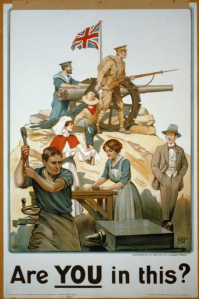
4540“Are you in this?” asked a popular British propaganda poster from the First World War. A nattily dressed young man, hands in pockets, walks through a landscape in which other men and women are actively fighting, nursing, and manufacturing armaments. Their society is fully engaged in war. His non-participation is clearly shameful.

From October 19-22, 240 delegates gathered at the National World War I Museum and Memorial in Kansas City to hear 70 presentations. Historians described forgotten voices of dissent and conscientious objection, while today’s defenders of conscience and civil liberties drew connections between the long-ago war and their current work. Music began the conference with a performance of Vaughan Williams’s Dona Nobis Pacem, and ended it with hymns and songs of peace sung by the Hutterian Baker and Silverwinds Youth Choirs from Manitoba. Their music accompanied the moving story of two American Hutterite conscientious objectors who died in prison.

IMG_20171022_085223

Inscribed brick to be added to the museum’s Walk of Honor (Photograph by Laureen Harder-Gissing)

The site of the conference added to the atmosphere. The museum sits at the base of a dramatic Egyptian Revival-style monument, the Liberty Memorial, which opened in 1926. The state-of-the-art museum, constructed in 2006, tells the story of the war to a modern audience. On Sunday morning, a memorial service for war dissenters was held at the entrance–a glass bridge spanning a field of poppies. The conference ended with a bus tour of Fort Leavenworth where 16 imprisoned conscientious objectors died.

Did the conference succeed in unmuting voices? While the traveling exhibit “Voices of Conscience” told stories of peace witness in the Great War, conference participants observed that voices of dissent are nearly absent from the museum’s permanent exhibits. During the memorial service, Hutterite delegates partially rectified this by unveiling a stone in memory of the Hofer brothers who died at Fort Leavenworth. The stone will join the “walk of honor” at the museum’s entrance.

IMG_20171022_103741

A base historian at Fort Leavenworth describes wartime conditions in the former prison hospital. (Photograph by Laureen Harder-Gissing)

Some religious voices were unmuted. In addition to papers about traditional peace church members, papers about Pentecostals, Jehovah’s Witnesses and mainline church members uncovered additional stories of religious dissent.

While the conference predominantly focused on American and British history, papers on opposition to the war in Germany and African diaspora communities hinted at a broadening of diversity. While the role of women in leadership in the anti-war movement was explored, much ground in terms of gender was left untouched.

The conference did not succeed in unmuting all voices, but I believe it helped participants sharpen our hearing. Whether we are primarily engaged as historians or activists (or both), becoming attuned to muted voices of conscience and dissent is a valuable skill. After all, there are many ways in which we are “in this” still.

IMG_20171022_084718

Sunday’s memorial service took place on the museum’s glass bridge. The bridge floats over a simulated field of poppies. (Photograph by Laureen Harder-Gissing)

Anabaptists and the Reformation 500 Years Later

October marked the 500th anniversary of Martin Luther’s Ninety-five Theses and the start of the Protestant Reformation in 1517, an event remembered around the world through festivals, sermons, and hefty debate. Here in Buenos Aires, Argentina, I attended a conference on “The Relevance of the Message of the Reformation,” which raised many of the concerns which have recently reverberated across Christian communities. While many Protestants see the Reformation in unambiguously heroic terms, it was also a period of immense bloodshed and a fundamental rupture in church history. Historians have long argued that the sixteenth century ended the Middle Ages and ushered in a new age of modernity. But this too—particularly the claim that Protestantism is responsible for modern capitalism—has a dark side.

image1-17

Panelists in Buenos Aires discuss the Reformation and its legacy. The event was sponsored by Argentina’s Ecumenical Network of Theological Education, which includes Mennonites, Lutherans, Waldensians, and others.

As panelists at the Buenos Aires conference pointed out, the way we choose to talk about the Reformation will shape its ongoing legacy in the twenty-first century. In addition to Luther’s Bible translation and insistence on sola scriptura, for example, should we remember his anti-Semitism—including writings that inspired the Nazis? Are our narratives of the Reformation, with emphasis on figures like Luther, too male-focused? How do we tell a global history of the Reformation, when today most Protestants live in the Global South and are people of color? Perhaps more abstractly, should we even consider the Reformation to be the starting point of Protestantism? After all, one sponsor of the Buenos Aires conference was the Waldensian church, whose tradition—identified by Martyrs Mirror author Thieleman van Braght as a forerunner to Anabaptism—dates not to the sixteenth century but to the twelfth.

How should Anabaptists relate to the 500th anniversary of the Reformation? As in the wider Protestant world, this question is complex. Despite reconciliation talks recently conducted with the Catholic Church and the Lutheran World Federation, inherited memories of the torture and murder of sixteenth-century Anabaptists by both Catholics and Protestants remain significant for many. Nevertheless, broader efforts to commemorate Luther and his contemporaries have found resonance. Mennonite World Conference has initiated a ten-year conference series entitled “Renewal 2027.” Its first event—held last February in Augsburg, Germany—was widely reported in the denominational press. Countless congregations have independently broached the subject.

image3-19

Conceived as a global pilgrimage to Anabaptism’s “birth place” in Switzerland, the first Mennonite World Conference, held in 1925, was the first time that Mennonites celebrated a world-wide denominational centennial.

Among the richest forums to appear so far has been the special online issue of Mennonite Life, entitled “Why 500 Years?” In addition to an introduction from editor Brad Born, the special issue includes fourteen essays from Mennonite thinkers on three continents about whether and how to tell Anabaptist origin stories five hundred years after the Reformation. César Garcia, General Secretary of Mennonite World Conference, and J. Nelson Kraybill, its president, outline the plans and promise of “Renewal 2027,” including the joys of being part of a worldwide faith community whose members respond to the history of early Anabaptism in diverse and often unexpected ways.

Offering historical perspectives, Troy Osborne of Conrad Grebel University College explores the distinction between the Reformation itself and the way that it has been studied by Mennonite historians, while Walter Sawatsky, professor emeritus of Anabaptist Mennonite Biblical Seminary, highlights the important role of Mennonites in twentieth-century Russia. Mennonite Central Committee’s Alain Epp Weaver notes the remarkable emergence of global Anabaptist institutions like MCC and Mennonite World Conference during the 1920s—a period in which church leaders celebrated the 400th anniversary of Anabaptism—and asks how we can be responsibly address the good, the bad, and the ugly of historic institutions.

image5-21

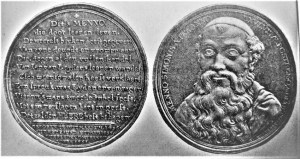
Anabaptists have long been debating the merits of historic commemorations. This 1761 medallion, struck in Amsterdam on the 200th anniversary of Menno Simons’ death, emphasizes restraint: “celebrate now this man’s second centenary festival/ With a humble heart and spirit.”

Fascinating cross pollination emerges between activist Tim Nafziger’s discussion of how some Mennonites have used triumphalist tales of Anabaptist history to enter dominant white cultures and poet Raylene Hinz-Penner’s account of Cheyenne Peace Chief Lawrence Hart’s integration of Anabaptist theology with the history of native peoples’ destruction. Tobin Miller Shearer, historian at the University of Montana, examines how a holistic approach inspired by civil rights leader and Mennonite pastor Vincent Harding might help us reimagine Anabaptist history. And Julia Spicher Kasdorf of Penn State University reminds us to take seriously the women of the Reformation. “Don’t dismiss your sisters,” she writes.

Considering the radical demographic changes that over the past decades have remade the global church, Bock Ki Kim, Interim Director of Korea Anabaptist Center and Karl Koop of Canadian Mennonite University warn against Reformation commemorations that privilege Eurocentric accounts of Anabaptism, while equally affirming this opportunity to celebrate. Likewise embracing theological and ethnic diversity, Hannah Heinzekehr, editor of The Mennonite, welcomes a future in which our church’s origin stories are plural and plentiful. Gerald W. Schlabach, theologian at the University of St. Thomas, encourages us to look beyond the Anabaptist fold by considering how Mennonites, Catholics, and others have long influenced each other in ways that defy denominational labels. 

As we remember the 500th anniversary of the Reformation, the special issue of Mennonite Life offers a stimulating conversation to join. It is a pleasure to read and think with each of these essays, and I hope that as dialogue continues over the next decade—whether through Mennonite World Conference’s “Renewal 2027” program or via other avenues—the ideas these authors have put forward will offer models for reflection and action. We can surely all agree that those who lived and died five centuries ago experienced the Reformation as an era of peril, opportunity, and fascinating complexity. May the memory of this multifaceted past speak forcefully into our own time of religious and political strife.

Ben Goossen is a historian at Harvard University. He is the author of Chosen Nation: Mennonites and Germany in a Global Era, published in 2017 by Princeton University Press.

King William I Signs the Military Service Law, Imposing the Draft on Mennonites, Nov. 9, 1867

Mennonites Accept and Contest Military Service in the German East: A Sesquicentennial Series

4.1 Wilhelm I

William I, King of Prussia

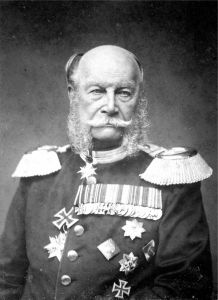
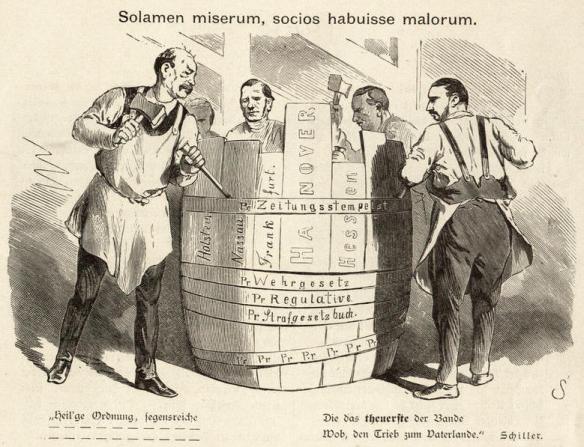
On November 9, 1867, William I, King of Prussia, signed the military service law of the North German Confederation in his capacity as Confederation head of state. He was also commander-in-chief of the combined military services. Mennonites were now subject to the draft with no obvious alternative outside of emigration. The parliament and the government had both agreed that religious freedom did not extend to the duty of military service since equality before the law was a more important principle. In addition, many leaders saw military service as an issue on which national unity between the peoples of the different German states could be built. A caricature of Prussian and North German Chancellor, Otto von Bismarck, in the satirical newspaper Kladderadatsch under the Latin title that roughly translates “misery loves company” showed Bismarck as a cooper making a cask out of the “boards” of the former German states. They would be bound together by common laws mostly of Prussian origin, including the Prussian Military Service Law (Wehrgesetz). Mennonites were thus caught up in a much larger project of German nation-building on the foundations of culture, militarism, and nationalism that they only dimly understood.1

4.2 Wilhelm Scholtz Misery loves company

Wilhelm Scholtz, “Misery loves company”

The signing day itself did not play a role in the Mennonites’ initial reaction. In fact, Peter Bartel’s account of the efforts of five rural Vistula Delta elders to maintain an exemption does not mention the date at all. His account jumps from the elder’s departure from Berlin on October 25 after their initial lobbying effort failed to February 17, 1868, when their local representative in parliament, Wilhelm von Brauchitsch, alerted them to the need to return to Berlin to try lobbying again.2 The next post on February 20 will take up their efforts. There are indications that the traditionalist Mennonites did not fully understand the law-making process under the relatively new constitution of 1850 for Prussia, or the one written just that year for the North German Confederation.3 The date is also not mentioned in H.G. Mannhardt’s account of these events published in 1919, where he noted instead failed petition efforts on November 4 and December 26.4

November 9 is mentioned in the executive order of March 3, 1868, that will mark the end of this series of posts. This order created a special category of noncombatant for Mennonites in the Prussian army. It noted that the law went into effect on November 9, so after that time Mennonites would have had reason to note the date. The first major Mennonite newspaper article to speak approvingly of the law was published in August 1868 and erroneously dated the entire parliamentary debate and royal signing all to that particular day.5

German historians, of course, will not be surprised to hear that after 1919 mention of November 9 is highlighted by some Mennonites. In addition to the imposition of the draft dating from this day in 1867, five other major events of modern Germany history fall on this day, making it the most important non-holiday on the German calendar. Less noticed at the time was the first event, the execution in 1848 of Robert Blum, an important leader of the Frankfurt National Assembly in Vienna. The second event was a naval mutiny and Social Democratic revolution in 1918 that toppled the Imperial government two days before the armistice ending World War I went into effect. In response to what they considered the ignominy of that event, Nazis staged first a failed revolution on that date in 1923 and then instigated a massive Jewish pogrom known as Kristallnacht in 1938. The Berlin Wall was forced open by demonstrators on November 9, 1989, signaling the end of Communist rule in East Germany and paving the way for German unification in 1991. The overabundance of history on this day prevented it from becoming a new holiday, so that October 3, the date of formal unification, is the official holiday marking events of 1989.6

The first time H. G. Mannhardt wrote about these events after the end of the Great War he did the equivalent of italicizing the date November 9, 1867.7 His earlier article was likely written before the end of the war and the Socialist revolution of 1918. Writing the history of his own congregation, where he reflected on the bitter German defeat, the date apparently had new meaning for him as a German nationalist who would have seen the revolutionary events of November 1918 as treason. How should we think about and commemorate this day in 1867 when Mennonites were both subjected to the draft and an important step closer to whole-hearted inclusion as good citizens in the German nation? Is it a matter of indifference or sadness, a marker of continuing oppression and illiberality, or time of relief or even joy? Where, how, and if Mennonites fit into this or that nation remain interesting and important questions to ponder.

SEE OTHER POSTS IN THIS SERIES


  1. For a general overview, see Mark Jantzen, Mennonite German Soldiers: Nation, Religion, and Family in the Prussian East, 1772-1880 (Notre Dame, IN: University of Notre Dame Press, 2010), 191-218. 
  2. Peter Bartel, “Beschreibung der persönliche Bemühung der fünf Aeltesten bei den Hohen und Allerhöchsten Staatsmännern in Berlin um Wiederheraushelfung aus dem Reichsgesetz, worin der Reichstag uns Mennoniten am 9. November 1867 versetzt hat,” Christlicher Gemeinde-Kalendar 29 (1920), 72. 
  3. H. G. Mannhardt, “Zur Entstehung und Geschichte der königl. Kabinettsordre von 3. März 1868, betreffend den Herresdienst der Mennoniten,” Christlicher Gemeinde-Kalender 28 (1919), 100-102, Jantzen, Mennonite German Soldiers, 196-200. 
  4. H. G. Mannhardt, “Zur Entstehung,” 100-101. 
  5. Available in English at https://ml.bethelks.edu/issue/vol-70/article/the-resolution-of-november-9-1867-by-the-north-ger/. See also my accompanying introduction at https://ml.bethelks.edu/issue/vol-70/article/a-comparative-analysis-of-church-conflict-an-intro/
  6. “Der 9. November in der deutschen Geschichte,” Bundeszentrale Für politische Bildunghttp://www.bpb.de/politik/hintergrund-aktuell/69545/der-9-november-09-11-2012 
  7.   H. G. Mannhardt’s The Danzig Mennonite Church: Its Origin and History from 1569-1919, trans. Viktor G. Doerksen, ed. Mark Jantzen and John Thiesen (North Newton, Kansas: Bethel College, 2007), 198. 

Some Clarity on an Old Mystery

John D. Thiesen

Samuel S. Haury (1847-1929) was the first missionary sent out by a North American Mennonite denomination, working among Arapaho and Cheyenne people in what is now Oklahoma starting in 1880. His mission career lasted only seven years, however, ending in scandal in 1887. The end of Haury’s career has only been publicly known in vague generalities. The most specific explanation is found in Lois Barrett’s 1983 history of General Conference home missions, where she says Haury resigned because of “his sexual indiscretion with another missionary at Cantonment.”1

Darlington school children and teachers;

Darlington school children and teachers; left to right at top, Dian Luginbuel (m. Jacob Meschberger), Maria Lehrman (m. Jacob Warkentin), Susie Richert (m. C. H. Wedel), S. S. Haury, Barbara Baer Voth and baby Frieda, H. R. Voth (top of head cut off). Mennonite Library and Archives Photo Collection 2003-0081

The archival record does actually allow for a bit fuller explanation. Haury was located at Cantonment, Indian Territory, where the General Conference had a school for Cheyenne and Arapaho children. Haury was in charge of all of the Cheyenne-Arapaho mission activities. Another missionary, Heinrich R. Voth, was located at Darlington, where Haury had started the first Mennonite mission school several years earlier. In a letter on May 14, 1887, from Haury to Voth, Haury says, “C. Krehbiel [chair of the mission board] has already informed you of my approaching departure from the mission, and of the sad cause, brought about by my own conduct and fault. The consequences are terrible. My heart is shattered. Pray for a deeply fallen one.”2

A week later, May 21, there is another letter to Voth: “Our departure is not yet specified. I expected to get my dismissal in today’s mail but it did not come. I hope that it will come soon. It would be best under these circumstances to leave tomorrow. But we will hardly be able to get away by the first of June.”3

The timeline of events seems a little muddied, however, since a letter also dated May 21, 1887, from Haury to the mission board, says: “I write these lines in deep shame and humiliation. I have already given the president of the board verbally and the secretary in written form my confession of my deep fall. . . . My deep fall consists of marital infidelity with Christina Hirschler, sister of my dear wife, so that she is already about 6 months pregnant.”4 This letter circulated among the members of the mission board, scattered from Kansas to Pennsylvania, through at least June 10.

A week later we find the sole surviving voice from one of the women concerned, Susie Hirschler Haury writing to H. R. Voth on May 28, in English (most of the other correspondence is in German): “We will go away soon, & it will be no more than natural that everybody at the Agency & at the schools will want to know why we have. Please tell them that we felt we could not remain or something to that effect. I would not ask you to tell an untruth, Never, but there is no need of having it spread among outsiders. It is not on my or our account I ask this, but on account of the Mission work & Christianity’s sake. For such people as live in the Agency & in this country generally, hearing anything of that kind, would call ‘the whole thing a fraud.’ Having had no Christian experience, they cannot know of the hearts-anguish such a person that has fallen, has in his own chamber & in the silent nightwatches.”5 Voth reassured her the next day that he would comply with her wishes.6

Samuel Schmidt Haury (1847-1929) and Susanna Hirschler Haury (1861-1944)

Samuel Schmidt Haury (1847-1929) and Susanna Hirschler Haury (1861-1944). Mennonite Library and Archives Photo Collection 2006-0096

Susie Hirschler Haury gave birth to a son Paul on Jan. 28, 1887.7 This means that if her sister Christina was 6 months pregnant in mid-May, then that event must have occurred in mid- December 1886 when Susie was about 8 months pregnant. Presumably her sister Christina had come out to help with household tasks before and after the birth. Paul died on June 14, 1887. “This morning at about 5:00 the Lord took our little son Paul to himself, after several days of severe suffering and a 2 hour hard death struggle. The burial will be tomorrow afternoon about 2:00, Lord willing, and would like to ask you sincerely and urgently to lead this service. The service should be in English.”8

The Haurys must have finally left Indian Territory sometime around the end of June. A letter from G. D. Williams, the Indian agent for the Cheyenne and Arapaho, to J. D. C. Atkins, the Commissioner of Indian Affairs in Washington, DC, on Aug. 12, 1887, gives a perspective from outside of Mennonite circles:

In accordance with instructions of Office letter of the 9th ult. [July 9] I have the honor to report that in the latter part of May last there were rumors about Cantonment, involving the moral character of Mr. Haury. As he had the entire confidence of this community as well as my own, and standing so high in his Church I gave them no credence. June 4th Mr. Haury advised me, by letter, of his resignation as Missionary among these Indians, without alleging any cause. On the 22nd day of June last, in company with Inspector Gardner, I visited Cantonment and learned beyond question that the charges were true.

During the second day of inspection of Indian houses, a number of the head men of the Cheyenne talked with Inspector Gardner about the matter, saying that they did not wish any more such men sent among then and that they desired Mr. Haury sent away. They were assured that he was about to depart, which he did in a few days thereafter.

These Indians do not entertain the highest sentiment regarding chastity, and while I do not believe the unfortunate act within itself would deter them from sending their children to the school, they will use it as an incontrovertible argument against a mission school under the same patronage and decline to support it. This applies more particularly to the Cheyennes who are largely in the majority at Cantonment and who have no earnest desire for the education of their children.

They grasp any excuse for withholding their children; for two years past they have given as a reason that the buildings were old, damp and unhealthful, but as soon as a new building was erected they would fill it.

In view of this I submit that they will use the late unfortunate occurrence with great effect among their people. I do not believe the scandal will in the least injure the mission school located at the Agency and in charge of the Rev. Mr. Voth, as for several years past Mr. Haury has not, in the Indian mind, been identified with it, and I am constrained to believe that the Cantonment Mission will not soon recover from the recent blow and that its success for the next year or two is in the gravest doubt.

The present “picket” structures at Cantonment will serve another year with some few repairs – but a new building is needed and I believe it should be conducted solely by the Government to insure [sic] its success.9

The leading historian of the Arapaho, Loretta Fowler, offers some further explanation of Williams’ comments.

When Cheyenne and Arapaho chiefs directly challenged officials, they often did so by appropriating elements of the dominant ideology. For example, in the delegates’ attempt to counter Agent Woodson’s disparaging description of Cheyennes and Arapahos, they turned his own discourse against him: Woodson was lazy, neglected his work, was fiscally imprudent, and fell short of the ideals of monogamy and sobriety. He spent idle hours dancing while trying to prevent the Cheyennes and Arapahos from having dances. This same tactic was used in regard to local boarding school superintendents and even to missionary Haury, who was caught in an adulterous relationship.10

Fowler gives no sources for her comment about Haury’s “adulterous relationship.”

On Aug. 16, 1887, H. R. Voth wrote to a Captain J. M. Lee, who had apparently had some previous role in the Cheyenne-Arapaho area and remained friends with Voth.

Mr. H. has fallen very deeply. He had had unlawful intercourse with his sister in law, the sinful deed bearing bitter fruit. Mr. H. acknowledged his guilt voluntarily to the Mission Board, was of course promptly discharged, & had to leave. Although covered with shame & disgrace, yet accompanied by the deep sympathy & genuine regret of thousands of friends, his field of faithful labor and is now living in obscurity. The child was born a few weeks ago, but did not live long. That is, in a few words, the deplorable history which ended in such an extremely tragical manner, Mr. Haury’s evidently successful career as an Indian Educator and missionary.11

Haury moved to St. Louis to attend medical school.12 There is one major postscript to the 1887 scandal. At a meeting of the Kansas Conference (predecessor to today’s Western District area conference) at First Mennonite Church in Newton, Kansas, Nov. 5-6, 1889, there is this resolution:

  1. At the request of the brother, S. S. Haury, that the Conference use its influence in favor of his admission into the Mennonite denomination, the Conference resolves that as such it is ready to offer him the hand gladly and to let his reception take place in a public meeting to which all of the conference churches are herewith invited, on the 13t h inst. in the Alexanderwohl Church by Elder Chr. Krehbiel with the assistance of Elder Jak. Buller, as commissioners of the Conference.13

Two persons recorded the actual event at Alexanderwohl. Johann Jantzen, a Mennonite minister from Beatrice, Nebraska, who was attending a ministers’ meeting, noted the event in his diary:

In the Alexanderwohl church, the former missionary Haury, who had been separated from the church, was re-accepted. He seemed very repentant. Elder Balzer read Psalm 51 and had the opening prayer. Elder Gaeddert preached on John 10:12, a very nice exposition. Elder Christian Krehbiel carried out the acceptance and Elder Stucky closed with prayer. It was a large gathering and a very large church, recently built. On the way back [to Newton] we had very nice weather and better roads; we stopped at the Bethel College foundation [construction site], it is around 15 feet high now, with 3 feet in the ground.14

Then, H. R. Voth’s father Cornelius described the event in a letter to his son, mixed in with news about the farm and crops, in a Nov. 17, 1889, letter:

We still have 20 acres of corn to [cut?] and also so much work to prepare the cattle for winter. Now dear son, I must write to you a little about the acceptance of S. S. Haury into the community [Gemeinschaft] on the 13th last Wednesday in our church (it was a nice day), there were quite many people present, especially many elders and preachers because the day before in our school was the preachers’ conference, it was really a sad sight how deeply humiliated Haury was, an evil picture of how sin can bring a person down, it was too bad that you could not be present and also at the conference, since there is always something to learn for our life, I certainly believe Haury has genuine repentance, he cried many tears and was very broken down, there were also many tears from the assembly with him, it was a moving performance, to begin Elder Buller read Psalm 51, how we are kept, then Elder Gaeddert preached very seriously and Christian Krehbiel did the actual acceptance, Elders Buller, Gaeddert and Newton elder Toews stood around him and greeted him with hand and mouth [holy kiss?] and with moving words of encouragement, may the dear Lord protect everyone from such a heavy burden since one sees what serious sins bring about. They are again gathering potatoes which will be brought to Newton on Tuesday and sent to you.15

It is completely unclear what kind of reconciliation service took place on Nov. 13, 1889. It was not an Alexanderwohl congregational matter but something more general, Kansas/Western District conference or General Conference. There is no evidence that Haury was ever a member of Alexanderwohl church. He joined First Mennonite in Halstead on Mar. 30, 189016 and then transferred to First Mennonite in Newton on Nov. 21, 1897.17 These record books do not indicate where he was a member before 1890, but it was probably Summerfield, Illinois. The Summerfield membership records have been lost.

The Hirschler family was fairly prominent in General Conference Mennonite circles. The father of Christina and Susanna, Daniel A. Hirschler (1821-1888), was a minister at Summerfield, Illinois.  Their brother John S. Hirschler (1847-1915) was also a widely-known minister. A brother, Daniel B. Hirschler was an Oklahoma missionary. A niece (daughter of John S. Hirschler), Anna, married Gustav A. Linscheid and they were later Cheyenne missionaries. Another sister, Anna (1854-1896), was married to Peter S. Haury, brother of Samuel S.18

Two additional pieces of misinformation about the Haury incident deserve to be clarified. One rumor that apparently circulated in the Berne, Indiana, Mennonite community tied Haury to another sister-in-law, Elisabeth Welty Hirschler, wife of Daniel B. Hirschler. The rumor claims that Haury fathered the child Dorothea Hirschler born Nov. 20, 1885. Daniel and Elisabeth Hirschler were mission workers in Cantonment.19 But obviously this does not fit the chronology of Haury’s departure almost two years later nor the contents of the Haury and Voth correspondence. Presumably someone in the community knew, well after the event, that Haury had had a sexual relationship with his “sister-in-law” and extrapolated to the wrong sister-in-law.

The second piece of misinformation appears in Donald Berthrong’s 1976 The Cheyenne and Arapaho Ordeal. Berthrong stated that Haury “had been involved with school-girls at Cantonment.” But the only source he cites for this is the letter from Williams to Atkins of August 12, 1887, quoted above, which makes no mention of school girls.20 Obviously Berthrong had not seen Haury’s letter of resignation or the other mission-related correspondence, so he was reading into the Williams letter assumptions that were unsupported by his evidence.

Jim Juhnke also references this student-involvement rumor but footnotes Berthrong so apparently he did not have an independent source for it.21

Christina Hirschler (1865-1941) married Louis M. Ledig in 1891, and they moved from Summerfield to Upland, California, in 1895. They had one son. Samuel and Susie Haury also moved to Upland when he retired in 1913. 22

  1.  Lois Barrett, The Vision and the Reality: The Story of Home Missions in the General Conference Mennonite Church (Newton, Kans.: Faith and Life Press, 1983), 22. 
  2.  H. R. Voth papers, MS.21, folder 63, Mennonite Library and Archives, North Newton, Kans. 
  3.  H. R. Voth papers, MS.21, folder 63. 
  4.  General Conference Mennonite Church, Board of Missions records, I.A.1.a, folder 29 “Correspondence 1887 Jan-June.” 
  5.  H. R. Voth papers, MS.21, folder 63. 
  6.  H. R. Voth papers, MS.21, copy book 2, p. 675. 
  7.  GRANDMA database 
  8.  Haury to Voth, June 16, 1887, H. R. Voth papers, MS.21, folder 24. 
  9.  Oklahoma Historical Society, Cheyenne Arapaho Agency microfilms, reel 17, vol. 20, 236-239. 
  10.  Loretta Fowler, Tribal Sovereignty and the Historical Imagination: Cheyenne-Arapaho Politics (Lincoln, NE: University of Nebraska Press, 2002), 46. 
  11.  H. R. Voth papers, MS.21, copy book 2, p. 763-764. 
  12.  Haury to Voth, Sept. 13, 1887, H. R. Voth papers, MS.21, folder 63. 
  13.  Minutes of the Kansas Conference, Nov. 5-6, 1889, English translation. 
  14.     Jantzen, Johann (1823-1903) Collection, MS.549 
  15.  H. R. Voth papers, MS.21, folder 2. 
  16.  Halstead Kirchenbuch, 90 (Mennonite Library and Archives). 
  17.  First Mennonite Stammbuch (Mennonite Library and Archives). 
  18.  See Melvin J. Voigt, From Whence We Came ([Del Mar, California: Voigt, 1989), esp. p. 12. Voigt is aware of the Samuel S. Haury scandal but seems to have no indication that it involved anyone else in the Hirschler family. 
  19.  Email from David Habegger to John D. Thiesen, 15 Sep 2006. Printed copy in S. S. Haury papers, MS.76, folder 1. 
  20.  Donald J. Berthrong, The Cheyenne and Arapaho Ordeal: Reservation and Agency Life in the Indian Territory, 1875-1907 (Norman, OK: University of Oklahoma Press, 1976), 144. 
  21.  James C. Juhnke, “General Conference Mennonite Missions to the American Indians in the Late Nineteenth Century,” Mennonite Quarterly Review 54 (April 1980): 126. 
  22.  Voigt, From Whence We Came. It seems like that would have been awkward situation.