Centennial Histories Symposium at Eastern Mennonite University March 24, 2018

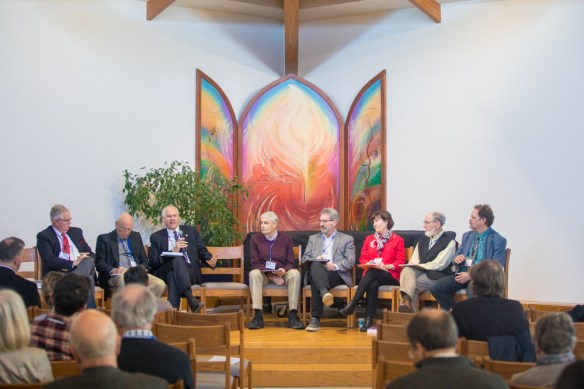
20180324-centennial histories conference-001-1000pxPhoto credit: Macson McGuigan/EMU

In celebration of Eastern Mennonite University’s centennial year, history professors Mary Sprunger and Mark Sawin planned a symposium centered around the centennial histories of the five MCUSA colleges: Bethel1, Goshen, Bluffton, Hesston, and EMU. They brought together the five authors of centennial histories as well as past presidents to share their reflections on the histories of the schools. The symposium offered an opportunity for consideration of how the past of these schools plays into their present and future.

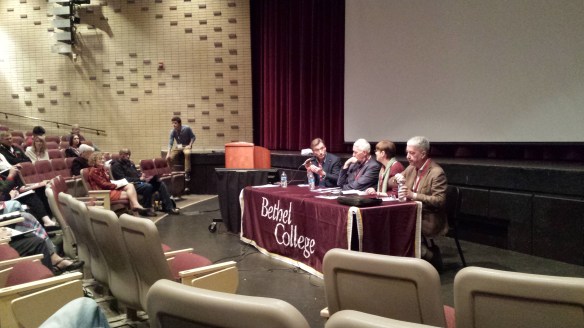
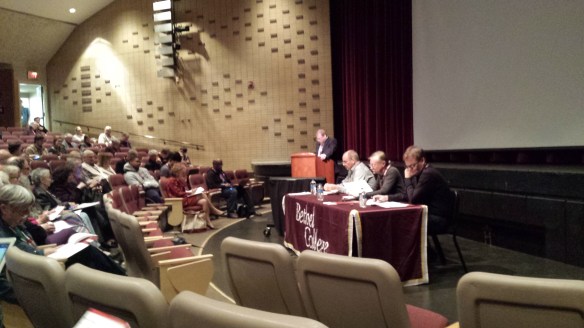
The first session was a panel discussion where each author gave a brief overview of the histories of their institution. The authors shared in order of school age; Keith Sprunger from Bethel first, then Susan Fisher Miller from Goshen, Perry Bush from Bluffton, John Sharp from Hesston, and finally Donald Kraybill from EMU. It was interesting to hear parallels in the motives for some of the schools’ foundings. There was a common thread of these schools starting in order to save Mennonite students–both to save them from the evils of the world and to save them from leaving so that their talents could be used in the church. All of the authors recognized that loyal faculty and staff have seen the schools through very difficult times. They also echoed a theme of change and adaptation across the five schools stories. But some differences were apparent as well–Midwest vs. East coast, “liberal” vs. “conservative”, and an openness to the world vs. a fortress mentality. Past presidents Loren Swartzendruber and Victor Stoltzfus and outgoing Bluffton president James Harder also shared their reflections.

In the second session the authors shared about challenges throughout the schools’ history. Keith Sprunger shared about Bethel first, mentioning issues like financial struggles, low enrollment, difficulty in finding quality faculty, and diversity. These topics would be echoed by many of the authors on the panel. Susan Fisher Miller discussed declining Mennonite enrollment and pondered whether the Mennonite institutions have become victims of their own success–did they nurture strong minds early on who then moved on to “greener pastures” of more prestigious education and subsequently encouraged their children to do the same? Perry Bush spoke about how Mennonite institutions are now a part of the national marketplace of higher ed and have to contend with issues like being competitive cost-wise, offering good value for money, and finding support outside of traditional church and parachurch organizations. John Sharp mentioned the historic lack of cooperation between Hesston and Bethel even though they are located just a few miles apart. Don Kraybill spoke of the particular issue of encouraging diversity at EMC while contending with the Jim Crow-era South. The authors all acknowledged ongoing “sibling rivalry” between the institutions, but noted that early attitudes of isolation and competition have since been replaced with an attitude of cooperation.

The third session was a time where groups of faculty, students, staff, administrators and authors gathered around tables for conversation. Participants discussed the morning’s sessions as well as questions from a prepared handout that asked:

  • What should the guiding mission and purpose of Mennonite schools be in coming years given the changes in both the church and the student bodies?
  • Is being distinctively ‘Mennonite’ important?
  • Institutions by necessity grow and change. How will Mennonite institutions need to change to remain relevant in the future? What are the ‘givens’ that must remain? What are the traditions that may need to change?

There was a second handout highlighting enrollment trends at the Mennonite institutions over the past fifteen years. It broke down enrollment by MCUSA conference, trends of Mennonite student attendance, and overall full-time Mennonite traditional undergraduate enrollment at the schools. These graphs can be found here: http://bit.ly/MennoHS & http://bit.ly/MennoSystem

These questions and the data sparked fascinating conversations surrounding Mennonite identity and population at the institutions, what it means to be a Mennonite institution in the face of dwindling Mennonite attendance, and what impact larger societal trends are having on these institutions.

In the final session the authors gave their final thoughts on how the first centuries of these institutions will inform the next. Many reiterated the distinctiveness of these five institutions in maintaining their Mennonite identity over their histories and the importance of loyal faculty and alumni. Susan Fisher Miller highlighted the benefits of diversity and an international focus. Perry Bush reminded the group of how radical and attractive the Anabaptist perspective can be to students, both Mennonite and non-Mennonite, and said he believes remaining distinctly Anabaptist and following a Third Way is the best path forward for our schools. John Sharp posed the question: who are we serving if the church that we serve is scattering? Don Kraybill had to leave early but left remarks that were read reflecting on the difficulties of maintaining Mennonite institutions of higher education without a critical mass of Mennonite students and strong church support. Finally, students responded to what they had discussed in the afternoon. They spoke of their appreciation for the opportunity to learn more about the history of their institutions and called for more cooperation and conversation between the student bodies of the schools.

Many in the Q&A sessions voiced a wish that these conversations had taken place long ago and a desire to see them continue in the future. It was a hopeful time for me to see such cooperation and engagement across a variety of sectors in our Mennonite institutions and I, too, hope that these conversations continue as we all work toward our common goal of providing distinctive, faith-based, Anabaptist education. As I reflect on the symposium, I feel that it is clear that the Mennonite institutions of higher ed are entering a new era. The old models are unreliable and in order to survive and thrive there must be an openness to new ways of being. This brings uncertainty, grappling with questions of identity, and, at times, pain. But it feels necessary to ensure the survival of these beloved institutions in their second centuries. As someone who was shaped by Mennonite education and feels privileged to work at EMU, I hope that the challenges facing the institutions will spark creativity, cooperation, and positive change and allow for the continued flourishing of our Mennonite institutions.

Special thanks to Mark Sawin, Mary Sprunger, Barbara Byer, Scott Barge and all others who contributed to facilitate this fantastic symposium.


  1. Bethel’s history was written to commemorate its 125th anniversary. 

Whitesburg, Kentucky, 1981

#4-Whitesburg, KY, 1981

Whitesburg, Kentucky, 1981 (MCC Photo/Jim King)

MCC first became involved in housing repair work in Letcher County, Kentucky, in 1979. Pictured here is John Nighswander of Kitchener, Ontario, repairing the support for a house near Whitesburg. In 1985, Sharing With Appalachian People (SWAP) was formed, offering short-term service opportunities in Appalachia for church groups. SWAP continues in southeastern Kentucky and West Virginia as part of MCC Great Lakes.

Frank Peachey, Mennonite Central Committee Archives

Re-Shaping the Chaco

In early 1930, 1500 Russian Mennonite refugees arrived in the Gran Chaco—a semi-arid, lowland region of dense bush on Paraguay’s western frontier.  While their new home may have seemed far-removed from the conflict that had characterized their lives in post-revolutionary Russia, only two years later these pacifist Anabaptists found themselves at the center of the largest inter-state conflict in twentieth century Latin American history. 

Anabaptist Historians readers are invited to read the complete article, “Reshaping the Chaco: Migrant Foodways, Placemaking and the Chaco War,” which explores the strategies that these Russian Mennonite settlers employed to solidify their tenuous claim to an unfamiliar and highly-contested landscape (Instructions for accessing the article are available at the bottom of this post).

Mennonite colonists engaged in a range of seemingly contradictory place-making practices—from the agro-environmental and the political, to the spiritual and the cultural.  Ideas of food security, seen in terms of both production and consumption, linked these diverse exercises. In the Paraguayan Chaco, these former Russian wheat farmers experimented with new crops and foodways. Although pacifists, they supplied the Paraguayan military efforts and provided food aid to wounded soldiers even as they also sent symbolic shipments of their new crops to Nazi Germany. Finally, as an ethnic group practicing endogamy and seeking isolation from their neighbors, they unexpectedly initiated a campaign to evangelize the Chaco’s indigenous population centered, in part, on reforming the latter’s ‘deficient’ diet.

These diverse practices are evident in the pages of Mennoblatt, the small German-language newspaper that colonist Nikolai Siemens published and distributed to his fellow settlers in Fernheim colony.  In Mennoblatt, colonists debated issues from the mundane to the dramatic.  An article advocating for bread produced from varying portions of sorghum or manioc flour would appear next to a reflection on Mennonite’s place in the global Volksgemeinschaft.  A discussion of the Chaco’s intense heat and the recent cotton or peanut harvest might follow an account of military troops passing through the colony or a report on the status of Mennonite’s new mission work among the Enlhet, a local indigenous group.

Published in the Journal of Latin American Studies, this article also seeks to bring the experience of Latin American Mennonites (a rapidly growing community of over a quarter of a million) into greater dialogue with Latin American history. Mennonites arrived in Latin America at times, and in places, that provide a compelling window on agro-environmental change, food security and state formation. Over the last century, they settled in frontier zones like the Gran Chaco on lands that governments considered of ‘marginal’ agricultural value. While the Russian Mennonites in question arrived in Paraguay immediately prior to the outbreak of the war, Canadian Mennonites settled the frontiers of Mexico and Bolivia in the wake of national revolutions and along Belize’s contested border with Guatemala as that small nation gained independence.

In those regions, Mennonites formed endogamous, isolated and ‘traditional’ colonies, but also became ‘model producers’ for domestic economies. In doing so, they consolidated and successfully leveraged a form of agricultural citizenship to sustain a conspicuous autonomy characterized by religious, educational and military exemptions. By turns considered ‘Russians’, ‘Canadians’, ‘Dutch’ or ‘ethnic Germans’, Mennonites benefitted from a racialized ideology of immigration as ‘whitening,’ even as their settlement was conditional upon a legally sanctioned refusal to assimilate into national society. They also maintained strong connections to their brethren throughout the Americas and Europe. This simultaneous engagement with a dispersed diaspora and distinct national identities might have represented an untenable paradox for earlier scholars of an assimilationist paradigm. Recently historians have adopted a more fluid approach to the complex, but often complementary, transnational–national negotiations among Latin American migrant communities. Finally, as one of the earliest Mennonite settlements in Latin America, the experience of Chaco colonists remains critical to understanding this evolving state–settler bargain as Mennonites—and their accompanying foodways—expanded across Latin America.

Instructions for Interested Readers:

Published by the Journal of Latin American Studies and currently available on Cambridge Core’s First View the article can be accessed for free at the link below.

https://www.cambridge.org/core/journals/journal-of-latin-american-studies/article/reshaping-the-chaco-migrant-foodways-placemaking-and-the-chaco-war/B50DFA1959426C9471CEF6D98B95646C 

Use the Sharing Code: 4375333AB40A9D06B132046D5D7B57B3

To use the access codes above, please follow these steps: 
1. Log in to your Cambridge Core account or register for an account 
2. Once logged in, navigate to ‘My account’, then ‘My content’
3. Enter your access code into the ‘Redeem access code’ field and click ‘Activate’.”

Why collect a Nazi flag?: Kauffman Museum’s Role in Confronting Our Past

Renae Stucky, Kauffman Museum, Collections Manager

In November 2016, a donor approached Kauffman Museum at Bethel College with the offer of this Nazi flag for consideration for donation. The flag belonged to the donor’s father who traveled to do relief work in Europe following WWII. The young Mennonite volunteered as a “Seagoing Cowboy” helping tend and deliver livestock being transported to war-torn countries by the United Nations Relief and Rehabilitation Administration and the Heifer Project. The donor believes that the flag was given to his father by a man he befriended during his time in Germany.

Nazi Case-bell-wagon-0397-144dpi

While the flag has Mennonite connections, usually a decisive factor in the museum’s collections policy, its Nazi connections made it a controversial case. The decision about whether or not to accept the object evoked many questions. What would it mean to have the flag in our collection? Would accessioning the item show insensitivity to those who suffered under the Nazi regime? Or could we use the flag to expose and confront this difficult history? What role did the flag play in our mission to tell the Mennonite story?

Due to the controversial nature of the artifact, the flag was brought to the full Kauffman Museum board for consideration and discussion. Members of the board, staff, and Bethel College history faculty were invited to offer their expertise and insight to the conversation. A variety of viewpoints were presented. In preliminary correspondence, the potential donor of the flag asserted that if there was no interest in the artifact by an historical institution he would likely destroy it ceremoniously in memory of those who perished. The members of the history faculty acknowledged the sensitivity of the object, however they ultimately agreed that “there are more constructive ways” of dealing with troubling historical topics if used or displayed in the “appropriate interpretative context.”

After much discussion among the board about the flag’s Mennonite connections, the importance of not denying “painful history” and the need to address recent scholarship related to Mennonites and the Holocaust the board voted unanimously to accept the artifact into the museum’s permanent collection.

The flag was officially accessioned at the end of 2017 with the understanding that it would be used to acknowledge the difficult history surrounding the symbol, and to confront hate rather than celebrate it.

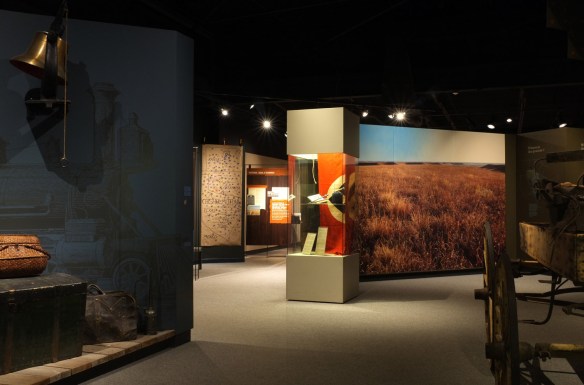
In conjuncture with the recent conference “Mennonites and the Holocaust” held at Bethel College in North Newton, Kansas, the flag was displayed across the street at Kauffman Museum along with several other Nazi artifacts from the museum’s collection (including artifacts brought to the United States from Mennonite colonies in South America.) The artifacts were displayed in a tall narrow case with the flag as a backdrop to a Luftwaffe dagger, an iron cross medal, and a commemorative pin from the Nazi era, and a copy of Mein Kampf. Accompanying the artifacts was interpretive text explaining the museum’s thoughtful consideration and acceptance of these Nazi artifacts, specially the flag, entitled “Why collect a Nazi flag?”

Why would Kauffman Museum collect a Nazi flag? In the same way that the conference continued the conversation about Mennonite involvement in the Holocaust, a museum has a unique opportunity to use artifacts, like this flag and others objects like it, as a catalyst for conversation about historical and current topics. We talk about these difficult issues, and display these controversial symbols, in order to confront the troubling parts of our past. If we ignore or destroy evidence of our misdeeds we risk forgetting them, letting them gather dust in the dim corners of our memory—or in this case our storage space.  However if we literally, put them on display for all to see, we are forced to come face-to-face with the reality of our past, which could change our future.

Call for Papers–“Health and Well-Being in Amish Society: A Multidisciplinary Conference”

June 6-8, 2019

The international conference will focus on health, healing, health care, and individual and community welfare and well-being in Amish life. Since at least 1964, with the publication of the essay “Genetic Studies of the Amish,” by Victor McKusick, John Hostetler, and Janice Egeland, scholars have identified the unique contribution that Amish communities play in advancing medical knowledge. In the years since then, clinical studies, ethnographic research, and creative new avenues for providing health care have flourished with the active participation of the Amish.

The conference will highlight topics such as genetics, culturally appropriate care, Amish understandings of healing and well-being, mental health, alternative and complementary medicine, preventive medicine, health and Amish spirituality, insurance, aging, and death and dying. Speakers will address cultural resources for, as well as barriers to, health and well-being.

Conference planners welcome proposals from scholars and practitioners working in disciplines such as social science, medicine, public policy, and human services. Proposals may address the conference theme, other aspects of Amish life, or other traditional Anabaptist groups. Proposals for papers, panel discussions, or poster sessions are acceptable.

Specifications: A clear statement of topic, methods, and significance (350 words or fewer) and a one- to two-page résumé of the presenter

Submission: By e-mail attachment to amish2019@etown.edu

Deadline: October 1, 2018

Decision: December 1, 2018

Mennonites and The Holocaust: Five Ideas I Brought Home from The Conference

Joy Kraybill

When I saw an advertisement for a 2-day conference on “Mennonites and the Holocaust” at Bethel College, I jumped at the chance to attend. My family is of Swiss-German Anabaptist descent, and in college in the mid-90s, I had majored in German. I had recently read Ben Goossen’s 2017 book, Chosen Nation: Mennonites and Germany in a Global Era and suffice it to say, I had many questions about Mennonite activity during World War II. So I took two vacation days off of work, and flew to Kansas to learn more.

The conference was intense and almost overwhelming. I came home awash with thoughts and feelings and ideas. I found it useful to synthesize the things that were running through my mind into a few key ideas. While I’m sure each attendee experienced the conference very differently, I wanted to share the five main realizations that I brought home from it:

1. Despite what we might have hoped, Mennonites seem to have reacted to the Holocaust and Nazism in much the same way as the bulk of mainstream society did.

Most Mennonites really didn’t behave any “better” or any “worse” than most other European and Russian populations did at that time. As one example, we learned at the conference about a Mennonite family who bought a store as part of the “Aryanization” efforts which essentially robbed Jews of their property and gave that property to Nazis and/or non-Jews. Apparently Mennonites were not separate from this commonplace practice at the time. Likewise, I picked up a book at the conference about a Mennonite pastor who served for 5 years in Hitler’s army. (A Witness in Times of War and Peace: The story of Gerhard Hein, a Mennonite Pastor who served in the Wehrmacht during World War II by Wilfried Hein, 2015) Next on my list is another book from the conference, Mennonite German Soliders, by Mark Jantzen, 2010. These are just some examples of many. I do not know exactly what to do with these stories just yet, but I commend the people who are finding the courage to come forward and share them. To learn about these kinds of stories within Mennonite communities is sobering and shocking, because it does not at all correlate with the image of Mennoniteism that most of us held in our minds. We assumed that Mennonites might have acted differently, and we are now learning that they generally did not. It’s hard to know what to do with this information.

2. The story likely feels different, based on your exact Mennonite roots.

Most of my family came from Switzerland, fled to Germany for about 40 years to escape the Swiss government, and then emigrated to the U.S. by the early 1700s in search of better farming conditions. By the time Hitler rose to power, all of my relatives had already been living in the U.S. for over 200 years. As I sat in the conference, I realized that this perspective probably distanced me quite a bit from the topic, in comparison to Mennonites whose families were still living in the Soviet Union in the late 1920s, for instance. Likewise, it was clear to me that Mennonites whose families were living in Poland or Germany in the 1920s and 1930s had much closer ties to the Holocaust topic than my family did. I’m not saying one situation is better or worse; I’m saying that I suddenly realized that because my family line was 200+ years removed from the countries in which the war directly took place, it distanced me from this topic more than other Mennonites may feel. Your specific Mennonite ethnicity and lineage probably matters a lot, when it comes to this topic.

3. This begs the question of what each of our individual accountability is, for the role of Mennonites in the Holocaust.

I sat in the conference, reflecting on the fact that we were discussing Mennonites’ actions in other countries, about 30-40 years before I was born. And I began to ask myself: As a person of Swiss Mennonite heritage, what is my accountability in all of this? The issues in question happened on another continent(s), decades before I was born. But despite that, I don’t think that allows me to say, “Oh, but I’m not one of those Mennonites—my family was Swiss Mennonite, and we had already been in the U.S. since the 1700s.” Drawing that kind of a line seems to negate the point of belonging to a group, and doesn’t seem like it would lead to anything good. However, on the flip side, does that mean that I share accountability for anything that any Mennonite in any country, in any time period does? If I identify as Mennonite, do I bear the responsibility for what Mennonites in Europe were doing before I was born?

4. When it comes to history, we need to rethink our Mennonite school curriculums.

I am a graduate of a Mennonite high school and a Mennonite college. I never heard a thing about Mennonites and the Holocaust from any Mennonite educational institution. I realize that we are just first now learning about Mennonite roles in the Holocaust, in very recent years. This explains why it was not discussed during my education in the 1990s. However, what this has also led me to reflect upon is the amount of classroom education I received about the history of the original Anabaptist church formation vs. the amount of classroom time spent discussing how Anabaptists applied their faith during major historical eras over the following centuries. The difference is shocking. We were schooled extensively on the original founding of the Anabaptist faith, and almost not at all on how Anabaptists applied that faith during the major historical eras of the following centuries. Hopefully this balance has shifted since my schooling in the 1990s. We clearly need to move away from reveling endlessly in the stories of the 1500s and also prepare students for how one applies that same faith in other settings over time.

5. The Mennonite world hasn’t confronted its role in World War II, and it doesn’t seem to have made any amends for it. We have to do better than nothing.

Towards the end of the conference, one of the speakers concluded his presentation with a very compelling observation that the Mennonite world has not confronted its role in World War II, and that it hasn’t processed it, and that it hasn’t attempted to reconcile it in any way. I would love for someone to show me how that speaker’s assessment is wrong, but from what I can tell so far, he is exactly, and painfully, right. I do not pretend to know how one makes right things that are so wrong. Huge, overwhelming atrocities have occurred, and they cannot be easily righted—most of them can’t really be righted at all. However, I do hope that we, as a faith community, can do better than doing nothing. We are going to have to do better than nothing, if we want to uphold the values we believe in. It seems to me that at the bare minimum we want to be thinking about what our apology statement might look like, and who (which organizations) an apology statement would come from. We clearly have a very, very long way to go on all of this—what I am flagging here is that I don’t really see us as having a choice not to do anything further, now that we are suddenly learning the truth.

In conclusion, I want to note again how grateful I am to the people who have been courageous enough to share their stories. It is only because of the people who have bravely shared their stories that we are able to grow in our group identity and better understand ourselves as a faith community.

How Mennonites Reckon with our History in the Holocaust

Lisa Schirch

Bethel College should be applauded for taking the leadership to organize the “Mennonites and the Holocaust” conference March 16-17, 2018. Because of a generous grant from Israel/Palestine Partners in Peacemaking initiative of MCUSA, I was able to attend the conference.  Across the street from Bethel College’s campus, the Kauffman Museum portrays a history of Mennonites that illustrates the type of commonly told positive narrative of our beliefs, pacifism, martyrdom, humanitarian work and community. While there are stories of Mennonites opposing the Nazis and hiding Jews in this history, the recently revealed story of Mennonites and the Holocaust feels like a betrayal of everything I’ve been taught over the last fifty years of attending and working for Mennonite institutions. There is a terrible chapter in our history that has been intentionally silenced and absent from my education. Records of Mennonite history are like Swiss cheese: full of holes that leave out our participation in the holocaust. It is important for the church to reflect on how we reckon with this history and what this history requires us to do.

IMG_E4818

Jerusalem at Sunrise

Beyond Academic Discussions

This is not just an abstract, academic conversation among historians who compete to document the facts of this history. Many people in the audience at the conference were experiencing intense emotions because of the shocking revelations about Mennonite complicity and participation in the Holocaust.

I grew up in the Mennonite community of Bluffton, Ohio, where I never heard anything anti-semitic. I was encouraged to read Jewish literature as a kid and was taught to have nothing but respect for Judaism. I was taught to commit to “Never Again” and took up a career in peacebuilding to prevent genocide. On the other hand, I never heard any Mennonite discuss broader church responsibility for the anti-semitism or the Holocaust. In hindsight, this is problematic. Christians are generally unaware of the long history of Christian persecution of Jews.

Last fall, I led Eastern Mennonite University’s study abroad program to Israel and Palestine where we focused on Israeli and Palestinian peacebuilding efforts. My husband is Jewish, and we are raising our children to be both Jewish and Mennonite. We know at least fifteen other Jewish-Mennonite families. For us, this is not just history. I was flooded with emotion hearing about Mennonites participating in massacres of Jewish families or Mennonites taking Jewish land. 

My first thought was this: ethnic Mennonites went from participating in the Holocaust, to helping Palestinian refugees, to denouncing Israeli occupation. Where in this story did ethnic Mennonites help Jewish refugees or stand up for Jewish rights at the same scale? How dare Mennonites act self-righteous in their relentlessly critical stance toward Israel when these Mennonites literally pushed Jews out of their homes and some of those Jews fled to Palestine, where my Palestinian friends were pushed out of their homes. This is a sick and twisted history where Mennonite victims hurt Jewish victims who hurt Palestinian victims. And of these three groups, Jews suffered the most.

The role of Mennonites in the Holocaust has direct impacts on Mennonite-Jewish families, the integrity of Mennonite peacebuilding efforts in Israel and Palestine, and our collective voice on issues of peace and justice.

IMG_4496

Synagogue Bimah in Migdal, beside the Galilee, where Jesus studied. The bimah is the Seed of Life symbol, a symbol used to represent the sacredness of life in many religions.

Emotional Intelligence and Personal Sharing

During the first few panels of the conference, members of the audience shared personal stories. These were a necessary part of the audience digesting and processing the information provided by researchers. But it was not without consequence.

A Mennonite holocaust denier, Bruce Leichty, attended parts of the conference. Leichty is a California-based lawyer known for representing the Holocaust deniers Ernst Zundel and his Mennonite wife Ingrid Rimland Zundel. Leichty has passed out anti-semitic literature at the past several MCUSA gatherings. At the introduction of the conference, the organizers told the audience there was someone attending the conference who they were watching. But many were not in the room or did not understand what was being said. When Leichty began to ask an offensive question during the conference, the organizers removed him by calling campus security, but did not inform the audience of who the man was or why he was being removed. The lack of communication confused many in the audience.

Minutes earlier, a Jewish participant in the audience shared about her discomfort at the emotionally inappropriate discussion of these topics. I can’t imagine how difficult it was for her to stand up in a room where she was alone in representing the Jewish people to a group of Mennonites. She noted the lack of acknowledgment that the stories being told were about people like her and included her relatives. She expressed offence at the laughter and lighthearted comments that were tone-deaf to the seriousness of the stories being told. For example, one panelist mentioned there were “fifty shades of Mennonite collaboration” which was met with laughter. She asked, “you’re laughing at the number of ways your people were involved in the genocide against my people?” I felt pain and embarrassment over the behavior of “my people.” Perhaps Mennonites are so allergic to grief that some choose to laugh inappropriately instead? This was so awkward and uncomfortable. But what came next made it worse, not better.

Panel moderators immediately told the audience we were no longer allowed to share personally. They informed us we were only allowed to write down our questions on slips of paper and submit these to the moderators. Coming immediately after the sharing of a Jewish woman, while a number of us in the audience were in tears, it was hard to understand the logic. No one explained this decision.

A trauma expert, facilitator or pastor could have helped the conference audience recognize and make space for the personal impacts we might experience during the conference. We could have acknowledged that people in the room would feel a range of emotions. We might have been reminded that laughter can be therapeutic but that we need to be careful to understand that inappropriate laughter can also be harmful.

The body and brain are not separate. I have attended many academic conferences that also include elements that address emotion and spirituality. It is not either/or. A conference can be both academic and address the intense emotional significance of a subject.

It is not possible or desirable to have an academic conference on a topic involving discussion of Mennonite complicity in the genocide of six million Jews and other groups without the expression of emotion. This insistence that the conference ONLY be academic and heady, without allowing other people to participate in shaping elements to support emotional, spiritual and personal responses was harmful. Because several conference attendees had mentioned this need for a grief room, candle or prayers to the conference organizers before and during the conference with no response. It appeared as if the organizers themselves were unable to imagine or acknowledge the emotion that might emerge from the academic discussions, overwhelmed when audience members shared their personal responses, and felt deeply uncomfortable with giving up some control of the conference and allowing others to help facilitate aspects of the program.

For a conference about Mennonite collaboration with the Nazis, it felt in form like Mennonites are still infected with some lingering patriarchal, authoritarian mindsets. There was only one person of color involved as a panel moderator. White men were in charge. No emotion was allowed. Participants were restricted in how they participated. Offers to help facilitate grief circles were seemingly ignored. There was no collective accountability or statement of responsibility. The tone and form of the conference felt offensive given the weight of the facts presented.

P1130403

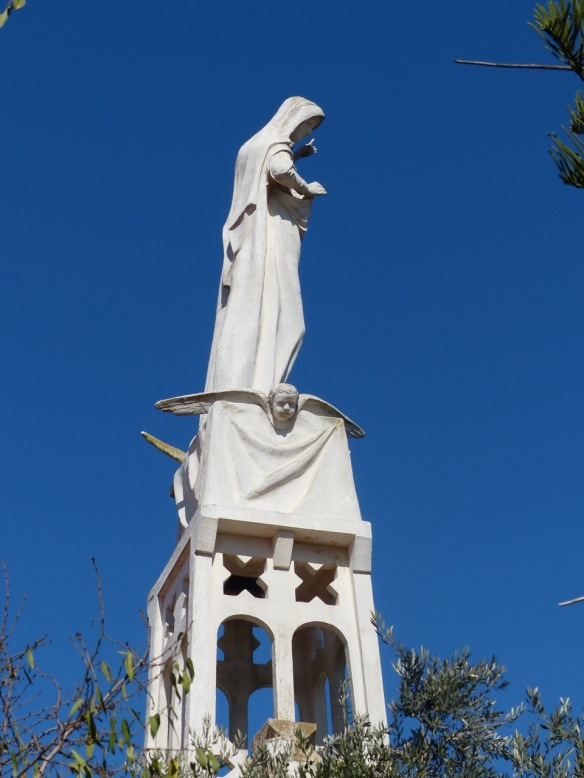
Statue of Mother Mary standing on Jewish Covenant representing Supercessionist Theology

Ramifications for Mennonite Theology, History, and Institutions Today

For decades, Mennonite historians and theologians have searched for a coherent statement of our history and theology. History impacts theology. While the Associated Mennonite Biblical Seminary (AMBS) is planning a theology conference to address this history in 2020, it feels strange to try to completely separate out a history conference from a theology conference or to have to wait two more years to take church action on this history. Mennonite complicity with the Holocaust requires action in the present. This is not just an academic historical topic – this history disrupts Mennonite narratives about ourselves, our history, our theology, and our current struggle with racism in the church. Mennonite Nazi connections and theologies of racial superiority continue to have impact today. 

The role of Mennonites and the Holocaust requires an acknowledgement and a statement to Jewish groups that we are undergoing a process of accountability and repentance and invite their participation in how we best do that.  I am curious to understand the rationale for not inviting Jewish participants to attend these conferences where we are wrestling with how we are accountable.

The Bethel conference included papers about German and Dutch Mennonite theology, Some challenged Nazi theology. Some justified Nazi theology. But these scholarly panels made no reference to how the story of Mennonites and the Holocaust seriously disrupts today’s narrative of Mennonite theology.

  • Some Mennonite theologians took part in Nazi racial science, opened church records, and asserted with Nazis that “morals pass through blood.” This is seemingly in direct opposition to Anabaptist beliefs about adult baptism.
  • Some Mennonites in the Netherlands, Germany, Poland, Ukraine and elsewhere rejected pacifism and joined the military to defend national interests. This directly challenges the narrative of Anabaptist nonviolence.
  • Just as West Germany went through a process of self-reflection and intentional de-Nazification, so too does the Mennonite Church need an explicit de-Nazification effort to address the lingering anti-semitism that informs our history and church culture.
  • Mennonite-born White Nationalist leader Ben Klassen is one of the two main figures of the white nationalist movement in North America.  Ben Klassen grew up in a Mennonite colony in Ukraine and read Mein Kampf there. He credits Mennonite theology for his white supremacy.  Regrettably, Klassen is not an aberration. Some Mennonites have reinforced the ideology of white supremacy in unique ways in US and Canadian history. White nationalism is a serious threat to Muslims, Jews, First Nations, African Americans, Latinos and all people of color and non-Christians in North America today. The white supremacists in Charlottesville last summer were carrying the words of Mennonite-born Ben Klassen. In sharing the history of Mennonite roles in the Holocaust with friends on Facebook, the strongest response has been from African American friends who repeatedly reported that they were “not at all surprised.” Racism and anti-semitism stem from the same superiority narrative and belief that “morals pass through blood.” Friends recounted how they didn’t get jobs at Mennonite institutions even though they were clearly more qualified than the “ethnic Mennonites” who were hired. Our current work on racism needs to be informed now by this history.
  • The Mennonite Central Committee (MCC) story has been told in a way that has suppressed the fact that Russian Mennonites were both victims and perpetrators. At the conference, we heard that MCC storyteller Peter Dyck told stories that intentionally deceived not only immigration agents, but also the Mennonite church at large. MCC has hidden the fact that some Russian Mennonites were Nazi leaders and collaborators. The whole story of MCC needs to be retold. MCC needs to reckon with its founding, its relationship to Jews, and its programming in Israel and Palestine which to date has focused almost entirely on the Palestinian narrative without acknowledging Jewish connection to the land and need for control over their safety following centuries of persecution. MCC is holding a 100-year anniversary conference in 2020. Hopefully, this awful history can be addressed, and real action can take place to be accountable for both these historic wrongs and the glaring absence of attention to Jewish connections to the land of Israel just as Palestinians are connected to the land of Palestine, and the need for safety for both Jews and Palestinians.
  • Who will be held to account for suppressing this awful history? Some scholars in the audience at the conference shared that they had tried to raise this history with Mennonite institutions thirty to forty years ago. Church leaders intentionally silenced these voices, diminished the Mennonite role in the Holocaust, and continued to leave out this history. Even today, I’ve heard a dozen Mennonite scholars assert that Ben Goossen’s historical survey of this history in his book Chosen Nation: Mennonites and Germany in a Global Era is an “exaggeration” or “not footnoted carefully.” When I ask for specifics, it turns out they haven’t yet read the book. But they are clearly eager to downplay the significance of this history (which, as a fellow scholar, I think is well footnoted). This failure to take responsibility and to illustrate accountability and repentance is familiar to those of us who have worked on the history of sexual abuse in the Mennonite church.  Mennonite leaders practice denial and suppression of any facts about Mennonites that are not flattering. They give speeches over and over about Mennonite values, our humility, our history of persecution, our work for reconciliation and justice. But they leave out any truthful acknowledgement of our failings.  They seem to think they can keep these terrible histories down by ignoring and suppressing them.  But truth always has a way of coming out. And the church is more likely to suffer lack of integrity by the failure of Mennonite leadership to confront these problems than it will if it admits the failures of the past.
  • Mennonites and Jews have a unique history. For centuries before the holocaust, Jews and Mennonites were persecuted together. European states applied special taxes, restrictions on public office, and allowed Mennonites and Jews only to live in certain areas. Helen Stolzfus is a Mennonite friend also married to a Jewish man, and also raising her children as both Mennonite and Jewish. Helen gave a reading of a play she and her husband wrote about their discussions of this painful history of Mennonite roles in the long history of anti-semitism. In the play, her Mennonite ancestors and her husband’s Jewish ancestors talk to each other. I know fifteen or so other Mennonite-Jewish families, at least. I don’t know that many Mennonites married to any other groups, not Mennonite Catholics, or Quakers, or Muslims. So why do Mennonites and Jews intermarry so often? And what more can we learn about the history of this, for Mennonite friends have also found they have Jewish blood. Mennonites also need to look into this broader history between Mennonites and Jews.
  • Finally, Mennonites pride themselves as being “authentic” Christians who attempt to return to the teachings of the early church, before the Council of Nicaea and before Christianity became the state religion of the Roman Empire. Of course, Jesus and the early church were Jewish. Jesus was very clear he was an observant Jew and was not trying to start a new religion. While traveling though Galilee last fall with my students from EMU, we visited the synagogues where Jesus studied. We learned many new things about Jesus, seeing him through the eyes of our Israeli and Palestinian guides. If Mennonites actually want to practice an authentic way of following Jesus, we are going to need to learn more about Judaism.

Mennonite history classes, books and museums need to tell this newly-revealed story of Mennonites and the Holocaust. The positive narrative of Mennonites needs to include the angels and demons in our histories. We can’t wait another few years to address Mennonite history and theology. It will take a lifetime for me to recover a positive sense of identity after learning all of this. And Mennonites have some serious work to do in taking responsibility for those Mennonites who did these terrible things. We urgently need to begin talking about the ramifications of this history now.

As a witness to this conference and this history, I feel shame, grief, and immense sadness. This history disrupts my world, my identity, and my relationships.

Mennonites and the Holocaust: Panels on The Netherlands and German Mennonite Responses

Session Four: The Netherlands20180317_095008.jpg

“Dutch Mennonite Theologians and Nazism”
Pieter Post, United Mennonite Church of Heerenveen and Tjalleberd

  • Post contrasted the thought and practice of Cornelis Bonnes Hylkema (author of Werkelijkheids-theologie [The Theology of Reality] (1932), among other works) and Fritz Kuiper (author of De Gemeente in de Wereld [The Church in the World] (1941) among others). Hylkema was a retired minister from Haarlem who regarded himself as an idealist and historian.  Kuiper was a minister in Alkmaar, a member of the Social Democratic Workers Party, and founder of the “Committee for Socialism and the Church.” Post analyzed how each understood the relationship between church and state, Anabaptism, nonresistance, and the faith community.
  • Hylkema emphasized love of God as an example for the National Socialist party and believed that Christians should submit to the state as part of God’s creation order.  Hylkema agreed with the Anabaptist tenet that violence was not in the spirit of Christ but was not himself a pacifist. Instead he argued that “a Christian people is armed and able bodied” who would fight in the name of God. He also understood the church to be a universalist faith community that offered a common grace and a “place of refuge for the spirit in a turbulent reality.”
  • Kuiper believed in the strict separation of church and state, where the church serves to remind the world of God’s commandments. As a social democrat, Kuiper emphasized the freedom of Christians to choose whichever party expressed biblical justice and believed that the faith community must be prepared to suffer in order to preserve its independence.  After the execution of two of his friends, however, he confessed to a friend that he “no longer had the courage to believe in peace work.” He viewed the faith community as a service of reconciliation.

“Dutch Mennonites and the Yad Vashem Recognition”
Alle Hoekema, professor emeritus, Vrije Universiteit, Amsterdam

  • Hoekema used testimonies collected by the Yad Vashem and other sources from Dutch Mennonite communities to narrate the stories of individuals who aided Jewish neighbors and friends during the Holocaust.
  • He emphasized the importance of community networks and argued that most people were motivated to help, not because of their religious faith or Mennonite identity, but a more general sense of common humanity.
  • He concluded by highlighting several patterns that emerged from his analysis of Dutch Mennonites who were recognized. Most were upper-middle class, many were involved in resistance movements, few later spoke about their experiences, and most saw their actions as normal rather than extraordinary.

“From War Criminal in the Netherlands to Mennonite Abroad and Back to Prison in the Netherlands”
David Barnouw, researcher emeritus, Dutch Institute for War, Holocaust, and Genocide Studies

  • Barnouw narrated the story of Jacob Luitjens, a Dutch collaborator with the Nazi regime during World War II. After the war, Luitjens managed to flee to Paraguay, claiming Mennonite identity and adopting the pseudonym Gerhard Harder. He later moved to Canada but was eventually arrested and extradited to the Netherlands where he was tried and convicted of war crimes.
  • Barnouw highlighted how Luitjens made strategic use of his Mennonite identity and connections in the Mennonite community to avoid prosecution for his wartime collaboration. In court proceedings, he said “I told my God and He forgave me.”
  • Luitjens spent time in jail but was release before serving his full sentence. Stripped of his Canadian citizenship and denied the rights of Dutch citizenship, Luitjens exists as a person without a state. Barnouw is unable to confirm whether Luitjens is still living.

Session Five: German Mennonite Responses in Theology and Memory20180317_103617.jpg

“German Mennonite Theology in the Era of National Socialism”
Arnold Neufeldt-Fast, Tyndale Seminary

  • Neufeldt-Fast’s paper used the writings of German Mennonite church leaders to analyze the underlying logic that led most of them – from across the theological and ideological spectrum – to accept and promote National Socialist ideology.
  • Drawing upon Zygmunt Bauman’s concept of the “gardening state,” Neufeldt-Fast argued that most leaders came to embrace National Socialism’s “order-making, instrumental rationale” of a modern German society in which some plants should be protected and cared for while others should be segregated, contained, removed, or destroyed.
  • While earlier writings of theologians were not explicitly anti-Semitic, they did not condemn Nazi racial doctrine as heresy. By the late 1930s, however, many actively drew upon contemporary understandings of race and blood purity to argue for the expulsion of Jewish people from Germany.
  • Neufeldt-Fast ended his discussion with a call for a critical evaluation of Mennonite theology and the need to develop a post-Holocaust theology.

“Judaism as Argument: German Mennonites between Anti-Semitism and the Old Testament God”
Astrid von Schlachta, Mennonitischer Geschichtsverein (paper delivered by John Thiesen in her absence)

  • In her paper, Astrid von Schlachta used sermons and other publications to explore the range of theological convictions among German Mennonites on the role and use of the Old Testament in the church during the 1930s.
  • Von Schlachta argued that there was not a unified opinion among Mennonites on the matter and that the influence of National Socialist ideology on Mennonite interpretations of Judaism in the Old Testament depended upon the context.
  • While some interpretations were clearly anti-Semitic, other authors pushed back against a racialized view of the Old Testament and argued for its continued relevance for Mennonites and other Christians.

“Selective Memory: Danziger Mennonite Reflections on the Nazi Era, 1945-1950”
Steve Schroeder, University of the Fraser Valley

  • Steve Schroeder drew from oral histories and memoirs to examine how Mennonites from Danzig remembered and explained their experiences during and after World War II. While other Christians in Germany were forced to account for their actions under allied occupation, Danziger Mennonites emigrated and were able to avoid critical reflection on their actions.
  • Schroeder used the framework of cycles of grief and loss – denial, bargaining, and acceptance – to categorize Mennonite memories of the Nazi era. Although many supported the Nazi regime and identified as ethnic Germans during the war, afterwards many made strategic use of their religious identity as Mennonites, distancing themselves from the German nation in an effort to seek asylum abroad.
  • Schroeder ended with a call to continue a critical examination of the role that Mennonites have played, not only in the Holocaust, but also colonial and other systems in which they continue to participate and from which they continue to benefit.

America’s Pastor among the “Quiet in the Land”: Billy Graham and North American Anabaptists, Part I

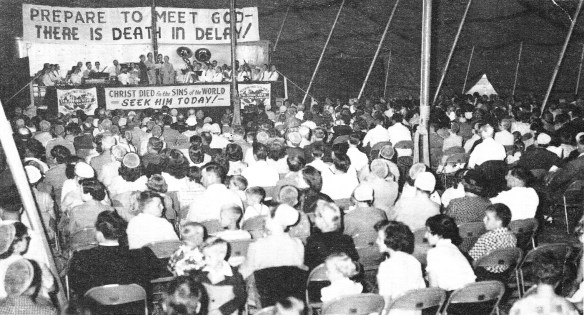
In the summer of 1951, two Mennonites from Virginia — brothers George and Lawrence Brunk — and a team of workers erected a large tent capable of seating 6,000 people in a field in Lancaster County, Pennsylvania. For the next seven weeks, area Mennonites flocked to the tent to hear George preach and Lawrence lead the singing. The services featured all the trappings of had come to define the American revivalist tradition: expressive preaching, compelling music, modern methods of advertising and promotion, and invitations for listeners to leave their seats, walk down the aisle to the altar, and experience a religious conversion. According to reports, hundreds of people came forward at the Lancaster meetings to convert to Christianity for the first time, to renew their covenant as members of the Mennonite Church, or to make a deeper consecration as Christians.1

A man stands with his back facing the camera. He is preaching to a large crowd under a large white canvas tent.

George R. Brunk II speaks during a revival service in the 1950s. Note the large crowd sitting under the massive tent, as well as the signage at the front of the stage. Both of these elements, along with elements of Brunk’s preaching style, are borrowed from another mid-century revivalist: Billy Graham. (Source: Theron F. Schlabach Photograph Collection [HM4-378 Box 1 Folder 4 photo], Mennonite Church USA Archives, Goshen, Indiana)

After closing the event in Lancaster, the Brunk brothers traveled east to Souderton, Pennsylvania, where they held a five-week series of meetings. An article in the Gospel Herald reported that 2,500 people attended the meetings on weekday evenings, an an additional ten to twelve thousand on weekends or closing nights. Those who came to the altar confessing sin and seeking a conversion experience were invited to share their testimony. And yet, attuned to Mennonite expectations about decorum, the Gospel Herald writer also made clear that the meetings were conducted appropriately and without excessive emotionalism.2 From Souderton, the Brunk brothers conducted campaigns in Orville, Ohio and Manheim, Pennsylvania, before the end of 1951. Their crusades continued throughout the 1950s and 1960s.3

The Brunks’ work inspired others. In 1952, after attending the Brunks’ services in Ohio the previous year, Mennonite preachers Myron Augsburger and Howard Hammer each began careers as evangelists, adopting a style cribbed from the Brunk Brothers.4 Also in 1952, a Brethren in Christ minister from Mount Joy, Pennsylvania — John Rosenberry — launched the Living Hope Gospel Campaign and began holding revival meetings in the local area. Rosenberry and his team borrowed the Brunks’ tent for their first series of meetings.5

A large crowd of people sit under a large canvas tent watching a preacher behind a podium. Large signs are posted behind him, proclaiming Christian messages.

A scene from one of John Rosenberry’s Living Hope Gospel Campaign tent meetings, probably in the early 1950s. Note the use of a large canvas tent (just like the Brunk brothers and, before them, Graham) and dramatic signage. (Source: Brethren in Christ Historical Library and Archives, Messiah College, Mechanicsburg, Pa.)

One scholar has noted that these revival meetings “were a dramatic change from traditional Mennonite experience.”6 While revivalism per se was not new to Anabaptists, the style of these mid-century meetings — massive tents, dramatic signage behind and in front of the pulpits, branded materials such as logos, the use of technology such as speakers, and more — were clearly different than those used by previous generations. Anabaptists in the mid-twentieth century were embodying a modern revival style.7

What inspired these Mennonites and Brethren in Christ to launch revival meetings? The answer, quite simply, is Billy Graham.

Today, in popular memory, Graham — who died last week at the age of 99 — is remembered as an evangelist, a presidential confidant, and an influential icon of American evangelicalism. As then-President George W. Bush noted in 2007, Graham was “America’s pastor.”

Moreover, in the historiography of American Christianity, Graham has come to symbolize conservative Protestantism’s move from fundamentalist isolationism to irenic neo-evangelicalism. Graham’s ascendance to the national stage in the late 1940s and early 1950s marked a public “resurgence” (to use the language of Joel A. Carpenter) in conservative Protestantism. Christians from various denominational backgrounds flocked to Graham’s rallies, subscribed to Graham’s periodicals, listened to Graham’s radio program, and watched Graham’s films. In a way, Graham served to unite those communities fragmented by sectarian differences and fundamentalist-modernist schisms.

Indeed, Graham was a symbol of this conservative Protestant resurgence after World War II. But he also modeled a style that characterized this resurgence — a style emulated by well-intentioned imitators such as the Brunks, Hammer, Augsburger, and Rosenberry. As his biographer, the Duke Divinity School historian Grant Wacker, has argued, Graham was a product of his age — an evangelist who rose to fame amid the midcentury rise of mass popular media, youth culture, and organizational efficiency. From the start of his ministry Graham delivered his sermons in a crisp, compelling, and direct manner that mirrored the style of contemporaries such as the news broadcaster Walter Winchell. His preaching was backed up by heartwarming testimonies and toe-tapping music. Moreover, Graham was tall and handsome, perfectly suited to captivate audiences and appear on newsprint pages and glossy magazine covers. And behind him stood the well-oiled Billy Graham Evangelistic Association machine, comprised of a small army of professionals and staffers who promoted Graham’s services through slick advertising, organized and streamlined his growing throng of volunteers, and armed his old-fashioned tent-style meetings with dramatic signage that grabbed the attention of the audience almost as much as Graham’s preaching.8

This period newsreel from Graham’s first revival crusade, held in a Los Angeles field under a big canvas tent in 1949, showcases some of the style that captivated audiences and inspired Anabaptist imitators.

Of course, these methods evolved over time: Graham’s first crusade, held in a Los Angeles field under a big canvas tent in 1949, was a far cry from the stadiums and amphitheaters he filled later in his career. But for midcentury Mennonites and other Anabaptists, this early style was simple enough — yet also sufficiently modern — that they believed they could borrow it, adapt it, and deploy it effectively in order to bring about what they saw as much-needed spiritual renewal in their churches.

Yet it was more than just the would-be Anabaptist evangelists who were drawn to Graham’s style. As the Goshen College historian John D. Roth recently observed in an article for The Mennonite, Graham influenced not only imitators within the Anabaptist fold but also directly inspired the many Mennonites, Brethren in Christ, and other Anabaptist laypeople that attended his crusades:

Long before Mennonites were comfortable with the “ecumenical movement,” they were participating fully in the Billy Graham revival crusades. Many of us were attracted by the biblicism, clarity and simplicity of Graham’s message, and the “altar call” fit well with our conviction that following Jesus should be a public decision. Not least, the Billy Graham crusades offered Mennonites a chance to enter alongside their neighbors into the evangelical mainstream. The long-term impact of Graham’s impact on the Mennonite community has been profound.

As Roth’s comments suggest, many Mennonites embraced Graham, his message, and his style. The work of the Brunks, Hammer, Augsburger, and Rosenberry reflects this positive assessment; they saw his success and the response to his message and style, and sought to emulate it. And the activities of these Anabaptist evangelists would make an important impact on mid-century North American Anabaptism, especially in terms of their relationship to the wider evangelical Protestant world.

But not all Mennonites held such a positive view of Graham or American evangelicalism — or their influence on North American Anabaptism. In my next post, I want to explore some of the negative reactions to America’s pastor. Then, in a final post, I want to use these reflective comments about Graham’s influence as a jumping off point for thinking about one of my major areas of research interest: the relationship between Anabaptism and evangelical Protestantism in twentieth century America. Stay tuned!

NOTES:


  1. Harold S. Bender and Sam Steiner, “Brunk Brothers Revival Campaign,” Global Anabaptist Mennonite Encyclopedia Online, 2009, and Maurice E. Lehman, “The Lancaster Revival,” Gospel Herald, September 4, 1951, 852-853, cited in Beulah Stauffer Hostetler, American Mennonites and Protestant Movements: A Community Paradigm (Scotdale, Pa.: Herald Press, 1978), 281-282. 
  2. Paul M. Lederach, “Revival in Franconia,” Gospel Herald, September 18, 1951, 902-903, cited in Hostetler, American Mennonites and Protestant Movements, 281-282. 
  3. Bender and Steiner, “Brunk Brothers Revival Campaign.” 
  4. James O. Lehman, Mennonite Tent Revivals: Howard Hammer and Myron Augsburger, 1952-1962 (Kitchener, ON: Pandora Press, 2002). 
  5. E. Morris Sider, Called to Evangelism: The Life and Ministry of John L. Rosenberry (Nappanee, Ind.: Evangel Press, 1988), 90-92. 
  6. Sam Steiner, “Brunk, George Rowland (1911-2002),” Global Anabaptist Mennonite Encyclopedia Online, 2016. 
  7. This point regarding revivalism is especially true of the Brethren in Christ, who were engaged in such religious activity as early as the late nineteenth century. See Morris N. Sherk, “Tent Evangelism Among the Brethren in Christ,” Brethren in Christ History and Life 11, no. 2 (August 1988): 157-204. 
  8. This assessment of Graham’s style comes from Grant Wacker, “Billy Graham’s America,” Church History 78, no. 3 (September 2009): 500-504. See also Wacker, America’s Pastor: Billy Graham and the Shaping of a Nation (Cambridge, Mass.: Bellknap Press of Harvard University Press, 2014).