You shall not oppress a refugee. You know the heart of a refugee, for you were refugees in the land of Egypt. (Exodus 23:9)

shenandoah-valley-sept-1864
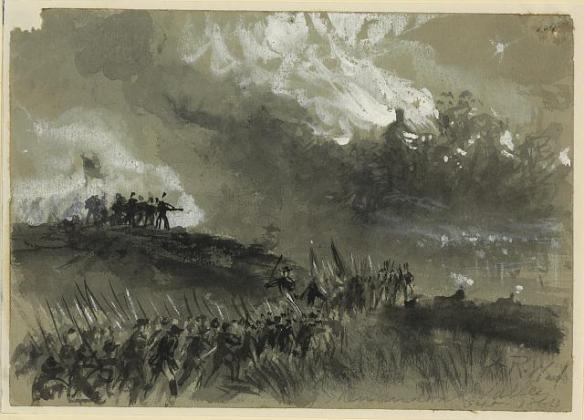
Shenandoah Valley, Sept. 1864. Alfred R. Waud.

Diaries give us a unique, intimate look into the lives of people throughout history. They have a special ability to shed light on our present realities by exposing similarities and differences in daily life across time.

The Virginia Mennonite Conference Archives, located on the first floor of EMU’s Hartzler Library, is fortunate to have the diaries of Emanuel Suter, a Mennonite potter from the Shenandoah Valley. His diaries span nearly 40 years (1864-1902), and today I will highlight some entries from early October 1864, almost exactly 152 years ago. In September 1864, under the direction of General Sheridan, the Union army began a systematic burning of the Shenandoah Valley, which was known as the “breadbasket of the Confederacy”. Fearing for their safety and facing the destruction of their homes and livelihoods, Suter and his family, along with other Mennonite and Brethren families from the Valley, made the difficult decision to leave the Valley and were escorted to safety in the North by the Union army1 Here are his reflections on that trek:

Diary commencing the 5th day of October 1864

The federal army being in the valley of Virginia, burning barns dwelling houses mills &c a general destruction was threatnt [sic]. Myself and family decided to leave the Shenandoah Valley and go north. In the morning of the 5th day of October we left went to Harrisonburg then went with the army to Mt. Jackson, there we remained that night and all the day of the 6. I will here mention that my family at this time consisted of myself and wife Elizabeth, three children Daniel Reuben, Susan Virginia, John Robert…The sister Margaret Suter and father Daniel Suter were with us. Brother Christian Suter, also belonged to the family but he and a young man Albert Jenkins were back in the rear but came to us on the way.

On the morning of the 7th we were ordered to get in readiness to move at one o’clock we with the Army started down the Valley Pike, I will also mention here, that at Mt. Jackson we found many families of the Valley that we knew also going some north and some west. we were now pushed on hurretly [sic] in a fast walk but most of the time in a trot. This evening we came to Cedar Creek where we put up for the night. Here we had some trouble keeping my horses from being stolen. Father and I took turn about guarding them. One fellow cut the halter strap while in Father’s hand but found that he was seen and got away quickly.

This morning the 8th which was Saturday. The Army soon move down the valley2 We traveled like the day before mostly in atrot two wagons in abrest. We past through Winchester and at night we stopped at a place called Bunker Hill. It turned cold during the day. It was cold and blustery all night. We were constantly compelled to keep an eye on our horses, our nights rest was not at all comfortable. We had considerable trouble keeping warm.

The morning of the 9th Sunday we moved towards Martinsburg [WV]. We arrived there at 8pm. Here we spent another cold night out in an open field

The morning of the 10th Monday we moved on an old sawmill where we remained camped until the 12th. The two days while there all that were going north and west were required to take the oath of allegiance.

We left for Maryland, traveled nearly all day. At night myself and my family came to old John Horst we remained with him the next day and that night. The same day [the 13th] myself Father Suter Brother Christian…started with the wagons and…crossed the little South mountain through Adams and York counties. The first night we came to Christian Muslemans [sic]. We had some trouble to get a place to stay the people did not trust us they thought we were rebels but this man received us and treated us kindly.

We were away from home under very unfavorable circumstances, yet we engaged ourselves as well as could be expected. We were in a strange country and surrounded with everything quite different to what we were used to, but kind friends made us comfortable.3

By the time the Suter family reached their destination of Lancaster, Pennsylvania, they had traveled over 200 miles, mostly by foot.

Many Mennonites in North America today live lives of comfort, privilege, and stability. It is easy to see the news and feel removed from the experience of refugees whose troubles seem worlds away from our day-to-day life. It is also easy to forget that it wasn’t long ago that Mennonites were driven from their homes with little warning and forced to settle in new places to ensure safety for their families. The Suters fled just 150 years ago. Many Russian Mennonites had to flee the hostile Soviet regime in the early 20th century.4 And even today, Anabaptists in the Global South face intolerance and fear for their safety.5

Emanuel Suter wrote that at times it was hard to find a place to stay as “the people did not trust us.” Many refugees today are also met with hostility, xenophobia, and violence as they flee dangerous homelands and attempt to find security for their families. In Suter’s diary he notes the names of each person or family who helped his family and expresses his appreciation for “kind friends who made us comfortable.” We should remember the people throughout history who helped Mennonites in their time of need and seek to be helpers as well.

To learn more about the refugee wagon train that took many Mennonites out of the Shenandoah Valley during the Civil War, you can read Shenandoah Mennonite Historian’s Autumn 2014 edition (v.22 n.4), or the book The Burning by John L. Heatwole.

To learn more about how you can help the cause of refugees today, visit Mennonite Central Committee’s website.

Works Cited:

1864 Diary, Box 1, I-MS-31, Emanuel Suter Diaries 1864-1884, Virginia Mennonite Conference Archives.

Epp, Frank H., Mennonite exodus; the rescue and resettlement of the Russian Mennonites since the Communist Revolution. (Altona, Manitoba : Canadian Mennonite Relief and Immigration Council, 1962).

Heatwole, John L. The Burning : Sheridan’s Devastation of the Shenandoah Valley. (Charlottesville, Va. : Rockbridge Pub., 1998).

Waud, Alfred R. , Artist. Shenandoah Valley, Sept. 1864. September, 1864. Image. Retrieved from the Library of Congress, https://www.loc.gov/item/2004660274/. (Accessed October 13, 2016.)


  1. Heatwole, The Burning, 30. 
  2. This means north. Valley folk use the northern flow of the Shenandoah River rather than traditional cardinal directions to indicate direction in the Valley. So you go “down” (North) to Winchester and “up” (South) to Roanoke. 
  3. Suter, 1864 Diary, 1-9. 
  4. Epp, Mennonite Exodus, 139-155. 
  5. For example, consider the violence and persecution facing Ekklesiyar Yan’uwa a Nigeria (Church of the Brethren in Nigeria). 

Threads of Connection Woven through History

What do the Anabaptists from Prussia, cowboys, and Eastern Mennonite College have in common? Admittedly not much, but these three threads have intertwined in a unique way throughout history to weave a tale of conflict, connection, and caring.

Gesangbuch 1908 1

Danzig Mennonites

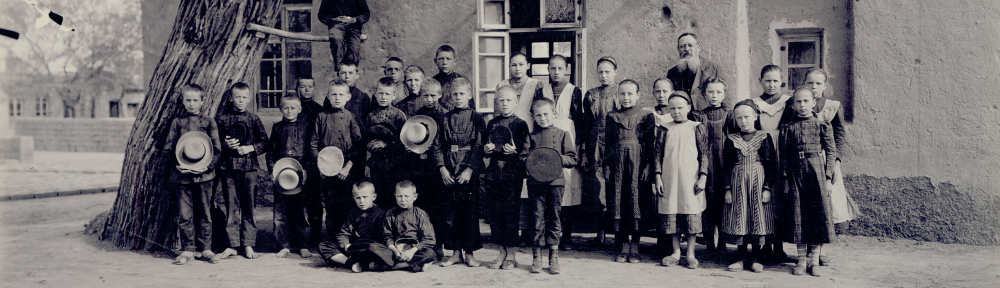
The first thread is the Anabaptists in Danzig, Prussia (now Gdansk, Poland). The history of the Danzig Mennonites is long and complex and there isn’t enough time or space do it justice here, but I will attempt to give a brief overview.1 Anabaptists moved to the Danzig area in the 1530s fleeing persecution in the Netherlands and other areas of what is now Germany and Switzerland (Mannhardt 2007, 37-38). They established a community in Danzig, living there from the 16th century to the early 20th century.  Both Menno Simons and Dirk Philips visited the Anabaptists at Danzig a number of times, with the latter living there for a while. Danzig church historian H.G. Mannhardt says that “the beginnings of our church can be traced to Menno himself” but that Philips “is considered the actual founder of the Danzig Mennonite Church.”2 
The Danzig Mennonites practiced strict church discipline, tried to avoid fashionable clothing, and were excused from military service so long as they paid for two substitutes. They also practiced mutual aid and care for the poor. They maintained an alms house to house the homeless and had an alms fund for the care of needy church members. Mannhardt says that “their care for the poor was to be similar to that of the early Christians, and for that reason they had, besides the office of preacher, the office of deacon or caregiver to the poor.”3

The Mennonites were appreciated for their work ethic and quiet nature, but they still experienced some discrimination. For the first few centuries of their tenure they were denied the rights of citizenship as they refused to take the citizenship oath, were not allowed to live within the city walls (many settled in the nearby suburb of Schottland), and endured hindrances to practicing their crafts and trade in lace and fine liquors. Seemingly each time a new King of Poland came to power he would try to evict them.4 Fortunately, they were given enough protection by the Danzig City Council to be able to continue living in and around Danzig.5

By the 1800s Danzig Mennonites were granted citizenship along with other protections and were able to move within the city walls, where they constructed a church building on what became known as Mennonitenstrasse (Mennonite Street).  Church membership was always strong and had grown to over one thousand after World War I, but it dwindled significantly after World War II as many were driven out by the conflict and subsequent Soviet occupation.6  The church building was restored after the war and continues to serve as a church, although it is no longer used by Mennonites.7 

Seagoing Cowboys

The second thread is post-World War II relief work done by young men of Mennonite, Church of the Brethren, Brethren in Christ, Quaker, and other Anabaptist faiths. Mennonite Central Committee (MCC) was instrumental in overseeing and coordinating the Anabaptist connection to governmental conscientious objector (CO) programs during and after the war, including Civilian Public Service (CPS) and the United Nations Relief and Rehabilitation Administration (UNRRA).8 After WWII, the UNRRA partnered with the Heifer Project, a Church of the Brethren organization, to provide livestock for people in Europe and China whose lives and livelihoods had been destroyed during the war. The men who volunteered to accompany heifers, horses, mules, and other livestock across the ocean were nicknamed “Seagoing Cowboys”. In total they made over 350 trips over the course of three years.9 Many went over as a fulfillment of their alternative service, but some were just seeking adventure. All came back with a deeper understanding of the gravity of pain and destruction endured by the survivors of WWII.10 

The Menno Simons Historical Library

The final thread is that of Eastern Mennonite College (now Eastern Mennonite University), more specifically its special collections library, the Menno Simons Historical Library (MSHL). The MSHL was started in the 1920s by two professors who wanted to create a collection of materials related to Mennonite and Anabaptist history, life, and culture. Since its inception, the collection has grown to include a number of rare books and materials relating to the early Anabaptists in Germany, Switzerland, and the Netherlands. It now holds over 45,000 books, including about 5,000 rare books, and a host of other materials related to the Mennonites and Anabaptists.

Conflict, Connection, and Caring

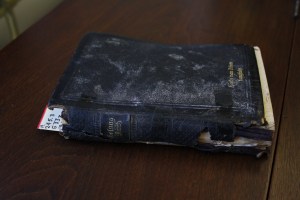
These threads were woven together when a young man from the Shenandoah Valley named Wilbur C. Layman went over to Poland as a seagoing cowboy in 1946. His fellow cowboys went out one day to explore the ruins of the bomb-damaged Danzig Mennonite church, but Wilbur stayed back as he wasn’t feeling well. The men found church records and documents in the damaged church, many of which they recovered and brought back to the United States.11 These were housed at the Mennonite Library and Archives at Bethel College in North Newton, Kansas from 1947-2009 (they have since been transferred to the Mennonitische Forschungsstelle in Weierhof, Germany).12 Although he had stayed back that day, two items found their way into Wilbur’s hands and were brought home to Virginia. He later donated them to the Menno Simons Historical Library–a 1908 songbook from the Danzig Mennonite Church entitled Gesangbuch zur kirchlichen und häuslichen Erbauung : für Mennoniten-Gemeinden and a single page entitled Rechnung von unsrer Gemeinte[sic] Armen Gelder : welche anno 1698 adÿ 29 December geschlossen worden, which very roughly translated means, “Account of our community poor funds which concluded December AD 1698”. This page lists the deacons for the poor that are mentioned in Mannhardt’s history of the church as well as an account of the alms fund. The deacons listed are Martin Enken, Harman Allerts, Hendrick Klaassen, Andries Penner, Gerrit Jansen, and Nicolas Penner. This document is a fantastic example of the mutual aid and care for the poor practiced by the Danzig Mennonites.

Gesangbuch 1908 2.JPG

Documentary evidence such as this provides a tangible connection to history that is hard to replicate through reading facts and figures. Every rare item in the Menno Simons Historical library has a unique provenance, but we aren’t fortunate to have such a complete and fascinating tale for them all, which makes this document and songbook all the more special.


  1.  More information can be found in the GAMEO article on the Danzig Mennonite Church or in H.G. Mannhardt’s book The Danzig Mennonite Churchthat was recently translated and published in English. Mannhardt, H.G. The Danzig Mennonite Church: Its Origin and History from 1569-1919. Translated by Victor G. Doerksen, edited and annotated by Mark Jantzen and John D. Thiesen. North Newton, Kansas: Bethel College, 2007; Mannhardt, H. G. Global Anabaptist Mennonite Encyclopedia Online. October 2012. “Danzig Mennonite Church (Gdansk, Poland).” Accessed August 22 2016.
    http://gameo.org/index.php title=Danzig_Mennonite_Church_(Gdansk,_Poland)&oldid=127394 
  2. Mannhardt 2007, 44-46. 
  3. Mannhardt 2007, 116). 
  4.  (Mannhardt 2007, 53; 56-57). 
  5.  (Mannhardt 2007, 71-72). 
  6.  (Mannhardt 2007, 245). 
  7.  (Mannhardt 2007, 251-53). 
  8.  Byler, J. N. Global Anabaptist Mennonite Encyclopedia Online. 1959. “UNRRA (The United
    Nations Relief and Rehabilitation Administration).” Accessed August 19 2016.
    http://gameo.org/index.php?title=UNRRA_(The_United_Nations_Relief_and_Rehabilitation_Administration)&oldid=78411
  9. For more information on Seagoing Cowboys, visit seagoingcowboys.com, where a great deal of information and wonderful stories have been compiled by Peggy Reiff Miller. Also check out her new children’s book entitled The Seagoing Cowboy, now available from Brethren Press. Miller, Peggy Reiff. The Seagoing Cowboys: Delivering Hope to a War-Torn World. Accessed August 18, 2016. www.seagoingcowboys.com
  10. Miller, Peggy Reiff. The Seagoing Cowboy. Elgin, Illinois: Brethren Press, 2016, 38-39). 
  11. Scans of the Danzig Mennonite Church records that were once housed at the Mennonite Library and Archives can be found 
  12.  (Mannhardt, xxvii).