The Insurance Problem

September’s issue of The Mennonite focuses on Mennonites and healthcare costs. In a moment of synchronicity, my own family has recently been facing unexpected healthcare costs after a member of my family had a routine medical procedure to screen for cancer. We were relieved to hear the positive news of a clean bill of health, but soon became stressed as the medical bills began to arrive. The EOBs rolled in to the tune of tens of thousands of dollars, with seemingly arbitrary “adjustments,” allowed amounts, and finally, the absurdly high bottom line that we are responsible for.  I was yet again reminded of how broken our American medical system is and grew curious about the historical origins of our current insurance system. It’s hard to remember a time before co-pays and deductibles, HMOs and PPOs, but I quickly learned that the system, as well as American Mennonites’ embrace of it, is relatively new. So I wanted to know: what changed in the last sixty years that led to our compliance with such a system? 

What I found when I began to investigate this issue is that many American Mennonites in the nineteenth and early twentieth centuries were vehemently opposed to most forms of insurance, specifically life insurance. Some conferences were lenient on members holding property or fire insurance, but other conferences, like Virginia Mennonite Conference, went so far as to make the holding of insurance a test of membership. Harry Brunk writes in History of Mennonites in Virginia 1900-1960 that, “In 1900 Virginia Conference was asked—”Why do we oppose life insurance? Scripture references were given as the answer and members were told to make “Christ our Life Insurance.”1

The practice of buying insurance, especially life insurance, was seen as placing one’s trust in the world and rejecting faith in God’s providence. The church also called upon its members to practice mutual aid, assisting one another financially in times of loss or hardship. This idea had strong historic roots—many Anabaptist groups since their beginnings had practiced poor relief and sharing of goods.2 This barn-raising mentality continues today in many conservative Mennonite and Amish communities, with members providing tangible and financial relief for coverage of healthcare costs, property loss, and in other times of need.3

But for some church members, especially those whose livelihood was dependent on farms or property, insurance was still tempting. In order to help their members avoid an unequal yoke with insurance companies, some conferences responded by creating “Aid Plans” for property and automobiles.4 Others established mutual aid societies, to cover many possible pitfalls of life like storm damage, fire, or to help with burial costs.5 These were highly successful for a time, providing mutual aid to members in need, but began to hit snags as the US government tightened up regulations surrounding insurance coverage.6  After the Great Depression and during the onset of the Second World War there was agitation by some in the Mennonite Church for a more formalized, church-wide form of mutual aid to coordinate aid for church members in times of need.7

Mennonite Mutual Aid (MMA) came about at a time of upheaval and transition in the Mennonite church and the world. It came on the heels of World War II after many years of negotiation and work by emerging leaders in the church including H.S. Bender, Chris Graber, Guy Hershberger, and Orie O. Miller. Al Keim writes in his essay “My Brother’s Keeper: Origins of Mennonite Mutual Aid” that the fact that MMA “so long in gestation, should be born at this pivotal moment of leadership change was no accident. Both the war and the new generation of leaders made it happen.”8 It also came at a time where Mennonite nonconformity was being tested, and many feared that worldliness and assimilation were taking hold. 

At the same moment, in 1945, an Insurance Study Committee was created by Virginia Mennonite Conference, comprised of George R. Brunk II, Aldine Brenneman, and Clarence Huber. It appears to have been created in response to some members acquiring automobile and property insurance and an overall relaxation of opposition to insurance in the laity. After thorough scriptural examination, the committee delivered a report on May 24 that doubled down on the belief that forms of insurance such as automobile and property, “though generally thought to be less objectionable” than life insurance, “are, in fact, we believe, opening wedges that may bring us finally to the point of recognizing and tolerating insurance of life itself.” They called for the church to better educate members about the perils of insurance, create aid plans for hospitalization and burial costs, and “continue to make Life Insurance a test of membership.”9

But the wedges had already been opening in Mennonite communities in other areas of the country, and just a week after this VMC group delivered their report, on May 31, 1945, a church wide mutual aid agency was born.10 Although the idea garnered support from many, the more conservative conferences were not easily convinced. Keim writes that “Graber presented the plan to both the Virginia and Pacific Coast conferences” and was “dismayed when both conferences failed to endorse the plan.” When he complained to Guy Hershberger, Hershberger replied that “Virginia…and Oregon…are afraid of everything new as being something worldly.”11 Keim notes that to many of those conservative conferences, “the organizational good sense of the new generation of leaders looked to some . . . like a worldly trend” and “the insurance features of the aid plan seemed to have more to do with clever means of risk reduction than with New Testament mutual aid.”12 Ultimately, through the strong leadership of a few and the slow acquiescence of many, the roots of MMA took hold. It quickly added a number of aid policies, including those for “property loss, sickness, or death.”13

As the insurance industry grew in the United States, so did Mennonite church members’ desire for insurance and so did MMA’s offering of more traditional insurance plans. This shift toward acceptance was likely driven by urbanization, education, and overall assimilation of the constituency, increasing government regulations for insurance, and a loss of tight-knit communities based in rural areas. In the realm of health care specifically, the introduction of Health Maintenance Organizations (HMOs) and Preferred Provider Organizations (PPOs) along with healthcare reform in the 1990s limited the options MMA (now Everence) could provide its members. Keith Graber Miller writes in his 1995 essay “Mennonite Mutual Aid: a Margin of Difference?” that “the result is that Mennonite Mutual Aid’s HMO and PPO health products become increasingly like those sold through other commercial companies.”14

Nearly twenty-five years after Graber Miller wrote that, it appears that the Mennonite Church has fully embraced, or at least complied with, the insurance industry it once actively worked to avoid. Those of us who work at Mennonite institutions are offered plans by our employers that include health insurance, dental and vision insurance, life insurance, accidental death and dismemberment insurance, short term disability, and on and on. Most of these plans are brokered by Everence (formerly MMA), but come through large providers such as Anthem Blue Cross Blue Shield. There is no longer a conversation about whether or not insurance is worldly or scripturally sound, it is simply a benefit we all expect with our employment. 

Yet I find myself wishing we as a church could do better than this status quo. It is naive to hope that a denomination like MCUSA could return to the forms of mutual aid encouraged by early Mennonite leaders or practiced by the tight-knit communities of the Amish and Conservative Mennonites. But our complicity in these systems that cause pain and financial ruin to so many in our country troubles me. 

With an understanding of the historical perspectives within the church on insurance and its pitfalls, I wonder if there is a place for Mennonites to speak into these issues and imagine a system whose first priority is caring for the sick, not making a profit. I doubt the conservative Mennonite leaders in Virginia and Oregon could have foreseen our convoluted dealings with insurance companies issues 80 years ago, but I can’t help but feel that their caution should have been heeded rather than being dismissed as the cries of fearful sectarians unwilling to embrace change. They saw a different way forward, rejecting capitalist impulses, and tried to put their faith in God and the church.  How can we do the same today?


  1. Harry A. Brunk. History of Mennonites in Virginia, 1900-1960. (Verona, Va: McClure Printing Company, Inc., 1972.), 447. 
  2. Albert N. Keim, “My Brother’s Keeper: Origins of Mennonite Mutual Aid,” in Building Communities of Compassion, ed. Willard M. Swartley and Donald B. Kraybill (Scottdale, Pa.: Herald Press, 1998), 193. 
  3. Kristyn Rohrer and Lauren Dundes. 2016. “Sharing the Load: Amish Healthcare Financing.” Healthcare, No. 4: 92. doi:10.3390/healthcare4040092. 
  4. Brunk. History of Mennonites in Virginia, 1900-1960, 467-477. 
  5. Steven M. Nolt, “Fifty Year Partners: Mennonite Mutual Aid and the Church,” in Building Communities of Compassion, ed. Willard M. Swartley and Donald B. Kraybill (Scottdale, Pa.: Herald Press, 1998), 214. 
  6. Brunk. History of Mennonites in Virginia, 1900-1960, 467-477. 
  7. Keim, “My Brother’s Keeper: Origins of Mennonite Mutual Aid,” 194. 
  8. Keim, “My Brother’s Keeper: Origins of Mennonite Mutual Aid,” 204. 
  9. Report of the Insurance Study Committee, May 24, 1945. Insurance. Vertical File. Menno Simons Historical Library. 
  10. Keim, “My Brother’s Keeper: Origins of Mennonite Mutual Aid,” 207. 
  11. Keim, “My Brother’s Keeper: Origins of Mennonite Mutual Aid,” 206. 
  12. Keim, “My Brother’s Keeper: Origins of Mennonite Mutual Aid,” 208. 
  13.  Nolt, “Fifty Year Partners: Mennonite Mutual Aid and the Church,” 216. 
  14. Keith Graber Miller, “Mennonite Mutual Aid: a Margin of Difference?” Building Communities of Compassion, ed. Willard M. Swartley and Donald B. Kraybill (Scottdale, Pa.: Herald Press, 1998), 270. 

Lives of Service

Image

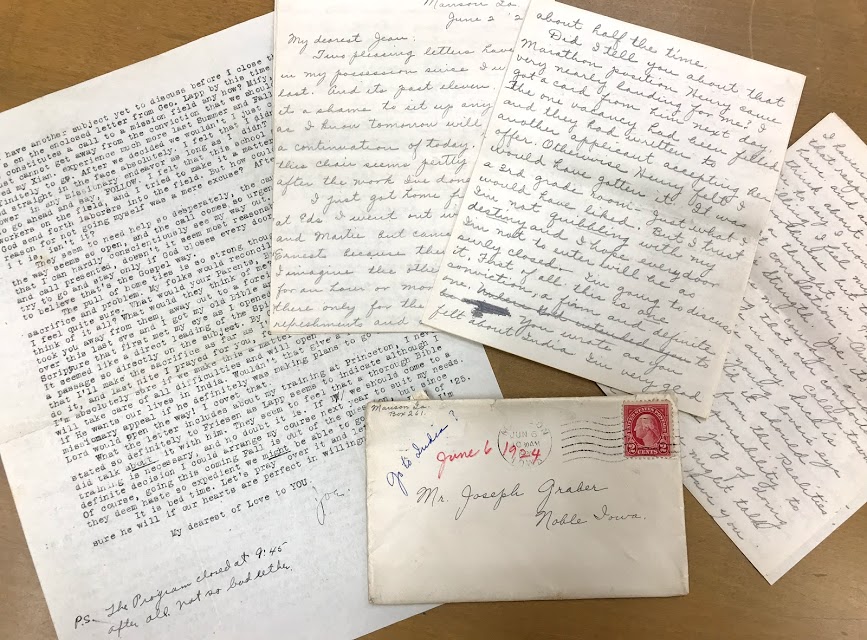
letters from June 1924 mark the first exchange of correspondence between Joseph D. Graber and Minnie Swartzendruber about their decision to commit their lives to mission work.
These letters from June 1924 mark the first exchange of correspondence between Joseph D. Graber and Minnie Swartzendruber about their decision to commit their lives to mission work. Just over a year later, the two were married and appointed as missionaries to India through the Mennonite Board of Missions. Source: Joseph Daniel and Minnie (Swartzendruber) Graber Papers, 1920-1978. Box 14, Folder 4 and Box 15, Folder 1. HM1-503. Mennonite Church USA Archives. Elkhart, Indiana.

As young students in their early 20s, J.D. Graber and Minnie Swartzendruber thought they were headed toward careers as educators. A new set of correspondence at the Mennonite Church USA Archives sheds light on their early lives, their courtship, and their decision to serve as missionaries in India. The mostly handwritten letters between the two span a period of four years (1921-1925) and contain rich details about their family life, social networks, educational pursuits, and Mennonite faith.

About the decision to serve in India, J. D. wrote, “I’m absolutely sure if we make this a matter of earnest prayer God will take care of all difficulties and will open the door for us to go if He wants our lives in India.” In her letter of response, Minnie wrote that God’s strength gave her courage “and makes me willing that our comfortable little home in some college town should fade away. Such is alluring to a young lover’s eye but God forbid it should blind our eyes from the realities of life, the responsibility to be met, and the joy of doing it.”

After seventeen years in India, J. D. later served as the first full-time general secretary of the Mennonite Board of Missions from 1944 to 1967. Minnie was the president of the Women’s Missionary and Service Commission from 1950 to 1959 and spoke widely throughout the church. The collection also includes diaries and journals, sermon notes, and a series of published and unpublished manuscripts that J. D. authored over the course of his career.

The Radical Mennonite Union

Down with Fat-Cat Christianity
Obscenity is stuffing yourself and your garbage can while watching
with quiet glee as ‘our Boys’ burn rice paddies in Vietnam,
Happiness is smashing the state
Before change, understanding; before understanding, confrontation.
Anabaptists have a persecution complex, or is it prosecution complex?
A New Christianity for a New Religious Age
God is alive; Magic is Afoot
“Welcome to you who read me today. Welcome to you who put my heart down. Welcome to you, darling and friend, who miss me forever in your trip to the end.”

Cohen1

A few years ago, while researching the history of Mennonite involvement in labour unions for my book NOT Talking Union, I came across a file at the Mennonite Archives of Ontario labelled “Radical Mennonite Union.”2 Sadly, the Radical Mennonite Union was not actually a labour union. But it was such an interesting entity that I was compelled to do further research. That research was published as the final chapter in an edited volume titled Entangling Migration.

Surprisingly, Braun saw my Entangling Migration chapter and contacted me, inviting me to conduct oral history interviews with him at his current residence in Oregon, and to accept his personal papers for archival deposit. Though Braun has revised his understanding of the significance of his past activism, the Radical Mennonite Union offers an insight into the diversity of belief in the post-1970 North American Mennonite community. Braun’s story is a reminder that even “conservative” religious groups have radicals among them, that the failure of communities to embrace those radicals sometimes leads to their disaffection, and that what was once radical can become mainstream.

The Radical Mennonite Union (RMU) was a university student group led by John Braun, a Simon Fraser University student from Abbotsford, British Columbia. Braun founded the RMU in 1968, influenced by the Vietnam War draft resistance movement, the Students for a Democratic University (SDU) at SFU, and the SDU’s subsequent occupation of an SFU administration building in 1968. Braun produced what he now describes as “the most ill-tempered thing ever written”:3 the RMU Manifesto. The Manifesto’s purported goal was to unite the ideals of the New Left with those of Anabaptism.

Copies of the Manifesto rapidly spread throughout North America, reproduced in various underground student newspapers and distributed by mail to various professors, leftist students, communes, and intentional communities. The Radical Mennonite Union, a group of some two dozen people in British Columbia committed to the content of the Manifesto, undertook various activities in an attempt to radicalize young Mennonites and, by extension, the church. In 1972, Braun even secured a Canada Council grant for this purpose, renting a van to drive across Canada and meet with other young Mennonite dissidents to discuss the potential for radicalizing the Mennonite church.4

The RMU Manifesto focused on four key issues in Mennonite theology and society: Mennonites’ failure to engage with political and social issues; undemocratic practices within the Mennonite church; the failures of Mennonite schools and colleges; and Mennonites’ general conservatism. The Manifesto’s radicalism lies both in its content and its forms of expression: Mennonite church members, for example, are described as “passive, docile idiots… human near-vegetables incapable of facing life with any kind of honesty.”5 The Mennonite church is accused of promoting a “rigid theology and outdated social mores” as well as supporting “the status quo in the political sphere.” Nonetheless, the church itself is not rejected, but instead is called to radically transform itself. Examples of such transformation are offered, including active support of war resisters, the promotion of “free and open discussion of all theology, doctrines, rules, etc.,” and the equal treatment of women. Mennonite schools (secondary and post-secondary) are called to a similar radical transformation. But the transformation was to extend beyond the walls of the churches and schools, and into the broader, non-Mennonite society, since “to honestly follow Christ in this day is to make the social revolution.”

In retrospect, Braun believes that his formation of the Radical Mennonite Union was somewhat disingenuous. He wanted to “build up credibility as a radical on campus more so than actually try to change anything in the Mennonite world, which is pretty impossible.”6 And yet he fairly quickly experienced disillusionment with the New Left as it degenerated into sectarianism and (in some instances) violence. The legacy of the Radical Mennonite Union, for him today, is the “need to work to make the world a better place for the less fortunate.”7 His politics when he was an SFU student were “revolutionary and theatrical.” Now, he believes that “politics can’t be a matter of pure ideas” but must be a “matter of real solutions to real problems.”

Braun’s story reveals that Mennonitism is neither static nor cohesive, and that what was once radical can become mainstream. Braun’s ideas regarding the Mennonite church in the 1960s and 1970s, as outlined in his Manifesto (and his subsequent Confession of Faith), were no longer radical by the turn of the millennium. Much of that for which he had agitated has been embraced by the denominations of both the Mennonite Church and the Mennonite Brethren Church: acceptance of war resistance, greater involvement of women in decision-making within the church, relaxation of prohibitions on lifestyle choices like smoking or movie theatre attendance, greater understanding of the role of colonialism in Canadian society, and even cooperation with non-Christians in social protests (such as the Women’s March).


  1. John Braun, “A Confession of Faith,” 32, John Braun fonds, Hist. Mss. 1.156 (s.c.), Mennonite Archives of Ontario, Waterloo ON. The final three sentences are a quotation from Leonard Cohen’s novel Beautiful Losers.
  2. John Braun fonds, Hist. Mss. 1.156 (s.c.), Mennonite Archives of Ontario, Waterloo ON.
  3. John Braun, interview by Janis Thiessen, McMinnville OR, 14 June 2016, audio recording, John Braun fonds, Hist. Mss. 1.156 (s.c.), Mennonite Archives of Ontario, Waterloo ON.
  4. I presented a paper about this at the A People of Diversity: Mennonites in Canada Since 1970 conference in Winnipeg in 2018, and published an expanded version of that talk and this blog post as “John Braun and the Radical Mennonite Union,” Journal of Mennonite Studies37 (2019): 119-32.
  5. John Braun, “Manifesto of the Radical Mennonite Union,” typescript, John Braun fonds, Hist. Mss. 1.156 (s.c.), Mennonite Archives of Ontario, Waterloo ON.
  6. John Braun, interview by Janis Thiessen, McMinnville OR, 14 June 2016, audio recording, John Braun fonds, Hist. Mss. 1.156 (s.c.), Mennonite Archives of Ontario, Waterloo ON.
  7. Ibid.

Reflections on Selective Immigration and Questions of Belonging

There is a strange thing about academia, namely, that once a book or article is published, one’s research has often moved to other topics. My research remains related to larger questions involved in my book about Mennonites and Mormons in Mexico, such as the relative power or weakness of the nation-state, and how and why a nation-state might include or exclude various minority groups, but no longer focuses on a group of people related to the topic of Anabaptism. More importantly, for the purposes of this short post, none of my recent research would help me write a post for this blog.

Then, last week, I received an invitation to speak about the work that led me to this blog in the first place, and I am reminded that while Mennonites are not the largest or most important group in Mexico (my area of study) let alone anywhere else, the questions that came up in my research for Liminal Sovereignty, remain relevant. The country where I live (the USA), the country I’m from (Canada), and the country I study (Mexico) are all trying to regulate who gets to come in.

I am particularly struck by the commonalities between my own experience as an immigrant to the United States, and those of early Mennonite immigrants to Mexico. I moved to the US for a job, and my current employer was willing to sponsor me to become a permanent resident. This process – which is inaccessible to millions of undocumented immigrants, and incredibly lengthy for people who immigrate for the purposes of family reunification – was remarkably easy for me. My employer has an office to do most of the work, to coach me for my interview, to make sure every “i” is dotted and every “t” is crossed. I also am white, middle class, educated and speak English in a way that makes people immediately realize these things about me.

I think again about the Low German Mennonites who migrated to Mexico. They also had “brokers” who dealt with the Mexican government to negotiate their initial immigration and “brokers,” like David Redekop, who could assist them with their dealings with Mexican officials once they arrived. I still wonder, though, how with all the troubles that these people face how they went about creating a new life, how they went about trying to understand the ways that Mexican agrarian reform would affect them, and how, in more recent years, their lives would be changed by drug trafficking.

All this wondering is because I want to understand who these people were, what they were doing, and why. Sometimes, the way the past resonates with our lives today can give us some indications.

Language Shift among Weaverland Conference Mennonites

In a post to this blog last year I discussed the use of Pennsylvania Dutch among Weaverland Conference Mennonites (also known as Horning or Black-bumper Mennonites). Although they are closely connected to the Groffdale Conference (Wenger or Team Mennonites), with whom they share an Old Order affiliation since 1927, when the two conferences divided over the use of the automobile, the less tradition-minded Weaverland Conference has seen a shift away from the use of German in worship in favor of English.

In many Weaverland families, active use of Pennsylvania Dutch as an everyday language continues today, however there, too, the shift to English is evident. For their part, Groffdale Conference Mennonites maintain both German in church and Pennsylvania Dutch as a community language. The gradual transition from German/Pennsylvania Dutch to English within the Weaverland Conference parallels the experience of the Beachy Amish, whose split from their Old Order brethren also dates to 1927. Use of English in worship has become the norm in Beachy congregations and proficiency in Pennsylvania Dutch has declined among younger members.

An astute witness of the changing language situation among traditional Mennonites is the historian Amos B. Hoover, who together with his wife Nora founded Muddy Creek Farm Library on their farm near Ephrata, Pennsylvania, in 1956. This library is a leading repository of documents related to the history of traditional Anabaptists. As a Weaverland Conference member who was born in 1933, Hoover has had a unique vantage point from which he has observed and written about numerous changes in the life of his church and related groups.

The language question has been of special interest to Hoover. Recently, he has written a fascinating volume that complements wonderfully the scholarship on Anabaptists and their languages. Titled German Language: Cradle of Our Heritage (Ephrata, Pa.: Muddy Creek Farm Library, 2018), Hoover’s book is a rich compendium of primary and secondary resources he has gathered over decades, many of which have not been easily accessible to researchers. Just as important as the documentary material Hoover shares is his analysis of the language trends he has observed. In this way Hoover combines an insider’s perspective with scholarly objectivity, making this an invaluable resource for a range of readers.

The subtitle of the book is “Struggles with Language Change among Mennonites,” which points to the fact that the shift from German/Pennsylvania Dutch to English has not been one universally welcomed among Hoover’s brethren. As Mennonites in this country and Canada have felt the pull of modernity, different opinions on the continued use of German have emerged. Among those groups who sought formal training for their ministers, pursued mission work, and desired to sponsor Sunday schools for their children, the shift to English made sense. Most Old Orders, however, who have preferred to hold the line on these and other changes, are committed to “keeping Dutch.” Interestingly, Hoover himself views the shift to English with regret. As he comments on p. 247 of his book, “… our losses have been great by tossing our native tongue.”

Hoover begins his book with an introductory essay in which he presents six theses about language based on his experience and supported by the documentation in the chapters that follow. I will paraphrase these six theses, which are given on page 15.

  1. Most Old Order Mennonite and Amish groups have successfully maintained some form of German since their arrival in America nearly three centuries ago.
  2. Language is a central part of the religious expression of Old Orders (and certainly many other people of faith as well), therefore the choice of which specific language a group uses will have spiritual implications. Hoover sees the preference of English over German in hymnody (or vice versa) as an especially important example in this regard.
  3. The increasing importance of English as a language of literacy has “opened the door to mainstream Protestant theology.”
  4. Bi- or multilingualism is a good thing for anyone, but brings special benefits to Christians by making multiple translations of Scripture accessible.
  5. Whenever North American Mennonites have experienced divisions over the past nearly two centuries, language has played at least some role, if not the central one.
  6. As a practical matter, knowledge of German (including the old typeface and handwritten script) and Pennsylvania Dutch is important for researchers to be able to engage with many primary historical documents.

Hoover’s book is divided into eight parts. The three main sections of the book, part II “Personal Interviews, and Observations on Language Related Issues,” (35–137); part III “Language Issues Mentioned in Previously Unpublished Documents,” (141–165); and part IV “Language Issues Mentioned in Previously Published Sources,” 169–241), are framed by two essays by Hoover, “Introduction to Language Transition among Mennonites” (15–28) and “The Author’s Summary on PA German” (247–252). The book concludes with brief “Biographical Sketches of Contributors to this Study” (253–275), a list of language-related materials held in the Muddy Creek Farm Library (277­–282), and an index (283–311).

I will share a few gems from part II, which is essentially a journal assembled by Hoover that includes hundreds of entries describing community events and conversations related to language use that he either observed or participated in between 1959 and 2017. One theme that recurs in many of these conversations is the linkage of the preference of English over German with the sin of pride. One illustrative quote is attributed to Bishop Joseph O. Wenger (1868–1956), who led the Groffdale Conference at the time of the 1927 division. (In Pennsylvania Dutch, Groffdale Mennonites are referred to this day as Tscho Wenger ‘Joe Wengers’.) Documenting a conversation that he had with a contemporary of Wenger, David K. Martin (1915–2012), in 1975, Hoover shares the following (p. 59):

[Q]uoting Joe Wenger in Zeigness [commentary after an Old Order sermon]: “Sis nau so weit as es englisch Singes rei komme is an die Singings, aber die Junge sette doch jo net Stimmig singe. Sis nix letz mit die englisch Sproche. Es scheint aber won d[ie] Deutsche leit mohl englisch warre welle, dann dutt der Hochmut sich ei stelle.”

This is such a classic statement and quote of Joe Wenger, that I also write it in English. It is undated but early in the 1920s. This is based on the fact that the singing schools were restarted in 1920 and there was a sentiment among some people that we need to do something for the young people even if they sing some English: “It has now changed to the point that English singing came into use at the young people’s singings, but youth should not sing four-part harmony. There is really no problem with the [English] language, but it appears that when German people make an effort to become English then pride is getting a foothold.”

The connection between the use of English and pride (Hochmut) is a strong one for many tradition-minded Mennonites. In a conversation from 1976 that Hoover records, his interlocutor, Minister Wesley P. Martin (1898–1985), shared the following (pp. 60–61):

We always preached in German. In 1917, we elected a minister and my father Bishop Joseph Martin preached the qualification sermon and he cautioned the congregation that perhaps in this day and age the time is here that we should choose a minister that can preach some English. When he was through old Elias (Eli) Hornberger got up and testified, “Des English predige is nix weder hochmut.” [This English preaching is nothing but arrogance.] They got a real Dutchman too. It was Davy Hornberger.

Other comments linking language use to Scripture are especially interesting. Hoover quotes a conversation he had with a Weaverland Conference minister, Lester B. Martin (b. 1936), in 1978, in which speaking English with a “Dutchy” accent, which is regularly stigmatized, may not be such a bad thing (p. 69):

We should not be ashamed of our [English] language if it contains a PA Dutch accent, and if we cannot speak “as the world.” This may be as a “thorn in the flesh” or even as a means of saving our souls as Peter’s Galilean accent did when he was told “thy speech betrayeth thee,” thus Peter repented.

Indeed, other brethren with whom Hoover spoke extended the equation of the use of English with pride by connecting maintenance of German/Pennsylvania Dutch with the cardinal virtue of Old Order life, humility (Demut). As Hoover recalls from a conversation with another Weaverland Conference minister, Luke N. Good (1928–2015), in 1973 (pp. 52, 54):

Ich mehn es Deutsch es mir hen is ken g’schrivene sproch awwer is genunk für helfe uns zammenhalte. Gott hut die sproche verwechselt un es hut gedient zum gute, nau vielleicht sette mir net schaffe für en unified sproch. Ich denk als oft, glei as ich bei die gmeh war hut en alte fraa grote, “D[ie] schul kinner sette aa wenig lerne ihr kreitz drage, mit die gleder dracht” un ich mehn aa so mit die sproch. Sis gut won sie wenig verschpot warre.” [I believe though the German we have is not a written language, yet it is enough to help keep us together (as a people). God confused the languages, and it served a good purpose, now maybe we should not strive for a unified language. I often think how an old sister counseled, soon after I had joined the church, that “children should also learn something about bearing their cross, with their clothing style.” I think also it is thus with the language. It is good for them to endure a little ridicule.]

The interpretation of the confusion of tongues after the fall of the Tower of Babel as offering a reminder of the importance of humility, with multilingualism as its tangible expression, is a profound one.

Amos B. Hoover’s contributions to the documentation of Old Order history are many, as German Language: Cradle of Our Heritage attests.