This past semester I had the privilege of spending a few months looking through a new collection donated to the Mennonite Archives of Ontario, housed in the Milton Good Library at Conrad Grebel University College. The collection is a gift from Thomas A. Brady Jr. and Katherine Gingrich Brady. Thomas Brady, the Sather Professor Emeritus of History at UC Berkeley and his wife Katherine, an expert paleographer, have spent decades studying the history of the Reformation(s) in Strasbourg and Reformation-era politics more broadly.1 During that time, they gathered a wealth of early modern primary sources on microfilm, which they have now donated to Conrad Grebel University College. The collection promises to be a great resource for scholars interested in the late medieval/early modern history of Strasbourg and politics in the Reformation era.
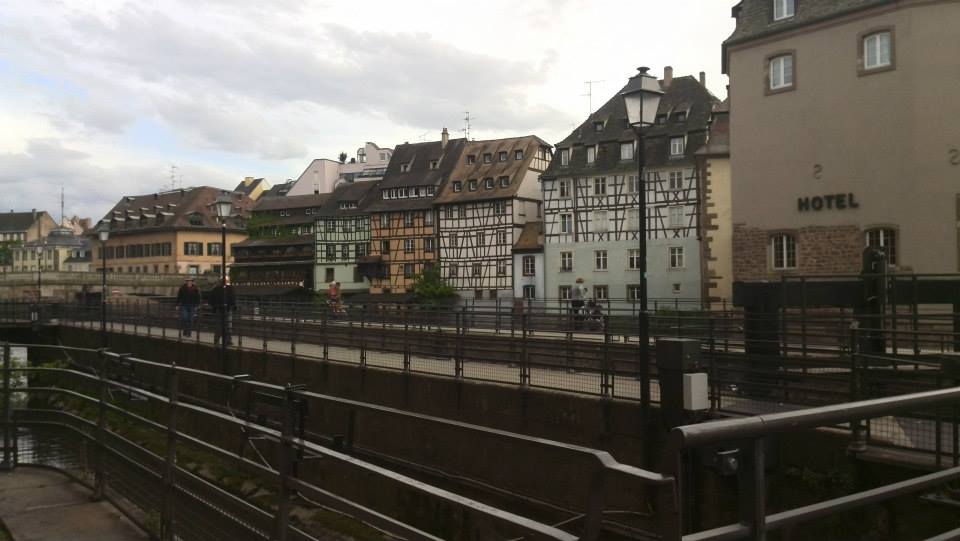
The Grande-Ile, the heart of Strasbourg’s old town, was designated a UNESCO World Heritage site in 1988. Many of the buildings first erected in the medieval and early modern periods are still standing there today. Photo by the author.
The
city of Strasbourg is of particular interest to scholars of early
Anabaptist history, both for the number and diversity of Anabaptists
it attracted and the relatively mild punishments Anabaptists and
other religious dissenters faced there. While Strasbourg’s
Anabaptists alone numbered as many as 2000 in 1530—a substantial
minority of the city’s population—only two Reformation-era
non-conformists received a death sentence from Strasbourg’s
magistrates: Claus Frey, who practiced bigamy, and Thomas Salzmann,
who called Christ an imposter.2
As the spiritualist chronicler Sebastian Franck put it, “he whom
one hangs elsewhere, one drives out of Strasbourg with rods.”3
While some scholars have attributed Strasbourg’s relative tolerance
for dissent to the irenicism of its reformers—and Martin Bucer,
Wolfgang Capito, and Mathis Zell were certainly less quick to burn
bridges than many of their contemporaries—Brady has argued
convincingly that the primary impetus for toleration came from
Strasbourg’s magistrates, who sought peace and order more than they
sought conformity.4
While few of the documents in the collection deal directly with
Anabaptists, the primary sources the Bradys donated shed light on the
inner workings of Strasbourg politics and the history of the city
leading up to and during the Reformation era, all of which helps to
illuminate the context in which so many sixteenth-century Anabaptists
managed to survive and even thrive to some extent.
The
majority of the microfilms in the collection contain copies of
documents housed in the Archives
de la ville et de l’Eurométropole de Strasbourg (the
Strasbourg municipal archives, which also house the Archives
de St. Thomas, dedicated
to Strasbourg church history), the Archives
départementales du Bas-Rhin
(the regional archives for the Lower Rhine), and the Bibliothèque
nationale et universitaire de Strasbourg
(the Strasbourg university library, which houses a substantial
collection of premodern manuscripts and rare books). Other microfilms
include copies of documents from a number of other European and North
American libraries and archives, including the Bibliothèque
nationale in
Paris, the Weimar
Staatsarchiv,
the Danish Royal Library, the Newberry Library, and the Harvard
University Library. The contents of these documents include multiple
late medieval and early modern chronicles of Strasbourg history,
large amounts of sixteenth-century correspondence from Strasbourg’s
Reformation-era political and religious leaders (including the entire
Thesaurus
Baumianus,
a collection of nineteenth-century copies of the Strasbourg
reformers’ correspondence), sixteenth-century notes from Strasbourg
Senate meetings (particularly focused on the years of the
Schmalkaldic War), and many other treasures. For scholars interested
in Reformation-era religion and politics, the collection promises to
yield the raw material for several fascinating projects.
Among Professor Brady’s best-known books are Ruling Class, Regime, and Reformation at Strasbourg, 1520-1555 (Leiden: Brill, 1978), Protestant Politics: Jacob Sturm (1489-1553) and the German Reformation (Atlantic Highlands, N.J., 1995), and German Histories in the Age of Reformations, 1400-1650 (Cambridge: Cambridge University Press, 2009).↩
John David Derksen, From radicals to survivors: Strasbourg’s religious nonconformists over two generations, 1525-1570 (Goy-Houten, Netherlands: Hes & de Graaf Pub., 2002), 53; Camill Gerbert, Geschichte der Strassburger Sectenbewegung zur Zeit der Reformation, 1524-1534 (Strasbourg: Heitz & Mundel, 1889), ix. ↩
Cited in Bodo Brinkman and Berthold Hinz, Hexenlust und Sündenfall: Die Seltsamen Phantasien des Hans Baldung Grien (Petersberg: Imhof, 2007), 181.↩
William Yoder (Gvardeysk/Moscow) and Dr. Lawrence Klippenstein (Winnipeg)
Introduction
The Chortitza and Molotschna Mennonite settlements in New Russia became the so-called ”mother colonies” of all the subsequent settlements in New Russia (later Ukraine). Their total population by the end of WWI is said to have reached about 110,000. They spread out widely in Central and southern Russia and began to look elsewhere in the search for more land.
They did not begin to settle in western Siberia until 1897. The first to do so, as far as we know, was the J. J. Hildebrand family who moved to Omsk in that year. They founded an agricultural machinery business there. Families seeking land for farming then followed and to make a long story short, began to establish settlements westward from Omsk along both sides, north and south, of the Trans-Siberian Railway, and to the southeast somewhat in another cluster of villages that were at first oriented toward the old city of Barnaul, and then, settling east and south shifted their attention more to the much closer and newer city of Slavgorod located on a southward stretching spur of the Trans-Siberian Railway. A later expansion of these village settlements took some thousands of persons to an area on the north bank of the Amur River, around Blagoveschensk. A settlement at Pavlodar west of Slavgorod sprang up also.
Eventually, all these areas came under Soviet control also, but the villages of these larger communities remained relatively free of physical damage resulting from World War II. Hundreds of persons were forcibly resettled to northern prison and work camps during the war, with many dying there, and others managing to return to warmer southern communities. Some were reunited with their families on their return, with others were deprived of reunions.
In this process of resettling, many found themselves in Siberian and Central Asian new and former urban areas to attempt more permanent resettlement and community reorganization. One of the sites which acquired a large new congregation of Mennonites, with membership ultimately over four hundred was the city of Novosibirsk. Bernhard Sawatzky was an early pastor of this congregation in the 1970s. It belonged to the so-called kirchliche (lit. church) branch of the larger Soviet Mennonite body in the USSR.
Minister Willi Peters (1940-2016) Novosibirsk, Siberia
Right: Minister Willi Peters and his son Andrei with Ben Falk, MCC volunteer at Neudachino, Siberia (1993). Photo : Lawrence Klippenstein
Willi Peters was born in the Ukrainian Mennonite colony of Chortitza on April 30, 1940. Times were highly volatile, so Willi had little chance of growing up in Ukraine. After the massive German attack of June 22, 1941, an edict of the Supreme Soviet issued on August 28 that year decreed that all ethnic Germans in western USSR would be deported eastward away from the approaching Wehrmacht.
By 1942, the year after the German attack, Willi’s family found itself in Tayshet in Central Siberia. This city is a critical junction of the Trans-Siberian Railway 245 miles east of Krasnoyarsk. Willi’s father, Jakob, had been forced into the Trudarmee (forced labor camp) and consequently spent years as a logger in the forests of Tayshet region. However, the family was exceptionally fortunate in one respect: Jakob’s wife Maria, nee Toews, with their children, were allowed to live with him in Tayshet.
The family remained subject to the Soviet military regime ((kommandatura) until its dissolution in 1956. At that time the family was permitted to move southeast-ward to the industrial city of Angarsk, founded in 1948 near Irkutsk. It was there that young Willi received his education as an electrician. He remained an electrician for the rest of his life.
Willi’s future wife, Maria Gunther was also born in Chortitza in 1941. Her family was among the 313,000 Germans overtaken by the German army moving into the Soviet Union before they were evacuated eastward. Maria, along with her brothers and sisters then fled westward along with the Wehrmacht now retreating, in 1943-44. Maria’s father disappeared during WWII and was never found.
According to the agreements at Yalta signed early in 1945, the USSR was permitted after the war to repatriate former citizens of the USSR from refugee camps in Western Europe. The 200,000 ethnic Germans forced to return eastward included Maria’s and siblings who had been waiting in a refugee camp in Yugoslavia. Maria’s mother was then forced to eke out a subsistence living for herself and her children working as a maid for military officers in Berdsk, south of Novosibirsk.
By the late 1950s, the Mennonites of Central Siberia knew the whereabouts of many members of their faith in the region. In the early 1960s, Willi Peters began a search for a spouse and ended up making repeated treks to Berdsk. Willi and Maria married in October of 1967; the couple immediately moved back east to Angarsk. Their three children were born there: Anna in 1967, Andrei (Heinrich) in 1970 and Katarina in 1974.
For Mennonites Angarsk had only house gatherings where they could worship, so the family chose to move to Berdsk in 1976. Almost immediately the Peters joined the large Mennonite congregation meeting in a renovated private house at Ulitsa Proyektnaya 13 on the western fringe of Novosibirsk. Here the minister at the time was Bernhard Sawatzky (savadskii). The congregation registered since 1967, had nearly four hundred members meeting in its chapel. The group was connected to forty smaller gatherings in Tomsk, Berdsk, Barnaul, and other sites throughout the region.
Church services in Novosibirsk took place on Wednesdays, Saturdays, and Sundays. Mennonite Brethren congregations were strong to the west of Omsk, but Novosibirsk was by far the largest gathering of kirchliche (lit. church) Mennonites in the area.
Willi first became involved in the congregation by singing bass in the Novosibirsk choir, with his son Andrei joining in 1983. After the choir director’s emigration westward in 1988, Jakob Dirksen succeeded him as leading minister, in Novosibirsk. However, the emigration to Germany had been in high gear since 1986, and Dirksen who already perched on packed suitcases accepted his new calling with reluctance. However, after Dirksen’s departure in early 1990, fifty-year-old Willi Peters was ordained and commissioned as the new leading minister in May. Since Willi had only begun preaching in 1986 and had not previously served as a minister, his appointment was not entirely without dissent.
Why did Willi and Maria not join the trek westward? “We saw staying as God’s calling,” Andrei explained briefly. “My parents were convinced that we had been called to remain here and serve others who had not left. We were not called to be where life was most comfortable, but where God wishes to use us.” Andrei believed that his father was called because of his wide acceptance as a convinced Christian. He thought it was easy for his father to get close to his people. He was a gifted counselor and knew how to converse with people. People felt the love of God in presence, Andrei pointed out.
Retired seminary professor Walter Sawatsky has noted that ninety percent of Russia’s Mennonites, roughly one hundred thousand persons, moved to Germany during the last great exodus. The movement was a nearly fatal blow for an ongoing Mennonite presence in Russia. Sawatsky added at the same time that immigrants to Germany formed numerous relief/mission agencies and church associations for Russia, which became the primary Mennonite support lasting until present times.
Sawatsky noted further that Mennonite church bodies in Germany, the Netherlands, Canada, and MCC had long tried to walk alongside those who could not leave Russia. The Peters family had also served as a lightning rod drawing Mennonites who were seeking contact with brothers and sisters in Siberia.
Willi stopped working when his firm collapsed in 1990. After 1990, his family received support from family and church members who had left and settled in Bielefeld, Germany. He visited Germany several times after 1990. In January 1997, Willi made a most memorable trip when he and Nikolas Dueckman from the Evangelical /Mennonite Brethren congregation in Marianovka near Omsk, attended the Mennonite World Conference sessions in Calcutta, India.
When the Novosibirsk house caretaker moved to Germany in 2005, Willi, Maria, and Andrei had moved into the former church quarters. As of 2018 only daughter Katarina, who is single, remains in the family apartment in Berdsk. Anna and her two children have also moved from Berdsk to the Novosibirsk church home.
The end began to arrive for Willi when he suffered his first stroke. His son, Andrei, had been assisting him pastorally since 1997 and was consequently ordained as a second minister on September 29, 2000. Two additional strokes and a heart attack followed. Willi became less and less able to fulfill his ministerial duties. He continued to meet people in a friendly manner as he was able but passed away quite unexpectedly on April 20, 2016. After his funeral in Novosibirsk two days later, he was buried in Berdsk where his parents were also interred.
Through deaths and emigration, kirchliche Mennonite ministries have shrunk considerably in Siberia since 1990. Andrei continues to serve as leading pastor in the local congregation at Novosibirsk, also attempting at the same time to maintain with other smaller groups in Artyemsk, Barnaul, Grishevka, and Orsnyak.
The even smaller group in Neudachino lost its leading pastor, Gerhard Neufeld, when that entire family of two dozen or more persons moved to Germany also. This group remains independent, having virtually no contact with the Novosibirsk congregation, officially, and also does not relate significantly to the local Evangelical/Mennonite Brethren congregation. The sermons of the kirchliche remaining small group are read from a book by a member of the congregation.
That the entire Peters family should remain in Russia to carry on its life together and maintain their mission as found possible, is a very rare phenomenon. Willi’s sister (a second Maria Peters) and Maria’s sister, Anna Gunther, now reside in Bielefeld. A kirchliche Mennonite mission outreach ministry, directed from Bielefeld, remains active in the Orenburg area of the Urals region. Willi Peters’ devotion to his church, his Christian integrity, and sense of duty in good times and bad, and periods of illness and adversity, his refusal to abandon a Mennonite remnant of believers, remain the lasting testimony of his life.
A version of this story first appeared in the June 2019 issue of the Mennonite Historical Society of Alberta Chronicle. Learn about their work at mennonitehistory.org
Resources:
Harms, Wilmer A., ed. The Odyssey of Escapes from Russia: The Saga of Anna K (Hillsboro: KS , Hearth Publishing, 1998).
Klippenstein,
Lawrence. A series of articles on Mennonites in Siberia in
Mennonitische Post, 2011- 2013, Steinbach, Manitoba.
……
“The kirchliche Mennonites in the USSR,” Mennonite
Historian, Vol. V. December, 1979, 1-2, and Vol. VI, March,
1980, 2-3.
Rahn,
Peter, Mennoniten in der Umgebung von Omsk (Vancouver, B.C.:
by the author, 1975).
Savin,
A.I. and Paul Toews, comp. and ed. Ethno-Confession in the Soviet
State. Mennonites in Siberia, 1920 – 1989. Annotated List of
Archival Docunents. Translated by Olga Shmakina and Liudmyla
Kariaka (Moscow and Fresno: Russian Academy of Sciences and Center
for MB Studies, 2008).
Sawatsky,
Walter, “From Russian to Soviet Mennonites,” in John Friesen,
ed., Mennonites in Russia.1788-1988. Essays in Honour of Gerhard
Lohrenz (Winnipeg, MB: CMBC Publications, 1989), 299-339.
Yoder,
William, News releases from Moscow for the Evangelical Lutheran
Church, ca. 2000-2019. See especially release of news dated November
14, 2018.
This fall I’m teaching HIST 348: The Radical Reformation at Conrad Grebel University College. Given how much I’ve benefited from other instructors’ pedagogical transparency, in this post I’m sharing an early draft of the syllabus. As I describe here, the status of the “Radical Reformation” as a recognizable historical phenomenon and framework for research is a matter of current discussion. I intend to involve students in this debate in class, but have decided to center the course itself on early modern Anabaptists and Anabaptism. The course is twelve weeks long, and students meet twice a week for eighty minutes. The content and structure of the course reflects my intent to help students both master the subject matter and engage in tasks of historical investigation and interpretation. I welcome comments and suggestions.
Expected Learning Outcomes
At the conclusion of the course, students will be able to:
Identify questions that animate the scholarly study of early modern Anabaptism and pose their own
Assess the impact of context on the content of primary source evidence
Critically evaluate and compare the content of other historians’ written argumentation
Synthesize evidence from various sources of information about the past to produce a historical argument
Communicate original and persuasive historical interpretations in oral, written, and visual form
1. Secondary source scavenger hunt and analysis (1000 words)
Students will select two articles from the assigned essay collections (see course schedule below). They will identify the following elements related to the mechanics of scholarly writing: the author’s field and affiliation; the volume’s intended audience; the essay’s argument; the location and scope of the article’s literature review; and three pieces of primary source evidence. The analytical portion of their essay will address the authors’ approaches to the question of “radicality” in relation to their historical subjects.
2. Primary source analysis (1000 words)
Students will select a pair of primary sources with a theological focus from distinct regions, time periods, or Anabaptist writers/groups (I will provide a list of source pairings). In their essays, students will (1) contextualize the sources, (2) describe their contents, and (3) formulate a conclusion about Anabaptist theological commonalities and differences, using chapter eight from Snyder (1997) as a framework for comparison.
3. Additional syllabus unit (3 pages)
Students will create an additional unit for the course syllabus, which includes a topic/theme, lecture/activity outlines, and reading(s). The scholarship on which this unit is based will have been published in the last ten years. Students will include a one-page reflection in which they explain their choices.
Final: Timeline JS Assignment (25%)
Students will select a course topic (theme, theological position, or Anabaptist group or figure) and create a visual representation of 10-12 related historical developments using the open source tool Timeline JS. In addition, they will submit a three-page essay in which they explain the significance of the events they have selected and explore the interpretive implications of their work. The purpose of this summative exercise is to lead students to make an argument about the meaning of continuity and/or change over time in relation to the historical subject they have selected.
Course Texts
C. Arnold Snyder, Anabaptist History and Theology: Revised Student Edition (1997)
Other readings listed in course schedule below
Course Schedule
I. Origins
1. Introduction
Sept. 5 – Presentation of course themes
2. Context
Sept. 10 – Late Medieval European Religion
Reading: Snyder, Anabaptist History and Theology, chapters 1 and 2
Sept. 12 – The Reformation, 1517-1525
Reading: Snyder, Anabaptist History and Theology, chapter 3, 4, and 5
3. Polygenesis
Sept. 17 – Origin Stories: South
Reading: Snyder, Anabaptist History and Theology, chapter 6 and 7
Sept. 19 – Origin Stories: North
Reading: Snyder, Anabaptist History and Theology, chapter 11
4. Spread and Development
Sept. 24 – Persecution, Migration, and Missions
Reading: Martin Rothkegel, “Pilgram Marpeck and the Fellows of the Covenant: The Short and Fragmentary History of the Rise and Decline of an Anabaptist Denominational Network,” Mennonite Quarterly Review 85, no. 1 (2011): 7-36
Sept. 26 – Conversion
Reading: “Hans Fischer Responds to Questioning (1548),” in C. Arnold Snyder (ed.), Later Writings of the Swiss Anabaptists, 1529-1592 (2017), 57-67.
5. Historiographical Workshop #1: A “Radical Reformation”?
Oct. 1 – Definitions of Reformation Radicalism
Readings: student selections from Bridget Heal and Anorthe Kremers (eds.), Radicalism and Dissent in the World of Protestant Reform (2017) and James M. Stayer and John D. Roth (eds.), A Companion to Anabaptism and Spiritualism (2007)
Oct. 3 – Conversation with Invited Guest
II. Anabaptist Religious Cultures
6. Authority and Gender
Oct. 8 – Scripture, Prophesy, and Communal Practice and Belief
Readings: “Margret Hottinger of Zollikon” and “Ursula Jost and Barbara Rebstock of Strasbourg,” in C. Arnold Snyder and Linda A. Huebert Hecht, Profiles of Anabaptist Women (1996), 43-53 and 273-87
Oct. 10 – Courtship and Marriage
Lyndal Roper, “Sexual Utopianism in the German Reformation,” Journal of Ecclesiastical History 42, no. 3 (1991): 394-418
Oct. 22 – Münster
7. Communication
Oct. 24 – Orality and the Written Word
Reading: Snyder, Anabaptist History and Theology, chapter 9
8. Historiographical Workshop #2: “Anabaptist Theological Divergences and Commonalities”
Oct. 29 – A Common Anabaptist Theological Core?
Readings: Snyder, Anabaptist History and Theology, chapter 8; selected primary source pairings
Oct. 31 – Conversation with Invited Guest
9. Anabaptist Minorities in Conflict and Coexistence
Nov. 5 – Swiss Brethren
Reading: “Strasbourg Discipline,” in Snyder (ed.), Later Writings,92-99
Nov. 7 – Dutch Mennonites
Reading: Piet Visser, “Mennonites and Doopsgezinden in the Netherlands, 1535-1700,” in Stayer and Roth, 299-345
10. Identity Formation
Nov. 12 – Hymns and Martyr Stories
Readings: Ausbund,number 17; Erin Lambert, “Friction in the Archives: Storytelling in Sixteenth-Century Anabaptism,” Renaissance and Reformation/Renaissance et Réforme 41, no. 2 (2018): 113-138
Nov. 14 – Transnational Disputes and Convergences
Reading: Troy Osborne, “The Development of a Transnational ‘Mennonite’ Identity among Swiss Brethren and Dutch Doopsgezinden in the Sixteenth and Seventeenth Centuries,” Mennonite Quarterly Review 88, no. 2 (2014): 195-218
Reading: Snyder, Anabaptist History and Theology, appendix
Nov. 21 – New Approaches
Readings: Mathilde Monge, “Research Note: Who Is in the ‘Society of Christian Brothers’? Anabaptist Identity in Sixteenth-Century Cologne,” Mennonite Quarterly Review 82, no. 3 (2008): 603-614; Kat Hill, Baptism, Brotherhood, and Belief in Reformation Germany: Anabaptism and Lutheranism, 1525-1585 (2015), chapters 5 and 6
12. Continuing Anabaptist Tradition
Nov. 26 – Genealogies: Visit to “Growing Family” Exhibition at the Mennonite Archives of Ontario, Conrad Grebel University College
Nov. 28 – Global Anabaptisms
Reading: Felipe Hinojosa, Latino Mennonites: Civil Rights, Faith, and Evangelical Culture (2014), chapter 5
An important set of sources for understanding Anabaptism in Emden are the Kirchenrat records, which were edited by Heinz Schilling in the 1980s. Though the Kirchenrat itself was established in 1544, the records did not begin for another decade due to the interruption of the Interim.1 Looking for inhabitants called before the consistory and labelled as some variation of “Täufer,” we can identify Reformed community members flirting with marginal beliefs and navigating life in Emden as it assumed its full height as a refugee city. These records begin after the rapid expansion of the city in the mid-1550s, following the influx of Dutch Calvinist refugees, and demonstrate a need to police the edges of the reformed community–precisely because there were a variety of nonconforming believers in the city.2
A few examples will give texture to this source. Johan van Bellen first appeared in the records on 15 November 1557. Subjected to instruction regarding his nonconforming beliefs, the “doepers” were identified as a source of these errors.3 Moreover, and incriminatingly, he had at least three unbaptized children. Van Bellen was something of a troublemaker; he recurred repeatedly in the records of the consistory, and was admonished for both his beliefs and actions.4 Though he was not always identified as holding Anabaptist sympathies, he was clearly an outsider – and he expressed this in a rare bit of direct speech: “So Menno Simons’ sect does not want me and you do not want me and the papists do not want me . . . ”5 Lacking any true institutional affiliations, he was brought before the consistory in an attempt to bring his religious and lifestyle choices under the aegis of a stabilizing authority.
It
is important to note that the consistory differentiated between
generalized “Anabaptists” and those Mennonites, Jorists and
others who were identifiable as belonging to a particular
nonconformist community. On 26 July 1557, we see concern that one
Severin Koperslager belonged to what must have been a small but
persistent community of Jorists.6
Because David Joris himself, or some of his followers, had taken to
announcing the coming of the “third David” by the later 1540s,
the accusation was that Severin “knew another savior.” Severin is
thus forced to gainsay David Joris and denounce him as a “spirit of
the devil.” Most interestingly, however, no mention is made of
“Anabaptists” or baptism at all, suggesting some separation
between a larger understanding of Anabaptism and these individual
charismatic groups. There are two later references to suspected
Jorists; one mentioned as a “Davidiorismo” in February of 1559,
and one who may be a papist or a libertine or belong to
the “David-Joris” group.7
Again, neither of these accusations accompany anything like a
denunciation of Anabaptism, and suggest a separate category has
formed for the purposes of communal discipline.
In
March of 1559, the two groups arose in conversation during the same
day of consistory testimony8
In a discussion about bookbinding and publishing, Cornelis Benninck
mentioned the need to address Mennonite writing in Holland, while
Adrianus de Kuper presented two pamphlets he wrote against “de
wederdopers.” Though representatives of these groups were not
present to defend themselves, the separation of one from another
seems significant. That the consistory would attempt to limit
Mennonite publishing or publish treatises against marginalized
beliefs is not surprising, but the careful deployment of these
contested categories seems significant for decision making within the
Reformed church court system.
These few pieces of the Kirchenratsprotokolle, then, might be read as
merely the continuation of an increasingly sophisticated deployment
of terms. The church council both took up and further populated the
categories which we have seen in the official correspondences of the
1530s and 1540s, and it is certainly worth further study to determine
how discourses between secular and religious authorities intertwined
during this period. Yet the development of these distinctive
categories proved operational for the Emden Kirchenrat, who
associated particular beliefs or behaviors with certain Anabaptist
groups and treated suspected individuals accordingly. That the church
council found these categories to be meaningfully different may
reflect a more intimate knowledge of these groups, or perhaps an
increasingly codified understanding of exactly who these groups
contained and what these groups believed. The creation of categories
became useable knowledge, and altered the lives of individual
nonconformists when authorities began to differentiate rehabilitation
and punishment accordingly.
Heinz Schilling, “Einleitung” in Die Kirchenratsprotokolle der reformierten Gemeinde Emden 1557-1620, Vol. 1 (Vienna: Heinz Böhlau, 1989), xviii-xix. Hereafter KRP. ↩
A 2001 article by Samme Zijlstra examined some Anabaptists and spiritualists who came before the consistory, and focused on the theological differences that motivated conversions between members of the dominant Reformed church and these smaller, marginalized communities; Samme Zijlstra, “Anabaptists, Spiritualists, and the Reformed Church in East Frisia,” in Mennonite Quarterly Review (Jan. 2001, Vol 75:1), 57-73. ↩

 Anabaptist Historians