When Master’s Theses Go Bad: Thoughts on Mennonite Exceptionalism and Self-Revisionism

A few years back, when I was a young PhD student, I went to one of my professors for advice. How could I turn some of my languishing seminar papers into publications? Particularly papers on Mennonites? My professor, himself a well-known historian of immigration and Jewish life, gave me this advice: when dealing with ethnic groups or subcultures you can emphasize difference from mainstream society or you can place them in the larger American story. He preferred the latter approach.

This advice percolated in my brain for a few years. It eventually helped me re-examine an earlier master’s thesis on Mennonite involvement in the antiwar movement during Vietnam. I had gone the route of emphasizing difference, rather than a story within a story, and in doing so I had missed something important– both about Mennonites and about the antiwar movement.

The thesis title, “Doves of a Different Feather: Mennonites and the Antiwar Movement During Vietnam,” symbolizes my approach. To quote from the thesis intro (italics not in the original):

The church issues in the 1960s were complex. There was debate on the issues of war, peace, and church-state relationships, a debate that would surround those Mennonites who engaged in antiwar activities. These Mennonites did share characteristics of the larger antiwar movement but, at heart, they cannot be described as a microcosm of that group. Instead, they are best understood within the context of their specific religious community.

Mennonites were a part of the national antiwar movement but they were also a part of a specific ethno-religious community. Some embraced this community, some challenged it, but overall, Mennonite activists engaged with it. Their opposition to the war, therefore, was a form of speaking to the United States government but also to their own community.1

Part of this thesis is fine. Mennonites who protested the Vietnam War did speak to both government and their own community. But this does not mean that Mennonites are best understood apart from the rest of the antiwar movement.

My thesis had focused on Eastern Mennonite College (now University) and Goshen College antiwar activity. I found examples of antiwar students who were hesitant to identify too closely with the larger antiwar movement. One EMC student wrote about attending a 1969 peace march in Washington, D.C. and explained that he felt “out of place” until the EMC group found other Mennonites at the rally. They linked arms, “mainly to let those who saw us know we had a unique reason for marching.”2 Others showed similar sentiment discussing draft resistance. Some antiwar students supported those who refused to cooperate with the Selective Service System but hesitated about secular draft resisters and a praised Mennonite draft resisters as different. A Goshen College student compared draft resisters to a “tornado” while claiming conscientious objectors had “stable, religious grounds” for their refusal to participate in war. Another Goshen student also criticized non-Mennonite draft resisters, calling them “starry-eyed” and vague. However, he agreed with them on the “terrible injustice of war.”3

Comments like these lead me to the conclusion that many Mennonites who protested the war saw themselves as doves of a different feather—in, but not of, the antiwar movement. But I was too quick to take the students at their own word. More than a decade later, much more fully immersed in the history of the antiwar movement, I see things differently (for more on my work on the 1960s—unrelated to Mennonite history—see here).

Considering the antiwar movement in all its diversity, Mennonite students appear more typical than not of peace activists. In the words of historian Charles DeBenedetti, the antiwar movement was “local and ephemeral.”4 Although images of student radicalism and confrontation dominated news coverage, recent scholarship has stressed the diversity of antiwar activists. Whether they acted as mothers, religious figures, or members of ethnic groups, activists nationwide often filtered their antiwar activism through local concerns or specific group identities. This is precisely what gave the movement its broad power—and its struggles with strategy and unity.5 The movement was filled with doves of different feathers. Mennonite activists were not so exceptional in this. Furthermore, some activists’ suspicions about the broader movement reflect key ways in which Mennonites were not unique from their non-Mennonite neighbors.

Sociologist Todd Gitlin has demonstrated that media coverage of antiwar protest was deeply problematic. Reporters depicted the movement as potentially subversive or, paradoxically, ineffective and trivial. Journalists privileged stories with conflict and violence, often focusing on action above ideas and issues. Gitlin argues this encouraged activists to plan ever more dramatic protests and meant that protests that did not involve confrontation failed to reach the eyes of many Americans.6 Gitlin does not blame media coverage for the antiwar movement’s image problems. The movement, he argues, made several of its own mistakes. However, he illustrates some of the very real limitations set up by this coverage.7

The Mennonite student activists who were wary of the larger movement show how much impact media could have, even on those critical of the war. These students defined themselves apart from the movement, perhaps because they did not recognize their own preferred methods of nonviolence and moderation as truly belonging to the movement. And yet, Mennonite students were hardly alone in their preference for a firmly nonviolent movement over the highly visible, but not universally embraced, turn to confrontation that came at the end of the 1960s.8

Mennonites were also not unique in a desire to relate antiwar activism to one’s home community. Historian Lorena Oropeza has described the way Mexican-Americans’ antiwar views became intertwined with the growing Chicano movement. Chicano antiwar leaders valued having their own organizations, separate from the rest of the antiwar movement. They worked with the broader movement but they also wanted space where the concerns and voices of their own community could flourish.9 Likewise, African Americans critiqued the war, arguing that African American men were more likely to be drafted and arguing that they should not have to fight abroad for a nation that denied them equal rights at home. Historian Simon Hall has noted a paradox: that African Americans were the group in America most critical of the war and yet largely absent from the antiwar movement, at least at a grassroots level.10

Many African Americans feared that joining forces with the peace movement would blunt their analysis of the way racial issues at home related to the war abroad. Some African Americans called for a black-led antiwar organization, as a way to take part in the movement without fear of being engulfed by it, but this never materialized. African Americans may not have joined antiwar organizations or events but they continued to address the war from within civil rights and black power groups. They were a part of the movement, but highly conscious of retaining a distinct identity within it.11

Beyond the experiences of racial and ethnic groups, Women Strike for Peace, one of the most active antiwar groups, couched their activism in what historian Amy Swerdlow has termed “maternalist” terms. They emphasized acting as women, “in service of others”—their sons at risk of the draft and the children injured in Vietnam. In doing so, they encouraged a more mainstream image of antiwar work, hoping to appeal to any American woman.12

In the American South, antiwar students tried to use southern identity to galvanize others. They encouraged southerners to “secede” from America over the war, hoping to capitalize on positive associations with a rebel image to inspire antiwar work. This tactic did not necessarily work—indeed it alienated many African Americans—but it was yet another attempt to draw on a specific group identity in protesting the war, as well as an example of seeking to transform a cultural value.13

Vietnam veterans would also form an important bloc of protesters, organizing in groups like Vietnam Veterans Against the War (VVAW). They, too, felt they had a unique perspective and reason for protesting. VVAW became yet another group that was distinct within the movement, yet integral to the cause, providing some of the most compelling testimony against the war.14

Mennonites shared another feature of the antiwar movement: intra-generational conflict. While the stereotype of the 1960s is that campuses were alight with protest this was not always the case. Antiwar student activism often involved a band of dedicated few, facing hostilities from other students and drawing on antiwar faculty for support.15 This was the case for Mennonite campuses where faculty members were often more supportive of student protest than other students. Goshen College professors like J. R. Burkholder, Dan Hess, Dan Leatherman, and Atlee Beechy were integral to antiwar work.16 Professors at EMC also defended students involved in peace vigils, cautioning in the campus newspaper that the Mennonite mentality of “die Stillen im Lande,” or being “the quiet in the land” could lead to terrible atrocities, citing the example of Nazi Germany as a situation when being quiet made ordinary people complicit in government violence.17 These faculty were part of a new interpretation of the peace position, one that questioned obedience to the state and looked for ways to make pacifism active.18 In the meantime, many students still interpreted Mennonite pacifism to preclude protest. In the words of an EMC student, critical of draft card burning in 1965, “. . . Let’s give Uncle Sam his due place in our society…While our citizenship is not in this world, we must serve our nation.”19

In the 1960s Mennonites were reconfiguring pacifism and this does make their story during the Vietnam years unique in some ways. But the ways Mennonites were not unique also matter. When I first took Mennonite expressions of exceptionalism at face value I contributed to two problems: over-simplification of the antiwar movement and romanticization of Mennonite sub-culture.

The story of the 1960s has too often been told as one of movements for social justice that started with the highest ideals, only to come crashing down in a haze of hedonism, violence, and excess by the end of the decade. Historians have been reassessing this narrative for a long time. Moving the spotlight away from students at elite universities, 1960s activism appears more complex, involving many types of people, often lasting well into the 1970s and having a constructive impact on communities. The antiwar movement was more flexible, broad, and diverse than memory has it. Acknowledging this makes the Mennonite story less unique.

Reframing my observations also avoids romanticizing Mennonite sub-culture. American Mennonites are, after all, Americans. In the 1960s they shared many characteristics with other Americans, including support for a war against communism, distrust of the antiwar movement, and susceptibility to negative news media framing of the antiwar movement. There are times to emphasize what is unique about Mennonites, but that should not distract from the ways that Mennonites are shaped by being American.

History is a process of constant revision. Usually this means scholars revise the interpretations of other scholars. But sometimes we need to revise ourselves—and speak more openly about how and why our own interpretations shift.


  1.  Holly Scott, “Doves of a Different Feather: Mennonites and the Antiwar Movement During Vietnam,” (MA thesis, Penn State Harrisburg, 2006). 
  2.  Mel Lehman, “The March, The Ball, The Man,” Weather Vane, January 24, 1969, p. 1 
  3. “The Draft. . .” >The Record, February 23, 1968, p. 4. 
  4. Charles DeBenedetti, An American Ordeal: The Antiwar Movement of the Vietnam Era (Syracuse: Syracuse University Press, 1990), 1-2. 
  5. DeBenedetti argues that because the movement was so broad it was able to penetrate almost all aspects of American life, making it a very impactful movement culturally. However, he notes this loose coalition also made it difficult to strategize or clearly assess political gains made. 
  6. Todd Gitlin, The Whole World is Watching: Mass Media and the Making and Unmaking of the New Left (Berkeley: University of California Press, 2003). Edward Morgan, What Really Happened to the 1960s: How Mass Media Culture Failed American Democracy (Lawrence: University Press of Kansas, 2010), makes similar arguments. 
  7. Gitlin, The Whole World is Watching
  8. See Kenneth Heineman Campus Wars: The Peace Movement at American State Universities in the Vietnam Era (New York: New York University Press, 1993) for an examination of the diversity within the movement. See also Robert Cohen, Freedom’s Orator: Mario Savio and the Radical Legacy of the 1960s (New York: University Press, 2009), and Todd Gitlin, The Sixties: Years of Hope, Days of Rage (New York: Bantam Books, 1993), particularly at 388-415. Gitlin notes the large number of student activists who felt no affinity with increasing radicalization and turn to violence at the end of the decade; indeed he faults the turn to violence in groups like SDS with destroying the antiwar movement. Most members did not want to be part of this turn and thus, losing their institutional home, were cast adrift. 
  9. Lorena Oropeza, ¡Raza Si! Guerra No! Chicano Protest and Patriotism During the Vietnam War Era (Berkeley: University of California Press, 2005). 
  10. Simon Hall, Peace and Freedom: The Civil Rights and Antiwar Movements in the 1960s (Philadelphia: University of Pennsylvania Press, 2005). 
  11. Hall, 1-12, 70-71, 128-129. 
  12. Amy Swerdlow, Women Strike for Peace: Traditional Motherhood and Radical Politics in the 1960s (Chicago: University of Chicago Press, 1993). 
  13. See Jeffrey Turner, Sitting In and Speaking Out: Student Movements in the American South 1960-1970 (Athens: University of Georgia Press, 2010). Even the student power approach to antiwar work can be seen as part of the trend to organize from within a set identity. See Robbie Lieberman, ed. Prairie Power: Voices of 1960s Midwestern Student Protest (Columbia: University of Missouri Press, 2004). The oral histories she collected demonstrate how antiwar activists at conservative campuses were able to make common cause with students around issues they all agreed on—the need for more student rights. This created what were sometimes strange bedfellows, as activists made alliances with fraternities in working on student rights issues. They hoped sharing an identity as students could help to bring these other students into the larger movement. 
  14.  Richard Stacewicz, ed. Winter Soldiers: An Oral History of the Vietnam Veterans Against the War (New York: Twayne Publishers, 1997). See also Jerry Lembck, The Spitting Image: Myth, Memory and the Legacy of Vietnam (New York: New York University Press, 1998). 
  15. An excellent treatment of this topic is Heineman, Campus Wars. A similar portrait of campus protest can be found in Lieberman, Prairie Power: Voices of 1960s Midwestern Student Protest and Rebecca Klatch, A Generation Divided: the New Left, the New Right and the 1960s (Berkeley: University of California Press, 1999). Klatch’s work details the way the baby boom generation is significant not only for shaping the New Left but also for providing many of the leaders of a New Right, thus placing intra-generational conflict at the heart of the story of the 1960s. 
  16. Doug Baker, interview by author, October 7, 2006 and Matthew Lind, interview by author, October 2, 2006. Sam Steiner, email to author, December 13, 2006 and J.R. Burkholder, interview by author, September 22, 2006. 
  17. Quote in “Reverberations,” Weather Vane, February 24, 1967, p. 3. See also Grant Stoltzfus, March 4, 1968, Opinion Board 1967-68 and posting by Gerald Brunk, November 2, 1970, Opinion Board 1970-71. These professors voiced support for protest and warned that excessive fears of communism or charges that protest was a threat to law and order at home were misguided at best, potentially dangerous for democracy, at worst. Professor John Lapp also contributed to the discussion, challenging the campus to see student protesters as authentically embodying the Anabaptist nonconformity to the world. See “The Ironies of Change at EMC,” John A. Lapp, posted April 17, 1967, Opinion Board file 1966-67 and “Beyond Irony or Living with Irony?” John A. Lapp, April 19, 1967, Opinion Board 1966-67. All Opinion Board files come from the archives of Eastern Mennonite University, Harrisonburg, VA. 
  18. For an examination of changing Mennonite peace theology see Perry Bush, Two Kingdoms, Two Loyalties: Mennonite Pacifism in Modern America (Baltimore: Johns Hopkins University Press, 1998) and Leo Driedger and Donald Kraybill, Mennonite Peacemaking: From Quietism to Activism (Scottdale, PA: Herald Press, 1994). 
  19. “The Draft: Our Worry?” Weather Vane, October 29, 1965, p. 2. 

An Anomalous Defense of Anabaptist Mobility

The Zurich government’s efforts to end the long-term presence of an Anabaptist minority in their territory in the late sixteenth and seventeenth centuries focused on the control of nonconformists’ physical mobility. The council’s anti-Anabaptist decrees, provoked in part by the movement of Hutterite missionaries in the city’s lands, obliged middling officials to collaborate in a project to segregate, enclose, or banish local dissidents from parishes across rural jurisdictions.1 Periodically, Anabaptist community members were barred from using the commons, incarcerated, or expelled. By imposing these sanctions, Swiss Reformed authorities joined governments across early modern Europe who saw in the restriction and control of movement a means to force members of religious minorities and other marginalized groups to conform.2 Their stated objective was the restoration of subjects’ obedience and communal wholeness. The violence inherent in this approach marked the everyday lives of Anabaptists living in the region over a period of decades. The more systematic implementation of this punitive regime in the 1630s and 1640s helped to permanently eliminate an Anabaptist religious culture from Zurich’s territory.

Plague Image

The burial of three victims of plague in the church yard of Zurich’s Grossmünster, 1582. From the chronicle of the Zurich canon Johann Jakob Wick, Zentralbibliothek Zürich, Handschriftenabteilung, Wickiana, Ms. F 30, Fol. 11r.

In this context, it is difficult to imagine that these same authorities would forward an argument in favor of the free movement of Anabaptists through imperial territory. Yet, in a November 1612 letter to Ernst Georg, the Duke of Hohenzollern residing in Krauchenweis, this is precisely what Zurich’s burgomasters and council did.3 This piece of incongruous reasoning stemmed from the arrest and incarceration of a group of five travelers traveling east between Mengen and Rüdlingen in the duke’s jurisdiction, among them one citizen and one subject of Zurich, one of them a barber surgeon, and three Anabaptist men from Moravia, who were journeying home.4 After being held for several days, the Swiss officials reported, the party’s members had been relieved of a significant sum of money, more than two hundred ducats, before being expelled from the German territory upon the swearing of an oath not to return. The travelers’ misfortune was regrettable, the Zurichers explained, because they had only had cause to traverse Ernst Georg’s lands after being summoned by the doctor Bastian Herber to aid in his efforts to treat victims of an outbreak of plague, which had devastated the city’s territory over the previous year.5 Herber—and, putatively, the assistants he had called for—had “behaved kindly towards us,” using his God-given medical arts and enduring great personal danger. His collaborators were now returning home along a familiar route connecting Zurich and Moravia, carrying with them significant monies bequeathed to them by grateful patients.

The letter’s authors expressed some understanding for the punitive instincts of the duke’s agents. The Swiss officials themselves had been dismayed when circumstances had forced them to welcome wrong-believing adherents of Anabaptism into their territory, where they were not usually tolerated. They also knew the content of the Constitutiones of the Holy Roman Empire, under whose stipulations they assumed that the travelers had been detained and relieved of their possessions. Nevertheless, under the same legal code, the officials contended, if an Anabaptist were to pass through a German territory without spreading error, without coercing those with whom he came into contact, without transporting his property, while remaining quiet (sich still haltend), there was no cause to judge him an evildoer. Under such conditions, even a Jew or Turk could not be treated as the travelers had been. Thus, the officials requested that the confiscated money be returned to the Anabaptists and sought assurances that citizens of Zurich would have no more reason to submit further grievances.

This curious episode warrants attention, first, because it provides yet more evidence of the deep integration of Anabaptists into professional networks of medical practitioners in Swiss territories.6 These networks included local nonconformists and those living well outside the region, whose reputation and ability warranted temporary toleration of their presence in Zurich during times of desperation. Long-distance connections within this network remained viable, it seems, because of the groundwork laid by Hutterite missionaries and Swiss migrants’ ongoing need to settle outstanding financial concerns.7

Second, this case shows that authorities had no obligation to restrict and control the mobility of nonconformists. A variety of options between hospitality and open hostility remained open to them. Under certain circumstances, officials drew on available legal resources to make countervailing arguments, even in an environment in which their coercive approach, and the justifications that buttressed it, appeared to have ossified. Repeated determinations to segregate, enclose, and expel were made deliberately, despite the variety of other paths open to the territory’s governors.


  1. See, for example, “Verbot des Täufertums (1585 [1612]),” in Zürcher Kirchenordnungen, 1520-1675, ed. Emidio Campi and Philip Wälchli (Zurich: Theologischer Verlag Zürich, 2011), 429-35. Astrid von Schlachta has argued that concerns raised by the activities of Moravian missionaries shaped the 1585 mandate. Hutterische Konfession und Tradition (1578-1619): Etabliertes Leben zwischen Ordnung und Ambivalenz (Mainz: Von Zabern, 2003), 352-53. 
  2. For a broader study of this phenomenon, see Nicholas Terpstra, Religious Refugees in the Early Modern World: An Alternative History of the Reformation (New York: Cambridge University Press, 2016). 
  3. The following account draws from this missive, found in Staatsarchiv Zurich, B IV 71, 519-22. 
  4. Leonhart Rützensdorffer was the citizen of Zurich and Conrad Bentz, from the Rumstal west of Winterthur, the city’s subject. The scribe did not record the names of the Anabaptist travelers. It is possible that the party included a man referred to as “one of our doctors” in the Hutterite Chronicle. The Chronicle reports that in 1612 an unnamed medical practitioner “had been in the city of Zurich and Swabia for over a year. God had blessed his work, and he had rendered good service to many prominent people with his medicines, especially during the epidemic in Zurich when eight thousand people died within a short time.” The Chronicle of the Hutterian Brethren, Volume I, ed. and trans. Hutterian Brethren (Rifton, N.Y.: Plough Publishing House, 1987), 598. 
  5. Otto Sigg’s study of records from the rural parish of Ossigen in Zurich’s lowlands suggests that between 35-44% of the population perished in the twelve months preceding the authorities’ letter. “Die drei Pestzüge in Ossingen, 1611/12, 1629/30 und 1636,” Zürcher Taschenbuch 99 (1979): 107. 
  6. For more on this phenomenon, see Hanspeter Jecker, “Im Spannungsfeld von Separation, Partizipation und Kooperation: Wie täuferische Wundärtze, Hebammen und Arzneyer das ‘Wohl der Stadt’ suchten,” Mennonitica Helvetica 39 (2016): 21-33; Roland Senn, “Wer war (Hans) Jacob Boll? Die Geschichte Zweier Täufer aus Stein am Rhein,” Mennonitica Helvetica 37 (2015): 11-44. 
  7. Given the location of the travelers’ arrest, it is likely that they were following a path well-established by Hutterite missionaries and the hundreds of migrants they recruited in Zurich’s territory. Travelers left Zurich’s territory through the northern lowlands, skirted Schaffhausen to the east, walked overland to Ulm, and then contracted water transportation downriver on the Danube. For more on this route, see von Schlachta, Hutterische Konfession, 355-56. Long after they left for Moravia, Swiss migrants returned to Zurich to address outstanding debts and claim inheritance. The Chronicle’s account of Hutterite participation in the provision of medical care highlights the fact that, because of their doctors’ faithful service to the Swiss citizenry, “the lords at Zurich [allowed] more than usual of the money inherited [by the brothers from Switzerland] to go out of the country to the church [in Moravia].” Chronicle, 598. 

Ministers of the Eastern District of the General Conference Mennonite Church, 1898

Image

2

Ministers of the Eastern District of the General Conference Mennonite Church, during a conference session at the Springfield meetinghouse near Coopersburg, Pennsylvania, in 1898.  While the Eastern District never printed rules for attire, ministers wore distinct garb into the late nineteenth century. Picture from left to right are Levi Schimmel, Silas Grubb, Harvey Clymer, Augustus Shuhart (layman), Jacob Moyer, Andrew Shelly, Anthony Shelly, William Gottshall, Allen Fretz, and Nathaniel Grubb.

Forrest Moyer Moyer, Archivist, Mennonite Heritage Center

Selections from the Visions of Lienhard Jost

The survival of the visions of the Strasbourg prophetess Ursula Jost (or rather, the first edition from 1530) has long been known to scholars of sixteenth-century Anabaptist history. Klaus Deppermann, in his 1979 biography of Melchior Hoffman, devoted several pages to the Strasbourg prophets and Ursula visions, and Lois Barrett’s 1992 PhD dissertation examined Ursula’s visions in greater detail and translated them into English for the first time.[1] While Deppermann, Barrett, and other scholars of Anabaptism in Strasbourg were aware that Lienhard Jost had played a prominent role in the Melchiorite movement in Strasbourg and that Hoffman had printed an edition of his prophecies, they believed that those prophecies were no longer extant. Recently, however, Jonathan Green brought to the attention of the scholarly community the survival of an edition of Lienhard’s prophecies (together with a second edition of Ursula’s visions) at the Austrian National Library in Vienna.[2] The edition, printed by the Deventer printer Albert Paffraet, who also printed the works of David Joris, offers a wealth of new information on Lienhard Jost. [3]

While Ursula’s visions offer only scant biographical details, Lienhard’s prophecies are related in an autobiographical format. The account focuses particularly on early 1523 (when Lienhard spent two months involuntarily hospitalized in Strasbourg, since the authorities believed him to be insane) and late 1525 (when Lienhard experienced a resurgence of prophetic revelations and attempted to prophesy publicly again and especially to convince the Strasbourg reformer Mathis Zell of his legitimacy).

Below are two chapters from Lienhard’s prophecies in English translation, both relating events from 1523. The third chapter recounts the events that led to Lienhard’s hospitalization (and calls to mind another infamous sixteenth-century Anabaptist episode, when seven men and five women—known collectively as the naaktlopers—ran naked through the streets of Amsterdam).[4] The nineteenth chapter takes place near the end of Lienhard’s confinement.

00000005

Title page of the 1532 edition of Lienhard’s visions.

The Third Chapter [5]

After I had shown this, as mentioned above, to the lords and leaders of the city of Strasbourg and passed on the message, in the night the glory of the Lord surrounded me one more time and spoke to me forcefully in my heart: Well, up! You must go there stark naked and unclothed. The Mord Glock must be rung before it is day.[6]

That same hour I had to wake, and I could not stay according to my preference. And I said to my wife: Ursula, I must go out stark naked, as I was told. When I came out onto the streets of Strasbourg in the open air, my arms immediately moved apart from each other and I went from there [so quickly] that I cannot know whether I remained on the ground or not.

That same hour my mouth opened and I had to speak and yell at the top of my voice: Murder upon murder! The child in its mother’s womb must and shall be terrified before the word of the Lord comes to pass. Murder once again! If the rulers and lords only know that their princely clothes will be removed from them before God and the world, that they might seek God again, they would all cry along with me: murder upon murder!

But after this the child in its mother’s womb will rejoice again and there will be much peace for all who have been sad.

In this midst of this aforementioned crying out I was snatched in this state, naked, and captured by my neighbours and handed off to the aforementioned city councillor Herrto Ludwig, and he handed me over to the hospital the next morning and recommended me to its overseer.


The Nineteenth Chapter[7]

This place shall have a bishop, so that he might observe the Lord’s supper. His eyes shall be sharp. He will carry around across the land the banner of godly righteousness and will faithfully teach the idle to work. And those little bees that he finds tired out from work he shall lead into the houses of God and there let them rest and feed them with the word of God. He will shield his little sheep from the approach of the rapacious wolf. Such a man is worthy to observe the Lord’s supper.

After this the glory of the Lord urged me to celebrate Mass and I was obedient and did this until [the point when] the Lord Jesus said with his disciples the word of thanksgiving, and, at the call of the glory of the Lord, I had to take the little pitcher and sing these words:

Holy holy holy is the day of our Lord Jesus Christ. Come to the table of our Lord Jesus Christ, which is made holy through Him.

Proclaim the death of our Lord Jesus Christ, who died for us. He has rescued us from eternal death, rejoice over this you children of Israel.

Rejoice, rejoice, and rejoice greatly. Savour the bread of our Lord Jesus Christ, that was given for us. Savour the blood of our Lord Jesus Christ, that was poured out for us.

In this speech I had to lift up the little pitcher above itself. Then the glory of the Lord opened itself in the little pitcher and swept over me and then my heart said: Is this the mirror of God? Then it was answered to me through the glory of the Lord.

I am a light for the children of God and food for the soul and way to the righteousness of the body.

I will feed in eternal life he who acts mercifully. But the mirror of God is man.

As you eat this bread, you should not pray to stone and wood, but you should bow before your rulers, who have been established for you by God.

But the mirror of God is man, who is next to you and around you. Look at this mirror from bottom to top, and so you will see that a master workman created you and him. You shall look after him and have mercy on him and, when you feed him, God will give you in your heart his free shield, so that you do not become a mirror of the world. As you act mercifully, God will lead you from one freedom into another, all the way to eternal life.

Those who were around me in the hospital chamber did not believe these things. Then the glory of the Lord said to me: you must perform a miracle for them. And they all looked at me to see what I would do. And I said: O God eternal Father, my doing and undertaking is nothing, but Your will be done. Then I had to take the little pitcher and turn it around and upside down, and no liquid ran out of it.

Then those who were around me answered all together: Now we see that you are a sorcerer, and Lucifer your father, and your power comes from the devil.

Then I said to them: if this power is from the devil, then why do I not speak his word? I have the Word of God, and you incite the word of the devil and his work, from one midnight to another. My words are from God and cause you pain, and your words that are from the devil cause me pain. If my power is from the devil, why do your words not please me?  Since I see that you do not want to believe me, I will not speak with you anymore until you speak with me.

Then began the woe and lament of those who were around and next to me in the hospital chamber, and they were greatly overwhelmed until the third day

On the third day one of them came to me and to my bed and said: Lienhard, when you are sad, we are also sad. How does this happen? Then I said, I already told you that you should let me do what I do. What I do and allow is not from me, but from God. When I go out from among you, out of this hospital and prison, you will all be glad.

But in these aforementioned three days I lay in such distress and agony as can scarcely be described.

And I also in those days noticeably felt the wounds on Christ in my hands and feet and side, and a tangible reminder (deckzeichen) was given to me on my right foot, and in this the glory of the Lord spoke through me to those who were around me: watch! This wine must now be spilled in the name of the Father and of the Son and of the Holy Ghost.[8]

And the glory of the Lord moved me, so that I had to spill the little pitcher of wine, with which I had held Mass and performed a miracle.

And I poured it onto my bed. Then the glory of the Lord said in me: this wine will flow across the width of the earth, and after this time all things will grow sufficiently. Wine, oil, and fruit will be sufficient. Then you will live in peace and you will lie in the sunshine, and there will be such an abundance of sufficiency that the grapes will hang over your mouths.

Then the time of the Lord will approach. Think on this: the Lord is not far away and will come to wake us from the dead and to save us.


Endnotes:

[1] Klaus Deppermann, Melchior Hoffman: Soziale Unruhen und Apokalyptische Visionen im Zeitalter der Reformation (Göttingen: Vandenhoeck & Ruprecht, 1979), 178-186; Lois Barrett, “Wreath of Glory: Ursula’s Prophetic Visions in the Context of Reformation and Revolt in Southwestern Germany, 1524-1530” (PhD diss., The Union Institute, 1992).

[2] Jonathan Green, “The Lost Book of the Strasbourg Prophets: Orality, Literacy, and Enactment in Lienhard Jost’s Visions,” The Sixteenth Century Journal 46:2 (Summer 2015): 313-330.

[3] On Paffraet, see Paul Valkema Blouw, “Printers to the ‘Arch-Heretic’ David Joris” in Dutch Typography in the Sixteenth Century: The Collected Works of Paul Valkema Blouw (Leiden: Brill, 2013), 508-509.

[4] On the Naaktlopers, see Samme Zijlstra, Om de Ware Gemeente en de Oude Gronden: Geschiedenis van de Dopersen in de Nederlanden, 1531-1675 (Hilversum: Uitgeverij Verloren, 2000), 135-136.

[5] Lienhard Jost, Ein Worhafftige Hohe und Feste Prophecey des Linhart Josten van Stroßburg, edited by Melchior Hoffman (Deventer: Albert Paffraet, 1532), fol. B3r. See also http://digital.onb.ac.at/OnbViewer/viewer.faces?doc=ABO_%2BZ169334206

[6] The Mord Glock was a silver bell in the Strasbourg cathedral used to warn the people of Strasbourg of crisis or sedition. See Philippe André Grandidier, Essais Topographiques et Historiques sur l’Église Cathédrale de Strasbourg (Strasbourg: Levrault, 1782), 242-243.

[7] Jost, Worhafftige Hohe und Feste Prophecey, fols. E1R-E2r.

[8] Lienhard’s account of the wounds on his foot calls to mind Francis of Assisi’s reception of the stigmata (tangible signs of the wounds of Christ on hands and/or feet), a famous event that inspired many imitators—particularly women—well into the early modern period. On the stigmata in late medieval and early modern mysticism, see Stephen Haliczer, Between Exaltation and Infamy: Female Mystics in the Golden Age of Spain (Oxford: Oxford University Press, 2002).

The Young People’s Conference Movement and the Church of the Future

Jason B. Kauffman

Note: The following is an abridged version of a sermon I gave on Sunday morning, April 15, at Oak Grove Mennonite Church (Smithville, OH) during the congregation’s “Historical Reflections Weekend.” It was the first of three events planned for 2018 to celebrate Oak Grove’s bicentennial.

What does it mean to be the church together in a time of uncertainty and crisis?

Crisis is the stuff of history but, as a community of believers, conflict and confrontation often make us uncomfortable. We want to preserve harmony and unity at all costs so we don’t adequately address disagreements when they arise. It’s often easier if we just don’t talk about it.

But if the history of Christianity is any indication, conflict is unavoidable in the life of the church. In 1 Corinthians 3, Paul wrote to the early church in Corinth during a time of significant uncertainty. Factions and competing allegiances were developing and Paul wrote to remind them to put their trust in God instead of themselves.

This morning, I want to share another story of crisis that involved many people from the Oak Grove community. This is the story of the Young People’s Conference movement and its emergence during a watershed moment in the history of the (old) Mennonite Church in North America.[1] I’ll end by drawing some parallels between that story and the crisis that our denomination is facing today.

In the years following World War I, the institutional Mennonite Church was barely twenty years old and its growing pains were readily apparent.[2] The new denomination was in crisis over a polarizing conflict between traditional elements of the church and a new generation of reform-minded leaders.

One well-known example comes from Goshen College. Critics felt that the college was overly influenced by the modernist wave that had overtaken many other Protestant denominations. In 1905, the Mennonite Board of Education took oversight of the college to exercise closer control over its operations.[3] In 1923, ongoing financial troubles forced Goshen College to close for the academic year. Around the same time, Mennonite conference leaders in Indiana, Ohio, and Ontario revoked the credentials of multiple pastors deemed “at variance” with the church’s teachings on things like dress and the purchase of life insurance. In response, hundreds of people left their churches and joined other congregations from the General Conference Mennonite Church. Others left the Mennonite church altogether.

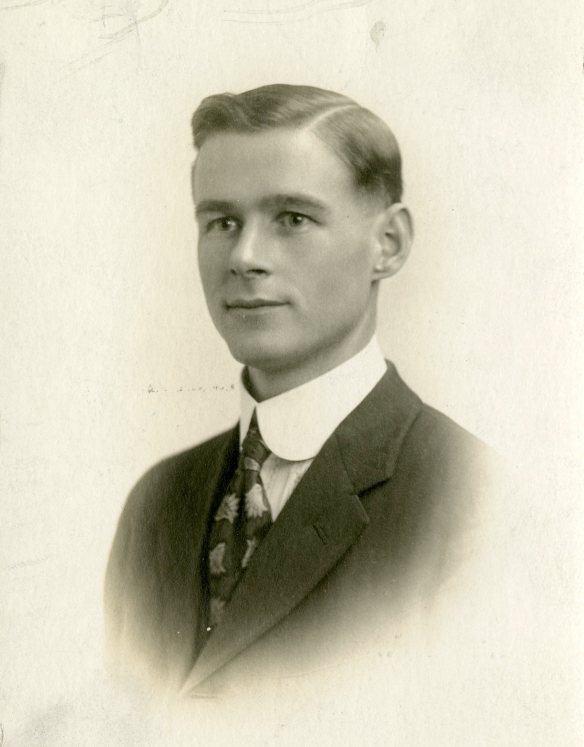
It was within this context that the Young People’s Conference movement was born. Its leaders included many from Oak Grove, including Jacob Conrad Meyer, Vernon Smucker, and Orie Benjamin Gerig. They were part of a new generation of Mennonite men and women who came of age during these first few decades of conflict in the church. Many graduated from Mennonite colleges and embraced new initiatives in home evangelism and overseas missions.

1917 J C Meyer

Portrait of Jacob Conrad Meyer taken in 1917, shortly before he left for France. MC USA Archives

More importantly, they came of age during World War I, the deadliest war in history to that point. During the war, hundreds of Mennonite men lived in work camps as conscientious objectors. Many felt abandoned by denominational leaders who they believed had not equipped young people to face the challenges of being a CO during wartime. They also came away with a renewed conviction that the church should adopt a more outward focus, one centered on service, peace, and engagement with the rest of the world.

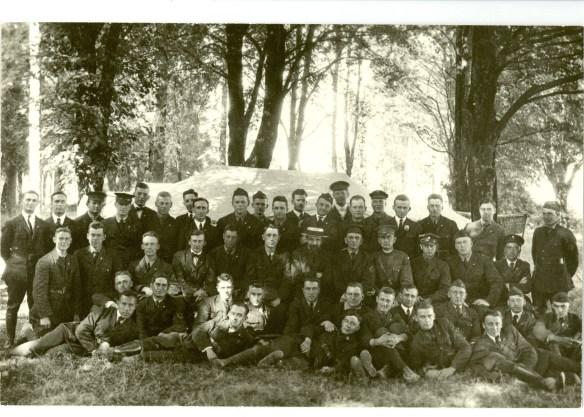
After the war, several dozen young Mennonites acted on this conviction by volunteering to assist the reconstruction efforts in France. Here they gained firsthand exposure to the destruction of war. They also met regularly to discuss their concerns about the Mennonite Church. One of the key organizers for these meetings was Jacob Conrad Meyer. He and others became increasingly critical of what they saw as weak leadership and lack of support for the concerns of younger members.

01 WWI COs with American Friends Service Comm France

Attendees at the first Young People’s Conference in Clermont-en-Argonne, France, June 20-22, 1919. MC USA Archives

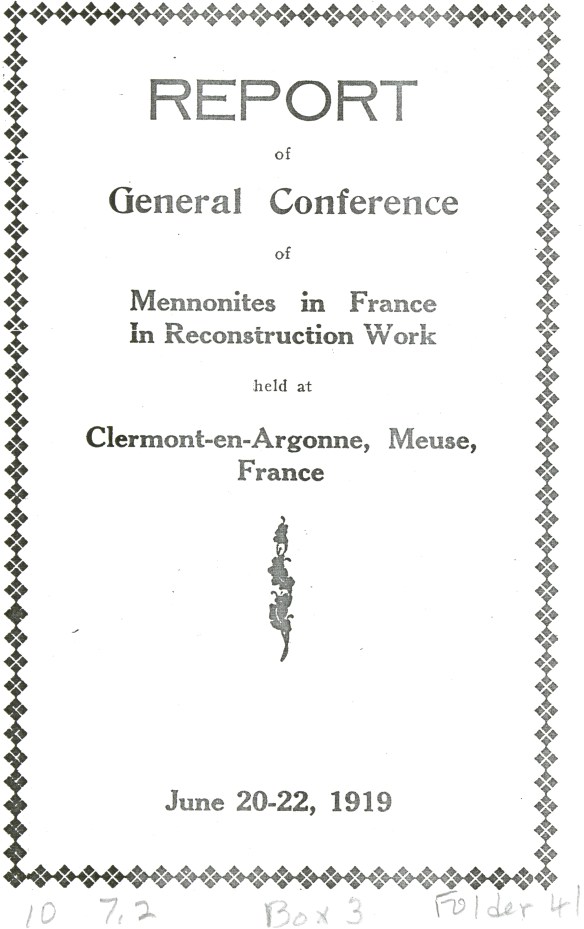
Eventually, these relief workers organized the first Young People’s Conference at Clermont-en-Argonne in June 1919. At the end of the conference, they produced a list of priorities for the “church of the future.”[4] They also drafted a constitution and elected an executive committee to provide leadership for the emerging movement. Of the six committee members, three were from Oak Grove: Vernon Smucker, J.C. Meyer, and O.B. Gerig.

04 Report Mennonites in France page 1.jpg

However, the YPC movement was short-lived. After returning to the United States, leaders planned and organized three annual meetings between 1920 and 1923. But the movement faced steady opposition from denominational leaders who accused its leaders of unorthodox theology. Ultimately, the YPC movement couldn’t convince church leaders that it sought to work with rather than against them. By 1924, the movement was over.

How should we interpret the failure of this movement?

In 1 Corinthians 3:11-13, Paul writes: “For no one can lay any foundation other than the one already laid, which is Jesus Christ. If anyone builds on this foundation using gold, silver, costly stones, wood, hay, or straw, their work will be shown for what it is, because the Day will bring it to light. It will be revealed with fire, and the fire will test the quality of each person’s work.”

For those involved in the YPC movement, its failure after just a few years must have been a big disappointment. Here were young, intelligent leaders ready to offer their gifts to the work of the church, only to see their ideas met with suspicion and rejection. Indeed, O.B. Gerig was so disillusioned that he left the Mennonite church entirely. In a letter to J.C. Meyer in 1921, Gerig wrote, “I have come to the point where I can no longer view all problems only in the light of our own little branch of the church. We have a larger project in view. In the end, our plan will live after all their intrigue has passed on the blemished page of history.”[5]

As we now know, Gerig’s words turned out to be prophetic. One hundred years later, most of the reforms that the YPC movement advocated have been implemented.[6] Indeed, many have become central to the identities of multiple generations of Mennonites who grew up during the twentieth century. For example:

  • The YPC wanted the church to take a proactive stance with the U.S. government on issues of peace and conscientious objection to war. In the 1930s, the denomination worked with leaders from other historic peace churches and the government to create the Civilian Public Service program. During WWII thousands of Mennonites served with CPS as an alternative to military service and active peacebuilding remains a key focus for Mennonites today.
  • The YPC called for a stronger emphasis on service and relief to those in need. Over the course of the twentieth century Mennonite Central Committee has emerged as one of the most highly respected inter-Mennonite institutions in North America and abroad.
  • The YPC called for more dialogue between Mennonites of different national and cultural traditions. Today, Mennonite Mission Network continues its good work and Mennonite World Conference brings together people of Anabaptist faith from across the globe.

It took the fresh eyes of new leaders to articulate a new vision for the Mennonite Church in a complex and changing world. Through these young people, God planted a seed. Over the last 100 years, you at Oak Grove have watered that seed, dedicating your lives to the work of Christ in both large and small ways. Back in 1918, and even more so in 1818, the future of the Mennonite Church was anything but clear, but God has been faithful and God—not us—caused the seed to grow.

Today we are entering a new phase of uncertainty in the history of the Mennonite community in North America. Like the church 100 years ago, our newly merged denomination—Mennonite Church USA—is less than 20 years old and the growing pains are readily apparent. Our Mennonite colleges and universities are struggling financially. Our missions, service, and publishing agencies have drastically reduced operations in the last few decades. And our denomination is experiencing a rapid decline in membership, including the departure of entire conferences. As in 1918, the current crisis grows from a conflict based largely upon differing views regarding the kind of church Christ is calling us to be.

Last summer, MC USA organized the Future Church Summit at the bi-annual convention in Orlando. The goal of the summit was to gather voices from across the denomination to identify core convictions and chart a new course for the church. One tension that I observed throughout the FCS was between denominational leadersusually heritage Mennonites, usually middle agedand younger participants, many of whom did not grow up in the Mennonite church.

I heard resentment from younger leaders about the unwillingness of the “old guard” to let go of control. And I heard older participants lament the exodus of young people from the church and their “indifference” and lack of commitment to MC USA and its ministries. But I was also impressed by the many articulate and passionate young leaders who are committed to working for positive change from within the denomination. Their words echoed many of those voiced 100 years ago at Young People’s Conferences. They were filled with the same optimism, energy, and hope.

It is a fact that church attendance among Mennonites and many other denominations is declining. Many young people no longer see the church and its institutions as relevant parts of their lives. Yet, as I look out over the pews, I am struck by the number of young people and children here at Oak Grove. So, in closing, I want to speak to you and leave you with a few questions.

Why have you chosen to stay connected to the church? What about Oak Grove made you want to invest your lives in this community? Now, more broadly, what is important to you about being Mennonite? What is your hope for the future of the church…here in Wayne County, in North America, and around the world? Do we still need institutions like MC USA, MMN, or MCC to help us do the work of God in the world? I would argue yes. These institutions connect what is now a truly global church and allow us to accomplish much more of Christ’s work than we could on our own.

But these are tough questions, ones that I continue to struggle with as a 35-year-old Mennonite by choice. As you seek answers, I challenge you to take inspiration from Oak Grove’s history and consider the “cloud of witnesses” that has gone before you. For 200 years, the community of believers gathered at Oak Grove has found a way to remain in fellowship, even in the midst of crisis. In 100 years, how will your grandchildren and their children look back on you? What will you do to help continue this work? We aren’t perfect and we will make mistakes but I pray that we will “run with perseverance the race marked out for us, fixing our eyes on Jesus, the pioneer and perfecter of faith.”

OakGrove200


[1] Originally an Amish Mennonite community, Oak Grove was part of the Eastern Amish Mennonite Conference from 1893 until 1927 when the conference merged with the Ohio Mennonite Conference to form the Ohio Mennonite and Eastern Amish Mennonite Joint Conference (later the Ohio and Eastern Mennonite Conference), affiliated with the “old” Mennonite Church. From 1947 to 1970, Oak Grove held no conference affiliation. In 1970 the congregation became a dual affiliate of the Ohio and Eastern Mennonite Conference and the Central District Conference of the General Conference Mennonite Church. The Young People’s Conference movement engaged leaders mostly from the “old” Mennonite Church.

[2] Before the establishment of the General Conference Mennonite Church in 1860 and the (old) Mennonite Church in 1898, Mennonite communities in North America functioned mostly as a loose association of local districts and conferences without any centralized institutions.

[3] Most of the context and background for this section comes from a well-researched essay by Anna Showalter, “The Mennonite Young People’s Conference Movement, 1919-1923: The Legacy of a (Failed?) Vision,” The Mennonite Quarterly Review 85:2 (April 2011), p. 181-217.

[4] The full list is printed in Showalter, “Mennonite Young People’s Conference Movement,” 196.

[5] Ibid., p. 182.

[6] Anna Showalter and James O. Lehman make this same point in their analyses of the YPC. See Showalter, 212-217, and James O. Lehman, Creative Congregationalism: A History of Oak Grove Mennonite Church in Wayne County, Ohio (Smithville, OH: Oak Grove Mennonite Church, 1978), 211-212.