Mennonites and the Doctrine of Discovery: A Report from “Indiana Indian Day”

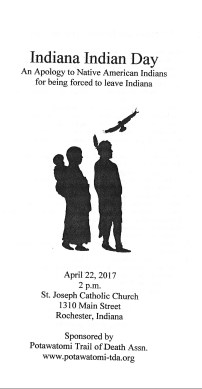
Indiana Indian Day event program 4-22-2017_Page_1Jason B. Kauffman

On September 5, 1838, members of the Potawatomi nation—859 men, women, and children—were marched at gunpoint through the main street of Rochester, Indiana. It was the beginning of a two-month forced march of over six hundred miles that ended in remote eastern Kansas along a tributary of the Osage River. Almost 180 years later, at an “Indiana Indian Day” event on April 22, 2017, Father Mike McKinney of St. Joseph Catholic Church walked to the middle of that same street in Rochester. With police cars stopping traffic and those in attendance looking on, Father McKinney blessed Main Street, “reclaiming it for peace.” It was a powerful and moving gesture of reconciliation between the descendants of the Potawatomi and those who benefited from their removal. After the blessing, Father McKinney left the road and the idling cars continued on their way.

Along with Denominational Minister Nancy Kauffmann, I represented Mennonite Church USA (MC USA) at the April 22 event at the invitation of co-organizers Shirley Willard, retired Fulton County historian and founding officer of the Potawatomi Trail of Death Association, and Adam Friesen Miller, a fourth grade teacher at Bethany Christian Schools in Goshen, Indiana. Over the past school year, Adam has been teaching his students about the history of the Potawatomi people and their forced removal from Indiana in 1838, using a curriculum developed by Char Mast, an Anabaptist Mennonite Biblical Seminary alumna.
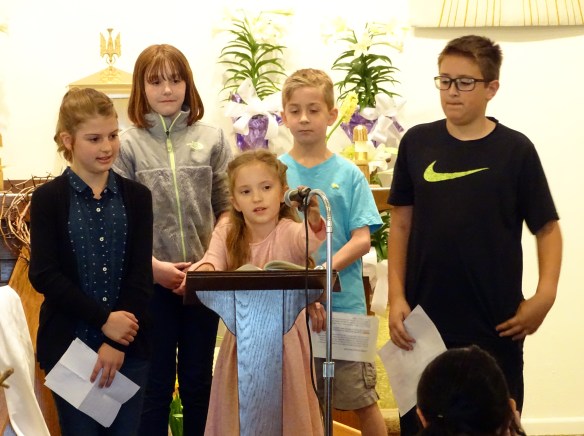
DSC01880 Bethany 4th graders

Students from Bethany Christian Schools present on the erasure of Potawatomi experiences in Indiana history textbooks. Photo by Annette Brill Bergstresser, Anabaptist Mennonite Biblical Seminary

I had little prior knowledge of Potawatomi history or the confluence of historical circumstances and events that led to their removal from Indiana, but I was excited to participate in support of Adam and his students. I certainly don’t remember learning as a fourth grader about the violence and injustice that Native Americans faced as colonists and settlers moved west in search of land. I was impressed that Adam exposed his students to these tough questions and that they, in turn, wanted to do something to make a difference.

Shirley and Adam requested MC USA participation in the event because many early Mennonite settlers to northern Indiana gained title to land previously occupied by the Potawatomi, thus benefiting at their expense. Nancy and I agreed to offer a formal statement of apology to the Potawatomi and Miami people on behalf of Mennonite Church USA. As the date approached, however, we modified our statement at the request of the event organizers to include more information about the Doctrine of Discovery1 and the work that Mennonites are doing to address the legacies of injustice that Native American communities continue to face. After some last minute changes, we finalized our Statement of Confession and Commitment and read it publicly on April 22.2
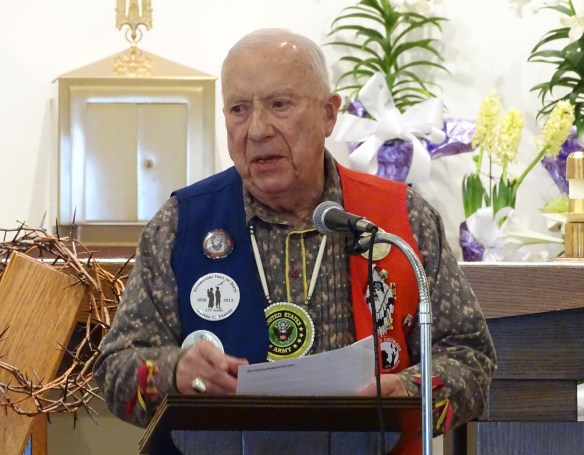
DSC01911 Bob Pearl

Bob Pearl, a Potawatomi descendant, speaking during Indiana Indian Day. Photo by Annette Brill Bergstresser, Anabaptist Mennonite Biblical Seminary

The event itself went well and was a meaningful time to publicly confess the ways that Mennonites—and the rest of North American society—have profited from the marginalization of the Potawatomi and other Native American communities. It was also a great opportunity to meet and begin building relationships with members of the Potawatomi and Miami nations and to stand with members of the broader northern Indiana community in support of justice for Native Americans.

But the event and the statement we produced also left me with lingering questions about the relationship between words and action and what it takes to bridge the divide that often separates them. In particular, the following quote from Sarah Augustine on the Dismantling the Doctrine of Discovery Coalition website has continued to challenge me since the event: “Until individuals representing committed institutions stand together with indigenous and vulnerable peoples, our words and gestures too are rendered hollow and symbolic.”3 In other words, it’s one thing to acknowledge and lament this history of injustice and another thing entirely to do something about it. This is why the image of Father McKinney’s blessing and the stopped cars on Main Street in Rochester has stuck with me. After the powerful moment of reclaiming that space for peace the idling cars continued on their way, consuming a resource that our society continues to privilege ahead of justice for indigenous and other marginalized people.

These patterns of exploitation and injustice against indigenous people have deep historical roots which took hold with a series of papal bulls dating to the fifteenth century. These papal bulls established the legal and theological framework for the Doctrine of Discovery and played an early and enduring role during the period of Spanish and Portuguese colonization in the Americas.4 Under the encomienda system, for example, indigenous populations in the central valley of Mexico and the Andean highlands were forced to provide tribute—in the form of labor or goods—to colonial title holders. In return, encomenderos were supposed to instruct indigenous people in the Christian faith.5 In some regions, such as the Andean highlands, the system later evolved into a forced labor draft through which indigenous communities provided an annual quota of laborers to the Spanish colonial government.6 Many of these workers ended up toiling in mines to produce the silver that fueled Spain’s colonial empire. In one notorious case, untold numbers of indigenous people died from prolonged exposure to mercury, the toxic mineral used by colonists to extract silver from mined ore.7

These injustices have taken on new forms over time. Across the Americas, indigenous people continue to struggle against unjust systems. In South America, indigenous communities are fighting to maintain their livelihoods and access to communal lands in the face of multinational corporations seeking to profit from the production of oil and hydroelectric power. Similar dynamics are playing out in North America between the Standing Rock Sioux and developers of the Dakota Access Pipeline. At the heart of both colonial, pre-capitalist economic systems and the current globalized, neoliberal order is the desire to maximize profit through the control of natural resources and the labor of others. And, as history shows, those in power—including governments and corporations—are not above using violence and repression to protect those interests.

As people who care about peace and social justice, what responsibility do Mennonite and other members of the Anabaptist community have to right the wrongs of history? In our statement on April 22, I said that Mennonite Church USA affirms the current efforts among Mennonites and people of Anabaptist faith to “actively dismantle the Doctrine of Discovery at every level of society—in our laws and policies, in our states, in our communities, in our church institutions and in our congregations.” What can we do as individuals and as a denomination to make good on this commitment? This seems like a daunting (even impossible) goal to accomplish in light of over 500 years of injustice and a global economic system that continues to favor the interests of the powerful few at the expense of millions. But I think it is important to think about what it would look like to put these convictions into practice.

Education and consciousness-raising are clearly two of the best places to start. We can’t address injustice without first taking the time to understand how it has functioned in both its historical and present contexts. The Dismantling the Doctrine of Discovery Coalition has already done much work in this regard. The coalition recently produced a documentary that explains the historical context and theological basis of the Doctrine of Discovery and has also published study guides and reflections that help establish a biblical foundation to expose the misinterpretation of God’s word that the fifteenth century Church used to justify colonization.

It’s also important to open dialogue and build relationships with indigenous brothers and sisters in our local communities and across the country. For example, Ervin Stutzman, executive director of MC USA, and Jess McPherson, an educator and multidisciplinary artist of Susquehanna descent, have engaged in conversation about Stutzman’s work in historical fiction and how identities (as Amish, Native American, etc.) influence our ability to “tell history with integrity.” In northern Indiana, people like Rich Meyer have spent years researching the history of the Potawatomi and building relationships with members of the Potawatomi community. More recently, students and faculty at Anabaptist Mennonite Biblical Seminary have worked to plan and lead a nine-day Trail of Death Pilgrimage from Indiana to Kansas. The course provides opportunities for participants to learn from members of the Potawatomi community about their history and the challenges they continue to face.

How do we get from education and relationship-building to the “actively dismantling” part? What would justice look like for Native American communities today and how can Mennonites best work in solidarity with them to achieve it? Would justice involve returning land, as the Jesuit order recently did to the Rosebud Sioux? Should Mennonite Church USA or member conferences and congregations establish a tithe paid to descendants of indigenous communities expelled from their lands? Or would dismantling the Doctrine of Discovery require a more radical restructuring of society and the legal, economic, and philosophical frameworks that underpin it? I don’t have answers to these questions. But the examples of people like Adam Friesen Miller and his students give me hope that God is at work in the relationships that Mennonites are building with Native American brothers and sisters, and that justice is possible.


  1.  The Dismantling the Doctrine of Discovery Coalition defines the Doctrine of Discovery as a “philosophical and legal framework dating to the 15th century that gave Christian governments moral and legal rights to invade and seize indigenous lands and dominate indigenous peoples.” The Gilder Lehrman Institute of American History website contains a brief synopsis of its historical evolution as a concept. 
  2. The statement benefited greatly from feedback and phrasing suggestions given by Rich Meyer, Sarah Augustine, Katerina Friesen, and David B. Miller. 
  3. Augustine is co-director of Suriname Indigenous Health Fund, a private international charity, and Professor of Sociology at Heritage University. She is also actively involved in Mennonite efforts to work towards justice for indigenous communities in North America through the Dismantling the Doctrine of Discovery Coalition. 
  4. I’m most familiar with the case of Latin America but these dynamics played out in the context of British, French, and Dutch colonialism as well. 
  5. The encomienda was not initially a land grant. In the early years of colonization land held little inherent value without access to indigenous laborers to make it productive. This is one reason why the encomienda system became so entrenched in the highly populated regions of central Mexico and highland Peru. For a classic essay on the subject, see James Lockhart, “Encomienda and Hacienda: The Evolution of the Great Estate in the Spanish Indies,” Hispanic American Historical Review 49:3 (Aug. 1969), 411-429. 
  6. Many indigenous “elites” and middlemen actually profited from such colonial labor systems. 
  7. Nicholas A. Robins, Mercury, Mining, and Empire: The Human and Ecological Cost of Colonial Silver Mining in the Andes (Bloomington, Ind.: Indiana University Press, 2011). 

Encounters with the Spirit: Anabaptists and Charismatic Renewal (Part 2)

In October 2016, I teased a multi-part series sharing some of my research into Anabaptist engagement with the late twentieth century charismatic renewal movement. In that post, I pointed to the dearth of writing on Anabaptist-charismatic influence and to the larger historiographical problem represented by that silence.

Today’s post picks up where that post left off. I want to share at least three reasons why I think this research matters for scholars of the Anabaptist-Mennonite tradition.

First, engagement with the North American charismatic renewal movement represented one of Mennonites’ first ecumenical encounters. The last two decades have seen growing rates of participation by Anabaptists in ecumenical dialogue, mostly through Mennonite World Conference.1 For instance, Mennonite and other Anabaptist media gave significant coverage to the 2010 service in which the Lutheran World Federation formally asked Mennonite World Conference for forgiveness “for the violent persecution of Anabaptists in the sixteenth century and for the way negative portrayals of Anabaptists and Mennonites have been allowed to continue within their communities and theological institutions.” But these high-profile ecumenical encounters of recent decades tend to obscure earlier forms of interchurch engagement, including with the charismatic renewal movement — a movement that, as numerous scholars have pointed out, was often quite ecumenical.

For instance, when charismatic Christians from various denominations—including Roman Catholics, Presbyterians, Lutherans, and many others—came together in 1977 for the Kansas City Charismatic Conference, Mennonites were highly involved. Retired (Old) Mennonite church missionary Nelson Litwiller sat on the organizing committee, and hundreds of Mennonite laypeople and leaders were among the 50,000 people who crowded into Arrowhead Stadium for the week-long event.2 Worshiping alongside and rubbing elbows with Christians across the denominational spectrum would have been anathema to (Old) Mennonites a generation or two beforehand. Yet by 1977, engagement with religious beliefs and practices from outside the Mennonite tradition had drawn these men and women into contact with other believers. As the historian Perry Bush has demonstrated, Mennonites engaged in ecumenical conversations before 1977.3 But the Kansas City conference had symbolic significance as an ecumenical encounter: Mennonites were known, active participants and partners in a widely-reported, transdenominational religious gathering.

Arrowhead Stadium, the site of the Kansas City Charismatic Conference in 1977 (Wikimedia Commons)

Arrowhead Stadium, the site of the Kansas City Charismatic Conference in 1977 (Wikimedia Commons)

Second, while some Anabaptists cut loose their denominational ties as a result of their encounters with the Spirit, other Mennonites and Brethren in Christ attempted to forge a distinctively Anabaptist variety of charismatic renewal. At the cutting edge of this endeavor was Mennonite Renewal Services, a grassroots denominational agency that formed in the mid-1970s by two Mennonite leaders sympathetic to charismatic expressions. The organization planned conferences and published a magazine, Empowered, in order to promote charismatic renewal within local congregations while simultaneously attempting to stop charismatic Mennonites from seeking fellowship with and guidance from non-Mennonite charismatics.

But perhaps their most enduring contribution emerged in their efforts to promote a distinctively Mennonite “brand” of charismatic renewal. For instance, in the inaugural issue of Empowered in 1983, one writer opined that the baptism of the Spirit was important, but that there were many signs or sets of signs—not just one singular sign—that could confirm it. He wrote that “difficulty, severe testing or spiritual challenge may be a more typical consequence of the baptism” than signs such as glossolalia or prophecy.4 The writer’s appeal to suffering and “spiritual challenge” spoke directly to the longstanding Anabaptist conviction that hardship and adversity are expected outcomes of Christian discipleship, beliefs that reflect a living memory even among twentieth­-century Anabaptists of their ancestors’ sixteenth­-century persecution.

The predominantly African-American congregation at Calvary Community Church in Hampton, Virginia, are more open to charismatic expressions than some of their fellow white Mennonites. With about 2,200 members, this congregation is the largest in Mennonite Church USA.

Third, the growing presence of African American, Latino/a, and Hispanic Anabaptists after 1980 helped to sustain charismatic expressions in Mennonite and Brethren in Christ churches. Although pockets of resistance to charismatic beliefs and practices continued to exist within some segments of the Mennonite denominations and the Brethren in Christ Church into the 1980s and beyond, by the last decades of the twentieth century most denominational hierarchies relaxed their older, outright opposition to the movement. Such gradual embrace was a boon to Mennonites and Brethren in Christ in the 1980s, as both groups increasingly welcomed African Americans, Latino/as, and Hispanics into their church communities.5

For these Anabaptists, charismatic expressions did not necessarily conflict with the tradition’s other beliefs and practices. For instance, as the historians Steven Nolt and Royden Loewen have argued, Latino Mennonites “were [often] puzzled as to why so many white Mennonites seemed surprised by, or even opposed to, dramatic expressions of divine activity,” such as speaking in tongues or divine healing.6

A recent demographic study of Mennonite Church USA confirmed these dynamics. Only forty-four percent of white church members claimed that they had “ever personally experienced . . . gifts of the Spirit” such as casting out demons, speaking in tongues, prophesying, or receiving the baptism of the Holy Spirit. By contrast, seventy percent of African-American, Latino/a, and Hispanic church members claimed those experiences.7

Since we scholars still have much to learn about African American, Latino/a, and Hispanic Anabaptists in North America, paying attention to the emergence of, ongoing presence of, and tensions resulting from charismatic beliefs and expressions within Anabaptist communities may help provide fresh insights into these late twentieth century developments.

Stay tuned for more posts on these “encounters with the Spirit,” as I continue to share insights from my ongoing research into Anabaptist engagement with the charismatic renewal movement.

NOTES:


  1. See, for instance, the recent collection by Fernando Enns and Jonathan Seiling, eds., Mennonites in Dialogue: Official Reports from International and National Ecumenical Encounters (Eugene, Ore.: Pickwick, 2015). 
  2. On the Kansas City Charismatic Conference, including Mennonite involvement, see Vinson Synan, The Holiness-Pentecostal Tradition: Charismatic Movements in the Twentieth Century, 2nd ed. (Grand Rapids, Mich.: Eerdmans, 1997), 260-264. 
  3. Perry Bush, “”Anabaptism Born Again: Mennonites, New Evangelicals, and the Search for a Usable Past, 1950-1980,” Fides et Historia 25, no. 2 (Winter-Spring 1993): 26-47. 
  4. Daniel Yutzy, “The Baptism with the Spirit,” ​Empowered, Spring/Summer 1983, n.p. 
  5. Historians of North American Anabaptism are only beginning to understand how and why African Americans, Latino/as, and Hispanics became involved in groups such as the Old Mennonites and the Brethren in Christ, groups historically comprised of members with Swiss­-German ethnic heritages. For some early considerations of this development, see Tobin Miller Shearer, ​Daily Demonstrators: The Civil Rights Movement in Mennonite Homes and Sanctuaries (Baltimore, Md.: The Johns Hopkins University Press, 2010), and Felipe Hinojosa, ​Latino Mennonites: Civil Rights, Faith, and Evangelical Culture (Baltimore, Md.: The Johns Hopkins University Press, 2014). 
  6. Steven M. Nolt and Royden Loewen, Seeking Places of Peace: A Global Mennonite History–Vol. 5: North America (Intercourse, Pa.: Good Books; Kitchener, ON: Pandora Press, 2012), 262. 
  7. Conrad L. Kanagy, Road Signs for the Journey: A Profile of Mennonite Church USA (Scottdale, Pa.: Herald Press, 2007), 99. 

An Invitation to the “Crossing the Line: Women of Anabaptist Traditions” Conference

Rachel Waltner Goossen

It’s been twenty-two years since historians from the U.S. and Canada collaborated on the first academic conference focusing on women of Anabaptist traditions.  A sequel comes this summer: an interdisciplinary conference, Crossing the Line:  Women of Anabaptist Traditions Encounter Borders and Boundaries, slated for June 22-24, at Eastern Mennonite University (EMU) in Harrisonburg, Virginia.  Scholars from around the globe as well as students and others interested in women’s and Anabaptist/Mennonite history will gather for cross-disciplinary panels, sessions, and conversations.  The conference theme invites us to consider how Anabaptists, Mennonites, Amish, and related groups have bumped up against – and traversed – physical and figurative borders, right up to the present day. 

crossing-the-line-header

Crossing the Line is a conference about women from Anabaptist traditions. Panels will emphasize the rich diversity of Anabaptist women’s experiences.

In 1995, a landmark scholarly conference titled The Quiet in the Land? Women of Anabaptist Traditions in Historical Perspective drew 256 participants from Canada, the U.S., Germany, and the Netherlands. Hosted at Millersville University in Pennsylvania, this early collaborative effort among Mennonite scholars featured artistic performances, especially drama, music and poetry. Approximately one hundred academic presentations explored the richness of women’s experience and interests drawn from Mennonite, Mennonite Brethren, Amish, Hutterite, Brethren in Christ, German Baptist, and Jewish perspectives. 

At the conclusion of the 1995 conference, participants were enthusiastic about the variety of methodological and interdisciplinary approaches on display, but noted that a future conference would need to cast a more inclusive net.  Many called for greater attention to international stories and viewpoints, pointing out that a critical mass of individuals in Anabaptist traditions lived outside of U.S./Canadian communities.  Others critiqued the Millersville gathering for failing to incorporate LGBT history, although other forms of inclusion/exclusion were dominant themes of the conference. 

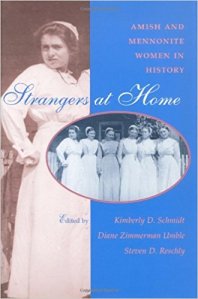
Strangers at Home

Strangers at Home came out of a landmark 1995 conference on Anabaptist women.

By the final day of the conference, one observer noted the gathering’s big-tent flavor:  “Many perspectives have been expressed underneath this canopy . . . . We have not been concerned with boundaries.” Johns Hopkins University Press was attracted to the gendered theme of the conference and subsequently published an edited collection, Strangers at Home:  Amish and Mennonite Women in History (2002), which highlighted European- and North American-focused scholarship (a notable exception was Marlene Epp’s “’Weak Families’ in the Green Hell of Paraguay”). 

Intensifying an international reach this time around, the June 2017 conference will focus on boundaries and border-crossings. Women from the Global South will participate. Students and scholars from a dozen countries are among the panelists and plenary speakers.  Each day, an invited scholar will address implications of border- and boundary-crossings.  Hasia Diner, New York University Professor of History, will speak on gender systems in ethno-religious immigrant communities. Cynthia Peacock of India, affiliated with Mennonite Central Committee for nearly four decades and a representative for Mennonite World Conference, plans to address church leadership in South Asia. And Sofia Samatar, a Somali-American writer and English professor at James Madison University, will be drawing from her own Arab and Mennonite heritage for her presentation, “Crossing Ethnicities.”

Sofia-Samatar

Sofia Samatar, professor of English at James Madison University, will be one of several plenary speakers at Crossing the Line.

Academic presentations on a wide array of topics, as well as an art exhibit, poetry readings, original dramatic performance, modern dance and ballet performances, and Shendandoah Valley cultural tours round out the conference offerings. In the spirit of the 1995 gathering, organizers of the upcoming Crossing the Line gathering hope the event will contribute to “mentoring relationships that crossed traditions and disciplines and age groups,” according to planning committee co-chair Kimberly Schmidt.

Watch this Anabaptist Historians blog site for regular updates and postings from participants throughout and after the conference. Participants may register for the entire conference or for a daily rate.  Registration, schedule, sponsorship, and lodging details are available via the conference website.

Rachel Waltner Goossen is a member of the conference planning committee and professor of history at Washburn University in Topeka, Kansas.

Online Resources

Ben Goossen’s introduction to Anabaptist digital history in January got me wondering what other Anabaptist history resources were available online. I embarked upon a very unsystematic quest, crowdsourcing the question via Facebook and Google-searching such terms as “Mennonite Database.” I found more than I thought I would and I’m sure I found only a small portion. Many of the sites I found made reference to each other, but there were also closed loops that represented denominational communities. Interestingly, I also found Ben’s post reproduced on the Mennonite Historical Society of Alberta (http://mennonitehistory.org/) homepage, presumably because he’d made reference to a partner organization, Mennonite Archival Image Database (MAID), near the end of the post.

Consider what follows a brief annotated bibliography of the Anabaptist history online archive. I’ve included mostly resources that are available for free and marked the few paid services with an asterisk. Please use the comments section to add resources I’ve missed.


Primary Sources

Mennonite Genealogical Resources: A deceptively simple website, this contains links to a lot of interesting resources from lists of names and places of settlement to other databases. One word of caution: I followed a rabbit trail of links to the Mennonite Genealogy Data Index (http://mgdi.mennonitehistory.org/) which had a lot of dead links and at least one that seemed fishy and sent all kinds of dialog boxes flying at me. Digital history 101: Not all that is put on the internet stays on the internet.

http://mennonitegenealogy.com/

The Mennonite DNA Project: While not really history per se; this resource attempts to use the widespread adoption of tools such as familytreedna.com and 23andme.com to put DNA to work in genealogical quests. While I’ve heard mixed reviews of these sorts of DNA, this could be interesting to some. I’ve included an asterisk because while Tim Janzen’s collection and analysis is free, neither of the DNA tests are.

http://www.mennonitedna.com/*

GRANDMA’s Window: GRANDMA (which is a very convenient initialism) is a project of the California Mennonite Historical Society’s Genealogy Project Committee. It’s a database of Mennonite family lines that go back through Poland and Russia. It costs a little to access it via the web or CD-ROM so I can’t say I’ve tested this out.

http://www.grandmaonline.org/gW-asp-3/login.asp

Index of Saskatchewan Cemeteries – MHSS: The Mennonite Historical Society of Saskatchewan has links to a lot of other resources (GRANDMA, GAMEO, etc.) but I think the coolest thing I found was their Index of Saskatchewan Cemeteries, which is available online. I think its a good example of a set of data that is easily moved from print to digital.

http://mhss.sk.ca/cemeteries/index.shtml

The Mennonite Historical Society of Alberta has some neat stuff going on: links to censuses in Canada and Mexico, lists of “travesties” committed to Mennonites in Russia during WWI, and a forum for identification of images. Worth more exploration

Home

Mennonite Archival Image Database (MAID) launched in 2015, is a collaboration of: the Centre for Mennonite Brethren Studies (Winnipeg); the Mennonite Archives of Ontario; the Mennonite Heritage Centre (Winnipeg); the D. F. Plett Historical Research Foundation; Mennonite Historical Society of Alberta; Mennonite Historical Society of British Columbia; Mennonite Historical Society of  Saskatchewan; and Mennonite Library & Archives at Fresno Pacific University (ML&A). It’s got some cool stuff  but it also watermarks everything, which for this copyleft guy is kind of a bummer. It does have Dublin Core export functionality, which is pretty cool.

https://archives.mhsc.ca/

Then there are the Mennonite Church USA Archives, whose Flickr page has “No known copyright restrictions,” which is very cool. I would have gone with a Creative Commons license, myself, but access is awesome. I’ll be pulling from this the next time I have to illustrate a blog post. Oh wait.

John Miller, Leslie Hochstetler, Harry Wenger, Sam Hershberger, 1969 Annual Meeting, Kalona, Iowa

16299748237_6ec2ae7faa_z

Images like this one of Raymond Jackson, MBM-related Home Missions leader in Philadelphia, Pennsylvania in 1979 are freely available at the MC USA Archives Flickr page.

German Mennonite Sources Database: Ben talked about this particular resource in more depth in his post but it’s pretty great if you need access to German Mennonite newspapers and books. I can’t read German but a lot of the frontispieces are pretty!

https://mla.bethelks.edu/gmsources/gmsources.php

Mennonitische Geschichte und Ahnenforschung: A vast array of sources on Russian Mennonites, mostly in German. The collection includes maps, diaries, magazine and newspaper excerpts, and more.

http://chort.square7.ch/Sitemap.htm#01

Archive-it/Mennonite Church USA: This has already been featured on Anabaptist Historians but it’s always worth a mention. The MC USA Archives have been using the Internet Archive (archive.org) to archive Mennonite-affiliated blogs and web content. These various sites and publications, taken together, form a snapshot of mainstream Mennonites in the early 21st century.

https://archive-it.org/home/MennoniteChurchUSA

Anabaptist Mennonite Biblical Seminary library has posted some of their holdings online. Issues of The Mennonite and The Gospel Herald from throughout the twentieth century and published minutes of the Mennonite Board of Missions and Charities are highlights of this collection.

https://archive.org/details/anabaptistmennonitelibrary

I should note that this is just one collection available on archive.org, there are also occasional gems that may be of use, such as the Holdeman Mennonite hymnal, copyright 1959, posted by churches or individuals. With the right search keywords, there may be more Anabaptist sources here than first meet the eye.

John Howard Yoder Digital Library: largely consisting of unpublished work. Additional supplemental reading necessary for those studying Yoder: http://mennoniteusa.org/menno-snapshots/john-howard-yoder-discernment-group-2/ and http://www.ourstoriesuntold.com/to-the-next-generation-of-pacifist-theologians/

http://replica.palni.edu/cdm/landingpage/collection/p15705coll18

Martyr’s Mirror images: Reference images (i.e. not print quality) of images from the Martyrs Mirror, courtesy of the Mennonite Library and Archive in Bethel, KS.

 https://mla.bethelks.edu/holdings/scans/martyrsmirror/

Centre for Mennonite Brethren Studies: A ministry of the Canadian Conference of MB Churches, CMBS is “preserving and maintaining historical records of churches, schools, and people; assisting in research and writing on topics of historical and theological interest to MBs; and publishing books and the quarterly magazine, Mennonite Historian.” It’s digital collection includes institutional records, church publications, personal papers, genealogies, and more.

Home

Secondary and Tertiary Sources

GAMEO is onto at least its second online iteration and still going strong. Based upon the print Mennonite Encyclopedia, it’s a great reference work for when someone refers to a Mennonite theologian whose name sounds really familiar but maybe it’s just because you have a cousin with that name. And now it’s built on a Wiki structure, which is cool. 

http://gameo.org

Global Anabaptist Wiki was in its infancy when I was at Goshen so it was a little bit on my radar but it seems to have mutated a bit in the time when I wasn’t paying attention (perhaps when it allied with GAMEO) but in really interesting ways, providing primary and secondary sources (in multiple languages!!) as well as encyclopedia entries (which I think have mostly been moved to GAMEO). For instance, there’s full-text versions of Anabaptist Confessions of Faith.

http://www.anabaptistwiki.org

Mennonite Brethren Historical Commission also offers some online reading of published works on Mennonite Brethren history.

http://www.mbhistory.org/pub.en.html


I have compiled this list to facilitate use of these resources but the many archives and libraries of the Anabaptist tradition remain the richest sources for historical study. As we make strides in diversifying The Archive, digital repositories present a valuable tool to quickly, efficiently, and cheaply, share sources around the world. However the internet is impermanent (and so it goes) and physical archives have greater longevity. New collections should not only be digitized and shared but added (in some form, whether physical or digital) to the institutions that still form the backbones of our amateur and scholarly historical endeavors.

And there are many such places. Here is a 2015 list of the Mennonite/Anabaptist archives and libraries in North America:  2015DirectoryofNorthAmericanMennoniteHistoricalAgencies

Joel Nofziger is currently on a team working to update this list worldwide, so if you know of any that aren’t on this list, share them in the comments!

Here are a (very) few links to finding aids for Anabaptist archives: