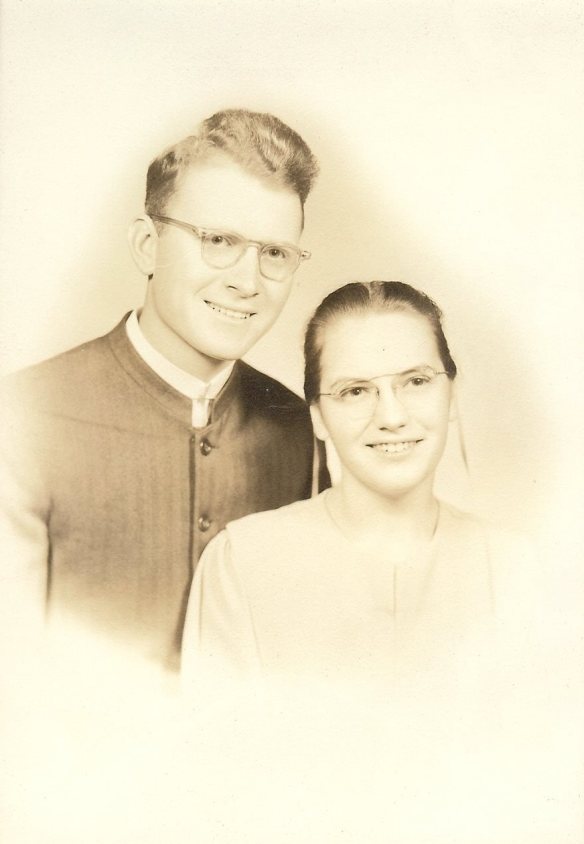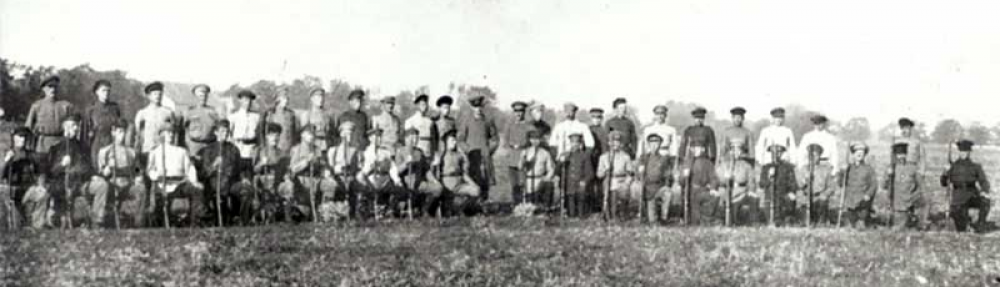
“Hey Smucker”: Protest, Neutrality, and My Cousin Lloyd

Janneken Smucker

A sign at a recent rally against the Trump administration’s proposed immigration policies— including the revised Executive Order known as the “Muslim Ban”—read “Hey Smucker, 200 years ago our Mennonite family took sanctuary in PA, just like yours did.” While I’m all in favor of protest signs calling me out personally, this message was targeted at Lancaster County, Pennsylvania’s newly elected Republican congressman, Lloyd Smucker. I heard about these protesting Mennonites first in a Tweet sharing a post on Esquire magazine’s website, titled “It Takes Something Seismic to Get this Group Protesting: The Mennonites are out in the Street” and in a McClatchy article covering Mennonite responses to current politics, titled “Trump turns apolitical Mennonites into protestors.”

Representative Smucker has publicly stated his support of the administration’s ban on refugees and on immigrants from 6 predominantly Muslim countries, earning the ire of many Mennonites in Lancaster County, who have long welcomed immigrants and refugees into their communities and churches, often sponsoring these newcomers through the Mennonite Central Committee and Church World Service. These protesters knew their local history, and identified that Smucker’s ancestors were indeed part of the wave of German-speaking Anabaptists who flocked to colonial Pennsylvania in the face of religious persecution in Europe.

Trachselwald_chains

The chains where prisoners at Schloss Trachselwald were locked up. Photo by George Smucker, Smucker Heritage Tour, 1988.

A few clicks on the Swiss Anabaptist Genealogical Association’s online database confirmed that Lloyd Smucker and I share an immigration story. We are fifth cousins once removed, each descendants of Christian Schmucker—“The Immigrant,” as the Amish man is known by the Schmucker, Smucker, Smoker Family Association. Schmucker arrived in Philadelphia in 1752 on the St. Andrew, which departed from Rotterdam. My family’s account holds that Christian was deported from Switzerland circa 1745 after serving jail time at Schloss Trachselwald because he was a “Pietist teacher.” Like many Amish emigrating in the mid-eighteenth century, he and his wife Catherine Hesster and their four children arrived in Pennsylvania as religious refugees. In the new world, living in Berks County, Christian and his adult male sons repeatedly were fined for not reporting to militias to fight in the American Revolution or hire mercenaries in their stead.1 This form of resistance (or is it nonresistance?) was common among Mennonites and Amish during the Revolutionary era.2
silas_trachselwald

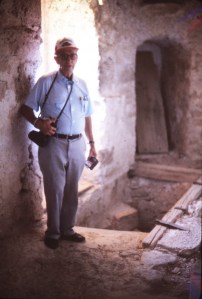
Silas J. Smucker, my grandfather and amateur historian, at Schloss Trachselwald where “The Immigrant” Christian Schmucker was jailed in the 1740s. Yes, that’s a Smucker’s Jam hat. Photo by George Smucker, Smucker Heritage Tour, 1988.

I read about the contemporary protesting Mennonites a day after I (and fellow Anabaptist Historian blogger Ted Maust – catch his recap here) attended Pub Comm, the Philadelphia area’s annual Public History Community Forum. The theme of this year’s one day event was “‘This is Why We Fight’: Public History for the Public Good,” and featured panels, workshops, and discussions focused on how public historians can harness “public history principles and programming to address issues of social justice and advocacy within their community and beyond.” A presentation from Eastern State Penitentiary’s Sean Kelley focused on how this Philadelphia institution—notorious for imprisoning Al Capone and for its creepy Halloween tour—has rewritten its mission statement in order to examine contemporary mass incarceration, as well as the prison’s historical context. Margery Sly, an archivist from Temple University Library’s Special Collections Research Center, talked about the need to archive contemporary protest movements as they are happening. Annie Polland from the Tenement Museum shared how its public programming makes space to address issues of contemporary immigration experiences, just as it interprets the lives of early twentieth-century immigrant families who lived at 97 Orchard Street in New York’s Lower East Side. I came away from the day feeling more empowered as a historian, reevaluating my own personal mission as I interact with students and pursue my scholarly agenda.

Some historians, like Mennonites, have often tended toward a neutral outside observer status, often preferring to appear apolitical rather than confrontational. These historians have strived for objectivity, despite the subjective perspectives historians bring to our interpretation of the past. Howard Zinn famously observed, “You can’t be neutral on a moving train,” calling on historians to wear their subjectivities on their sleeves while identifying neutrality as collaboration with the status quo and existing power structures.3 Public historians have a particular utility—and by extension, power—in exerting non-neutrality since our audiences are not fellow historians in the academy, but members of the public.

Schmocken

Janneken Smucker, age 12, at the crossroads near Schmocken, the town that perhaps the Schmuckers originally came from. Photo by George Smucker, Smucker Heritage Tour, 1988.

In some ways, historians’ traditionally preferred neutral stance is similar to the Old Mennonite (MC) doctrine of “nonresistance,” a form of pacifism espoused by mid-twentieth century Old Mennonite leaders. Nonresistance emphasized non-political disengagement with the “world” rather than an orientation toward pursuit of social justice.4  Mid-century MCs were not in fact neutral, just as historians cannot be. But both historians and Mennonites tried to be passive “witnesses” rather than active participants. The Mennonites rallying outside my cousin Lloyd Smucker’s office and the public historians gathered at Pub Comm demonstrate that neither group is willing to be neutral any longer. Too much is at stake.


  1. Silas Smucker, Christian Schmucker: Stalwart Pioneer (Goshen, Ind.: Silas J. Smucker, 1986). 
  2. Richard K MacMaster, Land, Piety, Peoplehood: The Establishment of Mennonite Communities in America, 1683-1790, vol. 1, Mennonite Experience in America (Scottdale, Pa.: Herald Press, 1985), 249-260. 
  3. Howard Zinn, You Can’t Be Neutral on a Moving Train: A Personal History of Our Times, First Printing edition (Boston: Beacon Press, 2002). 
  4. Paul Toews, Mennonites in American Society, 1930-1970: Modernity and the Persistence of Religious Community (Scottdale, Pa: Herald Press, 1996), 124-27, 262-66. 

A Review of New (Swiss-German) Mennonite Historical Fiction

My Loyalist Origins, by Herb Swartz. Victoria, B. C.: Friesen Press, 2015. 275 pp. Paperback. $15. ISBN: 978-1-4602-7458-3.

Both My Sons, by Ken Yoder Reed. Morgantown, Pa.: Masthof Press, 2016. 412 pp. Paperback. $19.95. ISBN: 978-1-60126-499-2.

Christian’s Hope, by Ervin R. Stutzman. Harrisonburg, Va.: Herald Press, 2016. 339 pp. (paper). $14.99. ISBN: 978-0-8361-9942-0.

In his excellent monograph on what it means to understand the past, Historical Thinking and Other Unnatural Acts, Sam Wineburg relates an experience from his 1996 study of how ordinary people understand themselves in relation to the past. In one interview, he spoke with a father who wanted his daughter to understand the Vietnam War experience. The father did not look to books of history, nor his coworker who fought in the war; instead he suggested, “We’ll have to get a copy of The Green Berets, you know, with John Wayne or something like that, so she’s a little bit more aware of what was going on. I don’t know how accurate all that is, but a least it would bring up some questions” (232). Fiction shapes how we see the past. Three historical fiction novels with the ability to shape how modern Anabaptists see the past were published in 2016: My Loyalist Origins, by Herb Swartz; Both My Sons, by Ken Reed; and Christian’s Hope, by Ervin Stutzman. 

My Loyalist OriginsHerb Swartz’s My Loyalist Origins is an attempt to work through his personal identity through historical fiction. He tells the story of the founding of America, from colonialism through the Revolutionary War, with some forays earlier back in time to discuss the origins of Anabaptism. Structured as a series of dreams with brief intervals of lucidity, Swartz gives a semi-historical account with a sometimes thin ribbon of story tying it all together. The book has six sections covering the discovery of America; the origins of Pennsylvania and Anabaptism; early wars, both colonial and the Revolution; the creation of the United States government; loyalist emigration to Canada, focusing on the Mennonite experience; and the settlement of Ebytown, now Kitchener, Ontario.

Swartz’s approach to understanding his personal origins in a very broad context is interesting, and he does attempt to create an approachable past throughout the book. He clearly understands that people operate in a broader milieu, and that understanding the world around them is key to gaining insight into how they understand themselves. So committed is he to helping readers understand the political environments of those colonial Americans that he includes the Declaration of Independence, Articles of Confederation, the United States Constitution, and a list of failed amendments as appendices to his book.

However, the narrative framework—a secret-agent style television producer pays Swartz-as-narrator to research his origins as background for a “rest of the story” television show, a process that inspires a feverish series of dreams he has that show him the way back—are less compelling and require great suspension of disbelief. Swartz seems to be writing more for himself, and allowing us to accompany him on his journey to see what we might learn from it. There is value in this, but it is not presented neatly. It must be found.

Unfortunately, My Loyalist Origins falls apart with a flurry of small errors, some of which I will cover, often in short, offhand comments. Puerto Rico is not the island of Hispaniola, as he mentions on page 20; Hispaniola is modern day Haiti and the Dominican Republic. He also gives a classic monogenesis of Anabaptism in Chapter 10, as opposed to the more accurate polygenesis account. He dreams of a Quaker member of parliament in 1739 objecting to the War of Jenkins Ear (79-80), but Friends were not allowed to serve in the British Parliament until the 1798 Act of Toleration allowed them to take seats without swearing oaths. Longbows were not invented by the Scottish and during the wars of Scottish independence (114) led by Robert the Bruce—longbows are generally considered to be Welsh, and were in use centuries earlier. Swartz could have used a better fact checker. None are major errors, but as they pile on, they cloud the truth that Swartz does include.

Both My Sons Front Cover, 6.9.16Both My Sons, by Ken Reed, is a story of leaving and belonging, reconciliation and redemption, capturing in broad strokes the experiences of early immigrants to what is now Lancaster County. Reed tells the story through Klaus Greenywalt, a composite of early immigrants. The story centers around Greenywalt’s relationship to his two sons, one of which is legitimate, and their mothers—one being his European Mennonite wife, the other his Scots-Irish mistress (taken while he thought his wife had died in Europe). We are carried along as Greenywalt converts in Europe while working for a Mennonite miller after the murder of his father, purchases land in the original Pequea settlement, is involved with colonial administration, helps foster further Mennonite immigration, loses his eldest son, and dies during the middle of the French and Indian war, all the while trying to maintain relationships with his children and peace between their mothers.

Reed does engage in interesting use of perspective in Both My Sons, with two middle sections being told from the perspectives of “the indentured girl,” Janey, with whom he has an affair, and “the wife.” This helps provide fuller insight into the colonial experience—not just the perspective of a white male Mennonite settler.

Where Both My Sons runs into trouble is the nature of truth when history and fiction collide, a problem exacerbated by his characterization through historical composite. There is one notable absence in the Pequea Settlement as portrayed by Reed: Martin Kendig. Greenywalt is clearly modeled heavily from Kendig: a major land dealer, returning to Europe to recruit immigrants, and even occupying the same tracts of land on the representation of the Pequea settlement. Kendig was, however, not an adulterer, and so did not share the engaging conflict that makes Greenywalt such a compelling character. When doing history, it is important to treat those who lived in the past with respect, and eliminating Kendig without comment is not treating his subject with due deference. Reed is writing fiction, and as such has great liberty to shape his story; perhaps that he does not let historical accuracy impede a good story is a testament to his imagination. But because he is writing historical fiction instead of creating a story from scratch, he is responsible for the past he presents.

Reed makes an attempt to address this in his disclaimer, “But is it true?.” He answers, “the central character, Greenywalt, is an invention of the author. . . . The scenes and conversations of his life are imaginary. However, the main events and people in Greenywalt’s world are real” (xi). This slipperiness between history and fiction, as best indicated by the curious case of Martin Kendig, while allowing for an enjoyable story, limits its historical usefulness in appreciating the lives of those who have gone before.

Christian's-Hope-Final-medium-webChristian’s Hope, like Both My Sons, is a novel of colonial Pennsylvania set just after the French and Indian War. The third and final installment in the Return To Northkill series picks up the story of Christian Hochstetler, the youngest son of Jacob Hochstetler. Christian, having lived with the Shawnee for eight years following his capture during the “Hochstetler Massacre,” is forced to return to his father and colonial Pennsylvania society due to the terms of the treaty ending the French and Indian War. Back on the farm, he struggles to reintegrate with his birth family and farm life, bound by a vow to remain true to the native way of life. He finds peace through an enticing relationship with Orpha Rupp and her Dunkard community.

Stutzman’s prose is clear and engaging, keeping the story moving at a steady clip. Though it is part of a series, it is not necessary to have read the prior novels, Jacob’s Choice and Joseph’s Dilemma, to appreciate Christian’s Hope. The details are filled in through a prologue and some flashbacks.

In contrast to Both My Sons, Christian’s Hope sets up an excellent author-reader contract. Stutzman is clear where he has taken liberties and what we do not know. In the preface before the novel, and the historical note after, Stutzman gives helpful historical context, clearly states what he changed for clarity, and admits what cannot be known.

As I was working on this review, I discussed it with a scholar friend of mine. He said, “I don’t have the time to read that sort of stuff, but I suppose somebody has to.” The issue of time is a real one, but he is missing out on some of the most important works on Mennonite history to come out in 2016 on two counts. First, fiction allows us to enter the past in a more intimate way, such as when we follow Greenywalt on the long road to his son’s funeral or enter the conviction of Christian’s conversion. Secondly, history is made of the stories we tell ourselves. This is the only way we understand the past, and on that account these works are important because stories of the past are being told, and being told in an accessible way. The importance of historical fiction, despite any errors individual works have, is that it gives us an accessible past that we can use. As the father muses in his interview with Wineberg, “at least it would bring up some questions.” Each of these books is worth picking up.

A condensed version of this review first appeared in Pennsylvania Mennonite Heritage 40:1 (January 2017)

Archives Power? The Role of Record-Keepers in Historical Preservation and Research

library-power

Simone D. Horst

I recently saw this picture when my graduate advisor, a longtime library science educator, shared it on her Facebook page. I can say that as a librarian, the comic mostly rings true–one generally does not enter the library profession seeking fame and fortune. But the last word, power, gives me pause. Librarians, archivists, and all others who are given stewardship of records do have power. They have influence over historical narratives that must be given attention by both the record-keepers themselves and the people they serve. It is only through recognition of this influence that they can be held accountable and that those with whose histories they are entrusted can ensure that the preservation and access of those stories is being handled in a professional, ethical manner.

There are a number of facets to this influence, three of which Randall Jimerson explores in the introduction to his book Archives Power: Memory, Accountability, and Social Justice.  He opens by saying that archives can be seen as temples, prisons, or restaurants. For Jimerson, “the temple reflects the power of authority and veneration. The prison wields the power of control. The restaurant holds the power of interpretation and mediation. These represent the trinity of archival functions: selection, preservation, and access. Archives at once protect and preserve records; legitimize and sanctify certain documents while negating and destroying others; and provide access to selected sources while controlling the researchers and conditions under which they may examine the archival record.”1

Jimerson’s first example, the temple, describes the power exerted by record-keepers in the selection process. He writes that “the very acts of selection and preservation set some records apart from others and give them heightened validity” and reminds his readers that “in the archival temple, archivists make value-laden decisions with momentous implications for the knowledge that the future will have of the past.”2  Jason Kauffman, Mennonite Church USA Archivist, touched on this in his blog post “Now You’re the Institution” when he talked about the importance of addressing ‘archival silences’ by cultivating institutional collections that represent groups that have been marginalized or left out of a group’s historical records.3 Archives cannot collect everything, but an intentionality in the formation of collection development policies and in the activities of acquisition can help ensure the preservation of an historic record that makes an attempt at balance and inclusion.

Jimerson’s second example, the prison, demonstrates how archives have historically handled the preservation of records. Preservation meant maintaining the records exactly as they were when they arrived. Physical materials were kept in tightly controlled, high security spaces, with acid-free storage, climate control, and strict rules on viewing and usage. But with the advent of technology archives, libraries are being forced to reassess their methods of preservation and make decisions about the application of technology: what gets scanned and stored electronically? What formats are digital items stored in and how will archives ensure that these formats remain available five or ten years down the road as technologies change? Why digitize one collection rather than another? How do institutions maintain copyright control and security when items are shared on a platform as vast and far-reaching as the Internet? Digitization has enhanced the ability for records managers to provide access, but it also brings up difficult questions of preservation. This new frontier does not follow the pattern of how archives have historically gone about preservation, nor does it fit neatly into Jimerson’s prison narrative. It is an entirely new aspect that is allowing archives to provide more unlimited access to their collections, but also challenges the historically held beliefs of how best to preserve historic resources.

The final facet of power is access. This is Jimerson’s restaurant, where record-keepers and information-seekers come together to use and interpret historical documents. Providing patrons with access to resources is at the heart of the ethics of both the archival and library professions. The Society of American Archivists Code of Ethics states that “Although access may be limited in some instances, archivists seek to promote open access and use when possible” and the first point in the American Library Association’s Code of Ethics is “We provide the highest level of service to all library users through appropriate and usefully organized resources; equitable service policies; equitable access; and accurate, unbiased, and courteous responses to all requests.” This is where an archivist’s power can be most plainly seen; there are many unfortunate examples of record-keepers bucking ethical codes and using their own discretion to assess whether records are fit for public consumption and withholding those they deem inappropriate. And, unfortunately, the lofty goals of living up to ethical principles of providing access can sometimes clash with more benign limits like restricted open hours, processing backlogs, and privacy rights that hinder the amount of free access the public can have to archival and library materials. Of the three facets of discussed here, this is both the easiest place for outsiders to recognize a record-keeper’s power and also the easiest place to hold records-keepers accountable.

Jimerson goes on to discuss how archives, once regarded by historians and others who use their contents as an unbiased source of materials that contained stories just waiting to be told, are now being seen for the power they have in shaping the discourse even before historical research begins. For many of us who work in these places, this power can feel uncomfortable. But power in archives and records-keeping doesn’t have to been seen as a bad thing. Jimerson states, “[O]ne challenge for archivists is to embrace the power of archives and use it to make society more knowledgeable, more tolerant, more diverse, and more just…once archivists acknowledge their professional and personal viewpoints, they can avoid using this power indiscriminately or, even worse, accidentally.”4  He concludes by saying that “rather than hide from their power in the realm of history, memory, and the past, I hope that archivists will embrace the power of archives and use it for the good of mankind.”5 

Anabaptists and Mennonites are privileged to have a large number of institutions and groups dedicated to preserving their historical record. There have been many devoted historians, librarians, and archivists over the years who have shaped and grown the historical collections that today’s church inherits. To continue and improve upon this legacy, record-keepers, historians, church leaders, and anyone interested in the church as it was and as it can be must take an active interest in the preservation and maintenance of our shared heritage. Those who are entrusted with the stewardship of historical materials need to be aware of how all aspects of their work impacts the history being told. They must take seriously the responsibility to work ethically and morally to provide historians and researchers with the highest possible access and most complete historical record possible. Likewise, church leaders must take seriously the importance of historical records and dedicate energy and funds to their care and protection. Only then can record-keepers and historians tell the best and most complete versions of our history.

Works Cited:
Jimerson, Randall C. 2010. Archives Power: Memory, Accountability, and Social Justice. Chicago, Ill: Soc. of American Archivists.


  1. Randall C. Jimerson, Archives power. (Chicago, Ill: Soc. of American Archivists, 2010), 2. 
  2. Jimerson, 4. 
  3. Kauffman, Jason. “Now You’re the Institution,” Anabaptist Historians, Nov. 10, 2016, https://anabaptisthistorians.org/2016/11/10/now-youre-the-institution/ 
  4. Jimerson, 185-86. 
  5. Jimerson, 3. 

Mennonite Weddings at Home and Church

Anna Showalter

When people find out that I am planning my wedding for this summer they often ask, “What are Mennonite weddings like?” Sometimes I respond saying, “no dancing, no alcohol,” and enjoy watching the disbelief on my non-Mennonite friends’ faces. In reality, however, there are as many ways to have a Mennonite wedding as there are Mennonites. Despite the inevitable diversity of practice across North American Mennonites, my study of Gospel Herald essays and marriage announcements between 1908-1960 made it clear that Mennonite Church leaders felt strongly that important matters of doctrine and practice were at stake in how church members conducted their marriage ceremonies. Beyond the problem of dress, music and the wedding ring was the question of home wedding versus church wedding. The primary concern was that weddings, whether at home or church, be consistent with Mennonite commitment to simplicity and non-conformity to the world. The shift from home weddings to church weddings meant that weddings were no longer semi-private events but full congregational occasions. Though there is little discussion of what is at stake with this shift in the Gospel Herald it strikes me as a question to pursue. How does the inclusion of marriage vows in congregational worship reflect Mennonite beliefs about marriage in relation to our beliefs about the church as the family of God?

At the turn of the twentieth century, (Old) Mennonites had a firmly established practice of holding wedding ceremonies in the home of either the bride or the officiating bishop. The services were small, involving a handful of close friends and family, often on a Tuesday or Thursday. Gospel Herald marriage announcements usually described these events as a “quiet wedding.” In the late 1920s, however, an occasional “church wedding” appeared in the listing of recent marriages. The trend continued to build slowly so that by 1957 the majority of weddings were held in churches rather than homes.1

Though less is known about Mennonite weddings prior to the twentieth century, we do know that the shift to church weddings did not come without a precedent. The 1890 Minister’s Manual instructs officiants that “The marriage ceremony, according to our present usage, generally takes place at the home of the bride. There is apparently no reason, however, why it should not be performed in the meetinghouse at the time of public services, according to the custom of our brethren in former times, and as is still the custom with some Mennonite churches.”2 An eyewitness account of a nineteenth century Reformed Mennonite wedding describes such a wedding. The couple stood up during Sunday morning worship after a sermon on marriage and divorce, said their marriage vows and then took their (segregated) seats in the congregation.3

Historical precedent or not, the shift back to church weddings in the 1930s and 40s in Mennonite Church communities raised questions and concerns for some. Virginia Conference, for instance, ruled against church weddings entirely in 1900 but modified the prohibition in 1914 to permit weddings to take place at church during regular services.4 The question was still debated in 1944, and Ruben Brubaker wrote to the Gospel Herald to express his concern. “[I] would not encourage the practice of church weddings for [I] feel they will cause drift into worldly practices.”5 A church wedding opened the door for a larger congregation, and increased the visibility of the couple as they made their vows. Even if the wedding was conducted without the pomp and circumstance of attendants, processional, special clothing and flowers, a church wedding would still be a larger, public event in contrast to the “quiet wedding” of previous years.

16443775_10155768055812166_233282845_o

John and Doris Sollenberger married December 9, 1951 during Sunday morning worship at the Rowe Mennonite Church. The bride wore blue.

My own grandparents exchanged their marriage vows during Sunday morning worship at the Rowe Mennonite Church near Shippensburg, Pennsylvania, in 1951. They wore their Sunday best and stood up during church at the appointed time to say their vows. My grandma remembers her mother-in-law cautioning her against this plan in favor of a low-profile home wedding that would not draw unnecessary attention to the couple. My grandparents, however, felt that since Grandpa had recently been ordained as a minister, it was fitting for them to take their marriage vows in the midst of their church community.

Despite a cautious attitude toward church weddings in general, several essays in the Gospel Herald show that my grandparents were not alone in believing that the church body gathered at the meetinghouse was potentially an ideal context to make marriage vows. One voice representative of this view was Amos Weaver of Ronks, Pennsylvania. In 1956, he noted the shift to church weddings as a positive change:

Until about 10 years ago Mennonite church weddings were practically unknown in many communities. Today, any other type of wedding is a rare thing. To have this very important God-given ordinance of holy matrimony solemnized publicly in the church of Christ certainly seems right and proper for a Christian. Many of us will say it is a change for the better.

Amos Weaver went on to clarify that this change could only be positive if done with the utmost simplicity within the context of regular church worship. Any added frills would obscure the advantage of explicitly placing marriage vows in the midst of corporate worship. Weaver described the church wedding he would advocate:

We could have a church wedding with all of the advantages of the church’s sanction and blessing by including it in a regular church service without all the fanfare we now have. I believe all the truly spiritual values to be had in a church wedding for the bridal couple and for the brotherhood would be retained and enhanced by a simple marriage ceremony in connection with a regular Sunday morning or Sunday evening service. No dramatic arrangements staged for the bridal party to enter at timed intervals, and no tableau of specially gowned attendants would be necessary.6

It appears that for Weaver and his like-minded contemporaries, the primary issue at stake was simplicity, economy and non-conformity to worldly wedding practices. I wonder, however, if in addition to the exhortation to simplicity, a subtext running underneath conversations about changing wedding practices is the question of how marriage vows belong in the life and worship of the church. Perhaps unarticulated in the hesitation to shift weddings from semi-private events to full congregational occasions is concern about a fine line between elevating the romantic couple in the public eye and maintaining the simplicity of a community of Christian brothers and sisters.

My study of Mennonite home and church weddings leaves me with more questions than answers. For instance, is it possible to read the inclusion of marriage vows in congregational worship as potentially, very subtly, obscuring the Christian claim that it is our baptismal vows rather than our family ties that constitute our membership in the family of God? Alternatively, could such an inclusion be read as acknowledging the particularity of the marriage vow while placing it in the context of community instead of romanticizing the idea of an insular, self-containing couple? In a cultural moment in which marriage practices are changing, today Mennonites have the opportunity to again consider how to make marriage vows in a way that communications our convictions about human marriage and the family of God.


  1. Orville R. Stutzman, “Vital Statistics,” Gospel Herald 50 (Nov 12, 1957): 970. 
  2. Confession of Faith and Minister’s Manual (Elkhart In: Mennonite Publishing Company, 1890). 89. 
  3. Phebe Earle Gibbons, Pennsylvania Dutch and Other Essays (Philadelphia Pa: J.B. Lippincott & Co, 1872), 28-31. 
  4. Minutes of the Virginia Mennonite Conference (1835-1938), (Scottdale Pa: Virginia Mennonite Conference, 1939), 56, 109. 
  5. Ruben Brubaker, “Church Weddings,” Gospel Herald 37 (October 13, 1944): 557. 
  6. Amos W. Weaver, “Weddings,” Gospel Herald 49 (June 26, 1956): 622.