
Dispatches from Crossing the Line

This weekend, June 22 to 24,  “Crossing the Line: Women of Anabaptist Traditions Encounter Borders and Boundaries” is taking place at Eastern Mennonite University in Harrisonburg, Virginia. Throughout the conference, contributors to Anabaptist Historians will give short dispatches for those who are unable to attend in person. “Crossing the Line” builds on the 1995 conference “The Quiet in Land? Women of Anabaptist Traditions in Historical Perspectives” held at Millersville University.

20170623_132819

Anabaptist Historians contributors at “Crossing the Line.” From Left to right: Ben Goossen, Christina Entz Moss, Joel Horst Nofziger, Simone Horst, Devin Manzullo-Thomas, and Anna Showalter.

The conference opened with a plenary address by Hasia Diner of New York University entitled: “Jewish Women in America: A History of Their Own.” The presentation was framed by how each facet of her title—“American,” “Jewish,” and “women” shaped the experience of these individuals.

While admitting that she works a very different group from Anabaptists, she noted similarities between the two ethno-religious communities, noting that both were shaped by an inability to disconnect religion and group identity, and living lives according to the demands of religious tradition while maintaining boundaries with host cultures.

Diner noted that in America, the experience took a distinct turn for Jewish women, when they began to gain influence within the synagogue. Traditionally, synagogues were strictly male public spaces, and while the men were obligated to attend, women were neither required nor expected to come. This could be seen architecturally, where women sat hidden behind thick walled screens, able to see and hear only through thin slits into the synagogue. But in America, as Jewish women observed how heavily Protestant women were engaged with church life, they too began to push for more engagement, including starting to attend synagogue. The building design then changed, with the women’s balconies opening up and more fully allowing for the women to seen and be seen. This in part could also be traced to the Female Hebrew Benevolence associations formed by Jewish women which provided social functions, as well as aid for the poor and travelers. The men of the synagogues often turned to these associations for moneys to construct new synagogues, but the money was conditional on the women, who were successful fundraisers, to have more input.

image1

Hasia Diner delivering the opening presentation at “Crossing the Line.”

She also noted that Jewish immigrants had a distinct experience from their contemporary eastern European immigrants. While Italians immigrated three men for every woman, and the Greeks eight men for every woman, Jewish communities migrated equally, both men and women. Especially when looking at which children to bring, Jewish families brought the oldest children, regardless of gender, while the other eastern European immigrants preferentially brought sons. Diner noted that this was because girls were not a liability in the family task of raising enough funds to bring the remainder of the family to America. In the garment industry, where many young women worked, there was no disadvantage based on gender, other than less pay. Interestingly, because many Jewish women were working in the garment industry and could clearly see that they were being paid less and facing harassment their male counterparts were not, they flocked to trade unions.

Diner noted that the question of why to study (Jewish) women was obvious: “No man was ever defined as a problem in the synagogue.” Women also had different experience than men in work culture, as well as in education. She noted a constant tension in that while the women organized and responded to local needs, the men quickly decided that the cause was “too important to be controlled by women” and would wrest control. This was the case for what has become the Beth Israel Hospital in Boston, as well as the National Council of Jewish Women’s project to station receiving volunteers for single Jewish women arriving to Ellis Island.

She ended the presentation by hoping that it gave a way to think about intersectionality, and especially in thinking about how people juggle identity and demands.

See other writings on “Crossing the Line: Women of Anabaptist Traditions Encounter Borders and Boundaries” here.

An Invitation to the “Crossing the Line: Women of Anabaptist Traditions” Conference

Rachel Waltner Goossen

It’s been twenty-two years since historians from the U.S. and Canada collaborated on the first academic conference focusing on women of Anabaptist traditions.  A sequel comes this summer: an interdisciplinary conference, Crossing the Line:  Women of Anabaptist Traditions Encounter Borders and Boundaries, slated for June 22-24, at Eastern Mennonite University (EMU) in Harrisonburg, Virginia.  Scholars from around the globe as well as students and others interested in women’s and Anabaptist/Mennonite history will gather for cross-disciplinary panels, sessions, and conversations.  The conference theme invites us to consider how Anabaptists, Mennonites, Amish, and related groups have bumped up against – and traversed – physical and figurative borders, right up to the present day. 

crossing-the-line-header

Crossing the Line is a conference about women from Anabaptist traditions. Panels will emphasize the rich diversity of Anabaptist women’s experiences.

In 1995, a landmark scholarly conference titled The Quiet in the Land? Women of Anabaptist Traditions in Historical Perspective drew 256 participants from Canada, the U.S., Germany, and the Netherlands. Hosted at Millersville University in Pennsylvania, this early collaborative effort among Mennonite scholars featured artistic performances, especially drama, music and poetry. Approximately one hundred academic presentations explored the richness of women’s experience and interests drawn from Mennonite, Mennonite Brethren, Amish, Hutterite, Brethren in Christ, German Baptist, and Jewish perspectives. 

At the conclusion of the 1995 conference, participants were enthusiastic about the variety of methodological and interdisciplinary approaches on display, but noted that a future conference would need to cast a more inclusive net.  Many called for greater attention to international stories and viewpoints, pointing out that a critical mass of individuals in Anabaptist traditions lived outside of U.S./Canadian communities.  Others critiqued the Millersville gathering for failing to incorporate LGBT history, although other forms of inclusion/exclusion were dominant themes of the conference. 

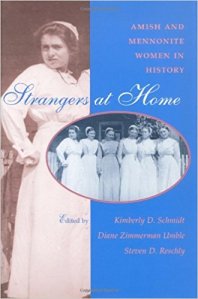
Strangers at Home

Strangers at Home came out of a landmark 1995 conference on Anabaptist women.

By the final day of the conference, one observer noted the gathering’s big-tent flavor:  “Many perspectives have been expressed underneath this canopy . . . . We have not been concerned with boundaries.” Johns Hopkins University Press was attracted to the gendered theme of the conference and subsequently published an edited collection, Strangers at Home:  Amish and Mennonite Women in History (2002), which highlighted European- and North American-focused scholarship (a notable exception was Marlene Epp’s “’Weak Families’ in the Green Hell of Paraguay”). 

Intensifying an international reach this time around, the June 2017 conference will focus on boundaries and border-crossings. Women from the Global South will participate. Students and scholars from a dozen countries are among the panelists and plenary speakers.  Each day, an invited scholar will address implications of border- and boundary-crossings.  Hasia Diner, New York University Professor of History, will speak on gender systems in ethno-religious immigrant communities. Cynthia Peacock of India, affiliated with Mennonite Central Committee for nearly four decades and a representative for Mennonite World Conference, plans to address church leadership in South Asia. And Sofia Samatar, a Somali-American writer and English professor at James Madison University, will be drawing from her own Arab and Mennonite heritage for her presentation, “Crossing Ethnicities.”

Sofia-Samatar

Sofia Samatar, professor of English at James Madison University, will be one of several plenary speakers at Crossing the Line.

Academic presentations on a wide array of topics, as well as an art exhibit, poetry readings, original dramatic performance, modern dance and ballet performances, and Shendandoah Valley cultural tours round out the conference offerings. In the spirit of the 1995 gathering, organizers of the upcoming Crossing the Line gathering hope the event will contribute to “mentoring relationships that crossed traditions and disciplines and age groups,” according to planning committee co-chair Kimberly Schmidt.

Watch this Anabaptist Historians blog site for regular updates and postings from participants throughout and after the conference. Participants may register for the entire conference or for a daily rate.  Registration, schedule, sponsorship, and lodging details are available via the conference website.

Rachel Waltner Goossen is a member of the conference planning committee and professor of history at Washburn University in Topeka, Kansas.

Holding to the Jot and Tittle: Deaconesses in Virginia Conference

Anna Showalter

I grew up in a Mennonite community that did not recognize women in positions of church leadership.  As times changed, I assumed that my sisters and I were the first generation of women in our family to imagine that our calls to ministry might be affirmed and even ordained by the Mennonite Church.  Imagine my surprise when my dad discovered that my great-great-great-grandmother, Elizabeth Shank Showalter, was ordained as a deaconess in 1889 to the Middle District of Virginia Conference!  As much as I celebrated the rediscovery of my deaconess matriarch, I also learned that church polity, influenced by a renewed zeal for doctrinal conformity, significantly confined the role of the deaconess, eventually making it obsolete.

elizabeth-shank-showalter

Deaconess Elizabeth Shank Showalter

Deaconesses were an anomaly in the (Old) Mennonite Church except for in the Middle District of Virginia Conference, where around 28 women were ordained as deaconesses loosely between the years of 1861-1962.1  Deaconesses were appointed to assist ministers in providing for the pastoral care and physical needs of women and girls and to help facilitate services of baptism, communion and footwashing.2  The role of deaconess, at its best, offered women an outlet for meaningful (albeit modest) ministry in the church complete with public affirmation through ordination (of a kind).  However, as power consolidated around conferences and Bishops, Mennonites began emphasizing doctrinal and behavioral uniformity.  As a result, the role of deaconess was significantly curtailed to focus heavily on monitoring women’s dress and behavior.  

Mennonite historians have amply documented increases around the turn of the century in ordered organizational structures in conferences, which consolidated power to Bishops and enforced order in doctrine, dress, and congregational life.3  This institutionalization was part of an attempt to secure and clarify Mennonite identity so that it could withstand the challenges of a modern era.  Maintaining doctrinal and behavioral compliance was a struggle, however.  In 1919, the Middle District of Virginia Conference reported that out of its 700 members only 100 men and 175 women “conform to the regulations of the church.” Leadership addressed this problem, saying, “We need to redouble our energy.  We need to hold to the…jot and tittle and it is necessary to place more emphasis on this subject now since the world is against it.”4

The responsibility for holding women to the “jot and tittle” fell to deaconesses.  Their work increasingly consisted of “visiting women and girls, members of the church who were out of line in dress, morals and conduct.”5  Holding the line included ensuring that other women were dressed properly, particularly for communion and baptism, sewing suitable garments for converts in mission posts and “visiting” (a euphemism for correcting) those who did not comply.  

Some deaconesses fully embraced their role in holding the line. Deaconess Betty Keener believed wholeheartedly in the importance of the bonnet and plain dress.  A missionary with her husband in West Virginia from 1909-1912, she sought to bring the women there into compliance with Mennonite standards of dress.  She was appalled to learn that “fault had been found” in a convert who ceased to wear her bonnet because she didn’t feel comfortable being the only woman her community to do so.  The woman was seen in “one of those big straw hats and jewelry.” The sister in question “flew off the handle” when confronted and said, “ If you can’t carry me as I am, scratch my name off the book.”  Betty expressed her disappointment.  “How could she?  How can it be possible for her whom we thought consecrated to fall away so soon?  What has done it?”6  

Other deaconesses, however, had more empathy with the “transgressors” and felt the burden of enforcing standards.  Frances Suter Harman, daughter of deaconess Pearl Suter, recalled impressions of her mother’s ministry in the 1930s and 40s.  “The deaconesses of those later years often felt that their duties were becoming onerous, as they tried to hold the line with the rules for the dress of the women.  They did this for the bishops who felt they should not become involved in overseeing that the women and girls were dressed properly for baptism and communion.”7  Another daughter remembers feeling how much her mother worried about the task of visiting sisters who had fallen into sin—a task assigned by church leadership as hers to “deal with.”

By the 1940s and 50s, as the work of the deaconess became more “onerous,” fewer deaconesses were ordained, and finally in 1962 the Middle District Ministerial Council decided that the wives of ordained men would perform the duties of deaconess but without title or ordination.  In her study of Virginia Conference deaconesses, Ruth Lehman suggests that the ministry of deaconesses had “become so mundane that the vision of the possibilities for the office in the life and growth of the church were no longer seen.”8  Someone still needed to bake communion bread, wash out basins for foot washing and attend to women’s needs in the church, but the role of deaconess had become so confined to upholding discipline that there was no longer vision for a recognized ministry role for women in the church.   The ministerial council decided that pastors’ wives should take over these tasks.  Thus, church polity, with its solidifying institutions and insistence on doctrinal and behavioral uniformity, first curtailed the role of the deaconess before finally phasing it out.

Thus, church polity, with its solidifying institutions and insistence on doctrinal and behavioral uniformity, first curtailed the role of the deaconess before finally phasing it out.

The story of my deaconess great-great- great-grandmother was completely forgotten by my family until my dad stumbled across it while doing family research.  We are surprised that my grandpa, a knowledgeable Mennonite historian, never told us about it.  His cousin compiled the deaconess list at the archive so surely he would have seen it.  We will never know if Grandpa didn’t know about his deaconess great-grandmother or if he chose not to talk about it because of his opposition to women in leadership.  In any case, those of us who know about Elizabeth Showalter and the deaconesses of Virginia Conference have the opportunity to remember forgotten leaders of our past and to be aware of how church polity continues to affect marginal leaders in our own day.  

Today women serve in a variety of roles in Virginia Mennonite Conference and are ordained as pastors.  Concerns about holding to the “jot and tittle” no longer pertain to plain dress, but issues of authority, decision-making, compliance and discipline continue to affect leaders in minority positions.  Are negotiations between ministry on the margins and conference polity once again “onerous?”  The future of a viable ministry for leaders in minority positions may depend on the answer to that question.  


  1.  Ruth K. Lehman, “Deaconesses of the Middle District of Virginia Conference,” (class paper, Eastern Mennonite Seminary, 1989), 40-42. 
  2.  Lehman, 14. 
  3.  James C. Juhnke,  Vision, Doctrine, War: Mennonite Identity and Organization in America, 1890-1930, vol. 3: Mennonite Experience in America (Scottdale, Pa.: Herald Press, 1989), 119. 
  4. Minutes of the Virginia Mennonite Conference (1835-1938), (Scottdale, Pa,  Virginia Mennonite Conference, 1939), 125. 
  5. Lehman, 14. 
  6.  Henry Brunk, History of Mennonites if Virginia 1900-1960, (Verona, VA. McClure Printing Company, Inc., 1972), 188. 
  7.  Lehman, 17. 
  8.  Lehman, 22.