Along with the introduction of electricity, vehicles, and running water during the 1970s, 80s, and 90s, during tumultuous times of community and colony reorganization in Chihuahua’s southern Mennonite colonies near the city of Cuauhtémoc, in Mexico’s Tres Culturas Region, one of changes that most deeply impacted daily life for Mennonite residents was the wide-reaching education reform that completely changed the educational landscape in the colonies over the course of fifty years, providing a greater level of educational access and diversity of school experiences within the Campos Menonitas, which still continues to impact education in all but the most traditional communities to this day.
Until the late 1960s, schooling in the Tres Culturas Region of Chihuahua followed the traditional Darpe Schule model beginning with Fiebla (basic reading and writing) around age six and continuing with Katekjisem (catechism) and Jesankbuak (hymnal), and ending with Bibel (Bible) around age thirteen with basic arithmetic also integrated throughout. In this model, which is still used today in the most traditional communities, instruction is given by one male teacher in High German in a one-room schoolhouse and involves recitation, dictation, and Langeviese singing and has an end goal of preparing students for baptism and daily life within the traditional Darpe community. Billy Froese, who attended a traditional Darpe Schule in the 1980s, described his experiences to the Rebels, Exiles, and Bridge Builders: Cross-Cultural Encounters in the Campos Menonitas of Chihuahua Oral History Project,
The girls are on one side, the guys are one side. That can also be a punishment. You go sit with the girls. And I at one time thought that was a punishment! But the fule Benkj” is the “lazy bench.” And if you’re not doing your work, up there beside the teacher, there’s a bench. This hard bench. And you go sit up there. Of course, there were spankings, stuff like that. But they had these big windows. And you had to stand in the window, facing the street [if you got in trouble]. I just remember the teacher coming to my desk and putting the pen in my right hand. Or the chalk. Whatever it was then. We had those little Tofels too. Those little chalk boards. And the chalk. So, he would start me off writing, and then he would leave. And I would just put it back in my left hand….My experiences, my most memorable experiences in the school aren’t positive. They’re interesting, but not so positive. It was usually getting punished.
Education reform occurred first in the Manitoba Colony and then was implemented later in the Swift Current, Ojo de la Yegua, and Jagueyes colonies. In each colony and each Darp within individual colonies, reforms were propelled by external and internal factors and often came in waves. Reforms were implemented at different times and to different degrees depending on the community and educational infrastructure, pedagogy and curriculum remains in flux across the Mennonite colonies in the Tres Culturas Region.
One of the largest external factors impacting reform, was the establishment of the Álvaro Obregón school in the Quinta Lupita community, located near the outskirts of Cuauhtémoc at the edge of the Manitoba Colony by Mennonite missionaries from Canada’s General Conference in the late 1960’s. The founding of the Álvaro Obregón school was followed in subsequent years by mission churches and schools from other Mennonite conferences as well as other from other denominations, such as the German Church of God. These schools had multiple instructors and classrooms divided by age, a wider range of subjects including geography and history, and instruction in Spanish. These schools became known as Konferensa (Conference) schools because of their association either directly or indirectly with General Conference missionaries and churches and enrolled students not only from their congregations, but also students from more traditional backgrounds whose parents were interested in educational options that were different from the traditional Darpe Schule.
At times, Konferensa churches, particularly with the assistance of missionaries of Canada, would build relationships with a much more traditional community and launch a school within the community primarily designed to serve traditional students, but with a more modern pedagogy and academically diverse curriculum, which included Spanish, like in Konferensa schools. With the introduction of Spanish into the curriculum, Mestizo teachers began working in Mennonite schools for the first time as Spanish language instructors and gained access and proximity to traditional communities that was previously unheard of. One of these teachers, Diana Sandoval Arballo, who began teaching in 1998 at a school launched in the Ojo de la Yegua Colony by Iglesia Anabautista Ebenezer, a Spanish-speaking Mennonite church in Cuauhtémoc whose congregation is about evenly split between Mestizo-Mennonite converts, ethnic Low-German Mennonites and Mestizo and Mennonite couples and their bicultural children, shared her experiences in 2018 with the Rebels, Exiles, and Bridge Builders: Cross-cultural encounter in the Campos Menonitas of Chihuahua Oral History Project
The church at Campo 67, in a Mennonite community, was looking for a Mestiza teacher, but with Mennonite faith, to work in the community. So, they invited me to go to work for a year, and I accepted. And that was the first time I had direct contact with the more traditional Mennonite community….I lived in the Campo. There was a couple that were teachers, and another couple that were the pastors. So, I worked with these teachers and lived with the pastors. But I lived in the community from Monday to Friday, and for the weekend I returned to Cuauhtémoc, to my house…The first years it was difficult. For them it was difficult seeing and living with a Mestiza in the middle of the community. Maybe my way of dressing was also different, and that drew attention. There was also a bit of fear, because they had someone unknown and didn’t know who I was, what I was going to teach, what I was trying to do…. I came for one year and I stayed 20, but I think my biggest motivation has always been to serve and I think that I have a desire because God uses me to be able to serve. And I saw that this would be the way the God would use me. Teaching people the faith, mainly, that is my first goal, and the second is, well, the language. And I also believe that one of the things that has always impassioned me is that they can see that the Mestizo culture is different than the idea that they have always had in their head. That I think is one of the biggest motivations in my life. And also, I fell in love with the Mennonite culture. For me, it was never difficult being with them. I can’t say that there was anything I had to sacrifice, it was a pleasure.
Though external intervention from Conference churches and schools, which included the transformational role of teachers like Diana Sandoval Arballo, played a large part in implementing education reform in the Tres Culturas Region, it would not have been possible without internal proponents for school reform, like Peter Rempel Enns, whose lifelong advocacy for education reform in the Mennonite Campos was chronicled by the State of Chihuahua’s Mennonite Resource Office’s 2016 publication, Hombres y mujeres menonitas destacados: Caminos inspirantes (Outstanding Mennonite Men and Women: Inspirational Paths). These local advocates for school reform were concerned about what they perceived to be low educational standards, low levels of literacy among graduates, harsh punishments, and an incomplete curriculum. Often advocates for school reform, particularly those within more traditional communities faced strong backlash from community leadership and some were excommunicated for their stances; however, as more families chose Konferensa schools at the same time that tensions were high in traditional communities concerning increased business and social relationships between Mennonite and Mestizo communities, the use of vehicles with rubber tires, and the introduction of electricity, questions began to arise with traditional church leadership about the best path forward concerning education. Some remained steadfast in their Darpe Schule model, but many more began to make small, but significant changes to their education systems.
Faced with external and internal pressures for school reform, Kleingemeinde and Old Colony communities sought a solution that they felt would allow them to raise their academic standards while maintaining their distinctive values and cultural practices. Beginning in 1995, through the MCC and a variety of other Mennonite aid agencies, they built relationships with Amish communities and schools in the United States and began receiving Amish teachers, not just in the Campos Menonitas of Chihuahua, but across Mexico, to teach in Kleingemeinde and Old Colony schools, and to assist in the restructuring of administration, curriculum, and assessment. (This topic is addressed more in depth in Rebecca Janzen’s 2019 Anabaptist Historians blog post, “How Much to Change: Amish Teachers in Mexico.”)
Perhaps the most significant impact to education in the Tres Culturas Region in recent history, was when many private, Mennonite church schools began seeking accreditation from Mexico’s Secretary of Public Education (SEP). SEP accredited Mennonite schools have to meet specific national curriculum, assessment, achievement and enrollment standards, but are allowed to have religious instruction and maintain cultural practices. While the majority of SEP Mennonite schools only include Primaria (Grades 1-6) and Secundaria (Grades 7-9), which are the levels of compulsory education in Mexico and the most common level of education among Gen-Z Mennonites in the Campos, particularly among those from less traditional communities, a few SEP Mennonite schools offer Preparatoria (Grades 10-11/12), which was previously only available at non-Mennonite public and private schools in Cuauhtémoc.
More and more students from the Campos have been going to study at the universities in Cuauhtémoc and Chihuahua. Even some of the most traditional Darpe Schule in the region have been taking steps to examine educational practices and standards within their cultural context. Adults from traditional backgrounds are beginning to finish SEP accredited Primaria and Secundaria schooling through ICHEA (The Chihuahuan Institute for Adult Education), while other traditional adults, including Peter Rempel, the principal of a Kleingemeinde school in the Manitoba Colony, who shared his experiences with the Rebels, Exiles, and Bridge Builders: Cross-Cultural Encounters in the Campos Menonitas of Chihuahua Oral History Project, have taken advantage of a government program called Prepa Abierta to finish their high school equivalency online. From Darpe Schule to high schools that prep students for university and everything in between, the Campos Menonitas in the Tres Culturas Region have an educational diversity that is unique and 50 years in the making.
From her teacher housing, provided to her by the SEP school that serves traditional students in Campo 38 ½ where she currently works, Diana Sandoval Arballo looked out her window into the Darp and commented on the changes that she had seen during her 20 years as a Spanish instructor in Mennonite schools
Over the course of years, the parents became more interested in the education of their children. They saw it as more important, the fact that they could learn. And they are more motivated to make the school grow. I think it happens with the passing of the years. They have lost the fear towards education, that is different than what they got. And they have been motivated more so that their children can go further, even though they learn different things, they dream of being a doctor, not just working in agriculture. So, I think that the change in these years that I have been here have been very big and the steps have been very steady toward education.
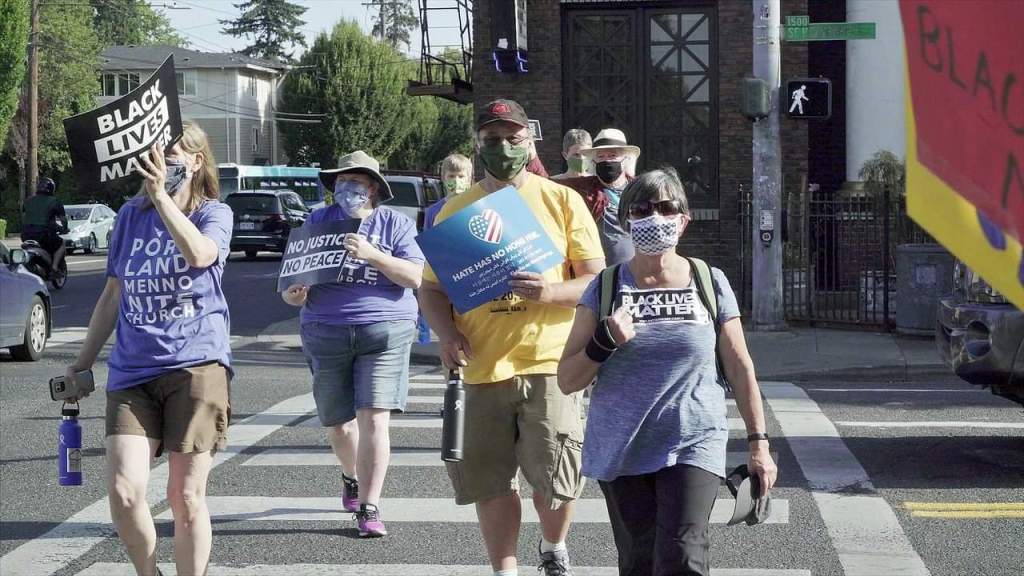
In early November of 2020, Mennonite Church USA asked pastors from across the country to share how their congregations engaged in community action during the 2020 Presidential Election. Manhattan Mennonite Fellowship in New York City hosted open mediations for peace before and after the election. Raleigh Mennonite Church in North Carolina focused efforts on “fair elections, poll watching, and get-out-the-vote efforts.” Joel Miller, the lead pastor at Columbus Mennonite Church in Ohio, served as a peacekeeper at the polls, ready to prevent, de-escalate, and reduce the violence that many feared would occur on election day. These leaders’ responses, published in Anabaptist World, described nine congregations that unabashedly valued political action inspired by their faith. In our unavoidably politicized world, it seems that the driving question for these and many other Mennonites is how does our faith lead us to participate in politics? Even in the very questions MC USA posed to their pastors (How are people in your congregation preparing to engage in community action?”), political participation was assumed. This assumption, however, was once a highly contested issue among Mennonites. The driving question that preceded our current query was at once more simple and more complex: does our faith lead us to participate in politics? This question came under severe scrutiny and reconsideration during the 1950s and early 1960s, as an emergent theological paradigm and the social and moral imperatives brought to bear by the Civil Rights Movement worked in tandem to forge among Mennonites a social conscience with critical political underpinnings. The arduous working-out of this nascent political identity was on full display during the 1964 Presidential Election.1
In the fall of 1964, The Gospel Herald, the denominational organ of the “Old” Mennonite Church, published an unprecedented degree of political coverage in the weeks leading up to the presidential election between President Lyndon B. Johnson and Republican challenger Barry Goldwater. The dozens of editorials, letters to the editor, discussion pieces, and official statements printed that fall revealed a complex religious and political milieu. In new and public ways, a Mennonite’s politics became a religious issue, and one’s spirituality became a political issue. Because political participation was still far from the modus operandi, Mennonites simultaneously debated the very practice of voting and, for those who would vote, the candidates’ merits. On all sides of these debates, Mennonite leaders and laity articulated religious and political arguments in their favor.
These divisions wrought by the 1964 Election were thrown into sharp relief that June when J. Lawrence Burkholder, a leading advocate of social responsibility in the “Old” Mennonite Church, suggested that the Committee on Economic and Social Relations (CESR) and the Peace Problems Committee (PPC) take a public stance on Barry Goldwater, a highly divisive Presidential hopeful closing in on the Republican nomination. Gravely concerned with Goldwater’s international and domestic policies, Burkholder suggested that a statement be published “help the Mennonites to form enlightened attitudes regarding Goldwater.” Such “enlightened attitudes,” Burkholder suggested, would reflect his view that Goldwater posed a serious “threat to the peace of the world.” Many of Burkholder’s and others’ arguments against Goldwater were founded in the Arizona Senator’s civil rights stance. His vote against the Civil Rights Act of 1964 was ambiguous at best and deeply racist at worst. Many Mennonites were equally troubled by Goldwater’s foreign policy, shaped willingness to use nuclear weapons and his criticism and rejection of the United Nations. Burkholder certainly recognized the risk in making such an overtly partisan political statement but believed that speaking out in an official church capacity was in order. As he saw it, the differences of conscience between Goldwater and the Mennonite Church were stark enough to avoid significant controversy. Moreover, he thought such an opportunity could be used to “help our people to think politically on one of the clearest issues in many years.”2
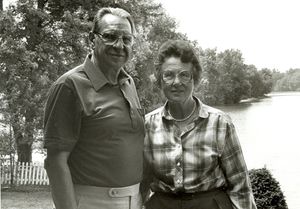
J. Lawrence Burkholder and his wife, Harriet, 1971
There was some precedent for a church committee to speak on political concerns during a national election. In the presidential election of 1960, the Peace Problems Committee made an official statement advising “old” Mennonites not to give in to or become involved in the anti-Catholic propaganda aimed at the Kennedy campaign. Motivated and justified by the religiosity of the issue, the PPC urged its members as “peace-loving nonresistant Christians” to “hold aloof from all such lower-level proceedings,” such as being swayed by or participating in the campaigns of misinformation and lies, as well as any general “electioneering,” all of which violated official church doctrine. Voting, however, was another issue. Because the church did not “forbid voting” as they did “electioneering,” the PPC left the matter up to the individual, only advising that one’s conscience not be swayed by “the current political pressures.” The committee members who faced Burkholder’s challenge in 1964 were reminded of their previous work but were undoubtedly aware of the difference between the explicitly religious problem of 1960 and the partisan declaration that Burkholder was suggesting. Moreover, as Hershberger reminded his fellow committee members, the PPC did not take a position for or against either candidate in 1960.3
Among members of the CESR and PPC, Burkholder’s proposal was met with mixed support. On the one hand, many “Old” Mennonite leaders shared Burkholder’s personal fear of the political dangers of a President Goldwater. Carl Kreider, for example, wrote that Goldwater’s “election would be a disaster to American foreign policy as well as to our domestic program.” Clearly, these Mennonites had been following the election and held developed opinions about the candidates and what they would do for the country. Writing the week after the Republican National Convention, John E. Lapp, who was still in disbelief about Goldwater’s nomination, feared “war, militaristic tactics in the race question, and break with Russia” would be all but certain under a Goldwater administration. On the other hand, however, most members were hesitant to go so far as to publish an official statement supporting or rejecting a specific political party or candidate. Opening this epistolary conversation which would play out over the summer, Guy F. Hershberger suggested that they ought not to consider the reactions of church members, but rather “whether in taking such a step we would be true to our obligation to give a true Christian witness.”4
Lay perception, however, dominated much of the discussion. Conservative Mennonites, whether theologically or politically so, were the primary concern of committee members. These leaders worried that an expression of support for Johnson or the Democratic Party would upset the laity, either because they supported the Democratic candidate or because they entered political discourse in the first place. The vital question of does our faith lead us to participate in politics? was an undercurrent of the conversation, explicitly shaped by the institutional nature of Burkholder’s proposal. Orie O. Miller summarized the concern of many of his moderate colleagues, writing that such a statement would “be entering into territory for which we have no mandate and probably no clear church position as a point of reference.” Without direction and blessing from the MC General Conference for such a political move, no matter how vague or issues-focused a committee statement might be, it was inadvisable. On the other hand, several members agreed with Burkholder that the positions that the MC General Conference had taken on race relations and nuclear warfare—which opposed to Goldwater platform clearly enough—was a sufficient mandate to warrant a statement, especially if it remained on the issues, not the candidates.5 Moderate members proposed a compromise that was eventually adopted, suggesting that instead of these church committees articulating an official position in a formal statement, several members submit a message to the Gospel Herald as individuals.
However, the views of Republican Mennonites received far more attention than those of religiously conservative, non-voting members.Lapp, who gave full-throated support for a statement detailing the moral and political dangers Goldwater posed, was optimistic about the political views of the laity: “Now the conservative elements of the church may be inclined to vote for Goldwater, simply because he is a Republican candidate, but I can’t for the life of me see how any nonresistant Christian could support the man.” On the other hand, Paul Landis and others predicted that any move against Goldwater’s platform would be “interpreted as an attack against [his] personality” and “a position in favor of the Democratic Party.” This sort of overt political statement, Landis feared, would lead many “old” Mennonites to lose confidence in the committee and the church. Many leaders’ desire to make a political statement on the election was itself contradictory: they were deeply concerned about the prospect of a Goldwater White House, but while they were aware of the Republican leanings of many “old” Mennonites, few wanted to upset their partisan constituency.
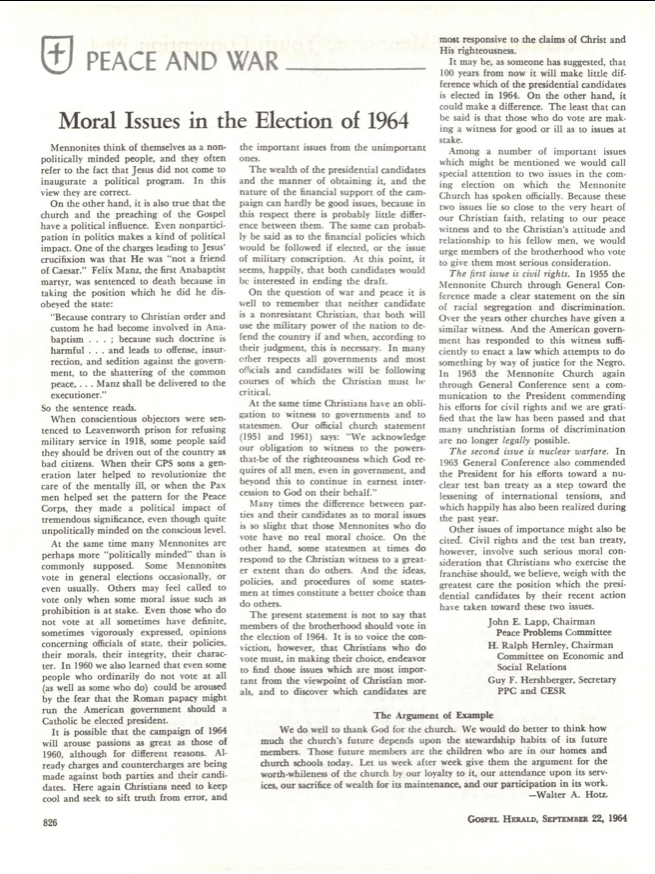
The resultant statement, “Moral Issues in the Election of 1964,” which appeared in the Gospel Herald on September 22, reflected the moderate consensus. The three authors—Lapp, Chairman of the PPC, Hernley, Chairman of the CESR, and Hershberger, Secretary of both committees—made no mention of Johnson or Goldwater or the Democratic or Republican parties in explicit terms, but rather “the candidates” and “the coming election.” In line with official church doctrine, these leaders left the questions of voting and political participationup to the individual and chose to focus entirely on issues of the election and Christian conscience: “The present statement is not to say that members of the brotherhood should vote in the election of 1964. It is to voice the conviction, however, that Christians who do vote must, in making their choice, endeavor to find those issues which are most important from the viewpoint of Christian morals, and to discover which candidates are most responsive to the claim of Christ and His righteousness.” This choice, in the eyes of the authors, was clear enough, considering that the issues of civil rights and nuclear warfare deserved “most serious consideration,” briefly citing previous church action on these issues. Far from the explicitly partisan statement Burkholder wanted, these issue-based suggestions for voting Mennonites reflected the MC leadership’s political limits.6
“Moral Issues in the Election of 1964,” Gospel Herald, September 22, 1964
However carefully Hershberger and the other authors may have tread, readers had no trouble “read[ing] between the lines,” as one Elkhart Mennonite opined. “It seems the Peace Problems Committee might just as well have come out in the open, and endorsed the one party.” Bill Sauder penned an even more blunt criticism and missed (or ignored) the nuance entirely: “I find distressing the committee’s statement. . . in which they advise Mennonite church members to vote for the Johnson-Humphrey presidential ticket if they vote at all.”In the weeks between the publication of “Moral Issues in the Election of 1964” on September 22 and Election Day on November 3, fourteen Mennonites (a remarkably large number of respondents to a single topic) wrote to the Gospel Herald to weigh in, expressing everything from extreme gratitude and support to dismay and harsh opposition.7
Facing this gambit of responses, John M. Drescher, editor of the Gospel Herald, grappled with how to present these issues to the Mennonite community. In a private letter to Guy F. Hershberger the week after “Moral Issues” was published, Drescher wrestled with the paradox of neutrality created in this contested theological and political space. Politically, some urged him to remain neutral and give equal coverage of all political and theological positions. In contrast, others demanded that he publicize whom he is supporting in the current election. On the theological axis, Drescher faced pressure to stay entirely out of politics by some and wholeheartedly enter into the political fray by others. These pressures, Drescher lamented, had been “heavy and hard” from all sides during this particular election season. Privately, while Drescher watched the political proceedings with great interest, he felt “that every election is basically the same” and was not particularly excited about either ticket. However, as the editor of the denominational organ, he strove to avoid partisanship and only discuss political issues when clearly “in the light of Scripture.”8
Even this distinction, though, was a bridge too far for several readers, who wrote in lamenting the publication of politically-focused material: “I would much rather read my political speeches in a public newspaper than to read it in what is supposed to be a church paper covering the religious aspects instead of the political.” Wilbur M. Wyse strongly advocated for an entirely non-political Gospel Herald, but he nevertheless held his own strong political opinions: “The thing that alarms me most is that so many of our Mennonite professors from our church colleges lean so strongly toward the Socialistic Party, or the Democratic Party, if you want to call it thus. . . .” (ellipsis in original). Indeed, most of the condemnation of Drescher’s handling of the organ came from political conservatives who desired more balanced coverage of the candidates and the issues. Concerning church involvement in politics, theological conservatism went hand in hand with political conservatism, while theologically liberal Mennonites (that is, those who advocated political action within the church) represented all angles of the political spectrum. It stands to reason, however, that those most likely to comment at length on the political issues covered in the Gospel Herald would be the most politically informed, while the non-participatory Mennonites would remain quiescent.9
Several weeks after the publication of “Moral Issues in the Election of 1964” and amid the ongoing debate in “Our Readers Say,” the Gospel Herald ran Paul Peachey’s “Faith, Fear, and the 1964 Elections.” Peachey, Secretary of the Church Peace Mission in Washington, D.C., and a former professor of sociology and church history at Eastern Mennonite College, took aim at the Goldwater platform but did so from an entirely different position than those that preceded him. In Peachey’s view, the rise of “New Republican Radicals,” led by Goldwater, the John Birch Society, and the Minutemen, was a reactionary movement to the “shattering” of the illusion of religiously-founded American exceptionalism brought on by the Civil Rights Movement and the Cold War. “The notion that America was. . . endowed with a kind of redemptive mission in the world, was clearly a distortion of the “chosen people” theme of the Bible,” from which Americans have incorrectly and dangerously viewed their “wars as righteous and holy.” His main concern was with this emergent radical faction that was gaining a strong influence over the traditional political left. Goldwater, Peachey argued, “posed a real peril to Christian faith.” Standing “firm in faith, [and] in witness and obedience in the face of communist evils” is one thing, he wrote, but it another thing entirely to follow Goldwater and “shoot the men who we think are disobeying God.” Thus, Peachey’s aim was not to condemn “the Republican party as such,” nor to endorse “the Democratic platform,” but rather to warn his fellow Mennonites of the dangers of Goldwater and “the Republican platform of 1964,” for its dangerous “idolatrous nationalism which seeks to play God among the nations of the world.” With this line of argumentation, he further blurred the distinction between the political, the religious, and the relationship between the two in the pages of the Gospel Herald.
Upon entering this discourse, Peachey received several statements of support in “Our Readers Say,” but also drew the same criticisms that Hershberger and his colleagues did: he was too partisan and too political in the public space of the Gospel Herald. Curiously, however, the center of the conversation remained centered around “Moral Issues” and seemed somewhat unaffected by Peachey’s bold article. Perhaps the most striking reaction to Peachey’s article came from Isaac Hershey, Jr.: “If Bro. Peachey is truly an alien here, he will not vote and aliens should not criticize the government under which he has permission to live. . . I count it a privilege to vote for Mr. Goldwater.”10
The final full-length article to address the presidential race appeared in the Gospel Herald on November 3, election day, and was written by none other than J. Lawrence Burkholder. Occasioned by a summer of political discussions in his home church, the Mennonite Church of Boston, and perhaps displeased with the direction the CESR and PPC took his suggestion that June, “A Congregational Discussion of Political Decisions” laid out the views of Burkholder and his fellow Boston Mennonites on the church’s responsibility in American politics and society. After prayerful study of the Bible, sermons, and campaign issues, these Mennonites agreed that political issues are indeed the church’s concern. As such, congregations and individuals should discuss the positions and qualifications of specific parties and candidates. They agreed with the reasoning of Hershberger, Hernley, and Landis, that the church should help its members face political issues and decisions “in the light of the Christian faith,” but pushed even further: “Moreover, when the church, through corporate effort, has reached a consensus on a political matter, it cannot remain silent, but must give witness to its decisions.” While they noted “the civil rights problem” and America’s global “responsibility” as the two most important political issues that confronted Christians, Burkholder made no mention of Goldwater or the Republican Party as he was so keen to do that summer. Published on election day, however, this cry for political discourse and participation in the life of the church took a forward-looking position that stressed the constant importance of political witness.
Alongside this statement from Boston Mennonites, Drescher gave considerable attention to lay voices in the November 3 issue, publishing ten politically-oriented letters in the “Our Readers Say” column. Here, as in previous publications, ordinary Mennonites issued their support or condemnation for “Moral Issues” and “Faith, Fear, and the 1964 Election” on theological and political grounds. In nearly every instance, readers demonstrated that they were acutely aware of the political issues at play and had formed developed personal opinions. Moreover, many folks grounded their political stance in their conception of Christian morality. In other words, they had done—and had been doing—what Hershberger and his colleagues were calling them to do. Ironically, and much to these leaders’ chagrin, most of these laypeople supported Goldwater and thus chastised “Moral Issues” whole cloth for its thinly-veiled liberalism.
Perhaps most demonstrative of this pattern is Maurice W. Landis. This Lancaster Mennonite expressed his gratitude to the authors of the September 22 article, complimenting them on “rightly alert[ing] us to the fact that there are unprecedented moral issues in the 1964 election.” Deftly, however, he flipped the statement on its head and wrote an extensive analysis of political issues in light of Christian morals that led to the support of Senator Goldwater’s conservative platform. He implored readers to evaluate each candidate on the moral issues that Hershberger’s statement failed to address, including where the candidates stood on “compromising with the enemies of God” and recognizing God and permitting the Bible to be read in schools,” as well as supporting “free enterprise as taught in the Bible.” Landis demonstrated his keen interest in the nuances of domestic and foreign politics and articulated them in terms of his own view of Christian morality. He was not alone in his views either; several other faith-conscious and politically-conscious Mennonites wrote in voicing their economic concerns and the importance of school prayer. Joni D. Yoder went so far as to say that “as far as a moral issue is concerned and as far as putting souls at stake, such things as the Supreme Court ruling against prayer in public schools. . . far outweigh[s] an issue of fear of nuclear weapons.” The efforts of Landis and his right-leaning brothers and sisters to sway fellow Mennonite voters underscores the fact that political participation based on Christian morality was not entirely a liberal movement, but a pattern that emerged on both sides of the political spectrum during this era. Moreover, the “old” Mennonite leaders’ decision to counsel their members on moral issues rather than specific candidates and parties opened the door for their original intent to be turned against them. As we have seen, though, this was a double-edged sword; their moderate position and vague language were still too radical for many conservatives.11
After the Johnson victory on election day, political discourse in the Gospel Herald fell silent. As the dust settled from these debates about the role of the church in political participation and discourse, it appeared that few minds had been changed. In one sense, the leaders and laity of the “old” Mennonite Church were still working through the thorny question of does our faith lead us to participate in politics? As the Gospel Herald‘s active readership demonstrated, however, the new issue of how faith directed political opinion and participation had emerged as an intricate and divisive issue for the church and its members. The fact that these two questions were inextricably linked and progressing at different speeds and in different directions throughout church adds to the layered complexity of this election-season eruption. Although these issues were in no way resolved, the fall issues of the Gospel Herald powerfully demonstrated that the age of public quietism was waning and that political discourse and participation was very much alive among Mennonites.
1. Mennonite Church USA, “MC USA Congregations Prepare for Bold Peacemaking Amid Election,” Anabaptist World, November 2, 2020, https://anabaptistworld.org/mc-usa-congregations-prepare-for-bold-peacemaking-amid-election/. For the theological, social, and political changes during the middle decades of the twentieth century and the specific impact of the Civil Rights Movement, see Perry Bush, Two Kingdoms, Two Loyalties: Mennonite Pacifism in Modern America (Baltimore, MD: Johns Hopkins University Press, 1998); Leo Driedger and Donald B. Kraybill, Mennonite Peacemaking: From Quietism to Activism (Scottdale, PA: Herald Press, 1994); Tobin Miller Shearer, Daily Demonstrators: The Civil Rights Movement in Mennonite Homes and Sanctuaries (Baltimore, MD: Johns Hopkins University Press, 2011).
2. J. Lawrence Burkholder to Guy F. Hershberger, June 22, 1964, Guy F. Hershberger Collection, 1896-1989, MS 1-171, b. 21, f. 20, Mennonite Historical Library. The entire committee correspondence regarding Burkholder’s proposal is in this folder, hereafter referred to as GFH.
3. Peace Problems Committee, “A Statement by the Peace Problems Committee Concerning Involvement in the Religious Issue of the Current Presidential Election Campaign,” Gospel Herald, October 11, 1960, 890.
4. Carl Kreider to Guy F. Hershberger, August 12, 1964, GFH; John E. Lapp to Guy F. Hershberger, July 23, 1964, GFH; Guy F. Hershberger to Members of the Committee on Economic and Social Relations, July 10, 1964, GFH.
5. Orie O. Miller to Guy F. Hershberger, July 27, 1964, GFH. Some members of the CESR and PPC found precedent in the communications sent from the “old” Mennonite General Conference to President Kennedy, enough so to cite them in the statement they produced: John E. Lapp, H. Ralph Hernley, and Guy F. Hershberger, “Moral Issues in the Election of 1964,” Gospel Herald, September 22, 1964, 826. For a copy of the telegram commending Kennedy for signing the nuclear test ban treaty and expressing the church’s support of the administration’s position on civil rights and racial justice, see Arnold Cressman, “General Conference Meets at Kalona,” Gospel Herald, September 3, 1963, 787. Also, see Mennonite General Conference, “The Way of Christian Love in Race Relations” (Hesston, KS: Mennonite General Conference, 1955).
6. Lapp, Hernley, and Hershberger, “Moral Issues in the Election of 1964,” 826.
7. Harold S. Alexander, “Our Readers Say,” Gospel Herald, October 27, 1964, 942; Bill Sauder, “Our Readers Say,” Gospel Herald, November 3, 1964, 965.
8. John M. Drescher to Guy F. Hershberger, September 29, 1964, Guy F. Hershberger Collection, 1896-1989, MS 1-171, b. 21, f. 21, Mennonite Historical Library, Goshen, IN.
9. Wilbur M. Wyse, “Our Readers Say,” Gospel Herald, November 3, 1964, 965.
10. Isaac Hershey, Jr., “Our Readers Say,” Gospel Herald, November 3, 1964, 965. For other reactions to “Faith, Fear, and the 1964 Election, see Wyse; Allan Eitzen, “Our Readers Say,” Gospel Herald, November 3, 1964, 965.
11. Maurice W. Landis, “Our Readers Say,” Gospel Herald, November 3, 1964, 966; Joni D. Yoder, “Our Readers Say,” Gospel Herald, October 6, 1964, 860.
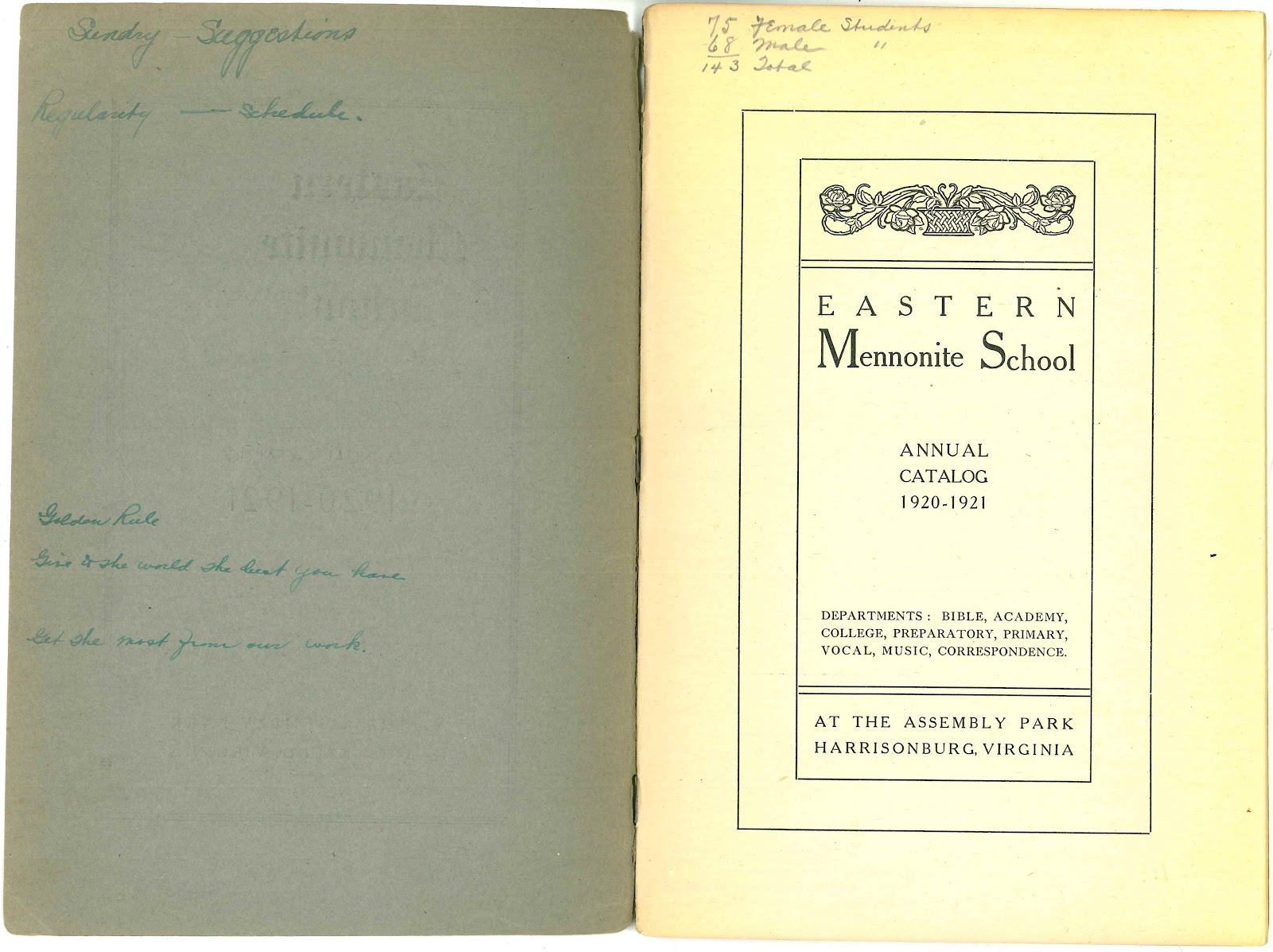
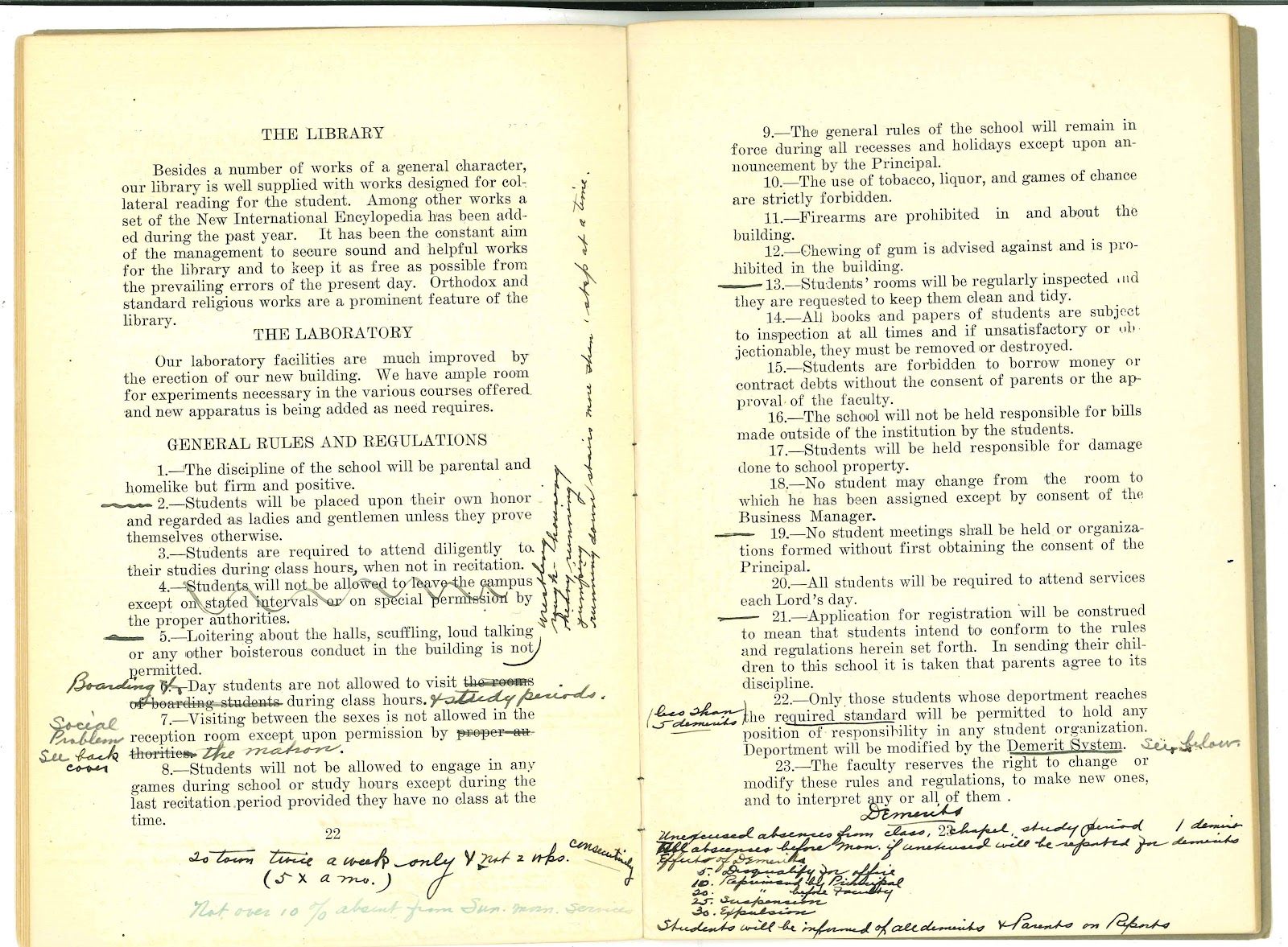
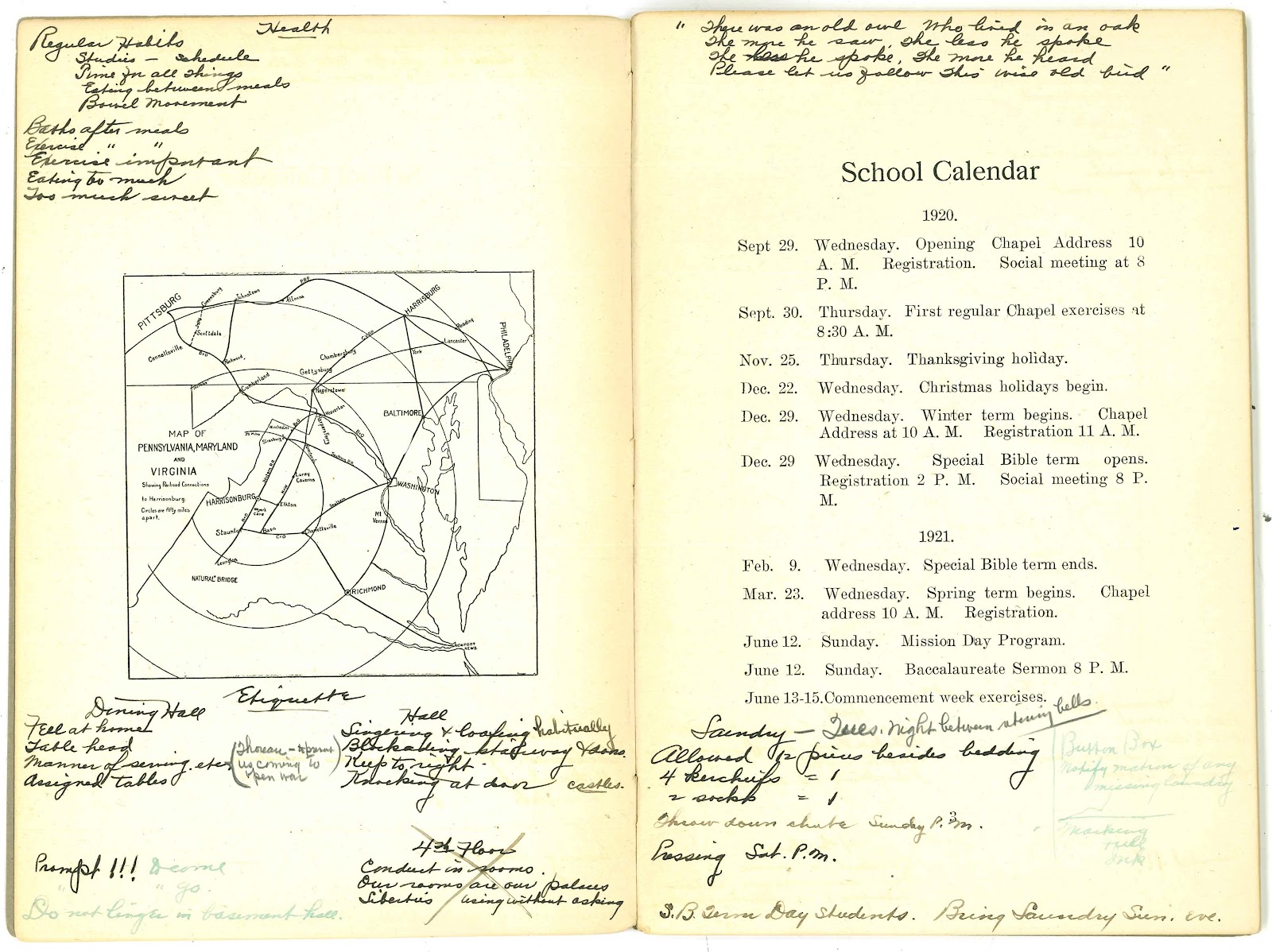
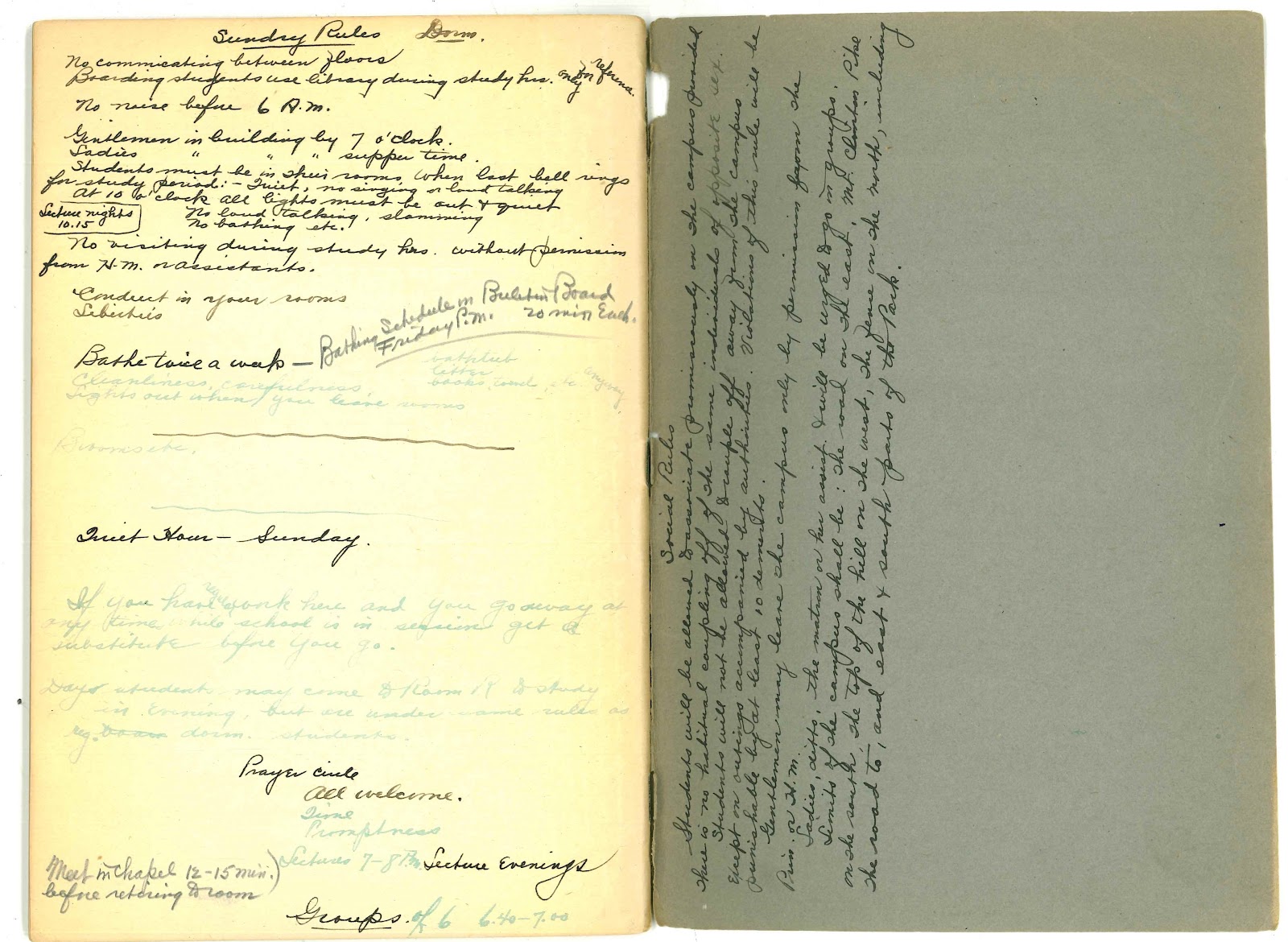
While processing a recent box of donations, I happened upon an Annual Catalog from the 1920-21 school year at Eastern Mennonite School. As I leafed through it, I found handwriting all throughout the margins. There is no name on the catalog, so it could have been a student eager to remember all the rules or a member of the faculty or staff taking notes so they knew how to guide their pupils. Either way, these notes provide a revealing look at the minutiae of life at EMS a century ago.
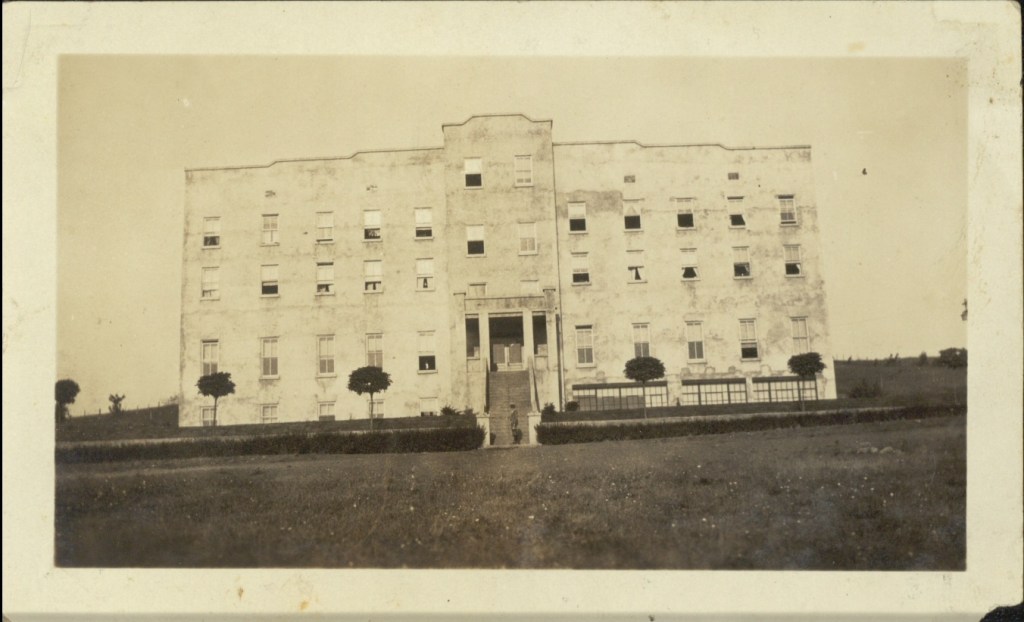
EMS was in its fourth year in 1920-21 and the fledgling school was finding its wings. In January of 1920, students and faculty moved up the hill from the White House in Park Woods to the newly built Administration Building. As the only building on campus, it was the focus of campus life. Students studied and lived all together under one roof. Enrollment was 216, nearly triple the first year’s enrollment of 77.1
EMS Administration Building
The rules were numerous at EMS in 1920-21, so our scribe was savvy to take notes. The first rule under, “General Rules and Regulations” sets the tone, stating that, “The discipline of the school will be parental and homelike but firm and positive.” The rest of the 23 rules and regulations cover behavioral expectations both in and out of the classroom.2 EMS sought to educate young people to become good workers for the Mennonite church, and their rules were meant to keep students in good standing with the school, the church, and their fellow students. The “Discipline and Decorum” section states that “for a denomination to maintain and perpetuate doctrines which are unpopular and the observance of which call for self-denial and non-conformity to the world, she must exercise a rigid and judicious discipline.” and “It should not be considered that obedience and submission to wholesome discipline and authority militates against the happiness of man, or that it infringes upon his real liberty”3. Following the rules was required to maintain the harmony of community at EMS and foster an environment where learning was possible.
Here is a sampling of what was noted in the catalog:
On curfews and timeliness:
“Gentleman in the building by 7 o’clock. Ladies in the building by supper time.”
“Prompt to come, prompt to go. Do not linger in basement hall.”
In the halls, one must not linger or loaf habitually or blockade the stairway and doors.
“Students must be in their rooms when last bell rings for study period. At 10 o’clock all lights must be out and quiet”
“No noise before 6 A.M.”
On relationships:
“Students will be allowed to associate on the campus provided there is no habitual coupling off of the same individuals of opposite sex”
“Students will not be allowed to couple off away from the campus except on outings accompanied by authorities. Violations of this rule will be punishable by at least 10 demerits.”
“No visiting during study hrs. without permission from H.M. or assistants”
On personal health:
“Bathe twice a week–bathing schedule on bulletin board Friday P.M. 20 minutes each”
“Have a study schedule, refrain from eating between meals, exercise regularly, and avoid too much sweet.”
Failure to follow these rules, along with other infringements like unexcused absences could result in a demerit. The writer notes that five demerits disqualify someone from office (for school clubs or literary societies), 10 earn a reprimand from the principal, 20 a reprimand before the faculty, 25 suspension and 30 expulsion.
There was at least one perk of 1920 EMS–someone else does your laundry! The scribe writes that students were allowed 12 pieces besides bedding and were to throw their items down the chute Sunday afternoon.
Though the above rules have gone, the 2020-21 school year at EMU has seen a new crop of regulations–this time for the physical health of all on campus and in the wider community. Due to the COVID-19 pandemic, students must do their best to observe social distancing, mask wearing, and there are limits on the dining hall, athletic spectators at games, and gathering size. Following the rules is yet again required to maintain the harmony of community and to foster an environment where learning was possible. Though the methods and reasoning look different a century on, I believe the hoped for outcome is the same: a conscientious and caring community that prepares students to make a difference in the world.
1. Kraybill, Donald B. Eastern Mennonite University: a Century of Countercultural Education. University Park, PA: The Pennsylvania State University Press, 2017. p. 343.
2. Eastern Mennonite School. Annual Catalog 1920-21. p. 22-23.
As a Swabian from Stuttgart in southwestern Germany, I am frequently asked about my Anabaptist roots by Mennonites, Amish, and Hutterites I encounter during archival field trips. Lutz is not an Anabaptist household name, compared to Hofer, Krehbiel or Janzen. There are a few Lutz’s among American Anabaptists though. For example, during my research I came across a Mennonite named Clarence Lutz from the Lancaster Mennonite Conference. My father, from whom I inherited my last name, hailed from a small Franconian village in the region of Hohenlohe in northeastern Württemberg, not far from Anabaptist centers in the early modern period. But as far as I know, there are no direct Anabaptist connections in my family.
It would be another story to delve more into the question of why it seemed so unusual to American Anabaptists for an outsider would be interested in their history. Here, I will focus on a different topic: the role of kinship in modern societies.
Until recently, historiography held that kinship was a distinctly pre-modern form of social identity and organization. For the European context, this narrative suggested that kinship groups were a common, possibly dominant way of structuring social relationships in the Middle Ages and the early modern period. Modernization processes such as the emergence of the modern state, the market and voluntary associations then gradually replaced kinship’s societal functions.
Social historians David Sabean, Simon Teuscher and others have convincingly argued against this perspective: Far from losing ground, kinship structures outlived the threshold to modernity in Western societies. Indeed, Sabean and Teuscher consider the nineteenth century as a “‘kinship-hot’ society, one where enormous energy was invested in maintaining and developing extensive, reliable, and well-articulated structures of exchange among connected families over many generations.”1
In my previous work, I have looked at the case of the Siemens entrepreneurial family2 where these patterns appear as an important element in shaping business strategy in the nineteenth century. The Siemens Stammbaum (family tree) and various family institutions have since then played a considerable role in tying the various branches of the vast kin group (and its wealth) together.3
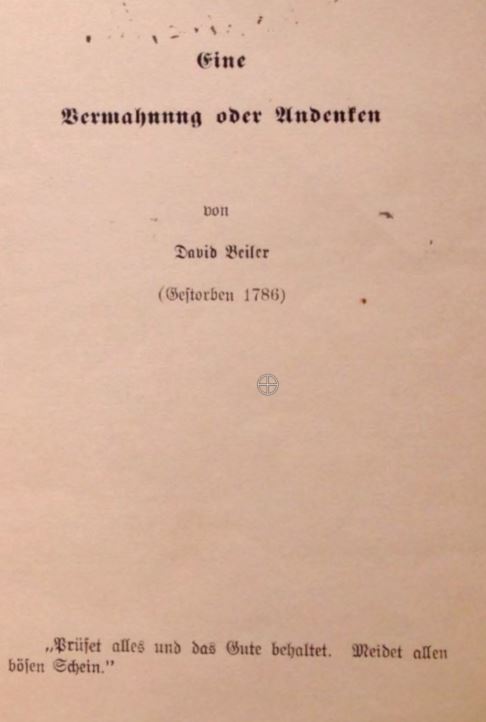
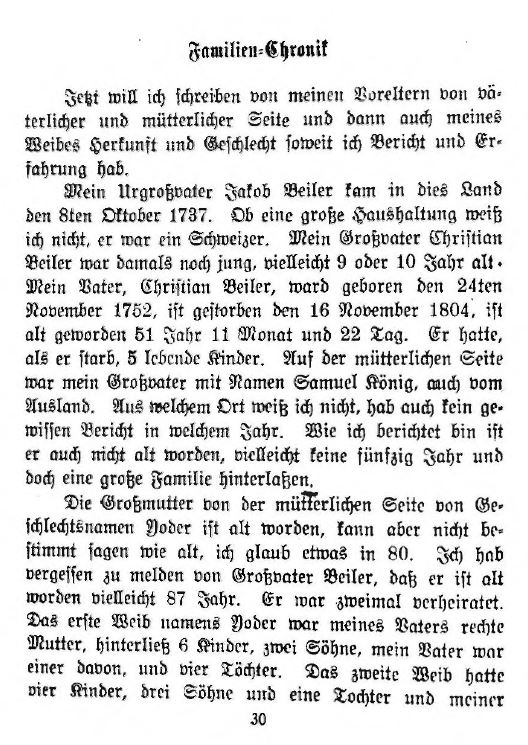
The front page of David Beiler’s “Vermahnung oder Andenken,” printed in 1928. Beiler was born in 1786, not “gestorben.”
It appears that similar notions of kinship evolved among the Amish and Mennonites in nineteenth century America. I recently took a closer look at David Beiler’s memoir “Eine Vermahnung oder Andenken” from around 1860.4 Beiler was a prominent Amish bishop who was involved in the formation of the Old Order congregations in the 1860s and 1870s. He might be most famous for his book Das wahre Christentum, and his memoirs offer a rare glimpse into the perception of change by an Amishman in the nineteenth century. Less prominent in the scholarly literature is the Familien-Chronik at the end of Beiler’s memoir where he gives a detailed account of his ancestors.
For his and his wife’s paternal and maternal ancestors, Beiler outlines the Herkunft (ancestry) and Geschlecht (lineage). For each line, there is one distinct progenitor (Stammvater) listed as the point of origin. For example, Beiler’s great-grandfather Jakob Beiler, a Swiss Anabaptist, immigrated to America in 1737. On his maternal side, the progenitor was Samuel König, also an immigrant. Whenever the information available to him allows it, Beiler then lists the number of sons and daughters in each household (Haushaltung), and how many lived long enough to found their own families. It is somewhat striking how Beiler’s Familien-Chronik resembles contemporary European efforts to document and construct familial ancestry. As with the Siemens Stammbaum, it represents an effort to build shared ancestry as an imagined community, to borrow Benedict Anderson’s words.
The sociological and anthropological literature stresses the ongoing role of kinship relations among twentieth century Amish and other Anabaptist groups.5 The ubiquitous Mennonite “name game” certainly reveals the importance of ancestry even in the twenty-first century. Steven D. Reschly’s work on nineteenth century Amish demonstrates how these patterns were a crucial aspect in communal boundary maintenance and transmission of property across generations.6 This literature implies that the Amish kinship system is a rather specific form of social organization distinct from the majority society in the modernizing context of the United States and Canada.
The first page of the Familien-Chronik.
As part of my overall research agenda, I am interested in how social relationships shaped economic interaction in the nineteenth and twentieth century. While the Siemens industrialists and the Amish farmer David Beiler appear to be on the opposite ends of a spectrum, I am convinced that their joint reference to the kin group holds important lessons for economic and social historians. If we follow Sabean’s and Teuscher’s larger interpretation of kinship in the nineteenth century, it would appear that Beiler’s Familien-Chronik fits perfectly with these larger developments in the Western world. At least in Beiler’s case, American Anabaptists appear to be as “kinship-hot” – and indeed as “modern” – as the emerging bourgeois class in Central Europe.
1. David W. Sabean and Simon Teuscher, “Kinship in Europe: A New Approach to Long Term Development,” in Kinship in Europe: Approaches to Long-Term Developments (1300-1900), ed. David W. Sabean, Simon Teuscher and Jon Mathieu (New York: Berghahn Books, 2007); Chapter I, 13.
2. Martin Lutz, Carl von Siemens: Ein Leben zwischen Familie und Weltfirma, 1829-1906 (München: C.H. Beck, 2013).
3. Siemens-Familienstiftung and Werner Siemens-Stiftung, Stammbaum der Familie Siemens: Aus Anlaß der 600jährigen Wiederkehr des ersten urkundlichen Nachweises des Namens Siemens in Goslar, 1984 neu bearbeitet von Sigfrid von Weiher (München: Selbstverlag, 1985).
4. David Beiler, Eine Verwahrnung oder Andenken, 1862, II-MS-29, Eastern Mennonite University Archive.
5. In the older literature, John A. Hostetler stresses the small-scale and genealogical embeddedness of Amish society. John A. Hostetler, Amish Society (Baltimore: Johns Hopkins University Press, 1993), 12 For more recent discussions see: Vlatka Škender, “Flesh, Freundschaft, and Fellowship: Towards a Holistic Model of the Amish Kinship System,” Journal of the Amish and Plain Anabaptist Studies 8, no. 1 (2020); John A. Cross, “Amish Surnames, Settlement Patterns, and Migration,” Names 51, 3-4 (2013).
6. Steven D. Reschly, The Amish on the Iowa Prairie, 1840 to 1910 (Baltimore, Md: Johns Hopkins Univ. Press, 2000), 119.
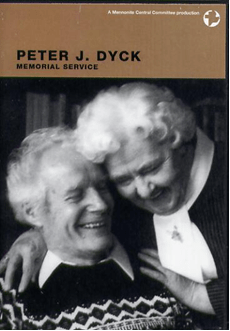
My little granddaughters love stories. A favourite is “Our Lives Together.” These excerpts from the reel-to-reel films that their great-grandfather Peter Dyck took on his movie camera, memorialize the work that he and his wife Elfrieda Klassen Dyck shared as Mennonite Central Committee volunteers in post-war England.1 Mennonite Central Committee has thrived during its one hundred-year history by virtue of such stories that North American workers have told about their experiences in the some sixty countries where they have served.
As Anabaptist historians, our mission is not so much to tell our own stories; we focus on people from the past. Biographers preserve the memory of individuals whose lives have the capacity to inspire.2 Although some do “quite explicitly” weave their “own lives into discussion of others,” the historical profession encourages us to keep a distance, to maintain objectivity.3 Historians tell the stories of individuals whose lives have made a difference in the public domain – leaders and institution builders, people who have left documents allowing their contributions to be tracked. Take for instance, GAMEO (Global Anabaptist Mennonite Encyclopedia On-line).4 Brief articles provide glimpses into the lives of hundreds of men and women who are deemed to have made significant contributions to the church. Carefully contained within the interpretative framework designed by GAMEO’s management team allows for what Leon Edel, well-known as the doyen of biography, has described as “a successful biography,” one that keeps the focus on public life and institutions.5 The GAMEO format allows the biographer to disengage and write the life of another with detachment.6
The traditional view has been challenged and expanded by what biographer Barbara Caine labels as a “new biography.” In contrast to Edel, with his formula for the “successful biography,” feminist methodology allows for questions that are “more personal and impressionistic.”7 Acknowledging that “potentially all lives are of interest and worth writing and reading about,” greater fluidity opens the way to consider the struggles that individuals have faced.8 This expanded biographical approach has demonstrated that “the extent to which one individual shares experiences and problems with others,” is often what makes a life worth remembering.9
Feminist theory and social historical methodology have shaped my own writing of biography. The permission that these disciplines allow to explore little known lives, “reading between the lines,” to use Betty Jane Wylie’s words, inspires my inner detective.10 In my life as a historian, I have found meaning in searching out and writing the lives of individuals, most previously virtually unknown.11
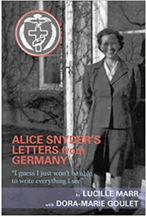
Take, for instance, my biographical work on Alice Snyder (1917 – 2000). Searching out the story of this long-time MCC worker began as I researched the history of MCC Ontario for what would be published as Transformation of a Century. Alice Snyder’s work in the MCC Ontario Cutting Room, with her mother Ida Snyder, turned out to be foundational to MCC’s work during World War II.12 After the war, Alice would take on the challenge of volunteering in post-construction Germany. Although Alice’s schooling had ended with grade eight, her letters home from Europe proved to be a historical document worth publishing.13
Scholars have noted the significant place that letter writing has played in nurturing family ties in times of separation.14 Alice’s letters had done exactly that. Perhaps “the secret bestower of possibility” that had eluded her in her own life, Alice’s mother Ida preserved her daughter’s letters from Germany in a small black binder.15 Alice’s letters home provide insights into what a young Waterloo County Mennonite woman, with a mere grade eight education, deemed worthy of preserving and sharing with her family from her work with MCC. With their ultimate destination in the Mennonite Archives of Ontario, they also have bestowed possibility for later generations. Indeed, Alice’s letters inspired at least one of my research assistants on the letters project to do her own stint overseas in voluntary service.16
Griffen has noted the traditional wisdom “that every woman is her mother.” As much as her suggestion that “it may be that every woman of achievement is, in part, paying a debt to the past, bringing to fulfillment her mother’s dreams and potential,” reflects the mission of Ida and Alice Snyder, it resonates with the life and mission of Lucille Brechbill Lady (1910 – 1968).17 With her mental health challenges, Lucille Lady was remembered in the public record solely as a burden to her husband Jesse Lady, a prominent Brethren in Christ church leader.18 As I explored the hidden recesses of the historical record to bring her story to light, writing became a path to healing.19
In recent times biographers have become more open to exposing the personal challenges and difficulties of their subjects. With this biographical project, the burden of my great-aunt’s suicide that I felt as one carrying her name, miraculously, was lifted. Travels to California, Indiana, and Pennsylvania, places where she and her husband had lived and ministered, brought opportunities to interview people who had been close to her, some also still suffering from the aftermath of her suicide.
Out of these connections materialized documentary evidence, including family letters, her Bible, her wedding certificate, school yearbooks, and even a tape recording of her funeral.20 For the biographer, a fertile imagination is a strong asset.21 A decade of research, slowly put the pieces of the puzzle in place, creating a picture of a life well worth remembering – an intelligent, caring nurse, teacher and writer, a woman who was a devout Christian and church woman, a mystic, and a devoted wife, aunt, sister, sister-in-law, daughter and friend.22
Griffen’s notion of paying a debt to the past also speaks to my current biographical work on H. Frances Davidson.23 In the mid-1970s, when Morris Sider memorialized this icon well-known among Brethren in Christ and Mennonites, especially in Zambia and Zimbabwe where she lived out her long missionary career, I was a young woman seeking a script to follow.24 In feminist historian Gerda Lerner’s words, as women growing up in the post-war years we were still “denied the power to define, to share in creating the mental constructs that explain and order the world.”25 I was among those looking for role models, “an idealized maternal figure,” as Caine has put it.26
Now nearly fifty years later, my inner detective continues to delight in the search for past lives. This work is delicate.27 And yet, it is important work as we attempt to pay back some of the debt owed to our foremothers, women like H. Frances Davidson who struggled to find their way without scripts to follow. As Morris Sider has noted, subjects like Davidson who left ample documentary evidence are dear to the hearts of historians.28 The multiple primary documents that she left – her diaries, a travelogue, letters to family, photos, and writing for the Evangelical Visitor await further exploration.
H. Frances Davidson, whom biographer Morris Sider has identified as a “woman with great stores of energy … one of the most extraordinary and striking persons to have held membership” in the Brethren in Christ denomination,” has become a symbol for female leadership among the membership, both in North America and in Africa. She was also a woman with a rich inner life.29 With the tools of the social historian and feminist methodology, it is possible to ask and explore questions about her family, her education, the geographic and social context of her life and work. In addition, as other feminist scholars have observed, the exploration of women’s inner lives, their spirituality, is essential as we continue to create scripts to follow.30 In my role as Anabaptist historian I am anticipating many more challenges and joys as I continue to explore the reality and constraints of this nineteenth-century Brethren in Christ woman’s life.
* Barbara Caine. Biography and History (New York: Palgrave MacMillan, a division of St. Martin’s Press, 2010), 71.
4 GAMEO was created by Canadian Mennonite historians to preserve data collected in the mid-1980s by researcher Marlene Epp, (now Professor of History and Peace and Conflict Studies at Conrad Grebel University College in Waterloo), originally intended for a third volume of her father Frank H. Epp’s history of Mennonites in Canada; Samuel J. Steiner, “Global Anabaptist Mennonite Encyclopedia Online (Website),” Global Anabaptist Mennonite Encyclopedia Online. June 2017. Web. 2 Feb 2021. https://gameo.org/index.php?title=Global_Anabaptist_Mennonite_Encyclopedia_Online_(Website)&oldid=164961
5 In Biography and History, 71-72, 88, Caine references Leon Edel. See, for instance, his Writing Lives: Principia Biographica (New York and London: Norton, 1984) and “Confessions of a Biographer,” in George Moraitis and George Pollack (ed), Psycholanalytic Studies of Biography (Madison, WI: International Universities Press, 1987): 3-29.
7 Caine, Biography and History, 88-89; In Writing a Woman’s Life (New York: Ballantine Books, 1988), Carolyn Heilbrun paved the way for feminist biographers with her call for a new interpretative framework.
10Reading Between the Lines: The Diaries of Women (Toronto: Key Porter Books, 1995); Caine, History and Biography, 111.
11 One of my recent posts on Anabaptist Historians illustrates. “Making meaning when the historical record is silent,” https://anabaptisthistorians.org/2020/11/07/making-meaning-when-the-historical-record-is-silent/ Accessed February 10, 2021. See also my biographies listed as follows: “Henry B and Frances (Fannie) Rice Davidson: Life and Vision,” Brethren in Christ History & Life, Volume XLI, no. 2 (August 2018): 115-54; “Conflict, Confession and Conversion: H. Frances Davidson’s Call to Brethren in Christ Mission,” Brethren in Christ History & Life XI, No. 3 (December 2017): 335-52; “Jane Drummond Redpath,” in Still Voices, Still Heard, Sermons, Addresses, Letters, and Reports The Presbyterian College, Montreal, 1865-2015, edited by J.S.S. Armour, Judith A. Kashul, William Klempa, Lucille Marr, and Dan Shute (Eugene, OR: Wipf & Stock, 2015); “Writing a Woman’s Life: Lucille Brechbill Lady, 1910 – 1968,” Brethren in Christ History and Life 33.1 (2010): 3-50; the author with Dora-Marie Goulet, “I guess I won’t be able to write everything I see …”: Alice Snyder’s Letters Home, 1948-1950 (Waterloo, ON: Pandora Press, 2009); “Ontario’s Conference of Historic Peace Church Families and the ‘Joy of Service’,” Mennonite Quarterly Review 19 (2001): 257-72; “Naming Valiant Women: Biographical Sketches of Three Women in the Canadian Methodist Tradition.” Consensus: A Canadian Lutheran Journal of Theology 20.2 (1994): 35-56; “If you want peace, prepare for peace”: Hanna Newcombe, Peace Researcher and Peace Activist.” Ontario History 84.4 (1992): 263-282.
12Transforming Power of a Century: The evolution of Mennonite Central Committee in Ontario (Waterloo, ON: Pandora Press, 2003).
13“I guess I won’t be able to write everything I see …”. As noted earlier, she also became the subject of a GAMEO article.
14 See for instance, Susan J. Rosowski, Birthing a Nation: Gender, Creativity, and the West in American Literature (Lincoln, Nebraska: University of Nebraska Press, 1999), 36.
15 On the role of mother as model, please see Heilbrun, Women’s lives: the view from the threshold (Toronto: University of Toronto Press, 1999), 52-53; Gail B. Griffen, Emancipated Spirits: Portraits of Kalamazoo College Women (Kalamazoo, Michigan : Ihling Bros. Everard Co., 1983, 1990), xii.
16 See “A Biographical Sketch,” 11-21, in “I guess I won’t be able to write everything I see ….”
17 The photo’s source is “U.S., School Yearbooks, 1880-2012”; School Name: Beulah College; Year: 1949; Ancestry.com. U.S., School Yearbooks, 1900-1999 [database on-line]. Lehi, UT, USA: Ancestry.com Operations, Inc., 2010. Accessed 8 February 2021.
18 Samuel Lady, “Jesse F. Lady ‘A Loyal Churchman in a Time of Transition’,” Brethren in Christ History and Life (April 1995): 3-41.
19 Please see Louise DeSalvo, Writing as a Way of Healing: How Telling Our Stories Transforms Our Lives (Beacon Press, 2000).
20 Please see also the author, “Breaking the Silence on Suicide and Mental Illness: The Brethren in Christ, 1968-1989,” Journal of Mennonite Studies 29 (2011), 121-32.
27 Biographers warn the would-be biographer about the pitfalls as one attempts to interpret the life of another. See, for instance, Sider, “Finding Vocation,” 15; Griffen, introduction to Emancipated Spirits, xi; and Caine, History and Biography, 72.
28 Sider, Nine Portraits, 9; See also his “Finding Vocation and Mission: Reflections on Writing Brethren in Christ History,” Brethren in Christ History and Life. Vol. XLIII, no. 1 (April 2020), 9; In an email exchange with the author, Sider encouraged further research on Davidson; Sider to Marr, 12 December 2012; see also Wylie, Reading Between the Lines, 224.
30 See for instance, Gerda Lerner, The Creation of Feminist Consciousness: From the Middle Ages to Eighteen-seventy (New York, NY: Oxford University Press, 1993); Women’s Personal Narratives, edited by Leonore Hoffman and Margaret Culley (New York: Modern Language Arts of America, 1985); Nell Irvin Painter, Sojourner Truth: A Life, A Symbol (New York: Norton & Company, 1996).
Whoever wants to have fellowship with [Christ] and be a partaker of his kingdom must also do like him here on this earth. Whoever would inherit with him must have much pain here for the sake of his name.1
The strong connection between suffering and salvation displayed in this Swiss Brethren Anabaptist hymn is underscored throughout sixteenth-century Anabaptist hymnody. Such a connection was inspired by Anabaptists’ developing theological beliefs and by their experiences of persecution and suffering in early modern Europe. The writing and singing of hymns were popular and powerful means of religious expression for early Anabaptists, whose music could be heard everywhere from worship spaces to prison cells to the burning stake. They wrote and sang hymns to declare their faith, memorialize their martyrs, and connect to other believers. As music historian Rosella Reimer Duerksen has observed, in the case of Anabaptists, “hymnodists practiced little restraint or sophistication, but presented their views and beliefs freely in the stanzas which they penned.”2 Thus, their compositions offer an unadulterated look into the hearts and minds of lay people rather than the formal doctrine found in other confessional hymnals of the Reformation. The lack of any formal doctrine in Anabaptist hymnody is also reflective of the fact that, as historian John Rempel has noted, “little time was taken for doctrinal or liturgical formulation; what mattered was spiritual rebirth and a life of surrender.”3 This grassroots form of religious expression and experience emphasized passionate spirituality, concern for living a holy life, and, perhaps most strikingly, the powerful and effective motifs of suffering and martyrdom.4
Among the developing doctrinal and theological ideas with which Anabaptist hymnodists interacted, adult baptism appears as one of the most prominent, for it was both the distinguishing feature of the confession theologically and politically. In the sixteenth century, adult baptism, or believer’s baptism, was “cited more often than any other doctrine as the crime condemning an Anabaptist to execution.”5 The connection between baptism and death was not lost to hymnodists, who frequently set baptism in a context of suffering. In addition to the baptismal sequence of grace followed by water, Anabaptists understood there to be a third rite of baptism: that of blood.
The Lord Jesus Christ, therefore, assigns three witnesses for us. The two are called water and Spirit. The third, blood, that is, suffering.6
In a very real way, Anabaptists thought of baptism as the first step on the path to martyrdom. Baptism was a commitment to a godly life and a suffering life, a statement of faith that was a violation and rejection of the state church punishable by death. The emphasis of suffering in sixteenth-century Anabaptism, especially among the Swiss Brethren, was both a response to their experiences as a persecuted people and their theological formulation that true Christian discipleship demanded that Christians follow in the way of Christ, suffering as Christ suffered.
The importance of believer’s baptism was stressed in the context of martyr hymns, like in the account of the imprisonment, trial, and execution of Claesken Gaeledochter. In recounting Claesken’s inquisition, the hymnodist stresses her commitment to believer’s baptism, intimate knowledge of Scripture, and personal and passionate spirituality—all of which are common themes in Anabaptist martyr hymns.
About her baptism he did question; But she, without alt’ring her course, Courageously the Scriptures told: That of new life and repentance Both John and Christ most clearly tell; ‘Repentance first!’ was taught the people.7
Not confined to a baptismal context, Anabaptists’ theology of suffering consistently appears throughout their robust oral and literary traditions, most especially in their hymns.8 Like other confessions of the Reformation, Anabaptists connected their own suffering to the larger narrative of Christian persecution. One Passau hymnodist recounted the lineage of Christian suffering, declaring that “it began with Abel.”9 The author goes on to write:
Afterwards, all the prophets and other pious also— some were killed, other experienced especially great humiliation through fear and distress, cross and affliction.10
Anabaptist hymnodists accounted for the suffering of martyrs as well as their own affliction. In doing so, many hymns depicted imprisonment, torture, and execution in graphic detail. Stanzas told of burning, beheading, drowning, and stretching on the rack, along with other forms of physical torment. One of the most gruesome examples appears in the hymnal account of Elisabeth van Leeuwarden:
They had two thumbscrews put on When for a long time she refused to confess, So that they smashed thumb and fingers Till the blood spurted out from her nails.11
However grim this theology of suffering may seem, it was often closely linked to messages of consolation and hope. The acceptance of “innocent suffering,” as one wrote, was not only a manifestation of discipleship but necessary for salvation.12 This union between suffering and salvation simultaneously inspired, sustained, and consoled sixteenth-century Anabaptists. Often, consolatory hymns took the form of prayers, pleading for God to grant peace to the suffering:
In anguish and distress, Give us the bread of heaven, And in the pain of death Let peace to us be given.13
Anabaptist hymnodists also looked directly to Christ to inspire their work, as in this stanza, adapted from the Sermon on the Mount:
When you are slandered and abused now, Persecuted and beaten for my sake, be joyful, for see, your reward is prepared for you on heaven’s throne.14
Many hymns that connected suffering to consolation and salvation were created by those who immediately needed such a message, namely, the imprisoned. The most famous collection of such hymns is the Ausbund, the primary hymnal of the Swiss Brethren. The core of this hymnal was first published in 1564 and consisted of fifty-three hymns, which were composed by Swiss Brethren Anabaptists imprisoned in Passau between 1535 and 1540 and include hymns written by well-known early Anabaptist leaders such as George Blaurock, Felix Mantz, and Michael Sattler, and others.15
Motifs of sorrow and distress underscore much of the Ausbund, a clear reflection of the immediate situation of the hymns’ authors. These understandable themes, however, are offset by “a note of triumph [and] of a conviction that [the authors’] past of sorrow and tribulation is leading them to everlasting life.”16 In one hymn, Michael Schneider joins the reality of bondage and suffering with the hope of salvation in the opening and closing stanzas:
We cry to you, Lord God, and lament to you all our distress, which now confronts us in dungeons and in stocks where they have stuck us. Give our spirit power and much strength that it may lay hold of the goal which has long stood before us, so that we might obtain it. O God, Release the captives! Amen.17
Schneider’s urgency, religious conviction, and belief in the salvation of and from suffering were common themes often repeated in many of the hymns composed in Passau.
While the composition of many hymns was often an individual practice of meditation and expression, singing hymns was nearly always communal. For early Anabaptists across Europe, the singing of hymns was decidedly a shared practice, be it in a congregational, familial, or clandestine setting.18 Because of the wide variety of Anabaptist hymnody, songs were sung to worship God, express religious ideas, commemorate martyrs, and give comfort and hope to the persecuted and imprisoned. Dutch martyrologist Hans de Ries believed that “songs of the cross” were “profitable to be sung at times when the congregation [was] burdened with the cross and suffering.”19 Anabaptists readily recognized and employed the power that singing hymns could have for a community of believers. Simply, the hymns of the Ausbund and other hymnals were written by the suffering, for the suffering.
Related to the motif of salvation and suffering was the prevalence of a belief in imminent eschatology. Several hymns in the Ausbund expressed the hymnodist’s belief that Christ would soon return and usher in the Kingdom of God. Here, hymnal messages were intended to instill a sense of urgency to convert, repent, and “console the suffering and encourage them to endure a little longer.”20 Michael Schneider conveyed the urgency of repentance in the face of imminent eschatology on multiple instances throughout the Ausbund:
God burned Sodom for its sinful deeds. You should accept this. It is certainly an example for all who live godlessly in this time. God will give them their reward. The fire is already prepared.21
In another hymn, which anticipates the New Jerusalem in a remarkable forty-six verses, Schneider consoles his audience:
You, Church of God, keep your pure covenant, namely the covenant of your groom, Christ. For a short time be patient and suffer. He will soon give your rest.22
Prominently, Anabaptists experienced and expressed their suffering through the drama of martyrdom, which included not only execution but also imprisonment and prosecution. Although Protestants and Catholics of the sixteenth century also published their own extensive martyrologies, those of Anabaptists were unique in that they were preserved primarily through song. When Anabaptist hymns were published, they rarely appeared with musical notation but rather with a familiar tune designation. Believers preserved these tunes, often adopted from popular folk songs, and the lyrics through communal singing and rote memorization.23 Anabaptism’s distinctive separatism, strong in-group orientation, and low literacy levels among believers contributed to hymnal martyrology for Swiss Brethren and Dutch Anabaptists in the sixteenth century.24
The extant of hymnal martyrologies was not long-lasting among some Anabaptist groups, however. Hans de Ries, who published a new Dutch Mennonite martyrology in 1615—one that became the basis of the Martyr’s Mirror—refashioned much of the content from earlier hymnals into prose. Although no information was lost, a certain distinctiveness was. This editorial decision reflected a transition in Dutch Mennonite life: the stories of martyrs were no longer memorized and sung in secret by illiterate Christians; instead, they were studied openly by the educated.25 The Swiss Brethren and their descendants, on the other hand, continued publishing updated versions of the Ausbund in America until 1785 and in Europe until 1838, which helped to maintain a “theology of suffering…long after the actual experience of martyrdom had become relatively rare.”26 Generally, however, the intense attention paid to the theology and experience salvation and suffering, sustained through early believers’ hymns, faded with their own martyrdom. Nevertheless, an interest in Anabaptist martyrdom is still alive among many present-day Anabaptists.
Despite the near absence of sixteen-century hymns in modern Anabaptist worship and experience, these songs were absolutely foundational to the experience of the Christians who wrote and sang them. The composition and singing of original hymns provided consolation, meaning, and continuity to a persecuted religious movement still in its infancy. The themes of suffering and martyrdom pointed to a distinctive and immensely meaningful aspect unique to this Reformation-era confession. Beyond the narratives which many of these hymns outlined, early Anabaptist hymnodists also unveiled their own understandings of the larger narrative of the unfolding of the Kingdom of God, as well as their place in it. Viewed from the twenty-first century, these hymns provide a unique glimpse into the temporal and existential realities of the first Anabaptists.
1. Galen A. Peters, ed., The Earliest Hymns of the Ausbund: Some Beautiful Christian Songs Composed and Sung in the Prison at Passau, Published in 1564, trans. Robert A. Riall (Kitchener, Ontario: Pandora Press, 2003),62.
2. Rosella Reimer Duerksen, “Anabaptist Hymnody of the Sixteenth Century: A Study of Its Marked Individuality Couples with a Dependence upon Contemporary Secular and Sacred Musical Style and Form.” Ph.D. diss., Union Theological Seminary, New York, 1956, 268-269.
3. John D. Rempel, “Anabaptist Religious Literature and Hymnody,” in A Companion to Anabaptism and Spiritualism, 1521-1700, ed. John D. Roth and James M. Stayer (Leiden, The Netherlands: Koninklijke Brill NV, 2007), 391.
4. Rosella Reimer Duerksen, “Doctrinal Implications in Sixteenth Century Anabaptist Hymnody,” Mennonite Quarterly Review 35, no. 1 (January, 1961), 38.
6. Peters, The Earliest Hymns of the Ausbund, 266.
7. Hermina Joldersma and Louis Grijp, eds. and trans., Elisabeth’s Manly Courage: Testimonials and Songs of Martyred Anabaptist Women in the Low Countries (Milwaukee, WI: Marquette University Press, 2001), 91.
8. John D. Roth, “Marpeck and the Later Swiss Brethren,” in Roth and Stayer, A Companion to Anabaptism and Spiritualism, 1521-1700, 352.
9. Peters, The Earliest Hymns of the Ausbund, 409.
People identifying as lesbian, gay, bisexual, transgender, and queer have long faced stigmatization and discrimination in many North American Mennonite churches and institutions. But during the past decade, two parallel denominations, Mennonite Church USA and Mennonite Church Canada, have been moving sporadically but irrefutably toward policies of inclusiveness.1 The rise of LGBTQ Mennonite leaders is reshaping the North American Mennonite world, expanding a faith tradition that has staked its identity to radical Christian nonviolence and reinterpreting what it means to live in peaceable communities.
These changes within several Mennonite groups, which have been accompanied by intense controversy and schism, signify substantial developments in Anabaptist faith traditions. Until the early 2000s, when profiles of LGBTQ Mennonite individuals began appearing in a few publications, Mennonites were rarely visible in histories critiquing homophobia and heterosexism.2 More likely, students of Anabaptism might have encountered stories conforming to, in the words of literary scholar Daniel Shank Cruz, “the usual Mennonite trope of leaving the community because of its restrictions.”3
In 2016, I began interviewing theologically-trained Mennonite leaders on both sides of the Canadian/U.S. border who identify as LGBTQ, a project culminating in newly-published scholarship in the journal Nova Religio: “’Repent of the Sins of Homophobia’: The Rise of Queer Mennonite Leaders.”4 To help me locate potential interviewees, staff and board members of the Brethren Mennonite Council for LGBT Interests, headquartered in Minneapolis, provided names of colleagues ranging in age from 24 to 80. Snowball sampling—that is, the practice of following leads gleaned through personal contacts—yielded forty-four seminary-trained LGBTQ leaders across the U.S. and Canada, some of whom no longer affiliated with Mennonite institutions.
Of the forty I was able to contact, thirty individuals consented to interviews. Many of them also made available sermons, letters, photographs, and other relevant documents for this study. Our interviews, which cover personal narratives and engagement with congregations and church-related institutions ranging from schools to mission agencies and publishing houses, provide windows into the experiences of queer leaders across decades and geographic regions. Although I had begun this work intending to document the loss of theologically-trained pastors and others to Mennonite faith communities as a result of discriminatory practices, I learned that their paths had been both complicated and highly variable.
Theda Good (in rainbow stole) at her ordination celebration in Denver, December 2016. Courtesy Theda Good
In some cases, individuals had been pushed out of their faith communities or had left in search of more hospitable church homes. Stories of harm and spiritual violence, both episodic and sustained, are an integral part of these oral history narratives. At the same time, many interviewees recounted how they persisted in professional roles as Mennonite pastors, chaplains, and administrators, despite barriers embedded in institutional policies and practices. Still others, who in previous decades had departed their faith communities under painful circumstances, had eventually circled back to Mennonite structures undergoing profound theological shifts regarding sexual ethics and congregational hospitality.5
Interviews conducted for this study are now available for further research at the Mennonite Church USA Archives in Elkhart, Indiana.6 Leaders whose narratives have been archived include Sharon Andre, Michelle Burkholder, Jason Frey, Joanne Gallardo, Theda Good, Sarah Klaassen, Shannon Neufeldt, Paula Northwood, John Rempel, Annabeth Roeschley, Russ Schmidt, and Randy Spaulding. Additional Mennonite pastors and theologians who are hetero-identified and allied with LGBTQ Mennonites also contributed interviews for archival repository and public dissemination. Notably, former Mennonite Church USA officials Ervin Stutzman and Nancy Kauffmann, prior to retiring from their administrative positions in 2018, also went on record with interviews focused on their practices affecting LGBTQ pastoral candidates. In their interviews, Stutzman and Kauffmann reflected on the sustained criticisms of the denomination’s policies from the Brethren Mennonite Council for LGBT Interests, Pink Menno, and other progressive activists within the church, as well as the exodus of conservative churches and conferences from Mennonite Church USA.7
This body of recorded oral histories is a significant resource for contemporary Mennonite studies. At its heart are first person narratives of theologically-trained individuals who identify as lesbian, gay, bisexual, and queer. Some of the interviewees have been in leadership in Mennonite congregations that have long welcomed all adherents, regardless of sexual orientation.8 One respondent, for example, recounted the prophetic witness of the Hyattsville Mennonite congregation in Maryland, which, she noted, has been a welcoming church for more than three decades and, as such, has earned the status of “rebel stepchild in the Mennonite Church.”9 But nearly all the respondents, in their personal and professional lives, have navigated far more conventional Mennonite settings.
The oral histories reveal how complex negotiations have been in the broader Mennonite world, as queer leaders and their allies have strategized to transform churchwide perspectives on sexual identity, and, in some cases, have moved to less heteronormative sites to practice their faith.10 Some left the church temporarily, even for decades, before returning with broadened perspectives to Mennonite settings. When queer Mennonite leaders and their allies departed, where, denominationally speaking, did they go? The evidence suggests that most individuals who moved away from Mennonite affiliations turned to the Disciples of Christ, United Church of Christ, United Methodists, Society of Friends (Quakers), United Church of Canada, and the Unitarian Universalists. Others have circled again into Mennonite congregations that have grappled with, and ultimately dropped, exclusionary practices.
The oral history interviews make clear that “staying Mennonite” is not necessarily the most desirable outcome for pastoral leaders who have moved on to other faith traditions. Most who leave continue to identify culturally and theologically as Anabaptist Mennonites, even while serving as pastors, chaplains, and administrators in other faith communities. Several of the interviewees referenced other Mennonite pastors, beyond the scope of this study, who identify as LGBTQ but, at present, remain circumspect about publicly acknowledging their sexual identities. And although I sought to interview transgender Mennonites, only one transgender person agreed to be interviewed. Further historical research is needed on transgender leadership in Mennonite settings, as well as on the experiences of LGBTQ Mennonites who are not theologically trained.11
The witness of LGBTQ-identified leaders living their lives authentically continues to impact faith communities across geographic and denominational boundaries. Their perspectives inform and alter Mennonite institutions that are seeking, however convulsively, to acknowledge and address homophobic religious culture reaching back many decades. Beginning in 2014 with Theda Good’s ministerial licensing at First Mennonite Church in Denver and continuing to the present, regional conferences within Mennonite USA that have licensed openly LGBTQ pastors and chaplains include Mountain States Mennonite Conference, Pacific Southwest Mennonite Conference, Central District Mennonite Conference, and Allegheny Mennonite Conference.12
The quickening pace of LGBTQ leaders arriving into and heading out from Mennonite institutional life blurs the lines of denominational identification, as openly queer pastors and theologians move into positions of influence in and beyond the Mennonite church. While many sectors within the broader Anabaptist landscape—not only in North America, but worldwide—continue to deny calls for equity and justice, queer leaders are pushing Mennonite bodies to make history, dismantling discrimination against LGBTQ-identified members and confronting the sins of homophobia.13
Rachel Waltner Goossen is Professor of History at Washburn University in Topeka, Kansas. Thanks to Ben Goossen for providing comments on this essay.
1. In 2020, for example, an advisory group within Mennonite Church USA proposed a series of nondiscriminatory practices regarding LGBTQ individuals; formal action is expected in 2021. See “Report from the Advisory Group on Mennonite Church USA Guidelines,” 27 January 2020, http://mennoniteusa.org/wp-content/uploads/2020/01/REPORT-MGAdvisoryGroup-Final-2.pdf; “Panel Recommends Retiring Membership Guidelines,” Mennonite World Review, 10 February 2020, 1, 13. On the Canadian context, see the General Board of MC Canada’s statement of apology to LGBTQ individuals across the denomination, “General Board Confession,” The Canadian Mennonite, 29 Sept. 2017, http://www.canadianmennonite.org/stories/general-board-confession.
2. Significant scholarship includes Roberta Showalter Kreider, From Wounded Hearts: Faith Stories of Lesbian, Gay, Bisexual and Transgendered People and Those Who Love Them(Gaithersburg, MD: Chi Rho Press, 1998); Together in Love: Faith Stories of Gay, Lesbian, Bisexual and Transgender Couples (Kulpsville, PA: Strategic Press, 2002); The Cost of Truth: Faith Stories of Mennonite and Brethren Leaders and Those Who Might Have Been (Kulpsville, PA: Strategic Press, 2004); Alicia Dueck, Negotiating Sexual Identities: Lesbian, Gay, and Queer Perspectives on Being Mennonite (Zurich: LitVerlag, 2012); Stephanie Krehbiel, “Pacifist Battlegrounds: Violence, Community, and the Struggle for LGBTQ Justice in the Mennonite Church USA,” Ph.D. diss., University of Kansas, 2015, and Irma Fast Dueck and Darryl Neustaedter Barg, The Listening Church, documentary, 2016, http://listeningchurch.ca/?page_id¼16.
3.Queering Mennonite Literature: Archives, Activism, and the Search for Community (University Park, Pa.: Pennsylvania State University Press, 2019), 136.
4. Rachel Waltner Goossen, “’Repent of the Sins of Homophobia’: The Rise of Queer Mennonite Leaders,” Nova Religio, 24 (February 2021): 68-95. Academic audiences provided commentary that informed this work at the Crossing the Line Conference, Eastern Mennonite University, Harrisonburg, Virginia, in June 2017; the Menno Simons Lectures, Bethel College, North Newton, Kansas, in October 2018; the Women Doing Theology Conference, Anabaptist Mennonite Biblical Seminary, Elkhart, Indiana, in November 2018; and the Queer History Conference, San Francisco State University, in June 2019.
5. Examples include Shannon Neufeldt, Keith Schrag, and Randy Spaulding.
7. Stutzman interview via phone, Harrisonburg, VA, 5 February 2018, audio recording; Kauffmann interview via Skype, 18 January 2018, Elkhart, IN, audio recording. On the Brethren Mennonite Council for LGBT Interests and Pink Menno, see “BMC Mission and Vision,” https://www.bmclgbt.org/about, and “Pink Menno: History and Vision,” http://www.pinkmenno.org/history-vision/.
8. Cf. Richard Lichty, An Increase in Time: Story Lines of Germantown Mennonite Church and Its Historic Trust, 1683-2005 (Elkhart, IN: Institute of Mennonite Studies, 2015), and an account of Hyattsville Mennonite Church’s relationship to Allegheny Mennonite Conference in Emma Green, “Gay and Mennonite,” The Atlantic, 18 March 2015, https://www.theatlantic.com/national/archive/2015/03/gay-and-mennonite/388060/.
10. On queer theologians incorporating personal experience, see Stephanie Chandler Burns, “Queering Anabaptist Theology: An Endeavor in Breaking Binaries as Hermeneutical Community,” in Recovering from the Anabaptist Vision: New Essays in Anabaptist Identity and Theological Method, eds. Laura Schmidt Roberts, Paul Martens, and Myron A. Penner (London: T&T Clark, 2020), 77–92.
11. The Brethren Mennonite Council for LGBT Interests’ Oral History Project, one avenue for fruitful research, makes available videotaped oral history records pertaining to individuals from multiple Anabaptist groups; see https://www.bmclgbt.org/center-history.
12. On the historic first licensing of an openly queer leader in Mennonite Church USA, see “Theda Good, Lesbian Mennonite Minister, Licensed in Denver, a First Step Towards Gay Ordination,” Huffington Post, 4 February 2014, https://www.huffpost.com/entry/theda-good-gay-mennonite_n_4723272.
13. This study is intended to spur broader research on other continents, as well. Mennonite leaders identifying as queer are prominent in Europe, but LGBTQ membership and leadership remain controversial among adherents in Asia, Africa, and Latin America. See Rachel Waltner Goossen, “Transnational Perspectives: LGBTQ Mennonites,” chapter in Just Peace, Vol. 2, Amsterdam Centre for Religion and Peace and Justice Studies, Vrije Universiteit, Amsterdam, forthcoming.
As a historian, I am well aware that all times are in some sense historic, that every time period and every surviving source worthy of study, and yet, like so many of us, I have been well aware that the events of the past year—the Covid-19 pandemic, the protests for racial justice and against police brutality that spanned first America and then the globe, and the end of the Trump presidency—are events that my descendants will ask about, in the same way that I have been curious about my grandparents’ experiences of World War II. Likewise, I am confident that future students taking Mennonite history courses will want to know how Mennonites and other Anabaptists were affected by and responded to these events—as in fact, did my current students, who brought up some of these topics in their online discussions. This, then, is the beginning of a modest collection of contemporary links, in the hope that they might serve as useful primary sources for future Mennonite history instructors and students writing term papers as they attempt to make sense of the past year.
Covid-19
When it first became evident that Covid-19 would spread virtually unchecked across North America, I couldn’t help but think of the Amish and Old Order Mennonites who refuse both private and government-run health insurance might be affected. Would they be more reluctant to seek medical care for Covid as a result? Moreover, how difficult would it be for them to maintain social distancing without many of the technological solutions that the rest of us have used to fill the gap?
I was intrigued by this post from Penn Medicine, which discussed health outreach efforts among the Amish by Lancaster General Health, useful as a way to see how Amish communities in Lancaster County have been affected and how health care workers have tried to provide Covid safety guidance in culturally appropriate ways.1
This CBC news article detailed how, a month into the pandemic, Hutterite and Old Order Mennonite communities in Canada were adapting to restrictions on gatherings.2 The better part of a year after these restrictions have been put in place, the cost of isolation is felt even more keenly.
Of course, anyone seeking to learn how more assimilated Mennonite churches have weathered the pandemic is faced with an embarrassment of riches, as more churches than ever have recorded sermons and even full services and shared them online over the past year.
Black Lives Matter
During the protests following the murder of George Floyd, an image and video quickly circulated featuring a group of people in plain dress, singing hymns and holding signs that read “Justice for George Floyd,” “Thou Shalt Not Kill Anyone,” “I Can’t Breathe,” and “Standing Against Systems of Oppression.” Twitter users quickly identified the group as Amish, and tweets about Amish support for Black Lives Matter quickly proliferated. One such post, by Twitter user @nedwhat, garnered over 400, 000 likes.3 In fact, these protesters were not Amish at all, but members of the Church of God (Restoration), a church with no Anabaptist affiliation based in Greenville, Ohio.4
Though the actual Amish do not appear to have participated in Black Lives Matter protests in any great numbers, other Anabaptists did. On June 1st, Mennonite Church USA released a statement on racial injustice that forcefully repudiated white supremacy and state violence and encouraged Mennonite congregations “to lament and pray together…to stand in solidarity with communities of color, walk alongside them and, indeed, be led by them.”5 My own city of Portland became a particular point of national and international media attention, and several members of Portland Mennonite Church participated in peaceful protests across the city. Britt Carlson, our pastor of community life, also wrote a reflection on the citywide protests for Baptist News.6
Members of Portland Mennonite Church participate in a protest for racial justice. Photo by Art Wright.
The 2020 Election
As journalists and political strategists attempted to determine which candidate might carry the swing states in the Great Lakes region, several outlets published pieces about the political sympathies of Amish communities in states like Pennsylvania, Ohio, and Michigan. Many of the Amish interviewees had a broadly favorable opinion of Trump’s presidency, particularly his support of deregulation and his perceived support of businesses.7 Amish voter turnout remained low in the 2020 election, but opposition to restrictions on businesses and religious gatherings designed to curb the spread of Covid-19 appears to have motivated at least some younger Amish voters.8 The ongoing work of Steve Nolt and Kyle Kopko of the Young Center for Anabaptist and Pietist Studies at Elizabethtown College will no doubt help to clarify how Amish turnout in 2020 compared to past year.
We are, of course, in the midst of these events still. It remains to be seen just how various Mennonite and other Anabaptist communities will have been shaped in the long term by the events of the pandemic, the ongoing work of racial justice, and the increasing political polarization in the United States (and indeed in many parts of the world). I welcome additional links and resources in the comments as well, in the hopes that this collection might continue to evolve as the situation does.
A German hymn popular among Amish and traditional Mennonites centers on humility, a cardinal virtue in Plain Anabaptist life.
Demut ist die schönste Tugend, Aller Christen Ruhm und Ehr’, Denn sie zieret unsere Jugend Und das Alter noch viel mehr.
Humility is the most beautiful virtue, The glory and honor of all Christians, For it adorns our youth And old age even more so.
It’s fair to say that humility is receding as a lodestar in many mainstream Americans’ lives, as a December 2019 article in the online publication Medium explored.1 Empathy, a hallmark of humility, has, according to the article’s author, lost ground to narcissism, especially in public life. The continued centrality of humility in Plain culture is one of many intangible ways in which Amish and traditional Mennonites stand apart from many of their non-Plain neighbors.
As observers of traditional Anabaptist groups have noted, their identity as people of faith is expressed visibly, most obviously in the ways they dress and groom themselves. Plain people read 1 Peter 5:5, for example, as a literal call to express their humility through what they wear.
… And all of you must clothe yourselves with humility in your dealings with one another, for ‘God opposes the proud, but gives grace to the humble.’”
Plain humility is encoded linguistically as well. In a manual on Christian (i.e., humble) living directed at Amish youth, there is a section devoted to how one should speak. Seven principles for appropriate speech are laid out, each supported by Scripture.
The anonymous editors of this manual do not suggest that any specific language is more or less suited to humble speech. However Pennsylvania Dutch–speaking Plain people, which includes most Amish and Old Order Mennonites, do often perceive a link between the maintenance of their German-related vernacular language alongside standard German for devotional purposes and humility.
Both plain dress and “keeping Dutch” are connected in an interesting quote collected by the Old Order historian Amos B. Hoover and included in his wonderful book, German Language: Cradle of Our Heritage. In a conversation with Hoover, a Weaverland Conference Mennonite minister, Luke N. Good (1928–2015), shared the following thoughts.
Ich meen, es Deitsch as mir hen is ken gschriwweni Schprooch, awwer is genunk fer helfe uns zammehalde. Gott hot die Schprooche verwechselt un es hot gedient zum Gude. Nau velleicht sette mer net schaffe fer en unified Schprooch. Ich denk als oft, glei as ich bei die Gmee war, hot en aldi Fraa grode, “Die Schulkinner sette aa wennig lanne ihre Greiz draage, mit die Gleederdracht.” Un ich meen aa so mit die Schprooch. S’is gut wann sie wennig gschpott warre.3
In my opinion, though the German we have is not a written language, it is enough to help keep us together as a people. God confused the languages, and it served a good purpose. Now maybe we should not strive for a unified language. I often think how an old sister counseled, soon after I had joined the church, that “children should also learn a little something about bearing their cross, with their clothing style.” I think also it is thus with the language. It is good for them to endure a little ridicule.
Plain people are not the only Pennsylvania Dutch speakers to associate humility with how one dresses and what and how one speaks. So-called “Fancy Dutch,” the descendants of mainly Lutheran and German Reformed immigrants who comprised the great majority of Pennsylvania Dutch speakers into the 20th century, expressed sensibilities much like those of Luke N. Good.
Below is an excerpt from a dialog in Pennsylvania Dutch that appeared in 1841 in a German-language Lutheran newspaper published in Easton, PA. Although the author and most if not all of his readers were native speakers of Pennsylvania Dutch, German was at that time the preferred medium for writing. Whenever Pennsylvania Dutch was used in print, it marked a shift to a more direct, colloquial style that connected author and reader closely. The two men in the dialog from which the text below is excerpted were members of the same Lutheran congregation.
Wer sei Schprooch verlaesst, daer schemmt sich noch vun sei Eldre un verlaesst noch sei Religion un watt en Maddedischt. Un is denn die englisch Schprooch vornemmer un schenner as die deitsch? Ich denk net. Unser alder Parre hett immer gsaat dass die deitsch Schprooch die vornemmscht un bescht waer, un sell glaawich aa. Awwer sobald der Hochmut in die junge Leit faahrt, wolle sie englisch sei un schemme sich, Deitsch zu schwetze, as wann’s Sind un Schand waer.
Waar’s Deitsch gut genung fer mich, so denk ich, is’s aa gut genung fer mei Kinner. Sie sin deitsch un solle aa deitsch bleiwe. So viel Englisch wie sie breichte, lanne sie ennihau uf der Schtroos.
Whoever abandons his language is ashamed of his parents and will leave his faith and become a Methodist. And is the English language really loftier and more beautiful than German? I don’t think so. Our old pastor always said that the German language was the loftiest and best and I believe that, too. But as soon as pride enters young people, they want to be English and are ashamed of speaking German, as if that were a sin and scandal.
If German was good enough for me, then I think it is good enough for my children, too. They’re German and should stay German, too. They’ll learn all the English they’ll need in the street, anyway.
In prose and poetic texts in the 19th and 20th centuries, Pennsylvania Dutch writers often lamented the tendency for youth to stray, which aside from preferring English was also reflected in their worldly fashions. One example that appeared in several German-language newspapers in Pennsylvania starting in the 1860s was a reader’s letter titled “Teite Hosen un Ständups mache der Mann net” (Tight Pants and Standup Collars Do Not Make the Man).4 The letter concludes with this verse:
Fer weiti Hupps un teiti Hosse Nemmt mer besser sich in Acht, Sie sin graad wie falschi Rose, Zum Verfiehre yuscht gmacht. Zwar gucke sie recht fei un schee, Doch wer kann dehinner seh?
Of wide hoops and tight pants One had better beware; They are like fake roses, Made just to lead astray. They may look quite fancy and pretty, Yet who can see through them?
Though the author of this poem was almost certainly a Fancy Dutch male, the sentiments he expresses align well with contemporary Plain values. Amish and traditional Mennonite women have never worn hoop skirts and still today males in the most traditional Amish groups, including the Swartzentruber and Nebraska Amish, wear collarless shirts and loosely fitting trousers.
The spirit of the “Tight Pants” text is echoed in the Pennsylvania Dutch poem below from 1870, in which the “poor soul” quoted prefers both stylish clothing and English over her native tongue.
So schteck ich do in meine Hupps Un bin en aarmi Seel, Ausse glatt un inne Schmutz, So simmer unni Fehl. Un wann ich yuscht drei Sent noch hab, So muss ich doch in Schtoor. Datt muss der letschte Kupper fatt, So geht’s vun Yaahr zu Yaahr. Schwetzt ennich epper zu mir Deitsch Un froogt mich, ‘Kannscht du des?” So saag ich awwer jo net “Ja”, Ich saag in Englisch, “Yes!’5
That’s how I am in my hoops, A poor soul, Smooth on the outside and dirty on the inside, That’s how we are without fail. And when I’m down to my last three cents I still have to go to the store. That’s where the last copper has to go, So it goes, year in and year out. If someone speaks to me in Dutch And asks, “Can you understand?” Then of course I don’t say “Ja”, I say in English, “Yes!”
Just as Plain people ensure the survival of the Pennsylvania Dutch language in the twenty-first century, so too do they continue the tradition once shared by their “Fancy” neighbors of linking both language and modest dress with the time-honored virtue of humility.