In Search of Women’s Histories: Crossing Space, Crossing Communities, Crossing Time at “Crossing the Line”

20170624_114547

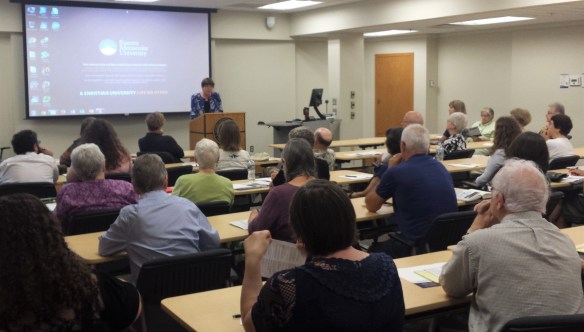
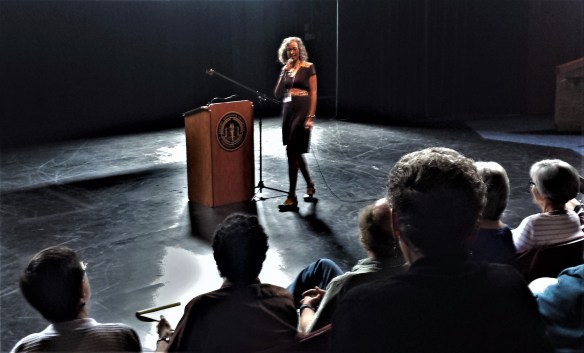
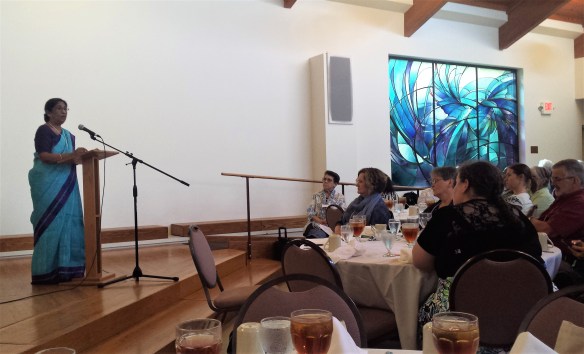
Sofia Samatar answering questions at “Crossing the Line.”

“We need all the women’s stories we can get.” This was the message of the third plenary talk at Crossing the Line, “In Search of Women’s Histories: Crossing Space, Crossing Communities, Crossing Time,” delivered by award-winning novelist Sofia Samatar.

Samatar, who teaches literature at James Madison University, opened her presentation with a discussion of the poem “Annie,” published in 1912 by the French writer Guillaume Apollinaire. The poem describes a chance encounter between the rakish poet and a Mennonite woman in a rose garden in eastern Texas.

“Her rose bushes and dress have no buttons,” Apollinaire writes. “And as my coat has lost two / She and I are almost of the same religion.”

Like many of us who have run across unexpected Mennonite references in literature, Samatar described the small “flash of joy” she felt upon reading Apollinaire’s poem, as well as the “sting” of wondering what, exactly, this woman in the rose garden represents. How does this short, possibly inaccurate representation reflect on Anabaptists as a whole?

Arcing through the twentieth century, Samatar took us on an insightful, often hilarious tour of Mennonites and Amish in popular media. We reflected on Witness (1985), in which Harrison Ford goes Amish to solve a crime, and learned about the thriving subgenre of Amish romance novels—so-called “bonnet rippers”—that apparently include Amish vampire romance.

Common to all these examples, according to Samatar, is the stereotyped figure of the sexualized Anabaptist woman. Chaste and coy beneath her bonnet and cape dress, this trope inherently invites uncovering by the male gaze. Think of Rachel in Witness, who memorably locks lips with Harrison Ford—or of Apollinaire’s “Annie,” based on a governess whom the poet wished to bed.

Or consider the first season of Breaking Amish, which features a young Mennonite woman named Sabrina. She is of Puerto Rican background and leaves her conservative adoptive family to find biological relatives in New York City. Long-lost sisters run a beauty parlor, it turns out, and Sabrina gets a makeover—traditional dress swapped for a t-shirt and tight shorts.

For Samatar, Sabrina’s transformation (from innocent Mennonite into sexy Latina) presupposes a narrative strategy incapable of acknowledging both aspects of the young woman’s identity. She cannot simultaneously be both Puerto Rican and Anabaptist. According to the logic of mass entertainment, she must choose.

Samatar rejects this dichotomy. Only when we welcome the messiness, the complexity of women’s lives, she suggests—when we cross lines of gender, race, religion, and language—will we be able to understand our cultural richness as well as, ultimately, ourselves.

Giving body to this idea, Samatar concluded her keynote with three readings. She chose autobiographical pieces by three Mennonite women: her grandmother, her mother, and herself. Through the multi-generational voices of Amy Kreider Glick, Lydia Glick, and Sofia Samatar, we heard unexpected, beautiful stories: of a girl growing up in rural Missouri; of a young woman traveling to Somalia and falling in love; of a brown student reading fantasy and navigating fashion at her boarding school.  

These are the stories we need. We can all look forward to Samatar’s forthcoming short story collection, Monster Portraits, as well as to her next project, an exploration of women’s experiences in a nineteenth-century Mennonite-Muslim settlement in Central Asia.
See other writings on “Crossing the Line: Women of Anabaptist Traditions Encounter Borders and Boundaries” here.

Dispatches from Crossing the Line: “Lines of Memory and Encounter on the ‘Mission Field'”

Lines of Memory and Encounter on the ‘Mission Field

Panel 2: Friday, June 23, 8:30 to 10

Three presenters gave papers focused on women on the “mission field”—either those serving as missionaries, or being missionized.

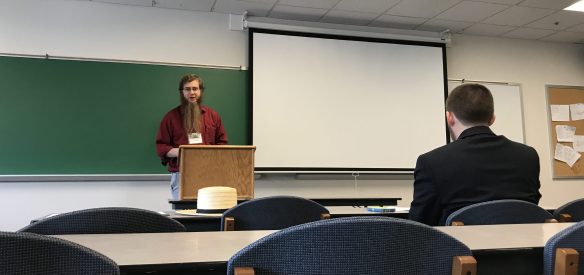
Joel Horst Nofziger presents his paper on Eastern Mennonite Mission workers in Ethiopia.

‘I Was the Kind of Woman Whom the Culture Expected’: The Experience of Mennonite Missionary Women in Ethiopia

By Joel Horst Nofziger, Lancaster Mennonite Historical Society

  • Recorded and transcribed oral histories of ten Eastern Mennonite Mission workers who served in Ethiopia in the 1940s-1990s.
  • Explored the challenges of language training—and lack thereof. While women missionaries wanted such training, mission administrators rarely supplied it. As a result, these missionaries often experienced loneliness and tended to communicate only with those who shared their language, mostly other missionaries and male converts.
  • Described the interpersonal, cultural, and religious challenges associated with “intercultural mixing.” Although EMM actively discouraged it, some single women missionaries married Ethiopian men. These couples faced discipline from the mission board as well as social stigma.
  • Conclusion: EMM workers crossed national lines as well as cultural and religious boundaries in their work.

“Mennonite Brethren Missionary Women Encounter Dalit Women in Colonial South India”

By Yennamalla Jayaker, Mennonite Brethren Centenary Bible College:

  • Twentieth-century Mennonite Brethren mission workers in colonial South India had significant impact, especially in uplifting Dalits (the “untouchables,” members of the lowest caste system) through education.
  • MB missionaries provided not just religious education, but also general education in subjects such as reading, writing, etc.
  • Women missionaries played a key role in these educational endeavor, as school builders, teachers, and more. The key to their success was learning the local language of the Dalit and teaching in that language, rather than English.

“Gendered Historical Memory, Tanzania Mennonite Church Women and the East African Revival, 1940s-1950s”

By Jan Bender Shetler, Goshen College:

  • Due to a family situation, Bender Shetler could not attend and instead sent a student to read her paper.
  • Advancing the work of Africanists such as Derek Peterson, Bender argued that the East African Revival was not only a cosmopolitan, transnational discourse that provided Christian converts with an alternative to the nationalist discourse of ethnic patriots—but also a gendered discourse.
  • Through participation in this revival movement, church women learned a particular kind of life narrative or testimony (in which they described their move from spiritual darkness to salvation) that they repeated in church settings. This testimony enabled them to resist certain tribal rituals (i.e. female circumcision) and to understand storytelling as a form of empowerment—one that was threatening to male leaders.
  • In this sense, the East African Revival was a “feminist space,” one in which women participated in cross-ethnic fellowship and forged relationships beyond the Mennonite Church and beyond Tanzania.

See other writings on “Crossing the Line: Women of Anabaptist Traditions Encounter Borders and Boundaries” here.

Dispatches from “Crossing the Line”: The Universal Boundaries of Silence and Voice

The Universal Boundaries of Silence and Voice

Panel 21: Saturday 1:30-3

“Expected Decorum/Silence and Speaking Out: Experiences from KMT”

By Esther Mugahachi, Kanisa la Mennonite Tanzania

  • Esther Mugahachi, director of Grace and Healing Ministry and a bishop’s wife, talked about her experiences in the Tanzania Mennonite Church and the struggle of Mennonite women in Tanzania to find a platform.
  • She identified several boundaries the Mennonite women in Tanzania face, both cultural (inside and outside the Church) and personal. Culturally, women are expected to be submissive and to keep quiet in order to protect their husband’s reputation and ministry. Personally, they often struggle with low self-esteem and discouragement.
  • She shared changes that have already happened in the Tanzania Mennonite Church: women (including Esther) have begun to receive theological education, to work with children and people with HIV/AIDS, and to offer pastoral Sister Care workshops to other women. She also shared changes that still need to happen: women need to be heard, not only seen, men need to learn gender sensitivity, and the Constitution of the Tanzania Mennonite Church needs to officially recognize women’s ordination.


“Empowering Girls and Women with Education”

By Pamela Obonde, Kenya Mennonite Church

  • Pamela Obonde, the coordinator of women for Kenya Mennonite Church, spoke about her own experience as a Mennonite woman in Kenya and the ways in which she is using her NGO skills to empower women in the Kenya Mennonite Church.
  • She spoke of the boundaries Kenyan Mennonite women face, including traditional cultural and biblical narrative of women’s inferiority, lack of access to education, limited economic opportunities, underrepresentation in church leadership, and a lack of older female mentors.
  • She also spoke of the work that needs to be done to transcend those boundaries, work she has already begun to do: training workshops to teach women their constitutional rights, workshops to train women for participation in the Church, and engagement with the scriptural texts that have been used to subdue women. She also spoke of the comprehensive educational efforts she has begun, through which women learn literacy, entrepreneurial skills, and their inherent worth and dignity.


“Ages and Ages Hence: A Conservative Mennonite Woman’s Hidden Desire for Education”

By Hope Nisly, Fresno Pacific University

  • Hope Nisly’s paper, delivered in her absence by Anne Hostetler of Goshen College, spoke of Nisly’s mother Edith Swartzendruber Nisly, the education she received as part of her conservative Mennonite community, and the further education she wished she could have received.
  • Edith’s community decided that she had to stop high school after grade nine. Ultimately, Edith remained within her community, but she eventually admitted to her children that she wished she could have gone on to college and studied mathematics. In her later life, this wish manifested as a recurring dream, in which Edith began college as a senior and was always pleased to finally attend.
  • Nisly notes that stories of women who leave to pursue new opportunities are told, but those of women like Edith, who chose to stay but the lost opportunities, come to light more rarely.

See other writings on “Crossing the Line: Women of Anabaptist Traditions Encounter Borders and Boundaries” here.

“Overcoming Barriers and Building Empowerment: Stories of Anabaptist Women in India” by Cynthia Peacock

Cynthia Peacock, Banquet.jpg

Cynthia Peacock, the second keynote speaker at Crossing the Line, gave a warmly received talk on the achievements and challenges of Anabaptist women in India. Cynthia spoke from her decades of ministry experience in India, first with Mennonite Central Committee in India and then with the Mennonite World Conference. She began her talk by describing a challenge faced during her work: how could she, and the women she worked with, build bridges across the boundaries they encountered?

She shared stories of two women in India who served as role models early in her work. The first, Pandita Ramabai, was a high-caste Hindu woman who converted to Christianity and became a Bible translator and worked to uplift women of lower caste. The second, Mother Teresa, was someone Cynthia worked with personally, as part of her work with MCC in Calcutta. Cynthia shared stories of how Mother Teresa fearlessly overcame boundaries and asked government officials for support of her relief work.

Cynthia then went on to tell stories of some of the setbacks she and other Indian Anabaptist women encountered as they tried to take on more active roles in their churches and denominational structures. For example, she and a group of women spent three years working on a constitution for an independent women’s group within the Anabaptist church hierarchy in India. They had received some support from male church leaders, but when the leadership changed they were completely unsupportive of the endeavor, and even physically destroyed the copy of the constitution the women had brought to the meeting.

She also spoke of her efforts to provide Anabaptist women in India with theological training. These efforts did not always have the full support of male church leaders. In one instance, Cynthia and other women tried to organize a women’s conference, and the male official in charge of a final logistical detail failed to fulfill his responsibilities, which caused the conference to be postponed indefinitely.

In addition to stories of setbacks, she told of women’s successes as they played more active roles in churches. Cynthia’s own church grew from a five-member house church to a much larger church with a Sunday School serving over a hundred children, in large part because the women of the congregation were free to use all their gifts in service of the church. The women in her church organize programs, preach, lead worship, and have an important voice in matters of church governance.

She ended by sharing how she had overcome barriers in her own life. God’s help, and the help of supportive friends, have strengthened and empowered her through the difficulties she has faced over the course of her own life. With God’s help, she overcame fear and shyness and began to share her story as she ministered to other women. She gave glory to God for all that has happened in her life. Indeed, she concluded, John 5:5 and Philippians 4:13 have proved true in her life. Apart from God, she could do nothing, but she can do all things through Him who strengthens her.

See other writings on “Crossing the Line: Women of Anabaptist Traditions Encounter Borders and Boundaries” here.

Dispatches from “Crossing the Line”: European Anabaptist Women Make Their Mark and Gender Identities and Leadership

EMU Campus

“Crossing the Line; Women of Anabaptist Traditions Encounter Borders and Boundaries” was hosted by Eastern Mennonite University in Harrisonburg, Virginia.

European Anabaptist Women Make their Mark

Panel 8: Friday 10:30-noon

“The Role of the Prophetess: An Opportunity to Cross Boundaries?”

By Christina Moss, University of Waterloo

  • In the first paper for the European panel, Christina Moss presented work from her ongoing dissertation, entitled “‘Your Sons and Daughters Shall Prophesy’: Visions, Apocalypticism, and Gender Among the Strasbourg Prophets, 1524-1539.”
  • Moss focused on the early female Anabaptist prophets Barbara Rebstock and Ursula Jost, emphasizing their prominent role in Reformation-era Strasbourg, including their influence on the leader Melchior Hoffman.
  • While radicals like Melchior Hoffman scoured scripture to find justification for supporting female preachers, detractors such as David Joris wrote polemics against such gender non-conformity, charging that in Strasbourg, “They hear and believe [Barbara Rebstock] as they do God.”

“Austrian Anabaptist Women of Status: The Case of Bartlme Dill Riemenschneider’s Family, 1527-1550,”

By Linda Huebert Hecht, Waterloo, ON and Hanns-Paul Ties, Bozen, Italy

  • Historian Linda Huebert Hecht—whom readers may know as co-editor of Profiles of Anabaptist Women: Sixteenth-Century Reforming Pioneers—presented on work that she has been conducting with Hanns-Paul Ties, a doctoral candidate in sixteenth-century art history at the University of Basel.
  • Hecht began her presentation by asking what influence the Renaissance may have had on the Radical Reformation. She then revealed that the most prominent artist of the period in Tyrol, now in southwestern Austria, was an Anabaptist named Bartlme Dill Riemenschneider, famous for frescos, oil paintings, and ceramics.
  • By painstaking examination of court records, Hecht and Ties have followed the lives of six women associated with Riemenschneider, three of whom were likely Anabaptists. Multiple individuals in the household faced arrest (due to a denunciation by their maid), but were not immediately tortured, since their judge had himself been influenced by a radical preacher.

“‘By the Hand of a Woman’: Antje Brons and the Origins of Mennonite History Writing,”

By Ben Goossen, Harvard University

  • My presentation drew on research for my recently published book, Chosen Nation: Mennonites and Germany in a Global Era, focusing particularly on the nineteenth-century German Mennonite historian, Antje Brons.
  • Brons was likely the most widely-read Mennonite woman of the first four hundred years of Anabaptist history, and during her day she was widely recognized as the author of the first comprehensive history of the Mennonite church, published in 1884.
  • Tracing the reception of Brons’ book in Germany and the United States, I argued that her work was successful not in spite of her gender, but rather because she successfully aligned her project with contemporary notions of German nationalism and gender propriety.
Rachel Goossen, Panel 13

Rachel Goossen presenting at “Crossing the Line.”

Gender Identities and Leadership

Panel 13: Friday 1:30-3:00pm

“Finding a Home: LGBTQ Mennonite Leaders and Denominational History,”

By Rachel Waltner Goossen, Washburn University

  • This panel on LGBTQ identities opened with a paper from Rachel Waltner Goossen about queer women in church leadership positions. She interviewed women who have either remained Mennonite, switched denominations, or layered affiliations since coming out.
  • Goossen conceived of this project while research the history of sexual abuse in the Mennonite church, which revealed a substantial exodus of talented female leaders to other denominations. She spoke of this as a “legacy of loss” for Mennonites.
  • Queer interviewees and conversation partners emphasized their calling to serve as well as their love of Anabaptist communities, while also highlighting the institutional and interpersonal violence they experienced because of their sexual orientation.

“Wisdom on the Edges: Hearing the Voices of LGBTQ Women in Mennonite Church Canada,”

By Irma Fast Dueck, Canadian Mennonite University

  • Speaking from a Canadian perspective, Irma Fast Dueck raised similar themes in her discussion of a listening tour conducted with Darryl Neustaedter Barg among LGBTQ individuals affiliated with Mennonite Church Canada.
  • Dueck showed clips from these interviews, which were filmed and edited to create a 30-minute video, entitled Listening Church, intended for use in adult Mennonite Sunday School classes.
  • Interviewees responded to three questions: 1) What is your experience in the church? 2) Why is the church important to you? And 3) What wisdom do you have for the church’s ongoing discernment process? The film is moving – please watch it!

“‘Love to All’: Bayard Rustin’s Effect on Attitudes toward LGBTQ Issues in South-Central Kansas Mennonites,”

By Melanie Zuercher, Bethel College

  • Opening with the well-known story of Dr. Martin Luther King, Jr.’s visit to Bethel and Goshen Colleges in 1960, Melanie Zuercher revealed that Bayard Rustin traveled among Kansas Mennonites a decade earlier.
  • Rustin was black, gay, and Quaker, and he was the main organizer of the 1963 March on Washington where King delivered his “I Have a Dream” speech. Although he faced discrimination for both his race and sexual orientation, Rustin credited his Quaker background as the source of his activism.  
  • Zuercher’s research suggests that although Rustin’s 1950 visit to Bethel College and area churches did not predispose local Mennonites to be more favorable toward queer identities, it did build bridges to the burgeoning Civil Rights movement.

See other writings on “Crossing the Line: Women of Anabaptist Traditions Encounter Borders and Boundaries” here.

Dispatches from Crossing the Line

This weekend, June 22 to 24,  “Crossing the Line: Women of Anabaptist Traditions Encounter Borders and Boundaries” is taking place at Eastern Mennonite University in Harrisonburg, Virginia. Throughout the conference, contributors to Anabaptist Historians will give short dispatches for those who are unable to attend in person. “Crossing the Line” builds on the 1995 conference “The Quiet in Land? Women of Anabaptist Traditions in Historical Perspectives” held at Millersville University.

20170623_132819

Anabaptist Historians contributors at “Crossing the Line.” From Left to right: Ben Goossen, Christina Entz Moss, Joel Horst Nofziger, Simone Horst, Devin Manzullo-Thomas, and Anna Showalter.

The conference opened with a plenary address by Hasia Diner of New York University entitled: “Jewish Women in America: A History of Their Own.” The presentation was framed by how each facet of her title—“American,” “Jewish,” and “women” shaped the experience of these individuals.

While admitting that she works a very different group from Anabaptists, she noted similarities between the two ethno-religious communities, noting that both were shaped by an inability to disconnect religion and group identity, and living lives according to the demands of religious tradition while maintaining boundaries with host cultures.

Diner noted that in America, the experience took a distinct turn for Jewish women, when they began to gain influence within the synagogue. Traditionally, synagogues were strictly male public spaces, and while the men were obligated to attend, women were neither required nor expected to come. This could be seen architecturally, where women sat hidden behind thick walled screens, able to see and hear only through thin slits into the synagogue. But in America, as Jewish women observed how heavily Protestant women were engaged with church life, they too began to push for more engagement, including starting to attend synagogue. The building design then changed, with the women’s balconies opening up and more fully allowing for the women to seen and be seen. This in part could also be traced to the Female Hebrew Benevolence associations formed by Jewish women which provided social functions, as well as aid for the poor and travelers. The men of the synagogues often turned to these associations for moneys to construct new synagogues, but the money was conditional on the women, who were successful fundraisers, to have more input.

image1

Hasia Diner delivering the opening presentation at “Crossing the Line.”

She also noted that Jewish immigrants had a distinct experience from their contemporary eastern European immigrants. While Italians immigrated three men for every woman, and the Greeks eight men for every woman, Jewish communities migrated equally, both men and women. Especially when looking at which children to bring, Jewish families brought the oldest children, regardless of gender, while the other eastern European immigrants preferentially brought sons. Diner noted that this was because girls were not a liability in the family task of raising enough funds to bring the remainder of the family to America. In the garment industry, where many young women worked, there was no disadvantage based on gender, other than less pay. Interestingly, because many Jewish women were working in the garment industry and could clearly see that they were being paid less and facing harassment their male counterparts were not, they flocked to trade unions.

Diner noted that the question of why to study (Jewish) women was obvious: “No man was ever defined as a problem in the synagogue.” Women also had different experience than men in work culture, as well as in education. She noted a constant tension in that while the women organized and responded to local needs, the men quickly decided that the cause was “too important to be controlled by women” and would wrest control. This was the case for what has become the Beth Israel Hospital in Boston, as well as the National Council of Jewish Women’s project to station receiving volunteers for single Jewish women arriving to Ellis Island.

She ended the presentation by hoping that it gave a way to think about intersectionality, and especially in thinking about how people juggle identity and demands.

See other writings on “Crossing the Line: Women of Anabaptist Traditions Encounter Borders and Boundaries” here.

Would There be Peace Without Mennonites?

By Anne M. Yoder

I’m sure I’m not the only one who was brought up on stories of Mennonites as peace-keepers, makers, builders, and more. There was nothing wrong with those stories, except that they left out all the non-Mennonites who were doing the same thing around the world throughout time. For me, and for many people I know, it led to a sort of blindness from which it can be hard to recover unless we are confronted with the truth.

One example of this relates to the history of conscientious objection. I remember as a sixteen-year-old reading Noah Leatherman’s published diary about being a conscientious objector (C.O.) during World War I and the struggles he had in the army camp where he was sent. My notion while reading it, and for years afterward, was that other than a few Quakers, all WWI C.O.s were Mennonites, like Leatherman. I expected that all these C.O. witnesses would have had pretty much the same narrative of being persecuted for their peace stance, and prevailing through all the difficulties with God’s help.

I would not have had any argument with James Juhnke, who wrote back in 1970: “In the past, Mennonites, Quakers, and Brethren have had the pacifist action pretty much to themselves. To be sure, there were always some humanitarian and socialist pacifists around who did a lot of talking about pacifism, especially between  wars when talk was cheap. But every time war rolled around the humanitarian pacifists evaporated, and it was up to the Mennonites to provide the conspicuous majority of refusers of military service.”1

Many Mennonites I talk to in this day and age still believe this assertion. It is true that the majority of WWI C.O.s were from the Historic Peace Churches, but that does not by any means describe the full picture.

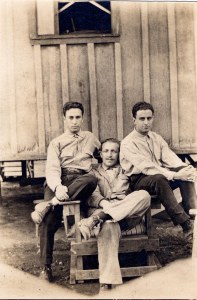
I came to the Swarthmore College Peace Collection to be its archivist in 1995. Five years later we received a shipment of boxes from Seymour Eichel, who was donating the WWI papers of his father, Julius Eichel, and his uncle, David Eichel, both of whom had been C.O.s. These texts changed my life, and became my primary research interest since then. There were diaries and dozens of letters written by both brothers, as well as other documents. Immigrant Jews from New York City, the Eichels had embraced socialism as their lens for analyzing what was happening in the world. This philosophy led to them becoming C.O. absolutists, unwilling to accept any orders from the military, and they were sentenced to prison for it

PhotImgeichel3

Eichel brothers with a friend (I don’t know which is Julius and which is David), circa 1919 [DG 131: Eichel Family Papers, Swarthmore College Peace Collection]

What a fascinating group of papers, and so helpful in expanding my view of conscientious objectors! Julius and David Eichel were extremely detailed in describing their experiences in camps and prisons, the other C.O.s they met, and their viewpoints about all that was happening on the C.O. front. They gave voice to the political and humanitarian objectors who did not have the protection of being from a pacifist church tradition. I learned to admire the depth of the Eichels’ convictions and their tenacity in faithfully holding these beliefs, despite the pressures to conform, to which many others succumbed. I started searching for C.O.s who were not from the Historic Peace Churches and found that there were far more than a few — so many, in fact, that it puts to shame any notion that without the Mennonites, Quakers and Brethren, there would be a very small number of conscientious objectors.2

The Historic Peace Churches have done a wonderful job of archiving and making known the stories of C.O.s from their traditions. But, again, this gives us a limited view of what was happening. The full account is far richer, and far more complex. Because of my unique position as a Mennonite at an archives where the non-religious C.O. material finds its way, I have the privilege of filling in some of the gaps. I’m not an historian per se, but see myself as a revealer of sources. As such, I’m currently working on a website where the personal writings of the Eichels and other non-religious C.O.s will be made available, both as scans of the original pages and as transcriptions. I hope to add some Quaker and Mennonite sources too, at some point. This site will be open to the public in October 2017, along with a presentation about it to be given at the World War I Museum’s conference the same month. I hope that it will help to round out the works about WWI conscientious objection that have been published up until now.

I recently re-read Noah Leatherman’s published diary. Once again I was moved by his witness to his faith and pacifist principles, but I was also shocked (and embarrassed) by how much I had considered unimportant in my earlier reading of the text. Many of the details had a deeper meaning to me now that I’ve been immersed in similar texts for a number of years. But I was also amazed at how many non-Mennonite C.O.s he mentioned – he was aware of them, and we would do well to note their presence as well.

Caplovitz16

Group of Socialist C.O.s at Ft. Douglas U.S. Disciplinary Barracks, 1919 [CDGA: Philip Caplovitz Collected Papers]

It is ironic to me that David Eichel was one of the most staunch in his refusal to work for the military in prison and was one of the very last C.O.s to be released, in 1920. If only he had been a Mennonite, how we could crow over it! But he didn’t use religion as his reason for being willing to endure whatever it took, for however long it took, to stay true to his convictions. We can certainly admire and gain spiritual conviction from our Mennonite forbears, but we can also open the door to admire and learn from all the others, such as the Eichel brothers. They, too, suffered much for the sake of peace. They have also passed down to us an important legacy of conscientious objection to war and militarism.

Would there be peace without the Mennonites? I would give a resounding yes to that question. I celebrate all who have been, and are now, motivated to give themselves to this cause, no matter what their reasoning may be.

Anne M. Yoder is the archivist of the Swarthmore College Peace Collection.


  1. James C. Juhnke, “The Agony of Civic Isolation: Mennonites in World War I,” Mennonite Life 25, no. 1 (January 1970): 33. 
  2. I curate a database whereby I list information about every C.O. I come across, Mennonite or otherwise. This helps to document the variety of men involved, as well as the differences in their experiences (2300+ names so far; see http://www.swarthmore.edu/Library/peace/conscientiousobjection/WWI.COs.coverpage.htm). 

Mathilde Monge’s Des communautés mouvantes: Les «Sociétés des frères chrétiens» en Rhénanie du Nord: Juliers, Berg, Cologne vers 1530-1694: A Review

In the historiography of early modern Anabaptism, the imperial city of Cologne and its surrounding areas have long been understudied. The multivolume Quellen zur Geschichte der Täufer  series, a valuable repository of reprinted primary sources on sixteenth-century Anabaptist topics, contains no volumes on Cologne, and the 2007 Companion to Anabaptism and Spiritualism, 1521-1700 included only four references to Cologne, slight attention compared to that paid to nearby Amsterdam or Strasbourg.1 Sigrun Haude’s In the Shadow of Savage Wolves contains a chapter on the Cologne authorities’ response to religious dissenters2  before and after the Anabaptist takeover of Münster, but much work remained to be done on the history of Anabaptist and Anabaptist-adjacent communities in Cologne.3 Mathilde Monge’s 2015 monograph Des communautés mouvantes: Les «Sociétés des frères chrétiens» en Rhénanie du Nord: Juliers, Berg, Cologne vers 1530-1694 (Community in Motion: The “Societies of Christian Brothers” in the Northern Rhineland: Julich, Berg, Cologne Circa 1530-1694), published in Geneva by Droz, goes a long way towards filling that lacuna.des-communautés-mouvantes

Monge’s book is wide in scope, both geographically and temporally. She looks not only at the city of Cologne and its territories, but also the adjacent duchies of Jülich (Juliers) and Berg, and her research covers the sixteenth and seventeenth centuries, rather than stopping in the mid to late 1500s. In fact, this wider geographical focus enables the longer time scale, since dissidents with Anabaptist leanings residing in Cologne proper had virtually disappeared by the beginning of the seventeenth century.4

The monograph is divided into eight chapters; Monge deals with accusations of heresy as a means of exclusion, the prosecution of heresy as a pastoral task, the practice of denunciation by heretics’ neighbors and associates, how the Christian Brothers fit into sixteenth-century Christianity, the local and international networks to which Anabaptist and Anabaptist-adjacent persons in the Northern Rhineland belonged, the rituals and practices they used in worship, the ways in which they were integrated into the broader social fabric, and finally the groups’ eventual dissolution by the end of the seventeenth century.

Monge grapples, as all historians of early modern Anabaptism must, with the complications inherent in studying a religious group (or rather, groups) whose label was not freely chosen, but was rather imposed on them by governing authorities. Even sixteenth-century Christians who received baptism as adults did not self-identify as Anabaptists—the subjects of Monge’s study simply referred to themselves as Christian brothers and sisters—and a far larger number of Christians questioned the practice of infant baptism, even if they did not go so far as to undergo believers’ baptism themselves, or even refuse to baptize their children. The question of identifying which sixteenth-century Christians were “truly Anabaptist” is thus fraught with difficulty, and Monge sidesteps it altogether. She treats Anabaptism in early modern Cologne not as a religious group with clearly defined boundaries and membership requirements, but rather as a relational phenomenon; those designated Anabaptist received their label as a result of their relationships with the governing authorities and with other heretics. 5

While Anabaptist and Anabaptist-adjacent groups in the early modern Northern Rhineland did not have a single uniform theology and practice, Monge nevertheless uncovers several recurring themes in inquisitorial records: refutation of infant baptism (this rejection, Monge argues, was of greater importance to the Cologne authorities than the act of re-baptism itself), rejection of Catholic sacraments (with the exception of modified forms of baptism and the Lord’s Supper), and belief in a Melchiorite celestial flesh Christology among them.6 Monge’s work on the Societies of Christian Brothers of the Northern Rhineland is an important addition to the historiography of sixteenth-century Anabaptisms and other non-Magisterial Protestantisms, and I can only hope that an English translation, which would make it accessible to a greater number of North American undergraduates, will be forthcoming.

Footnotes:


  1. John D. Roth and James M. Stayer (eds.), A Companion to Anabaptism and Spiritualism, 1521-1700 (Leiden: Brill, 2007), passim. 
  2.  In the Catholic imperial city, this was a label that encompassed not only Anabaptists but also Lutherans and Sacramentarians as well. 
  3. Sigrun Haude, In the Shadow of Savage Wolves: Anabaptist Münster and the German Reformation during the 1530s (Boston: Humanities Press, 2000), 39-69. 
  4. Mathilde Monge, Des communautés mouvantes: Les «Sociétés des frères chrétiens» en Rhénanie du Nord: Juliers, Berg, Cologne vers 1530-1694 (Geneva: Droz, 2015), 48; 223. 
  5. Monge, 7. Melchior Hoffman taught that Christ had not received his human flesh from Mary (since her flesh, like all human flesh, was corrupted by sin), but rather brought his own flesh from heaven. For more information on Melchiorite celestial flesh Christology, see Sjouke Voolstra, Het woord is vlees geworden : de Melchioritisch-Menniste incarnatieleer (Kampen: J.H. Kok, 1982.) 
  6. Monge, 112; 115; 120. 

What Young Historians Are Thinking

For the last five years, it has been my pleasure to organize “What Young Historians are Thinking” as part of my responsibilities at the Lancaster Mennonite Historical Society. This event brings together young or early-career historians connected to historic peace churches, and lets them share their work in a public forum. Over the years, presentations have covered topics as varied as early Anabaptist hymnody and the life of John F. Funk, to the treatment of Moravians in the American revolution and the legal position of the Amish in the United States today.

This year’s lecture will be held Monday, June 5, beginning at 7 p.m. at Ridgeview Mennonite Church, Gordonville, Pennsylvania. Preview the evening with their abstracts below.

“What Young Historians Are Thinking” is sponsored by the Lancaster Mennonite Historical Society; the Sider Institute for Anabaptist, Pietist, and Wesleyan Studies; The Young Center for Anabaptist and Pietist Studies; and the Menno Simons Historical Library at Eastern Mennonite University.

Mapping Peace: 100 years of American Friends Service Committee Transnational Work

Steven Baumann

After World War I, when most of the world was focused on punishing Germany, Quakers crossed international boundaries to establish a program called Quakerspeisung which helped over one million people get food in thousands of feeding centers. While this operation was unique for the world, in that most people did not think to help rebuild after the devastation of war, it was not unique for the Religious Society of Friends, a church with a long history of peace work.

This year is the one-hundredth anniversary of the American Friends Service Committee (AFSC), an organization on a mission to promote lasting peace with justice, as a practical expression of faith in action. Although the AFSC won the Nobel Peace Prize in 1947, it remains one of the most understudied historical peace organizations in the world, despite an enormous amount of personal memoirs, official documentation, and local histories. Using the Philadelphia archives of the AFSC, I will map the locations and operations of the AFSC throughout its history in order to show the global reach of its relief and rehabilitation efforts.

My study will not just show where the AFSC worked and operated, but also inquire as to why places were chosen for transnational peace connections to be made. By tracing the location and the connections between the operations in Philadelphia and work done across the world, I will argue that the AFSC is a truly global non-governmental organization that transcended national boundaries long before it was standard practice to do transnational work.

One of God’s Avenues of Progress: Exploring the Outcomes of the Brethren in Christ’s Evangelical Visitor

Micah B. Brickner
In 1874, the Brethren in Christ General Council considered creating a denominational publication, but the subject was postponed.1 After thirteen years of debate and discussion, the Brethren agreed to a petition from the Michigan district to publish the Evangelical Visitor for a trial period of four years.2 However, the implementation of this new communication medium was not without opposition. In the 50th anniversary edition of the Evangelical Visitor, Editor Vernon L. Stump addressed the opposition to the publication:

“There were those then, and they are to be found in every age, who could not see the need, nor recognize this as one of God’s avenues of progress, and felt that there were too many evils attendant to the launching of a publication […]”3

Despite the disapproval that the editors of the Evangelical Visitor faced, the periodical played a significant role in shaping the identity of the church. Historian Carlton O. Wittlinger identifies four outcomes that resulted from the publication: (1) unifying a geographically diverse church; (2) expanding the religious and intellectual horizons of the community; (3) facilitating change regarding methodologies of ministry; and (4) illustrating the advantages of education.4

For this paper, my research will expound upon Wittlinger’s observations on how the Evangelical Visitor impacted the Brethren in Christ. I will also explore how the opposition to the publication may have directly correlated to these aforementioned outcomes. Finally, I will propose several insights for contemporary Anabaptist churches in regards to their communication methods and potential areas of caution.

Mennonite Films as Cultural Markers

Joel Horst Nofziger

Modern American society often turns to film as a tool to understand past, giving this medium vast control over how the collective memory is retained. This relationship between film and memory is curious in the Mennonite community, which has not been a major viewer of movies, nor prolific producers of feature length films. Since 1974, there have been only four Mennonite non-documentary films made in the United States. The first of this these was Hazel’s People (originally titled Happy as the Grass was Green) by Merle Good. Three others followed: The Weight (1983), The Radicals (1990), and Pearl Diver (2004).

For the purpose of this presentation, Mennonite films are defined as films made by people self-identifying as Mennonites. As works of art reveal their creators, these films necessarily also deal with Mennonite identity. While meant for broad audiences, all four films retain a distinct character due to the Anabaptist tradition which created them. These films are documents of Mennonite identity. This presentation will consider these films in context, and specifically examine how they address martyrdom.


  1. Origin Confession of Faith, and Church Government (Abilene, Kans.: The News Book and Job Print, 1901), 10. 
  2. Minutes of the General Conference of the Brethren in Christ, 1887. 
  3. Stump, Vernon L. “When… Why… How…” Evangelical Visitor Vol. L, (August 28–29, 1937): 7. 
  4. Carlton O. Wittlinger, Quest for piety and obedience: the story of the Brethren in Christ (Nappanee, Ind.: Evangel Press, 1978), 269.