“Art, Migration and (Home)making: Mennonite Women, Mexico and ‘the World’” Women from Old Colony Communities in Mexico Share Their Stories and Their Art at Eastern Mennonite University’s Crossing the Line Conference

Abigail Carl-Klassen, Anna Wall, and Veronica Enns

50 years after their arrival from Prussia in the 1870s, 7,000 Altkolonier (Old Colony) Mennonites left Manitoba and Saskatchewan to form new, more conservative colonies in northern Mexico, due to conflicts with the Canadian government concerning secularization and compulsory English language instruction mandates for colony schools. The Mexican government promised Old Colony communities educational autonomy and exemptions from military service in exchange for occupying and developing remote, yet contested, territory in the wake of the Mexican Revolution. The first colonies in the states of Chihuahua and Durango were established in 1922 and 1924 respectively and grew quickly as a result of high birthrates and subsequent migrations. Today there are more than 100,000 Mennonites living in Mexico, primarily in Chihuahua and Durango, but also in more recently settled colonies in Zacatecas, San Luis Potosi, Quintana Roo, Tamaulipas and Campeche. Descendants of this migration have also participated in subsequent migrations and have formed colonies in Belize, Bolivia, Paraguay, and most recently Peru and Colombia.

In the early days of the Mexican colonies, residents were isolated geographically and socially from larger Mexican society; however, over time, modernization of agriculture, industry, and transportation has increased commercial contact with surrounding Mexican communities and social and commercial contact with Mennonite colonies throughout the Americas. Today it is not uncommon for colonies with modern dress, cars, Internet, and schools accredited by the Mexican education system to exist within close proximity of colonies with much more strict and traditional regulations concerning dress, education, and technology.

Editor’s Note: While Anabaptist Historians generally focuses on historical research, in the interdisciplinary spirit of “Crossing the Line”, we are broadening our scope during this series to include a wide variety of Anabaptist studies.

In the last quarter of the 20th century, Mennonites in Mexico have become increasingly mobile and transnational. In the 1970s, several thousand Old Colony Mennonites from Mexico, many of whom still retained Canadian citizenship, began migrating to Ontario while others established a new colony in Seminole, Texas. While many formed migrant worker circuits residing in Canada and/or the United States for half the year to perform agricultural work and returning to Mexico for the other half, others settled permanently. These migrations continue to the present day and impact the social and cultural landscape of colonies in all three countries.

“Art, Migration, and (Home)making: Mennonite Women, Mexico and ‘the World’” was a panel at Eastern Mennonite University’s Crossing the Line: Anabaptist Women Encounter Borders and Boundaries conference that sought to explore the personal side of this complex network of migrations and identities through the presentation of poetry, creative non-fiction and visual art.

Abigail Carl-Klassen, who grew up in Seminole, Texas, read poetry based on ethnographic research and oral history interviews that she conducted in Seminole, Texas and Chihuahua, Mexico. The poems “Freizeit” and “Self-Portraits with the Flower Women” explored the multi-faceted encounters that Old Colony women had with personal, community, and geographic borders from the 1940s to the present day. Her work can be found at https://abigailcarlklassen.wordpress.com/

Reflecting on the panel and her conference experiences Abigail noted,

When I started writing I didn’t know there was such a thing as Mennonite literature or scholarship. I just knew that I needed to tell the compelling stories of the people around me. While I was working on my thesis, a collection of poems based on the experiences of friends and family in Old Colony communities in Mexico, I was introduced to a thriving community that welcomed me into the fold. When I slip the work of Di Brandt, Sarah Klassen, or Julia Kasdorf into the hands of women I grew up with or connect someone from my community with Rhubarb or the work of Royden Lowen it’s like experiencing that joy of discovery all over again.

I organized this panel because I feel it is important that Mennonite women from colonies in Mexico be able to tell their own stories and have a space to showcase their creative work. Though Anna, Veronica and I only knew each other through social media before the conference, I felt like we had an instant connection and would be good friends. I was overwhelmed by the positive response that our panel received and am excited about new opportunities for collaboration and about the ways these connections will open up ways for women of Old Colony origin to share their experiences and creative work whether they are living in Mexico, the U.S., Canada, or elsewhere in the Americas.

Anna Wall, who blogs at http://www.mennopolitan.com/ about her experiences growing up in a conservative colony in Durango, Mexico, read a creative non-fiction piece from her blog that explored her struggles leaving the colony and as a new immigrant in Canada.  With humor and seriousness she talked about learning to read and write, earning her high school diploma, finding her identity and her current job as a community health worker and Plautdietsch interpreter in Ontario.

Anna shared her experiences as an attendee and presenter saying,

At the age of 16, I crossed a pivotal boundary, and two borders when I left my colony that is tucked away, hidden far in the mountains of Durango, Mexico. I left everything I had ever known and came to Canada. I was illiterate and didn’t speak English. I faced many barriers as I began my journey of learning how to fit into a whole new world that I had never been part of before.

At the age of 19, I began attending an adult learning center in St. Thomas Ontario. At that point, I had only ever written my name a handful of times. Even just simply holding a pen in my hand was awkward. I was ashamed of my literary incompetence and felt like I was going to kindergarten. Reading and writing have become my obsession ever since.

Three years ago, I started a blog www.mennopolitan.com I post stories of my lived experience growing up as an Old Colony Mennonite. Going to kindergarten in Canada as an adult, being torn between two worlds and finding my place in it.

When I received and email from Abigail Carl-Klassen telling me that she had been following my blog for a while and invited me to participate in a panel that would showcase creative work by and about women from Mennonite communities in Mexico. Discussing transnational identities and issues. I said YES! Before I finished reading the email.  

Within minutes of meeting both Abigail and Veronica, I immediately connected with both of them. The experience was soulful.

It was surreal. Not only being in the presence of such scholars I had only read about, but discussing an art piece with Canadian History Professor Royden Loewen in Plautdietsch and sharing my dream of publishing a memoir with author Saloma Miller Furlong, while comparing notes on similar experiences and how we are still struggling with how to dress our bodies after leaving our communities. I left the conference with an abundance of knowledge and new relationships. The experience has inspired me to no end. Thank you for opening the door!

Veronica Enns, a visual artist, and creative director at Cabañas Las Bellotas in Chihuahua, whose work can be found at http://www.veronicaenns.com/ shared her experiences growing up in a conservative colony in Chihuahua, her immigration to Canada as a young woman, and how studying and creating art allowed her to process and heal from past trauma. She also discussed what ultimately motivated her to move from Vancouver back to Mexico, close to the colony where she was raised. Currently, she runs a ceramics studio, gives community arts workshops, has exhibitions in Mexican galleries and works on collaborative projects with Mexican artists. Most recently, her work was showcased at the Festival of Three Cultures which seeks to celebrate and bring together the indigenous Tarahumara, Mexican, and Mennonite communities in the Cuauhtémoc, Chihuahua region.

She spoke excitedly about her experiences at the conference saying,

Growing up [in a conservative colony in Mexico], I didn’t think that Mennonite and education went together. I never imagined that a conference like this was possible—that people went to university to learn about Mennonites and that our life in the colony was the subject of academic study or that I would be a part of that by presenting here. When I left the colony I thought I was done being Mennonite, but over the years I’ve been brought back to my roots in new ways.

Several years ago, a friend of mine gave one of my paintings to Elsie K. Neufeld, a writer, photographer and storyteller of Mennonite origin who lives in Vancouver, Canada. Elsie was curious to find out more about the artist, as she linked my last name to be Mennonite. Thanks to social media we connected a few months after I moved from Vancouver back to my roots in Chihuahua, Mexico. Elsie met Abby Carl Klassen on a writing conference in Fresno California in 2015 and shared some details about my art and experiences. This connected Abby to me and the ball got rolling.

I trusted that my presentation would be embraced at this conference. Although not knowing anyone in person and having compiled a bunch of personal stories made me very nervous; however, a few hours after arriving on the EMU campus, I felt overwhelmed with the warmth in hospitality. I was impressed with all the highly educated personalities and how humbly they shared their own personal stories as we all had walked common grounds as woman who often encounter similar boundaries. Academics and faith had never been used together before in my educational and cultural experience. I had found my tribe.

See other writings on “Crossing the Line: Women of Anabaptist Traditions Encounter Borders and Boundaries” here.

Fannie Swartzentruber, Ecclesial Gaslighting, and The Witness of Holy Disruption

Swartzentruber's photo

Fannie and Ernest Swartzentruber. Virginia Mennonite Conference archives, Papers of Va. Menn. Bd. of Missions and Charities, Box “Harold Huber’s Papers, Broad Street Mennonite Church Materials (History, etc.)”

Tobin Miller Shearer

Fannie Swartzentruber has stuck with me for more than a dozen years. I first encountered this unassuming church matron from Gay Street Mennonite Mission in Harrisonburg, Virginia, back in March of 2005 while on a research trip to Eastern Mennonite University’s archives. As I read of her life and legacy, I was impressed with the deliberation, focus, and passion she brought to her ministry with the African-American community in Harrisonburg during the 1940s. Although her story, like all of ours, is complex—at times burdened by white paternalism and the patent racism of her era and at times leavened by a deep courage and fidelity of friendship across many decades—she nonetheless speaks to our present moment because of her witness of holy disruption.

Disruption in the church is, by its very nature, controversial. During the Mennonite Church USA gathering in Kansas City in 2015, Pink Menno activists disrupted the assembly meetings with a piece of satirical theater that left as many angered and frustrated as elated and energized. There have been other acts of holy disruption in the Mennonite world that have garnered attention. In February 2003, a group of activists connected to the Damascus Road anti-racism process disrupted a meeting of the Mennonite Central Committee Central States board to call for action to dismantle racism in the organization.1 In the 1980s, a homelessness advocate and Mennonite minister by the name of David Hayden disrupted meetings of the Virginia Conference to demand delegates’ attention to housing issues in their region.

Given Mennonites’—and especially white Mennonites of European descent—love of order, decorum, and respectability, it is perhaps no wonder that activists have chosen to disrupt convention meetings, delegate sessions, and occasionally even worship services. The payoff in attention to their cause, even if accompanied by frustration, anger, and, sometimes outright animosity, has been disproportionate to the risk. There was little chance that peace-loving Mennonites would physically assault interlopers. Even when emissaries of the 1969 reparations movement known as the Black Manifesto threatened to disrupt worship services, Lancaster Mennonite Conference leaders enjoined ministers to engage in “orderly discussion” rather than “calling . . . the police” or “attempting to restrain those who would enter our services.”2

No wonder then that Swartzentruber caused such a fuss. In 1940, the Virginia Mennonite Conference’s executive committee announced that they would be conforming to the “general attitude of society in the South toward the intermingling of the two races.”3 The executive committee segregated the rites of baptism, the holy kiss, foot washing, and communion, claiming that they did so in “the best interests of both colored and white.”4 Not coincidentally, they instituted the Jim Crow policy even as Mennonites in Virginia faced increased pressure for their non-conformity to the country’s military buildup during World War II.5

Swartzentruber and her husband Ernest challenged their supervisors, demanding scriptural backing for the action. In a highly unusual reply, the bishops declared that not every decision necessitated scriptural mandates. Rather, they stated, “as a matter of expediency we must make some distinction to meet existing conditions.”6 The decision to take away the shared communion cup particularly devastated Fannie.

For the better part of four years, Swartzentruber went along with the dictate. She took communion from a separate cup. She watched Eastern Mennonite College deny admission to the daughter of one her African-American co-believers, Roberta Webb. She said good-bye to her long-time companion, Rowena Lark, as Lark and her husband moved away from the Jim Crow South to plant churches in Chicago. Swartzentruber went along with the demands of her religious community—until she could no longer do so.

During the communion service at Gay Street Mennonite Mission in the fall of 1944, Swartzentruber had had enough. She got up and marched out.

And she kept on marching. Toting her youngest daughter Rhoda in her arms, Swartzentruber walked four miles out of town to the farm north of Harrisonburg where she and Ernest lived. When Ernest returned home from church, she informed him that “she would never again sit through such a service.”7

Disruptive actions, whether ecclesial or otherwise, bear consequences. Church responses to those who transgress boundaries of decorum have often been just as debilitating, if not more so, than secular responses. Communities who preach grace and reconciliation in the midst of retaliation amplify the damage they do to transgressors. Even when camouflaged with scriptures, gaslighting is still gaslighting. In this instance, Mennonites were no exception.

A scant four months after Swartzentruber disrupted the Gay Street communion service, members of the Virginia Mennonite Board of Missions dismissed Fannie and Ernest from their positions as matron and superintendents of the Gay Street mission.8 Although officially cloaked in bureaucratic double-talk as “voluntary expression of willingness . . . to discontinue,” the decision was anything but voluntary. Family members attested to the trauma that both Fannie and Ernest experienced in the aftermath of their dismissal, trauma that was furthered by the ecclesial gaslighting they encountered.9

It was not until 1955 that Virginia Conference leaders overturned their segregation dictate. In a statement that year they publicly acknowledged their “former spiritual immaturity” and pledged to extend “the right hand of fellowship” to all “true believers.”10

But Fannie was not present for that conference statement. She and Ernest had left Harrisonburg in the aftermath of their ejection from Gay Street, settling in Greenwood, Delaware, in 1946, and then, following the death of her husband in 1986, moving to northern Indiana where she attended a Baptist congregation through her passing in 1999.

Regardless of the prophetic truth they often offer, holy disrupters bear the long-term consequences of their actions. In Swartzentruber’s case, her spontaneous march from the sanctuary to the streets resulted in her dismissal and in a long-term alienation from the church community that she loved.

Historical precedents are only sometimes illuminating of our present circumstances. Both past and present are complex and never map exactly one on one. But there are connections, tendrils we can draw across time. In this instance, I simply wonder whether the church can do better now. How will church leaders respond to those who have followed in Swartzentruber’s footsteps? Can they respond with grace rather than retaliation? Will the church let go of its gaslighting past? Will they find better ways to respond to the actions of holy disrupters like those who have called out church leaders for their collusion in the face of sexual abuse and those who have demanded that the voices of the LGBTQ community be included in the conversation about human sexuality?

Swartzentruber was alienated from her faith community, but she and her husband Ernest did experience a modicum of restoration. In the mid 1980s, while visiting the congregation that emerged from the Swartzentrubers’ work at Gay Street, the Broad Street Mennonite Church, members of the congregation apologized. They used the occasion of their church’s fiftieth anniversary to acknowledge that Fannie and Ernest had been wronged and that, on behalf of the Virginia Conference, they were sorry for their actions.

Fannie and Ernest were left in tears. Their family members later reported that the gesture, even though small and absent of official Conference approval, had freed them from a “depth of pain” that they had born for three decades.

In our present moment, I can only hope that the church moves much more quickly to restoration with those who have offered holy disruption.


  1. In the interest of full disclosure, the author helped organize that event. 
  2. “Lancaster Conference Peace Committee Responds to Black Manifesto,” Gospel Herald, August 12 1969. 
  3. Tobin Miller Shearer, Daily Demonstrators: The Civil Rights Movement in Mennonite Homes and Sanctuaries (Baltimore: Johns Hopkins Press, 2010), 43. 
  4. Ibid., 36. 
  5. Ibid., 43. 
  6. Ibid., 37. 
  7. Ibid., 41. 
  8. “Executive Committee Meeting – Friday 10:00 A.M., January 5, 1945,” (Harrisonburg, Va.: Virginia Mennonite Board of Missions And Charities, 1945). 
  9. Harold Huber and Vida Huber, “Interview with Harold and Vida Huber,” ed. Tobin Miller Shearer (Harrisonburg, Va., 2005). 
  10. Linden M. Wenger, “Progress Report on Integration,” Gospel Herald, February 9 1960. 

Unique etchings by Jan Luiken

Bowyer_Bible_Volume_1_Print_7._Portrait_of_Jan_Luyken._BronenPortrait of Jan Luiken File created by Phillip Medhurst – Photo by Harry Kossuth, FAL,
https://commons.wikimedia.org/w/index.php?curid=8987881

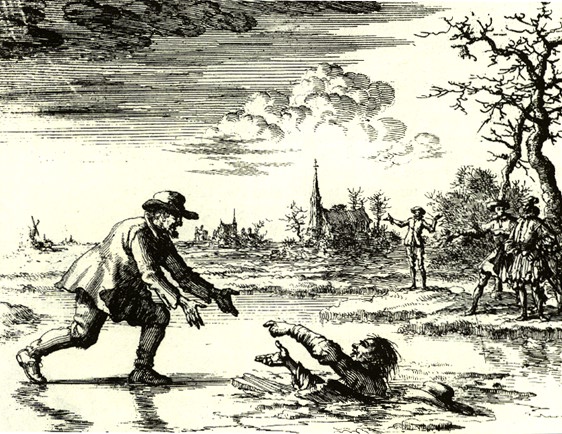
When the name Jan Luiken is mentioned in Anabaptist circles, most think of his brilliant etchings in the Martyrs’ Mirror. His depiction of the martyr Dirk Willems may be the most famous, appearing on book covers, adapted artwork, and even secular psychology textbooks.


Dirk.willems.rescue.ncsDirk Willems rescues his captor. Public Domain,
https://commons.wikimedia.org/w/index.php?curid=544931


IMG_20160802_135903_119.jpgLuiken etching found in the textbook “Exploring Psychology“ used by my husband when he taught a General Psychology course at James Madison University last fall.


But Luiken’s oeuvre goes far beyond his martyr drawings. Born in April 16, 1649 in Amsterdam, he was a Mennonite who made his living during the Dutch Golden Age as an illustrator, taking on numerous projects that spanned genres and topics. 

The Menno Simons Historical Library at Eastern Mennonite University is fortunate to have a considerable collection of books containing Luiken’s artwork. The content of these books ranges from exotic topics like the Laplanders of northern Finland to pirates on the North African coast and to more domestic portraits of tradesman and interiors of Dutch homes. Here I will highlight just a few interesting books and etchings in our collection.

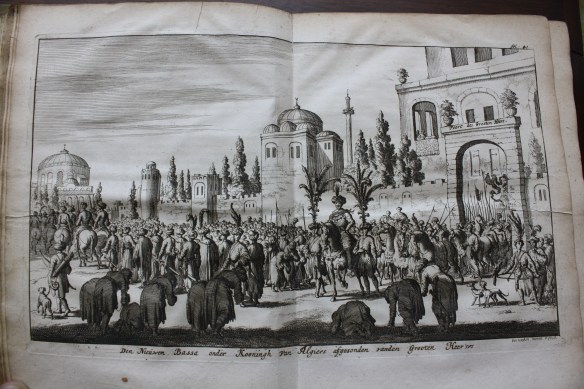
The first illustrations are from a 1684 book entitled “Historie van Barbaryen, en des zelfs Zee-Roovers”—which discusses the history of the Barbary (North African) coast and pirates.

IMG_6263Title page
IMG_6262The new king of Algeria
IMG_6264A battle at sea

The next illustrations are from a 1682 book about the history of the Lapland region of Finland. Luiken’s illustrations show the customs and activities of the Lapland or Sami people.

IMG_6266Baptisms
IMG_6265Skiing and sledding

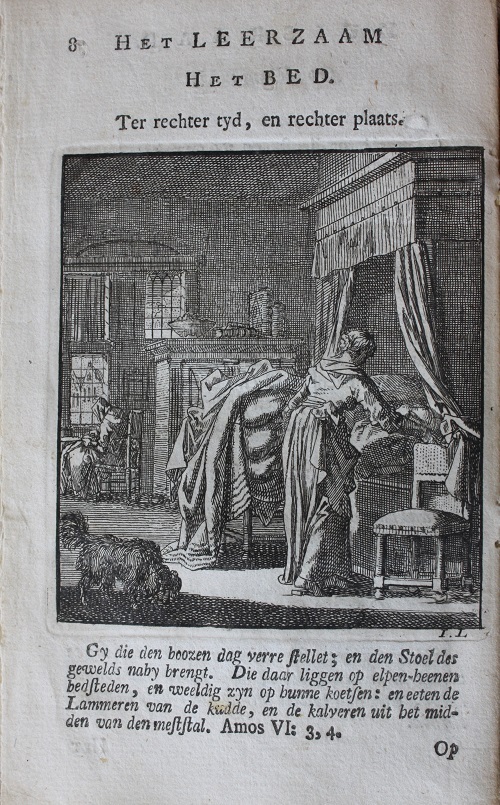
His illustrations in 1711’s “Het leerzaam huisraad” depict objects in a typical Dutch household.

IMG_6257The bed
IMG_6258The dishes

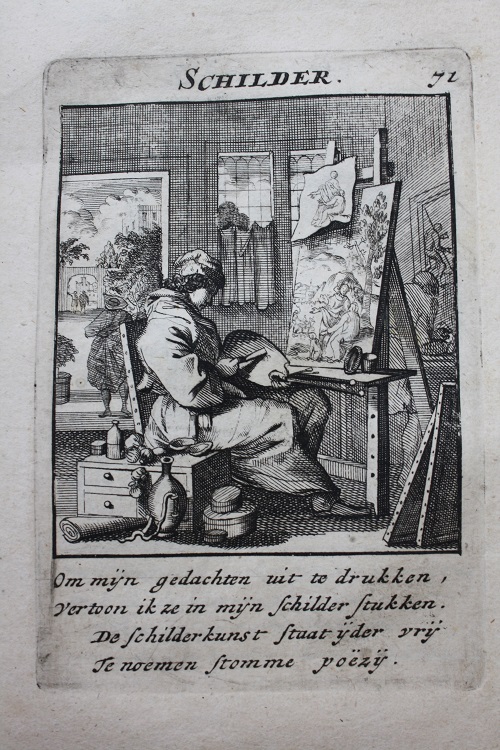
Likewise, his illustrations in “Het Menselyk Bedryf” depict various occupations of his day.

IMG_6259The painter
IMG_6261The fisher

Lois Bowman, Librarian Emeritus at EMU and former librarian in the Menno Simons Historical Library, has done a great deal of work cataloging our rare book collection and worked closely with the Jan Luiken Collection. She notes that the detail in Luiken’s work distinguishes it from other contemporary etchings; in addition to the main subject there are often background goings-on in his pictures that add a depth and realness to the illustration. The next time you encounter Luiken’s works either in the Martyrs’ Mirror or in other books, take some time to examine the etchings and note his attention to detail and skill. You are likely find something new and unique to appreciate! 

“Crossing the Line” Reflections

Wendy Urban-Mead

19420796_10154676829650869_7648785543472254809_n

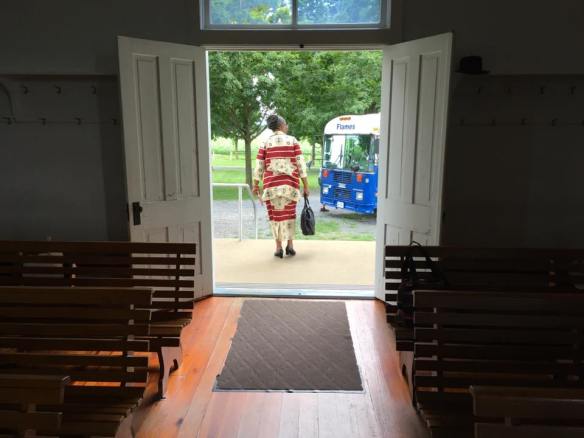
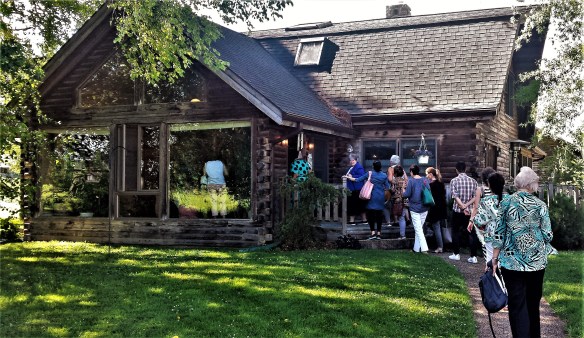
Two notable elements of the “Crossing the Line” conference come to mind: first, it was exceptionally well-planned, logistically, and flowed beautifully at a rich but manageable pace. Second, the offerings were refreshingly varied, ranging from serious academic work in the fields of history, sociology, literary analysis, and theology, but also offered memoirs and family histories, as well as a range of fine arts including dance, poetry, and visual arts. The tour to nearby notable Mennonite sites was truly beautiful and memorable. I would like to draw your attention to the photo I took of Mrs. Barbara Nkala, as she exited a church building we visited on the tour. This photo speaks to the question, “who is an Anabaptist today?” The image reaches from Old Order Mennonites in the Shenandoah Valley to a Brethren in Christ Church Zimbabwean mother in the faith—who journeyed far and at significant expense, together with her sister, to participate in and lead at Crossing the Line.  The impact of this admirably well-thought-out and holistic program was to offer participants both spiritual and intellectual refreshment.

19247666_10154676830050869_6048055334866956995_n

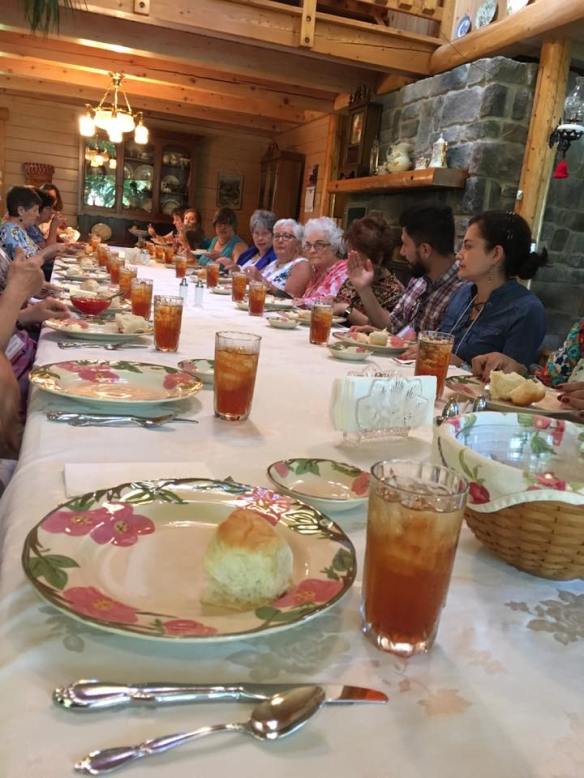
The long supper table and delicious-looking dessert comes from our meal at the home of Janet Shank.

I came to the conference in response to urging from Jan Bender Shetler that I send in a paper proposal, and at the invitation of Devin Manzullo-Thomas, to join a panel he was proposing on BICC women in leadership. I gave a talk about Sithembile Nkala, a member of the Brethren in Christ Church, Zimbabwe, who served as pastor of her BICC church during the 1970s. The story I shared centered around Pastor Nkala’s encounter with liberation war guerrillas. She drew on what I called “spiritual muscles” to find courage to confront the guerrillas, challenging them not to believe at face value the “sell-out” accusations they heard, in spite of the real possibility that they could have executed her for speaking out in this manner. This material is based on research I did for my dissertation in history at Columbia University and which in turn served as the basis for my book, The Gender of Piety: Family, Faith, and Colonial Rule in Matabeleland, Zimbabwe (Ohio Univ Press, 2015.) Devin spoke about women of the BICC in North America in the post-WWII era during the BICC’s “evangelical turn.”  Also presenting on this panel was Lucille Marr, a historian from McGill University in Canada. Lucille spoke on the early life and calling of Hannah Frances Davidson, the BICC’s first foreign missionary. H. F. Davidson, Lucille’s own great-aunt, was a crucial leader of the BICC’s mission to Rhodesia (now Zimbabwe.) See the photo of Lucille, Devin, and me—which Devin has also posted in his social media platforms.

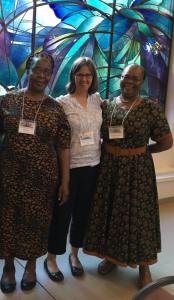
19399675_10154676829305869_7987347151558697291_nBarbara Nkala’s talk on “Unsung Heroines” of the BICC Zimbabwe was delivered with clarity and authority. Based on her own and her sister Doris Dube’s extensive work of collecting stories of women of the BICC Zimbabwe, Barbara’s joyful spirit came through, as well as her well-honed teacher’s expertise.  A longtime secondary school teacher at the BICC’s Matopo Secondary School, she is now a publisher of Christian and Ndebele literature and serves as the southern Africa regional representative for MWC.  I had not seen Doris and Barbara since 1999; our reunion at Crossing the Line was poignant and joyful. See the photo of the three of us standing before EMU seminary’s gorgeous stained glass window. Note also the photo of the conference’s wrap-up panel, which includes Barbara Nkala seated at the far right.
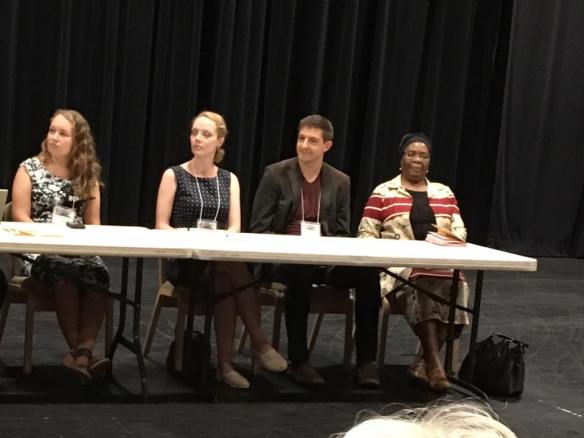
19429639_10154676830320869_914360242205161917_nI may well have been one of the only (if not the only) participants in the conference who is not a member of an Anabaptist-derived church.  I felt welcome; I became more deeply acquainted with the Anabaptist tradition, and came to admire and appreciate my Anabaptist fellows in Christ and in scholarship all the more. Thank you to the conference planners who accepted my paper proposal, allowing me to partake of these riches.

See other writings on “Crossing the Line: Women of Anabaptist Traditions Encounter Borders and Boundaries” here.

Does the Future Church Have a History?

Felipe Hinojosa

FCS-logo-colorThis week Mennonites will gather in Orlando at MCUSA Convention 2017 to worship, meet old friends, and learn together. I won’t be there this year and I regret that I will miss what is being called the “Future Church Summit.” The central driving question for the summit is: “How will we follow Jesus as Anabaptists in the 21st century?” All of this talk about the future of the church, via podcasts and church press articles, took me back to my very first Mennonite Convention in Philadelphia in 1993. Everything about the experience was spectacular. Philadelphia, an iconic American city, meant the Liberty Bell and Rocky for us kids from the United States/Mexico borderlands. It meant American history, American pop culture, and lots of Mennonites. Perfect. Because I have always been one to push boundaries and challenge established rules, one of the first things I did as a good American was buy a beautiful American flag shirt. The sleeves were blue, and across my chest and back were the stars and stripes. Why would I, then a sixteen-year-old Mexican American kid, want to walk into a Mennonite convention wearing the stars and stripes? Primarily because I wanted to stand out, I wanted people to know that I didn’t really buy into this Mennonite peace thing, and I wanted to show my patriotism in one of America’s most historic cities. Some people stared, some made comments, and others simply ignored me. But understand that I come from a community in South Texas with a proud military tradition. I was raised in a Mennonite Church where it was common to have both peace activists and military veterans worshiping side by side. In all of this I have often wondered if peace theology, rooted in the white Mennonite experience, has anything to say to us, to my Latina/o Mennonite community?

Even as I am a pacifist and a critic of the military industrial complex, I owe my utmost respect and honor to the Latina/o soldiers who in the years after World War II came home to a country that continued to treat them as second-class citizens. In fact, it was many of those veteranos y veteranas who launched the Mexican American and Puerto Rican civil rights movements in the years after World War II. Like African American soldiers who fought for “Double V,” victory against fascism overseas and victory over racism and segregation at home, Latina/o soldiers made the ultimate sacrifice for a country where they suffered discrimination, segregation, and poverty.

So, what are we to do with this history? How are we to reconcile a peace theology that does not speak to our diverse experiences, to our military tradition, and to our forms of peacemaking, which are often at odds with the very scholarly forms of white Mennonite peacemaking? These questions are not new. In the 1960s, as a student at Hesston College, Lupe De León asked why it was that peace-loving Mennonite boys were “driving around in hemi-charged cars, living like the devil and hiding behind the skirt of the church… If I have friends dying in Vietnam, then why are these Mennonite boys having such a good time?”1 When Lupe’s childhood friend, Raúl Hernandez, learned that one of his cousins had been killed in Vietnam, Raúl immediately gave up his conscientious objector status and joined the war effort for his country and as a way to honor his dead cousin. These experiences varied from the very clinical and effortless narratives that we read about conscientious objectors in Mennonite history books. And if these experiences were more complex, as I suspect they were, Mennonite historians have failed in their responsibility to tell us the stories of war and struggle that do not neatly fit the peace narrative that remains rooted in a mythical, sixteenth century story.

To counter these narratives and push back against white Mennonite peace theology, Black and Brown Mennonites drafted their own essays where they argued for a peace theology rooted in their own experiences as Americans in urban and rural sites. Curtis Burrell drafted an essay entitled “The Church and Black Militancy,” Lupe De León and John Powell penned essays on peacemaking in the “barrio” and the “ghetto,” María Rivera Snyder drafted essays on peacemaking in the home, and Seferina De León and Gracie Torres made peace by merging the hits of Bob Dylan and Joan Baez with Texas Mexican Border music. Much of this history remains unexplored, dug deep in the Mennonite archives where historian after historian has ignored the calls by Black and Brown Mennonites—and marginal white Mennonites— that offer us alternative visions of the future church.

As Mennonite church leaders gather to dream and envision a new church for the twenty-first century, I hope they are aware of this history. Not the history of white Mennonites captivated by Harold Bender’s Anabaptist Vision, but instead the history of Black and Brown Mennonites who—away from the careful watch of white Mennonites—have introduced their own visions, their own stories, and their own ways of being Anabaptist and Mennonite. Does the future church have a history? Yes, it does. And acquainting ourselves with the history of tomorrow can move us beyond tired attempts at unity as we imagine a new political and ecclesiastical future full of possibilities.


  1. Felipe Hinojosa, Latino Mennonites: Civil Rights, Faith, and Evangelical Culture (Baltimore: Johns Hopkins University Press, 2014), 86. 

Reflection on “Crossing the Line”

Anita Hooley Yoder

at book signing

Anita Hooley Yoder (right) with Doris Dube (left) and Marian Buckwalter (center)

For me, part of the fun of attending a conference in Harrisonburg, Virginia, is the drive there. It’s about six and a half hours from my home near Cleveland, Ohio, and I enjoyed taking a somewhat mountainous route and stopping to hike along the way. I also enjoyed staying with my sister and brother-in-law, who live in town.

The first day I spent with my sister, before the conference began, and she shared some past struggles that I knew little about. I thought that, unlike many of our female Anabaptist ancestors, my sisters and I had a pretty great childhood. And in many ways we did. But I suspect that all of us have stories in our past—our own histories—that we haven’t heard or acknowledged.

“Crossing the Line” was, at least in part, about honoring those kinds of stories.

One of the most poignant moments was hearing Jean Janzen, an 83-year-old Mennonite Brethren writer, share one of her first published poems, which focused on a long-buried family story about the suicide of her grandmother. “I am speaking the syllables you could not say,” Janzen read.

As part of the conference wrap-up panel, Doris Dube mentioned that Zimbabwean women often carry children wrapped tightly on their backs. Then she shared a proverb: “A weaning baby that does not cry aloud will die on its mother’s back.”

We, gathered here, are the children crying aloud on our mothers’ (mother church’s?) backs, I thought. And, we are the mothers who hear the cries and will not leave the child to die.

Hearing people’s cries—their most heartfelt stories—has become a kind of vocation for me.

I spent a large part of the past several years listening to stories of Mennonite women as I worked on a book about the history of Mennonite women’s organizations. These stories inspired me, as I encountered women who received little recognition but continued serving faithfully for decades.

Last August I started working as a campus minister at a small Catholic college. In that role I listen to students, faculty and staff, sometimes for most of the day. Their stories are sometimes painful, even shocking, but also full of resilience and serendipity and grace.

However, my experiences at and around this conference made me wonder about other stories I need to attend to. If hearing people’s stories is my vocation, how did I miss the stories my sister had been living for so long?

Sometimes it seems easier to focus on faraway stories, whether from distant times or distant lands. That was perhaps a shortcoming of this generally wonderful conference. While the presence of international attenders was commendable and clearly a focus of conference organizers, there was a lack of women from U.S. minority groups, even though there are Mennonite congregations of various ethnicities not far from our gathering place.

“We need all the women’s stories we can get,” Sofia Samatar said in her brilliant and broad-sweeping plenary address. So I am left to consider whose stories are still missing. What are the stories in my own family, my own community, my own soul that need to be heard? What about the stories of Mother Earth, the ground I drove across and walked over during my trip to Virginia?

Really hearing and honoring these kinds of stories often entails “crossing a line” of sorts, because such stories have been ignored and marginalized for so long. This conference was brimming with women and men who seem compelled to lift up all kinds of stories—the stories of undocumented immigrants, LGBTQ folks, Mennonite ancestors who had uncomfortable nationalistic tendencies. We didn’t cover everything, didn’t include everyone. But we know more stories now than we arrived in Harrisonburg, and that fills me hope for years to come.

See other writings on “Crossing the Line: Women of Anabaptist Traditions Encounter Borders and Boundaries” here.

Dispatches from “Crossing the Line”: Literary Women—The Lines They Cross

Eileen R. Kinch

Literary Women: The Lines They Cross

Panel 1: Friday, June 23, 8:30 am to 10:00 am

Three presenters gave papers on the lives and/or writing of Mennonite writers.

“Queering Tradition in Jessica Penner’s Shaken in the Water

by Daniel Shank Cruz, Utica College

Editor’s Note: While Anabaptist Historians generally focuses on historical research, in the interdisciplinary spirit of “Crossing the Line”, we are broadening our scope during this series to include a wide variety of Anabaptist studies.

  • Shaken in the Water is a novel that claims space for queer Mennonite bodies and is set in the early 1900s, the earliest chronological queer relationship to appear in a novel written by a Mennonite.  Agnes, the main character, has a scar on her body that causes her pain.  Not wearing clothes is far more comfortable, and Agnes discovers that only one person can touch her scar in a way that feels good: Nora.
  • The novel feels anti-Mennonite, but hopeful in that Penner is clearly writing in a (Kansas) Mennonite tradition.  Other Kansas Mennonite writers include Gordon Friesen and his book, Flame Throwers, and Dallas Wiebe, best known for his book, Skyblue the Badass.  Shaken is not a rejection of Mennonite community, but rather a wish for more flexibility for community members.
  • Magical realism in the novel pushes for non-traditional ways of experiencing the divine, and helps serve to resist the mind-body split.

“Bad Mennonites, Usable Truths, and Other Misreadings: Julia Spicher Kasdorf, Grace Jantzen, Sofia Samatar, and Mennonite Stories,”

by Jeff Gundy, Bluffton University

  • According to Roxane Gay, a “bad feminist” is one who admits her failure to embody feminist ideals, but still tries to live into the feminist project.  A “bad Mennonite” is one who admits his/her failure to embody Mennonite ideals, but still tries to, anyway.  (A problem with this, though, is that it allows the most intractable Mennonite folks to define what it means to be a Mennonite.)  The discussion will be on writings by people who might be considered “bad Mennonites,” but whose writerly concerns are related or connected to Mennonite concerns in a more underground way.
  • Grace Jantzen, a Canadian feminist theologian, argues in Foundations of Violence that the fascination with death and violence produces a  mystical longing for the other worlds.  Sophia Samatar’s fantasy novels Stranger in Olondria and Winged Histories are grounded in this thinking.  Samatar creates worlds that interrogate masculinist worldviews and form narratives about life, love, and flourishing.
  • Julia Kasdorf also works against death and violence, but is doing so through documentary poetry, a forthcoming volume called Shale Play.  Like fantasy, the documentary style opens up the experiences of folks who are caught in things beyond their control.

“Writing a Mennonite Woman’s Life: Alta Elizabeth Schrock, 1911-2000,”

by Julia Kasdorf, Pennsylvania State University

  • Feminist scholars have encouraged life writing since the 1970s.  The way a writer sees her life influences her writing and how she sees the world around her.  In terms of plot, men have the hero quest and adventure, but women have the domestic plot.  They are denied anger and exercise of power.  Kasdorf considers the project of writing Alta E. Schrock’s life to be a form of biographical life writing, and writing about Schrock’s life opens the possibility for other scripts.
  • Schrock, who had Amish roots but grew up in a Conservative Amish Mennonite church setting, was an ecologist.  She led CPS men on nature walks, taught a “Botany for Rural Service” course at Goshen, and opened her home to students in effort to foster community and family.  She also served in refugee camps in Germany.  She was the first woman to get a PhD and remain in the church.  She was something like a cross between Rachel Carson and Dorothy Day in her interests, and later lived with and helped Appalachian mountain folks.
  • Schrock lived “outside the script,” and not everyone appreciated that, including some of her neighbors.  She was also a “bintu,” someone who left the community for education, but then returned to the community to enrich it.

See other writings on “Crossing the Line: Women of Anabaptist Traditions Encounter Borders and Boundaries” here.

Dispatches from “Crossing the Line: Crossing the Line Art Exhibition

Dr. Rachel Epp Buller, curator

20170624_211435Artists are in the habit of crossing lines. In 1917, Marcel Duchamp caused an uproar by submitting to an exhibition a mass-produced urinal that he had signed, titled, and declared art. In 1989, Andres Serrano drew fire when several prominent Republicans in the United States Congress objected to his receipt of National Endowment for the Arts funding for his religiously themed photographs that achieved saturated colors through the use of materials such as blood and urine.1 The collective known as the Guerrilla Girls regularly raises a ruckus with their activist informational posters that draw attention to the disparities of gender and race representation in the art world, calling out museums and gallerists by name for their discriminatory practices. And just this year, the online art daily Hyperallergic has been awash in articles of activist artists protesting gentrification, the occupation of Palestine, the underwhelming global response to the Syrian refugee crisis, as well as many of the policies and executive orders of the Trump administration still in its infancy.
Editor’s Note: While Anabaptist Historians generally focuses on historical research, in the interdisciplinary spirit of “Crossing the Line”, we are broadening our scope during this series to include a wide variety of Anabaptist studies.

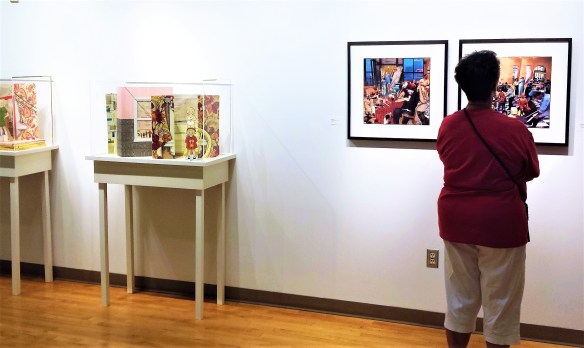
Artists affiliated with Anabaptist traditions cross lines in ways quiet and bold, subtle and overt. The conference during which this exhibition takes place, Crossing the Line: Women of Anabaptist Traditions Encounter Borders and Boundaries, invited presenters to consider border- and boundary-crossings in terms of ethnic and religious heritage, gender and sexual identity, geographic borders, private and public spaces, or disciplinary expression. The artists included in this exhibition most often cross lines in order to experiment and question, to make statements, or to think back through time.

A number of the artists represented here cross temporal borders and the boundaries of memory as they engage with the stories of ancestors. In her panels from Nine Tetrameters, Jayne Holsinger collapses varied historical references. Working in a four-patch quilt block format, Holsinger crosses easily between visual echoes of fabric patterns, historical prints, and bread baking, all modes of reaching out to the women of her Anabaptist heritage. Three prints by Gesine Janzen speak to her paternal family’s history of emigration from Poland’s Vistula Delta to central Kansas. By exploring the narratives evoked by historic photographs and letters, Janzen imagines a cross-generational dialogue, moving their stories forward across the decades and offering a meditation on family, intimacy, and absence. Teresa Braun’s video, The Plaint, explores family lore surrounding a specific place. A family cemetery and the fusion of human and plant organisms feature as mythological elements in Braun’s weaving of a fragmented ancestral narrative. Teresa Pankratz’s multi-act The View from a House in Kansas, excerpts of which are included in this exhibition and other parts of which will be performed during the conference, engages with semi-fictional narratives revolving around the artist’s childhood home, which was destroyed by fire some years ago.

20170624_211429Other artists purposefully cross borders of material. Historically, the highly regarded “fine arts” materials of painting and sculpture have far outweighed the importance of craft traditions such as needlework. However, one important legacy of the Feminist Art Movement of the 1970s has been the revaluation of media long denigrated as “women’s work.” Karen Reimer employs methods of embroidery and appliqué not only to bring feminized craft traditions into a high art context but also as a means by which to question the value of certain kinds of labor and notions of originality. Reimer intentionally copies her texts from other contexts as a way to destabilize definitions of creativity and innovation. As she writes, “Generally speaking, in the art world copies are of less value than originals. However, when I copy by embroidering, the value of the copy is increased because of the added elements of labor, handicraft, and singularity–traditional sources of value. The copy is now an ‘original’ as well as a copy.”2 At the same time, Reimer’s hand-sewn texts sometimes border on illegibility, producing a bad copy and inviting us to question the relative value of such painstaking labor. Kandis Friesen seeks to examine how textiles and other materials might impart narratives about migration and exile. In Onsa Japse Jeit Jantsied, drawing sewn onto leather makes reference to both indigenous and colonial histories. Friesen draws on a clothing pattern from a Russian Mennonite museum artifact from the 1800s, one that also incorporated buffalo skin from newly colonized lands. Like Gesine Janzen, Friesen looks to visual culture as a connection between the past and the future, yet in this case she also problematizes the narrative of hard-working Russian Mennonite immigrants as she uses textiles to implicate the diaspora’s participation in colonial processes.

Mary Lou Weaver Houser and Jen Dyck cross boundaries of medium through their work with found materials. Dyck’s collages investigate dream imagery, in some cases, and in others, such as Potluck, speak to her personal experiences of Anabaptist cultural traditions. Weaver Houser, on the other hands, positions her mixed media assemblages as metaphors: as she walks an edge between varied art materials, she also imagines edges – between generations, between different world views, between what is and what could be.3 Similarly, Jessie Pohl crosses material boundaries and points to the possibility of crossing emotional bridges as well. As she incorporates the unexpected material of scrap lumber as the substrate for delicate pen-and-ink drawings, she emphasizes a contrast of strength and vulnerability.

20170624_211422Some artists cross lines as a political gesture, seeing their methods as a way to issue public statements, either subtle or explicit. In Blamed Shamed Abandoned, one from a series of 60 paintings, Jerry Holsopple directly addresses the failures of U.S. Mennonite communities to protect, believe, or even listen to the many women abused by well-known Mennonite theologian John Howard Yoder. Holsopple grapples in his expressive portraits with the idea of collective responsibility and he explicitly brings the issue of sexual abuse out from behind closed doors, for public discussion and accountability. Audra Miller’s The Gender Project, which is represented here by two photographic diptychs, explores what it can mean to cross between feminine and masculine gender presentations. Through Miller’s photographs, we see not only the possibilities of either/or but also of in-between, of gender identities that are not always so easily classified in a binary system.

Lora Jost regularly engages with political activism, on topics ranging from local school closures to the local and global impacts of climate change. In her piece for this exhibition, Jost emphasizes more broadly the importance of critical thinking in our world. Informed by her experiences of a Mennonite historical focus on peace and social justice, Jost uses a combination of text and linework to ask the viewer to more carefully consider, when confronted with any issue of substance, “Does this make sense?” Jennifer Miller takes on a topic with both personal and political meanings in addressing the Keystone XL pipeline. Crude, a mixed media drawing, makes topographical references to the proposed path of crude oil transfer from the Tar Sands of Alberta to the Gulf Coast. The map follows the same path traveled by Miller’s family in their move from north to south for her father’s job as a pilot for the oil industry, pointing to complicated convergences of politics, business, childhood memories, and a family’s financial security. While the pipeline was halted under President Obama in 2015, a new administration has proven more receptive to the interests of big oil and Miller’s piece becomes relevant for political discussion once again.

Our Anabaptist ancestors wrestled with the idea of how to be in the world but not of it, an intentional choice not to cross borders. The art on display in this exhibition might be seen to run the gamut between insularity and worldliness, yet each artist thoughtful engages with notions of borders and boundaries. Whether speaking to themselves and their Anabaptist communities or to much broader audiences, these artists traverse edges of materials, politics, identity, generation, and memory, and they invite us to join them on the journey.  

See other writings on “Crossing the Line: Women of Anabaptist Traditions Encounter Borders and Boundaries” here.


  1.  For in-depth discussion of Serrano and the NEA controversy, see Steven C. Dubin, Arresting Images: Impolitic Art and Uncivil Actions (New Jersey: Routledge, 1994). Other texts that examine high-profile crossing of lines in contemporary art include Dubin’s Displays of Power: Controversy in the American Museum from the Enola Gay to Sensation! (New York: New York University Press, 2001) and Michael Kammen, Visual Shock: A History of Art Controversies in American Culture (New York: Vintage Books, 2006). 
  2. Karen Reimer, artist statement. Emailed to the author, 12 October 2016. 
  3. Mary Lou Weaver Houser, artist statement. Email to the author, 2 April 2017. 

Dispatches from “Crossing the Line”: Mennonite Women in the Shenandoah Valley History Tour

1

Conference organizer and professor of history Mary Sprunger organized a bus tour of Anabaptist historic and cultural sites in the Shenandoah Valley for Crossing the Line participants.

2

The first stop was the Burkholder Myers House (built 1854), where participants heard from Ruth Stoltzfus Jost about her family’s role in the Underground Railroad as well as about her mother, Ruth Brunk Stoltzfus, who at the age of 74 became the first woman to be ordained in the Virginia Mennonite Conference (1989).

3

Following a stop at the Hickory Hollow School of the Weaverland Old Order Group, the tour visited this Old Order Mennonite Church, including lively Q and A with Minister Lewis Martin.

4

Sisters Ruth and Etta Showalter run the Rocky Cedars Store which sells goods such as these hats and broad coats to customers from the Shenandoah Valley’s three different horse-and-buggy Anabaptist groups.

5

The tour concluded with a delicious meal at the home of Old Order entrepreneur Janet Shank, whose business is to cater dinners with the help of her family and neighbors.

See other writings on “Crossing the Line: Women of Anabaptist Traditions Encounter Borders and Boundaries” here.