Hitler’s Mennonite Physicist

A Mennonite named Abraham Esau headed the Nazi nuclear program during much of the Second World War.1 Esau’s activities contributed to Albert Einstein’s decision to warn US President Franklin Roosevelt on August 2, 1939, that Hitler’s government was studying atomic chain reactions that might lead to “extremely powerful bombs.”2 The program Esau ran in the Third Reich constituted a prime justification for the United States’ secret Manhattan Project, which produced the first atomic weapons. After the war, the North American-based Mennonite Central Committee helped rehabilitate Esau, who in turn downplayed Mennonite involvement in Nazism. 
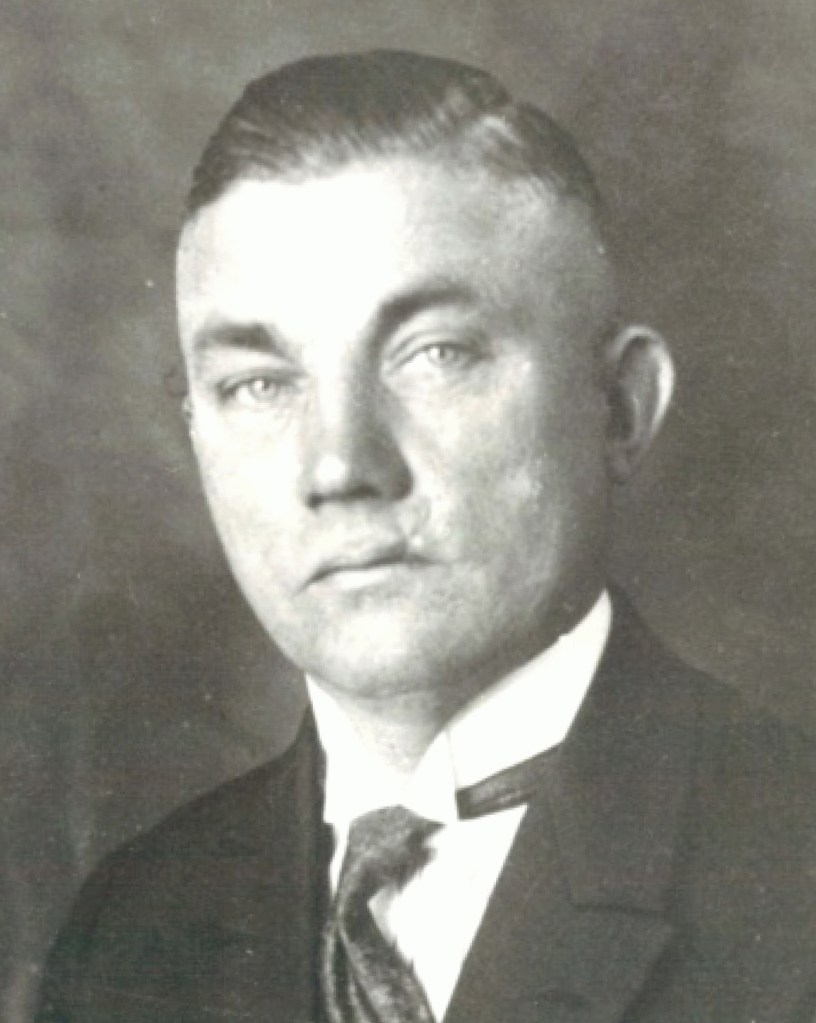
Abraham Esau, Mennonite physicist. One 1944 article described Esau as “a stocky man with a solid peasant’s skull,” the ideal of a Nazi scientist.

Abraham Esau was born in 1884 to a respected Mennonite family in eastern Prussia. His paternal grandfather was elder of the large Tiegenhagen congregation. He was raised by his father, a local bureaucrat.3 During Esau’s adolescence, Mennonites across Germany adopted nationalist ideals.4 Esau, perhaps more than anyone else, benefitted from the denomination’s new enthusiasm for higher education and military service. After receiving his doctorate in 1908, he performed noncombatant service as a radio physicist. He became involved in an ambitious state-sponsored project to confront British power by building a global wireless network to spread German news.5

Esau cut his teeth combining German expansionism with large-scale physics projects in colonial Africa. In 1914, on the eve of the First World War, he traveled to the German colony of Togo to install a massive radio station, which he subsequently destroyed in the face of invading French troops. French captivity deepened Esau’s nationalism, as did the postwar Treaty of Versailles, which gave much of his native Prussia to a new Polish state. In 1925, Esau joined the faculty at the University of Jena. There, he developed a physics research program. He discovered how to use radio waves for therapy, was nominated for a Nobel Prize, and became university president. 

The rise of Adolf Hitler in 1933 proved fortuitous for Esau. Joining the Nazi Party in May, he strengthened his presidency at Jena within the new political order. The governor of Thuringia appointed Esau a State Councilor, giving him access to powerful Nazi leaders. Meanwhile, his knowledge of radio physics made him valuable to the Propaganda Ministry, for which he served as an advisor. By the end of the decade, Esau had relocated to Berlin, where he headed the Reich Physical and Technical Institute. As a prominent science administrator with impeccable political credentials, Esau eagerly followed new discoveries in the field of high-energy atomic physics. 
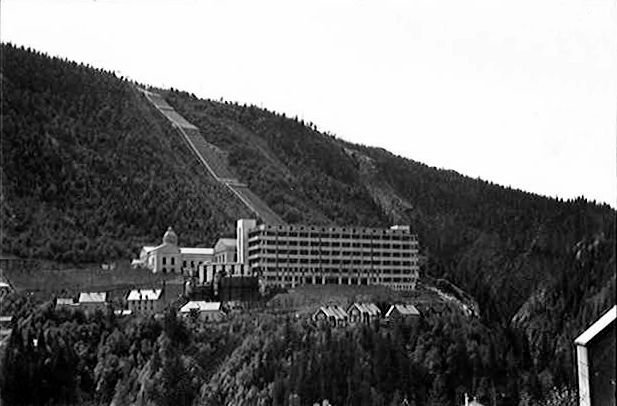
The Vemork Hydroelectric Plant in Telemark, Norway. This facility produced heavy water for the Third Reich while Abraham Esau ran the Nazi nuclear program in 1942 and 1943.

Esau headed the Nazi nuclear program briefly in 1939 and then again from March 1942 to the end of 1943.6 In April 1939, he organized a conference on nuclear chain reactions through the Reich Ministry of Education, where he announced plans to collect all uranium in Germany. With the outbreak of the Second World War in September, Esau lost control to the Army Weapons Office, which grew the program during the next eighteen months. Upon determining that nuclear power would not arrive in time to help win the war, the Army relinquished oversight to the Reich Research Council, which Esau headed. He ran the project until falling from political favor. 

Unlike the US Manhattan Project, Esau’s nuclear program was geared toward industrial applications of atomic energy, not bomb production. Nuclear science was certainly big business in the Third Reich. Esau oversaw a budget in 1943 worth $1,200,000.7 But this was hundreds of times smaller than the Manhattan Project, whose total cost reached $2 billion. Anxious not to overpromise at a time when Nazi leaders sought “wonder weapons,” Esau deliberately refrained from discussing atomic bombs with his superiors. This was not for lack of military commitment, however, but rather an effort to keep crucial war funds from being wasted on long-term research. 

On January 1, 1944, Abraham Esau exchanged his title of “Plenipotentiary for Nuclear Physics” for “Plenipotentiary for High-Frequency Technology.” Infighting within the atomic program had earned Esau the enmity of Albert Speer, the Reich Minister of Armaments and War Production. Nevertheless, as Esau handed the atomic program to his successor, he could boast real victories, including the enrichment of uranium isotopes by means of a centrifuge, application of nuclear physics to biology and medicine, and success with particle accelerators. Esau remained in the good graces of Hermann Göring, head of the Air Force, who gave him control of radio matters.

Esau committed the war crimes for which he was eventually convicted not as a nuclear scientist but through his capacity as Plenipotentiary for High-Frequency Technology. The Third Reich had contracted with an electronics company in the Nazi-occupied Netherlands called Philips to produce hundreds of thousands of dollars’ worth of materials for the war effort. In the autumn of 1944, as Allied forces advanced, Esau ordered an SS captain named Alfred Boettcher to evacuate equipment from Philips in the Dutch city of Eindhoven to Nazi Germany. Boettcher transported goods valued around $28,000 on three large trucks across the border, engaging in war plunder. 

As the Second World War came to an end in 1945, Abraham Esau was apprehended by a special team of American soldiers tasked with finding high-profile Nazi scientists and engineers. Like Albert Speer, the rocketeer Wernher von Braun, and others, Esau was interned and interrogated. In late 1946, Dutch state prosecutors requested that he be transferred to the Netherlands to be tried along with Alfred Boettcher for plundering the Philips electronics company. US officials agreed, deeming Esau less culpable than Speer and less valuable than von Braun. Esau was sent to the Dutch city of ‘s-Hertogenbosch, where he remained in prison for eighteen months.8

Esau’s first contact with North American Mennonites came while he was in Dutch prison. After the Second World War, an aid organization called Mennonite Central Committee (MCC) built a robust relief presence in the Netherlands, Germany, and other parts of Europe. This agency had a long history of transnational aid work, dating to the 1920s. It had briefly operated in the Third Reich and Vichy France between 1939 and 1942, until the United States entered the war. For several years, MCC concentrated on North American needs. But with the war’s end, it returned to Europe, where staff distributed food and clothing to those suffering in the wake of violence.9

Mennonite Central Committee recruited some personnel from congregations in Germany and the Netherlands, but its most influential staff were drawn from Canada and the United States. Two early members were Peter and Helene Goertz of Kansas. Peter Goertz was the academic dean of Bethel College, a Mennonite institution of higher education, from which he received leave to work in Europe with his wife during 1947 and 1948. Much of their activity concerned the 45,000 Mennonite refugees from Ukraine, Poland, Germany, and the former Free City of Danzig who were then spread across postwar Europe. Their most unusual case was that of Abraham Esau.
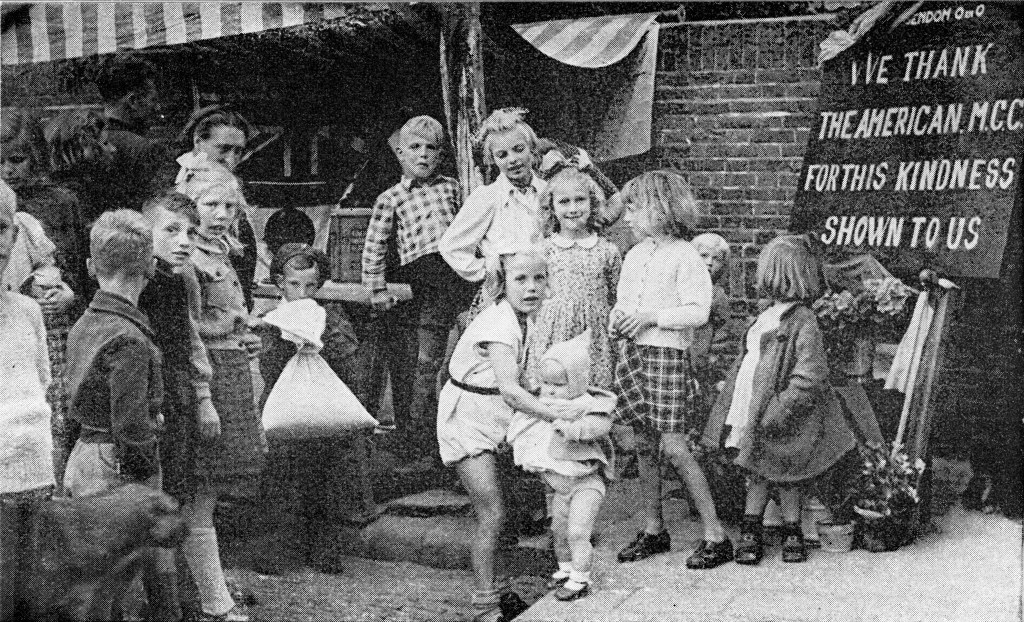
Dutch schoolchildren were among thousands of Europeans to receive humanitarian aid after World War II from the North American-based Mennonite Central Committee, or MCC. Credit: Mennonite Library and Archives.

After more than a year of imprisonment in the Netherlands, Esau had become desperate to leave. He wrote letters incessantly, seeking to connect with his former scientific colleagues and to find anyone who could help him achieve freedom. When Esau’s daughter, then living in northern Germany, discovered that a Mennonite Central Committee office had been established in Kiel, she explained her father’s plight and asked if MCC could help. The Kiel office wrote to MCC in Amsterdam, where Peter and Helen Goertz received the request.10 On February 25, 1948, Peter traveled two hours by train to ‘s-Hertogenbosch, where he met with the imprisoned Esau.

Peter Goertz described his encounter with Abraham Esau in correspondence to friends and family in Kansas. Goertz reported that upon arriving at the prison in ‘s-Hertogenbosch, he spent twenty minutes speaking with the warden, who agreed to vacate his office so the two Mennonites could meet in private. They spoke for two hours. To Goertz’s eye, Esau had become a despondent man, in need of “spiritual uplift.” Esau’s demeanor seemed to brighten over the conversation, and he expressed his gratitude so fervently that Goertz himself felt moved. The experience left a deep impression. Back in Amsterdam, he wrote: “Such are rather exciting moments even for me.”11

Over the following months, Peter and Helene Goertz reportedly developed a real friendship with Esau, although from their correspondence, it is hard to escape the thought that the former Nazi scientist cynically played his Mennonite benefactors. Although Peter clearly knew of the charges against Esau, he nonetheless took the prisoner at his word, writing that he “was not a confirmed Nazi,” that he “had been forced to care for physics laboratories in the whole of Germany,” and that “he does not know why he is in prison.”12 Helene, like her husband, expressed awe for Esau’s academic record, describing him as “a great physicist from the German Mennonites.”13

The willingness of Peter and Helene Goertz to believe Esau’s claims of innocence was typical of Mennonite Central Committee’s treatment of other Mennonites from the former Third Reich. After touring several refugee camps, Peter wrote, “It is amazing to me how many of the men from the Danzig area, even among the Mennonites, joined the [Nazi] party.”14 Helene identified attitudes of racism and territorial irredentism among the same group.15 Yet neither they, their colleagues, nor MCC as a whole seem ever to have seriously questioned their project of helping fellow Mennonites. Denominational connections outweighed even known Nazi collaboration.

Abraham Esau received several more visits in prison from Peter Goertz, who along with Helene also visited Esau’s daughter in Germany. Peter supplied his imprisoned friend with scientific and religious reading materials. He charged at least one book on electromagnetism to the MCC relief fund.16 Esau was particularly pleased with another volume, The Story of the Mennonites by the US historian C. Henry Smith.17 Commenting that this book should be available to the tens of thousands of Mennonite refugees then scattered across Europe, Esau began translating the 800-page tome into German using pencils and notebooks that Peter Goertz brought from Amsterdam.

On April 27, 1948, a Dutch court in The Hague released Abraham Esau along with his colleague and fellow inmate Alfred Boettcher, the former SS captain, with no criminal conviction. Exactly why Esau and Boettcher were released is unclear. Possibly, one or more of the letters written by Esau and his daughter convinced someone powerful to intercede on the prisoners’ behalf. It is likely that Mennonite Central Committee played at least a minor role, if only by providing Esau with the ability to claim association with a well-known and respected relief agency. MCC at this time held remarkable legal clout with multiple Allied governments, including the Netherlands.

In any event, Esau and Boettcher immediately made their way, after leaving prison, to the MCC center in Amsterdam. Arriving on May 1, they stayed for nearly a month, until May 28, when the two men left for a camp on the Dutch border, eventually arriving back in Germany. While living in the MCC house, Esau and Boettcher became acquainted with many of the leading Mennonite relief workers in Europe, since they regularly passed through Amsterdam. Both visitors penned glowing thank-you notes. Boettcher was touched with the generosity of the MCC workers after his time in isolation, and he was glad to have learned more about Mennonite faith communities.18
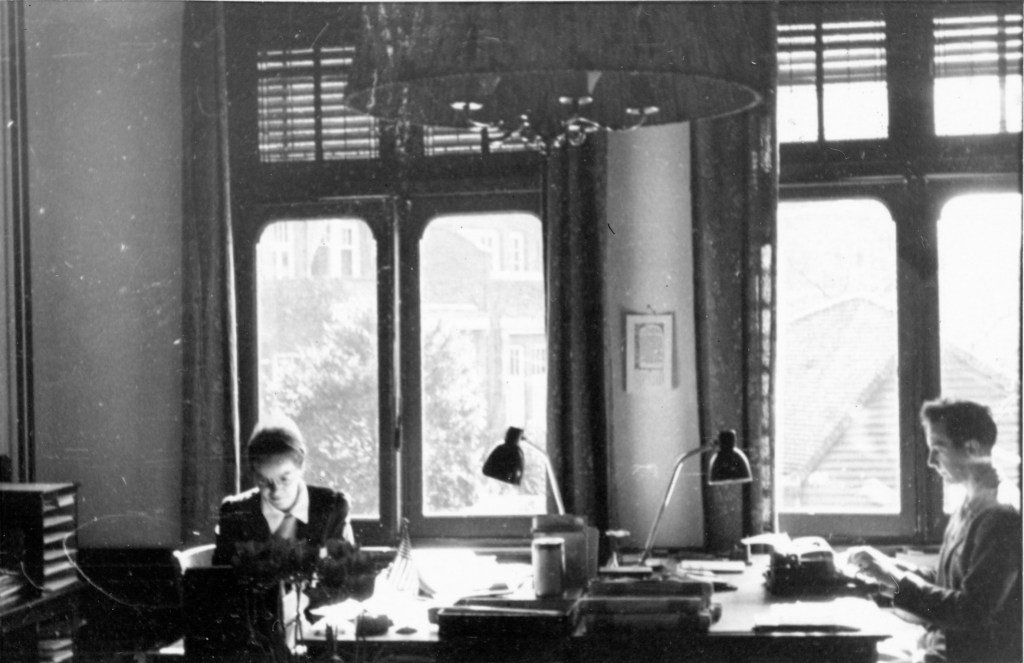
Mennonite staff members working inside the Amsterdam MCC center where the former Nazi scientists Abraham Esau and Alfred Boettcher lived for several weeks in May 1948. Credit: Mennonite Library and Archives.

Helene Goertz described the weeks Esau and Boettcher spent in Amsterdam in her letters. She referred to both men as “university professors” and considered them to be “proved innocent.” To Helene’s mind, Esau and Boettcher were victims of circumstances, who had nonetheless retained “their manners, their cultured ways, and their sense of humor.”19 The former Nazis washed dishes, carried baggage, and enlivened the atmosphere. Both plied Helene with flowers and fresh fruit. “Prof. Esau has been more than generous since you are away,” Helene wrote to her traveling husband. “Twice while I was sick he sent up some luscious strawberries and once a peach!”20

MCC rendered aid to Abraham Esau on the basis of his Mennonite identity, yet it is unclear that Esau was a practicing Mennonite prior to his contact with Peter and Helene Goertz. He had married a Mennonite (since deceased) and retained other family connections, but I have seen no evidence of any religious contacts between Esau and active Mennonite congregations during the Third Reich. A Mennonite Address Book published in Germany in 1936 does not include Esau’s name, despite printing membership lists for all the congregations to which he would likely have belonged.21 One Nazi-era article referred to him simply as from an “ancient peasant family.”22

Yet Esau represented himself to his MCC friends as a good and faithful fellow Mennonite. He attended church in Amsterdam with Helene Goertz, and he used religious language in his letters to her husband. “I thank God, that He has led me into your house and your family,” Esau wrote to Peter Goertz after leaving Amsterdam. He even portrayed his scientific and administrative activities in the Third Reich as consistent with Christian faith, writing: “I will resume the task which God will give to me with the old energy and in the same manner as before.”23 And all the while, he continued translating The Story of the Mennonites, completing ten pages every day.

Esau had nearly finished his German version of The Story of the Mennonites when he departed the MCC center in May of 1948. He left his completed notebooks with Peter and Helene Goertz. Upon arriving at his daughter’s home in northern Germany, Esau finished the work, and he gave the last part of his translation to MCC workers in Kiel, who then brought this document to the Netherlands. Finally, in mid-1948, Peter and Helene Goertz carried the full manuscript with them back to Kansas, where they deposited it at the Bethel College library. They reported Esau’s own hope that his translation would prove “of some profit for Mennonite circles in the world.”24

At the same time Abraham Esau was reconnecting with his Mennonite heritage, he faced critique from his former scientific colleagues. In the early postwar years, German nuclear physicists formed a remarkably solid front against perceived intrusions by occupying Allied forces. They abandoned old internal disputes and helped one another launch new carriers in the wake of the Third Reich’s collapse. Esau was unusual in being largely dismissed by this group. Physicists like Werner Heisenberg, who had won a Nobel Prize for describing quantum mechanics and had been Esau’s chief rival in the Nazi nuclear program, portrayed Esau as irredeemably tainted.25

Notably, it was the radio scientist Leo Brandt, not a nuclear physicist, who aided Esau’s reentry into Germany’s scientific culture. Brandt knew Esau from earlier radio research and now invited him to North Rhine-Westphalia. In 1949, Esau became a professor in Aachen and joined a new aeronautical research institute. Brandt also nominated Esau for West Germany’s highest federal service prize. But fellow scientists, including the Nobel Prize winner Max von Laue, intervened. Von Laue wrote that during the Nazi period, Esau cast himself as a “chief representative of National Socialism.” A former subordinate also testified that Esau had twice threatened to murder him.26

Upon his death in 1955, Abraham Esau left two remarkably distinct legacies. In the scientific world, he was remembered as an ardent Nazi, rejected after the war by many of his onetime friends. He was also a convicted war criminal, having been re-charged in absentia by a Dutch court and sentenced to time served for plundering the Philips company.27 By contrast, Esau was eulogized by prominent Mennonite intellectuals in Germany and the United States. In 1964, when Esau’s translation of The Story of the Mennonites finally appeared in print, the foreword by Cornelius Krahn of Bethel College praised him as “a man of uncommon creative capacity.”28 
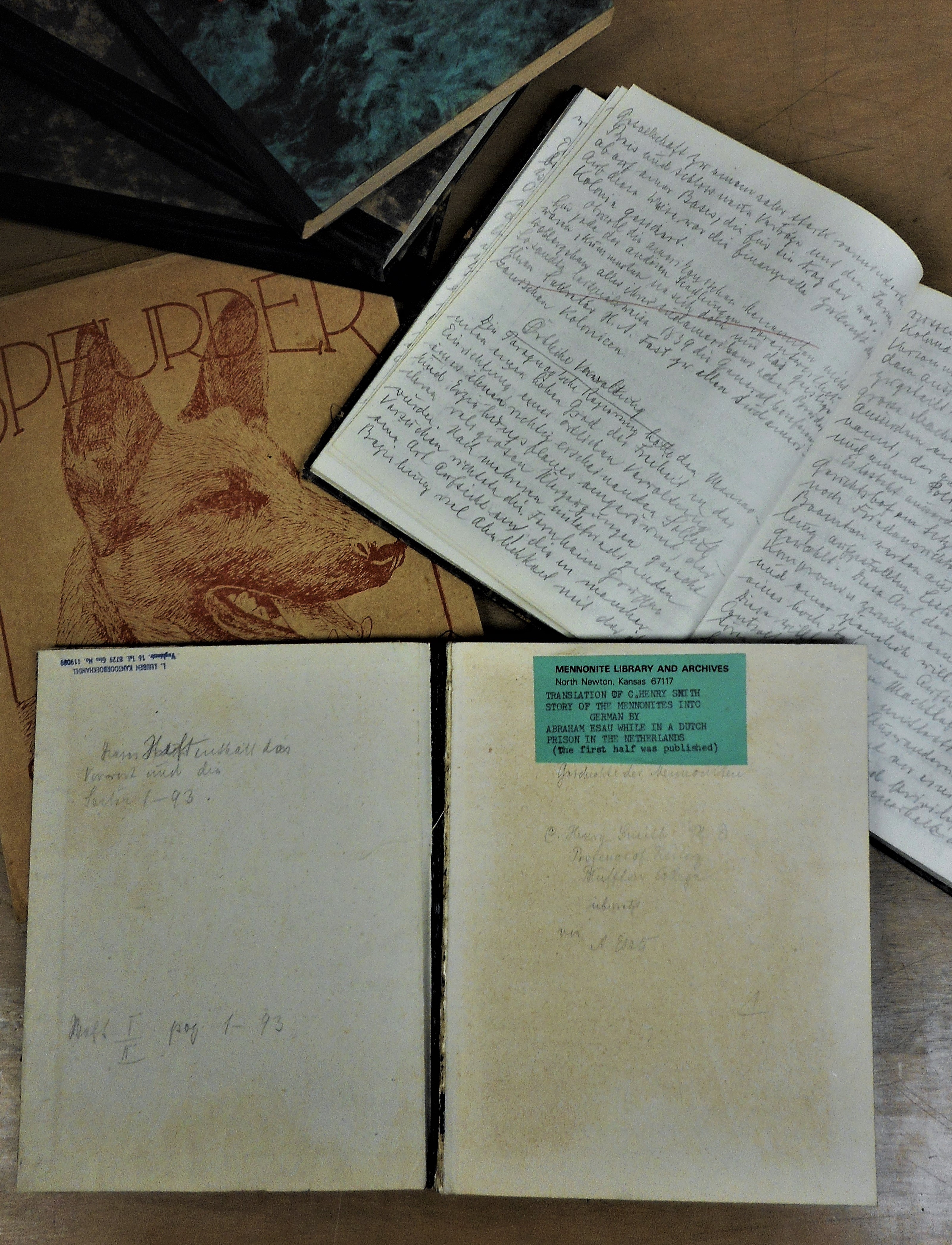
Abraham Esau’s handwritten translation of C. Henry Smith’s The Story of the Mennonites. Esau began his translation while in Dutch prison and completed the work after his release. These notebooks are now held at the Mennonite Library and Archives in North Newton, Kansas.

The German edition of The Story of the Mennonites sanitized not only Abraham Esau’s past but the broader role of Mennonites in the Third Reich. MCC expressed interest in the manuscript as a means of catering “to our German constituency,” and the US Mennonite General Conference took charge of printing it.29 Cornelius Krahn assembled a team of six readers, including Esau and three other former fascists, who proofed the typed chapters. These appeared in serialized form in a Canadian Mennonite newspaper beginning in 1951. The book’s final version included some additions, but it also entirely omitted a critical original chapter about the Third Reich.

It is appropriate that Abraham Esau, arguably the most powerful Mennonite in the Third Reich, also helped spark—quite unintentionally—the first efforts to publicly reckon with the church’s entanglement with National Socialism. In the same year that Esau’s translation of The Story of the Mennonites appeared, a young Mennonite named Hans-Jürgen Goertz received his doctorate in Germany on the history of radical theology. Goertz, who became a pastor of the Mennonite congregation in Hamburg, took issue with the book’s silence on the Third Reich. He translated the missing chapter and had it serialized in 1965 in a German-language denominational paper.30

Hans-Jürgen Goertz’s resurrection of the redacted chapter on Nazi Germany from The Story of the Mennonites helped ignite a slow-burning interrogation into the denomination’s troubled past. Run-ins with former Nazis as well as Goertz’s own ongoing interest in radical theology led to his landmark 1974 essay, “National Uprising and Religious Downfall,” which alleged that during the Third Reich, Germany’s Mennonites abandoned their principles for nationalism.31 This piece, which sparked still more debate and instigated the first book-length study of the denomination’s Nazi complicity, continues to inspire a process of research and response that is not yet complete.  

The story of Hitler’s Mennonite physicist illuminates much of the arc of Mennonite involvement in German nationalism from the late nineteenth century into the postwar era. Abraham Esau’s denominational background primed him to fuse academia with state militarism, allowing him to helm the Nazi nuclear program during the Second World War. Afterwards, the North American Mennonite Central Committee treated Esau, like thousands of other collaborators, as innocent and deserving of aid. Esau, meanwhile, portrayed himself as a model Mennonite, thereby erasing the stain of his war crimes. Being Mennonite suddenly mattered to Esau in an entirely new way. 

Mennonites in North America, Europe, and around the globe might reflect on this history of perpetration and denial. Why is it that European Mennonites like Esau found collaboration with Hitler’s genocidal regime so easy and desirable? How could North American Mennonites then so breezily cover for their coreligionists, without raising serious concerns about crimes they might have committed? Abraham Esau’s case may require special soul-searching, given his direct and significant role in the Nazi war machine, as well as his broader impact on the global rise of nuclear weapons. But he was also one among tens of thousands of Mennonite Nazi collaborators. 

Ben Goossen is a historian at Harvard University and the author of Chosen Nation: Mennonites and Germany in a Global Era, to be released in paperback from Princeton University Press on May 28. 

The author thanks Hans-Jürgen Goertz, Dieter Hoffmann, Bernd-A. Rusinek, Allan Teichroew, John Thiesen, Mark Walker, and Madeline Williams for their help with sources and interpretation. 


  1. The most complete biography of Esau is Dieter Hoffmann and Rüdiger Stutz, “Grenzgänger der Wissenschaft: Abraham Esau als Industriephysiker, Universitätsrektor und Forschungsmanager,” in ‘Kämpferische Wissenschaft’: Studien zur Universität Jena im Nationalsozialismus, ed. Uwe Hoßfeld, Jürgen John, Oliver Lemuth, and Rüdiger Stutz(Cologne: Böhlau Verlag, 2003), 136-179.
  2. Albert Einstein, Einstein on Peace (New York: Avenel Books, 1968), 295. On the Manhattan Project, see Jeff Hughes, The Manhattan Project: Big Science and the Atom Bomb (New York: Columbia University Press, 2003).
  3. For works that consider Esau’s relationship to Mennonitism, see Horst Penner, “Abraham Esau: Der Große Physiker aus Tiegenhagen,” Mennonitisches Jahrbuch 14 (1974): 54-57; Horst Gerlach, “Abraham Esau: Ein Physiker und Pionier der Nachrichtentechnik,” Westpreußen-Jahrbuch 27 (1977): 57-66; Horst Gerlach, “Esau, Abraham Robert,” MennLex V, online.
  4. Mark Jantzen, Mennonite German Soldiers: Nation, Religion, and Family in the Prussian East, 1772-1880 (Notre Dame: University of Notre Dame Press, 2010); Benjamin Goossen, Chosen Nation: Mennonites and Germany in a Global Era (Princeton: Princeton University Press, 2017), 18-95.
  5. See Heidi Tworek, News from Germany: The Competition to Control World Communications, 1900-1945 (Cambridge: Harvard University Press, 2019), 45-69.
  6. Information in this section is from Mark Walker, German National Socialism and the Quest for Nuclear Power 1939-1945 (Cambridge: Cambridge University Press, 1989), 17-206; Kristie Mackrakis, Surviving the Swastika: Scientific Research in Nazi Germany (Oxford: Oxford University Press, 1993), 162-186.
  7. Klaus Hentschel, ed., Physics and National Socialism (Basel: Birkhäuser Verlag, 1996), 321-322.
  8. Bernd-A. Rusinek, “Deutsche und Niederländische Physiker,” paper given at the conference “Ambivalente Funktionäre: Zur Rolle von Funktionseliten im NS-System,” held November 9-10, 2001 in Osnabrück, Germany, online.
  9. See Benjamin W. Goossen, “Taube und Hakenkreuz: Verhandlungen zwischen der NS-Regierung und dem MCC in Bezug auf die lateinamerikanischen Mennoniten,” Jahrbuch für Geschichte und Kultur der Mennoniten in Paraguay 18 (2017): 133-160; Goossen, Chosen Nation, 174-199.
  10. Helene Goertz to C. Henry Smith, September 24, 1948, Cornelius Krahn Collection, Box 5, Folder: Correspondence Horst Quiring 1943-1949, Mennonite Library and Archives, North Newton, Kansas, hereafter MLA.
  11. Peter Goertz to Peter [Unknown], February 26, 1948, Peter S. Goertz Collection, Box 2, Folder: Correspondence 1948-1950, MLA.
  12. Peter Goertz to Pat Goertz and Ruth Goertz, February 27, 1948, Peter S. Goertz Collection, Box 2, Folder: Correspondence 1948-1950, MLA.
  13. Helene to Family Members, February 27, 1948, Peter S. Goertz Collection, Box 2, Folder: Correspondence 1948-1950, MLA.
  14. Peter Goertz to Emil [Unknown] and Rachel [Unknown], November 15, 1947, Peter S. Goertz Collection, Box 2, Folder: Correspondence October-December 1947, MLA. On MCC’s postwar refugee efforts, see also Benjamin W. Goossen, “From Aryanism to Anabaptism: Nazi Race Science and the Language of Mennonite Ethnicity,” Mennonite Quarterly Review 90, no. 2 (2016): 135-163.
  15. Helene Goertz to Emil [Unknown] and Rachel [Unknown], November 15, 1947, November 15, 1947, Peter S. Goertz Collection, Box 2, Folder: Correspondence October-December 1947, MLA.
  16. Peter Goertz to Dewey Yoder, April 15, 1948, Peter S. Goertz Collection, Box 2, Folder: Correspondence 1948-1950, MLA.
  17. C. Henry Smith, The Story of the Mennonites (Berne, IN: Mennonite Book Concern, 1941).
  18. Alfred Boettcher to Helene Goertz, May 30, 1948, Peter S. Goertz Collection, Box 2, Folder: Correspondence 1948-1950, MLA.
  19. Helene Goertz to Pat Goertz and Ruth Goertz, May 8, 1948, Peter S. Goertz Collection, Box 2, Folder: Correspondence 1948-1950, MLA.
  20. Helene Goertz to Peter Goertz, May 16, 1948, Peter S. Goertz Collection, Box 2, Folder: Correspondence 1948-1950, MLA.
  21. Christian Neff, ed., Mennonitisches Adreßbuch 1936 (Karlsruhe, 1936).
  22. Hentschel, ed., Physics and National Socialism, 324.
  23. Abraham Esau to Peter Goertz, June 17, 1948, Cornelius Krahn Collection, Box 5, Folder: Correspondence Horst Quiring 1943-1949, MLA.
  24. Abraham Esau to Peter Goertz, July 1, 1948, Cornelius Krahn Collection, Box 5, Folder: Correspondence Horst Quiring 1943-1949, MLA.
  25. Klaus Hentschel, The Mental Aftermath: The Mentality of German Physicists 1945-1949 (Oxford: Oxford University Press, 2007), 96.
  26. Bernd-A. Rusinek, “Leo Brandt: Ein Überblick,” in Leo Brandt (1908-1971): Ingenieur, Wissenschaftsförderer, Visionär, ed. Bernhard Mittermaier and Bernd-A. Rusinek (Jülich: Forschungszentrum Jülich, 2009), 22-23; Bernd-A. Rusinek, “Von der Entdeckung der NS-Vergangenheit zum generellen Faschismusverdacht: Akademische Diskurse in der Bundesrepublik der 60er Jahre,” in Dynamische Zeiten: Die 60er Jahre in den beiden deutschen Gesellschaften, ed. Axel Schildt, Detlef Siegfried, and Karl Christian Lammers (Hamburg: Hans Christians Verlag, 2000), 120.
  27. Bernd-A. Rusinek, “Schwerte/Schneider: Die Karriere eines Spagatakteurs 1936-1995,” in Der Fall Schwerte im Kontext, ed. Helmut König (Opladen: Westdeutscher Verlag, 1998),44-45.
  28. C. Henry Smith, Die Geschichte der Mennoniten Europas, trans. Abraham Esau (Newton, KS: Faith and Life Press, 1964), Einleitung.
  29.  Orie Miller to Cornelius Krahn, October 6, 1948, Cornelius Krahn Collection, Box 5, Folder: Correspondence Horst Quiring 1943-1949, MLA.
  30. Hans-Jürgen Goertz, Umwege zwischen Kanzel und Katheder: Autobiographische Fragmente (Göttingen: Vandenhoeck & Ruprecht, 2018): 70.
  31. Goertz’s original essay is reprinted with commentary in Marion Kobelt-Groch and Astrid von Schlachta, eds., Mennoniten in der NS-Zeit: Stimmen, Lebenssituationen, Erfahrungen (Bolanden-Weierhof: Mennonitischer Geschichtsverein, 2017), 11-38. For historiographical context, see John Thiesen, “Menno in the KZ or Münster Resurrected: Mennonites and National Socialism,” in European Mennonites and the Challenge of Modernity: Contributors, Detractors, and Adapters, ed. Mark Jantzen, Mary Sprunger, and John Thiesen (North Newton, KS: Bethel College, 2016), 313-328.

Why Think with Early Anabaptists?

The history of sixteenth-century Anabaptists has occupied a privileged position in North American and European Mennonite historiography and self-understanding during the last century. The reasons for this are myriad. Most importantly, this history, and the theological writings associated with it, have offered these Mennonite communities legitimacy and a framework for determining a shared purpose.1

The role that early Anabaptist history has played in this context is undergoing reevaluation. Firstly, historical Anabaptist theology is diminishing in prominence as a resource for shaping Mennonite belief and practice. Secondly, as more North American and European Mennonite groups reflect to a greater degree the diversity of their societies and as distinctive Mennonite traditions in Asia, Africa, and Latin America shape a global church’s conception of itself–developments to be celebrated, surely–a history of origins rooted solely in early modern Europe is insufficient to the task of describing a common story. The question of whether the study of sixteenth-century Anabaptists is relevant to twenty-first century Mennonites requires continuous answering; a positive response should not be assumed.

Beyond these dynamics, a decentering of the sixteenth century in Anabaptist-Mennonite historiography–a trend represented in the content of this blog and one which I do not oppose–also coincides with a broader growth of doubts, in educational institutions and society more generally, about the value of studying a deeper past. Demand for pre-twentieth-century history (wars, presidents, and palace intrigue aside) is drying up, as indicated by class enrollments, hiring lines, and page views.

This colors the everyday experience of teaching, research, and writing for those working in fields of premodern history. When my colleague Cory Davis and I were recently approached to contribute to a fiftieth anniversary issue of the Sixteenth Century Journal entitled “Taking the Temperature of Early Modern Studies,” we wrote about the value of early modern history. Beyond questions of utility and origins, we argued, premodern historical scholarship retains relevance because of the habits of thought that it embodies and promotes. In the introduction to the piece, we highlighted two of these habits:

“First, early modern scholarship privileges empathetic understanding over judgment; while sharing with all good historical research the impulse to comprehend human subjects on their own terms, it is uniquely equipped to model this objective. Early modernists join historians of the ancient world and Middle Ages in noting the alterity of the values, worldviews, and modes of behavior of these eras’ peoples; the nature and quantity of early modern sources, however, make larger pieces of this foreign past accessible. We cannot claim to ever know what a person thought or felt in the past, even (or perhaps especially) when he or she recorded it. Nevertheless, our sources make it possible for us to practice and train others in the empathetic task of thinking with an enormous variety of people in radically different, and yet accessible, worlds.

Second, because of the period’s importance in shaping the structures that undergird modern life, early modern research reveals the contingency of both the past and present. Recognizing the circumstances in which world systems have come into being serves to denaturalize our own reality and provides alternative examples of how past communities have dealt with challenges comparable to those we face today. Thinking with early modern subjects requires us to set aside the privilege of hindsight in order to reconstruct their world and the possible futures they envisioned. Reducing the inevitability of the present in the minds of readers and students spurs us all to recognize that oppressive systems and ideologies are not destined to exist.

The promotion of these habits of thought, demanded by the practice of early modern scholarship, has taken on renewed import in present circumstances. By encouraging an impulse to understand the Other and by demonstrating possibilities for systemic change, the significance of early modern scholarship extends beyond its explanatory function and aids us to live better.”2

Scholarship on a deeper Anabaptist past epitomizes and encourages these same impulses. Engagement with the writings of early Anabaptists, and the search for traces of their existence in archives of the governments which repressed them, obligate us to wrestle with these people’s apparent strangeness. This encounter often confounds the assumption, or desire, that we will find ourselves in them. Attempts to overcome our basic difference from these subjects have at times led to projects of selective forgetting; better are efforts to reach across chronological distance to consider motivations and deeds of those who are inescapably foreign and to carry out the task of reconstructing environments in which their thoughts and actions made sense.

If thinking with early Anabaptists requires imaginative empathy, it also pushes us to take the contingency of their experience and legacy seriously. Early modern Anabaptist history is characterized by paths laid out and then diverted or blocked off, the result of moments of social and imaginative possibility punctuating generalized hostility. Recent scholarship has reinforced the notion that our understanding of Anabaptist phenomena is illuminated as much by the thoughts and actions of those figures and groups without a surviving tradition as by those whose link to the present is strengthened by shared convictions, organizational structures, or family names. These historical outliers too reasoned in ways worthy of consideration and demonstrated the capacity to temporarily construct alternative communities with geographical breadth and emotional and theological depth.3

When such an approach is taken, early Anabaptist history grows in its capacity to illuminate present questions and concerns rather than serving as a shibboleth.


  1. This point could be demonstrated variously, but Albert N. Keim’s description of the role of Anabaptist historiography in the work of H.S. Bender and the “Concern” group provides an example. Harold S. Bender, 1897-1962 (Scottdale, PA and Waterloo, ON: Herald Press, 1998), esp. 306-31 and 450-71.
  2. Cory D. Davis and David Y. Neufeld, “Thinking with the Early Modern Past: The Relevance of our Scholarship,” The Sixteenth Century Journal (forthcoming, spring 2019).
  3. Recent studies of instances of this phenomenon include Martin Rothkegel, “Pilgram Marpeck and the Fellows of the Covenant: The Short and Fragmentary History of the Rise and Decline of an Anabaptist Denominational Network,” Mennonite Quarterly Review 85, no. 1 (2011): 7-36; Kat Hill, Baptism, Brotherhood, and Belief in Reformation Germany: Anabaptism and Lutheranism, 1525-1585 (Oxford: Oxford University Press, 2015).

Reading the Signs of Nature in Traditional Pennsylvania Dutch Culture

This past Saturday, people across the country focused their attention on a groundhog named Phil who crawled out of his hole near Punxsutawney, Pennsylvania, at dawn. Unable to see his shadow, Phil “predicted” that spring will be coming early this year. For those of us just emerging from our burrows in the Upper Midwest, this is welcome news.

Groundhog Day, an event now celebrated in many communities across the US and Canada, takes place annually on February 2nd, which is the midpoint between the winter solstice and spring equinox. February 2nd is also Candlemas, an ancient Christian holy day whose roots go far back in pre-Christian Europe (cf. the Celtic festival of Imbolc). There are parallel spring-heralding traditions in Native American cultures, with which early German settlers in Pennsylvania very likely became familiar.1

By the turn of the twentieth century, the groundhog came to be adopted as a cultural symbol by nonsectarian Pennsylvania Dutch (church people, Fancy Dutch). As an antipode to greater America’s soaring bald eagle, the groundhog evokes humility, common wisdom, and proximity to nature, classic Pennsylvania Dutch virtues, including among the Plain people. Amish and traditional Mennonites, however, have kept their distance from celebrations involving the groundhog, including Pennsylvania’s Grundsow Lodge movement, which has become an important vehicle for nonsectarian Pennsylvania Dutch culture. The “seriously nonsensical” worship of King Groundhog at lodge meetings, which are also overtly patriotic, is out of sync with Plain sensibilities.2

Even though one was unlikely to have spotted any beards or bonnets at Gobbler’s Knob last Saturday morning, contemporary Amish and Plain Mennonite culture does have elements of traditional Pennsylvania folk astronomy.3 A common sight on the book table in many a Plain home, alongside the Bible and prayer and song books, is the farmer’s almanac.4 The almanac goes back to the beginning of Pennsylvania Dutch history and is deeply interwoven with the Christian faith and folk spirituality of sectarians and nonsectarians alike.

Julius F. Sachse (1842–1919), a keen observer of Pennsylvania Dutch culture, wrote this about the farmer’s almanac in a 1907 essay titled “Prognostics and Superstitions.”5

The Aberglaube (superstitions) of the early Germans may be said to have been divided into at least a hundred different forms, the scale running all the way from a simple belief in the efficiency of Bible verses promiscuously selected down to demonology itself. Perhaps the most common of these superstitions was what was known as Kalender-Aberglaube, or a belief in prognostics based upon the almanac. This was again subdivided into various departments, based upon the phases of the moon and other celestial bodies. This, however, is not to be confounded with the custom of astrology or the casting of the horoscope. To any person schooled in the art, the almanac became the guide and mentor for almost every function of daily life. First, it told us of the state of the weather for every day of the coming year; then it informed us what were to be the prevalent diseases, gave us the proper days for felling timber, taking purgative medicine, for bleeding and blood-letting, for cutting the hair, for weaning calves, children, etc. It gave the lucky days for sowing grain, the proper days for a merchant to speculate, and for other daily avocations.

Plain people today take special care not to allow superstitions into any aspect of their life. Young folks don’t ask each other what their signs are when they meet. However, deciding when it is auspicious to plant certain crops and cut one’s hair and nails, depending on the situation of the moon and constellations, for example, is understood as aligning one’s behavior to the cycles of a natural world that is created by God and therefore fundamentally good.

The nonsectarian Pennsylvania Dutch poet, Harvey M. Miller (1871–1939), lyrically recounts the wisdom contained in the pages of “Mother’s Almanac” (Der Mammi Ihre Kalenner), which is given here, first in English translation, and then in the Pennsylvania Dutch original, along with a recitation of it.6

Mark L. Louden reciting “Mother’s Almanac”

“Mother’s Almanac”

Faith has much to do
With our human life;
The lawyer believes in big pay,
The minister believes in praying;
The young girls get a lot of joy
From their faith in men;
Mother takes the good old way,
And believes in the almanac.


Sie always observes the signs,
Before we dig the garden;
And goes by the moon, you can bet on it,
For that is her faith.
In order to grow well, everything must go in
During the waxing of the moon;
Thus she plants in that sign,
As others do, as well.


Potatoes you plant in Libra,
Then they get nice and big;
You might think that’s a joke,
But I’m not so narrow-minded.
That’s why I wish they would not slip
Down so deep into the ground,
And if there were no such sign,
They would not be so round.


So if you don’t watch the sign,
Just as it is in the almanac,
Then your potatoes will be ruined,
And we’ll have nothing to sell;
I tell you now, don’t plant in Cancer—
They crawl down too deep,
And get as warty as a toad
And also taste bad.


Cucumbers, really, you may not
Plant in the sign of Gemini,
Otherwise they just go ahead and bloom
And creep around like roaches;
That sign is not for a good crop,
They just don’t form on the vine—
Whoever wants cucumbers, doesn’t plant
In the sign of Gemini.


But now, whoever likes flowers,
This sign is the best;
The blossoming virgin is also good
For planting flowers.
In spring here, in Virgo, that is,
You let the hens out,
Whoever goes by this sign then gets
Better chicks from them.


When bees swarm in Libra,
Honey becomes plentiful in the hive;
If a cat drowns in a water trough,
At least it won’t die of thirst.
When fruit trees are in full bloom
While the moon waxes, there’ll be fruit;
But if the trees blossom during the waning,
There’s not much you can do.


In the setting moon you roof a house,
That keeps the shingles down;
And whoever doesn’t build according to the almanac,
His shingles will be down right away.
To roof during the waxing of the moon,
That’s the wrong thing;
The shingles curl right up,
And you get a ragged roof.


You make the post fence according to the moon,
But just when it is setting;
The posts will not stay in the ground
In any other sign.
So, don’t laugh, and take heed,
I’ll tell you that in advance,—
Whoever makes fence in the waxing of the moon,
His posts will creep out.


Some poke fun, there are such people,
Especially among the menfolk,
Yet they are in no way as smart
As Mother’s almanac.
“An old wives’ tale, ha!”
That’s what they always say,
But faith will still save,
And it rules digging in the garden.


Libra is supposed to be good for planting,
But some also put in potatoes
In the Aries waxing moon,
That’s just testing.
And for good luck with radishes
Seeds have to be planted in Pisces,
That means that radishes will be tender and thick
And plenty on the table.


In the fall apples have to be put away,
And so that they don’t rot
You have to do this in the dark moon, you bet,
Even if the men-folk complain.
To get vinegar you need to tap the cider
In the sign of Leo, definitely:
That makes you as strong as ginger pop,
And as crusty as an old grouch.


But winter meat should not be
Hung up in the sign of Leo,
Otherwise it will get as “lively” as a lion—
One definitely wouldn’t think that!
White worms will move right in,
If no one goes fishing,
That way you get fresh meat, too,
If you don’t understand the sign.


A board left out in the weather
Often gets quite warped,
But one doesn’t consider the reason
As being the influence of the moon;
In the waxing of the moon the board turns up,
In the waning down,—
It all depends how the moon shines on it.
Isn’t that amazing?


You don’t clean your house in a full moon,
That’s the wives’ tale,
For if you do, the house will fill up 
Terribly with moths;
That just goes to show, moths go
By the moon sign in the almanac,
Apparently they are sharper
Than our clever menfolk.


The signs have the world in order,—
Capricorn, Pisces, and Aries,
Leo, Libra, Aquarius,
Taurus, he’ll knock you down;
Sagittarius, he shoots, Aquarius pours,
We have Cancer and Gemini,
Scorpio stings, Virgo speaks,
That’s how you find it in the almanac.

“Der Mammi Ihre Kalenner”

Der Glaawe hot doch viel zu duh
Mit unserm menschlich Lewe;
Der Lawyer glaabt an grooser Luh,
Der Parre glaabt an Bede;
Die yunge Meed hen groosi Freed
Fer Glaawe an die Menner;
Die Mammi nemmt der gut alt Weg,
Un glaabt an der Kalenner.


Sie watscht die Zeeche immer uff,
Eb mer als Gaarde graawe;
Un geht beim Muun, verloss dich druff,
Fer sell is ihre Glaawe.
Fer waxich sei, muss alles nei
Im Zunemmede vum Muun;
So blanst sie als in selre Sign,
Wie aa noch annri duhn.


Grummbeere blanst mer in der Woog,
Noh duhn sie schee grooss warre;
Du denkscht verleicht sell is en Joke,
Awwer ich bin net so narrow.
Also ich wett, sie schluppe net
So dief nei in der Grund,
Un wann’s ken so en Zeeche hett,
Waere sie net so rund.


So wann mer net des Zeeche watscht,
Graad wie’s is im Kalenner,
Dann sin Grummbeere glei verbatscht,
Un Marrick hen mer kenner;
Ich saag dir yetz, blans net im Krebs—
Sie graddle zu dief nei,
Un warre waarzich, wie en Grott,
Un schmacke schlecht debei.


Die Gummere, waerklich, darf mer net
Im Zeeche Zwilling blanse,
Sunscht bliehe sie yuscht graad ahead,
Un graddle rum wie Wanse;
Die Sign is net fer en guder Crop,
Sie henke gaar net aa—
Wer Gummere hawwe will, geht net
Im Zeeche Zwilling draa.


Awwer nau, wer scheeni Blumme suit,
Des Zeeche is am Beschte;
Die bliehend Yungfraa is aa gut
Fer Blumme naus zu setze.
Es Friehyaahr do, Yungfraa also,
Setzt mer die Glucke naus—
Wer geht beim Zeeche, grigt dernoh
Die Yunge besser raus.


Wann Ieme schwaerme in der Woog,
Watt Hunnich schwer im Kaschte;
Wann die Katz versauft im Wasserdroog,
Dutt sie ennihau net verdaschte.
Wann Obschtbeem recht am bliehe sin
Im Zunemmede, gebt’s Frucht;
Wann awwer die Bliet ins Abnemme kummt,
Gebt’s net viel zum Versuch.


Im Unnergehnde deckt mer’n Haus,
Sell halt die Schindle drunne;
Un wer net beim Kalenner baut,
Sei Schindle sin glei hunne.
Im Iwwergehnde Deckes duh,
Sell is en letzi Sach;
Die Schindle ringle sich graad uff,
Un’s gebt en schtruwwlich Dach.


Mer macht die Poschtefens beim Muun,
Awwer yuscht im Unnergehnde;
Die Poschte bleiwe net im Grund
In ennich annrer Zeeche.
So, net gelacht, un geb doch acht,
Ich saag der’s vannenaus,—
Wer Fens im Iwwergehnde macht,
Sei Poschte graddle raus.


Deel mache Gschpass, es hot so Leit,
Abbadich bei die Menner,
Doch sin sie uf ken Weg so gscheit
Wie die Mammi ihre Kalenner.
“En alder Weiwerglaawe, huh!”
Sell’s was sie immer saage,
Doch macht der Glaawe selig noch,
Un regiert Gaardegraawe.


Die Woog soll gut fer blanse sei,
Awwer deel duhn aa Grumbeere
Im Iwwergehnde Schteebock nei,
Sell is yuscht im Browiere.
Un fer gut Glick im Reddich-Schtick
Muss Suume naus im Fisch,
Sell bringt die Reddich zaart un dick
Un blendi uff der Disch.


Im Schpootyaahr misse Eppel weg,
Un dass sie net verfaule
Geht’s draa im Dungelmuun, you bet,
Wann aa die Menner maule.
Fer Essig zappt mer Cider ab
Im Sign vum Leeb, net letz:
Sell macht en schtark wie “ginger pop,”
Un groozich wie der Gretz.


Awwer Winderfleesch, des soll mer net
Im Zeeche Leeb uffhenke,
Sunscht watt’s lewendich wie en Leeb—
Mer deet’s gewiss net denke!
Es ziehe glei weissi Warrem nei,
Wann niemand fische geht,
So hot mer aa frisch Fleesch debei,
Wer net die Sign verschteht.


En Board das draus im Wedder is
Watt oftmols arrick grumm,
Doch denkt mer net die Ursach is
Der Eifluss vun em Muun;
Im Iwwergehnde dreht sich uff,
Im Unnergehnde nunner,—
S’is nochdem wie der Muun scheint druff.
Is sell nau net en Wunner?


Mer butzt ken Haus am Vollmuun rum,
Sell is der Weiwerglaawe,
Fer wann mer dutt watt’s Haus gans rum
Gaar hesslich voll mit Schaawe;
Des weist doch pleen, die Schaawe gehn
Beim Muun-Sign im Kalenner,
Sie sin yo scharfer, sell’m nooch,
Dass unser gscheite Menner.


Die Zeeche hen die Welt in Hand,—
Der Schteebock, Fisch un Widder,
Der Leeb, die Woog, der Wassermann,
Der Ox, daer schtoost em nidder;
Der Schitz, daer schiesst, der Wassermann giesst,
Der Grebs un Zwilling hen mer,
Der Schkorpion schticht, die Yungfrau schpricht,
So findt mer’s im Kalenner.


  1. Don Yoder, Groundhog Day, Stackpole Books, 2003.
  2. William W. Donner, Serious Nonsense: Groundhog Lodges, Versammlinge, and Pennsylvania German Heritage, Penn State University Press, 2016.
  3. Louis D. Winkler, “Pennsylvania German Astronomy and Astrology I: Almanacs,” Pennsylvania Folklife 21.3, Spring 1972, pp. 24–31.
  4. See this 2004 Mennonite Weekly Review article on the popularity of almanacs among the Amish: http://www.mennoworld.org/archived/2004/1/12/amish-almanacs-help-keep-year-order/?print=1.
  5. Julius F. Sachse, “Prognostics and Superstitions [Current in Pennsylvania],” Historical Papers and Addresses of the Lancaster County Historical Society VII, pp. 75–101, 1907, accessible at http://www.lancasterhistory.org/images/stories/…/vol7no5pp75_101_682506.pdf
  6. Solly Hulsbuck (Harvey M. Miller), Pennsylvania-German Stories, Prose and Poetry, Hawthorne Press, 1911, pp. 3–6.


Searching for Anabaptists in Emden

At the risk of appearing preoccupied with Emden and its Schutzgeld, I write today about another aspect of these seventeenth-century registers. When I began researching in the summer of 2016, I assumed the example I found in Emden to be one of a readily available type of bureaucratic document. A simple list of Mennonite believers, with names and sums – surely these are widespread! Sadly, no. Although Schutzgeld structures were in place in a number of cities in the Holy Roman Empire, and presumably were collected regularly within those cities, sparse records remain. The Emden city archive itself holds only the registers from 1601, 1602, 1626, 1737 and 1749.  For today, then: a short note on my research and its many dead ends.

As the Schutzgeld registers fueled my earliest research and writing, names were on my mind. What could I do with names? My initial instinct was to amass a database of individuals mentioned as Anabaptists in the northwest corner of the Empire. I could use static official documents to infer movement – where Anabaptists were taxed, where they were disciplined, where they were expelled. I had hoped that, by tracing who left where, and why, I might be able to reconstruct patterns of itinerancy and find new civic sources to flesh out the lives of these religious refugees. This was my big-picture goal, but I began in Emden with my lists of names and a wonderful, digitized archival finding aid courtesy of the friendly archivists in Emden.

I was immediately confronted with problems common to genealogists and historians alike. To begin with, only the most unique of surnames provided any hope of a definitive match. The many iterations of ‘Jacobs/sen,’ ‘Jans/sen’ and ‘Peters/sen’ proved too numerous to hope for success. I found a Johan Janßen in the notarial records – perhaps related to the Johan Janßen who paid a Schutzgeld of 15 thaler and six schap in 1602 – petitioning the court for the release of his father in 1568.[1] Yet, Johan Janßen? A more common name can hardly be found. More likely the connection was a coincidence of popular naming.

Yet, despite these setbacks, I hoped that these Schutzgeld records might have more to teach me. Perhaps the most useful aspect of these lists is the notation of ‘vertrocken,’ – rendered in modern Dutch as ‘vertrokken’ – those who departed, or emigrated. This was a smaller subset of names to investigate, and promised some sort of movement.

Those who are noted as ‘departed’ throughout the 1602 register, seventeen in all, largely do not leave a mark elsewhere in the Emden archives. One small exception is Hanß Kock. Obligated to pay two thaler, he had by Easter remitted one thaler five schap, and “thereby departed.”[2] He received his letter of safe conduct from Henrica Ripperda, the widow of the Lord of Dornum, on 30 June 1602. As a boatman, Kock provided the means of transport to Hamburg for two brothers bearing a load of butter and cheese.[3] The timing suggests that this Hans Kock is the same as found in the Schutzgeldlists, as does the von Dornum’s long history of Anabaptist sympathy.[4] But that’s about all it suggests.

I’ll keep Hanß Kock in my database, and check for him in Hamburg if my research ever takes me there. But this methodology, of names and lists and cross checking, has become just one of many tools I use to find Anabaptists wherever I can in the archive. I have benefitted greatly from the recommendations of my mentors, the suggestions of fellow grad students, and the inventions that arise out of necessity – as I keep searching to find those who largely did not want to be found by early modern authorities.


[1] Stadtarchiv Emden, I. Registratur, Nr. 712c.

[2] Ibid., Nr. 415, Bl. 80: Hanß Kock Ad 2 {dhr} soluit vp Oisterenn darmitt vertrockenn

[3] Ibid., Nr. 176a.

[4] The lords of Dornum and Oldersum fueded in the early seventeenth century. Ibid., Nr. 824.

How much to change: Amish teachers in Mexico

The average person is not a revolutionary even though the average person might want some kind of change. I noticed this tendency to be especially strong in the Mennonites and Mormons I spent time with in Mexico, because of the strong communal ethos. And yet, in every community, there are people who risk a lot to make changes.

One way that people attempt to make change is in the realm of education. Education, particularly of young children, is a highly contentious area in most communities because changing young children’s experiences will change the future. Maintaining religious education in German is one of the reasons that Mennonites initially moved from Canada to Mexico, and for that reason, education is especially important in Mennonite communities in Mexico. There have been some efforts to change traditional schools from within Mennonite communities in Mexico and from people in Canada and the United States.

Students playing broom jail. (Muddy Creek Farm Library, Ephrata, Pennsylvania)

Many different aid groups have worked in Mennonite colonies (groupings of villages) in Mexico, most notably MCC. One of the most surprising groups to find there, at least from my perspective, were Amish people. I first came across this cultural exchange when I began researching Mennonites in Mexico. Many people would ask me if I knew any Amish people, because I lived in Ohio, and Amish people lived in Ohio. I didn’t and would say so.

Mennonite people usually encounter Amish people as teachers. (I should note that the family and friends who first asked about Amish teachers were in the Mexican state of Zacatecas, where it is my understanding that people from the Conservative Mennonite Conference teach in summers, not from any Amish group). Moreover, not all the teachers that come to Mexico through the “Amish” board were Old Order Amish – some were Old Order Mennonite and others were New Order Amish. Still other Amish people, namely the Beachy Amish, are involved in aid work with Mennonites in the Southern Mexican state of Campeche and in other countries.

I have just mentioned approximately four Christian denominations (Beachy Amish, Old Order Amish, New Order Amish, Old Order Mennonite) and have grouped together all Mennonites in Mexico, who are divided into a multitude of church groups, the largest of which is the Old Colony church. These words are really unimportant for the story I am telling today – although the distinctions between groups are important for people who are part of them. The important thing for today is that all these people dress differently from their surrounding country, be it Canada or the United States. They are also involved in cultural exchange with one another.

Steve Nolt has discussed the roots of this exchange in his Article “Amish Stories, Images, and Identities,” and it was basically fostered by the Mennonite Central Committee through a learning tour for some of their Amish donors in the 1990s. After this trip some kind of board was formed for teaching in some parts of Mexico – where church leaders were already familiar with ideas of educational reform thanks to the work of people like George Reimer and others. Then, this board began sending young women from the United States to Mexico to go teach (or to go to Kansas and teach Old Colony Mennonites there). The teachers, by and large women, go to Mexico in groups and live with house parents from their community who look after them and house sisters to do some of the housework.

This movement is fascinating because this exchange replicates the colonial missionary engagement either at home or in other countries and likely a lot of the negative things that happened as part of the fresh air movement, which Felipe Hinojosa discusses in Latino Mennonites. At the same time as it repeats these troubling patterns, it gives the people who participate in it a new experience of travel and also of ability to see the world and meet a different kind of person – which is challenging in a closed religious community.

This travel has many of the same effects on the Amish women as it had on previous generations of women missionaries, which Marlene Epp talks about in Mennonite Women in Canada. They can be leaders in a way they would not be able to be at home. At the same time, the teachers and others who are part of the project exercise agency very much within their communal boundaries

The people to change education in Mennonite communities in Mexico, including those who participate in this project, as well as the children in these schools likely did not set out to be revolutionaries. They did set out to make small changes that made sense within their communities and I hope that it has a positive effect.

This post relates to an article I’ve written: “American Old Order Teachers Write Home from Mexico: Reflections on Gender, Religion and Caregiving.” Journal of Mennonite Studies 36 (2018): 237-258 and to some of the background research I conducted for this research note ““Expanding Low German Childhood: The Children’s Feature in the Mennonitische Post [Mennonite Post].” Mennonite Quarterly Review 92, no. 1 (2018): 471-481. If you’d like to read either article please let me know and I can share a copy with you.

Bibliography

Epp, Marlene. Mennonite Women in Canada: A History. Winnipeg: University of Manitoba Press, 2008.

Hinojosa, Felipe. Latino Mennonites. Baltimore: The Johns Hopkins UP, 2014.

Nolt, Steven M. “Amish Stories, Images, and Identities: Two Windows and a Mirror on Contemporary Culture.” The Conrad Grebel Review vol. 33, no. 1, 2015, https://uwaterloo.ca/grebel/publications/conrad-grebel-review/issues/winter-2015/amish-stories-images-and-identities-two-windows-and-mirror.

The Musical Million for the millions

mm1881xii12.jpg

It is always exciting for librarians and archivists when we are able to share our collections in new and accessible ways. For this reason we were thrilled when the Library of Virginia’s Virginia Newspaper Project approached us proposing a collaboration to digitize and make available the Musical Million1. With the help of those at the Library of Virginia, specifically Errol Somay, and the dedication and swift scanning ability of our summer work-study student Finn Wengerd, we were able to complete this project in a few short months and are pleased to make it freely available.

Some very thorough and informative pieces been written about the Musical Million in conjunction with this digital launch, so I encourage you to read the blog post written by Gregg D. Kimball from the Library of Virginia as well as a post written by EMU’s Lauren Jefferson to get a good sense of the importance of this periodical and its place in both Shenandoah Valley and Southern Gospel music History.

EMU is one of the few institutions in the country to have a nearly complete run of the Musical Million, and it has been top on our wish-list of things to digitize and make available for many years now. We are very proud of this collection and this collaboration, and hope researchers and other interested folk can make good use of it! If you find yourself wanting to know more about Joseph Funk or the Ruebush-Kieffer company, come visit us in the Menno Simons Historical Library, where you can see an outstanding collection of songbooks and other publications from Funk and Ruebush-Kieffer, as well as interesting artifacts such as Joseph Funk’s writing chair, original printing plates for the 16th edition of the Harmonia Sacra, and Aldine Kieffer’s pump organ.


  1. As of this writing, there are 315 issues of the Musical Million available beginning in 1879. We hope to be able make accessible the first decade of the periodical as soon as we are able to digitize the fragile issues. It is also our hope that the precursor to the Musical Million, the Southern Music Advocate and Singer’s Friend, will soon be available. 

Newly Processed Collections at the MC USA Archives

Jason B. Kauffman

If I had to choose one word to describe the work of the Mennonite Church USA Archives over the last several months it would be: “productive.” In September I welcomed Eva Smucker Lapp as the new archives assistant, along with a Goshen College intern and two more regular volunteers. They joined a small, but dedicated core of long-term volunteers who have worked for years to process collections, build our online database of obituaries, and add images to our online collection of historical photographs. Together we made much progress this fall toward arranging, describing, and cataloging collections that accumulated before I arrived and while I was preparing for the move from Goshen to Elkhart.

IMG_4183.jpgSome processing highlights include:

I am grateful for colleagues, interns, and volunteers who keep things moving behind the scenes at the archives. They help complete the necessary work of organizing materials, rehousing and refoldering documents, and creating online finding aids so researchers can discover our new collections. Without their work, it would not be possible to make these important and fascinating collections available to researchers and the broader public.

And researchers are finding and using the collections. For example, a doctoral student from Canada spent three weeks in 2018 researching the Africa Inter-Mennonite Mission records for her dissertation project. Two other professors from universities in Canada and England recently consulted the Melvin Gingerich Papers for sources documenting his involvement (through MCC) with the United Nations Relief and Rehabilitation Administration and Seagoing Cowboys trips to Poland after World War II. And, of course, other researchers near and far continue to make creative use of many of the thousands of other collections housed at the archives.

I am amazed at the richness of our collections and am grateful that I can continue to make them accessible to researchers. I look forward to seeing what new discoveries await in 2019.

Christmas Controversy: Community Mennonite, Interracial Marriage, and a Hope from a Half-Century Ago

The Christmas pageant at Community Mennonite Church in Markham, Illinois, was always a treat. The brick walls festooned with greenery. The eager anticipation of young children bursting into chatter and antics and no small bit of mayhem. Christmas carols. Advent wreaths. Food and friends and beauty. For the six years we worshipped with that congregation between 2002 and 2008, I don’t think we ever missed a pageant.

One of those years my partner played the part of Mary. A young man from the youth group played Joseph. Another year, I played Joseph, and the partner of one of our pastors played Mary. In both instances, as was the case most every year, the holy couple was interracial.

Not such a big deal, that. Not in 2018. Although commercials featuring interracial couples still ignite the ire of white supremacists and interracial couples report instances of social ostracism and harassment, interracial marriages have grown more commonplace and socially acceptable – at least as compared to 1963.

I mention 1963 because that was the year when the depiction of an interracial holy couple in Community Mennonite’s Christmas pageant did cause a hullabaloo. A big one. They had to call in the denominational heavyweights. It was not, apparently, very pleasant.

This is how it went down.


By December 1963, Community had been experimenting with integration for a little over two years. One Sunday in 1961, three African-American women attended a Sunday morning worship service at the previously all-white congregation. In 1956 when charter members had purchased property on which to construct a sanctuary, they had signed off on a restrictive covenant excluding “‘any one who is not a Caucasian’ from the premises.”1 The congregation, nonetheless, welcomed the African-American women. Despite a few bumps along the way, a core of both white and black members continued to attend. And, by all accounts, they enjoyed each other as they worshipped.2

Yet, tensions built below the surface. From the onset, some white members had raised concerns that an integrated congregation would lead, inevitably, to intermarriage. In keeping with the history of black-white racial unions, the white community has been less supportive of interracial unions than has the black community, a pattern especially true in the 1940s and 50s.3 Although white attitudes had begun to liberalize by the 1960s, the issue remained fraught in a community like Markham that was at that time in the midst of white flight. Black families had started to relocate to the community in search of a bit of suburban safety and security.4

Community Mennonite Church, Markham, Illinois, circa mid-1960s and featuring Pastor Larry Voth

In that context of rapidly changing racial demographics, a long history of white fear of interracial marriage, and a still fledgling congregation, the organizers of the 1963 Christmas pageant cast a black Joseph and a white Mary.5 The service ensued. Christmas came and went. All apparently without incident.

Then the church board met on January 17. With the start of the new year came reports on attendance (it was up), heating of the church building (it had started), and offering envelopes (they should be numbered). Then the pastor at the time, Larry Voth, invited the field secretary for city churches from the national-level home Missions Commission of the General Conference Mennonite Church, Peter Ediger, to speak. Ediger noted that the rest of the denomination was very interested in what was happening in Markham as this small, formerly all-white congregation found itself on a journey toward racial integration. He offered a word of encouragement by noting that when a congregation is “having a struggle for existance [sic] it is a living church.”6

All seemed in order.

And then it wasn’t.

Church board chair Al Levreau read Genesis 11:1-9, the description of the tower of Babel in which “the Lord confused the language of the whole world. From there the Lord scattered them over the face of the whole earth.”7 The notes from the meeting on January 17 don’t explain what message Mr. Levreau meant to send by reading that passage. Perhaps he saw in the story of Babel’s chaos a case study to be avoided as Community Mennonite embarked on racial integration.

What was clear was that he did not approve of mixed race marriages. Not at all. Not even the hint of one in a Christmas play. With a generous dose of understatement bordering on cheekiness, the unidentified keeper of the minutes observed, “there was quite a discussion regarding inter-marriage.”8

It must have been quite a discussion. At the end of it Levreau has resigned from his position a board chair and declared that he would not return to worship services at CMC. After a unanimous vote to close the meeting, Ediger offered “a word of prayer.”9

I’ve often wondered what the conversations went like in the church parking lot after this meeting. I imagine that there was some venting. Perhaps even a bit of invective and opprobrium directed at the departing chairperson. A bit of self-righteous indignation even? Or, there could as easily have been mourning and expressed concern for the sudden separation. After all, when the congregation had weathered a previous racial controversy, Levreau had been the one to lobby for an open-door policy that set the path toward the integrated nativity scene.10 The record doesn’t say.

A month later the board met again. This time the president of the entire General Conference joined the meeting on February 15. Although Levreau did not attend – and in fact had not been visited by church leadership since his abrupt departure – board member Margaret Carr also objected to the prospect of intermarriage and grilled conference executive Walter Gering on the denomination’s position on the topic. After Carr explained her objections to both integration and intermarriage, Gering backpedaled by asserting that denominational officers had never encouraged intermarriage but that he thought black and white couples could have a happy marriage. When prompted, African-American board member William Smith explained that black families in the congregation were not interested in marrying across racial lines, an assurance that black church leaders had been stating to white Mennonites for nearly a decade.11

The controversy came to an end a month later. A delegation reported that they had met with Levreau, but that he was not willing to return unless he could influence the church away from integration. Smith replied, “As well educated as we are why do these things keep coming between us?”12 His incredulity at the prospect of a Christian brother objecting to his presence in the congregation leaps off the page across a half-century.

In response the board put their collective foot down. They voted – unanimously – to discontinue discussion about whether the church would be integrated and to declare – officially – that “Community Mennonite Church of Markham, Illinois …welcomes continued growth on a racially integrated basis.”13

History could have gone in a different direction that night. Board members could have chosen to be silent, allow the controversy to spill over into the congregation as a whole, or simply decide that the bother wasn’t worth it. Other majority white churches certainly did.14 But instead they set their faces toward an uncertain future and made the decision to continue trying to figure out what it would mean for black and white to worship together.


I chose this story to write about because it is a Christmas story, and we are in the midst of the nativity season. And also because I miss CMC’s Christmas pageants. They were a fine thing. Always a bit chaotic around the edges. Sometimes the congregation’s singing was a bit flat. It wasn’t always entirely – well – polished. But the love in that room? That was unmistakable. And the holy couple – by tradition through the first decade of the twenty-first century if not longer – was always interracial. The hope and promise of that image – however simplistic it may have been – never failed to move me.

I write this blog post on the morning of a day in which I will later denounce white nationalism at a local rally. Given the resurgence of white supremacy in our country, writing about an integrated Christmas service fifty years in the past can seem irrelevant if not naïve. To a degree, that may be true. But I also know that when I speak tonight, when I call out white nationalists for being small-minded, hard-fisted, and racist through and through, I will do so carrying a little bit of that nativity scene with me, and a little bit more of a congregation that decided to say yes rather than no to the question of integration before them fifty years ago.

  1. Tobin Miller Shearer, Daily Demonstrators: The Civil Rights Movement in Mennonite Homes and Sanctuaries (Baltimore: Johns Hopkins Press, 2010), 166.
  2. Don Burklow and Grace Burklow, “Interview with Don and Grace Burklow,” ed. Tobin Miller Shearer (Markham, Ill.,2005); Mary Ann Woods, “Interview with Mary Ann Woods,” ed. Tobin Miller Shearer (Markham, Ill.,2005); Mertis Odom, “Interview with Mertis Odom,” ed. Tobin Miller Shearer (Markham, Ill.2005); Gerald Mares and Dolores Mares, “Interview with Gerald and Dolores Mares,” ed. Tobin Miller Shearer (Markham, Ill.,2006).
  3. Renee Christine Romano, Race Mixing: Black-White Marriage in Postwar America (Cambridge, MA: Harvard University Press, 2003), 45.
  4. Andrew Wiese, Places of Their Own: African American Suburbanization in the Twentieth Century, Historical Studies of Urban America (Chicago: University of Chicago Press, 2004).
  5. That is at least the gender arrangement recalled by one couple. The written record doesn’t specify the gender mix, just that they were an interracial pair. Given the response by certain white members of the congregation, a black male/white female combination makes the most sense. Historically, the white community has been less threatened by white male/black female pairings, in part due to the record of white slave masters raping female enslaved Africans and denying the progeny that resulted any rights of inheritance. For reference to CMC’s casting decision, see: Mares and Mares.
  6. “Community Mennonite Church Church Board Meeting,” (Markham, Ill.: Community Mennonite Church, 1964).
  7. Genesis 11:1-9, New International Version.
  8. “Community Mennonite Church Church Board Meeting.”
  9. Ibid.
  10. Shearer, 167.
  11. “Community Mennonite Church Church Board Meeting.”
  12. M. Carr, “Community Mennonite Church Board Meeting,” (Markham, Ill. : Community Mennonite Church, 1964).
  13. Ibid.
  14. Stephen R. Haynes, The Last Segregated Hour: The Memphis Kneel-Ins and the Campaign for Southern Church Desegregation (New York: Oxford University Press, 2012); Kip Kosek, “‘Just a Bunch of Agitators’: Kneel-Ins and the Desegregation of Southern Churches,” Religion and American Culture 23, no. 2 (2013); Douglas E. Thompson, Richmond’s Priests and Prophets: Race, Religion, and Social Change in the Civil Rights Era (Tuscaloosa, AL: University of Alabama Press, 2017).

Suspended Movement

It was originally my intention to study Anabaptists as religious refugees during the first few decades of the Reformation. Though the notion of early modern religious refugees is well-developed, for a long time it was largely a reference to the itinerant ‘Calvinist international’ that Calvin himself wrote into existence from his position in Geneva.1 Though recent works have advocated for an expansive and inclusive re-imagining of the term, the traditional tripartite structure of Reformation scholarship still lingers–and narrows our focus to those identifiable as Catholics, Lutherans or Calvinists. I wanted to think about what it would mean for “Anabaptists” (broadly construed) to be included in this expanding concept of early modern religious refugees.

Yet in seeking to capture the movement of groups who are visible, in the early modern bureaucratic sources that I use, which reflect only in moments of stasis, it was pointed out to me that I was thinking more about the meaning of potential movement rather than movement itself. As I sorted through evidence in the archives of Westphalia and East Frisia, I often found Anabaptists immersed in legal negotiations about economic conditions–resisting or contesting their own dispossession, and negotiating the extra taxes they bore. Though these are often hostile sources, they illuminate the precarities and practicalities of material survival for marginalized religious groups during the early modern period.

I took my first archival trip in the summer of 2016 to visit Emden, in East Frisia, and to follow the work of Timothy Fehler.2 Dr. Fehler had included a reference to Mennonites paying Schutzgeld (literally “protection money”) in Emden, and I was eager to see what I might glean from these registers of “Mennoniten.” To give a brief glimpse into the scale of these documents: in 1601, there were 166 individuals or families who paid Schutzgeld.The total amount collected is given as 943 gulden, 8 schap and 10 witten. A later entry indicates that an additional sum of 400 gulden was paid for the Mennonites’ share of the protection of the city, and sent directly to the city treasurer–bringing the final amount remitted to 1343 gulden, 8 schap and 10 witten.4 In comparison, the chief preacher of the Große Kirche, Menso Alting, had received a generous annual salary of 600 gulden in 1595.5

Of those listed in the 1601 account, seven are Jews–denoted by the simple appellation “the Jew” after each of their first names. The seven Jewish men are scattered throughout the various collection groups, and pay obligations which appear to be calculated in the same manner as those of the Mennonites. If the collection units denote neighborhoods, then the possibility of Jews and Mennonites living together is certainly intriguing. Yet, as both were required to pay this extra protection money to live within the city, it is possible that this relationship was more of a bookkeeping convenience than anything else. In any event, the fact that these two groups were combined on bureaucratic lists speaks to a developing sense of a religious ‘other’ in the minds of Calvinist city leaders.

Of course, Jewish communities in the Holy Roman Empire had been subject to violent expulsion campaigns for hundreds of years. Michael Driedger has emphasized the need to think about commonalities between early modern Anabaptist and Jewish experiences during the upheaval of reform, and much work remains to be done.6 As I continue to work on Schutzgeld, the idea of suspended, potential movement continues to animate my thinking, especially as I consider the Mennonites and Jews in East Frisia who needed to negotiate, and pay, to stay in their Emden homes.

  1. Heiko Oberman, “One Epoch – Three Reformations,” in The Reformation: Roots and Ramifications, trans. Andrew Colin Gow (Edinburgh: T&T Clark, 1994); Heiko Oberman, “Europa Afflicta: The Reformation of the Refugees,” in John Calvin and the Reformation of the Refugees (Genève: Librairie Droz S.A., 2009). More recent studies advocate for, or operate on, an expansion of terms: Geert H. Janssen, The Dutch Revolt and Catholic Exile in Reformation Europe (Cambridge: Cambridge University Press, 2014); Nicholas Terpstra, Religious Refugees in the Early Modern World: An Alternative History of the Reformation (New York: Cambridge University Press, 2015).
  2. Timothy Fehler, Poor Relief and Protestantism: The Evolution of Social Welfare in Sixteenth-Century Emden (Brookfield, VT: Ashgate Publishing House, 1999).
  3. Stadtarchiv Emden, I. Reg. Nr. 415, 54-72.
  4. Ibid., 66.
  5. Fehler, Appendix, 292.
  6. See Michael Driedger, “The Intensification of Religious Commitment: Jews, Anabaptists, Radical Reform, and Confessionalization,” in Jews, Judaism, and the Reformation in Sixteenth-Century Germany, edited by D.P. Bell and S.G. Burnett (Leiden: Brill, 2006), and “Crossing Max Weber’s ‘Great Divide’: comparing early modern Jewish and Anabaptist histories,” in Radical Reformation Studies: Essays presented to James M. Stayer, edited by Werner O. Packull and Geoffrey L. Dipple (Brookfield: Ashgate, 1999), 157-174.