Unknown's avatar

About JoelHNofziger

Joel Horst Nofziger is an independent scholar based in Ephrata, Pennsylvania.

You wouldn’t think corn is fascinating, but it is: Three years of Midstate Memories

“You wouldn’t think corn is fascinating, but it is.” And with this comment, so launched the Lancaster Mennonite Historical Society’s final “Midstate Memories” segment.

In 2014, Good Day PA, a program on WHTM/ABC27 in Harrisburg, Pennsylvania, began “Midstate Memories” as a repeating segment of its live show to educate viewers about history in central Pennsylvania and efforts to preserve that history. The vision was for brief spots—two and a half to three minutes of live television—that covered “one specific event (or anniversary of an event), an industry, a building, a natural disaster, a special visit of a prominent person, etc,” that also included strong visuals, whether photos, artifacts, or film footage. A caveat was that each segment was not to be promoting an upcoming event by the presenting organization, but instead “the essence of the segment [should] be a mini history lesson.” For 2014 and 2015, the segment ran every Tuesday sometime between 12:30 and 1 p.m., depending on the other portions of the show. In 2016, “Midstate Memories” aired the second and fourth Tuesdays of each month. In the first year, there were eleven participants, increasing to twelve in the second year, and thirteen for 2016.1 Each participating organization provided a scripted interview for its respective segments, which was then filmed live.

I became involved in my role as Director of Communications for the Lancaster Mennonite Historical Society (LMHS), which includes the 1719 Hans Herr House & Museum. Over three years, we organized eleven segments:2 four each for 2014 and 2015, three for 2016. There topics were as follows:

  • Mennonite hymnody
  • Hispanic Mennonites in Lancaster, Pa.
  • Mennonite films
  • Travel and Mennonite emigration/immigration
  • Mennonite connections between Lancaster and the rest of the world
  • DNA and Genealogy
  • West Willow, Pa.
  • Native Americans in Central Pa.
  • Collecting historical photographs
  • Grain Harvesting
  • The history of corn

My general approach was to choose an upcoming event, and then do a segment on a topic related to what would be covered so that I could promote LMHS events while still living into the purpose of Midstate Memories. For example, the 1719 Hans Herr House & Museum, as well as the upcoming Christmas Candlelight Tours, focus on the role of corn in Native American society and how European immigrants interacted with it, and so on November 22, we focused the segment on corn. The presentation on connections between Lancaster and the broader world integrated the preparatory work the Society did leading up to Mennonite World Conference in Harrisburg, Pa., specifically the 2015 Annual Music Night which focused on the music of Anabaptist-associated immigrants to Lancaster (hymns, yes, but also norteño and more).

I was only in front of the camera for one spot. For the others, I worked with other LMHS staff persons or volunteers who were more connected with the topic, and had them present. When the segment was on Hispanic Mennonites, I turned to Rolando Santiago, our director, because this is part of his story. When the topic was Native Americans, I looked to Ruth Py, a volunteer educator for the Lancaster Longhouse at the 1719 Hans Herr House & Museum, because it is her story.

It is hard to quantify how successful these segments were. I have no hard data, only anecdotal evidence. As a marketing endeavor, there was no detectable impact on event attendance, and limited increases in website visitation and social media engagement. In terms of educating midstate residents about history, I can but wonder. It was only in the final year that I felt I had an effective approach—mostly on account of trying to accomplish too much in previous years during the very limited time slot. However, after each spot, I left feeling as if each segment’s core message had been communicated adequately, even if not in the depth I had hoped. Appearing on Good Day PA also presented the opportunity to reach out to a much larger audience in a very different space than usual for the Society, and making history known and visible in that way is valuable.


  1. Email Correspondence between the author and Good Day PA staff between 2014 and 2016. 
  2. See some of those here: http://abc27.com/?s=Lancaster+Mennonite+Historical+Society 

Call For Papers: What Young Historians Are Thinking

What Young Historians Are Thinking Symposium

June 5, 2017

The Lancaster Mennonite Historical Society, in partnership with the Sider Institute for Anabaptist, Pietist, and Wesleyan Studies at Messiah College and with the Young Center for Anabaptist and Pietist Studies at Elizabethtown College, welcomes paper proposals for its event “What Young Historians Are Thinking.”

Invited to participate are undergraduate, graduate, and doctoral students, those who have just started careers in history, and those who are “young” in scholarly study of historical topics (no matter what their age). All must be engaged in original research using chiefly primary sources (written and/or oral). All should be a part of an Historic Peace Church (Amish, Brethren in Christ, Church of the Brethren, Mennonite, Religious Society of Friends/Quaker, etc.) or focusing on one or more of these traditions.

Those interested should submit a 250-word proposal for a 20-minute paper to be given at the symposium, along with a brief autobiographical sketch and full contact information. Send these to Joel Nofziger at Lancaster Mennonite Historical Society, 2215 Millstream Road, Lancaster, PA 17602, or at younghistorians@lmhs.org. A limited number of travel scholarships are available. Please note in the proposal whether this will be needed. The symposium will take place at Ridgeview Mennonite Church in Gordonville, Pennsylvania, at 7:00 p.m.

Symposium Planning Committee: Jeff Bach, Simone Horst, Devin Manzullo-Thomas, Joel Nofziger, and Anne Yoder.

Proposals are due April 14, 2017

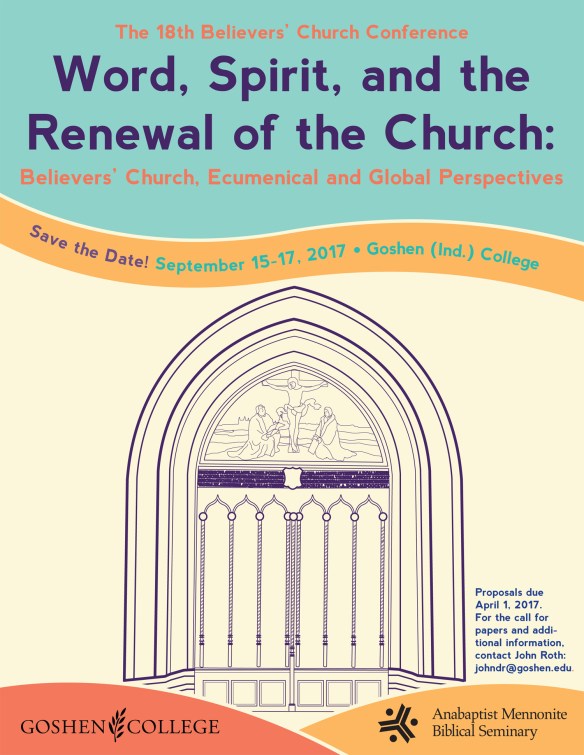
Call for Papers: Word, Spirit, and the Renewal of the Church

believerschurchconfwordspiritrenewalposter

In the fall of 1517, Martin Luther’s challenge to the authority of the papacy and church tradition—along with his appeal to Sola Scriptura (Scripture alone)—inspired various reformers to read scripture and to understand the liberating power of the Holy Spirit in new ways. But what started as a renewal movement within the Catholic Church soon led to a host of divisions, giving rise to Protestant, Anabaptist, and other traditions, including those groups known as the Believers’ Church. Among the latter, the deep debts to the renewal impulses of late medieval Catholicism and the Protestant Reformation are unmistakable. In the 500 years since then, the church—including the Believers’ Church movement—has further expanded globally in a great diversity of forms.

This conference seeks to explore the gifts and tensions of the Reformation legacy for the Believers’ Church tradition, with a view toward its ecumenical and global dimensions. The gathering will focus especially on the debates that have swirled around the themes of Biblical authority, the movement of the Spirit, and the renewal of the church.

The conference theme “Word, Spirit, and the Renewal of the Church” can encompass a wide range of disciplines, approaches, and topics. We seek proposals from theologians, biblical scholars, ethicists, historians, pastors, and graduate students that address how the debates of the sixteenth century continue to find expression in contemporary understandings of Word, Spirit, and the renewal of the church. We are especially interested in papers that bring voices from the Believers’ Church into conversation with other Christian traditions.

Possible questions and topics to address include:

  • How does a given understanding of Word and Spirit, and their relation to each other, interact with another doctrine (e.g., creation, Christology, ecclesiology, etc.)?
  • What are some of the theological and sociological dynamics of past and present renewal movements within the Believers’ Church tradition?
  • How do groups in the Believers’ Church tradition interpret the Bible and its authority vis-à-vis other Christian traditions?
  • How has the Reformation called into question the location of the church: where/who is the church today?
  • What are some of the key issues facing comparative theologies, ethics, and practices of grace, discipleship, tradition, enculturation, church unity and renewal, worship and preaching, etc.?
  • How are the central issues of the Reformation relevant to the Believers’ Church, especially in its global dimension?

Presentations should reflect a thoughtful engagement with scholarship but be accessible to a broad audience, including interested lay people. A limited number of travel grants will be available, with highest priority going to presenters coming from the Global South and students.

Please submit a one-page CV and a 250-word abstract for a paper or a complete panel/workshop session (with presenters indicated) by April 1, 2017 to John D. Roth (johndr@goshen.edu). Conference organizers will respond by May 1, 2017.

Shoofly Pie, Pennsylvania Dutch, and the Mennonites

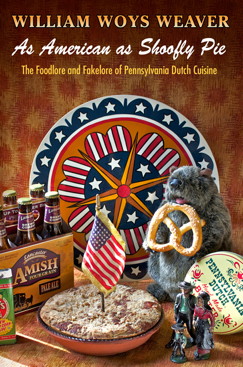
As American as Shoofly Pie: The Foodlore and Fakelore of Pennsylvania Dutch Cuisine1 by William Woys Weaver is many things: it is a detailed look at the foodways among the Pennsylvania Dutch, a commentary on modern culture, and a cookbook. It is scholarly and snarky. It purposely does not focus on Anabaptists, though it does deal extensively with the Amish in popular imagination. Weaver states in his introduction: “In terms of the larger culinary story, the Amish are mostly marginal anyway because the real centers of creative Pennsylvania Dutch cookery were in the towns and not to be found among the outlying Amish or Mennonite communities, even though today the Mennonites have attempted to preempt the Amish as their cultural public-relations handlers in their Amish and Mennonite cookbooks to press for ‘Christian’ culinary values—whatever that may mean” (7). He is also clear that one of his major criteria for the recipes he highlights in the book was to contrast against the “artificial portrait” created by Amish tourism (8).15094

What Weaver sets about doing in As American as Shoofly Pie is to take food as the avenue into Pennsylvania Dutch culture to discuss its identity markers—historic and current—as well as the class dynamics involved, portrayals in popular culture, and the commercially driven conflation of the Amish and Pennsylvania Dutch. He details cooking implements, the “cabbage wall” of sauerkraut defining the borders of Pennsylvania Dutch country, how the Amish imagery became normative for Pennsylvania Dutch tourism, and how the culture is renewing itself. It is an excellent read, both informative and engagingly written.2

I use here the term “Pennsylvania Dutch” instead of “Pennsylvania German” for two reasons: first, because that is the terminology of Weaver, and second, because the “Pennsylvania Dutch” have no connection to the nation-state of Germany, past or present. On the second point, I will offer a story from my wife’s family history:

When Pop-Pop Riegle was a prisoner of war in Germany during World War II, the camp taught German to the POWs. The guards doubled over in laughter to hear the POWs from New York City try to pronounce words with a New York accent. My grandfather, from what I understand, could converse with the guards easily, because he spoke Pennsilfaanisch Deitsch. The German guards asked him why he was fighting for the wrong side. To them, speaking German meant loyalty to Deutschland. For my grandfather, speaking a German dialect was part of his American culture.

Furthermore, it seems this story is borne out in every ethnography of the Pennsylvania Dutch I have encountered. They all carry a variation of the following: A researcher walks up to some Pennsylvania Dutch women and asks them about how they describe themselves, only to be rebuffed with, “We’re not Pennsylvania Dutch, we’re American.” The Pennsylvania Dutch are an American cultural group consisting of a blend of German speakers, mostly Palatinate and Swiss, who settled together. The eponym “Dutch” has long roots going back into medieval Europe as a term for western German speakers. They can be divided into two broad categories, the Plain Dutch, such as the Amish and Mennonites, or the Gay (Fancy) Dutch, such as my wife’s Lutheran and Reformed forebears.

It is important for Mennonite scholars to remember that Mennonite fish were just one school swimming in Pennsylvania Dutch water. Even though they may have been marginal in shaping Pennsylvania Dutch culture, as Weaver notes, they were still shaped by it. Mennonites all across South Central Pennsylvania were surrounded by people who spoke, ate, and worked in the same ways they did—the majority of them Lutheran or Reformed, but also the Amish, Church of the Brethren, and other plain Anabaptists.[^3]  As Felipe Hinojosa has noted, place matters—both in space and time, as well as culturally. The Swiss-German strain of the Mennonite experience practiced their faith and promulgated their beliefs not in ethnic colonies but surrounded by a shared culture that itself was distinctive from broader America. Surely this has led to a different way of knowing and living as Mennonites. For this reason, scholars dealing with Mennonite identity must familiarize themselves with Pennsylvania Dutch culture. For its insistence on placing the Pennsylvania Dutch culture within the broader national culture, and his disgust at the conflation of the Amish with the Pennsylvania Dutch, Weaver’s As American as Shoofly Pie is an excellent place to start.


  1. William Woys Weaver, As American as Shoofly Pie: The Foodlore and Fakelore of Pennsylvania Dutch Cuisine (Philadelphia: University of Pennsylvania Press, 2013). 
  2. This is not to say there are no points where I disagree with Weaver.  For example, his repetition of Rufus Jones’ claim that the Amish adapted bonnets from Quakers as “common knowledge” (135) is uncritical at best.
    [^3] Moravians are one of the German groups that maintained a markedly different culture than that of the Pennsylvania Dutch. 

Mennonites, Service, and the Humanitarian Impulse: MCC at 100

Call for papers

October 23-24, 2020

mcc-logo_fbIn 1920 Mennonites from different ethnic and church backgrounds formed Mennonite Central Committee (MCC) to collaboratively respond to the famine ravaging Mennonite communities in the Soviet Union (Ukraine). Over the ensuing century, MCC has grown to embrace disaster relief, development, and peacebuilding in over 60 countries around the world. MCC has been one of the most influential Mennonite organizations of the twentieth and twenty-first centuries. It has operated as a mechanism for cooperation among a wide variety of Mennonite groups, including Brethren in Christ and Amish, constructing a broad inter-Mennonite, Anabaptist identity. Yet it has also brought Mennonites into global ecumenical and interfaith partnerships.

This centennial conference invites proposals for papers that examine the past, present, and future of MCC. More broadly it invites papers on the Mennonites’ response to the biblical call to love one’s neighbor through practical acts of service. Proposals from a wide variety of disciplinary perspectives are welcomed, including but not limited to anthropology, conflict transformation and peacebuilding, cultural studies, development studies, economics, history, political science, sociology, and theology.

The conference will be hosted by the Chair of Mennonite Studies, University of Winnipeg, in collaboration with Canadian Mennonite University.

Proposal submission: December 1, 2019. Send proposals or questions to Royden Loewen, Chair in Mennonite Studies, University of Winnipeg, Winnipeg, Manitoba, R3B 2E9, Canada. Email: r.loewen@uwinnipeg.ca

Limited research grants are available to help defray costs related to research in MCC’s archives in Akron, Pennsylvania or at other MCC sites. Queries, with a brief two paragraph description of the proposed research, should be sent to Alain Epp Weaver (aew@mcc.org). Requests for research grants will be assessed on an ongoing, rolling basis.

See also at https://mccintersections.wordpress.com/mcc-at-100-call-for-proposals/

Submission Deadline Changed for Crossing the Line

The deadline for submissions for “Crossing the Line: Women of Anabaptist Traditions Encounter Borders and Boundaries” has been extended to October 15. This conference, to be held at Eastern Mennonite University June 22-25, 2017, will examine gendered experiences within Anabaptist traditions.

See the call for papers here: http://www.emu.edu/academic-conferences/women-of-anabaptist-traditions/.

An Introductory Taxonomy of Anabaptist Histories

IMG_6493“Anabaptist Historians: Bringing the Anabaptist Past into a Digital Century” is a collaborative blog gathering scholars of Anabaptist history to share their research and engage on critical issues in contemporary Anabaptist life. But what is Anabaptist history? Part of the trouble is that the word “anabaptist” has many overlapping meanings, as does “Mennonite.” In this blog, each contributor will have his or her own understanding of what “Anabaptist” and “Anabaptist history” means.

In a conversation with Linford Stutzman during my Cross Cultural semester with Eastern Mennonite University, he postulated a three-part criteria for being a Mennonite, where meeting two out of three constituted a pass: 1) having Mennonite values; 2) belonging to a Mennonite congregation; 3) belonging to a Mennonite family. This construct concisely states the three strands of identity that are bound together in each individual’s experience (I recognize the lack of any may be as important– if not more important–in shaping the experience). The variations are not just an individual experience, they play out in the stories Anabaptists (and I include myself therein) tell themselves. As Dallas E. Wiebe ends his satirical work, The Sayings of Abraham Nofziger: A Guide for the Perplexed, vol. 3:1

147. The logical extension of Anabaptist thought is that each person becomes a church of one.

148. I’m the only Mennonite I know.

There are as many Anabaptist histories as there are Anabaptists. Since it is crucial to understand which type of history is being read in order to understand it, I am providing a brief taxonomy.

The Ethnic Genus of Anabaptist History

The Ethnic Genus of Anabaptist History is the story of Anabaptist peoplehood. That is, it is the story of how Anabaptists have been together.

To many understandings, an “ethnic” understanding of Anabaptism is simply not true, as believer’s baptism and the clear choice to join are central to Anabaptist faith. There are, however,  cultural markers that persist in differing Anabaptist communities, and the language of ethnicity can be a helpful tool to describe them—it is not meant as a pejorative.

Ethnic: Peoplehood Studies

Perhaps the most developed species of Anabaptist history is “Ethnic: Peoplehood Studies.” This is focused on looking at the many types of Anabaptist groups (say, “Ethnic: Peoplehood Studies: Amish Studies” or “Ethnic: Peoplehood Studies: Mennonite Studies”). It looks at trends, markers, and mores in the groups on the Anabaptist spectrum. There are as many subfields under “Ethnic: Peoplehood Studies” as there are Anabaptist groups.

Ethnic: Boundary Politics

The species of “Boundary Politics” is worthy of special attention: it is historical work that is less concerned about the past and more with the present. One example of this would be Thieleman J. van Braght’s guiding ethos when he considered whom to include in the Martyrs’ Mirror,  in counting only the “Defenseless Christians” as part of the true Brotherhood. Another can be found in the work of H. S. Bender—who through historical work attempted to recreate an Anabaptist vision.2 Bender systematically expunged violent Anabaptists from the mythic past: “this principle of nonresistance, or biblical pacifism, which was thoroughly believed and resolutely practiced by all the original Anabaptist Brethren and their descendants throughout Europe from the beginning until the last century.”3 The story of staunch pacifism had such sway for Bender that he ignored the likes of Thomas Müntzer, the Anabaptist Kingdom of Munster, or the Anabaptist Riot of 1535. Both Braght and Bender used history as their medium to work theologically“Bender was able to build the new vision because his initial position at Goshen College was in history rather than biblical studies. He was thus able to avoid most of the divisive disputes over doctrine. By concentrating on Anabaptist-Mennonite history, he was able to concentrate on questions that drew communalism back into the center of Mennonite discussion.” 4

The efforts of German Mennonite leaders to shift Mennonite identity by creating historical narratives from 1772 to 1950 is an example of “Boundary Politics.”  Mark Jantzen in Mennonite German Soldiers: Nation, Religion, and Family in the Prussian East, 1772–1880, traces how Mennonites reworked their identity to move from closed sectarians to fully German.5 Ben Goossen, in his Mennonite Quarterly Review article, “From Aryanism to Anabaptism: Nazi Race Science and the Language of Mennonite Ethnicity,” looks at how that same identity-shifting work was brought to fullness under the Third Reich and then quickly redone to rebirth Anabaptists as a distinct Ethnicity for preferential treatment post World War II.6 Examples of “Boundary Politics” can be very problematic: they wear the clothing of history, but have another purpose. When encountering work that falls under “Ethnic: Boundary Politics,” it is especially necessary to understand what the type of work one is reading so that what is not being said can be considered, as well as that which is.7

Ethnic: Genealogical/Family

One popular form of folk-history among many Anabaptists is that of genealogy and family history. I call it a folk-history because it is not a field of study popular in the academy. Perhaps this is so because of the past efforts by eugenicists to develop it as a scientific field. Or it could be that while genealogists are busy collecting and archiving pieces of the past, they do not, strictly speaking, work historically; they are not using what they have collected to tell a story beyond personal and family identity. But for many Anabaptists, this is their primary way of thinking about history: Where and Who Did I Come From? Working at the Lancaster Mennonite Historical Society, it is clear that most people who come through our doors are looking for answers about where they came from, and the tools they use or desire to answer that question are genealogical.

The Ecclesiastical Genus of Anabaptist History

The Ecclesiological Genus of Anabaptist History is concerned with the study of Anabaptist church history. That is, it is the story of how Anabaptists have been church.

As is the case with “Ethnic: Peoplehood Studies,” each sect and sub-organization therein has its own species and subspecies. For Lancaster Mennonite Conference, John Ruth’s tome, The Earth is The Lord’s: A Narrative History of Lancaster Conference is the defining work; Ruth’s Maintaining Right Fellowship would hold the same position for Franconia Mennonite Conference. For the Meserete Kristos church of Ethiopia, Alemu Checole’s work in Anabaptist Songs in African Hearts is another fine example.

The Epistemological Genus of Anabaptist History

This Epistemological Genus of Anabaptist History is concerned with how people considering themselves Anabaptist have known; it is Anabaptist historiography. When Julia Kasdorf traces how and looks towards why the Martyrs’ Mirror “has collapsed into only one story and one iconic image for many readers” (that of Dirk Willems), she is working in the Epistemological Genus of Anabaptist History.8 This area is receiving the most attention in emerging scholarship, not just from the historical arena but in literary studies. I will not try to give a synopsis of current state of the field here.

Conclusion

Here I have attempted to start a taxonomy of Anabaptist Histories, identifying in broad strokes the subsets of our discipline. However, unlike Linnaeus and his heirs, most of the specimens we see in the wild are chimeras, and so I have sought to describe various phenotypic packages rather than prescribe what this scholastic menagerie should look like. Surely there are species out there that I have not seen yet, in other parts of the world, in other languages, or in other fields. These classifications I have laid out are not fixed, nor are they meant to demean or devalue, but simply to help the hunters of Anabaptist History to properly place and understand that which they read.


  1. Dallas E. Wiebe, The Sayings of Abraham Nofziger: A Guide For the Perplexed (2004), 65. 
  2. Leonard Gross, “Bender, Harold Stauffer (1897-1962),” Global Anabaptist Mennonite Encyclopedia Online,1990. <http://gameo.org/index.php?title=Bender,Harold_Stauffer(1897-1962); (Accessed August 29, 2016). 
  3. Harold S. Bender, The Anabaptist Vision, (Scottdale, Pa.: Herald Press, 1944), 32. 
  4. Fred Kniss, Disquiet in the Land, (New Brunswick, N.J.: Rutgers University Press, 1997), 65. 
  5. Mark Jantzen, Mennonite German Soldiers: Nation, Religion, and Family in the Prussian East, 1772-188, (Notre Dame, Ind.: University of Notre Dame Press, 2010). 
  6. Ben Goossen, “From Aryanism to Anabaptism: Nazi Race Science and the Language of Mennonite Ethnicity,” Mennonite Quarterly Review 40 no. 2 (April 2016). 
  7. I might be inclined to argue that the role of the historian in the church is to promote an unbounded boundary politics. “I have discovered a truly marvelous proof of this, which this margin is too narrow to contain.” 
  8. Julia Spicher Kasdorf, “Mightier than the Sword: Martyrs Mirror in the New World,” The Conrad Grebel Review 31, no. 1 (Winter 2013), https://uwaterloo.ca/grebel/publications/conrad-grebel-review/issues/winter-2013/mightier-sword-martyrs-mirror-new-world (Accessed August 29, 2016).