A Letter from Maggie Leonard

John Thiesen

The Mennonite Library and Archives recently received a box of papers of Heinrich H. Epp (1857-1933), who was a minister in the Bethesda Mennonite Church in Henderson, Nebraska, for many decades and elder of the congregation 1910-1924. As I unpacked the box, a folded-up document caught my attention when I noticed the signature “Maggie Leonard, Mennonite Mission, Darlington, Ind. Terr.”
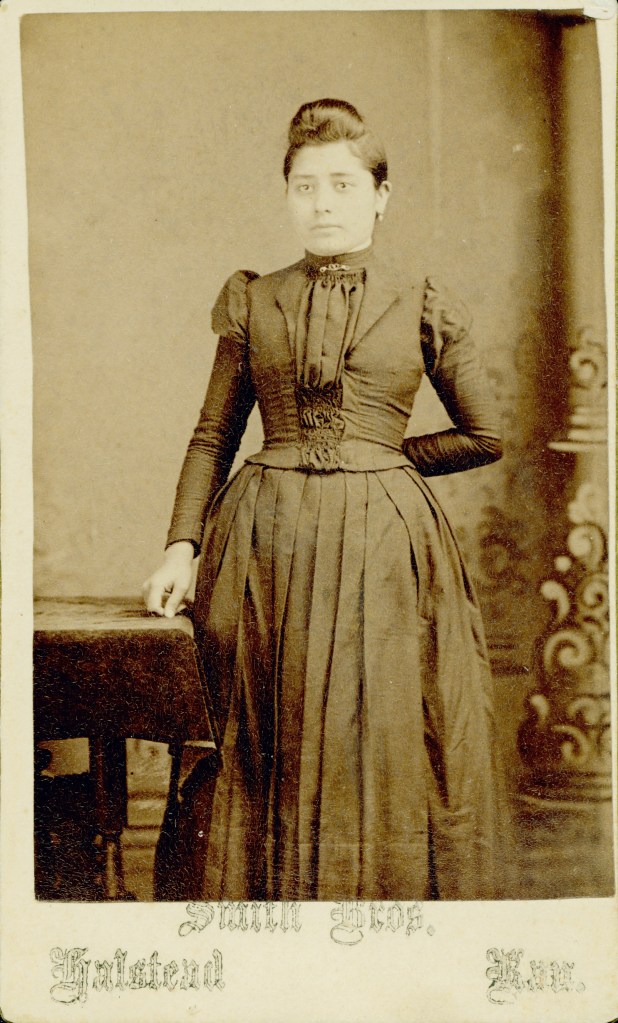
Margaret/Maggie Leonard, first person baptized at Darlington, Oklahoma, mission in 1888; this photo probably taken while she was attending school in Halstead, Kansas (Mennonite Library and Archives, Bethel College, North Newton, Kansas)

Maggie Leonard was the first person baptized in the mission work conducted by the General Conference Mennonite Church among Cheyenne and Arapaho at Darlington and Cantonment in what is today Oklahoma. She was baptized in 1888, but did not come from the two groups among whom the Mennonites were working. Her father Joseph Leonard was white (likely an Indian agency employee) and her mother was Caddo. (Maggie Leonard is listed as Caddo in the 1900 census). She also attended the Indian Industrial School at Halstead, Kansas, run by Christian Krehbiel, and also the Mennonite Seminary (teacher training school) at Halstead (during 1890-1892).
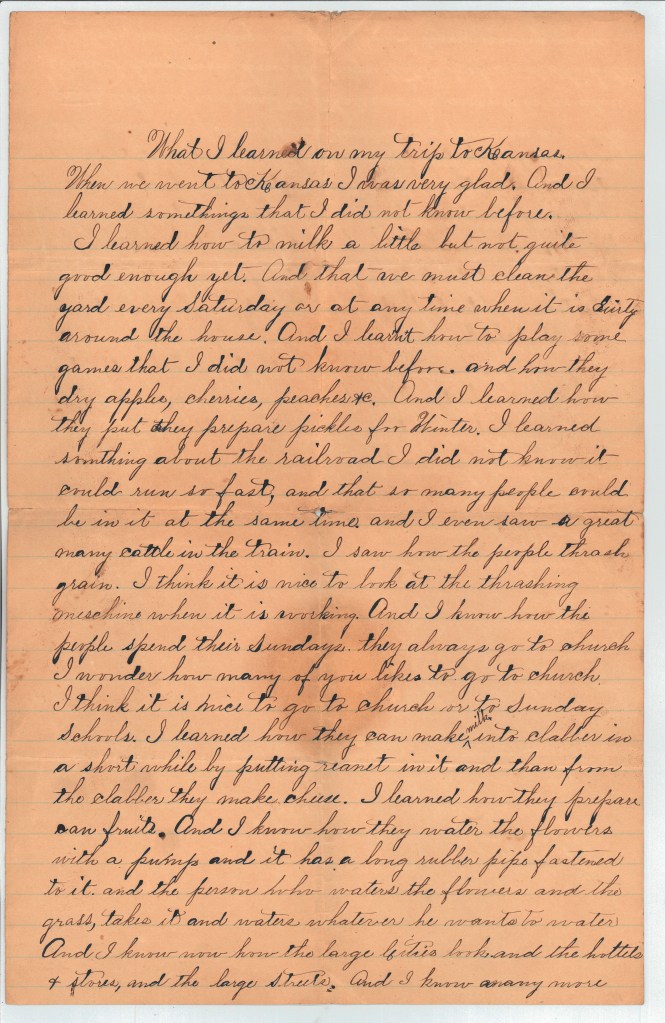
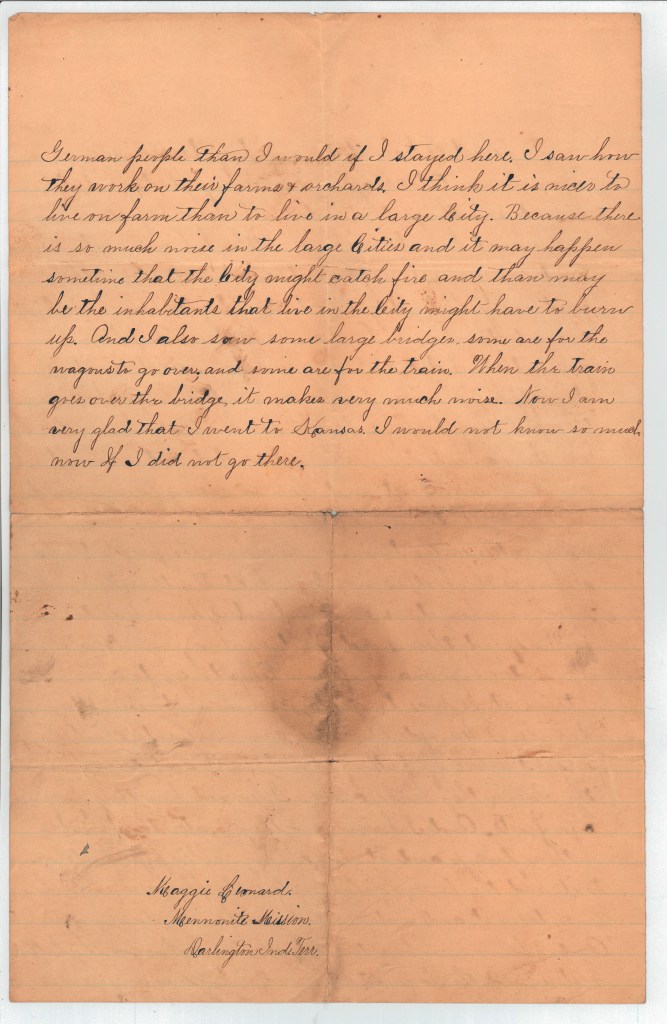
This is the text of the document:

What I learned on my trip to Kansas.

When we went to Kansas I was very glad. And I learned some things that I did not know before.

I learned how to milk a little but not quite good enough yet. And that we must clean the yard every Saturday or at any time when it is dirty around the house. And I learnt how to play some games that I did not know before, and how they dry apples, cherries, peaches etc. And I learned how they put they prepare <sic> pickles for Winter. I learned something about the railroad I did not know it could run so fast, and that so many people could be in it at the same time. And I even saw a great many cattle in the train. I saw how the people thrash grain. I think it is nice to look at the thrashing machine when it is working. And I know how the people spend their Sundays. They always go to church. I wonder how many of you likes to go to church. I think it is nice to go to church or to Sunday Schools. I learned how they can make milk into clabber in a short while by putting rennet in it and then from the clabber they make cheese. I learned how they prepare can fruits. And I know how they water the flowers with a pump and it has a long rubber pipe fastened to it. And the person who waters the flowers and the grass, takes it and waters whatever he wants to water. And I know now how the large cities look and the hotels & stores, and the large streets. And I know many more German people than I would if I stayed here. I saw how they work on their farms & orchards. I think it is nicer to live on farm than to live in a large city. Because there is so much noise in the large cities and it may happen sometime that the city might catch fire and then may be the inhabitants that live in the city might have to burn up. And I also saw some large bridges, some are for the wagons to go over, and some are for the train. When the train goes over the bridge, it makes very much noise. Now I am very glad that I went to Kansas. I would not know so much now if I did not go there.

Maggie Leonard.
Mennonite Mission.
Darlington Ind. Terr.

It is unclear if she is describing her time in the Halstead schools or whether she had made a trip to Kansas before that already.

Maggie Leonard did not retain formal ties to the Mennonites after her baptism. Sometime in the early 1890s she married someone named Garen and had a son. In 1898 she married a widower, John David Downing, and they had 7 more children. Downing was apparently a prominent rancher and Freemason in Grady County, Oklahoma. He is listed as Cherokee in the 1900 census. He died in 1923. (see https://www.findagrave.com/memorial/53563566/john-david-downing).

Margaret Downing did keep some personal contacts with Mennonites over the years. In March 1936, Missionary News and Notes, the publication of the Women’s Missionary Association of the General Conference Mennonite Church, included this note:

Last week Mrs. Goerz received a letter from Mrs. Margaret Downing–nee Maggie Leonard. Some of the older readers will remember that she, then 17 years old was the first Indian who accepted Christ and was baptized in our Mission at Darlington on June 3rd, 1888. Rev. H. R. Voth was the missionary stationed there then. Later Maggie came to Krehbieltown, at Halstead, Kansas and during that time she attended the Mennonite Seminary at Halstead. She has been married twice, is mother of eight children–three girls and five boys–all living. At present she is keeping house for her youngest son who is in the government service as clerk in the Jicarilla Indian Agency at Dulce, New Mexico.

Mrs. Goerz was Martha Krehbiel Goerz, Mrs. Rudolph A. Goerz, a daughter of Christian Krehbiel. She was an editor of the Missionary News and Notes. Martha Goerz may well have been acquainted with Maggie Leonard already from her Halstead school days.

Margaret Downing returned to her home territory towards the end of her life. Here’s the death notice from the Chickasha Daily Express, Aug. 14, 1966, p. 3. (see also https://www.findagrave.com/memorial/25408163/margaret-l-downing)

Funeral services were held Thursday in Arcadia for Mrs. Margaret Downing, 97, who died Aug. 2 in Oklahoma City. Mr. and Mrs. Downing were early ranchers north of Verden. Surviving children are: Mrs. Thelma Moring, Mrs. Pearl Dennero, Mrs. Rena Topatche, Ernest and John Downing, all of Oklahoma City; and Eden Downing, of California.

A major unanswered question is, how did Maggie Leonard’s early handwritten account of a visit to Kansas end up in the possession of Heinrich H. Epp in Henderson, Nebraska? He was not a member of the General Conference mission board; there is no indication he ever visited Darlington, nor that Maggie Leonard ever visited Henderson. The link between the two persons remains a mystery.

Notes from Mennonite/s Writing

The Mennonite/s Writing conference was September 30 to October 2, 2022 at Goshen College in Goshen, Indiana. It was a meaningful space for me of cross-pollination, listening and learning. Here are a few highlights for folks who weren’t able to attend and might be interested. You can read the full schedule here.

Thursday 

On the afternoon of September 29 Julia Kasdorf and Steven Rubin led us in a four hour pre-conference workshop on documentary photography. They were inspired by the work of writers and photographers funded during the Works Progress Administration. As part of the workshop they had us interview and photograph people in and around downtown. The resulting slide deck with photos and quotes was on display during the conference as a way of introducing out of town conference participants to the community.

The opening plenary was with Julia Kasdorf, one of the most prominent promoters and creators of Mennonite literature in the US. She talked about Shale Play her latest book of poems (with photographs by Steven Rubin) that looks at the impact of fracking in her community in central Pennsylvania.

Friday

First thing on Friday morning I was part of a panel on technology and Mennonite writing organized by Hope Nisly. Melanie Springer Mock talked about the growing community of Mennonite content creators on TikTok. Adam Schrag looked at the Mennonite meme pool and the parallels with Martyrs Mirror and I talked about the parallels between the socially disruptive impact of pamphlets in the radical reformation and the use of social media by the Arab Spring and other mass movements using the internet to create space for dissent.

Mennonite writer Sofia Samatar spoke during the plenary on Friday morning. She read from her new book, The White Mosque, a memoir tracing the journey of an apocalyptic Mennonite community in Central Asia. I was excited to discover that she’s written a fantasy series that I hadn’t heard of before. In the Q&A I asked her about the subject of whiteness in her memoir (her father is Somalian and her mother is white Mennonite) and she described what it is like to always having to convince other Mennonite that she is Mennonite, but she also pointed out in a playful way that she values the random, a theme that would continue through the conference.

Saturday 

On Saturday morning, Ervin Beck surveyed the community of plain poetry among plain Anabaptists through careful study of their poetry publication which has been published regularly for over twenty years. Ervin encouraged those of us at the conference to take an approach of “benign neglect” this community. On the same panel, Christopher Dick summarized the Mennonite Socialist Vision of Jakob G. Ewert, who was confined to a bed for twenty-five years and Joel Horst Nofziger looked at how Mennonite understandings and tellings of our history influences power dynamics in our theology.

It was clear that while Literary Mennonite writers and critical review of Mennonite Literature have formed a key part of these gatherings (happening every few years for thirty-twoyears) there is also a growing space for other forms. One example was getting to hear my sister, Abigail Nafziger and her librarian colleague Matilda Yoder talk about their podcast “Just Plain Wrong” in a panel on humor. They described some of their work humorously reviewing Amish Romance as “reading these books so you don’t have to.” Also on their Saturday morning panel was Andrew Unger of “The Daily Bonnet” and Johnny Wideman of Theatre of the Beat. All the panelists kept us laughing and also thinking about the line between Popular and Literary work. In the Q&A time folklorists Magdalene Redekop reminded us of the tradition of the female Mennonite trickster. 

In the plenary on Saturday afternoon, Sheri Hostetler interviewed Rachel Yoder about her book (and upcoming movie) Nightbitch, about a mother who finds herself becoming a dog. Sheri told a story from Carl Jung’s The Red Book in which he talks about being haunted by Anabaptist ghosts. The ghosts are deeply frustrated because they died with the purest of belief but cannot find rest. Jung tells Ezechiel, the spokesperson for the group that he did not “live his animal” (see passage here). This theme of embodiment and learning to be outside of our heads was also a key theme in the week.

Later on Saturday afternoon there was a panel on Mennonite speculative fiction featuring Yoder, Samatar (see above) and Jessica Penner, author of Shaken in the Water, a magical realism novel that was also new to me. The panel talked about Mennonite and Anabaptist connections with wilderness.

On Saturday night we heard from Hildi Froese Tiessen, organizer of the first Mennonite/s Writing conference (in 1990) and she quoted Magdalene Redekop about how these Mennonite/s Writing gatherings are about play.

My friend John Kampen talked about he valued the space for play and speculation that he found at the conference in light of other spaces that can be more focused on correct ethics. That was a helpful framing for me to reflect on my own experience of Mennonite and social justice spaces, particularly around when a focus on the “right thing” can get in the way of being fully in our bodies.

Daniel Born was on a panel talking about Mennonite Noir as a genre and his novel Unpardonable Sins. This was a highlight for me because Dan co-authored the book with my friend and mentor Dale Suderman who died in January 2020.

I also got to listen to a lot of wonderful poetry from Jeff Gundy, Julia Baker, Jean Janzen, Julia Kasdorf and many others.

Sunday

On the closing panel Sunday afternoon, there was a fruitful dialogue between Robert Zacharias and Laura Hostetler about how many people in the room have a foot in multiple worlds. Laura (a scholar of cartography and empire) reminded us that margins are not just about marginalization. It can be useful to have a foot in multiple worlds. The margins in ecology are a very fruitful space: beaches and areas between forests and grasslands are examples.

I’m grateful to have spent three days playing on the margins with this community of writers, readers and critics. It’s a fruitful space.

A big thanks to Ann Hostetler, Daniel Shank Cruz and the entire planning committee for pulling this event together.

I’ll close with this story: in her keynote Rachel Yoder shared about how her car broke down the night on her way from her home to the conference.  She described how demoralized she was stuck just inside the Indiana border, still an hour and a half short of Goshen. She was sitting there when a minivan with conference organizer Ann Hostetler (and others rolled up). The van door and someone said: hop in, we are going to get ice cream! This story embodied something special about this gathering for me.

You can see photos from the event here.