Early next year, I’m presenting a paper at the American Society of Church History on a panel titled “Competing Identities: Denominational Higher Education in the American South.” In the literature on American higher education, the examination of denominational schools, particularly those in the South, remains understudied. My co-panelists and I hope to explore the impact of geography and religious affiliation on single-sex and co-educational colleges in the nineteenth and twentieth centuries. My paper, tentatively titled “Embers of the ‘Burning’: Shenandoah Valley Anabaptists, Higher Education, and Civil War Legacy,” will investigate the postbellum tensions between nonresistance and the memory of the Civil War at two Anabaptist colleges in Virginia’s Shenandoah Valley: Bridgewater College and Eastern Mennonite University. The former a school started by the Church of the Brethren, the latter a Mennonite institution. Founded in 1880 and 1917, respectively, many of the schools’ founders carried personal or family memories related to the destruction caused by the war. While the conference paper will address both schools, in the post I’m going to take an initial dive into the sources and offer some preliminary conclusions about the interplay between nonresistance, Civil War memory, and institutional life at Bridgewater College.
Elder John Kline and the Virginia Brethren’s interest in higher education emerged on the eve of the Civil War. Their early efforts indicate they possessed an increasing openness to the value of education for the benefit of the church. In 1857, the Yearly Meeting of the Brethren took action to allow members to advocate for higher education in accordance with “gospel principles.”1 Two years later, Brethren leadership spearheaded the creation of Cedar Grove Academy in the northern Rockingham County town of Broadway. It was the first Brethren institution for higher education. The Academy persisted through the Civil War, but closed soon after the conclusion of the conflict. Elder John Kline proved instrumental to its founding, gathering supporters, and providing the land for the school.2
As a local leader, Kline also played an important role in the Virginia Brethren’s response to the looming Civil War. Acknowledging the precarity of the nonresistant position, he and other church leaders worked diligently for provisions for Anabaptists in Virginia and Confederate conscription legislation. Though succeeding in that aim rather quickly with Virginia law, Confederate legislation threatened to nullify their efforts. Only after a brief imprisonment for noncompliance and the advocacy of Virginia political and military officials did Kline and other Anabaptist leaders obtain allowances from the Confederate governmen in October 1862 for Anabaptists to opt out of military service.3 Kline’s leadership in the Brethren community persisted, but hostility toward dissenting Anabaptists amped up as the war leeched empathy from their Shenandoah Valley neighbors.4 Unlike Anabaptists in neighboring Augusta County, Brethren and Mennonites in Rockingham County largely opposed secession, while many Anabaptists in both counties also supported the Confederacy through agricultural commerce.5 Elder Kline’s prominence, as well as his anti-slavery position and Union sympathies, made him a target for violence as the war escalated community tensions. Confederate loyalists murdered Kline near his home in Broadway on June 15, 1864, for his positions, but also in response to his frequent trips north on church business and alleged engagement in smuggling Anabaptists evading conscription into Union territory.6 Fifty years after his death, a Brethren historian described Kline as a “martyr” assassinated as part of a “deeply laid scheme” by those that despised his goodness and faithfulness to God.7 Only a few months after Kline’s murder, a second tragedy swept through the Anabaptist community in Rockingham County.
Union General Phillip Sheridan’s scorched earth campaigns in the Shenandoah Valley during the fall of 1864 indiscriminately scarred its residents, regardless of religious affiliation. The Valley served as a prime agricultural region for the Confederacy, so cutting off supplies to the South proved essential to Union victory. “The Burning,” as Sheridan’s autumn inferno came to be called, reduced the barns, mills, and homes of Anabaptists and their neighbors to ashes, with no regard for professed loyalty.8 The effects of the destruction continued to smolder in the Valley long after the fires ended. James Lehman and Steve Nolt conclude, “Never before—or since—had Mennonites [and other Anabaptists] in the United States experienced such collective property destruction.”9 The trauma caused by the Burning lingered after the war as the Union denied the claims of most Anabaptists who tried to recover assets lost in the conflagration due to their commercial support of the Confederacy.10 Such destruction also delayed any efforts to re-establish Brethren higher education in the Shenandoah Valley.
Fifteen years after the war’s end, the school that would be Bridgewater College started in southern Rockingham County. The years following the war necessitated rebuilding and a reorientation of collective identity. Lehman and Nolt note that, like many of their neighbors, Anabaptists in the reconstructing South chose to value the repair of national and local relationships over advocating for the rights of African Americans, which historian David Blight chronicled in his book Race and Reunion.11 Bridgewater College started as a joint effort between Daniel C. Flory, educated at the Brethren Juniata College, and Virginia Brethren leaders in 1880. Originally called Spring Creek Normal School, Flory’s co-educational institution maintained its ties to earlier Brethren education while also charting a new path. The first board included John J. Bowman, a Brethren layman who helped found the Cedar Grove Academy, as well as Walter B. Yount, who would become Bridgewater’s first president in 1895.12 Known as the Virginia Normal School in 1882, the institution settled in Bridgewater seven years later and took its eponymous name. Literary societies flourished at the normal school and later the college, as did sports.13 The institution experienced hardships in its early years, but it matured under the leadership of President Yount (1895-1910).14 Records produced in the years of his administration provide the first clear picture of the legacy of the Civil War at Bridgewater College.
The first printed Bridgewater College history owes its origins to a student society memorializing the Confederacy. A December 1902 program of Bridgewater’s Virginia Lee literary society produced pieces for the student periodical, the Philomathean Monthly, and eventually became a1905 alumni-produced institutional history titled Bridgewater College: Its Past and Present.15 One of the two societies formed in 1897 when the Philomathean Society grew too large, the Virginia Lee Society influenced student life and periodicals into the 1930s.16 The organization embedded remembrances of the southern cause into its activities. Selecting Confederate gray as their color, the Society celebrated Robert E. Lee’s birthday annually, adorned their space with his likeness, and hosted speakers who interacted or served with him.17 Examining the life and work of the Society’s founding president, John W. Wayland provides a glimpse into the endurance of Lost Cause memory and its connections to Bridgewater.
Born in Shenandoah County in 1872, John Walter Wayland started attending Bridgewater in the late 1890s, graduating in 1899. He presented the name “Virginia Lee” for the Society to honor the Lee family and the inaugural state that produced them. Wayland also composed the lyrics to the Society’s song.18 Upon his graduation from Bridgewater, Wayland served as Editor-In-Chief of Bridgewater College: Its Past and Present and its 1930 alumni-produced history: Fifty Years of Educational Endeavor. By the latter work’s publication, he had earned a PhD in History from the University of Virginia in 1907 and embarked on a prolific career as a professor, administrator, and author.19 He also spent a significant portion of his adult life ordained in the Brethren Church. He died in Harrisonburg, Virginia in 1962. A brief analysis of the Civil War/Reconstruction sections of one of Wayland’s histories illustrates how he viewed the conflict and rebuilding as a Virginia Brethren and historian.
In A History of Rockingham County (1912), Wayland couched his assessment of the conflict and rebuilding in a measured tone. While he did characterize Reconstruction as a failure, only once did he deploy the term “carpetbaggers” to describe northerners presence in the South.20 Wayland mentions that 418 African Americans registered for the 1867 election, and found their civic participation indicative of “why the process of reconstruction was accomplished [in Rockingham County] with so little disturbance.”21 The relatively small numbers of enslaved African Americans living in the County during the antebellum period, as well as the its proximity to the free state of West Virginia, likely contributed a smaller free Black population during Reconstruction. This context may have also influenced Wayland’s conclusion that reunification was an easy process.22A History of Rockingham County contains a section titled: “Some Interesting Incidents.” Of the four events mentioned that occurred during the Civil War, the death of John Kline was one. Surrounding this account of “a martyr to duty and the work of peace,” Wayland placed reports of the death and memorial of Confederate General Turner Ashby, the ingenuity of General Stonewall Jackson, and the innocence of Confederate scouts in the murder of Union Lieutenant. John R. Meigs, an incident that helped spark General Sheridan’s burning of the Valley.23 The inclusion of Kline’s murder points to its importance in the mind of the book’s Virginia Brethren author, but its location points to a shift in how Bridgewater College through one of its notable alumni recalled the Civil War.
The trials of the Brethren during the Civil War and the civil religion of the Lost Cause formed two district streams of memory with no dissonance between them. The prevalence of the Lost Cause at the college and in Wayland’s writings is not altogether unsurprising given its pervasiveness in the South. Charles Reagan Wilson argues in Baptized in Blood that, as the civil religion of the South, the Lost Cause inextricably bound together southern culture and interpretations of history in ways that made it distinct from the northern civil religion. “Southerners interpreted the Civil War as demonstrating the height of Southern virtue, as a moral-religious crusade against the atheistic North…. The antebellum and wartime religious culture evolved into a Southern civil religion, based on Christianity and regional history.”24 Thus the religious life at Bridgewater, grounded in service to the nonresistant Brethren church and community, co-existed alongside a student organization memorializing the heroics of Robert E. Lee. Likewise, John W. Wayland remembered Elder John Kline for his nonresistance and faithfulness to God, rather than as an individual who opposed slavery and suffered death for his supposed actions for the Federal cause and Union sympathies. Couching an early supporter of Brethren education as a religious rather than political martyr allowed Wayland to place Kline alongside such venerated local Confederates as Turner Ashby and Stonewall Jackson. All these men could be celebrated for their faithfulness and dedication. The nonresistant convictions and wartime experiences of the Shenandoah Valley Brethren did not prevent the presence of the Lost Cause at Bridgewater College, but rather they dwelt alongside one another as influential, but mutually exclusive, historical memories.
As I develop this project, I’ll investigate further these initial conclusions about Bridgewater and put them into conversation with my exploration of Civil War memory at the slightly younger Mennonite school that became Eastern Mennonite University. What similarities and differences existed between Brethren and Mennonite historical narratives about the Civil War? How did those memories manifest in the institutional life of each school? It will be fascinating to continue to study the interplay between historical memory and Anabaptist theology, alongside attention to their roles in developing higher education in the South.
1. Paul Haynes Bowman, Brethren Education in the Southeast (Bridgewater, VA: Bridgewater College, 1955), https://digitalcommons.bridgewater.edu/brethren_education_southeast/1, 27. See also: Kenneth M. Shaffer, “Higher Education Institutions of the Church of the Brethren,” in Religious Higher Education in the United States: A Source Book, ed. Thomas Hunt and James Carper (New York: Routledge, 1996), 279–295, 279-281.
3. For a summary of this process see: Lehman, James O., and Steven M. Nolt. Mennonites, Amish, and the American Civil War (Baltimore: Johns Hopkins University Press, 2007), ProQuest Ebook Central, 63-66. In his analysis of Confederate substitution in Rockingham County, John Sacher notes the statistically higher rates of substitution, which he primarily attributes it to the concentration of Anabaptists in the community. John Sacher, “The Loyal Draft Dodger?: A Reexamination of Confederate Substitution,” Civil War History 67, no. 2 (2011): 153–178, 161-165.
7. Daniel H. Zigler, History of the Brethren in Virginia (Elgin, IL: Brethren Publishing House, 1914).143-144.
8. For more detailed accounts of Sheridan’s campaigns see: Lehman and Nolt, Chapter 10; John L. Heatwole, The Burning: Sheridan’s Devastation of the Shenandoah Valley (New York: Rockbridge Publishing, 1998); and Jeannie Cummings Harding, “Retaliation with Restraint: Destruction of Private Property in the 1864 Shenandoah Valley Campaign” (Masters Thesis, James Madison University, 2013), https://commons.lib.jmu.edu/cgi/viewcontent.cgi?article=1241&context=master201019.
11. Lehman and Nolt, 222-223. Though they make this claim only about Mennonites, the similarities shared between Mennonites and Brethren make it claim likely to pertain to both groups. David A. Blight, Race and Reunion: The Civil War in American Memory (Cambridge, MA: Belknap Press, 2001).
12. Bowman, 28; Francis Fry Wayland, Bridgewater College: The First Hundred Years 1880-1980 (Lawrenceville, VA: Brunswick Publishing Corporation, 1993). 11-12.
19. In recognition of his educational influence, Rockingham County Schools opened a school named after Wayland in 1964. It still bears his name and is in operation today.
20. John W. Wayland, A History of Rockingham County, Virginia (Dayton, VA: Ruebush-Elkins Company, 1912), 172.
In May 1933, Mennonites delivered Adolf Hitler the only country-wide majority he achieved in an open election. Four months after Hitler became Chancellor of Germany at the head of a short-lived coalition with another party, the Nazis won an outright majority during elections in a nearby microstate known as the Free City of Danzig. Located in what is today northern Poland, Danzig had a substantial Mennonite population. Mennonite ballots pushed the Nazis over the 50 percent threshold in the popular vote.1 A parliamentary majority allowed the Nazis to rule Danzig alone, and no fair state-wide elections were held again.
Would Mennonite opposition have prevented the Nazi Party from violently seizing full control of Danzig and turning the city into a loyal puppet state for Hitler? Assuredly not. Events surrounding the burning of the Reichstag in Germany demonstrate the Nazis’ willingness to manufacture crises to sideline their elected colleagues and to move toward single-party dictatorship. But then again, to envisage a world in which Danzig’s Mennonites did not widely welcome Nazism is to conjure an alternative reality indeed.2
As 1.5 percent of Danzig’s population, Mennonites punched above their weight. This historically pacifist Christian church disproportionately influenced Nazi rule in the Free City. During World War II, members became enmeshed in the Holocaust, staffing concentration camps and using Jewish slave labor on their farms and in their factories. Prominent Nazis believed most Mennonites were “Aryan.” They planned to settle tens of thousands from the USSR and the Americas on land in Eastern Europe stolen from Jews, Poles, and others. “[I]t would be of great propagandistic importance for the Mennonites overseas,” one SS officer wrote, “if one could deal very generously with the Mennonites in Danzig and their desires.”3
Hitler entered Danzig on September 19, 1939, early in World War II. His visit celebrated the Free City’s return to German sovereignty and the end of its status as a nominally independent Nazi puppet state. While in Danzig, Hitler spoke about Mennonites with Nazi politician Walter Neufeldt. Source: Wikimedia Commons.
After the Third Reich collapsed, Mennonite leaders from Danzig falsely portrayed themselves as victims of fascist persecution. Bruno Ewert, elder of the Heubuden church, disingenuously claimed: “The Jewish religion especially was severely attacked by the party, and since Christianity developed within the Jewish religion, it too, was cast aside.”4 Ewert failed to mention that like most of Danzig’s top Mennonite faith leaders, he himself had joined the Nazi Party. At the height of the Holocaust, in fact, he took advantage of Hitler’s machinery of death to grow church membership. Ewert performed baptisms at a site where Nazi doctors had killed children with disabilities. Murder helped make Mennonitism under Hitler’s rule.
The Free City of Danzig was a bizarre byproduct of the First World War. The city itself—today Gdańsk—had been founded in the tenth century. It was an old Hanseatic trading city on the Baltic Sea, humming with north European ship traffic and flush with products from its farming hinterland in the fertile Vistula River delta. Danzig’s population grew by the early twentieth century to around 400,000 people, ninety-five percent of whom spoke German. At the end of the First World War, the new state of Poland desired Danzig as a port, despite its strong German ties. The independent “Free City” emerged as a compromise.
Mennonites had inhabited the area since the Protestant Reformation of the sixteenth century. They had originally come as religious refugees from the Netherlands. The ex-priest Menno Simons had promoted a radical embrace of Biblical teachings that challenged the authority of Catholic and Lutheran rulers alike. His followers practiced adult baptism. They refused to swear oaths. And they did not spread their faith with violence. As thousands faced imprisonment and death in West Europe, refugees found toleration in the Polish-Lithuanian Commonwealth. They built thriving farming communities across the Vistula Delta.
Between the World Wars, around 13,000 Mennonites lived along the Baltic Sea in nineteen congregations. The creation of Poland and the Free City of Danzig after World War I divided this population, which had previously been entirely within German borders. This map shows locations of Mennonite settlement in and near the Free City of Danzig. The Free City’s territory included 6,000 Mennonites, organized into six rural congregations as well as one urban church in the city of Danzig proper. Map adapted from GAMEO.
Four hundred years later, the Mennonites who helped to bring Nazism to Danzig were a theologically transformed group. Prior to the 1933 election, one preacher praised National Socialism to a ministerial assembly as “the only party which we as Mennonites can support.”5 This viewpoint would have been anathema to this preacher’s own ancestors. Church historian C. Henry Smith, observing from across the Atlantic, rightly assessed that Danzig’s Mennonites strayed from their roots. “Menno Simons would find himself ill at ease, today, among his namesakes,” Smith wrote, “were he to return to his familiar haunts around the Baltic.” A time-travelling Menno would soon be “in all likelihood, in a concentration camp.”6
Two factors made Danzig’s Mennonites particularly susceptible to Hitler’s project. First, members saw themselves as part of a global religious denomination they viewed as vulnerable to atheist communism. Since the eighteenth century, thousands of Mennonites had emigrated from the Danzig area to Imperial Russia. Although nationalist pressure convinced Danzig’s Mennonites to abandon pacifist teachings, they retained ties to pacifist coreligionists abroad. After the Bolshevik Revolution of 1917, Mennonites in the new Soviet Union faced hardships. Their relatives in Danzig welcomed Hitler’s anti-Bolshevism and his antisemitism. The Führer blamed Soviet atrocities on a fictional cabal he labeled “Judeo-Bolshevism.”
Racial scientists considered Mennonites to be unusually pure specimens of Aryanism. Anthropologist Friedrich Keiter studied 386 members—including these three women—in or near the Free City of Danzig in 1931, helping integrate local Mennonites into racial scholarship already before Hitler’s rise to power. Source: Keiter, Rußlanddeutsche Bauern, Tafel VIII.
Second, Nazism appealed to Danzig Mennonites’ sense of aggrieved nationalism. Those who had given up pacifism and chosen not to emigrate adopted a strong German identity. They lamented Germany’s defeat in the First World War, and they reviled the 1919 Treaty of Versailles, which became a nationalist punching bag. This treaty assigned guilt for World War I to Germany. It required steep reparations. And it split Danzig from Germany. The nineteen Mennonite congregations in eastern Germany, with 13,000 attendees, had once formed a united group. Versailles divided them between Germany, Poland, and the Free City (where 6,000 lived). Mennonite farmers further resented Danzig’s customs union with Poland.
During the 1930s, Mennonites became involved at every level of the Nazi Party in Danzig. Arthur Greiser, president of the Danzig Senate, reportedly praised Mennonites for having been his “fellow comrades in the years of struggle [before 1933].”7 One Mennonite activist, Otto Andres, became the second-highest-ranking Nazi in Danzig.8 Mennonite men joined the paramilitary SA and the SS. Their mothers, wives, and sisters populated Nazi women’s organizations. As was typical of other religious groups, top officers often left the church, but many rank-and-file members apparently retained church affiliation.9 Mennonite faith leadership became deeply Nazified. Party members headed five of the seven churches in the Free City.10
Nazi-controlled Danzig remained technically separate from the Third Reich until the outbreak of World War II. On September 1, 1939, Germany invaded neighboring Poland on false pretenses. Hitler declared Danzig’s reunification with the Reich, and on September 19, he triumphantly entered the formerly free city. Danzig’s predominantly German population welcomed the Führer and cheered their merger with Germany. After delivering a speech, Hitler met with local Nazi leadership in Danzig’s party headquarters. The conversation apparently touched on Mennonites. The Führer reportedly requested more materials about the faith, exclaiming: “Future founders of religions should take Mennonite traits as examples!”11
What impressed Hitler about Mennonites? The brief discussion in Danzig in 1939 surely did not highlight the faith’s historic pacifism. No transcript of this encounter exists, but we can surmise what the Führer likely heard by analyzing how religious leaders publicly depicted their faith in other instances. The main strategy church officials deployed to ingratiate themselves with top Nazis involved claiming racial purity. Mennonites had supposedly kept their bloodlines “Aryan” through centuries of intermarriage. German racial scientists had tested Mennonite populations in Danzig and agreed with this assessment.12 Faith leaders further sought to prove heritage by harvesting centuries-old data from church record books.13
Mennonites’ privileged racial status drew them into Nazi crimes. Hitler waged World War II as a race war. His soldiers conquered vast swaths of Eastern Europe to provide expanded “living space” for the German people, whom the Nazis considered a “master race.” The invaders and local collaborators seized property from Poles, Jews, and others. They distributed this plunder to members of the German racial elite and forced non-Germans into subservient positions. In Danzig, many Mennonites benefitted from robbery and slavery. For instance, SS officers at the Stutthof concentration camp, built in 1939, formed an entire labor commando with 500 inmates to serve a Mennonite munitions manufacturer, Gerhard Epp.14
Leadership of the Mennonite-owned Epp Firm that leased hundreds of Jews and other slave laborers from the Stutthof concentration camp to produce materials for war. Owner Gerhard Epp is seated at center. Source: Rehaag, ed., Ostseebad Stutthof, 114.
Danzig Mennonites also contributed to Nazi conquests and rule further east. Numerous prominent Nazi administrators in Eastern Europe hailed from Danzig, and faith leaders could use personal connections to pursue their interests in neighboring regions. Church delegations met with Nazi officials in the new Wartheland province, helping to ease the integration of Mennonites from occupied Poland into the Nazi order.15 When Hitler invaded the USSR in 1941, Danzig’s Mennonites especially watched developments in Ukraine.16 35,000 Mennonites remained in the area. Two years later as the Red Army advanced, most of these evacuated westward. An SS officer with Danzig ties oversaw their resettlement from Ukraine.17
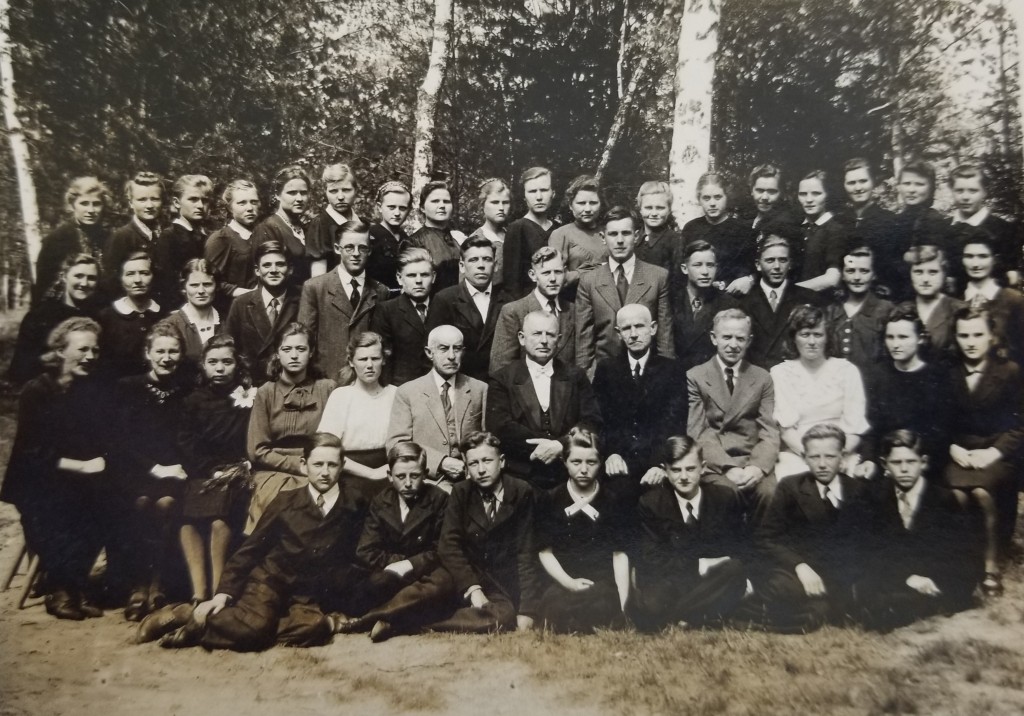
The SS temporarily housed two large groups of Mennonites from Ukraine in former mental institutions near Danzig. Nazis had killed 4,000 patients at these facilities, known as Konradstein and Konitz. Among the victims were 550 children with disabilities transported to Konradstein for poisoning by 1943.18 The Mennonite resettlers knew that previous inhabitants had been murdered.19 Church leaders from Danzig welcomed these refugees’ arrival. They worked closely with Nazi administrators to provide spiritual care. In May 1944, dozens of young people from Konradstein traveled to the Heubuden church for baptismal training. Elder Bruno Ewert inducted them into the faith a week later in a hall of the mental institution.20
Bruno Ewert (second row, seventh from left) baptized these forty-seven Mennonite refugees from Ukraine at the former Konradstein mental institution, May 28, 1944. Source: Nachlaß Ernst Crous, Folder: Briefw. 1944, MFS.
Only one Mennonite from the Danzig region is known to have been imprisoned for resisting Nazism. The eldest son of a well-established Mennonite family, Hermann Epp had been arrested two months before Ewert baptized forty-seven young people in Konradstein. Epp’s attitudes toward Nazism were unusual in his family and among Danzig Mennonites generally. He had a history of communist sympathies and close friendships with Jews. In 1943, when his first child developed disabilities, Nazi officials forcibly took and euthanized the infant, possibly perpetrating this murder at Konradstein. Epp’s public bitterness landed him in the Stutthof concentration camp. Eventually released, he survived the Third Reich’s collapse.21
World War II’s end heralded the demise of the Mennonite communities around Danzig. In the last days of the war, much of Danzig’s population began a hectic evacuation westward. As Soviet forces advanced, Mennonites and others fled by ship to Denmark or through the countryside across pre-war borders with Germany. Bruno Ewert later recalled this time of terror. The evacuees “were plundered, the women of all ages were dishonored, many were taken captive, others suffered affliction and death. Families were brutally separated.”22 Ewert blamed Poles and Soviets for German suffering. He did not mention SS-led death marches from Stutthof, nor that Jewish deaths erased evidence of forced labor for Mennonites.23
A North American church aid organization, Mennonite Central Committee (MCC), helped Mennonites from Danzig resettle in new homes. None wished or would have been allowed to return to their former residences, now located in the Soviet-dominated country of Poland. In 1945, MCC’s commissioner for refugee matters, C.F. Klassen of Canada, toured Europe to find displaced Mennonites. In Denmark, he met Bruno Ewert. This former elder of the Heubuden church had been working with fellow faith leaders to contact thousands of Mennonites refugees, and Ewert shared his list with Klassen.24 Over the next decade, MCC helped resettle thousands of Danzig Mennonites to Canada, Uruguay, and West Germany.
MCC leaders kept quiet about the Danzig Mennonites’ deep ties to Nazism. Aid workers privately called the number of former Nazis among the refugees “amazing.”25 The organization nevertheless sought to reintegrate this group into the international faith community. Before a Mennonite World Conference in the US in 1948, staff selected four delegates from Germany. They had difficulty finding any clergy from Danzig, however, who could meet visa qualifications.26 Previous Nazi Party membership precluded both short visits and emigration. MCC worked with faith leaders in North America who successfully lobbied Canada to accept Mennonite refugees from Danzig, beyond “the few who are not party members.”27
The history of Hitler’s Mennonite voters should be of substantial interest today. These Christians came from a tradition that professed peaceful coexistence. By the 1930s, many had become rabidly nationalist and antisemitic. Mennonite voters helped bring the Nazi Party to power in the Free City of Danzig, and when Hitler’s expansionism unified this territory with the Third Reich during World War II, some members joined in the process of expropriation and genocide. Religious leaders claimed resistance and persecution after the war, but we can count the number of Danzig Mennonites jailed for anti-Nazi activities on one finger. Dealing openly and seriously with this past remains a task for Mennonites over seventy-five years later.
Ben Goossen is a fellow with the American Historical Association and the author of Chosen Nation: Mennonites and Germany in a Global Era, published with Princeton University Press. Thanks to Danuta Drywa, Arnold Neufeldt-Fast, Frank Peachey, Alain Epp Weaver, and Madeline J. Williams for help with this essay.
1. Due to Danzig’s parliamentary system, the Nazi win on May 28, 1933, was more substantial (38 out of 72 seats in the Volkstag) than indicated by their razor-thin popular vote majority, which exceeded the 50% mark by only 267 ballots. Additional research is required to understand precisely how Mennonites contributed to the electorate. If they were registered at the same rate as other Danzigers, voted at the same rate, and chose parties in the same percentages as their neighbors, then Mennonites would have had about 3,438 registered voters; 3,230 would have voted; and 1,647 would have chosen the Nazis. However, the Nazi Party’s strong rural showing in Danzig suggests that these estimates may be low, a possibility affirmed by contemporary observers: “the overwhelming majority of German Mennonites were always nationally oriented and welcomed Hitler’s project with open arms.” Benjamin Unruh to D. Hege, July 28, 1933, Nachlaß Benjamin Unruh, box 2, folder 8, Mennonitische Forschungsstelle, Bolanden-Weierhof, Germany (hereafter MFS); “The majority of Mennonites welcomed the National Socialist seizure of power on January 30, 1933, in the German Reich and in May of the same year in Danzig.” Hermann Epp, “Die Westpreussischen Gemeinden von 1933 bis zum Untergang,” Der Mennonit 1, no. 1 (1948): 4.
2. On the Free City of Danzig, see Christoph Kimmich, The Free City: Danzig and German Foreign Policy, 1919-1934 (New Haven: Yale University Press, 1968); Herbert Levine, Hitler’s Free City: A History of the Nazi Party in Danzig, 1925-1939 (Chicago: University of Chicago Press, 1973); Dieter Schenk, Danzig 1930-1945: Das Ende einer Freien Stadt (Berlin: Ch. Links, 2013). The topic of Mennonites in the Free City of Danzig deserves more attention from historians. Important treatments include Gerhard Rempel, “Mennonites and the Holocaust: From Collaboration to Perpetuation,” Mennonite Quarterly Review 84, no. 4 (2010): 507-508, 512-525; Steven Schroeder, “Selective Memory: Danziger Mennonite Reflections on the Nazi Era, 1945-1950,” in European Mennonites and the Holocaust, ed. Mark Jantzen and John Thiesen (Toronto: University of Toronto Press, 2020), 307-318. For works on Mennonites in the Danzig region prior to World War I, see Peter J. Klassen, Mennonites in Early Modern Poland and Prussia (Baltimore: Johns Hopkins University Press, 2009); Mark Jantzen, Mennonite German Soldiers: Nation, Religion, and Family in the Prussian East, 1772–1880 (Notre Dame, IN: University of Notre Dame Press, 2010).
3. Gerhard Wolfrum suggested this language to Mennonite leader Benjamin Unruh in the spirit of advising Unruh how best to phrase a letter the head of the SS, Heinrich Himmler, with a specific request. Quoted in Benjamin Unruh to Gustav Reimer, January 12, 1944, Nachlaß Benjamin Unruh, box 4, folder 21, MFS.
4. Bruno Ewert, “Four Centuries of Prussian Mennonites,” Mennonite Life 3 (April 1948): 15-16. Other Mennonite leaders from Danzig and nearby regions made similar exculpatory ex post facto claims, for instance falsely alleging that church leaders took “a very determined stand… against the advocates of anti-Semitism.” Emil Händiges, “The Catastrophe of the West Prussian Mennonites,” Mennonite Quarterly Review, 24, no. 2 (1950): 126-127.
5. Quoted in Ewert, “Four Centuries of Prussian Mennonites,” 15. The views of this preacher, Gerhard Fast of Heubuden, appear to have been shared generally by Danzig’s Mennonite clergy. A conference of faith leaders from Danzig and nearby regions sent a telegram to Hitler on September 10, 1933, expressing “deepest thanks for the mighty revolution, which God has granted our nation through your energy.” Aron Mekelborger, “Bericht über die 4. Allgem. Westpr. Konferenz in Tiegenhagen am 10. September 1933,” Mennonitische Blätter, October 1933, 101.
6. C. Henry Smith, The Story of the Mennonites (Berne, IN: Mennonite Book Concern, 1941), 345.
7. Quoted in Benjamin Unruh “Bericht über Verhandlungen im Warthegau im März 1944,” March 30, 1944, Nachlaß Benjamin Unruh, box 4, folder 21, MFS. On Greiser’s career in Danzig, see Catherine Epstein, Model Nazi: Arthur Greiser and the Occupation of Western Poland (Oxford: Oxford University Press, 2010), 15-123. Danzig’s SA leader, Bruno Fricke, was moreover familiar with Mennonites abroad. He had lived in Latin America and published about a group in Paraguay. Bruno Fricke, “Das Drama der Sklaven im Chaco,” Münchener Beobachter, August 22, 1926.
8. See Imanuel Baumann, “Der Mennonit und Nationalsozialist Otto Andres (1902–1975),” Mennonitische Geschichtsblätter 75 (2018): 87-99. Andres (who left the Mennonite church in the mid-1930s) also served as Commissioner for the county of Großes Werder, one of five major administrative regions of the Free City. His deputy, Cornelius Jansson, was a practicing Mennonite. Jansson took over administrative duties in Großes Werder when Andres was away, e.g., when he became the Lieutenant Governor (Stellvertreter-Gauleiter) of Danzig-West Prussia in late 1939. In this capacity, Jansson was involved in the expansion of the Stutthof concentration camp. Horst Gerlach, “The Final Years of Mennonites in East and West Prussia, 1943–45,” Mennonite Quarterly Review 66, no. 2 (1992): 239.
9. Of five SS officers in the Free City with the common Mennonite surname “Wiens,” only one listed Mennonite affiliation, and church records show that he remained unbaptized. See A3343, roll 243B, Captured German and Related Records, National Archives and Records Administration, College Park, Maryland, USA (hereafter NARA); Christian Neff, ed., Mennonitisches Adreßbuch 1936 (Karlsruhe, 1936), 202. By contrast, four rank-and-file SS men with the common Mennonite surname “Enss,” self-identified as Mennonite. See A3343-SM-C107, NARA. These preliminary findings conform to broader patterns among Christians in the SS. See Herbert F. Ziegler, Nazi Germany’s New Aristocracy: The SS Leadership, 1925-1939 (Princeton: Princeton University Press, 1989), 87. Mennonite church leaders appear to have welcomed SS membership among congregants. When the SS denied membership to one Mennonite, faith leaders appealed directly to Himmler. Emil Händiges to Heinrich Himmler, August 12, 1938, Vereinigung, folder: Briefw. 1938 Jul.-Dez., MFS. In another case, the son of a preacher from southern Germany joined the SS “without problem by giving a Mennonite promise [rather than swearing an oath].” Benjamin Unruh to Gerhard Wolfrum, January 19, 1944, Nachlaß Benjamin Unruh, box 4, folder 21, MFS.
10. See NSDAP membership files for elders Johannes Dyck II of Ladekopp (joined 1936), Bruno Enss of Orlofferfelde (joined 1936), Bruno Ewert of Heubuden (joined 1937), Johann Penner of Ladekopp (applied 1936 – no surviving membership card), Ernst Regehr of Rosenort (joined 1931), and Franz Regehr of Tiegenhagen (joined 1933), NARA. A Mennonite delegation to Nazi headquarters in Munich affirmed, “As a church we unconditionally support the party.” These delegates reported that in Danzig, “the great majority of elders and preachers are members of the party.” Gustav Reimer, “Bericht über die Verhandlung in Braunen Haus in München am 6.7.1938, betreffend die Regelung der Eidesfrage,” Vereinigung, box 2, folder: Briefw. 1938 Jul.-Dez., MFS. Internal church correspondence confirms: “numerous respected members of the Mennonite ministry wear the swastika on their breast with pride and joy as party members.” Emil Händiges to Daniel Dettweiler, Benjamin Unruh, Ernst Crous, Abraham Braun, and Gustav Reimer, June 23, 1938, Vereinigung, box 2, folder: Briefw. 1938 Jan.-Jun., MFS.
11. Gerlach, “The Final Years,” 240. Hitler spoke at this meeting with the Mennonite Walter Neufeldt, Commissioner of Marienburg County in East Prussia. In response to Hitler’s request for follow-up, Neufeldt gathered documents with help from church leaders Johannes Dyck II and Gustav Reimer and the non-Mennonite historian Erich Keyser.
12. The racial scientist Friedrich Keiter evaluated 386 Mennonites from the Rosenort, Orlofferfelde, Ladekopp, and Heubuden congregations in Danzig as well as from the Elbing and Markushof-Thiensdorf churches in East Prussia. He noted the “especially gracious obligingness of the Mennonites themselves,” thanking the Danzig elders Erich Göttner, Franz Regehr, and Johann Penner as well as Emil Händiges and Cornelius Dirksen of East Prussia. Friedrich Keiter, Rußlanddeutsche Bauern und ihre Stammesgenossen in Deutschland (Jena: Gustav Fischer, 1934), 2. Erich Keyser lauded Danzig Mennonites’ “special racial biological importance” and recommended further “detailed racial examination.” Erich Keyser, “Die Mennoniten im Weichselland,” Volk und Rasse 17, no. 4 (1942): 72-73.
13. The secretary of the Union of Mennonite Congregations in the German Reich explained this process to the Union’s two top officials: “I have experience approving (notarizing) ancestry passports in cases when they cannot be notarized by registry offices. It is probably the case for all ancestry passports that some ancestors can be notarized by the registry office, and others must be notarized by the appropriate church official. In our congregations, the church council is of course entitled to perform notarizations by affixing the congregational seal.” Abraham Braun to Emil Händiges and Ernst Crous, December 22, 1939, Vereinigung, folder: Briefw. 1939, MFS. In the Free City of Danzig, deacon Gustav Reimer of Heubuden became particularly active in notarizing Aryan papers for practicing as well as former Mennonites. According to Reimer, “none of the men from our circles who today hold leading positions in the economy or politics could have provided the necessary proof of Aryan ancestry without my assistance.” Gustav Reimer, “Fritz van Bergen-Kartei,” Mitteilungen des Sippenverbandes Danziger Mennoniten-Familien 8, no. 4/5 (1942): 128-130. He reported that without church records, “proving Aryan ancestry—especially for dates before 1800—would never have been possible.” Gustav Reimer, “Die Kirchenbücher der Menno. Gemeinden in West- und Ostpreussen,” Der Berg 7 (1940): 83. Ancestry documentation from before 1800 would only have been necessary for people in high party or state positions, such as SS officers.
14. On this “Epp Kommando,” see Jania Grabowska, Stutthof: Ein Konzentrationslager vor den Toren Danzigs (Bremen: Edition Temmen, 1995), 30, 55, 74; Günter Regaag, ed., Ostseebad Stutthof (Heimat-Dokumentation Stutthof, 1995), 114-115; Marek Orski, Niewolnicza praca więźniów obozu koncentracyjnego Stutthof w latach 1939-1945 (Gdańsk: Muzeum Stutthof w Sztutowie, 1999), 61, 136, 156-158, 167-168, 178, 236-239, 263, 294, 302; Danuta Drywa, The Extermination of Jews in Stutthof Concentration Camp (Gdańsk: Muzeum Stutthof w Sztutowie, 2004), 118; Danuta Drywa, “Stutthof – Stammlager,” in Der Ort des Terrors: Geschichte der nationalsozialistischen Konzentrationslager, vol. 6, ed. Wolfgang Benz and Barbara Distel (Munich: C.H. Beck, 2007), 512; Rempel, “Mennonites and the Holocaust,” 520-525. Epp was a member of the Mennonite church in Tiegenhagen. Neff, ed., Mennonitisches Adreßbuch, 205. Broader Mennonite involvement with the Stutthof camp requires further study. Lists of camp staff include surnames common among Danzig Mennonites, including Bartels, Berg, Classen, Dirks, Enss, Fast, Foth, Friese, Gortz, Haack, Hamm, Janson, Jansson, Jantz, Jantzen, Janz, Janzen, Löwen, Pauls, Peters, Ratzlaff, Reimer, Schröder, Thimm, Unrau, Vogt, Wall, Wedel, Wiebe, and Zimmermann. See the three-part staff list: Mirosław Gliński, “Załoga obozu koncentracyjnego Stutthof,” Stutthof: Zeszyty Muzeum 5 (1984): 188-216; 6 (1985): 97-120; 7 (1987): 203-234. These names might profitably be checked against Mennonite church lists.
15. After extensive exchange of correspondence, a Mennonite delegation met with Wartheland officials on January 22, 1942. Emil Händiges to Gausippenamt im Warthegau, August 31, 1944, Nachlaß Ernst Crous, folder: Briefw. 1944, MFS. After this meeting, SS officers in Wartheland identified Mennonites in the Americas as their preferred settlers. See Andreas Strippel, NS-Volkstumspolitik und die Neuordnung Europas: Rassenpolitische Selektion der Einwandererzentralstelle des Chefs der Sicherheitspolizei und des SD, 1939-1945 (Paderborn: Ferdinand Schöningh, 2011), 245. A lay Mennonite leader from the Lemberg church, Rudolf Dick, acquired affiliation with Wartheland’s Department for Ethnic Questions, where he advocated for Mennonites. Dick helped organize Benjamin Unruh’s meeting with Wartheland governor Arthur Greiser on March 16, 1944. In addition to welcoming Mennonites from Ukraine, Greiser expressed interest in “the planned resettlement of [Mennonites] from overseas, right after the end of the war.” Unruh “Bericht über Verhandlungen im Warthegau.” After Unruh’s trip, SS officers issued special instructions for handling Mennonite resettlers. Strippel, NS-Volkstumspolitik und die Neuordnung Europas, 247.
16. Two thirds of soldiers in a Wehrmacht division that fought around the Mennonite settlements in Ukraine were reportedly from Danzig, with some units being up to forty percent Mennonite. Horst Gerlach, Die Russlandmennoniten, vol. 1 (Kirchheimbolanden: Selbstverlag, 1992), 90. Reports of invaders’ encounters with Mennonites in Ukraine include Günther Fieguth, “Volksdeutscher Aufbruch am Dniepr,” Danziger Vorposten, December 13, 1942; Agnes Epp, “Ein Geschenk des Führers an unsers Sippenangehörigen in der Ukraine,” Mitteilungen des Sippenverbandes Danziger Mennoniten-Familien 8, no. 3 (1942), 112-113; P.H., “Von unseren Siedlungen in der Ukraine,” Nachrichtenblatt des Sippenverbandes Danziger Mennoniten-Familien (December 1943): 2-3.
17. Benjamin Unruh testified after the war that Werner Lorenz, who headed the Ethnic German Office of the SS, had been “very well acquainted with the Mennonites from Danzig, and he knew the attitude of our church, and he respected our attitude, and he promised us all possible support.” “United States of America v. Ulrich Greifelt et al.,” December 17, 1947, M894, roll 4, NARA. Unruh took up regular contact with Lorenz after a personal audience with Himmler: “An extremely good relationship has developed between us and the high [Nazi] leaders. I may write and meet at any time in relation to Mennonite matters. We have agreed that Lorenz will personally work on our matters. He is constantly in contact with Himmler and [Horst] Hoffmeyer [an SS officer responsible for Mennonites in Ukraine].” Benjamin Unruh to Emil Händiges, January 22, 1943, Vereinigung, box 3, folder: Briefw. 1943, MFS.
18. Irena Sławińska and Franciszek Ścigała, “Kocborowo (Conradstein) Landesanstalt für psychische Kranke,” in Die Ermordung der Geisteskranken in Polen, 1939-1945, ed. Zdzisław Jaroszewski (Warsaw: Wydawnictwo Naukowe PWN, 1993), 57-63; Volker Rieß, Die Anfänge der Vernichtung ‘lebensunwerten Lebens’ in den Reichsgauen Danzig-Westpreußen und Wartheland 1939/40 (Frankfurt am Main: Peter Lang, 1995), 23-53, 150-166; Maria Fiebrandt, Auslese für die Siedlergesellschaft: Die Einbeziehung Volksdeutscher in die NS-Erbgesundheitspolitik im Kontext der Umsiedlungen 1939-1945 (Göttingen: Vandenhoeck & Ruprecht, 2014), 293-297. For more background, see Doris Bergen, War & Genocide: A Concise History of the Holocaust (Lanham, MD: Rowman & Littlefield, 2009), 129-165.
19. One boy reported hearing that previous inhabitants of the Konitz mental institution “had been ‘disposed of’ as being, in Hitler-perspective, ‘unworthy life.’” Waldemar Janzen, Growing Up in Turbulent Times: Memoirs of Soviet Oppression, Refugee Life in Germany, and Immigrant Adjustment to Canada (Winnipeg: CMU Press, 2007), 62.
20. Gustav Reimer to Christian Neff, May 26, 1944, Christian Neff Nachlaß, Folder: Briefwechsel 1944, MFS.
21. Christiana Epp Duschinsky, “Mennonite Responses to Nazi Human Rights Abuses: A Family in Prussia/Danzig,” Journal of Mennonite Studies 32 (2014): 87-89. See also Gerlof Homan, “From Danzig to Down Under: A Mennonite-Jewish Family’s Escape from the Nazis to Australia,” Mennonite Historical Bulletin 73, no. 1 (2012): 13-18. Mennonite church leaders’ attitudes toward Nazi euthanasia policies require additional research. Other faith groups exhibited substantial opposition to euthanasia, and at least one Mennonite preached a sermon opposing it. James Irvin Lichti, Houses on the Sand? Pacifist Denominations in Nazi Germany (New York: Peter Lang, 2008), 79. However, faith leaders’ sympathies appear to have been limited. Benjamin Unruh worked with colleagues to help keep most Mennonite refugee families from Ukraine together, but when SS agents told him disabled members could not be settled in Wartheland with other Mennonites, he did not press the matter. Benjamin Unruh, “Bericht über meine zweite Reise in den Warthegau,” July 17, 1944, Nachlaß Benjamin Unruh, box 4, folder 21, MFS.
22. Ewert, “Four Centuries of Prussian Mennonites,” 17.
23. 41,500 prisoners had died in the main Stutthof camp or its satellite facilities between 1939 and 1945. Another 21,500 died during the evacuation in the last weeks of the war. Forty-three percent of all Stutthof inmates killed were Jews, and the vast majority of these died during the war’s final year. Drywa, “Stutthof – Stammlager,” 520.
24. Ewert, “Four Centuries of Prussian Mennonites,” 18.
25. Peter Goertz to Emil [Unknown] and Rachel [Unknown], November 15, 1947, Peter S. Goertz Collection, Box 2, Folder: Correspondence October-December 1947, Mennonite Library and Archives, North Newton, Kansas, USA.
26. Two of the four individuals MCC staff had originally chosen turned out to be former Nazis. When MCC workers tried to replace these delegates, they found the refugee group from Danzig-West Prussia “apparently has no non-party members among its active ministers in the western zones of Germany at the present time.” Harold Bender to Orie Miller, P.C. Hiebert, and H.A. Fast, March 13, 1948, IX-06-03, box 64, folder 35/73, Mennonite Central Committee Archives, Akron, Pennsylvania, USA (hereafter MCCA). MCC staff thus worked with many former Nazis, although they praised the anti-Nazi Hermann Epp and hired him for editorial work: “He is the one Mennonite from West Prussia, or even in all Germany, so far as I know, who suffered for his anti-Nazi convictions, and spent some time in prison…. He, alone of all the West Prussian refugees [i.e. from Danzig-West Prussia] in Denmark, has been classified as an Allied D.P. [Displaced Person], and consequently has received freedom and different treatment.” Harold Bender to C.F. Klassen and Robert Kreider, October 25, 1947, IX-06-03, box 55, folder 29/147, MCCA.
27. “MCC Gronau Annual Report 1950,” December 1, 1950, IX-19-16.3, box 1, folder 9/27, MCCA. When 62 Danzig Mennonites applied for Canadian visas as a test case, 35 were denied due to past party membership. Sponsors in Canada assessed that, since “most Danziger were connected with the party,” any large-scale migration to Canada would require changing rules that barred Nazis. J.J. Thiessen, “Bericht des Vorsitzenden der Canadian Mennonite Board of Colonization für die erweiterte Boardsitzung,” March 1, 1951, IX-19-9, box 3, folder 2/21, MCCA.