Regina Wenger
I recently pulled from my bookshelf my great-grandfather A.D. Wenger’s account of his globe-trekking journey in 1899-1900: Six Months in Bible Lands and Around the World in Fourteen Months. It’d been a while since I read it, but I should have known that as a historian it was impossible for me to just read a primary source for fun. It sparked an interest to play with some digital history tools, but also to highlight some new material sources that I discovered in my extended family’s possession.
Amos Daniel (A.D) Wenger was born in 1867, just north of Harrisonburg, Virginia and under the shadow of the Civil War. After several terms of elementary school, he completed a teachers certificate at Bridgewater Normal School.1 However, rather than teaching, Wenger followed a call to preaching and farming which took the twenty-two year old out west. In addition to traveling around Mennonite communities, he trained at Moody Bible Institute, received ordination, and inaugurated an evangelistic ministry.2 Feeling a call to preach to young people, Wenger ended his western sojourn and headed to Lancaster, Pennsylvania.3 There he gained a reputation as an excellent preacher, despite his controversial tactic of holding protracted meetings.4 While in the Lancaster area, he wed Mary Hostetter of Millersville on July 1, 1897. She died suddenly of kidney disease a little over a year into their marriage. The money provided by her inheritance financed Wenger’s trip around the world.
Travelling abroad was a luxury afforded to very few at the turn of the twentieth century. In keeping a record of his travels, Wenger likely hoped to educate the Mennonite community still relatively isolated by theology and circumstance. Donald Kraybill observes that Wenger’s account of his travels carried the assumptions and perspectives of a rural American Mennonite. Each identifier—rural, American, and Mennonite—carried the power to shape his narrative.5 Race also shaped Wenger’s account as his voice vacillated between traveller, pastor, and professor. He felt the weight of “the white man’s burden.”6 Though there is a lot to unpack in his language and presuppositions, I want to spend the remainder of this post discussing new information that caught my attention in my re-reading of Six Months in Bible Lands.
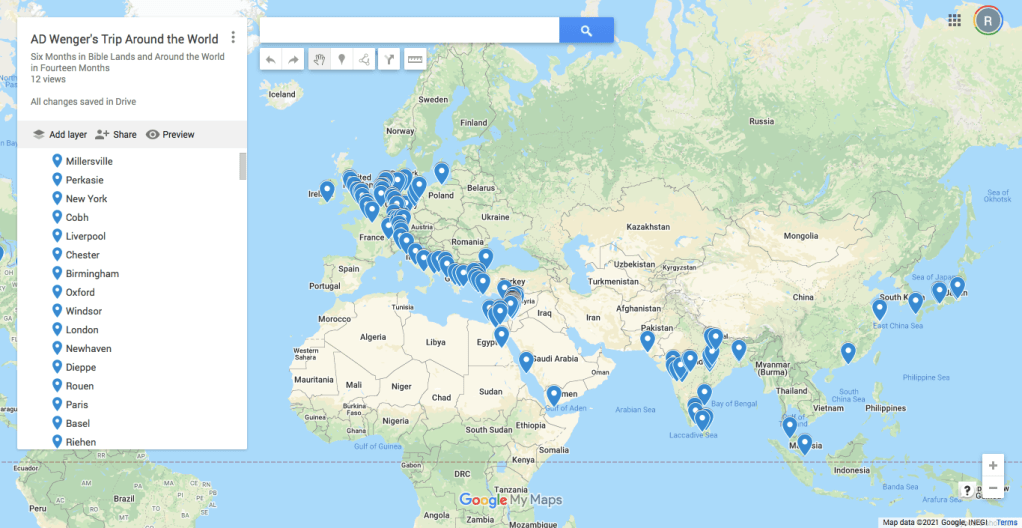
The locations where Wenger traveled fascinated. So, I started to track them using Google Maps. You can view his journey here. Whenever possible, I included dates and modes of transportation. Some places—like the Holy Land—weren’t surprising stops on his journey. However, some omissions caught my attention. I wondered, why not visit Mennonite communities in the Russian Empire? In the narrative, Wenger explained that though he desired to travel there, restrictive visa practices and the threat of having papers and possessions taken stifled any appeal to travel into the realm of Tsar Nicholas II.7 Regardless of their denominational background, Wenger desired to draw his readers’ attention to missionaries and their activities around the globe.8 Not only was this interest an outgrowth of his premillennial theology, but he also sought to bring Mennonites into the missionary movement during its rapid expansion at the turn of the twentieth century. These gospel workers also served as Wenger’s most frequent companions during the various legs of his journey.9 He could continually count on them for hospitality and an assessment of a country’s conditions and indigenous peoples.10
The extent of Wenger’s travels meant that he constantly needed to exchange currencies. On a couple of occasions, he commented on money changers or the power of loose change in poor countries.11 While outside of Shanghai he and a travelling companion tried to be generous but also escape the people clamoring for money. He stated,
Just before leaving Shanghai I had gotten about ten cents worth of Chinese money called “cash” which I intended to bring home. It takes sixteen of those coins to make one cent of our money so I had about one hundred and sixty pieces of money in my pockets. Seeing no way of escape from our dilemma for a time I suddenly thought of a plan to draw them away. Running my hand into my pocket and grasping about a hundred of these cheap coins, I arose to my feet and threw them as far behind the carriage as I could.12
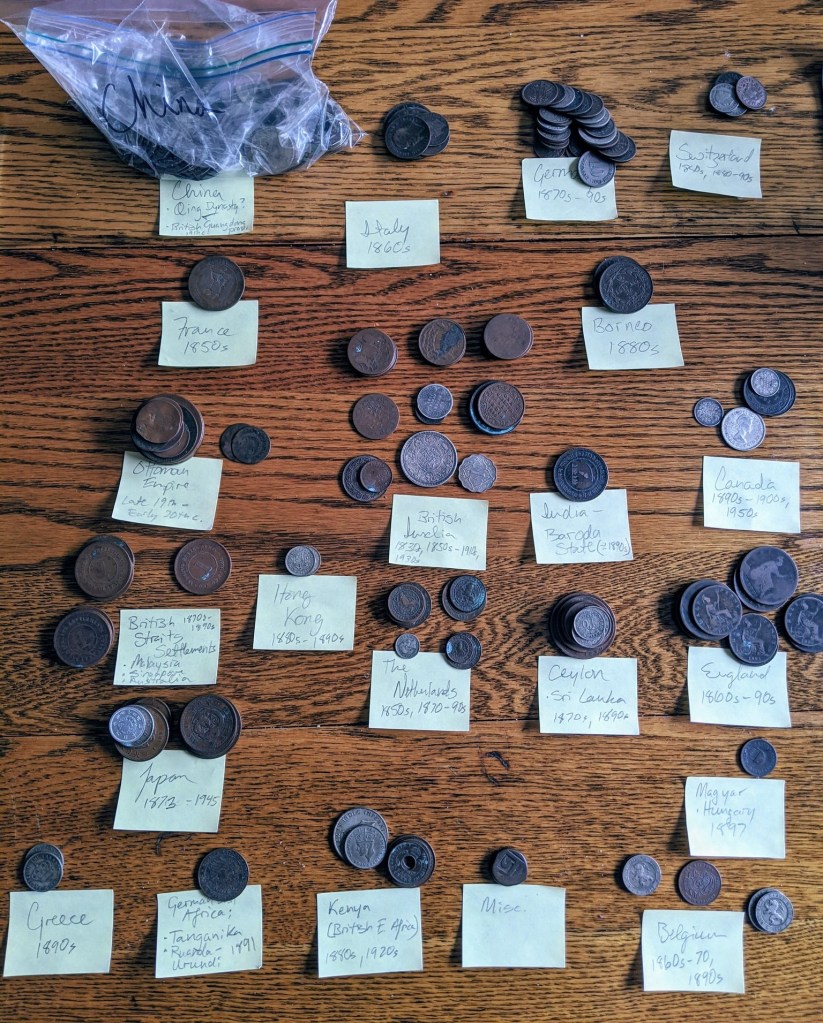
This passage and Wenger’s other discussions of money illustrate how he viewed foreign currencies during his travels: with a frugal nonchalance. He had the finances to respond to situations like this one with spontaneous generosity, but he liked a good price and did not appreciate attempts to extort travellers. The story from China also provides useful information about exchange rates and Wenger’s intensions for his remaining “cash.” Despite dispensing some of it, he indeed brought home coins from his travels. They are currently in my parents’ possession. I sorted them by country and marked the chronological range of the coinage.13 They provide another method of mapping Wenger’s journey around the globe. By far the greatest number of coins that returned home with him came from China. Also of note are the coins he acquired in the late Ottoman Empire. It presents a turn-of-the century geopolitical snapshot in the form of currency.
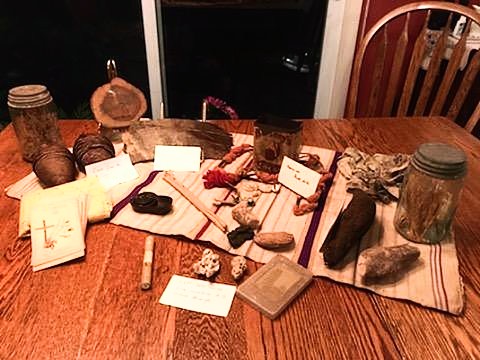
A.D. Wenger not only returned from his travels with money, but he also kept other artifacts to show Mennonite communities when he shared about his journey. Among the items are natural specimens such as whale baleen and pinecones from the cedars of Lebanon. They reveal not only his personality and interests, but practical considerations as well. Attention to flora and fauna meshed with Wenger’s farming background, but also those of his audience.14 He also kept an oil lamp from the Holy Land and scroll with either Chinese or Japanese characters. These items handled transport over long distances well. Traveling with both coins and interesting objects, however, once got him into trouble. On September 26, 1899 he attempted to depart Egypt for India. Customs officials discovered possible contraband. He recalled,
They found a piece of ore and a piece of lava that aroused their suspicion. The lava had a coin of money imbedded in it. The coin had been pressed into the molten lava when I was on Mount Vesuvius and when it cooled and hardened I carried it for a relic. They had been looking for makers of counterfeit money and now they thought they had one of them. The coin and ore pointed that way, they thought; so they held me prisoner and sent for a higher officer.15
Eventually his explanation satisfied the officer who released him and Wenger continued, though delayed, onto India. Wenger’s artifacts, supplemented by his stories, provided his audiences with tangible windows into foreign lands to which they were unlikely to travel.
His experiences abroad, plus his evangelistic ministry, provided Wenger with ample speaking opportunities upon his return to the United States in March 1900. However, contracting polio in October 1900 inhibited his mobility and left him unable to accept any preaching invitations for several months.16 Only a month before getting ill, he married Anna May Lehman after a brief courtship. The family moved to Fentress (Chesapeake), Virginia in 1907, where Wenger continued to farm while preaching and involving himself in building Mennonite education. He served as president of Eastern Mennonite School (University) beginning in 1922, a post he held until his sudden death in 1935.
The money and artifacts were in the possession of my grandfather, Chester, A.D.’s youngest son, until Grandpa’s death in 2020. The family intends to have some of the coins professionally appraised before donating them, and the other objects, to an archive. There other researchers, less close to the subject, may utilize them to examine an American Mennonite’s perspective of the peoples of the world at the turn of the twentieth century.
1. John C. Wenger and Mary W. Kratz, A.D. Wenger (Harrisonburg, VA: Park View Press, 1961), 7. Now known as Bridgewater College, the school is located in Bridgewater, Virginia.
2. Regina Wenger, “Illumination in the West: A.D. Wenger’s Theology of Revival, Dispensationalism, and Mission” (unpublished manuscript, November 7, 2013).
3. John Landis Ruth, The Earth is the Lord’s: A Narrative History of Lancaster Mennonite Conference (Scottdale, PA: Herald Press, 2001), 724–25.
4. Mark R. Wenger, “Ripe Harvest: A. D. Wenger and the Birth of the Revival Movement in Lancaster Conference,” Pennsylvania Mennonite Heritage, April 1981.
5. Donald B. Kraybill, Eastern Mennonite University: A Century of Countercultural Education (University Park, PA: The Pennsylvania State University Press, 2017), 3-6.
6. A. D. Wenger, Six Months in Bible Lands and Around the World in Fourteen Months (Doylestown, PA: Joseph B. Steiner, 1901), 480, 494-495.
7. A. D. Wenger, Six Months in Bible Lands, 53.
8. A. D. Wenger, Six Months in Bible Lands, 155, 455-483.
9. A. D. Wenger, “Unfulfilled Prophecies,” in Outlines and Notes, ed. John S. Coffman. (Elkhart, IN: Mennonite Publishing Company, 1898), 52–59; Harold S. Bender, “The History of Millenial Theories,” Eastern Mennonite University Historical Library (Harrisonburg, VA), 10; George M. Marsden, Fundamentalism and American Culture, 2nd ed. (New York: Oxford University Press, 2006), 68; See: See for example, A. D. Wenger, Six Months in Bible Lands, 135, 494.
10. A. D. Wenger, Six Months in Bible Lands, 153, 442.
11. See for example, A. D. Wenger, Six Months in Bible Lands, 341-342, 528.
12. A. D. Wenger, Six Months in Bible Lands, 521.
13. A few of the coins in the image are chronological and geographic outliers Wenger’s trip. I suspect that they belonged to his daughter, Rhoda E. Wenger, who served as a missionary in East Africa during the mid-twentieth century.
14. Kraybill, 3-6.
15. A. D. Wenger, Six Months in Bible Lands, 445. The lava, though now absent of the coin, may be seen in the center of the above photograph of the objects Wenger brought back from his journey.
16. Wenger and Kratz, 20.
 Anabaptist Historians