Along with the introduction of electricity, vehicles, and running water during the 1970s, 80s, and 90s, during tumultuous times of community and colony reorganization in Chihuahua’s southern Mennonite colonies near the city of Cuauhtémoc, in Mexico’s Tres Culturas Region, one of changes that most deeply impacted daily life for Mennonite residents was the wide-reaching education reform that completely changed the educational landscape in the colonies over the course of fifty years, providing a greater level of educational access and diversity of school experiences within the Campos Menonitas, which still continues to impact education in all but the most traditional communities to this day.
Until the late 1960s, schooling in the Tres Culturas Region of Chihuahua followed the traditional Darpe Schule model beginning with Fiebla (basic reading and writing) around age six and continuing with Katekjisem (catechism) and Jesankbuak (hymnal), and ending with Bibel (Bible) around age thirteen with basic arithmetic also integrated throughout. In this model, which is still used today in the most traditional communities, instruction is given by one male teacher in High German in a one-room schoolhouse and involves recitation, dictation, and Langeviese singing and has an end goal of preparing students for baptism and daily life within the traditional Darpe community. Billy Froese, who attended a traditional Darpe Schule in the 1980s, described his experiences to the Rebels, Exiles, and Bridge Builders: Cross-Cultural Encounters in the Campos Menonitas of Chihuahua Oral History Project,
The girls are on one side, the guys are one side. That can also be a punishment. You go sit with the girls. And I at one time thought that was a punishment! But the fule Benkj” is the “lazy bench.” And if you’re not doing your work, up there beside the teacher, there’s a bench. This hard bench. And you go sit up there. Of course, there were spankings, stuff like that. But they had these big windows. And you had to stand in the window, facing the street [if you got in trouble]. I just remember the teacher coming to my desk and putting the pen in my right hand. Or the chalk. Whatever it was then. We had those little Tofels too. Those little chalk boards. And the chalk. So, he would start me off writing, and then he would leave. And I would just put it back in my left hand….My experiences, my most memorable experiences in the school aren’t positive. They’re interesting, but not so positive. It was usually getting punished.
Education reform occurred first in the Manitoba Colony and then was implemented later in the Swift Current, Ojo de la Yegua, and Jagueyes colonies. In each colony and each Darp within individual colonies, reforms were propelled by external and internal factors and often came in waves. Reforms were implemented at different times and to different degrees depending on the community and educational infrastructure, pedagogy and curriculum remains in flux across the Mennonite colonies in the Tres Culturas Region.
One of the largest external factors impacting reform, was the establishment of the Álvaro Obregón school in the Quinta Lupita community, located near the outskirts of Cuauhtémoc at the edge of the Manitoba Colony by Mennonite missionaries from Canada’s General Conference in the late 1960’s. The founding of the Álvaro Obregón school was followed in subsequent years by mission churches and schools from other Mennonite conferences as well as other from other denominations, such as the German Church of God. These schools had multiple instructors and classrooms divided by age, a wider range of subjects including geography and history, and instruction in Spanish. These schools became known as Konferensa (Conference) schools because of their association either directly or indirectly with General Conference missionaries and churches and enrolled students not only from their congregations, but also students from more traditional backgrounds whose parents were interested in educational options that were different from the traditional Darpe Schule.
At times, Konferensa churches, particularly with the assistance of missionaries of Canada, would build relationships with a much more traditional community and launch a school within the community primarily designed to serve traditional students, but with a more modern pedagogy and academically diverse curriculum, which included Spanish, like in Konferensa schools. With the introduction of Spanish into the curriculum, Mestizo teachers began working in Mennonite schools for the first time as Spanish language instructors and gained access and proximity to traditional communities that was previously unheard of. One of these teachers, Diana Sandoval Arballo, who began teaching in 1998 at a school launched in the Ojo de la Yegua Colony by Iglesia Anabautista Ebenezer, a Spanish-speaking Mennonite church in Cuauhtémoc whose congregation is about evenly split between Mestizo-Mennonite converts, ethnic Low-German Mennonites and Mestizo and Mennonite couples and their bicultural children, shared her experiences in 2018 with the Rebels, Exiles, and Bridge Builders: Cross-cultural encounter in the Campos Menonitas of Chihuahua Oral History Project
The church at Campo 67, in a Mennonite community, was looking for a Mestiza teacher, but with Mennonite faith, to work in the community. So, they invited me to go to work for a year, and I accepted. And that was the first time I had direct contact with the more traditional Mennonite community….I lived in the Campo. There was a couple that were teachers, and another couple that were the pastors. So, I worked with these teachers and lived with the pastors. But I lived in the community from Monday to Friday, and for the weekend I returned to Cuauhtémoc, to my house…The first years it was difficult. For them it was difficult seeing and living with a Mestiza in the middle of the community. Maybe my way of dressing was also different, and that drew attention. There was also a bit of fear, because they had someone unknown and didn’t know who I was, what I was going to teach, what I was trying to do…. I came for one year and I stayed 20, but I think my biggest motivation has always been to serve and I think that I have a desire because God uses me to be able to serve. And I saw that this would be the way the God would use me. Teaching people the faith, mainly, that is my first goal, and the second is, well, the language. And I also believe that one of the things that has always impassioned me is that they can see that the Mestizo culture is different than the idea that they have always had in their head. That I think is one of the biggest motivations in my life. And also, I fell in love with the Mennonite culture. For me, it was never difficult being with them. I can’t say that there was anything I had to sacrifice, it was a pleasure.
Though external intervention from Conference churches and schools, which included the transformational role of teachers like Diana Sandoval Arballo, played a large part in implementing education reform in the Tres Culturas Region, it would not have been possible without internal proponents for school reform, like Peter Rempel Enns, whose lifelong advocacy for education reform in the Mennonite Campos was chronicled by the State of Chihuahua’s Mennonite Resource Office’s 2016 publication, Hombres y mujeres menonitas destacados: Caminos inspirantes (Outstanding Mennonite Men and Women: Inspirational Paths). These local advocates for school reform were concerned about what they perceived to be low educational standards, low levels of literacy among graduates, harsh punishments, and an incomplete curriculum. Often advocates for school reform, particularly those within more traditional communities faced strong backlash from community leadership and some were excommunicated for their stances; however, as more families chose Konferensa schools at the same time that tensions were high in traditional communities concerning increased business and social relationships between Mennonite and Mestizo communities, the use of vehicles with rubber tires, and the introduction of electricity, questions began to arise with traditional church leadership about the best path forward concerning education. Some remained steadfast in their Darpe Schule model, but many more began to make small, but significant changes to their education systems.
Faced with external and internal pressures for school reform, Kleingemeinde and Old Colony communities sought a solution that they felt would allow them to raise their academic standards while maintaining their distinctive values and cultural practices. Beginning in 1995, through the MCC and a variety of other Mennonite aid agencies, they built relationships with Amish communities and schools in the United States and began receiving Amish teachers, not just in the Campos Menonitas of Chihuahua, but across Mexico, to teach in Kleingemeinde and Old Colony schools, and to assist in the restructuring of administration, curriculum, and assessment. (This topic is addressed more in depth in Rebecca Janzen’s 2019 Anabaptist Historians blog post, “How Much to Change: Amish Teachers in Mexico.”)
Perhaps the most significant impact to education in the Tres Culturas Region in recent history, was when many private, Mennonite church schools began seeking accreditation from Mexico’s Secretary of Public Education (SEP). SEP accredited Mennonite schools have to meet specific national curriculum, assessment, achievement and enrollment standards, but are allowed to have religious instruction and maintain cultural practices. While the majority of SEP Mennonite schools only include Primaria (Grades 1-6) and Secundaria (Grades 7-9), which are the levels of compulsory education in Mexico and the most common level of education among Gen-Z Mennonites in the Campos, particularly among those from less traditional communities, a few SEP Mennonite schools offer Preparatoria (Grades 10-11/12), which was previously only available at non-Mennonite public and private schools in Cuauhtémoc.
More and more students from the Campos have been going to study at the universities in Cuauhtémoc and Chihuahua. Even some of the most traditional Darpe Schule in the region have been taking steps to examine educational practices and standards within their cultural context. Adults from traditional backgrounds are beginning to finish SEP accredited Primaria and Secundaria schooling through ICHEA (The Chihuahuan Institute for Adult Education), while other traditional adults, including Peter Rempel, the principal of a Kleingemeinde school in the Manitoba Colony, who shared his experiences with the Rebels, Exiles, and Bridge Builders: Cross-Cultural Encounters in the Campos Menonitas of Chihuahua Oral History Project, have taken advantage of a government program called Prepa Abierta to finish their high school equivalency online. From Darpe Schule to high schools that prep students for university and everything in between, the Campos Menonitas in the Tres Culturas Region have an educational diversity that is unique and 50 years in the making.
From her teacher housing, provided to her by the SEP school that serves traditional students in Campo 38 ½ where she currently works, Diana Sandoval Arballo looked out her window into the Darp and commented on the changes that she had seen during her 20 years as a Spanish instructor in Mennonite schools
Over the course of years, the parents became more interested in the education of their children. They saw it as more important, the fact that they could learn. And they are more motivated to make the school grow. I think it happens with the passing of the years. They have lost the fear towards education, that is different than what they got. And they have been motivated more so that their children can go further, even though they learn different things, they dream of being a doctor, not just working in agriculture. So, I think that the change in these years that I have been here have been very big and the steps have been very steady toward education.
In early November of 2020, Mennonite Church USA asked pastors from across the country to share how their congregations engaged in community action during the 2020 Presidential Election. Manhattan Mennonite Fellowship in New York City hosted open mediations for peace before and after the election. Raleigh Mennonite Church in North Carolina focused efforts on “fair elections, poll watching, and get-out-the-vote efforts.” Joel Miller, the lead pastor at Columbus Mennonite Church in Ohio, served as a peacekeeper at the polls, ready to prevent, de-escalate, and reduce the violence that many feared would occur on election day. These leaders’ responses, published in Anabaptist World, described nine congregations that unabashedly valued political action inspired by their faith. In our unavoidably politicized world, it seems that the driving question for these and many other Mennonites is how does our faith lead us to participate in politics? Even in the very questions MC USA posed to their pastors (How are people in your congregation preparing to engage in community action?”), political participation was assumed. This assumption, however, was once a highly contested issue among Mennonites. The driving question that preceded our current query was at once more simple and more complex: does our faith lead us to participate in politics? This question came under severe scrutiny and reconsideration during the 1950s and early 1960s, as an emergent theological paradigm and the social and moral imperatives brought to bear by the Civil Rights Movement worked in tandem to forge among Mennonites a social conscience with critical political underpinnings. The arduous working-out of this nascent political identity was on full display during the 1964 Presidential Election.1
In the fall of 1964, The Gospel Herald, the denominational organ of the “Old” Mennonite Church, published an unprecedented degree of political coverage in the weeks leading up to the presidential election between President Lyndon B. Johnson and Republican challenger Barry Goldwater. The dozens of editorials, letters to the editor, discussion pieces, and official statements printed that fall revealed a complex religious and political milieu. In new and public ways, a Mennonite’s politics became a religious issue, and one’s spirituality became a political issue. Because political participation was still far from the modus operandi, Mennonites simultaneously debated the very practice of voting and, for those who would vote, the candidates’ merits. On all sides of these debates, Mennonite leaders and laity articulated religious and political arguments in their favor.
These divisions wrought by the 1964 Election were thrown into sharp relief that June when J. Lawrence Burkholder, a leading advocate of social responsibility in the “Old” Mennonite Church, suggested that the Committee on Economic and Social Relations (CESR) and the Peace Problems Committee (PPC) take a public stance on Barry Goldwater, a highly divisive Presidential hopeful closing in on the Republican nomination. Gravely concerned with Goldwater’s international and domestic policies, Burkholder suggested that a statement be published “help the Mennonites to form enlightened attitudes regarding Goldwater.” Such “enlightened attitudes,” Burkholder suggested, would reflect his view that Goldwater posed a serious “threat to the peace of the world.” Many of Burkholder’s and others’ arguments against Goldwater were founded in the Arizona Senator’s civil rights stance. His vote against the Civil Rights Act of 1964 was ambiguous at best and deeply racist at worst. Many Mennonites were equally troubled by Goldwater’s foreign policy, shaped willingness to use nuclear weapons and his criticism and rejection of the United Nations. Burkholder certainly recognized the risk in making such an overtly partisan political statement but believed that speaking out in an official church capacity was in order. As he saw it, the differences of conscience between Goldwater and the Mennonite Church were stark enough to avoid significant controversy. Moreover, he thought such an opportunity could be used to “help our people to think politically on one of the clearest issues in many years.”2
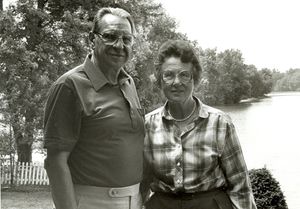
J. Lawrence Burkholder and his wife, Harriet, 1971
There was some precedent for a church committee to speak on political concerns during a national election. In the presidential election of 1960, the Peace Problems Committee made an official statement advising “old” Mennonites not to give in to or become involved in the anti-Catholic propaganda aimed at the Kennedy campaign. Motivated and justified by the religiosity of the issue, the PPC urged its members as “peace-loving nonresistant Christians” to “hold aloof from all such lower-level proceedings,” such as being swayed by or participating in the campaigns of misinformation and lies, as well as any general “electioneering,” all of which violated official church doctrine. Voting, however, was another issue. Because the church did not “forbid voting” as they did “electioneering,” the PPC left the matter up to the individual, only advising that one’s conscience not be swayed by “the current political pressures.” The committee members who faced Burkholder’s challenge in 1964 were reminded of their previous work but were undoubtedly aware of the difference between the explicitly religious problem of 1960 and the partisan declaration that Burkholder was suggesting. Moreover, as Hershberger reminded his fellow committee members, the PPC did not take a position for or against either candidate in 1960.3
Among members of the CESR and PPC, Burkholder’s proposal was met with mixed support. On the one hand, many “Old” Mennonite leaders shared Burkholder’s personal fear of the political dangers of a President Goldwater. Carl Kreider, for example, wrote that Goldwater’s “election would be a disaster to American foreign policy as well as to our domestic program.” Clearly, these Mennonites had been following the election and held developed opinions about the candidates and what they would do for the country. Writing the week after the Republican National Convention, John E. Lapp, who was still in disbelief about Goldwater’s nomination, feared “war, militaristic tactics in the race question, and break with Russia” would be all but certain under a Goldwater administration. On the other hand, however, most members were hesitant to go so far as to publish an official statement supporting or rejecting a specific political party or candidate. Opening this epistolary conversation which would play out over the summer, Guy F. Hershberger suggested that they ought not to consider the reactions of church members, but rather “whether in taking such a step we would be true to our obligation to give a true Christian witness.”4
Lay perception, however, dominated much of the discussion. Conservative Mennonites, whether theologically or politically so, were the primary concern of committee members. These leaders worried that an expression of support for Johnson or the Democratic Party would upset the laity, either because they supported the Democratic candidate or because they entered political discourse in the first place. The vital question of does our faith lead us to participate in politics? was an undercurrent of the conversation, explicitly shaped by the institutional nature of Burkholder’s proposal. Orie O. Miller summarized the concern of many of his moderate colleagues, writing that such a statement would “be entering into territory for which we have no mandate and probably no clear church position as a point of reference.” Without direction and blessing from the MC General Conference for such a political move, no matter how vague or issues-focused a committee statement might be, it was inadvisable. On the other hand, several members agreed with Burkholder that the positions that the MC General Conference had taken on race relations and nuclear warfare—which opposed to Goldwater platform clearly enough—was a sufficient mandate to warrant a statement, especially if it remained on the issues, not the candidates.5 Moderate members proposed a compromise that was eventually adopted, suggesting that instead of these church committees articulating an official position in a formal statement, several members submit a message to the Gospel Herald as individuals.
However, the views of Republican Mennonites received far more attention than those of religiously conservative, non-voting members.Lapp, who gave full-throated support for a statement detailing the moral and political dangers Goldwater posed, was optimistic about the political views of the laity: “Now the conservative elements of the church may be inclined to vote for Goldwater, simply because he is a Republican candidate, but I can’t for the life of me see how any nonresistant Christian could support the man.” On the other hand, Paul Landis and others predicted that any move against Goldwater’s platform would be “interpreted as an attack against [his] personality” and “a position in favor of the Democratic Party.” This sort of overt political statement, Landis feared, would lead many “old” Mennonites to lose confidence in the committee and the church. Many leaders’ desire to make a political statement on the election was itself contradictory: they were deeply concerned about the prospect of a Goldwater White House, but while they were aware of the Republican leanings of many “old” Mennonites, few wanted to upset their partisan constituency.
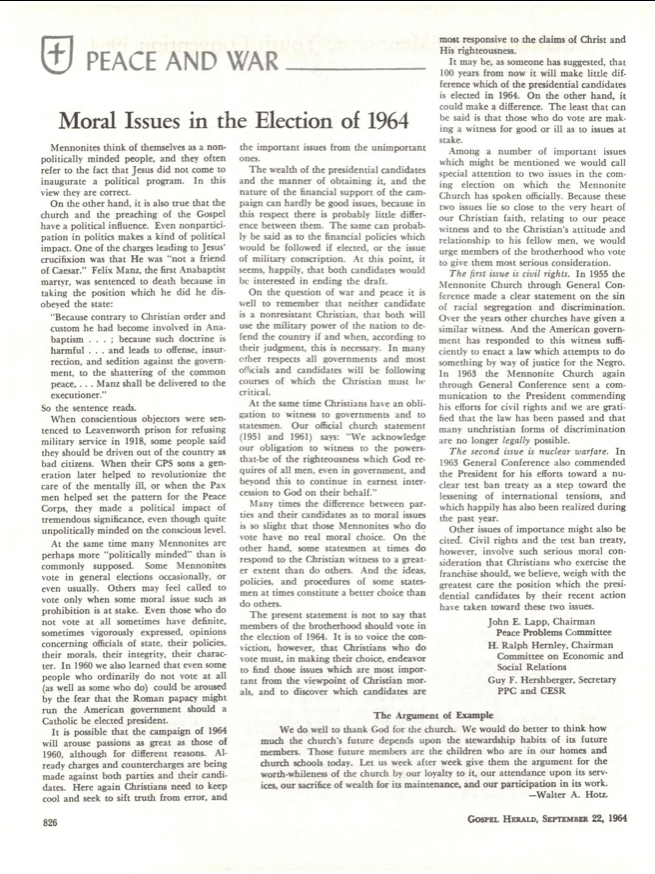
The resultant statement, “Moral Issues in the Election of 1964,” which appeared in the Gospel Herald on September 22, reflected the moderate consensus. The three authors—Lapp, Chairman of the PPC, Hernley, Chairman of the CESR, and Hershberger, Secretary of both committees—made no mention of Johnson or Goldwater or the Democratic or Republican parties in explicit terms, but rather “the candidates” and “the coming election.” In line with official church doctrine, these leaders left the questions of voting and political participationup to the individual and chose to focus entirely on issues of the election and Christian conscience: “The present statement is not to say that members of the brotherhood should vote in the election of 1964. It is to voice the conviction, however, that Christians who do vote must, in making their choice, endeavor to find those issues which are most important from the viewpoint of Christian morals, and to discover which candidates are most responsive to the claim of Christ and His righteousness.” This choice, in the eyes of the authors, was clear enough, considering that the issues of civil rights and nuclear warfare deserved “most serious consideration,” briefly citing previous church action on these issues. Far from the explicitly partisan statement Burkholder wanted, these issue-based suggestions for voting Mennonites reflected the MC leadership’s political limits.6
“Moral Issues in the Election of 1964,” Gospel Herald, September 22, 1964
However carefully Hershberger and the other authors may have tread, readers had no trouble “read[ing] between the lines,” as one Elkhart Mennonite opined. “It seems the Peace Problems Committee might just as well have come out in the open, and endorsed the one party.” Bill Sauder penned an even more blunt criticism and missed (or ignored) the nuance entirely: “I find distressing the committee’s statement. . . in which they advise Mennonite church members to vote for the Johnson-Humphrey presidential ticket if they vote at all.”In the weeks between the publication of “Moral Issues in the Election of 1964” on September 22 and Election Day on November 3, fourteen Mennonites (a remarkably large number of respondents to a single topic) wrote to the Gospel Herald to weigh in, expressing everything from extreme gratitude and support to dismay and harsh opposition.7
Facing this gambit of responses, John M. Drescher, editor of the Gospel Herald, grappled with how to present these issues to the Mennonite community. In a private letter to Guy F. Hershberger the week after “Moral Issues” was published, Drescher wrestled with the paradox of neutrality created in this contested theological and political space. Politically, some urged him to remain neutral and give equal coverage of all political and theological positions. In contrast, others demanded that he publicize whom he is supporting in the current election. On the theological axis, Drescher faced pressure to stay entirely out of politics by some and wholeheartedly enter into the political fray by others. These pressures, Drescher lamented, had been “heavy and hard” from all sides during this particular election season. Privately, while Drescher watched the political proceedings with great interest, he felt “that every election is basically the same” and was not particularly excited about either ticket. However, as the editor of the denominational organ, he strove to avoid partisanship and only discuss political issues when clearly “in the light of Scripture.”8
Even this distinction, though, was a bridge too far for several readers, who wrote in lamenting the publication of politically-focused material: “I would much rather read my political speeches in a public newspaper than to read it in what is supposed to be a church paper covering the religious aspects instead of the political.” Wilbur M. Wyse strongly advocated for an entirely non-political Gospel Herald, but he nevertheless held his own strong political opinions: “The thing that alarms me most is that so many of our Mennonite professors from our church colleges lean so strongly toward the Socialistic Party, or the Democratic Party, if you want to call it thus. . . .” (ellipsis in original). Indeed, most of the condemnation of Drescher’s handling of the organ came from political conservatives who desired more balanced coverage of the candidates and the issues. Concerning church involvement in politics, theological conservatism went hand in hand with political conservatism, while theologically liberal Mennonites (that is, those who advocated political action within the church) represented all angles of the political spectrum. It stands to reason, however, that those most likely to comment at length on the political issues covered in the Gospel Herald would be the most politically informed, while the non-participatory Mennonites would remain quiescent.9
Several weeks after the publication of “Moral Issues in the Election of 1964” and amid the ongoing debate in “Our Readers Say,” the Gospel Herald ran Paul Peachey’s “Faith, Fear, and the 1964 Elections.” Peachey, Secretary of the Church Peace Mission in Washington, D.C., and a former professor of sociology and church history at Eastern Mennonite College, took aim at the Goldwater platform but did so from an entirely different position than those that preceded him. In Peachey’s view, the rise of “New Republican Radicals,” led by Goldwater, the John Birch Society, and the Minutemen, was a reactionary movement to the “shattering” of the illusion of religiously-founded American exceptionalism brought on by the Civil Rights Movement and the Cold War. “The notion that America was. . . endowed with a kind of redemptive mission in the world, was clearly a distortion of the “chosen people” theme of the Bible,” from which Americans have incorrectly and dangerously viewed their “wars as righteous and holy.” His main concern was with this emergent radical faction that was gaining a strong influence over the traditional political left. Goldwater, Peachey argued, “posed a real peril to Christian faith.” Standing “firm in faith, [and] in witness and obedience in the face of communist evils” is one thing, he wrote, but it another thing entirely to follow Goldwater and “shoot the men who we think are disobeying God.” Thus, Peachey’s aim was not to condemn “the Republican party as such,” nor to endorse “the Democratic platform,” but rather to warn his fellow Mennonites of the dangers of Goldwater and “the Republican platform of 1964,” for its dangerous “idolatrous nationalism which seeks to play God among the nations of the world.” With this line of argumentation, he further blurred the distinction between the political, the religious, and the relationship between the two in the pages of the Gospel Herald.
Upon entering this discourse, Peachey received several statements of support in “Our Readers Say,” but also drew the same criticisms that Hershberger and his colleagues did: he was too partisan and too political in the public space of the Gospel Herald. Curiously, however, the center of the conversation remained centered around “Moral Issues” and seemed somewhat unaffected by Peachey’s bold article. Perhaps the most striking reaction to Peachey’s article came from Isaac Hershey, Jr.: “If Bro. Peachey is truly an alien here, he will not vote and aliens should not criticize the government under which he has permission to live. . . I count it a privilege to vote for Mr. Goldwater.”10
The final full-length article to address the presidential race appeared in the Gospel Herald on November 3, election day, and was written by none other than J. Lawrence Burkholder. Occasioned by a summer of political discussions in his home church, the Mennonite Church of Boston, and perhaps displeased with the direction the CESR and PPC took his suggestion that June, “A Congregational Discussion of Political Decisions” laid out the views of Burkholder and his fellow Boston Mennonites on the church’s responsibility in American politics and society. After prayerful study of the Bible, sermons, and campaign issues, these Mennonites agreed that political issues are indeed the church’s concern. As such, congregations and individuals should discuss the positions and qualifications of specific parties and candidates. They agreed with the reasoning of Hershberger, Hernley, and Landis, that the church should help its members face political issues and decisions “in the light of the Christian faith,” but pushed even further: “Moreover, when the church, through corporate effort, has reached a consensus on a political matter, it cannot remain silent, but must give witness to its decisions.” While they noted “the civil rights problem” and America’s global “responsibility” as the two most important political issues that confronted Christians, Burkholder made no mention of Goldwater or the Republican Party as he was so keen to do that summer. Published on election day, however, this cry for political discourse and participation in the life of the church took a forward-looking position that stressed the constant importance of political witness.
Alongside this statement from Boston Mennonites, Drescher gave considerable attention to lay voices in the November 3 issue, publishing ten politically-oriented letters in the “Our Readers Say” column. Here, as in previous publications, ordinary Mennonites issued their support or condemnation for “Moral Issues” and “Faith, Fear, and the 1964 Election” on theological and political grounds. In nearly every instance, readers demonstrated that they were acutely aware of the political issues at play and had formed developed personal opinions. Moreover, many folks grounded their political stance in their conception of Christian morality. In other words, they had done—and had been doing—what Hershberger and his colleagues were calling them to do. Ironically, and much to these leaders’ chagrin, most of these laypeople supported Goldwater and thus chastised “Moral Issues” whole cloth for its thinly-veiled liberalism.
Perhaps most demonstrative of this pattern is Maurice W. Landis. This Lancaster Mennonite expressed his gratitude to the authors of the September 22 article, complimenting them on “rightly alert[ing] us to the fact that there are unprecedented moral issues in the 1964 election.” Deftly, however, he flipped the statement on its head and wrote an extensive analysis of political issues in light of Christian morals that led to the support of Senator Goldwater’s conservative platform. He implored readers to evaluate each candidate on the moral issues that Hershberger’s statement failed to address, including where the candidates stood on “compromising with the enemies of God” and recognizing God and permitting the Bible to be read in schools,” as well as supporting “free enterprise as taught in the Bible.” Landis demonstrated his keen interest in the nuances of domestic and foreign politics and articulated them in terms of his own view of Christian morality. He was not alone in his views either; several other faith-conscious and politically-conscious Mennonites wrote in voicing their economic concerns and the importance of school prayer. Joni D. Yoder went so far as to say that “as far as a moral issue is concerned and as far as putting souls at stake, such things as the Supreme Court ruling against prayer in public schools. . . far outweigh[s] an issue of fear of nuclear weapons.” The efforts of Landis and his right-leaning brothers and sisters to sway fellow Mennonite voters underscores the fact that political participation based on Christian morality was not entirely a liberal movement, but a pattern that emerged on both sides of the political spectrum during this era. Moreover, the “old” Mennonite leaders’ decision to counsel their members on moral issues rather than specific candidates and parties opened the door for their original intent to be turned against them. As we have seen, though, this was a double-edged sword; their moderate position and vague language were still too radical for many conservatives.11
After the Johnson victory on election day, political discourse in the Gospel Herald fell silent. As the dust settled from these debates about the role of the church in political participation and discourse, it appeared that few minds had been changed. In one sense, the leaders and laity of the “old” Mennonite Church were still working through the thorny question of does our faith lead us to participate in politics? As the Gospel Herald‘s active readership demonstrated, however, the new issue of how faith directed political opinion and participation had emerged as an intricate and divisive issue for the church and its members. The fact that these two questions were inextricably linked and progressing at different speeds and in different directions throughout church adds to the layered complexity of this election-season eruption. Although these issues were in no way resolved, the fall issues of the Gospel Herald powerfully demonstrated that the age of public quietism was waning and that political discourse and participation was very much alive among Mennonites.
1. Mennonite Church USA, “MC USA Congregations Prepare for Bold Peacemaking Amid Election,” Anabaptist World, November 2, 2020, https://anabaptistworld.org/mc-usa-congregations-prepare-for-bold-peacemaking-amid-election/. For the theological, social, and political changes during the middle decades of the twentieth century and the specific impact of the Civil Rights Movement, see Perry Bush, Two Kingdoms, Two Loyalties: Mennonite Pacifism in Modern America (Baltimore, MD: Johns Hopkins University Press, 1998); Leo Driedger and Donald B. Kraybill, Mennonite Peacemaking: From Quietism to Activism (Scottdale, PA: Herald Press, 1994); Tobin Miller Shearer, Daily Demonstrators: The Civil Rights Movement in Mennonite Homes and Sanctuaries (Baltimore, MD: Johns Hopkins University Press, 2011).
2. J. Lawrence Burkholder to Guy F. Hershberger, June 22, 1964, Guy F. Hershberger Collection, 1896-1989, MS 1-171, b. 21, f. 20, Mennonite Historical Library. The entire committee correspondence regarding Burkholder’s proposal is in this folder, hereafter referred to as GFH.
3. Peace Problems Committee, “A Statement by the Peace Problems Committee Concerning Involvement in the Religious Issue of the Current Presidential Election Campaign,” Gospel Herald, October 11, 1960, 890.
4. Carl Kreider to Guy F. Hershberger, August 12, 1964, GFH; John E. Lapp to Guy F. Hershberger, July 23, 1964, GFH; Guy F. Hershberger to Members of the Committee on Economic and Social Relations, July 10, 1964, GFH.
5. Orie O. Miller to Guy F. Hershberger, July 27, 1964, GFH. Some members of the CESR and PPC found precedent in the communications sent from the “old” Mennonite General Conference to President Kennedy, enough so to cite them in the statement they produced: John E. Lapp, H. Ralph Hernley, and Guy F. Hershberger, “Moral Issues in the Election of 1964,” Gospel Herald, September 22, 1964, 826. For a copy of the telegram commending Kennedy for signing the nuclear test ban treaty and expressing the church’s support of the administration’s position on civil rights and racial justice, see Arnold Cressman, “General Conference Meets at Kalona,” Gospel Herald, September 3, 1963, 787. Also, see Mennonite General Conference, “The Way of Christian Love in Race Relations” (Hesston, KS: Mennonite General Conference, 1955).
6. Lapp, Hernley, and Hershberger, “Moral Issues in the Election of 1964,” 826.
7. Harold S. Alexander, “Our Readers Say,” Gospel Herald, October 27, 1964, 942; Bill Sauder, “Our Readers Say,” Gospel Herald, November 3, 1964, 965.
8. John M. Drescher to Guy F. Hershberger, September 29, 1964, Guy F. Hershberger Collection, 1896-1989, MS 1-171, b. 21, f. 21, Mennonite Historical Library, Goshen, IN.
9. Wilbur M. Wyse, “Our Readers Say,” Gospel Herald, November 3, 1964, 965.
10. Isaac Hershey, Jr., “Our Readers Say,” Gospel Herald, November 3, 1964, 965. For other reactions to “Faith, Fear, and the 1964 Election, see Wyse; Allan Eitzen, “Our Readers Say,” Gospel Herald, November 3, 1964, 965.
11. Maurice W. Landis, “Our Readers Say,” Gospel Herald, November 3, 1964, 966; Joni D. Yoder, “Our Readers Say,” Gospel Herald, October 6, 1964, 860.
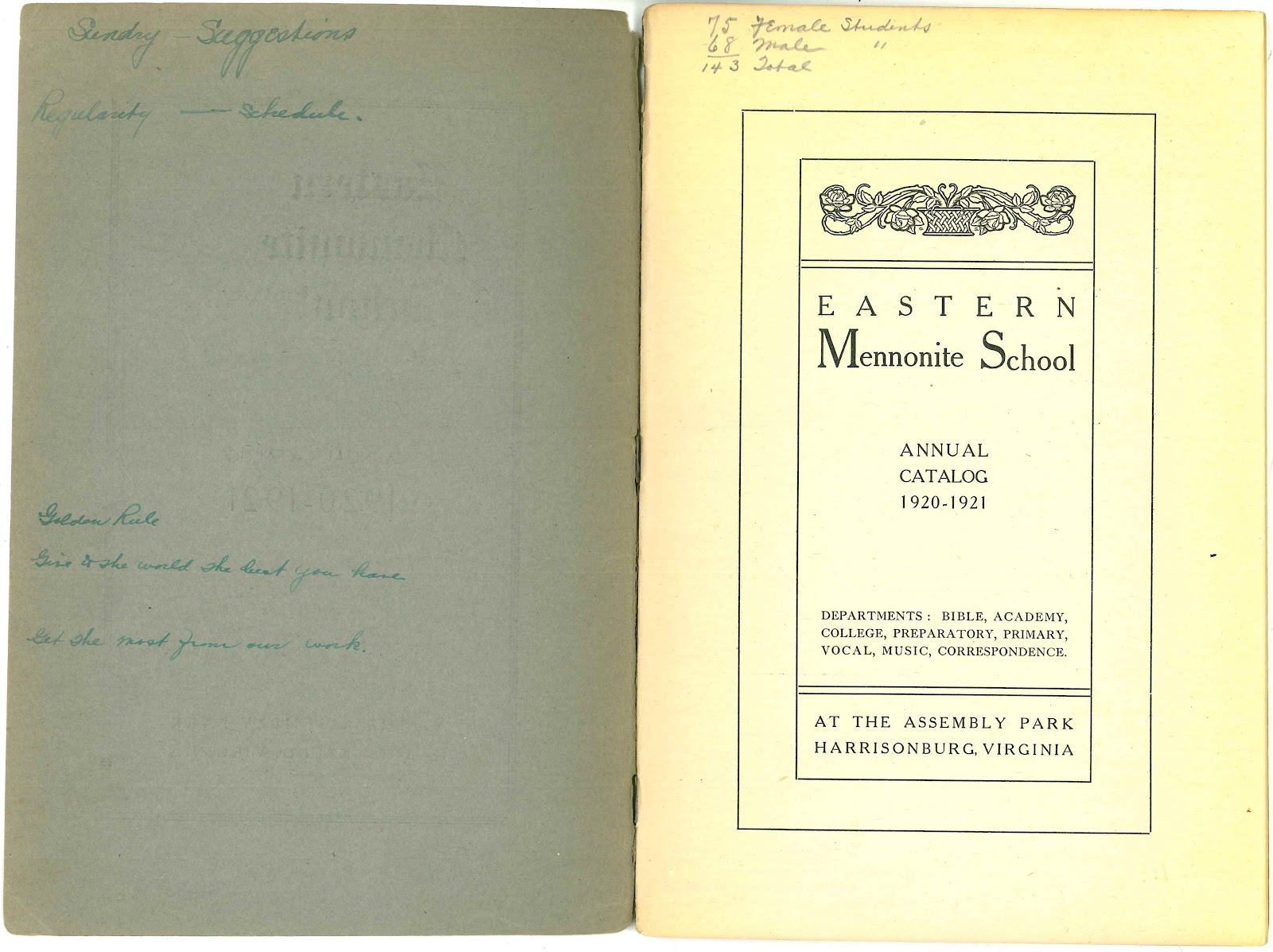
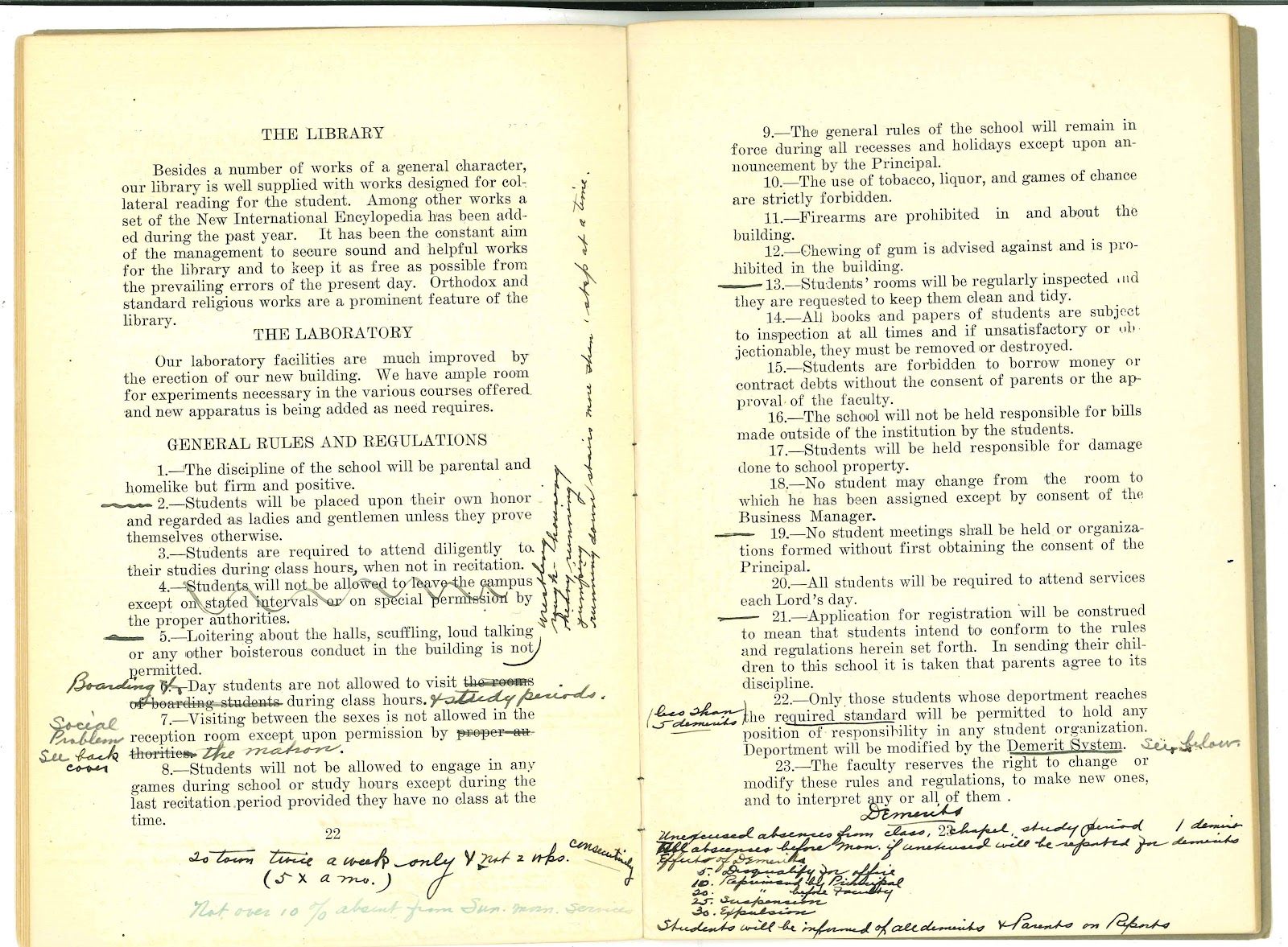
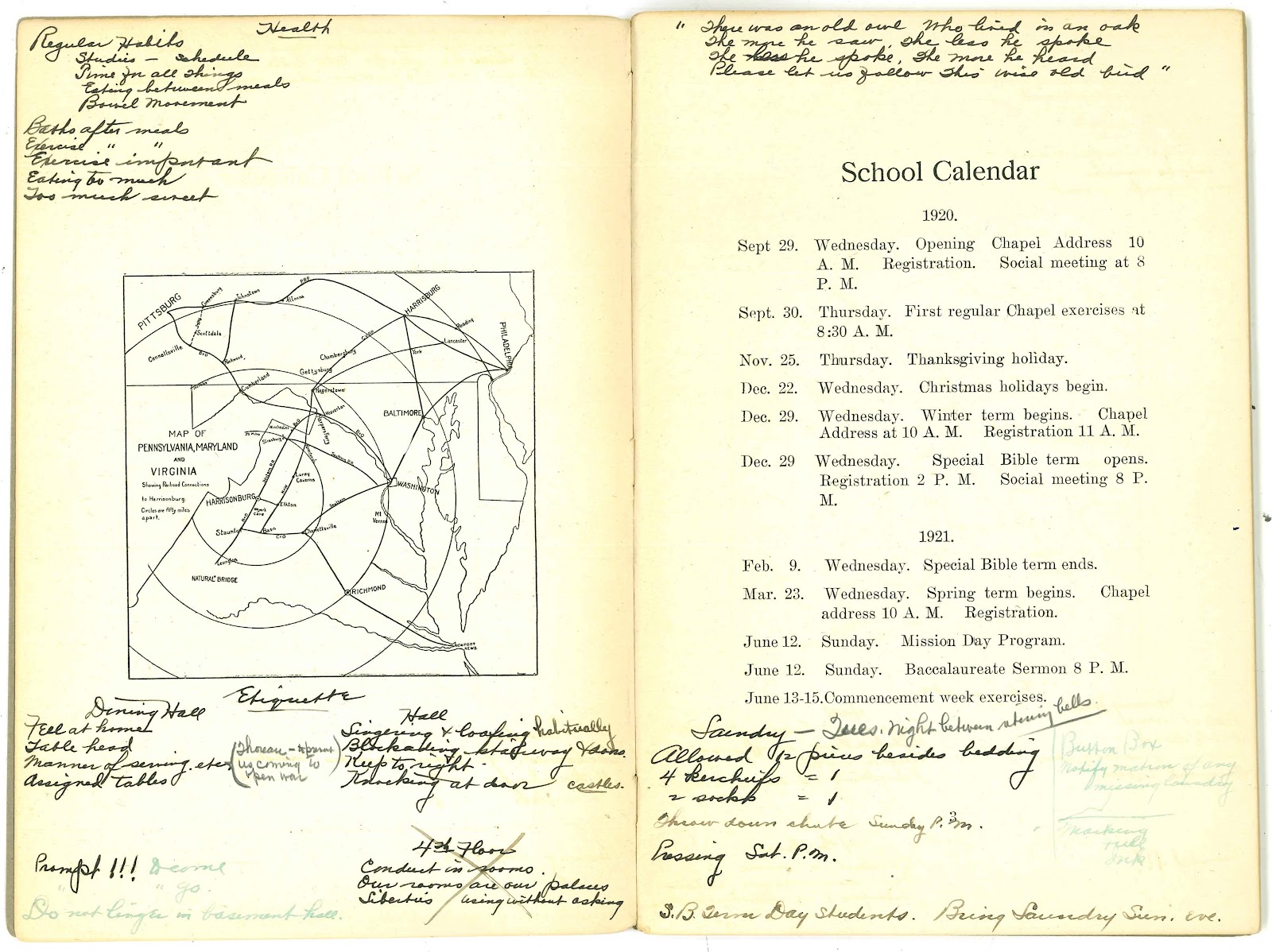
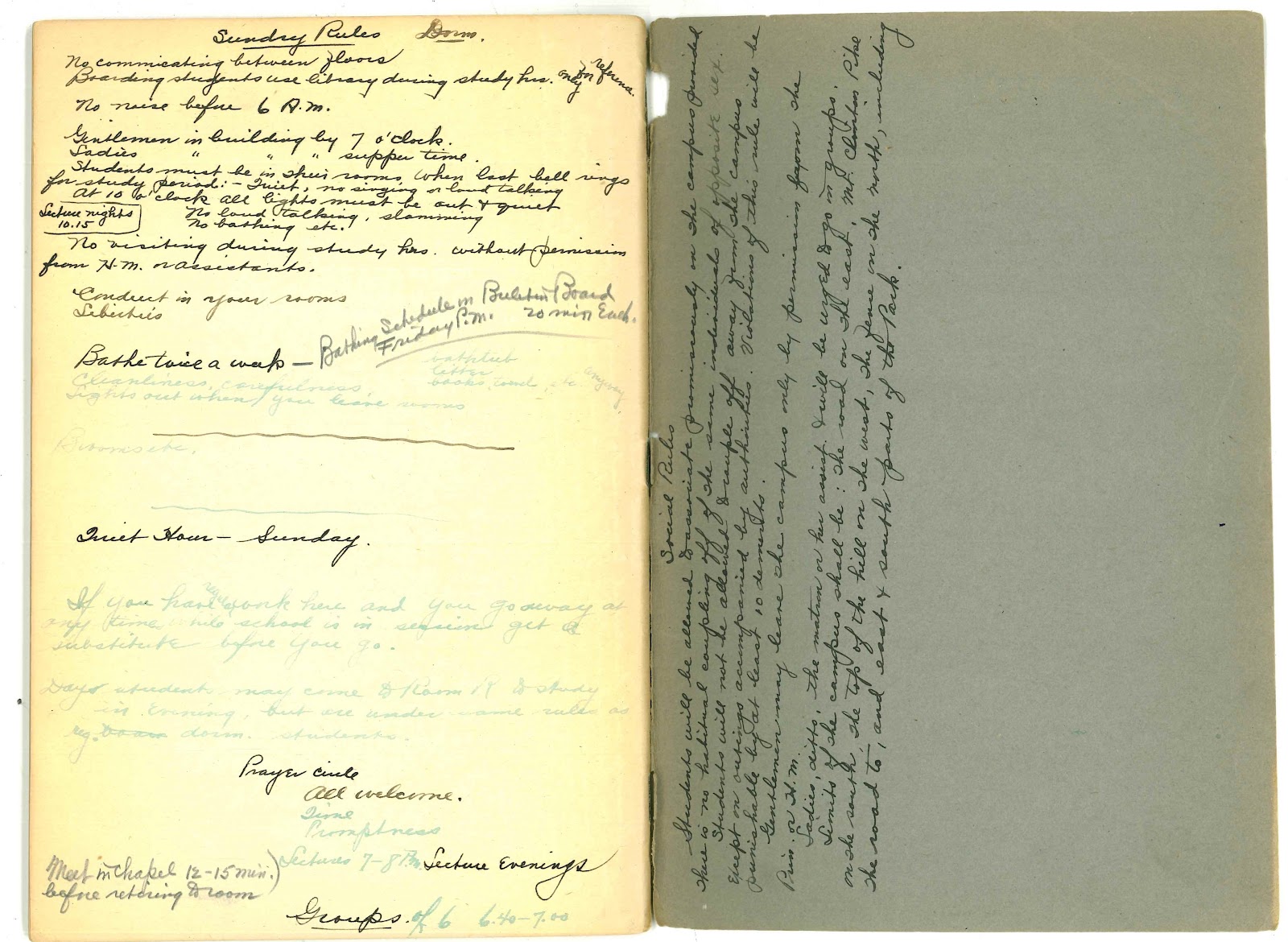
While processing a recent box of donations, I happened upon an Annual Catalog from the 1920-21 school year at Eastern Mennonite School. As I leafed through it, I found handwriting all throughout the margins. There is no name on the catalog, so it could have been a student eager to remember all the rules or a member of the faculty or staff taking notes so they knew how to guide their pupils. Either way, these notes provide a revealing look at the minutiae of life at EMS a century ago.
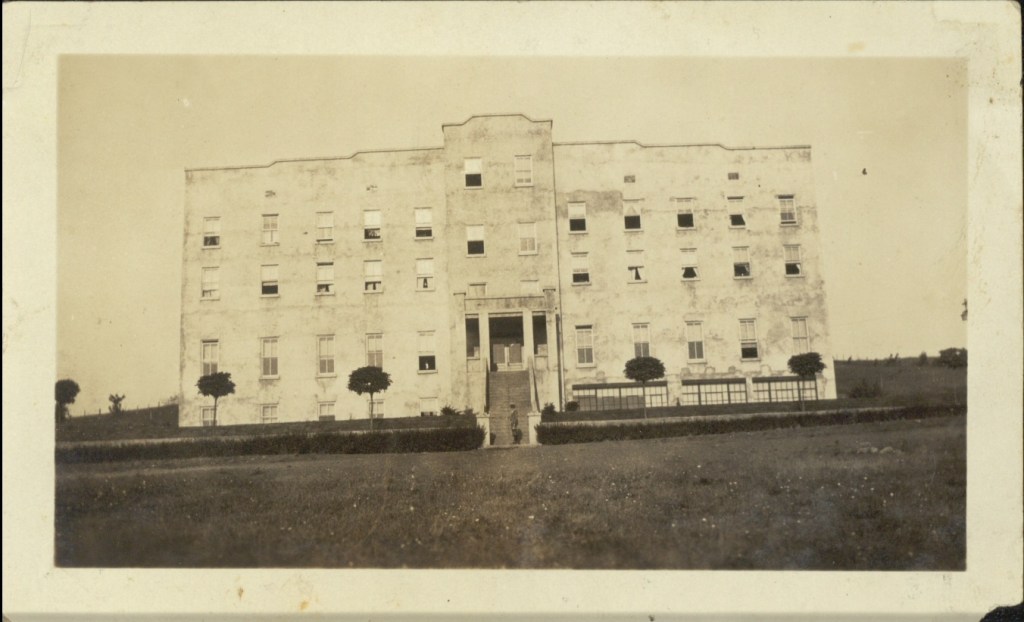
EMS was in its fourth year in 1920-21 and the fledgling school was finding its wings. In January of 1920, students and faculty moved up the hill from the White House in Park Woods to the newly built Administration Building. As the only building on campus, it was the focus of campus life. Students studied and lived all together under one roof. Enrollment was 216, nearly triple the first year’s enrollment of 77.1
EMS Administration Building
The rules were numerous at EMS in 1920-21, so our scribe was savvy to take notes. The first rule under, “General Rules and Regulations” sets the tone, stating that, “The discipline of the school will be parental and homelike but firm and positive.” The rest of the 23 rules and regulations cover behavioral expectations both in and out of the classroom.2 EMS sought to educate young people to become good workers for the Mennonite church, and their rules were meant to keep students in good standing with the school, the church, and their fellow students. The “Discipline and Decorum” section states that “for a denomination to maintain and perpetuate doctrines which are unpopular and the observance of which call for self-denial and non-conformity to the world, she must exercise a rigid and judicious discipline.” and “It should not be considered that obedience and submission to wholesome discipline and authority militates against the happiness of man, or that it infringes upon his real liberty”3. Following the rules was required to maintain the harmony of community at EMS and foster an environment where learning was possible.
Here is a sampling of what was noted in the catalog:
On curfews and timeliness:
“Gentleman in the building by 7 o’clock. Ladies in the building by supper time.”
“Prompt to come, prompt to go. Do not linger in basement hall.”
In the halls, one must not linger or loaf habitually or blockade the stairway and doors.
“Students must be in their rooms when last bell rings for study period. At 10 o’clock all lights must be out and quiet”
“No noise before 6 A.M.”
On relationships:
“Students will be allowed to associate on the campus provided there is no habitual coupling off of the same individuals of opposite sex”
“Students will not be allowed to couple off away from the campus except on outings accompanied by authorities. Violations of this rule will be punishable by at least 10 demerits.”
“No visiting during study hrs. without permission from H.M. or assistants”
On personal health:
“Bathe twice a week–bathing schedule on bulletin board Friday P.M. 20 minutes each”
“Have a study schedule, refrain from eating between meals, exercise regularly, and avoid too much sweet.”
Failure to follow these rules, along with other infringements like unexcused absences could result in a demerit. The writer notes that five demerits disqualify someone from office (for school clubs or literary societies), 10 earn a reprimand from the principal, 20 a reprimand before the faculty, 25 suspension and 30 expulsion.
There was at least one perk of 1920 EMS–someone else does your laundry! The scribe writes that students were allowed 12 pieces besides bedding and were to throw their items down the chute Sunday afternoon.
Though the above rules have gone, the 2020-21 school year at EMU has seen a new crop of regulations–this time for the physical health of all on campus and in the wider community. Due to the COVID-19 pandemic, students must do their best to observe social distancing, mask wearing, and there are limits on the dining hall, athletic spectators at games, and gathering size. Following the rules is yet again required to maintain the harmony of community and to foster an environment where learning was possible. Though the methods and reasoning look different a century on, I believe the hoped for outcome is the same: a conscientious and caring community that prepares students to make a difference in the world.
1. Kraybill, Donald B. Eastern Mennonite University: a Century of Countercultural Education. University Park, PA: The Pennsylvania State University Press, 2017. p. 343.
2. Eastern Mennonite School. Annual Catalog 1920-21. p. 22-23.

 Anabaptist Historians