Stories “Worth Writing and Reading About”*: Thoughts of an Anabaptist Biographer

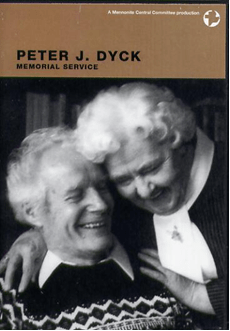
My little granddaughters love stories. A favourite is “Our Lives Together.” These excerpts from the reel-to-reel films that their great-grandfather Peter Dyck took on his movie camera, memorialize the work that he and his wife Elfrieda Klassen Dyck shared as Mennonite Central Committee volunteers in post-war England.1 Mennonite Central Committee has thrived during its one hundred-year history by virtue of such stories that North American workers have told about their experiences in the some sixty countries where they have served.

As Anabaptist historians, our mission is not so much to tell our own stories; we focus on people from the past. Biographers preserve the memory of individuals whose lives have the capacity to inspire.2 Although some do “quite explicitly” weave their “own lives into discussion of others,” the historical profession encourages us to keep a distance, to maintain objectivity.3 Historians tell the stories of individuals whose lives have made a difference in the public domain – leaders and institution builders, people who have left documents allowing their contributions to be tracked. Take for instance, GAMEO (Global Anabaptist Mennonite Encyclopedia On-line).4 Brief articles provide glimpses into the lives of hundreds of men and women who are deemed to have made significant contributions to the church. Carefully contained within the interpretative framework designed by GAMEO’s management team allows for what Leon Edel, well-known as the doyen of biography, has described as “a successful biography,” one that keeps the focus on public life and institutions.5 The GAMEO format allows the biographer to disengage and write the life of another with detachment.6

The traditional view has been challenged and expanded by what biographer Barbara Caine labels as a “new biography.” In contrast to Edel, with his formula for the “successful biography,” feminist methodology allows for questions that are “more personal and impressionistic.”7 Acknowledging that “potentially all lives are of interest and worth writing and reading about,” greater fluidity opens the way to consider the struggles that individuals have faced.8 This expanded biographical approach has demonstrated that “the extent to which one individual shares experiences and problems with others,” is often what makes a life worth remembering.9

Feminist theory and social historical methodology have shaped my own writing of biography. The permission that these disciplines allow to explore little known lives, “reading between the lines,” to use Betty Jane Wylie’s words, inspires my inner detective.10 In my life as a historian, I have found meaning in searching out and writing the lives of individuals, most previously virtually unknown.11
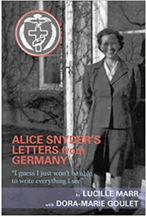
Take, for instance, my biographical work on Alice Snyder (1917 – 2000). Searching out the story of this long-time MCC worker began as I researched the history of MCC Ontario for what would be published as Transformation of a Century. Alice Snyder’s work in the MCC Ontario Cutting Room, with her mother Ida Snyder, turned out to be foundational to MCC’s work during World War II.12 After the war, Alice would take on the challenge of volunteering in post-construction Germany. Although Alice’s schooling had ended with grade eight, her letters home from Europe proved to be a historical document worth publishing.13

Scholars have noted the significant place that letter writing has played in nurturing family ties in times of separation.14 Alice’s letters had done exactly that. Perhaps “the secret bestower of possibility” that had eluded her in her own life, Alice’s mother Ida preserved her daughter’s letters from Germany in a small black binder.15 Alice’s letters home provide insights into what a young Waterloo County Mennonite woman, with a mere grade eight education, deemed worthy of preserving and sharing with her family from her work with MCC. With their ultimate destination in the Mennonite Archives of Ontario, they also have bestowed possibility for later generations. Indeed, Alice’s letters inspired at least one of my research assistants on the letters project to do her own stint overseas in voluntary service.16

Griffen has noted the traditional wisdom “that every woman is her mother.” As much as her suggestion that “it may be that every woman of achievement is, in part, paying a debt to the past, bringing to fulfillment her mother’s dreams and potential,” reflects the mission of Ida and Alice Snyder, it resonates with the life and mission of Lucille Brechbill Lady (1910 – 1968).17 With her mental health challenges, Lucille Lady was remembered in the public record solely as a burden to her husband Jesse Lady, a prominent Brethren in Christ church leader.18 As I explored the hidden recesses of the historical record to bring her story to light, writing became a path to healing.19
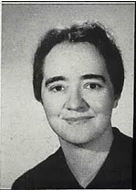
In recent times biographers have become more open to exposing the personal challenges and difficulties of their subjects. With this biographical project, the burden of my great-aunt’s suicide that I felt as one carrying her name, miraculously, was lifted. Travels to California, Indiana, and Pennsylvania, places where she and her husband had lived and ministered, brought opportunities to interview people who had been close to her, some also still suffering from the aftermath of her suicide.

Out of these connections materialized documentary evidence, including family letters, her Bible, her wedding certificate, school yearbooks, and even a tape recording of her funeral.20 For the biographer, a fertile imagination is a strong asset.21 A decade of research, slowly put the pieces of the puzzle in place, creating a picture of a life well worth remembering – an intelligent, caring nurse, teacher and writer, a woman who was a devout Christian and church woman, a mystic, and a devoted wife, aunt, sister, sister-in-law, daughter and friend.22

Griffen’s notion of paying a debt to the past also speaks to my current biographical work on H. Frances Davidson.23 In the mid-1970s, when Morris Sider memorialized this icon well-known among Brethren in Christ and Mennonites, especially in Zambia and Zimbabwe where she lived out her long missionary career, I was a young woman seeking a script to follow.24 In feminist historian Gerda Lerner’s words, as women growing up in the post-war years we were still “denied the power to define, to share in creating the mental constructs that explain and order the world.”25 I was among those looking for role models, “an idealized maternal figure,” as Caine has put it.26

Now nearly fifty years later, my inner detective continues to delight in the search for past lives. This work is delicate.27 And yet, it is important work as we attempt to pay back some of the debt owed to our foremothers, women like H. Frances Davidson who struggled to find their way without scripts to follow. As Morris Sider has noted, subjects like Davidson who left ample documentary evidence are dear to the hearts of historians.28 The multiple primary documents that she left – her diaries, a travelogue, letters to family, photos, and writing for the Evangelical Visitor await further exploration.

H. Frances Davidson, whom biographer Morris Sider has identified as a “woman with great stores of energy … one of the most extraordinary and striking persons to have held membership” in the Brethren in Christ denomination,” has become a symbol for female leadership among the membership, both in North America and in Africa. She was also a woman with a rich inner life.29 With the tools of the social historian and feminist methodology, it is possible to ask and explore questions about her family, her education, the geographic and social context of her life and work. In addition, as other feminist scholars have observed, the exploration of women’s inner lives, their spirituality, is essential as we continue to create scripts to follow.30 In my role as Anabaptist historian I am anticipating many more challenges and joys as I continue to explore the reality and constraints of this nineteenth-century Brethren in Christ woman’s life.


* Barbara Caine. Biography and History (New York: Palgrave MacMillan, a division of St. Martin’s Press, 2010), 71.

1 “Peter J. Dyck, Memorial Service,” https://www.commonword.ca/ResourceView/82/12983 Accessed February 4, 2021

2 On the moral benefits of biography, see Caine, Biography and History, 31.

3 Caine. Biography and History, 71.

4 GAMEO was created by Canadian Mennonite historians to preserve data collected in the mid-1980s by researcher Marlene Epp, (now Professor of History and Peace and Conflict Studies at Conrad Grebel University College in Waterloo), originally intended for a third volume of her father Frank H. Epp’s history of Mennonites in Canada; Samuel J. Steiner, “Global Anabaptist Mennonite Encyclopedia Online (Website),” Global Anabaptist Mennonite Encyclopedia Online. June 2017. Web. 2 Feb 2021. https://gameo.org/index.php?title=Global_Anabaptist_Mennonite_Encyclopedia_Online_(Website)&oldid=164961

5 In Biography and History, 71-72, 88, Caine references Leon Edel. See, for instance, his Writing Lives: Principia Biographica (New York and London: Norton, 1984) and “Confessions of a Biographer,” in George Moraitis and George Pollack (ed), Psycholanalytic Studies of Biography (Madison, WI: International Universities Press, 1987): 3-29.

6 I have found it inspiring to prepare the following biographies for GAMEO: “Nighswander, Joseph Martin (1923-2006),” Global Anabaptist Mennonite Encyclopedia Online (March 2017) Web. 17 Apr 2017 http://gameo.org/index.php?title=Nighswander,_Joseph_Martin_(1923-2006)&oldid=147448; Sherk, J. Harold, Global Anabaptist Mennonite Encyclopedia Online (July 2013) http://gameo.org/index.php?title=Sherk,_J._Harold_(1903-1974)&oldid=100074; “Nigh, Ross Edward (1917-2001),” Global Anabaptist Mennonite Encyclopedia Online (November 2012) Web (17 Apr 2017) http://gameo.org/index.php?title=Nigh,_Ross_Edward_(1917-2001)&oldid=95956; Snyder, Alice (1917-2000)” Global Anabaptist Mennonite Encyclopedia Online (March 2011) Web. 04 November 2011. http://www.gameo.org/encyclopedia/contents/snyder_alice_1917_2000; “Taves, Harvey W. (1926-1965),” Global Anabaptist Mennonite Encyclopedia Online (July 2009) Web. 04 November 2011. http://www.gameo.org/encyclopedia/contents/taves_harvey_w._1926_1965.

7 Caine, Biography and History, 88-89; In Writing a Woman’s Life (New York: Ballantine Books, 1988), Carolyn Heilbrun paved the way for feminist biographers with her call for a new interpretative framework.

8 Caine, Biography and History, 111.

9 Caine, Biography and History, 67.

10 Reading Between the Lines: The Diaries of Women (Toronto: Key Porter Books, 1995); Caine, History and Biography, 111.

11 One of my recent posts on Anabaptist Historians illustrates. “Making meaning when the historical record is silent,” https://anabaptisthistorians.org/2020/11/07/making-meaning-when-the-historical-record-is-silent/ Accessed February 10, 2021. See also my biographies listed as follows: “Henry B and Frances (Fannie) Rice Davidson: Life and Vision,” Brethren in Christ History & Life, Volume XLI, no. 2 (August 2018): 115-54; “Conflict, Confession and Conversion: H. Frances Davidson’s Call to Brethren in Christ Mission,” Brethren in Christ History & Life XI, No. 3 (December 2017): 335-52; “Jane Drummond Redpath,” in Still Voices, Still Heard, Sermons, Addresses, Letters, and Reports The Presbyterian College, Montreal, 1865-2015, edited by J.S.S. Armour, Judith A. Kashul, William Klempa, Lucille Marr, and Dan Shute (Eugene, OR: Wipf & Stock, 2015); “Writing a Woman’s Life: Lucille Brechbill Lady, 1910 – 1968,” Brethren in Christ History and Life 33.1 (2010): 3-50; the author with Dora-Marie Goulet, “I guess I won’t be able to write everything I see …”: Alice Snyder’s Letters Home, 1948-1950 (Waterloo, ON: Pandora Press, 2009); “Ontario’s Conference of Historic Peace Church Families and the ‘Joy of Service’,” Mennonite Quarterly Review 19 (2001): 257-72; “Naming Valiant Women: Biographical Sketches of Three Women in the Canadian Methodist Tradition.” Consensus: A Canadian Lutheran Journal of Theology 20.2 (1994): 35-56; “If you want peace, prepare for peace”: Hanna Newcombe, Peace Researcher and Peace Activist.” Ontario History 84.4 (1992): 263-282.

12 Transforming Power of a Century: The evolution of Mennonite Central Committee in Ontario (Waterloo, ON: Pandora Press, 2003).

13 “I guess I won’t be able to write everything I see …”. As noted earlier, she also became the subject of a GAMEO article.

14 See for instance, Susan J. Rosowski, Birthing a Nation: Gender, Creativity, and the West in American Literature (Lincoln, Nebraska: University of Nebraska Press, 1999), 36.

15 On the role of mother as model, please see Heilbrun, Women’s lives: the view from the threshold (Toronto: University of Toronto Press, 1999), 52-53; Gail B. Griffen, Emancipated Spirits: Portraits of Kalamazoo College Women (Kalamazoo, Michigan : Ihling Bros. Everard Co., 1983, 1990), xii.

16 See “A Biographical Sketch,” 11-21, in “I guess I won’t be able to write everything I see ….”

17 The photo’s source is “U.S., School Yearbooks, 1880-2012”; School Name: Beulah College; Year: 1949; Ancestry.com. U.S., School Yearbooks, 1900-1999 [database on-line]. Lehi, UT, USA: Ancestry.com Operations, Inc., 2010. Accessed 8 February 2021.

18 Samuel Lady, “Jesse F. Lady ‘A Loyal Churchman in a Time of Transition’,” Brethren in Christ History and Life (April 1995): 3-41.

19 Please see Louise DeSalvo, Writing as a Way of Healing: How Telling Our Stories Transforms Our Lives (Beacon Press, 2000).

20 Please see also the author, “Breaking the Silence on Suicide and Mental Illness: The Brethren in Christ, 1968-1989,” Journal of Mennonite Studies 29 (2011), 121-32.

21 Caine, History and Biography, 114-15.

22 The author, “Writing a Woman’s Life: Lucille Brechbill Lady.”

23 See, for instance,” Mysticism and Evangelicalism in the Writings of a Spiritual Mothers,” Anabaptist Historians, https://anabaptisthistorians.org/2020/01/28/mysticism-and-evangelicalism-in-the-writings-of-a-spiritual-mother/ Accessed February 10, 2021; “Conflict, Confession and Conversion.”

24 “Hannah Frances Davidson,” in Nine Portraits: Brethren in Christ Biographical Sketches (Nappanee, Ind.: Evangel Press, 1978), 159 – 214; Sider, E. Morris. “Davidson, Hannah Frances (1860-1935).” Global Anabaptist Mennonite Encyclopedia Online. 1988. Web. 8 Feb 2021. https://gameo.org/index.php?title=Davidson,_Hannah_Frances_(1860-1935)&oldid=122476.

25 Gerda Lerner, Why History Matters: Life and Thought (NY: Oxford University Press, 1997), 207.

26 Caine, History and Biography, 72.

27 Biographers warn the would-be biographer about the pitfalls as one attempts to interpret the life of another. See, for instance, Sider, “Finding Vocation,” 15; Griffen, introduction to Emancipated Spirits, xi; and Caine, History and Biography, 72.

28 Sider, Nine Portraits, 9; See also his “Finding Vocation and Mission: Reflections on Writing Brethren in Christ History,” Brethren in Christ History and Life. Vol. XLIII, no. 1 (April 2020), 9; In an email exchange with the author, Sider encouraged further research on Davidson; Sider to Marr, 12 December 2012; see also Wylie, Reading Between the Lines, 224.

29 Sider, Nine Portraits, 159.

30 See for instance, Gerda Lerner, The Creation of Feminist Consciousness: From the Middle Ages to Eighteen-seventy (New York, NY: Oxford University Press, 1993); Women’s Personal Narratives, edited by Leonore Hoffman and Margaret Culley (New York: Modern Language Arts of America, 1985); Nell Irvin Painter, Sojourner Truth: A Life, A Symbol (New York: Norton & Company, 1996).

A Theology of Suffering: Suffering and Martyrdom in Sixteenth-Century Anabaptist Hymnody

Alec Loganbill

Whoever wants to have fellowship with [Christ]
and be a partaker of his kingdom
must also do like him
here on this earth.
Whoever would inherit with him
must have much pain here
for the sake of his name.1

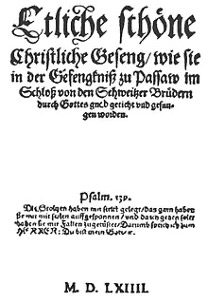
The strong connection between suffering and salvation displayed in this Swiss Brethren Anabaptist hymn is underscored throughout sixteenth-century Anabaptist hymnody. Such a connection was inspired by Anabaptists’ developing theological beliefs and by their experiences of persecution and suffering in early modern Europe. The writing and singing of hymns were popular and powerful means of religious expression for early Anabaptists, whose music could be heard everywhere from worship spaces to prison cells to the burning stake. They wrote and sang hymns to declare their faith, memorialize their martyrs, and connect to other believers. As music historian Rosella Reimer Duerksen has observed, in the case of Anabaptists, “hymnodists practiced little restraint or sophistication, but presented their views and beliefs freely in the stanzas which they penned.” 2 Thus, their compositions offer an unadulterated look into the hearts and minds of lay people rather than the formal doctrine found in other confessional hymnals of the Reformation. The lack of any formal doctrine in Anabaptist hymnody is also reflective of the fact that, as historian John Rempel has noted, “little time was taken for doctrinal or liturgical formulation; what mattered was spiritual rebirth and a life of surrender.”3 This grassroots form of religious expression and experience emphasized passionate spirituality, concern for living a holy life, and, perhaps most strikingly, the powerful and effective motifs of suffering and martyrdom.4

Among the developing doctrinal and theological ideas with which Anabaptist hymnodists interacted, adult baptism appears as one of the most prominent, for it was both the distinguishing feature of the confession theologically and politically. In the sixteenth century, adult baptism, or believer’s baptism, was “cited more often than any other doctrine as the crime condemning an Anabaptist to execution.”5 The connection between baptism and death was not lost to hymnodists, who frequently set baptism in a context of suffering. In addition to the baptismal sequence of grace followed by water, Anabaptists understood there to be a third rite of baptism: that of blood.

The Lord Jesus Christ, therefore,
assigns three witnesses for us.
The two are called water and Spirit.
The third, blood, that is, suffering.6

In a very real way, Anabaptists thought of baptism as the first step on the path to martyrdom. Baptism was a commitment to a godly life and a suffering life, a statement of faith that was a violation and rejection of the state church punishable by death. The emphasis of suffering in sixteenth-century Anabaptism, especially among the Swiss Brethren, was both a response to their experiences as a persecuted people and their theological formulation that true Christian discipleship demanded that Christians follow in the way of Christ, suffering as Christ suffered.

The importance of believer’s baptism was stressed in the context of martyr hymns, like in the account of the imprisonment, trial, and execution of Claesken Gaeledochter. In recounting Claesken’s inquisition, the hymnodist stresses her commitment to believer’s baptism, intimate knowledge of Scripture, and personal and passionate spirituality—all of which are common themes in Anabaptist martyr hymns.

About her baptism he did question;
But she, without alt’ring her course,
Courageously the Scriptures told:
That of new life and repentance
Both John and Christ most clearly tell;
‘Repentance first!’ was taught the people.7

Not confined to a baptismal context, Anabaptists’ theology of suffering consistently appears throughout their robust oral and literary traditions, most especially in their hymns.8 Like other confessions of the Reformation, Anabaptists connected their own suffering to the larger narrative of Christian persecution. One Passau hymnodist recounted the lineage of Christian suffering, declaring that “it began with Abel.”9 The author goes on to write:

Afterwards, all the prophets
and other pious also—
some were killed,
other experienced especially great humiliation
through fear and distress, cross and affliction.10

Anabaptist hymnodists accounted for the suffering of martyrs as well as their own affliction. In doing so, many hymns depicted imprisonment, torture, and execution in graphic detail. Stanzas told of burning, beheading, drowning, and stretching on the rack, along with other forms of physical torment. One of the most gruesome examples appears in the hymnal account of Elisabeth van Leeuwarden:

They had two thumbscrews put on
When for a long time she refused to confess,
So that they smashed thumb and fingers
Till the blood spurted out from her nails.11

However grim this theology of suffering may seem, it was often closely linked to messages of consolation and hope. The acceptance of “innocent suffering,” as one wrote, was not only a manifestation of discipleship but necessary for salvation.12 This union between suffering and salvation simultaneously inspired, sustained, and consoled sixteenth-century Anabaptists. Often, consolatory hymns took the form of prayers, pleading for God to grant peace to the suffering:

In anguish and distress,
Give us the bread of heaven,
And in the pain of death
Let peace to us be given.13

Anabaptist hymnodists also looked directly to Christ to inspire their work, as in this stanza, adapted from the Sermon on the Mount:

When you are slandered and abused now,
Persecuted and beaten for my sake,
be joyful, for see, your reward
is prepared for you on heaven’s throne.14

Many hymns that connected suffering to consolation and salvation were created by those who immediately needed such a message, namely, the imprisoned. The most famous collection of such hymns is the Ausbund, the primary hymnal of the Swiss Brethren. The core of this hymnal was first published in 1564 and consisted of fifty-three hymns, which were composed by Swiss Brethren Anabaptists imprisoned in Passau between 1535 and 1540 and include hymns written by well-known early Anabaptist leaders such as George Blaurock, Felix Mantz, and Michael Sattler, and others.15

Motifs of sorrow and distress underscore much of the Ausbund, a clear reflection of the immediate situation of the hymns’ authors. These understandable themes, however, are offset by “a note of triumph [and] of a conviction that [the authors’] past of sorrow and tribulation is leading them to everlasting life.”16 In one hymn, Michael Schneider joins the reality of bondage and suffering with the hope of salvation in the opening and closing stanzas:

We cry to you, Lord God,
and lament to you all our distress,
which now confronts us
in dungeons and in stocks
where they have stuck us.
Give our spirit power and much strength
that it may lay hold of the goal
which has long stood before us,
so that we might obtain it.
O God, Release the captives! Amen.17

Schneider’s urgency, religious conviction, and belief in the salvation of and from suffering were common themes often repeated in many of the hymns composed in Passau.

While the composition of many hymns was often an individual practice of meditation and expression, singing hymns was nearly always communal. For early Anabaptists across Europe, the singing of hymns was decidedly a shared practice, be it in a congregational, familial, or clandestine setting.18 Because of the wide variety of Anabaptist hymnody, songs were sung to worship God, express religious ideas, commemorate martyrs, and give comfort and hope to the persecuted and imprisoned. Dutch martyrologist Hans de Ries believed that “songs of the cross” were “profitable to be sung at times when the congregation [was] burdened with the cross and suffering.”19 Anabaptists readily recognized and employed the power that singing hymns could have for a community of believers. Simply, the hymns of the Ausbund and other hymnals were written by the suffering, for the suffering.

Related to the motif of salvation and suffering was the prevalence of a belief in imminent eschatology. Several hymns in the Ausbund expressed the hymnodist’s belief that Christ would soon return and usher in the Kingdom of God. Here, hymnal messages were intended to instill a sense of urgency to convert, repent, and “console the suffering and encourage them to endure a little longer.”20 Michael Schneider conveyed the urgency of repentance in the face of imminent eschatology on multiple instances throughout the Ausbund:

God burned Sodom
for its sinful deeds.
You should accept this.
It is certainly an example
for all who live godlessly
in this time.
God will give them their reward.
The fire is already prepared.21

In another hymn, which anticipates the New Jerusalem in a remarkable forty-six verses, Schneider consoles his audience:

You, Church of God, keep your pure covenant,
namely the covenant of your groom, Christ.
For a short time be patient and suffer.
He will soon give your rest.22

Prominently, Anabaptists experienced and expressed their suffering through the drama of martyrdom, which included not only execution but also imprisonment and prosecution. Although Protestants and Catholics of the sixteenth century also published their own extensive martyrologies, those of Anabaptists were unique in that they were preserved primarily through song. When Anabaptist hymns were published, they rarely appeared with musical notation but rather with a familiar tune designation. Believers preserved these tunes, often adopted from popular folk songs, and the lyrics through communal singing and rote memorization.23 Anabaptism’s distinctive separatism, strong in-group orientation, and low literacy levels among believers contributed to hymnal martyrology for Swiss Brethren and Dutch Anabaptists in the sixteenth century.24

The extant of hymnal martyrologies was not long-lasting among some Anabaptist groups, however. Hans de Ries, who published a new Dutch Mennonite martyrology in 1615—one that became the basis of the Martyr’s Mirror—refashioned much of the content from earlier hymnals into prose. Although no information was lost, a certain distinctiveness was. This editorial decision reflected a transition in Dutch Mennonite life: the stories of martyrs were no longer memorized and sung in secret by illiterate Christians; instead, they were studied openly by the educated.25 The Swiss Brethren and their descendants, on the other hand, continued publishing updated versions of the Ausbund in America until 1785 and in Europe until 1838, which helped to maintain a “theology of suffering…long after the actual experience of martyrdom had become relatively rare.”26 Generally, however, the intense attention paid to the theology and experience salvation and suffering, sustained through early believers’ hymns, faded with their own martyrdom. Nevertheless, an interest in Anabaptist martyrdom is still alive among many present-day Anabaptists.

Despite the near absence of sixteen-century hymns in modern Anabaptist worship and experience, these songs were absolutely foundational to the experience of the Christians who wrote and sang them. The composition and singing of original hymns provided consolation, meaning, and continuity to a persecuted religious movement still in its infancy. The themes of suffering and martyrdom pointed to a distinctive and immensely meaningful aspect unique to this Reformation-era confession. Beyond the narratives which many of these hymns outlined, early Anabaptist hymnodists also unveiled their own understandings of the larger narrative of the unfolding of the Kingdom of God, as well as their place in it. Viewed from the twenty-first century, these hymns provide a unique glimpse into the temporal and existential realities of the first Anabaptists.


1. Galen A. Peters, ed., The Earliest Hymns of the Ausbund: Some Beautiful Christian Songs Composed and Sung in the Prison at Passau, Published in 1564, trans. Robert A. Riall (Kitchener, Ontario: Pandora Press, 2003),62.

2. Rosella Reimer Duerksen, “Anabaptist Hymnody of the Sixteenth Century: A Study of Its Marked Individuality Couples with a Dependence upon Contemporary Secular and Sacred Musical Style and Form.” Ph.D. diss., Union Theological Seminary, New York, 1956, 268-269.

3. John D. Rempel, “Anabaptist Religious Literature and Hymnody,” in A Companion to Anabaptism and Spiritualism, 1521-1700, ed. John D. Roth and James M. Stayer (Leiden, The Netherlands: Koninklijke Brill NV, 2007), 391.

4. Rosella Reimer Duerksen, “Doctrinal Implications in Sixteenth Century Anabaptist Hymnody,” Mennonite Quarterly Review 35, no. 1 (January, 1961), 38.

5. Ibid., 44.

6. Peters, The Earliest Hymns of the Ausbund, 266.

7. Hermina Joldersma and Louis Grijp, eds. and trans., Elisabeth’s Manly Courage: Testimonials and Songs of Martyred Anabaptist Women in the Low Countries (Milwaukee, WI: Marquette University Press, 2001), 91.

8. John D. Roth, “Marpeck and the Later Swiss Brethren,” in Roth and Stayer, A Companion to Anabaptism and Spiritualism, 1521-1700, 352.

9. Peters, The Earliest Hymns of the Ausbund, 409.

10. Ibid.

11. Joldersma and Grijp, Elisabeth’s Manly Courage, 119.

12. Duerksen, “Doctrinal Implications in Sixteenth Century Anabaptist Hymnody,” 42.

13. Quoted in Paul M. Yoder, et al., Four Hundred Years with the Ausbund (Scottdale, PA: Herald Press, 1964), 45.

14. Quoted in Gregory, Salvation at Stake, 203.

15. Yoder, et al., Four Hundred Years with the Ausbund, 5-6.

16. Ibid.,6.

17. Peters, The Earliest Hymns of the Ausbund, 143-148.

18. Global Anabaptist Mennonite Encyclopedia Online, s.v. “Hymnology of the Anabaptists,” accessed March 2, 2019, https://gameo.org/index.php?title=Hymnology_of_the_Anabaptists.

19. Quoted in Brad S. Gregory, Salvation at Stake: Christian Martyrdom in Early Modern Europe (Cambridge, MA: Harvard University Press, 1999), 239.

20. Duerksen, “Anabaptist Hymnody of the Sixteenth Century,” 259.

21. Peters, The Earliest Hymns of the Ausbund, 133.

22. Ibid.,244.

23. Yoder, et al. Four Hundred Years with the Ausbund, 7.

24. Gregory, Salvation at Stake, 212.

25. Ibid., 237.

26. Roth, “Marpeck and the Later Swiss Brethren,” in Roth and Stayer, A Companion to Anabaptism and Spiritualism, 1521-1700, 352.

The Rise of LGBTQ Mennonite Leaders

Rachel Waltner Goossen

People identifying as lesbian, gay, bisexual, transgender, and queer have long faced stigmatization and discrimination in many North American Mennonite churches and institutions. But during the past decade, two parallel denominations, Mennonite Church USA and Mennonite Church Canada, have been moving sporadically but irrefutably toward policies of inclusiveness.1 The rise of LGBTQ Mennonite leaders is reshaping the North American Mennonite world, expanding a faith tradition that has staked its identity to radical Christian nonviolence and reinterpreting what it means to live in peaceable communities.

These changes within several Mennonite groups, which have been accompanied by intense controversy and schism, signify substantial developments in Anabaptist faith traditions. Until the early 2000s, when profiles of LGBTQ Mennonite individuals began appearing in a few publications, Mennonites were rarely visible in histories critiquing homophobia and heterosexism.2 More likely, students of Anabaptism might have encountered stories conforming to, in the words of literary scholar Daniel Shank Cruz, “the usual Mennonite trope of leaving the community because of its restrictions.”3

In 2016, I began interviewing theologically-trained Mennonite leaders on both sides of the Canadian/U.S. border who identify as LGBTQ, a project culminating in newly-published scholarship in the journal Nova Religio: “’Repent of the Sins of Homophobia’: The Rise of Queer Mennonite Leaders.”4 To help me locate potential interviewees, staff and board members of the Brethren Mennonite Council for LGBT Interests, headquartered in Minneapolis, provided names of colleagues ranging in age from 24 to 80. Snowball sampling—that is, the practice of following leads gleaned through personal contacts—yielded forty-four seminary-trained LGBTQ leaders across the U.S. and Canada, some of whom no longer affiliated with Mennonite institutions.

Of the forty I was able to contact, thirty individuals consented to interviews. Many of them also made available sermons, letters, photographs, and other relevant documents for this study. Our interviews, which cover personal narratives and engagement with congregations and church-related institutions ranging from schools to mission agencies and publishing houses, provide windows into the experiences of queer leaders across decades and geographic regions. Although I had begun this work intending to document the loss of theologically-trained pastors and others to Mennonite faith communities as a result of discriminatory practices, I learned that their paths had been both complicated and highly variable.

Theda Good (in rainbow stole) at her ordination celebration in Denver, December 2016. Courtesy Theda Good

In some cases, individuals had been pushed out of their faith communities or had left in search of more hospitable church homes. Stories of harm and spiritual violence, both episodic and sustained, are an integral part of these oral history narratives. At the same time, many interviewees recounted how they persisted in professional roles as Mennonite pastors, chaplains, and administrators, despite barriers embedded in institutional policies and practices. Still others, who in previous decades had departed their faith communities under painful circumstances, had eventually circled back to Mennonite structures undergoing profound theological shifts regarding sexual ethics and congregational hospitality.5

Interviews conducted for this study are now available for further research at the Mennonite Church USA Archives in Elkhart, Indiana.6 Leaders whose narratives have been archived include Sharon Andre, Michelle Burkholder, Jason Frey, Joanne Gallardo, Theda Good, Sarah Klaassen, Shannon Neufeldt, Paula Northwood, John Rempel, Annabeth Roeschley, Russ Schmidt, and Randy Spaulding. Additional Mennonite pastors and theologians who are hetero-identified and allied with LGBTQ Mennonites also contributed interviews for archival repository and public dissemination. Notably, former Mennonite Church USA officials Ervin Stutzman and Nancy Kauffmann, prior to retiring from their administrative positions in 2018, also went on record with interviews focused on their practices affecting LGBTQ pastoral candidates. In their interviews, Stutzman and Kauffmann reflected on the sustained criticisms of the denomination’s policies from the Brethren Mennonite Council for LGBT Interests, Pink Menno, and other progressive activists within the church, as well as the exodus of conservative churches and conferences from Mennonite Church USA.7

This body of recorded oral histories is a significant resource for contemporary Mennonite studies. At its heart are first person narratives of theologically-trained individuals who identify as lesbian, gay, bisexual, and queer. Some of the interviewees have been in leadership in Mennonite congregations that have long welcomed all adherents, regardless of sexual orientation.8 One respondent, for example, recounted the prophetic witness of the Hyattsville Mennonite congregation in Maryland, which, she noted, has been a welcoming church for more than three decades and, as such, has earned the status of “rebel stepchild in the Mennonite Church.”9 But nearly all the respondents, in their personal and professional lives, have navigated far more conventional Mennonite settings.

The oral histories reveal how complex negotiations have been in the broader Mennonite world, as queer leaders and their allies have strategized to transform churchwide perspectives on sexual identity, and, in some cases, have moved to less heteronormative sites to practice their faith.10 Some left the church temporarily, even for decades, before returning with broadened perspectives to Mennonite settings. When queer Mennonite leaders and their allies departed, where, denominationally speaking, did they go? The evidence suggests that most individuals who moved away from Mennonite affiliations turned to the Disciples of Christ, United Church of Christ, United Methodists, Society of Friends (Quakers), United Church of Canada, and the Unitarian Universalists. Others have circled again into Mennonite congregations that have grappled with, and ultimately dropped, exclusionary practices.

The oral history interviews make clear that “staying Mennonite” is not necessarily the most desirable outcome for pastoral leaders who have moved on to other faith traditions. Most who leave continue to identify culturally and theologically as Anabaptist Mennonites, even while serving as pastors, chaplains, and administrators in other faith communities. Several of the interviewees referenced other Mennonite pastors, beyond the scope of this study, who identify as LGBTQ but, at present, remain circumspect about publicly acknowledging their sexual identities. And although I sought to interview transgender Mennonites, only one transgender person agreed to be interviewed. Further historical research is needed on transgender leadership in Mennonite settings, as well as on the experiences of LGBTQ Mennonites who are not theologically trained.11

The witness of LGBTQ-identified leaders living their lives authentically continues to impact faith communities across geographic and denominational boundaries. Their perspectives inform and alter Mennonite institutions that are seeking, however convulsively, to acknowledge and address homophobic religious culture reaching back many decades. Beginning in 2014 with Theda Good’s ministerial licensing at First Mennonite Church in Denver and continuing to the present, regional conferences within Mennonite USA that have licensed openly LGBTQ pastors and chaplains include Mountain States Mennonite Conference, Pacific Southwest Mennonite Conference, Central District Mennonite Conference, and Allegheny Mennonite Conference.12

The quickening pace of LGBTQ leaders arriving into and heading out from Mennonite institutional life blurs the lines of denominational identification, as openly queer pastors and theologians move into positions of influence in and beyond the Mennonite church. While many sectors within the broader Anabaptist landscape—not only in North America, but worldwide—continue to deny calls for equity and justice, queer leaders are pushing Mennonite bodies to make history, dismantling discrimination against LGBTQ-identified members and confronting the sins of homophobia.13

Rachel Waltner Goossen is Professor of History at Washburn University in Topeka, Kansas. Thanks to Ben Goossen for providing comments on this essay.


1. In 2020, for example, an advisory group within Mennonite Church USA proposed a series of nondiscriminatory practices regarding LGBTQ individuals; formal action is expected in 2021. See “Report from the Advisory Group on Mennonite Church USA Guidelines,” 27 January 2020, http://mennoniteusa.org/wp-content/uploads/2020/01/REPORT-MGAdvisoryGroup-Final-2.pdf; “Panel Recommends Retiring Membership Guidelines,” Mennonite World Review, 10 February 2020, 1, 13. On the Canadian context, see the General Board of MC Canada’s statement of apology to LGBTQ individuals across the denomination, “General Board Confession,” The Canadian Mennonite, 29 Sept. 2017, http://www.canadianmennonite.org/stories/general-board-confession.

2. Significant scholarship includes Roberta Showalter Kreider, From Wounded Hearts: Faith Stories of Lesbian, Gay, Bisexual and Transgendered People and Those Who Love Them(Gaithersburg, MD: Chi Rho Press, 1998); Together in Love: Faith Stories of Gay, Lesbian, Bisexual and Transgender Couples (Kulpsville, PA: Strategic Press, 2002); The Cost of Truth: Faith Stories of Mennonite and Brethren Leaders and Those Who Might Have Been (Kulpsville, PA: Strategic Press, 2004); Alicia Dueck, Negotiating Sexual Identities: Lesbian, Gay, and Queer Perspectives on Being Mennonite (Zurich: LitVerlag, 2012); Stephanie Krehbiel, “Pacifist Battlegrounds: Violence, Community, and the Struggle for LGBTQ Justice in the Mennonite Church USA,” Ph.D. diss., University of Kansas, 2015, and Irma Fast Dueck and Darryl Neustaedter Barg, The Listening Church, documentary, 2016, http://listeningchurch.ca/?page_id¼16.

3. Queering Mennonite Literature: Archives, Activism, and the Search for Community (University Park, Pa.: Pennsylvania State University Press, 2019), 136.

4. Rachel Waltner Goossen, “’Repent of the Sins of Homophobia’: The Rise of Queer Mennonite Leaders,” Nova Religio, 24 (February 2021): 68-95. Academic audiences provided commentary that informed this work at the Crossing the Line Conference, Eastern Mennonite University, Harrisonburg, Virginia, in June 2017; the Menno Simons Lectures, Bethel College, North Newton, Kansas, in October 2018; the Women Doing Theology Conference, Anabaptist Mennonite Biblical Seminary, Elkhart, Indiana, in November 2018; and the Queer History Conference, San Francisco State University, in June 2019.

5. Examples include Shannon Neufeldt, Keith Schrag, and Randy Spaulding.

6. Rachel Waltner Goossen Collection on LGBTQ Mennonite Leaders, 2016-2020, HM1-1030, Mennonite Church USA Archives, Elkhart, Indiana, https://archives.mhsc.ca/index.php/rachel-waltner-goossen-collection-on-lgbtq-mennonite-leaders.

7. Stutzman interview via phone, Harrisonburg, VA, 5 February 2018, audio recording; Kauffmann interview via Skype, 18 January 2018, Elkhart, IN, audio recording. On the Brethren Mennonite Council for LGBT Interests and Pink Menno, see “BMC Mission and Vision,” https://www.bmclgbt.org/about, and “Pink Menno: History and Vision,” http://www.pinkmenno.org/history-vision/.

8. Cf. Richard Lichty, An Increase in Time: Story Lines of Germantown Mennonite Church and Its Historic Trust, 1683-2005 (Elkhart, IN: Institute of Mennonite Studies, 2015), and an account of Hyattsville Mennonite Church’s relationship to Allegheny Mennonite Conference in Emma Green, “Gay and Mennonite,” The Atlantic, 18 March 2015, https://www.theatlantic.com/national/archive/2015/03/gay-and-mennonite/388060/.

9. Annabeth Roeschley interview via Skype, Washington, D.C., 5 Sept. 2017, audio recording.

10. On queer theologians incorporating personal experience, see Stephanie Chandler Burns, “Queering Anabaptist Theology: An Endeavor in Breaking Binaries as Hermeneutical Community,” in Recovering from the Anabaptist Vision: New Essays in Anabaptist Identity and Theological Method, eds. Laura Schmidt Roberts, Paul Martens, and Myron A. Penner (London: T&T Clark, 2020), 77–92.

11. The Brethren Mennonite Council for LGBT Interests’ Oral History Project, one avenue for fruitful research, makes available videotaped oral history records pertaining to individuals from multiple Anabaptist groups; see https://www.bmclgbt.org/center-history.

12. On the historic first licensing of an openly queer leader in Mennonite Church USA, see “Theda Good, Lesbian Mennonite Minister, Licensed in Denver, a First Step Towards Gay Ordination,” Huffington Post, 4 February 2014, https://www.huffpost.com/entry/theda-good-gay-mennonite_n_4723272.

13. This study is intended to spur broader research on other continents, as well. Mennonite leaders identifying as queer are prominent in Europe, but LGBTQ membership and leadership remain controversial among adherents in Asia, Africa, and Latin America. See Rachel Waltner Goossen, “Transnational Perspectives: LGBTQ Mennonites,” chapter in Just Peace, Vol. 2, Amsterdam Centre for Religion and Peace and Justice Studies, Vrije Universiteit, Amsterdam, forthcoming.