As a historian, I am well aware that all times are in some sense historic, that every time period and every surviving source worthy of study, and yet, like so many of us, I have been well aware that the events of the past year—the Covid-19 pandemic, the protests for racial justice and against police brutality that spanned first America and then the globe, and the end of the Trump presidency—are events that my descendants will ask about, in the same way that I have been curious about my grandparents’ experiences of World War II. Likewise, I am confident that future students taking Mennonite history courses will want to know how Mennonites and other Anabaptists were affected by and responded to these events—as in fact, did my current students, who brought up some of these topics in their online discussions. This, then, is the beginning of a modest collection of contemporary links, in the hope that they might serve as useful primary sources for future Mennonite history instructors and students writing term papers as they attempt to make sense of the past year.
Covid-19
When it first became evident that Covid-19 would spread virtually unchecked across North America, I couldn’t help but think of the Amish and Old Order Mennonites who refuse both private and government-run health insurance might be affected. Would they be more reluctant to seek medical care for Covid as a result? Moreover, how difficult would it be for them to maintain social distancing without many of the technological solutions that the rest of us have used to fill the gap?
I was intrigued by this post from Penn Medicine, which discussed health outreach efforts among the Amish by Lancaster General Health, useful as a way to see how Amish communities in Lancaster County have been affected and how health care workers have tried to provide Covid safety guidance in culturally appropriate ways.1
This CBC news article detailed how, a month into the pandemic, Hutterite and Old Order Mennonite communities in Canada were adapting to restrictions on gatherings.2 The better part of a year after these restrictions have been put in place, the cost of isolation is felt even more keenly.
Of course, anyone seeking to learn how more assimilated Mennonite churches have weathered the pandemic is faced with an embarrassment of riches, as more churches than ever have recorded sermons and even full services and shared them online over the past year.
Black Lives Matter
During the protests following the murder of George Floyd, an image and video quickly circulated featuring a group of people in plain dress, singing hymns and holding signs that read “Justice for George Floyd,” “Thou Shalt Not Kill Anyone,” “I Can’t Breathe,” and “Standing Against Systems of Oppression.” Twitter users quickly identified the group as Amish, and tweets about Amish support for Black Lives Matter quickly proliferated. One such post, by Twitter user @nedwhat, garnered over 400, 000 likes.3 In fact, these protesters were not Amish at all, but members of the Church of God (Restoration), a church with no Anabaptist affiliation based in Greenville, Ohio.4
Though the actual Amish do not appear to have participated in Black Lives Matter protests in any great numbers, other Anabaptists did. On June 1st, Mennonite Church USA released a statement on racial injustice that forcefully repudiated white supremacy and state violence and encouraged Mennonite congregations “to lament and pray together…to stand in solidarity with communities of color, walk alongside them and, indeed, be led by them.”5 My own city of Portland became a particular point of national and international media attention, and several members of Portland Mennonite Church participated in peaceful protests across the city. Britt Carlson, our pastor of community life, also wrote a reflection on the citywide protests for Baptist News.6
Members of Portland Mennonite Church participate in a protest for racial justice. Photo by Art Wright.
The 2020 Election
As journalists and political strategists attempted to determine which candidate might carry the swing states in the Great Lakes region, several outlets published pieces about the political sympathies of Amish communities in states like Pennsylvania, Ohio, and Michigan. Many of the Amish interviewees had a broadly favorable opinion of Trump’s presidency, particularly his support of deregulation and his perceived support of businesses.7 Amish voter turnout remained low in the 2020 election, but opposition to restrictions on businesses and religious gatherings designed to curb the spread of Covid-19 appears to have motivated at least some younger Amish voters.8 The ongoing work of Steve Nolt and Kyle Kopko of the Young Center for Anabaptist and Pietist Studies at Elizabethtown College will no doubt help to clarify how Amish turnout in 2020 compared to past year.
We are, of course, in the midst of these events still. It remains to be seen just how various Mennonite and other Anabaptist communities will have been shaped in the long term by the events of the pandemic, the ongoing work of racial justice, and the increasing political polarization in the United States (and indeed in many parts of the world). I welcome additional links and resources in the comments as well, in the hopes that this collection might continue to evolve as the situation does.
A German hymn popular among Amish and traditional Mennonites centers on humility, a cardinal virtue in Plain Anabaptist life.
Demut ist die schönste Tugend, Aller Christen Ruhm und Ehr’, Denn sie zieret unsere Jugend Und das Alter noch viel mehr.
Humility is the most beautiful virtue, The glory and honor of all Christians, For it adorns our youth And old age even more so.
It’s fair to say that humility is receding as a lodestar in many mainstream Americans’ lives, as a December 2019 article in the online publication Medium explored.1 Empathy, a hallmark of humility, has, according to the article’s author, lost ground to narcissism, especially in public life. The continued centrality of humility in Plain culture is one of many intangible ways in which Amish and traditional Mennonites stand apart from many of their non-Plain neighbors.
As observers of traditional Anabaptist groups have noted, their identity as people of faith is expressed visibly, most obviously in the ways they dress and groom themselves. Plain people read 1 Peter 5:5, for example, as a literal call to express their humility through what they wear.
… And all of you must clothe yourselves with humility in your dealings with one another, for ‘God opposes the proud, but gives grace to the humble.’”
Plain humility is encoded linguistically as well. In a manual on Christian (i.e., humble) living directed at Amish youth, there is a section devoted to how one should speak. Seven principles for appropriate speech are laid out, each supported by Scripture.
The anonymous editors of this manual do not suggest that any specific language is more or less suited to humble speech. However Pennsylvania Dutch–speaking Plain people, which includes most Amish and Old Order Mennonites, do often perceive a link between the maintenance of their German-related vernacular language alongside standard German for devotional purposes and humility.
Both plain dress and “keeping Dutch” are connected in an interesting quote collected by the Old Order historian Amos B. Hoover and included in his wonderful book, German Language: Cradle of Our Heritage. In a conversation with Hoover, a Weaverland Conference Mennonite minister, Luke N. Good (1928–2015), shared the following thoughts.
Ich meen, es Deitsch as mir hen is ken gschriwweni Schprooch, awwer is genunk fer helfe uns zammehalde. Gott hot die Schprooche verwechselt un es hot gedient zum Gude. Nau velleicht sette mer net schaffe fer en unified Schprooch. Ich denk als oft, glei as ich bei die Gmee war, hot en aldi Fraa grode, “Die Schulkinner sette aa wennig lanne ihre Greiz draage, mit die Gleederdracht.” Un ich meen aa so mit die Schprooch. S’is gut wann sie wennig gschpott warre.3
In my opinion, though the German we have is not a written language, it is enough to help keep us together as a people. God confused the languages, and it served a good purpose. Now maybe we should not strive for a unified language. I often think how an old sister counseled, soon after I had joined the church, that “children should also learn a little something about bearing their cross, with their clothing style.” I think also it is thus with the language. It is good for them to endure a little ridicule.
Plain people are not the only Pennsylvania Dutch speakers to associate humility with how one dresses and what and how one speaks. So-called “Fancy Dutch,” the descendants of mainly Lutheran and German Reformed immigrants who comprised the great majority of Pennsylvania Dutch speakers into the 20th century, expressed sensibilities much like those of Luke N. Good.
Below is an excerpt from a dialog in Pennsylvania Dutch that appeared in 1841 in a German-language Lutheran newspaper published in Easton, PA. Although the author and most if not all of his readers were native speakers of Pennsylvania Dutch, German was at that time the preferred medium for writing. Whenever Pennsylvania Dutch was used in print, it marked a shift to a more direct, colloquial style that connected author and reader closely. The two men in the dialog from which the text below is excerpted were members of the same Lutheran congregation.
Wer sei Schprooch verlaesst, daer schemmt sich noch vun sei Eldre un verlaesst noch sei Religion un watt en Maddedischt. Un is denn die englisch Schprooch vornemmer un schenner as die deitsch? Ich denk net. Unser alder Parre hett immer gsaat dass die deitsch Schprooch die vornemmscht un bescht waer, un sell glaawich aa. Awwer sobald der Hochmut in die junge Leit faahrt, wolle sie englisch sei un schemme sich, Deitsch zu schwetze, as wann’s Sind un Schand waer.
Waar’s Deitsch gut genung fer mich, so denk ich, is’s aa gut genung fer mei Kinner. Sie sin deitsch un solle aa deitsch bleiwe. So viel Englisch wie sie breichte, lanne sie ennihau uf der Schtroos.
Whoever abandons his language is ashamed of his parents and will leave his faith and become a Methodist. And is the English language really loftier and more beautiful than German? I don’t think so. Our old pastor always said that the German language was the loftiest and best and I believe that, too. But as soon as pride enters young people, they want to be English and are ashamed of speaking German, as if that were a sin and scandal.
If German was good enough for me, then I think it is good enough for my children, too. They’re German and should stay German, too. They’ll learn all the English they’ll need in the street, anyway.
In prose and poetic texts in the 19th and 20th centuries, Pennsylvania Dutch writers often lamented the tendency for youth to stray, which aside from preferring English was also reflected in their worldly fashions. One example that appeared in several German-language newspapers in Pennsylvania starting in the 1860s was a reader’s letter titled “Teite Hosen un Ständups mache der Mann net” (Tight Pants and Standup Collars Do Not Make the Man).4 The letter concludes with this verse:
Fer weiti Hupps un teiti Hosse Nemmt mer besser sich in Acht, Sie sin graad wie falschi Rose, Zum Verfiehre yuscht gmacht. Zwar gucke sie recht fei un schee, Doch wer kann dehinner seh?
Of wide hoops and tight pants One had better beware; They are like fake roses, Made just to lead astray. They may look quite fancy and pretty, Yet who can see through them?
Though the author of this poem was almost certainly a Fancy Dutch male, the sentiments he expresses align well with contemporary Plain values. Amish and traditional Mennonite women have never worn hoop skirts and still today males in the most traditional Amish groups, including the Swartzentruber and Nebraska Amish, wear collarless shirts and loosely fitting trousers.
The spirit of the “Tight Pants” text is echoed in the Pennsylvania Dutch poem below from 1870, in which the “poor soul” quoted prefers both stylish clothing and English over her native tongue.
So schteck ich do in meine Hupps Un bin en aarmi Seel, Ausse glatt un inne Schmutz, So simmer unni Fehl. Un wann ich yuscht drei Sent noch hab, So muss ich doch in Schtoor. Datt muss der letschte Kupper fatt, So geht’s vun Yaahr zu Yaahr. Schwetzt ennich epper zu mir Deitsch Un froogt mich, ‘Kannscht du des?” So saag ich awwer jo net “Ja”, Ich saag in Englisch, “Yes!’5
That’s how I am in my hoops, A poor soul, Smooth on the outside and dirty on the inside, That’s how we are without fail. And when I’m down to my last three cents I still have to go to the store. That’s where the last copper has to go, So it goes, year in and year out. If someone speaks to me in Dutch And asks, “Can you understand?” Then of course I don’t say “Ja”, I say in English, “Yes!”
Just as Plain people ensure the survival of the Pennsylvania Dutch language in the twenty-first century, so too do they continue the tradition once shared by their “Fancy” neighbors of linking both language and modest dress with the time-honored virtue of humility.
What did it mean to be Mennonite during the Holocaust? The records of a Nazi death squad that killed tens of thousands of Jews in Ukraine during the Second World War offer one perspective. This death squad, Einsatzgruppe C, produced detailed reports for superiors in Berlin on a nearly daily basis during Hitler’s invasion of the Soviet Union in 1941. In addition to meticulous counts of Jews, communists, and others murdered under their command, the officers of Einsatzgruppe C devoted substantial attention to pockets of German-speaking communities that they encountered across Ukraine, including large Mennonite settlements. These wartime documents show how the Third Reich’s most infamous killing units treated local Mennonites while perpetrating genocide.
Einsatzgruppe C was one of four major death squads (labeled A, B, C, and D) that the SS created in 1941 to conduct ethnic cleansing and racial warfare in newly conquered regions of the Soviet Union. Each Einsatzgruppe operated in the wake of an army group. They collectively comprised about 3,000 members. These murder units grew more ruthless as they went, at first killing mostly men, but then also slaughtering women and children. Einsatzgruppe C worked in areas destined for civil administration. This territory became the Reich Commissariat Ukraine. It encompassed several Mennonite colonies including the region’s oldest settlement, Chortitza. By contrast, the largest colony, Molotschna, lay to the south in a military district assigned to Einsatzgruppe D.1
Experiences in western and central Ukraine with Lutheran and Catholic German speakers shaped Einsatzgruppe C’s attitudes toward the Mennonites it encountered farther east. Prior to invading the Soviet Union, Nazi officials feared that few “ethnic Germans” would be left alive in the areas they conquered, and that those remaining would be hardened communists. Invaders were instead pleased to discover large groups of anti-Bolshevik German speakers. “The impression that these people make is surprisingly good,” Einsatzgruppe C reported. “There can be no talk of any kind of Bolshevization.”2 The murder team immediately began integrating these ethnic Germans into its operations, distributing Jewish plunder and placing trusted men in positions of local authority.
The death squad’s officers expressed ambivalence toward Christian piety among ethnic Germans it encountered. On one hand, religious belief had helped preserve their morale during decades of communist oppression. But Einsatzgruppe C also felt the Bolshevik ban on churches had yielded a “positive result,” in that the previously strong divisions between Christian denominations had begun to dissolve, giving way to a common attitude of racial unity: “Clergy must be prevented from reestablishing lines of denominational division.”3 This view was almost certainly shaped by Einsatzgruppe C’s in-house racial expert, Hans Beyer. As a prolific academic and editor, Beyer was well versed in the history of Ukraine’s Mennonites, whom he would soon meet in person.4
Einsatzgruppe C had already operated across west and central Ukraine before encountering areas of Mennonite settlement to the east. This map shows massacres by the death squad up to its arrival near the Dnieper River. Red circles denote the three Mennonite areas discussed at greatest length in officers’ reports (from left to right: Kronau, Stalindorf, Chortitza). Map adapted from Dieter Pohl, “The Murder of Ukraine’s Jews under German Military Administration and in the Reich Commissariat Ukraine,” in The Shoah in Ukraine: History, Testimony, Memorialization, ed. Ray Brandon and Wendy Lower (Bloomington: Indiana University Press, 2008), 36.
Hans Beyer and other members of Einsatzgruppe C arrived in areas of Mennonite settlement by September 1941. Their sub-unit, Einsatzkommando 6 (EK 6), established temporary headquarters in the city of Kryvyi Rih. In evaluating ethnic German villages around Kryvyi Rih, EK 6 devoted attention to what it considered a “strange mixed settlement” called Stalindorf. Thousands of Jews lived alongside hundreds of ethnic Germans. The latter group included Mennonites, described as being of “Dutch” origin but nonetheless fully Germanized. The pre-Soviet state had settled these families as model farmers for the Jews. “The Jews conducted a regime of terror and rigorously exploited the German farmers,” EK 6 reported. “The hate against the Jews is accordingly large.”5
To what extent can historians trust the sociological evaluations of a genocidal murder squad like Einsatzgruppe C? The officers of this unit possessed a fanatical hatred of Jews that led them to drastically misunderstand the basic dynamics of communist society. “Our experiences confirm the earlier assumption,” one report asserted, “that the Soviet state is in the purest sense a Jewish state.”6 Members appear to have truly believed that Jews controlled every significant political organization, city administration, and commercial enterprise in Ukraine. To “liquidate” Jewish leaders—and eventually the entirety of the region’s Jews—made strategic and economic sense to the killers of Einsatzgruppe C, who saw murder as a prerequisite to breaking Bolshevik power.
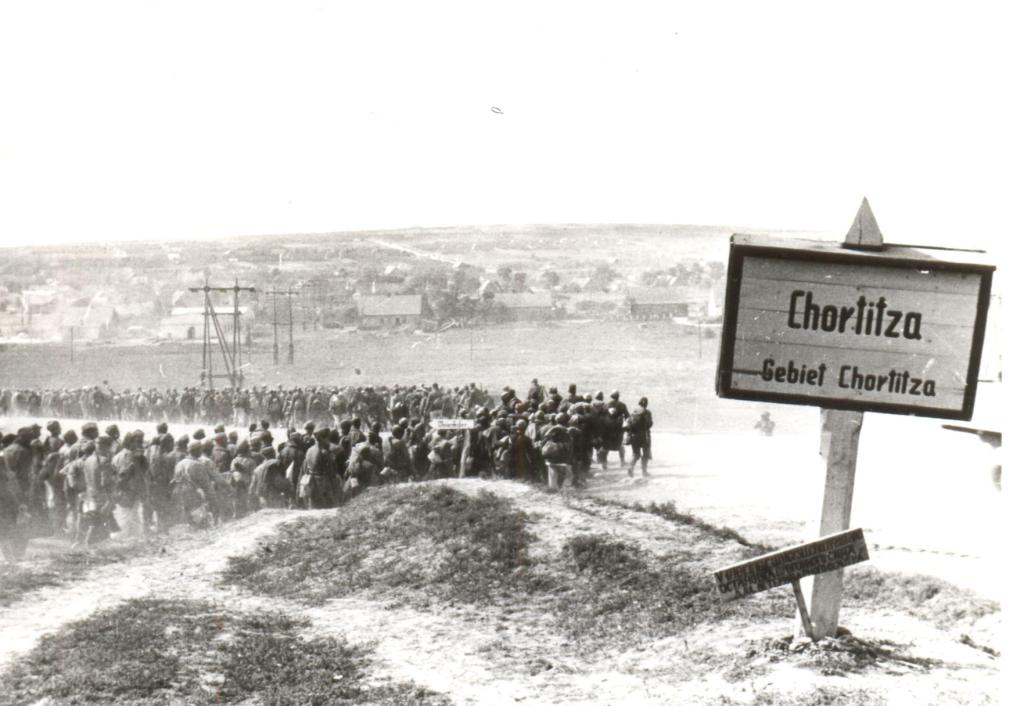
The killers of Einsatzgruppe C believed their mass murder of Jews to be part and parcel of Hitler’s plan to break communist power. Here, Soviet prisoners of war march past a sign for the Chortitza colony in eastern Nazi-occupied Ukraine. Source: Mennonite Heritage Centre, Photograph 351-27.
Einsatzgruppe C hoped that local populations, including Mennonites, would share its extremist views. The death squad’s officers were therefore predisposed to overstate anti-Judaism among locals. Yet Nazi expectations also pushed these groups to become more antisemitic than they might otherwise have been. To convince Ukraine’s general populace that mass murder would be carried out mainly against Jews, officers marched victims through villages in broad daylight. They also involved local militias in the killings, distributing complicity. “Executions of Jews were everywhere accepted and viewed positively,” Einsatzgruppe C evaluated. “What is striking is the calm with which the delinquents allow themselves to be shot, both Jews and non-Jews.”7
The death squad took pride in killing a small number of ethnic Germans known to have served as Soviet bureaucrats or police informants. “The population’s trust in [our] activities,” officers reported, “has been further strengthened because in necessary cases, the most serious measures are also taken against ethnic Germans.”8 SS leaders expressed special disgust for ethnic Germans who had helped Bolshevik police arrest, deport, or kill fellow Germans. Einsatzgruppe C showed remarkable leniency, however, to individuals who claimed that their work for Soviet offices had been coerced. Indeed, numerous former Soviet secret police agents of myriad ethnic backgrounds collaborated with Nazi occupiers, offering their service in hopes of surmounting suspect pasts.9
One former Soviet agent who joined Einsatzgruppe C was a Mennonite woman named Amalie Reimer. Originally from the Chortitza settlement, Reimer had slipped behind German lines as an undercover Soviet spy. Instead of completing this task, however, she defected. Asking to speak with the highest German authority, Reimer arrived at the EK 6 headquarters in Kryvyi Rih. She told the death squad that she had been forced into spying against her will. Reimer explained that Soviet police had deported her husband, and they further threatened to imprison her and to harm her five-year-old son. EK 6 extended Reimer the benefit of the doubt. The death squad’s officers treated her tale as reliable evidence of ethnic Germans’ horrific oppression under communism.10
Historian Doris Bergen has argued that the Nazi term “ethnic German” (Volksdeutsche) helped to exacerbate antisemitism among German speakers in Eastern Europe during World War II. People categorized as ethnic Germans could access favorable treatment from Hitler’s forces. Achieving this desirable status often required racial appraisal. Applicants could provide genealogical data or demonstrate their fluency in German folkways. Borderline cases could also prove their political loyalty by participating in Holocaust atrocities.11 Records produced by Einsatzgruppe C suggest that the term “Mennonite” constituted an even more desirable sub-category of belonging than the more general “Volksdeutsche” designation. Hopes for high status gave incentives to collaborate.
A map of the Chortitza colony in eastern Ukraine drawn by Nazi occupation officials in 1942. Racially cleansed “ethnic German” villages are marked with swastika flags. The sub-commando EK 6 of Einsatzgruppe C operated around Chortitza and the nearby large city of Zaporizhzhia on the eastern bank of the Dnieper River (shaded here in black) during the autumn of 1941. Source: BArch, R6/622.
The case of Amalie Reimer illustrates how the concept “Mennonite” held coveted value during the Holocaust. Although EK 6 did not yet know it when Reimer presented herself in Kryvyi Rih, she was a persona non grata in her home community of Chortitza. Numerous local Mennonites firmly believed that Reimer had not been forced to act as a Soviet spy. Rather, they saw her as a hardened communist who had personally betrayed many fellow ethnic Germans. One rumor even held that Reimer, having grown unhappy in her marriage, had sold out her own husband to the Soviet secret service. Reimer made sure to steer clear of her hometown, where accusations against her had convinced the Mennonite chief of police to arrest her, should she ever return.12
Reimer may have been rejected by her fellow Mennonites, but she carefully portrayed herself to Nazi authorities as a good and upstanding community member. Nazi officers who interviewed Reimer in Kryvyi Rih clearly accepted her motives.13 An autobiographical account penned later in the war reveals what Reimer probably told her interviewers. “I had a joyful childhood,” she wrote, “and was raised in the Mennonite faith.” Reimer underlined this information. It was the only phrase she underlined in the entire document, including her discussion of atrocities against ethnic Germans, reference to Stalin’s secret police as a “Jewish organization,” or promise to be a “loyal daughter of the German country.”14 For Reimer, being Mennonite already implied the rest.
SS race experts considered members of the denomination to be unusually pure and industrious specimens of Aryanism. Einsatzgruppe C expressed ambivalence toward Mennonite religiosity, but officers were no more disparaging than they had been toward the faith of the Lutherans and Catholics already evaluated to the west: “Despite their religious fundamentalism, their German racial consciousness and faith in the Führer and Reich has been uniformly strongly awakened.”15 Indeed, a comprehensive SS report on German speakers in eastern Ukraine (based on data from Einsatzgruppe C as well as from units to the south) concluded that “the Mennonites make the consistently best physical and spiritual impression of all the ethnic Germans assessed so far.”16
High-ranking Nazi officials accelerated the Holocaust precisely as killing squads arrived in areas of Ukraine with large Mennonite populations. The head of the SS, Heinrich Himmler, visited EK 6 in Kryvyi Rihin early October. This trip helped Himmler formulate plans to reshape Ukraine as an Aryan utopia. After Himmler told subordinates to intensify their murder operations, EK 6 shot Jewish women for the first time.17 Himmler also tasked an SS officer who had accompanied him to Ukraine, Karl Götz, with eventually importing hundreds of thousands of German farmers from overseas for settlement in Eastern Europe.18 Götz envisioned a special role for Mennonites in this process, and he reached out to denominational leaders in Germany to coordinate plans.19
More local Mennonites, besides Amalie Reimer, soon became entangled in the activities of EK 6. Himmler’s visit to Kryvyi Rih had coincided with the Nazi conquest of Zaporizhzhia, a large city near Chortitza. From October 5 to November 19, EK 6 reported murdering 1,000 Jews during operations in the Dnieper Bend, and it initiated plans to kill 1,500 individuals with mental and physical disabilities.20 Some local Mennonites denounced their neighbors as the SS arrived, and others may have directly participated in shootings. At a postwar trial, one former commander of EK 6 reported that a number of ethnic Germans had joined the death squad: “There were students who had experienced how their parents were shot. It actually frightened us, what bloodlust they had.”21 Further reserach is required to understand the full extent of Mennonite participation.
The brutality of the Nazi occupation created violent cycles that drew Mennonites and others into crimes. While in the Zaporizhzhia region, EK 6 complained that its work had been hampered by huge quantities of denunciations. “Nearly all the residents consider it necessary,” officers wrote, “to self-interestedly denounce their relatives, friends, etc., to the German police as having been communists.”22 The complexity of assessing these accusations’ validity in turn created roles for local collaborators to prove their worth. Amalie Reimer—after retrieving her son, whom she had hidden with a Russian family—traveled with EK 6 to the regional capital, Dnepropetrovsk. She worked there for the General Commissar and regularly performed confidential tasks for the SD.23
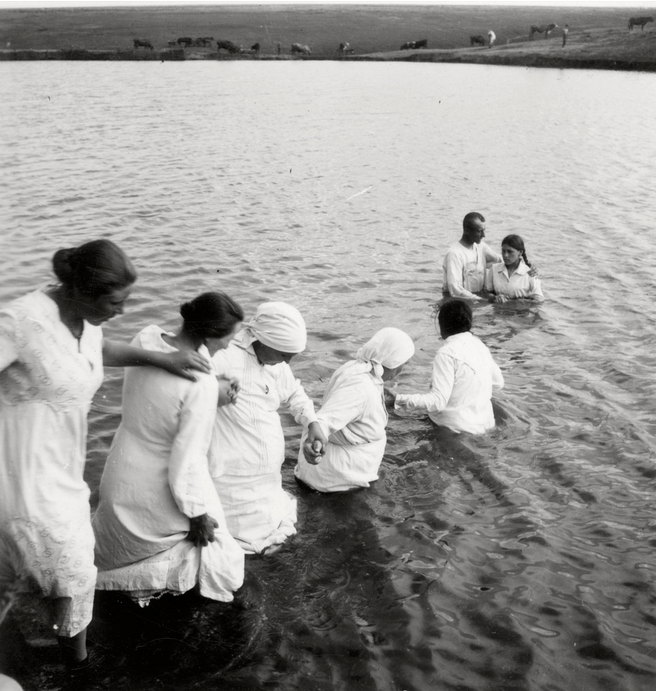
Most Mennonites in Nazi-occupied Ukraine received goods and privileges as Jews and others were slaughtered around them. Religious life even flourished again after years of repression under atheistic Bolshevik rule. Here, a Mennonite church leader baptizes women from Chortitza in the Dnieper River, 1943. Source: Magnum Photos.
Regardless of whether other Mennonites continued onward with EK 6, its decisions—along with the wartime empowerment of ethnic Germans—ensured local Mennonites’ further involvement in genocide. EK 6 in fact murdered fewer Jews than some comparable death squads. It did not shoot most of Zaporizhzhia’s Jews, explaining: “due to the considerable shortage of skilled workers, we had to keep Jewish craftsmen alive for the time being.”24 Similarly in Stalindorf, EK 6 left most Jews to work.25 Between October 1941 and May 1942, local Mennonite authorities thus participated in the ghettoization, enslavement, and murder of remaining Jews. Some received plunder from the 2,500 Jews in Stalindorf.26 Others helped organize the shooting of 3,700 Jews in Zaporizhzhia.27
National Socialists’ genocidal plans to infuse the ethnically cleansed regions around Ukraine’s Mennonite colonies with vast new migrations of Aryan settlers never came to fruition. Battle losses on the eastern front forced Hitler’s armies into retreat by 1943. Instead of bringing more colonists to Ukraine, the SS evacuated Ukraine’s Germans to the west. Most found themselves in refugee camps in or near occupied Poland. The Third Reich planned to naturalize nearly all these evacuees as German citizens. In a twist of fate, a prominent Mennonite named Johann Epp—the former chief administrator of the Chortitza colony, who was now helping Nazi officials evaluate evacuees’ suitability for citizenship—found Amalie Reimer and her son in one of the camps.28
The unexpected meeting in 1944 between Amalie Reimer and the Mennonite Johann Epp offers a final opportunity to analyze the denomination’s relationship to Einsatzgruppe C. Epp believed that Reimer was a former communist agent, and he recommended she be denied citizenship. Reimer appealed to her SS superiors. They affirmed that her work in Ukraine outweighed any “rumors” and suggested that she be employed in a concentration camp.29 Epp, in turn, submitted damning statements by himself and four other Mennonites, who accused Reimer of betraying kith and kin while fraternizing with Jews and socialists.30 In the end, Reimer was denied citizenship.31 In this remarkable exchange, the opinions of Mennonites outweighed the desires of leading SS officers.
To be within the Mennonite fold during the Holocaust was to wield influence. Einsatzgruppe C’s records prove that prominent Nazis believed killing Jews would rectify communist violence against ethnic Germans. Mennonites, moreover, enjoyed a higher reputation than did ethnic Germans generally. They could even defeat SS officers in disputes. After the war, Mennonite evacuees in Western Europe repurposed tales of suffering in the USSR to cast themselves exclusively as victims. Amalie Reimer adopted this position in postwar testimony at Nuremberg.32 Like thousands of others, she and her son migrated to the Americas through help from Mennonite aid societies.33 Knowledge about the denomination’s connections to a major Nazi death squad subsided, until recently, into obscurity.
Ben Goossen is a historian at Harvard University. He is the author of Chosen Nation: Mennonites and Germany in a Global Era, published by Princeton University Press. Thanks to Laureen Harder-Gissing for providing sources for this essay and to Madeline J. Williams for her comments.
1 It would be valuable to systematically trace Einsatzgruppe D’s interactions with Mennonites during its operations in Transnistria, Crimea, southern Ukraine, and the Caucasus, as this essay does for Einsatzgruppe C’s activities in the Reich Commissariat Ukraine. On Einsatzgruppe D and Mennonites, see Mark Jantzen and John Thiesen, eds., European Mennonites and the Holocaust (Toronto: University of Toronto Press, 2020), 3-4, 57-62, 210-220.
2 “Ereignismeldung UdSSR Nr. 81,” September 12, 1941, in Die “Ereignismeldungen UdSSR” 1941: Dokumente der Einsatzgruppen in der Sowjetunion, ed. Klaus-Michael Mallmann, Andrej Angrick, Jürgen Matthäus, and Martin Cüppers (Darmstadt: Wissenschaftliche Buchgesellschaft, 2011), 454.
4 See Hans Beyer, Aufbau und Entwicklung des ostdeutschen Volkstums (Danzig: Paul Rosenberg, 1935), 109-110; Hans Beyer, “Hauptlinien einer Geschichte der ostdeutschen Volksgruppen im 19. Jahrhundert,” Historische Zeitschrift 162, no. 3 (1940): 519. In 1937, Beyer strategized with Mennonite denominational leaders about how to improve their reputation in Nazi Germany. “Aus der Unterredung Beyer-Regehr (Danzig),” October 4, 1937, Vereinigung Collection, folder: Briefw. 1937 Jul-Dez, Mennonitische Forschungsstelle, Bolanden-Weierhof, Germany (hereafter MFS). Beyer’s interlocutor may have been Ernst Regehr, elder of the Rosenort Mennonite congregation, who had joined the Nazi Party on June 1, 1931. According to “Ereignismeldung UdSSR Nr. 85,” September 16, 1941, in Die “Ereignismeldungen UdSSR” 1941, ed. Mallmann, Angrick, Matthäus, and Cüppers, 483, Beyer spoke to ethnic Germans in Zhytomyr. He arrived with Einsatzgruppe C in Chortitza by the end of September 1941. Karl Roth, “Heydrichs Professor: Historiographie des ‘Volkstums’ und der Massenvernichtungen,” in Geschichtsschreibung als Legitimationswissenschaft, 1918-1945, ed. Peter Schöttler (Frankfurt: Suhrkamp, 1997), 291-294.
5 “Ereignismeldung UdSSR Nr. 85,” September 16, 1941, 468-469.
6 “Ereignismeldung UdSSR Nr. 81,” September 12, 1941, 451.
8 “Ereignismeldung UdSSR Nr. 80,” September 11, 1941, in Die “Ereignismeldungen UdSSR” 1941, ed. Mallmann, Angrick, Matthäus, and Cüppers, 444.
9 Jeffrey Burds, “Turncoats, Traitors, and Provocateurs”: Communist Collaborators, the German Occupation, and Stalin’s NKVD, 1941–1943,” East European Politics & Societies and Cultures 32, no. 3 (2018): 606-638.
10 “Ereignismeldung UdSSR Nr. 88,” September 19, 1941, in Die “Ereignismeldungen UdSSR” 1941, ed. Mallmann, Angrick, Matthäus, and Cüppers, 497-498.
11 Doris Bergen, “The Nazi Concept of ‘Volksdeutsche’ and the Exacerbation of Anti-Semitism in Eastern Europe, 1939-45,” Journal of Contemporary History 29 (1994): 569-582.
12 David Löwen to Johann Epp, April 24, 1944, Einwandererzentralstelle Collection, A33420-EWZ50-GO62/2902-2954, Mennonite Archives of Ontario, Waterloo, ON, Canada (this file hereafter cited as MAO).
13 Friedrich Werner to Hermann Behrends, February 2, 1944, MAO.
14 “Handschriftliche Aufzeichnungen der volksdeutschen Angestellten (ehem. Lehrerin) Amalie Franziska Reimer, geb. am 3. Jan. 1911 (in Chortitza im Rayon Saporoshe),” ca. February 1944, MAO. It is possible that whoever typed Reimer’s handwritten account may have added the underlining, in which case its meaning would be different. Regardless, Reimer took pains to portray herself in this seven-page document as belonging to Chortitza’s Mennonite community, which she depicted positively in contrast to Judaism, communism, and the Soviet secret police.
15 “Ereignismeldung UdSSR Nr. 86,” September 17, 1941, 484. Leading Mennonites exhibited antisemitism in correspondence with fellow denominational leaders. The district administrator of Chortitza, for example, praised the Nazi invasion for ending an era in which “Jews and Jew-lovers sat in our villages and played their evil games.” Quoted in Benjamin Unruh to Johann Epp, December 5, 1943, Vereinigung Collection, folder: 1943, MFS.
16 “Das Deutschtum im Raum von Kriwoj Rog, Saporoshje, Dnjepropetrowsk, im Gebiet Melitopol und im Gebiet Mariupol: Vorläufige Feststellungen, insbesondere über die Mennonitensiedlungen,” November 1, 1941, in Deutsche Besatzungsherrschaft in der UdSSR 1941-45: Dokumente der Einsatzgruppen in der Sowjetunion, ed. Jürgen Matthäus, Klaus-Michael Mallmann, Martin Cüppers, and Andrej Angrick (Darmstadt: Wissenschaftliche Buchgesellschaft, 2013), 221-226, here 223. This report’s information on Mennonites in areas under Einsatzgruppe C’s jurisdiction had been collected from September 19 to 23; information on Mennonites in the area under Einsatzgruppe D’s jurisdiction had been collected from October 17 to 24.
17 Heinrich Himmler, Der Dienstkalender Heinrich Himmlers 1941/42 (Göttingen: Wallstein Verlag, 1999), 224-225.
18 On Götz’s anticipated postwar role in resettling Germans from overseas, see “Ratsherrn Karl Götz, Stuttgart,” September 19, 1941, A3343 SSO, roll 21A (Karl Götz 11.3.03), National Archives and Records Administration, College Park, Maryland, USA. One version of this plan envisioned bringing 200,000 settlers from overseas. These were to join nearly two million total settlers intended for Eastern Europe, where one major new province called Gotengau would be erected in a region known for its historic Mennonite populations: “the Dnieper Bend, Taurida, and the Crimea.” “Stellungnahme und Gedanken von Dr. Erhard Wetzel zum Generalplan Ost des Reichsführers SS,” April 27, 1942, in Vom Generalplan Ost zum Generalsiedlungsplan, ed. Czeslaw Madajczyk (Munich: Saur, 1994), 51-52. Nazi planers contemplated a special role for South American migrants in their hypothetical Gotengau: “Here we could perhaps trade [with South American countries] to get back the South America Germans, especially the Germans from southern Brazil, [in exchange for Polish settlers whom the Nazis wanted to remove from Europe] and locate them in the new settlement areas, possibly in Taurida and the Crimea as well as the Dnieper Bend.” Ibid., 63.
19 Götz wrote to the Mennonite leader Benjamin Unruh on October 24, 1941 with the goal of facilitating a meeting between Unruh and Himmler. Meir Buchsweiler, Volksdeutsche in der Ukraine am Vorabend und Beginn des Zweiten Weltkriegs—Ein Fall Doppelter Loyalität? (Gerlingen: Bleicher Verlag, 1984), 321. On Götz and his relationship to Mennonites, see Benjamin W. Goossen, “‘A Small World Power’: How the Third Reich Viewed Mennonites,” Mennonite Quarterly Review 75, no. 2 (2018): 173–206.
20 “Ereignismeldung UdSSR Nr. 135,” November 19, 1941, in Die “Ereignismeldungen UdSSR” 1941, ed. Mallmann, Angrick, Matthäus, and Cüppers, 818. EK 6’s rate of murder accelerated as compared to the period from September 14 to October 4, during which it reported killing 106 political functionaries, 48 saboteurs and plunderers, and 205 Jews. Mallmann, Angrick, Matthäus, and Cüppers, ed., Die “Ereignismeldungen UdSSR” 1941, 673, 777.
21 Ernst Biberstein’s testimony from June 29, 1947 at the Einsatzgruppen Trial in Nuremberg is quoted in Buchsweiler, Volksdeutsche in der Ukraine, 377. Records of ethnic German evacuees processed by the Einwandererzentralstelle in 1944 offer one avenue for identifying Mennonites previously recruited by the Einsatzgruppen. For instance, the file of one Chortitza colony resident reports that he joined the SiPo and SD on November 11, 1941, while EK 6 was still in the Dnieper Bend; after transfer to a different area in October 1943, he was listed as affiliated with an “Einsatzkommando.” Jakob Ediger, “Einbürgerungsantrag,” April 13, 1944, Einwandererzentralstelle Collection, A3342-EWZ50-B034/1214-232, Mennonite Archives of Ontario, Waterloo, ON, Canada. [Caption edited 7/26/2022]
22 “Ereignismeldung UdSSR Nr. 135,” November 19, 1941, 818. This complaint applied generally to the Dnieper Bend region, where Mennonites were only a minority of the population, but the pattern also held for Mennonites. In one case, a Mennonite in Zaporizhzhia who had reportedly “betrayed several ethnic Germans” to the Soviets died of illness before he could be tried by Nazi authorities. Benjamin Unruh to Vereinigung and Verband, October 18, 1943, Vereinigung Collection, box 3, folder: Briefw. 1943, MFS. In a postwar interview, Heinrich Wiebe (who had served as the mayor of Nazi-occupied Zaporizhzhia) discussed another case: women in Chortitza had denounced a fellow Mennonite named Niebuhr for betraying their husbands to the Soviet secret police. Niebuhr avoided punishment by joining the Gestapo. Wiebe added: “Among our Mennonites, very many unfortunately joined the Gestapo. Many.” Heinrich Wiebe, Interview, ca. 1950s, Cornelius Krahn Interviews, tape 5, side B and tape 6, side A, Mennonite Library and Archives, North Newton, Kansas, USA.
23 “Amalie Reimer worked in various capacities as a trusted agent for the Security Police and SD office that I headed in Dnepropetrovsk.” Hermann Ling to Chef der SiPo and des SD, EWZ, Lager Litzmannstadt, March 24, 1944, MAO. Ling had previously been an officer with Einsatzkommando 5 of Einsatzgruppe C. While in Dnepropetrovsk, Ling oversaw the enslavement of thousands of Ukraine’s remaining Jews. Ray Brandon and Wendy Lower, eds., The Shoah in Ukraine: History, Testimony, Memorialization (Bloomington: Indiana University Press, 2008), 43, 205. Reimer may have arrived in Dnepropetrovsk prior to the massacre of around 15,000 Jews in that city by mid-October of 1941. 5,000 Jews reportedly remained alive in Dnepropetrovsk as of October 19. Mallmann, Angrick, Matthäus, and Cüppers, ed., Die “Ereignismeldungen UdSSR” 1941, 821.
24 “Ereignismeldung UdSSR Nr. 135,” November 19, 1941, 818.
25 “EK 6 decided against shooting these Jews in the overriding interest of continuing the [agricultural] work, being satisfied with liquidating the Jewish leadership.” “Ereignismeldung UdSSR Nr. 81,” September 12, 1941, 452.
26 Buchsweiler, Volksdeutsche in der Ukraine, 381, gives the number 2,500 for October 1941. On their ghettoization and murder, see Danielle Rozenberg, Enquête sur la Shoah par balles, vol. 1 (Paris: Hermann, 2016), 65-119. Most of Stalindorf’s able-bodied Jews were sent in April 1942 to work on the Dnepropetrovsk- Zaporizhzhia highway. Martin Dean, Collaboration in the Holocaust: Crimes of the Local Police in Belorussia and Ukraine, 1941-44 (New York: St. Martin’s Press, 2000), 83. Stalindorf’s remaining Jews were killed in May 1942. Wila Orbach, “The Destruction of the Jews in the Nazi-Occupied Territories of the USSR,” Soviet Jewish Affairs 6, no. 2 (1976): 44. Further research is required regarding Mennonites’ relationship to the killings. Viktor Klets, “Caught between Two Poles: Ukrainian Mennonites and the Trauma of the Second World War,” in Minority Report: Mennonite Identities in Imperial Russia and Soviet Ukraine Reconsidered, 1789-1945, ed. Leonard Friesen (Toronto: University of Toronto Press, 2018), 304. Some empty Jewish homes were given to Mennonites, and Stalindorf was renamed Friesendorf after their “Frisian” heritage. See “Dorfbericht: Friesendorf,” July 7, 1942, R 6/623, Bundesarchiv, Berlin, Germany (hereafter BArch).
27 See Aileen Friesen, “Khortytsya/Zaporizhzhia under Occupation: A Portrait,” in European Mennonites and the Holocaust, ed. Jantzen and Thiesen, 229-249; Gerhard Rempel, “Mennonites and the Holocaust: From Collaboration to Perpetuation,” Mennonite Quarterly Review 84, no. 4 (2010): 530-535.
28 Reimer had been trying to leave the camp and gain new employment. An SS-Brigadeführer had already written on her behalf to a Nazi office in Reichsgau Sudetenland, noting that she “had made notable contributions to the German cause.” Rudolf Creutz, “Rußlanddeutsche Umsiedler-Lehrerin Amalie Reimer,” March 15, 1944, MAO. For Johann Epp’s initial evaluation of Reimer’s citizenship application, see Amalie Reimer, “Einbürgerungsantrag,” March 19, 1944, MAO. Epp’s title at this time was “Volkstumssachverständiger bei der Einwandererzentralstelle-Kommission XXVIII.” Epp had already rejected other evacuees’ applications on similar grounds. Benjamin Unruh to Vereinigung, January 7, 1944, Nachlaß Benjamin Unruh, box 4, folder 21, MFS.
29 Ling to Lager Litzmannstadt, March 24, 1944. Ling had found a position for Reimer at the Potulice concentration camp, where she would have worked with kidnapped children of anti-German partisans from the Soviet Union. Regarding Johann Epp’s charges against Reimer, Ling added: “One must know the context of the ethnic Germans from Zaporizhzhia to know that there, Russian rule caused much internal malice.”
30 Accusations by Luise Schmidt, Anna Cornies, and Johann Rempel are contained in K. Löwen to Johann Epp, March 31, 1944, MAO; Johann Epp, “Meine Stellungnahme zum Lebenslauf der Amalie Reimer,” April 24, 1944, MAO; David Löwen to Johann Epp, April 24, 1944. See also Rudolf Rempel, “Vernehmungsniederschrift,” April 24, 1944, MAO.
31 Regierungsrat to Niedenführ, April 4, 1945, MAO. This process took over a year to resolve. Already by mid-1944, however, the accusations against Reimer resulted in the revocation of her employment offer at the Potulice concentration camp. Authorities who weighed the evidence for and against Reimer considered the Mennonites who denounced her to be “Russia German evacuees, who not only have known her for years, but who also must be seen as leading people within Germandom.” Schapmeier to Ehrlich, June 10, 1944, MAO.
32 Instead of working at the Potulice concentration camp, Reimer had received employment in a factory through the help of a former EK 6 officer, Matthias Graf, and she later testified (under her middle name, Franziska) on his behalf at Nuremberg. See Erika Weidemann, “Identity and Survival: The Post-World War II Immigration of Chortitza Mennonites,” in European Mennonites and the Holocaust, ed. Jantzen and Thiesen, 269-289. The racial expert Hans Beyer also remained in contact with Mennonites after his service with Einsatzgruppe C. See Hans Beyer to Christian Neff, May 31, 1944, Nachlaß Christian Neff, folder: Briefwechsel 1944, MFS; Benjamin Unruh to Vereinigung, November 21, 1944, Nachlaß Benjamin Unruh, box 4, folder 21, MFS.
33 Reimer and her son left for Canada on November 4, 1948, sponsored by A. Reimer of Lockwood, Saskatchewan. Hermann Schirmacher, Hans Peter Wiebe, and Thomas Schirmacher, eds., “MCC Auswanderungslisten nach 1945: The Mennonite Central Committee Post-World War II Refugee List, 1945-1952,” 2020, Mennonite Genealogical Resources, online.
In Kristin Kobes Du Mez’s Jesus and John Wayne: How White Evangelicals Corrupted a Faith and Fractured a Nation, she argues that white evangelical support for Donald Trump was not an aberration, but the culmination of more than fifty years of evangelicalism’s increasing affinity for militant masculinity. The recent riot and invasion of the US Capitol by persons displaying Christian nationalist slogans adds a tragic concreteness to Du Mez’s claims.1 While Du Mez does not explicitly discuss Anabaptism in her narrative, she presents a definition of evangelicalism in America behind Trump’s ascendency that I believe needs to be wrestled with in historical discussions about Anabaptism’s relationship with evangelicalism after World War II.
Du Mez offers a cultural definition of white evangelicalism specifically tied to consumption. A white evangelical consumer culture exploded in the postwar period with books and resources (e.g. Focus on the Family, Mars Hill Church), Christian Contemporary Music (CCM), and films like the God’s Not Dead series. “Rather than seeking to distinguish between ‘real’ from ‘supposed’ evangelicals,” Du Mez contends, “…it is much more useful to think in terms of the degree to which individuals participate in this evangelical culture of consumption.”2
Du Mez’s definition of evangelicalism runs counter to those of a more theological and doctrinal nature offered by people such as David Bebbington and Thomas Kidd.3 The scholarly conversations about how to best to characterize modern evangelicalism open a Pandora’s Box too extensive to discuss here. Nonetheless, Du Mez’s conceptualization of evangelicalism as participation in a broadly shared Christian consumer culture represents a notable contribution to discussions on the topic.
One of the things that struck me in Du Mez’s description of the diffuse nature of evangelical consumer culture was her observation about its effect on her own Christian Reformed denomination. “My own upbringing in the Christian Reformed Church, a small denomination founded by Dutch immigrants, is a case in point,” she states. “For generations, members defined themselves against American Christianity, but due to the onslaught of evangelical popular culture, large swaths of the denomination are now functionally evangelical in terms of affinity and belief. Denominational boundaries are easily breached by the flow of religious merchandizing.”4
Du Mez’s observation mirrors my own experience as a pastor and lifelong member of various congregations within Mennonite Church USA. Out of both personal and scholarly experience, I think that the pervasiveness of evangelical consumer culture, and its abilities to transgress denominational boundaries, present an intriguing angle from which to evaluate the relationship between evangelicalism and Anabaptism.
Two books, written decades apart, display two distinct approaches for understanding the relationship between Anabaptism and evangelicalism. The first, Norman Kraus’ Evangelicalism and Anabaptism (1979), generally views the two traditions in tension rather than compatible.5 Conversely, Jared Burkholder and David Cramer’s The Activist Impulse: Essays on the Intersection of Evangelicalism and Anabaptism (2012) sees the traditions more as able conversation partners.6Additionally, as my Anabaptist Historians colleague Devin Manzullo-Thomas pointed out, there has been an “Anabaptist Turn in Recent American Evangelical Historiography.”7
What Du Mez’s definition of evangelicalism and her personal aside reveal is a new paradigm for historically interrogating the relationship between Anabaptism and evangelicalism. Have congregations and persons in the Anabaptist tradition become “functionally evangelical”? If so, how and when? For example, would a historical examination of purchasing patterns of Christian education materials in Anabaptist-related congregations shed light on this phenomenon?
One of the reasons I think this relationship needs reevaluation—utilizing Du Mez’s approach—is the extent to which she ties evangelicalism to militancy and Christian nationalism. Our post-2016 conversations about the relationship between Anabaptism and evangelicalism need to more readily grapple with Anabaptism’s positions on peace and nonviolence in conjunction with the rising militancy in postwar evangelicalism that Du Mez charts. The power and pervasiveness of evangelical consumer culture can overwhelm efforts from both the pulpit and denominational publishers.8
I expect new explorations of the relationship between Anabaptism and evangelicalism using Du Mez’s insights would not reveal a doctrinal declination of the former in its interactions with the latter; in that assessment I concur with Burkholder and Cramer.9 However, I also suspect, particularly related to examining matters of war and peace, that the incompatibility that Kraus sees between the two traditions will come to the fore as well.10 And it is because, as these and other texts illustrate, postwar evangelicalism has interacted with Anabaptism in various and complex ways that Du Mez’s culture of consumption definition of evangelicalism can offer insight into histories of contemporary Anabaptism. It is an exploration in which I invite the readers and contributors of Anabaptist Historians to join me in undertaking.
1. “…the belief that America is God’s chosen nation and must be defended as such…” Kristen Kobes Du Mez, Jesus and John Wayne: How White Evangelicals Corrupted a Faith and Fractured a Nation (New York: Liveright, 2020), 3. For a recent and more thorough explanation of Christian nationalism, see: Andrew L. Whitehead and Samuel L. Perry, Taking America Back for God: Christian Nationalism in the United States (New York: Oxford University Press, 2020).
3. Bebbington lays out his influential “quadrilateral” description of evangelicalism as characterized by belief in conversion, activism, cruci-centrism, and biblicism in Evangelicalism in Modern Britain: A History from the 1730 to the 1980s (London: Routledge, 1989). Kidd’s most recent and developed definition of evangelicalism may be found in Who Is an Evangelical?: A History of a Movement in Crisis (New Haven, Yale, 2019).
5. Norman Kraus, ed., Evangelicalism and Anabaptism (Scottdale, PA: Herald Press, 1979), reprints are available from Wipf and Stock. In Kraus’ opening chapter, he described an early 1970s “shift in public opinion” regarding evangelicalism, “…heralded by the ‘Honor America’ celebration on July Fourth, 1970, when Billy Graham was featured as the star speaker along with Bob Hope and John Wayne…” Kraus, “What is Evangelicalism?” in Evangelicalism and Anabaptism (Eugene, OR: Wipf and Stock, 2001), 16-17.
6. Jared S. Burkholder and David C. Cramer, “Introduction,” in Jared S. Burkholder and David C. Cramer, eds., The Activist Impulse:The Activist Impulse: Essays on the Intersection of Evangelicalism and Anabaptism (Eugene, OR: Pickwick Publications, 2012), 5.
7. Devin C. Manzullo-Thomas, “The Not-So-Quiet in the Land: The Anabaptist Turn in Recent American Evangelical Historiography,” The Conrad Grebel Review, 33, no. 3 (Fall 2015): 359-71.
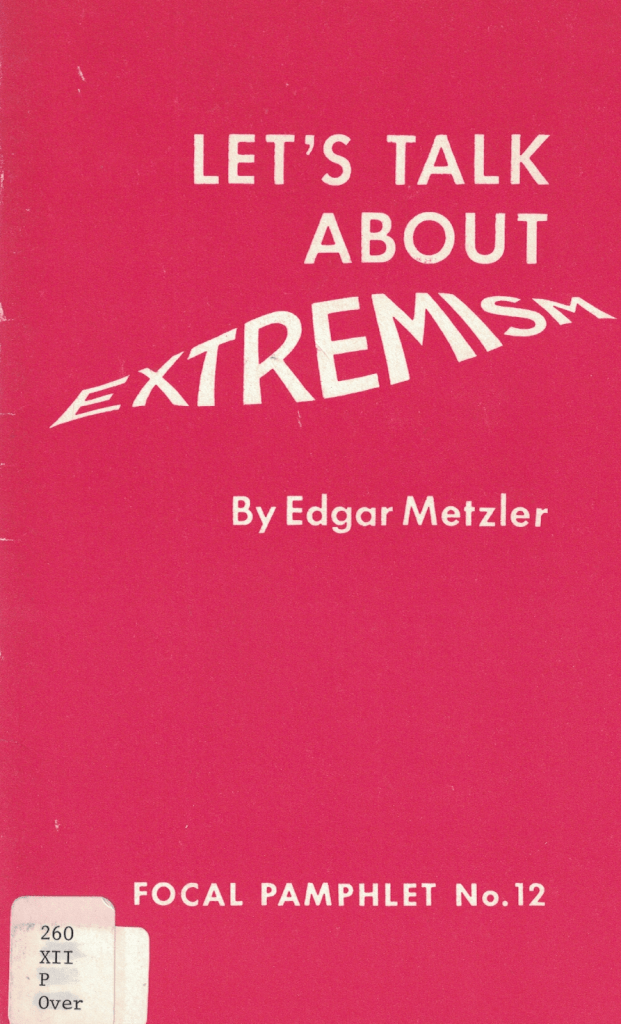
In 1968 a Mennonite pastor and peace worker named Edgar Metzler published a short booklet in the popular “Focal Pamphlet” series published by Herald Press – a series that includes other more widely read works by Mennonite historians and theologians like Harold S. Bender and J. Lawrence Burkholder. The brief preface on the inside cover gives some indication of its purpose and audience in the context of the American Mennonite experience during the late 1960s.
This pamphlet is prepared to stimulate the Christian’s peace testimony. Christians need constantly to return to the Bible to discover the message of the gospel. This message must be translated into living terms by every generation. The S. F. Coffman Peace Lectures are sponsored by the Committee on Peace and Social Concerns of the Mennonite Church. They are financed by an individual who has an interest in the message of the gospel of Jesus Christ as it relates to the social needs and the international tensions of the world in which we live.
Metzler’s text is situated amidst the international tensions alluded to above, particularly racial tensions and violence in the United States during the Vietnam War era. The pamphlet is titled Let’s Talk About Extremism, but what the author means by the term “extremism” calls for explanation, some of which the author provides in the first section of the text below.
Although other pamphlets in the series were more widely read, Let’s Talk About Extremism has only been cited a few times since it was published – most recently in a survey of definitions of radicalism and extremism.1 The lack of scholarly or public engagement with the text in the years since it was published is a problem that I hope to remedy in this edition.
In short, the argument of the pamphlet is that how we think about the relationship between extreme or opposed positions – whether they are political, religious, social, or a combination of all three – matters deeply. For Metzler, ways of thinking and knowing, or what scholars call “epistemologies,” are just as important for the Christian peace witness as more visible manifestations of violence like killing or war. Whereas Metzler refers to “extremism,” today we tend to refer to the problems he addresses by using the term “polarization.” In response to these problems, Metzler calls his readers to consider how hard oppositions between liberals and conservatives are clarified when we think about not only what we think, but also how we think, and how we express what we think.
But rather than staying within the bounds of the liberal-conservative opposition, Metzler enjoins his readers to reframe their vision of extreme positions by measuring ways of thinking against a different standard, asking: “Is this way of thinking closed or open?” Drawing attention to the presence of closed-mindedness at all points on the political spectrum (a pattern recently explored by Francois Cusset), Metzler advocates for openness. Against racist, nationalist, and religious prejudices, Metzler values a kind of open-mindedness that is able to listen to the other, take in new information, and charitably engage with “extreme” perspectives. By contrast, the closed mind is reactive, reliant on questionable second-hand sources, and unable to be moved. This is not to say, however, that Metzler advocates for a kind of passive middle way that sits between extremes and attempts to remain neutral on matters of justice. Rather, Metzler helps his readers to avoid the pitfalls of both polarization and neutrality.
One further benefit of how Metzler frames his argument for openness is that he leaves open the question of how this openness is authorized or validated. For Metzler himself, it is the peaceful figure of Jesus Christ who is the model for a more open epistemology. But Metzler leaves open the possibility of taking on his perspective without confessing Christian faith. Metzler’s resistance to oversimplification, selectivity, black and white thinking, appeals to fear, authoritarianism, and so forth, are critical values that can resonate with the priorities of Christians and religious ‘nones,’ secular and confessional Mennonites, and anyone who is concerned with the problems of our shared world. For this reason, perhaps anachronistically, I would characterize Metzler’s work as “postsecular” – where “postsecular” names a way of thinking that challenges the claims to superiority made by both religions and secularities.
One final point that makes Metzler’s work important today is his critique of conspiratorial thinking. His conversation with an alienated congregation member, as described in the final pages of the pamphlet, is a model for how to openly and critically engage with those who are given to conspiratorial thinking, while seeing through the content of such arguments to the narratives of rejection and victimhood that lie beneath. In a time when conspiracy theories are becoming more influential, concomitant with a decline in public trust and trust in expertise, I think it is essential to consider Metzler’s reminder that beneath the “extreme” positions of those who believe in conspiracy theories is often a common human desire to be heard and recognized. Again, this is not to say that Metzler’s work is a resource for those who would, in the name of ‘free speech,’ give an open platform for hate (for example, the conspiracism and violence of far-right groups). Instead, his concluding comments point to the deeper social roots of present political problems, and provide practical ways of challenging violent ways of thinking.
Editorial Note
In the digitized edition below I have made very few editorial interventions. I have left the original text entirely unchanged. My only additions are the footnoted references for the quotations provided by Metzler and some references to resources. Paragraph breaks, headings, and numbering have been preserved, along with older usage (ex. ‘catalog’). References to original page numbers appear in square brackets.
I am especially grateful to Edgar Metzler and his son Michael Metzler for their permission to publish this online edition of the pamphlet, and I want to acknowledge not only their support but also their conviction that this historical document still has much to teach contemporary readers.
Original Author Note
“Edgar Metzler was born in Masontown, Pennsylvania, where his father, A. J. Metzler, served as pastor for a number of years. He was graduated from Eastern Mennonite High School, Harrisonburg, Virginia, and received his BA and BD degrees from Goshen College and Goshen College Biblical Seminary, Goshen, Indiana. The latter degree was received in 1961. During 1966-67 he studied at the Graduate School of International Affairs at American University, Washington, D.C. Before he became pastor he served for two years as associate executive secretary on the National Service Board for Religious Objectors, Washington, D.C. He was ordained to the ministry in 1957 when he became pastor of the First Mennonite Church, Kitchener, Ontario. where he served until 1962. He was Executive Secretary of the Mennonite Central Committee Peace Section from 1962-66. In 1967 he with his family joined the United States Peace Corps as Program Officer in Nepal. He has served on the Peace Problems Committee, later the Committee on Peace and Social Concerns of Mennonite General Conference. He has written curriculum for Uniform Sunday School Lessons and articles for various publications in the areas of peace and social concern.” 2
Introduction
Have you ever called anyone an extremist? Or have you thought that someone was one? What did you mean? Likely you meant that he had certain ideas, patterns of thought, styles of expressing and discussing ideas, or actions which you considered to be unreasonable or irresponsible.
But that’s your judgment. He may think the same of your ideas and the way you support and express them. Extremism is thus not a very useful term. It is vague and difficult to define precisely. It is relative. One man’s extremism is another man’s moderation. Nevertheless, the term is in common use in our society. The term usually appears in the discussion of political and social policy and programs. In church circles the discussion may be intertwined or overlaid with religious and doctrinal issues.





 Anabaptist Historians
