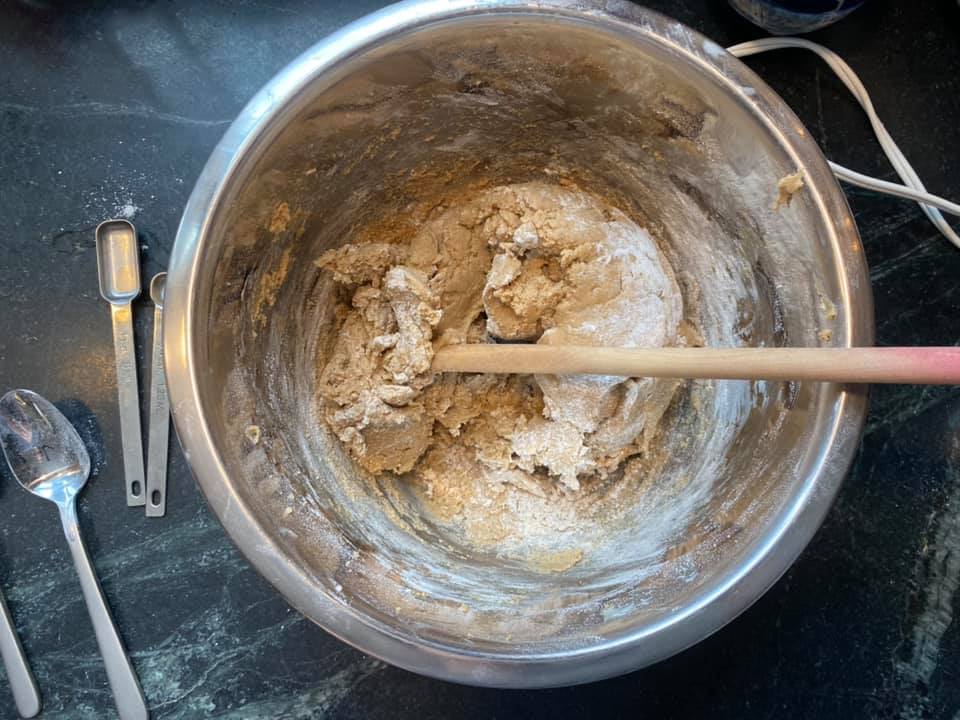
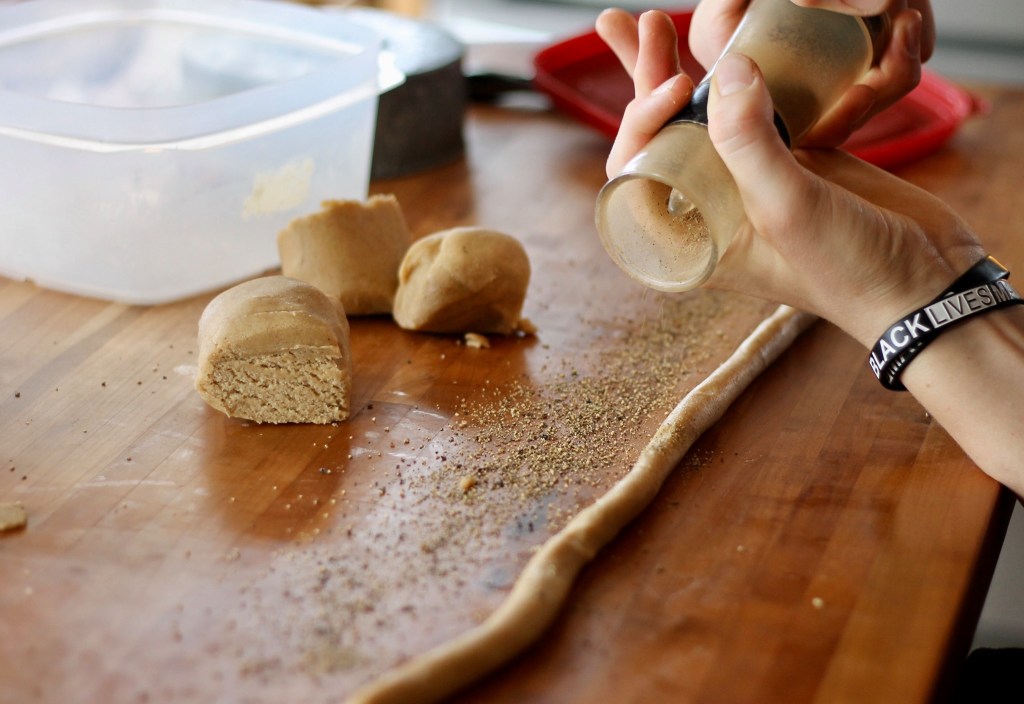
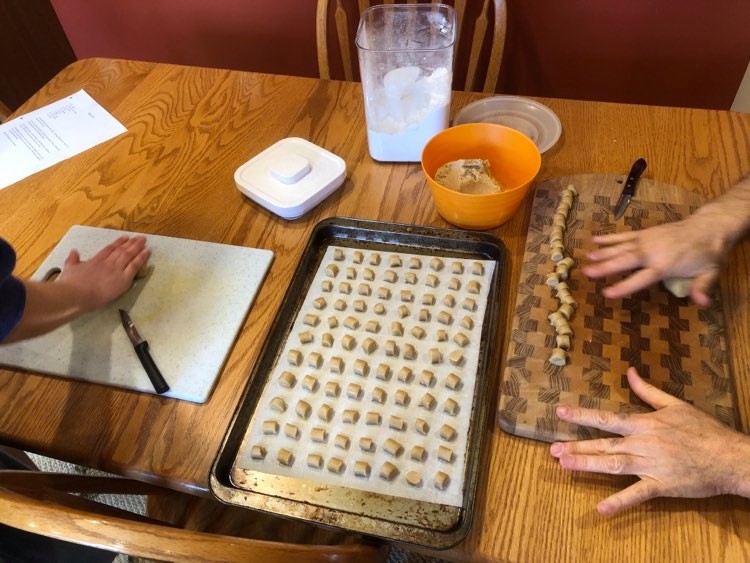
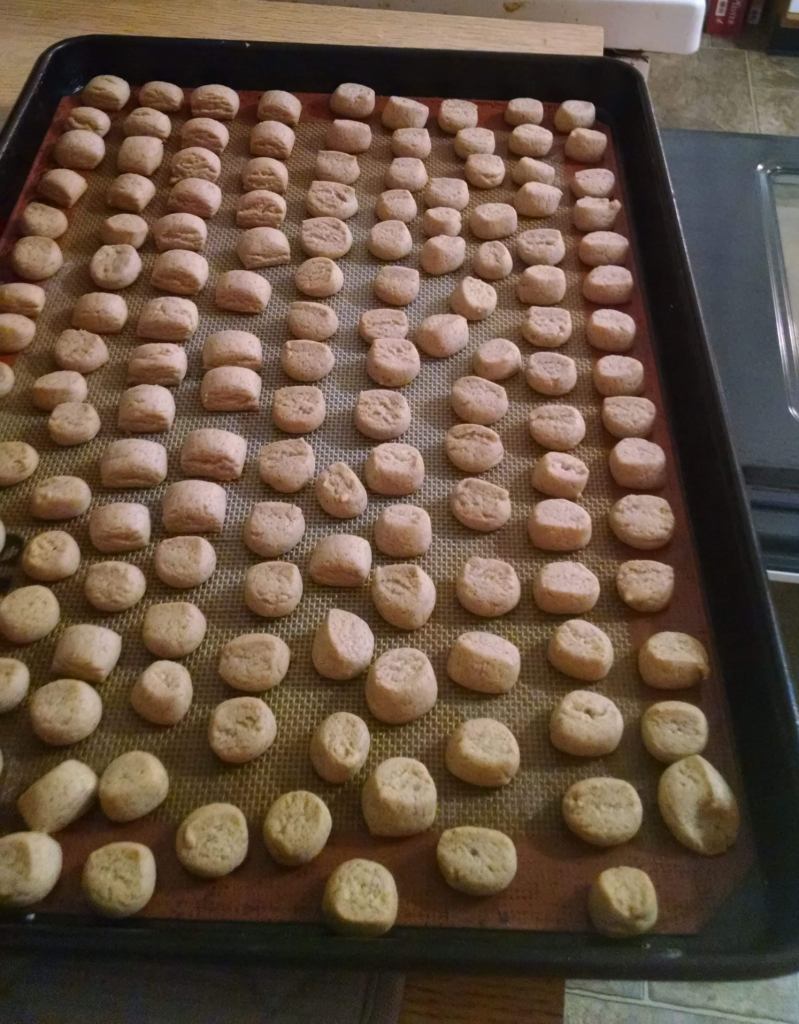
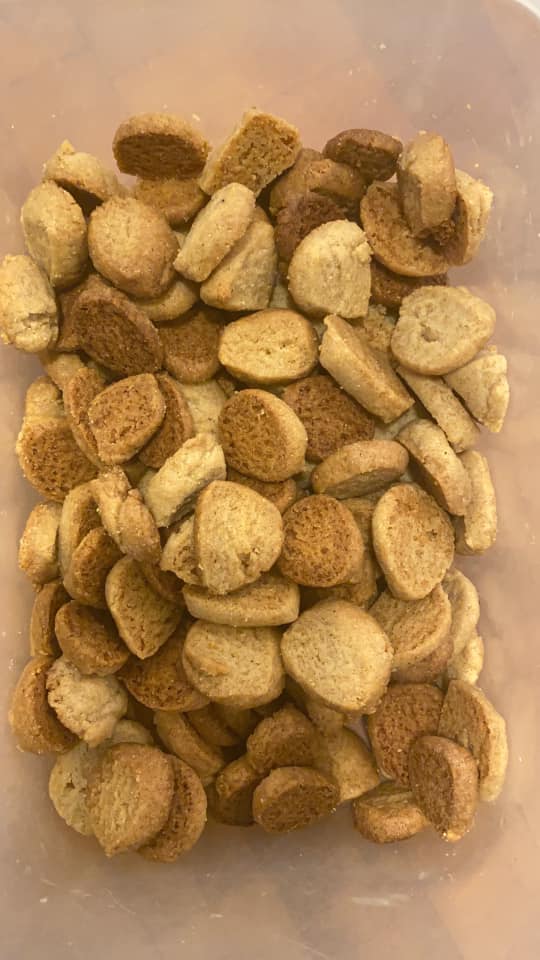
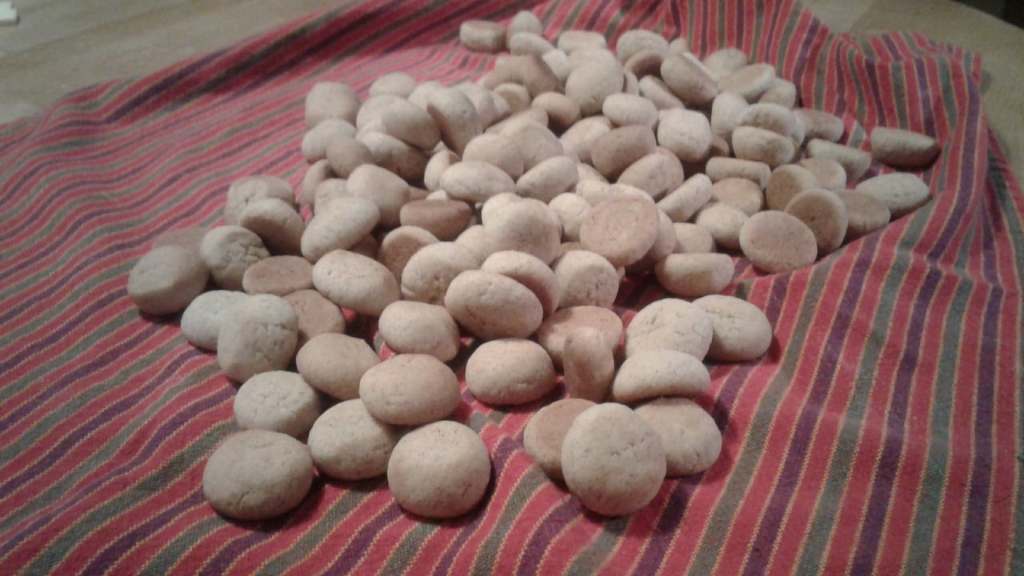
A number of Facebook friends graciously shared photos of their peppernut-making and peppernuts when I asked for photos this week. Thank you all for helping to demonstrate the diversity of this delicacy!
To me, Christmas has well and truly arrived when the peppernuts are made. Though both my maternal and paternal lines come from a Swiss-German Mennonite background, my dad began pastoring a General Conference Mennonite church when I was a young girl, which meant that my understanding of “Mennonite food” wasn’t Shoo-fly pie and fastnacht but pluma moos and peppernuts. No fewer than three varieties of peppernuts graced the cookie table at our Christmas Eve service, some small and spicy, others slightly larger with a mild molasses flavor. I loved them all.
As I prepared to make peppernuts this year, I became curious about their origins. I had always heard that they were closely associated with Mennonites (even Wikipedia says so!). But was that true? Where did this tradition come from? To try to discover the origins I did a quick survey of our cookbook collection at the Menno Simons Historical Library and struck gold when I found the two-volume Mennonite Foods & Folkways from South Russia by Norma Jost Voth. When I saw that it had a nearly 40 page chapter dedicated solely to “Christmas Peppernuts”, I knew I was in the right place!
I learned that peppernuts or similar cookies, “are made in most Scandinavian countries at Christmas. Pfeffernüsse are also made in northern Germany. However, the older recipes from the Russian Mennonite kitchens more closely resemble the Dutch or Scandinavian pepernoot or pebernødder cookie than the German Pfeffernüsse.”1 Voth also writes that “Peppernuts have been part of Russian Mennonite baking traditions for several centuries.” But “Whether or not this custom came from the Mennonites from Holland to the Vistula Delta in the 1500s has not been established.”2
Everyone I speak to about peppernuts mentions that each family they know who make them has a unique recipe or method for “their” type of peppernut. The recipes have all been tweaked as they have been passed down through families and across years and borders. And it continues on into the next generation! Earlier this month I was scanning the Nov. 19 issue of the Goshen College Record when a line in “The GC pandemic logbooks” caught my eye. Claire Franz writes:
“Made pfeffernusse today with Kristin. Even though we’re the only two Russian Mennonites in the house, we still managed to disagree about everything in the recipe. Ground anise or whole anise seeds? Chill the dough in the fridge or the freezer?”3
For her chapter, Voth collected over 33 recipes hailing from at least six different countries, though I’m sure the true number of peppernut varieties is many times more. The basic recipe is made from butter or shortening, sugar, flour, leavening like baking powder or soda, molasses or a similar syrup, and spices. The dough is chilled then rolled into logs and cut into coin sized rounds. The recipe variations in Voth’s volume included ingredients like lard, eggs, Karo syrup, watermelon syrup, candied peel, peppermint, anise seed, nutmeg, walnuts, almonds, honey, buttermilk, whipping cream, sour cream, cherries, pineapple, and even gumdrops, each adding a different flavor to the iterations (though I want to stress that no one recipe contained all of these ingredients).4
The more I read about these little spice cookies, the more I am convinced that folklore is a secret ingredient. The stories about peppernuts Voth captured in her volume were as delicious as the recipes. Some folks remember peppernuts being given by grandmothers to their grandkids to keep them quiet in church.5 Their small size also meant that they were perfect to fill the pockets of children “on their way to school or to do the chores.”6 Hildred Schroeder Wiebe recalls a tale her grandmother told of men throwing peppernuts to wolves to ward them off as they made their way by horse and sleigh into town. And there are a number of stories in Voth’s volume that describe hard Christmases where no treats can be expected, only to be surprised at the last minute by mothers or community members scraping together the necessary ingredients for a batch of peppernuts.7 Passing down the tales seems just as important as passing down the ingredients list.
Voth writes that as she compiled this chapter, “the testers and tasters came to these conclusions: The best peppernuts are crisp and very spicy. Anise is the most popular flavor. Pepper enhances the other spice flavors. The plain, traditional peppernut is still very good. This tradition will continue!”8 Traditional foods like peppernuts connect us in a very tangible way to the experiences of those who came before, and are a tasty way to pass down the past. May we all find ways to continue these traditions in this very untraditional year.
1. Voth, Norma Jost. 1994. Mennonite foods & folkways from South Russia. Intercourse, PA: Good Books, 366.
2. Ibid., 365.
3. Franz, Claire. “The GC Pandemic Logbooks.” The Record , November 19, 2020.
4. Voth, Norma Jost. 1994. Mennonite foods & folkways from South Russia. Intercourse, PA: Good Books, 372-402
Dr. Kat Hill, Senior Lecturer in Early Modern History, Birkbeck, University of London Dr. Simone Laqua-O’Donnell, Senior Lecturer in European History, University of Birmingham
In her memoir of her life in twentieth-century Ukraine in the Mennonite colony of Molotschna, Justina D. Neufeld (born 1930) expressed the sense of dislocation and displacement which often characterized diasporic belonging and the Mennonite experience of migration. She said that as a young girl growing up on the Steppe she never really felt like this was home, for her community spoke a different language and their pasts were rooted in the Netherlands. But alongside her sense of discomfort was also the idea of hope for a better future, for somewhere where they would feel at home. As she said, she always sensed they were pilgrims on a long journey which was not yet complete. “We had come from somewhere far away where people spoke our language, and we were hoping someday to leave this foreign land in which we now lived.”1
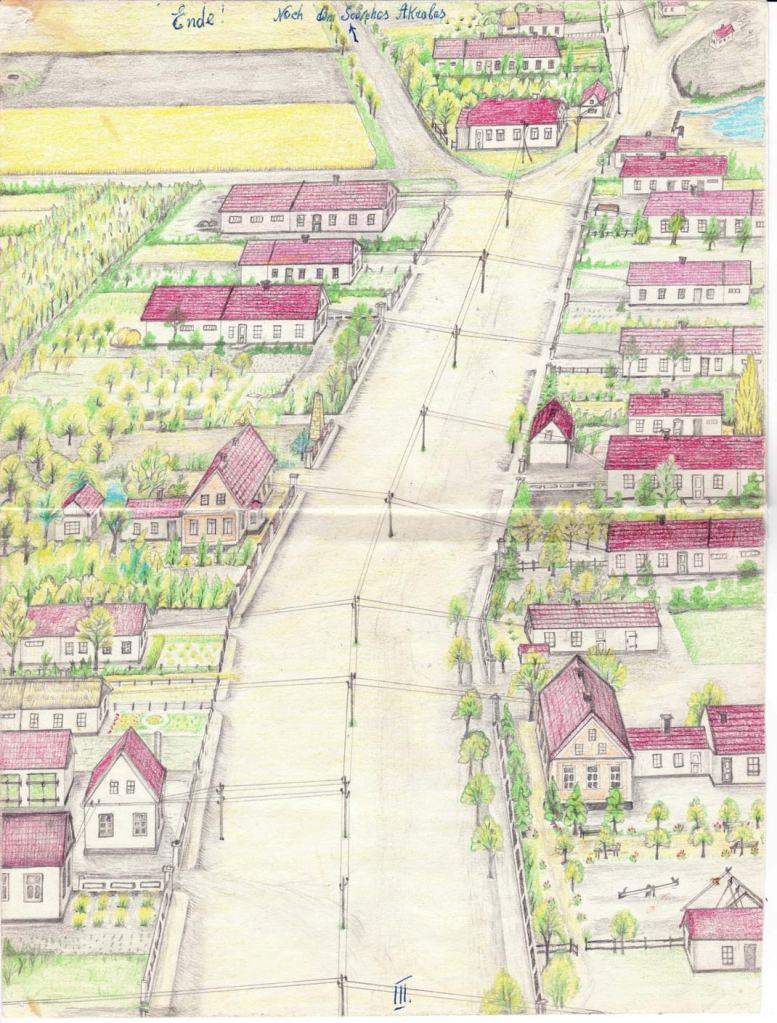
Altonau, Molotschna (1941), drawing by Johann Regehr.
This tension between here and there, present and future underpins what we might term utopian thinking and is prevalent in the imagination of many religious non-conformist groups. But why have communities turned to the idea of utopia? What was the significance of this idea? And how does it sit alongside other notions of idealized and hopeful ideations of place and time, such as the longing for a homeland in the diaspora or anticipations of heaven? These are questions which have come to feature in our research together, and this piece is an initial foray into answering these questions.
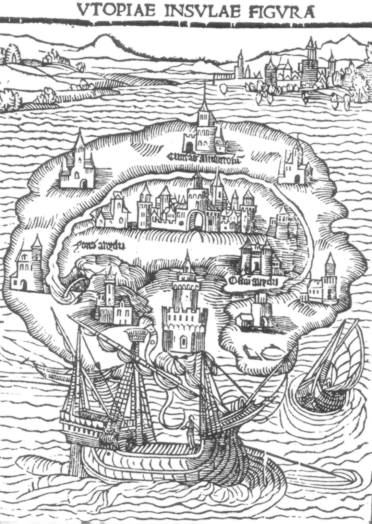
Utopia is imagined often as a place beyond reach, idealized, unachievable and fictional. Thomas More’s utopia was never imagined as a reality but as a dreamed-up land with tolerance of religious difference, no private property and a welfare state (although also slavery in a jarring reminder of the different world in which More lived).2 But for groups like the Mennonites it has been in constant touching distance and a tangible possibility in the here and now, not just a prospect in the afterlife. There may be similarities between utopia and heaven, but they also exist in different chronotopic frameworks. Utopia is distinct from the community of the faithful in heaven in that it is something which human hands can theoretically build, and it is also an ideal which exists in the temporal realm of human existence, not the sacred time of eternity. It is, therefore, a place believers can work towards rather than await in the afterlife.
If we understand Neufeld’s memoir in the context of utopia, however, it raises a series of interesting questions: Even though Mennonite communities often seem to believe a utopian future might be on the horizon and might become reachable through the plain lifestyle, when does utopia actually begin? And what is the role of human agency in its creation? Is it in the striving towards perfection perhaps? This constant striving for individual and communal perfection is essential to the community’s survival and has been an important dynamic in the migratory histories of the Mennonite diaspora and other similar groups. Scholars such as E.K. Francis and Leo Driedger have characterized the moments when Mennonites decided to migrate from Prussia to Russia, from Russia to Canada, as a search for utopia.3 But when is utopia actually achieved? Is it a place, an activity, or perhaps a time? Can it be found in the rural rhythm of an Old Order Mennonite’s workday? Does it have apocalyptic implications and is there any relationship between the New Jerusalem and utopia? These are some of the questions our research currently grapples with.
Utopias, of course, are also a form of critique of the modern world. By building the ‘city upon a hill’ or conforming to the romantic narrative of the withdrawn pastoral idyll,4 utopian groups comment on what is wrong with the world even when this is not explicitly their aim. There are many examples of utopian communities evolving from non-conformist Christian traditions that have built their vision of an ideal world in north America and beyond – branches of the Mennonite and Amish churches, the Shakers, the Amana colonies. This critique can take quite radical forms and often found its most provocative expression in the regulation of sexual relationships. Oneida was a utopian community founded by John Humphrey Noyes (1811-1886) in the mid-nineteenth century. The Oneida community practiced “complex marriage,” in which each man was married to each woman. Sexual relations followed a schedule and were recorded to assure no illicit favouritism occurred. Sexual intercourse fulfilled the threefold function to regulate pleasure and procreation as well as the creation of community. The radicalism of this set up not only lay in this practice of religious communistic love but also in the separation of sexual intercourse from procreation, which is of course highly controversial in Christian tradition.
For Mennonites, the wish to live their own idea of communal harmony has often manifested as the desire to be somewhere where they can be ‘the quiet in the land’, while the Amish have become famous for their simple way of life apart from the modern world. Whilst seen as ‘quaint’, or old-fashioned, the critique they offer of contemporary American culture does touch a nerve with wider society and goes some way in explaining the popularity of the Amish in wider society.5 Although the isolated and cutoff nature of Mennonite or Amish communities can mean that they are hard to maintain because new recruits are not necessarily welcome, they still attract an increasing number of those known as ‘seekers.’ Research has shown that these are particularly attracted to the stability offered by the plain lifestyle. It seems to offer a timeless utopia ‘reminiscent of America’s past, when small agrarian communities supported stable family relations, and religious and social customs provided the nation’s citizens with security and belonging.’6
These visions of Christian perfection have also been translated beyond their western contexts, clashing and mingling with other traditions. In 1972, former Buddhist monks in Owa, Japan formed a Hutterite colony with support from the Dariusleut Wilson Siding Colony near Lethbridge, Alberta. In a valley between low-lying hills about 165 km north of Tokyo, this group established their haven of communal living away from the urban demands of Japanese life.7 And there are many examples of utopian experiments beyond a western Christian framework. Auroville is an experimental utopian society in Viluppuram district in India founded by Mirra Alfassa (1878-1973) whose goal is human unity ‘above all creeds, all politics and all nationalities.’8 Whilst it is beyond our current research to investigate all these communities, they are examples of people who have stepped outside the contemporary world to critique of the world they live in in complex ways.
Conditions for utopia
Utopias need building, they need to be imagined as somewhere – even if that somewhere never comes to be. For Mennonites this has never been one specific place but rather a type of landscape or place which accommodates their idealisations. When Mennonites moved to the Central Chaco in the 1920s they were drawn to it because they mistakenly believed the landscape was a perfect grass farmland.9 Actually this dense jungle area, known as the Green Hell, was completely unsuitable for farming. Amongst many utopian groups, the idea of the ‘plain people’ has been crucial as has the value attributed to a simple, rural life, working the land. Kanter argues that a feature of utopian communities is the return to the land as a pathway to perfection.10 Many of the nineteenth-century American utopian communities sprang up when industrialization threatened patterns of life and the return to rural simplicity, by communities such as the Unitarians of Brook Farm in Massachusetts.
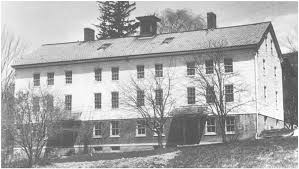
The construction of the utopian community exists in the social relationships between people – whether this is the emphasis on equality, Christian love, sharing of goods, or particular patterns of raising children, marrying or family structures. However, it is also reflected in the architecture and the layout of the communities which facilitate the communal lifestyle. The Shakers around Ann Lee (1736-1784) became widely known for the simplicity and functionality of their community layout and furniture designs. Larger communities also included dual spaces for men and women, emphasising their general striving for order and their celibate lifestyles.
Shaker Dwelling House, South Family, New Lebanon, by 1831. Undated photograph
Early modern Hutterites practiced communal living in the Bruderhof, with long buildings around a central common. The ground floor of larger buildings were workshops or spaces for communal living, whilst the top attics were living quarters for couples and their children.11 Mennonites settling in Ukraine in the late eighteenth and early nineteenth centuries, built villages along specific plans, family homesteads close to one another along a central street, and each with its own cemetery, schoolhouse, and administrative buildings. This sense of constructed perfection extends even to the dead. The Amana colonies designed cemeteries lined by pine trees, always facing east since they believed Christ would return from this direction, and individuals were buried by chronological order of death not by family group to emphasise equality. The whole community was united as one large family in death.12 The Moravian Brethren followed a similar principle.
The longing for utopia propels movement and migration but when communities do reach their utopia it remains unstable and in constant negotiation. The Oak Knoll Amish Mennonite Community are a community for whom some sense of a utopian present has been constructed by cutting themselves off from the modern world. Alarmed at rapid urbanization in California, in 1969 three families in Oak Knoll bought one thousand acres of land.13 To maintain this refuge from the modern world, however, they have a constant process of assessment and negotiation which decides which aspects of modern technology to allow into their “other world.” Threats can be internal as well external. What happens to utopia when the society begins to break down and the vision of perfection crumbles?
Utopian dilemmas
Religious utopian communities seem to look back to an older often imagined past which is, however, constantly being constructed. Does a utopia then look back or forward in time? Can utopias also exist in the past? A mirage of a golden past of perfection from which the contemporary world has declined often seems to fuel utopian ideals yet they also constantly look the future. Koselleck proposed the notion of the temporalization of utopia, as the faith in a future heaven and millenarian ideals declined and utopian ideals shifted to the secular world of now and the future.14 He argued that the ‘imagined perfection of the formerly spatial counterworld is temporalized.’
But this model also raises problems. How does this fit with Anabaptist legacies? Is utopia something which exists on earth or in heaven or beyond earth, and how then is it to be constructed? Is this something the Mennonites and other Christian communities would agree with? Do they feel connected to the notion of utopia? Would they not strongly disagree that their lifestyle is utopian and even more so that their vision is? After all, they are already living a kind of utopia in the here and now and the utopia of the afterlife is a certainty for them, not a dream.
1. Justina D. Neufeld, A Family Torn Apart (Kitchener, 2003), 21–23.
2. Thomas More, Libellus Vere Aureus Nec Minus Salutaris quam Festivus (London, 1516); “Utopia”, trans. John P. Dolan, in James J. Greene and John P. Dolan, eds, The Essential Thomas More (New York, 1967).
3. E.K. Francis, In Search of Utopia: The Mennonites in Manitoba (Glenco, IL, 1955); Leo Driedger, Mennonite Identity in Conflict, Studies in Religion and Society 19 (Lewiston, NW, 1988), Harold J. Schultz, ‘Search for Utopia: The Exodus of Russian Mennonites to Canada, 1917-1927’, Journal of Church and State 11.3 (1969), 487–512.
4. John P. R. Eicher, Exiled Among Nations: German and Mennonite Mythologies in a Transnational Age (Cambridge, 2020), 22–23.
5. Dachang Cong, ‘The Roots of Amish Popularity in Contemporary U.S.A.’, Journal of American Culture, Volume 17.1 (1994), 59–66.
6. Cory Anderson, ‘Religious Seekers’ Attraction to the Plain Mennonites and Amish’, Review of Religious Research, 58.1 (2018), 125–147, here 142.
7. Hiroshi Tanaka Shimazaki, ‘The Emergence of Japanese Hutterites’, Japan Review 12 (2000), 145–164.
9. Esther Breithoff, Conflict, Heritage and World-Making in the Chaco: War at the End of the Worlds? (London, 2020), 29, 37.
10. Rosabeth Moss Kanter, Commitment and Community: Communes and Utopias in Sociological Perspective (Cambridge, MA: 1972), 8.
11. John A. Hostetler, Hutterite Society (Baltimore, 1997), 35.
12. Jonathan G. Andelson, ‘Amana Cemeteries as Embodiments of Religious and Social Beliefs’, Plains Anthropologist 62 (2017), 181–200.
13. Duncan Waite and Denise Crockett, ‘Whose Education? Reform, Culture, and an Amish Mennonite Community’, Theory Into Practice 36.2: Exploring the Margins: Lessons from Alternative Schools (1997),117–122; Denise Crockett, ‘Lessons from a Utopian Community: Is a Critical Examination of Technology Feasible, Possible, or Necessary?’, Scholar-Practitioner Quarterly 4.3 (2010), 256–269.
14. Gregory Claeys, ‘Utopia at Five Hundred: Some Reflections’, Utopian Studies 27. 3, SPECIAL ISSUE: On the Commemoration of the Five Hundredth Anniversary of Thomas More’s Utopia—Part II (2016), 402–411; Richard Koselleck, The Practice of Conceptual History (Stanford, 2002), 85, 88.
The following is the fifth and final article in the series Trachtmaokas, Parteras, and Midwives: 100 Years of Maternal Care in Chihuahua’s Mennonite Campos.
The work of Casa Geburt Birthing Center and Midwifery Training School, featured in Part 4 of this series, has been gaining a lot of attention, locally in the Tres Culturas Region, as well as nationally in Mexico, since its establishment in 2016. The school has graduated 3 classes of midwives and continues to train midwives and doulas from traditional and non-traditional Mennonite backgrounds, as well as from Mestiza and Indigenous Rarámuri backgrounds. Graduates from the midwifery and doula programs are attending births in their home communities and the Casa Geburt Birthing Center provides services in the center’s birthing room, in clients’ homes, and in the local maternity ward through a partnership with Hospital Angeles in Cuauhtémoc.
The following link features a segment from the nationally syndicated news program, Milenio, titled, “Doulas y parteras menonitas en Chihuahua” (“Mennonite Doulas and Midwives in Chihuahua,”) which was originally broadcast January 21, 2020. English subtitles are available by using YouTube’s closed captions feature and a translated transcript is also available below.
Translated Transcript “Menonite Doulas and Midwives in Chihuahua”
[Translation from Spanish] And now we go to Chihuahua where they have created a midwifery and doula school that serves the Mennonite community in Cuauhtémoc so they have options–alternative options, as well as, traditional options to give birth to their babies. Norma Ponce has the complete report.
[Speaking English] Katia LeMone: My name is Katia LeMone and I am a midwife and herbalist and I’ve been here in Cuauhtémoc since 2015. I moved here at the end of 2015 at the invitation of the Mennonite community.
[Translation from Spanish] Norma Ponce: Mennonites in the municipality of Cuauhtémoc began the work of bringing an American doula and midwife to their community to facilitate births that were more humanizing and in accordance with their traditions.
Aggie Froese: In regards to Mennonite women, there is often a language barrier and no one to attend to them in the hospitals. The objective is to give them more options and to give them a different, more beautiful experience.
Clara Enns: Well, we were losing this tradition and we didn’t have anyone to learn from, but once again, the need has arisen. Young couples are searching for a midwife.
Norma Ponce: With the help of the community, Katia created Casa Geburt, a school for doulas and midwives that serves and supports mothers and gives them the opportunity to give birth at home, at a birthing center, or in the local hospital.
Diego Fernández: Yes, it’s something unusual. It’s probably not something you’d find in any other hospital in Mexico. What’s important to us is to raise the quality of healthcare in a region, in a community, which because of their customs, for many years, until recently, has been isolated.
Norma Ponce: With a population of more than 50,000 Mennonites, doulas and doctors from the region have learned to work cross-culturally, respecting their traditions, which has led to a lowering of C-section rates and a greater demand for more humanizing births.
Dr. Guiller Stauferd: We’re wanting to create an atmosphere where the patient feels relaxed, like she is at home and not at a hospital or a hotel. Where she feels like she is receiving good care in her home, but knows that she has complete hospital access within 10 or 20 steps.
Norma Ponce: They have witnessed such great success that Mexican [Mestiza] and Rarámuri women are beginning to see this group of doulas and midwives as an option. From 2016 to today, more than 125 babies have been brought into the world through the hands of these women.
Angélica Galaz: I met these women at a Christmas fair, from the first appointment I had, I felt very confident in them. They give you all the time you need. They answer all your questions. It was very different from what I was used to.
Delma Cecilia Martínez: They charge what people are able to pay. The women give them what they can. They create a secure environment where women feel cared for and protected, within the hospital.
[Speaking English] Katia LeMone: The Rarámuri didn’t have any money to pay, but they wanted a partera [midwife] to help them. I’ve had women do a lot of sewing for me. And we’ve had Mennonite women who couldn’t afford do canning of fruits and vegetables for us. We’ve had people clean houses.
[Translation from Spanish] Norma Ponce: From Chihuahua, with images provided by Daniel Ramírez, this is Norma Ponce with Milenio News.
Aggie Froese: It’s high time that we change how mothers bring their babies into the world.
This nationally syndicated broadcast reveals changing sentiments locally and nationally to midwifery and highlights the work of midwives in the Tres Culturas Region, offering them public recognition for work that had largely gone unnoticed for almost a century.
The following accounts were collected by Casa Geburt doulas and midwives who gave the Rebels, Exiles, and Bridge Builders Oral History Project (REBB) permission for their use. These accounts reveal many of the recurring issues that have faced women giving birth in the Campos Menonitas of Chihuahua over the last 100 years such as: linguistic and other communication barriers; pregnancy loss and infant mortality; fear and distrust of the medical establishment; high C-section rates; the intersection of traditional midwifery and modern medicine, as well as and the role of the doula and midwife as a comforter and advocate. These accounts were translated from German to Spanish by Sarah Banman, a midwifery school graduate who currently attends births in her community. The Spanish to English translation was done by Abigail Carl-Klassen.
The first account, from a woman who chose to remain anonymous, details difficulties faced by her mother-in-law, mother, sisters, and friends in childbirth:
My mother-in-law had all of her babies by Cesarean. And my mother had extremely difficult births because the doctor did not give her the care she needed. She had to lay in the bed, not allowed to get up, suffering for hours. She had her last two babies by Cesarean.
Two of my sisters had difficult births and the other two sisters had their children by Cesarean. The majority of my friends had their babies by Cesarean. The reason that the doctors do it this way is so that the woman does not suffer so much pain and for the doctor it’s faster.
She continues, describing her fear of the hospital and what she believes to be a case of medical malpractice experienced by her sister.
My husband and I don’t know a lot about hospitals or therapies; because so far we have only gone to the hospital to visit family. There are things that still scare us about going to the hospital in the city or having a baby in a hospital.
Another reason why I didn’t have my birth with a doctor was because of an experience one of my sisters had. My sister was expecting her second child, but she hadn’t realized it yet and she was not feeling well and she went to the doctor. He told her she had something in her uterus and needed to see a specialist. The specialist examined her and told her it was something very serious and needed to take medication. If the uterus did not clean itself out after a few days she would have to have a surgery.
My sister and her husband had the presence of mind to think that maybe she was pregnant and they waited to use the medicine that had been prescribed to them by the doctor to clean her uterus. Instead, they took a pregnancy test, which came back positive.
If they had followed the directions of this doctor, today I would not have this beautiful, healthy, and strong nephew. Many doctors do not respect the trust that people put in them and they care for them at their own convenience.
She describes her own birth and the ease and safety she felt with the midwives:
The most beautiful and wonderful experience I ever had in my life was the birth of my daughter. She was born at home, and the birth went well. Although I had a lot of strong pain, I was comfortable to be at home and the service from the midwives was the best. The most valuable part of the experience was that my husband was at my side to support me as best as he could and the baby was born in her father’s arms.
I am currently expecting my second baby and we didn’t question for a second who we were going to receive care from during this pregnancy, birth, and post-partum period. We feel at home with the midwives and I have fallen in love with the kind of care they provide.
The second account, provided by Mina Gunther, echoes many of the challenges and positive experiences described in the previous account, but also highlights the positive experiences she had at Casa Geburt concerning the partnership they had with her gynecologist and how they walked beside her through the difficulties she encountered in her post-partum period:
My name is Mina Gunther. I want to write a little about my story and my experiences with the midwives at Casa Geburt Cuauhtémoc Chihuahua. For my second pregnancy I decided to go the midwife Katia LeMone, for all maternal services and to have a home birth, since my first pregnancy where we had Dr. [Redacted] attending me, ended at 25 weeks with an extremely premature birth, where the baby did not survive. For this reason, we decided to change and have Dr. [Redacted] as our gynecologist, whom we would like to thank for his professional care and support when he knew we were planning a birth with the midwife that he approved of.
Dr. [Redcated] explained our situation clearly and supported us at all times and was very honest about the situation. We had monthly appointments with the midwife until the third trimester, and after that we had weekly appointments. At Casa Geburt they checked: Pulse, Blood Pressure, Weight, Hydration, the Position and Heartbeat of the Baby. The last weeks before the birth and the first appointments postpartum, they made house calls.
I had the opportunity to choose the position that was the best and most comfortable for me. During labor they gave me the time I needed and did not pressure me.
They taught me lactation when I had complications since I didn’t have any experience and they gave me all the instructions on how to do it and it helped me so much which makes me very happy. They explained everything to me and answered all my questions and brought me everything I needed. And they inspired me to eat healthy, drink lots of water and take vitamins. They were also accepting of our decision to have Dr. [Redacted] as our gynecologist. They were not against any medication given to me by the gynecologist though they always try to help people in the most natural way possible.
She reflected on the future, confident in her ability to make choices about her reproductive health and the quality of care she would receive.
I am very thankful to God, because without him our beautiful boy would not have been born and to the midwives for their presence for being peaceful and waiting until the right time to give birth….If I become pregnant again, I will choose them and have a home birth because of the professional care and experience. I would recommend Casa Geburt as a place where the mother and baby are the highest priority and they are not motivated by money, but the well-being of mothers and babies. They have made a big difference in the community in the years they have been offering this service.
Though the Campos Menonitas, Cuauhtémoc, and and the surrounding Tres Culturas Region have undergone significant socio-political, economic, ideological and cultural shifts in the 100 years since the Mennonites’ arrival in 1922, midwives and their commitment to accompany and advocate for women in all aspects of their reproductive health remain as important as ever. In many ways, today’s midwives are far removed from the experiences of Caterina Shroder and Susanna Shellenburg, whose work as midwives in the Campos Menonitas of Chihuahua in the early and mid-20th Century, was featured in Part 1 and Part 2 of this series; however, they still embody the same drive and spirit of service which propels them to confront reproductive health taboos and navigate cultural dynamics that often prohibit or discourage connection between women from different communities, in order to provide maternal care to women from all backgrounds regardless of religious affiliation, language, or ability to pay.
Today, after nearly a half-century of decline, midwifery is undergoing a resurgence not only in Mennonite communities in Chihuahua, but all across Mexico, particularly in rural areas and Indigenous communities. A MacArthur Foundation report on public health in Mexico found, “In recent years, more than thirty organizations—from small, indigenous led organizations, to government institutions and non-profit organizations—have worked together to bring back professional midwives with the hopes of improving access and quality of care for mothers and babies and respecting the reproductive rights of women. This movement wants midwives to be more respected and acknowledged and for them to be seen as a safe and reliable alternative, which according to many women is more comfortable and dignified than current hospital methods, especially in rural areas. After education and promotion, the number of training programs has grown to more than a dozen and the number of clinics that work with midwives has doubled. Hundreds of seminars, workshops and basic courses have become available to health authorities and practitioners throughout the country.”1
Casa Geburt Birthing Center and Midwifery School, located in Campo 6 ½ in the Manitoba Colony, approximately twenty kilometers north of Cuauhtémoc, is part of this movement to provide “partos humanizados” or “humanized births” that respect and empower women to be active agents in their reproductive choices and experiences. Founded in 2016 by Katia LeMone, a midwife, and public health practitioner with more than thirty years of experience, Casa Geburt is at the center of reproductive and maternal care in the Tres Culturas region of Chihuahua. Originally from New Mexico, Katia relocated to the Mennonite Campos in 2015 at the request of members from the Mennonite community to train doulas and midwives in the Tres Culturas Region.
In 2018, she shared how her decision to become a midwife and to train midwives had its origins in an encounter she had with an Indigenous Rarámuri woman in Chihuahua in the late 1970s with the Rebels, Exiles, and Bridge Builders Oral History Project (REBB)2:
In 1979, I was living in Parral and I met a Tarahumara [Rarámuri] woman on the street and she invited me to her house. We were talking and drinking tea and she asked me if I wanted to see her “instruments.” She showed them to me and said, “I’m a midwife. I help women give birth.” I was very interested and when I returned to the United States, I volunteered in El Paso with some friends of mine who were training to be midwives. At that time, I had a transformative experience during a difficult birth and I decided that I not only wanted to be a midwife, but I also wanted to train midwives. Women didn’t have and still don’t have access to the care that they need. I wanted to be an advocate for women and provide them with what they need. The important thing is women supporting women.
Katia had her first client from the Campos Menonitas in Chihuahua come to her midwifery practice in New Mexico in 2008, a Trajchtmoaka who was well known in the community, and by 2014, Katia had attended more than twenty births for Mennonite women from the Campos.
After a few years [of attending births], I was invited to come to the Campos Menonitas and teach some training classes in the community. The first time, I came for ten days to train doulas, but in December of 2015, I moved to the Campos to train midwives because there was a high demand for the course. My goal was to train women who could then later train others in Low-German. We have had two graduating classes from the midwife training course so far. The first class had fifteen participants and all of them were Mennonite, both liberal and conservative. There were students from such conservative communities that I was surprised that they wanted to come and train with us. In the second class we had 7 Mennonites, 2 women from the Rarámuri Pueblo and a Mestiza woman. In the second class I tried to integrate public health training in order to create relationships with churches and the community.
She continued, sharing about the challenges, successes and future goals for the work of Casa Geburt in the Campos Menonitas and the larger Tres Culturas Region.
We have really high maternal mortality rates and in this environment midwives and doulas have to be promotors of public health3. We have really big goals. I couldn’t have imagined what we have been able to accomplish. In 2016, we opened the Casa Geburt Birthing Center and Midwifery Training School. We have partnerships with La Asociación Mexicana de Partería (The Mexican Association of Midwifery) and some hospitals. We want for every woman to have quality care in her mother tongue. This is what I would love to see. There is always the goal of raising up more Mennonite women to be educators, midwives, childbirth educators, breastfeeding educators, doulas. To raise up those ranks so that we have a doula for every woman. A midwife that every woman can feel comfortable with. And then, the Tarahumara [Rarámuri] community, and working with them. Developing our program so more of our programs can be in Spanish and Tarahumara [Rarámuri]. More of them can be in Low-German. Those are the things that are all really important to us. The ultimate goal would be to have a functioning school with dormitories that’s associated with the Maternity Center Clinic where women in any of these communities could come in, and get care by women from their community.
Clara Enns, a seamstress and midwife from the Swift Current Colony in the Mennonite Campos in Chihuahua, Mexico, was one of the first graduates from Casa Geburt’s Midwifery Training Program in 2016. She spoke with REBB about the importance of Low-German speaking midwives and doulas as public health practitioners, educators and advocates in the Tres Culturas Region of Chihuahua4.
The return to midwifery is really modern in a lot of ways, but there also is a respect and a deep knowledge of the traditional, of what used to be. Deep down that makes sense to many of the traditional women. In our communities there’s a lack of information, a lack of education. Childbirth and women’s health in general, is not talked about. There’s very little knowledge. There’s a shame surrounding it. Women have lost the information they did have. Breastfeeding is completely a lost art for so many women here. The high rate of C-sections needs to change5. The World Health Organization guidelines are there and we need to change6. Mexico in general has a very, very high C-section rate, and is being pushed and incentivized to change that7. We Mennonites form a big part of that. The C-section rate in our communities is much, much higher than it is in general in Mexico in general8. A big part of it is language barrier. It may be the biggest one. We have a lot of traumatized women. We want to empower women in our community to take back what they need.
The fifth article in this series will feature first-hand accounts of present-day pregnancy, birth and post-partum care in Chihuahua’s Campos Menonitas, and will explore perspectives concerning midwifery within and outside the Campos, including the transcript from a segment that aired on the nationally syndicated news program El Milenio in early 2020 that featured Casa Geburt.
2. Katia LeMone, interviewed by Abigail Carl-Klassen, Rebels, Exiles and Bridge Builders: Cross-Cultural Encounters in the Campos Menonitas of Chihuahua Oral History Project, Mennonite Heritage Archives, 2018.
3. World Health Organization Maternal Mortality Rate for Mexico, 38/100,000 (2015).
4. Clara Enns, interviewed by Abigail Carl-Klassen, Rebels, Exiles and Bridge Builders: Cross-Cultural Encounters in the Campos Menonitas of Chihuahua Oral History Project, Mennonite Heritage Archives, 2018.
5. World Health Organization Estimate for Medically Necessary C-section Rate, 10-15% (2017); World Health Organization C-section Rate for Mexico, 45.5% (2017).
6. World Health Organization Statement on C-Sections, “While many women in need of caesarean sections still do not have access to caesarean section particularly in low resource settings, many others undergo the procedure unnecessarily, for reasons which cannot be medically justified. Caesarean birth is associated with short- and long-term risks that can extend many years beyond the current delivery and affect the health of the woman, the child and future pregnancies. These risks are higher in women with limited access to comprehensive obstetric care.”
7. Word Health Organization C-section Rate for the state of Chihuahua (2017), 37.6% (public facilities) 60% (private facilities).


 Anabaptist Historians