Encountering Race, Creating Place, and Opening Space in the Hardings’ Mennonite House

In the early summer of 2020, I began drafting this essay about the Atlanta Mennonite House in the early 1960s as a vignette of the Civil Rights Movement and the Mennonite community. Created by black Mennonite leaders Vincent and Rosemarie Harding in 1961, the Mennonite House was both the organizational center of a voluntary service unit and an influential place in the geography of the Civil Rights Movement. However, the brutal murder of George Floyd on May 25, 2020, the spectacular resurgence of the Black Lives Matter movement, and the outburst of violence against people of color have thrust the needs and demands for racial justice to the forefront of the American social conscience once again. In such a contemporary situation, this short article has taken on increased pertinence and purpose. Although this study remains focused on the past, it is also an opportunity to reflect and learn about our present situation. Perhaps, in this time of turmoil, with the potential for significant change on the horizon, American Mennonites and others can find contemporary guidance in the early history of the Mennonite House. Significantly, this vignette of the Civil Rights Movement and the Mennonites highlights the importance of creating place and opening space for the cause of racial justice. As was the case in 1961, this process often requires institutional support, buy-in, and the funding of ideas to make a meaningful impact. To begin such a study of the Mennonite House, we must first understand the people who created such an significant place—Vincent and Rosemarie Harding.

Vincent Harding joined the General Conference Mennonite Church in 1957 and was soon appointed as a pastor at Woodlawn Mennonite Church in Chicago. His entrance into the Mennonite fold was rooted in his fascination with sixteenth-century Anabaptists, whom he discovered during his graduate studies at the University of Chicago. He was drawn to the “discipleship, self-sacrificing love, [defiance of] the power of kings and rulers . . . [and] willingness to accept death rather than inflict suffering” demonstrated by early Anabaptists, and he was eager to apply the ethics of “peacemaking, reconciliation, and nonviolence” to the burgeoning Civil Rights Movement.1 While at Woodlawn, Vincent met Rosemarie Freeney, a public school teacher in Chicago who had been attending a congregation in the “old” Mennonite Church, another Mennonite denomination, since 1951. They were married in 1960 and created the Mennonite House in Atlanta that next summer.2

Together and as individuals, the Hardings were “involved in trying to encourage that traditional peace church community to think more fully and creatively about how it could relate to the Freedom Movement,” and to see the “natural connection” between the Movement and Mennonite theology.3 Indeed, the Hardings’ dual identities positioned them to be effective agents for pushing Mennonites further to seek integration, practice nonviolence, and witness to society. On the one hand, the Hardings’ leadership, faith, and action within the church made them Mennonites among Mennonites. On the other hand, they were black people born outside of the Mennonite fold. This gave them a distinctive vantage point to guide white Mennonites toward their unrealized potential and criticize them for their shortcomings. The Hardings’ unique identity, personal investment in the Civil Rights Movement, and strong advocacy for Mennonite involvement in the Movement were critical in creating the Mennonite House.
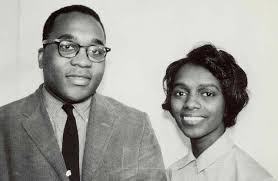
Vincent and Rosemarie Harding. Source: The Mennonite, March 20, 1962, 207.

In the late summer of 1961, the Peace Section of Mennonite Central Committee (MCC) established a voluntary service (VS) unit at 504 Houston Street, Atlanta, Georgia.4 The Peace Section appointed Vincent and Rosemarie Harding as its first directors, and as the first black directors of any MCC VS unit.5 Such an appointment was natural, as the Hardings had long been agitating for a greater Mennonite presence in the heart of the Freedom Movement. The Atlanta unit, which identified almost exclusively as “the Mennonite House,” was formed to “witness to the Christian way of love and self-sacrifice in all aspects of life.”6 This was part of MCC’s response to the Hardings’ charge for Mennonites “to think more fully and more creatively about how it could relate to the Freedom Movement.”7 This open-ended commission reflected the Peace Section’s recognition of the theological and social space the Hardings had carved out for themselves among socially-reticent white Mennonites. Indeed, the Hardings, with the support of MCC, created the Mennonite House with the explicit purpose of establishing a Mennonite presence in the Freedom Movement and connecting Mennonite volunteers with the work of the Movement. The MCC Peace Section recognized the importance of establishing a physical presence in the South to facilitate meaningful work. By 1961, Mennonites had made progress in the way of race relations, but much of that progress had come in the form of conferences, study groups, and statements. In 1961, much work remained to be done. Boldly, the Peace Section recognized that “Christian obedience may at times lead to violation of government laws and regulations.”8 Such a statement was reflective of Mennonites’ theological and practical departure from their traditional posture of nonresistance during the civil rights era.9

The Hardings’ dual identities helped imbue the Mennonite House’s work with a respectful, just, and Christ-centered spirit of volunteerism, rather than one of ‘white savior’ patronage. “The privilege is really ours to be allowed by God and by our brothers of the South to share in so noble a climb [toward justice],” the Hardings wrote, advertising the Mennonite House. “They urge us to come, not to carry them, not to patronize them, but simply to add our own lives to the brave company of persons who believe that God calls men to a better way than the path of segregation, discrimination, and hatred.”10 The Hardings placed volunteers—often numbering in the thirties during the summer months—with local social work organizations and community centers, the nationally known Southern Christian Leadership Conference (SCLC), and the Student Nonviolent Coordinating Committee (SNCC).11

Although the Mennonite volunteers who came to Atlanta did so with a desire to participate in the Freedom Movement, many quickly were forced to face the racism and classism that existed in their own hearts and minds. Living and working in Atlanta often came as a rude awakening for the volunteers, known colloquially as VSers. Many were struck and even staggered by the realities of racial injustice in the city. The Hardings found such attitudes and feelings unsurprising, seeing that many of these volunteers came from rural, white, Mennonite communities in the Midwest and Canada. They worked diligently to enlighten their volunteers. Reflecting on her time with the VSers at the Mennonite House, Rosemarie believed that their VSers did good meaningful work and were transformed for the better while working in Atlanta.12

Under the Hardings’ leadership, the Mennonite House certainly fulfilled its charge from MCC to connect Mennonites to the Freedom Movement. But the Hardings made the Mennonite House something far more than a home and organizational office for Mennonite VSers involved in the Civil Rights Movement. It became, in Vincent Harding’s words, “a kind of Movement center.”13 In the context of the Movement, the Mennonite House was unique in that it was the only place in Atlanta where white and black people lived together in community. “That life together,” Vincent remarked, “was a project in itself.”14 In addition to the Hardings and Mennonite volunteers, dozens, if not hundreds, of neighbors, scholars, theologians, and activists spent time sitting around the Hardings’ dining room table engaging in lively discussion, debate, and reflection. Those who gathered at the Mennonite House included Staughton Lynd, director of the SNCC; Andrew Young, SCLC leader and later prominent politician; Howard Zinn, a young American historian; and Fannie Lou Hamer, a well-known civil rights activist.15 Moreover, activists from the Civil Rights Movement, the Nation of Islam, and the Black Power movement came together under the Mennonite House’s roof. Among the most prominent and frequent guests at the Mennonite House were Martin Luther King, Jr. and his wife Coretta Scott King, who lived just around the corner. Coretta would often visit to spend time with Rosemarie and the volunteers. Rosemarie believed that Coretta found their “little community house relaxing, maybe even a bit of a refuge.”16 Most of those who spent time at the Mennonite House found it to be a place of solace, a place where white and black people alike could share their experiences, process their emotions, and grow together.

The close relationship the Hardings developed with the Kings while in Atlanta became a central feature in the Hardings’ participation in the Civil Rights Movement. Not long after the Hardings’ arrived in Atlanta in 1961, King approached them with an invitation to join the SCLC and “help keep this a Christian movement.”17 Throughout the summer of 1962, Vincent and Rosemarie Harding traveled back and forth between Atlanta and Albany, Georgia, splitting their time between their Mennonite House responsibilities and the Civil Rights Movement. They did similar work with King and the Movement in Birmingham, Alabama, in the summer of 1964.18 Rosemarie recalled that while in Albany, they “quietly encourag[ed] conversation between black organizers and sympathetic whites, counsel[ed] movement participants, help[ed] to write speeches, and participat[ed] in the mass meetings, protests and marches at the Movement’s heart.”19 Through all of this, the Hardings felt called as Mennonites to teach and converse with others about peace and nonviolence—both as a tactic for the Movement and as a personal, faith-centered way of life.20

The Mennonite House, however, did not shelter those living there from the ugly realities of racism. In the early 1960s, those on “the front lines” of the Civil Rights Movement were often emotionally spent, physically exhausted, and at times severely wounded. The Mennonite House quickly became a place of physical and emotional healing. Fannie Lou Hamer originally came to the Mennonite House because she had been “brutally attacked [and] badly bruised” while working in Mississippi.21 Instead of being taken to a hospital, Hamer was brought to the Mennonite House by Andrew Young and others for a few days of rest and healing. Moreover, while this project of interracial community-building found wide acceptance among those sympathetic to the Freedom Movement in Atlanta, it was still a place that challenged a racist status quo. One VSer recalled that police cars would often slowly drive back and forth in front of the Mennonite House, “trying to check out what was going on” in there.22
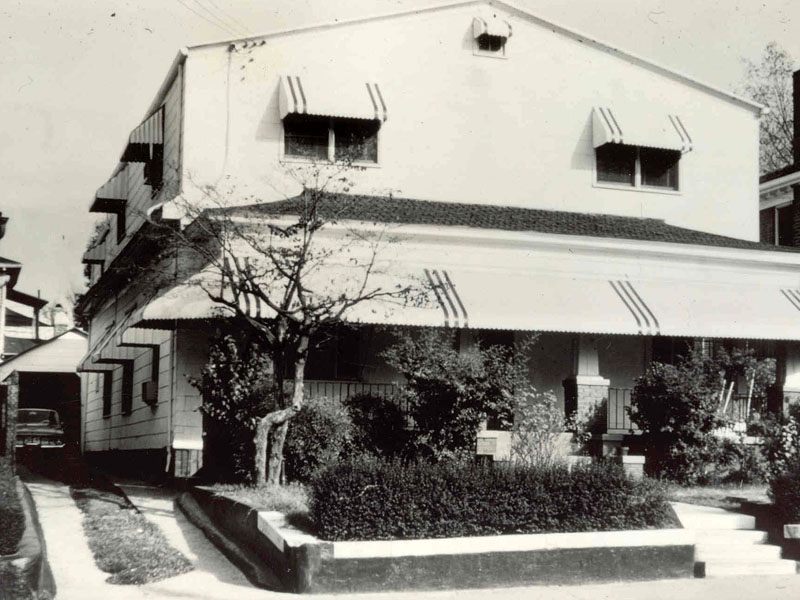
The Mennonite House, at 504 Houston Street, Atlanta Georgia. Source: The Mennonite, March 20, 1962, 207.

The Hardings had a distinct vision for what the Mennonite House should be—a center for the Movement which existed in a context far broader than that of the Mennonite community. They understood their work in Atlanta to be groundbreaking on several fronts. First, they were pushing the boundaries of how Anabaptist-Mennonite theology could be understood and practiced. Second, as Rosemarie reflected, the importance of the Mennonite House was that it “was one of the places, perhaps one of the few, where interracial conversations and community was being consciously created in the South. Our work encouraged that impulse in the life of the city of Atlanta and in the life of the Freedom Movement.”23 The Hardings surely fulfilled their commission to “witness to the Christian way of love and self sacrifice in all aspects of life” in ways that few—if any—Mennonites at the time would have.24 During their time with the Mennonites, the Hardings pushed Anabaptist-Mennonite theology and social action outward in the cause of racial justice. In terms of their work at the Mennonite House, this pioneering occurred in the theological and social space the Hardings had carved out for themselves among Mennonites.

Reflecting today upon the early history of the Mennonite House, American Mennonites (and others) can find significance in what the MCC Peace Section did and did not do. The creation of the Mennonite House in Atlanta was a direct result of the early agitation of the Hardings. To a large degree, the Peace Section put their institutional, material, and spiritual support behind the Hardings’ Atlanta project while simultaneously providing the Hardings space to explore and realize new social applications of Anabaptist-Mennonite theology. This space, however, was conditional and more a result of the Hardings’ constant efforts than the benevolence of white Mennonites. For example, the Peace Section demanded that Vincent Harding account for and report on how he spent his time as leader of the Mennonite House.25 Despite such limitations, it was in this place and space that the Hardings created something important not only to the Mennonite community, but also to the Freedom Movement.

In our contemporary situation, guidance can be found in the Peace Section leaders of the early 1960s and—more importantly—in the Hardings. We must listen to and learn from our black brothers and sisters—both within and beyond our own denominational fold; create physical place and share material resources in the cause of racial justice; and, open intellectual, theological, and social spaces so that people of color can work for justice in ways white Mennonites never can. In the early history of the Mennonite House, the creation of place and opening up of space occurred because of the agitation and hard work of the Hardings. Although the institutional and financial support of the MCC Peace Section was necessary for the creation of the Mennonite House, the Hardings were the pioneers, not the white Mennonite leadership. Today, we can and should dare to do better. In these times of turmoil, white American Mennonites must turn inward to interrogate our own prejudices, turn backward to learn from our past, turn upward to understand what our faith calls us to do, and turn outward to learn from and support those fighting for freedom and justice. In Vincent Harding’s call to those seeking to serve in Atlanta comes a powerful commission—one simple in words, challenging in practice, and worthy of striving toward. “Above all, we will seek to understand our brothers [and sisters of color]. We will seek to share their living and dying; we will seek to help them in whatever ways we can. We will walk with them.”26


1. Vincent Harding, “Vincent Harding: A Black Historian,” in Peacemakers: Christian Voices from the New Abolitionist Movement, edited by Jim Wallis (San Fransisco, CA: Harper & Row, 1983), 88; Harding and Harding, “Biography, Democracy, and Spirit,” 689.

2. Vincent and Rosemarie Harding’s association with the Mennonite church ended by the end of 1966. It was a schism primarily caused by Vincent Harding’s growing frustration with the degree to which his faith community would abandon their traditional nonresistance and separatism for the cause of social and political activism. The Hardings’ leadership in and break from the Mennonite community lies outside this more specific study of the Mennonite House but is nevertheless important to note. For more on Vincent Harding’s time with the Mennonites, see Tobin Miller Shearer, Daily Demonstrators: The Civil Rights Movement in Mennonite Homes and Sanctuaries (Baltimore, MD: The Johns Hopkins University Press, 2010)and Tobin Miller Shearer, “Moving Beyond Charisma in Civil Rights Scholarship: Vincent Harding’s Sojourn with the Mennonites, 1958-1966,Mennonite Quarterly Review (July, 2008), https://www.goshen.edu/mqr/2008/07/april-2008-millershearer/.

3. Rachel E. Harding and Vincent Harding, “Biography, Democracy, and Spirit: An Interview with Vincent Harding,” Callaloo 20, no. 3 (Summer, 1997), 688-689.

4. Tobin Miller Shearer, “A Prophet Pushed Out: Vincent Harding and the Mennonites,” Mennonite Life 69 (2015), https://mla.bethelks.edu/ml-archive/2015/a-prophet-pushed-out-vincent-harding-and-the-menno.php.

5. Rosemarie Freeney Harding with Rachel Elizabeth Harding, Remnants: A Memoir of Spirit, Activism, and Mothering (Durham, NC: Duke University Press, 2015),128.

6. Quoted in Perry Bush, Two Kingdoms, Two Loyalties: Mennonite Pacifism in Modern America (Baltimore, MD: The Johns Hopkins University Press, 1998), 213.

7. Harding and Harding, “Biography, Democracy, and Spirit,” 688-89.

8. Ibid.

9. For Mennonites, the postwar era was one of acculturation and politicization. See Bush, Two Kingdoms, Two Loyalties; Leo Driedger and Donald B. Kraybill, Mennonite Peacemaking: From Quietism to Activism (Scottdale, PA: Herald Press, 1994). My research has located the Civil Rights Movement as the first challenge to and a significant catalyst of the half-decade long transformation of Mennonite theology and social action. See Alec Loganbill, “A New Responsibility: The Awakening of the Mennonite Social Conscience During the Civil Rights Era, 1950-1965,” Mennonite Life 73 (2019), https://ml.bethelks.edu.

10. Vincent and Rosemarie Harding, “Come to Atlanta,” The Mennonite, March 20, 1962, 205.

11. Harding and Harding, “Biography, Democracy, and Spirit,” 689.

12. Harding, Remnants, 130.

13. Ibid.

14. Harding and Harding, “Biography, Democracy, and Spirit,” 689.

15. Harding, Remnants, 132.

16. Ibid.,133.

17. Quoted in Shearer, Daily Demonstrators, 107.

18. Ibid., 142.

19. Harding, Remnants, 156.

20. Ibid., 157.

21. Ibid.

22. Ibid., 133.

23. Ibid., 135-136

24. Quoted in Bush, Two Kingdoms, Two Loyalties, 213.

25. Shearer, Daily Demonstrators, 121.

26. Harding, “Come to Atlanta,” 205.
The Philosophical Legacy of Robert Friedmann

Maxwell Kennel

Robert Friedmann was born into a Jewish family in Vienna on June 9, 1891, and by the time he was twenty-three years old he had earned an engineering diploma and aspired to continue his education. His father, Dr. Peter Friedmann, was a physician and wanted Robert to become an engineer or physicist. But at the beginning of World War I in 1914 Robert Friedmann’s life took a different turn, and he became an officer, and eventually a lieutenant at the Italian front, in the army of Austria-Hungary for four years until 1918. Following the collapse of Austria-Hungary after WWI, in 1920 Robert Friedmann enrolled at the University of Vienna where he studied history and European philosophy, completing a dissertation on German philosophy in 1924, and then teaching for the next thirteen years at various colleges and technical schools in Vienna.1

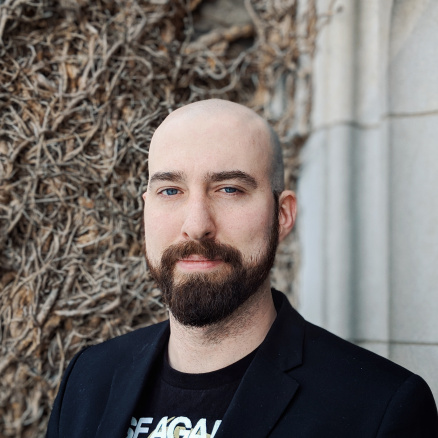
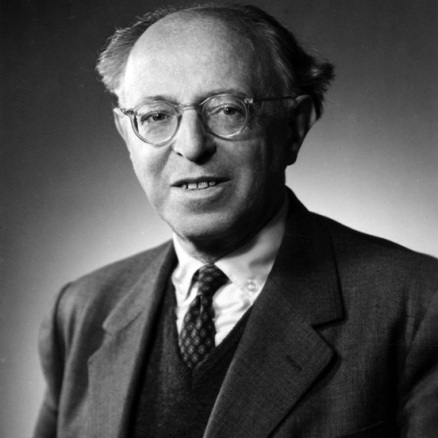
Robert Friedmann (Provided by Author)

In November of 1938, during the Anschluss when Austria was being annexed by Germany, Robert Friedmann was imprisoned by the SS, just after the Kristallnacht on the morning of November 10. He writes of his imprisonment in a pseudonymous account published in the Neue Wege.2 After twelve days of imprisonment he and his wife were mysteriously released, and in the early days of 1939 Robert Friedmann and his wife Susi fled Austria, first spending six weeks in Switzerland and then staying in Sussex before immigrating to the United States. Friedmann’s arrival in the United States was orchestrated by Roland Bainton, a professor at Yale University, and after a short stay at that institution Friedmann connected with Harold S. Bender.3 Bender recalls the moment when Robert Friedmann and his wife Susi stepped off of the train in Goshen, Indiana, and into a new life “at 10:30 pm on a warm July night in 1940.”4 New to the United States, the Friedmann family attended Eighth Street Mennonite Church in Goshen, although Robert and Susi had joined the Reformed Church before leaving Europe. From 1940 to 1943 Robert Friedmann was a visiting lecturer and research fellow in Anabaptist Studies at Goshen College, but in 1944 his wife Susi died after a serious illness.

From 1945 onward Robert Friedmann taught at Western Michigan University in Kalamazoo. Although he had become interested in Anabaptism in the 1920s when he was working on Hutterite codices,5 and although he authored over two hundred articles on theological and historical themes in the Mennonite Encyclopedia, Friedmann had a long-standing interest in European philosophy and literature, particularly German philosophers like Immanuel Kant and Friedrich Nietzsche and literary figures like Leo Tolstoy and Fyodor Dostoevsky. This interest endured from his doctoral studies in the early 1920s to his time at Western Michigan College (later renamed Western Michigan University) where he taught introductory courses in history, philosophy, and ethics.

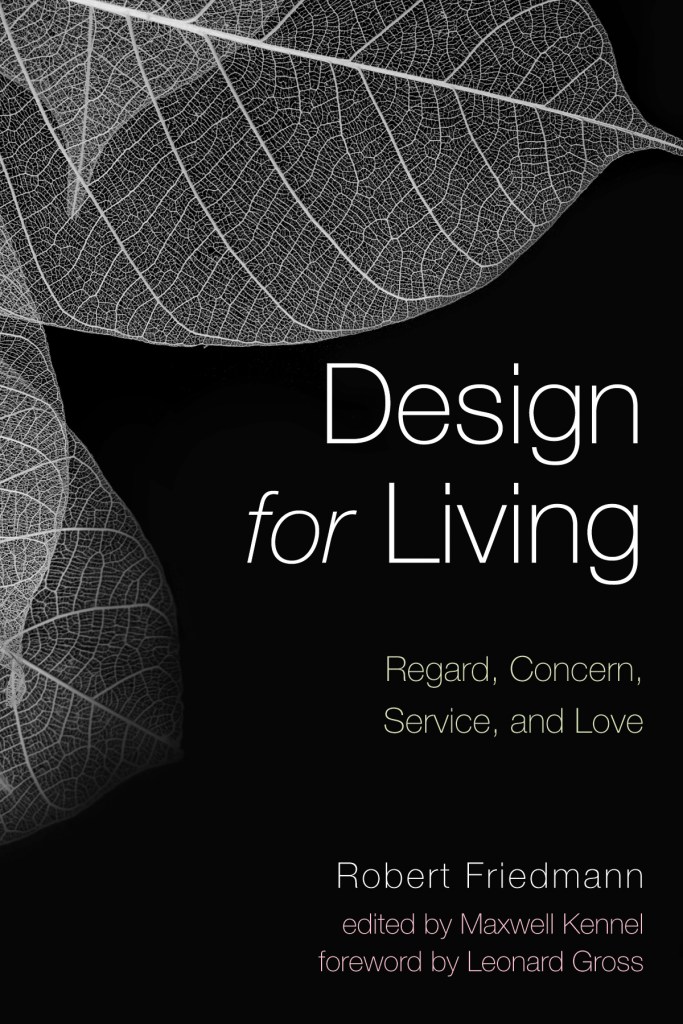
During that time, Friedmann taught a philosophy course on ethics and values called “Design for Living.”6 This course is exceptional for many reasons, not least of which is that few Mennonites taught philosophy courses in the 1950s.7 Robert Friedmann’s friend Leonard Gross recalls that Friedmann would diligently prepare for his lectures, but then would use only a few written notes instead of following his prepared material.8 His course called “Design for Living” was taught from 1948 to 1960, but in the middle of that time, in 1954, after the end of the school term, a student approach him and gave him a copy of his lectures that she had typed out. This came as a great surprise to Friedmann, and he used the opportunity to edit the text for publication, revising and rewriting the original oral lectures so that they would read well as a book. Unfortunately, Friedmann’s efforts to publish the manuscript as a book in 1956 were met with failure, and presumably he gave up on the manuscript in favor of other projects.9

Shortly before his death in 1970, Robert Friedmann gave copies of two book manuscripts to his friend Leonard Gross, with the hope that he would publish them. The first manuscript is one that he is well known for: The Theology of Anabaptism: An Interpretation, published by Herald Press in the Studies in Anabaptist Mennonite History Series in 1973. The second book manuscript, however, was Design for Living. Unlike Theology of Anabaptism the manuscript for Design for Living was rejected for publication by the Mennonite publishing house. In a letter dated March 13, 1972, an editor for Herald Press wrote to Leonard Gross, stating that they would not publish the manuscript because of the “limited market,” adding: “Now this sounds commercial, but if we can get no one to buy the book then no one will read it and it lies on our inventory shelves and this is not very pleasing to the publisher.”10 And so the manuscript for Design for Living sat in the Mennonite Church USA Archives from 1972 onward, being cited only a handful of times by Levi Miller and J. Lawrence Burkholder.11

In 2013 I began a research project on the relationship between Mennonites and philosophy, part of which meant I went looking for any use of philosophies or philosophers by Mennonite thinkers. After reading about Friedmann’s manuscript in J. Lawrence Burkholder’s entry on ‘Philosophy’ in the Mennonite Encyclopedia I acquired a digitized copy of Design for Living from the Mennonite Church USA Archives.12 In 2015 I began to work on an edited version of the manuscript, and by early 2017 I had secured a contract to publish the book with Wipf and Stock. While in contact with Robert Friedmann’s friend Leonard Gross and his sons John and Martin, I began to prepare the manuscript for publication, editing the text and adding some additional references. The more I worked on it the more I realized that the manuscript contained a wealth of insight into the very existential questions that initially spurred me toward graduate work in Religious Studies and the Philosophy of Religion. A scholarly exercise in doing editorial work on an old manuscript soon became part of my own moral convictions. In reading Friedmann’s lost manuscript I became convinced of its value because of its combination of Anabaptist and Mennonite values with the works of secular, philosophical, and literary figures.

Friedmann’s insight in Design for Living is that the good life is about regard, concern, service, and love.13 Friedmann wants to educate the heart, and he begins by citing Ezekiel 36:26 and its promise of a new heart of human flesh rather than a cold and inflexible heart of stone (1). His first goal in the book is to make more sensitive the hearts of his readers without avoiding the challenges and complexities of life, and the seriousness of the task of living. Design for Living implores the reader to examine their values and priorities – and Friedmann defines values as those things we prioritize and put first, those things we spend our time and energy on, and those things we sacrifice other things for. For Friedmann the most important concern that we ought to have is for the meaning of life, and he thinks that the quest to understand life’s meaning requires a reorientation of the heart and the mind amidst the violent conflicts of the world (2-3). Friedmann calls out to his readers, arguing against apathy and disinterest, contending that life is about more than gaining personal pleasures like money, sex, or power (11-19), and challenging the hegemony of self-interest (20-23). Against hedonism and conventional morality, Friedmann pushes his reader to move beyond mere reception of values, and toward intentional living (23-26).

Friedmann begins by establishing a minimum ethics: a basic moral standard to which all people ought to be held. At base he argues that we should be decent to each other (26-29), although I worry that language of ‘decency’ is still too embedded in the colonial project of propriety and education. Friedmann argues within a western Jewish and Christian paradigm, suggesting that his reader should consider the Ten Commandments and the Golden Rule to be basic standards of secular morality (29-36). For Friedmann, without these foundational guides we are already missing something, and he argues that we cannot afford to be indifferent, given the seriousness of our task to figure out what exactly it means to live, and to discern what is morally required of us (37-40). For Friedmann, mutual responsibility is basic, and without it we cannot ascend toward the goal of a truly meaningful life.

Preparing his reader for the ascent to his positive answer, chapter 2 of Design for Living insists that the reader look outside of themselves and consider the needs and suffering of others in the world that we share. Through confession (chapter 3) and an acknowledgment of the inherent difficulty of life (chapter 4), Friedmann builds a four-part framework upon which he argues we should scaffold our moral life, our religious life (if any), and our everyday life. Anticipating objections with a substantial preparatory section, Friedmann provides four steps that build upward toward the meaning of human life. He begins with Regard, which “means to take the other person fully as a person” (119). When we look at another person, we need to see them for who they are, rather than reducing them to an object or dehumanizing them by considering them to be less than ourselves. This is the first step, required of all people so that those from different backgrounds can live well together, both politically and socially. The next step is Concern, which “affirms our interrelatedness, our belonging together” (119-120). Concern means that we not only understand the other as a person, but that we take another step toward them by caring for them. I can see someone else as human, but it may take some effort, self-awareness, and education of desire to feel care toward them. The third step requires the first two. Friedmann writes that “service presupposes the two earlier steps: regard for the fellow human being as a person, and concern for this fellow person and their affairs by an inner participation. In service these steps now become activated into a doing” (120). When we act on our care for others by actually serving them and taking care of them, then we move to Friedmann’s penultimate step on the ladder of human meaning and purpose – his design for living.

The final step on the ladder is Love, and Friedmann understands that love cannot be commanded or legislated without defeating its aspirations. For Friedmann, love “is the crowning of all endeavors to fill life with value and meaning and to be interrelated with our fellow people.” (120). After presents his fourfold principle in summary, Friedmann concludes the book with a postscript that begins with a quotation by H.E. Fosdick: “Life consists not simply in what heredity and environment do to us but in what we make out of what they do to us.” (169).

These issues are not abstract for him, for he struggled to find work in America after he fled Austria in 1940, and many of his job applications were rejected because he was a refugee. The Mennonite Church USA Archives preserves papers that document his struggle to find work in a culture that was suspicious of European immigrants. Prejudice lived then, and it does now. Friedmann saw this and understood it. But he did not become bitter and resentful, despite the difficulty of trying to support a family on a low income. Without resorting to a cheap redemption narrative that covers over suffering and violence, and contrary to contemporary politics of resentment, Friedmann became resilient and turned his negative experiences into fuel for a critical and positive philosophy of human values, encouraging his students at Western Michigan University to consider their social responsibility for those around them.

At its best, this is exemplary of the underground tradition of philosophical and secular humanism in the Anabaptist Mennonite tradition. As I looked into his life, I found that Friedmann’s identity was much more complex than it is often presented, and cannot be fully captured by the Mennonite name. Throughout his career Friedmann’s identity shifted and changed and I explore some of these changes in my preface to Design for Living.14 But there is more work to be done exploring the complexities of Friedmann’s self-understanding. He identified as a “Jew who sides with Christ” in the 1930s, he situated himself between religious socialists and Anabaptists in the 1950s, and he regularly attended a Quaker meeting in his late life.15 In a footnote to his work on Hans Denck, Clarence Bauman makes an intriguing suggestion:

Robert Friedmann, more than any other Anabaptist scholar, recognized in his own educated heart [a reference to the first chapter of Design for Living, which Bauman read] the implicit Jewishness of Anabaptist spirituality, though in his writings he himself hardly dared to make this connection explicit – possibly for personal reasons – and, instead, identified the genius of Anabaptist ‘existential Christianity.’16

It is not out of the question, then, to consider Bauman’s suggestion that Friedmann’s identity may have been more than just primarily Mennonite, but also may have been akin to the Jewish Marrano phenomenon. Elsewhere, in a forthcoming book chapter titled “Secular Mennonite Social Critique: Pluralism, Interdisciplinarity, and Mennonite Studies”, I argue that complex identities like Friedmann’s must be considered within the scope of Mennonite Studies, both because they challenge the dominant narrative of Mennonite identity from within and because they show the entanglement of philosophical and secular sensibilities within a Mennonite figure.


Maxwell Kennel is a PHD candidate in the Department of Religious Studies at McMaster University where he has taught courses on religion and violence and methodological approaches to the study of religion. He has published articles on postsecular approaches to time and history in Studies in ReligionTelosrhizomes, and Political Theology, and articles on Mennonite topics in Literature & TheologyMennonite Quarterly Review, and Journal of Mennonite Studies. In 2017 he edited Mennonite historian Robert Friedmann’s manuscript Design for Living: Regard, Concern, Service, and Love (Wipf & Stock), and in 2021 he will edit a special issue of Political Theology on Mennonite Political Theology. His dissertation is on ontologies and epistemologies of violence in the works of Jacques Derrida, Mennonite philosophical theologians, and the late work of philosopher of religion Grace M. Jantzen. 


1. Robert Friedmann, Das Harmonieprinzip in der Metaphysik, ein problemgeschichtlicher Versuch, dargestellt an Haupttypen [The Principle of Harmony in Metaphysics: A Study in the History of Philosophy] Doctoral Dissertation, University of Vienna, 1924. 128 pp. Examined by J. Döller, F.E. Suess, and R. Much. A copy of the dissertation can be found in Box 20 of the Robert Friedmann Papers, housed in the MCUSA Archives, in Elkhart, Indiana.

2. Robert Friedmann (pseudonym Peter Worb), “Gott shuf den Menschen nach seinem Bilde [God Created Man in his own Image].” Neue Wege (1939): 335-337. Trans. Elizabeth Bender. Mennonite Quarterly Review 48 (April 1974): 174-176.

3. “Conversations with Robert Friedmann,” Mennonite Quarterly Review 48 (April 1974): 141-173.

4. See Steve Nolt, “The Spiritual Journey of Robert Friedmann,” (https://8thstmennonite.org/?page_id=3777).

5. See his description in Robert Friedmann, “Ein persönlicher Bericht als Vorwort,” in Die Schriften Der Hutterischen Täufergemeinschaften: Gesamtskatalog Ihrer Manuskriptbücher, Ihrer Schreiber, Ihrer Literatur 1529-1667. Zusammengestelt von Robert Friedmann, unter mitarbeit von Adolf Mais (Hermann Böhlaus, 1965).

6. For his lecture notes see Box 60, 4/48 “Ethics, Design for Living Course” and 4/49 “Design for Living,” Robert Friedmann Papers.

7. See the brief survey of Mennonites who taught philosophy courses in Delbert Weins, “Philosophy and Mennonite Self-Understanding” in Mennonite Identity: Historical and Contemporary Perspectives. Ed. Calvin Wall Redekop with Samuel J. Steiner (London: University Press of America, 1988), 117-135.

8. See Leonard Gross, “Foreword: Robert Friedmann: His Life, His Philosophy,” in Robert Friedmann, Design for Living: Regard, Concern, Service, and Love. Ed. Maxwell Kennel (Eugene, OR: Wipf & Stock, 2017), x.

9. The Friedmann Papers collection, Box 28, contains reader reports for the publisher Rider and Co. (then an imprint of Ebury publishing, which is now a part of Penguin), dating from June 1956. Of the two reports, one recommends publication and the other recommends rejection. Presumably, the manuscript was rejected by Rider and Co.

10. Box 25. Letter from Herald Press to Leonard Gross, dated March 13, 1972.

11. Levi Miller, “Leo Tolstoy and the Mennonites.” Journal of Mennonite Studies 16 (1998) 163-180.

12. I have since written an update to this entry: “Philosophy” Global Anabaptist Mennonite Encyclopedia Online. https://gameo.org/index.php?title=Philosophy (April 2020).

13. Robert Friedmann, Design for Living: Regard, Concern, Service, and Love. Ed. Maxwell Kennel. Foreword by Leonard Gross (Eugene, OR: Wipf & Stock, 2017), page references in-text.

14. “Discovering the Other Friedmann,” in Friedmann, Design for Living, xv-xx. (https://maxwellkennel.files.wordpress.com/2018/03/dfl-excerpt.pdf)

15. Astrid von Schlachta, “Robert Friedmann—Searching for the Meaning of Faith for the World,” in Robert Friedmann, Hutterite Studies: Celebrating the Life and Work of an Anabaptist Scholar. Ed. Harold S. Bender. 2nd Ed (MacGregor, Manitoba: Hutterian Brethren Book Centre, 2010).

16. Clarence Bauman, “Denck’s Spirituality,” in The Spiritual Legacy of Hans Denck: Interpretation and Translation of Key Texts (Leiden: Brill, 1991), 44, note 139. I am grateful to Jamie Pitts for bring this to my attention.

Searching for Mary Mathilda (Davidson) Yoder

Recently a post on the Brethren in Christ historical website caught my attention: “’I am about to go abroad as a Missionary’: H. Frances Davidson’s Passport Application and what it tells us about Brethren in Christ Life.”1 I was captured by the fine pensmanship of the witness: Mrs. Mary M. Yoder. Denominational historian Morris Sider has characterized Davidson as “one of the most extraordinary and striking persons to have held membership in the denomination.”2 Who was the witness that attested Davidson’s bold declaration of life-long commitment to mission, underscored by the striking of the “entire section of the form dealing with returning to the States!”3 Are there clues that suggest why Frances chose Mary to accompany her to the notary’s office on that October day in 1897? In the bigger picture, will discovering more about Mary provide further insights into the Brethren in Christ of the time?

I knew Mary Yoder to be Frances’s half sister, the eldest of their father Henry Davidson’s thirteen children. Geneological research has revealed that she was among his numerous offspring who exited the Brethren in Christ denomination.4 It also suggests that she was the namesake of her paternal grandmother Mary (Young) Davidson. Mary Mathilda Davidson was fifteen when Frances was born; by the end of her step-mother Fannie (Rice) Davidson’s child-bearing years, Mary had become the eldest of thirteen. Married at age twenty-two to Christian B. Yoder, she gave birth to Effa when Frances was eight years old; by the time Fannie birthed her last child, Ida, Mary was mother to three.5 The birth of LeRoy Isaiah would complete the family. Edwin’s death as a small child must have torn at Mary’s heart; her decision to name her two younger sons for her full brothers William and Isaiah, likely brought her comfort and suggests the closeness of the larger family circle which had been wrenched with the death of their biological mother Hannah (Craft) Davidson when Mary and her siblings were still children.6

Mary would continue to suffer and navigate significant losses. In 1893, four years before she signed her sister’s passport, she had been widowed; she was not yet fifty. Mary’s married name suggests that her husband Christian B. Yoder had Amish roots. They were both raised on farms close to Smithville, Ohio, where they had met and married. Christian had practiced a variety of trades including building, contracting, and grocering, ultimately becoming a hotel manager. The purchase of Eastern House in the nearby city of Wooster brought him to the pinnacle of his career. Only a year before his death he had become “proprietor of the hotel bearing his name,” Hotel Yoder, described in Caldwell’s Atlas in 1897 as “the Oldest Reliable Hotel in the city.”7

Although it remains unclear what role Mary played in Christian’s business enterprise, her identity as entrepreneur is underscored by her decision to hold Christian’s funeral at Yoder House, rather than the Methodist Episcopal Church where they were members. Shortly, Mary M. Yoder herself became the proprietor of Yoder House where,,with the assistance of her sons William and Roy, she continued to run the hotel renovated and branded by her husband Christian only a year before his untimely death.8

Eighteen months later tragedy again devastated Mary and her family. Twenty year old Roy succumbed to typhoid; Mary lost her son to the same disease that had taken her mother Hannah forty years earlier. Demonstrating a strength of character reminiscent of that for which her sister Frances is known, Mary continued to run Yoder Hotel with her remaining son William as manager.9 Census records reveal that Mary employed eleven live-in servants and employees – a laundress, cooks, chambermaids, waitresses, a porter and a solicitor – to keep the establishment running.10

Why did Frances Davidson, the renowned Brethren in Christ pioneer missionary, have her sister, the Methodist Episcopal owner of a prestigious downtown hotel, witness her first passport? Why did Frances choose Mary to attest to subsequent passports? A brief exploration of the Methodist Episcopal Church where Mary and Christian Yoder held their membership gives a clue. The denomination was a strong proponant of missions overseas and at home, working in “some of the most deprived urban areas of the nation.”11 Was Mary an active supporter of the local missionary societies in the Wooster Methodist Episcopal Church? Confirmation would require further research.

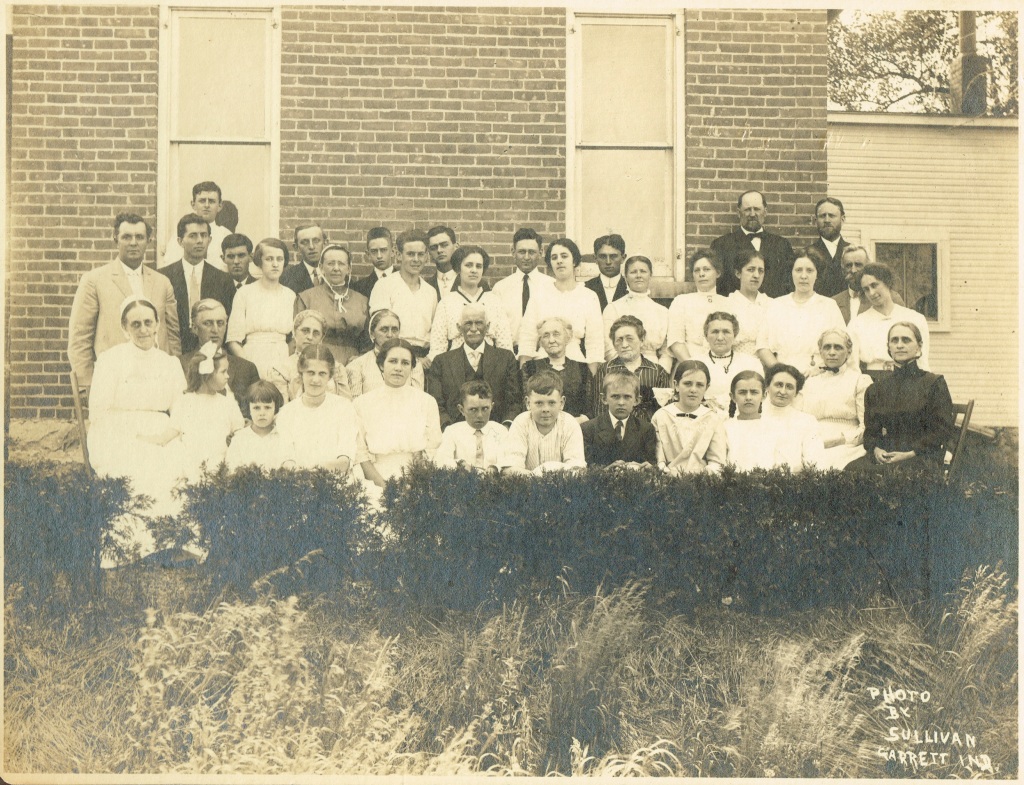
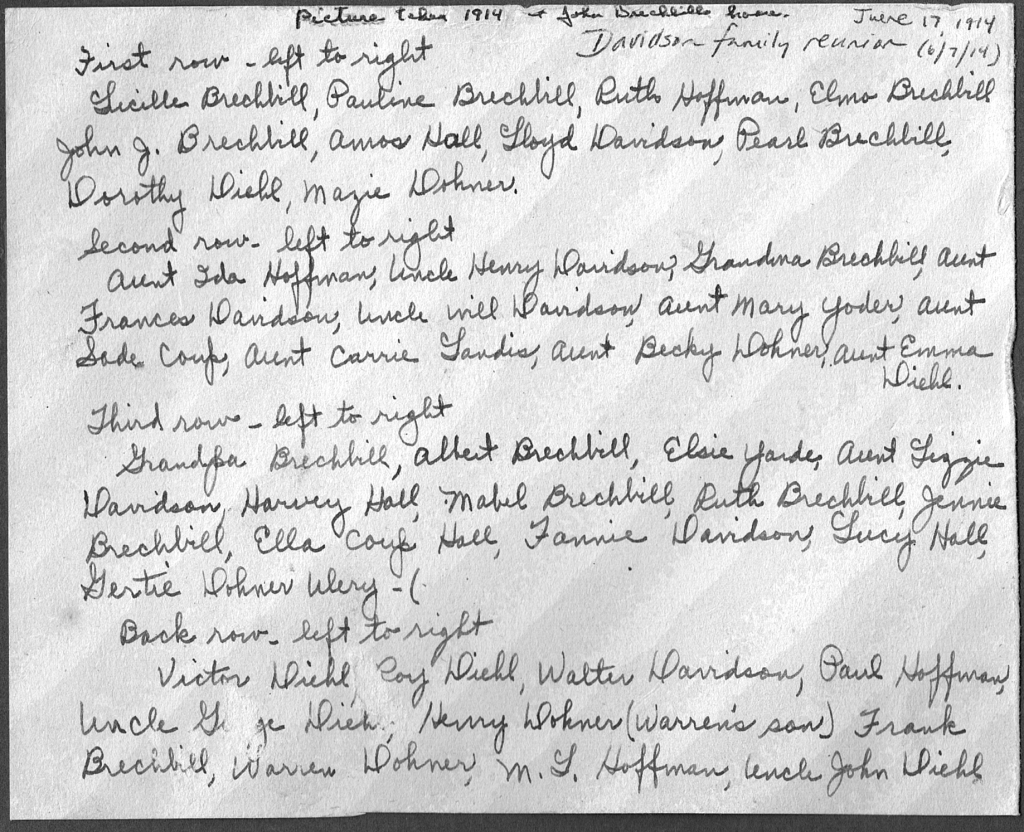
The 1914 Brechbill Reunion in Garrett, Indiana, while Frances was on furlough writing South and South Central Africa

What is becoming clear is Mary’s unflagging support of her younger sister’s mission. Not only was Mary Davidson Yoder recorded as witness on each one of Frances’s passports through the latter’s twenty-four years in the Rhodesias (now Zambia and Zimbabwe), it is quite likely that we have Mary to thank for Frances’s travelogue.12 As Frances noted in her journal on 26 December 1908, “Sister Mary writes that she wants me to be sure and keep up my diary. Well, I have never kept a diary only these few jottings in a journal which are so few that they give only a general outline of our life and scarcely that.”13 A few months later, she confided to her journal: “I have not told any one of my resignation except I wrote it to Sister Mary, as also some of the particulars. She is away from the rest.”14

Does this sideline into family history have anything to tell us about the history of the Brethren in Christ? Brethren in Christ history has been assessed and written, for the most part, by insiders, to build a denominational identity.15 The excerpts from Frances Davidson’s journal published in Brethren in Christ History & Life some decades back were edited for just this purpose. Missing excerpts, which can now be found on the Brethren in Christ Historical Library and Archives website, if read closely, reveal just how important Frances Davidson’s family relationships were, including the many siblings and nieces and nephews outside of the denomination.16

Elsewhere I have argued that Mary’s and Frances’s father Henry Davidson used his influence as editor of The Evangelical Visitor to bring the denomination into the burgeoning nineteenth-century mainstream evangelical movement with its promotion of education and mission.17 While family history suggests that their father was disappointed that so few of his children remained in the Brethren in Christ denomination, Mary M. Yoder’s signature on Hannah Frances Davidson’s passport confirms a closeness and common vision for mission between the two sisters.18

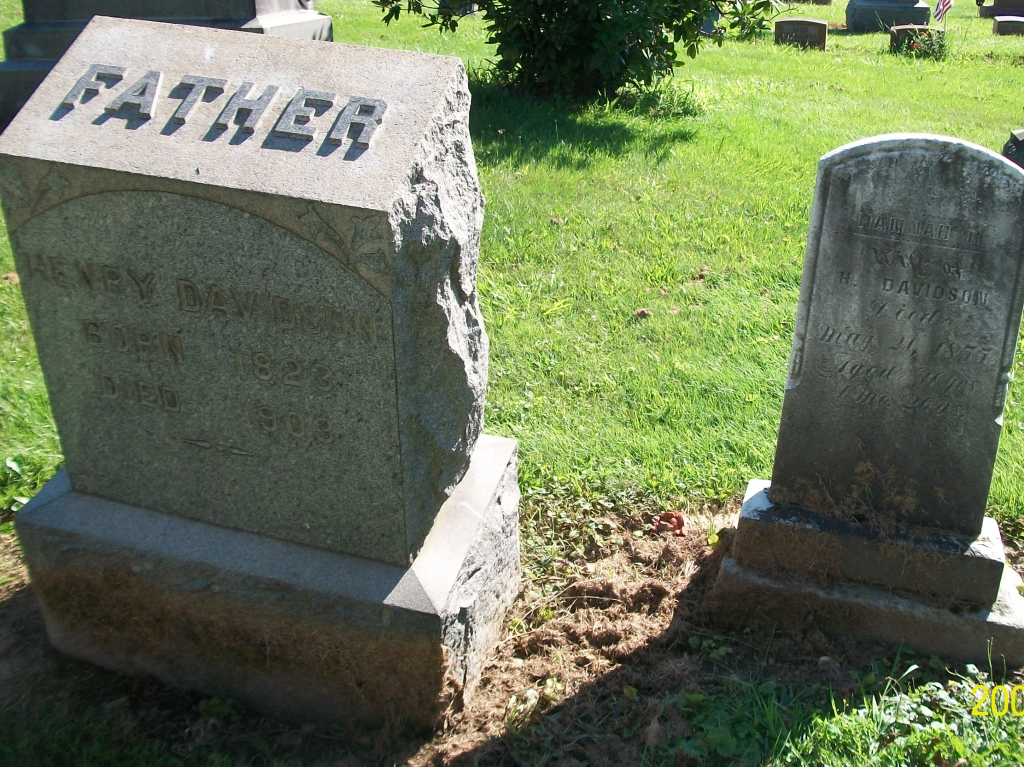
This brief glimpse into the life of the witness to a late nineteeth-century passport that symbolizes dramatic changes in the Brethren in Christ, leaves significant questions. What influence did Mary Mathilda (Davidson) Yoder have on her father Henry Davidson? Did her immersion in mainstream culture by virtue of membership in a prominent evangelical church ultimately influence the direction of the Brethren in Christ? Although history is still silent on this count, the Davidson family’s decision to lay their father to rest next to his first wife and Mary’s mother Hannah (Craft) Davidson, in the circle that included her husband Christian and sons LeRoy and Edwin Yoder hints at the relationship of father and daughter. Mary’s unflagging support of her sister Frances Davidson during the latter’s twenty-four years in the Rhodesias suggests a heretofore undiscovered cheerleader and supporter for her sister held up by the Brethren in Christ for her role as pioneer missionary.


1. Devin C. Thomas, “’I am about to go abroad as a Missionary’: H. Frances Davidson’s Passport Application and what it tells ua about Brethren in Christ Life.” Brethren in Christ Historical Society https://bic-history.org/i-am-about-to-go-abroad-as-a-missionary-h-frances-davidsons-passport-application-and-what-it-tells-us-about-brethren-in-christ-life-2/ ; National Archives and Records Administration (NARA); Washington D.C.; Roll #.496 – 01 October 1897-31 October 1897, Ancestry.com ,U.S. Passport Applications, 1795-1925 [database on-line]. Lehi, UT, USA: Ancestry.com Operations, Inc., 2007; Accessed 14 May 2020. Thomas has made several insightful observations about what the passport can tell us about the mindset of the Brethren in Christ of the late nineteenth century, especially as he put it, Davidson’s “unwavering commitment to her church’s foreign mission endeavor.”

2. Nine Portraits: Brethren in Christ Biographical Sketches (Nappanee, Indiana: Evangel Press, 1978), 159.

3. Thomas declares this to be his favourite part of the document.

4. Earl Brechbill, “The Ancestry of John and Henrietta Davidson Brechbill: A Historical Narrative” (Greencastle, PA: printed by author, 1972), 26, 34.

5. “Henry R. and Frances (Fannie) Rice Davidson: Life and Vision, Brethren in Christ History & Life XLI, no. 2 (August 2018), 115-117, n. 2, 3 4, 10, 11; Brechbill, “Ancestry,” 52, 55-57.

6. “Our Dead, Christian B. Yoder,” Evangelical Visitor, Vol. II, no. 6 (1 March 1893), 80; reprinted from The Wayne County (Wooster, Ohio) Herald (9 February 1893); Year: 1870, Census Place: Orrville, Wayne, Ohio; Roll 14593_1280; page 242B, 1870 U.S. Federal Census [data base-on-line], Provost, USA, Ancestry.com operations, Inc. Accessed 13 June 2020.

7. “Peace to His Ashes,” Wooster Daily Republican (6 February 1893); Caldwell’s Atlas (1897), Wooster, Ohio https://wiki.wcpl.info/w/index.php?title=Caldwell%27s_Atlas_(1897)/Wooster,_Ohio Accessed 27 May 2020.

8. Although “Peace to his Ashes,” ibid., gives no inkling of church affiliation, it does tell us that “’Christ’ Yoder was a quiet, unassuming Christian gentleman who enjoyed the confidence of all with whom he did business, a father who loved his family and lived for them.” The obituary in the Wayne County Herald gives a brief nod to his membership in “the M.E. Church;” reprinted in “Our Dead, Christian B. Yoder,” Evangelical Visitor (1 March 1893), 80; “Our Dead,” LeRoy Yoder, Evangelical Visitor (1 November 1894), reprinted from Wayne County Herald.

9. Brechbill, “Ancestry,” 56; LeRoy Yoder obituary, Wayne County Herald, cited in “Our Dead,” Evangelical Visitor (1 November 1894).

10. “Our Dead, Christian B. Yoder,” Evangelical Visitor, Vol. II, no. 6 (1 March 1893), 80; Wm. W. Yoder, 1900 US Federal Census, Census Place: Mansfield Ward 6, Richland, Ohio, 13, Ancestry.com, 1900 US Federal Census database on line], Provo, UT, USA, Ancestry.com Operations, Inc. 2014, Accessed 18 May 2020.

11. Justo L. Gonzalez, The Story of Christianitiy: Vol. II The Reformation to the Present Day, revised and updated (NY: Harper and Collins, 2010), 339; see also Diarmaid McCulloch, Christianity: The First Three Thousand Years (London: Penguin Books, 2009), 903; “Woman’s Foreign Missionary Society of the Methodist Episcopal Church,” https://en.wikipedia.org/wiki/Woman%27s_Foreign_Missionary_Society_of_the_Methodist_Episcopal_Church Accessed 11 June 2020.

12. The photo, labeled Brechbill Reunion 1914, took place in Garrett, Indiana, while Frances was on furlough writing South and South Central Africa (Elgin, Ill: Brethren Publishing House, 1915). The photo is scanned from “The Journal of Frances Davidson. Part V: The Later Years (1908-1931), Brethren in Christ History and Life IX, no. 3 (December 1986), 286. Images of Davidson’s passports appear in Ancestry.com. U.S. Passport Applications, 1795-1925 [database on-line] (Lehi, UT, USA: Ancestry.com Operations, Inc., 2007); Original data: Selected Passports, National Archives, Washington, D.C. Accessed 15 May 2020.

13. H. Frances Davidson Diaries 6 (December 26, 1908) http://bicarchives.messiah.edu/files/Documents4/Hfd_diary_vol_6_aug_19,1906_to_dec_31,1909.pdf Accessed 22 June 2020.

14. Ibid. HFD Diaries 6 (April 21, 1909). Their father Henry Davidson’s obituary reveals that the Brethren in Christ contingent of the family lived in Abilene, Kansas and Garrett, Indiana. Mary had remained in Ohio. Wooster Weekly Republican, (25 March 1903), p. 4, col. 3, p. 5, col. 1.

15. Wendy Urban-Meade’s perspective on the Brethren in Christ mission in the Rhodesias (Zimbabwe and Zambia) as an outsider to the denomination has illustrated the inward focus of most history of the Brethren in Christ. Please see “An Unwomanly Woman and Her Sons in Christ: Faith, Empire, and Gender in Colonial Rhodesia, 1899-1906,” 94-116, in Competing Kingdoms: Women, Mission, Nation, and the American Protestant Empire, 1812-1960, edited by Barbara Reeves-Ellington, Kathryn Kish Sklar, and Connie A. Shemo (Durham & London: Duke University Press, 2010); and The Gender of Piety: Family, Faith, and Colonial Rule in Matabeleland, Zimbabwe (Athens, Ohio: Ohio University Press, 2015); Morris Sider’s recently published retrospective “Finding Vocation and Mission: Reflections on Writing Brethren in Christ History,” Brethren in Christ History & Life Vol. XLIII, no. 1 (April 2020) gives helpful insight into his motivation for dedicating his professional career to advancing the history of the Brethren in Christ.

16. H. Frances Davidson Diaries http://bicarchives.messiah.edu/files/Documents4/Hfd_diary_vol_2_sept_17,1893_to_may_17,1898.pdf Accessed 28 May 2020.

17. “Henry R. And Frances (Fannie) Rice Davidson,” 148; Mark A. Noll, David W. Bebbington and George A. Rawlyk, Evangelicalism:ComparativeStudiesofPopularProtestantisminNorthAmerica,TheBritishIsles,andBeyond,1700-1990 (New York and Oxford: Oxford University Press, 1994), 6, 9.

18. Brechbill, “Ancestry,” 142; I have told of my search for Henry Davidson’s burial site in “Life and Vision,” 117, n. 9.