Considering Seventeenth-Century Schutzgeld

The collection of Schutzgeld, or ‘protection money,’ had begun in the East Frisian city of Emden shortly after the city’s revolt against Count Edzard II in 1595. The first extant records date to 1601 and detail the amount owed by each Mennonite and Jewish household within the newly autonomous (and predominantly Calvinist) jurisdiction. (For a bit more on the earliest Schutzgeld records in Emden, please see my post from November 27, 2018.) But only a few registers of this particular tax remain for the city of Emden. We have documentation from the years 1601, 1602, 1626, 1638, 1737 and 1749. There are a few additional documents from the eighteenth century in which Schutzgeld was recorded from both across the county and within the city of Emden, but only compelled from Jews – a development that illustrates the increasingly disparate paths made for Mennonites and Jews in this area of the empire. But even with those additional accounts, we can see the records that remain are the exception rather than the rule. Today, I’ll examine the two sets of records from the mid-seventeenth century.
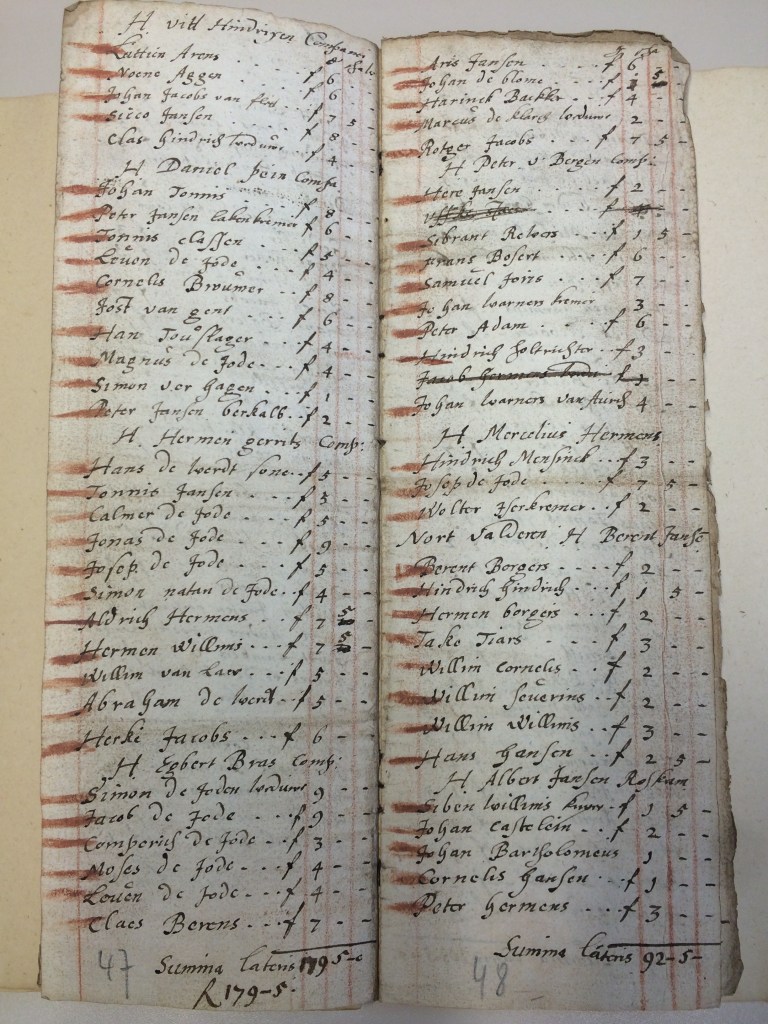
The 1626 Emden Schutzgeld records [Fig. 1] were clearly functional, as owed amounts were crossed out and replaced, red scratches along the edge denoted fulfilled obligations, and the slim bound booklet generally displayed marks of use and wear.1 The obligations were divided among 22 different geographic sections, named companies, each with a corresponding responsible captain. These captains were not Mennonites, but the leaders of the city or night watch – a communal obligation that this tax exempted Mennonites from performing. The numbers in these ‘companies’ varied from as few as one man or household (Dirck Simons, in Hindrich Busert’s company, who owed 3 Emden gulden) to as many as 19. There are 175 names overall, of which 19 were noted as Jews. Another 3 names were stricken from the record; as two of the three names stricken were widows owing only 1 gulden, it seems likely that these were either the recently dead or the benevolently omitted. Unlike the Schutzgeld records from a quarter-century before, however, none are here designated as ‘paupers’ and thus exempt from payment.

That leaves 153 paying Mennonite households, 9 of which were headed by widows and 3 of which appear to have been headed by underage sons. The density and prosperity of the Mennonite community in Emden held steady in the quarter century between 1602 and 1626. The total amount remitted by that Mennonite community came to 654 Gulden and 5 Schap – an amount figured through an informal sum on the back of the well-worn booklet itself.
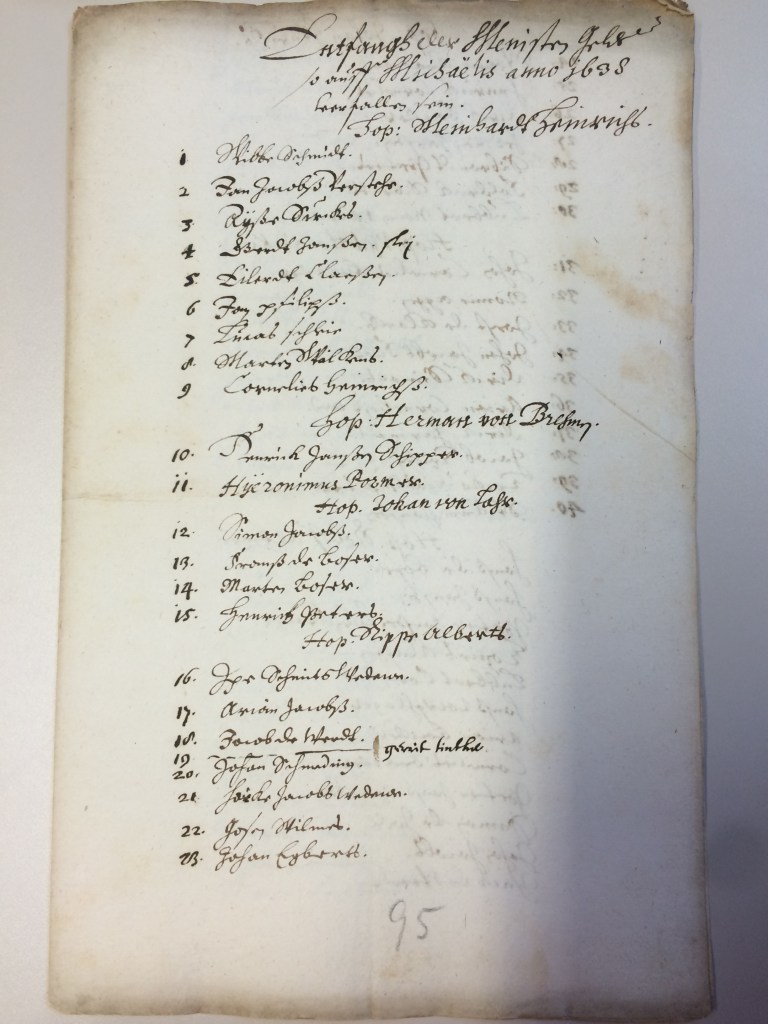
The 1638 Schutzgeld records [Fig. 2], by contrast, are much cleaner and show no evidence of their use as a working document – but also include no amounts at all.2 There is no indication of amounts owed, the vagaries of collection, or indeed that money exchanged hands at all. This, then, is a list that named Mennonites and Jews, but shares little else in common with the list from just 12 years prior. This lack of consistency could perhaps be evidence for haphazard or even intermittent collection within the city of Emden, but it is more likely that this document represented a different stage in the process than the worn document of 1626. Additionally, the helpful numbering along the left edge of this document drops off in the middle of the second page, after ‘40,’ which confirms further that this is merely a draft of a later, more useable register.

There are 21 companies in the 1638 record, and a total of 176 names – almost no movement in the overall number of marginalized residents sharing this tax. However, the number of Jews has dropped significantly for such a small population, from 19 to 11. That leaves a modest increase in the number of Mennonite households, now at 165 and up from 153 in 1626. Of those 165 households, a steady number – 8 now, in comparison with the 1626 count of 9 – are widows. For the first time, a ‘doctor’ appears in the register: a ‘Doctor Eilde’ residing in the company of Captain Eggo Hermans. Without amounts, however, it’s hard to tell how prosperous this Mennonite doctor was – or indeed, whether the fortunes of the community had changed in aggregate.

Four captains’ names remain the same from the 1626 collection to that of 1638, a comparison that allow us to consider the nature of community change. The company of Viet Hindricks grew from 5 to 10 in those twelve years, and only two of the names remained the same: Nonne Aggen and Johan Jacobs ‘Flet,’ neither of whom appear in the index of the city archive. In Herman Gerrits’s company the growth was more modest, from 11 to 13, but a full seven of the names remained the same. This was perhaps a younger set of taxed households, and an area of the city with more Jewish inhabitants (4 were designated as Jews in both 1626 and 1638). The company of Jeldrich Taken grew from 7 to 12, with 4 names remaining the same. The number of Mennonites shrunk in the company of Johan Horstman, from 7 to 5, and there are two instances of family name matches but no individual persons who appear on both records.

These comparisons are more suggestive than anything. Twelve years represents perhaps half of a generation, and the 1638 records leave open the question of economic growth, prosperity, or burden. Schutzgeld was presumably a yearly tax, as it replaced watch service that was continuous for other male adults, but the lack of sources leaves confusing caesura in the historical record. What the remaining Schutzgeld sources continue to attest to, however, was the bureaucratic grouping of Mennonites and Jews together within the city of Emden. These religious minorities were nameable, even when the names given by governmental authorities were imprecise, and they were thus taxable. These were communities who continued to live and worship despite a lack of official toleration documents, and it is in this way that economic instruments must be read as crude (and inherently unstable) religious settlements. Informal toleration through taxation and through other one-time compulsory payments – for dikes, for military expenses, or just to balance the books; what older historiography has rightly labeled ‘extortion’ – provided both plausible cover and continuing threat for both Mennonites and Jews in early modern Emden.


  1. Stadtarchiv Emden, I. Reg. Nr. 415, 45-52.
  2. Stadtarchiv Emden, I. Reg. Nr. 415, 95-98 and 101-103.

The Faint Past and Constructed Identity: The Challenges of Historical Awareness in Javanese Mennonite Church

Danang Kristiawan

Introduction

Talking about history in the Javanese Mennonite Church (Gereja Injili di Tanah Jawa) is always difficult and challenging due to several factors. First, as the oldest Mennonite community outside of Europe and North America, dating back to 1854, the Javanese Mennonite Church has such a long history and has existed through many dynamic events, including Dutch colonization, Japanese occupation, the Indonesian revolution and struggle for independence, and the anti-Communist massacres of 1965-66. All of these events, and others, have had significant impacts on the survival of the archives and historical documents as well as the kinds of memories that have been handed down. Second, most Javanese Mennonite congregations live in rural and coastal areas in Northern Java and some parts of Sumatra. In the past, many rural people were uneducated and told their stories with an oral rather than written tradition. Third, many local churches show a lack of concern for history and administrative issues, including documenting and writing their experiences.

Making History, Constructing Identity: Hegemony of written tradition in an oral culture?

It is commonly understood that the most important resources for constructing and writing history are archival and documentary records. This inevitably means that history will be written from the perspective of the elites and educated people who had access and the ability to write. To know about early Javanese Mennonites, the written primary documents records are found in the writings of Pieter Janzs, the Dutch Mennonite Mission reports, and the colonial government documents, all of which are in Dutch. The most complete source is the Dutch-language diary of Pieter Janzs which has been edited by Alle Hoekema and published 1997 with title “Tot Heil van Java’s Arme Bevolking. Een Keuze uit het Dagboek (1851-1860) van Pieter Jansz, Doopsgezind Zendeling in Jepara, Midden-Java”. The mission report is preserved in Amsterdam. Additionally, there is a book by T. H. E. Jensma, Doopsgezinde Zending in Indonesie, written in 1968, about history of Mennonite mission in Indonesia based on Mennonite mission archives in Amsterdam. Therefore, our historical construction of Mennonites in Java starts from the Dutch Mission perspective. The lives, theology, and teaching of Javanese evangelists and believers are hidden because they did not leave written materials. Even though Kyai Ibrahim Tunggul Wulung had far more followers than Jansz, information about him is very limited. In mission documents, Jansz’s diary and reports, Wulung was pictured negatively, as not “really Christian” because of his many Javanese ways and ideas.

Writing history is also constructing identity and those who have power will make their story the dominant identity. In oral cultures, it’s very important to give attention to the oral story as well as written records. Both written and oral resources contain the same probability of truth and\or bias. Written documents were written in paper and preserved in archives. But oral tradition was also written in the hearts of the people and passed down between generations. For oral societies, validity does not become the main concern, but the question instead is how the story touch experiential meaning and values that they live.

Local Churches and their Unrevealed Histories

Of the 110 local churches which are members of the Javanese Mennonite Conference/Synod, only few churches have written histories. Many more churches haven’t written their history yet, even though they have existed more than forty years. These churches face similar problems when they start to write their local church histories:

  • The absence of documents and archives. Many churches are located in rural and coastal area and they lack concern to write church administrative records and documentation, even membership and baptismal records. So oral history approach will be useful for writing their history.
  • Many of those who know most about their church history have already passed away. Later generations often don’t understand their history because the history was not passed down to them.
  • There is a tendency in writing history in Indonesia to focus on leaders and church buildings. Many churches are mad about history which regards of whom, how, what, and where was the first of something. Sometimes the church history becomes the list of buildings.
  • Difficulty to decide on the start or the beginning of a new church in history. Is the beginning of the church counted from the first worship? Or is it the first baptism of local? Or is it the first church building? Or is it the first local church organization?

Conclusion:

This short reflection shows our struggles with archiving and maintaining history in the Javanese Mennonite Church. Talked about writing history is related to cultural tradition of society. It is important to think about archiving oral tradition by collecting story, legend, and myth which is connected to church and consider it as resource for writing history. Finally, I would encourage Anabaptist/Mennonite churches to more aware about their history, which is very important. Local churches should be more aware about documents, archives, local stories before all documents are lost, memories fade, and all witnesses die.

Trajchtmoakas, Parteras, and Midwives: 100 Years of Maternal Care in Chihuahua’s Mennonite Campos

Abigail Carl-Klassen

This article is the first in a series investigating the history of Mennonite midwives and doulas in the Tres Culturas region of Chihuahua, Mexico, including personal narratives of Mennonite midwives in the Campos, past and present and as well as an exploration of the intersection of midwifery training, culturally appropriate care and public health outcomes in the Tres Culturas Region.

On the surface it would appear that Catalina Schroder and Susanna (Fast) Shellenburg lived very different lives and embodied the differences and tensions that existed between traditional and non-traditional Mennonite communities in Mexico during their lifetimes, which spanned from the early 1900’s to the last quarter of the twentieth century. However, differences in country of origin, dress, religious and cultural practices, and approaches to education did not keep them from building bridges between communities and providing maternal care to women from all ethnic, cultural and religious backgrounds in region surrounding Cuauhtémoc, Chihuahua, for nearly sixty years.

Catalina, who married her husband after a nontraditional courtship (which included learning to cook from her fiancé) was formally educated as a midwife in what is now modern-day Ukraine. The young family arrived in the Mexican state of Veracruz in 1926 via a ship from Russia, fleeing violence and religious persecution. Eventually, after many delays, including the loss of newly-issued government documents in a fire, they made their way north to Cuauhtémoc in the state of Chihuahua along with small number of other Low-German-speaking Mennonites who had immigrated directly to Mexico from Russia with the hopes of settling alongside five thousand Low-German-speaking Altkolonier Mennonites who arrived from Canada in 1922, after negotiating a Privelegium from President Álvaro Obregón.

Catalina’s grandson, Walter Rempening Rico, pastor of Templo Ebenezer, a Spanish-speaking Mennonite congregation in Cuauhtémoc, shared with the Rebels, Exiles, and Bridge Builders Oral History Project (REBB) in 2018 how his grandmother, grandfather and their young children settled in the city of Cuauhtémoc and quickly integrated into many aspects of local Mexican culture because Mennonites from Russia were not allowed to live in the nearby Altkolonier colonies because of their less traditional lifestyle, dress and approach to education. Despite community prohibitions, Catalina worked tirelessly as a Trajchtmoaka, a sobadora (bonesetter), and midwife, and was, highly sought after to attend births for traditional Mennonite women and was beloved in the traditional, non-traditional, and Mestizo communities she served. 

Susanna Shellenberg, on the other hand, was a traditional Altkolonier Mennonite woman from Canada who arrived in Mexico with her husband Heinrich and young daughters in 1927 and was able to live in the traditional Mennonite Darpe, which was settled many kilometers outside of Cuauhtémoc in the years following the initial 1922 migration from Canada. 

In Canada, Susanna had trained under two Orthodox Jewish women as a midwife and herbal healer, and she continued her work upon her arrival in Mexico. Her granddaughter, Susanna Thiessen, who is also a midwife, related in a recent interview with Casa Geburt, a midwifery and doula training school and birthing center located in the Campos Menonitas about twenty minutes north of Cuauhtémoc, “At that time there were no doctors in the Cuauhtémoc area. She immediately began to care for the sick. After some years in Mexico, she also began to provide midwifery services. She served in the Campos Menonitas, as well as in the Mexican ranches. Sometimes, people came for her in the middle of the night in a horse and buggy to take her to attend births or to heal the sick. Many times the people were so poor, they couldn’t even offer her a coffee. She attended many births where she didn’t receive payment of any kind. She also took along baby clothes and blankets because she knew that the people didn’t have anything to keep their babies warm.”

Susanna worked as a midwife until she was eighty years old. Near the end of her life, after she had attended her last birth, the birth of her great-grandson, she was asked about the number of babies she helped bring into the world and she responded, “How many births have I attended? I don’t know. I never wrote it down. For me, it is good that God knows.”

Since the days of Catalina Schroder and Susanna Shellenberg, midwives in the Campos from traditional and non-traditional communities have occupied a vital role in community life and have been at the center of changing dynamics in the region over last century. There is a strong heritage of midwifery in each of Cuauhtémoc’s three cultures (from which the Tres Culturas Region derives its name): Mennonite, Mestizo, and Indigenous Rarámuri Pueblo. Midwives in each community, while distinct, are powerful advocates for women who are marginalized because of language, ethnicity and/or socio-economic status and serve as public health practitioners and educators in some of the most at-risk and underserved regions for maternal and child health in the country. Often operating at the margins of the official community rules, subverting taboos surrounding reproductive health, pregnancy and breastfeeding, midwives in the Mennonite communities of Chihuahua have always been invaluable in the creation of support networks between women and as agents of cross-cultural women’s solidarity and as bridge builders between communities that have historically experienced tension for a variety of cultural, economic and socio-political reasons. 

The next article with further explore Susanna Shellenberg’s life and experiences as a midwife and will include perspectives from her great-granddaughter Susanna Thiessen who, in keeping with family tradition, is a midwife in the Campos Menonitas of Chihuahua.