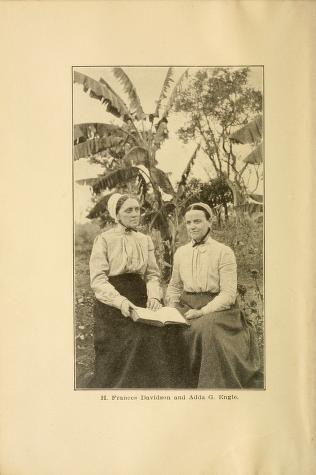
“She should have been a bishop!” Barbara Nkala pounded the table emphatically.1 An historian and long standing member of the Brethren in Christ Church in Zimbabwe, Nkala’s voice echoes that of many in that community, who continue to hold up the memory of pioneer missionary H. Frances Davidson.2 Davidson is remembered for having travelled from the Kansas prairie to the Matopo Hills in 1898 to help establish a mission there; well over a century later, members of the Zimbabwean Brethren in Christ church still regard her as their “spiritual mother.”3
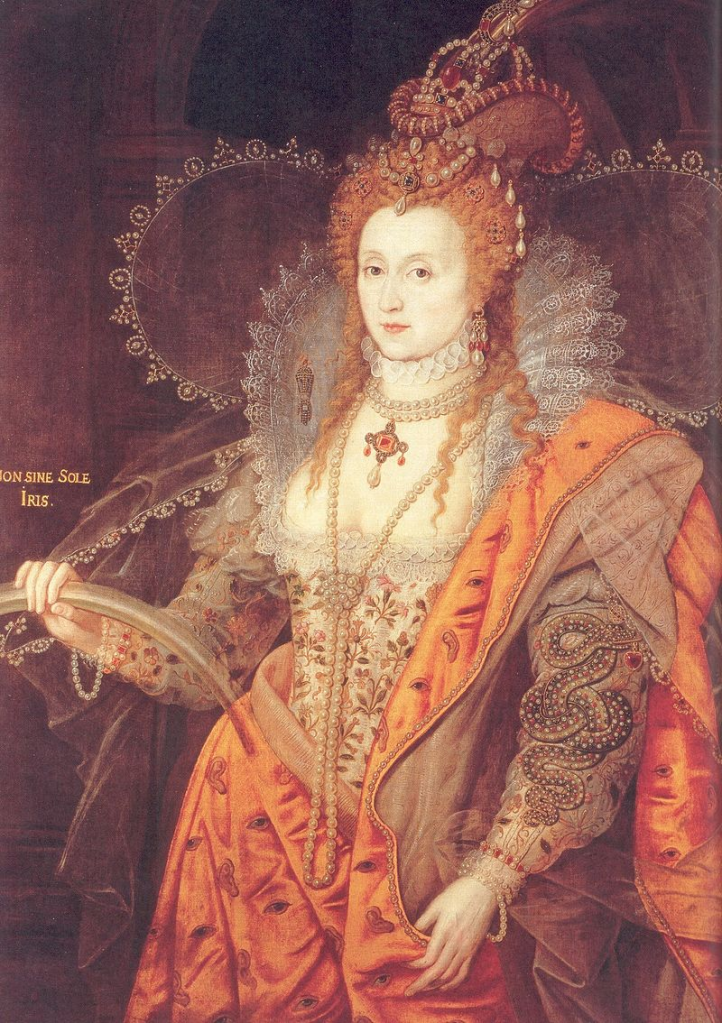
My current research is taking further my previous observations on the spiritual awakening that inspired Davidson’s conversion from college teacher to missionary.4 Following in the wake of other Protestants who have retained a reverence for Mary, for Davidson, an encounter with what she called “that great work Murillo’s Immaculate Conception” proved to be a moment of transformation and awakening.5 Coming face to face with that masterpiece on a class trip to the Chicago Fine Arts Museum immediately followed what she recorded in her journal as a moving and productive session of writing on the Faery Queen for a literature class she was taking at University of Chicago.6 These encounters in March 1895 coincided with Davidson’s thirty-fifth birthday, and seem to have kindled a passion which had previously lain dormant.7 As she recorded in her journal that evening, “Beauty, in its supreme development, invariable (sic) excites the sensitive soul to tears. There seemed to be in me a longing and restlessness, a desire for something higher and beyond.”8
As these recollections suggest, Davidson’s journals appear to have provided her with a confidante, a safe place where she could express joy and process inner turmoil. In her missionary career, for instance, she wrote of her struggles as she denied the urge to step out in leadership in ways that she, as the social mores of the time, deemed inappropriate for a woman. Scholars have investigated the pioneer leadership emphasizing her vision, and unique strength as an “unwomanly woman.”9 Through her writings, we can decipher ways that she dealt with the conflict of the external and internal pressures pressing her to take on spiritual leadership normally reserved for men.
In my quest to explore the writings of H. Frances Davidson, I anticipate becoming better acquainted with this “spiritual mother” of Brethren in Christ women. Expressing her spiritual struggles in language familiar to the piety of her evangelical tradition, her desire to surrender self, and to know God’s will echo the Sophia mysticism of Jacob Boehme and medieval mystics.10 What do the mystical moments, which she articulated in ways reminiscent of the deeper conversion and transformation of gelassenheit or surrender to God’s will familiar in Anabaptist piety as well as colonial pietism, reveal about the faith, and the strong leadership of this spiritual mother who remains to this day an iconic figure for her denomination the Brethren in Christ in Zimbabwe, Zambia, the United States and Canada?
Conversation with Barbara Nkala, 23 June 2017, at “Crossing the Line: Women of Anabaptist Traditions Encounter Borders and Boundaries,” a conference held at Eastern Mennonite University, Harrisonburg, Virginia. She has authored and co-authored several books on the denomination’s history including Celebrating the Vision: A Century of Sowing and Reaping (Bulawayo: Brethren in Christ Church, 1998); see also Nkala and Doris Dube, Growing and Branching Out: Brethren in Christ Church in Zimbabwe and Southern Africa (Harare, Zimbabwe: Radiant Press, 2014) and Bekithemba Dube, Doris Dube and Barbra Nkala. “Brethren in Christ Churches in Southern Africa,” edited by John A. Lapp and C. Arnold Snyder, 97-191, in Anabaptist Songs in African Hearts: a Global Mennonite History, vol. I, Africa, (Intercourse, PA: Good Books and Kitchener, ON: Pandora Press, 2003). Nkala is a member of the Zimbabwean Brethren in Christ Church.↩
The photo is of Davidson and Adda Engel, that appears as the frontispiece in H. Frances Davidson, South and South Central Africa: A Record of Fifteen Years’ Missionary Labors among Primitive Peoples (Elgin, ILL: Brethren Publishing House, 1915).↩
Dube, Dube and Nkala, Anabaptist Songs, 150-55; Wendy Urban Mead, The Gender of Piety: Family, Faith, and Colonial Rule in Matabeleland, Zimbabwe (Athens, OH: Ohio University Press, 2015), 38, 42, 49-50, 60, 76.↩
Earl D. Brechbill, “The Ancestry of John and Henrietta Davidson Brechbill: A Historical Narrative” (Greencastle, PA: printed by author, 1972), 56-57. ↩
Hannah Frances Davidson, Diaries, 13 March 1895; her journals have been edited by E. Morris Sider and published in Brethren in Christ History and Life. See “The Journal of Frances Davidson.” “Part 1: The Early Years (1861-1895)” 8, no. 2 (August 1985): 103-23; “Part II: The Call to Africa (1895-1898)” 8, no. 3 (December 1985): 181-204; “Part III: The First Years in Africa (1898-1904)” 9, no. 1 (April 1986): 23-64; “Part IV: The Founding and Early Years of Macha Mission (1904-1908)” 9, no. 2 (August 1986):125-49; “Part V: The Later Years (1908-1931)” 9, no. 3 (December 1986): 284-309.↩
See, for instance, E. Morris Sider, “Hannah Frances Davidson,” in Nine Portraits: Brethren in Christ Biographical Sketches (Nappanee, IN: Evangel Press, 1978), 159-214; Wendy Urban-Mead, “Religion, Women and Gender in the Brethren in Christ Church, Matabeleland, Zimbabwe, 1898-1978,” (PhD diss., Columbia University, 2004); and “An Unwomanly Woman and Her Sons in Christ: Faith, Empire, and Gender in Colonial Rhodesia, 1899/1906,” in Competing Kingdoms: Women, Mission, Nation, and the American Protestant Empire, 1812–1960, ed.Barbara Reeves-Ellington, Kathryn Kish Sklar, and Connie Shemo (Durham, NC: Duke University Press, 2010), 94-116.↩
The Classics of the Radical Reformation Series is published under the auspices of Anabaptist Mennonite Biblical Seminary’s Institute for Mennonite Studies and overseen by a reference council of scholars from Canada and the United States, a group I joined in 2018. Since the 1970s, the series has existed “to offer in the English language, scholarly and critical editions of the primary works of Reformers of the Radical Reformation…also intended for the wider audience of those interested in Anabaptist and free church writers of the sixteenth century.”[1] The first nine volumes, published from 1973 to 1999, were published by Herald Press, while the remaining five volumes, which first appeared between 2001 and 2017, were published by Pandora Press. The series included the writings of such prominent sixteenth-century figures as Pilgram Marpeck, Balthasar Hubmaier, Michael Sattler, Andreas Karlstadt, and David Joris, as well as collections organized by genre (confessions of faith) and loose geographical networks (Swiss Anabaptism and South German/Austrian Anabaptism). They have proved an indispensable resource for both academics (I cited multiple volumes in my doctoral dissertation) and interested pastors and laypeople.
As some of the older titles fell out of print, however, it has become increasingly difficult for those without borrowing privileges from well-stocked university libraries to access the full series. In the interests of making all the volumes accessible to a new generation of readers, the entire series was republished by Plough, the publishing house of the Bruderhof, in late 2019. Plough marked the republication of the series with a November 23rd launch in San Diego, during the annual meeting of the American Academy of Religion and the Society for Biblical Literature.[2] The first nine volumes, originally published by Herald Press, also have updated prefaces (from the author where possible, and otherwise from top scholars in the field).
The following volumes are now available from Plough: [3]
The Legacy of Michael Sattler (edited by John H. Yoder, with a new preface by C. Arnold Snyder)
The Writings of Pilgram Marpeck (edited by William Klassen and Walter Klaassen, with a new preface by John D. Rempel)
Anabaptism in Outline: Selected Primary Sources (edited by Walter Klaassen, with a new preface by John D. Roth)
The Sources of Swiss Anabaptism: The Grebel Letters and Related Documents (edited by Leland Harder, with a new preface by Andrea Strübind)
Balthasar Hubmaier: Theologian of Anabaptism (edited by H. Wayne Pipkin and John H. Yoder, with a new preface by Brian Brewer)
The Writings of Dirk Philips, 1504–1568 (edited by Carnelius J. Dyck, William E. Keeney, and Alvin J. Beachy, with a new preface by Piet Visser)
The Anabaptist Writings of David Joris (edited by Gary K. Waite, with a new preface by the editor)
The Essential Carlstadt (edited by E. J. Furcha, with a new preface by Amy Nelson Burnett)
Peter Riedemann’s Hutterite Confession of Faith (edited by John J. Friesen, with a new preface by the editor)
Sources of South German/Austrian Anabaptism (edited by C. Arnold Snyder)
Confessions of Faith in the Anabaptist Tradition 1527–1660 (edited by Karl Koop)
Jörg Maler’s Kunstbuch: Writings of the Pilgram Marpeck Circle (edited by John D. Rempel)
Later Writings of the Swiss Anabaptists 1529–1592 (edited by C. Arnold Snyder)
We hope that this re-launch will prompt new interest in the CRR series and that it will continue to be useful both inside and outside academia.
Marie Regier wrote about Martin Luther King, Jr., a little over six months after his death. She recalled a conversation in which yet another acquaintance had suggested that King’s efforts had gone “too fast.” In response, this long-time white missionary to China said she grew so angry that she saw “red.”1
Rezmerski, John C. “For Martin L. King, Jr.” Mennonite Life, July 1968, 99.
Regier was hardly the first Mennonite to have written about King. In the space of the twelve years between 1956 and King’s death in 1968, at least ninety articles appeared in the Mennonite press that either mentioned King or were written by him. Following his assassination, Mennonites eulogized him in the pages of Christian Living, The Mennonite, Gospel Herald, Mennonite Life, Mennonite Weekly Review, and – perhaps most surprisingly – the conservative publication The Sword and Trumpet. Representatives from Mennonite Central Committee and the (Old) Mennonite Church’s Committee on Peace and Social Concerns attended King’s funeral and submitted reports about the event. In the year of his death, thirty-one articles appeared, almost all penned by Mennonite authors who claimed some kind of direct, personal connection with King.
In the dozen years that Mennonites engaged with King – indeed for the decade that followed and beyond – no single individual from outside the Mennonite community had more impact on the Mennonite peace position than did King. In comparison to other historically white denominations, Mennonites referred to, discussed, and connected with King to a greater and far more influential degree. Despite some who voiced concerns about King’s purported connections with communism, King loomed large among Mennonites at mid-century and served as a catalyst to substantive re-evaluation of white Mennonites’ commitment to nonresistance.
King’s Mennonite Connections
Mennonites’ connection with King was already well developed by 1956. In the pages of Christian Living readers encountered a report on the Montgomery bus boycott that emphasized the values of “love and nonviolence” at “the heart of their protest.”2 The following year readers encountered additional reporting emphasized his ongoing commitment to nonviolence, and Mennonite Paul Peachey called for Mennonite to act as “consultants” to ministers who were for the first time considering nonviolence after listening to King discuss the theology of repudiating “all force, war included” as part of their Christian witness.3
The connection between Martin and the Mennonites only solidified in the years that followed. In 1956, 1957, 1958, and 1960 tour groups sponsored by Mennonite Central Committee traveled through the South and often met with King. Following one such trip, minister Delton Franz, who later served as director of MCC’s Washington Office, couldn’t stop thinking about King’s challenge to eschew religion devoid of action, “the kind the Marxists like to see – an opiate of the people.”4 At the 1959 Race Relations Conference in Chicago attended by Mennonite leaders from across the country, participants referenced King’s writings, his activism, and his witness.5 By 1960, African-American Mennonite leaders Vincent and Rosemarie Harding had developed a relationship with both Martin and Coretta King and put plans in motion to relocate to Atlanta to found an integrated community of black and white Mennonites – Mennonite House – that was realized the following year.6 In the subsequent months, the Hardings reported on Mennonite Houses’ close proximity to the King residence, frequent consultations with King, and special assignments from King asking them to meet behind the scenes and negotiate with white moderates and segregationists alike at conflict sites such as Albany, Georgia, and Birmingham, Alabama.7
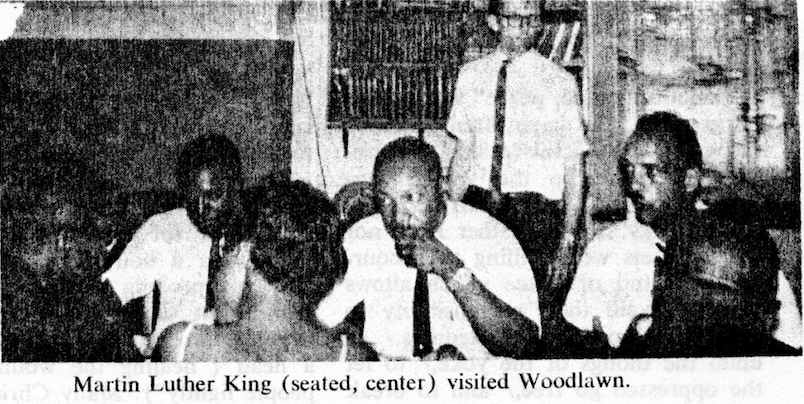
Franz, Delton. “King Comes to Woodlawn.” The Mennonite, September 28 1965, 607-608.
King and Guy Hershberger
College professor and peace advocate Guy Hershberger particularly promoted King to the Mennonite world. He not only wrote about him in the church press on numerous occasions, but also hosted him at Goshen College in 1960 and attended meetings of King’s Southern Christian Leadership Conference.8 In response to a request from Mennonite Stanley Kreider for clarification as to whether King exemplified “good Biblical nonresistance,” Hershberger revealed the high regard in which he held King and how central he felt he was to the church’s peace witness. Hershberger wrote, “However short King’s nonviolence may be of what the New Testament requires, I would need to say that as far as public figures are concerned, King was closer to it than anyone which American history has so far produced.”9 But a statement by Hershberger just prior to his assessment of King’s historic witness drives home the point of King’s relevance specifically to the Mennonite community. Hershberger wrote, “One thing which King should cause us Mennonites to do is to take a thorough look at what we mean by nonresistance.” He also relayed an anecdote passed on to him by long-time civil rights activist and educator Septima Clark about a time that King refused to strike back at an attacker who had just hit him in the face and asked his associates to also refrain from retaliating, saying, “Don’t hurt him; he doesn’t know what he is doing; we must overcome with love.”10
Mennonites understood such stories. They were the very stock in trade of many a sermon and household morality tale that formed Anabaptist youth and adults alike. While marching in the street gave most white Mennonites pause, turning the other cheek was familiar.
Of course, Hershberger wasn’t always so sanguine about King. Back in 1959, he and MCC representative Elmer Neufeld – who would go on to serve as president of Bluffton College – attended the First Southwide Institute on Non-Violent Resistance to Segregation in Atlanta. In their report, the two men compared the Atlanta conference to one run by King and his lieutenant Ralph Abernathy, noting that the two men were “not strong in administration” and therefore vulnerable to take over by stronger administrators who were “secular and no more Christian than the N.A.A.C.P.”11 Hershberger expressed wariness about anyone who engaged in nonviolence for purely tactical reasons. He wanted King to succeed as a civil rights leader because, as Hershberger wrote a year later, King was “a Christian pacifist who sincerely seeks to follow Christ.”12
Many others from the Mennonite community joined Hershberger in seeking out positive connections with King. Lancaster Conference bishop Paul Landis reported that one of the first things King said to him was, “Where have you Mennonites been?” adding, “I’ve read your Anabaptist history and theology… at the time when we needed you most you weren’t there.” Landis said King concluded by saying, “I believe a lot of what you believe … you’ve showed us the way hundreds of years ago but we need your help now.”13 Those kinds of conversations helped pave the way for the Hardings’ eventual work in Atlanta. King also took time to meet with urban Mennonite church leaders in Chicago and Cleveland, visits that stayed with those involved for years to come.14
Some Mennonites made more negative connections. The white leaders of Seventh Avenue Mennonite Church in New York City took exception to King’s methods in a 1965 self-study. They stated, “A church of largely white members located in a Negro community in contemporary America offers potentially greater gains for the claims of Christ than does ten civil-rights marches led by Rev. M. L. King, Jr.”15 Likewise, that same year, Pamela Mueller, a Mennonite from Arizona, wrote a letter to the editor in the pages of the Mennonite Weekly Review in which she berated the “so-called reverend or doctor,” found his actions “inexcusable,” and claimed that he was “well-known in communist circles.”16 Like the Seventh Avenue congregants, Mueller also found King’s street marching the most objectionable. In a letter written two years later, she continued to rail against King, this time calling him an “agitator.”17
King’s Legacy for Mennonites and Beyond
It was exactly this kind of reaction that had caused Marie Regier to grow so frustrated. By 1968, she followed the news. She knew that, in her words, “angry black men” had grown tired of waiting for change in the aftermath of King’s assassination.18 She most certainly would have read Vincent Harding’s essay describing the wall of racial separation in the U.S. behind which African Americans had asked King, “Why? Why do we have to love, even after beatings and rejections and deaths? Why?”19 She might have recalled the article by black Mennonite pastor Curtis Burrell who criticized King for failing to “offer the black man an identity.”20 Her writing indicates that she knew just how profound an impact King had had on the black community, the country as a whole, and Mennonites in particular. She cautioned, “It may be too late even now to stem the tide” of racial rebellion.21 King had called for action much earlier.
In the decades that followed, King continued to prove influential. Mennonite Minority Ministries Council leader John Powell wrote that King’s death prompted him to enter the pastorate and go on to serve the church.22 In 1978, a group of black Mennonites in Philadelphia marked their reflections on their experience with racism in the church by referring to the time before and after King’s death.23 During oral history interviews conducted in the first decade of the twenty-first century, numerous Mennonite leaders brought up King’s influence about their work on racism in the church.24
The story I have described here of Martin Luther King’s involvement with the Mennonites offers three insights for those seeking to bear witness to King’s legacy today.
First, this history reminds us that King was controversial because he challenged the status quo. Both those who praised and those who pilloried him in the Mennonite community did so for essentially the same reason: he asked the community to do things differently. He was not satisfied with a society – or a church, whether Mennonite or otherwise – that supported and maintained white supremacy. Those involved in challenging those racist systems today should expect to encounter similar controversy.
Secondly, King found both strategic and ethical reasons to pursue nonviolence. Although new scholarship has emphasized that armed self-defense was an equally important element of the mid-century black freedom struggle, King worked hard to hold those around him to high standards of nonviolence.25 Even though he held far less virtuous values around other matters of ethical conduct such as marital fidelity and gender equity, on the point of nonviolence he had integrity worth modeling.
Finally, Mennonites found in King an example of the cherished narrative of selfless martyrdom. The eulogies that poured out after his death make that evident. But I don’t offer this element of King’s engagement with Mennonites as a historical exemplar. Although King was exhausted and depressed at the time of his death, he didn’t actively seek out martyrdom. At the time of his assassination on April 4, 1968, he was getting ready for an evening of feasting and fellowship with his friends and co-workers. On this last point, we can remind ourselves that the work of anti-racism is demanding and calls not only for persistence but also for all the practices of self-care and celebration along the way that we can muster.
Taking time to remember the full breadth of King’s legacy within and without the Mennonite community offers one place to begin that process of resistance and reflection.
Marie J. Regier, “Bitter Harvest of Hate,” The Mennonite, November 26, 1968, 732.↩
Glenn E. Smiley, “They Do Not Walk Alone,” Christian Living, November 1956, 13.↩
Leo Driedger, “Faith Creates Colorblindness,” The Mennonite, November 5, 1957, 697; Levi C. Hartzler, “Looking at Race Relations,” Gospel Herald, December 31, 1957, 1145; Martin Luther King, Jr., “We Are Still Walking,” The Mennonite, January 29, 1957, 71; Paul Peachey, “On January 8-10, 1957, I Attended …,” (Harrisonburg, Va.: Peace Problems Committee, 1957), 1-2.↩
Delton Franz, “Notes on a Southern Journey,” The Mennonite, January 6, 1959, 6.↩
Guy F. Hershberger, “Report of the Chicago Race Relations Seminar,” (Goshen, Indiana: Mennonite Central Committee Peace Section, 1959), 15.↩
Rosemarie Harding and Vincent Harding, December 1961.↩
Vincent Harding, “The Christian and the Race Question,” (Kitchener, Ontario: Mennonite World Conference, 1962); Rosemarie Harding and Vincent Harding, “Pilgrimage to Albany,” The Mennonite, January 22, 1963; Vincent Harding, “Birmingham, Alabama,” (Atlanta, Ga.: Mennonite Central Committee Peace Section Executive Committee, 1963).↩
Paul Toews, Mennonites in American Society, 1930-1970: Modernity and the Persistence of Religious Community, ed. Theron F. Schlabach, 4 vols., vol. 4, The Mennonite Experience in America (Scottdale, PA: Herald Press, 1996), 256; Guy F. Hershberger, “Nonresistance, the Mennonite Church, and the Race Question,” Gospel Herald, June 28, 1960; “A Mennonite Analysis of the Montgomery Bus Boycott,” (Goshen, Indiana: Intercollegiate Peace Fellowship, 1962).↩
Stanley Kreider, Letter, April 25 1968; Guy F. Hershberger, Letter, May 24 1968.↩
Elmer Neufeld and Guy F. Hershberger, “First Southwide Institute on Non-Violent Resistance to Segregation, Atlanta, Georgia, July 22-24, 1959: A Report with Recommendations by Elmer Neufeld and Guy F. Hershberger,” (Akron, Pa.: Mennonite Central Committee, 1959), 3.↩
Hershberger, “Nonresistance, the Mennonite Church, and the Race Question,” 578.↩
Paul G. Landis, “Interview with Paul G. Landis,” ed. Tobin Miller Shearer (Lancaster, Pa./Evanston, Ill., 2005).↩
Delton Franz, “King Comes to Woodlawn,” The Mennonite, September 28 1965. My mother and father, Vel and John and Shearer, often told me the story of the time King met with church leaders in Cleveland while they served with a Voluntary Service Unit there.↩
“Seventh Avenue Mennonite Church: Self-Analysis of Congregation in Response to Questionnaire Titled ‘Some Questions to Ask When Describing a Church’,” (New York, N.Y.: Seventh Avenue Mennonite Church, 1965), 10.↩
Pamela Mueller, “Tears and Lumps,” The Mennonite, May 18, 1965, 336.↩
Pam Mueller, “Shook up but Different,” ibid., November 7, 1967.↩
Marie J. Regier, “Bitter Harvest of Hate,” ibid., November 26, 1968.↩
Vincent Harding, “Wall of Bitterness,” ibid., June 18, 1968, 426.↩
Curtis Burrell, “Response to Black Power,” ibid., October 11, 1966.↩
Marie J. Regier, “Bitter Harvest of Hate,” ibid., November 26, 1968.↩
John Powell, “Among Chaos, a Place to Belong,” ibid., September 25, 1973.↩
Katie Funk Wiebe, “Mennonites Like Me,” Gospel Herald, August 22, 1978.↩
Ron Kennel, “Interview with Ron Kennel,” ed. Tobin Miller Shearer (Goshen, Ind./Evanston, Ill., 2004); Calvin Redekop, “Interview with Calvin Redekop,” ed. Tobin Miller Shearer (Harrisonburg, Va./Evanston, Ill., 2004); Samuel Horst, “Interview with Samuel Horst,” ed. Tobin Miller Shearer (Harrisonburg, Va., 2005); Harold Huber and Vida Huber, “Interview with Harold and Vida Huber,” ed. Tobin Miller Shearer (Harrisonburg, Va., 2005); Landis; Paul Peachey and Ellen Peachey, “Interview with Ellen and Paul Peachey,” ed. Tobin Miller Shearer (Harrisonburg, Va., 2005); Harold Regier and Rosella Wiens Regier, “Interview with Harold Regier and Rosella Wiens Regier,” ed. Tobin Miller Shearer (Newton, Kans./Evanston, Ill., 2005).↩
Hasan Kwame Jeffries, Bloody Lowndes: Civil Rights and Black Power in Alabama’s Black Belt (New York: New York University Press, 2009); Akinyele Omowale Umoja, We Will Shoot Back: Armed Resistance in the Mississippi Freedom Movement (New York: New York University Press, 2013); Jr. Charles E. Cobb, This Nonviolent Stuff’ll Get You Killed: How Guns Made the Civil Rights Movement Possible (New York: Basic Books, 2014).↩
My dissertation focuses on the early modern period and addresses the economic experiences of nonconformists in the northwestern Holy Roman Empire. One piece of twentieth-century evidence, however, demonstrates how economic strength became a rhetorical pose necessary for later Mennonites—a pattern familiar to any minority group that must justify its continued existence to a wider community. This short nineteen-page pamphlet, The Cultural Achievements of the Mennonites in East Frisia and the Münsterland, written and published by Pastor Abraham Fast of Emden in 1947, began by explaining the common experience of Mennonites in what was now northwestern Germany: “In East Frisia and the Münsterland the Mennonites were, from the beginning, much less a segregated non-resident settlement community than later in the eastern part of the Empire or further in Russia.”1 This ‘integration’ was made easier by what Fast described as “blood and language,” common membership in a so-called “Saxon-Frankish-Friesian tribe” as those in the East Frisian and Westphalian communities to which they immigrated.
Predictably, in a publication dedicated to an elder of the Mennonite community in Gronau, Fast was effusive about the positive role Mennonites had played. This was both genuinely celebratory and an expedient means of justification; Fast argued that Mennonites had a small but nonetheless integral role as “economically and spiritually a good leaven for this region.” He dug into the archives to evidence this claim, pulling sources from the sixteenth, seventeenth and eighteenth centuries before turning to his main concern: the “most recent 150 years” of Mennonite history in the area (indeed, Fast gives quite a detailed industrial history of a number of textile firms).2
My concern, of course, is his use of evidence from the early modern period. Fast highlighted the irony of sixteenth-century economic toleration: “This fact is simply appealing when one observes how the sharpest memories of the edicts against the Mennonites fade, while at the same time [they were] negotiating with these forbidden heretics over leases, money borrowing or even gifts for the princely court.”3 This ironic use of ‘heretic’ (‘Ketzer’) is striking. Most importantly for Fast, however, was the clear economic advantage to business dealings with Mennonites even as they were singled-out for religious nonconformity. Fast went on to argue that authorities recognized this advantage early on, and sought to bring Mennonites into these territories despite religious difference.
Fast, remarkably, harkened back to the same 1577 letter from the Emden council about which I wrote about a few months ago, and quoted from the complaint by Emden authorities that Anabaptists were taking up the most prominent houses and prominent roles in the wider business and merchant community. It is notable that Fast was here comfortable quoting from a letter that only ever referred this group as Anabaptists (Wiedertäufer) – and one in which their social position was made explicitly analogous to that of Jews. Fast went on to quote from a protection letter from 1688, in which authorities warned that the expiration of Mennonite protections would have a significant financial strain on the area, and to quote extensively from a 1708 petition by a governmental official in Norden who expounds upon the necessity of Mennonites for the larger community there – and especially for the poor.4
In his sparse use of early modern evidence, Fast meant only to set the stage for the more impressive economic achievements of Mennonites in the nineteenth and twentieth centuries. However, the addition of the letter from 1577 does two unique things. First, it uses a hostile account as evidence for prosperity—the latter two pieces of early modern evidence appear to be neutral if not complimentary, while the 1577 letter was clearly pejorative. And secondly, it naturalizes the economic strength of the Mennonite community; it has always been so, and the community’s industriousness has paved the way for its inclusion.
Similarly, Fast listed a number of western Münsterland industrial concerns begun by Mennonites – most of which had been founded only during the nineteenth century, but which had grown out of a tradition of Mennonite weaving and cloth-trading that began in the early modern period.5 The relative wealth of Mennonites compared to wider society was a commonality amongst Mennonites in both East Frisia and the Münsterland, evidenced by the saying “only rich people belong to the Mennonites.”6 This pride in the relative wealth of the community is certainly a prominent theme of Fast’s pamphlet, and he noted that Mennonites gave generously to the poor of other confessions, as well as contributed significantly more to school taxes.
But Fast acknowledged some differences between the two communities, in a striking paragraph that closed his pamphlet:
“Worth mentioning, however, are the following peculiarities. In contrast to the families from Emden and Norden, the Münsterlanders did not appear on the political stage. But they built up all the more zealously as entrepreneurs that which gives public life its basis and its freedom of movement: the economy. On the other hand they revered, as did the East Frisian Mennonites, a religious inwardness and the free cosmopolitanism associated with it, as had always belonged to the tradition of these communities. Most of the above-mentioned, significant business founders in East Frisia and the Münsterland and their successes have put their forces at the service of local communities as church councilors and as deputies in the service of the Association of the German Mennonites, where the community in Emden shaped the spiritual center of the whole group and still shapes it until today.”7
But if Mennonites would eventually find themselves wealthy, and protected by that wealth – however reliable this ebullient pamphlet was – it took round and rounds of negotiation in the early modern period to establish their homes in communities such as Emden, Norden and Leer.
Abraham Fast, Die Kulturleistungen der Mennoniten in Ostfriesland und Münsterland (1947), 3. An editorial note on the inside of the front cover indicated that the text had been prepared in 1939 but its publication had been delayed by the Second World War. ↩
That same editorial note indicated that he used a number of well-known nineteenth century works to gather this evidence, particularly J.P. Müller, Die Mennoniten in Ostfriesland.↩

 The Classics of the Radical Reformation Series is published under the auspices of Anabaptist Mennonite Biblical Seminary’s Institute for Mennonite Studies and overseen by a reference council of scholars from Canada and the United States, a group I joined in 2018. Since the 1970s, the series has existed “to offer in the English language, scholarly and critical editions of the primary works of Reformers of the Radical Reformation…also intended for the wider audience of those interested in Anabaptist and free church writers of the sixteenth century.”
 Anabaptist Historians