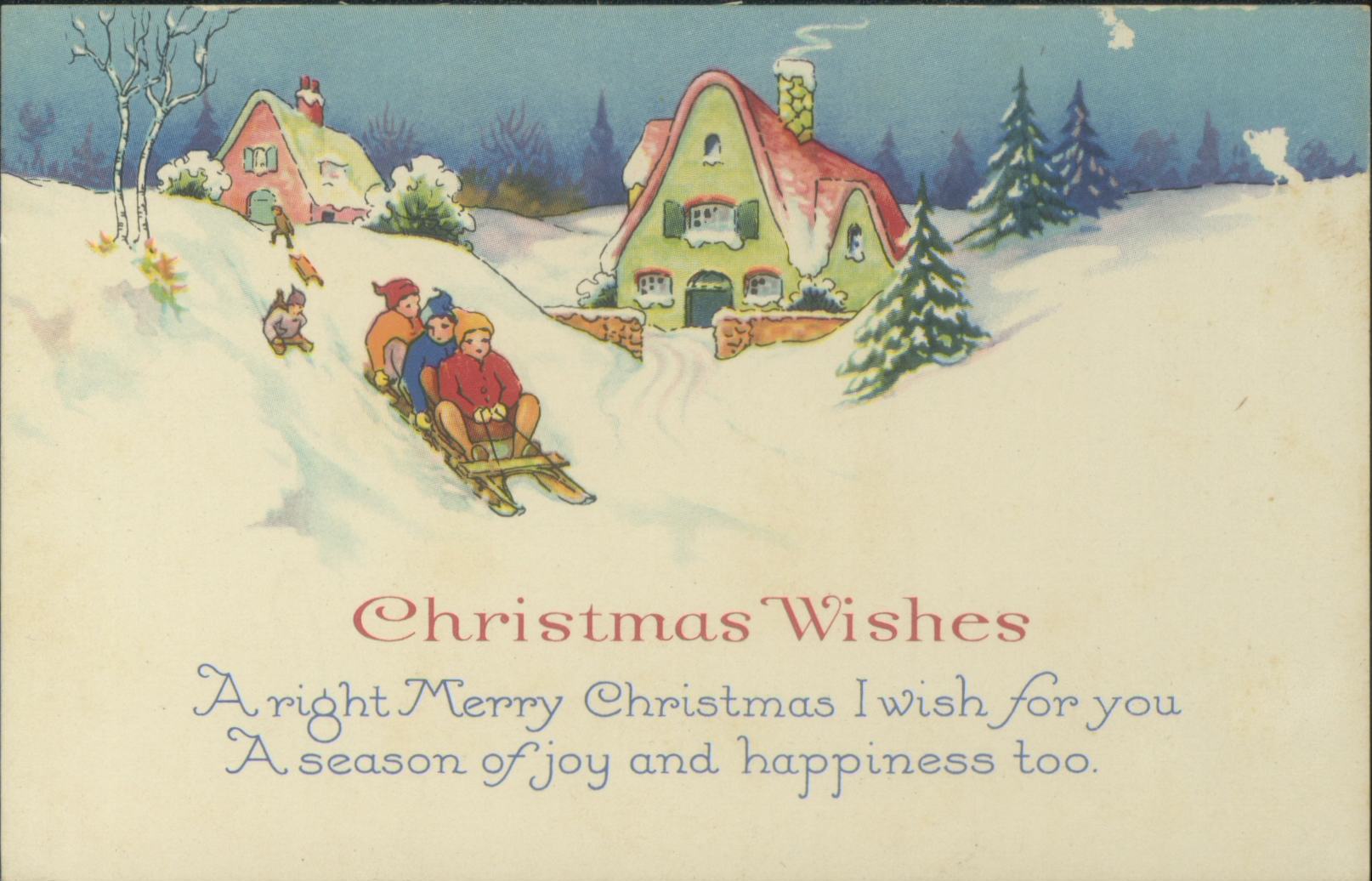
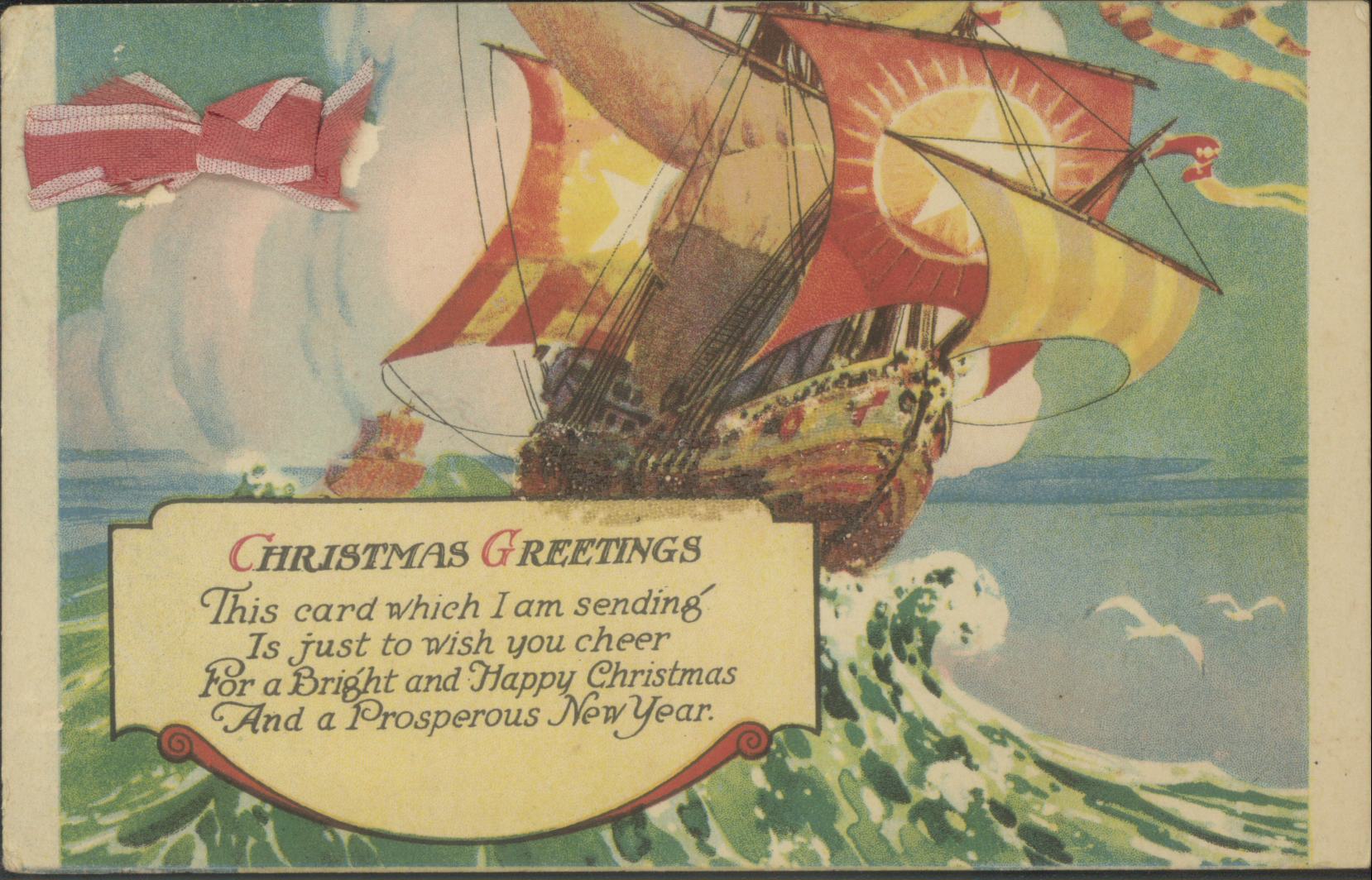
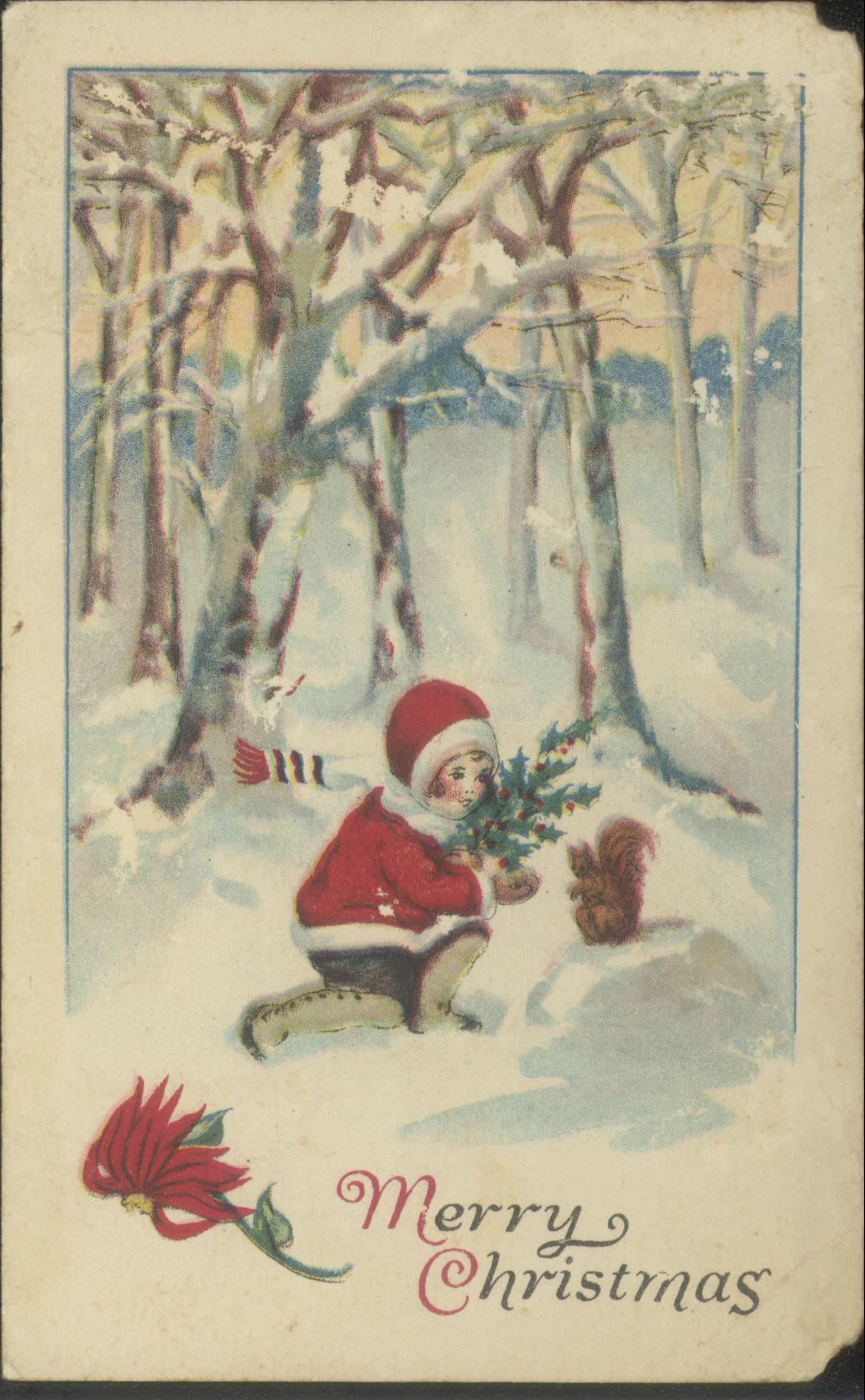
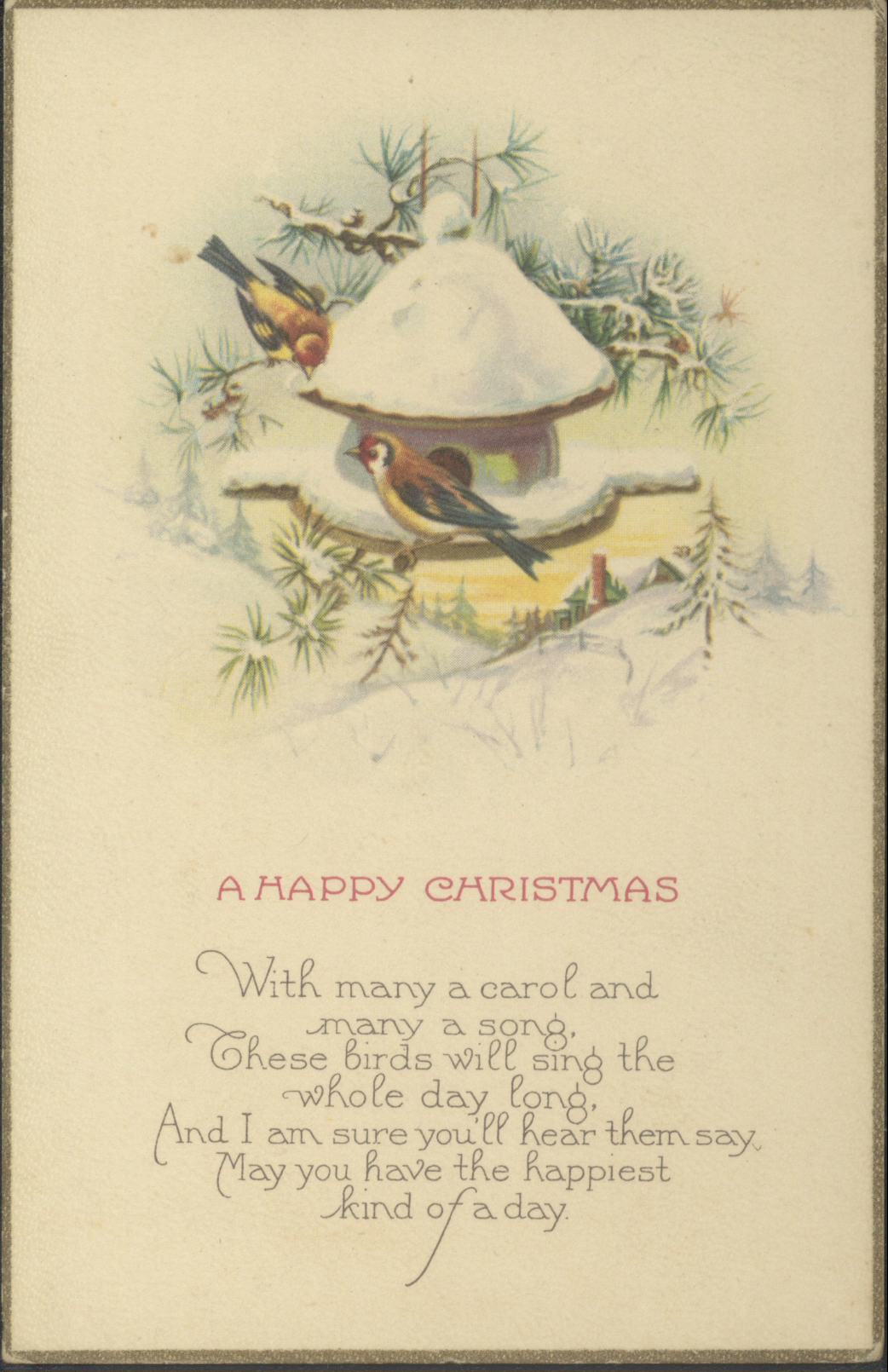
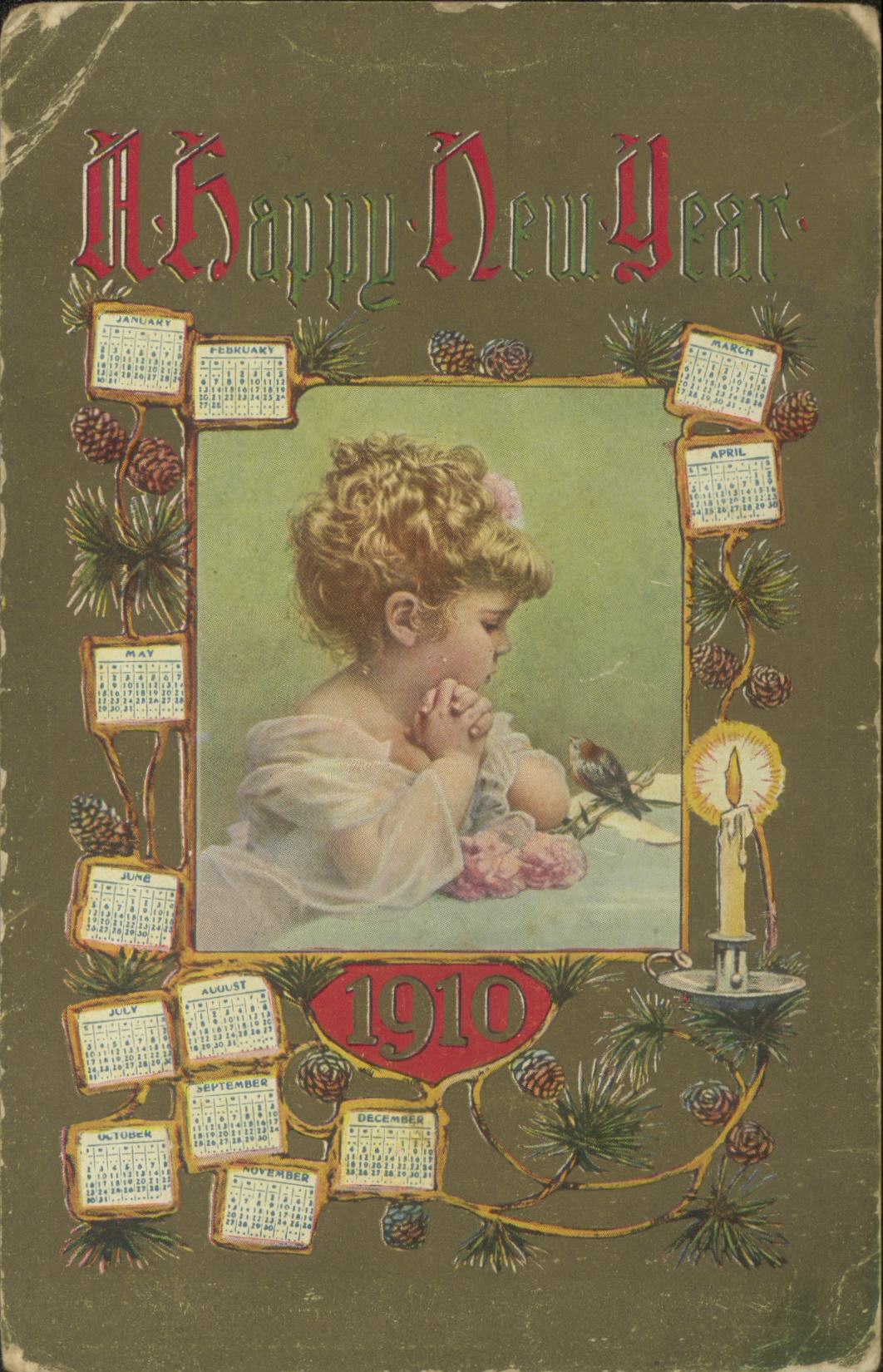
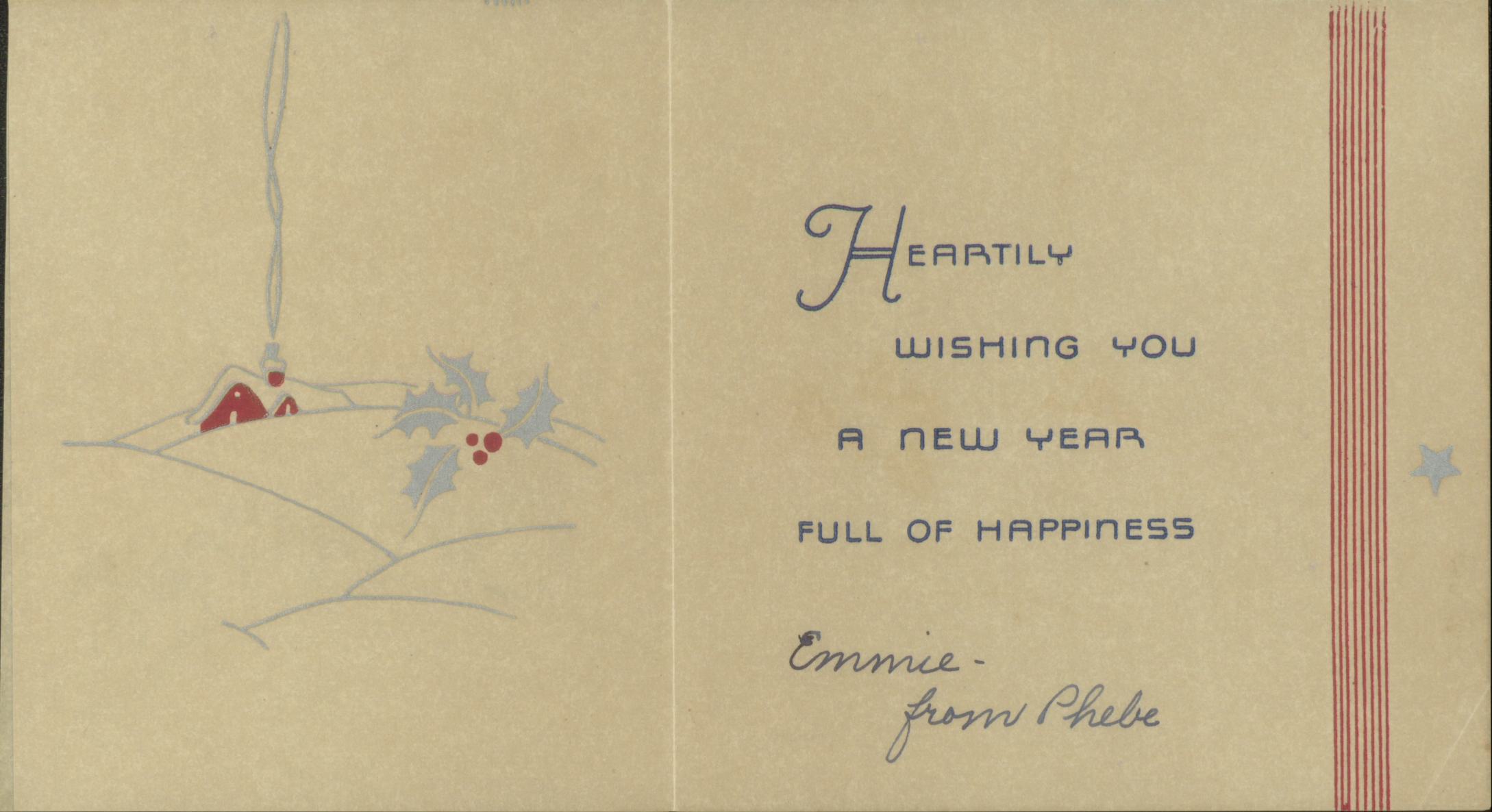
‘Tis the season to send and receive holiday greetings! While the missives of today often contain perfectly posed photos of the sender’s family, a century ago photographs had yet to make it to the mainstream since they were not as easily reproduced. Instead, holiday postcards contained lovely illustrations coupled with sweet sayings.
The Virginia Mennonite Conference Archives is fortunate to house the collection of Nora Hostetter, which contains some fantastic examples of these antique cards sent to her family and friends over a century ago. I have scanned a selection to share here and hope they give you a glimpse into holidays past.
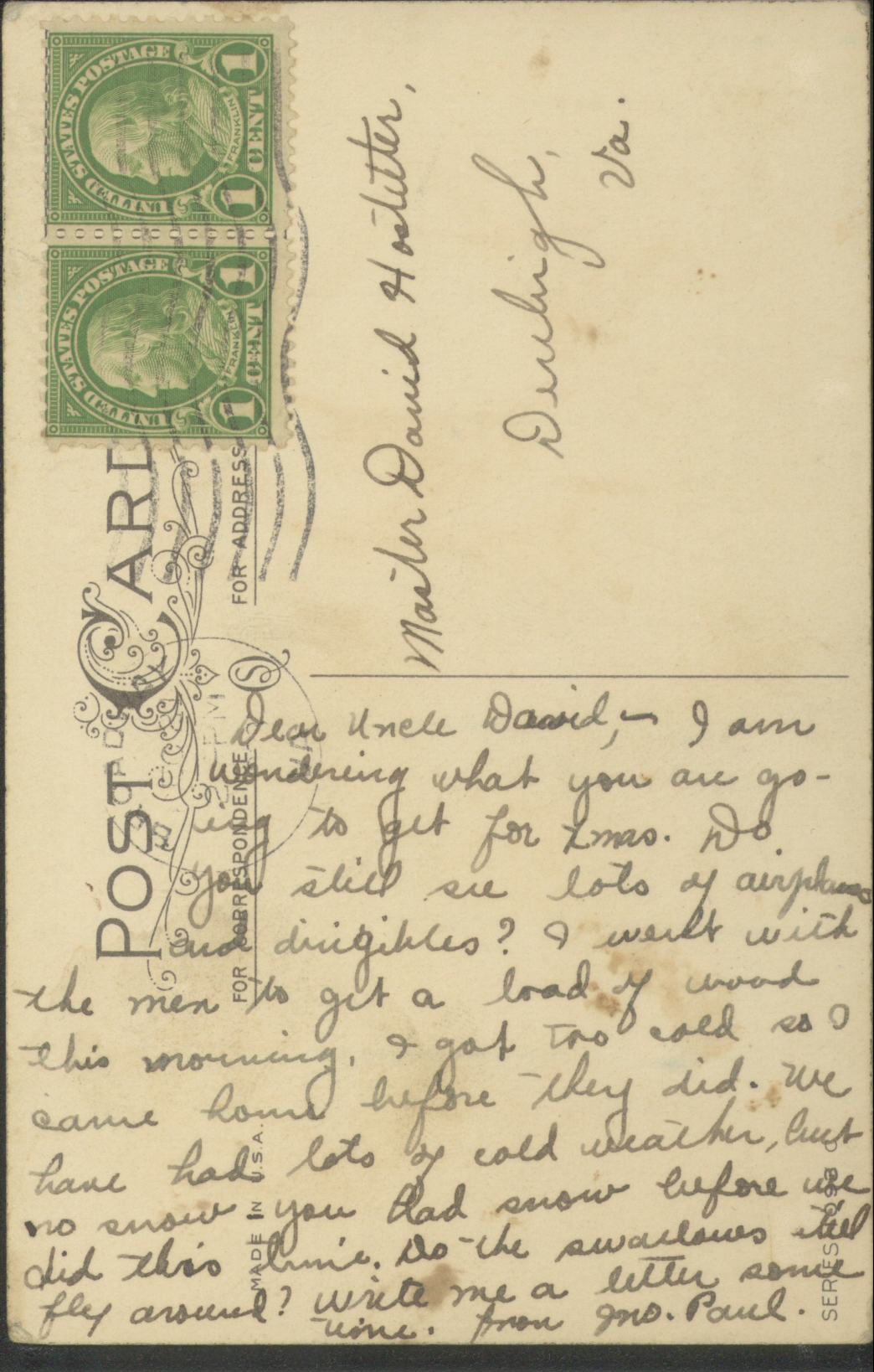
The message on this card gives a unique glimpse into the sights of the day, with John Paul asking his uncle David Hostetter whether he is still seeing “lots of airplanes and dirigibles” ( blimps) and if the “swallows still fly around” in Denbigh.
Merry Christmas and here’s to another year of discovering treasures in our historical collections!
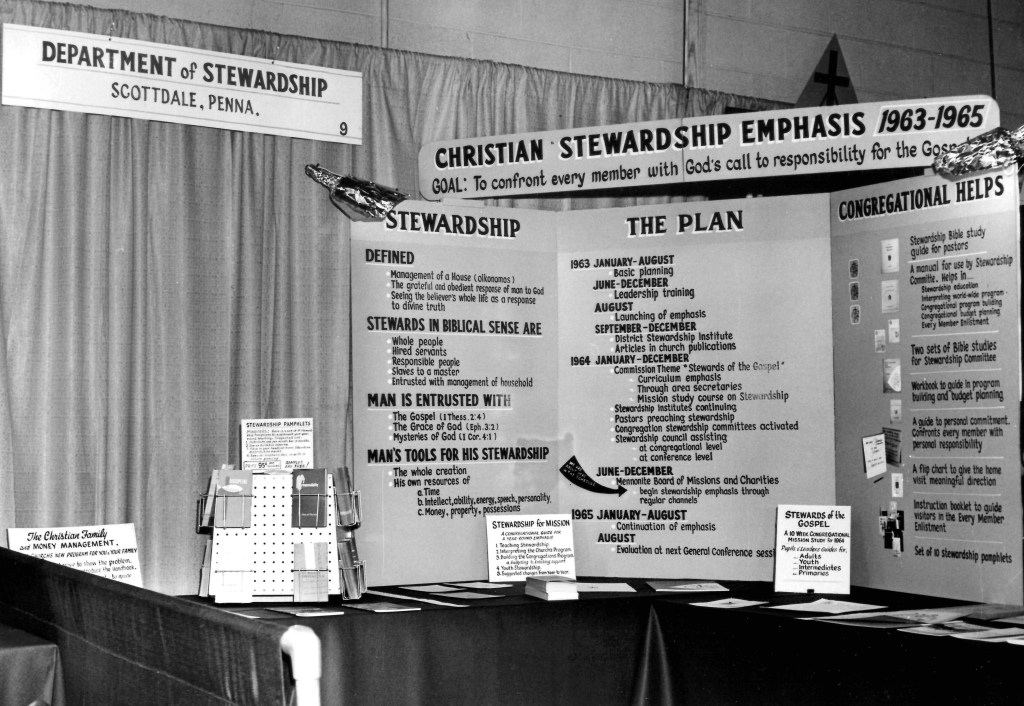
Daniel E. Kauffman (left) and Nelson E. Kauffman (right) speak at a workshop (early 1960s) for leaders seeking to implement stewardship initiatives in local congregations. The stewardship booth at the 1964 Sunday School Convention.
Source: Mennonite Church Secretary of Stewardship Records, 1956-1972. Box 5, Folder 32. I-3-11. Mennonite Church USA Archives. Elkhart, Indiana.
Mennonites have been talking about money for a long time, but questions about its place in the lives of believers loomed especially large in the twentieth century. As Mennonites sought to come to terms with their growing prosperity, stewardship emerged as a concept to promote the responsible management of God-given resources (time, money, talents, possessions, etc.). During the first half of the twentieth century, several leaders in the (old) Mennonite Church began to articulate a theology of Christian stewardship, including J.S. Shoemaker, Christian L. Graber, and Daniel Kauffman. It was not until midcentury, however, when stewardship initiatives became institutionalized in the Mennonite Church with the formal creation of organizations and committees such as Mennonite Mutual Aid, the Mennonite Foundation, the Mennonite Community Association, and the Committee on Economic and Social Relations.
Between 1945 and 1960, the Mennonite Research Foundation conducted four separate studies on the topic of Mennonite income and giving patterns and, in 1953, Milo F. Kauffman spoke in over 250 Mennonite congregations on the topic of Christian stewardship. In 1957, the Mennonite Church General Conference passed a resolution approving a churchwide emphasis on Christian stewardship and Daniel E. Kauffman was installed as Secretary of Stewardship in 1961. The secretary worked with a churchwide stewardship council to host conferences, organize training workshops and institutes, track giving statistics, and create curriculum, manuals, and study guides for use in Mennonite congregations. Other people who promoted stewardship initiatives on behalf of the denomination between 1961 and 2000 include Jonathan J. Hostetler, Robert A. Yoder, Ray and Lillian Bair, Everett Thomas, Lynn Miller, Mark Vincent, and Michele Hershberger.1
As part of a larger denominational restructuring process, the Mennonite Board of Congregational Ministries took over responsibility for churchwide stewardship initiatives in 1971. ↩
Why is it news in 2019 that some Mennonites participated in the Nazi Holocaust of European Jews? Last month, the Jewish Heritage Centre of Western Canada sponsored a symposium in Winnipeg on the history of Mennonite-Nazi collaboration. During the question and answer period, audience members asked historians Aileen Friesen and Hans Werner why this story is only now gaining public attention. The scholars gave two main answers. First, new sources in East European archives have recently come to light. And second, Mennonite memoir literature has tended to treat the Holocaust cursorily or emphasized Mennonites’ own wartime suffering.
To
these two responses might be added a third reason: Mennonite leaders
and others affiliated with the church actively repressed evidence of
Nazi collaboration and Holocaust participation. As the recent
scholarship
by Friesen, Werner, and others suggests, the story of why it has
taken so long for Mennonites to speak publicly and extensively about
this dark chapter in twentieth-century history requires investigation
in its own right. This essay considers one small slice of that larger
question. It examines testimony given by two witnesses, Benjamin
Unruh and Franziska Reimers, at trials of Nazi war criminals held in
Nuremberg in occupied Germany in the 1940s.
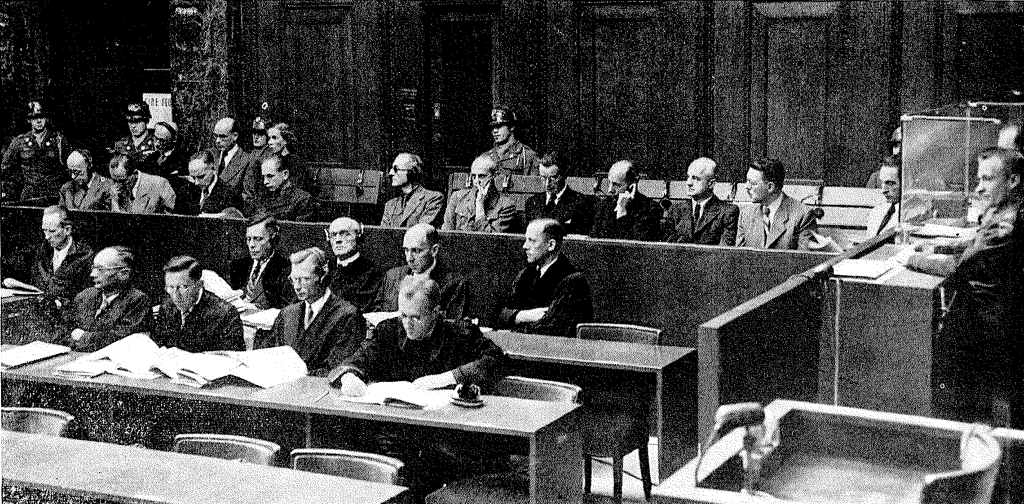
Defendants in the case United States of America vs. Ulrich Greifelt, et al. in the dock at Nuremberg. Defense lawyers are in the foreground. Werner Lorenz is at center back, chin in palm. Credit: Trials of War Criminals, 605.
The
first witness, Benjamin Unruh, testified at Nuremberg on December 17,
1947 on behalf of the Nazi administrator Werner Lorenz. Lorenz had
headed the Ethnic German Office of the SS, which during the war had
resettled hundreds of thousands of people in Eastern Europe with the
purpose of demographically engineering an Aryan utopia. At Nuremberg,
Lorenz was tried along with thirteen other defendants in the eighth
of twelve trials organized by United States authorities to prosecute
war criminals. Unruh, who had been born in a Mennonite colony in
Crimea in 1881, had liaised with Lorenz in his capacity as a leading
Mennonite church leader in the Third Reich.
Unruh
testified to the court that Lorenz and his subordinates had extended
favorable treatment to Mennonites and other so-called Ethnic Germans
in Eastern Europe. From 1941 to 1943, Nazi offices had provided aid
to German-speaking
Mennonite colonies
in occupied areas of the Soviet Union, and in 1944, the SS had
overseen their evacuation from Ukraine to more western regions. Unruh
emphasized a longer history of Mennonite suffering under communist
rule in the USSR. He himself had helped to organize a mass exodus of
tens of thousands of church members during the 1920s, and he
considered Lorenz’s activities a continuation of this older
humanitarian effort.
The
court understood that the favorable policies of SS leaders like
Lorenz toward Mennonites and other “Ethnic Germans” had come at
the expense of populations the Nazis had considered to be non-Aryans.
Judges sentenced Lorenz to twenty years imprisonment for his crimes.
However, Unruh refused to acknowledge links between welfare and
genocide. During cross-examination, he claimed that “we, the
Mennonite Church, always collaborated in perfect harmony with all
other churches and also with the Jewish church.” When asked about
the Holocaust, Unruh said that he knew of the killings, but he
insisted that he “always protested against that energetically.”1
Benjamin
Unruh’s postwar claims of helping Jews and of opposing genocide are
not supported by the extensive correspondence preserved in his
personal papers, government archives, or other sources. In fact, he
appears to have hastened the turn toward extreme antisemitism in
Mennonite church organizations in the Third Reich. Unruh contributed
financially to the SS already in 1933, and in the same year, he
personally quashed a request by two Jewish physicians for Mennonite
help in leaving Germany.2
During the Second World War, Unruh collaborated with various Nazi
agencies to aid Mennonites while these same offices expropriated and
murdered Jews and others.
The
second Mennonite to testify at Nuremberg, Franziska Reimers, served
as a witness at the ninth and next war crimes trial organized by the
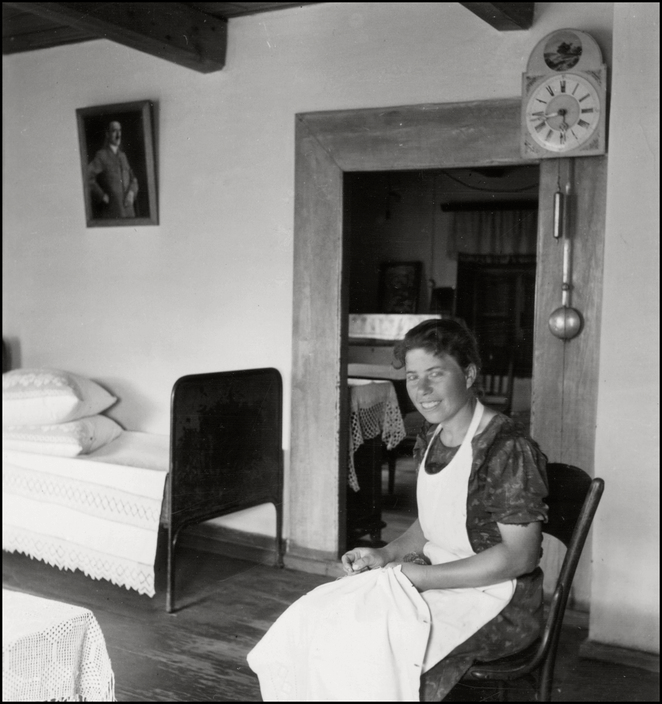
United States. Born in 1911 in the Mennonite Chortitza colony in
Ukraine, Reimers came under Nazi rule during Hitler’s wartime
invasion of the USSR. As a young woman, she had experienced the
Bolshevik revolution and the horrors of Stalinization. Soviet secret
police had arrested her husband in 1937, along with numerous other
Mennonites. She had not heard from him since. In August 1941, as the
Nazis advanced eastward, Soviet secret police pressured Reimers to
spy behind German lines, threatening her young child.
During
her testimony at Nuremberg on January 7, 1948, Reimers reported that
Romanian troops had apprehended her. The Romanians sent Reimers to
the Nazi killing squad, Einsatzkommando
6,
then based in the Ukrainian city of Kryvyi Rih. It was on behalf of
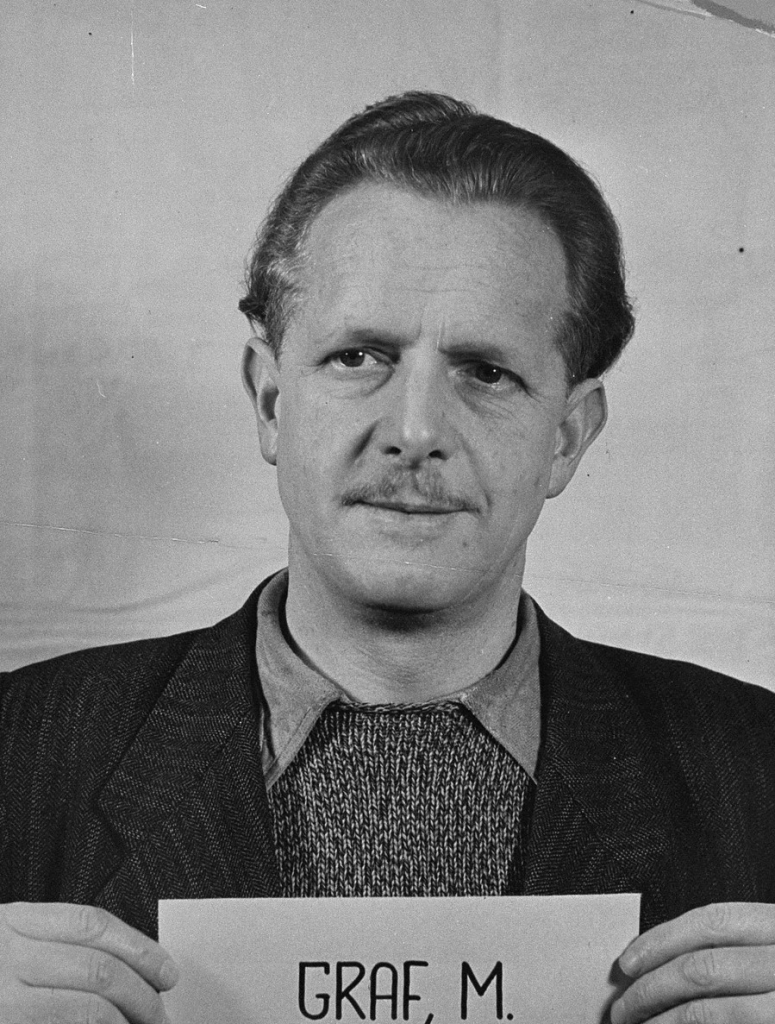
one member of this group, Mathias Graf, that the court called Reimers
to testify. Graf had served as a low-ranking member of the death
squad, and he was on trial along with twenty-three other members of
the liquidation units called Einsatzgruppen,
or Task Forces. Each of the four main Task Forces had between 800 and
1,200 members, and they were collectively responsible for murdering
two million people.
A Mennonite woman at her home in the Chortitza colony in Nazi-occupied Ukraine, 1943, sewing with photograph of Hitler on the wall. Credit: Image NN11456799, Herbert List/Magnum Photos
Reimers
described Graf as an upstanding and pious man. In cross examination,
the prosecution expressed surprise that Graf’s Commando 6, which
was a subunit of the larger Task Group C, had not summarily shot
Reimers, a Soviet spy. But she explained that as an “Ethnic
German,” she had seen the invading Nazis as liberators, and in turn
they had treated her as a persecuted conational. Reimers testified
that Mennonites in the USSR “had to suffer terribly from cruelties
in Russia; in the flourishing locations at the time not one man ever
came home in the villages, all the men were expelled to Siberia.”
Reimers responded by offering “service to my countrymen.”3
For
several weeks during September 1941, Reimers lived under special
protection of Commando 6 in Kryvyi Rih. She gave Russian language
lessons to several death squad members, including Graf. According to
Reimers, Graf arranged with the commando’s leader, Erhard Kroeger,
to take her back to the region around Chortitza to search for her
child, and she arrived in late September or early October. While
Reimers presented this move as a happy tale of family reunification,
the transfer of part of Commando 6 from Kryvyi Rih to Chortitza
coincided with the Nazi capture of the nearby city of Zaporizhia. The
group murdered 3,000 Jews there over the next month alone.4
Asked
at Nuremberg if she had known about the operations of Commando 6,
Reimers said, “in general I saw that Jews were herded together with
bundles on their back. What happened to these people I could not find
out.”5
Reimer’s claim that she learned of the Holocaust only years later,
after leaving Ukraine, is certainly false. Commander Erhard Kroeger’s
personal involvement in Reimer’s transfer to the Chortitza area
suggests that he considered her valuable as a translator and cultural
link to the local Mennonite population. Upon arrival at Chortitiza,
the Commando 6 subgroup recruited dozens of volunteer auxiliary
policemen, including a number of Mennonites.6
Whether
Reimers directly participated in the recruitment of Mennonite killers
for the Nazi death squad, or whether she herself was present during
related actions, is difficult to know. However, her testimony does
reveal that she reestablished contact with her child and other
relatives thanks to Commando 6. Even children among this local
Mennonite population were aware of Holocaust atrocities. Years after
the war, one Mennonite woman recalled how as a girl, she had
encountered the body of a murdered Jew in the hedgerow by her farm.
In another case, she helped distributed bloodstained clothing. She
herself washed and wore a dress with a bullet hole through the
chest.7
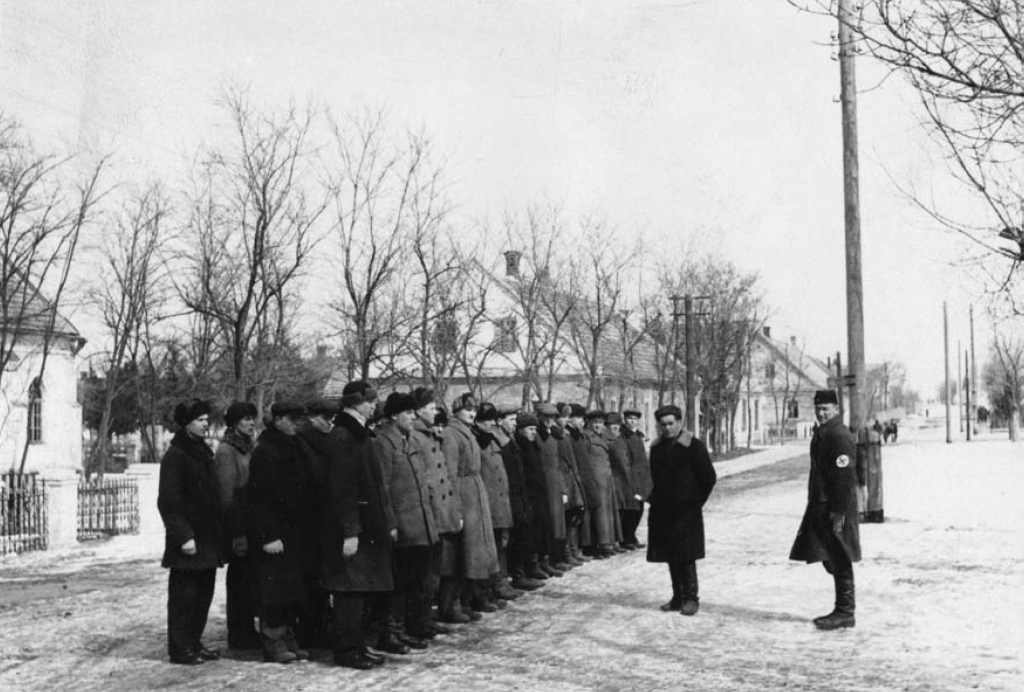
Nazi officials organized Mennonite men in occupied Ukraine into police and military units, such as this “self-defense” group in the Molotschna colony in 1942. Credit: Bild 137-78955, Bundesarchiv, Berlin.
That
Reimers acquitted herself well in the eyes of Commando 6 is suggested
by the fact that she continued onward with Graf and other squad
members from the Chortitza area to another city, Dnipropetrovsk.
Reimers reported working there for the German civil administration,
although she continued to provide Russian language lessons to
Commando 6 two or three times weekly. Reimers was one of numerous
Mennonites to join the Nazi administration in Ukraine. Others served
as mayors for cities like Zaporizhia. Collaborators aided various
aspects of the Holocaust, expropriating Jews, forcing them to wear
identifying symbols, and assembling them in ghettos.8
Although
Graf left Dnipropetrovsk after several weeks, Reimers remained in
touch with him by post. After the city’s evacuation in 1943, Graf
invited Reimers to resettle near his own home in Germany along with
her mother and child. He helped her find office work in a munition
factory. Reimer’s testimony in support of Graf may or may not have
positively influenced the Nuremberg court’s verdict. The judges
ultimately sentenced Graf to time served and ordered his release. The
ruling noted that while Graf had certainly belonged to a criminal
organization, lack of evidence due to his low rank meant that his
presence at killing actions could not be definitively proved.9
The Nuremberg testimony of Benjamin Unruh and Franziska Reimers shows how Mennonites with vastly different relationships to church leadership could suppress histories of collaboration. While Reimers lived in Bonn after the war, a city without any Mennonite congregations, Unruh worked closely with both the North America-based Mennonite Central Committee (MCC) and Germany’s largest conference, the Mennonite Union. He helped MCC provide aid to Mennonite refugees from Ukraine as the agency downplayed their wartime actions.10 Meanwhile, his Union colleagues sought to intercede with Allied authorities for former Nazis facing criminal charges.11
While
Mennonite participation in the Holocaust is making headlines in 2019,
the fact that two Mennonites testified at Nuremberg is not news.
Transcripts of their remarks have been available for years in church
archives, alongside numerous reels of Nazi documents copied from
state repositories.12
Researchers have more often used such materials to recount
suffering
in the Soviet Union than to reveal complicity with genocide. Indeed,
one person was sufficiently taken with Reimer’s testimony to pen a
fictional coda. Grateful for ostensibly having saved each other, Graf
and Reimers fall in love, although she and her child eventually
depart with MCC for Canada.13
One anonymous author imagined a romantic affair between the Mennonite Franziska Reimers and the former death squad member Mathias Graf, pictured here at Nuremberg in 1947. Credit: Image 09930, United States Holocaust Memorial Museum.
How
could it ever have been possible to imagine such a tone-deaf fantasy?
Stories of Mennonite victimhood in the Soviet Union circulated so
widely through official and informal channels, and memories of
Mennonite involvement in murdering Jewish neighbors had become so
thoroughly repressed, that this author found it possible to compare
Graf’s imprisonment in postwar Germany to Reimer’s suffering
under Stalinism. It apparently seemed unproblematic to laud romantic
love between a Mennonite and a former member of a Nazi death squad.
The reality that such an idea could inspire not horror but wistful
longing should give pause to Mennonites and others today.
Ben
Goossen is a historian at Harvard University and the author of Chosen
Nation: Mennonites and Germany in a Global Era,
published in 2017 by Princeton University Press.
“United States of America v. Ulrich Greifelt et al.,” December 17, 1947, M894, roll 4, National Archives and Records Administration, College Park, Maryland, USA (hereafter NARA). ↩
Benjamin Unruh to Emil Händiges, August 25, 1933, Nachlaß Otto Schowalter, Folder: Korrespondenz 1929-1945, Mennonitische Forschungsstellte, Bolanden-Weierhof, Germany. Thanks to Arnold Neufeldt-Fast for sharing this source. ↩
“The United States of America vs. Otto Ohlendorf, et al.,” January 7, 1948, M-895, roll 5, NARA. Reimers was summoned by Graf’s legal counsel. Eduard Belzer, “Defendant’s Application for Summons for Witness,” September 15, 1947, M895, roll 34, NARA. ↩
Alexander Kruglov, “Jewish Losses in Ukraine, 1941-1944,” in The Shoah in Ukraine, ed. Ray Brandon and Wendy Lower (Bloomington: Indiana University Press, 2008), 279. ↩
“The United States of America vs. Otto Ohlendorf.” ↩
Gerhard Rempel, “Mennonites and the Holocaust: From Collaboration to Perpetuation,” Mennonite Quarterly Review 84, no. 4 (2010): 530-535. ↩
Pamela Klassen, Going by the Moon and Stars: Stories of Two Russian Mennonite Women (Waterloo: Wilfrid Laurier University Press, 1994), 85. Mennonite women in Ukraine participated in the distribution of clothing from murder victims on several occasions. The Nazi press referred to such clothing as “used” but did not specify its origins. For example, “Kleider für 13000 Volksdeutsche,” Deutsche Bug-Zeitung, June 30, 1943, 3; “Kleidungsstücke für 13000 Volksdeutsche,” Deutsche Ukraine-Zeitung, July 6, 1943; “Die Hilfsaktion wird fortgesetzt,” Ukraine Post, July 20, 1943, 8. However, archival correspondence demonstrates that clothes and other goods taken from Jews were to be designated for redistribution among Mennonites and others. On one occasion, Himmler ordered that items from warehouses in Auschwitz and Lublin be sent to the 55,000 “Ethnic Germans” in the Molotschna and Chortitza colonies for Christmas 1942. His instructions included that each person was “to be given a dress or suit, a coat and hat if available, each three shirts and relevant underwear and other daily necessities including utensils as well as a trunk. The needy are also to be given featherbeds and blankets as well as linens.” Heinrich Himmler to Oswald Pohl and Werner Lorenz, October 14, 1942, T-175, roll 129, NARA. ↩
Martin Dean, “Soviet Ethnic Germans and the Holocaust in the Reich Commissariat Ukraine, 1941-1944,” in The Shoah in Ukraine, ed. Brandon and Lower, 248-271; Markus Eikel and Valentina Sivaieva, “City Mayors, Raion Chiefs and Village Elders in Ukraine, 1941-4: How Local Administrators Co-operated with the German Occupation Authorities,” Contemporary European History 23, no. 3 (2014): 405-428; Viktor Klets, “Caught between Two Poles; Ukrainian Mennonites and the Trauma of the Second World War,” in Minority Report: Mennonite Identities in Imperial Russia and Soviet Ukraine Reconsidered, 1789-1945, ed. Leonard Friesen (Toronto: University of Toronto Press, 2018), 287-318; James Urry, “Mennonites in Ukraine During World War II: Thoughts and Questions,” Mennonite Quarterly Review 93, no. 1 (2019): 81-111. ↩
Michael Musmanno, John Speight, and Richard Dixon, “Mathias Graf,” in Trials of War Criminals before the Nuernberg Military Tribunals, vol. IV(Washington, D.C.: US Government Printing Office, 1949), 587. See also Hilary Earl, The Nuremberg SS-Einsatzgruppen Trial, 1945-1958 (Cambridge: Cambridge University Press, 2009), 258-260. ↩
Part of this history is told in Benjamin W. Goossen, “From Aryanism to Anabaptism: Nazi Race Science and the Language of Mennonite Ethnicity,” Mennonite Quarterly Review 90, no. 2 (2016): 135-163. ↩
In one case, an executive leader of the Union claimed to British authorities that Heinrich Enß, a Mennonite who had served with the Waffen-SS at the Stutthof concentration camp, “had only to do with the financial administration and was able to help some of the prisoners in that camp.” Ernst Crous to Religious Affairs Branch Zonal Executive Offices, October 22, 1947, FO 1050/1565, The National Archives, Kew, United Kingdom. Enß joined the Nazi Party and the SS in 1933. By 1941, he had advanced to the rank of SS-Oberscharführer. See A3343-SM-C107, Heinrich Enß 2.3.7, NARA. Postwar charges against Enß are archived in BY 5/V279/124, vol. 7, Bundesarchiv, Berlin, Germany. ↩
“Official Transcript of the American Military Tribunal against Otto Ohlendorf et. al. Nurnberg, Germany,” 1948, Siegfried Janzen Papers, Volume 5456, Mennonite Heritage Centre, Winnipeg, Canada; “Case #8 Tribunal 1 US vs. Ulrich Greifelt, et al., Volume 7 Transcripts,” December 17, 1947, SA.I.184, Mennonite Library and Archives, North Newton, Kansas, USA. ↩
“Leben u. Liebe im Sowjetparadiese,” Henry B. Hoover Papers, Lancaster Mennonite Historical Society, Lancaster, Pennsylvania, USA. This account appears to be entirely fictional, with Reimer’s name changed to “Ella.” Records of Mennonite immigrants to arrive in Canada after World War II do not include a Franziska Reimers. ↩
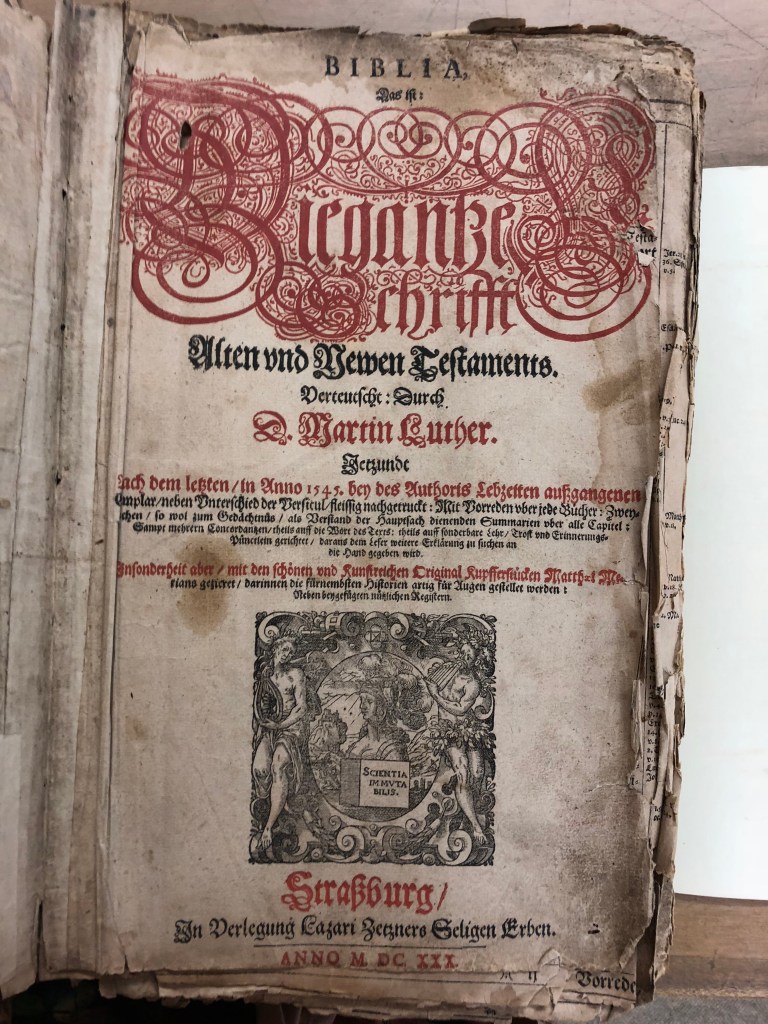
Title page of a bible printed in Strasbourg in 1630
Kat Hill
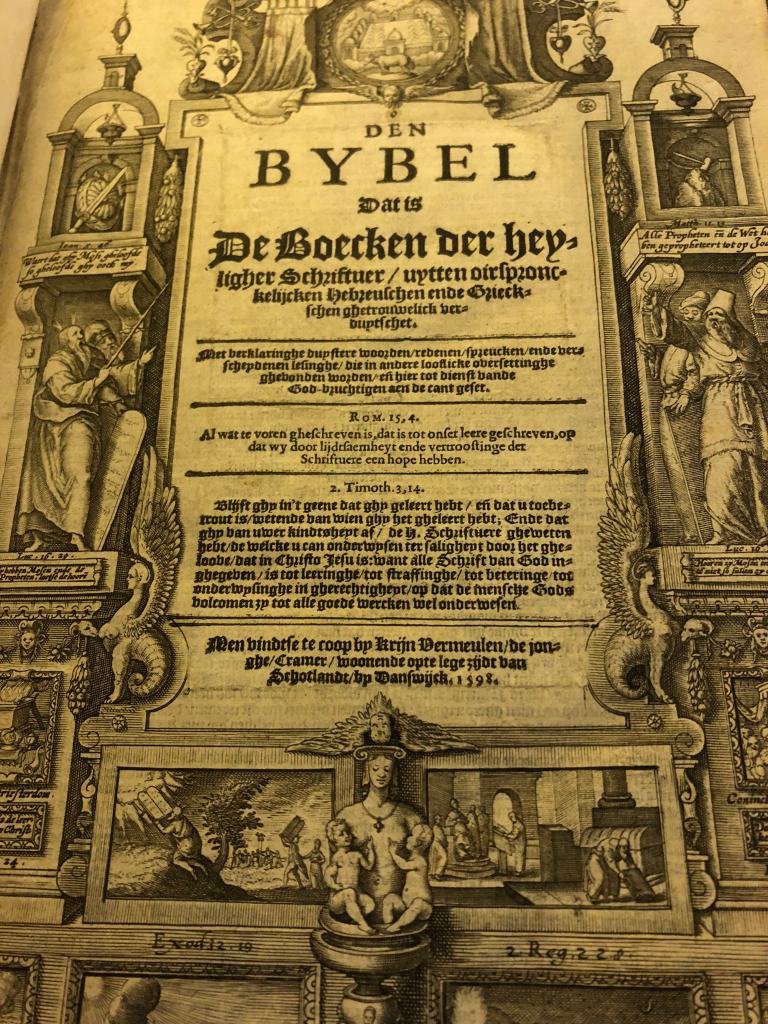
Two editions of the Bible, one in Dutch and one in German, both printed in the early modern era. One came off presses in the Netherlands in the 1590s and is now housed in the British Library in London.1 The other was printed in Strasbourg in 1630, but resides in the Mennonite archives in Bethel College, North Newton, Kansas, over 7000 kilometers away across the Atlantic.2 These thick volumes of vernacular scripture embody complicated confessional and material histories of Anabaptism and its legacies.
Title page of a bible printed in the Netherlands in the 1590s for Danzig Mennonites, the Schottland bible
The Dutch bible, known as the Schottland bible, is a large, decorative volume filled with maps produced for Danzig Mennonites in the Vistula Delta sometime between 1595 and 1598. Mennonites were not allowed to print in Danzig itself, so these bibles were produced in the Netherlands in Haarlem, probably from the workshop of Gillis Rooman. From Haarlem, the bibles then crossed to Danzig via trade routes across the Baltic, and Quirin Vermeulen, a Mennonite Elder, distributed them from his home in Schottland, a suburb of Danzig outside its walls where Mennonites could settle which gave the bibles their name.3 The Strasbourg bible appeared from the presses of Lazarus Zetzner in 1630 in the midst of the Thirty Years’ War, during which the city maintained a neutral stance and avoided devastation. Whilst it was a reprint of the Luther Bible, based on the last edition printed in Luther’s life in 1545, it had been checked and updated with commentaries provided by Daniel Cramer, a Lutheran pastor in Stettin.4
At the point of creation, then, these bibles existed in similar but also distinct Protestant worlds and represented the importance of vernacular scripture in the age of reformations.5 But there were different vernaculars and choices to be made in confessional communities. The Schottland bible represented the continued use of Dutch amongst Mennonites who had migrated to Polish Prussia. The Strasbourg bible was printed for a Lutheran vernacular audience, but it was bought by the Friesens, a Mennonite family, in Russia in 1797, who had moved from the Vistula Delta in the 1780s. These communities had spoken Dutch until the mid-eighteenth century but the seepage of German into communities meant it became the official language of worship and administration for Mennonites.6 The decision to purchase a German Bible was, therefore, not neutral but an indicator of the way in which these communities had changed, compared with the Dutch-language Schottland bible. Mennonites took German with them to Russia and later to America, where it became a linguistic reminder of their past.
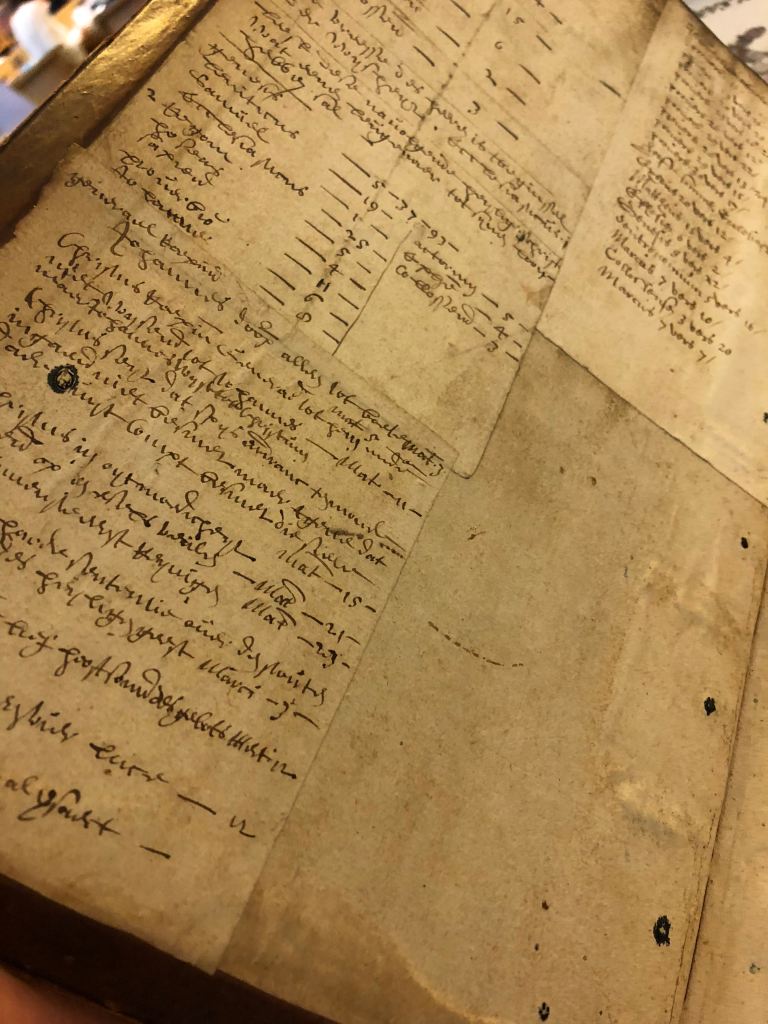
Notes for sermons written on the inside cover of the Schottland bible
Both bibles had material lives too as
objects which were used and read, and both bear the imprints of that
use. At the front of the Schottland bible, are handwritten lists of
suitable passages for sermons and a dedication. The Friesen bible was
a repository for family and community memory. A folder in the
Mennonite archives in Kansas contains a slip taken from the front of
the Friesen Bible, a copy of the printed letter of invitation issued
by the Tsarist regime in 1787 to Mennonites in Danzig when they moved
from Polish Prussia to settle in Ukraine.7
It had been kept as a memento of this important moment in the
family’s history. The single sheet has become separated from the
bible where it was once kept, archived away from the volume, which is
stored with the rare books. The slip and the bible had then had
travelled all over the world from Poland, to Russia, to Paraguay,
British Columbia, Minnesota, and then Kansas.8
The bibles, with their annotated pages and memorial pasted-in
preface, embody the connections, memories and emotions that sustained
Mennonite communities as they moved. Bibles often served this
function as treasured possessions. Families might use bibles for
example to paste in documents or record genealogies, taking the bible
with them when they travelled. The Bachmann’s copy of the 1536
Froschauer bible, in the Mennonite Heritage Centre, Harleysville,
Pennsylvania, contains the family record, sometimes composed in
beautiful fracture.9
The Friesen family bible’s afterlife is much more dramatic than the volume now in the British Library, but in their own ways both bibles as material things record memory and connections across generations, revealing how Mennonite confessional identity was contained in objects as well as ideas. It is not enough to simply look at numbers of books printed or the textual content alone. These bibles were two of countless vernacular editions of the scriptures produced in the early modern era, but these volumes encapsulate the way in which books tell histories beyond the text they contain. They are individual artefacts, with their own distinct biographies and contexts, they are printed, handled, used, written on, and handed down.10 As material things, entangled with the stories of religious lives and communities, they illuminate the way in which vernacular bibles were more than vehicles for scripture and instruction but can allow us to explore histories of Mennonites and their lived experiences across chronologies and geographies.
Den Bybel … uytten oirspronckelijcken Hebreuschen ende Grieckschen ghetrouwelick verduytschet, etc (Danzig: K. Vermeulen, 1598, actually printed in Haarlem). BL 3041.h.5.↩
Biblia: Das ist Die gantze Schrifft Alten und Neuen Testaments. Verteuschet: Durch D. Martin Luther. (Strasbourg: Lazarus Zetzner), Mennonite Library and Archives, Bethel, Kansas, 220.531 B471LF.↩
Peter J. Klassen, Mennonites in Early Modern Poland and Prussia (Baltimore: JHU Press, 2009), 146–7; Edmund Kizik, ‘Relgious Freedom and the Limits of Social Assimilation: The History of the Mennonites in Danzg and the Vistula Delta until their Tragic End after World War II’, in Alistair Hamilton, Sjouke Voolstra and Piet Visser (eds), From Martyr to Muppy: A Historical Introduction to Cultural Assimilation Processes of a Religious Minority in the Netherlands: the Mennonites (Amsterdam: Amsterdam University Press, 1994), 54.↩
Andrew Pettegree, ‘Books, Pamphlets and Polemics’, in Pettegree, The Reformation World (London: Routledge), 116–32; Pettegree, Reformation and the Culture of Persuasion (Cambridge: Cambridge University Press), 139↩
Mennonite Library and Archives, Bethel, Kansas, Small Archives II-55, ‘Von Trapp Flyer to Danzig Mennonites’; James Urry, Mennonites, Politics and Peoplehood. Europe – Russia – Canada 1525-1980 (Winnipeg: University of Manitoba Press, 2006), 123–4.↩
Note written by Jacob T. Friesen to accompany the bible. Mennonite Library and Archives, Bethel, Kansas, 220.531 B471LF.↩



 Anabaptist Historians