Pushed on Our Beliefs: 50 Years After Vietnam Moratorium Day

This month, October 2019, marks the fiftieth anniversary of the Moratorium to End the War in Vietnam, a national demonstration in which millions of Americans protested the United States’ involvement in the Vietnam War. The Moratorium Day demonstrations—along with the Moratorium March on Washington which occurred that November—marked the first time the anti-war cause manifested itself as a mass movement. An immoral war, an unpopular government, rising public concern about peace and social justice, and a fervent culture of activism all came together to create a strong sociopolitical environment. Within this context in the late 1960s, American Mennonites found themselves in a new and uncomfortable position. For the first time, they were the minority among conscientious objectors and those opposed to war. Popular public objections directed toward the U.S. government ranged specifically to their involvement in Vietnam and more generally to their use of the draft and taxes. In all of these conversations, Mennonite voices were now joined by those of worldly citizens. With the growing unpopularity of the Vietnam War, Mennonites found themselves in the unusual position of being able to openly express their pacifist beliefs without the fear of public criticism, quite a contrast to what they had experienced during previous times of war.

In this new situation, and especially by 1969, Mennonites’ views on conscientious objection, the Vietnam War, and war in general had become muddled. Individually, some Mennonites were engaged in anti-war efforts on religious grounds, while others were  more politically or morally motivated. Still others openly supported the government’s efforts in Vietnam. Additionally, any vocal position was criticized by those Mennonites who still upheld traditional nonresistance and two-kingdom theology; those who were in the world but not of it. Even these Mennonites, however, were not immune to the influences of American society. They, too, were becoming divided on the issue of the war, although they did not discuss or act upon these emerging thoughts.

On October 15, 1969, the events of Vietnam Moratorium Day brought the shifting and contested positions of Mennonites in American society into sharp relief. The Bethel College Peace Club’s Moratorium Day demonstration raised serious theological, moral, and social questions among Mennonites about active peacemaking and witnessing to the state. In this sense, this demonstration and the events surrounding it become a microcosm of the debates and transformations which occurred at the denominational level during this period. In remembering the Bethel College Moratorium Day events, one Mennonite remarked, “when there is not a conflict like this here, people tend to settle down and forget about their major beliefs because they’re not pushed on them. But when they’re pushed on them, we have to do some of our best thinking.”1 Fifty years later, as we remember the Bethel Peace Club’s Moratorium Day demonstration, two subjects come to mind: first, the significant impact that these events had on Mennonite faith and identity; and second, the compelling idea that in moments of conflicts of faith, we as Mennonites have to do some of our best thinking.

On October 15, 1969, the large campus bell at Bethel College began to toll. Students of the Peace Club rang the bell every four seconds for four days straight, one toll for each of the forty thousand Americans who had lost their lives in the Vietnam War. This peaceful and powerful act of remembrance had a profound effect at Bethel, with the continuous tolling heard on every corner of the campus and throughout North Newton, acting as a constant reminder of the suffering in Vietnam. Bethel professor J. Harold Moyer remembered the Moratorium Day activities as “one of the most effective things we’ve done.”2
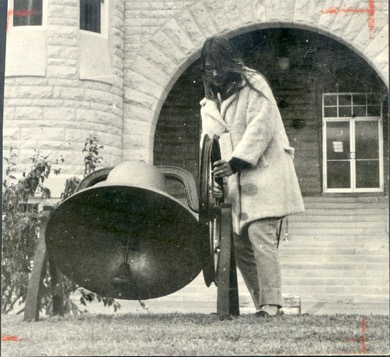
Kristen Zerger ringing the Bethel College bell, October, 1969.

When the bell fell silent four days later on October 18, Bethel College students, faculty, and community members, along with members of other college campuses, marched twenty miles to Wichita’s 81 Drive-In Theater, further exemplifying a resilient commitment to peace. The march ended at the theater with a memorial service led by Bible and religion professor Alvin Beachy. Bethel’s Moratorium Day peace activities captured national attention, grabbing a front page of The New York Times and several spots on national television news broadcasts. Additionally, the national Vietnam Moratorium Committee also found out about the Peace Club’s planned demonstrations and reached out to them in the weeks leading up to October 15 to affirm and encourage the students’ efforts. “Everyone else in the office thought I was out of my mind,” wrote one committee executive, “as I ran around in ecstatic glee talking about the Mennonites and their bell.”3

For many Bethel students, faculty, and administrators, as well as Newton community members, the 1969 Moratorium Day activities brought back memories of the Peace Club’s anti-war protest which occurred three years earlier, in 1966. In November of that year, the Peace Club marched through campus to the North Newton Post Office to deliver letters to their congressional representatives protesting the United States’ involvement in Vietnam. In the weeks leading up to this event, the Peace Club was met with opposition from other Bethel students, administrators (especially from Bethel President Vernon Neufeld,) the Mennonite press, the local American Legion, and other members of the larger Newton community. Threats of violence ensued, the most striking of which was a peace marcher hanged from the Bethel Administration Building in effigy, causing the Peace Club to redirect their march. The 1966 demonstration, which occurred peacefully on November 11, generated considerable conversation among Mennonites. They became divided in their thoughts about the event itself, the theological and moral motivations, and the usefulness of public peace witness.4
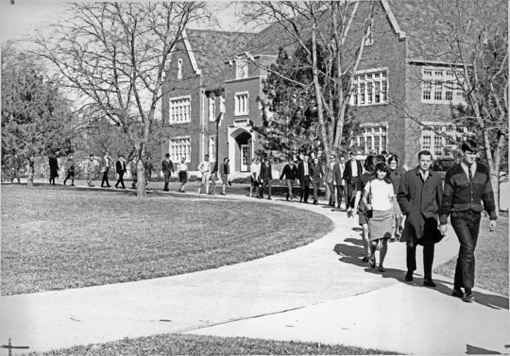
Bethel College Peace Club demonstration, November, 1966.

Although the Moratorium Day events of 1969 were met with wider support from the community and the nation, the reception on campus was similar to that experienced three years earlier. Professor Alvin Beachy described the relationship between students and administration as a “clash of will.”5 The faculty was deliberate in not holding an official stance on the 1969 peace activities, though many were personally concerned with the war and participated in the student-led activities to show multi-generational support. The administration took a cautious stance, attempting to carefully balance the public image of Bethel College and the rights of its students. Bethel College President Orville Voth was deeply skeptical. “Motivation must be in the name of Jesus Christ,” Voth said, “Political arguments are insufficient for committing our lives to.”6 Voth, however, was assuming two things that were not entirely true—first, that the students’ motivations were solely political; and, second, that political action and religious commitment were mutually exclusive. In reality, the motivations of many students were rooted in their Mennonite faith, which they saw as compatible with political action. Kirsten Zerger, a leader of the Peace Club at the time, reflected, “What I wanted to do was a Mennonite thing to do, but the church as an organization was not there.”7 Zerger was convinced that “the most powerful work is done when it’s multigenerational.”8 Bethel faculty also recognized this, as some participated in peace activities to show multi-generational concern and attempted to provide stability to the contentious situation. “I couldn’t understand my participation in these peace activities apart from my religious commitment,” Professor Alvin Beachy reflected, “If it weren’t for that, I wouldn’t have been involved. I can only see my action in terms of where I’m coming from.”9

While national media attention to these events was short-lived, the Peace Club’s actions in 1969 remained a relevant focal point for the controversial issues surrounding Vietnam among Mennonites. As was also the case in 1966, the Peace Club witnessed both their position on the Vietnam War to the state and their position on witness itself to the church. Peace activism among Mennonites spread quickly to Bluffton and Goshen Colleges, where students organized anti-war teach-ins, letter-writing events, and peace marches.10 The Bethel Peace Club and President Voth were contacted directly by Mennonites from around the country. Some were concerned with the national attention the events had generated. “It is unfortunate that this is the way millions of people have been introduced to Bethel College,” one critic lamented.11 On the other hand, some alumni praised the Peace Club and shared their feelings of pride when they saw the good work of Bethel students on the national news. Furthermore, a great deal of support for the Peace Club came in the form of monetary donations to fund future club activities.

The debate which surrounded the Peace Club’s activities can be understood as a microcosm of what was happening among Mennonites at the denominational level. In November 1969, the MCC Peace Section released a statement recognizing “noncooperation with military conscription as a valid expression of nonconformity and peacemaking.”12 By 1970, the Peace Section took a major step in establishing its new position on conscription, declaring that “the very existence of the draft contributes to the militarism that now dominates American life and threatens the freedom, stability and survival of the world.”13 Perhaps most exemplary of the change in the Mennonite conception of peace came from a statement issued by the General Conference Mennonite Church in 1971, which declared that “[peace] is much more than saying ‘no’ to war. It is saying a joyful ‘yes’ to a life of self-giving discipleship and evangelistic peacemaking,” and that “the Christian brotherhood should be involved in the decision and support of persons who disobey the law for conscience’ sake.”14 Boldly, the General Conference made a definitive shift away from their commitment to nonresistance toward one of active peace witness to society. The “Old” Mennonite Church also moved further away from nonresistance in their support of active peacemaking. In all cases, these changes were justified as a return to traditional Anabaptist theology.

It is here where we can circle back to the reflection stated earlier by a Mennonite in response to the Peace Club’s Moratorium Day demonstration. “When there is not a conflict like this here, people tend to settle down and forget about their major beliefs because they’re not pushed on them. But when they’re pushed on them, we have to do some of our best thinking.”15 Now, fifty years later, when active peacemaking has become a defining feature of Anabaptist-Mennonite faith and identity, this statement can and should still resonate with us. Yet, it is much easier to look back proudly on past events such as these and praise the progress we have made theologically and socially than it is to look at our current situation and find where changes still need to be made. People of faith, Anabaptist and otherwise, have never lived inside a vacuum. The students who pushed the edges of the Mennonite faith during in the 1960s were reinterpreting it in order to respond to the realities of their world. It seems that more and more our convictions are being pushed by political, social, and environmental forces, as well as by tensions which exist within the church itself. But how are we responding? Surely today’s world is changing, requiring from us a renewed Anabaptist vision, for our own sake, for the sake of the oppressed, and for the sake of all. Indeed, in situations of theological, social, and political conflict, we as a people of faith must do some of our best thinking, striving to face and address the challenges of the ever-changing world in which we live and witness.


  1. Mennonites and the Vietnam War: An Oral History, tape 41, tape recording, Mennonite Library and Archives, North Newton, KS (MLA).
  2. J. Harold Moyer, interviewed by Raymond Reimer, October 30, 1972, interview 30, tape recording, MLA.
  3. Lynn Edwards to Peace Club, September 23, 1969, Bethel College Peace Club Papers, MLA.III.1.A 29.e, b. 1, f. 2, MLA.
  4. Maynard Shelly, “Peace Walk Baffles Peace Church,” The Mennonite, December 13, 1966, 757-764.
  5. Alvin Beachy, interviewed by Raymond Reimer, November 10, 1972, interview 31/32A, tape recording, MLA.
  6. Quoted in Maynard Shelly, “For Us the Bell Tolled,” The Mennonite, November 4, 1969, 663.
  7. Kirsten Zerger, interviewed by Dan Krehbiel, April 11, 2001, interview 83, tape recording, MLA.
  8. Ibid.
  9. Beachy.
  10. Perry Bush, Two Kingdoms, Two Loyalties: Mennonite Pacifism in Modern America, (Baltimore, MD: Johns Hopkins University Press, 1998), 242.
  11. Letter to Orville Voth, Bethel College Peace Club Papers, MLA.III.1.A 29.e, b. 7, f. 1, MLA.
  12. Mennonite Central Committee Peace Section, A Message from the Consolation on Conscience and Conscription, November 22, 1969, in Urbane Peachey, ed., Mennonite Statements on Peace and Social Concerns, 1900-1978 (Akron, Pa.: Mennonite Central Committee U.S. Peace Section, 1980), 74.
  13. Mennonite Central Committee Peace Section, The Draft Should Be Abolished, June 5, 1970, in Peachey, 75.
  14. General Conference Mennonite Church, The Way of Peace, August 14-20, 1971, in Peachey, 145.
  15. Mennonites and the Vietnam War.

Russian German re-migrants’ and stayees’ belongings: Everyday food practices in Western Siberia

Anna Flack

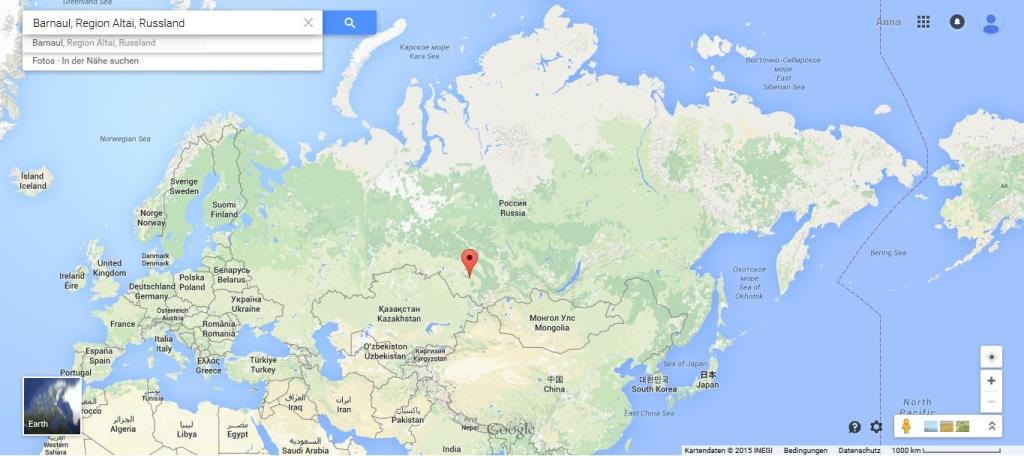
Led by the central research question of which resources re-migrants and stayees use for the construction of belongings, in 2015 I conducted participant observation and topic-centered interviews at a three months field research in Western Siberia with Russian Germans. 1 According to the Russian Federation’s latest census by 20102, approximately one eighth of Russia’s dispersed German minority lives in the Altai region. Thus, I made my way to Barnaul, the capital of this region. Not, as one might expect, to the German national district (немецкий национальный район) with the village of Halbstadt as administrative center.

Source: Google maps.

As a cultural anthropologist/ European ethnologist3, I conceive belongings not as static as that implies an often essentializing understanding of culture. More precisely and differentiated, culture can be defined as the total of human practices, products and articulations. This includes, inter alia, individual and collective, theoretical and practical, historical and mythical expressions. Culture then means practices, objects and institutions.4 To be able to research cultural continuities and changes it is necessary to focus on concretely observable phenomena. Such phenomena are obvious, often unreflected everyday practices, e.g. concerning language, living, clothing, music, religion and last but not least food. By examining the everyday practices of food and drink, I realized a practice-oriented approach following Judith Butler’s concept of performative construction of belongings.5 Consequently, I understand belongings as a preliminary result of constant construction and negotiation processes.

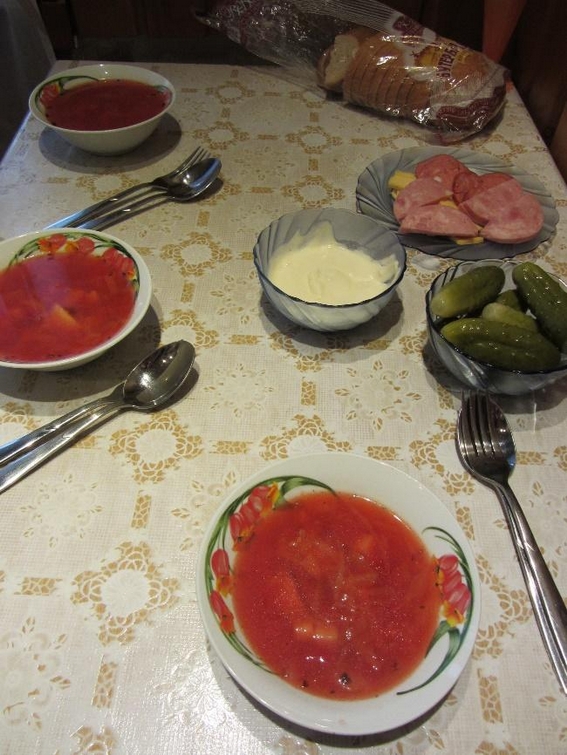
Boršč – “typically Russian” soup with smetana (sour cream) and pickled cucumbers. Photo by the author.

In three case studies, I illustrate the parallelism and relation between cultural continuities and changes. Moreover, there can be shown the plurality, situativity and entanglement of, even contradictory, belongings. In the following, my findings will be summarized and illustrated by empirical data on three subjects called Marina, Kat’ja and Mrs Müller.6

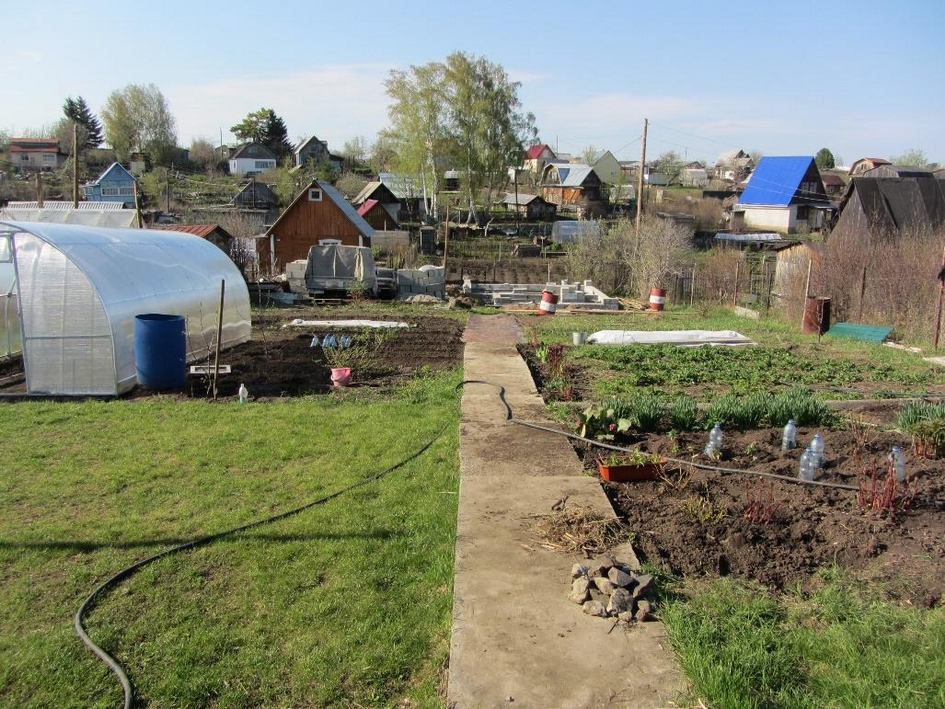
In everyday life as well as on holidays still dominates a Soviet “conservatism of taste” (“Geschmackskonservatismus”).7 Continuing subsistence farming and eating salat oliv’e8 on holidays are examples that give proof of the persistent effectiveness of Soviet values, norms and action patterns until the present.

Subsistence farming in an allotment garden. Photo by the author.

The accompanying cultural changes can be conceived as, on the one hand, processes of detraditionalization and, on the other hand, processes of (re)traditionalization. In all my case studies a selective influence of a Western, globalized lifestyle can be observed. Examples include the consumption of coffee (instead of tea, the Russian national drink), pizza and sushi. This indicates an orientation along Western lifestyle and a detraditionalization of daily life.

Symbols of a globalized lifestyle. Photos by the author.

The retraditionalization that manifests itself in a return to ethnicity and/or religiosity can also be interpreted as an answer to Soviet and Russian hegemony. At the same time, retraditionalization can be a reaction to global cultural influences. Soviet/ Russian hegemony and the global cultural influences potentially compromise individuality and/or an ethnocultural belonging.

So called “national dishes“ (e.g. Strudel, Riebelkuchen) and Marina’s as well as Kat’ja’s choice of profession as German language teacher can be interpreted as an expression of their “symbolic ethnicity.”9 This means that they can feel a nostalgic ethnic belonging and be proud of their ancestors’ traditions without practicing these traditions (regularly) on their own. Much more important than the cultural everyday practices are ethnic symbols as e.g. consumer goods, especially food and drink.10

Strudel. Photo by the author.

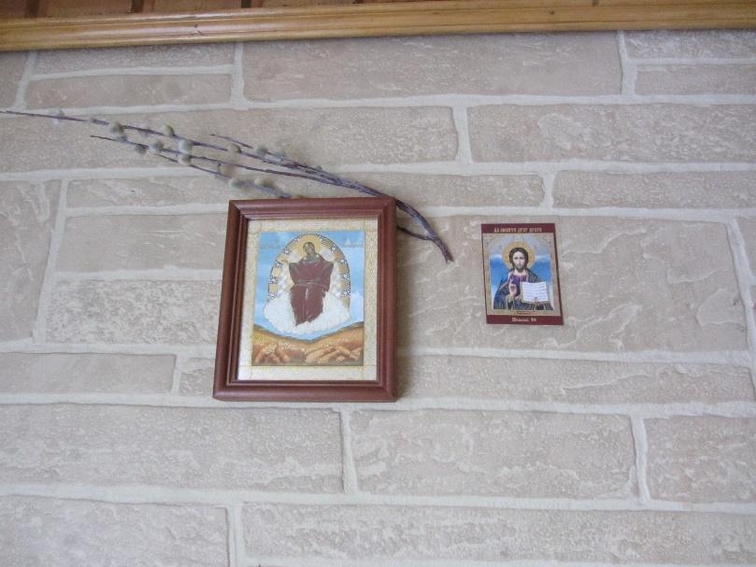
In Kat’ja’s case the (re)traditionalization served the re-migrants’ reintegration into Russia. By adopting the Russian Orthodox faith and practicing fasting and praying, the subject reintegrated into Russian society. In the Russian perception, being Orthodox is equal to being Russian in an ethnocultural sense.11 The Russian Orthodox faith also gains special significance because Kat’ja became Orthodox by baptism just before the Aussiedlung12 to Germany. Thus, the baptism can be interpreted as a rite de passage.13 Baptism guarantees an emotional closeness to (Orthodox) Russia despite the territorial distance. Furthermore, the (re)traditionalization is rather an “invention of tradition”14 than a supposed return to a lost tradition.

Russian Orthodox icons above the dining table. Photo by the author.

Interestingly, Kat’ja’s great-grandmother has had “some kind of German faith, she even always prayed in German.” The subject then remembers that the great-grandmother’s congregation was Baptist. But what is most important here is the difference making and the demarcation of a “Russian” and a “German” faith.15

In Mrs Müller’s case reintegration was achieved the other way round, by a globalized lifestyle indicating detraditionalization. Food products (e.g. instant garden herbs, special fries salt, sweetener) brought to Russia by relatives living in Germany help the subject to compensate perceived limitations in her “new old home.”16 Hence, the subject copes with the undesired re-migration, which was initiated by her husband, and the inconveniences of life in the Russian countryside by consumption.

Self-made fries. Photo by the author.

The transforming of everyday food practices illustrates not only Russian Germans’ heterogeneity, but also the heterogeneity of belonging resources in general. Food and drink serve as a mirror of these different resources which are used for the conscious and unconscious construction of belongings. In interaction with other individuals there exists more than one belonging discourse. Belongings are manifold and fragmented. Therefore, they are constantly negotiated and situationally emphasized. In a postmodern society, apart from ethnicity subjects make use of and combine different resources, experiences, social imaginations, and orientation patterns to create a lifestyle that fits best their needs for belonging, individuality, and peculiarity.17


  1. Anna Flack: Zugehörigkeiten und Esskultur. Alltagspraxen von remigrierten und verbliebenen Russlanddeutschen in Westsibirien. Bielefeld: transcript, 2020.
  2. Cf. Institute of Demography of the national research university “Higher School of Economics”, Demoskop Weekly. URL: demoscope.ru/weekly/ssp/census.php (25.2.2016). According to official census data, in 1989 in the Russian Socialist Federative Soviet Republic lived 842.295 Germans. 127.731 of them lived in the Altai region. In 2002 597.212 Germans lived in the Russian Federation. 79.502 lived in the Altai region. Cf. Federal State Statistics Service (Rosstat), Census 2010. National composition of the population according to the subjects of the Russian Federation. [Национальный состав населения по субъектам Российской Федерации]. URL: http://www.gks.ru/free_doc/new_site/perepis2010/perepis_itogi1612.htm (12.6.2017). According to the 2010 census, there live 50.701 Germans in the Altai region. In overall Russia, 394.138 people stated a German ethnicity.
  3. In Germany, Europe and North America the disciplines underlied different influences, conditions and developments. Therefore, we do not always mean the same when using similar or identical terms. Cf. e.g. C. B. Brettell, “Theorizing Migration in Anthropology. The Cultural, Social, and Phenomenological Dimensions of Movement,” in C. B. Brettell, J. F. Hollifield, eds., Migration theory. Talking across disciplines. 3d edition (New York: Routledge, 2015), 148–197; C. Markom, “Geschichte der Migrationsforschung. Interdisziplinäre Verflechtungen,” in M. Six-Hohenbalken, J. Tošić, eds., Anthropologie der Migration. Theoretische Grundlagen und interdisziplinäre Aspekte (Vienna: facultas, 2009), 29–49.
  4. Cf. P. M. Hejl, “Kultur,” in A. Nünning, ed., Metzler-Lexikon Literatur- und Kulturtheorie. Ansätze – Personen – Grundbegriffe. 4th edition (Stuttgart: Metzler, 2008), 267; cf. A. Reckwitz, Die Transformation der Kulturtheorien. Zur Entwicklung eines Theorieprogramms (Weilerswist: Velbrück Wissenschaft, 2006), 75; G. Hirschfelder, “Europäischer Alltag im Fokus der Kulturanthropologie/Volkskunde,” in S. Conermann, ed., Was ist Kulturwissenschaft? Zehn Antworten aus den „Kleinen Fächern“ (Bielefeld: transcript, 2012), 151; A. Hütig, “Dimensionen des Kulturbegriffs,” in J. Kusber, M. Dreyer, J. Rogge, A. Hütig, eds., Historische Kulturwissenschaften. Positionen, Praktiken und Perspektiven (Bielefeld: transcript, 2010), 116.
  5. Cf. J. Butler, Das Unbehagen der Geschlechter (Frankfurt am Main: Suhrkamp, 1991); J. Butler, Körper von Gewicht. Die diskursiven Grenzen des Geschlechts (Berlin: Berlin Verlag, 1995); H. Bublitz, Judith Butler zur Einführung (Hamburg: Junius, 2013).
  6. With the exception of Barnaul, places and persons are anonymised due to data security and research ethics. Cf. H. von Unger, “Forschungsethik in der qualitativen Forschung. Grundsätze, Debatten und offene Fragen,” in H. von Unger, P. Narimani, R. M’Bayo, eds., Forschungsethik in der qualitativen Forschung. Reflexivität, Perspektiven, Positionen (Wiesbaden: Springer 2014), 15–39.
  7. Cf. U. Tolksdorf,“Strukturalistische Nahrungsforschung. Versuch eines generellen Ansatzes,” in Ethnologia Europaea 9 (1976), 64–85; cf. U. Tolksdorf, “Das Eigene und das Fremde. Küchen und Kulturen im Kontakt,” in A. Wierlacher, G. Neumann, H. J. Teuteberg, eds., Kulturthema Essen. Ansichten und Problemfelder (Berlin: Akademie Verlag, 1993), 187–192.
  8. Russian Salad. Cf. I. Makoveeva, “Olive (Olivier),” in Tat’jana Ė. Smorodinskaja, ed., Encyclopedia of contemporary Russian culture (London: Routledge, 2007), 436.
  9. H. J. Gans, Symbolic ethnicity. The future of ethnic groups and cultures in America, in Ethnic and Racial Studies 2, 1 (1979), 1–20.
  10. Cf. ibid., 8–10.
  11. Cf. K. Rousselet, A. Agadjanian,“Pourquoi et comment étudier les pratiques religieuses?,” in Revue d’études comparatives Est-Ouest 36 (2005), 6; A. Agadjanian, Turns of Faith, Search for Meaning. Orthodox Christianity and Post-Soviet Experience (Frankfurt am Main: Peter Lang, 2014), 18–20, 59; I. Hartwich, “Die Rolle der Religion in Russland. Von Atheisten zu gläubigen Christen”, in Federal Agency for Civic Education (Bundeszentrale für politische Bildung (bpb)), 3.2.2011. URL: http://www.bpb.de/internationales/europa/russland/47992/religion (4.9.2017).
  12. Aussiedlung means a migration regime introduced by the Federal Republic of Germany after World War II that allowed people of German descent living in the (former) Soviet Union, Poland, Romania, Yugoslavia and Czechoslovakia to migrate to Germany and to be recognised as German citizens. The basis is a personal confession to the German Volkszugehörigkeit. This implies a confession to the German descent, language, upbringing and culture. Cf. Federal Displaced Persons Act (Bundesvertriebenengesetz (BVFG)).
  13. Cf. A. van Gennep, Les rites de passage (Paris: Picard, 1981).
  14. E. Hobsbawm, T. Ranger, eds., The Invention of Tradition (Cambridge: Cambridge University Press, 2009).
  15. The significance of the Lutheran faith for a subject of the generation of experience is further regarded in A. Flack, “Methodische Überlegungen über Generationenunterschiede in einer nahrungsethnologischen Feldforschung in Russland. Erkenntnisgewinn durch Scheitern,” in S. Scholl-Schneider, M. Kropp, eds., Migration und Generation. Volkskundlich-ethnologische Perspektiven auf das östliche Europa (Münster: Waxmann, 2018), 193–222.
  16. Cf. A. Flack, “Hühnernudelsuppe, Pel’meni und Pommes frites. Ernährung, Identitäten und Lebensstile von remigrierten SpätaussiedlerInnen,” in Migration. Jahrbuch des Bundesinstituts für Kultur und Geschichte der Deutschen im östlichen Europa 24 (2016), 279–308.
  17. Cf. A. Appadurai, “Globale ethnische Räume,” in U. Beck, ed., Perspektiven der Weltgesellschaft (Frankfurt am Main: Suhrkamp, 1998), 21; A. Appadurai, Modernity at Large. Cultural Dimensions of Globalization (Minneapolis: University of Minnesota Press, 1996); O. Brednikova, “„Eigentlich bin ich Russe, aber manchmal trotzdem auch Deutscher“. Die deutsche Gemeinde in St. Petersburg,” in I. Oswald, V. Voronkov, eds., Post-sowjetische Ethnizitäten. Ethnische Gemeinden in St. Petersburg und Berlin/Potsdam (Berlin: Berliner Debatte Wissenschaftsverlag, 1997), 78–79; G. Hirschfelder, P. Pollmer, “Ernährung und Esskultur. Kulturwissenschaftliche Perspektiven,” in Aktuelle Ernährungsmedizin 43 (2018), 46.

Anabaptists and Jews in Emden, before Schutzgeld

In January of 1577, the mayor and city council of Emden drafted a letter to Count Edzard II.1 Complaining primarily about the boldness with which Anabaptists went about both their religious and secular business in Emden, the letter nevertheless began with condemnatory descriptors for both Anabaptists and Jews. Grouping together two religious communities that were variously tolerated in the city, council members noted their aim in the letter’s opening paragraph: “and particularly to report on the seductive sect of the Anabaptists, and the vile, blasphemous Jews.”

They certainly reported in detail on the behavior of local Anabaptists. Though they named no leaders or even members, the council accused them of living “in the noblest houses,” gathering indiscriminately in public, and joining together to create business associations (which must have been profitable, to buy or rent such prominent houses); indeed, the council seemed to identify open prosperity as the foremost offense. They quickly tied that charge to a parallel accusation of “public conventicles, holding and preaching their seductive false doctrine in great considerable numbers . . . by which they seduced many simple hearts, also honest people.” This was particularly problematic for the city council as these preachers also regarded all authority as suspect. The council characterized the reach of these condemnations as totalizing: “And they hold as a principal piece of their heretical doctrine that all authority is damned and cannot be saved, that the evangelical preachers of this and all reformed Christian churches, officers and preachers are devils.” Anabaptist preaching, in other words, had all the necessary ingredients to subvert the current social order. Fervor was increasing, and with it a distrust in authority.

This did not, the council argued, bode well for the general peace. Pointing to the examples of “Münster, Amsterdam in Groningen and West Frisia,” the council warned that enabling Anabaptists “brought forth well-identifiable fruit.”2 A later paragraph explicitly referenced the danger of repeating the “riotous” events of the Kingdom of Münster, but this admonition appears to have been stricken from the final copy.3 While frantic appeals to the specter of Münster were a common trope of anti-Anabaptist polemic across the empire, the historic connections between Emden and Münster – not least of which was the millenarian preaching and teaching of Melchior Hoffmann – added texture to a letter saturated with fear.

The council finally addressed their accusations against Jews in the second-to-last paragraph of this draft, one completed in a different hand and presumably added at a later date. The first author, then, had not managed to address the Jews he had slandered in his opening salutation. Furthermore, this late charge against the Jewish inhabitants of Emden was both brief and vague by comparison. The council complained about the presence in Emden of “daily more Jews, and their usury (which, like cancer, daily eats away and spoils everything).”4 Though the number of Jewish inhabitants of Emden certainly may have been increasing at this time, the lack of specifics is not terribly convincing. Moreover, the charge of usury was perhaps the most ubiquitous in Christian polemics against Jews. A more generalized anti-Semitic aside can barely be imagined.

So why were Anabaptists and Jews grouped together in this plea? Perhaps the council was attempting to condemn both communities by an association with the other. This letter and others written in January of 1577 would, over the course of the next year, convince Enno II that a disputation would be the best way to counter the spread of Anabaptist teaching and rid the city of unrepentant Anabaptist sympathizers. Yet the disputation of 1578 did not, in fact, convert or drive away the majority of Anabaptists or self-defined Mennonites. Their residence in the city would continue to be disputed – resulting, over two decades later, in the institution of a specialized protection tax (Schutzgeld) collected from both the Anabaptist and Jewish communities. It is clear from this letter that secular authorities in Emden had long been thinking about these two groups as connected, even as little evidence exists of meaningful connections between the communities themselves. The Emden city council had begun to populate its own imaginary of the marginalized, an imaginary which endured to structure the taxed toleration of both Anabaptists and Jews in Emden for over two hundred years.


  1. Stadtarchiv Emden, I. Reg. Nr. 415, 12-14.
  2. Ibid., 12-13.
  3. Ibid., 13.
  4. Ibid., 13.

State of the Race: A Short History of Mennonite Racial Statements, 1940-1979

Tobin Miller Shearer

In 1955, white Mennonite church periodical editor Paul Erb wrote, “Perhaps in nothing have our Mennonite people so completely conformed themselves to a worldly idea as in this.”1 He was not referring to dancing, watching movies, cutting hair (women’s! – not men’s), wearing wedding rings, or any of the other worldly pursuits deemed anathema by Mennonite church leaders at the time. He was referring to racial discrimination and segregation.

He did so on the occasion of the release of the 1955 Mennonite uber race relations statement, “The Way of Christian Love in Race Relations.” That carefully vetted document, largely a result of the wordsmithing provided by Guy F. Hershberger and Grant M. Stoltzfus, called the Mennonite Church community to repent of the sin of racism and embark on a “ministry of reconciliation” by working “against the evils of prejudice and discrimination wherever they may be found.”2

The 1955 document was one in a series of twenty-two race-focused statements that Mennonite bodies in the United States released between 1940 and 1976.3 By far the most high-profile of any of those statements, it was not the boldest, the most challenging, or the most theologically sophisticated of that set of twenty-two pronouncements. It was, however, the touchstone that statements for the next twenty-years – and beyond – referred back to and built upon.

Yet I am less interested in the impact of that particular statement than I am in the context of all but two of the twenty-two statements issued by Mennonites and Mennonite Brethren. For the three and half decades here examined, written statements about race by U.S. Mennonites were prompted by external political forces and almost exclusively a project of white men. Not once in any of those twenty-two statements did the white male authors identify, name, or evaluate their own racial identity. As a result, I will argue that, with one exception, these statements failed to address the underlying problem of white domination and supremacy in the church.

The story that I am focusing on begins not with the oft-touted 1688 Germantown anti-slavery statement because, as I have argued elsewhere, it was a document written to a Quaker assembly by practicing Quakers. It simply wasn’t a Mennonite document in terms of audience, sensibility, or authorship.4 Instead the story begins with the 1940 Virginia Conference statement that mandated racial segregation in church sacraments such as communion, footwashing, and the Holy Kiss.5

That 1940 statement – like only one other of the twenty-two I have documented – was released primarily in response to dynamics internal to the Mennonite community. In essence, the workers at Broad Street Mennonite Church in Harrisonburg, Virginia, had in their bishops’ eyes become too racially progressive. As a result, the Virginia bishops reigned them in by segregating the sacraments.6 When Broad Street leaders Fannie and Ernest Swartzentruber resisted that racist doctrine, the bishops dismissed the couple from their posts.7

To be certain, the Virginia bishops also passed the segregation mandate in hopes of placating the critics who called into question their patriotism as a result of the Mennonites’ refusal to bear arms in the midst of World War II. By making the decision to conform to segregationist practices, Virginia Mennonites could at least demonstrate they were willing to cooperate with the dictates of a racially segregated and white supremacist society.

The first record I can find of a Mennonite group issuing a statement challenging racism – as opposed to instituting segregation – was a 1948 statement by the Southwestern Pennsylvania Conference in which they declared their opposition to “prejudices and discrimination against minority groups.”8 In keeping with broader national trends, few white majority Protestant groups issued any statements against racism until after the Federal Council of Churches issued their declaration of the same in 1946. In that year the FCC declared that “the pattern of segregation in race relations is unnecessary and undesirable and a violation of the Gospel of love and human brotherhood.”9

Prior to the 1955 Mennonite church statement issued in the immediate aftermath of the previous year’s Supreme Court Brown v. Board desegregation ruling, a study group meeting at Laurelville Mennonite retreat center in 1951 had released a general statement on Christian Community Relations that included a short section calling for action against “racial discrimination.”10 That same year, Lancaster Mennonite Conference bishops C. K. Lehman, J. Paul Graybill, and Amos Horst were tasked with drafting a statement on “racialism,” but the Bishop board failed to act upon or promote the “tentative statements” developed by the three bishops.11

The 1955 statement deserves its reputation as the principal document that defined the parameters of Mennonite theology and practice in response to – employing the language of the day – “race relations.” In addition to reviewing the biblical texts supporting racial unity, the statement declared racial prejudice and discrimination a sin, confessed complicity in that sin, and called for full integration of all congregations and church institutions, robust teaching on the evils of racial discrimination, and a “ministry of reconciliation” focused on correcting “the evils of racial intolerance within our society.”12

That same year Bluffton College in Ohio released a statement encouraging racial integration and advising students to carefully consider the “potential richness” and “painful consequences” of interracial marriage, a topic that received frequent and near universal attention by white people at that time.13

List of Twenty-Two Race-Focused Statements by Mennonites – 1940-1979

  1. 1940 Virginia Conference segregation statement
  2. 1948 Southwestern Pennsylvania Conference statement on race
  3. 1951 Laurelville Study Conference on Christian Community Relations
  4. 1951 Lancaster Conference Bishop board statement on race (limited action)
  5. 1955 Mennonite Church statement on race – The Way of Christian love in Race Relations
  6. 1955 Bluffton College Statement on race
  7. 1959 General Conference Mennonites: A Christian Declaration on Race Relations
  8. 1960 Lancaster Conference Statement on Race Relations
  9. 1961 The Christian In Race Relations Statement/Paper
  10. 1963 Mennonite General Conference statement on Reconciliation
  11. 1963 Mennonite Brethren Statement on Race and Baptism
  12. 1963 IN-MI statement on race Relations
  13. 1964 MCC Statement from Words to Deeds in Race Relations
  14. 1964 EMC Faculty Statement on Race Relations
  15. 1964 MCC Peace Section statement on race discrimination and human rights
  16. 1964 Virginia Conference Statement on Race Relations
  17. 1967 Virginia Conference statement overturning segregation
  18. 1969 Mennonite Church General Conference Statement on Urban-Racial Concerns
  19. 1969 Lancaster Conference Statement on the Black Manifesto
  20. 1971 Minority Ministries Council Statement to the Mennonite Church
  21. 1971 Lancaster Conference Statement on Racism
  22. 1976 Liberty and Justice Workshop statement

The 1960s then erupted with a host of statements – more than half of the total examined here – in response to national events and presidential prompting. In keeping with the efforts spearheaded by Martin Luther King, Jr.’s Southern Christian Leadership Conference to gain passage of a civil rights bill and President Kennedy’s June 11, 1963, civil rights address, white church leaders across the country – not just white Mennonites – issued race-focused statements and developed new race relations programs.14 In 1963 and 1964 alone, Mennonites generated seven official statements including denomination-level pronouncements by the General Conferences of the Mennonite and the Mennonite Brethren churches. In addition the faculty at Eastern Mennonite College in Harrisonburg, Virginia, released a statement against the “evils of racial discrimination” in 1964, the same year that Virginia Conference called for full integration of all their institutions.15 Yet they did not at that time address their existing mandate to segregate the sacraments. They would not overturn those segregationist dictates until three later when they did so in 1967.16

Through the end of the 1960s, all of the statements generated by Mennonites had been in direct response to national events or political promptings. Although the correspondence around those statements and the articles and letters to the editor that filled that pages of church periodicals in those years of racial tumult and unrest pointed to much hand wringing and genuine discomfort on the part of the white Mennonites who wanted to do better, this set of race-focused declarations consistently shied away from naming the racial make-up of the church itself. In short, none of the statements up through the 1960s specifically talked about the problem of racism as a white issue for which white people needed to take responsibility.

In contrast to the relative silence of Mennonites about white involvement in racism, others outside the church did name white responsibility for racism. White civil rights leaders and activists like Anne Braden, Juliette Morgan, Will Campbell, Clarence Jordan, and many others had long been calling white people to recognize the particular role they played in perpetuating a racist society. In the Mennonite community, African-American minister and civil rights activist Vincent Harding famously challenged white Mennonites in 1967 to confront “the power of Mennonite prestige, the power of middle-class respectability, the power of whiteness.”17 Yet, the vast majority of the statements authored and released by white Mennonites rendered their own racial identities invisible and therefore unexamined.

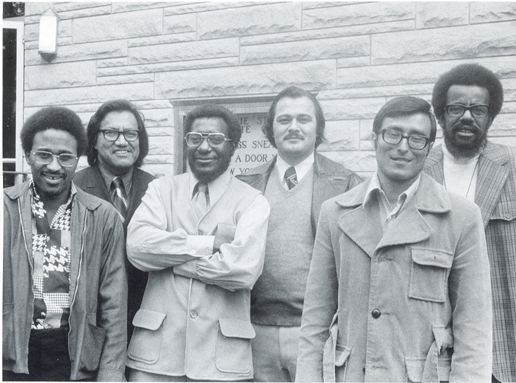
Members of the Minority Ministries Council

It was not until 1971 that a statement emerged directly engaging with racial identities in the church. The Minority Ministries Council, then only three years old, released a statement to the Mennonite Church in which they confronted “our white Christian brothers” for not accepting them “on their terms” but instead demanding that they deny their “cultures and backgrounds” in order to become assimilated into “the main stream of white America.” They confessed that they had “accepted a ‘false kind of integration’ in which all power remained in the hands of white brothers” (the repeated male reference is notable here as well). They concluded by committing themselves to speak honestly to their “white Mennonite brothers” while seeking to develop “indigenous congregations” in which they would be the “generals” and white people the “foot soldiers.”18

In far more specific and unapologetic ways than any of the statements up to that point, this 1971 statement named the racial dynamics of the church, called for authentic engagement across racial lines, and introduced – for the first time in an official statement – voices from communities of color writing as Mennonites to their co-religionists. Although limited by the idioms and practices of patriarchy and sexism, the document did what none of the previous statements had done before. It called attention to what Paul Erb had noted back in 1955, that white Mennonites had “completely conformed themselves” to the “worldly” identity of white people. Only a direct and unapologetic wrestling with that kind of conformity would move the church forward to a more authentic anti-racist identity.

I have documented two other statements in the 1970s. One was a new statement by Lancaster Conference also released in 1971 that echoed much of the conference’s previous position paper while introducing the language of “racism” for the first time. The second one was released in 1976 by participants at a Race and Reconciliation conference in Newark, New Jersey, sponsored by Evangelicals for Social Action. This was the only one of the twenty-two statements documented here to have included women in the development of the statement; in this case Lois Leidig of Canton, Ohio, and Bev Lord of Philadelphia, Pennsylvania. They were two of twelve signatories. Yet, neither of these two additional statements named white people or reflected on the identities of those drafting the documents.

To date, I have been unable to locate any race-focused statements by Mennonite groups in the following decade and a half through 1988.19In 1989, a joint statement by the Mennonite Church and the General Conference Mennonite Church entitled “A Church of Many Peoples Confronts Racism” did take on racism directly, but again the drafters did not see fit to focus their attention on white people or name them directly.20

This tabulation of Mennonite statements on race is not intended to suggest that the passing of statements is a futile exercise. We have many historical examples of faith-based statements igniting action, changing minds, and re-directing resources.

Rather this essay argues that Mennonites have had a particular history of putting pen to paper and declaring their position on “race relations.” At key junctures, the passage of those statements challenged racial discrimination both within and without the church community. But by failing to address white people as white people, those statements fostered more assimilation than they did anti-racism.21 By demanding that African Americans, Native Americans, Latinex, and Asian American members of the Mennonite church become like white people to become Mennonite, those statements did little to change the nature, structures, and power relations within the church itself.

I await with eagerness for the day when white people in the Mennonite church will truly reckon with our conformity to whiteness. I expect that a statement may assist in that work, but the true mark of movement forward will be lived out in the collective action of white Mennonites to dismantle racism both within and without the church.


  1. Paul Erb, “Nonconformity in Race Relations,” Gospel Herald, June 7, 1955, 531.
  2. Mennonite General Conference, “The Way of Christian Love in Race Relations,” (Hesston, Kans.: Mennonite General Conference, 1955).
  3. I have been able to document twenty-two such statements. I invite amendments and additions from readers who are aware of additional statements other than those listed at the end of this article. If you know of other race-focused statements issued by Mennonite groups between 1940 and 19990, please contact me at tobin.shearer@umontana.edu.
  4. Tobin Miller Shearer, Daily Demonstrators: The Civil Rights Movement in Mennonite Homes and Sanctuaries (Baltimore: Johns Hopkins Press, 2010), 255.
  5. “Policy Governing the Organization of a Mennonite Colored Organization,” (Harrisonburg, Va.: Virginia Mennonite Conference; Virginia Mennonite Board of Missions And Charities, 1940).
  6. Shearer, 36-37.
  7. Ibid., 42-43.
  8. Ibid., 269.
  9. Ibid., 357-58.
  10. “Statement of Concerns of the Study Conference on Christian Community Relations,” (Laurelville, Pa., 1951).
  11. “Lancaster Conference Bishop Board Minutes,” (Lancaster, Pa.: Lancaster Conference, 1951).
  12. Conference, “The Way of Christian Love.”
  13. “Attitude of Bluffton College on Relationships between Races on the Campus,” (Bluffton, Ohio: Bluffton College, 1955).
  14. “Churches Respond to Race,” The Mennonite, August 6, 1963.
  15. “E.M.C. Faculty Statement on Racial Discrimination,” Gospel Herald, January 14 1964; Guy F. Hershberger, “Executive Secretary’s Report,” (Goshen, Ind.: Committee on Economic and Social Relations, 1965).
  16. “Minutes Forty-Fifth Annual Meeting Virginia Mennonite Conference,” in Minutes of the Virginia Mennonite Conference Including Historical Introduction, Statistical Section with Data on Conference Members and Her Official Statement of Christian Fundamentals (Harrisonburg, Va.: Virginia Mennonite Conference, 1967).
  17. Vincent Harding, “Voices of Revolution,” The Mennonite, October 3, 1967.
  18. “Minority Statement to Mennonite Church,” (Elkhart, Ind.: Minority Ministries Council, 1971).
  19. As noted above, I would invite readers to alert me to any statements not named here.
  20. http://home.mennonitechurch.ca/1989-racism (accessed October 2, 2019).
  21. Ibram X. Kendi, Stamped From the Beginning (New York: Bold Type Books, 2016), 2.