Toward a History of the Future of Mennonite Church USA

Jason B. Kauffman

In 1975, the Gospel Herald published a series of articles focused on the church of the future. Over the course of several issues, editor Daniel Hertzler invited authors to offer suggestions on “models for the next quarter century” in relation to the institutional church, the family, economics, and education.[1] The point of the series, Hertzler explained, was not to predict the future or to prescribe an exact formula that the church should follow. Instead, Hertzler hoped the articles could “suggest patterns of response to the issues that are likely to face us.” He believed that a proactive approach would help the church to choose models that “honor[ed] the lordship of Christ” instead of simply being “swept along by the late-twentieth century tide.”[2]

Hertzler commissioned this series of articles in the midst of a historical moment in which the charismatic movement was gaining increasing attention and influence in Mennonite circles.[3] The movement itself was diverse in its origins and expression, but key tenets included the central role of the Holy Spirit in the life and mission of the church and the practice of New Testament spiritual gifts. With its emphasis on renewal and church revitalization, the charismatic movement was a forward-looking project. While it was not widely adopted by Mennonites in North America, the movement did help, in part, to spur Mennonites to think more about the future.

This particular moment of self-reckoning and its impulse towards renewal was just one in a long line of such moments in the history of Anabaptism. Another came 100 years ago in 1919 when the Young People’s Conference compiled a list of priorities they hoped would guide the “church of the future.” In the 1980s, both the Mennonite Church and the General Conference Mennonite Church adopted statements calling the broader church to renew corporate commitments and set goals for the future.[4] More recently, MC USA’s Future Church Summit gathered Mennonites in Orlando to identify the renewed commitments that will guide the denomination on its Journey Forward in the coming decades.[5]

Such periods of introspection and looking to the future exercise an important function in the life of the church. They help us to take stock of where we have come from and to chart a course for where we want to go. As John W. Miller put it in 1975, “By thinking about the future we can become more intentional about the present. We can decide whether or not we want that future that we see taking shape on the horizon.”[6] This was the main goal of the Future Church Summit and, at this summer’s convention in Kansas City (July 2-6), delegates will hear how multiple Mennonite communities are seeking to journey forward in their own contexts.

I would add that any efforts to chart a course for the future should pay close attention to the voices of young people. After all, these people will lead the Mennonite community forward in the coming decades and the decisions we make today will affect them the most. We are entering a phase in our history when MC USA will need to make decisions about how the denomination, its agencies, and related ministries can best serve a rapidly changing church. Young people should have multiple opportunities to speak into this process. The move to include youth as full delegates at convention this summer is a step in the right direction.

The Mennonite Church USA Archives is also planning a pilot, oral history project at convention that seeks to document and preserve the voices of young people that are part of MC USA. A few weeks ago, we sent invitations to all people who registered for convention between the ages of 20-40 and, so far, the response has been much greater than we anticipated. We are currently working to find extra team members who will help to conduct interviews with as many participants as possible. At this point, we anticipate that all interviews will take place at convention.

We realize that the interviews we gather will not represent the voices of all young people who identify as Mennonite, and that is not our goal. Instead, our goal is to record the voices of young people who have chosen to participate in this gathering of the broader church. Due to the nature of convention, these are most likely to be pastors, congregational delegates, youth group sponsors, and employees of church agencies and institutions: some of the people most likely to shape the direction of the broader church in the future. We believe the project provides a unique opportunity to learn about the lives and experiences of the diverse, young voices that make up our denomination. We hope that the project will capture a historical snapshot, documenting the hopes, challenges, and dreams of the church of the future.


[1] The articles appeared between August 19 and September 30, 1975. Authors included Ann and Paul Gingrich (church), David Schroeder (family), Henry Rempel (economics), and Dean R. Chamberlain (education). Digital copies of all issues are available online at the Digital Mennonite Periodicals website at: https://archive.org/details/gospelherald197568hert_0/page/n95 (accessed 5-16-2019).

[2] Daniel Hertzler, “Some Models for the Future,” Gospel Herald 68:35 (9 September 1975), p. 644.

[3] By 1975, Mennonite Renewal Services emerged as an organization to represent the interests of charismatic Mennonites and in 1977, the (old) Mennonite Church adopted an official statement in response to the charismatic movement entitled, “The Holy Spirit in the Life of the Church.”

[4] The Mennonite Church statement was entitled, “Vision ’95,” and the General Conference statement was entitled “A Call to Kingdom Commitments.”

[5] At the global level, Mennonite World Conference’s Renewal 2027 events are designed to commemorate the 500th anniversary of the beginning of the Anabaptism and, among other goals, “to renew and deepen our understanding of Christian faithfulness as shaped by the Anabaptist movement.” See the GAMEO article on Renewal 2027 at: https://gameo.org/index.php?title=Renewal_2027 (accessed 5-16-2019)

[6] John W. Miller, “The Mennonite Church in 2025?” Gospel Herald 68:32 (19 August 1975), p. 573.
Maeyken Boosers’ Pear: A Mennonite “Relic” at the Library


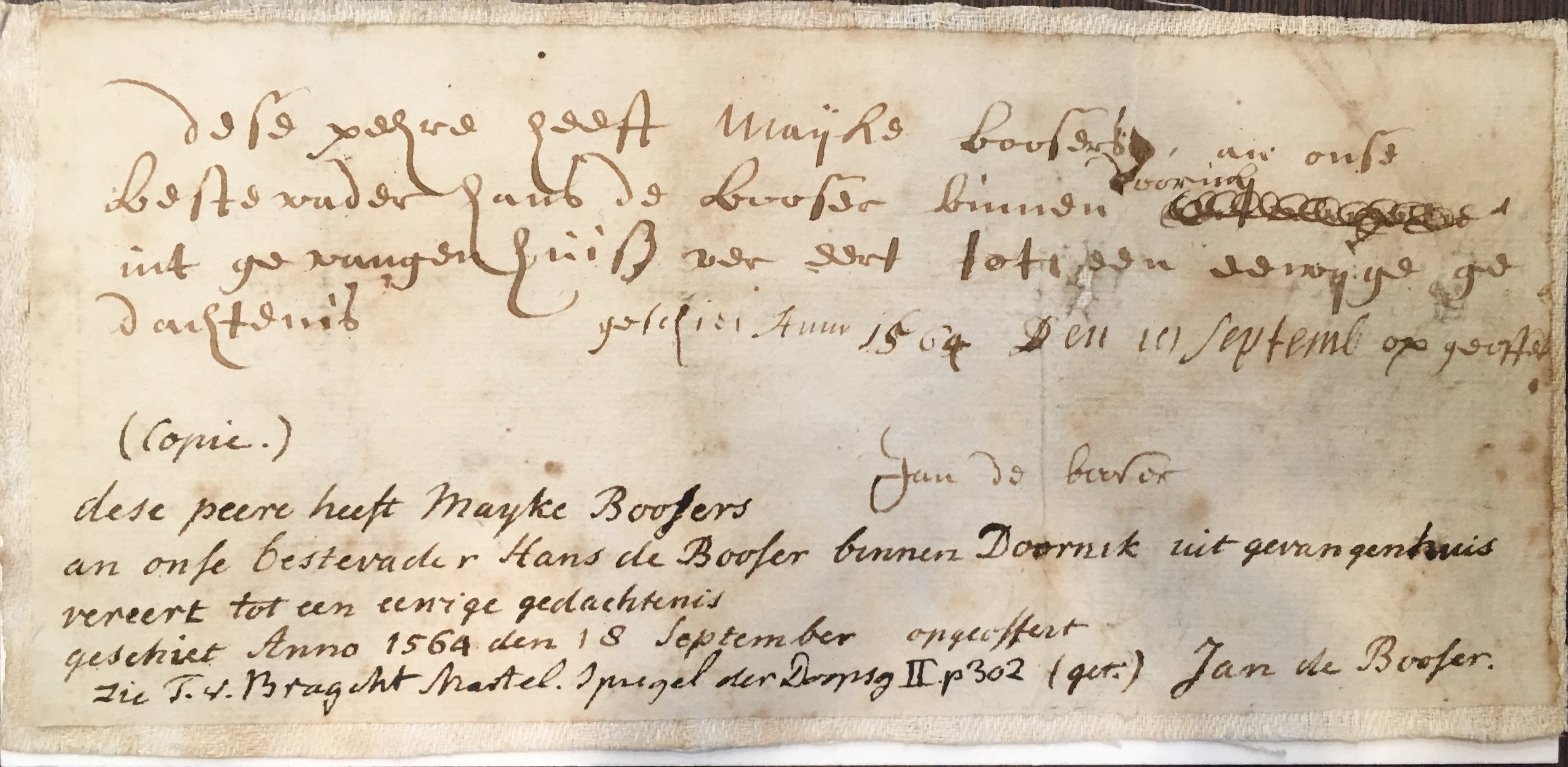
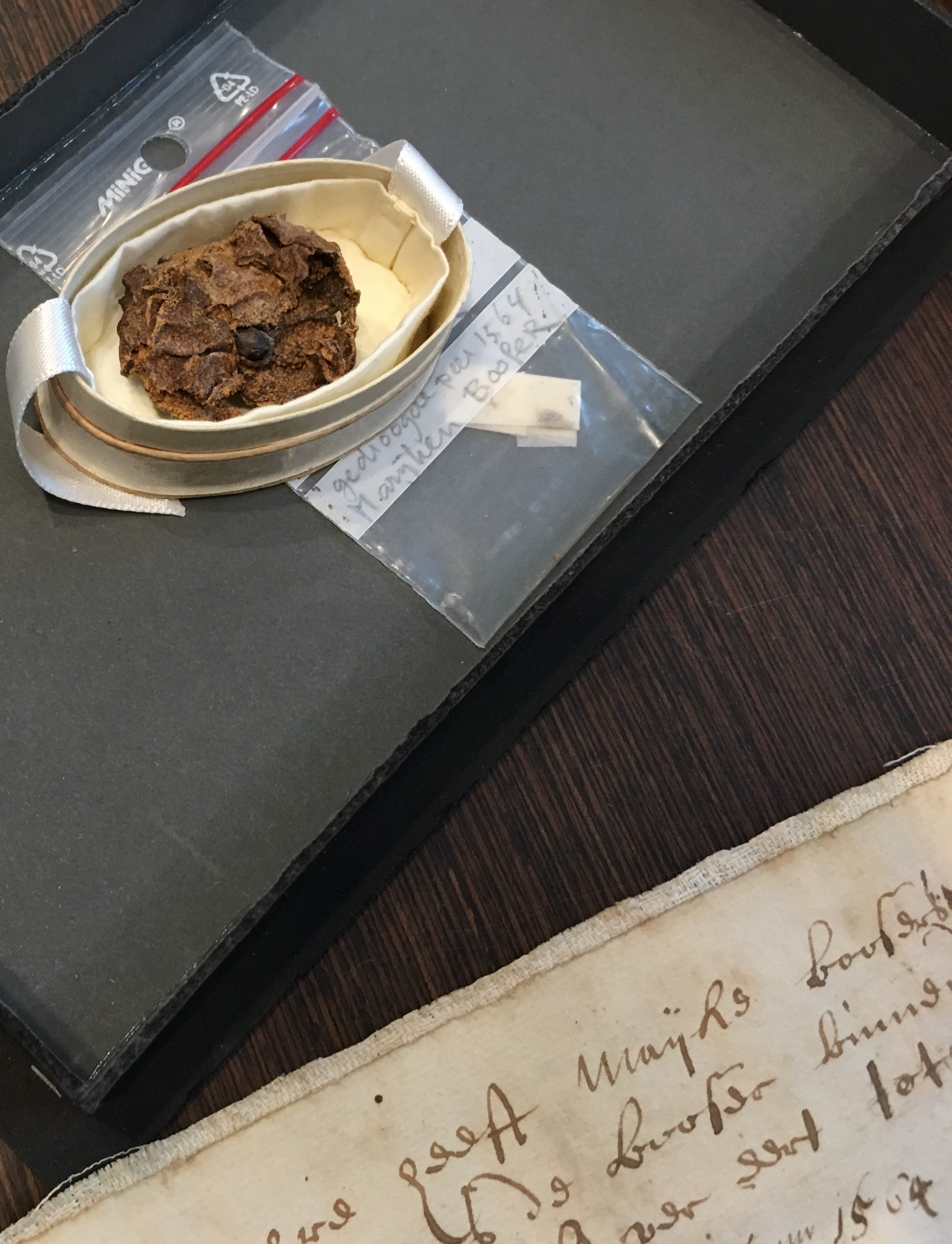
Figure 1. A dried pear that belonged to Maeyken Booser, Collection of the Mennonite Church of Amsterdam (VDGA), on loan to the Special Collections, University of Amsterdam.  

Nina Schroeder

There are a very small number of extant objects that have direct connections with the stories of early Anabaptist and Mennonite martyrs: the list of currently known items includes a part of a serviette owned by Thomas von Imbroich (1533-1558); a pear that Maeyken Boosers (d. 1564) gave to her relative (probably her son) Hans Booser in the time leading up to her execution; and a tongue screw, which was used on Hans Bret (d. 1577)1. The tongue screw is in private ownership, and the other two objects are a part of the collection of the Mennonite Church of Amsterdam (VDGA), on loan to the University of Amsterdam2. The Amsterdam Mennonite Church’s collection also includes the only extant handwritten letter by Menno Simons.3

The pear, cloth, and the tongue screw are historical items that occupy a middle ground between artifacts and memorial objects. These are not only of interest for scholarly research, but also items that have been considered to be of emotional or even devotional importance within the centuries-long Mennonite story.

I recently had the chance to see Maeyken Boosers’ pear in the Zaal Mennonitica (Mennonite Room) at the Special Collections library of the University of Amsterdam. Withered, shrunken, and extremely delicate, the 455 year old dried pear does not look much like a fruit any longer (figure 1). The story of Maeyken Boosers is well preserved in Dutch Mennonite circles and in the Mennonite martyrological literary tradition. Boosers was executed in Doornik (present day Tournai, Belgium) following imprisonment and torture. Notes to her family describe these trials, while demonstrating her dedication to her faith. Her story circulated as a song, “Die op den Heere betrouwen” (Those who trust in the Lord), which made its way into the late sixteenth-century Dutch Mennonite martyrology, Offer des Heeren4. Seventeenth-century martyrologies, including the Martyrs Mirror include several of her letters to her family.5 Maeyken passed along the pear to a member of her family during a visit to her in prison before her execution.6 Since then, the object has been protected and passed down over the centuries by her Dutch descendants.7 In the nineteenth century the pear found its way from the Booser family (sometimes written Boosers/de Booser) to the related Van Geuns family, after which time it entered into the Amsterdam Mennonite Church’s collection in the twentieth century.8

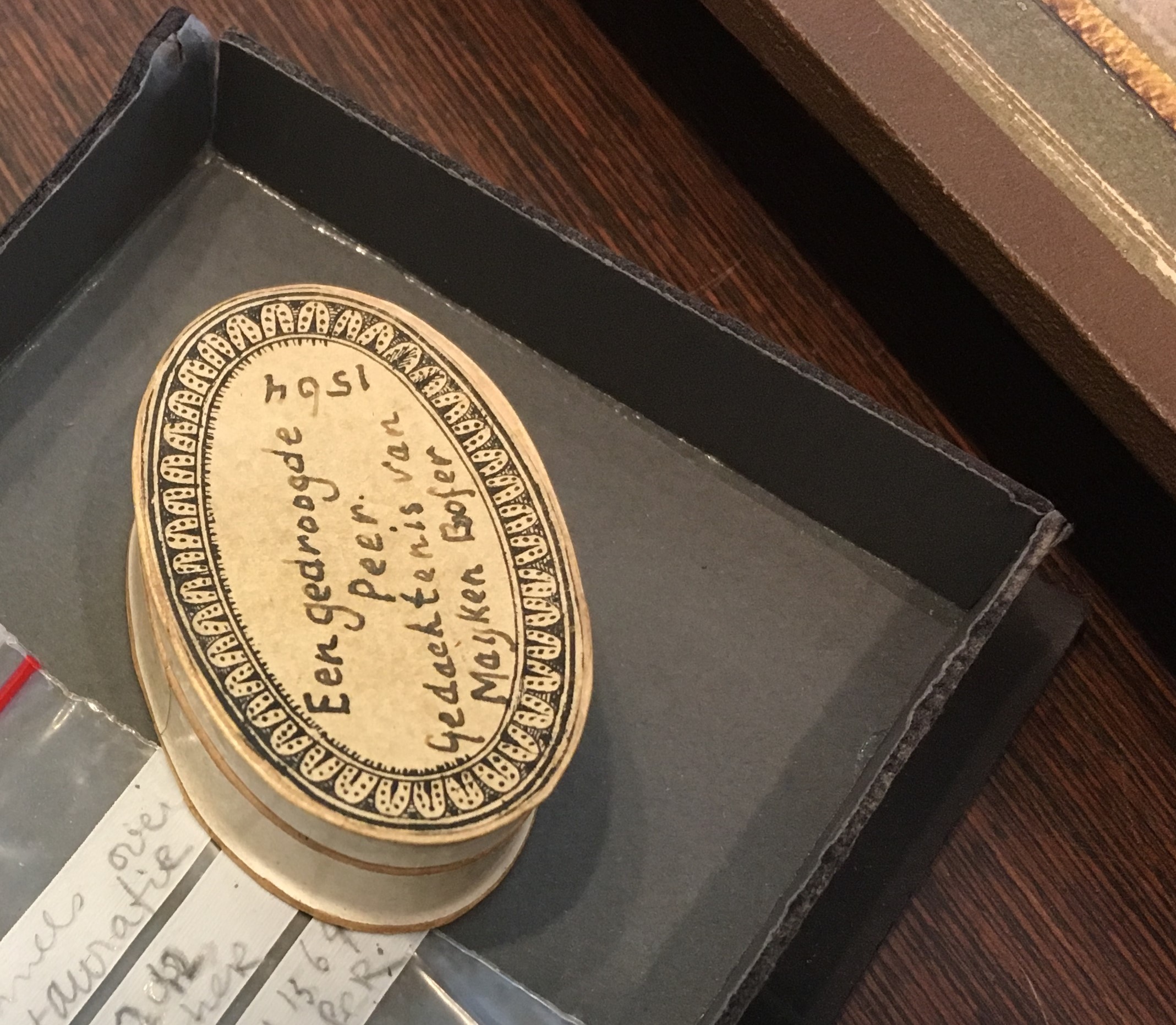
At present, the pear is stored in a simple oval box with a hand written label indicating the   contents (figure 2). However, up until the nineteenth century, it appears that the pear was kept in a silver casing. According to Samuel Cramer, writing about the “Mennonite relics” at the turn of the twentieth century, several of the older members of the Van Geuns family still remembered the silver container.9


Figure 2. The current container for the pear is labeled “Een gedroogde Peer/Gedachtenis van Mayken Booser/ 1564]” [A dried pear/Memorial of Mayken Booser/ 1564].

A handwritten note, which has long accompanied the pear, offers a short account about the origins of the pear. The message is signed, “Jan de Booser.” He is thought to be the grandson of Maeyken – the son of Hans Booser, who received the pear from Maeyken in prison. Jan de Booser, who lived in Grossenfehn in East-Friesland, died around 1630, meaning that the note likely dates to the late sixteenth- or early seventeenth century.10 The note states, “[t]his pear was given by Mayke Boosers to our dear father [beste vader] Hans de Booser in Doornik in the prison to be honoured as an eternal memorial” for Maeyken who was “sacrificed on September 10, 1564” (figure 3).11

The text is transcribed again in later penmanship beneath the early modern hand, followed by addition instructions to see the account in Thieleman Jansz. van Braght’s Martyrs Mirror, volume II, p. 302. This is likely an inscription added by a later member of the Booser or Van Geuns family. The more modern hand also adjusts the death date to September 18, which matches with the date given in the Mennonite martyrs books.12 This handwritten note was briefly lost in the nineteenth century. Cramer details the rediscovery and reacquisition of the letter by Dr. J.B. Van Geuns, a member of the family then in possession of the pear.13

The careful preservation of this pear, together with the fact that it used to be kept in a fine silver casing certainly lends itself to the characterisation of the object as a “relic” in some respects.  Furthermore, the pear is referred to as a relic in the existing literature on this object; namely, the articles by Cramer and the Mennonite Encyclopedia entry on “Mennonite relics.”14 In other ways, the term is perhaps not appropriate, given the historical Mennonite perspectives on relic veneration, and given the history of the pear as an object. In broader Christian tradition, relics are objects or physical remains thought to be from early Christian apostles, saints, martyrs, and even Christ. Since the origin and spread of Anabaptist movements around Europe in the sixteenth century, Mennonites have eschewed the veneration relics along with the veneration of saints, images, and the Host. These theological decisions have shaped the appearance of Mennonite churches, as well as the form of Mennonite worship. While relics housed in fine reliquaries have a long history of attracting pilgrims and generating a tradition of miracle stories in the Catholic tradition, Mennonite churches have not systematically kept or searched for “relics,” and Mennonites have historically excluded important heritage objects – whether artifacts or memorial items – from within the church sanctuary. The pear is very explicitly an object intended as a memorial for Maeyken Boosers – this is stated in Jan de Booser’s note. However, the known history and provenance of the pear suggest that it was treasured for sentimental and devotional reasons within the family sphere. In keeping with long engrained Mennonite theological practice, it was not placed within a Mennonite worship space as an object to be venerated. Now, the pear is stored among rare books, letters, and prints, in a library. The aim in this post is not necessarily to arrive at a definitive conclusion about how we should relate to Maeyken’s pear and the other objects that belonged to Mennonite martyrs – as artifacts, memorial objects, or indeed as “relics.” However, it is always interesting to check in on the question of how we as Mennonites relate to material culture that pertains to our socio-religious history. As a memorial object in a library setting the pear certainly continues to garner some attention (and spark some scholarly library pilgrimages) from within the global Mennonite faith community and the networks of Mennonite history aficionados.


  1. Christian Neff, “Relics of the Martyrs,” Global Anabaptist Mennonite Encyclopedia Online, Web, http://gameo.org/index.php?title=Relics_of_the_Martyrs&oldid=146122.
  2. Ibid. The pear is being housed within the University of Amsterdam’s Special Collections, and the cloth of Thomas von Imbroich is likely also there. See H.W. Meihuizen, Catalogus: Historische tentoonstelling achste doopsgezinde wereldcongres, Amsterdam RAI (Amsterdam: 1967), p. 25, cat. no. 40.  
  3. This is also on loan to the Special Collections of the University of Amsterdam. See I.B. Horst, “De strijd om het fundament des geloofs: van melchioriten tot menisten,” in Wederdopers, menisten, doopsgezinden in Nederland: 1530-1980,  S. Groenveld, J.P. Jacobszoon, S.L. Verheus ed. (Zutphen: Walburg Pers, 1993), p. 35, figure 21.
  4. The martyrology went through many editions in the last decades of the sixteenth century.  Karel Vos and Nanne van der Zijpp, “Maeyken Boosers (d. 1564),” Global Anabaptist Mennonite Encyclopedia Online, Web. http://gameo.org/index.php?title=Maeyken_Boosers_(d._1564)&oldid=162649 .
  5. Thieleman van Braght, Het Bloedigh Tooneel of Martelaers Spiegel der Doopsgesinde of Weereloose Christenen, Die om ‘t getuygenis van Jesus haren Salighmaker geleden hebben ende gedood zijn van Christi tijd of tot desen tijd toe. 2nd ed. (Amsterdam: Hieronymus Sweerts, etc., 1685), part II, 302 ff.; in English translation, Van Braght, The Bloody Theatre or Martyrs’ Mirror of the Defenseless Christians Who Baptized Only upon Confession of Faith and Who Suffered and Died for the Testimony of Jesus Their Saviour . . . to the Year A.D. 1660 (Scottdale: Herald Press, 1951), pp. 667-669.
  6. Samuel Cramer, “Het reliek van Mayken Boosers,” De zondagsbode. Doopsgezind weekblad,  P. Feenstra Jr. Ed., vol. 15 (1902), p. 79.
  7. Samuel Cramer, “Martelaarsrelieken,” Doopsgezinde Bijdragen, vol. 38 (1898), pp. 115-116.
  8. Ibid., pp. 115-116.
  9. Ibid.
  10. Cramer, “Het reliek van Mayken Boosers,” De zondagsbode, p. 79
  11. Original Dutch: “dese peere heeft Mayke Boosers/ an onse beste vader Hans de Booser binnen doornick int gevangenhuisz ver eert tot een eeuwyge gedachtenis/ geschiet Anno 1564 den 10 Septemb [sic.] op geoffert/ [signed] Jan de Booser”]
  12. The early modern handwritten note reads “September 10.” Cramer is first to note the discrepancy in date. Cramer, “Het reliek van Mayken Boosers,” De zondagsbode, p. 79.
  13. When Samuel Cramer first wrote about the pear in his 1898 article, the note remained lost. He wrote only on the basis of the pear, the martyr accounts, and the family recollections. His 1902 articles on the pear note that the paper has been found once again, and he offers a transcription. See Samuel Cramer, “Martelaarszaken,” Doopsgezinde Bijdragen vol. 42 (1902): pp. 150-171 especually, 168-170, transcription in Dutch on p. 168.
  14. Christian Neff, “Relics of the Martyrs,” Global Anabaptist Mennonite Encyclopedia Online http://gameo.org/index.php?title=Relics_of_the_Martyrs&oldid=146122. (also in Mennonite Encyclopedia, print edition from the 1950s).

Anabaptists and Minority Languages

Mark L. Louden

Recently a sobering report was released by the United Nations stating that as many as one million of the roughly eight million animal and plant species on Earth – about 13% – are threatened with extinction. On the human cultural front, the statistics are even grimmer. Of the approximately 7,000 languages spoken around the globe today, at least half, probably many more, are predicted to die out, that is, they will no longer be spoken natively by the turn of the next century. While the loss of biodiversity is likely to initiate a negative cascade effect on our natural world, the extinction of a language deals a critical blow to the cultural heritage with which it is associated.1

Most of the world’s languages, including all those that are endangered, are spoken by small minority populations. In the United States and Canada, for example, all indigenous languages are threatened to some degree, including Navajo in the US, which has the largest number of native speakers at around 150,000, and Cree, which is spoken by about 117,000 in Canada. Among the descendants of immigrant populations in North America, only English and French (in Canada) are considered “safe” languages. Contrary to popular opinion, Spanish as a heritage language in the US is not in a robust state of health among those who were born in this country. The vast majority of fluent native speakers of the language are first-generation immigrants from Latin America. Were the migration of Spanish speakers to the US to cease tomorrow, within a generation the language would be just as critically endangered as, say, Mandarin, Hmong, Somali, Arabic, and a host of other languages brought to the North American continent by immigrants.

There is a small group of languages spoken in North America and elsewhere that are successfully resisting the threat to minority languages worldwide. These include the native tongues of hundreds of thousands of traditional Anabaptists and Orthodox Jews, languages that are coincidentally all members of the Germanic language family. The primary vernacular of most Hasidic Jews is Yiddish, while members of Amish and many traditional Mennonite groups speak languages that descend from regional dialects of German.

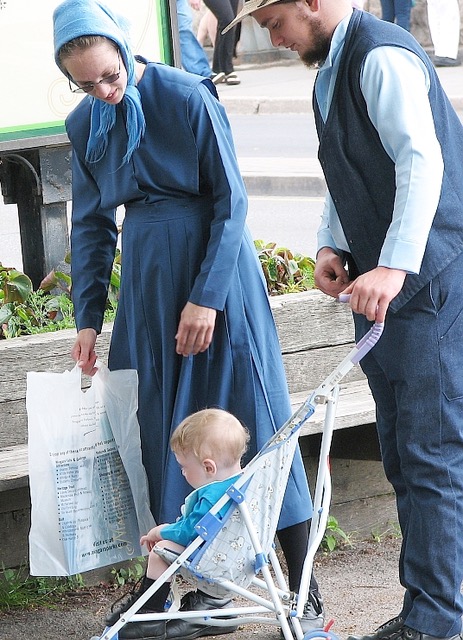
Amish family at Niagara Falls (Photo credit: Gila Brand)

The two largest Anabaptist heritage languages are Pennsylvania Dutch, spoken by most Amish and many Old Order Mennonites in the US, Canada, and Belize; and Plautdietsch, a form of Low German used by the descendants of Russian Mennonites, most of whom live in North and South America, especially Mexico, Paraguay, and Bolivia. Pennsylvania Dutch and Plautdietsch each have about 400,000 native speakers. Other Germanic heritage languages spoken by Anabaptists include Hutterite German (Hutterisch) and the languages of the so-called Swiss Amish (Shwitzer) subgroup within the Old Order Amish, most of whom live in Adams and Allen counties in Indiana. The Swiss Amish, who descend from nineteenth-century immigrants from France and Switzerland to North America, speak either a variety of Bernese Swiss or Alsatian German.

These five Anabaptist minority languages, along with Yiddish, are in a robust state of health. Despite being mostly oral vernaculars, they are acquired by children without formal instruction and actively used in a range of informal and formal settings. Four key factors promote the health of these languages.

First, each of these languages has become an important external symbol of group identity and a way of marking the socio-religious distance between their speakers and the larger societies in which they live, a distance that for the Anabaptists is explicitly grounded in their understanding of separation from the world. It should be pointed out, though, that all speakers of these Germanic heritages languages are bilingual and in some cases multilingual, for example, knowing both English and Spanish in addition to their mother tongue.

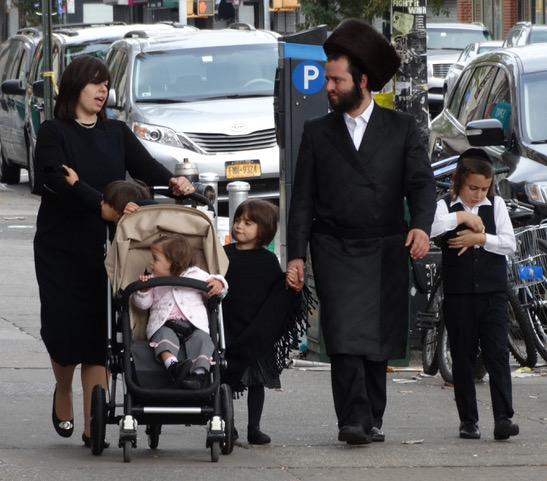
Hasidic family in Brooklyn, New York (Photo credit: Adam Jones)

A second crucial factor is that these traditional faith communities are strictly endogamous: marrying outside the faith – which would mean marrying someone who does not speak their heritage language – is not an option for those seeking to formally join or, in the case of the Hasidim, remain within the community, which the overwhelming majority do. This high retention rate is the third factor.

Finally, another important plus-point for groups like the Amish, traditional Mennonites, Hutterites, and Hasidim, and not only with respect to language, is their exceptionally high birth rates, which are between three and four times the national averages in the US and Canada. No other human populations anywhere are increasing more rapidly, which means that minority languages like Pennsylvania Dutch, Plautdietsch, and Yiddish are not only surviving but in fact now have the distinction of being fastest growing languages in the world.

For linguists and community members who seek to revitalize endangered languages, there are few practical lessons to be learned from groups like the Amish. Forbidding intermarriage and expecting couples to have at least a half-dozen children are not likely to be popular strategies for even the most ardent members of minority linguistic communities. But speakers of all languages, large and small, safe and endangered, can appreciate the emotional value that traditional Anabaptists and Hasidim attach to tongues that are a tangible connection to a treasured spiritual heritage.

Mennonite family in Campeche, Mexico (Photo credit: Adam Jones, Ph.D.)

When people who grew up speaking the Germanic languages discussed here leave their heritage communities, the shift to English monolingualism is usually swift, typically within one generation. But there are exceptions. In my own experience, I have found that people of Amish background living in Holmes County, Ohio, are more likely to maintain Pennsylvania Dutch than folks in Lancaster County, Pennsylvania, or the Elkhart-LaGrange area of northern Indiana. And in places like Mexico and Bolivia, the continued use of Plautdietsch among people no longer affiliated with Old Colony groups is not uncommon. The Ekj Ran (I Run) ministry based in Bolivia is one excellent example.

I will close with the thoughtful reflections of an Amish schoolteacher from Pennsylvania who taught in Mexico as part of the Old Colony Mennonite School Project and whose experience living among Plautdietsch speakers deepened her appreciation of her own native language.

Learning Plattdeutsch allows you to feel more connected with the Russian Mennonite culture. It also opens the door to a very fascinating language. My impression is that Plattdeutsch is somehow more colorful and descriptive than either High German or English. For example, the Plattdeutsch poem and song that the first graders learned one Easter were so alive with meaning. The clear word pictures, the powerful way the emotions of Good Friday and Easter were portrayed in the poetry, seemed singular to me. I have grown to appreciate the beauty of the language.

Speakers of Plattdeutsch seem also to be aware of this beauty and therefore treasure it enough not to lose it. To us, as conservatives from the States, this stands out because of the trend towards English and away from Pennsylvania German in our circles. Among our people, one of the first things lost in a more liberal move is the German language. In Mexico, even the most liberal of the Russian Mennonites retain the speaking of their mother tongue. There are many beautiful Plattdeutsch songs and hymns, and recently Plattdeutsch Bibles and dictionaries are available. Plattdeutsch is still their favorite language to speak, even for those who know High German, Spanish, and English.2


  1. The United Nations Educational, Scientific and Cultural Organization (UNESCO) maintains excellent resources in endangered languages: http://www.unesco.org/new/en/culture/themes/endangered-languages/atlas-of-languages-in-danger/..
  2. Called to Mexico, Old Colony Mennonite Support, 2011, p. 318..


“The Swiss Brethren, as they are called”

On March 31, 2019, following a thematically-diverse, well-attended international colloquium at Bienenberg Theological Seminary on “Anabaptist History and Renewal Movements,” John D. Roth moderated a day-long discussion on the subject of the identity of the Swiss Brethren. This conversation centered around Martin Rothkegel’s challenge to the scholarly consensus, which Arnold Snyder has recently reasserted, concerning the character of this Anabaptist tradition.1 The essential contours of this disagreement are as follows: Snyder (along with most of his colleagues) sees the Swiss Brethren as a transregional confessional movement, rooted in the earliest theological statements of Anabaptists in Switzerland, with a consistent set of distinctive doctrinal and behavioral markers; Rothkegel, meanwhile, posits that the label Swiss Brethren was the name given to an organized, underground network of churches, analogous in structure to Calvinist églises plantées and centered in the Holy Roman Empire, with only incidental links to the Swiss Confederation and early Swiss Anabaptist theological positions and texts.

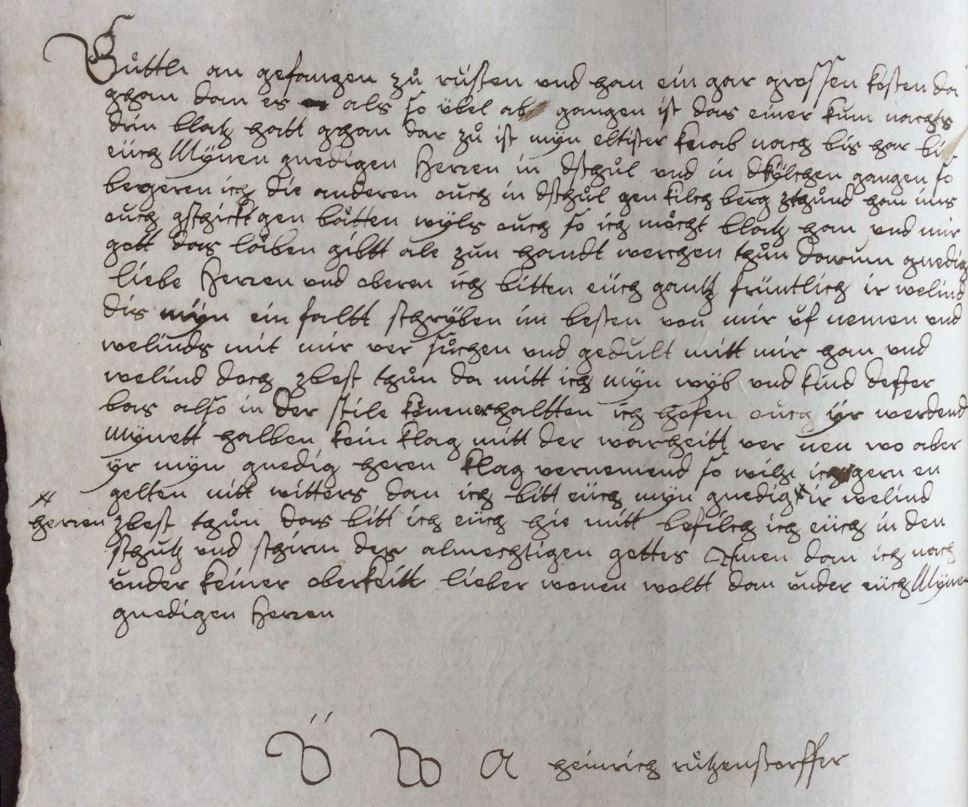
An excerpt from Heinrich Rützensdorfer’s written defense against accusations raised by the Reformed parishioners of Kilchberg. Staatsarchiv Zürich, E I 7.3, #75 (undated).

This interchange represents a new chapter in debates over group definition which have long characterized historical research into early Anabaptism. This focus persists, in large part, because the categories and models that historians have employed to explain the development of official confessional movements (Lutheran, Catholic, Reformed) during and after the Protestant Reformation cannot be easily applied to marginalized communities of nonconformists. Arguments about who Anabaptists were, what they believed and did, and how they related to each other and to those outside of their communities require creative interpretations of sparser evidence.

This particular iteration of a longer conversation about the identity of the Swiss Brethren is provocative because it encourages reconsideration of basic questions. Which sources matter in determining where the boundaries of the Swiss Brethren community lay? Which methods are most effective in uncovering these sources’ significance? And, at the core of the matter, what is the historical significance of Swiss Anabaptist origins to later Anabaptist-Mennonite traditions?

These questions brought to mind a rare reference to the “Swiss Brethren” in my reading of legal records from Zurich’s territory in the late-sixteenth and seventeenth centuries. In May 1595, Markus Wydler, the pastor of the village of Kilchberg, along with a local deputy bailiff and lay elder authored a supplication to Zurich’s city government on behalf of their community.2 They complained of the recent settlement of the glassmaker Heinrich Rützensdorfer “of the Anabaptist sect” and his wife and children in their parish. The new family refused to attend Reformed services. The locals’ efforts to persuade Rützensdorfer and his family to integrate into Reformed parish life had failed. On multiple occasions, the pastor, lay community leaders, and, eventually, Rützensdorfer’s own mother-in-law had visited the couple’s home in order to investigate their religious opinions. Rützensdorfer responded to these approaches, the supplication’s authors claimed, by outlining positions associated with the “Swiss Brethren, as they are called.”3 He would only attend a church that, one, exercised the ban and, two, allowed congregants to correct the preacher when he erred. (In a separate interrogation, Rützensdorfer also expressed unwillingness to swear an oath.)4 Out of fear of the potentially “damaging unrest” that might result from these new arrivals’ presence, the supplicants asked the authorities to remove the Anabaptists, “who had never existed in our parish since the beginning of the Reformation.”

In the framework of Snyder and Rothkegel’s exchange, this document presents intriguing evidence. On the one hand, the document’s authors appear to see continuity in the identity of Anabaptists within Zurich’s territory over time. One sect has been present in the region from the introduction of Zwinglian reform in Zurich to the end of the sixteenth century. At the same time, after diligently examining Rützensdorfer’s stated beliefs, the people of Kilchberg apply a label (Schweizerbruder) to him that authorities in the area simply did not use to refer to local Anabaptists settled permanently in their communities. Officials who governed parishes and bailiwicks inhabited by larger numbers of Anabaptists employed the derogatory labels Wiedertäufer, Täufer, or, in rarer cases, Taufbrüder. In my reading, the use of the name Swiss Brethren attributes a degree of foreignness to Rützensdorfer and his family.

There is a tension within sixteenth-century attempts to categorize the religious community or tradition to which Rützensdorfer belonged which suggest both continuity and change. Examination of other extant records are not particularly helpful in resolving this tension for modern observers. As Christian Scheidegger has shown, Rützensdorfer participated in a reading circle of Schwenckfelders in Zurich proper in the late-1580s before being temporarily expelled from the city.5 Although he continuously refused to attend Reformed services in Kilchberg into the 1610s, Rützensdorfer’s wife eventually participated actively in the life of the parish and regularly sent her children to Reformed religious instruction.6 I have not yet been able to document whether Rützensdorfer established membership in a specific Anabaptist congregation or, indeed, whether he was ever baptized. Still, in addition to his aforementioned statements regarding the proper form of Christian community, Rützensdorfer also used theological argumentation often employed by local Anabaptists when refusing to submit to authorities’ demands for him to leave the territory.7

This set of documents doesn’t provide conclusive evidence about the nature of Swiss Brethren group identity, organization, and theology. Rather, it shows that even contemporary observers struggled to understand the ongoing influence of early Swiss Anabaptism on nonconformists and the forms of nonconformity they encountered in their own time. Although unique in its particulars, this case represents many more which frustrate attempts to make narrow claims about who the Swiss Brethren were. On account of Anabaptists’ marginality, Rützensdorfer’s biography is complicated in ways that many nonconformists’ biographies are complicated. As we continue to refine an understanding of the Swiss Brethren, our models need to be flexible enough to account for this type of evidence. As this post has shown, the task of definition does not necessarily become easier as we move past the turbulence of the early Reformation.


  1. Martin Rothkegel, “Schweizer Brüder,” Mennonitisches Lexicon, vol. 5, updated February 11, 2016, http://www.mennlex.de/doku.php?id=top:schweizer_brueder; Arnold Snyder, “In Search of the Swiss Brethren,” Mennonite Quarterly Review 90, no. 4 (2016): 421-515.
  2. Staatsarchiv Zürich (StAZH), E I 7.3, #74.
  3. The context of the referenced quote follows: “Demnach so habenn wir durch unseren pfarrer un[d] die Ehegoumer zu mehermalen un[d] undersheidenlichen ziten, Inne siner Meinung der Religion halben Laßen erforschen, die dan bey uns ungebrechlich, Insonders wie Er sich deß kilchgange halben wölle halten. do Er sich dan für das ine zu[o] den Schweitzerbrudern, wie man si nennt.”.
  4. StAZH, E I 7.3, #70.
  5. Christian Scheidegger, “Täufergemeinden, hutterische Missionare und schwenckfeldische Nonkonformisten bis 1600,” in Die Zürcher Täufer, 1525-1700., ed. Urs B. Leu and Christian Scheidegger (Zurich: Theologisher Verlag Zürich, 2007), 155.
  6. StAZH, E I 7.4, #43.
  7. During an undated period of imprisonment prior to Rützensdorfer’s settlement in Kilchberg, Zurich’s authorities interrogated him in the Wellenberg tower in the middle of the Limmat river. When he was asked to promise to leave the city’s territory and not return, the prisoner responded by citing Psalm 24:1. Since the earth was was the Lord’s, secular authorities had no ultimate power to determine people’s movement through it, Anabaptists often claimed.