My Anabaptist Heritage and the Classroom

“Why does a historian study the dead ‘past’? To reveal how much of it lives in us today.”1 Recently Abigail told me that she has this brief quotation posted on her refrigerator. She had noted it during one of my lectures and wanted to keep it where she would see it every time she opened her fridge door. During our conversation, she owned that in the class on “Canadian Church History” that she had recently completed with me, she had learned for the first time that slavery is a part of our nation’s past. North of the 49th parallel, we prefer to focus on our role in helping enslaved people towards freedom through the Underground Railroad.2 As the hard truth was exposed, she confided, a new awareness of her own racism began to emerge. Our conversation confirmed for me that some of my passion for the classroom had stuck. My sense of mission had born fruit.3

My life in university classrooms spans five decades. Early on in my student life I began to imagine myself in the role of professor. I recall sitting in a class on “Canadian Indian History,” as it was called then, observing Professor Palmer Patterson and admiring his passion. As a quiet, reserved young woman sitting towards the back of the room, I remember thinking how I’d like to end up where he was, behind the podium – teaching. Not long after that Professor Patterson began to draw me out of my reserve; he assisted me in moving forward, helping to kindle the passion that he had observed in that student in the back of the classroom. His invitation to work under him as a graduate student, and to fill the role of teaching assistant was a critical moment in my development. As an undergraduate, I also admired Professor Frank Epp’s clear understanding of the multiple expressions of Mennonites in Canada and their common Anabaptist heritage that tied them together. He, too, would become a significant mentor.

Decades later I reflect back on being at the front of countless classrooms, attempting to kindle in my students some of the passion that had sparked mine as a young undergraduate. In my development as a teaching professor, I have been inspired by many scholars. Some of those are Anabaptist. But the two thinkers that I find myself returning to again and again are neither Brethren in Christ nor Mennonite. They are Jewish and Quaker. This is hardly surprising, I suppose, with the cultural connections shared between Jewish and Mennonite communities, and shared principles in Anabaptist and Quaker perspectives on peace.
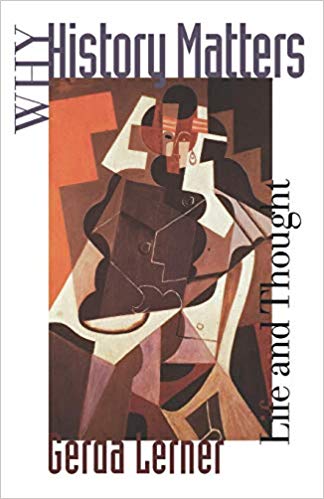
A secular Jew who narrowly escaped the Nazi invasion of Austria, Gerda Lerner’s career as a historian that included the founding of women’s studies, played itself out in the United States. I share Lerner’s feminist principles. But I am a Canadian historian, formed by my Brethren in Christ background and adult academic and faith journey shaped, in part, in Mennonite communities. Although the classrooms where I have taught have been in Liberal Arts institutions and a School of Religious Studies, and they have rarely included Anabaptist students, it seems that whether I’m teaching women’s studies, Canadian history or church history, I come back to Gerda Lerner’s stimulating essay collection Why History Matters, again and again.4

Lerner has spoken to my desire to kindle in students a sense of knowing who they are in relationship to their own past, and that of others. Her work has provided a paradigm for incorporating into my course syllabi those who have suffered intolerance and persecution in the past – indigenous peoples, people of African-Canadian heritage, Asian Canadians, those with Eastern European roots, and the women who comprise more than fifty per cent of every cultural group.5 Lerner’s insistent plea, that the failure to give expression to the underside and dark moments of the past – the horrors of wars, holocausts, genocides, slavery, rape, sexual abuse – will allow such atrocities to happen again and again, reinforces my Anabaptist beliefs.6

Including voices infrequently heard means making hard decisions. What do I omit, so I can do this work? Who decides what is critical? How does one integrate the previously voiceless into the canon? Although none of this is obvious, my Anabaptist background means that from childhood I have viewed the world from outside the mainstream. I have known myself as ‘the other’. This formation has trained me to see the hidden dark places in history; it has planted in me the hope that exposure will promote healing. My Anabaptist background has me teaching in trust that creating an environment that allows students to do some of their own reconciliation work will do its small part in working towards healing and justice.

Parker Palmer’s The Courage to Teach provides a helpful paradigm for this reconciliation work in the classroom: “Knowing of any sort is relational, animated by a desire to come into deeper community with what we know.”7His insistence that in the classroom the student and the teacher must be in relationship, not just with each other, but with the knowledge that they are together deepening into, provides a model for a community of learners. Abigail responded with surprise as she began to own her previously unnamed racist attitudes; I have also heard students’ gratitude for the naming of their personal hurts and sense of exclusion. As we grow in community with each other and our subject matter, students come to know themselves in a deeper way, even as I do, semester after semester.

In my academic journey teaching mostly Canadian history and Women’s Studies in the Liberal Arts in a variety of universities and colleges in three Canadian provinces, the student with Anabaptist background sitting in my classrooms has been rare. But as I often hear from students whether they are theology, history, women’s studies, Canadian studies majors, that they’ve come out of our experience together in the classroom with a deepened sense of community. They have entered into relationship with me and with each other, as we together deepen our knowledge. Some, like Abigail, tell me that they have gained a new awareness of the necessity to hear the voices of the marginalized and oppressed. Others come to a deeper sense of their own experience of being ‘the other’, sometimes hurt deeply by their experience.

Are my classrooms Anabaptist? I have come to see that at least in part, my attraction to both Gerda Lerner’s insistence on exposing the dark side, and Parker Palmer’s relational way of knowing is a product of my Anabaptist formation shaped by my Brethren in Christ and Mennonite background heritage. As I reflect on my Anabaptist heritage and how it has shaped my experience of the classroom, I, too, come into a deeper knowing and relationship with the past.


  1. Parker Palmer, The Courage to Teach (San Francisco, CA: Jossey-Bass, 1998), 54.
  2. Denise Gillard, “The Black Church in Canada,” McMaster Journal of Theology and Ministry, Vol. 1 (1998).
  3. See, for instance, my Presidential address to the 1917 meeting of the Canadian Society of Church History published as “Reflections on the Necessity of Canadian Church History, Historical Papers, Canadian Society of Church History (1917).
  4. Thirty-five years ago, on 1 April 1982, Gerda Lerner spoke to the Organization of American Historians in Philadelphia, on “The Necessity of History and the Professional Historian.” It has since been published in her thought-provoking Why History Matters: Life and Thought (NY: Oxford University Press, 1997): 113-28.
  5. For a helpful discussion on the Canadian history of discriminatory legislation, please see Allan Levine, “Slow Road to Tolerance” Canada’s History (April-May 2016), 41-47.
  6. It also parallels the work of Canada’s Truth and Reconciliation Commission, where the revisionist work of numerous Canadian historians figures prominently. See “Final Report of the Truth and Reconciliation Commission of Canada,” Vol. I: Summary “Honouring the Truth, Reconciling for the Future,” (Toronto: Lorimer, 2015). J.R. Miller, Shingwauk’s Vision: A History of Native Residential Schools (University of Toronto, 1997) and John S. Milloy, A National Crime: The Canadian Government and the Residential School System, 1879 – 1986 (Winnipeg, MB: University of Manitoba, 1999) are key in this work.
  7. Parker Palmer, The Courage to Teach, 54.

Mennonites and the Magical African-American Friend

The Mennonite church in the United States has established a record from the middle to the end of the twentieth century of welcoming, celebrating, and then frequently discarding charismatic, provocative African-American leaders. Most – but not all – have been men. Some went on to established and well-respected careers outside the confines of the denomination. Few stayed within. Evangelist and seminary professor William E. Pannell provides one such example. I contend here that many of these figures offer striking parallels to the phenomenon of what journalist and author Christopher John Farley has called “magical African-American friends” or MAAFs.1

A MAAF, also referred to more problematically as a “magic negro,” is a well established Hollywood trope in which an African-American character plays a salvific role in the life of a White person, often through magic or supernatural means, even if it means sacrificing themselves to do so. In the 1958 crime drama, The Defiant Ones, Sidney Portier’s character sacrifices his chance at freedom to save the life of the White convict played by Tony Curtis. In The Green Mile (1999), John Coffey as played by Michael Clarke Duncan exercises his healing powers on behalf of a White inmate, White death row guard, and the White wife of the prison warden before being executed. The MAAF trope crops up in a host of other Hollywood dramas such as Will Smith in The Legend of Bagger Vance (2000), Whoopi Goldberg in Ghost (1990), and Morgan Freeman in The Shawshank Redemption (1994). The list goes on. The comedy duo Key and Peele spoof the Hollywood archetype in a hilarious 2012 skit the skewers the trope’s reliance on stereotypes.

Of particular importance to the function of a MAAF in these films is that the Black figure – again most often male but not always, note the Whoopi Goldberg role in Ghost – usually comes into the life of the White protagonist from outside. In the case of Will Smith’s Bagger Vance, he literally approaches the White lead played by Matt Damon from out of the dark of the night. In few of the films does the Black savior figure stay around in the life of the White person he or she has saved.

William E. Pannell came into the White Mennonite community having spent time with Brethren Assemblies in Detroit. By the end of the 1950s, already a well known evangelist, he began to show up at Mennonite sponsored meetings such as the 1959 round table discussion entitled “Program of Witness to and With Negroes,” held in Chicago and sponsored by the Home Missions and Evangelism Committee of the Mennonite Church.2

Although in these early meetings, his voice in the minutes comes across as reconciliatory and appeasing, that would change over time. While in 1959 he commented, “We should remember that our primary problems are the spiritual, and here we must make our basic contributions,” a year later in the pages of the Mennonite Church news outlet, the Gospel Herald, he caricatured White people as being held hostage by an insurmountable “basic fear” of Black people expressed by trembling “slightly” and mumbling “nonsense about intermarriage.”3 By 1968, an excerpt from his controversial book My Friend, The Enemy criticized White-dominated missions conferences sponsored by congregations that relocated from Black neighbors even as they claimed to minister to them.4 As of 1971, he appeared in the pages of the General Conference news magazine, The Mennonite, with a reflection on the need for the Black community to have “power, control, the sharing of power.”5 That same year he also participated in the AFRAM conference held near Nairobi, Kenya, to bring together African-American and African Mennonites.6

Pannell’s Mennonite connections were more extensive than these publications and meetings suggest. He counted White Mennonite church planer Vern Miller as a “friend and brother,” even indicating that Miller introduced him to Martin Luther King, Jr.7 He recalled conversations with theologian John Howard Yoder while visiting Goshen College and referenced talks he gave at nearly every Mennonite college and high school as well as most Black Mennonite congregations in the U.S.8 Even more importantly, Pannell credited Mennonites with forming his “understanding of servanthood, of discipleship, of dimensions of faith in practice,” going so far as to exclaim in the course of an oral history interview, “Ah, boy, that was good stuff. I watched them live that stuff out in very uncomfortable circumstances. It helped me enormously.”9

And the exchange between Pannell and the Mennonite community wasn’t just one way. His invitation to participate in the 1973 AFRAM conference was only one indication of the trust that Black Mennonites placed in him. Already in 1968, leaders of the racially integrated Broad Street Mennonite Church in Harrisonburg, Virginia, had invited him to consult with them to discern their role as a church in their immediate neighborhood.10 White Mennonites also found Pannell’s contributions helpful. One reader praised Pannell for “Telling it as it is and honestly facing” racism present within the Mennonite community.11

The connection I make between Pannell and the trope of the Magical African-American Friend has less to do with the nature of Pannell’s specific interactions with both Black and White Mennonites than it does with a larger pattern into which his interaction with Mennonites fits.

Consider the following list: Hubert Brown, Curtis Burrell, Rosemarie Harding, Vincent Harding, Warner Jackson, James Lark, Rowena Lark, Joy Lovett, Stan Maclin, Charles McDowell, Dwight McFadden, John Powell, Ed Riddick. Every one of these high-profile African-American individuals appeared on a national Mennonite platform between 1950 and 2000 either as a speaker, author, evangelist, or church official. Every one of them then left the church for at least a stretch of time or disappeared from national attention.12 In the case of Pannell, he had never officially become Mennonite.

So this is my question. What does this pattern tell us about the White Mennonite church during the second half of the twentieth century? Each one of the individuals listed here is worthy of much fuller attention than what this column can offer. The reasons for their specific departures from the Mennonite world range from the most problematic of personal failings to decisions to pursue alternate career paths. But what troubles me as I review this list and ponder the tenure of William Pannell in the Mennonite world is that, like MAAFs, high-profile Black Mennonite leaders have rarely found a long-term home in the church.

And, the historical record would suggest, there is a through line in the personal narratives behind these names that speaks of White Mennonites being willing to be challenged for a period of time but only, in the words of Pannell, in “relationship to a suitcase.”13 Here is what Pannell wrote back in 1968. His words are worth quoting in full:

It took considerable time, several years in fact, before I began to realize that there were any number of people whose acceptance of me was conditioned by my relationship to a suitcase. A singing Negro has always been welcome as long as he is a vagabond, and has no intention to settle with his family. Again this is an overstatement since many would have been delighted if I would have stayed. But they too disappoint me when I discover their unwillingness to fight for my right to stay against those entrenched local forces of bigotry. They handcuffed me to my suitcase by their silence.14

He wrote these words now more than fifty years ago. The Mennonite community today counts a host of African-American leaders who have stayed and are leading the church: Michelle Armster, Leslie Francisco, Glen Guyton, Cyneatha Millsapps, Regina Shands Stoltfzus. There are many others.

Yet, for those of us who are White and Mennonite, the history of Black Mennonite leaders who have left after performing important leadership roles in the church – often at significant psychological and spiritual costs to themselves – is a cautionary tale, one that points to how easily even the best of intentions to welcome and embrace can all too quickly fall into the same traps of paternalism, exclusion, and stereotyping that are at the root of the highly problematic and ultimately racist portrayal of Magical African-American Friends.

In a community that continues to find it far easier to speak of and respond to racism in interpersonal rather than systemic terms, the trap of the MAAF will be one that we will have to work hard to avoid.


  1. Gayle R. Baldwin, “What a Difference a Gay Makes: Queering the Magic Negro,” Journal of Religion and Popular Culture 5, no. Fall (2003), http://www.usask.ca/relst/jrpc/art5-whatagay.html.
  2. Linden M. Wenger and Virgil Brenneman, “Program of Witness to and with Negroes,” (Chicago: Home Missions and Evangelism Committee Round Table, 1959), 1.
  3. Ibid.; William Pannell, “The Evangelical and Minority Groups,” Gospel Herald, March 8, 1960, 205.
  4. William E. Pannell, “Somewhere in the Middle,” Christian Living, September 1968, 24.
  5. William Pannell, “Little Black Sambo Still Lives,” The Mennonite, February 16, 1971, 100.
  6. John Powell, “AFRAM to Bring Blacks Together,” Gospel Herald, July 31, 1973.
  7. William E. Pannell, interview by Robert Shuster, April 21, 1998, in person, Billy Graham Center Archives, Wheaton College, Collection 498, Pannell, William E.; 1929-Interviews; 1995-2007, Audio Tapes, Tape 3, https://ensemble.wheaton.edu/hapi/v1/contents/permalinks/Ne5q4L7G/view.
  8. William E. Pannell, interview by Robert Shuster, February 28, 2000, in person, Billy Graham Center Archives, Wheaton College, Collection 498, Pannell, William E.; 1929-Interviews; 1995-2007, Audio Tapes, Tape 5, https://ensemble.wheaton.edu/hapi/v1/contents/permalinks/Dz2e8FCa/view.
  9. Ibid.
  10. John S. Weber, “The History of Broad Street Mennonite Church 1936 – 1971” (Senior Thesis, Eastern Mennonite College, 1971), 46.
  11. John E. Fretz, “Hard to Face It as It Is,” The Mennonite, March 2, 1971, 150.
  12. John Powell, for example, returned to the church, fulfilled a variety of leadership roles, and continues to write a column for Mennonite World Review. James and Rowena Lark started a church in Fresno, California, in the mid-1960s that did not have a Mennonite affiliation.
  13. William Pannell, My Friend, the Enemy (Waco, TX: Word Books, 1968), 55.
  14. Ibid.

On Naming Early Modern Anabaptists

What ‘Anabaptism’ means in an early modern document is often ambiguous – a problem which is only compounded when looking at secular bureaucratic sources. Who did early modern authorities think they were dealing with, or talking about, when they issued mandates or negotiated tolerance?

The study of early Anabaptism in Emden is stymied by a paucity of documents. More thorough record-keeping, or record-storing, coincided with the later influx of Dutch Reformed refugees in the 1550s.1 One of the earliest extant documents is a letter dated 12 May 1534, in the midst of the crisis of the Kingdom of Münster but concerning baptisms happening within Emden itself.2 Sent by East Frisian Count Enno II and addressed to the chief magistrates of Emden, it offered an “admonishment” against the continued existence of Anabaptists in the city.3 The letter uses the catch-all term of “wider doper,” but does not identify any leaders of, or even adherents to, this movement. This general reprimand thus suggests either that the leaders’ identity should have been obvious to the magistrates, or that perhaps Enno had only a vague understanding of the matter.

A hybrid document concerning the nearby city of Oldenburg, however, indicates that individual charismatic leaders were indeed traveling through the surrounding area during the 1530s, even if they were not immediately identifiable to authorities. A nineteenth-century excerpt and copy of an eighteenth-century edition of a text, this document was originally assembled by seventeenth-century theologian Gottfried Arnold. This nesting doll-like document nevertheless presents “David Joris’s singular life,” described in the nineteenth-century introduction as originating from a “very old Dutch-language written manuscript.”4 Arnold’s work was undoubtedly some sort of pastiche, as the excerpt included in this document is actually the sixteenth-century “Anonymous Biography of David Joris,” available in translation and edited by Gary K. Waite.5 Waite suggests in the introduction to this piece that the author may well have been Joris himself.6

Joris’s biography describes an Oldenburg still in turmoil following the violence and upheaval of the Anabaptist Kingdom of Münster. A number of refugees from Münster had found some toleration in Oldenburg, which Waite attributes to an ongoing feud between the Bishop of Münster and the rulers of Oldenburg.7 Joris was ministering to the local Anabaptist and spiritualist congregation, and pushed his claim on authority through an interpretation of signs and mystical interventions that occurred during their discussions – including an incident where a Bible belonging to the Münsterites fell off a table.8

Joris’s reputation would certainly grow in East Frisia. A letter from Holy Roman Emperor Charles V, again addressed to the chief magistrates and city council of Emden, directly addressed the disruption and unrest that imperial authorities expected from Anabaptists in general and Jorists in particular.9

Dated 15 October 1543, it began by greeting the relatively recently widowed Countess Anna von Oldenburg, who assumed the regency of East Frisia following her husband Enno’s death in 1540. The imperial letter expressly demanded the “confession of Anabaptists and other agitators,” which the emperor believed Anna had the power to arrange and compel. Charles identified the ‘ringleader’ as David Joris himself, and requested Joris’s writings, along with the names of other prominent members and journeymen.10 This letter thus establishes the fragmenting groups of ‘agitators’ under charismatic leadership as a phenomenon legible to authorities. Although shielded by official inaction, the followers of Joris as well as other Anabaptists and dissenters existed on the margins of legal residence.

The specifics of naming and differentiating amongst these marginalized religious groups became almost immediately important. Menno Simons arrived in Emden in late 1543 or early 1544 and advocated on behalf of his followers in front of the newly appointed Zwinglian pastor, Jan Łaski. Menno and Łaski had a number of “semipublic” discussions and debates over theological points, and despite significant differences Menno and his followers continued to enjoy some sort of toleration in Emden. Łaski was the first to use the term ‘Mennisten,’ in 1545, apparently as part of a larger scheme to separate these more moderate Anabaptists from their potentially violent brethren.11 When his attempts to debate and persuade these ‘Mennonites’ failed, however, Menno and his followers were ordered out of East Frisia – though many remained.12

By 1556, however, perhaps not coincidentally corresponding with the largest influx of Dutch Calvinist immigrants and the pressures of the Interim, Countess Anna found herself at least performing an insistence on tighter residential controls. In an edict dated 10 January 1556, Anna identified both David Joris and Menno Simons as leaders within the larger frame of Anabaptism.13 Within the text of the edict itself she separates out the “Mennonites, Davidites, Batenburgers, and other damned sects” who were ordered to leave within fourteen days or face punishment.14 The inclusion of the Batenburgers – a violent remnant of the Münsterites who most probably were no longer extant – is curious, and again highlights the problem of bureaucratic knowledge. The boundaries between these groups were recognized by authorities, but only in so far as they cohered as outsiders who were variously tolerated in the city of Emden.


  1.  For secondary reading on Emden, see especially Andrew Pettegree, Emden and the Dutch Revolt: Exile and the Development of Reformed Protestantism (Oxford: Clarendon Press, 1992), as well as a recent chapter by Timothy G. Fehler, “Coexistence and Confessionalization: Emden’s Topography of Religious Pluralism,”in Topographies of Tolerance and Intolerance: Responses to Religious Pluralism in Reformation Europe, ed. Marjorie Elizabeth Plummer, and Victoria Christman (Leiden: Brill, 2018), 78-105. 
  2.  Stadtarchiv (StA) Emden, I. Reg. Nr. 415, 1-2.
  3.  StA Emden, Nr. 415, 1: “wir offtmals ein vermanu[n]g doen latenn als der wider doper halben” 
  4.  Niedersächsisches Landesarchiv (NLA) Oldenburg, Slg. 10, Best. 297, Nr. A 54, 1r-3v.
  5.  Gary K. Waite, The Anabaptist Writings of David Joris:1535-1543 (Waterloo, Ontario: Herald Press, 1994). The section that is reproduced in the Oldenburg manuscript runs from pp. 66-70.
  6.  Ibid., 32: “Joris clearly played a major role in the formulation of the anonymous account.”
  7.  Ibid., 302, fn. 94.
  8.  NLA Oldenburg, Slg. 10 Best. 297, Nr. A 54, 3r; Waite, The Anabaptist Writings, 69.
  9.  StA Emden, I. Reg. Nr. 415, 3-4.
  10.  Ibid., 3: Wir schreiben hieneben der Edler unserer lieben Andechtigen Anna gebornen zu Oldenburg und Grauin zu Ostfrisen wittib Das Sy uns die vrgicht der widerteuffer vnd anderer Anfruerischen […] Aber volgendenen widerums auskomen sein mit sambt amer verzaichnus der Namen Irer Mitverwandten vnd gesellen, desgleichen Ires Haubts vnd Redelfuerers Joristen Glaßmachers Buecher zuschicken solle Inhalt vnsers schreibens.”
  11.  George Huntston Williams, The Radical Reformation (Philadelphia: Westminster Press, 1962), 732-734.
  12.  Pettergree, 33. 
  13.  NLA Aurich, Rep. 4 BII d Nr. 1, 2: “Vnnd wi dan befindenn, dat bouen alle vnnse vorigenn Mandata vnnd vtgegangene gebot breue, der Wedderdoperie also Menno Simons vnnd David Joris vnnd anderenn secten anhegiche”
  14.  Ibid., 2: “dat so alle vnnd jder [illeg.] sienn Mennonisten, Davidianen, Baterberger, vnd andere vordampn secten”