How much to change: Amish teachers in Mexico

The average person is not a revolutionary even though the average person might want some kind of change. I noticed this tendency to be especially strong in the Mennonites and Mormons I spent time with in Mexico, because of the strong communal ethos. And yet, in every community, there are people who risk a lot to make changes.

One way that people attempt to make change is in the realm of education. Education, particularly of young children, is a highly contentious area in most communities because changing young children’s experiences will change the future. Maintaining religious education in German is one of the reasons that Mennonites initially moved from Canada to Mexico, and for that reason, education is especially important in Mennonite communities in Mexico. There have been some efforts to change traditional schools from within Mennonite communities in Mexico and from people in Canada and the United States.

Students playing broom jail. (Muddy Creek Farm Library, Ephrata, Pennsylvania)

Many different aid groups have worked in Mennonite colonies (groupings of villages) in Mexico, most notably MCC. One of the most surprising groups to find there, at least from my perspective, were Amish people. I first came across this cultural exchange when I began researching Mennonites in Mexico. Many people would ask me if I knew any Amish people, because I lived in Ohio, and Amish people lived in Ohio. I didn’t and would say so.

Mennonite people usually encounter Amish people as teachers. (I should note that the family and friends who first asked about Amish teachers were in the Mexican state of Zacatecas, where it is my understanding that people from the Conservative Mennonite Conference teach in summers, not from any Amish group). Moreover, not all the teachers that come to Mexico through the “Amish” board were Old Order Amish – some were Old Order Mennonite and others were New Order Amish. Still other Amish people, namely the Beachy Amish, are involved in aid work with Mennonites in the Southern Mexican state of Campeche and in other countries.

I have just mentioned approximately four Christian denominations (Beachy Amish, Old Order Amish, New Order Amish, Old Order Mennonite) and have grouped together all Mennonites in Mexico, who are divided into a multitude of church groups, the largest of which is the Old Colony church. These words are really unimportant for the story I am telling today – although the distinctions between groups are important for people who are part of them. The important thing for today is that all these people dress differently from their surrounding country, be it Canada or the United States. They are also involved in cultural exchange with one another.

Steve Nolt has discussed the roots of this exchange in his Article “Amish Stories, Images, and Identities,” and it was basically fostered by the Mennonite Central Committee through a learning tour for some of their Amish donors in the 1990s. After this trip some kind of board was formed for teaching in some parts of Mexico – where church leaders were already familiar with ideas of educational reform thanks to the work of people like George Reimer and others. Then, this board began sending young women from the United States to Mexico to go teach (or to go to Kansas and teach Old Colony Mennonites there). The teachers, by and large women, go to Mexico in groups and live with house parents from their community who look after them and house sisters to do some of the housework.

This movement is fascinating because this exchange replicates the colonial missionary engagement either at home or in other countries and likely a lot of the negative things that happened as part of the fresh air movement, which Felipe Hinojosa discusses in Latino Mennonites. At the same time as it repeats these troubling patterns, it gives the people who participate in it a new experience of travel and also of ability to see the world and meet a different kind of person – which is challenging in a closed religious community.

This travel has many of the same effects on the Amish women as it had on previous generations of women missionaries, which Marlene Epp talks about in Mennonite Women in Canada. They can be leaders in a way they would not be able to be at home. At the same time, the teachers and others who are part of the project exercise agency very much within their communal boundaries

The people to change education in Mennonite communities in Mexico, including those who participate in this project, as well as the children in these schools likely did not set out to be revolutionaries. They did set out to make small changes that made sense within their communities and I hope that it has a positive effect.

This post relates to an article I’ve written: “American Old Order Teachers Write Home from Mexico: Reflections on Gender, Religion and Caregiving.” Journal of Mennonite Studies 36 (2018): 237-258 and to some of the background research I conducted for this research note ““Expanding Low German Childhood: The Children’s Feature in the Mennonitische Post [Mennonite Post].” Mennonite Quarterly Review 92, no. 1 (2018): 471-481. If you’d like to read either article please let me know and I can share a copy with you.

Bibliography

Epp, Marlene. Mennonite Women in Canada: A History. Winnipeg: University of Manitoba Press, 2008.

Hinojosa, Felipe. Latino Mennonites. Baltimore: The Johns Hopkins UP, 2014.

Nolt, Steven M. “Amish Stories, Images, and Identities: Two Windows and a Mirror on Contemporary Culture.” The Conrad Grebel Review vol. 33, no. 1, 2015, https://uwaterloo.ca/grebel/publications/conrad-grebel-review/issues/winter-2015/amish-stories-images-and-identities-two-windows-and-mirror.

The Musical Million for the millions

mm1881xii12.jpg

It is always exciting for librarians and archivists when we are able to share our collections in new and accessible ways. For this reason we were thrilled when the Library of Virginia’s Virginia Newspaper Project approached us proposing a collaboration to digitize and make available the Musical Million1. With the help of those at the Library of Virginia, specifically Errol Somay, and the dedication and swift scanning ability of our summer work-study student Finn Wengerd, we were able to complete this project in a few short months and are pleased to make it freely available.

Some very thorough and informative pieces been written about the Musical Million in conjunction with this digital launch, so I encourage you to read the blog post written by Gregg D. Kimball from the Library of Virginia as well as a post written by EMU’s Lauren Jefferson to get a good sense of the importance of this periodical and its place in both Shenandoah Valley and Southern Gospel music History.

EMU is one of the few institutions in the country to have a nearly complete run of the Musical Million, and it has been top on our wish-list of things to digitize and make available for many years now. We are very proud of this collection and this collaboration, and hope researchers and other interested folk can make good use of it! If you find yourself wanting to know more about Joseph Funk or the Ruebush-Kieffer company, come visit us in the Menno Simons Historical Library, where you can see an outstanding collection of songbooks and other publications from Funk and Ruebush-Kieffer, as well as interesting artifacts such as Joseph Funk’s writing chair, original printing plates for the 16th edition of the Harmonia Sacra, and Aldine Kieffer’s pump organ.


  1. As of this writing, there are 315 issues of the Musical Million available beginning in 1879. We hope to be able make accessible the first decade of the periodical as soon as we are able to digitize the fragile issues. It is also our hope that the precursor to the Musical Million, the Southern Music Advocate and Singer’s Friend, will soon be available. 

Call For Papers: Young Historians

The Lancaster Mennonite Historical Society, in partnership with the Sider Institute for Anabaptist, Pietist, and Wesleyan Studies at Messiah College, and with the Young Center for Anabaptist and Pietist Studies at Elizabethtown College, welcomes paper proposals for its “Young Historians Spotlight,” held June 3, 2019.

Invited to participate are high school students, undergraduate, graduate, and doctoral students, those who have just started careers in history, as well as those who are “young” in scholarly study of historical topics (no matter what their age).

All must be engaged in original research using chiefly primary sources (written and/or oral). All should either be a part of a Historic Peace Church (Amish, Brethren in Christ, Church of the Brethren, Mennonite, Religious Society of Friends/Quaker, etc.) or focusing on one or more of these traditions. 

Those interested should submit a 250-word proposal, for a 20-minute paper to be given at the symposium, along with a brief autobiographical sketch and full contact information, by April 23, 2019. Send these to Joel Nofziger at Lancaster Mennonite Historical Society, 2215 Millstream Road, Lancaster, PA 17602, or at younghistorians@lmhs.org. A limited number of travel scholarships are available. Please note in the proposal whether this will be needed. The symposium will take place at the Lancaster Mennonite Historical Society at 7 p.m. on Saturday, June 3.

Proposals are due April 23, 2019

For the seventh year in a row, young historians are being invited to share their research findings with others in a symposium in the Lancaster area. This event was conceived by Joel Nofziger and Devin Manzullo-Thomas, who were concerned about the limited venues there are where young adults engaged in historical research and writing are the focus of attention, especially those from Historic Peace Churches. In the symposiums, three of the proposals received are accepted for papers to be given in a public event. In addition, the papers are subsequently published in Pennsylvania Mennonite Heritage. 

In the past, papers have included topics such as John F. Funk and the dissemination of information to the scattered churches of America, Quaker Anne Knight and her lifelong efforts for the rights of the disenfranchised, and the peace position of the Church of the Brethren, among others. 

Symposium Planning Committee: Jeff Bach, Young Center for Anabaptist and Pietist Studies, Elizabethtown College; Simone Horst, Menno Simons Historical Library, Eastern Mennonite University; Jason Kauffman, MC USA Archives; Devin Manzullo-Thomas, Sider Institute for Anabaptist, Pietist, and Wesleyan Studies at Messiah College; Joel Nofziger, Lancaster Mennonite Historical Society; and Anne Yoder, Swarthmore College Peace Collection

Newly Processed Collections at the MC USA Archives

Jason B. Kauffman

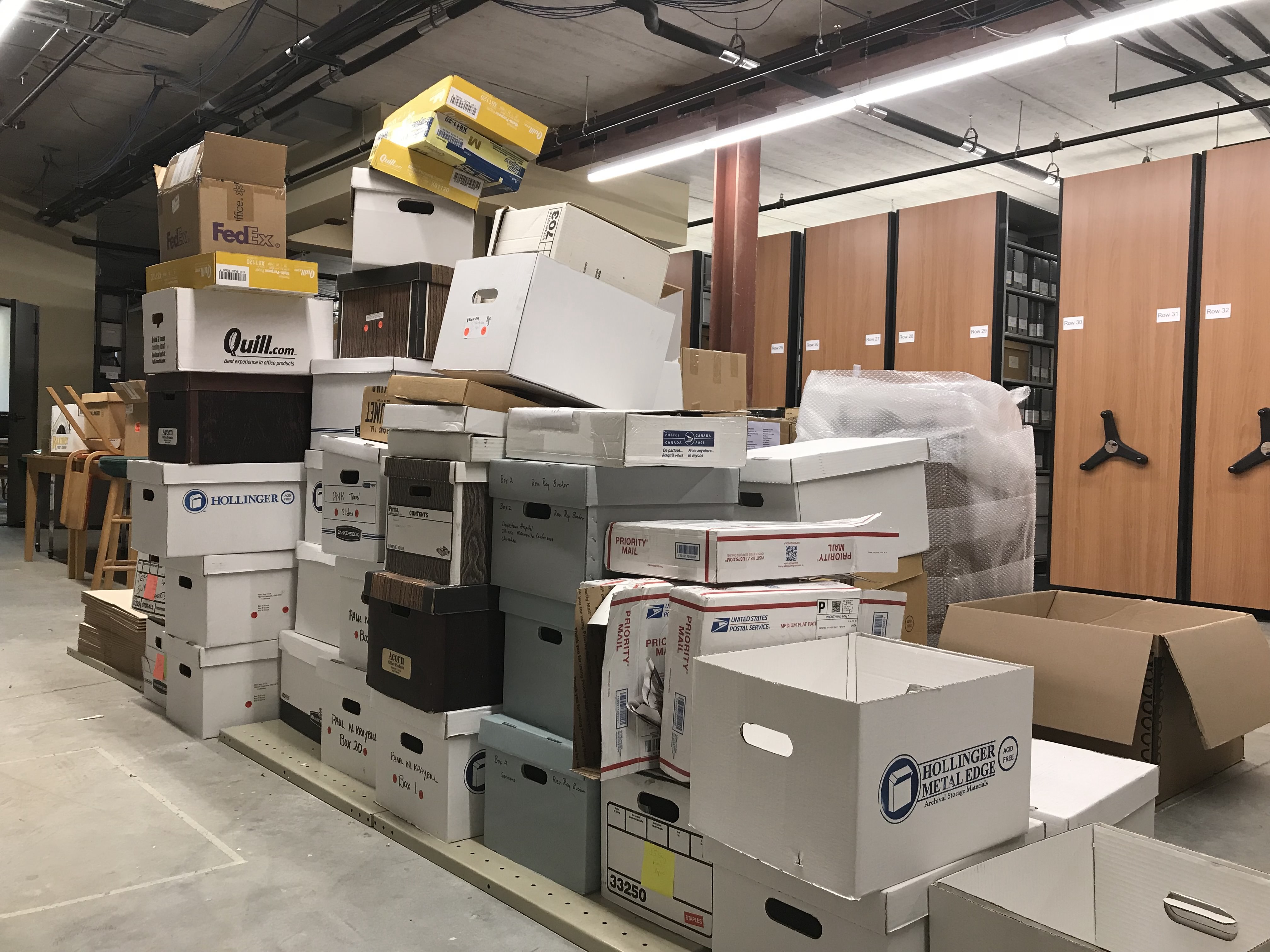
If I had to choose one word to describe the work of the Mennonite Church USA Archives over the last several months it would be: “productive.” In September I welcomed Eva Smucker Lapp as the new archives assistant, along with a Goshen College intern and two more regular volunteers. They joined a small, but dedicated core of long-term volunteers who have worked for years to process collections, build our online database of obituaries, and add images to our online collection of historical photographs. Together we made much progress this fall toward arranging, describing, and cataloging collections that accumulated before I arrived and while I was preparing for the move from Goshen to Elkhart.

IMG_4183.jpgSome processing highlights include:

I am grateful for colleagues, interns, and volunteers who keep things moving behind the scenes at the archives. They help complete the necessary work of organizing materials, rehousing and refoldering documents, and creating online finding aids so researchers can discover our new collections. Without their work, it would not be possible to make these important and fascinating collections available to researchers and the broader public.

And researchers are finding and using the collections. For example, a doctoral student from Canada spent three weeks in 2018 researching the Africa Inter-Mennonite Mission records for her dissertation project. Two other professors from universities in Canada and England recently consulted the Melvin Gingerich Papers for sources documenting his involvement (through MCC) with the United Nations Relief and Rehabilitation Administration and Seagoing Cowboys trips to Poland after World War II. And, of course, other researchers near and far continue to make creative use of many of the thousands of other collections housed at the archives.

I am amazed at the richness of our collections and am grateful that I can continue to make them accessible to researchers. I look forward to seeing what new discoveries await in 2019.