Praying to the Lord Against the City?

Dürer_FourHorsemen

Albrecht Dürer’s woodcut The Four Horsemen (1498), an interpretation of Revelation 6:1-8 featuring Death, Famine, War, and Pestilence (from left to right).

In 1639, the city council of Zurich published its so-called Manifest, an apologetic mandate which justified authorities’ recent repressive actions against the Anabaptist population living in the rural jurisdictions surrounding the city. Among the reasons given for a campaign of incarceration, intentional impoverishment, and child removal—the weight of which ended a more than century-long Anabaptist presence in the area—was the nonconformists’ alleged utterance of malevolent prayers. Instead of interceding on behalf of the authorities, in keeping with the instruction of the apostles [1 Tim. 2:1-2], Anabaptists were accused of asking God to visit “pestilence, war, and other plagues” on the territory’s inhabitants.1

This particular accusation is of uncertain origin, but it was not new. The authors of the Manifest claimed that Anabaptists had cultivated this specific prayer “among themselves for years.” Indeed, clerics stationed in rural parishes had complained of a prayer with similar content in a list of grievances submitted to Zurich’s synod already in 1601. Allegedly, several local Anabaptists had asked God to rain down disaster on the territory so that Reformed authorities would forget about the dissidents and leave them alone.2 Anabaptists denied such claims. For example, Hans Müller, a deacon from Zurich’s southeastern Oberland, dismissed the charge categorically as an untruth spread by “evil people.” In keeping with Christ’s command, his brethren prayed for those who persecuted them, Müller insisted.3

We cannot determine definitively whether beleaguered nonconformists actually beseeched God to inflict their Reformed neighbors with disease, famine, and armed conflict. Still, the occasional reappearance of the claim that they did leaves us with a few interesting questions: why were some members of Reformed communities convinced that Anabaptists engaged in such malicious devotions, despite dissidents’ frequent denials, and why did they care?

Reformed pastors—those who reported the practice in question—likely believed that Anabaptists were capable of such spiritual sabotage because it accorded with the stereotypes of the dissident movement reinforced by their clerical education. Ministers’ libraries contained texts that attributed to local Anabaptists the seductive power of heretics and the disruptive potential of rebels.4 In addition, in the early 17th century pastors periodically attended academic events organized around discussion of anti-Anabaptist theses, including one entitled “Concerning the diabolic possession of men . . .”5 Furthermore, ill-seeking prayer communicated a lack of concern for the welfare of the Reformed society. This fit with clerics’ understanding of the intentions behind Anabaptists’ withdrawal from the religious life of the majority: nonconformists’ refusal to participate in certain religious and civil ceremonies was viewed as an act of spiritual arrogance. Since religious disunity held the potential to invite divine wrath, their behavior put the entire Christian community at risk. By offering up malevolent prayers, Anabaptists requested with their words what they were calling for with their actions.

Other members of the Reformed majority may have believed allegations of ill-intentioned prayers because of some rhetorical consistency with other instances of Anabaptist speech. Anabaptists often openly denounced what they deemed to be the generalized moral depravity of Reformed society, and implied its members’ perdition. They also frequently got into trouble for purposefully provoking their Reformed neighbors in shared social spaces. When Anabaptists told fellow travelers on the street that they had seen a devil on the local minister’s shoulder, or suggested that reconciliation with the Reformed church was akin to a dog vomiting and snarfing the results back up again, they deliberately baited their audience by publicly impugning their faith.6 In this context, the malevolent prayers which accusers attributed to Anabaptists might have been understood to reflect a similar spirit.

Undergirding all of these concerns was an assumption that Anabaptists’ words mattered, that they had the power to enact some kind of effect on reality. One the one hand, this belief existed in tension with Reformed leaders’ claims that Anabaptists’ spiritual and civil disobedience had cut them off from communion with God. On the other, it fit easily within a worldview that saw the crises of the period—indeed, exactly those disasters the Anabaptists were accused of appealing for—in the context of a broader spiritual conflict, in which Zurich was deeply engaged. These were not theoretical disasters, but catastrophes that marred seventeenth-century Europeans’ everyday existence. A primary response of the city council to the threat posed by the period’s economic ruin and the Thirty Years’ War was to mandate mass participation in days of prayer and repentance. That Anabaptists were engaging simultaneously in spiritual counter-efforts simply confirmed their identity as opponents of the common good in the eyes of authorities. The assumption, of course, was that God would only answer the petitions of those faithful to him. Some, however, believed that Anabaptists’ utterances had the power to invoke diabolical forces. This was the charge often lodged against Anabaptist medical practitioners—midwives, doctors, and veterinarians—who supposedly harnessed dark powers in the practice of healing arts.

The charge of uttering malevolent prayers represents a curious facet of the long-standing relationship between Anabaptists and representatives of Zurich’s Reformed majority. It sheds light on how contemporaries understood the effects of dissidents’ clandestine devotional practices on social well-being. It also shows that, despite their non-participation in Reformed religious culture, Anabaptists were deeply implicated in rural communal life. Their participation in networks of village sociability and exchange was a feature of long-term coexistence. Differences in religious belief and practice did not make living together impossible. However, as this case shows, this coexistence did not exclude conflict over speech with religious content. When open conflict did erupt, latent accusations (of questionable derivation) could be reactivated and used to sanction the repression of members of the local religious minority.


  1. “Wahrhaffter Bericht…,” in Täufer und Reformierte im Disput: Texte des 17. Jahrhunderts über Verfolgung und Toleranz aus Zürich und Amsterdam, ed. Wälchli, Philip, Urs Leu, and Christian Scheidegger (Zug: Achius, 2010), 125. 
  2. Zentralbibliothek Zürich (ZBZ), Ms B 163, 82v. 
  3. ZBZ, Ms B 163, 303v-304r. 
  4. Hanspeter Jecker, “Lange Schatten und kurzes Gedächtnis – Heinrich Bullingers posthumer Einfluss auf die Behandlung der Täufer in der Schweiz,” in Heinrich Bullinger: Life – Thought – Influence, ed. Emidio Campi and Peter Opitz (Zürich: Theologischer Verlag Zürich, 2007), 709-713. 
  5. A thesis entitled “Disputatio theologico-philosophica, de diabolica hominum obsessione, et de daemonum eiectione” was submitted for dispute during synodal meetings in October 1626. Urs B. Leu, “Letzte Verfolgungswelle und niederländische Interventionen,” in Die Zürcher Täufer, 1525-1700, ed. Urs B. Leu, and Christian Scheidegger (Zürich: Theologisher Verlag Zürich, 2007), 208. 
  6. Francisca Loetz has argued that blasphemers engaged in similar forms of verbal performance. Dealings with God: From Blasphemers in Early Modern Zurich to a Cultural History of Religiousness (Farnham, England: Ashgate, 2009), 272-73. 

Lancaster Mennonite Historical Society Seeks Executive Director

Lancaster Mennonite Historical Society seeks an executive director to lead a vibrant organization poised to build on current strengths and expand its historical, educational, and visitor programming.

The executive director oversees approximately twenty-two employees, a combined budget of $1.1 million, and programming at three sites on two campuses: the LMHS library, archives, and museum gallery at Millstream Road, Lancaster, PA; the Mennonite Information Center, also at Millstream Road; and the Hans Herr House Museum at Willow Street, PA.

The successful candidate will combine effective executive team leadership with business acumen, strategic planning and implementation, and resource development skills. Candidates must possess strong communication skills, an ability to engage a wide range of constituencies, and demonstrate Anabaptist faith commitment. Anabaptist candidates of all backgrounds are encouraged to apply. 

Applicants should provide a letter of intent that includes their vision for LMHS, a résumé, and three references. Submit materials and inquiries to Steve Nolt, search committee chair, at search@lmhs.org. The search committee welcomes inquiries and will review applications until the position is filled.

More information at: https://www.lmhs.org/about/employment/

Samuel Ernst and the German Language

Mark L. Louden

Two years ago I was reading through a fascinating publication that appeared irregularly between 1943 and 1946. Der Pennsylvanisch Deitsch Eileschpiggel (The Pennsylvania Dutch Eulenspiegel [<Till Eulenspiegel, a prankster in German folklore]) was brought out by by J. William Frey (1916–1989), who was for many years a professor of German and Russian at Franklin and Marshall College. Frey was a native speaker of Pennsylvania Dutch who wrote his doctoral thesis on the language at the University of Illinois and became a pioneer in the field of Pennsylvania Dutch studies. The Eileschpiggel, which bore the subtitle En Zeiding, Schwetzbrief un Blauderschtick far die Deitsche (A newspaper, newsletter, and chat-sheet for the Pennsylvania Dutch), included Pennsylvania Dutch prose and poetry along with many other items of interest for both “scholars and laymen.”

In the first issue of the Eileschpiggel, Frey printed a short piece in Pennsylvania Dutch by a fellow native speaker and German professor at Lehigh University, Ralph Charles Wood, who expressed his support for Frey’s enterprise. Wood wrote:

This is not the first time that people have tried to publish a Pennsylvania Dutch newspaper to talk a little about the language in the language itself. Around 1860, Samuel Ernst of Millwood, Gap, [PA], published a newspaper in three languages – High German, Pennsylvania Dutch, and English . . .

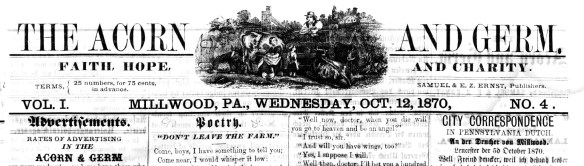
My curiosity was piqued, since I had never heard of Samuel Ernst and his trilingual publication. After a little sleuthing, I learned that Ernst was an “old” Mennonite who was born in Lancaster County in 1825, moved to Olathe, Kansas, in 1884, and died there in 1909. The newspaper Wood was referring to actually began in 1870 and was titled The Acorn and Germ.image1-17

According to the Global Anabaptist Mennonite Encyclopedia Online, The Acorn and Germ was published by Ernst and his son, Eleazar Israel (known as “E. Z. Ernst,” the “Z” referring to his mother’s maiden name, Zimmerman) from July until December 1870, at which time it was succeeded by Der Waffenlose Wächter (The weaponless watchman), which Samuel edited alone. The Wächter initially appeared monthly and eventually quarterly, continuing until 1888. Through the kind assistance of Iren L. Snavely, the Rare Books Librarian at the Pennsylvania State Library in Harrisburg,  I was able to obtain digital copies of several issues the The Acorn and Germ and Der Waffenlose Wächter from September 1870 through April 1871, some highlights of which I will share here.

Ernst’s newspapers were indeed trilingual, with material mainly in English and German, but also Pennsylvania Dutch. In my last post on this blog about Mennonites and Amish and Pennsylvania Dutch, I mentioned that Samuel Ernst is one of just two identified Anabaptists who published Pennsylvania Dutch material in the nineteenth century, the other being John H. Oberholtzer (1809–1895). Both Oberholtzer and Ernst expressed the concern in their respective publications that younger American Mennonites, especially schoolchildren, had insufficient knowledge of High German for the practice of their faith. This concern is shared by many Amish and Old Order Mennonites today, who continue to use the Luther Bible and German-language prayer and hymn books for devotions and worship.

A few words are in order about what kind of German was used by Anabaptists and other Pennsylvania Dutch speakers in Samuel Ernst’s day. Ralph Charles Wood, the German linguist and Pennsylvania Dutch scholar mentioned above, described it as “Pennsylvania High German” to distinguish it from the written German standard used in modern Europe. High German, so-called for the fact that it is based most closely on written dialects used in one part of the High (as opposed to Low) German dialect area (where “high” and “low” refer to the elevation of the Central European landscape), was not widely spoken in the 18th century, when the ancestors of the Pennsylvania Dutch set out for America. At that time and continuing into the 20th century, there was considerable variation in how German was written and even more variation in how it was pronounced when spoken.

Pennsylvania High German, which is still used by the Old Orders today, was strongly influenced by Pennsylvania Dutch, the vernacular language, as well as English. Its users, being cut off from German-speaking Europe since the 18th century, were unaffected by the increasing standardization of German vocabulary, grammar, spelling, and eventually, pronunciation throughout the 19th and 20th centuries. The maintenance of High German in devotion and worship was important for generations of Anabaptists, as well as other German-American Christians, especially Lutherans. For contemporary Old Orders, the continued use of their Mudderschprooch (mother tongue), which refers to both Deitsch (Pennsylvania Dutch) and Hochdeitsch (High German), is a salient marker of an identity that connects them to the spiritual heritage they brought with them from the Old World.

image2-19Samuel Ernst’s reverence for German was ardent. At the top of one page in every issue of The Acorn and Germ he printed the aphorism

Wir ströben nicht um zeitlich’s gut,

Obgleich wir lieben Deutsches blut

which may be translated as “We do not strive for temporal goods, but we love [our] German blood.” The spelling and word choice are classically Pennsylvania High German and differ from how the aphorism would be rendered in its normative European counterpart:

Wir streben nicht um zeitliches Gut,

Aber wir lieben deutsches Blut.

Contemporary Old Orders might feel uncomfortable with the second part of Ernst’s aphorism, however they would find the quote below it that he printed from the Luther German Bible (based on 1 John 4 and 12) more in line with their sensibilities: “They are from the world; therefore what they say is from the world, and the world listens to them . . . if we love one another, God lives in us, and his love is perfected in us.”

In the October 12, 1870, issue of The Acorn and Germ, Ernst published an interesting poem in Pennsylvania High German that he composed himself. Giving it the English title “On the German Language,” Ernst noted that the poem could be sung to the tune of “Yankee Doodle,” a fitting expression of the fundamentally American cultural milieu in which he and his fellow Mennonites lived.


Ihr jungen helten wachet auf,
Zum kampf der Deutschen sprache.
Laß nicht der dröchheit gahr den lauf
Durch schlummer, oder schlafe.

Das uns nicht der gute Geist
Die gabe gahr entzühe,
Obgleich in unsern odren flüßt
Daß Deutsche blut zum Ende.

Die ed’le Mutter sprache nun
Laßt nicht so gahr dahinden
Kost’s gleig was muhe, doch ist der lohn
Und nutzen auch zu finden.

In disem freyen Lande
Wo alle Völker wohnen,
Laß selbst den Kindern werden kund
Daß Deutsch, sich nicht läßt höhnen.

In Deutscher sprache war zuerst
Die Bibel Prot[e]stantisch,
Dem guten volke uberreicht
Nun ist sie Vatter-landisch.

Auch fast in allen Sprachen
Wie auch die “Druck erfindung,”
Und auch manch andre gutte Sach’n
Ihr’n uhrsprung Deutsch’r endöckung.

Auch selbst die sprache ist so leicht
Doch deitlicher auch keine,
Daß Man von ihr nun wenich braucht
Zur dämpfung ehrer Feinde.

Wo ihr Man die ehre gibt
Welch ehre ehr gebuhred,
Da zeigt ihr werd im a[u]genblick
Daß sie kein Esel führed.


Ye young heroes, awaken
To the battle for the German language.
Let not indolence run freely
Because of slumber or sleep.

May the Holy Spirit not from us
Take away the gift;
After all, in our veins flows
German blood till the end.

Now, do not abandon
The noble mother tongue.
Whatever effort it may cost, the reward
And utility are to be found.

In this free country
Where all peoples dwell,
Let even the children know
That German will not be scoffed at.

In the German language
The Protestant Bible was first
Passed on to the good people;
It is now a national possession.

Also in nearly every language,
As also the invention of printing
And also many other good things
[Owe] their origin to a German discovery.

And even though the language may be so easy [to learn],
None other is as precise,
Such that one needs to use just a little of it
To quiet its enemies.

Wherever one gives it its honor
That it is due,
It shows its value in that moment
[And] that it is led by no jackass.

The form of German that Ernst used was consistent with that of other Pennsylvania Dutch writers at that time; the poem’s content, however, would likely have struck his fellow Anabaptists as somewhat odd and perhaps a bit too worldly in its tone, bordering on the German-nationalistic.

There is much more fascinating material to be mined from the publications of Samuel Ernst, including on the topic of language, some of which I hope to share in future posts.