Juanita Lark Building Dedication at Goshen College

Regina Shands Stoltzfus

On February 10, Goshen College officially renamed its Welcome Center to honor Juanita Lark, the college’s first African American graduate. The daughter of James and Rowena Lark, mission workers and influential church planters, Juanita Jewel Lark graduated in 1943. On the day of the dedication, members of the Lark family visited the campus, and Linda Lyons, a niece of Juanita Lark, shared stories of her aunt’s time at Goshen College.

James Lark was the first black minister ordained in the Mennonite Church, becoming a bishop in 1954. The Larks planted six churches and spent much of their time in the 1940s, 50s and 60s as consultants to Mission Boards, conferences and congregations regarding planting new churches in black and urban areas.
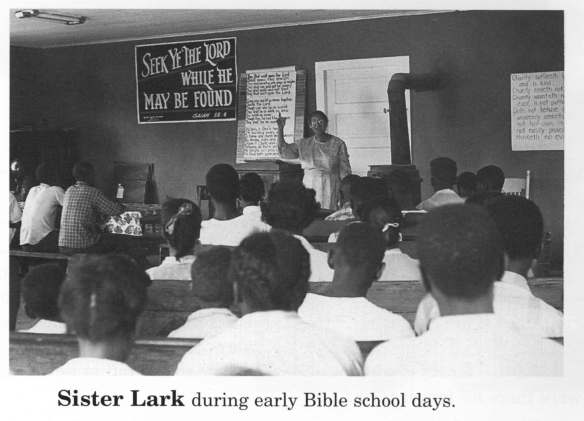
rowena-lark-rehoboth-campground-ca-1955

Born in 1888 in Savannah, Georgia, James Lark was baptized there at age sixteen in a Baptist church. He attended the Quaker Institute for College Youth in Cheney, Pennsylvania (now Cheney State College). James and Rowena married in 1918, and the couple had six children. In 1927 the family made their first contact with Mennonites when they moved to a farm near Quakertown, Pennsylvania. Members of the Rocky Ridge Mission Church invited the children to Sunday School; Rowena Lark also began to attend and eventually became a member. Later on her husband and three of their children became members. Rowena Lark later reflected:

“It was the literal fulfillment of scripture that caused me to join Rocky Ridge Mission. As I saw these faithful Christians coming eight or more miles from their homes and gathering up in their cars Italians, Poles, Dutch, American Negroes, and Germans, to take them to the house of the Lord, I was made to feel that here is a group of Christians who are really making their religion practical.”1

For Rowena Lark, Mennonites represented Christians who took their faith seriously; the evidence of this was the willingness to traverse racial and cultural boundaries to bring the word of God into the lives of all people and also meet their physical needs; the willingness to rub shoulders and share possessions. This was later reflected in the couple’s own ministry, when James Lark became the first African American Mennonite minister in 1944 with Rowena a capable partner in that work.

In February 1945, the Larks had become full time workers in Mennonite mission work in Chicago. They organized and presided over children’s activities, including boy’s club, girl’s chorus, and camp program. In 1949, the Larks purchased ten acres of land in rural Hopkins Park, Illinois for a Sunday School camp for children; in gratitude, Rowena named it “Rehoboth” after Genesis 22. This was the site that eventually became Rehoboth Mennonite Church.

The 1940s continued to be a relative swirl of activity concerning the convergence of African American and white Mennonite worlds in the midwest. The Voluntary Service unit that was established in Saginaw, Michigan eventually lead to the planting of Ninth Street Mennonite Church (now Ninth Street Community Church), and the Gladstone Mission was initiated in Cleveland. That mission led to the planting of the Lee Heights Community Church. Yet the Larks found themselves frequently impatient with the slow pace of white administrators who held the purse strings and made final decisions on various urban ministries. The work was urgent; as Rowena wrote to a friend – there was so much to be done. She also was sharp with those who would denigrate Black people and Black culture.  According to Leroy Bechler, Rowena Lark

“grieved and was not always patient with those who reflected an inflexible or critical spirit of the Black community or Black worship.  She was a woman ahead of her time – reading, studying – learning Spanish and going to Mexico to live for a number of months after she was 70 years old.”2

The Lark family legacy, realized in part by the naming of the Juanita Lark Welcome Center on the Goshen College campus, is an important reminder of this history of interracial partnership and the broadening nature of Mennonite identity, and an acknowledgement that this work continues into the present day.


  1. James and Rowena Lark Collection, Hist Mss 1-566, Box 1, Folder 4a, Bethel Mennonite Church (Chicago, Il) Mennonite Church USA Archives, Goshen, Indiana (MCA-G) 
  2. Urban Pioneers Interview, #2003-49, Box 1 Historical committee, Urban Pioneers Interview Project 2001-02. 

“The People of God around the World”: Melvin Gingerich’s Archival World Tour

Jason B. Kauffman

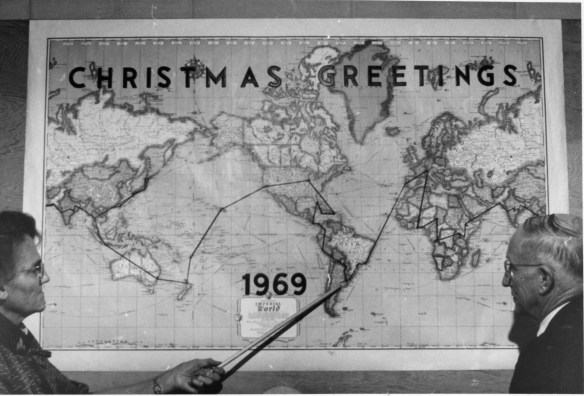
On January 13, 1969, Melvin and Verna Mae (Roth) Gingerich embarked on a tour of Mennonite church communities around the world. During a period of 4.5 months the couple traveled more than 54,000 miles (“by air, train, taxi, jeep, and touring cars”) over a distance spanning five continents and twenty four different countries or territories.1 In all, their itinerary included 47 flights on 25 different airlines. The tour was commissioned by the inter-Mennonite Council of Mission Board Secretaries (COMBS) with financial support from the Historical Committee of the (old) Mennonite Church and the Mennonite Central Committee (MCC).2

MGingerich067.jpg

Melvin and Verna Gingerich contemplate the itinerary for the 1969 archival world tour

By 1969, Gingerich had directed the archives of the (old) Mennonite Church for 22 years.3 He was also heavily involved in the Mennonite publishing world. Aside from his work as managing editor for the Mennonite Historical Bulletin and the Mennonite Quarterly Review, he was an editor and frequent contributor to several other publications including Mennonite Life, Mennonite Weekly Review, and the Gospel Herald. From 1955-1958, he represented the Peace Section of the Mennonite Central Committee in Japan. Gingerich’s active involvement with Mennonite institutions, his familiarity with trends in Mennonite writing and scholarship, and his experiences abroad shaped his worldview and over time he developed a keen interest in the global Mennonite Church.

Gingerich’s stated objectives for the archival world tour were to “determine the amount and nature of archival materials relating to American Mennonite missions located outside of the U.S. and Canada,” to consult with missionaries and church workers about record management practices, and to identify potential authors for the Mennonite Encyclopedia and other publications. But, for Gingerich, the trip was much more than a simple fact-finding mission. During his time abroad, Gingerich also planned to offer lectures on the important role of history in shaping the vision and identity of the global Mennonite community. He hoped that his meetings with mission workers, church leaders, and school groups would create a space for them to “examine together the Christian approach to history and to consider how historical interest could be aroused where it did not exist.”4

Such concerns became a recurring theme in his reports. After his visit with mission workers and church leaders in Argentina, Gingerich wrote:

It seems to me that perhaps my major contribution has been in making them aware of the fact that they have an obligation to witness to the rest of the church what God has been doing among them. The Bible is largely the account of God’s mighty works among His children. Much of the Old Testament was designed to review their history. The great sermons in the New Testament do the same thing. We have an obligation in our day to record and witness to this continuing history.5

Later in the trip, during a conversation with Dr. Saphir Athyal of the Union Biblical Seminary in Yavatmal, India, Gingerich discussed “the problem of how to get [seminary] students to feel that contemporary church history is a part of the ongoing stream of church history, directly related to past centuries of the story of God’s people.”

While educating the “younger churches” about Mennonite history was clearly part of his agenda, Gingerich was also sensitive to the local realities and traditions of the communities that hosted him.5 According to Gingerich, “the purpose of this visit to the fields was not a paternalistic one,” but rather “to encourage our brethren to share their story with the entire Christian brotherhood. We are brethren who can all share with each other and learn from each other.” As such, he felt that local Mennonite conferences should take the lead to develop “their own historians or historical committees and [to] cultivate the consciousness of their unique role in history.”

mgingerich068

Melvin and Verna Gingerich in Japan, Christmas 1956

Gingerich also had the intercultural awareness to recognize that not all members of the global Mennonite community transmitted and preserved history primarily through the written record. In several locations, Gingerich met with local church leaders to discuss plans for commemorating the upcoming anniversaries of their churches. In Ethiopia, he encouraged leaders from the Meserete Kristos Church to produce an account of their own history in order to tell “their own story from the Ethiopian perspective.” On other legs of the trip he also discussed the importance of recorded oral histories as a tool for preserving the life stories of early church members and leaders.

When Gingerich undertook his archival world tour, the global Mennonite population stood between 400,000 and 600,000 people. Roughly one third of these people lived in places outside of North America or Europe. Since then, the global Mennonite population has grown rapidly so that, today, Mennonites in Latin America, Asia, and Africa outnumber Mennonites in North America and Europe by a ratio of 2 to 1.6 The demographic shift that has occurred in the global Mennonite community in the last several decades raises important questions about the stories we tell about our shared history. Specifically, what should global Mennonite history look like and who should set the terms for those discussions?

Gingerich envisioned global Mennonite history as an unbroken narrative thread connecting the past to the present through the lives of “the people of God around the world.” His efforts to involve local believers in the telling of their own stories were ahead of their time. However, in his vision Mennonites from North America and Europe remained firmly at the center of this story as keepers of the collective memory of an Anabaptist tradition rooted in sixteenth century Europe.

Today, organizations such as the Mennonite World Conference and the Institute for the Study of Global Anabaptism are modifying this vision through initiatives such as Renewal 2027, a 10-year series of events during which Mennonites will meet annually in locations across the globe to commemorate and reflect upon the five hundredth anniversary of the beginnings of the Anabaptist movement. Organizers are planning the events with a broad, ecumenical vision which recognizes shared heritage and convictions but also the unique and varied ways followers have lived out the Anabaptist-Mennonite faith in diverse cultural contexts around the world.7 According to John D. Roth, the commemorations present an opportunity to “engage in fresh thinking” about the “global nature of the Anabaptist-Mennonite church today” and how this global nature “challenges or expands definitions of the word ‘Anabaptist.’”8 Such efforts are important steps toward decentering North America and Europe in the stories we tell about “the people of God around the world.”

Footnotes:


mgingerich069-4

Letter from Melvin Gingerich to Verna Gingerich, December 24, 1968


  1. Melvin and Verna visited Puerto Rico, Jamaica, Costa Rica, Colombia, Paraguay, Argentina, Uruguay, Brazil, Ghana, Nigeria, Congo, Uganda, Tanzania, Kenya, Ethiopia, India, Hong Kong, Japan, Taiwan, Indonesia, Australia, New Zealand, the Fiji Islands, and Hawaii. 
  2. Gingerich was careful to specify that the couple paid for Verna’s travel expenses from their own funds (see photo). 
  3. Gingerich was born and raised in Kalona, Iowa. After graduating from Goshen College – where he met his wife, Verna – in 1926 he later earned a Ph.D. in history from the University of Iowa in 1938. After some short teaching stints at Washington Junior College (Iowa) and Bethel College (Kansas), he moved with his family to Goshen (Indiana) where he served as archivist of the (Old) Mennonite Church Archives for the rest of his career (1947-1970). For part of this time he also directed the Mennonite Research Foundation and edited the Mennonite Encyclopedia
  4. Quotations come from reports contained in the Melvin Gingerich Papers, HM1-129, Archival World Trip – 1969, Box 78, Mennonite Church USA Archives, Goshen, Indiana. 
  5. Ibid. 
  6. Throughout his reports, Gingerich drew a distinction between the “younger churches” and the “older churches” in the global Mennonite community. 
  7. These are rough estimates based upon statistics from 1958 and 1978 published on the Global Anabaptist Mennonite Encyclopedia Online at http://gameo.org/index.php?title=World_Mennonite_Membership_Distribution 
  8. John Roth uses the concept of “right remembering” to examine the relationship between commemorations, historical memory, and collective identity formation in the global Anabaptist-Mennonite community. See John D. Roth, “How to Commemorate a Division? Reflections on the 500th Anniversary of the Lutheran Reformation and its Relevance for the Global Anabaptist-Mennonite Church Today,” Mennonite Quarterly Review 91:1 (January 2017), 24-35. 

Perception, Reality, and Anabaptist-Muslim Solidarity

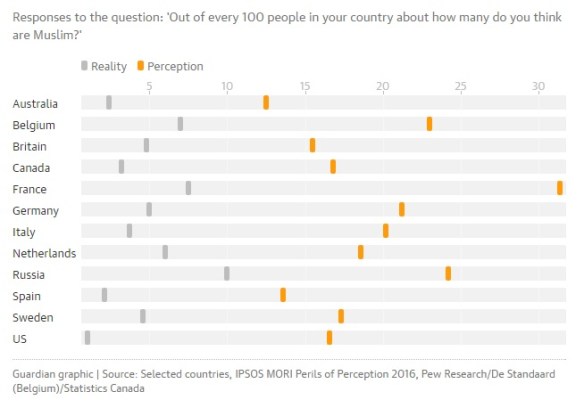
In a 2016 multinational survey Ipsos MORI, a United Kingdom and Ireland-based market research company, examined the disconnect between perception and reality in forty different countries in six different continents. The survey asked respondents to estimate figures such as the percentage of their nation’s inhabitants who report being happy, the percentage of homeowners, the percentage of their GDP that the country spends on health, and more.1 One particular aspect of the survey caught the attention of the Guardian: the respondents’ perception of the percentage of Muslims in their country. The respondents greatly overestimated how many Muslims lived in their country; European respondents were often off by a factor of as much as 4 (France’s average guess was 31%, compared to the actual figure of 7.5%), while North American respondents’ guesses were even further from reality (in the U.S., where Muslims represent 1% of the population, the average guess was 17%).2 These inflated perceptions of the size of the Muslim population in Western countries likely both fuel and are fueled by alarmism surrounding the so-called “Muslim takeover” of the West, though the actual statistics lend no credence to the narrative of a takeover.graphic-for-anabaptist-historians-article

As a historian of sixteenth-century Anabaptism, the idea of a misunderstood and oft-maligned religious minority, whose numbers are thought be much larger than they actually are and whose rise is thought to pose a demographic threat, is very familiar to me. It is far more difficult to make an exact demographic breakdown of Europe in the sixteenth century than in the present day. Moreover, religious identification is further complicated by the fact that Anabaptists operated largely underground in the sixteenth century, and the term Anabaptist itself was used primarily as an epithet rather than a form of religious self-identification. Nevertheless, while Anabaptists formed significant clusters in several regions, their overall numbers in German and Dutch-speaking lands (where the movement primarily took root) were undoubtedly relatively small. In his 1972 monograph Anabaptism: A Social History, Claus-Peter Clasen analyzed the numbers of reported Anabaptists in early modern Switzerland, Austria, and South and Central Germany, and concluded that they were numerically insignificant; even in the city of Ausgburg, which had the largest Anabaptist congregation in the Holy Roman Empire in the 1520s, the Anabaptists comprised only 1.2% of the city’s population.3 On the basis of his quantitative analysis, Clasen concluded that “the Anabaptist movement was so insignificant that it is misleading to use the term Reformation at all” and that “[the Anabaptist movement] cannot be called more than a minor episode in the history of sixteenth-century German society.”4

Clasen’s analysis drew criticism from other Reformation scholars. The accuracy of his numbers is difficult to gauge, and he omitted the Netherlands entirely from his quantitative analysis, despite the presence of a vibrant Anabaptist movement in the region. However, regardless of the accuracy of his numbers, Clasen forgot to account for the fact that the historical significance of religious minority groups rests less on their actual numbers than on their perceived numbers and the threat their contemporaries believe them to pose. As Sigrun Haude persuasively argued in In the Shadow of Savage Wolves: Anabaptist Münster and the German Reformation during the 1530s, “numbers are only part of the story…[Anabaptists] had a bearing on the era through their sheer existence and perceived menace.”5 The numerous anti-Anabaptist edicts issued at both the imperial and the municipal level from the emergence of the Anabaptist movement in 1525 and throughout the sixteenth century attest to how seriously Protestant and Catholic authorities took the threat of Anabaptist growth.

Other parallels between the experience of sixteenth-century Anabaptists and twenty-first century Muslims in the West come to mind. Both groups are and were far from ideologically homogeneous, yet members of both groups are and were frequently conflated with their most radical and dangerous co-religionists. Critics such as Lambertus Hortensius, whose Tumultus Anabaptistae (Anabaptist Tumults) circulated in various Latin, Dutch, and French editions well into the seventeenth century, printed and disseminated lurid tales of Münsterite violence and sexual excess long after Anabaptist groups with revolutionary impulses had largely disappeared.6 Then as now, feared religious minorities faced the difficult challenge of attempting to assimilate while still staying as true as possible to their religious values, even as the general public often made false assumptions about these values.

It is a lonely and at times dangerous path to be a visible part of a religious minority that members of the public and even lawmakers perceive as a threat to the status quo. The many stories of early modern Anabaptist martyrs attest to this, as do examples of modern Islamophobic laws and acts of violence. As people who are intimately acquainted with their religious forebears’ history of persecution and marginalization, modern-day Western Anabaptists are in a unique position to empathize and stand in solidarity with other religious minorities as they face public suspicion and hostile political administrations. This is already happening in many ways, as the Mennonite Central Committee in the United States and Canada works to welcome Syrian refugees in partnership with local Mennonite congregations and even Hutterite colonies.7 2017, with the new incoming administration in the United States, the upcoming federal elections in Germany and France, and a contentious Conservative leadership race underway in Canada, poses new challenges for Muslims and other religious minorities in the West. Particularly in light of the events of the last week, including Trump’s executive order on refugees and immigration from seven Muslim-majority countries and the tragic shooting at the Centre Culturel Islamique de Québec by far-right nationalist Alexandre Bissonette, solidarity with Muslims and other religious minorities is needed more than ever. It is my hope that more and more Anabaptists will commit to standing in the gap and becoming the sorts of allies their forebears might have wished for.


Image Source:

Duncan, Pamela. “Europeans Greatly Overestimate Muslim Population, Poll Shows.” Theguardian.com.

https://www.theguardian.com/society/datablog/2016/dec/13/europeans-massively-overestimate-muslim-population-poll-shows (Accessed 10 January 2017)


Footnotes:


  1. Ipsos MORI, “Perceptions Are Not Reality: What the World Gets Wrong,” Ipsos-mori.com, https://www.ipsos-mori.com/researchpublications/researcharchive/3817/Perceptions-are-not-reality-what-the-world-gets-wrong.aspx, accessed 10 January 2017. 
  2. Ipsos MORI; Pamela Duncan, “Europeans Greatly Overestimate Muslim Population, Poll Shows,” Theguardian.com, https://www.theguardian.com/society/datablog/2016/dec/13/europeans-massively-overestimate-muslim-population-poll-shows, accessed 10 January 2017. 
  3. Claus-Peter Clasen, Anabaptism: A Social History (Ithaca, NY: Cornell University Press, 1972), 27. 
  4. Clasen, 29; 428. 
  5. Sigrun Haude, In the Shadow of Savage Wolves: Anabaptist Münster and the German Reformation During the 1530s (Leiden: Brill, 2000), 150. 
  6. See, inter alia, Lambertus Hortensius, Tumultuum Anabaptistarum Liber Unus (Basel: Johannes Oporinus, 1548); Lambertus Hortensius, Oproeren der Wederdoperen: Geschiet tot Amsterdam, Munster, en in Groeningerlandt (Amsterdam: Samuel Imbrechts, 1660); Histoire des Anabaptistes: Contenant Leur Doctrine, Les Diverses Opinions qui les divisent en plusieurs Sectes, les Troubles qu’ils ont causez et enfin tout ce qui s’est passé de plus considérable à leur égard, depuis l’an 1521 jusques à present (Amsterdam: Jacques Desbordes, 1702). 
  7. Meghan Mast, “Hutterite Help: A Refugee Sponsorship Story,” MCCCanada.ca, https://mcccanada.ca/stories/hutterite-help-refugee-sponsorship-story, accessed 17 January 2017.